Sunset or Sunrise

Sunset

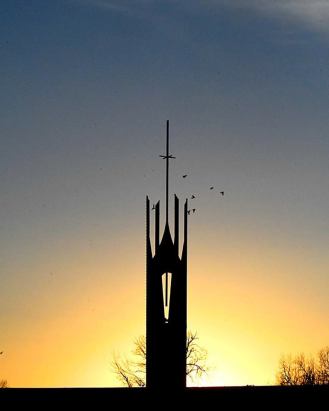
This picture appeared recently in the Enid News and Eagle. The caption simply read: “Sunset.” However, at first glance, it is difficult to tell if it is a sunset or a sunrise.

As attendance, giving, and baptisms continue to decrease in North American churches, many are asking: “Is the sun setting or rising on the church?”

After posting the picture on facebook and posing the question, “Is it a sunset or a sunrise?” Rev. Dean Phelps, a facebook friend and long-time minister, wisely commented: “It all depends on when we wake up.”

Rev. Phelps was prophetically suggesting that if the church wakes up early, it could be a sunrise. However, if the church wakes up too late, it could be a sunset.

I believe it is a sunset if the church continues to slumber under the covers of the culture. I have called this embracing an “alternative gospel” or a “fake news Jesus.” It is a protective, safe, defensive religion that fears the other, and thus judges, excludes, and condemns the other. It is miserly with mercy, stingy with love, and tight-fisted with grace.

However, I believe it is a sunrise if the church awakes to pull back the covers of the culture to embrace the authentic gospel and good news of Jesus. We must awaken to discover our purpose to be a community of radical inclusion and extravagant grace. We must awaken to answer our call to love others as Christ loves us, unconditionally, unreservedly and fearlessly.

I believe it is a sunset if the church continues to dream of the glory days. Sadly, the dreams of many churches are either stuck some in distant past recalling fuller pews and bigger programs, or they are stuck in some heavenly future, fixed on pearly gates and streets of gold.

However, I believe it is a sunrise if the church awakens with eyes wide-open to see its mission in the here and now. We must awaken with our eyes focused on the present suffering of the entire creation, and then we must selflessly and sacrificially use our gifts, time and energy to be a movement for wholeness, healing and peace.

I believe it is a sunset if the church continues to hit the snooze button to rest in their comfort zones. Many churches have no desire to get up and go out, leaving their cozy environments behind. There is no interest to get outside of the security blanket of the sanctuary to do the hard work of feeding the hungry, clothing the naked, defending the marginalized, and breaking the bonds of injustice.

However, I believe it is a sunrise if the church will rise up from its comfort zone to go out into what can be a cold and dark world. We must awaken to be the embodiment of Christ in this world even if it means there is a cross involved, even if it means suffering for the sake of God’s creation.

Is it a sunset or a sunrise?

It all depends on when we wake up.

A Movement for Wholeness in a Fragmented World

DOC Identity

John 9:1-41 NRSV

Let’s think for a minute what it did for this poor blind man when the disciples began a theological debate over his blindness.

“So, they tell us that you were born blind?  Well, let’s get out our Bibles and Sabbath Day School Quarterlies, and see if we can find some theological reasons for your blindness. Of course, everyone knows it is because of sin. But since you were born blind, perhaps it is not so much your sin as much as it is the sin of your parents.”

Yes, I’m sure all of that theologizing and rationalizing and Bible Study did absolute wonders for that poor man. I am sure he really appreciated it!

But how often have we’ve been guilty of doing the same. For some reason, because we are Christian, we believe it is our holy responsibility to try to explain human suffering in light of our faith in God.

When the earthquake and Tsunami struck Japan several years ago, I heard some preachers say that God was judging that area of the world because Christianity was not the prominent religion.

         When the terrorists destroyed the World Trade Center Towers on 9-11, some preachers said that corporate greed was to blame.

When Hurricane Katrina devastated New Orleans and Gulfport, Mississippi, many blamed it on all the new casinos that had been built in along the Gulf Coast.

And whenever there is an outbreak of strong storms, especially strong storms with tornadoes, I have heard many Christians say, as I am certain we will hear them say in the next couple of months: “God must be trying to get our attention!”

For whatever reason, when suffering occurs, we believe that God must have had some pretty good reasons to allow it.

In the face of human suffering, two predominate responses are echoed by the church.

The first response is the one I usually hear from the TV evangelists. It is the response of those in our text this morning. God is sitting at the command center in complete control of every earthly thing that happens. God has got a plan for the world, and it’s a good plan, and we human beings need to trust that plan. Even if people suffer, we shouldn’t question the plan or God’s judgments. Because God’s judgments are always just. You just have to have faith and believe God has God’s reasons. God has a driving purpose for everything that happens in this world.

The other response comes from some liberal scholars. And that is one of silence. They say that God is completely unknowable. Life, and the suffering that comes with it, is utterly mysterious. It is ok to question God, to ask “why?” But we simply have no answers to any of our “why” questions. Silence.

Frankly, I find both of these responses to human suffering to be troubling.

First of all, those who believe God has some kind of divine, driving purpose behind every evil thing that happens in this world, in my estimation, paint a very evil, mean portrait of God.

And those who respond only with only silence, those who refuse to say anything or do anything in response to human suffering paint a very detached, indifferent portrait of God. God is watching us, but as Bette Midler sings, “God is watching us from a distance.” God is reduced to this mysterious abstraction devoid of any real meaning.

The gospels, however, paint a very different image of God through the words and works of Jesus, who we believe to be the incarnation of God—which means that if we want to know how God responds to human suffering, all we have to do is look to Jesus.

I believe the life, suffering and death of Christ teach us that when a landslide shook the earth in Washington State a few year ago, so quivered the very heart of God. Last year, as the flood waters swelled in Southern Louisiana and North Carolina, tears welled up in the eyes of God

As the livelihood of many were suddenly poured out, so emptied the very self of God. God was not causing the evil, neither was God unmoved by it.

This is where I believe our gospel lesson this morning is especially helpful. When Jesus is questioned about this man’s lifetime of suffering by his disciples, Jesus really doesn’t answer the question, but he certainly isn’t silent or detached.

Jesus responds by saying that this is a good opportunity, not for theological debate, not for some long discussion theodicy (the problem of evil), not to assign blame or responsibility; but rather, it is an opportunity bend to the ground, spit in the dirt, and get his hands dirty, so that the glory of God might be revealed.

Jesus responds to a fragmented world by becoming involved, even if it means some work, even if it means rolling up his sleeves, lowering himself to the ground, and getting his hands dirty to touch the places on others that most need touching. Jesus responds to a fragmented world by becoming a movement for wholeness—bending, stooping, humbling himself to the ground—working, touching, healing, restoring.

And with that, a huge argument ensues.

But notice that Jesus refuses to engage in the argument. Jesus doesn’t have time for that. Jesus is not interested in doctrinal debate or theological speculation. Jesus is interested in simply being there with the man, for the man; thus, revealing the peculiar glory and power of our God.

I think it is interesting that the great Southeast-Asian Tsunami of the last decade struck the day after Christmas. One of the world’s worst natural catastrophes took place the very first day after the church’s celebration of the Incarnation, the celebration of the good news that our God did not remain silent, aloof and detached from us. Our God came to the earth, became flesh, became a part of the earth, to be with us. Our God is a God who descends to us. Our God is a God who bends, who stoops to the earth to be for us. Our God is a God who has selflessly and sacifcially chosen to suffer with the creation.

The story of this healed blind man comes in the same Gospel of John that begins, “In the beginning was the Word…and the Word was made flesh…and we beheld his glory.”

The great, grand glory of this God who became flesh with us is not that God is in complete control of everything earthly thing that happens, and it is not that God has an explanation or a reason or a driving purpose for everything that happens to us, but rather that God is Emmanuel, God here with us.

In the face of our suffering, our God reaches in and reaches out to us, bends to the ground, gets God’s hands dirty, and touches us.

And then God calls us to do the very same.

Every year as Holy Week approaches, I think about the worshippers of the Goshen United Methodist Church in Piedmont, Alabama.

It was Palm Sunday in 1994.

About midway through the worship service at 11:35 am, as the choir began to sing, a tornado ripped through the church building destroying it completely.

Eighty-three out of the 140 worshippers who attended the service that day were seriously injured. Twenty-one worshippers were killed. Eight of the dead were little children—children who had just walked down the aisle waving their palm branches.

There was absolutely no driving purpose, no theological explanation for that tragedy, except for the fact that we live in fallen, broken, unfair and sometimes senseless world where tornados, tsunamis, hurricanes, landsides, heart disease, dementia, and cancer can develop and arbitrarily destroy.

Thankfully, Christians from all over the world didn’t just talk about that tragedy in their Sunday School classes, trying to figure out if there was some reason God allowed it. They responded to that great tragedy by emulating the God revealed to us in Christ, by bending themselves to the ground, getting their hands dirty, to raise that church out of the rubble. Christians everywhere imitated their Savior by suffering with and being with the grieving. Doing whatever they could do to bring hope, wholeness, and restoration.

On the church’s website today, you will find these words:

 After the tornado, we received many gifts from all over the world. They lifted us up and helped us to know that we are not alone. Among those gifts were a banner and a painting of Jesus walking on turbulent waters. These and other gifts are reminders that God is with us through our storms, and with His help we will rise above them and be stronger because of them. We can now affirm the truth of the message that is contained on a plaque and in the words of a song: ‘Sometimes God calms the storm. Sometimes, …the storms rage, and God calms the child.’

And in the end, isn’t that much better than any theological explanation?

Let us pray together…

When Jesus was asked about the reason for human suffering, he did not answer the question. He did not get into a theological debate. He did not assign blame or responsibility. Instead, he chose to be a movement for wholeness in this fragmented world by bending to the ground and getting his hands dirty to bring about healing and  restoration. In the wake of the storms of our lives, may we do the same. Amen.

Enid Welcome Table

Enid Welcome

In our combined forty years of ministry, my colleague Rev. Shannon Speidel and I have had many church experiences that we would deem “holy.”

However, they all pale in comparison to what we have experienced during the last twelve months in the visioning and planning of the Enid Welcome Table.

During our preliminary conversations regarding moving one of our worship services to a different time, it was brought to our attention that the food insecure population of Enid was served a meal (with no strings attached) every day of the week with the exception of Sunday. We were also told that many who rely on the gracious ministry of a weekday community soup kitchen called Our Daily Bread are famished on Monday mornings. They report not having had anything to eat since Saturday, when they were served a meal by the wonderful feeding ministry of First Presbyterian Church of Enid.

A task force was created by the worship committee to discuss moving one of our services. Task force members have said that they “felt the spirit of God moving in the room” as they discussed the possibility of a worship service occurring around tables after a meal was shared with some of the most impoverished people in our community.

The Enid Welcome Table planning committee was soon developed. It includes members of our church, members of other Enid churches, and people who are not members of any church. They are people who are committed to providing a “restaurant quality” meal each Sunday to anyone in need.  They believe the best way to accomplish this is to recruit 52 organizations and businesses in Enid, asking them to prepare and serve one high quality meal a year.

The idea of inviting the entire community to be a part of the Enid Welcome Table is one the most exciting aspects of this ministry. My congregation has heard me talk at great lengths regarding the difficulty of doing “evangelism in the 21st century.” I say: “If you don’t believe it’s difficult, try inviting someone to who doesn’t attend church to come to church with you to listen to a sermon!”

Then I add, “On the other hand, I think you will get a quite different response if you try inviting someone who doesn’t attend church to join you in doing something that Jesus would obviously do, like feeding the hungry.”

As I often say, the reason people are not in church today is NOT because they have given up on Jesus. The reason people are not in church today IS because they do not see Jesus in the church.

We are excited about the Enid Welcome Table; because instead of inviting people “to come to church,” we will be inviting people “to be the church.” Instead of inviting people to listen to stories about Jesus that took place 2000 years ago, we will be inviting people to be the selfless hands and feet of Jesus in this world today. Instead of inviting people to come to a service of worship, we will be inviting people to go and worship with their service.

And all will be invited to serve. Your religion (or lack of religion), your sexuality, your race, your mental or physical ability, your political stance – it doesn’t matter! All means all.

I, along with many other church scholars, are convinced that this is the way to revive, revitalize, and restore the church in the 21st century. I have witnessed first-hand the miraculous transformation that can happen by embracing a missional model in my previous congregation.

We also believe it is very important to feed the hungry with “no strings attached.” We believe there are too many Christian organizations that offer to help people if.

“Love your neighbor, if they look like you.” “Welcome the stranger, if they want to be Christian.” “Feed the hungry, if they pray with you.”

No, Jesus never said “if.”

Jesus said: “Love your neighbors,” period. “Welcome the stranger,” period. And “feed the hungry,” period.

We do not believe Jesus ever put stipulations on grace. That is why it is called grace.

Therefore, the mission of the Enid Welcome Table is to graciously feed people with absolutely no strings attached. The worship service that will be offered after the meal will always be optional. People of other faiths and people with no faith are welcome. No one will ever be judged, disrespected or preached to. All will be loved, accepted, and fed.

We believe the Enid Welcome Table has the potential to dramatically transform our community to be an example to the world of miracles that can happen when people truly become the gracious hands and feet of Christ in our world.

_____________________________

If you, your business, or your organization would like to serve a meal to the food insecure of Enid, Oklahoma, please contact me at jarrettb@centralenid.org or Rev. Shannon Speidel at shannons@centralenid.org. Donations are also appreciated.


It Can’t Be the Messiah. Can It?

FullSizeRender

John 4:5-29 NRSV

With United Methodist Bishop William Willimon, I believe that the Bible is not so much an account of our search for God, as it is the amazing account of the extraordinary lengths to which God will go to search for us. Whether we know it or not, or can even begin to understand it or not, we are here this morning because we have been sought, we have been called, and we have been summoned. We are here because God has reached in, grabbed us, and led us here. We are here because God has pursued us. God is even now persuading, prodding and pulling us.

And I believe that the purpose of our worship is to condition us to pay attention to this, to admonish us to look over our shoulder, to help us to notice those little coincidences in our lives and those strange happenings.

For they may be a part of God’s continuing attempts to wrap God’s loving arms around us.

And these things, these coincidences, these strange happenings can occur anytime and in any place. As Jesus told Nicodemus, “The Spirit of God, like the wind, blows where it will”—whether or not we’re ready for it, looking for it, or even want it.

So, it would behoove us to stay alert, look, listen, always pay attention.

I believe the woman in our scripture lesson this morning teaches us how to pay such attention.

That fact alone teaches us something about the way God works. In the male-dominated society in which Jesus lived, especially in the area of faith and religion, Jesus uses a woman to teach us theology. Talk about the spirit of God blowing where it will!

In Jesus’ day, mainline Jewish rabbis simply did not speak to women about faith. However, Jesus was anything buy mainline. But one who always, very radically and counter-culturally, valued women and men equally.

Which brings us to another surprise. She was not only a woman; she was a Samaritan woman. And we know what Jews thought of Samaritans. They were known as pagans and foreigners. They were victims of racism, xenophobia, and bigotry.

Here, the radical words of the Apostle Paul are being fleshed out: “there is no longer Jew nor Greek, slave nor free, male nor female, but all are one in Christ Jesus” (Gal 3:28).

During her conversation with Jesus (which, by the way, is the longest recorded conversation that Jesus ever had with anyone), we also discover that she carries the stigma of divorce, as she has been remarried several times.

And, of course, she is astounded that this man, a Jew, talks to her, a Samaritan. In her eyes, she’s the wrong gender, wrong race, wrong religion. Yet, Jesus meets her where she is. Jesus initiates a conversation with her. Jesus reaches out to her. Jesus engages her.

And of all places, at a well!

It is important to understand that she isn’t there for Sunday School. She isn’t there for the 8am or the 10:15 worship service. She’s not even there for CWF. She is there doing the most ordinary of everyday tasks. She’s simply drawing water.

So, the first thing this woman teaches us is that God speaks to us, God reaches out to us, and God engages us when we least expect it, where we least expect it, and how we least expect it. God comes to us, unexpectedly, undeservedly in the most ordinary of ways.

Jesus then begins to teach her about something called living water and then tells her that he knows all about her; all of her failures, all of her disappointments, all of her grief which has been so much a part of her life.

She then runs all the way back home to tell everyone, “Come! See a man who has told me everything. He can’t be the Messiah. Can he?”[i]

Willimon has said: “She—Samaritan, woman, husbandless—thus becomes the precursor, the very first of all of us later preachers. She was the first to run to tell everyone about Jesus.”

And all she meant to do that day was to go out and get a bucket of water!

And here is the amazing part. She didn’t all of a sudden understand everything about who Jesus. She didn’t run back home singing the Gloria Patri and reciting the Lord’s Prayer. She merely left her encounter with Jesus with a simple, but very profound question: “He can’t be the Messiah. Can he?”

“He can’t be the Messiah. Can he?”  Do you hear it?  Listen again, “He can’t be the Messiah. Can he?

No, it’s not the words of some religious fundamentalist who has it all figured out. It’s more like the words of a innocent child. “He can’t be the Messiah, can he?”

Fifteen or so years ago, during the weeks leading up to Christmas, when my children would misbehave or fuss, when they were not looking, I remember making a fist and knocking on a wall or under the table.

Carson and Sara would immediately stop their fussing and ask, “Who is that? Someone’s knocking on the door.”

I’d get up, go to the door, open it, look around, and of course, not seeing anyone, I would shut the door and say: “It must have been Santa Claus! Don’t you know that this time of year he’s always watching?”

Sara Beth would say, “Nah uh! That wasn’t Santa Claus!” But a of second of silence later, she’d ask, “Was it?”

Can’t you hear it?  Like an innocent child, full of surprise and wonder and an unbridled hope, the woman at the well said: “He can’t be the Messiah. Can he?”

Do you hear it?

With Willimon, I hear a playful openness, a light flickering in the dark, a wonderful willingness to consider that God was larger than her presuppositions of God. I hear a courageous willingness to be shocked, surprised, and intruded upon. I hear a thirst for something to quench a longing soul.

I believe this is the problem with us grown-ups, especially we modern, mainline, mainstream church-goers. We simply say: “That can’t be the Messiah…period!

There is no openness to the possible potential that it might be, may be, could be, probably is.

We are so smart. We have things so figured out, we never question, “Can it? Was it? Is it?”

Even when we are at church, in a Bible Study or in worship, there is no real expectation that Jesus Christ, the Messiah and Savior of the world might actually show up.

To be honest with you, last Sunday, I was almost dreading coming to church. I was thinking: “Daylight Savings Time, Spring Break. Very few people are going to be at church today. And nothing good is really going to happen this Sunday.” I was also feeling a little disheartened that I had to make an announcement regarding our supplemental giving drive. Asking for more money makes me feel like I have perhaps failed at something.

The point is, last Sunday, when it came to church, I wasn’t feeling it.

But then, to my surprise, four people came forward during our final hymn asking to formally join the mission of our church to bless this community and world. One even offered to bless my family by taking us out to lunch after the service. And then, later in the week, I received a phone call with the news that someone believed in our church’s mission enough to make a sizable donation to be used anyway we believe God may be leading us.

And here it is, just one week later, and there’s this renewed, restored, replenished fullness in my soul. There’s this recommitment to share the love and grace of Christ with all people.

Now, I am aware many would say that those events were merely coincidences. Perhaps. However, as I have studied our scripture this week, like a light flickering in the dark, my heart has become open to the providential possibility that God was somehow involved. And the fullness that I feel in my soul is from this wonderful willingness to be shocked, surprised, and intruded upon by none other than the Messiah and Savior of the world, Jesus Christ himself.

Thinking on the words of the woman in our scripture this morning, I cannot help but to think: “It can’t be the Messiah. Can it?”

Can it possibly be that, here in this place last week, Jesus Christ was actually present? Could it be that he was coming to me through ordinary people, unexpectedly, undeservedly, bringing living water that quenches the deepest thirst of my soul.

Jesus, through this Samaritan woman, at the well, answers that question: “Yes, I am the Messiah. I am more alive and more present and more at work in this world than you ever thought possible. I am everywhere offering the wonder of living water, and those who drink of the water that I will give them will never be thirsty. The water that I give will become a spring of water gushing up to eternal life.”

One of the greatest things about being a pastor is sharing not only times of immense joy with a congregation, like childbirth with the Weibling family this week, but also sharing times of immense sorrow, like with Charlie Heller last week.

I look around this room and see people here who have experienced much sorrow, so much in this past year. I am certain that even getting up this morning and getting to this place was an arduous task for you. Some of you have recently lost a parent, a sibling, a spouse. Some of you have lost a child. You all have lost dear friends. Some of you have been diagnosed with cancer. Some have had to make the difficult decision to place a loved one in a nursing home. Some are grieving broken relationships, broken dreams, broken lives.

And people, including me, look at you and are amazed. We say, “We don’t know how you are making it.”

And yet, somehow, some mysterious way, you are making it. At the very least, something or someone has given you the sustenance to make it to this place this morning to possibly hear a hopeful word.

I look at you with the wonder of a wide-eyed child. And I think of the wonder of that woman from Samaria, and I ask, “It can’t be the Messiah…can it? Can it?


Commissioning and Benediction

Now, let’s go and get out on the road

to encounter ordinary people doing the most ordinary of things.

They may be dining at a restaurant, shopping for groceries, exercising at the gym, learning in a classroom, waiting to see the doctor.

They may be the server in a restaurant, the clerk at the store,

the trainer at the gym, the teacher in the classroom, the nurse, the doctor.

Their gender, their race, their religion—it doesn’t matter.

They may be a victim of prejudice or a beneficiary of privilege.

Meet them where they are. Engage them. Listen to them. Bless them.

And may the eternal well of God’s love be found in our encounters.

May the grace of Christ shine brightly through us.

And may the Spirit be with us on every hill, every plain, and in every valley.

[i] If my memory is correct, the words of this sermon were originally inspired and gleaned from a sermon written by William Willimon, possibly entitled, Look over Your Shoulder, in 2005.

Too Smart for Our Own Good

The Shack

John 3:1-17 NRSV

In today’s gospel lesson a very knowledgeable and prominent leader of Israel comes to Jesus seeking to discover who Jesus is and what Jesus is all about. Poised and confident, the educated and sophisticated Nicodemus begins his conversation with Jesus: “Now, we know that you are…”

He begins his conversation from the same place that most of us mature, experienced, long-time students of Sunday School often begin our conversations about God: from the things we know, the things we have figured out… or think we think we have figured out:

“Now we know that you are…”

And it’s from there that the conversation gets all confused, confounded and convoluted. Jesus begins talking to Nicodemus about birth, but poor Nicodemus thinks Jesus is talking about literal, physical birth. Jesus starts talking about the Spirit, but poor Nicodemus thinks Jesus is talking about the wind.

I think it is very interesting that Nicodemus comes to Jesus at night. Because in just a few moments with Jesus, we learn that when it comes to God, when it comes to this mystery that we call faith, Nicodemus is in the dark in more ways than one. Nicodemus comes to Jesus confident and assured, but by the time Jesus gets finished with him, Nicodemus is astounded and dumbfounded, mumbling, “Uh, how can this be?”

Nicodemus has a problem.  And perhaps Nicodemus’ problem is in the very way he came to Jesus in the first place: “Now we know that…”

And maybe that is precisely our problem: “Now we know that…”

Our problem is that we know. And I suppose we can’t help it. After all, we are modern, some say we are even post modern folks who know a lot!

We live in what they call the information age. If there’s something we don’t know, we can just Google it or YouTube it, and in a few simple clicks of a mouse, we know. With WebMD and Wikipedia, there is hardly anything that we cannot understand or easily explain.

Perhaps this is why we try to approach God the way we do. We believe God is to be understood and easily explained.

It is no wonder those on the outside of the church often accuse those of us who are on the inside of the church of being “know-it-alls” when it comes to religion.  They believe that we think we have God all figured out. There are some that think that the reason we are here this morning is because we are God-experts.

And maybe that is why some  they are not here with us this morning.

One day, I was introduced to someone who knew that I was a pastor. I think he wanted to shock me when shook my hand and said, rather proudly, “Well, I’m an agnostic.” Which means that he did not know what he believed about God.

I think I shocked him when I responded, “Well, I have my moments when I am an agnostic too.”

I then said: “If people were honest they would admit: Some people are agnostic all of the time, and all are agnostic some of the time.”

The reality is that what we should be doing here, in this place every Sunday morning, is acknowledging together how little we really know and how much we have to learn, instead of coming here to have everything we think we know about God reaffirmed.

We gather ourselves together to acknowledge the great truth, that when it comes to the mystery that is God, we are all, as God told Mack in the movie The Shack, “idiots.”

“If the shoe fits,” She said.

The truth is that the God we worship is much larger than our imaginations. God is bigger and more alive than we can ever possibly comprehend.

I believe this is one of the reasons some preachers are telling their congregations to avoid the movie The Shack (a movie by the way I highly recommend) And there are many reasons: like maybe Jesus as a Middle Eastern man, if you can imagine that; also, God’s love for humanity compelling Her desire to redeem all people.

But perhaps they are most upset by the way the movie may cause some to question everything they thought they knew about God. Many preachers can not handle God saying to Mack: “I am not who you think I am” and “You misunderstand the mystery.”

But to me, that sounds a little like Jesus’ conversation with Nicodemus (John 3:1-17).

Like Nicodemus, we think we know who God is, how God acts and what God desires. But after we truly encounter the Divine, we might learn that we are, well, idiots.

I heard one preacher you say, “If you want to know something about Jesus, don’t watch The Shack, instead watch the more biblical movie, The Son of God.

But, a few years ago, I remember walking out of the showing of The Son of God when it ended feeling disappointed. For I do not believe there is anyway anyone can capture the essence of who Jesus is and present it in a one-hundred and forty-minute cinematic presentation. I told someone that I have been preaching about God is for over thirty years, and I have not even begun to scratch the surface of who God is!

United Methodist Bishop William Willimon, commenting on how some reduce God to something we can easily understand, said: “You can’t define this God, put this God in your pocket, or on a leash and drag God around with you. Life with this God is an adventure, a journey, a leap into the unknown, an expectation that, among even the most regular attendees among us, there will be surprises, jolts, shocks.”[1]

How often have we gathered around this table confident that we know exactly what is going on?

Catholics, and some Episcopalians are all so mysterious, always insisting on calling it Holy Communion or the Holy Eucharist.

Some of us, though, prefer to simply call it “Supper.” Some believe that something mysterious takes place as they eat this meal. They call it transubstantiation. We only believe it is a dry little cracker and tiny sip of grape juice and an act of remembrance that is confined to our limited and finite minds.

But what if there is more going on here this morning than we can see, touch or taste or even remember?

When we gather around the Lord’s Table, what if there is more going on here than meets the senses? What if there is some mysterious communion or a very holy fellowship happening here?

Sharing what we merely call a “supper,” what if we are surprised to discover that we are somehow invited to join the same fellowship that is mysteriously and inexplicably enjoyed between the Father, Son and Holy Spirit?

In and around this table, what if there is something afoot, something happening— something moving, inviting, healing; something strengthening, loving, forgiving; something saving, calling, challenging, commissioning?

We thought that we have come to remember a life, a death and a resurrection, but I believe we could leave having been caught up in that life and death and transformed by that resurrection.

As Willimon has said, “For, that is our God at our God’s best. That night as Nicodemus talked with Jesus, he began with what he knew. And he ended with questions about what he did not know. He arrived fairly confident that he had a good grasp of, [a good hold on] who Jesus was; [he left surprised,] having been encountered and held by the mysterious, majestic Holy Spirit of God in the flesh.”[2]

This morning, when we awoke, we thought we knew what we were doing. We thought we were going to get up, get dressed and simply go to church, sing a few hymns, have the Lord’s Supper, listen to a choir sing and a sermon preached. Then we would leave, get some lunch and come back home unmoved and unchanged, to watch a little more basketball.

However, when got here, we realized that we did not know it all.

We were shocked when a song spoke to us.

We were surprised when a small wafer and tiny cup filled us.

We were jolted when a word challenged us.

We were startled when someone that we did not even know looked at us and blessed us.

And we were amazed when God, the Creator-of-All-that-Is, somehow, someway that we do not understand, called us by name and told us that She is especially fond of us.

And we were absolutely astounded as Christ himself came and wrapped his arms around us as the Holy Spirit breathed new life into us.

[1]Quote and interpretation of Nicodemus’ first words to Jesus “We know” came from William H. Willimon, We Know (PR 34/2; Inver Grove Heights Minnesota: Logos Productions, Inc., 2006), 49.

[2] Ibid.

A Nurse’s Prayer: Remembering Marianna Powell

Marianna Powell

I’m certain that many people have contacted the Powell family since Sunday to let them know that they were in their prayers.

Prayer: it is a wonderful gift of God’s grace. To know that others, some from great distances, from all over the country, are speaking to God on our behalf, asking God to bring us healing and comfort, can bring us a peace that is truly beyond our understanding.

For the good news is that we believe that God not only hears our prayers, listens to our prayers, but we believe God does all that God can do, gives all that God can give, to always answer our prayers.

This is why I loved Kerry’s response when I asked him and his brother Randy: “What was the most important thing that your mother taught you?”

Without hesitation, he said, “She taught us how to pray.”

Immediately, Randy nodded in affirmation.

I said, “What do you mean?”

“Oh. she would work and work with us to help us remember the and recite the words of the Lord’s Prayer,” he said. “Prayer was important to her. She believed in prayer. Before meals, before bed, she taught us to always pray.”

We talked a little more about prayer, but it wasn’t long, nor hard to understand, how prayer was the perfect segue to begin talking about her life, especially how she loved her vocation as a registered nurse.

As Randy and his wife Kandi, and Kerry and his wife Maria, who is also a nurse, talked about how important nursing was to Marianna, I began thinking about my grandmother who, like Marianna, was also born on April 19, but one year later in 1927; and, like Marianna, was also a registered nurse.

I will never forget my Nana talking about how she enjoyed nursing. She would often speak of what she believed to be “the healing power of personal touch,” the importance of “up close and personal” contact with patients.

And whenever I was sick or not feeling well, I always felt better when Mama would have Nana come over to check on me. I always felt better when Nana would come close to me, gently place the back of her hand on my forehead to check for a fever, placing her hands around my cheeks and neck to check for swelling.

Yes, as I said, there are many people praying for the Powell family today, some from great distances. They have sent cards, made phone calls, or reached out electronically with emails or social media, all pledging the Powell family their sincere prayers. Prayer is a wonderful gift of God’s grace. The Powell family appreciates prayer. Marianna taught them to believe in prayer.

But, then there are others (and I am speaking of you) who have gathered here in this place this morning. I am speaking of your who, as they they say, have put some feet on your prayers. You have come to be close this family in their grief. You have come to lay your hands on them, to touch them with an empathetic handshake or a loving embrace.

And they will forever be grateful for your presence here today. They will be grateful that you are not only here and near to them on this day, but grateful for the way that you will always remind them of their mother, grandmother and sister, for the way that you will always remind them of this this one with the heart of a nurse who loved them and loved others and prayed for so many, not from a distance, but up close and very personally.

I shared with the family the story of one of my first visits with Marianna. She was in the dining hall of the nursing home eating dinner. I pulled up a chair and sat beside her. At first, perhaps due to the strokes that she had suffered, she seemed to be a little distant, aloof.  I was on her left, unsure that she recognized my presence. She was sitting up, but slumping a little bit to the right, away from me.

However, when I leaned over and touched her arm, telling her that I was her pastor from Central Christian Church, she immediately turned to make eye contact with me and smiled. And I will never forget what happened next.

With strength that I did not know she possessed, she sat up and started leaning her head towards me.

The caregiver who was feeding her said: “She wants to kiss you!”

Surprised, but pleasantly so, I leaned in, turned my cheek towards her as she gave me what has to be one of the sweetest kisses I have ever received!

She loved her church and this one who represented her church so much, she prayed for her church in such a way that she could not remain distant, aloof. With the heart of a nurse still beating inside of her, she wanted to demonstrate her love, up close and personally. With every bit of strength that she could muster, with all that she had, a pure and powerful love compelled her to sit up and lean forward, until she could come close enough to me to offer me a prayer through her touch, through a beautiful kiss on the cheek.

Marianna taught her children how to pray with words. But, perhaps, more importantly, she also taught them how to pray with her life, with all that she had.

I believe the Apostle Paul aptly describes Marianna’s life when he wrote that we should “pray without ceasing.” That is, we should live a life of prayer. We should live our lives as if we are always with the Holy One.

It was this prayerful life that Randy and Kerry said taught them the Christian values of love, kindness and respect. However, they were both quick to point out: “Now we are not saying that we have always conveyed to others these values or lived out these values like our mother! We are just saying that because of our mother, and because of what she taught us with her life, we have at least been blessed with the wonderful opportunity live those values.”

We then talked about her love for God’s entire creation, especially for her beloved horses. They will never forget the time they took her to say goodbye to one of her horses. As you can imagine, Marianna did not say not say goodbye with a simple wave through the car window. She got as close as she could possibly get to her horse, so the horse could feel her touch and know her love.

This is why I thought it was rather interesting that one of the memories that Randy and Kerry said they will always cherish was their mother reading them the Christmas story from Luke’s gospel every Christmas. They then talked about how important it was to them to sit at their mother’s bedside this past Christmas and read it to her:

         In that region there were shepherds living in the fields, keeping watch over their flock by night. Then an angel of the Lord stood before them, and the glory of the Lord shone around them, and they were terrified. But the angel said to them, “Do not be afraid; for see—I am bringing you good news of great joy for all the people: to you is born this day in the city of David a Savior, who is the Messiah, the Lord. This will be a sign for you: you will find a child wrapped in bands of cloth and lying in a manger.” And suddenly there was with the angel a multitude of the heavenly host, praising God and saying, “Glory to God in the highest heaven, and on earth peace among those whom he favors!”  (Luke 2:8-14)

I find this interesting because the story of Christmas is essentially a story of a God who loved this world so much that God could not remain distant, aloof. God did not merely say to the heavenly host: “Let us pray for the creation. Let us pray for humanity.”

And of course, that in itself would have been enough. Because we believe in prayer. Marianna taught us to believe in prayer.

The writer to the Hebrews assures us that

[Christ] is able for all time to save those who approach God through him, since he always lives to make intercession for them.” The writer is saying that Jesus lives to make intercession for us. In other words, Jesus lives today to pray for us (Hebrews 7:25).

The Apostle Paul in his letter to the Romans writes:

Likewise the Spirit helps us in our weakness; for we do not know how to pray as we ought, but that the very Spirit intercedes with sighs too deep for words.  And God who searches the heart, knows what is the mind of the Spirit, because the Spirit intercedes for the saints according to the will of God (Romans 8:26-27).

If we ever worry that no one is praying for us, the Apostle Paul says that we can stop worrying. If no one earth is praying for us, Jesus certainly is. Jesus is our High Priest. He is our intercessor. He is our advocate. Christ lives today to pray for us. Even when we don’t know how to pray for others or for ourselves, even when we cannot find the words to pray, Paul says that the Spirit of God intercedes for us with “sighs too deep for words.”

Yes, if all God did for us was pray for us, even from a distance, that would be enough.

However, the love of God, the love of God that was revealed to us through Marianna Powell, and through Christ Jesus himself, is so great, so pure, and so powerful, that there was no way in heaven that God could remain distant, aloof.

God’s love for us compelled God to summon all the strength God could muster, to summon all that God had to give. Love compelled God to sit up in the heavens, and lean towards the earth, until God could come close enough to us to offer us a prayer through the “up close and personal” touch of the Divine, through a baby—Christ the Good Lord, the Good Shepherd, the Good Teacher, the Good Nurse—lying in a manger.

This is how we who are grieving today can truly be filled with a peace beyond understanding. People are not only praying for us from a distance. People are indeed here, in this room, with us. And God is not praying for us from some aloof heavenly place. God is indeed Emmanuel, which means, “God with us.”

God is here with us as God is with Marianna, loving her, touching her, embracing her, now and forevermore.

I want to close my remarks thanking God for Marianna’s love for us and for the special way that she revealed God’s love for us with these beautiful words by Allison Chambers Coxsey, entitled: A Nurse’s Prayer.

Give me strength and wisdom,

When others need my touch;

A soothing word to speak to them,

Their hearts yearn for so much.

Give me joy and laughter,

To lift a weary soul;

Pour in me compassion,

To make the broken whole.

Give me gentle, healing hands,

For those left in my care;

A blessing to those who need me,

This is a Nurse’s prayer.

Don’t Mess with Barbara: Remembering Barbara Newton

barbara-newton
Visiting with Barbara one week before her funeral service.

Eulogy delivered for Barbara J Newton Friday, December 16, 2016

The first chapter of our Bible teaches us that in the beginning “God created humankind in God’s image, in the image of God he created them; male and female he created them” (Genesis 1:27).

Canadian Theology professor Douglas John Hall wrote that the “image of God” is not necessarily something we human beings have or possess, but more of something that we are created and called to do and to be. Imago Dei is not a noun. Imago Dei is a verb.

During our relatively short time on this earth, we are called to do what we can where we can to image God, to reflect God, to mirror God. That’s why we pray, “Thy Kingdom come, thy will be done on earth as it is in heaven.”

And perhaps this is part of the reason that as a pastor and a preacher I have come to the conclusion that the only aspects of a person’s life that should be included in a person’s eulogy are those aspects of a person’s life that mirrors who or God is and how our God acts in the world.

Because of this, and unfortunately, because of the way some people live their lives on this earth, sometimes writing words of eulogy can be one of the most difficult tasks of a minister.

However, I have discovered that for most mothers, especially mothers like Barbara Newton, writing a Christian eulogy comes fairly easy.

For throughout the scriptures, God is oftentimes described as a mother.

In Deuteronomy 32:18 we read:

  You were unmindful of the Rock that bore you; you forgot the God who gave you birth.

Throughout the Hebrew Scriptures, God is portrayed as the mother of Israel. It is God who gave birth to the nation and loves Israel as a mother loves her child.

In the New Testament, it is obvious that Jesus understands this maternal love as he uses birth imagery to explain the gift of salvation, the gift of new life, abundant and eternal. Jesus told Nicodemus that if he wanted to truly experience life, he must be born anew, born from above.

And throughout the Church, baptismal waters have always been symbolic of the waters of the birthing process. The God that is portrayed throughout scripture is continually in labor. Always creating, recreating, working all things together for the good. Always giving life, abundant and eternal.

Fig, Kelly, and Chad, there is no doubt that part of the reason Barbara was such a wonderful human being was the way Barbara uniquely mirrored the motherly love of our heavenly parent. Her love was divine.

Now, I know what some of her immediate family are thinking: “Preacher, I don’t know about that. Mama loved us, but sometimes mama perhaps loved us to a fault.”

“Mama loved us so much, that if we were ever wronged or hurt by another, Mama was not the type to just let that go. The perfect title of her Eulogy might be: ‘Don’t…Mess with Barbara.’

So preacher, I am not so sure that I would describe her love as ‘divine love.’”

However, this is precisely how the holy scriptures describe it.

The prophets Hosea and Isaiah proclaimed a God, when it came to loving God’s children, you better not…mess with.

Hosea 13:8 reads:

I will fall upon them like a bear robbed of her cubs…  

In other words, thus saith the Lord, if anyone harms my children, if anything is done that causes pain and heartache to the ones that I love the most, you better believe that I am not letting that go!”

Isaiah 42:14 reads:

For a long time I have held my peace, I have kept still and restrained myself; now I will cry out like a woman in labor, I will gasp and pant.

Sound like anyone you know? And here is the good news for all of us who are grieving today.

Today, we are hurting. Today we are in pain. For death has wronged us. Barbara was too young and too good to suffer as I have seen her suffer since I have been her pastor.

And the good news is that our maternal God loves us so that God is not going let that go.

One day, Jesus and his followers encounter a funeral procession while traveling through the town of Nain.

He watches as a casket and a grieving family go by.

But because Jesus is God incarnate, the very image of our God, because Jesus loves with a divine, motherly love, Jesus can’t let it go.

The scriptures tell us that when he encounters this scene, he was moved with compassion. More specifically, he was moved very deeply.  The Greek word used here is a visceral verb. It means that Jesus was moved from deep within his inner bowels. Jesus has a visceral, gut wrenching reaction to that funeral procession. Jesus had this reaction, because Jesus loved. Some would say that he “loved to a fault.”

And Jesus’ deep compassion was for something more than the deceased. Jesus’ compassion was also for the living. Jesus recognized the tragedy of death.  Jesus recognized the pain and heart ache that this death had caused. Jesus recognized that it was not the will of God for any of God’s children to suffer like this. And because of his great love, Jesus is not going to let it go.

With great love and compassion, Jesus reaches out his hand and touches the casket and speaks to the one within it, “I say to you, get up!”  And then, listen to these wonderful words, “When the dead arose, Jesus ‘gave him back to his family.’” Isn’t that beautiful?  This young one’s life was restored, but so were the lives of the family.

Thus, Jesus demonstrates what our God is all about. God is and has always been about life. God is and has always been about bringing life, new life, abundant life, eternal life to God’s people.  In fact, giving life is the first, most important work that God does. For in the beginning, in the Genesis chapter one, we read that God breathed life into humanity.

Therefore, we have the certain hope that when Barbara breathed her last breath on this earth, God did not that go, but was there to breathe new, eternal life into her. And it is this hope that should also breathe new life and breathe peace into the lives of those of us who are grieving this day.

And we can rest assured that the divine motherly love of our God is not going to let our pain go today.

In Isaiah 66:12-13 we read:

For thus says the Lord; I will extend prosperity to her like a river, and the wealth of the nations like an overflowing stream; and you shall nurse and be carried on her arm, an dandled on her knees. As a mother comforts her child, so I will comfort you; you shall be comforted in Jerusalem.

The Psalmist declares:

Yet it was you who took me from the womb; you kept me safe on my mother’s breast.

And in Luke chapter 13, we read these beautiful words of Jesus:

Jerusalem, Jerusalem…  How often have I desired to gather your children together as a hen gathers her brood under her wings…!

In Revelation 21 we read:

See, the home of God is among mortals, He will dwell with them as their God; they will be his peoples, and God himself will be with them; he will wipe every tear from their eyes.  Death will be no more; mourning and crying and pain will be no more, for the first things have passed away.

Paul Smith, a pastor from Kansas City says, that here in the last book of the Bible, in John’s picture of eternal life, “We see God’s maternal presence doing something that almost every society understands as a mother’s delight.”  Someone once told me that there is nothing in the world that can wipe away tears better than a mother’s blouse, when she holds you tightly in her arms.

What a wonderful and hopeful joy to know that Barbara breathed her last breath on this earth…only to breathe her next breath in the arms of God, wiping away any tears that she may have shed. And God is also here to hold us, wiping away our tears.

God is not going to just let our tears go!

This is the hope for all of us who grieve this day. We look forward to the day when we, like Barbara, will be held in God’s arms, but until that day comes, we can find comfort in God’s church that has been commissioned with the mission of sharing the motherly love of God with all people. The good news is that God has graced each of us with friends and family, who like Barbara emulate our motherly God to care for us, especially when we are hurting.

And God, Emmanuel, God-with-us, is also here. God’s not letting our pain go. God is right here to wipe away every tear from our eyes. Until death is no more. Until mourning, crying and pain are no more.

Strength for the Lenten Journey

communion

After being affirmed by God on Mt. Carmel, Elijah found himself in a wilderness that was so bad, he did not know if he wanted to live or die.

1 Kings 19:3 reads: “Then he was afraid; he got up and fled for his life.” In verse three, it appears that he wants to live. He’s running from Jezebel to save his life.

Now, let’s look at the very next verse: “But he himself went a day’s journey into the wilderness, and came and sat down under a solitary broom tree. He asked that he might die: ‘It is enough; now, O Lord, take away my life…”

One day, he wants to live. The next day, he wants to die. Can you relate?

Elijah then fell asleep under that tree, but suddenly, an angel touched him and said to him, “Get up and eat.”  He looked and there at his head was a cake baked on hot stones and a jar of water. He ate and drank, and lay down again. But the Lord came a second time, touched him, and said, “Get up and eat, for the journey will be too much for you.”

“He got up and ate and drank, and went in the strength of that food for forty days and forty nights to Horeb, the mount of God.”

At times life can be so difficult, one day we want to live. The next day we are thinking that death might not be that bad of an option.

That is why, this Sunday, as I begin my forty day Lenten journey, I am going to eat and drink from a table with my family of faith. For if I do not, the journey in the wilderness of life will be too much for me.

Now, you might ask: How can one tiny, tasteless cracker, and one sip of juice give us sustenance for forty days and forty nights?

Last week’s scripture lesson took us to “the Mount of Transfiguration.” Before the disciples come back down into the wilderness of their lives, a voice came from heaven, saying: “This is my Son, the Chosen, listen to him.”

This is my Son, the Beloved, the Chosen, the one who has been tested and tempted and tried in the wilderness of life, listen to Him. Listen to the One who knows what it is like to be on the mountain top with God one day, only to be in Hell with the devil the next. Listen to the one who knows something about the ecstasy of being affirmed by God in the presence of God one day and to be famished in the middle of the desert the next day. Listen to the One who knows what it is like to be a human being living in a fragmented world.

Listen to the Christ as he says…

“For God so loved the world that he gave his only Son, so that everyone who believes in him may not perish but may have eternal life. Indeed, God did not send the Son into the world to condemn the world, but in order that the world might be saved through him.”

Listen to the Christ as he says…

“Your sins are forgiven.”

Listen to the Christ as he says…

“Your faith has saved you, go in peace.”

Listen to the Christ as he says…

“Daughter, your faith has healed you.  Go in peace.”

Listen to the Christ as he says…

“Whoever drinks the water that I give him will never thirst.  Indeed, the water I give him will become in him a spring of water welling up to eternal life.”

Listen to the Christ as he says…

“I am the bread of life.  He who comes to me will never go hungry, and he who believes in me will never be thirsty.”

Listen to the Christ as he says…

“I am the light of the world.  Whoever follows me will never walk in darkness, but will have the light of life.”

Listen to the Christ as he says…

“I am the good shepherd.  The good shepherd lays down his life for his sheep.  I am the good shepherd.  I know my sheep and my sheep know me.”

Listen to the Christ as he says…

“Your brother will rise again.”

Listen to the Christ as he says…

“I am the resurrection and the life.  He who believes in me will live, even though he dies; and whoever lives and believes in me will never die.”

Listen to the Christ as he says…

“Do not let your hearts be troubled.  Believe in God, believe also in me.  In my Father’s house are many dwelling places. If it were not so, would I have told you that I go and prepare a place for you? And if I go and prepare a place for you, I will come again, and I will take you to myself, so that where I am, you will be also.”

Listen to the Christ as he says…

“You are my friend”

Listen to the Christ as he says:

“I am with you always, even until the end of the age.”

Listen to Christ as he says, “This is my body given to you. This is my blood shed for you.”

Some might still say: “It is just a tiny cracker and a sip of juice.”

But the good news is that we can go in the strength of that food for forty days and forty nights, or however long our journey in the wilderness might last.