Crown of Thorns

Matthew 21:1-11 NRSV    nerve gas

Palm Sunday—it’s the spectacular day we celebrate the King of Kings’ triumphant entry into Jerusalem!  And in this world of so much suffering and pain, oh how we need a day like today!  Oh how we need to hear that Jesus Christ, our ruler and our king is coming through the gates to finally set things right, to take complete control of things. Oh how we need a day to reassure ourselves that no matter how bad life gets, no matter how distressed, fragmented and chaotic life becomes, and how hopeless it seems, Christ is large and in charge! “He’s got the whole world in his hands,” as we all like to sing.

Ok. Now, as we Disciples of Christ like to do, let’s get real for a moment. Let’s honestly think through this. Is the truth that “He’s got the whole world in his hands really that comforting?”

Although none of us good God-fearing, Bible-believing, church-going folks like to admit it, is this truth of God’s supreme providential power more than a little disturbing?

Think about those times you were reminded by someone, albeit with good intentions, that “God is in control.” When Lori and I lost our first child two months before the due date, people came up to us and said, “Don’t let this get you down. Just remember that God doesn’t make any mistakes.”

After the doctor gave you the news that the tumor was malignant, people came up to you and said, “Don’t worry, God knows what God is doing.”

When people learned that you were going to lose your job, they reminded you, “It is going to be alright, for God in control.”

At the graveside of a loved one, your friends and family lined up between you and the casket and whispered: “God has a reason for this.”

And very politely, we nodded. We even thanked them for their words with a hug or a handshake. But then, a short time later, after we dried our tears and came a little bit more to our senses, while we were sitting quietly at home or while we were out on a long drive, or maybe sitting in church, we began to reflect and to ponder those well-intended words. We began to think to ourselves: “If God is really sitting on some providential throne in complete control of this fragmented fiasco called life, this disastrous debacle called the world, then, really, just what type of ruler is this God? Just what type of king sits back and allows so much evil to occur in their kingdom, especially to people we are told the king loves.

The king of kings makes his triumphant entry—what is supposed to bring us great strength, peace and comfort, instead brings us frustration, anger and doubt.

Hosanna, the King is coming to save us—what is supposed to bring us assurance and hope brings us misery and despair. And we become tempted to join all those who will laugh and ridicule Jesus by the end of this week: “Umphh!  King of the Jews! Some King!”

I have said it before, and I do not mind saying it again—If God is the one who willed our first baby’s death, causes tumors to be malignant, gets us fired from our jobs, takes our loved ones from us, and sits back allowing such atrocities as the snuffing out of lives of little Syrian children being with nerve gas, then I really do not believe I want anything to do with a god like that!  I think I would rather join the millions of people who have chosen not to be in church on this Sunday before Easter.

But the good news is that I am here.

And I am here to proclaim with a confident voice God that God is not the type of King who decrees the death of babies, pronounces malignancies, commands layoffs and orders our loved ones to be suddenly taken from us. There is no doubt about it, Christ is King.  But thank God, Christ does not reign the way the kings of this world reign.

The reason I believe we allow ourselves to be tempted to give up on God in the face of evil is because we often forget that our God reigns not from some heavenly throne in some blissful castle in the sky. But our God reigns from an old rugged cross, on a hill outside of Jerusalem, between sinners like you and me.

I believe we oftentimes become despairing and cynical about God, because we forget that our God does not rule like the rulers of this world.

The kings of this world rule with violence and coercion and force. Earthly rulers rule with an iron fist: militarily and legislatively, and with executive orders. Worldly kings rule with raw power: controlling, dominating, taking, and imposing.

But, as the events that took place this week in Jerusalem 2,000 years ago remind us, Christ is a king who rules through self-giving, self-expending, sacrificial love. Christ is a king who rules, not from a distance at the capital city, not from the halls of power and prestige, but in little, insignificant, out-of-the-way places like Bethlehem and Nazareth, and Waukomis and Enid.

Our King doesn’t rule with an iron fist. Our King rules with outstretched arms.

Our King doesn’t cause human suffering from a far. Our King is right here beside us sharing in our suffering.

Our King possess what the late theologian Arthur McGill called a “peculiar” kind of power.

God’s power is not a power that takes. It is a power that gives.

God’s power is not a power that rules. It is a power that serves.

God’s power is not a power that imposes. It is a power that loves.

God’s power is not a power that dominates. It is a power that dies.

And as Arthur McGill has written, this is the reason that it is “no accident that Jesus undertakes his mission to the poor and to the weak and not to the strong, to the dying and not to those full of life.  For with these vessels of need God most decisively vindicates his peculiar kind of power, [a] power of service whereby the poor are fed, the sinful are forgiven, the weak are strengthened, and the dying are made alive.”[i]

Christ the King did not take our first child. The day our baby died, our King came and cried with us in that hospital room.

God did not cause the tumor. The day the doctor said the word “cancer” was a day of anguish for God as it was for us.

God did not create the layoff. The day you were told that your job was ending, God stayed up with you and worried with you all night long.

And God did not take your loved one.  When they died, something inside of God died too.

What we all need to learn are very different definitions of “king,” “rule,” “reign” and “power”—very different because they define the holy ways of the only true and living God, rather than defining our false gods and their worldly ways.

When life gets us down (and if we live any length of time at all in this world, it most certainly will), we need to remember the great truth of this day—The king has arrived. The king has entered the gates. And this king is has come to take his place on his throne, on an old rugged cross.  Do you see him reigning today? Do you see him bleeding, suffering, sacrificing, and giving all that God has to give from from the cross?

God does not make mistakes. God knows what God is doing. God is in control. God is king. But God’s throne is not made of silver and gold. God’s throne is made of wood and nails. God wears not a crown of jewels. God wears a crown of thorns.

This past week, I visited with Marion Batterman whose doctor just told him that he was dying. He said, “Pastor, my doctor gives me no hope. They said that my lungs are just about gone.”

I said, “Marion, I am so sorry.”

“Oh don’t be sorry he said. “Because my hope is not in my doctor! My hope is in my Lord!”

“So Marion,” I said, “Even when your lungs stop working completely…”

Marion finished the sentence, “I still have hope!”

No, he was not delusional. His mind was not clouded with medication. Marion was at peace, because his King reigns from a cross.

Marion was filled with hope, because his King is not far away from him seated a celestial throne removed from his agony. His King is seated at his very side suffering with him.

His King is not above his pain. His King is experiencing every bit of his pain.  His King is not willing or decreeing his death, his king is experiencing his death.

His King is not slowly taking his life away from him. His King is giving the King’s eternal life to him, pouring out the King’s holy self into him, and promises him every minute of every day to see him through his dying.

After he described an intensified intimacy that he now shares with his Lord, he then said something miraculous. With this hopeful joy in his smile and eternity in his eyes, he told me that he was a blessed man.

Think about that for a moment.

A man, barely able to breathe, nearing the end of his life, told me that he is blessed.

Aren’t we all?

[i] Arthur McGill, Suffering: A Test of Theological Method, 61-63.
Loosening the Bonds of Death

Lazarus

John 11:32-44 NRSV

John 11 is a great example of why I love the Bible. I love the Bible because the Bible is honest. The Bible is real. The Bible does not hide, cover up or try to sugarcoat the difficulties and even tragedy of life in this fragmented world.

I love that, because this world in which we live is sometimes incredibly painful. We live in a world surrounded by poverty and economic pain. We live in a world where the rich take care of themselves while taking advantage of the poor.

We live in a world where so-called “Christians” in the church are some of the meanest and most evil bullies we know. We live in a world where our loved ones suffer with all sorts of dreadful diseases. And we live in a world where we are continually reminded our own mortality.

Thus, I love John 11, for here in this very honest chapter, there is no denying the harsh reality of this fragmented existence we call life, especially in dealing with the most tragic aspect of this life: the death of a loved one.

Too many Christians, for many reasons would rather treat the tragedy of death as if it does not exist. We don’t want to talk about it.  And when we do, we try to deny the harshness, the sheer austerity of it. We do not even like to call it “death.” We would rather call it “passing away.”

We say things like: “there are worse things in this world than death;” however, in death there still exists an inescapable starkness that cannot be denied or ignored. When we are honest, we would admit that death is the most difficult thing about life. Losing someone we loved is the worst of all human experiences. We try to comfort ourselves by saying things like, “at least our loved one is no longer suffering.”  “At least she is now finally at peace.”  But if we are honest, just a second later, we find ourselves questioning why she had to get cancer and suffer in the first place. Why did they have to die as young as they did?

And we like to comfort ourselves by saying that he or she is in a far better place. But then a second later, we question why he or she would not be better here with us, at home, surrounded by family and love.

Yes, in John 11, there is no refuting the stark reality of death. Notice that Martha is absolutely horrified when Jesus commands the stone to be rolled back from the tomb. Her horror reminds us of something that we would rather ignore: the body was beginning to decay. The very sound of the words of verse 39 “Lord, already there is a stench, because he has been dead for four days” seems inappropriate to read from the pulpit. Dressed in our Sunday best on a beautiful spring morning, we don’t want to hear that!

But this is reality. This is truth.  And sometimes we simply do not want to hear the truth.

And sometimes we just think it is our Christian duty to be an example to the world, to the weak, to the unfaithful, how to be strong, how to put on a brave face and hold back the tears.

But notice in John 11 that there is no holding back.

Mary, the brother of Lazarus, weeps. The mourners who had gathered at the cemetery that day weep. Even Jesus himself weeps. The harsh reality of death and grief is evident everywhere.

We are told twice that Jesus “was greatly disturbed in spirit and deeply moved.” Is there really a difference there? That is like saying that Jesus was grieving and mourning.

Just looking at the tomb of Lazarus caused Jesus to burst into tears.  Even Jesus, who we believe is manifestation, the very embodiment of God, the creator of all that is, who became flesh to dwell among us, does not remain calm and serene as one unmoved and detached from the fragmented human scene. Jesus himself is deeply disturbed at death’s devastating force. There is no denying it or escaping it or muting it. Neither is there any dressing it up with euphemisms like “passing away” or “gone on to be with the Lord.”

John 11 also points out why Jesus grieved. In verse 36 we read: “So the Jews said, ‘See how he loved him.’”

It has often been said that the only way to miss pain in life is to miss love in life. Garth Brooks sings a song entitled “The Dance.” One line of the song goes: “I could have missed the pain, but I would have had to miss the dance.” Grieving only means that we have loved as our God has created us to love. The only way to never grieve is to never love. But to never love is to never truly live. As the song goes, the only way to miss the pain of loss is to miss the whole dance of life.

So, I believe John 11 gives each of us permission this morning to grieve. May we grieve long and deeply. May we never dare to run away from it.  May we never treat it as it was some stranger that we could send away, or deny that grief, because someone who doesn’t know any better thinks grieving means our faith is weak. Let us grieve what is lost. Grieve honestly, lovingly and patiently. Let us grieve until our cups are emptied.

However, (and here is the good news for all of us this day) as the Apostle Paul reminds us in his letter to the Thessalonians that those of us who call ourselves Christians should not grieve as others do who have no hope.  As Christians, our grief is real, but our grief is different. Our grief is not despairing, because as Christians, we possess hope because Jesus, who himself was not immune to grief and even death, always brings resurrection and new life.

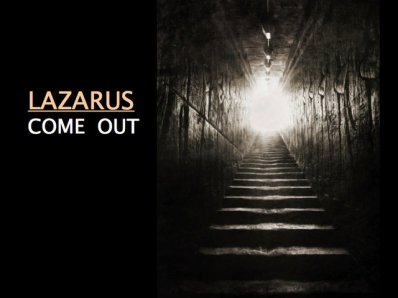
Those of us who are not immune to grief and death need to again to hear Jesus’ prayer which came in a loud voice.  “Lazarus, come out.”

I heard a preacher once ask his congregation, “You do know why Jesus said, ‘Lazarus, come out’ and not simply ‘come out’ don’t you?  Because if he did not call Lazarus by name, if he did not say specifically, “Lazarus, come out, then every tomb in Jerusalem would have opened up that day!

We need to hear this voice and see this very real and foul, decaying corpse walking out of the grave, still wrapped in burial cloths, coming, at the voice of Jesus, to life.

And then I believe we need to hear again, and hear again loudly Jesus’ words: “Unbind him, and let him go.”  “Unbind him, and let him go.”  Lazarus is loosed from the bonds of death. He is freed from the shackles of his past. He is let go into a brand new future, liberated and set free.

Then, I believe we need hear John and Jesus himself tell us over and over that this event reveals the glory of our God. What we have in this story is much more than the resuscitation of one dead corpse by one man.

Always for John, miracles are much more. Miracles are always signs that point us to something greater. Thus this miracle is the revelation that the God in whom we serve and trust and love, this God who is not unmoved and detached from the human scene, is always a death-overcoming and life-giving God.

The good news that we need to hear is that this God is still working in our world today unbinding, letting go, loosing, freeing. God is here enabling us to confront death and grief, us to acknowledge it, to look it straight in the eyes, to see all of its harshness and starkness, and then be liberated from it.

And if God is here liberating us from the shackles of death, then there is nothing else in all of creation from which God cannot set us free.

From evil bullies bent on crushing our spirits.

A job that is draining the very life from us.

A relationship that is killing us.

Fears that paralyze us.

Disease that is destroying us.

Economic hardships that never seem to end.

Depression that never lets go.

One of the great things about being a pastor is how I have the awesome privilege to witness this good news all of the time.

Someone loses their job. They come to me believing it is the end of the world. But a year later, working a new job, they share with me that losing that job was the very best thing that could have happen to them.

Someone else comes to me and says that their marriage has fallen apart. And that they are partly to blame. They said they thought life as they knew it was over. But a few months later, they tell me that they are beginning realize that although they cannot go back to the good old days, they have plenty of good new days ahead.

Someone comes to me sharing their deepest fear: the fear of being known for who they really are; the fear of rejection and ridicule. Then I see them a short time later, and they tell me how they have been surprised by unconditional love and unreserved acceptance.

People call me to share their doctor’s grim diagnosis. They say that they had just received a death sentence. But a short time later, I visit with them, and they tell me that they are beginning to understand that being alive and whole have very little to do with physical well-being.

And then I have visited with countless people as they are facing what is certainly their final hours on earth, and I hear in their voices, and I see in their eyes a faithful awareness that there is nothing at all “final” about them.

Thus, like Lazarus, in this incomplete and fragmented world where death, divorce, disease and hate entomb us, we can be loosed. We can be freed, and we can be unbound.

We can come out and let go and celebrate the good news together: where there is incompleteness and brokenness, there can be wholeness. Where there is tyranny of the mind, there can be freedom of the heart. Where there is an imprisonment of the soul, there can be a liberation of the spirit. Where there is grief and despair there is hope. And where there is death and even decay, there is always life.

Let us pray together…

O God of New Life, may we be a church that shares this good news with all people, honestly and truthfully and faithfully. May we weep with those who mourn. May we be deeply moved with those who are afraid. And may we be deeply disturbed in our spirit with all who are suffering. Stay beside them. Befriend them. Accept them. Love them…until they are whole, liberated and fully alive now and forever through Christ our Lord. Amen.