‘Twas the Night Before Christmas: One Shepherd’s Story


Written for the children’s Christmas program entitled “‘Twas the Night Before Christmas,” for First Christian Church, Fort Smith, AR. 


AngelShepherds


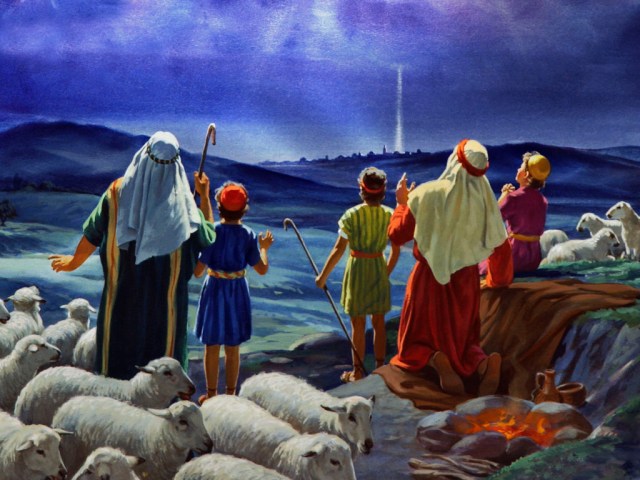
‘Twas the night before Christmas, when all through the dark,

Not a light was shining, not even a spark.

Yet, people were hoping for some kind of sign;

That something would happen, that God’s light would shine.


The children were hungry, so afraid and tired.

It was joy. It was peace and love they desired.

Mama was worried, and I was such a mess.

Neither one of us could sleep, nor could we rest.


When out in the fields we both heard a loud sound,

We went outside to take a good look around.

We met friends who were watching our flock by night;

Up in the sky, we saw a heavenly sight!


Angels singing about good news of great joy

For every woman and man, girl and boy.

They sang about God coming down to the earth.

They sang about the promise of a new birth.


All barriers broken, even religion and race—

With unconditional love and unfettered grace!

The love was unearned and the grace was so free,

All we could do was drop down to our knees.


Down on the ground, I pondered the intrusion,

I thought that this might all be an illusion.

‘Twas hard to believe, much harder to behold!

The world was so scary, so dark and so cold.


But it wasn’t a dream! It was all very real!

And the angels had more good news to reveal!

“To you is born in the city of David,

A Savior for whom the whole world has waited!”


“The child will be wrapped from his head to his foot

In bands of cloth. In a manger he’ll be put.

Although he’ll look like an ordinary kid,

The light he’ll give can never ever be hid.”


Without hesitation we knew we must go!

We all went together, the children in tow.

We found God’s gift, just as the angels foretold.

The world no longer seemed dark, nor was it cold.


His eyes—how they twinkled! His dimples—how merry!

His brown skin so pure, his nose like a berry!

His droll little mouth was drawn up like a bow.

This baby loved me. Somehow, God told me so!


The shepherds, my fam‘ly, they felt the same way!

Could this be the answer to all we had prayed?

He was so precious, so humble and so mild.

We bowed at the manger of this holy child.


He was tiny and meek, but he was no elf.

I cried when I saw him, in spite of myself!

But a wink of his eye, a turn of his head,

Let us all know that we had nothing to dread.


He spoke not a word, but the babe said so much;

Lifting not a finger, our hearts the child touched.

Laying in the straw, he closed his eyes and slept.

We turned toward each other; to our feet we leapt!


We sang, we danced for all that had taken place:

The angels, the baby, the amazing grace!

And to all we exclaimed with all of our might:

“Into the world’s darkness shines forth a great light!”

Thanksgiving Day Collusion

Turkey

Like many of us, after a big Thanksgiving meal, the only thing I want to do is take a nap. It is like I am in some drug-induced coma!

Several years ago, we were told that the culprit behind our Thanksgiving afternoon slumber and subsequent Advent hangover was too much Tryptophan!

Although scientists are now telling us that the amount of Tryptophan found in turkeys is no greater than the amount found in chicken, there still seems to be something about Turkey that makes it difficult to keep one’s eyes open watching the Dallas Cowboys Thursday afternoon.

Do you know what I think?

[warning: satire ahead]

I think there might be some type of criminal collusion afoot here, some type of evil conspiracy to make Christians sleep through the next four weeks that we call Advent! In addition to the Tryptophan, perhaps our turkeys have been inserted with some drug to make Christians miss the real reason for this most wonderful of seasons!

We essentially sleep through Advent and Christmas each year and miss the good news that the God who created the heavens and earth loves all of us so much that God humbled God’s self and became one of us, suffering for us even to the point of death, even death on the cross.

How else can one explain the number of Christians who believe God calls some people “abominations” simply because of the way they were born? How else can one explain the number of Christians who defend men who brag about molesting women or prey on fourteen-year old girls? How else can one explain how many Christians believe that God is behind hurricanes, earthquakes, floods and fires? How else can one explain Christians who dehumanize and scapegoat others for living a different faith, speaking a different language, or having a different skin tone? What else explains the apathy of so many Christians towards the poor and the marginalized? What explains the failure of so many Christians to love their neighbors?

Maybe Christians have eaten so much turkey at Thanksgiving that they’ve slept through countless Christmases!

Christians go through the whole month of December with their head in a fog, their souls numb to the good news that God is with us all and for us all, always working all things together in our world for the good. Every year, wearing turkey goggles, we somehow fail to see the good news of Christmas.

Now, I know I am not going to convince you to skip the turkey this year. Therefore, I urge all of you to plan to detox your souls by participating in our Advent Services of Worship leading up to Christmas Eve. Fight the terrible turkey withdrawals! Stay awake! And see the good news that God is Emmanuel, God with us!

Prophetic Persecution

roy moore.jpg

Roy Moore recently defended himself with the words of Jesus: “Blessed are you when people revile you and persecute you and utter all kinds of evil against you falsely on my account. Rejoice and be glad, for your reward is great in heaven, for in the same way they persecuted the prophets who were before you” (Matthew 5:11-12).

What must be said is that the prophets were not persecuted for displaying the Ten Commandments on government property.

The prophets were not persecuted for supporting state-sanctioned prayer in school.

The prophets were not persecuted for advocating for the governmental control of the bodies of women.

The prophets were not persecuted for protecting the rights of every citizen to own assault weapons.

The prophets were not persecuted for protecting the religious freedom of bigots to discriminate against minorities.

The prophets were not persecuted for stirring up fear and hatred of the foreigner in their midst.

The prophets were not persecuted for supporting legislation that blessed the rich and sent the poor away empty.

The prophets were not persecuted for fighting for the liberty and justice of the privileged.

No, what must be said is that the prophets were persecuted for supporting the moral values that has always made America great.

The prophets were persecuted for pointing out how any proposed legislation might break the greatest commandment to love our neighbors and may cause some of our neighbors harm, especially our poor neighbors.

The prophets were persected for standing up for justice for our most vulnerable citizens, such as the right of every child having equal access to an equitable and quality education.

The prophets were persecuted for elevating the status of women and protecting their freedoms and well-being.

The prophets were persecuted for promoting healing, health and peace for all people, especially for those living in poverty.

The prophets were persecuted for defending the rights and freedoms of those marginalized by the state and extreme religion.

The prophets were persecuted for always welcoming and accepting the stranger in their midst.

The prophets were persecuted for blessing the poor and sending the rich away empty.

The prophets were persecuted for fighting for the liberty and justice of all.

So, although Roy More may feel like he is being persecuted right now, he is not being persected like the prophets before us.

Avoiding the Holiday Blues

holiday blues

The next six weeks on the calendar can be the gloomiest time of the year. The nights grow longer, the temperatures cooler. The way we celebrate during these weeks also has a tendency to bring us down.

If the holidays are all about preparing meals and parties… Then it will mean a ton of extra calories that will lead to weight gain, tighter clothes, and the blues.

If the holidays are all about children… Then it will be especially painful for those who have lost children, for those who have never been able to have children, and for those whose children are estranged. The holidays will mean lost dreams that will lead to anguish, regret and the blues.

If the holidays are all about family… Then it will be especially painful for those of us, who have lost loved ones this past year. The holidays will mean empty chairs at the table that will lead to grief, sorrow and the blues.

If the holidays are all about shopping and exchanging gifts… Then it will mean a lot of shopping that will lead to a lot of stress, debt and the blues.

No wonder this is the gloomiest time of the year for many.

However, if holidays are truly holy days, if they are all about giving thanks to the Giver of Life and Love… Then the holidays will mean grace.

If the holidays are all about the Holy gift of God’s self to us through a little baby named Jesus… Then the holidays will mean hope.

If the holidays are all about Emmanuel, God with us… Then the holidays will mean peace.

If the holidays are all about God who came to earth to reach out, heal and forgive… Then the holidays will mean love.

If the holidays are all about God, who through Jesus the Christ came to love this world unconditionally and inclusively… Then the holidays will mean joy.

So, let’s avoid the blues this holiday season by making the worship of the God of our Lord Jesus Christ a priority, so we can receive the good news of these holy days, and together, share it with others.

The Baptisms of Lydia and Jamie

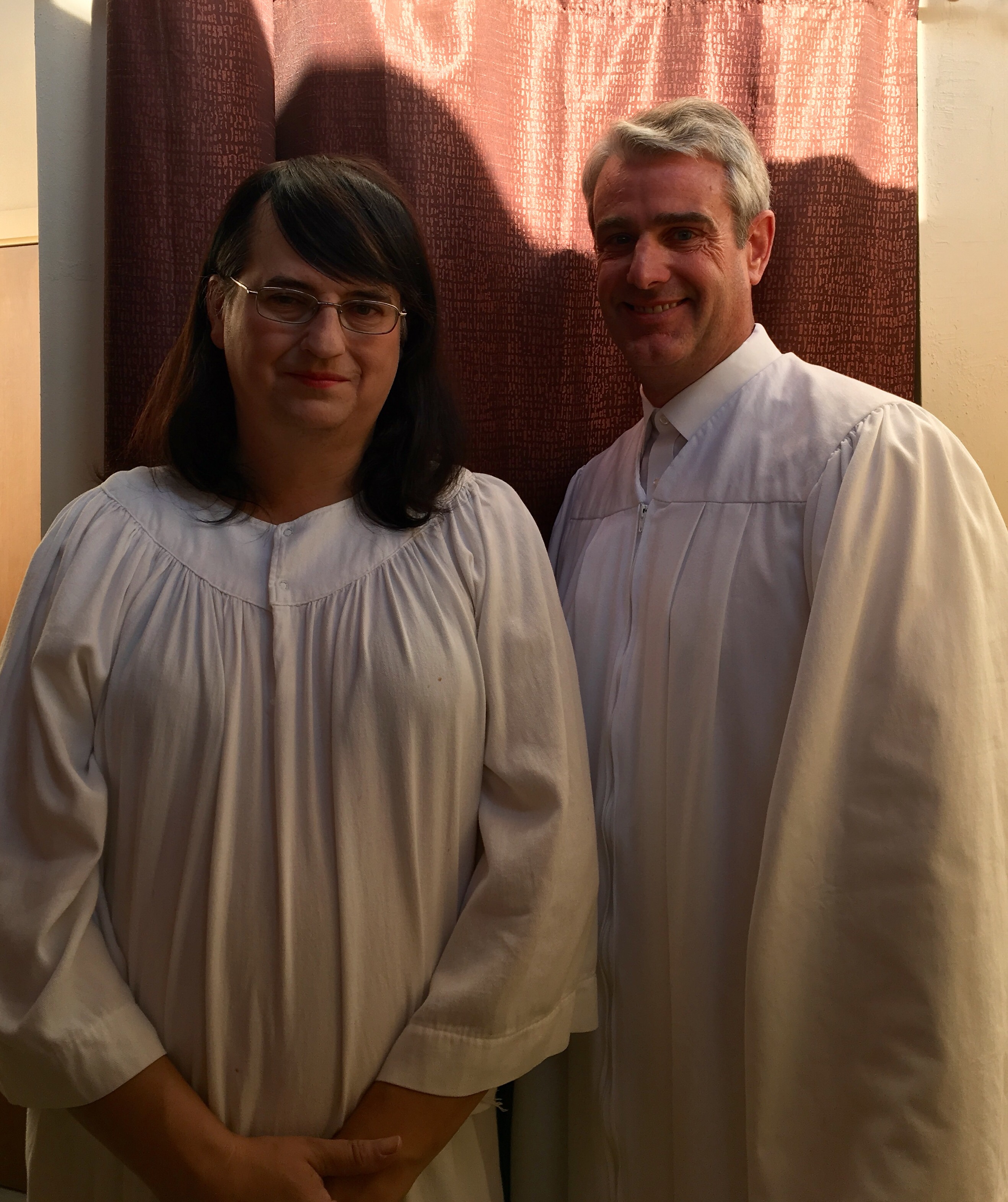
img_6863Acts 16:9-15 NRSV

I believe the baptism of a certain woman named Lydia and the baptism of a certain woman named Jamie have much to teach us this day.

The story of Lydia begins with Paul and Silas sharing the good news of Jesus in Troas, a town located in across the Aegean Sea from the European district of Macedonia. Paul has a vision of a man in Macedonia pleading: “Come on over and help us!” Convinced that God was calling them to go and proclaim the good news in Europe, they sailed to Macedonia, went through Samothrace and Neapolis, eventually settling in Philippi.

While in Philippi, Paul and Silas heard about a group of women that had been gathering for worship down by the river outside the gate. So when the Sabbath came, they went and found the women, sat down and engaged them in conversation.

Luke says it was obvious that one woman in the group, a woman named Lydia was closely paying attention to what Paul had to say.

It is then that Luke points out some very remarkable things about this woman. First of all, she is a foreign business owner from Thyatira, a town located in Asia minor in what is now Turkey. Secondly, because he says that “she and her household” were baptized, it’s evident that she was the head of her household.

Now, remember, this is the first century. It’s not a period known for women working outside of the home. Females were treated as second-class citizens, even as “property.” Males were the leaders, the heads of business and the heads of households. And yet, here is a woman who is the head of both.

And since she is the only one who is pointed out to be really paying attention to what Paul was saying, she also appears to be the head of that community of faith which gathered there each week by the river.

And this, says Luke, this baptism of a foreign woman who shatters all cultural expectations, this baptism of a woman who lived life two-thousand years ahead of her time, the baptism of this woman as the first European Christian, is the result of a vision from God that came to Paul.

So, what in the world was God trying to say to Paul and Silas through that vision of a man saying, “Come to Macedonia, because I need some help!”

Could it be that God was saying: “Paul and Silas, I know you are clear across the sea on another continent, but I need you to get in a boat right now and set sail to Macedonia. I need you to come over here to Europe, make your way through Samothrace and Neapolis, all the way to Philippi, and help me!

I need you to help me, to show the world once and for all that through my love revealed in Christ Jesus, through the one who continually lifted up the status of women, elevated the foreigner, accepted the Eunuchs, and did something almost daily to shatter all cultural expectations, destroying the stigma of status, race, ethnicity, class, and sexuality, that in my kingdom, there no longer Jew nor Gentile, slave nor free, male nor female. Help me clearly make the statement that in Christ all are one.”

It is as if God is saying: “I know people have heard the stories of Jesus calling women to be counted among his disciples. I know the word is out that Mary and Joanna were the first ones to proclaim the good news of Easter. I know many have heard about my disciple Tabitha and her works of kindness and gifts of charity. And I know that folks are hearing about the good work of sister Phoebe leading the church at Cenchreae; however, I am still afraid I am going to need some help over here in Europe.

Because I have this bad feeling that even if I do something as radical as making the first baptized Christian on this continent a strong woman like Lydia, some of these Europeans, and the descendants of these Europeans, are still going to argue, even two-thousand years from now, that a woman has no business being the head of a state, being at the head of a communion table, or being the head of a household, or even being the head of her own body. And I have this terrible notion that even in the year, let’s say, 2017, there will be still be reports of men with money, fame or political power molesting, even raping women and young girls.

And then people will have the audacity to defend such actions by blaming a 14-year-old girl for ‘not making good decisions’ or by trying to explain the illegal and immoral behavior with the relationship of Jesus’ earthly parents!

And I know people have heard the story of the Good Samaritan, that despised foreigner who proved to be a holy neighbor to the Jewish man who who was beaten and left dead on the side of the road, but I have this terrible inkling that even if I make a foreigner the first European convert, some Europeans, and the descendants of these Europeans, even two-thousand years from now, may still harbor all kinds of prejudices against those who are not of European descent.

So, get yourself over here to Macedonia as fast as you can and help me baptize this certain woman named Lydia! Because although not all churches will get it the message I am sending through this baptism, maybe, just maybe, there will be some churches who will get it.”

I believe Paul may have Lydia in mind when he penned the following words to the church at Ephesus: “But now in Christ Jesus you who once were far off have been brought near by the blood of Christ. For he is our peace; …and has broken down the dividing wall… So he came and proclaimed peace to you who were far off and peace to those who were near; for through him both of us have access in one Spirit to the Father. So then you are no longer strangers and aliens, but you are citizens with the saints and also members of the household of God” (Ephesians 2).

Then, there is the baptism of Jamie.

Like Lydia, Jamie is also a certain woman; however, fortunate for her, she has joined a church that has learned a thing or two from Lydia. For, here at First Christian Church in Fort Smith, the gifts of women are valued just as much as the gifts of men. Jamie will be encouraged here to use her gifts to freely follow Christ wherever the Spirit leads.

Jamie is not a foreigner. However, since she was not raised in our church, she was a stranger, an outsider to most of us. And sadly, Jamie has been and continues to be treated like an outsider by many in this town. Therefore, I believe the baptism of Jamie reminds us that we have been called by God to reach out beyond our walls and embrace others like Jamie who did not grow up in this church, or who have been marginalized by society, so that they will no longer be strangers, no longer outcast.

It is as if God is saying: “I know people have heard the Great Commission of the Risen Christ to “be witnesses in Jerusalem, in all Judea and Samaria, and to the ends of the earth” making “…disciples of all nations, baptizing them in the name of the Father, Son, and Holy Spirit…”

But I have this bad feeling, that if I do not stir the hearts of people like Jamie, and draw them into the renewing waters of the church, enlarging and changing the congregation, then the church might be tempted to become so comfortable with the status quo that they grow apathetic, uninterested in reaching out to welcome the stranger.

A few years ago, my wife Lori visited a Bojangle’s Chicken and Biscuit restaurant in North Carolina. The sign out front reads: “Famous Chicken and Biscuits.” She went through the drive-thru to get her some chicken. However, after she placed her order in the drive-thru, she was told that they were out of chicken.

Lori came home and said: “I am so mad! Bojangle’s Chicken and Biscuits told me that they were out of chicken. She said, “I can understand if they run out of the mashed potatoes. I can maybe even sympathize a little with them if they run out of biscuits. But a Chicken and Biscuit Restaurant, has got no business runnin’ out of chicken!”

The baptism of Jamie reminds us what the church is all about. If a church is not continually working to break down dividing walls, working to build bridges and relationships with those outside the church, with the goal of having several baptismal services a year, if the church is not a safe place of grace, love and mercy, then the church is like a Sweet Bay Coffee Shop that has run out of coffee! They might as well close down and put a chain on the doors!

After Lydia is baptized, notice the first thing that she does. She extends a gracious welcome to Paul and Silas inviting them stay at her home. Her words following her baptism remind me of our identity statement as Disciples of Christ, “We welcome all to the Lord’s table as God has welcomed us.”

I was on facebook Monday night, and I read these words from Jamie’s timeline that are so so reminiscent of Lydia’s words: “I want to invite all my friends to come to First Christian Church Sunday the 12th. We will be having a thanksgiving meal.”

Lydia and Jamie remind us that each person in this room who has been baptized, who has been welcomed by God through the gracious hospitality of Christ, should feel compelled by the Holy Spirit of Jesus to go out from this place and welcome all people.

Through the baptisms of a certain woman named Lydia and a certain woman named Jamie, I believe God is saying to each of us: “Go out, reach out, tear down a wall, build a bridge, connect, engage, get on facebook, get in a boat if you have to, travel through the streets of places like Samothrace and Neapolis and Philippi and Fort Smith and Van Buren and Greenwood, because I need some help! I need some help sharing the good news that at my table, all are welcome, and all means all!” Amen.

Invitation to Communion

As we sing our hymn of communion, please know that whoever you are, wherever you came from, whatever you bring with you, you are welcome to be served from this, God’s wide and inclusive table.

Jamie’s Story: Love Wins

Jamie reading
Jamie Pape gave the following testimony today after her baptism at First Christian Church in Fort Smith, AR.  Her words were for her church and members of the LGBTQ+ community who have been victims of hate and bigotry. 

Hello Everyone,

I want to thank everyone for being here today, not just for being here for my baptism, but really my rebirth as a human. I stand here in front of you, a simple humbled servant of God. I stand here only a short time removed from some very evil acts of violence, acts that send ripples of fear in their wake. I morn for those touched by this, but I also send out encouragement. This is not the end. I want them to know that they are loved by us and most importantly by God. God mourns the loss alongside you and will be there to comfort you. My plea is to never give up.

I know fully that pit of darkness that you can get close to. I have looked at it for most of my life. I know what fear can do. As a young child, I knew something was not right, and because of that I have endured countless acts of evil. I have been beaten and burned, but yet something kept giving me the strength to carry on.

I used to pray, every-night: “God please end my pain, God please, take me from this world.” Then, I would wake up, still living, but not alive, still here, but not. Confused as to why, afraid of what could happen should anyone discover my truth, confused as to why me, and alone, despite being with people who loved me. I felt like there was no one like me. Sure, there were characters on daytime talk shows, but I did not see people. I felt alone and afraid.

Now, I will not stand here and say that it was all gloom and doom. I had good days, and I had awesome days. The day I looked into someone’s eyes as she responded the words: “I do.” The day I held a tiny baby in my hands and realized this is why, this is why I was placed here. Then another came, and yes, another. I have three beautiful children who now are entering adulthood. I thank God for these, for they gave me a purpose, yet I still sat alone many nights, afraid, oftentimes depressed and silent. I still said the same prayers, had the same fears.

Fear ruled my life, until a little over two years ago. I decided to not let fear rule me any longer, to not live in pain any longer, to be fully truthful and honestly share that truth. SO I came out. It was not an easy road, and one I still travel to this day. But I do not walk it alone.

And yet, despite having taken this big step, that pit of darkness followed. Many times I feared it would consume me. I got to a point of wondering why God hated me, and I said one final prayer, I said God If you love me please, please speak to me, please show me that you love me… that Friday my boss at the job I had, for, no reason looked at me and said God loves you Jamie, just the way you are.

That night, I prayed. I said “God, thank you for speaking to me, but I need more. I need a church, because I used to go, but hate and fear drove me away from church. The next day, I met Dr. Jarrett Banks. He had said something I will never forget. He said: “I want to be your friend. Whether or not you come to church, I want to be your friend. He invited me to come here, no strings attached, just a promise that I would be safe. So I came. I faced my fears walking though the door. At first, I went in the wrong way and had to come around to the right door.

But I did. And with a deep breath I opened the door. I walked in. I stood right over there. I was going to sit alone. But someone noticed me, and she waved to me to come over. At first I thought maybe she was waving at someone else. Nope, she was indeed waving to me. So I went over. During that service I cried. I cried, because I felt a presence in my soul that I had not felt in ages. I cried at the words spoken about being inclusive.

Which brings us to today—a day where we celebrate a rebirth, as well as an early thanksgiving. I give thanks that God has placed all of you into my life. I thank God that people are starting to see the truth. I thank God for everyone who has been given the courage to stare down fear, and hate. And I thank God for giving strength to people to stand and defend those who cannot quite yet defend themselves. I give thanks to God… for life.

So in closing, I say this to those who hurt, those who mourn, those who fear: God loves you. We love you. I love you. Together, we will defend you, support you, and comfort you, until you can once again stand and do the same for others.

A Weapon in Church

shooting church

“Preacher, what are we going to do? Are we going to have to start carrying guns to church? Is this what it has come down to?”

I responded by saying: “Love is the only weapon I will carry into the pulpit.”

I said that, because I believe the only weapon this world needs is Love— Love that is from God, is of God, and is God.

This Love is not passive. It is neither silent nor afraid. It does not despair nor does it acquiesce. It is not weak, nor is it timid. It cannot be confined nor contained. It cannot be kept to one’s self. It never sits back and does nothing.

This Love is courageous. It is thoughtful. It is rational. It is vocal. It is always moving, doing, working, fighting. It gives and forgives and gives some more.

This Love is sacrificial. It is inclusive and expansive. It can overpower, overtake and overcome. It can change everything.

This Love puts feet on prayers. It attaches arms to offerings and hands to hymns. It gives life to a sermon.

This Love will always be opposed. It will be ridiculed, mocked and bullied. It will be hijacked, humiliated, imitated and defamed.

This Love never gives up. It never bows down. It never retreats. It cannot be bought by the ACLU nor the NRA. It will not compromise.

This Love will be shot—in a theater, in a limousine, on a motel balcony, in a school building, in a cinema, at a concert, in Wal-Mart, even in church. It will be crucified.

This Love will not accept defeat. It will never throw in the towel. It will die, but it will not pass away. It will be struck down and buried, but it will rise up and live.

This Love will conquer all. It will surpass all. It will never end.

This Love will win.

How God Responds to Death

cemetary sunsrise

Luke 7:11-15 NRSV

All Saints’ Sunday gives us an opportunity to reflect on a topic that we all like to avoid. Though it occurs to every living person, we do everything we can to distance ourselves from it.

Just a century or more ago, people seemed to be more comfortable with death. There was less distance between the living and the dead. Instead of dying in a hospital or a nursing home, people usually died in their own house.

And their bodies were not sent off to the funeral parlor, but kept at home, prepared there by family members for visitation and burial.

Today, death usually occurs in isolated places where where we have these specialists who deal with it. When families make funeral arrangements, we have more specialists step in to maintain a margin of protection around the grieving.

When I was growing up, I remember being shielded from death. Visitation with the family always occurred in the home of the deceased without the body being present. It stayed at the funeral home.  Although one had the opportunity to privately view the body at the funeral parlor, most people chose to only visit with the surviving family members in the home.

I remember my parents teaching me that there was no need to go to the funeral home to see my Great Granddaddy, because Great Granddaddy was not at the funeral home.

“That’s just his body, an empty shell. He is in heaven with God,” they’d say.

My parents were only doing what they could do to protect me, to keep me at a safe distance from death.

There’s a growing trend to revert back to a more acceptable view of death, to an understanding that death is a natural part of life. After all, at some point, everybody’s doing it. Hospice Homes have been built to accommodate entire families, so everyone can be included in someone’s final moments.

I believe this is a better approach to death. To face it. Accept it.

However, if we are not careful, I believe Christians can take acceptance of death too far. For I believe it can become very problematic when every death, no matter how tragic or horrific, is accepted as the will of God.

In fact, I believe we misconstrue who our God is when, upon hearing of someone’s untimely death we say things like: “Well, it must have been his time to go.” “The Lord called her home.” “Another flower was needed in God’s garden.”  “This is just God’s will, and we just have to accept it.”

By having an understanding that every death is God’s will, I believe some Christians encourage the grieving to move on too quickly with their lives. They infer that spending too much time grieving over a loss means their faith in God is weak and shallow.

“You need to accept that this is all a part of God’s plan. So dry it up. Get yourself together. Get on with your life.”

Thus, many people who still find themselves grieving over a loss they experienced as little as six months ago begin to feel guilty for lacking faith.

People today even try to naturalize the death of children. I do not believe there is anything more unnatural than the death of a child. It is a break of the natural order of things. Our children are supposed to be there to take care of us when we grow old and die.

But I’ve heard people try to limit the tragedy, naturalize the heartbreak. At the funeral of an infant, I one preacher said: “Some children have always died before their parents. The only reason that it seems so tragic is because, today, people are having fewer children.”

He then told the story of Johann Sebastian Bach who had 20 children by two wives. He said, “Only ten of his children survived to adulthood.  What nature took away in the form of untimely death, nature made accommodation by the fruitfulness of human union.”

It was as if he was saying to the grieving parents: “Your grief today is your fault for not having more children! Don’t blame death for your grief, for death is a natural, God-willed process.”

I believe our scripture lesson this morning encourages us to have a better-informed theology when it comes to death.

Jesus and his followers encounter a funeral procession while traveling through the town of Nain. Nothing unusual. A very common occurrence, even today. However, instead of ignoring and isolating himself from death, instead of distancing himself from or denying death by calling it a natural part of life, Jesus confronts death. Jesus stops, recognizes the harsh reality of death

And when Jesus learns that the funeral was for a widow’s only son, Luke tells us that he was moved with compassion. The Greek word used here is a “visceral” verb. It literally means that Jesus was moved from deep within his inner bowels. Jesus had a gut-wrenching reaction to this widow’s loss.

Jesus recognized the tragedy of this death, the unnatural pain and heartache that this death had caused. Jesus recognized that sons should bury mothers. Mothers should not bury sons. Jesus recognized that this was not the will of God.

This is how I believe our God always responds to death. God does not will death. God is not sitting on a throne pushing buttons calling people home.

No, Luke teaches us that when someone dies, God is moved and moved deeply. God has a visceral, gut-wrenching reaction. God is flooded with compassion and overcome with grief. God does not accept death as a natural part of life, but on the contrary, God recognizes the unnatural aspect of it, and God is moved from the very depths of who God is.

Remember Jesus’ response when his friend Lazarus died. It’s the shortest but perhaps most hopeful verse in the Bible: “Jesus wept.”  When a loved one dies, our God does not say: “Have some faith. Move on. Get over it and get on with your life. Stop cying.”

No, our God grieves. Our God cries with us.

With compassion, Jesus reaches out his hand and touches the casket and speaks to the one within it: “Young man, I say to you, get up!”

And then (listen to these wonderful words): “When the son arose, Jesus ‘gave him back to his mother.’” Isn’t that beautiful?  This young man’s life was restored, but so was the life of his mother.

Thus, Jesus demonstrates what our God is all about. God is and has always been about bringing life to all people.

Genesis says that the first act of our God was to breathe the breath of life into creation. God’s breath, God’s Spirit, swept over the face of the waters. God breathed into the human the first breath of human life. And it was in the same manner, God, in Jesus breathed new life into the young man from Nain by speaking the words: “Young man, I say to you, arise,” demonstrating that God’s business is always to give life, not death.

Therefore, I believe it may be questionable theology to say that “God wills death,” or “calls people home,” “or takes our loved ones.”

For our God is always giver. That means God is never a taker.

Thus, it’s more accurate to say that when any death occurs, no matter the age, no matter the circumstance, God confronts it. God is moved with compassion by it. In that moment someone takes their last breath, God is not there taking, but God is there giving, giving all that God has, pouring God’s self out into that person, fully, completely and eternally.

God does not ignore death, demean death, or simplify death saying: “This is all part of my plan.” God does not let any funeral pass by like it is somehow meant to be. No, God is moved with compassion and sees death as a force contrary to God’s will and takes action to overcome it, transform it, resurrect it.

It could be said that God’s whole life in the story Jesus is about this one thing: overcoming the power of death. As Jesus spoke life to this young man from Nain, God speaks life in the resurrection of Jesus and accomplishes not a resuscitation of one, but the redemption of all.

Through Jesus, God restores the natural order of things. God may not keep all children from dying before their parents, but God does restore the power of life over death, and the power of God over everything else in all of creation.

This is the good news for us on All Saints’ Sunday. We worship the God of life. We worship the God who has brought life to the ones we have lost this year, and who is even now bringing life eternally to us.

And this is the challenge for us this day. Because we worship the God of life, we are called even now to do what we can do to bring life, restoration and hope at the graveside of grieving parents and grandparents, as we will do this afternoon, at a Hospice Home or a funeral home, but also wherever there is degradation and dehumanization, wherever women are harassed and objectified, wherever children are neglected and victimized, wherever outsiders are scapegoated and demonized, wherever people are oppressed and demoralized, or wherever anyone is made to feel like they might be better off dead.

I will never forget the response of a homeless woman after our church served her a hot meal this past Easter Sunday.

She said, “Today you have made me feel human again.” T

hink about that. On Easter Sunday, because of the actions of a church, a woman, demoralized and dehumanized by the world, just didn’t learn about resurrection, she actually experienced resurrection.

Thank you for being the God of resurrection, the God of life and restoration. As we follow the Christ wherever he leads us, may we always be your resurrection people who make it our business daily to bring life and restoration wherever it is needed.

Invitation to the Table

Now, may the God of life breathe upon these gifts of grain and grape that they might be for all of us the live-giving presence of the living Christ, that we might be reflections of God’s likeness in a hurting world, so that others might know the blessings of life, abundant and eternal.

We remember all who have gone before us into God’s eternal splendor and now join them and all the angels and all of the saints of heaven as we continue to sing our praises to God together.