A New Teaching

Mark 1:21-28 NRSV

My first-grade teacher, Mrs. Banks, will always be remembered as one of my favorite teachers. And it is not because she had such a cool last name or that was one of my very first teachers. It is also not because of the wonderful lessons that she taught me. Because, the truth is, I do not remember a single lesson. Mrs. Banks will always be remembered as my favorite teacher, because during that school year when I spent some time in the hospital to have my tonsils removed, she came to see me. She came to my hospital room and brought me cards hand-made by my classmates with construction paper.

It is not the words of the teacher that I fondly remember today. I remember her actions.

Mark writes that people in the synagogue were amazed at the power of Jesus’ teaching. “They kept asking one another: ‘What is this? It’s a new teaching with authority!’” But notice that Mark does not mention any words. There is no mention by Mark of even a hint of the content of Jesus’ lesson or even one point from his sermon. For Mark, it is not the words, but the authoritative action of the teacher that is important. Perhaps this is what made Jesus’ teaching so “new.”

Throughout Mark’s gospel, Jesus is continually identified by Mark using the word, “teacher.” And we are quick to learn that Jesus is a different kind of “teacher.”

In chapter four, Mark says that the “teacher” stills a storm. In chapter five, the “teacher” raises a dead girl to life.

In chapter six, the “teacher” feeds a hungry crowd.

In chapter nine, the “teacher” cures an epileptic.

 In chapter eleven, the “teacher” curses a fig tree.

And here in our text this morning, the “teacher” is the one who exorcises a demon in the synagogue. Jesus is a different kind of teacher, an authoritative teacher, because Jesus is continually putting the Word of God into action. Jesus is continually on the move, working and reworking, creating and recreating, restoring, renewing, reviving, healing, saving, transforming, acting.

Although, we modern, well-educated, well-informed folks who believe in psychology and science would rather ignore this demon in our story, I do think it is important for us to notice the location of this demon in our gospel lesson this morning. It’s not in all those places that some would expect to find demons today. This demon is sitting on a pew. I do believe that the sad reality of this fragmented world is that evil is real and evil is present and evil is personal and evil is experienced in all places, even in the church, sometimes, especially in the church.

I believe the church is afflicted with a number of demons today, but the one that perhaps concerns me the most is this demon of “defeatism.”

Defeatism: We have too many people in the church who have just accepted the evil in this world as normative. We’ve given up that things in this world can get better, that we as a people can do better, be better, or in other words, we’ve stopped believing that “demons can be exorcized.”

People leave church on Sunday to show up at the polls on Tuesday for an unstable politician who brazenly look into the camera and stokes fear, xenophopia, misogyny, and racism. The gap between the super rich and the super poor in our world continues to widen; women and transgendered people are denied healthcare; the poor are not given living wages; public education is undermined; affordable housing is not available; the environment continues to suffer; wars continue to wage; gun violence is everywhere, and we in the church sit back and say that there’s just nothing we can do about it. “This is just the way things are.” “It is what it is.” “This is the new normal.”  Or worse, we say something like: “Thank God the Lord is coming back soon.”

Some in the church actually have the audacity to call this defeatism, “faith”; instead of calling it what it really is: “demonic.”

I believe the point Mark wants us to hear is that this new, unprecedented teaching of Jesus has the authoritative power today and takes authoritative action today over the evil that afflicts our world. Mark wants us to know that although evil surrounds us, although we are tempted to believe that things are only going to get worse, a teacher is coming, and he is coming not with mere words, but with authoritative, imminent action today for a more just, more equitable and more peaceful tomorrow.

When this teacher comes and teaches us that there is hope, he is not just “whistling in the dark” or “grasping at straws.”  He is not coming on some “wing and a prayer” “wishing upon a star.” He is not coming with mere words and tiresome clichés. He is coming taking authoritative action.

The teacher does not come with a mere history lesson of God’s past actions but comes beckoning us to see what God is actively doing in our world today and will do in our world tomorrow.

As one of my favorite preachers, the late John Claypool has said, Jesus comes teaching us that our faith is and has always been “a faith of promise; never a faith of nostalgia. Our faith is always looking forward; never backward.”

Our faith never sulks, pouts, or grumbles for the good old days, but always marches for, works for, fights for, and anticipates good new days.

When someone comes to see me who has just been diagnosed with cancer or another dreadful disease; or has just lost their job, their income; or has just lost their spouse to death, or worse, to separation or divorce; or has been afflicted in any number of ways; and I say to them “it is going to be ok,” I am not simply saying “cross your fingers” and “hope for the best,” or even saying something like “there’s a light at the end of the tunnel.”

I am saying with the authority of God, the creator of all that is, the One who has been revealed in Holy Scriptures and in the life, death and resurrection of Jesus Christ, that things are going to be better.

Because our faith that is rooted in the Holy Scriptures is one that has always, and will always, draw us into better days.

When God first approached human beings, it was never from behind (“Hey you, turn around, come back here”), but it was always from out ahead, out in the future, promising, beckoning.

God came to Abraham and Sarah in their old age with a promise. God came promising that they would one day father and mother a nation. And you know something? Abraham and Sarah did the very same thing that some of you do when I tell you that things are going to be ok. They laughed. They scoffed: “We are much too old to have any future.”

God came to Moses showing him that he would lead Israel into the Promised Land. And Moses responded the same way some of you do, the same way Abraham and Sarah responded: “Nah; not me!  You know that simply don’t have what it takes to have such a future.”

But we know the rest of the story, don’t we? We know the rest of their stories, but we also know the rest of some of our own stories. No, Abraham, Sarah and Moses, nor any of us, had what it takes, but thank God that God did. And God acted. We look back at our afflictions, where we have been, and how far we have come, what we have gained through the storms, and we say something miraculous like, “If I could go back and change anything in my life, I don’t believe I would change a thing.”

This is why we point to our God in a very different manner than people of other faiths point to their God. When we are asked: “Where is your God?” we should never say “Back there,” or “in here,” or even “up there.” Rather we should point straight into the future and say: “My God is out there, pulling me into a better tomorrow!”

This is the teaching that Jesus puts into action, and this is the teaching that he calls all of us to put into action.

It is why we make a commitment to teach our children the stories of faith through Worship and Wonder. It is what compels us to help prepare impoverished children for kindergarten. It is what propels us to volunteer at Park View Mission. It is what drives us to join a movement like One Home One Future.

It is what propels some of you to volunteer at the hospital, visit a nursing home, send a card, or make a phone call to someone who is hurting. And hopefully it is what has brought you to be a part of this church, this movement for wholeness in our fragmented world, this blessed place of love and inclusion and it is what will send you out to be a blessing in all places.

For our God is a God of promise—A God of hope who is made known more in actions than in words.

I believe this explains the conversation I had with a colleague who was under the care of hospice just days before her death.

She talked about her life. She talked about how good God had been to her in the past. She talked about her service through the church alongside her husband. Then she began to talk about her present situation and about the cancer that had returned and had spread throughout her body. She talked about her pain. She said she knew that she had days and not weeks left on this earth. She talked about how difficult her death was going to be for her family, for her husband and children. Then she said with this special smile that I will never forget, “But I’m fine! I am going to be fine!”

She was going to be fine because her God, whom she knew through her teacher, Jesus Christ, had never approached her from behind. But always from out ahead, out in the future, always promising, always beckoning, always acting, transforming, renewing, restoring, resurrecting. Her God was never back there, somewhere in the distant past, but her God was out there, always assuring her that her best days of living, her best days of life, were ahead of her.

In what she knew to be her last few days on this earth, she had miraculously been taught to say, “I’m fine. I’m going to be fine.”

Aren’t we all?

Going Fishing

Fishing net parament adorning the communion table of the First Christian Church in Lynchburg, Virginia

As we celebrate 150 years of being church, I think it is good to highlight something that is central to who we are as the First Christian Church in Lynchburg, VA. And that is fishing. You knew that right? Why else would we adorn our communion table with a giant, very colorful, diverse mosaic of a giant fishing net. There’s a great description of our fishing net parament hanging on the wall in the back of the sanctuary that I encourage you to read when you have a chance.

Our fishing net is appropriate as the gospels are full of great fishing stories. Like the story of Jesus is having church on the beach. Luke tells us that the congregation gathered that day is so large, they keep “pressing in on him to hear the word of God,” almost pushing Jesus into the water!

It is then that Jesus sees two boats belonging to some fishermen who are out washing their nets. He climbs into one of the boats belonging to a fella named Simon and asks him to put it out a little way from the shore so he could teach the crowds on the beach from the boat, setting up a little pulpit on the water.

After the Benediction is pronounced and church is over, Jesus says to Simon, “Let’s move the boat to some deeper waters and go fishing.” And this is the moment, for Simon and all of us, that church really begins.

Simon says, “Jesus, we’ve been fishing all night long and haven’t caught a thing. But, if you say so, I’ll cast my net one more time.”

It is then that Luke tells us that they catch so many fish that they had to call in re-enforcements and a second boat. Filled with so many fish, the nets almost break.

Do you remember Simon’s reaction to this glorious catch? “Praise God from whom all blessings flow for this miraculous catch of fish!”

Nope, not even close.

Scared to death, Simon says the almost unthinkable: “Go away from me Lord!”

Then, as it usually is with the stories of Jesus, we learn there is much more going on here than a few folks going fishing. As our scripture lesson in Mark reminds us, this story in Luke is not a story about catching fish at all. It is a story about catching people. It is a story about inclusion. It is a story about bringing new people aboard.

And like Simon, this can scare us sto death.

Growing up in Northeastern North Carolina surrounded by water, I quickly learned that there are basically two types of fishermen.[i] First, there’s the fisherman who really doesn’t care if they catch anything at all. They are perfectly content sitting in their boat with a line in the water. It doesn’t bother them in the least if they do not get a nibble all day long. Enjoying the sunshine and the fresh air, the brim of their hat pulled down over their eyes, they are so comfortable, so at peace, so at home, they might even doze off and take a little nap. They are just happy to be in the boat. They’ve got a bag lunch, some snacks and a few cold beverages, and a bumper sticker on their truck that reads: “A bad day fishing is better than a good day at work.”

And besides, if they did catch anything, which by the way would be by sheer accident or dumb luck since they’re not paying any attention whatsoever to their pole, that would just mean for some work for them to do when they get back to the shore. And the one thing that fishing is not supposed to be is work!

I am afraid I have just painted a portrait of many in the church today. We’re perfectly content just to have one line in the water, not really caring if we ever bring anyone else aboard. Because bringing aboard others always involves work. It involves sacrifice. Because you know about others? They are just so “other.”

So, the purpose of church is reduced to making sure that everyone who is already in the boat is happy, peaceful, and comfortable. If we catch something, that’s well and good. But if we don’t catch anything, well, that is probably for the best.

Then, we have the second kind of fisherman. These are the ones who are really intentional about catching fish. This was my Nana and Granddaddy.

On the water with Nana and Granddaddy, I didn’t know whether to call what we were doing out there in the boat “fishing” or “moving.” Because oftentimes, as soon as I could get some bait on my hooks and drop it in the water, I’d hear Granddaddy say, “Alright, let’s reel ‘em in. We’re going to find another place where the fish are more hungry.” I remember spending as much time watching the bait and tackle on the end of my line fly in the wind as we moved from place to place as I did watching it in the water. But guess what? With Nana and Granddaddy, we moved a lot, but we always caught a lot of fish!

To be the church that God is calling us to be, we must be a people on the move, willing to change, go to other places, and we must be intentional.

We must constantly reel in our lines to go outside of these walls to meet people exactly where they are, not where we might want them to be, but where they are, especially in those deep, dark places where people are hungry for love and starving for grace; where they are famished for liberty, and thirsty justice and equality.

And we must be willing to express our intentionality, publicly, out loud.

Many churches today are happy to say: “All are welcome.” But what does that truly mean? Welcome by whom?  For all can’t be welcome unless someone is doing the welcoming. Right? That’s why we need to be explicit saying, “The First Christian Church of Lynchburg, Virginia welcomes all.”

And who is “all”? Sadly, today saying “all” not saying enough. “All” who want to look like us, believe like us and behave like us?

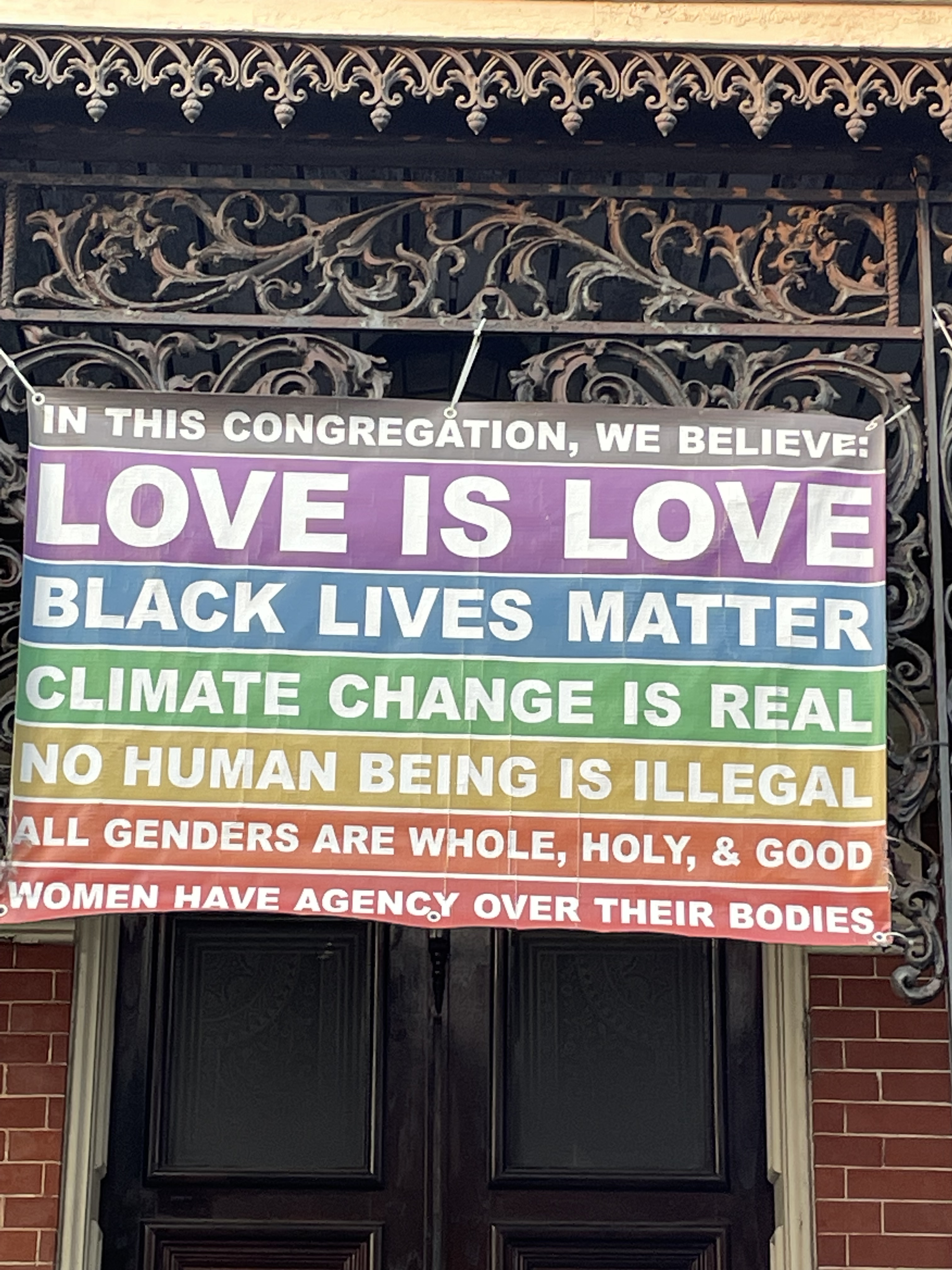
That’s why we have to say it, and say it explicitly, intentionally, out loud. Especially today, we need to keep saying that this church welcomes people who identify as LGBTQIA+. We need to say out loud that we do not believe being queer is any more sinful than being cisgendered and heterosexual can be. We need to keep saying publicly that we affirm all people are created in the image of God. We are not afraid to say out loud that this church believes black lives matter and black and brown people are always welcome here. To sit in our pews, be on our boards, lead our worship and preach from our pulpits.

We need to keep saying that our church welcomes women and believes women can teach a Bible study class that is of full men. We believe women, as well as people who identify as LGBTQIA+, can be teachers, preachers, pastors and even President of the Denomination. We believe women have power in the church’s boardroom, and that they always have power over their own bodies.

And when you are welcomed here, we need to keep reminding you that you become a part of our body; thus, when you suffer, we all suffer. So, you can count on us to be there for you, to care for you, to pray with you, and to fight for you when the world treats you unjustly.

The problem is that too many churches today are sitting back, half asleep, with one pole in the water. They are not moving, not changing, and not going out. And they are not intentionally saying anything, at least anything out loud. They could care less if anyone new comes to them, but if by sheer accident or dumb luck someone new does happen to come aboard, churches expect them to come aboard in a manner that measures up to their own expectations.

I will never forget that Nana used to go fishing with this special red pocketbook. It was leather or maybe vinyl and must have been lined with plastic. Nana always went fishing with this pocketbook, because when Nana was about the business of catching flounder, Nana did not discriminate.

When it came to flounders, you could say, Nana was Open and Affirming. Nana very graciously welcomed all flounders aboard the boat, even if they did not measure up to the expectations of the North Carolina Wildlife Commission.

I remember measuring a flounder: “Oh no! This flounder is an inch too short, I guess I need to throw him back.”

“Oh, you will do no such thing!” Nana would say, “He’s ‘pocket-book size!’”


Here’s what you don’t know, Nana’s son, my uncle, at the time, was a North Carolina Game Warden. Nana risked getting into trouble not only with the state, but with her own family.

I have heard it said, “If following Jesus does not get you into some trouble, then you’re probably not doing right.”

Pastors are constantly getting into trouble, for it is impossible to please everyone. But what’s crazy to me is that I have gotten into the most trouble when I have preached sermons on loving our neighbors, when I preach against hate and discrimination and for unconditionally loving and fully including people who may not measure up to our cultural, societal, or religious expectations.

I have had family members actually tell me that they are ashamed of me and that I embarrass them by preaching such inclusivity.

Some believe the sole purpose of the church is about making sure that everyone who is already in the boat is contented, comfortable and happy. They are unaware that Jesus calls us all to fish for people, to cast a large net bringing others aboard without discrimination, leading them to make the life-giving, world-changing decision to join a movement following the way of love that Jesus taught his disciples.

And God help us when the church is embarrassed to stand up to our friends and family and shout with the Apostle Paul: “For I am not ashamed of the gospel; it is the power of God for salvation!”  What’s the rest of that verse? “For everyone…Jew and Gentile. (Romans 1:16). Everyone.

I am afraid that many churches today are like fearful ol’ Simon, who upon looking at all those different fish in the boat, responded to Jesus with those unthinkable words, “Lord, go away from me.” They say it today through their exclusive membership policies, through their by-laws, creeds and confessions and in their sermons. And it is the main reason why so many churches today look nothing like Jesus.

Late Disciples of Christ pastor Fred Craddock loved to tell the story of one local church. Although their sign out front read, “A church that serves all people,” when all people would show up to be served, the exclusive spirit of the congregation continually drove the newcomers away.

About ten years went by. When, one day, Craddock was driving down the road where that church was located when he saw that the building that once housed that church had been converted into a restaurant.

Curious, he stopped and went inside. In the place where they used to be pews, there were now tables and chairs. The choir loft and baptistery was now the kitchen. And the area which once contained the pulpit and communion table now had an all-you-can-eat salad bar. And the restaurant was full of patrons—every age, color and creed.

Upon seeing the sad, but very intriguing transformation, Craddock thought to himself, “At last, God finally got that church to serve all people.”

[i] I heard Rev. Jesse Jackson allude to these “2 types of fishermen” at the Oklahoma Regional Men’s Retreat at Camp Christian, Guthrie, Oklahoma in 2016.

Come and See

Photo taken at the home of the Unitarian Universalist congregation in Lynchburg, Virginia.

What are we doing here this morning? How did we get to this place? Why are we here this morning sitting in a worship service? How does faith happen?

Well, according to John, it all started one day when John the Baptizer saw Jesus walking by and said to two of his disciples: “Look.” “Look, here is the Lamb of God.”

When the disciples heard him say this, they immediately, almost enthusiastically, began to follow Jesus, spending the entire day with him.

The disciple named Andrew went out and found his brother, Simon Peter and said, “We have found the Messiah.” He then brought Simon to Jesus so Simon could see for himself.

This is how church happens. This is how we got here this morning. We are here this morning because one person told another person who told another person who told another person about Jesus.

This is how our faith got started. It is the way our faith happens today. It is the way that faith has always happened. It is the way it is intended to happen. It is to be shared personally, person to person to person.

Our scripture text continues…

The next day, Jesus went out to Galilee and found a man named Philip and said to him, “Follow me.” Then Philip, much like Andrew who went and told Simon about Jesus, went out and found his friend Nathanael and said to him, “We have found him about whom Moses in the law and also the prophets wrote: Jesus, son of Joseph from Nazareth.”

And here’s where the story really gets interesting. Nathanael doesn’t respond with the eagerness and enthusiasm of Andrew or Simon when they first heard about Jesus. In fact, Nathanael responds much like we might expect people to respond to Jesus today. Nathanael seems cynical, skeptical, dismissive, and even rude. We can picture him arrogantly rolling his eyes asking, “Can anything good come from Nazareth?”

We can picture this, because we have seen it. We’ve heard this before, haven’t we?

Especially if we’ve invited anyone to be a part of a church lately, and I am hoping that all of you are inviting people! Because that is how our faith works. It is how church works. It is shared personally, person to person.

Do you remember hearing the cynicism in their voice, asking us: “Can anything good come from the church these days?” “Does anything good ever come from organized religion?”

Nathanael responds the same way people might respond to us when we bring up Jesus or the church these days.

However, notice how Philip responds to the cynicism of Nathanael. Philip does not respond in any of the ways I would respond. He doesn’t snap back. He doesn’t get defensive or walk away disappointed or angry. I am sometimes tempted to start preaching a little sermon, defending God and the way of Jesus, making the case for following Jesus, arguing that the things that he had heard about Jesus, Nazareth, and organized religion, are not all true.

No, Philip doesn’t do any of those things. He lets Nathanael’s criticism roll off his back and simply answers: “Come and see.”

What is interesting is that this is exactly how Jesus answered Andrew and his friend one day when they asked Jesus where he was staying. Jesus said, “Come and see.”

Andrew went and saw, and he saw that Jesus never really stayed anywhere. He saw that foxes have holes and birds have nests but the Son of Man has nowhere to lay his head (Matthew 8:20). He saw that Jesus was continually on the move, on a journey, teaching, leading, touching, healing, forgiving, feeding, giving, welcoming, accepting, restoring.

Jesus simply said, “Come and see,” and when Andrew went and saw, he saw that he had indeed seen the Messiah.

And when Nathanael dismisses Philip, Philip simply responds: “Come and see.”

Professor of preaching Michael Rogness points out that our task is “not to prove the truth of the Christian faith” to a skeptic or a cynic. It is not even to persuade others to become Christian. Our task is simply to say to others: ‘Come and see.’”[i]

And Nathanael came. And Nathanael saw this one who surprisingly knew him by name, this one who saw the good that was in him, this one who loved him and promised to open up heaven for him.

Seminary president David Lose remarks: “Such simple…and inviting words.” “Come and see.” Words, he says sum up “not only the heart of the Gospel of John, but the whole Christian life.” Because the Christian faith, he says, is “all about invitation.”

“It’s not about cramming your faith down someone else’s throat. After all, nowhere in the Bible does it tell us to ask anyone: ‘Have you given your life to Christ?’” Nowhere does the Bible tell us to go up to our neighbors and ask: “Have you accepted Jesus into your heart?” “Have you been saved?” Or worse: “If you died this very day, do you know where you will spend eternity?” Or even much worse: “God loves you and wants a personal relationship with you, but if you reject God, then God will send you straight to hell.”[ii]

No, we’re just asked to say (not to push, guilt or scare) but to say: “Come and see.” “Come and see for yourself what following this way of love that Jesus taught and embodied means in my life.”  “Come and see how the words and actions of Jesus informs my thinking, guides my life, gives my life meaning.” “Come and see for yourself the good things our church is doing to continue the revolution that Jesus started.” “Come and see.”

It is not our job to persuade, convert or to save; only to invite.

And here’s the thing. When we first bring up the subject of church, if they can see that we are truly being sincere, if they can see in our eyes that we are being honest and genuine, if they can see we are sharing from our hearts, we should expect them to be skeptical and cynical. We can fully expect them to dismiss what we are saying, or even make some smart-aleck response like: “I didn’t know anything good could come from church these days!”

And when they do, when they hesitate or smirk, we need to understand that that’s okay. In fact, in this world, it is to be expected. Because this good news that we are sharing—the good news that God, the creator of all that is, not only knows us by name, but loves us, sees the all of the good in us, the good that others are unable to see in us, the good we sometimes have trouble seeing us, and gives God’s self to us, affirming us as their child, and challenging us every day to bring some heaven to this earth—this good news does seem too good to be true.

Thus, we should completely understand if they pause at our invitation, if they look unsure, or even if they walk away. All we can do, all God wants us to do, is just say, “Come and see.”

Come and see a church that never stays put but is always on the move. Come and see a church that does not invite you to come to church but to go and be the church, to be the embodiment of Christ, a movement for wholeness in this fragmented world.

Come and see a church who strives every day to keep the dream of the Rev. Dr. Martin Luther King Jr alive by being a pro-reconciling, anti-racism church.

Come and see a church that believes in religious freedom for all religions, not just Christians. And come and see a church that does not believe religious freedom gives us a right to discriminate or to do harm to another.

Come and see a church that invites and welcomes both Jewish and Muslim leaders in our community to speak at a Thanksgiving Service, a church that wants to do all that it can do to break down the walls that divide us, to build bridges and create friendships will all our neighbors.

Come and see a church where you brain does not have to be checked at the door and believes in the importance of critical thinking. Come and see a church that believes science is real and caring for this planet is a God-given, moral and holy responsibility.

Come and see a church that believes all people are created in the image of God, and all means all. Come and see a church that values the leadership of women, ordains women, and believes women’s rights are human rights.

Come and see a church that is deeply rooted in the American dream, a church that was conceived by immigrants in the early 19th century, a church where the words of Emma Lazarus that are engraved in the foundation of the Statue of Liberty are engraved in our historical and spiritual DNA:

“Give me your tired, your poor,

Your huddled masses yearning to breathe free,

The wretched refuse of your teeming shore.

Send these, the homeless, tempest-tost to me,

I lift my lamp beside the golden door!”

Come and see a church that is not afraid to be labeled “woke” or “liberal” in a conservative town. And when we are, we smile and respond, “Thank you. We strive every day to be as wide awake and liberal as Jesus, Paul and the Hebrew prophets!”

Come and see a church that is committed to the Word of God, and, with the prophet Isaiah, isn’t afraid to speak truth to power:

Ah, you who make iniquitous decrees,

   who write oppressive statutes,

to turn aside the needy from justice

and to rob the poor of my people of their right,

that widows may be your spoil,

   and that you may make the orphans your prey!

Come and see a church that is preparing to celebrate 150 years of serving community by supporting childhood literacy, feeding the hungry, caring for the planet and supporting our threatened democracy by registering people to vote.

Come and see a church who, without condemning or judging, genuinely welcomes all people to join their mission to be the Body of Christ in this world. Come and see a church that believes we are all called to be ministers; we are all disciples called to build up the Body of Christ by inviting others to join us.

Come and see a church that believes that the grace of God extends to all, especially to those who need more grace, and that there is nothing in heaven or on earth, or in all of creation that can ever separate any of us from the love of God through Christ our Jesus Lord.

Come and see a church that seeks to be a place of grace, believing that none of us are better than others, and all of us, each one of us, including the pastor are imperfect and needs grace.

What’s that? You don’t believe what you are hearing?

Of course, you don’t. And we don’t expect you to. We are aware that it sounds too good to be true.

So, why don’t you just come and see!