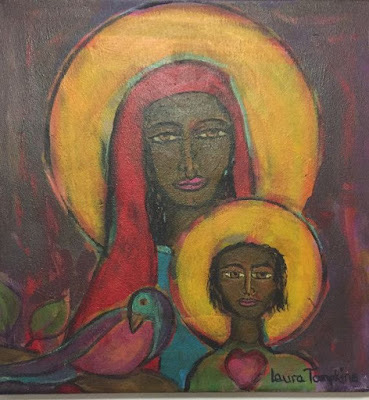
Christmas Contemplation

Luke 2:41-52 NRSV

It’s only been a few days since we celebrated his birth, but we fast forward twelve years when we read this morning’s lectionary gospel lesson where, in the same chapter of the story of his birth, Luke tells a story of 12-year-old Jesus that sounds something the contemporary holiday classic movie Home Alone.

After visiting Jerusalem for the Passover festival Mary and Joseph, with other members of their family had packed their bags and boarded the plane. From their seats in coach, they couldn’t see where Jesus was sitting, but assumed he as sitting somewhere among the large crowd of passengers. After a long day of travel, as they were retrieving their luggage from the baggage carousel, they picked up Jesus’ suitcase and handed it off to someone who began passing it down the line of relatives to Jesus, but at the end of the line, there’s no Jesus.

Because the boy never got on the plane and was now lost in New York, I mean Jerusalem.

It took three days of frantic searching before they found him in the temple, sitting among the rabbis, listening to their teachings, and asking questions. Don’t you wonder what questions twelve-year-old Jesus had for the Rabbis and what answers he gave in response to their questions that amazed all who heard him that day?

But it’s not Jesus’ questioning that gets my attention in this story. It’s Mary’s questioning. For I love the way Luke describes it: “Mary treasured all these things in her heart.”

The Greek word translated treasure means “to thoroughly keep.”

The thinking of Mary is thorough. Her questioning is meticulous and scrupulous. She thoroughly thinks it all through. Mary wonders, ponders, considers—she “treasures” the significance of what has happened.

And maybe, on this first Sunday after Christmas, this should be the mind of every disciple. A mind that is thoroughly evaluating and reevaluating, thoroughly questioning and wondering, thoroughly meditating and contemplating the meaning of Christmas.

What does it all mean to us? What does Christmas mean to the world? What does it mean to have faith in a God, who we believe is the creator, the source, and the essence of all that is, a God who we believe is Love love’s self becoming flesh, in the most humble, most selfless and most vulnerable of ways, to dwell among us, being with us, living in us, living through us, living for us, for all people, for the entire creation?

One of my favorite preachers, the Rev. Karoline Lewis writes: “Mary invites us into that contemplative space…not to obtain answers, but to ponder God’s place in and purpose for our lives. Mary summons us to sit and wonder…[reminding] us that an essential act of discipleship is reflection. Because none of what God is ever up to should be easy to get or at once understood.”

Lewis suggests that the best gift the church can give to people at Christmas is the gift of a safe and brave place for their own ponderings, a gift of space where reflection, questioning, and even doubting, are welcomed, and even encouraged, a gift of time that “demands only meditation and musing.”[i]

Especially in these days, when thinking doesn’t seem to be in vogue.

I’ve said it. You’ve said it. We’ve all noticed it. “Our country has a critical-thinking crisis.”

Well, we may not have put it in those exact words. But on this First Sunday after Christmas, it’s just not very nice using words like “stupid” or “idiots.”

We live in a world where there seems to be little time for any silence, much less for any meditation and contemplation. These days people are quick to allow others to tell them how to think and what to think without any questions. It’s what makes Fox News, some places on the internet, and churches where people are expected to check their brains at the door both popular and dangerous.

For a world where reasonable, reflective, critical thinking, and intelligent discourse have lost favor is a world that breeds authoritarianism and supports fascism. It is a world where an unstable, wannabe dictator can get a way saying something as ridiculous as: “What you are seeing is not happening.” And, without question, people will believe him.[ii]

I believe it’s fair to say that the lack of critical thought can be blamed for the most heinous and evil of all world events as it has led people to believe that something that is as obvious as our common humanity does not exist, to believe that one race, one nation or one religion is superior to another or favored by God over another, to believe that some people are cut-off or separated from God, while others are close to God.

So, perhaps the best sermon a preacher can preach on this Sunday after Christmas is one that invites us to join Mary after finding Jesus in the temple that day. It’s a sermon that gives us permission to think—a sermon that encourages us to follow the example of Mary to think deeply or to “treasure in our hearts” what this miraculous event we call Christmas truly means, to ask what our hearts are telling us in response to divinity becoming humanity, to the holy becoming flesh, to Love, love’s self, becoming a part of the creation and dwelling among us.

Franciscan Friar Richard Rohr, founder of the Center for Action and Contemplation, writes that contemplation is a way of “listening with the heart” in such a way that it awakens a new consciousness that is needed to create a more loving, just, merciful, and sustainable world.

Contemplation is the practice of being fully present—in heart, mind, and body—that allows us to creatively respond and work toward what could be. Contemplative prayer helps us to recognize and to sustain the Truth we encounter during moments we experience great love and great suffering, long after the intensity of these experiences wears off.”

So, on this Sunday after Christmas, let us ponder and wonder Christmas. Let us meditate and contemplate Christmas. Let us treasure Christmas. Let us make time for silence, and take time in silence to question our hearts and to listen. Not to hear the answer of popular culture, the answer of politicians, or even the answer of your church (and should I dare say) not even the answer of your pastor. Let us listen to hear a truth where Christmas becomes more than something we celebrate for a season, but a way of life that informs our being and instructs our living all year long.

Let us make time in these days of Christmas to listen to our hearts. What are our hearts telling us this morning about God being born as a vulnerable infant, in the body of a brown-skinned, Jewish Palestinian, to an unwed mother?

What are our hearts saying in response to a choir of Angels who invite not the rich and the famous to see the baby, but poor, lowly shepherds, those working the nightshift out in the fields tending to the sheep of another?

What do our hearts say when we read that the ones who feared the baby the most were those with the most privilege and power?

What are our hearts telling us when we hear the story of the baby and his parents fleeing their country as desperate refugees, crossing the border into Egypt as undocumented immigrants?

Father Rohr contemplates Christmas:

If we’re praying, [Christmas] goes deeper and deeper and deeper. If we are quiet once in a while…it goes deeper and deeper and deeper still.

There’s really only one message, and we just have to keep saying it until finally we’re undefended enough to hear it and to believe it: there is no separation between God and creation.

         This is the good news of Christmas, because, as Rohr observes:

Separation is the sadness of the human race. When we feel separate, when we feel disconnected…from our self, from our family, from reality, from the Earth, from God, we will be angry and depressed people. Because we know we were not created for that separateness; we were created for union.

So, God sent one into the world who would personify that union—[one] who would put human and divine together; [one] who would put spirit and matter together.”

[When we] wake up in the morning pondering and wondering: What does it all mean? What’s it all for? What was I put here for? Where is it all heading?

Rohr muses:

I believe it’s all a school. And it’s all a school of love. And everything is a lesson—everything. Every day, every moment, every visit to the grocery store, every moment of our so-ordinary life is meant to reveal, ‘My God, I’m a daughter of God! I’m a son of the Lord! I’m a sibling of Christ! It’s all okay. I’m already home free! There’s no place I have to go. I’m already here!’” Rohr then adds “But if we don’t enjoy that, if we don’t allow that, basically we fall into meaninglessness.[iii]

Rohr considers:

Friends, we need to surrender to some kind of ultimate meaning. We need to desire it, seek it, want it, and need it.

I know no one likes to hear this, but we even need to suffer for it. And what is suffering? Suffering is the emptying out of the soul so there’s room for love, so there’s room for the Christ, so there’s room for God.

On this first Sunday after Christmas, let us thank Mother Mary— For giving us permission to be still, to get quiet, to meditate and to contemplate, for encouraging us to ponder and to wonder, to find a safe and brave space to listen to our hearts to find meaning, purpose, and belonging, to empty our souls making room for love, to be enveloped with grace and held in love by the source and essence of all that is.

[i] https://www.workingpreacher.org/dear-working-preacher/keeping-company-with-mary

[ii] https://www.bbc.com/news/av/world-us-canada-44959340

[iii] https://cac.org/daily-meditations/only-one-message-2021-12-24/

For Unto Us, A Child Is Born

Luke 1:39-45 NRSV

It’s the Fourth Sunday of Advent, and all our waiting and expectation is almost over. We have gathered here this morning and will gather here again Tuesday evening if we are able to receive once again the long-expected baby Jesus. Even in this dark time, we are like Mary’s cousin Elizabeth, as something inside of us is leaping for joy!

Our anticipation stands in sharp contrast to that first Christmas, when this baby was not received by everyone. In response to the good news of Christmas, Elizabeth was filled with the Holy Spirit and exclaimed with a loud cry, “Blessed are you among women, and blessed is the fruit of your womb!” But not everyone thought of Christmas as good news.

The shepherds were filled with fear. King Herod, despite all his soldiers guarding him at the Palace, was sore afraid, driven to commit unspeakable acts, as he saw this baby’s birth as a threat to the empire. Even Joseph, the man engaged to Mary, didn’t readily receive the baby. In the beginning he spent many a sleepless night questioning: “Who’s really the father of this baby?”

In our sentimentalization of Christmas, we tend to forget that Jesus was conceived by a woman who was not married. The church and society have a history of giving ugly names to such babies. Thankfully, I don’t here many children called the “b-word” anymore. It is such a sad and offensive name to describe a child, so ugly that I find it inappropriate to say aloud from this pulpit, especially on this last Sunday before Christmas.

I do, however, sometimes hear the word illegitimate, to describe such children.  And that too, illegitimate, is a sad, ugly term for anybody, much less the very Son of God. Today, we also use other sad and ugly terms for children: “illegal,” “alien,” “vermin” and “abomination.”

In contrast to that very first Christmas where very few received this baby, in a few days, we will gather with the Church around the world to welcome and embrace the baby. With triumphant voices we will sing, “Come let us adore the baby!”

And there’s a counter miracle occurring here. We embrace the baby, but this baby is also embracing us. In the birth of Jesus, God came close to us, because we didn’t believe we were worthy enough to come close to God. So, before we congratulate ourselves on our willing and eager reception of this baby, let us wonder at this baby’s reception of us.

Not knowing we could reach up to God, without getting killed, in love and with love, God reaches down to us. God takes on our humanity so that we might know that we are a part of God’s divinity. God came as a child to show us that we are all beloved children of God. With every child born, we are born into this world in the image of God. We all have divine value, a sacred worth, a holy purpose. We were born in love, of love, for love, to love.

As someone who has been in the church for nearly sixty years now, and a minister for almost 40 of those years, people often tell me that I should write a book—A wonderful book of church stories filled with stories about you.

A Presbyterian minister from Northhaven, Minnesota did just that. In his book entitled, The Good News from Northhaven, Michael Lindval writes about his Presbyterian congregation.

It was his first Thanksgiving as pastor of the church. On the Sunday after Thanksgiving they were having an infant baptism. Much like the baptism of Phyllis Rose we had on the Sunday before Thanksgiving, the congregation was full of friends and relatives of the couple whose child was being baptized. Dr. Angus McDonald II, and his lovely wife, proudly presented their new son, Angus III, otherwise known as Skip, to be baptized. And the entire church could not have been more happy.

When it was time for the baptism, Rev. Lindval turned to the congregation and asked what is traditionally asked in some churches that baptize infants. He addressed the congregation and asked: “Who comes to stand with this child?”

Immediately, the grandparents, aunts and uncles and an assortment of relatives and friends, stood up and joined the parents at the front as they held the baby, presenting the baby for baptism.

When the service was over, after the congregation shook the minister’s hand upon exiting the church, Rev. Lindval, walked back through the sanctuary and noticed that one person had remained. He recognized her as someone who always sat on the back pew, closest to the back door.  She was a social worker, he remembered.

He greeted her, telling her he was glad to see her in worship, but she seemed to be at a loss for words.

After an awkward silence, she commented on how lovely the baptism was, and then, fumbling for words, said to the pastor, “One of my clients, her name is Tina. She has had a baby, and well, Tina would like to have the baby baptized.”

The pastor suggested that Tina should make an appointment to come to see him, along with her husband, and then they would discuss the possibility of baptism.

The woman looked up at the pastor and said, “Tina doesn’t have a husband.  She is not a member of this church but attended the youth group some when she was in Junior High. But then she got involved with this older boy. And now she has this baby. She’s only 17.”

The pastor awkwardly mumbled that he would bring the request before the next meeting of the Session, their church’s board meeting.

When the pastor presented the request before the Session, as you might imagine, there was some questions.  “Who’s the father?” “Where’s the father?”  The pastor said that he didn’t know. “Does Tina have any other family?” “I don’t know,” the pastor said. Heads turned.

“How could they be sure that Tina would be faithful to the promises that she was making in the baptism?” was a concern brought by more than one.

The pastor only responded by shrugging his shoulders, but thought to himself, “How could they really be sure about anybody’s promise?”

With much reservation, the Session reluctantly approved the baptism of Tina’s baby for the Fourth Sunday of Advent.

When the Fourth Sunday of Advent came, the sanctuary was full as children were home from college and many of the members had invited guests. They went through the service singing the usual Advent hymns, lighting the advent candle, and so forth. Then, it came time for the baptism.

The pastor announced, “And now, would those to be presented for baptism come forward.”  An elder of the church stood up and read off the three-by-five note card, indicating that he did not remember the woman or the child’s name, “Tina Corey presents her son, James, for baptism.”  The elder sat back down with an obvious look of discomfort on his face.

Tina got up from where she was seated and came down to the front, holding two-month-old James in her arms. A blue pacifier was stuck in his mouth. The scene was just as awkward as the pastor and the elders knew it would be.

Tina seemed so young, so poor, and so alone.

But as she stood there… holding that baby… with poinsettias and a Chrismon tree shining brightly in the foreground, they could not help but to think of another poor mother with a baby, young, alone, long ago, in somewhat similar circumstances. Yes, in another place and time, Tina and Mary seemed like sisters.

And then the pastor came to that appointed part of the service when he asked, “And who stands with this child?”  He looked out at the mother of Tina, who came that day, dressed in a very meager way, and nodded toward her. She, almost hesitantly stood and moved toward her daughter and her grandson.

The pastor’s eyes went back to his service book to proceed with the questions to be asked of the parents when he became aware of movement within the congregation.

A couple of elders of the church stood up. And many, on the same row as those elders, stood up beside them. Then the Junior High Sunday School teacher stood up. Then a new young couple in the church stood up. And then, before the pastor’s astonished eyes, the whole church was standing, and moved forward, clustering around the baby.

Tina began cry. Lindvall writes that Tina’s mother gripped the altar rail as if she were clutching the railing of a tossing ship, “which in a way she was”—a ship in a great wind. Moving forward this day so much closer to the ultimate destination of us all. And little James, as the water, touched his forehead, grew peaceful and content, as if he could feel the warm embrace of the entire congregation. Every person in the room was standing if this was their child, as if they were all family.

The scripture reading was from 1 John 3:1, “See what love the Father has given to us, that we should be called children of God; and that is what we are.”

On Tuesday night, we will gather here to celebrate the birth of a baby born into our family. But it is by this baby that we have been made family.

Maybe you came to this service this morning and plan to come Tuesday night all by yourself. Maybe you do not have much family, maybe you lost the family you had, or perhaps your family is far away.

But on this Fourth Sunday of Advent, here, right now, do you hear that rustling in the pews around you?

It’s the sound of your family. It’s the whole human family, taking shape around the manger.

Christmas means the Word has become flesh and is dwelling among us.

And what is that word?

“See what love the Father has given to us so we should be called children of God. And so we are” (1 John 3:1).

For unto us a child is born, so we will understand that we are all born in love, connected by love, bound together with love.

For unto us a child is born, so no child born should ever be called “illegitimate,” “illegal,” “alien,” “vermin” or an “abomination.”

For unto us a child is born, so we will stand up to stand with all God’s children.

For unto us a child is born, so every child will be welcomed, loved, and affirmed; every child will know their divine value, their sacred worth, and holy purpose.

For unto us a child is born, so all children will receive the hospitality of a cold cup of water, a hot meal, and warm shelter.

For unto us a child is born, so every child can be safe from gun violence, at home and at school, can live lives of peace, free of violence of any kind.

For unto us a child is born, so every child will have access to equitable education, a fair living wage, affordable healthcare, equal protection under the law—everything they need for a future full of promise, potential and peace.

For unto us a child is born, so every child will know freedom, justice, hope, and love.

For unto us a child is born, so every child will experience life: abundant and eternal.

For unto us a child is born, so blessed is the fruit of every womb.

Christmas in the Boondocks

Luke 3:7-18 NRSV

As a preacher, I often wonder about this thing we call a sermon. Like, why do we do it? Why do preachers prepare and deliver them, and why do you sit and listen to it?

I tend to believe that you are here for the sermon because need a little encouragement. In a world that can be dark and despairing, you need to hear a word of light and hope. In a world that can be sad and chaotic, you need to hear a word of joy and peace.

On top of all the problems in the world, war in Ukraine and in the Middle East, the acceptance of fascism throughout the world, including in our own country, you have all kinds of stress in your life. Some of your children are not doing as well as you would like. Some of you are having a difficult time taking care of aging parents. And some of you have your own health worries. Some of you are still dealing with grief over the loss of a loved one. And you are still struggling with forgiving that friend who let you down or loving a neighbor who betrayed you. So, you come to this place every to sit in a pew to get a little inspiration, to find a little peace.

So, I, along with hundreds of other moderate, educated, mainline preachers in our pretty, city pulpits, seek to give you a dose of what we think you want on Sunday mornings. Instead of saying anything that might add to the stress in your life, we try to say something to fill you with such peace, that when the time in the service comes when we pass the peace, you actually have something to pass. During the sermon, we seek to metaphorically pat you on the back on Sunday mornings assuring you that everything is going to be alright.

I am very tempted this morning to talk about my new granddaughter and how the birth of a little baby can change our world; then somehow compare that to the birth of Jesus peaching a soft, sweet, sentimental sermon of comfort and peace.

But then I encounter a text like this morning’s gospel lesson and read the account of a preacher who doesn’t remind us of any grandfather we know whose heart has been softened by the birth of a baby. His name is John, and he’s also a far cry any educated, moderate, mainline preacher in a pretty, city pulpit. He’s a harsh man with a harsh voice crying out in the boondocks far from the lights of the city.

No one ever called John “moderate.” And no one ever called him “mainline.” And there was seemingly nothing peaceful, about his message of hell, fire, brimstone, and impending judgment.

When John stood in the mud of the Jordan River and looked out in the congregation, he didn’t seem to see what I see when I look out on Sunday mornings. I see mostly good people who truly want to be better. John saw a snake pit. He preached: “You bunch of poisonous snakes! There’s a bunch of dead stones in this muddy river, but God is able to raise up a family out of these stones. There’s a heap of dry chaff, mixed all up in with the wheat, and you know what God’s going to do? God’s coming with fire to burn off the chaff. I wash you with water; and if this water is too cold for you… there is one who’s coming right behind me who is going to scorch you with fire!”

“You better get washed. You better get clean!  If you haven’t treated someone right, go make it right. If you have something you can give to those who have nothing to give, give it. If you have any prejudice in your heart, you better get rid of it. This may be your last warning. Today is the day. Now is the hour, for the ax and the fire are surely coming!”

Now I think, who wants to listen to a sermon like that? As it turns out, lots of people. Luke says: “multitudes” came out to hear him. And genteel, educated preachers in our nice city pulpits everywhere, scratch our heads and ask: “why?”

Perhaps you don’t come to church to listen to a sermon solely to be encouraged. Perhaps you also come to hear the truth.

Multitudes travelled way out into the boonies because that redneck preacher who looked like he could handle a snake or two named John was telling people the truth.

And perhaps that is why we are all here this morning. In a world where we are bombarded with lies…in a world in which we are overwhelmed with deceit, disinformation, propaganda, gaslighting and indoctrination… in a world where people make up stories to control us, using us for their selfish and greedy purposes…in a world where the rich and powerful control the media and malign the media they don’t control…and in a world where money is always the objective, we need to hear someone who will unashamedly speak to us, honestly and truthfully. We come here out of a deep yearning to hear a word of truth from God, because we know deep in our hearts that it is only that truth that will set us free and give us the peace we all desire.

That is why more people went out to hear John preach in the boondocks than have ever come here to hear me preach in the comfortable city sanctuaries where I have preached. Multitudes trudged through the briars and dust and went to hear a fire-breathing preacher who stood, not in a beautifully crafted and decorated pulpit, but in the muddy Jordan River, and spoke of axes, judgment, and fire. They went to hear the truth, even though they knew that truth was going to hurt. Because they somehow instinctively knew that it was the truth and only the truth that was going to set them free and give them a lasting peace.

If John was here today, I believe he would tell you that preachers like me often sell you short. And maybe he would be right.

For I have noticed, when every now and again, I unintentionally slip up and step on a few toes, a lot harder than I would ever intend to, inferring that some of you are not right…That some of you could do a little better…That some of you need a bath…That some part of you needs to be cut off, removed; something in you needs to be burned away…When I challenge you by saying something like: peace is only going to come on earth if you do something, that justice is only going to be done, if you use your privilege and power and act…When I explain how, even now, we are participants in the systems of oppression we deplore… you know what happens? Why, people line up after the service to say, “Thank you preacher. I really needed to hear that!” “You really got on top of my feet today! Thanks for being honest.”

I wonder what would happen if preachers all over the world had the gall to discuss all the lies and disinformation in our world today that is behind the growing popularity of fascism. What if we inferred that all of us could do more to stop it, that we could be more vocal in our condemnation of it, that our silence today only helps to normalize it, and such normalization is actually part of the historical playbook of fascism?

 What do we think our congregants would do if we challenged them— telling them the truth that when they hear their neighbors, co-workers and family members say things like: “People are just over-reacting;” “Things will not get that bad!” “The people in power? Why, they’re only talking. They don’t really mean what they say.” Our system of democracy is not fragile”—when they hear that, and then they say nothing, they only help to normalize fascism.

What would happen if preachers made a historical comparison between our silence today and the silence of those in 1860 when their friends defended slavery, saying things like: “We are actually doing them a favor!” What would happen if preachers compared our silence to those in 1930’s Germany when their friends defended concentration camps, saying something like: “Oh, they are just work camps. They are only helping people learn the value of labor and hard work!” What would happen if we compared our silence with those who said nothing when everyone around them was calling Martin Luther King Jr. “a troublemaker?”

Yeah, saying those things will certainly make some people mad. Some may not turn in their pledge cards. It may cause them to leave and never come back. But I have a feeling they’ll be many people lined up in narthexes everywhere to thank us, because people know the truth that before something can be born anew, something old must die. Before love can win, someone must be willing to pick up and carry a cross. Before justice can be done, work must be done. Before peace can happen, sacrifices must be made. Before Christmas can be celebrated, gifts must be given.

That is why people came to hear John preach. They came for the candor, for the honesty, and for the truth. From his prolific sermon illustrations (the fire, the ax, and chaff), we know that what John was preaching was the death of something old and the birth of something new.

This is why the multitudes traveled out into the boonies to hear John preach. Because when John told the people what they needed to change, what they needed to prune, cut off and burn up, the wilderness began to look something like the Garden of Eden. The muddy Jordan became the River of Life. Out of the dry dust, a flower began to bloom. Peace on earth became a little bit more of a reality.

This was the message of John the Baptist. People flocked to hear John, and I believe come to worship every Sunday so they can hear the truth: that none of us are who we ought to be. All of us could do better. We could be better.

We come here to ask God to hold up a mirror in front of us so we can see our complacency and our complicity. We ask God to search us and know our hearts; to test us and know our thoughts, to see if there is any wicked way in us and lead us the way that is everlasting. And having accepted the truth, we come to drop to our knees and ask God to take an ax and cut us down, or kindle a fire and purge us, so we can be reborn, so we can be cleansed and changed, so we can then do all that we can do to change the world. John preached the possibility of such a transformation.

And he’s still preaching it today. We can’t get to Christmas without first meeting him out in the boondocks. Multitudes have. By God’s grace, so will we.[i]

[i] Inspired from a sermon entitled Here Comes the Judge by William Willimon.

It’s Advent, and the Church Has Been Put on Alert

On this First Sunday of Advent, the lectionary gospel lesson puts the church on alert. If Luke was working with Homeland Security, the watch condition would be raised to the color, red, as the times in which we are living are severe. If there has ever been a time for the church to be prepared, wide awake, and paying attention it is now.

And what are we looking for? What are we making preparations for? For Jesus to show up of course!

The problem for some of us, including your pastor, is that sounds absolutely terrifying!

For that is how I was certainly introduced to this topic raised in a church where there was no shortage of end-of-the-world Sunday School lessons and doomsday sermons. In the sixth grade, I had a Sunday School teacher who talked about the imminent appearance of Christ every Sunday for an entire year. She clouded my head with charts and graphs, all indicating that Jesus was to appear in the clouds before my high school graduation.

In seventh grade, our youth minister took us to see the movie The Late Great Planet Earth that depicted people disappearing in the rapture. Planes, trains, and automobiles were suddenly without drivers. I watched in horror as planes crashed into crowded cities, trains derailed, and automobiles collided on every street.

And if this was not enough to permanently scar me for life, it seems like every revival preacher I heard preached that they were certain that the Lord was going to show up in their lifetime. This especially bothered me since most of those revival preachers were retired pastors, and to me, looked like they only had only one, maybe two good years left.

Today, we can find preachers all over the internet who are still preaching the imminent coming of Christ in this manner. They point to world events like Russia’s war with Ukraine and Israel’s war with Hamas, the involvement of North Korea and Iran—all signs that Jesus will soon be appearing.

And they’ll use scripture passages like our gospel lesson this morning to admonish Christians to stay alert, to be on guard watching for signs in the sun, moon, and stars. So, every eclipse, solar flare, supermoon, and shooting star is a sign that we are getting ready to meet Jesus! There will be distress among the nations confused by the roaring of the sea and the waves. So, every tsunami, hurricane, or the threat from melting ice caps, becomes signs that we are about to meet Jesus.

So, we are to be always on guard. Everyday, we must be on alert and prepared to stand before Jesus, because we don’t want to Jesus to come back unexpectedly, like a trap.

Thus, when I was a teen, this was the scripture my mom would use to discourage me from watching R-rated movies, drinking a beer, and smoking cigarettes:

“Jarrett, you need to know that the Lord could show up anytime. And if he catches you doing anything you are not supposed to do, he may not take you back to heaven with him.”

Although she probably didn’t realize it, my mom was using scripture the way the church has used it for 2,000 years, to control people with fear.

How sad and ironic is thar when it could be said that the greatest challenge our world faces today is fear.

From Pharaoh in the first chapter of Exodus (v. 8-10) to the fascist tyrants of our day, fear is used to turn those who are in some way different from us into the enemy. Fear causes us to be selfish. Fear is what makes us want to shout: “America first.” Fear causes us to horde, believing we will never have enough for ourselves if we continue to allow others to pour into our country. Fear drives wedges of distrust into our communities and makes any form of compassion or kindness seem dangerous.

Fear causes us to define ourselves and those around us not by what we share, but by what makes us different. Fear creates an “either/or” and “us/them” mentality that makes it nearly impossible to find any common ground, let alone see one another empathetically. Fear drives us inward. It hardens our hearts, darkens our vision, and makes us miserable.

Perhaps fear has always been our greatest problem as human beings, part of our evolutionary DNA. Maybe that is why the most common command in Scripture is: “Do not fear,” spoken 120 times by some angel, some priest or prophet or by an ordinary person.

I believe this is why I am drawn to the words of hope in verse 28 of our gospel lesson this morning. While many will faint in fear when they see bad things happening in the world, Jesus says: “Now when these things begin to take place, [we can] stand up and raise [our] heads, because [our] redemption is drawing near” (21:28).

It’s a promise that may be difficult to believe, because “these things” refers to foreboding signs in the earth and heavens, catastrophe and chaos among the nations, the powers of the day being shaken, and the coming of the apocalyptic “son of man” in power and glory.

So, how can we courageously stand up, and fearlessly keep our heads up, when the whole universe is burning down? How do we live in these days and in the coming days and not fear?

This is why I am glad that Luke is not the only gospel writer to write such apocalyptic narratives. A couple of weeks ago, we heard a hopeful word from Mark who said that such bad things happening just means that something beautiful is about to be born.

Matthew also wrote about Jesus talking about “the son of man coming in glory.” It is in Matthew 25 that we read:

When the Son of Man comes in his glory, (notice that he uses the same language as Luke) and all the angels with him…All the nations will be gathered before him…Then the king will say…“Come, you that are blessed by my Father, inherit the kingdom prepared for you from the foundation of the world; for I was hungry and you gave me food, I was thirsty and you gave me something to drink, I was a stranger and you welcomed me, I was naked and you gave me clothing, I was sick and you took care of me, I was in prison and you visited me.” Then the righteous will answer him, “Lord, when was it that we saw you hungry and gave you food, or thirsty and gave you something to drink? And when was it that we saw you a stranger and welcomed you, or naked and gave you clothing? And when was it that we saw you sick or in prison and visited you?” And the king will answer them, “Truly I tell you, just as you did it to one of the least of these who are members of my family, you did it to me.

I believe this passage in which we read Matthew’s description of the Son of Man coming in glory, helps explains why the church should be put on alert, be prepared and on watch today. We need to stay awake and pay attention for opportunities today to see Jesus in the chaos, catastrophe, and calamity of our world. Where? In the eyes of someone who is hungry and needs something to eat, or in the eyes of someone who is thirsty and needs something to drink. We need to stay on constant watch for opportunities to support organizations like Park View Mission, Meals on Wheels, or Lynchburg Daily Bread.

In these perilous days as missiles fall from the sky in Kyiv, bombs are denotated in Gaza, and fascists all over the world are stoking the fires of fear and division, the church is in a red alert situation to be on watch for opportunities to see Jesus in the eyes of a stranger, a foreigner, an immigrant, or a refugee who desperately needs a safe place of welcome, acceptance and hospitality. We need to be on watch for opportunities we may have to provide sanctuary.

In a world where politics is not only force that is more extreme these days, but extreme weather wreaks havoc on us all, especially those who are poor and vulnerable, the church needs to be woke enough to see Jesus the eyes of anyone who needs a safe and dry place to be and comfortable warm clothes to wear. We need to be on watch for opportunities to support warming shelters or places like Miriam’s House and Rush Homes.

In a world where sickness and disease is big business and access to affordable healthcare is tenuous, the church needs to be on watch for those who are sick or experiencing pain and be prepared support health providers such like Johnson Health Center, Community Access Network, or the Free Clinic.

During this time when tyrants seem to have the upper hand, when fear of marginalized groups is used to win elections, the church needs to be placed on full alert, on guard to see Jesus in the anxiety of someone living in some form of confinement, facing some sort of oppression, far from thriving, barely surviving. We need to be on watch for those opportunities we have to compassionately show up in solidarity.

Want to see Jesus this Advent Season? In these times of chaos, calamity, and catastrophe, we certainly need to be wide awake and watchful, hyper-vigilant and keenly aware of opportunities to see his imminent appearance. But don’t look up in fear. Look down with love. Look down and do justice.

Though signs may appear in the heavens like a shining star over Bethlehem, Jesus will not be found in the skies above. Though the capital city shakes, Jesus will not be seen in places of power. If we want to see the one who came into the world as a brown-skinned, middle eastern, undocumented refugee born in a lowly stable, we need to look for him down in the places we least expect to find him, suffering and crying among the least.

So, although the times in which we are living are severe, and the world around us seems to be falling apart, we can courageously keep standing, and fearlessly keep our heads up, because, as Luke says, our redemption is drawing near. Because when Jesus appears before us as we are being vigilant in caring for the least of these among us, it means that we are loving this world as we were created and called to love this world, with a just and equitable love that has the power to redeem, bringing wholeness to all of creation.