We Need a Slap in the Face

Luke 6:27-38 NRSV

These words from Jesus are some of the most difficult words to preach in the entire Bible. They are so counter-cultural, so offensive, that we would rather ignore them.

But these are the words of Jesus, and these are some of his very first words. So, if we want to call ourselves Christian, we cannot ignore them.

So, to avoid offending too many people, losing too many congregants, and, frankly, to avoid getting fired, preachers have this special knack of using a little hermeneutical smoke and mirrors. We pull this off by talking less about what the passages are saying, and more about what they are not saying. It’s a technique that preachers employ to keep their congregants happy.

And sadly, and tragically, this is one of the main reasons that many churches today, and many so-called Christian people, act nothing like Jesus.

Here’s an example of how it is done:

“But if anyone strikes you on one cheek, turn the other also.”

Now, Jesus is not saying here that should be pushovers.

“Give to everyone who begs from you, and do not refuse anyone who wants to borrow from you!”

Now, Jesus is not saying here that we should help those who are perfectly capable of helping themselves.

“Love your enemies.”

Now Jesus is not saying we have to like them!

See how that is done? Preachers get away with this all the time, and their congregations let them, because the preacher is saying the things they only wished Jesus said.

And then, to put the finishing touch on this chicanery, preachers quickly skip to the end of the passage and point out verse 36: “Be merciful, as your heavenly Father is merciful.”

It is then they say: “You see. None of us can be like God. Therefore, Jesus really does not expect us to do any of these things. He is just laying out some very high ideals—ideals that we can never live up to. Jesus is trying to reveal just how sinful and unworthy we are.

That’s when preachers leave these words of Jesus and go off on a tangent about grace and the need to accept Christ as our personal savior because none of us are like God, and we all fall short of the glory of God.

Now, I believe in grace. I need grace. I am by no means close to being a merciful as God, so grace is my friend. Grace is my hope. Grace is amazing. But here’s the problem with using grace as an excuse to not obey these counter-cultural commands of Jesus, and it is a huge problem— At the end of the sermon, Jesus (as if he knows we will try to use grace as some get-out-of-doing-what-I-say card) says, beginning with verse 46:

 Why do you call me “Lord, Lord”, and do not do what I tell you? I will show you what someone is like who comes to me, hears my words, and acts on them. That one is like a man building a house, who dug deeply and laid the foundation on rock; when a flood arose, the river burst against that house but could not shake it, because it had been well built. But the one who hears and does not act is like a man who built a house on the ground without a foundation. When the river burst against it, immediately it fell, and great was the ruin of that house.’

So, what are we to do with these passages? When someone slaps us in the face, does Jesus really want us to turn and give them the other cheek to slap? And are we really supposed to give people the very shirts off our backs? Give to everyone who begs of us? Really?

No, this just can’t be. For it is directly opposed to almost every instinct we possess.

We read these words of Jesus, and many of us have a problem. Let’s face it. We have a big problem.

Now, are you ready for some good news?

Well, you are going to have to wait, because the bad news is still coming.

The truth is: these very difficult and offensive words of Jesus expose an even bigger problem for most of us. Think about it…

When was the last time that you have taken a stand against an evil, an injustice, stood up for someone who was being marginalized and scapegoated, and because of that stand, because you stood up and spoke out, the supporters of that evil, not only sent you a nasty email, defriended you on Facebook, personally confronted you, but became so offended they physically attacked you by slapping you in the face?

What I am asking is: when was the last time that we’ve even had an opportunity to turn the other cheek?

When was the last time someone who was very cold approached you, and knew you well enough to ask you to give them the very coat that you were wearing? When is the last time anyone has asked you to sacrifice warmth so they could be warm? When was the last time that you even had the opportunity to offer someone in need the shirt off your back?

When was the last time that someone in great need came to you and begged for you to help them? I am not talking about the person you see holding a sign at an intersection, “Help. Homeless Vet.”  I am talking about someone whose name you knew, someone who knew your name, someone who felt like they could trust you, someone coming to you personally, swallowing their pride, and asking you for help?

Jesus says we are to love our enemies, but when was the last time that we’ve made an enemy? After all, isn’t confrontation something we all like to avoid? Isn’t it better, especially in this day and time, to mind our own business, keep our thoughts to ourselves, especially when it is about religion or politics?

Our problem is not that we are unwilling to turn the other cheek. Our problem is that we are so private, so unconcerned about anyone other than ourselves, that we never get off our blessed assurances to cause any confrontations.

Our problem is not that we are unwilling to give someone the shirt off our back. Our problem is that we are never around anyone who needs our coat.

Our problem is not that we are unwilling to give to the needy who personally approach us and beg of us. Our problem is that we do not personally know anyone in need.

Our problem is not that we are unwilling to love our enemies. Our problem is that most of us have never created any. We are so afraid of anything that might cause us a little discomfort, we never put ourselves out there to make any enemies.

And if we ever become bold enough to speak out, to take up for another or some gospel principle, if we know we have offended another, we usually go out of our way to always avoid that other. If we turn to go down an aisle at Kroger and see them, we will quickly turn and go to the opposite end of the store. Or we might leave and finish our shopping at Food Lion.

And because we stay away from those we have offended, because we keep our enemies at such a safe distance, we are simply nowhere close enough to them to even think about loving them.

You’ve heard the wisdom of keeping your friends close and your enemies closer.

The late Presbyterian author and preacher Frederick Buechner spoke of this wisdom:

If your enemies are close—

You see the lines in their faces and the way they walk when they’re tired. You see who their husbands and wives are, maybe.

You see where they’re vulnerable. You see where they’re scared.

 Seeing what is hateful about them, you may catch a glimpse also of where the hatefulness comes from.

Seeing the hurt they cause you, you may see also the hurt they cause themselves.

You’re still light-years away from loving them, to be sure, but at least you see how they are human even as you are human, and that is at least a step in the right direction.

It’s possible that you may even get to where you can pray for them a little, if only that God forgive them because you yourself can’t, but any prayer for them at all is a major breakthrough.

I believe Jesus is urging us to come close enough to others that we will truly be able to see them as beloved children of God, that tere is no “us” and “them.” There is only “us” as the Most High is kind to the ungrateful and to the wicked.

Now, here is the good news:

The good news is: You are here! You have put yourself out there! You are not so self-absorbed and selfish that you stayed home this morning. Your self-concern has not crowded out your moral concern.

The good news is: You are here, and together, as a church, we are going to go places where we will encounter people who are in such need that they may ask for our coats. And we will have opportunities to sacrificially offer them our shirts. We will get to know people who are so desperate that they may beg of us. And we will have opportunities to selflessly give.

Together, we will speak up, speak out, and stand firm for the gospel of Jesus Christ, for the prophetic justice he taught, and for the unconditional love for all people he modeled.

And yes, because this way of Jesus is socially unacceptable today in our country and in our city, we are certain to make some enemies. Like churches all over this country who are boldly standing up and speaking out, our property may be vandalized. Our flag will continue to be stolen. We are apt to stir up so much anger in some people that they will not only de-friend us on Facebook, send us ugly emails, but they may want to slap us in the face!

But together, because it is impossible to do it alone, together, as part of the household of God, we will not ignore them. Nor will we run and hide from them. We are having a discussion in our fellowship hall this Wednesday night to learn to have conversations with them. And we are having a workshop next month with Father John Dear to learn how to resist them nonviolently. We will learn together how to turn other cheek. We will learn together how to pray for them and how to love them. We will learn what actions we can take to make this world more peaceful, just, and equitable.

And no, we will never be as merciful as God, far from it. But we are going to do all we can do to stand up for mercy and to plead for mercy whenever poor people are called parasites, immigrants are scapegoated and transgendered and non-binary people are erased. We will stand together and stand up to the wicked in power who, full of lies, greed and hate, enrich themselves while trampling the poor, and then, we will at least be on our way, prayerfully, lovingly doing what we can, where we can, to become like the wise one who built a house on rock. And when the rains fall, the floods come, and the winds blow and beat on our house, it will not fall. Amen.

Far from the Shallow Now

Luke 5:1-11 NRSV

One morning, Jesus is preaching down at the lake. The crowd that had gathered is so large, Jesus felt like they were about to push him right into the water!

During the sermon, he sees two boats belonging to some fishermen who were on shore washing their nets. He gets into the boat belonging to Simon, and he asks Simon to anchor the boat a little way from the shore, where he continues his sermon.

Luke doesn’t record the words to Jesus’ sermon, but from his sermon in the very next chapter, we could probably take a good guess: “Blessed are you who are poor, for yours is the kingdom of God. Blessed are you who are hunger now, for you will be satisfied. Blessed are you who weep now, for you will laugh. Love everyone, even your enemies…” It’s a sermon of abundant mercy, extravagant grace, and boundless love!

After the sermon, Jesus tells Simon that he wants to do a little bit of fishing himself: “Let’s leave these shallow waters and let down the nets.”

Simon responds: “Master, with all due respect, I, along with my long-time business associates, James and John, have fished these waters all night long, and we haven’t caught a thing. Yet, if it will make you happy, I will go out a little deeper and put down the nets.”

Well, as soon as the nets hit the water, they catch so many fish that the nets begin to break. They quickly call out to James and John to get the other boat and offer them a hand.  And when they come, they fill the boats with so many fish that both boats begin to sink.

As Simon takes in the overwhelming scene— nets breaking, boats sinking, fish everywhere, a scene of failure and scarcity transformed into triumph and abundance, a scene of what can happen when you leave the shallow to dive into something deeper, what can be experienced when you obey the commands of Jesus—Simon is overwhelmed, and falling down at Jesus’ knees, he says: “Go away from me Lord, for I am a sinful man!”

It was as if Simon suddenly realized that it only seemed that Jesus was finished with his sermon that day. Jesus may be fishing, but he is still preaching. Through the abundant catch of fish, Jesus is still proclaiming God’s abundant mercy, extravagant grace, and boundless love. Believing he is underserving of such love, how unworthy he is of such abundance, Simon asks Jesus to go away.

But Jesus never goes away easily. “Simon, not only are you worthy to receive the abundant, extravagant, over-the-top love of God, you are worthy to share it with others and change this world! So, do not be afraid; for you are no longer going to be catching fish, you are going to be catching people!”

“I am asking you, Simon, along with your business partners James and John, to leave your shallow, contained, little world to venture out with me into a deeper, larger, revolutionary reality.

The truth is, Simon, I need you to go deeper. I need as many people as I can get to go deeper. The problems of the world are too great, and your lives are too short to waste any time wading in the shallow. And the grace of God is too extravagant. The mercy of God is too abundant. The love of God is too boundless for you to keep your it all to yourselves.

I need you to leave your shallow, safe world of spending all your time making a living to meet the needs of your immediate family, and I need you follow me into the deep, risky reality of sacrificing your time to meet the needs of the entire human family!

I need you to leave your shallow life that feeds you, and your children, and accept a deeper life that helps feed every child of God!

I need you to move beyond your shallow, narrow mission of caring for your own home, and accept the deeper, wider mission of caring for the entire planet!

I need you to lose the apathy towards issues that do not concern you and your limited of circle of family and friends to possess a deep empathy towards all who experience injustice!

I need you to move beyond your shallow understanding of success. Simon, no matter what you have been taught, success is not defined by the amount of fish you catch, or the size of your house or back account. It is so much deeper than that!

Your success is measured by how many people you loved extravagantly, abundantly, and graciously.

I need you to go deeper, Simon. You too, James and John, and be my disciples and fish for people. Do the hard, messy, oftentimes frustrating, and risky work to meet the needs of people, to care for and to liberate people. I need you to move far from the shallow now to do the deep work of love. And I am not talking about personal and intimate love, but a love that has public and political ramifications.

Now, here’s what I believe is the real miracle in this story. We read it in verse 11. After Jesus invited them to leave the shallow for something deeper, to leave the fish business to be in the people business we read: “When they had brought their boats to shore, they left everything and followed him.”

This is miraculous because when it came to accepting the extravagant grace and love of God revealed in the large catch of fish, Simon, seemed to have some difficulty: “Get out of here, Jesus! I am a sinful man!”

However, when it comes to following Jesus to a deeper life, to love others to selflessly and sacrificially, extravagantly and liberally, he, with James and John, leave everything and follow.

This is miraculous, because it is the exact opposite of how we humans usually work. We seem to have no problem accepting the grace of God for ourselves. We have no issues receiving the love of God for us personally. But we prefer to keep it shallow. We prefer to keep it personal. We prefer to keep it safe, keep it contained, keep it conservatively to ourselves. We are almost always reluctant to go deeper.

Because going deeper is dangerous. Going deeper is costly, and it is risky. Going deeper can be overwhelming. In the deep, fish break our nets and people break our hearts. Going deeper may mean leaving our friends and family behind.

I want to thank Katie Nunn for sharing her talent with us by creating this extravagant artwork that is adorning our baptistry today. When she first thought of this idea, which to me, speaks to the abundant and extravagant love we are called to share with others, she said she was tempted to think that the art might be “too far out” for church. But then, thinking about what this church means to her and to others, she thought, when it comes to love, for this church, there’s no such thing as being “too far out.”

In other words, Katie has joined a congregation of disciples, who, with Simon, James, and John, when it comes to love, have chosen to go deep, to go far out from the shallow.

We are disciples who have decided to go on a journey to share the abundant mercy, extravagant grace, and liberating love of God with all people, all the while knowing the journey will not be easy, comfortable, or popular.

Late author and professor John Augustus Shedd once said: “A ship in harbor is safe, but that is not what ships are built for.” And today, we are on a ship with Jesus. He is the captain who navigates our journey out of the harbor into deep, dark, and dangerous waters.

The darkness of these days, like deep water, requires more than a shallow response. The times are too serious, and our time is too short, to waste any amount of time playing around in the shallow.

When the president makes an executive order to “eradicate” any opposition to the sick religion of White Christian Nationalism or the cult of MAGA, while disparaging any religious thought that calls for mercy and compassion, empathy, and equality, we must go deeper.

When the tax status of non-profits and institutions that serve the common good are threatened, when aid to the poorest people in the world is cut off, our stewardship practices, our civic engagement and our commitments need to go deeper.

When houses of worship receive warnings by the government that sanctuary provided to the immigrant will not be honored, that we may be targeted, our commitment to the word of God “to treat the foreigner living among us as native born, to love them as ourselves” gets called into the deep (Leviticus 19:34).

When programs designed to celebrate diversity, create equity, and foster inclusion are eliminated in favor of protecting the privileged, our faith compels us to go into the depths of human solidarity and belonging.

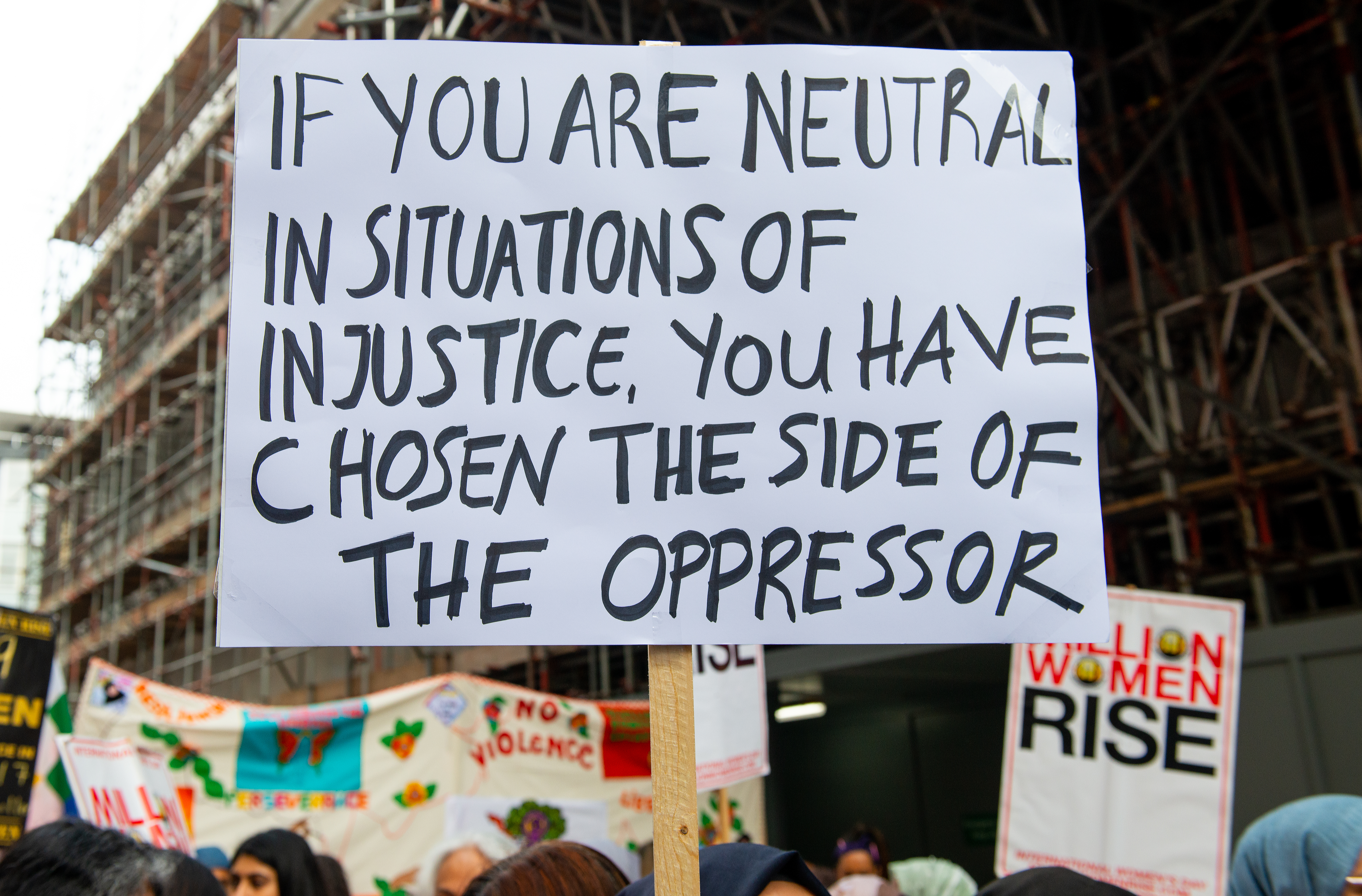
So, if you have come here this morning because you want to dip your toes in the safe shallow end of the pool, to wade, splash around, and enjoy yourselves, to nourish your private, personal relationship with the Lord, to remain neutral when it comes to public policy and politics that hurts the poor and the marginalized, then I am afraid, you have come to the wrong place! We don’t even have a kiddie pool for children in this place, as we are even training them to swim in the deep end.

Because we know that a shallow, safe, personal, and private faith, a faith that has the sole purpose to feed one personally, allows children to starve, and the entire creation to hunger.

A shallow faith allows the spread of a false gospel that is unconcerned with the living conditions of anyone else living on the earth as well as the state of the earth itself.

Shallow faith enables false prophets to reject Jesus, or worse, to act in ways that are the antithesis of Jesus, ways that are anti-Christ, and still claim they are following Jesus.

Shallow faith is afraid to enter into the depths of human suffering and oppression. It finds contentment inwardly, in one’s own family, job, possessions, and even church.

Shallow faith is afraid to rock the boat, afraid of losing a friend or upsetting a co-worker or family member.

Shallow faith is afraid of the sacrifices and the changes that need to be made.

And sadly, church is where people can be the most afraid, and thus the most shallow, the most small-minded and the most close-minded, the most self-interested and self-preserving

But the good news is that church can also be the place where people can be the most courageous, a place where we are challenged to be more open, more selfless, and more self-expending, where we are pulled by Jesus into the deep, dark, and dangerous places, far from the shallow.

To those difficult places where we have a deep conversation with that climate change-denier or anti-vaxer. Where we go out of our way to help an asylum seeker. Where we contact our legislatures to object to the wicked assault on trans people. Where we call out racism and white supremacy wherever we see it, on the school board, the city council, even in our own families.

The good news is that the First Christian ship of Lynchburg, Virginia has left the harbor. Jesus is our captain. And we are far from the shallow now! Amen.

When Jesus Falls Out of Favor (and nearly off a cliff!)

Luke 4:14-30 NRSV

Once upon a time, in a land far away, but not so different from our own, excitement was in the air as folks began gathering in the narthex, sipping their coffee. Everyone was looking forward to the sermon. Because today, they had a special guest preacher!

Many were just glad to have a break from listening to their pastor who they’ve had to now put up with for a year and a half. But some were really looking forward to hearing one of their own, someone who had moved away, made a name for himself, and made them proud. He had come back home for a visit and had been asked by the Elders to fill the pulpit.

No one paid attention as the announcements were being made. In the pews, heads moved and necks stretched, as everyone was trying to catch a glimpse of their hometown pride and joy.

After the Children’s Moment and the Pastoral Prayer, the young man stood up in the pulpit.

“Look! There he is!”

“My, hasn’t he grown!”

“He looks just like one of us, with his dark eyes and complexion.”

The worship leader handed him a scroll. He unrolled it and began reading words from the prophet Isaiah:

‘The Spirit of the Lord is upon me,

   because he has anointed me

     to bring good news to the poor.

He has sent me to proclaim release to the captives

   and recovery of sight to the blind,

     to let the oppressed go free,

to proclaim the year of the Lord’s favor.’

He rolled up the scroll, gave it back to the worship leader, and sat down. All were smiling as he had just read one of their favorite scripture passages.

It is then, that he stood back up and dropped the mic by declaring: ‘Today, this scripture has been fulfilled in your hearing!’

Countless amens could be heard throughout the sanctuary. One congregant shouted: “Hallelujah!” Another exclaimed, “Praise Jesus!” Another said, “I wished he was our full-time pastor!”

Everyone was pleased as they could be! Because the scripture he read was being fulfilled for them. Good news for the poor meant good news for them, because they didn’t consider themselves to be among the rich oligarchs that were in power.

And because they were living in an occupied territory, release to the captives, meant liberation for them!

Because they had lost hope and had a difficult time seeing anyway forward, recovery of sight to the blind meant recovery of hope for them!

And because they felt oppressed by the Romans, freedom for the oppressed meant freedom for them!

So, amen, brother! Preach it!

They could not have been more enthusiastic with their hometown hero! All throughout the sanctuary, you could hear proud comments like: “Why isn’t that Joseph’s oldest boy?”

After the choir sang the anthem, the young preacher stands back up, takes a sip of water, and begins the sermon: “There’s no doubt many of you will say: ‘Doctor, cure yourself.’ ‘Do here also here in your hometown the things that we heard you do Capernaum.’”

“That’s right!” someone shouted!

Another yells: “Charity begins at home!”

Someone else screams, “America First!” (I mean, “Israel First!”)

On the edge of their seats, their ears are itching to hear what their hometown boy had to say next!

It is then he says something like: “You know that no prophet is accepted in his hometown

Someone cupped their hands to their mouth and shouted: “We’ll always accept you Jesus!”

Another yelled: “That’s right! You are one of us!”

Still another shouted: “We’re with you all the way!”

He takes another sip of water and then begins to proclaim that Isaiah’s prophetic vision of good news, liberation, recovery of sight, and freedom is not for them only, or even for them first. It is for everyone, maybe even especially for those who need it the most, folks that may not be from around here

In the congregation, shoulders tense, and heads turn. More comments could be heard, but the enthusiastic tone becomes disconcerting: “Wait a minute! I know he’s not talking about diversity, equity, and inclusion, is he?”

Jesus, though, is undaunted by the sudden aggravation in the air, because he wasn’t there to win a popularity contest or to scratch itching ears. He’s  there to tell the truth, even if that truth is unsettling, because Jesus knows that the truth of God’s inclusive and equitable love, as offensive as it may be, is the only way to create a more peaceful and just world.

Jesus then reminded the congregation why the prophets are never popular in their hometown by referring to two stories, one about the prophet Elijah and one about the prophet Elisha.

“You remember Elijah, don’t you? And the story of those three and half years it hardly rained a drop, causing a severe famine throughout the region? Now there were countless widows living in Israel during that time who were starving to death. But God didn’t send the prophet Elijah to help any widows in Israel. No, instead, God sent the prophet to save a widow in Lebanon.”

Apart from a few gasps, the congregation fell so silent you could hear a pin drop.

“And you remember the prophet, Elisha? There were many lepers suffering in Israel, but instead sending the prophet to heal those in Israel of their disease, God sent Elisha to heal a leper in Syria.”

The sanctuary exploded! People rose to their feet. Some began shaking their fists in the air.

How dare he say that the blessings of God extend beyond our borders, to other cultures and ethnicities!

The audacity he has to say that God’s mercy, justice, and freedom are not just those of us who have the proper papers or the right genes!

And how dare he infer that God may even favor someone from Lebanon or from Syria, over us!

The unmitigated gall he has to say that this scripture is fulfilled in our hearing, but not fulfilled for us!

Overcome with rage, the congregation turns on Jesus.

Some demand an apology.

Others call his words “ungracious,” his tone “nasty.” And his service “boring.”

One accused him of being a left-wing lunatic who was bringing woke politics into the synagogue!

Someone else cried: “Deport him!” Another shouted: “Send him to Guantanamo Bay!”

They become so angry that before Jesus is able to finish the sermon, they chase him out of the sanctuary and run him clear out of town right to the edge of a cliff. But he doesn’t fall off the cliff. He somehow sneaks through the crown and escapes.

How quickly had Jesus fallen out of favor and nearly off a cliff!

But that’s the world in which we live—a world where empathy is considered a sin. Because empathy involves loving our neighbor—not the just ones who live next door, but the ones who live in Lebanon and Syria, in Mexico, Gaza, Columbia, Cuba, and Venezuela—as much as we love ourselves.

The word “freedom” has always been a threatening word when it is applied to a group people that another group of people deem “other” or “less.”

 “Diversity,” “equity,” and “inclusion” have always been offensive words to those who want good things for themselves only, or at least, for themselves first. Equality can feel like oppression to those accustomed to privilege. And in our nation, that means that the angry mobs have historically been white people.

It was only a little over 60 years ago, a time that those currenlty in power are trying to take us back to, empathetic people from all over the United States traveled to the South to take a stand for the civil rights of all people. Some were called Freedom Riders, as they rode buses throughout the South to nonviolently resist unjust Jim Crow laws.

Like the time Jesus preached freedom for the other in the synagogue, an angry mob formed. And on Mother’s Day in 1961, in Anniston, Alabama, 50 white men, many of them religious, attacked a Greyhound bus carrying black and white Freedom Riders with pipes, chains, and bats. They smashed windows, slashed tires, and beat the sides of the bus to terrorize the Freedom Riders who were inside.

Once the attack subsided, with the Freedom Riders still on board, the police pretended to escort the damaged bus to safety, but instead they abandoned it just outside the Anniston city limits.

Another armed mob surrounded the bus and began breaking more windows. The Freedom Riders refused to exit the bus and received no aid from two highway patrolmen who were watching nearby. When a member of the mob tossed a firebomb through a broken bus window, others in the mob attempted to trap the passengers inside by barricading the doors of the bus.

The mob fled when they feared the fuel tank was about to explode. Somehow, the Riders were able to escape the ensuing flames, only to be attacked and beaten as they exited the burning bus.[i]

Kindness, grace, and compassion have always made people wickedly angry when it is applied to outsiders. Some people have always called empathy a “sin,” because empathy involves caring for someone other than yourself, or other than “your” people. Thus, the powers of wickedness have always tried to trump the power of love. Darkness has always sought to overcome light.

The good news is that darkness is no match for even a little bit of light, and love always wins. The good news is that Jesus did not fall off that cliff, and through the resurrected body of Christ, he is still alive and preaching in our world today.

I know that it may feel like we are standing at the edge of a great cliff. Our feet may be slipping as the rocks move under our feet. Some of us have slipped, and our feet are dangling over the edge. We’re barely hanging on. But we are not falling.

Somehow, someway, as Jesus escaped those angry worshippers who chased him to an edge of a cliff outside the city limits of Nazareth, and as the Freedom Riders escaped that bus set on fire outside the city limits of Anniston, Alabama, we too have escaped.

 We are still here. Jesus and his followers may have fallen out of favor with the powers-that-be, but we have not fallen off the cliff!

And despite the opposition in our nation today, the intimidation in our state today, and the hostility in our city today, we are still proclaiming good news today, not just for ourselves, but for all people.

We are still committed as ever to fulfilling the promises of God for black and brown people—

Proclaiming God’s liberation for non-binary and transgendered people—

Proclaiming God’s freedom for undocumented people, asylum seekers, refugees, migrants, and victims of war.

And proclaiming a hopeful vision of God’s peace and justice—

God’s empathetic vision of mercy and compassion—God’s prophetic vision of diversity, equity, and inclusion—shining our lights so all can see it!

The dark winds of wickedness are howling, but our candles are still burning!

On the edge of a cliff, we may feel we are barely hanging on today. We may have fallen out of favor. But we are not falling off! Say it with me: We are not falling off! Amen.

[i] https://calendar.eji.org/racial-injustice/may/14