Grumpy Jesus: The Fierce Face of Love

Luke 9:51-62

Jesus seems a little stressed in our gospel lesson this morning. And who could blame him?

Luke tells us his face is set toward Jerusalem, not toward comfort or safety, not toward respectability or popularity, but toward the seats of power that believe the love he proclaims is weak, the empathy he demonstrates is a sin, the mercy he shows should get him deported, and his grace—His radical inclusion and acceptance of the marginalized? His free handouts of fish and bread and healthcare? His solidarity with foreigners? —Why, all of that lunacy oughta get him crucified!

And at this point in his ministry, he seems exasperated by the lack of support around him, by the religious culture, including his disciples, so much so, the obvious title for this sermon is “Grumpy Jesus.”

Jesus’ journey toward Jerusalem doesn’t get off on the right foot, as he receives word that there no hospitality awaiting him in a village of the Samaritans. No room in the inn, or this time, even in a barn! This is not surprising considering the Samaritans and Jews mutual animosity; yet knowing Jesus’ love that has no borders, he’s obviously frustrated. But perhaps he is more frustrated by his disciples’ response.

James and John, bless their lil’ hearts, ask Jesus if he wants them to reenact a scene from 2 Kings by asking God to rain down fire from heaven and wipe out the entire Samaritan village!

Episcopal priest Rick Morley says this is like “one of those moments at Thanksgiving when your crazy uncle says something so ridiculously inappropriate that everyone just turns and stares with their mouths agape.”

After James and John’s outrageous suggestion, he imagines Jesus doing a face palm.

Of course, grumpy Jesus immediately rebukes them.

Then, Jesus has a series of three encounters with some pretty good disciple prospects. And after James and John’s hell, fire, and brimstone comment, wouldn’t it be nice to have some fresh blood?

The first would-be disciple comes, and without Jesus asking him, presents himself as the perfect candidate: “Jesus, I will follow you wherever you go!”

Now, what’s not to like about that? It’s exactly the kind of people this world needs more of!

But, Jesus, perhaps still exasperated because no one in Samaria left the light on for him, responds: “Foxes have holes, and birds of the air have nests; but the Son of Man has nowhere to lay his head.”

“Okaaaay, Jesus. I’ll check back with you when you have had your coffee.”

Jesus then encounters another prospect and invites him to join the movement. He agrees but asks permission to go and bury his father first. It’s a very reasonable, loving, and faithful request. It was his part of fulfilling God’s law to “honor father and mother.”

But then, if you thought the “foxes have holes and birds have nests” comment was a bit snarky, Jesus responds: “Let the dead bury their own dead; but as for you, go and proclaim the Kingdom of God.”

Now, he’s really sounding grumpy.

C’mon Jesus. I know you are upset that you have nowhere to lay your head, and I know your disciples are idiots, or at least can be very frustrating, but the poor man just wants to bury his father! What can be wrong with that? Isn’t honoring our parents part of discipleship? Isn’t taking some time to grieve over the loss of a loved one something God would want us to do?

Then, Jesus encounters the third would-be follower, who like the first one, also volunteers for discipleship without being asked. But first, he wants to go and say good-bye to his family, perhaps to let their children know why Daddy wouldn’t be home for a while. Again, sounds like a reasonable request. Even Elijah allowed Elisha, who was plowing a field, to first say good-bye to his parents before leaving to join Elijah’s ministry (1 Kings 19:19-21).

But grumpy Jesus isn’t having it. Echoing the calling of Elisha, he says, “No one who puts a hand to the plow and looks back is fit for the Kingdom of God.”

This is when I wanna say: “Look Jesus. I know you’re upset. I know you’re tired. I know you’ve nowhere to lay your head. I know you’re frustrated. I know the disciples that you have been training to be compassionate, loving, forgiving, merciful and peaceful want to fire bomb an entire village. I know you have your face set on Jerusalem and all the opposition that is to come. But come on, Jesus, take it easy. Let this man say good-bye to his family. And for God’s sake, let this one bury his father!”

But this is Jesus. Thus, my faith tells me that there must be something more going on here—something more than a little fatigue, frustration, and fear.

His face is set toward Jerusalem. This could infer that he knows the that his time on earth is short. And he knows that if he is going to usher in the Kingdom of God before he dies, there’s no time to waste.

The same is true for us. The reality is that our time here is also short. And if we want to make a difference for the Kingdom of God while we’re here, there’s not a moment to lose.

But maybe Jesus’ grumpiness has nothing to do with himself. Afterall, Jesus is always demonstrating the importance denying and losing one’s self. So, perhaps Jesus is not thinking about his own circumstance at all.

Perhaps he had in mind other circumstances and people who needed the good news he was proclaiming. Perhaps Jesus knew that, not for him, but for others, for many, there wasn’t a moment to lose.

So, his grumpiness is really a holy urgency, a sacred stress fueled by a divine love with a height, a depth, a width, and a breadth that we can only begin to understand. Perhaps Jesus knew that for God’s kingdom to come to those who need it the most, there’s not a moment to lose.

There’s not a moment to lose –

For those who are poor, for those who hunger, for those who weep, for those who are hated, insulted, excluded, and rejected (Luke 6:20-22).

There’s not a moment to lose –

For those Samaritans who believe they have lost favor with God (Luke 10:25-29);

For a woman who had been crippled for eighteen years (Luke 13:10-17);

For a man who had been suffering with dropsy. Remember that Jesus healed him on the Sabbath in the presence of the Pharisees (he didn’t wait until the next day when it was lawful), proving, there is not a moment to lose (Luke 14:1-4).

There’s not a moment to lose –

For the rich man who thought he was blessed because he was rich. For the poor man who thought he was cursed because he was poor (Luke 16:19-31);

For the ten lepers who approached Jesus in a region between Galilee and Samaria (Luke 17:11-19);

For the blind beggar sitting beside the roadside near Jericho (Luke 18:35-43).

There’s not a moment to lose –

For a man named Zacchaeus who defrauded the poor;

For all of the poor people he defrauded (Luke 19:1-10).

Jesus is frustrated, because there’s not a moment to lose—

For an entire world that feels rejected, cursed and lost;

For LGBTQ people whose lives are not worth the cost to fund a suicide hotline.

For millions of Americans who are one step closer today to losing their health insurance because of a big, brutal, not beautiful, bill in congress.

For immigrants snatched from their homes, their gardens, their schools and workplaces without cause and due process and cruelly imprisoned separated from their families.

Jesus is exasperated, because there’s not a moment to lose—

For all children who suffer from neglect and abuse;

For girls who are raped and then denied healthcare;

For boys who are taught that it is okay to objectify girls;

For the person with a disability who feels like the whole world, even God, is against them.

Jesus is stressed, because there’s not a moment to lose –

For the one dying of loneliness in a nursing home;

For those who have to make the choice every week to either buy their medication or to buy groceries;

For those unjustly locked away in our prisons because of their economic status or skin color;

Jesus is grumpy, because there’s not a moment to lose –

To respond to climate change that threatens God’s good earth;

To end the destructive pollution of the planet with plastics and carbon.

And Jesus has his palm planted on his face today, because many of his disciples still don’t have a clue. Some still want God to rain down fire and brimstone on those who believe and live differently. And many would-be-followers still have no sense of urgency to be public witnesses of love, peace, mercy and justice.

And the clock is ticking. The Kingdom is at hand. The time is now. We don’t have the luxury of comfort. We don’t have the privilege of delay. We can’t afford to wait until the children are grown, until the house is paid off, until we’ve buried all our grief or kissed everyone goodbye. For there’s not a moment to lose.

This world is on fire, not with holy fire, but with the flames of greed, racism, heteroism, white Christian nationalism, militarism, and climate catastrophe. And while some are lighting matches, too many are just watching it all burn. Too many are saying: “Let me finish what I was doing first” or “let me look after my own first,” while the Samaritan is bleeding in the ditch, while the trans teenager is hanging on by a thread, while hungry people with brown skin are afraid to go to the grocery store for fear of being deported to a country where they’ve never been and have no connection.

Jesus has set his face toward Jerusalem, and he is calling us to set ours—not toward comfort or safety, not toward respectability or popularity, but toward the place where justice is born.

We are not called to admire Jesus from a safe distance in some comfortable sanctuary. We are not called to study him or sing praise songs to him. We are called to walk with him, to move with him, to carry his gospel like it’s a matter of life and death. Because it is.

So, let the church rise up, not with stones in hand, but with bread and wine, with towels and basins, and bullhorns and ballots. Let’s sound the alarm, flood the phones, take to the streets, and send so many emails to our representatives we crash the servers.

Let the church understand that there’s not a moment to lose to tell the truth—
Not a moment to lose to dismantle hate.
Not a moment to lose to march with the poor.
Not a moment to lose to shout that Black and Brown Lives Matter.
Not a moment to lose to say queer and trans people are sacred.
Not a moment to lose to break the chains of every modern-day Pharaoh.

In our text Jesus may be tired. Jesus may be exasperated. Jesus may even be grumpy. But Jesus isn’t giving up, and neither can we.

So, let’s stop looking back.
Let’s stop making excuses.
Let’s put our hand to the plow and move forward…
with power, with grace, with courage, with compassion, with mercy and with the fierce, unrelenting urgency of love!

Because the Kingdom is not coming later.

The Kingdom is coming now.

And there’s not a moment to lose!

Amen.
Rise Up and Live!

Luke 7:11-17

Our scripture lesson this morning takes us back in time with Jesus to the gates of Nain, a small town in Galilee. As soon as Jesus enters the city gates, he encounters a funeral procession for the young son of a widow being carried to his grave.

But I believe Jesus sees more than a funeral. I believe Jesus sees it all. He walks into Nain and sees an unjust system carrying its latest victim to the grave. He sees the only son of a widow, which means, the only source of security for a woman living in a patriarchal world. When her son died, the widow’s future died with him. Jesus sees what happens when poverty and patriarchy crush a family. Thus, this is not just personal tragedy. It’s cruelty. And it’s a social indictment.

And I believe this is what Jesus wants us to see.

But we don’t need a time machine to see this funeral procession in Nain with Jesus, do we? For here in America, we can see it every day.

When billionaires profit from privatized healthcare, while the working poor die from preventable diseases, it’s like we are back in Nain.

When a bill they call “big and beautiful” takes health insurance away from millions of poor people and eliminates grants for medical research so the rich can enjoy tax cuts, it’s like we’re standing at the city gates of Nain.

When food programs for the poor are slashed in the name of “fiscal responsibility” while millions are spent on masked men in unmarked vans kidnapping brown-skinned people who are on the way to school or work, we are watching a very cruel spectacle march by.

When the supreme court denies the right to gender-affirming healthcare, greatly increasing the suicide rate among trans youth, when women are denied abortions, when programs like Job Corps are suspended, when missiles are being launched and bombs are being dropped, when we stand today on the threshold of war, indeed, we are not far from that funeral procession in Nain.

And the actions of Jesus in response to this procession reveal another tragic truth. The tragedy of the funeral procession in Nain is what happens when the powers of injustice, violence and death are normalized. A dead child going to their grave before their time is what it looks like when no one stands up to say: “Enough is enough!”

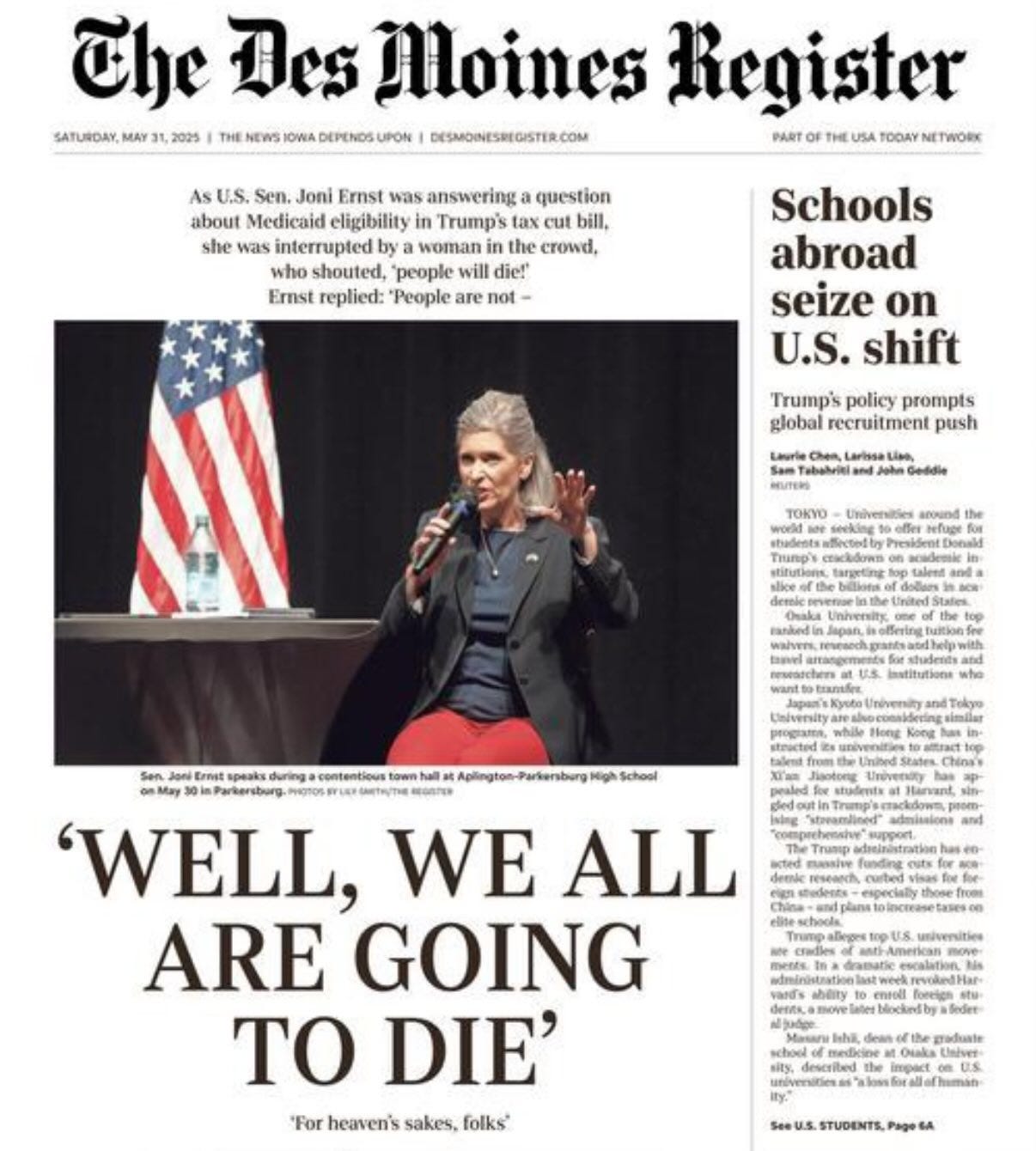
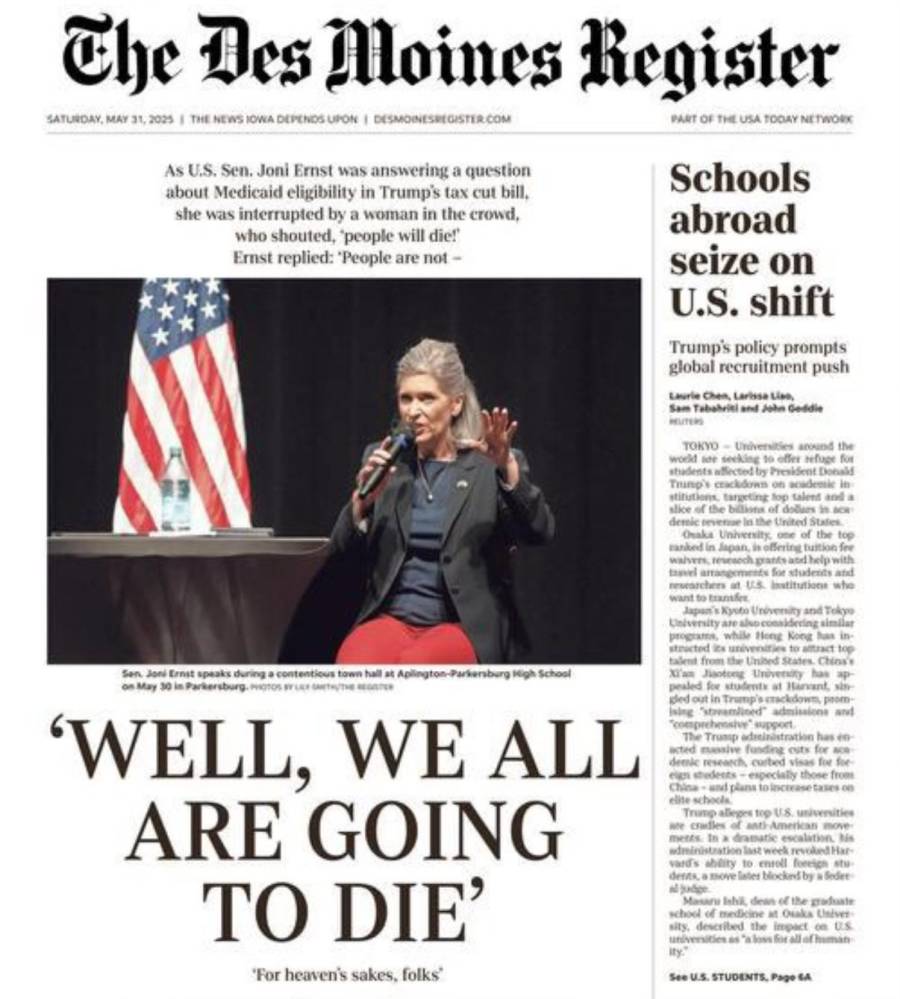
When a U.S. Senator from Iowa stands at the gates of power and shrugs her shoulders at the suffering of the elderly, veterans, children, and disabled folks if Medicare is cut, saying, “well, we are all going to die,” we know are living at the gates of Nain.

The good news is that when Jesus sees the funeral procession, he sees all of it. He sees the normalization of cruelty. He sees the pain of the widow. He sees her poverty. He sees her isolation. He sees the way she is seen or not seen by the political and religious culture. And Luke says, “He had compassion on her.”

As I have pointed out before, that word “compassion” in the Greek is visceral. Jesus felt it in his gut. The word literally means that he was filled with so much compassion, his stomach was in knots. And notice what happens next.

Jesus crashes the funeral. Jesus steps in and stops the procession. He reaches out and touches the bier.

By touching the bier, he touches what others refuse to touch. He breaks cultural, ritual, and religious protocol interrupting death with divine compassion. And then, with the authority of heaven, he speaks directly to the dead: “Young man, I say to you, rise!”

Notice that Jesus doesn’t offer thoughts and prayers. He doesn’t say “Rest in peace” or “God needed another angel in heaven” or, “bless his heart, he’s in a better place.” And he sure in heaven doesn’t say, “Well, we are all going to die.”

Jesus speaks in the face of injustice and death saying: “Rise!”

“Rise!”— That’s the gospel we are called to preach and to live.

“Rise!” is a gospel of protest; not passivity.

It’s a gospel of resurrection; not resignation.
It’s not a gospel that comforts the powerful, but a gospel that confronts the powerful and disrupts the unjust systems of death.

The question that this story begs of us today is: what kind of people will we be?

Will we be the indifferent crowd accepting injustice by following death to the grave, or will we be the disciples who walk with Jesus and interrupt it?

Will we shrug our shoulders accepting that “everybody dies,” or will we embrace a gospel that never shrugs, a gospel that always dares to stop the march of injustice?

These questions are most important today as many Christians have chosen death over life.

Oh, of course they would never confess that. They claim to follow the way of Jesus by being pro-life, but they act in ways that are the exact opposite.

They want to force children to be born into the world while they cut Head Start, undermine vaccines, refuse to fund public schools, stand against raising the minimum wage, deny healthcare, and cut food assistance. They hold press conferences about embryos but pass budgets that kill the most vulnerable among us. They preach “sanctity of life” but value their right to own an assault weapon more than they value the safety of school children. They cry “life is sacred,” but when asked about Medicare, they shrug and say: “Well, we are all going to die.”

That’s not pro-life. That’s pro-power, pro-patriarchy, and pro-political points. It’s s a theology of control, not compassion, and it has nothing to do with Jesus of Nazareth. I believe the church needs to be pro-life the way Jesus was pro-life.

That means pro-human dignity, pro-healthcare, pro-feeding the hungry, pro-housing, pro-living wages, pro-education, pro-immigrant, pro-refugee, pro-disabled persons, pro-LGBTQIA persons, pro-justice, pro-mercy, pro-nonviolence, and pro-peace.

Otherwise, it’s not life. It’s hypocrisy. Otherwise, what is the church good for?

I will never forget sharing with one of my former churches during a board meeting that unless some changes were made, unless we left the comfort and safety of the sanctuary to take the gospel from the pulpit into the public square, I believed the church was going to die.

Do you want to know what their response was?

“Well, we’re ok with that. The truth is, pastor, we would rather die than change anything.” I kid you not.

But I do not believe Christian pastors are called by God to be hospice chaplains for dying congregations. We are not called by God to manage the procession of death. And we are not called to be chaplains of empire or funeral directors for failed, unjust systems.

And we weren’t called to gather here in this place just to sing and sip coffee. We are called to go out and crash the funeral! We are called to disrupt the lie that poverty and cruelty is normal. We are called to touch the bier, to raise our voices, to say to a fragmented and unjust world: “This procession ends here! Rise up and live!”

Because Jesus didn’t come to help us die quietly and peacefully.
Jesus came so that we might have life and have it abundantly!

So, when they say, “well, we are all going to die,” we say:
Yes, that is true, but not all don’t need to die this way.
-Not for lack of access to healthcare.

-Not for a lack of opportunity to get an education.

-Not for a lack of food.

-Not for lack of insulin.

-Not for the lack of a living wage.

-Not because gender-affirming care upsets your privileged, ignorant, black and white, binary religious worldview.

– Not because compassion is considered too expensive and mercy too extravagant.

And not while the Church is still breathing and still following the way and voice of Jesus who says: “Open your eyes and see the suffering. See the injustice. And then step in— and touch the bier. Stand where the pain is. Interrupt the systems of death. Speak to the young people laid in caskets before their time and dare to declare: ‘You were meant for so much more than this!’”

Because healthcare is not luxury. It’s a human right. Compassion is not weakness, and empathy is not sin. It’s divine strength. The church is not called to manage the funeral. We’re called to proclaim resurrection.

So let us go from this place not in silence but in power.

Let us walk to the gates of our cities, our states, and this nation,
and speak like Jesus.

Let us say to our trans siblings: “We see you.”

Say to the poor, the and the disabled: “We are on your side.”

Say to the immigrant: “We stand with you.”
Say to the widow: “You are not alone.”
And say to the unjust systems of death: “Your time is up!”
And to all those who have been cast down: “Rise up and live!”

Because the final word is not cruelty. The final word is not indifference.
The final word is not: “well, everybody dies.” The final word is Jesus, and Jesus says: “Rise!”

So, let the Church rise! Let the people of God cry out at the gates of every system that shrugs at suffering:

To say to politicians obsessed with power and profit: We will not fooled by your pro-life bumper stickers.

To say to the politicians who offer thoughts and prayers but pass budgets of brutality: “We will not be silent!”

Because our Lord is the one who stops the funeral.

Our Lord is the one who touches the bier.
Our Lord is the one who weeps with the widow.
Our Lord is the one who speaks life into the grave and says: “Rise!”

And if we are going to follow that Lord, then we too must rise up, speak up, and lift up every child of God who’s been cast down. Because “everybody dies” may be a fact of biology, but rise up and live!” is the truth of theology!
So, let’s rise!

Dignity Is Not Conditional: Why Exempting Hotels and Farms from Immigration Raids Reveals a Deeper Moral Crisis

ICE will now raid homes but not hotels. They’ll round up families from neighborhoods but not from farms. Why? Because when it comes to immigration, it’s never been about “law and order.” It’s always been about profit and power. Let’s not be fooled: when farms and hotels are exempted from immigration raids, it’s not mercy. It’s exploitation. It’s greed wearing the mask of compassion. It says, you can stay, but only if you pick our fruit, clean our toilets, and stay silent.

However, a human being’s worth is not measured by how fast they can move in the field or how neatly they can make a bed. People are not machines. They are not tools. They are not “the help.” They are children of God, fearfully and wonderfully made, not for our convenience, but for beloved community.

Changing the immigration policy to raid homes but not hotels exposes the hypocrisy at the heart of immigration enforcement in America. It protects the industries that benefit from cheap, undocumented labor while punishing the workers themselves. That’s not justice. That’s not democracy. That’s Pharaoh.

The same Bible many evangelicals use to justify this cruelty also says: “Do not mistreat or oppress a foreigner, for you were foreigners in Egypt” (Exodus 22:21, Exodus 23:9, Leviticus 19:33-34). And let’s not forget Jesus himself was born into a family that fled persecution, crossed borders without papers, and found no room at the inn.

We don’t need immigration policies that ask: “How much can you produce?” We need policies that ask: “How much can we protect?” “How much can we love?” “How much justice can we make real together?

When we only protect immigrants when they’re useful to us, we are saying that dignity is conditional, that love is earned, and that God’s image in someone can be erased by a lack of paperwork. That is not moral. That is not just. And it is the anithesis of the gospel.

We must fight for policies rooted in human rights, not human labor. We must love people not because of what they can do, but because of who they are. And we must remember that no one is illegal. No one is disposable. No one is worth more because they work harder. In God’s economy, every person matters. Every life counts. Every stranger is a neighbor. Every neighbor is kin.

Trinity in the Trenches

Romans 5:1-5

Ok, here it is! The sermon that you’ve been waiting for! I wouldn’t call it a sugar-stick sermon, but it’s certainly a hopeful sermon. And oh, how we need some hope today! Because, in today’s world, we wonder how we’re still standing.

Our epistle lectionary lesson Romans 5:1-5 enters our turbulent time like a divine disruption, a flame refusing to be swallowed by the night. It doesn’t offer quick fixes or shallow answers, but it offers deep, lasting, transforming, Trinitarian hope.

I know, I know. Some of you have never been big fans of the Trinity. That’s because you’re not fans of any doctrine or creed, especially if it was decreed by the empire centuries ago, with other edicts and declarations that have caused more harm in the world than good. You don’t get it, and I get that. The Trinity is a strange concept. Three in one? Why three? Why not 7 or 12 or 17 or 153? Actually, I kinda like 153!

The good news for us on this day we call “Trinity Sunday” is that the Trinity doesn’t have to be a dusty old imperial doctrine. The Trinity can be divine, living reality.

I know, I know. Some of you didn’t like the sound of that. A preacher telling you what reality is. We have too much gaslighting these days from the power-that-be, and you’ve come to church this morning to hear the truth!

But hear me out. I am saying that maybe the Trinity, the Father, Son and Holy Spirit, or the Creator, Redeemer, Sustainer if you prefer, is not an ancient puzzle to solve. It’s a real, living, transforming, presence in which to dwell. The Holy Trinity is something to be lived more than learned, experienced more than explained, something or someone with whom to relate more than to understand. It’s not abstract; it’s active. It’s moving. It’s breathing. It’s calling, prodding, pushing, pulling us toward who we have been and are still being created to be.

Listen again to how the Apostle Paul describes the Trinity in his letter to the Romans:

“Since we have been justified by faith, we have peace with God through our Lord Jesus Christ… and hope does not disappoint us, because God’s love has been poured into our hearts through the Holy Spirit who has been given to us.”

Let’s walk together in this text and let the Trinity meet us in our grief, our protests, our healing, and our rising.

“Since we have been justified by faith, we have peace with God…”

To say, we are “justified by faith” is to say that God, the source of all that is, made a decision about us before the world could.

Before society tagged you as expendable, God named you “beloved”. Before empires wrote policies and made decrees to discount or disappear you, God wrote your name in glory.

  • Before redlining maps were drawn, God marked your entire neighborhood and called it blessed.
  • Before school districts were zoned to maintain inequality, God declared your mind worthy of wisdom.
  • Before they looked at your skin, your gender, your sexuality, and your zip code, and said “unworthy” God looked at you and said “very good!”
  • Before they erased you from textbooks, God had written your story in the Lamb’s Book of Life!

And it is God, the creator of everything, the energy of, in, and behind the universe, Love Love’s self, who is the one who declares peace over us— a cosmic, reconciling, justice-making peace.

It’s not the peace of silence. It’s not the peace of the status quo.

It’s not the peace one enjoys when they decide to play it safe.

It’s not the peace that comes with caution, following the rules or staying out of trouble.

It’s the peace that always lifts up the lowly, the least and the left out, even if it means flipping a table or two to do it!

It’s the peace that comes with the freedom of being justified. It’s not passive peace. It’s a prophetic peace. It’s the peace that tears down what divides and oppresses and builds what unifies and liberates in its place.

  • It’s the kind of peace that marched with Dr. King and bled with John Lewis on the Edmund Pettus Bridge.
  • It’s the kind of peace that says “Black Lives Matter” not to exclude anyone, but to expose what peace really demands.
  • It’s not the kind of peace that settles, but the kind of peace that agitates until justice rolls down like waters.

Let’s look at the next line:

“…through whom we have obtained access to this grace in which we stand…” (v.2)

Jesus is our access point to grace. Jesus didn’t just die because of our sins; He lived to show us what love looks like under empire, under oppression, under the shadow of the cross by living a life of grace.

Grace is not a loophole. It’s a lifestyle. Grace is what empowers us to stand tall in the rubble, to stand in front of an army deployed by a corrupt authoritarian and still speak truth. Grace is opportunity. Grace is an opening, a door, a window, even a crack. Grace is how Jesus reached out to the woman at the well, touched the leper, and restored the outcast.

And Paul says, Jesus is the access to this grace.

Sadly, this is where the church has really messed up its theology. Grace is not a ticket to heaven to escape the world. Grace is the opportunity to bring heaven to the world.

This is the grace Jesus came to give.

So let me say this prophetically: If your theology makes room for grace but not justice, you haven’t met Jesus yet.

If your gospel preaches forgiveness but ignores the systems that crucify, it’s not good news. It’s a performance.

Christ gives us grace to stand. Not to retreat. Not to hide. But to stand—

· To stand in the courtroom when the system is tilted, and still speak truth to power, with trembling hands but with a steady soul.

· To stand in the streets, in the pouring rain or the scorching heat and still lift up signs and prayers for a justice that won’t wait.

· To stand in your weary body—chronically ill, over-policed, underpaid—and say, “My presence is still a miracle!”

· To stand in grief when you’ve buried too many dreams, too many loved ones, and somehow still hope again.

· To stand when depression tells you to stay in bed, when anxiety says you’re not enough, and say: “Grace brought me here, and grace will keep me, and grace is enough.”

The good news is that there is more, much more! Look at verse 5.

“…and hope does not disappoint us, because God’s love has been poured into our hearts through the Holy Spirit…” (v.5)

Ah, the Spirit. The One too many of us try to explain instead of experience.

This is the Spirit who whispers to us when all hell is breaking loose.

This is the Spirit who moves us in protest chants and in silent prayers.

This is the Spirit who pours—not sprinkles, drizzles, or cautiously trickles, but liberally pours the love of God deep into us until we can breathe again, smile again, even laugh again.

And this is why we don’t give up or stand down or ever bow down. Because love has roots that run deep. Love has a heartbeat in us. And even when suffering surrounds us, the darkness envelops us, even when the trauma returns, the Spirit keeps saying, “Hold on. The good old days may be gone but good new days are coming!”

The Spirit does not eliminate suffering. The Spirit takes suffering and makes suffering meaningful. The Spirit resurrects and transforms suffering. The Spirit assures us that suffering produces endurance, endurance produces character, and character produces a hope that never disappoints us!

So, what do we do when the world is on fire?

When empires write decrees and send in the troops?

When systems still crucify the innocent?

When liberty and justice feels like a luxury only for the privileged?

When the whole world seems to be upside down, and we’re barely hanging on?

That’s when we remember the One, or the Three, who are holding on to us. The Father speaks peace. Christ gives grace. And the Spirit pours out love!

This is our Triune hope in the trenches, our Trinitarian anchor in a turbulent world. This is why we preach. This is why we worship in a pew, sing a hymn, and give an offering. This is why we pray and why we protest. This is why we forgive and feed, cry and console, resist and rise!

The Trinity is not an idea. It’s not just a concept. The Trinity is our inheritance, our identity, and our liberation. It’s how we can still stand when all is falling around us.

Still stand when policies crush the poor.

Still stand when truth is unfashionable.

Still stand when they gaslight and try to divide us.

Still stand when they deploy the military against us and threaten to kill us.

Still stand when love looks like resistance and hope costs everything.

The Trinity is not theoretical. It’s revolutionary!

The Father says, “Stand in this love.” The Son says, “Stand in this grace.” The Spirit says, “I’ve poured this love in you like wildfire—now go and light up your city, your state, your nation, and my world with my love. Go and stand and love until the torch of liberty and justice burns for all!”

So, let’s go and stand. Stand in courtrooms and stand in classrooms.

Stand in pulpits and in stand in peace vigils.

Stand in mourning and stand in movement.

Stand with our scars and with our sacred calling.

And when the world asks: Who gave you permission to stand like this? Who told you that you could be this courageous? How are you this strong, this confident? And why are you smiling like that?

That’s when you say, “I’ve been justified by faith!” “I’ve got peace from the Father!” “I’ve been given grace from the Son!” “And have been anointed with fire from the Holy Ghost!”

Now stand, and let your life be a sermon the world has been waiting for and cannot ignore.

Indivisible, We Rise

John 17:20-26

I was speaking with a colleague recently who shared that she was struggling to balance delivering sermons that are challenging with sermons that are comforting, sermons that are prophetic with sermons that are therapeutic. She said, “because the truth is that we can’t make peace in the world if we don’t know peace for ourselves.” She then added, “but it is so hard these days to preach soothing, comforting sermons when there is so much injustice everywhere.”

I said: “Yeah, I don’t know when I’ll be able to preach what I have heard some ministers refer to as a “sugar-stick sermon” —One of those sermons that just makes everyone feel good.

She asked: “Do you think your congregation may start to complain?”

I said, “Well if they do, saying they just want to come to church to get some serenity, I think…I’ll just have to…I don’t know…encourage them to check out the new Yoga classes we’re hosting, and perhaps give that a go.”

But then I added: “But since I am one of those lectionary preachers, If I’m presented a scripture text that enables me to preach a sermon that will just put everyone at ease, I suppose I’ll consider it. Because I sure could use a sermon like that myself!”

         So, earlier this week when I checked the lectionary and read Jesus’ words in John 17:

My prayer is not for them alone (not just for the twelve). I pray also for [all] those who will believe in me through their message that all of them may be one,

I thought, “maybe this is it!”

I may actually give my poor congregation a break this Sunday by saying something that soothes their souls, warms their hearts, and gives them permission to take it easy, relax a little, because Jesus is praying for us!  What a lovely thought! And what is he praying for? To go out and change the world? No, “That we may all be one,” that we may be brought to “complete unity.”

How wonderful! First Christian has been due a sugar-stick sermon for a while now, and this Sunday they may finally get one!

I don’t know about you, but living in this divisive time is exhausting. And ya’ll, I’m tired. Tired of the tension. Tired of the chaos. Tired of the fighting. Can we just take break?

Could it really be that Jesus is giving us prayerful permission to stop trying to change the world, and to just come together and get along, accept things as they are, you know, agree to disagree?

Wouldn’t that be nice?

Everybody, no matter your religious or political beliefs— just lovin’ life together, saying: “You do you, and I’ll do me.” “Live and let live!” “Tomato, tomahto.”

We can certainly do it.  We know how to do it. That’s what many of us do every time we get together with family, right?

 So, let’s go up on the mountain this afternoon, sing Kum ba yah, agree to disagree, and have some communion!

Now, before we get too excited, I suppose we ought to take a closer look at Jesus’ prayer.

Jesus is praying to God:

I have made You known to them, and will continue to make You known in order that the love You have for me may be in them and that I myself may be in them.

Jesus is praying for us to be in union with him, not with everyone on earth. Jesus is praying specifically for God’s love to be in us as it is in him. Jesus is praying for a divine moral unity, a unity grounded in holy relationship, divine truth, justice, and love.

Jesus is not praying for us to come together with others in order to keep the peace so we can be comfortable, while the fires of injustice rage! No, I believe Jesus is praying for what William Barber calls “a moral fusion.” He is asking God to fuse us together as one holy movement of divine truth, justice, liberation, and love.

Why?

Look at verse 21. “So that the world may believe…” that Jesus, the one who fed the hungry, defended the vulnerable, liberated the oppressed and challenged systems of injustice, was indeed sent by God.

The church is to be a witness for Jesus. But, when the church is divided, that witness is diluted.

When evangelicals wrap Jesus in the American flag but support policies that ignore the cries of the poor, the witness is diluted.

When pastors stay silent on racism, homophobia, transphobia, and xenophobia, just to keep the tithes rolling in, the witness is diluted.

When pulpits are more worried about being politically correct than prophetically faithful, more concerned about keeping their congregants happy with sugar-stick sermons than sermons that inspire them to do something to change the world, the witness is diluted.

Jesus is saying the moral authority of the church is tied to the moral unity of the people.

Now, if we are going to talk about unity in these divisive times, we need to name a prophetic truth. Fascism is not just a political ideology. It’s a spiritual disease. And its first move is always the same: Divide the people.

Fascism doesn’t need a majority. It just needs a divided public. It’s what William Barber has been preaching for 20 years.

  • It tells white workers to blame Black ones for their poverty.
  • It tells rural communities that immigrants are the enemy.
  • It tells churches to obsess over private piety while ignoring public suffering.
  • It stokes fear, fuels scapegoating, and spreads lies that demonize the very people Jesus dignified.

Because the architects of fascism know that a people united in truth is stronger than any regime on earth built on lies.

So, they don’t want unity. What they want is obedience. They’re not interested in justice, just in control. And they don’t ever want the church to ever come together, rise up as one, and start talking and acting like Jesus!

They need the church to bless their injustice with a bowed head and a blind eye.

But Jesus didn’t die for that. He died and rose to inspire a people to refuse to be divided by the lies of empire! He died and rose to inspire people to be united in their advocacy for the poor, the marginalized and the vulnerable—to be united in their efforts to tear down unjust systems that oppress and in organizing the broken into a holy movement for wholeness, while resisting the temptation to turn against one another.

So, let the church rise today, not with shallow calls for peace, but with a deep and defiant unity, a unity that refuses to trade justice for comfort. May pastors everywhere raise their voices understanding that silence is not harmony. It is complicity.

And the good news is every time we choose solidarity over silence, we strike a blow against fascism! Every time we refuse to be divided, we become more dangerous to those depending on our division.

This time in our history is not a political moment. It’s a moral emergency. And through his prayer, Jesus is telling us how to respond. We are to be one.

William Barber preaches the need for a “moral fusion coalition.” A revival of Jesus-rooted unity that brings together all good people to stand up and exclaim: “We will not be divided by race!” “We will not be divided by religion.” “We will not be divided by party!” And we will not be divided by fear!”

A moral fusion is people who love each other and their neighbors enough to fight side by side.

It’s communities coming together to say poverty is violence and silence is also violence.

A moral fusion is pastors linking arms with priests, rabbis, and imams, speaking in a unified voice proclaiming that hate has never made any nation great, and it never will.

It’s houses of worship becoming sanctuaries for the afflicted, not silos for the comfortable.

It’s labor organizers praying with farm workers.

It’s black grandmothers and young white activists marching together for voting rights.

It’s queer teens and disabled elders showing up at the same city council meeting to demand dignity.

It’s not about sameness. It’s about shared struggle.

A moral fusion is not about unity for unity’s sake, It’s about a moral commitment to the least of these. It’s when we stop asking, “What’s safe for me?” and start asking, “What’s faithful to God?” Because a moral fusion doesn’t blend us into blandness. It binds us in boldness!

That’s the unity Jesus prayed for. It’s the unity we are called to live into, and it’s the unity the empire cannot handle!

Jesus prayed that we might be one. And now it’s our turn to become the answer to that prayer. Not just in what we say we believe, but in what we do, how we act, and how we vote. And oh, how the church today needs to reexamine its actions. Because:

  • If your unity doesn’t do something to care for the poor, you need to know Jesus didn’t pray for it.
  • If your unity doesn’t protect the vulnerable, Jesus didn’t pray for it.
  • If your unity silences truth to keep the peace, Jesus didn’t pray for it.
  • If your unity is built on avoiding conflict instead of confronting injustice, Jesus didn’t pray for it.
  • If your unity demands that the oppressed stay quiet so the privileged can stay comfortable, Jesus didn’t pray for it.
  • If your unity won’t march, won’t speak, won’t sacrifice—then it’s not the unity Jesus was talking about.
  • And on this first Sunday of Pride, it must be said, that if your unity is about limiting the rights of LGBTQIA+ people and the reproductive rights of women, you need to know Jesus never prayed for it, never talked about it, or even once ever thought about it!

The unity Jesus prayed for doesn’t come cheap. It costs comfort. It costs silence. And it costs staying out of trouble.

But when we are indivisible with this unity, liberty and justice can truly come for all.

And the good news is: we don’t have to wait for it. Jesus already prayed it. Jesus already declared it. Jesus already called it down from heaven. And the same Spirit that raised Jesus from the grave is the same Spirit calling us today to rise up together!

To rise up with the poor.
To rise up with the forgotten.
To rise up with the queer, the trans, the disabled, the undocumented, the imprisoned.
To rise up not in mere charity, but in solidarity.

Jesus prayed that we may rise up and be as one.
That we may rise up and boldly love as Jesus loved, as God loves.

And here’s some more good news. It may not be what you’d call “sugar-stick news,” but it is hopeful news:

Fascism will not have the final word.

Fear will not have the final word.
And we will not let division have the final word.

Because love still speaks today.
Justice still speaks today.
And unity—moral, bold, dangerous, Spirit-filled, costly unity—still speaks.

Jesus prayed for it.

Now let’s go and be the answer to the prayer.
Go be one. Go be the witness. Go change the world. Amen.