
Seeing Clearly in a Violent World

John 9:1-41

Our gospel lesson today speaks about a kind of blindness that has nothing to do with our eyes but has everything to do with how we see God.

Jesus and his disciples encounter a man who has been blind from birth. He sits beside the road like so many people society has learned not to see. He is not asked his name. He is not asked his story. Instead, he becomes a theological puzzle. The disciples look at him and ask a question that has echoed through centuries of religion: “Rabbi, who sinned, this man or his parents, that he was born blind?”

Do you hear the assumption beneath that question?

If something is wrong, someone must be to blame.
If someone is suffering, God must be punishing them.
If tragedy occurs, it must somehow be deserved.

The disciples are not asking how to help the man, how to love the man. They are asking how to explain him. And that, my friends, is one of the oldest forms of spiritual blindness.

Because when we cannot see God clearly, we begin to see one others through the lens of judgment. We categorize people. We label. We decide who is worthy and who is not. We divide the world into the righteous and the sinners, the blessed and the cursed, those who matter, and those we can write off.

But Jesus refuses the premise of their question. He says, “Neither this man nor his parents sinned.”

In other words: You’re asking the wrong question!

The blindness in this story is not just in the eyes of the man sitting beside the road. The deeper blindness is in the religious imagination that believes God would punish a child before he was even born.

The truth is: that’s exactly how many of us were taught to see God.

The truth is: that’s exactly how some of us were taught to see God, a God who created a heaven for some and hell for others—a divine sorting system separating the saved from the damned. We were also told God knows all, past, present, and future. That means God created some people, all the while knowing, they would be tortured in hell for all of eternity.

And somewhere along the way, the fear of God instead of the love of God, became the engine of our faith.

Today, we are grateful to have Brian Recker with us, whose work explores how that fear has shaped Christian belief and practice for generations. And how when fear shapes our theology, it inevitably shapes our ethics.

Because if God condemns, we learn to condemn. If God divides humanity into insiders and outsiders, we feel justified doing the same. If God punishes people, then punishment itself begins to look holy. And if God punishes people eternally, then taking the life of another can start to look holy too.

Over time, that vision of God begins to justify things we might otherwise resist.

It rationalized stealing this land we enjoy.

It justified slavery.
It defended segregation.
It condemns LGBTQ people as beyond God’s love.

And it whispers that violence, war, and domination are acceptable tools in the hands of those who believe they are on God’s side.

Fear does not just distort our picture of God. It distorts how we see one other. And it doesn’t save us from hell. It unleashes hell on earth.

The good news is that Jesus reveals a very different vision of God. He doesn’t argue theology with the disciples. He doesn’t stand above them looking down on them, violently lashing out at them.

He bends down to the ground. He kneels in the dirt. He spits in the dust and makes mud that he places on the man’s eyes, telling him to go wash in the Pool of Siloam.

It’s a strange miracle of mud, spit, and dust. But it’s the same dust from which the book of Genesis says humanity was first formed. It’s almost as if Jesus is re-creating this man’s sight from the very soil of creation itself.

And when the man washes, suddenly he can see. But here’s the irony: the man who had been blind can now see clearly; but the religious authorities, those who believe they understand God the best, cannot.

They interrogate the man. They question his parents. They debate whether the miracle could possibly have happened. And finally, when the healed man refuses to abandon the truth of what he has experienced, they throw him out. Because when love disrupts a theology built on fear, the system is threatened.

Sometimes it’s easier to deny a miracle than to change our picture of God.

During my time in New Orleans planting a new expression of church, a movement that we called, “Just Love Your Neighbor,” I also served as an “as needed” or “PRN” hospice chaplain, like I do now.

I had a Jewish patient who had been married to a Christian for over 50 years.

After his death, his wife asked me to preach his funeral service. When I asked why she didn’t want to ask her pastor, she responded: “I am afraid that he might insinuate my husband is in Hell because he is not a Christian, and I know you will not do that.”

After the funeral, she started participating in our new movement, giving her time and her dollars, while remaining a member of her church.

Over time, she opened up about the frustration that was leading her to reject the things that she was being taught in her church.

One day, she said something like: “I was always taught that God loved me. But I was also taught that if I didn’t believe the right things, particularly about Jesus, God would send me to hell forever. But I think I am beginning to realize: that’s not love; that’s a threat.”

She paused for a moment and then said quietly, “I don’t think I’ve ever actually met the God Jesus talked about.”

That widow was not rejecting her church. She was rejecting her church’s distorted image of God. She was rejecting a God who looked suspiciously like our fears.

And she’s not alone.

There are countless people, here in this city, who are walking away from church, not because they’ve rejected the love of God, but because they cannot reconcile that love with the threat of eternal punishment.

Sometimes, the people some say have lost their faith, or doubt their faith, are actually the ones who see God the most clearly.

And the ones who are the most certain, those who say they see clearly, the ones we hear saying “The Bible is clear…,” are actually the ones who are the most blind.

And this blindness doesn’t only affect individual lives. But it shapes the entire world.

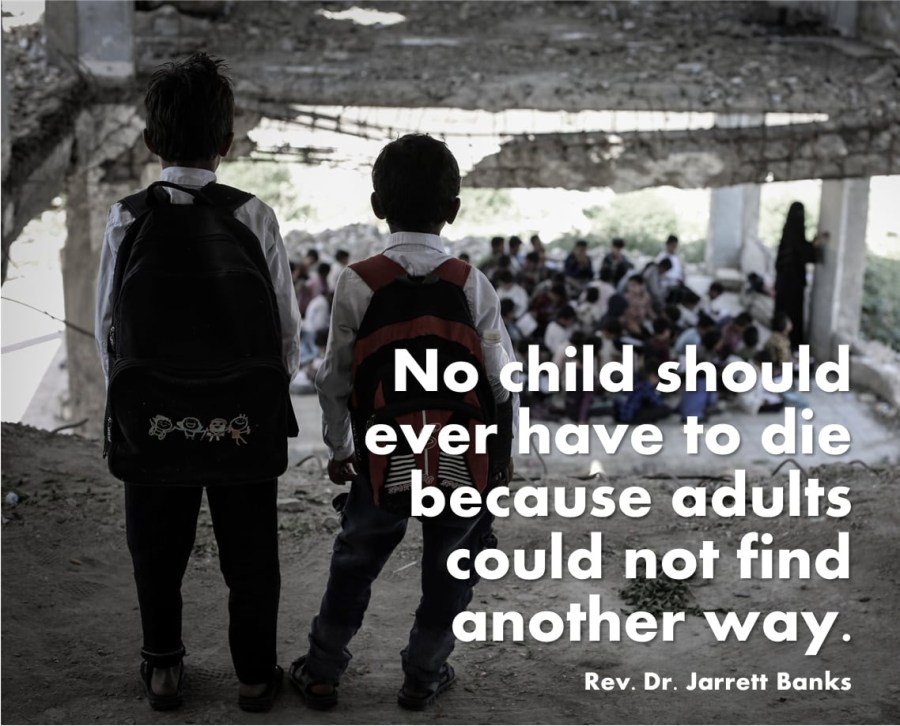
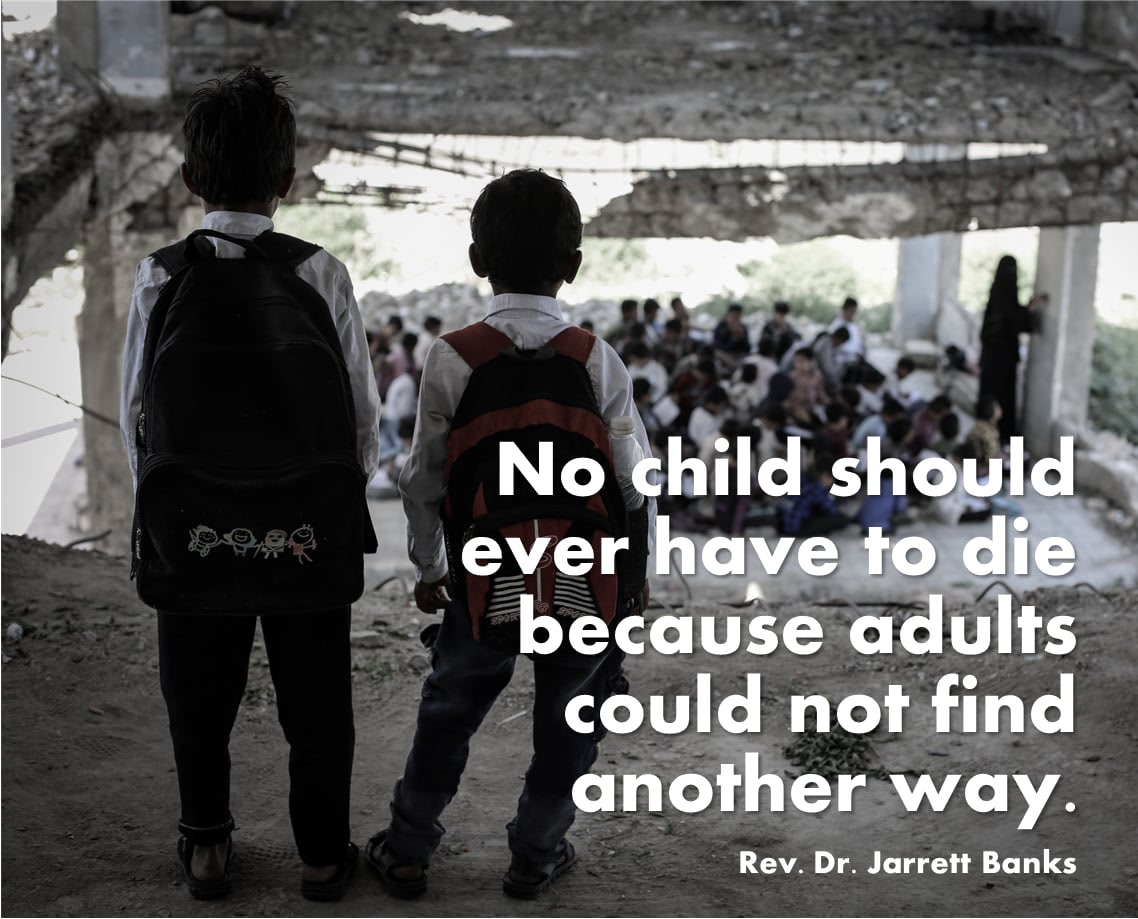
Right now, we are witnessing what happens when this blindness goes unchallenged. Missiles continue to cross the skies of the Middle East, and this week we learned that one of them, fired by our own country, struck a school in Iran, killing children as they sat in their classroom. Children at their desks. Children with books open in front of them. Children who woke up that morning expecting an ordinary day at school and instead became casualties of war.

No child should ever have to die because adults could not find another way.

If we can hear that story and not feel something break inside us, then perhaps the blindness Jesus speaks about has reached deeper into our hearts than we realize.

Because no matter which flag flies over the missile launcher, the God Jesus revealed is not the author of bombs that fall on children.

And yet, the language of righteousness still fills the air.

Every nation says God is on their side.
Every government says the violence is necessary.
Every military claims the destruction is justified.

But when we look through the eyes of Jesus, we begin to see something different.

We see children in classrooms who never chose this war.

We see parents praying the same desperate prayer on every side of every border: “O God, let my child live!”

And if we can see that, if we truly allow ourselves to see it, then we must ask an uncomfortable question: How did a faith centered on the Prince of Peace become so comfortable blessing violence?

Part of the answer is in the way we imagine God. For when we believe in a God who punishes, violence begins to look like divine justice.

But when we see the God revealed in Jesus, the God who heals instead of harms, who forgives instead of retaliates, who tells us to love even our enemies, then war begins to look less like righteousness and more like the tragic consequence of humanity still struggling to see clearly.

At the end of the story, Jesus finds the man who has been cast out by the religious authorities. And the man does something remarkable. He believes. Not in a doctrine. Not in a system. But in the love of the one who healed him. He trusts the love he encountered. And that is the heart of this story.

The miracle is not simply that a blind man gains sight. The deeper miracle is that Jesus reveals what God actually looks like.

A God who does not stand far away diagnosing sin. But a God who kneels in the dust beside human suffering. A God who touches our wounded places without hesitation. A God who sees us completely, and loves us anyway, unconditionally, unreservedly, and does all that God can do to recreate, restore, and resurrect.

When we begin to see God that way, something inside us changes. Shame begins to loosen its grip. Hatred begins to lose its power. The walls between “us” and “them” begin to crumble. And the people we once feared begin to look like neighbors again.

Near the end of the story, Jesus says something haunting: “I came into this world so that those who do not see may see, and those who think they see may become blind.”—Reminding us that the greatest spiritual danger is not doubt. It is certainty. Especially certainty about a God who violently condemns anyone before they were born.

But the good news of the gospel is that Jesus is still opening eyes, still kneeling in the dirt of our world, still touching wounded lives, and still inviting us to wash away the old stories that told us God was against us.

And when our eyes finally open, we may discover something astonishing. The God we feared was never really there. And the God who is there has been loving us all along.

Later today, Brian will help us explore what it means to move beyond a faith driven by fear of hell toward a spirituality rooted in love. And that journey, from fear to love, is exactly the journey this gospel story invites us to take.

The man healed by Jesus ends this story with a simple testimony: “One thing I do know: I was blind, but now I see.”

That may be the most honest confession any of us can make. Because faith is not about having every answer. It’s about learning to see. Seeing the love that is God more clearly. Seeing our neighbors more compassionately. Seeing our enemies more humanly. And seeing the world as Jesus sees it: a world filled with beloved people; a world worth healing; a world where love, not fear, has the final word.

And when we finally see that clearly enough, we may find ourselves saying with the man in the story: “One thing I do know, I was blind, but now I see!”

Amen.

Loved People Love

John 4:5-42

Jesus is tired.

 Now, think about that for a minute.

It’s only chapter four.

He’s just getting started.

He’s got a long way to go.

This one whom John affirms was in the beginning with God and was God, the one through whom all things came into being, is not just tired. Verse 6 reads he is “tired out.”

And it’s not because he lost an hour of sleep setting his clock forward the night before.

This is what happens when you are on a mission to make the world more inclusive, more equitable, more just for all people.

This is what happens to a body and soul when you are working to dismantle the violent systems in place that divide, oppress, and marginalize and when you challenge religious structures that bless those systems.

You get tired out.

So, if you are exhausted today, and you don’t think it’s because you lost an hour of sleep last night: congratulations. It probably means that you are following Jesus.

Jesus does what we may feel like doing today. He sits down. He takes a load off. He catches his breath at a well near Synchar, an historic watering hole the old-timers called “Jacob’s well.” It’s noon. The disciples have gone off to find some lunch. And Jesus, the Word made flesh, needs a drink.

So, if you feel like you need a drink today, again: congratulations! It probably means you are following Jesus.

Then, here she comes. A Samaritan woman, all alone. Because she comes at noon—when most came early in the morning or will come later in the evening when it is cooler—we might imagine she wanted to be alone. She was trying to avoid running into someone she knew.

 She’s carrying a jar. But she is also carrying something else. She may be carrying communal hostility. She’s certainly carrying some emotional baggage, some personal heartbreak, some shame, and maybe some spiritual trauma.

Jesus sees this woman and says, “Give me a drink.”

Wait a minute.

 Everyone knows Jews and Samaritans do not eat or drink together. And every good Rabbi knows they should never ask “those people” for favors.

So, what is really going on here?

Notice, that before Jesus addresses her shame, her complicated relationship history, Jesus asks her for water.

         This is interesting as Lent has a way of making us think that the first thing God asks from us is repentance. We need to try harder, give something up, change something, fix ourselves.

         But look carefully at this story. Jesus knows the order of John 3:16 and leads with love. He doesn’t begin with condemnation. He begins with conversation. He doesn’t say, “Explain yourself!” He says, “I’m thirsty.”

         Jesus makes himself vulnerable in her presence. He asks something of her but it is not judgment. He asks her for a water. And in doing so, he dignifies her. He is essentially saying: “I am willing to receive life—from you.”

This is how divine love works. God does not stand above us at a distance, evaluating us. God sits down at the well, identifies with our thirst, and speaks our language.

And when Jesus eventually names her five husbands and the man she is currently in a relationship with, it is not to shame her. It is to show her: “I see you. I see all of you. And I am still here.”

This is what I believe God wants us hear clearly today: We are fully known. And we are still deeply loved. Not our cleaned-up versions. Not our Sunday-morning version. The real me and the real you. All that we are— is loved.

Lent is not a forty-day wilderness journey to earn that love. Lent is the journey of waking up to that love.

         It is then that Jesus initiates a conversation that will shock his disciples as it crosses three lines at once: gender, religion, and ethnicity: “If you knew the gift of God… you would have asked him, and he would have given you living water.”

         Notice the word “gift.” It’s a big word. Jesus is not talking about something to earn, to work for, or to purify oneself for. He’s talking about a gift, the gift of living water.

Living water in the ancient world meant fresh, flowing, moving water. Not stagnant water. Not trapped water. Jesus is talking about water that renews itself and says that this is what it is like to have the gift of God’s love inside us. It’s not a trickle. It’s not rationed. And it’s not withheld until we get our lives together. God’s love for us is spring welling up to eternal life.

         The truth is: although we may be exhausted today because we are following the way of Jesus in a world that is broken, some of our exhaustion may be a result of trying to earn water that is already flowing. We are trying to prove ourselves worthy of love that has already been given.

And here’s the turning point of the story: the woman leaves her water jar. Think about that. The jar is the whole reason she came!

The very thing she carried to survive… she leaves behind.

Because when you finally know you are loved, you don’t have to hold your jar so tightly anymore.

Once we know we are loved, truly loved, something shifts inside of us. We stop grasping. We stop defending. We stop pretending. And we become free to love others.

She runs back to the city, to the very people who may have whispered about her, to the people she was trying to avoid by going to the well in the heat of the day and says: “Come and see a man who told me everything I have ever done.”

Notice what she does not say. She what she does not say. “Come see someone who shamed me.” “Come see someone who condemned me.” She essentially says: I was seen, all of me… and I was loved still.

And because she has tasted living water, she suddenly becomes a conduit of it. The woman once isolated becomes an evangelist. The outsider becomes the bridge. The thirsty one becomes the well.

This is what happens when we know we are loved. We become free to love like Jesus. Loved people love people.

Not because we are trying to impress God.
Not because we are afraid of perishing.
But because love has filled our cups until they are running over.

Psychologists sometimes call this “secure attachment.” It’s the idea that when people feel deeply accepted, it creates the emotional safety needed to love others freely.

And long before psychologists ever studied this, the early Christians understood it intuitively.

The writer of 1 John put it simply: “We love because God first loved us.” (1 John 4:19).

Because when people finally know—deep in their bones—that they are loved, something changes. Fear loosens its grip. Defenses soften. The jars we cling to so tightly no longer feel necessary.

And suddenly, we become free to do what Jesus calls us to do:
to love one another, as he loves us.

Lent is a season of returning to the well. Lent invites us to sit down, to rest, to admit that we are tired-out. Lent invites us to bring our thirst—for forgiveness, for purpose, for meaning. Lent invites us to stop hiding, to let ourselves be known, and to be loved, fully, unconditionally, unreservedly. To receive water gushing up to eternal life.

The good news is that we do not need to dig deep for this water. The good news is that Christ is already sitting here.

And here’s the deeper layer: Jesus is also thirsty. Later in John’s Gospel, hanging on the cross, Jesus will say, “I thirst.” The God who offers living water is not detached from human suffering. God shares it.

Which means our thirst does not disqualify us. But it is the very place where grace meets us.

And in a week when bombs are falling in Iran and across the Middle East, when more lives are being lost to the hell of war, when human beings are left to drown in the sea after their ship was torpedoed, as leaders gloat, we are reminded just how thirsty this world really is— thirsty for peace, for mercy, thirsty for some humanity, for the courage to choose love over violence.

         You have heard me surmise that much of the church is broken today, and as a result, our nation is broken, because many in the church have rejected the call to follow the way of love, mercy, and grace Jesus modeled and embodied.

But maybe it is not so much a refusal to follow as it is a refusal to sit down at the well and receive that love, mercy, and grace.

When we are unsure of our own belovedness, we cling to things like status, tribe, fear, and certainty. We avoid Samaritans. We protect our jars.

But when we know, when we deeply know that we are loved—We cross lines. We listen longer. We empathize. We risk vulnerability. We speak truth without judgment. We tell our stories without shame.

Because the simple truth is: loved people love. And a congregation that knows it is loved becomes a well in a thirsty world. A church that knows it is loved does not hoard grace, it shares it freely will all, and all means all.

         And notice what happens.

The townspeople in our story eventually say: “We know that this is truly the Savior of the world.”

Now think about that for a moment. The first group in John’s Gospel to make such a universal confession is not Jewish disciples. It is Samaritans.

The outsiders are the first recognize the wideness of God’s love. Because when you have been thirsty, you recognize living water when you see it.

This Lent, the invitation is simple:

Come and see.
Come thirsty.
Come tired out.
Come complicated.

Because the good news is this: Christ is already sitting at the well, waiting. And when you sit down beside him, you will discover something life-changing:

You are understood. Because he is tired too. He shares your thirst.

You are known. Because he sees all of you.
And you are loved still.
And that love is living water within you.

So, drink deeply.

And then leave your jar behind,

 and go love like Jesus.

Because the world is thirsty.

Amen.

The Verse We Turned Upside Down: Recovering the Promise at the Heart of John 3:16

John 3:16 Christian T-shirt Design

John 3:1-17

John 3:16 was the very first verse many of us memorized as a child, and it’s a verse that has stuck with us. We can hardly watch a ball game without seeing it on posterboard.  We see it on billboards.  And we see it on tracts lying around in public restrooms.

 For some of us, seeing this simple verse reminds us of God’s universal and unconditional love. We receive peace, affirmation, and hope. And yet, for others, including me, just the words “John-three-sixteen” triggers a little religious trauma.

I have suggested that the reason that things seem so upside down in the world these days is because John 3:16 has been turned upside down. Instead of leading with “For God so loved the world,” churches lead with “you are going to perish.” And God’s love for the world becomes a footnote instead of the title of the story. Consequently, some of us have been conditioned, not to hear John 3:16 as love, but as a divine threat or fateful ultimatum with eternal consequences.

Instead of announcing love, churches announce fear.
Instead of proclaiming grace, churches proclaim judgment.
Instead of good news, churches specialize in spiritual anxiety.

One of my favorite preachers, Rev. Karoline Lewis writes: “John 3:16 is used as an assertion of exclusion rather than one of God’s abundant love. A verse that sends people to hell rather than voices God’s extravagant grace.”

Detached from its context, it’s used to draw hard lines between “us” and “them,” and “the saved” and “the lost.” John 3:16 is used to justify a vision of salvation that is far more invested in sorting souls than in loving the world.

But when we put John 3:16 in its context, we see that there’s a seventeenth verse.

  “Indeed, God did not send the Son into the world to condemn the world, but in order that the world might be saved through him.” Not to condemn. Not to threaten. Not to sort out. Not to shame. But to save.

Here’s where we need to take a moment to address this loaded word, “save.”

Because when many of us hear the word “save,” we hear: “rescue from hell after we die” or “spiritual fire insurance.”

But that’s not how John uses the word. Salvation is not primarily about where we go when we die, but about how we live right now.

To be saved means to be made whole.

To be saved means peace, knowing you are loved.

To be saved means to step out of fear and into trust.

To be saved means to move from despair into hope, from darkness into light.

To be saved means to experience life, fully, and abundantly.

And when John speaks of “perishing,” he is not describing God actively destroying people, but the tragic reality of refusing the nonviolent, abundant life God offers. In a world of war and violence, where people are dying in conflicts like the recent military action between our country and Iran, it’s important to understand that John’s word ‘perish’ is not about divine retribution but about the real human cost of turning away from life-giving peace and love.

And it’s important to remember that eternal life in John’s gospel is not some future reward, but it’s a present participation in the life of God. It’s not about God helping us to escape the world, but about us working with God to heal the world, to make the world more peaceful, equitable and just.

And if salvation means wholeness, peace, and liberation from fear and shame, and if eternal life sounds like God’s active participation in the world, then suddenly John 3:16 begins to sound like good news and less like spiritual trauma.

Some of us, including me, were taught that God’s love came with a catch— that one wrong belief, one wrong doubt, one wrong question, one wrong action or thought, combined with one wrong prayer asking for forgiveness, could be damning.

Some of us were told that our sexuality, our identity, our mental health, our honest wrestling with questions, disqualified us from God’s love. We were taught to fear hell after death more than to trust love in life.

After our recent baptismal service, as I was driving Christopher Lilley home, Chris expressed his desire to be baptized. When I asked if he’d ever been baptized, he told me that he had (I believe he said “more than once”), but he had been told so often that he was going to hell because of who he was, he just felt like he needed some more assurance that he was going to be okay.

Parked in front of his apartment, before he got out of my car, I did my best to assure him that God’s love for him was unconditional. I said a little prayer that he would know deep in his bones that there was nothing in heaven or on earth, no person, no power, not even death could ever separate him from the love of God. I prayed that he would somehow know the height, breadth, depth, and length of God’s love for him.

Chris’ response was classic Chris. I would like to say there were tears and a great big hug, a verbal acknowledgment from Chris that he was unconditionally loved, blessed, and affirmed by God. But Chris just smiled, giggled the way Chris did, and said, “Okay then. Do you think you could give me a ride to church this Wednesday?”

The truth is: when “God so loves the world” becomes conditional, it ceases to be about love and becomes all about control. And control masquerading as gospel, doesn’t save anyone. It wounds people, and it wounds people deeply.

So, before we can turn John 3:16 right-side up for the world, we may need to first turn it right-side up for ourselves.

Because we cannot lead with love if we have never accepted it

And this is where the season of Lent meets us.

Lent has often been preached as forty days of intensified guilt, forty days of reflecting on how broken and sinful we are. But what if Lent is not a season of self-loathing, but a season of returning to our true origin? What if, to use the language of Jesus in his conversation with Nicodemus, Lent is a season of being “born from above?”

What if repentance this Lent is not confessing how sinful we are, but it’s confessing how loved we are, and how resistant we are to being loved, fully, unconditionally? What if Lent is a season of accepting that we were born in love, from love, for love?

But hear this clearly in this season of Lent: if trusting in God’s universal, unconditional, and never-ending love feels hard for you right now, that does not mean you are faithless. It may just mean you were hurt, perhaps even in God’s name. And it may take some time for you to accept God’s love. The good news is that the God who meets us in the wilderness does not rush our healing. Love is patient and long suffering. And love will not leave us just because we are struggling to trust it.

Nicodemus comes to Jesus at night. He’s curious, but he’s cautious. He’s religious leader fluent in certainty, and he has some questions for Jesus. And how does Jesus answer?

“You must be born again.”

No, Jesus never said that. Jesus said, “you must be born from above.” Sometimes the language of being ‘born again’ sounds as if it’s been shaped more by fear than by love. You could say it sounds more like “being born from below” instead of “being born from above.”

And we know what being “born from below” sounds like, don’t we?
It sounds like this: You are depraved. You are defective. You are suspect. You are one wrong belief away from eternal fire.

But Jesus says we must be “born from above.” And that sounds like this: You are loved well before you loved. You are loved before you believe correctly. You are loved before you get your life together. You are loved because God is love.

Being “born from above” has nothing to do with accepting the right doctrine or saying the right prayer. It’s simply allowing love, not fear, to name us, to identify us, and to call and commission us.

Jesus says we must be born from above, because we cannot share the good news that “God so loved the world” if we secretly believe God barely tolerates us.

We cannot love our neighbor as our self, if we believe our self is despised.

We cannot lead with love if our inner life is still afraid of condemnation.

Some of the most judgmental forms of Christianity today are not rooted in conviction, but are rooted in unhealed shame. People terrified of their own damnation often become the loudest proclaimers of someone else’s. Because when we are afraid for ourselves, it becomes easier to focus on the fear of others. And more difficult to see others as beloved.

To know we are loved is so important that “For God so loved the world” in John’s gospel is not a theory for salvation. It is embodied.

God loves Nicodemus, who comes at night because faith feels risky in the daylight.

God loves a Samaritan woman with a complicated story.

God loves a man born blind.

God loves a paralyzed man waiting by a pool.

God loves a woman nearly stoned by men certain of their righteousness.

God loves Lazarus, four days dead.

God loves disciples who argue about power while he kneels to wash their feet.

God loves friends who fall asleep when he asks them to stay awake.

God loves Peter, who will deny him over and over.

God loves Thomas, who cannot believe without touching the wounds.

God loves people who doubt.

God loves people who fail.

God loves people who hide.

God loves people who are afraid.

God loves the ones the system ignores.

God loves the ones religion shames.

God loves the ones the empire crucifies.

And (and this is a big “and”), “God loves the world” means God loves a fragmented world, a doubting world, even a world that turns the gospel upside down, using faith as a weapon, blessing bombs, mocking mercy, demonizing empathy, and crucifying love.

John 3:16 has been turned upside down, and now it’s past time for us to turn it right-side up again: by leading with love; by reading verse 17 alongside verse 16; by refusing to preach hell more passionately than we preach hope.

And by believing in our hearts, “For God so loved the world.”

Not parts of it. Not the easy parts. Not the familiar parts.

The world.

So, receive that love.

Let it name you. Let it free you. Let it heal you.

And then go love this world, turn the world right-side up!

Not with fear, not with control, but with the same unconditional, universal love of God. Amen.