
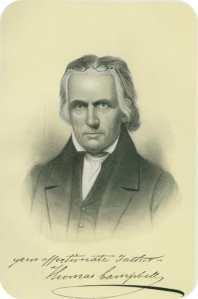
 The Christian Church (Disciples of Christ), including First Christian Church in Farmville, was born out of what has been called the Stone-Campbell movement. About the time Barton Stone was preparing to enter the Guilford Academy in the newly constituted United States, Thomas Campbell, the son of a former Roman Catholic Anglican was entering the University of Glasgow. There, from 1783 to 1786, he received a ministerial education “of greater depth than any of the other founders of the Disciples movement.”[i]
Prior to Campbell’s formal education at the University, Campbell had found a home with the Anti-burgher, Seceder Presbyterians. “Anti-burgher” meant that they did not believe burghers or mayors of cities in Scotland should be required to take an oath to the Church of Scotland. Seceders split from the Presbyterians because they believed congregations should have the freedom to choose their own pastors.
The value of an education at the University of Glasgow was described by an ordained minister:
A new school was formed in the western provinces of Scotland where the clergy, till that period, were narrow and bigoted…Professors opened and enlarged the minds of the students which soon gave them a turn for free inquiry, the result of which was candour [sic] and liberality of sentiment.[ii]
After graduating from The University of Glasgow, Campbell studied at the Divinity Hall at Whitburn, a theological school supported by the Anti-burgher Presbyterians giving him a very rich and thorough preparation for ministry. During his seminary education the writings of the following were great influences on Campbell:
Hugo Grotius (1583-1645), a proponent of Church Unity
John Cocceius (1603-1669), taught Covenant Theology
John Glas (1695-1773), advocated Restorationism
John Locke (1632-1704), valued Liberty and Toleration
James (1768-1851) and Robert Haldanes (1764-1842), believed in Congregationalism
After graduation from seminary, Campbell taught school, preached in Seceder congregations and married Jane Corneigle. In 1788, their first son, Alexander was born. Alexander, with his father, Thomas, would later be noted as two the forefathers of the Christian Church (Disciples of Christ).
An “Old Light,” “New Light,” controversy broke out in Scotland over an obscure Church-State relations point regarding the power of civil magistrates in religion. Subsequently, Campbell was called an “Old Light, Anti-Burgher, Seceder Presbyterian.” Campbell, who believed strongly in the toleration of different opinions, thought this designation was ludicrous and sought to restore unity to the Presbyterian Church. Campbell, a student of John Locke’s Letters Concerning Toleration, firmly believed in the freedom of the individual and the toleration of different opinions. In 1804, the year that Barton Stone dissolved the Springfield Presbytery, Campbell appeared before the Synod in Belfast and argued against “the evil nature and tendencies of our unhappy division” explaining that division was “inconsistent with the genius and spirit of the Christian religion.” However, the deep sectarian spirit in Scotland at the time prevailed.
To escape the growing hostilities between the Protestants and Catholics, like many of his friends, Campbell set sail for the United States where he would later move his family. As soon as he arrived in Philadelphia, he attended a conference coincidently being held by the Anti-Burgher Seceder Presbyterians of North America. He immediately became involved in the denomination in Pennsylvania.
Thomas Campbell followed many of other Irish-Scottish Presbyterians to Western Pennsylvania and settled in Washington where his education, scholarship and intellectual ability towered over his new Presbyterian colleagues. His tolerant, non-sectarian, liberal views caused immediate tension with the intolerant, conservative clergy in his Presbytery. He was aghast by the common practice of excluding others from the communion table. Even Presbyterians who were not Anti-Burgher Seceder were not permitted to the table with the Anti-Burghers. He discovered their exclusive views after he presided at a “Sacramental Occasion” in the community of Cannamaugh. During his sermon, Campbell criticized the divisions in the Church and welcomed all to the table as he did in Scotland and Ireland without respect to their Presbyterian connection.
Charges were soon brought against Campbell for his unorthodox Seceder views which led to his withdrawal and suspension. Campbell, however, continued to preach in the barns and houses around Washington while his message of liberty grew in popularity. In the summer of 1809, a large group gathered at a farm and discussed how they might organize. Campbell addressed the group and closed with a guiding principle: “Where the scriptures speak, we speak. Where the scriptures are silent, we are silent.” On August 17, 1809, a second meeting was held and the Christian Association of Washington was organized and named. They had no intention of forming a church, but wanted to be an association to bring reform within and through church.
Thomas Campbell drafted a proposal for a statement called: The Declaration and Address of the Christian Association of Washington. This inclusive and progressive document has been called “a charter for unity for the church”; “a charter of liberty for free Christians everywhere,” and “the founding document of Disciples.” The document had four guiding principles:
- Every person has a right of private judgment.
- The Scriptures will be the sole authority; no creeds.
- The sectarian spirit is evil; argument over human doctrines should cease; unity and peace should be restored.
- The Bible alone for our rule; The Holy Spirit for our teacher of truth; and Christ alone as our salvation.
These principles were almost identical to James O’Kelly’s cardinal principles written fifteen years before.
Campbell had hoped that the association would grow; however, because of the rigidness of the Presbyterians at the time, it was very difficult to join the association and remain in good standing with the church; therefore, no ministers or churches ever joined the association. However, the association and the document helped to articulate the great cause for Christian unity, and the ten summary statements that remain important to the theology and practice of the Disciples today. They are as follows:
- The Church of Christ is essentially, intentionally and constitutionally one.
- Congregations, necessarily separate, out to be in close fellowship with one another. There should be no schisms or uncharitable division.
- The New Testament is a perfect constitution for the worship, disciple and government of the church.
- Human authority cannot make new laws for the Church where the scriptures are silent.
- Doctrinal exhibitions must not be made terms of communion, because they are the product of human invention.
- Realization of the need of salvation, faith in Christ as Savior, and obedience to him are all that is essential to membership in the Church.
- Love each other as brothers and be untied as children of one family.
- Division among Christians is a horrid evil. It destroys the visible unity of the Body of Christ.
- For the perfection of the Church, receive those who profess faith in Christ, ministers teach only what is revealed, and divine ordinances be observed after the example fothe primitive church.
- Direct attention to first principles; remove the rubbish of the ages.
This document was the foremost important contribution of Thomas Campbell to the Disciples movement. The second contribution may be the training of his son, Alexander and the guidance that was given to him as Alexander traveled throughout the country to spread this message of Christian unity and the principles of the Declaration and Address.
However, Thomas, himself, also traveled throughout the country teaching the principles of the Declaration and Address with all who would hear it. In April of 1834, Thomas traveled to North Carolina and stayed at the home of Thomas Jordan Latham (1797-1862) in Pantego, outside of Belhaven.

Latham was a well-educated teacher of “marked success.” In 1830, at the age of 33, Latham confessed Christ and was baptized into a Free-Will Baptist congregation in Pantego. Free-Will Baptist reject the Calvinism inherent in other Baptist groups. On October 2, 1830, he helped organize the Concord Free-Will Baptist Church with 36 members. Latham served as the church clerk for many years.
As stated above, April of 1834, Latham entertained Thomas Campbell in his home where he learned first-hand the principles of the Christian Church movement. Latham taught Campbell’s principles of Christian Unity for many years, and in November, 1841, in his keynote message at the annual meeting of the Bethel Conference, he cleared the way for a merger of that conference with the local meeting of the Disciples of Christ on May 2, 1845. This began the annual state meetings of the Disciples of Christ in North Carolina.
Josephus Latham (1828-1889), the son of Thomas Latham, became a great evangelist for the Disciples in North Carolina for forty years. In 1854, Josephus Latham was called to serve as the first pastor of a new congregation called the Antioch Christian Baptist Church in Pitt County. The church was later renamed the First Christian Church of Farmville, North Carolina. For more see (http://wp.me/P3R4Q0-e8).
 Just Love