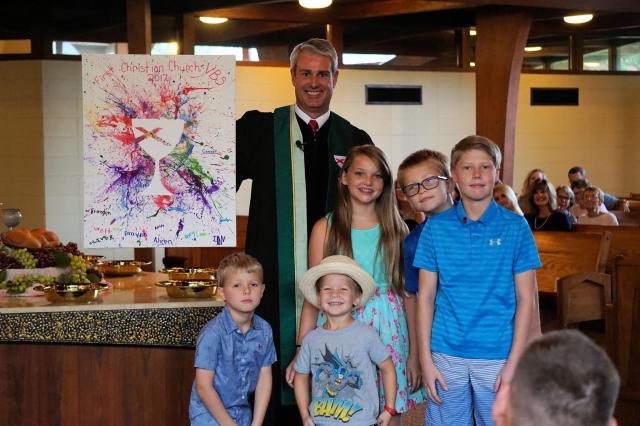
Jamie’s Story: Love Wins

Jamie reading
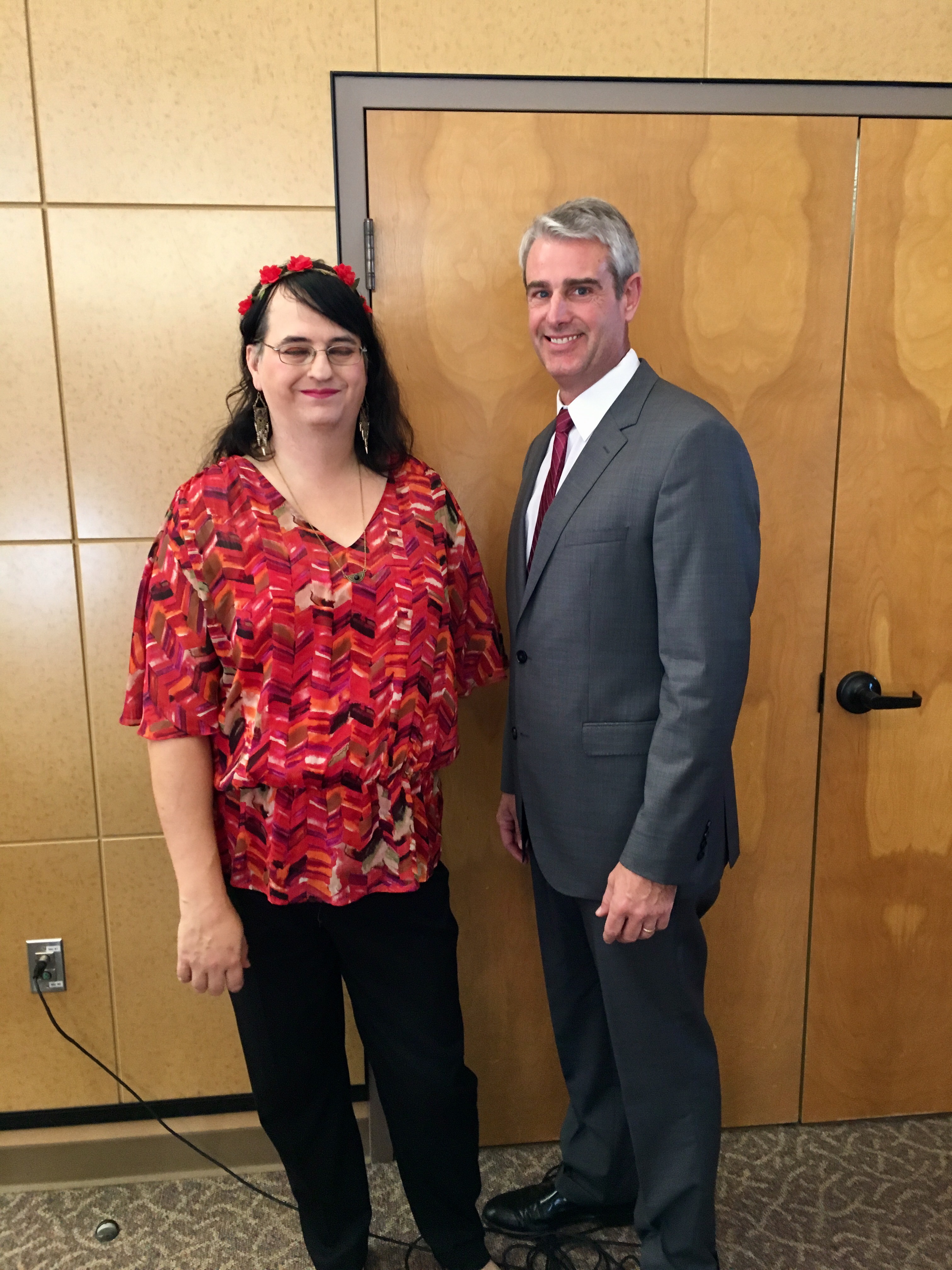
Jamie Pape gave the following testimony today after her baptism at First Christian Church in Fort Smith, AR.  Her words were for her church and members of the LGBTQ+ community who have been victims of hate and bigotry. 

Hello Everyone,

I want to thank everyone for being here today, not just for being here for my baptism, but really my rebirth as a human. I stand here in front of you, a simple humbled servant of God. I stand here only a short time removed from some very evil acts of violence, acts that send ripples of fear in their wake. I morn for those touched by this, but I also send out encouragement. This is not the end. I want them to know that they are loved by us and most importantly by God. God mourns the loss alongside you and will be there to comfort you. My plea is to never give up.

I know fully that pit of darkness that you can get close to. I have looked at it for most of my life. I know what fear can do. As a young child, I knew something was not right, and because of that I have endured countless acts of evil. I have been beaten and burned, but yet something kept giving me the strength to carry on.

I used to pray, every-night: “God please end my pain, God please, take me from this world.” Then, I would wake up, still living, but not alive, still here, but not. Confused as to why, afraid of what could happen should anyone discover my truth, confused as to why me, and alone, despite being with people who loved me. I felt like there was no one like me. Sure, there were characters on daytime talk shows, but I did not see people. I felt alone and afraid.

Now, I will not stand here and say that it was all gloom and doom. I had good days, and I had awesome days. The day I looked into someone’s eyes as she responded the words: “I do.” The day I held a tiny baby in my hands and realized this is why, this is why I was placed here. Then another came, and yes, another. I have three beautiful children who now are entering adulthood. I thank God for these, for they gave me a purpose, yet I still sat alone many nights, afraid, oftentimes depressed and silent. I still said the same prayers, had the same fears.

Fear ruled my life, until a little over two years ago. I decided to not let fear rule me any longer, to not live in pain any longer, to be fully truthful and honestly share that truth. SO I came out. It was not an easy road, and one I still travel to this day. But I do not walk it alone.

And yet, despite having taken this big step, that pit of darkness followed. Many times I feared it would consume me. I got to a point of wondering why God hated me, and I said one final prayer, I said God If you love me please, please speak to me, please show me that you love me… that Friday my boss at the job I had, for, no reason looked at me and said God loves you Jamie, just the way you are.

That night, I prayed. I said “God, thank you for speaking to me, but I need more. I need a church, because I used to go, but hate and fear drove me away from church. The next day, I met Dr. Jarrett Banks. He had said something I will never forget. He said: “I want to be your friend. Whether or not you come to church, I want to be your friend. He invited me to come here, no strings attached, just a promise that I would be safe. So I came. I faced my fears walking though the door. At first, I went in the wrong way and had to come around to the right door.

But I did. And with a deep breath I opened the door. I walked in. I stood right over there. I was going to sit alone. But someone noticed me, and she waved to me to come over. At first I thought maybe she was waving at someone else. Nope, she was indeed waving to me. So I went over. During that service I cried. I cried, because I felt a presence in my soul that I had not felt in ages. I cried at the words spoken about being inclusive.

Which brings us to today—a day where we celebrate a rebirth, as well as an early thanksgiving. I give thanks that God has placed all of you into my life. I thank God that people are starting to see the truth. I thank God for everyone who has been given the courage to stare down fear, and hate. And I thank God for giving strength to people to stand and defend those who cannot quite yet defend themselves. I give thanks to God… for life.

So in closing, I say this to those who hurt, those who mourn, those who fear: God loves you. We love you. I love you. Together, we will defend you, support you, and comfort you, until you can once again stand and do the same for others.

A Weapon in Church

shooting church

“Preacher, what are we going to do? Are we going to have to start carrying guns to church? Is this what it has come down to?”

I responded by saying: “Love is the only weapon I will carry into the pulpit.”

I said that, because I believe the only weapon this world needs is Love— Love that is from God, is of God, and is God.

This Love is not passive. It is neither silent nor afraid. It does not despair nor does it acquiesce. It is not weak, nor is it timid. It cannot be confined nor contained. It cannot be kept to one’s self. It never sits back and does nothing.

This Love is courageous. It is thoughtful. It is rational. It is vocal. It is always moving, doing, working, fighting. It gives and forgives and gives some more.

This Love is sacrificial. It is inclusive and expansive. It can overpower, overtake and overcome. It can change everything.

This Love puts feet on prayers. It attaches arms to offerings and hands to hymns. It gives life to a sermon.

This Love will always be opposed. It will be ridiculed, mocked and bullied. It will be hijacked, humiliated, imitated and defamed.

This Love never gives up. It never bows down. It never retreats. It cannot be bought by the ACLU nor the NRA. It will not compromise.

This Love will be shot—in a theater, in a limousine, on a motel balcony, in a school building, in a cinema, at a concert, in Wal-Mart, even in church. It will be crucified.

This Love will not accept defeat. It will never throw in the towel. It will die, but it will not pass away. It will be struck down and buried, but it will rise up and live.

This Love will conquer all. It will surpass all. It will never end.

This Love will win.

How God Responds to Death

cemetary sunsrise

Luke 7:11-15 NRSV

All Saints’ Sunday gives us an opportunity to reflect on a topic that we all like to avoid. Though it occurs to every living person, we do everything we can to distance ourselves from it.

Just a century or more ago, people seemed to be more comfortable with death. There was less distance between the living and the dead. Instead of dying in a hospital or a nursing home, people usually died in their own house.

And their bodies were not sent off to the funeral parlor, but kept at home, prepared there by family members for visitation and burial.

Today, death usually occurs in isolated places where where we have these specialists who deal with it. When families make funeral arrangements, we have more specialists step in to maintain a margin of protection around the grieving.

When I was growing up, I remember being shielded from death. Visitation with the family always occurred in the home of the deceased without the body being present. It stayed at the funeral home.  Although one had the opportunity to privately view the body at the funeral parlor, most people chose to only visit with the surviving family members in the home.

I remember my parents teaching me that there was no need to go to the funeral home to see my Great Granddaddy, because Great Granddaddy was not at the funeral home.

“That’s just his body, an empty shell. He is in heaven with God,” they’d say.

My parents were only doing what they could do to protect me, to keep me at a safe distance from death.

There’s a growing trend to revert back to a more acceptable view of death, to an understanding that death is a natural part of life. After all, at some point, everybody’s doing it. Hospice Homes have been built to accommodate entire families, so everyone can be included in someone’s final moments.

I believe this is a better approach to death. To face it. Accept it.

However, if we are not careful, I believe Christians can take acceptance of death too far. For I believe it can become very problematic when every death, no matter how tragic or horrific, is accepted as the will of God.

In fact, I believe we misconstrue who our God is when, upon hearing of someone’s untimely death we say things like: “Well, it must have been his time to go.” “The Lord called her home.” “Another flower was needed in God’s garden.”  “This is just God’s will, and we just have to accept it.”

By having an understanding that every death is God’s will, I believe some Christians encourage the grieving to move on too quickly with their lives. They infer that spending too much time grieving over a loss means their faith in God is weak and shallow.

“You need to accept that this is all a part of God’s plan. So dry it up. Get yourself together. Get on with your life.”

Thus, many people who still find themselves grieving over a loss they experienced as little as six months ago begin to feel guilty for lacking faith.

People today even try to naturalize the death of children. I do not believe there is anything more unnatural than the death of a child. It is a break of the natural order of things. Our children are supposed to be there to take care of us when we grow old and die.

But I’ve heard people try to limit the tragedy, naturalize the heartbreak. At the funeral of an infant, I one preacher said: “Some children have always died before their parents. The only reason that it seems so tragic is because, today, people are having fewer children.”

He then told the story of Johann Sebastian Bach who had 20 children by two wives. He said, “Only ten of his children survived to adulthood.  What nature took away in the form of untimely death, nature made accommodation by the fruitfulness of human union.”

It was as if he was saying to the grieving parents: “Your grief today is your fault for not having more children! Don’t blame death for your grief, for death is a natural, God-willed process.”

I believe our scripture lesson this morning encourages us to have a better-informed theology when it comes to death.

Jesus and his followers encounter a funeral procession while traveling through the town of Nain. Nothing unusual. A very common occurrence, even today. However, instead of ignoring and isolating himself from death, instead of distancing himself from or denying death by calling it a natural part of life, Jesus confronts death. Jesus stops, recognizes the harsh reality of death

And when Jesus learns that the funeral was for a widow’s only son, Luke tells us that he was moved with compassion. The Greek word used here is a “visceral” verb. It literally means that Jesus was moved from deep within his inner bowels. Jesus had a gut-wrenching reaction to this widow’s loss.

Jesus recognized the tragedy of this death, the unnatural pain and heartache that this death had caused. Jesus recognized that sons should bury mothers. Mothers should not bury sons. Jesus recognized that this was not the will of God.

This is how I believe our God always responds to death. God does not will death. God is not sitting on a throne pushing buttons calling people home.

No, Luke teaches us that when someone dies, God is moved and moved deeply. God has a visceral, gut-wrenching reaction. God is flooded with compassion and overcome with grief. God does not accept death as a natural part of life, but on the contrary, God recognizes the unnatural aspect of it, and God is moved from the very depths of who God is.

Remember Jesus’ response when his friend Lazarus died. It’s the shortest but perhaps most hopeful verse in the Bible: “Jesus wept.”  When a loved one dies, our God does not say: “Have some faith. Move on. Get over it and get on with your life. Stop cying.”

No, our God grieves. Our God cries with us.

With compassion, Jesus reaches out his hand and touches the casket and speaks to the one within it: “Young man, I say to you, get up!”

And then (listen to these wonderful words): “When the son arose, Jesus ‘gave him back to his mother.’” Isn’t that beautiful?  This young man’s life was restored, but so was the life of his mother.

Thus, Jesus demonstrates what our God is all about. God is and has always been about bringing life to all people.

Genesis says that the first act of our God was to breathe the breath of life into creation. God’s breath, God’s Spirit, swept over the face of the waters. God breathed into the human the first breath of human life. And it was in the same manner, God, in Jesus breathed new life into the young man from Nain by speaking the words: “Young man, I say to you, arise,” demonstrating that God’s business is always to give life, not death.

Therefore, I believe it may be questionable theology to say that “God wills death,” or “calls people home,” “or takes our loved ones.”

For our God is always giver. That means God is never a taker.

Thus, it’s more accurate to say that when any death occurs, no matter the age, no matter the circumstance, God confronts it. God is moved with compassion by it. In that moment someone takes their last breath, God is not there taking, but God is there giving, giving all that God has, pouring God’s self out into that person, fully, completely and eternally.

God does not ignore death, demean death, or simplify death saying: “This is all part of my plan.” God does not let any funeral pass by like it is somehow meant to be. No, God is moved with compassion and sees death as a force contrary to God’s will and takes action to overcome it, transform it, resurrect it.

It could be said that God’s whole life in the story Jesus is about this one thing: overcoming the power of death. As Jesus spoke life to this young man from Nain, God speaks life in the resurrection of Jesus and accomplishes not a resuscitation of one, but the redemption of all.

Through Jesus, God restores the natural order of things. God may not keep all children from dying before their parents, but God does restore the power of life over death, and the power of God over everything else in all of creation.

This is the good news for us on All Saints’ Sunday. We worship the God of life. We worship the God who has brought life to the ones we have lost this year, and who is even now bringing life eternally to us.

And this is the challenge for us this day. Because we worship the God of life, we are called even now to do what we can do to bring life, restoration and hope at the graveside of grieving parents and grandparents, as we will do this afternoon, at a Hospice Home or a funeral home, but also wherever there is degradation and dehumanization, wherever women are harassed and objectified, wherever children are neglected and victimized, wherever outsiders are scapegoated and demonized, wherever people are oppressed and demoralized, or wherever anyone is made to feel like they might be better off dead.

I will never forget the response of a homeless woman after our church served her a hot meal this past Easter Sunday.

She said, “Today you have made me feel human again.” T

hink about that. On Easter Sunday, because of the actions of a church, a woman, demoralized and dehumanized by the world, just didn’t learn about resurrection, she actually experienced resurrection.

Thank you for being the God of resurrection, the God of life and restoration. As we follow the Christ wherever he leads us, may we always be your resurrection people who make it our business daily to bring life and restoration wherever it is needed.

Invitation to the Table

Now, may the God of life breathe upon these gifts of grain and grape that they might be for all of us the live-giving presence of the living Christ, that we might be reflections of God’s likeness in a hurting world, so that others might know the blessings of life, abundant and eternal.

We remember all who have gone before us into God’s eternal splendor and now join them and all the angels and all of the saints of heaven as we continue to sing our praises to God together.

Mission Possible

shirt back

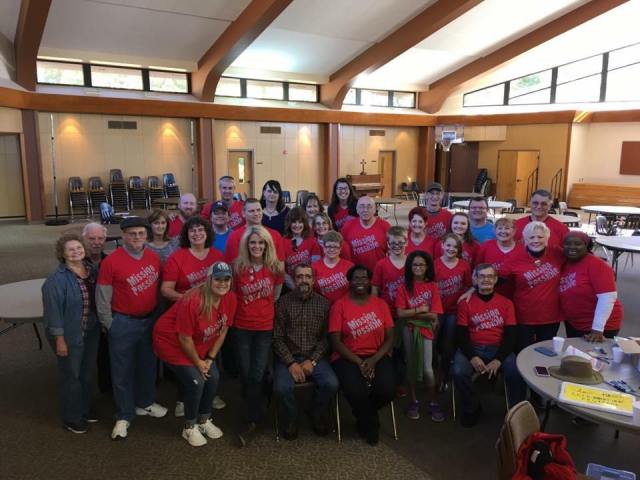
In a world of uncalled for meanness, is it possible to find people who believe they have actually been called to be on a mission to love kindness?

In a world of inequality and discrimination, is it possible to find people on a mission to do justice?

In a world of superiority and self-aggrandizement, is it possible to find people on a mission to walk humbly?

In a world of greed and selfishness, is it possible to find people on a mission to give rather than receive?

In a world of hatred and bigotry, is it possible to find people on a mission where diversity is valued?

In a world of violence and war, is it possible to find people on a mission that uses peace as a weapon?

In a world of indifference, is it possible to find people on a mission to empathetically care for others?

In a world of wealth and privilege, is it possible to find people on a mission to stand with the poor and marginalized?

In a world of divisive politics, is it possible to find people united on a mission of inclusion and respect?

In a world of alternative facts and fake news, is it possible to find people on a mission to live honestly, authentically, and unpretentiously?

In a world of bad religion, is it possible to find people who have little desire to be religious, yet yearn to be a mission to fulfill the greatest commandment to love one another?

Thanks to a group of folks that I have found who call themselves “Disciples,” I thank God that I know such a mission in this world is very possible!

shirt front

A Politically-Correct Gospel

Shannon

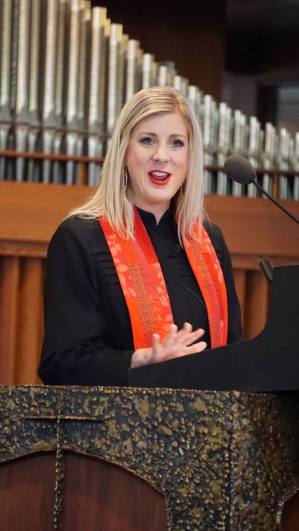
The following sermon was preached by Rev. Shannon Fleck at the Installation Service of Jarrett Banks as the 25th Senior Minister of First Christian Church in Fort Smith. 

Matthew 22:15-22 NRSV

  • Good morning everyone! I want to preface this morning by saying that I am not the usual occupant of this pulpit. So if you are visiting this morning and you hate it, come back next and hear Jarrett before making that decision. If you love what you hear today, come back next week also because he and I are kind of cut from the same theological cloth.


  • It is my intention to get a little real with you today. Because the world we live in could use a little more real. A little less side stepping. A little less “fake news”. A little less politically correct. I hope you don’t mind.


  • For sixteen blissful, easy breezy, smooth sailing months Jarrett and I served in ministry as a team in Enid, OK. And by easy breezy, I mean the hardest experience in ministry either one of us has ever faced. Those 16 months united the two of us as a team more so than any ministers I had ever seen.


  • And I tell you this only to qualify myself to you all as ready and willing to stand here on his behalf, alongside him as he makes promises to you all, his new congregation… and you make promises to him.


  • Ministry is hard. Ministry is especially hard in a world where religion has been used to repeatedly cause traumatic injury to God’s children for centuries. As a minister, one walks a consistent line of being “pastor” to those who have been hurt and those who have committed the hurting.


  • Living always in a dichotomy of another’s religious priorities versus your own, and inevitably, always letting someone down for not “doing faith” exactly as they see fit.


  • So friends, heeding to the promises exchanged here today will at times be easy and at times a challenge. But a minister’s heart and mind is constantly living in multiple places in order to be present with all of you;


  • You’re ALWAYS a minister. It is not an occupation that you do, it is a call you live every day, in every interaction.


  • I mean, one of the first questions one has upon meeting someone is asking what they do for a living, right? Ministers dread this question, because the minute we tell someone, we are immediately sentenced to carry whatever religious opinion, or guilt, or shame, or praise (maybe) they have.


  • Ministry is so very hard.


  • I know this person, as all of you will, if you don’t already. And he knows as well as I that there are things that pastors will always want to say that they probably never should, but a guest pastor can.


  • Like say, talk about politics from the pulpit.


  • This has been a spoken and unspoken no-no for ministers and preachers of the gospel for what seems like an eternity, erring on the side of caution, rather than offending the occupants of our pews. Ministers have been cautioned using the most emphatic of deterrents, fear.


  • So, imagine my quandary when today’s text appeared before me as the lectionary gospel for this week. A text that unashamadely places issues of religion and politics fully front and center. Crammed together. Not uncomfortably, like an awkward interaction with a relative at Thanksgiving, but as a matter of fact….


  • Any person who claims that religion and politics don’t mix, clearly missed today’s Gospel lesson.


  • It is important to note that Jesus, does not provide religious absolution from political and government involvement, we are going to have to pay those taxes.


  • But he makes the important distinction that loyalty to such things should only go so far as our complete and moral love of God will let us. So as we seek to give to Caesar what is caesars and to God what is God’s, we must remember that each and every being is God’s, and our loyalty is to what belongs to God first.


  • Now as I begin to wonder if some want to shift in their seats a bit I have to say that it’s understandable really, our desire to keep these topics out of the forefront of our most comfortable settings. Our relationships, our families, our sanctuaries. We do not want to be uncomfortable. There is nothing safe about that.


  • But in this effort to bifurcate the gospel from the reality of the political systems that influence our lives, we have done a disservice to that all important notion of Christian call.


  • And most importantly, we have left faith vulnerable and isolated. Up on the auction block to the highest bidder.


  • The bible has been contorted so many times to fit the comfort level of the powerful. Pushed, twisted, and breached more times than we can count.


  • What is politically correct about that?


  • Well church, if you wanted a pastor who would succumb to the fear of offending you… you hired the wrong guy.


  • Because this man that you just exchanged promises with, knows the politically correct work of the Gospel of Jesus Christ. And most importantly, he knows all about its unpopularity amongst the masses.


  • He is not concerned about comfort, least of all his own, he is concerned about living in the messy, abundant, unapologetic love of Christ with all people.


  • He is not one who will, as a friend of mine says, give you baby food from the pulpit, but sustenance for the journey.


  • He will ask from you all that makes you comfortable so that it can be stretched and extended into a grace filled life you may not had known was possible. But it will take trust on all your parts to change this world, and a willingness to stand up tall for what is hard.


  • That is a politically correct Gospel.


  • And in case you might need some real-world examples of a politically correct gospel, let me see if I can come up with a few.


  • When a terrorist, no matter the color of their skin, rings shots out through the streets or schools of America, the church should be prepared to offer a call to action against such disasters. Remaining silent is not an option.


  • When thousands upon thousands of women cry out “me too” on social media, the church of Jesus better stand in support of the endless victims of assault, harassment, and violence. Remaining silent is not an option.


  • When yet another person of color is gunned down by those sworn to protect and serve with nothing to show for it but another acquittal. Remaining silent is not an option.


  • When individuals are hated, ostracized, belittled, stripped of rights and protections, or disowned because of who they love. Remaining silent is not an option.


  • When the hurting, disabled, and abused are brushed aside, not even to be seen or heard. Remaining silent is not an option.


  • When white supremacists once again feel the safety to come out of their holes of hiding and not be held accountable by modern day “caesars”. Remaining silent is not an option.


  • When events like taking a knee become more important than providing aid to devastated storm victims, remaining silent is not an option.


  • When public education is devalued, politicized, and underfunded; when immigrants and refugees are locked out and shoved out of a better life; when Christians use their religious privilege to demean and degrade other religions… we absolutely cannot remain silent.


  • The idea that the Gospel isn’t political is offensive, because it refutes everything Jesus stood for and died for.


  • This gospel is a moving, emphatic, provocative, unshakeable political statement against a world that wants nothing to do with the unrestricted love God


  • I cannot help but congratulate you all on your choice of pastor.


  • Jarrett has had a journey out of a denomination that did not fit his need to practice a politically correct Gospel and into one that fits him like a glove.


  • His immense and humble gratitude for the opportunity to genuinely serve in context that is ready and willing to move and shake a world with unrestricted, unapologetic and immovable love radiates in his passion for the work of Christ.


  • Congratulations to you all. Now it’s time to get to work.


About Shannon

The Rev. Shannon Fleck currently serves as the Director of Community Engagement with the Oklahoma Conference of Churches, where she focuses on Community Organizing, Social Justice and Interfaith ministries.

Rev. Fleck is a native of the State of Oklahoma, spending her childhood with her family in Guthrie. Rev. Fleck attended the University of Central Oklahoma in Edmond, OK, where she received a Bachelor of Arts in Sociology. After working for the State of Oklahoma for two years in Juvenile Justice, she began seminary at Phillips Theological Seminary in Tulsa, OK where she was the Matthew Thompson Fellow, Student Senate Moderator, and the recipient of the Sojourner Award, the Interpreter’s Award and multiple book awards. Rev. Fleck was Ordained by the Christian Church (Disciples of Christ) in 2011.

Prior to her current position with OCC, Rev. Fleck served as the Associate Minister at Central Christian Church in Enid, OK where she was instrumental in beginning the weekly Welcome Table Ministry for the food insecure of Enid, a bi-monthly Suicide Survivor Support Group, a religious presence at Enid’s Pride Celebration, and multiple services and programs throughout the church year to accommodate marginalized communities. She has also served in ministry at the Little Rock Air Force Base Chapel in Jacksonville, Arkansas, First Christian Church in Yukon, OK, Western Oaks Christian Church in Oklahoma City, OK and First Christian Church in Guthrie, OK.

Rev. Fleck serves on the Board of the Oklahoma Coalition for Reproductive Justice and is the 2nd Vice Moderator for the Christian Church (Disciples of Christ) in Oklahoma. On October 20, 2017, Rev. Fleck was presented the 2017 Church Women United in Oklahoma Human Rights Award in recognition of her justice work in the State of Oklahoma. Rev. Fleck is a passionate minister for the work of Social Justice; standing up for the marginalized and ensuring dialogue and understanding among all people is at the heart of what ministry means for Rev. Fleck.

Halloween Masks and the Church

Some more Halloween thoughts…

Rev. Dr. Jarrett Banks's avatarJust Love

mc2

As a child, I had my share of nightmares.  The wicked witch from the “Wizard of Oz” would fly through my bedroom window to get me. Ronald McDonald and a gang of clowns, including Bozo and the Town Clown from Captain Kangaroo, would chase me down the road as I ran for my life. Even today, clowns still sort of freak me out. It might be why I prefer Wendy’s over McDonald’s.

However, the most frightening dream I ever had was the one where I was standing in the school cafeteria line. As I was on my way to the cash register to pay my 10 cents for my lunch and a carton of milk, I looked down to discover that I had somehow forgotten to dress myself that morning. I was as naked as I could be.

Now, I am not a psychiatrist, and I do not presume to…

View original post 226 more words

Halloween: O Holy Night

Some thoughts about Halloween…

Rev. Dr. Jarrett Banks's avatarJust Love

peanuts halloweenHalloween is sometimes called an evil or even a demonic holiday. However, I believe when we narrowly define demonic evil as fictional ghosts, goblins, and vampires that come out one night of the year, we may miss the true demonic evil that surrounds us every day—Greed, hate, racism, sexism, and all kinds of bigotry haunt our world day and night.

Furthermore, when one takes a close look at how our society observes All Hallows Eve, I believe one can reach the conclusion that Halloween may be the most holy night on the calendar. For example:

On what other evening of the year do we turn on our porch lights to welcome, not only friends and family, but all who may pass by?  All are welcomed and greeted with smiles and laughter, and “all” even includes witches, monsters and little devils. It does not matter who they are or from whence…

View original post 192 more words

No Regrets: Remembering Charles Young

img_6608
Life. Those of us who are truly grateful for it, those of us who understand the sheer grace of it, grasp the gift of it, appreciate the miracle of it, hope to get the most out of it as we possibly can. Whether we live 90 years or 83 years, we want to squeeze as much joy out of this world as long as we are in this world.

Charles and Wanda Young were those kind of people.

Charles faithfully served this country in the US Army during World War II. When the war was over, he continued serving in Germany, helping persons get their lives back on track, helping others squeeze as much joy as they could out of it, despite having their lives displaced by war or having their lives interrupted as a prisoner of war.

When he returned home, he continued serving others as a member of the First Christian Church of Fort Smith and as a member of the Belle Pointe Lodge of Freemasons in Fort Smith. He loved working to raise funds for Shriners Children’s Hospital in Memphis, Tennessee, serving as the Shrine Circus chairman. He also served children and youth here in Fort Smith, helping them to enjoy life through play and completion, as he coached and supported the Fort Smith Boys Club.

Charles also enjoyed playing himself. He loved hunting, fishing, skeet and trap shooting. He and his wife of 63 years, Wanda, were both Arkansas State Trap Shooting Champions for a number of years. The both of them also enjoyed playing golf.

These opportunities to enjoy life were afforded to him by his work ethic, starting many businesses throughout his career, retiring as president and owner of R.A. Young and Son Construction Equipment Company.

Now, on the surface, all of this sounds like a full and fulfilled life; all of this sounds as if Charles truly did squeeze all of the joy out of life that he could, especially as we consider how he also did all that he could to give others a chance to enjoy life. 

However, as I have heard many preachers say, when people reach the end of their lives, when they look back to make an assessment, look back to make a list of their regrets in life, there are several regrets that are never mentioned.

For example, at the end of life, no one ever says: “I regret that I did not spend more hours in the office  away from home.”

No one ever says: “I regret that I did not spend more time away from my family trapshooting, fishing, hunting or playing golf.”

And as proud as people usually are of their military service, preachers never hear people say: “I regret that I did not spend more years overseas away from my friends and family.”

No, the regret that most preachers hear is:

“I regret that I did not spend more time with my family.”

“If I had to do it all over again, I would have paid more attention to my children.”

“I wished I would have shared more of my life with my kids.”

“I regret that I did not teach my children more of the values that were instilled in me by my parents.”

“I wished I would have spent more time with my wife, especially when she became ill.”

This is why I believe the greatest line in Charles’ obituary, which is full of his attainments, pursuits and successes is this one:

“His family always came first in his life.”

Greater than his military achievements that we honor today in this National Cemetery, greater than his business accomplishments, perhaps even greater than his charitable generosity, was his devotion to his family. First and foremost in his life, and in the life of Wanda, whose obituary reads much like her husband’s as she had her own list of accolades, was family.

Their daughter Linda shared the following words with me:

We are grateful that both Mom and Dad shared their zest for life with us. They were both people with many varied talents and interests. Growing up with Mom and Dad was always an exciting adventure. We were constantly involved in interesting activities such as golf, skeet and trap shooting, and trail riding on motorcycles in the beautiful Ozark mountains, hunting, fishing, calf roping, heading and heeling.

A love for education, of reading and art was also important in our lives. Learning about new things, learning to do new things, accomplishing and mastering new activities was a constant in our lives. Life’s lessons were embedded in all the activities. Dad spent his life teaching us about the cornerstones of life that would guide us as adults.

These always involved pursuing excellence and competitions. Dad taught us that practice makes perfect. That meant lots and lots of practice at whatever we were learning.

They took us with them everywhere, and they involved us in everything.  Dad was the one who set the pace and it was rigorous.

Mom was always a good sport and jumped right in to join in the fun and learn right along with the kids! She ended up being an expert at whatever the activity. As the only girl, I am grateful that my mom set an example for me – ‘girls can do it all!’ With the right attitude and determination [I learned to always] go after your dreams!

We are grateful that Dad took time to be our mentor and a great role model.  We are grateful that dad spent lots of time with us teaching life’s lessons along the way.  My brother, Jim, reminded me that Dad had themes he worked on with us; he taught us to persevere – he taught us the meaning of integrity – honesty – and persistence – and to never judge the other man.

He taught us generosity for those less fortunate in life.

We are grateful that our mom was always home for us and that we were her sole focus in life besides our dad.  She shared her artistic talents with all of us. We all spent hours with Mom doing art projects, painting, ceramics, and other arts and craft activities. She always took us along when she volunteered at the Girl’s Club as an art teacher.

She was a perfect match for Dad in spirit and in energy. They shared 60 years together. When my mom became ill with Alzheimer’s, Dad took care of her at home. For six years, he devoted his life to caring for her and giving her the most quality of life possible as the terrible disease progressed.  Even when it was very, very hard he stepped up and worked harder at caring for her.

We are grateful that he showed us what true love and commitment is really about.

Life. Those of us who are truly grateful for it, those of us who understand the sheer grace of it, grasp the gift of it, appreciate the miracle of it, hope to get the most out of life as we possibly can. Whether we live 90 years or 83 years, we want to squeeze as much joy out this world as long as we are in this world.

Many people try to do that. However, I believe very few people can actually do it without regrets.

The good news is, according to what I have learned about Charles and Wanda through their children, I believe they may have done it: leave this life with no regrets.

And it is because of this good news, and because of their faithfulness to their God, to their church, to their communities, to this country, but especially to one another and their children, we, who are left behind to continue our lives, we also do not have any regrets this day. For we know that as they were faithful with the lives they were given by the miracle of creation, God has now been faithful to them by the power of the resurrection.

We come to this place with grateful hearts. Thanking God for eternal life in heaven, but also for eternity here on earth, as the Spirit of Charles and Wanda are still very much alive through their children and grandchildren.

Therefore, the final words from the Apostle Paul are most appropriate to conclude this eulogy, marking the end of lives well-lived.

2 Timothy 6

As for me, I am already being poured out as a libation, and the time of my departure has come. I have fought the good fight, I have finished the race, I have kept the faith. From now on there is reserved for me the crown of righteousness, which the Lord, the righteous judge, will give to me on that day, and not only to me but also to all who have longed for his appearing (2 Timothy 6:6-8).


Obituary

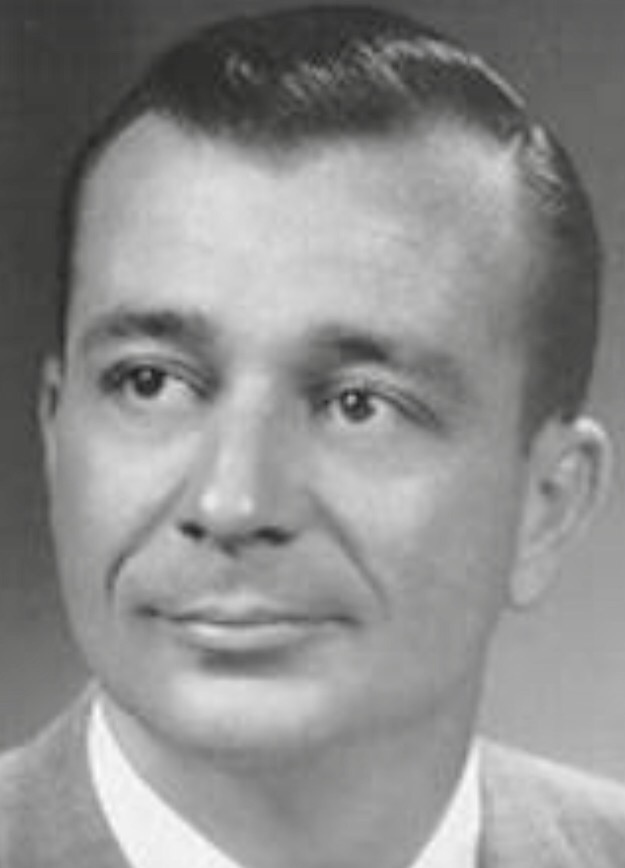
Charles Holt Young, 90, of Hot Springs passed away Saturday, Sept. 30, 2017. He was born in Greenwood on Nov. 10, 1926, to Horace William and Lucille (Scales) Young. Mr. Young graduated from Kemper Military Academy in 1944 and went on to attend Texas A&M University in College Station, Texas. He was a World War II veteran serving in the 3rd Army, First Calvary Division. Following the war, he remained in Nuremberg, Germany, as part of the Army of Occupation assigned to oversee reintegration of displaced persons and prisoners of war.

Mr. Young was a Mason and a member of the Belle Point Lodge in Fort Smith. He served as the Shrine Circus Chairman raising substantial funds in support of the Shriners Hospital in Memphis, Tenn. As a longtime volunteer and board member of the Fort Smith Boys Club, he enjoyed coaching and supporting the baseball program.

His interests included golf, reading, hunting, fishing, skeet and trap shooting, performance breeding of Angus cattle and thoroughbred horse racing. A keen competitor, he held state, regional and national trap and skeet shooting titles. He was the Arkansas State Trap Shooting Champion for a number of years and inducted into the Arkansas Trapshooting Hall of Fame in 1973. A successful businessman, Mr. Young started numerous businesses throughout his career. Prior to retirement, he was president and owner of R.A. Young and Son Construction Equipment Co.

His family always came first in his life. Loving survivors include his daughter, Linda Young of Little Rock; two sons, Charles William Young and wife Ranie of Dallas and James Franklin Young and wife Mary Ellen of Chicago; grandchildren, Charles and Patrick Murray, Dr. Virginia Young and husband Brad Geswein, Clayton and Madeline Young. He was preceded in death by his wife of 63 years, Wanda Louise Young; and his two sisters, Nancy Young and Billye Smreker.

A kind and generous man, Mr. Young will be greatly missed by all who knew him. Arrangements by Little Rock Funeral Home and Edwards Funeral Home in Fort Smith.

In lieu of flowers, please consider donation to the Michael J. Fox Foundation for Parkinson’s Research, www.michaeljfox.org.

Let the Children Come

Children

Matthew 19:13-15 NRSV

There is so much that the Church can learn from this wonderful passage of scripture.

Little children were being brought to Jesus.

Before children can come to Jesus, someone, or something has to bring them. They usually to do get to this place on their own. It may be a parent, a grandparent or another relative. It might be a neighbor, a Sunday School teacher, or just someone who cares. A good question for the church to ask is: what are we doing to bring children to this place? Or are we merely waiting for children to come.

Churches make the following mistake all the time: Oh, we don’t have a youth minister any more, because we just don’t have that many children. Have you ever considered that not having many children is the best reason to have a youth minister?

I believe churches bring children to church by working hard to have all sorts of theologically-sound learning experiences and hands-on missional opportunities for children. We don’t wait until we have enough children to have a vibrant children’s ministry. We create the very best ministry to children we can to bring children here.

I believe churches bring children to church by allowing children to participate in and even lead worship, for children have much to teach us.  We also bring children here by providing separate opportunities for smaller children during worship, as our education committee is currently planning.

I believe churches bring children to church by having a safe-church policy to protect children, and dedicated, compassionate, and screened volunteers to love and nurture children.

Little children were brought to Jesus that he might lay his hands on them and pray.

Children should always be brought here with a specific purpose to be loved, accepted, embraced, and supported. Children are to be the focus of our prayers. That means that children are to be the subjects of our most personal and intimate conversations with God.

Ask yourself this: how many times are the children in our community truly the main focus of our prayers?

But the disciples spoke sternly.

We think: who in the world would speak sternly preventing children from coming to Jesus? The answer surprises us, but at the same time, doesn’t surprise us. Matthew says that it was his very own disciples.

As a part of the Church for over 50 years, I have experienced this in many more ways than one.

When I was growing up I remember hearing offended church members sternly say terrible things about my home pastor when he supported having basketball goals installed on the church grounds. They criticized us playing ball at the church for many reasons. One, all the running around the goals was going to kill the grass. Two, we might leave drink bottles or other trash on the grounds. And three, the basketball games might attract the wrong type of kids, and by type, well, you know what they meant.

My pastor was also criticized by church members for sending our church bus out to pick up children who lived a few miles away in a trailer park (again, wrong type of kids), He was also criticized for asking the church to pay for children that they picked up on that bus to attend camp in the summer. And the four times each year we has communion, I always heard people grumbling about the pastor for not prohibiting children who had not been baptized to take communion.

As a long-time pastor, I have experienced similar criticisms, never by people outside of the church, but by people on the inside claiming to be disciples. There have always been people in the church who for some reason or another think it is their God-given, moral duty to put restrictions on who can and who cannot get to Jesus.

People have and will always be offended by Jesus’ revolutionary words:

Let the children come.

Let the children come to a safe place of welcome, a place of grace, a place of love, a place of nurturing where they can learn and grow into the people God has created them to be. And let all of them come. Let all children come to a place where no one is judged, treated unfairly, or ever feels excluded, second-rate or second class.

Do not stop them.

Do not let anyone or anything stop them. Do not let that one with money, power and prestige who thinks God has made him the gatekeeper of the church stop them, and do not let condescending words, snooty looks, or self-righteous expectations stop them. Do not let appearance, dress, ethnicity, documentation, race, size, gender, sexuality, health, class, or disability stop them. Do not let their families’ past or current situation, tax bracket, beliefs or lack of beliefs stop them.

That Jesus said this about little children speaks volumes about how we as the Body of Christ are to welcome all people.

For little children are people—

Before they are old enough, before they are strong enough, or before they are smart enough to help themselves or anyone else for that matter. Little children are folks who are not yet able to contribute to society, pay taxes, earn their place in the world, or deserve any sort of commendation. This means that the arms of the Body of Christ are to be open wide with a grace most extravagant and a love most radical.

It is the same love that parents have for our own children. We love them more than anything simply because they are our children.  So extravagant and radical is this love that there will be always be those, probably those who call themselves disciples, who will be so offended that they will speak and even act, sternly.

To such as these that the Kingdom of Heaven belongs.

This, says Jesus, is what the Kingdom of God looks like. This is what eternity looks like. This is what the church should look like. And this is what the church should help the world to look like. I believe one of the great purposes of the church is to show the world, through our words and our deeds, how to be people of extravagant grace and welcome, of radical love and acceptance.

But sadly, the church has been guilty of doing the opposite, have we not?  People go to church looking for grace and acceptance, and all they find is judgment and condemnation.

Somehow, we have been preaching the gospel the wrong way. In fact, I believe we have a tendency to actually preach the gospel, not just the wrong way, but we have a tendency to preach it backwards.

To share Jesus with others, we often start with what is sometimes called the doctrine of original sin. Now, don’t get me wrong. I believe that all people are sinners. I just don’t believe that is where we should begin the conversation or the sermon.

Our sermons usually have three points, and point number one is: All people are sinners. Point number two is: God sent Jesus to die for us. And point number three is: if we believe this, then God will forgive us and love us as God’s children forever.

I believe we should preach the same sermon, but proclaim it the other way around. And I believe the way we bring children here, to a place of grace, acceptance and welcome is the way to help us turn it around, to preach the gospel the right way.

I believe we should always begin with God’s love for all people. We should make our number one point, the first and foremost point of our sermon that God loves us as God’s children and wants nothing more but to love us forever.

The second point should be that God loves us as very own Children so much that God came and loved us so radically, showered us with grace so extravagantly, that it offended the organized religion of his day. They sternly spoke out, “crucify him,” and they sternly acted out with a whip, a crown of thorns and a wooden cross.

And we should make our third and final point that God did this while we were yet sinners, before we earned or deserved anything, before we contributed anything, even believed anything.

Do you see the difference? Instead of preaching that all people are born sinners standing outside of the grace and love of God until they do something, say something, or pray something to earn forgiveness, we are to preach that all people are actually born standing inside of the grace and love of God without doing, saying or praying a thing to earn it. For this is the gospel. This is what we want people to believe and accept— that all people are welcomed into God’s gracious and loving arms—they just may or may not know it.

Jesus put it this way—Point #1: For God so loved the world. Point #2: God gave God’s only son. And Point #3: So that all whosoever believes may not perish by their sins but have everlasting life.

If we keep teaching this, continue preaching this, if we keep welcoming children, all children, making the church and a place of extravagant grace and a place of radical love; then, before you know it, we are going to change the whole world. We will start seeing people differently. Instead of seeing people first as sinners who deserve hell, fire, and eternal damnation, we will begin to see them first as God sees them, as God’s “little children,” who are to be embraced, accepted, prayed for, nurtured, and loved.

O God, thank you again for all of the children in our midst and for the wonderful ways that they remind us of your grace and love. Amen.


Invitation to Communion

Christ welcomes all to eat and drink from this table,

And the arms of Christ are open wide.

There is nothing here that can stop you sharing this meal.

There is no sin so great, no shortcoming so large, no wound so deep, and no mistake so wide that it does not fit inside the arms of his grace. In the eyes of Christ, no one here is second-class or second rate. All are God’s beloved children. All are welcome.

Eternal Educator: Remembering Kaye Birkhead

BruceKaye_2777

It is with gratitude and honor that I stand before you today to share a word of hope and good news for all of us who loved Kaye Birkhead.

For how wonderful is it to be able to speak words marking the end of one’s life that are evidence that one truly fulfilled their human vocation, their very purpose for which they created.

In the first story of creation, we read about this purpose. It is the purpose of every human being. It’s the first commandment of God to humankind:

God blessed them, and God said to them, ‘Be fruitful and multiply, and fill the earth and subdue it (Gen 1:28)

And how do we do that? How do we become the people God has created us to be?

It is in the second creation story, that we read where God places the human in the garden, because to fulfill our purpose, we humans have to eat.

We are all going to have an opportunity to do this essential, primal thing together in just a few minutes, as we are all invited to gather in Disciples Hall, or what might be called, our church’s garden, to share a simple meal of Pintos and Cornbread, one of Kaye’s favorite dishes that her grandmother used to serve.

A side note here. I have sometimes been criticized for the funerals that I preach for making the person being remembered out to be a saint. Well, let me go ahead and state right here that Kaye was not perfect. Nope, as good as we think she was, she was a human being. For when Kaye’s mother would serve a meal that Kaye didn’t like when she was a little girl, I am told that Kaye would get under the table and cry until one of her uncles would go over to her grandmother’s house and come back with a bowl of beans and some left-over biscuits from breakfast.

Her grandmother’s food would comfort Kaye. It would dry her tears, and feed her heart.

Perhaps that is why Kaye loved coordinating countless meals, making certain everything was prepared just right, to comfort grieving families after the funeral or memorial services. Maybe she wanted to do what she could do to dry their tears and feed their hearts.

Back to the creation story:

Then the Lord God said, ‘It is not good that the human should be alone (Gen 2:18)

The very first thing that God said was not good in the creation was loneliness, so God created a partner for the human which made him exclaim: “This at last is bone of my bones and flesh of my flesh.” “At last, someone who gets me, understands me, and loves me.

To fulfill our purpose as human beings, the story of creation is explicit: we need one another. We need to understand the sanctity and the holiness and the grace that is in all human relationships.

It was very difficult visiting Kaye during these last couple of weeks of her life in palliative care, but what made it a little easier was knowing that Kaye was never alone. Kaye spent her last days on earth as she did all of her days, surrounded by her family and her friends, those with whom she shared a sacred relationship, those who got her, understood her, loved her, those who could relate to her so genuinely they affectionately called her “Muffin.” I never saw her in the hospital when Bruce, Todd, Zena, grandchildren, or others were not there with her. There is no doubt thate love that you share as a family is from God and of God.

Right before God creates a companion for the human, something else happens in this creation story that we can sometimes miss.

So out of the ground the Lord God formed every animal of the field and every bird of the air, and brought them to the human to see what the human would call them; and whatever the human called each living creature, that was its name. The human gave names to all cattle, and to the birds of the air, and to every animal of the field (Gen 2:19-20).

After eating, the very first thing the human did in order fulfill their purpose on the earth was to name the mystery and majesty of God’s creation. To be the person God was calling them to be, the first thing the human needed to do was to name God’s world.

Do you know what we call that?  In a recent sermon, I heard the Rev. Charles Johnson from Texas say, “We call that ‘education.’”[i]

The naming of God’s world, naming its beauty and its mystery, naming its diversity and its majesty: this is education.

In order to fulfill the first commandment of God to humankind, in order to be fruitful and replenish the earth, before we can be the person God has created us to be, we first need education. We need to name the creation.

Valuing every child and every child’s passion, and believing that every child, not just those who can afford it, has a God-given, inalienable right fulfill their purpose, to live out the full potential of who God created them to be, Kaye began a career in public education in 1957, a career she would love until her retirement in 2000.

But because Kaye truly yearned for all children to fulfill their God-given purpose, no matter their circumstance in life, she came right out of retirement to work for the Fort Smith Adult Education Center. She loved this work.

I believe Kaye appreciated the words of our second President John Adams who said in 1785: “Let there be not one square mile in this land without a school in it.” With our forbearers, Kaye believed in equitable public education for all, and all means all. And that this was the way to build a great nation.

And I believe Kaye would want her new pastor to emphasize today that equal access to quality public education is not only one of the highest ideals of our country, it is the high, God-ordained, holy work, spelled out on the first pages of our Bible—Learning, studying, discovering, and naming the creation, is the first thing human beings were called to do.

But God’s creation is so wonderfully diverse, so mysteriously majestic, sometimes naming it with mere words simply will not do.

To name the mystery of this miracle we call life, sometimes we need to appeal to the arts. I believe this is why art, sewing, cooking, floristry, the theater, dramatic and musical expressions of life, were so important in Kaye’s life and will always be important in the life of her family.

Likewise, the gospel of Christ, the good news of God’s love and grace, is so extravagantly expansive, so radically revolutionary, naming it with mere words simply will not do.

This is why I believe Kaye will always be known in this city, as not only an educator, but also as a selfless servant. Kaye served her community through public education, her church, her PEO, the Fort Smith Little Theater, teaching through her service the good news of the Christ who came as a sacrificial servant for all.

I believe Kaye’s servitude indicates that the greatest thing that this educator ever learned in life was knowing who she was in the creation. For this, I believe, is the greatest education any of us can receive: Knowing who we are before God in God’s world.

This sacred, intimate and personal knowledge that God’s love enveloped her, God’s grace covered her, God’s presence surrounded her, is the only way I can explain Kaye’s miraculous disposition during these last difficult days. Kaye knew that the one who had always been so gracious to her in life was not going to let her down in death. As a parent herself, she knew that her heavenly parent was going to take care of her the same way she took care of her children, and so many of God’s children.

Therefore, in her final days, there was really nothing final about them. Kaye was miraculously more whole, more alive, more aware, and more hopeful, than the healthiest person any of us know. Even when she no longer possessed the strength to open her eyes, she still mustered the strength to smile and sometimes laugh, for as Kaye always taught us, “laughing makes everything better.”

I marveled how she continued to stay so engaged with the world, so interested in what was going on around her, always asking questions, asking me how I was doing and how things at the church were going. It amazed me how she continued to watch Jeopardy every weekday afternoon.

Maybe it was because Kaye wanted to keep learning. Even at the end of her life, she wanted to keep growing, keep discovering, keep expanding her mind, keep naming God’s beautiful world. Because she believed that God through life itself, always had something to teach her.

The problem with many people we know is that they have life all figured out. They have all of the answers. There is no room for growth and change. Their minds are made up and closed. There is no mystery. And when we think about it, these are the people we usually don’t like being around. They are nothing like Kaye.

Kaye taught us to never stop learning, to never close our minds. As long as we are awake in this world, we should never cease listening to what God has to teach us.

And the good news for all of us who loved Kaye Birkhead is that by the power of the resurrection, God is still using Kaye to teach us. From eternity, this great educator will instruct us for the rest of our lives to keep learning, to keep our minds and our hearts wide-open, to keep growing, to keep discovering, to keep changing.

Continue to learn to know who we are in God’s creation before our Creator. Learn to know how loved we are. Touch, taste and inhale the grace that is in it all. And then, learn to know how we are uniquely called to share this love and grace with others.

Therefore, perhaps the best way you can remember Kaye, thank God for Kaye, celebrate Kaye, is to read a book, visit the library, take a class, go to a play, attend a musical, stop and absorb the beauty of a flower, hold a baby, cook a meal for a loved one, love, laugh, share.

Soak in as much of life as you can. Never stop naming God’s creation. Continue to allow God to teach you how much God loves us—how deeply, how graciously, how eternally.

And then, with the knowledge of God’s expansive and everlasting love, reach out and read to a child. Tutor a student. Get your business to offer an internship. Ask your church to adopt a school. Pray for a teacher. Join a PTA. Donate school supplies. Fill a backpack.

And I believe that Kaye would always want us to remember that this is not only what she would want from us, but according to the first two stories of our Bible, this is what our Creator wants from all of us if we are to be the people God has created us to be.

___________________________

[i] Rev. Charles Foster Johnson, the keynote speech at the first Pastors for Oklahoma Kids meeting, January 24, 2017, First Baptist Church, Oklahoma City, Oklahoma.


Kaye BirkheadIn Memory of Saundra Kaye Birkhead

January 3, 1939 – October 11, 2017

Obituary

Saundra “Kaye” Birkhead passed into the age of the eternal on October 11, 2017. She was born to Oza Butler Albert and Jack Albert on January 3, 1939 in White County, Arkansas. She and her brother, Jack Albert, grew up a part of a robust extended farming and mercantile family of which she was very proud. She earned a degree from then Arkansas State Teachers College, now UCA, and began teaching on an emergency teaching license in 1957. She married Bruce Birkhead in 1962 and together they raised two children, Zena Marshall and Todd Birkhead, in Fort Smith, Arkansas.

Kaye was a charter member of the Carnall Elementary School teaching staff and after a brief time away from education, taught at Orr Elementary School until her retirement in 2000. Rather than “retire” however she went to work for the Fort Smith Adult Education Center where she became the Chief GED Examiner. She was dedicated to each of her many students through the years and instilled in them, and her own children and grandchildren, a love for learning. In addition to her teaching career, she volunteered at the Fort Smith Little Theater for many years and helped many directors costume shows including “The Best Little Whorehouse in Texas” and the “Sanders Family” shows.

She is preceded in death by her mother and father; and son, Brett; her dear friend and sister-in-law, Barbara Arndt. She is survived by Bruce; her brother, Jack and his wife, Diane Albert; son, Todd and wife April Birkhead; daughter, Zena and husband Dan Marshall; her grandchildren, Katy and Grace Featherston, Claire Birkhead, Alex and Mitt Marshall and their families, Eleanor and Larry Underwood, Richard Arndt, nieces, nephews, and her cousins, along with many friends at First Christian Church (DOC) and PEO, Chapter AD, Fort Smith Adult Education Center, and The Fort Smith Little Theater.

Graveside services will be held at Mt. Salem Cemetery in Logan County at 11 a.m. on Saturday, October 14, 2017 under the direction of Edwards Funeral Home.

A memorial service will be held Saturday at 5 p.m. at First Christian Church (DOC), 3501 Rogers Avenue in Fort Smith.

Memorial contributions can be made for books for children who attend the Fort Smith Adult Education Childcare Center or First Christian Church, Fort Smith.