Get Your Heads out of the Clouds

Acts 1:6-14 NRSV

I have had more than my fill of end-of-the-world Sunday School lessons and doomsday sermons. In the sixth grade, I had a Sunday School teacher who talked about the end of days and the imminent return of Christ every Sunday for a year. She clouded my head with charts and graphs, all indicating that Jesus was certainly going to come back before my high school graduation.

In seventh grade, our youth minister took us to see the movie The Late Great Planet Earth. Like the recent Left Behind movie with Nicolas Cage, it was about all these people disappearing in the rapture. Planes, trains and automobiles were all of sudden without drivers. I watched in horror as planes crashed into crowded cities, trains derailed, and automobiles collided on every street.

And if that was not enough to permanently scar me for life, it seems like every revival preacher I ever heard would preach that the Lord was going to return in their lifetime. This always bothered me, especially since most of these revival preachers were retired, and to me, looked like they only had two, maybe three good years left.

Today, you can find preachers on TV who are still preaching the imminent return of Christ. They point to world events—ISIS, Iran, North Korea and Russia—as signs that the end is near. If you took some of these preachers to heart, you’d never plan anything a week in advance. You sure wouldn’t be freezing strawberries, and you’d never buy green bananas!

This is where today’s scripture lesson offers us a little bit of sanity.

For months, the risen Christ had been warning his followers that he would one day leave them, but he had reassured them, “I will not leave you orphans.” He told them that when he left they were to return to Jerusalem and wait for the coming of the Holy Spirit.

In today’s lesson, the time that they had been dreading for weeks had come. But before he departed, they asked him what my Sunday School teacher and those revival preachers seemed to already know: “When will you come again and restore the kingdom to Israel?”

He replied: “It is not for you to know the time or the period…But you will receive power when the Holy Spirit has come upon you; and you will be my witnesses in Jerusalem, in all Judea, and Samaria, and to the ends of the earth.”

After those words, he ascended into heaven, vanished from their sight, and left them standing there, gazing into the sky. They just stood there, looking up into the clouds.

And while they were gazing up toward heaven, while they had their heads in the clouds, suddenly, two men in white robes stood by them. They said, “Men of Galilee, why do you stand looking up toward heaven? This Jesus, who has been taken up from you into heaven, will come in the same way as you saw him go into heaven.”

Jesus’ followers were instructed to get their heads out of the clouds. They didn’t need to be alarmed about the departure of Jesus, for Jesus would one day return to them. They don’t know when, but they don’t need to know. In the words of Jesus, “It’s not for them to know the time or the period.”

“All you need to know,” said the angels, “is that he is coming.” It’s a certainty; he’s coming, so you can stop looking into the clouds, and start living for him by doing what he has commanded, and being his “witnesses to the ends of the earth.”

I believe this wonderful Ascension story teaches those of us who are obsessed with the second coming of Christ, that we need to stop obsessing. We need to get our heads of the clouds and start living the way Jesus commanded us to live.

There are too many Christians who regard faith as some ticket to heaven. Their salvation is something to be possessed, held on to, not actually lived, or shared with others.

I believe this scripture reminds us to get our heads out of the clouds, get our minds off of heaven, and come back down to earth. Come down and go to Jerusalem. Come down and go into all of Judea and even into places that we do not want to go, like Samaria. Go and be a witness to the good news of the gospel of Jesus Christ everywhere. Don’t go to church for the assurance that you possess something spiritual that others lack. Go and be the church by giving yourself to others who are the very image of God.

The story also teaches us that if we truly want to see God, if we really want receive the power of the Holy Spirit, instead of looking up in the clouds, all we have to do is to look around us.

In the play, Inherit the Wind, one of the characters says: “He got lost.  He was looking for God too high up and too far away.”

The truth is that we find God when we redirect our gaze from the heavens toward people, and toward the world around us. We find God when we understand that grace, salvation, and the love of God are not mere tickets to heaven, but something that is to be shared with all people every day here on earth.

And we find God through mirroring God’s love, a sacrificial, self-denying, self-expending love—a love from a God giving all that God has to give, for God so loved this world more than God’s self. Thus, our faith is about honoring a God who died for all.

Here in Enid, Oklahoma, our heavens are blessed with the roar of aircraft piloted by men and women who possess this same sacrificial, self-denying, self-expending love—a love that is willing to give all, for these men and women we see in the skies above us love their country more than self.

Tomorrow, we remember those who did give all, as they paid the ultimate sacrifice defending our freedom, but we also honor all who are willing to lay down their lives at a moment’s notice. And in Enid, living in the shadow of Vance Air Force Base, named for Leon Vance Jr. who heroically gave his all during World War II, all we have to do is walk outside and look toward the heavens to be reminded of these men and women.

But as our eyes are focused upward, we need to pay attention to the voice of angels: “Men and women, boys and girls of Enid, why do you stand looking up toward heaven? Get your heads out of the clouds and share this love—the love that you see in the jets flying overhead—share this love throughout Garfield County, across Oklahoma, and even into those places that you may not want to go.

This is the reason it has been such a wonderful blessing to welcome members of the 3rd and 33rd Flying Training Squadrons into our church the past two weeks to prepare and serve a hot meal to some of the the most impoverished men, women and children living in our community (last they week they served 60). The sacrificial love we hear and see in our skies literally came down to earth.

For when I walked into our church’s kitchen the last two Sunday afternoons, I saw none other than the very presence of the risen Christ. He had not disappeared into the clouds, but was right here in our church through the love of these service men and women who sacrificed a Sunday afternoon to feed the hungry. And there was no doubt that the risen Christ was also there sitting around those tables. You could see him clearly in the smiles, in the sincere gratitude of the ones who were being fed, accepted and embraced by selfless and unconditional love.

This is why the angels told the disciples to redirect their gaze, to get their heads out of the clouds. Stop looking for Jesus in the heavens. The angels said to them and says to us: “Look around you. In Jerusalem and Judea. But also look beyond you, even into Samaria, even in places that you may be afraid to go, places that may make you uncomfortable, places that may be painful, risky, dangerous.  Look, go, and live for Jesus, and you will find him.

Moshe is a prophet in Elie Wiesel’s book entitled The Oath.

Moshe was speaking with Azriel, the narrator of the story one evening after a meeting at the synagogue.

“You go to school?”  asked Moshe. “To what purpose?”

“To learn,” said Azriel.

“To learn what?”

“Torah,” the boy said uneasily (That’s the first five books of the Old Testament).

“Torah is life,” said Moshe, “and life must be lived; it cannot be learned from books, between four walls.”

“I thought,” said Azriel, “that Torah is more than life, since God himself submits to its commandments.”

“God too must be lived, my boy,” said Moshe. “You must live God, not study God in books, between four walls.”

Let us pray together.

God, help us to get our heads out of the clouds,

out of books,

out from these four walls,

and go out into the world to live Christ,

around us and even beyond us.

Help us to go and be the body of Christ,

be a community of grace,

of self-expending love,

and wholeness in our fragmented world. Amen.

Memorial Day and the Gospel

Memorial Day

We Americans are often guilty of trivializing things that are important. Consequently, survivors of loved ones who gave their lives for their country struggle every Memorial Day Weekend, and rightly so. For it can sometimes be difficult to tell if Americans truly know what Memorial Day is about.

Is it about the end of the school year and the beginning of summer? Is it about going to the beach, the river, or the lake? Is it about play golf, having a cookout, or opening the backyard swimming pool? Is it about red-tag sales at the mall or some other self-centered activity?

No, it is about sacrifice. It is about self-denying, self-expending love. It is about men and women giving all that they had to give, for they so loved their country more than self.

Thus, Memorial Day is about honoring those who died for us, and praying for those they left behind. It is also a time to recommit ourselves to those who continue to selflessly fight the evil in our world, evil that seeks to blow up innocent children at a concert without a second thought, and do such evil in the name of God.

May God forgive us for forgetting what this day is all about, or worse, for watering it down.

I am afraid that we have done the same thing to the Christian faith. Consequently, followers of Jesus everywhere struggle every day, and rightly so. For it can sometimes be difficult to tell if Americans truly know what the gospel is about.

Is it about judging and condemning others who believe, live and love differently? Is it about possessing an attitude of arrogance or superiority? Is it about having the right to discriminate and treat others as second class citizens? Is it about banning people of other faiths from our communities? Is it about going to heaven one day or some other self-absorbed venture?

No, it is about sacrifice. It is about self-denying, self-expending love. It is about a God giving all that God has to give, for God so loved this world more than God’s self.

Thus, faith is about honoring a God who died for all, and we do that by loving all of God’s children. It is about recommitting ourselves daily to continue to selflessly fight the evil in our world, evil that seeks to demean, dehumanize and destroy any of God’s children without a second thought, and do such evil in the name of God.

Monday is Memorial Day. May we remember what it is truly about.

And everyday is the day the Lord has made. May we remember how God calls us to live and who God calls us to love, everyday.

Born Holding Hands

Twins holding hands at delivery

John 14:15-21 NRSV

Three years ago on Mother’s Day, a rare set twins were born. They were called mono, mono twins, meaning that they shared the same amniotic sac and thus were in constant contact with one another. However, it was not the mono, mono rarity that got them so much attention. Jillian and Jenna Thistlewaite were born holding hands.

One of the most popular songs when I was born back in 1966 was entitled, Born Free. “Born free, as free as the wind blows, as free as the grass grows, born free to follow your heart.”

It’s a nice song. However, Jillian and Jenna reminded us of the truth. We were not born to be independent and free, but we were born to be bound to, dependent on, one another. We were born to need one another. Jillian and Jenna reminded us that Christ has commanded us to love one another, to link up with mutual care and concern for one another, and to feel responsibility for one another. We were born to live in community.

We were not born free, as the song goes. We were born holding hands.

This should not surprise even the most casual observer of the human condition. The human animal is dependent upon his or her parents longer than any other animal on the face of the earth. We humans are born as frail, vulnerable, needy and very dependent creatures. Other animals are born with a more robust set of instincts. Within a few days after birth, a few hours for some, other animals are out and about, exploring the world on their own two or four feet; but not humans. We remain dependent for years, needing parental instruction for just about everything that makes us human in the first place. The truth is that we were created to be dependent.

In today’s gospel lesson, Jesus is preparing to leave his disciples.  But notice how he says goodbye. Does he say to them: “Congratulations, I’ve taught you well! You are now free to be on your own. Good luck with that”?

No, Jesus says, “I will not leave you orphaned.”  “I’ll give you another advocate.”  And this “advocate” will be the Holy Spirit who is to be the same counselor, comforter and guide that I have been with you.”

Jesus is preparing to leave, but he promises that he will not leave his disciples alone. He does not expect them to freely find their own way. He tells them that this companion, this Holy Spirit, “will abide with them, and will be in them.” In other words, they will have the same intimate, personal connection with the Advocate that they have enjoyed with Jesus.

Jesus promises to never leave his disciples alone, and with that promise comes the responsibility to keep his commandments, which Jesus said could be summarized in two: “Love God with all of your heart, soul, strength and mind, and love your neighbor as yourself.” Jesus wants the disciples to ensure that none of their neighbors ever feel alone or unloved. They are commanded to remember how they were born, to be in relationship with others, linking up with one another in mutual care and concern, always feeling responsibility for one another.

Jesus understood that human beings, like perhaps no other animal on earth, share a primal need for community. And Jesus understood that God wills for no one to ever be alone.

The pain of loneliness is so great that many have likened it to Hell itself. C. S. Lewis once wrote about waking up in the middle of the night, and not being able to go back to sleep. He was living alone at the time; and as he lay there in utter darkness, and with no one to whom to relate, it dawned on him that such a condition was the antithesis of what it meant to be a vibrant human being. Then the thought struck him,

“What if I had to live on in this kind of vacuum forever?” Such a prospect appeared more fearful than a thousand burning hells. Then he realized that this kind of aloneness was the logical end of not loving or of refusing to relate.[i]

T. S. Elliot once wrote these words about loneliness:

There was a door, and I could not open it. I could not touch the handle. Why could I not walk out of my prison? What is Hell? Hell is oneself, Hell is alone, the other figures in it merely projections.

There is nothing to escape from and nothing to escape to. One is always alone.[ii]

No wonder the first thing in the creation that God said was “not good,” says Genesis, was loneliness.

During the same week that the Thistlewaite twins were born, I visited someone in the nursing home who was sound asleep when I arrived in her room. Her roommate heard that I was having trouble waking her up, and spoke up with a soft voice through the curtain that divided the beds: “She has been sleeping like that for hours.”

Being polite, I acknowledged her, “Hey! How are you doing today?”

The way she barely responded let me know right away that she was not well. So I went around the curtain to her bedside.

“How long have you been in the nursing home?” I asked.

“Three years,” she said.

“Three years! My goodness. Well, why are you here?” I asked.

She said, “I can no longer walk. I cannot even get out of this bed.”

She then told me that she had been a victim of domestic violence. “My second husband beat me and beat me and beat me. He messed up my back, my hip and my legs.”

“I am so sorry to hear that! Have you had surgery?”

“Oh, yes, I have had many surgeries, but none of them did any good.”

Do you have any children?”

She said, “I have two boys. One though lives in Oklahoma City. He is a pilot. The other lives closer. He is the only one who comes to see me.”

I asked: “Are you a member of a church?”

Tears began to well up in her eyes as she responded: “I tried to join a church one time, but I was always black and blue from the beatings my husband would give me. I reckon that because of that, people did not accept me. At least, I never felt that they accepted me.”

As tears now streamed down her cheeks, she got louder and said, “But I wanted nothing in my life more than to be a part of a church, to have a church family, to be accepted.”

I asked, “So you have never had a pastor?”

She shook her head “no.”

Now, how else could I have responded? What else could I have said? There was only one thing that I could have said. I was not free to say anything else, for I had been commanded by my Lord and Savior to say it. I pulled a business card from my pocket and said, “Well, you have a pastor now.”

I then reached down and took her hand, and holding hands, we prayed together. After the prayer, I told her that I was going to my car where I had some more information about our church for her. When I came back, she was holding the card that I had given her, sobbing. She looked at me with a smile and thanked me as if I had given her a million dollars.

May we never forget that each human born in this world was born to hold hands with another. No one is ever born to be alone. Everyone needs to be accepted. Everyone needs to be loved. Everyone needs to be a part of a family. Everyone needs to believe that their life matters to someone. Every one needs to be understood. Everyone needs to be able to pray the prayer of the seventy-third Psalm: “O God, I am never away from you, always with you, for you hold my right hand.”

Today is Senior Sunday. We do not have this service this morning to say: “Congratulations, you have been taught well. You are now free to be on your own! Good luck, with that!”

No, this morning, like every Sunday morning, we have gathered this morning acknowledging our dependency on one another and on God. We are here to be a part of something that is bigger than ourselves. We are here seeking to move away from selfishness and towards selflessness, away from loneliness and towards community. We are here to hold hands with one another and to hold hands with God.

We are here to help each other die completely to self, to deny the self-centeredness that C.S. Lewis said leads to “a thousand burning hells.” We are here to remind ourselves that we have been born again, not to be free, but to be dependent on God and one another as we seek to keep the commandments of Christ to love our neighbors as ourselves.

Emily Angleton, Meg Bloom, Molly Bloom, Hunter Evans, Sarah Johnson, and Brent Tilley…

Wherever you go, know that you are never alone. Know that you will always have a home here. You will always have a family here. You will always have a community of grace here. And remember you have been called to share the community we experience here, to share the love of Christ that binds us together here, with all people.

Be thankful not only for what you have already learned, but for the opportunities that lay before you to continue learning, to continue to be seekers of truth and knowledge; and may you use truth, never for selfish advantage, but to be advocates of acceptance and justice for all people.

Now, at this time, may we all reaffirm our commitment to love one another, to love these graduating Seniors, to link up with one another in mutual care and concern, and be responsible for one another, to live in community, to truly be a family of faith, by taking the hand of the person sitting next to you. For the sake of these graduates and for our community, let us follow the lead of Jillian and Jenna Thistlewaite, as we pray together.

O God, thank you for the high school graduates of our community.

Bless them as they seek to die to self and follow you daily.

May they remember that they are never alone. For we are and will always be family to them.

And we ask your blessings upon all of us here as we hold hands and commit ourselves be a community, a family of faith for each other.

And may we continue to recognize that there are many in our world,

in our town, who are experiencing the burning Hell of loneliness,

those who have never been accepted, welcomed, loved by others.

May we commit ourselves today to reach out to them with grace,

accept them, love them, and take them by the hand,

until they know the love of Jesus Christ

who does not want to leave any person orphaned. Amen.

[i] Claypool, John. God Is an Amateur (Cincinnati: Forward Movement Publications, 1994), 32

[ii] William P. Tuck, When You Are Lonely


The Way

ultrasound

John 14:1-14 NRSV

It was the summer 1993. Lori and I had been married five years and were expecting our first child. I had graduated from seminary the previous year and was serving with my first church as a pastor in rural Northeast Georgia. At our first OB/GYN appointment in Athens, we were told that our baby was due to be born on November 25. On Mother’s Day 1994, we were going to have some special reasons to celebrate.

During the last week of July, we were scheduled to have an ultrasound that would hopefully determine the gender of our child. I remember being more excited than anxious about this appointment. The baby was already moving and kicking quite a bit. Lori would call to me from another room in the house asking me to rush over to her. She would grab my hand and place it on the exact spot the baby was kicking so I could share her excitement. Lori was clearly showing at this time as strangers were beginning to approach us in public to offer their congratulations and to inquire when our baby was due.

As the doctor moved the ultrasound wand around on Lori’s abdomen and the black, white, and gray images of our baby appeared on a computer screen, I remember feeling like a wide-eyed child at Christmas getting a glimpse of the best present I could ever receive. We immediately heard a very strong and fast heartbeat. We then saw the outline of a head and a face. We saw arms, hands, legs, feet, even toes. After a minute or so, I remember growing impatient and asking the doctor if he could tell if it was a boy or a girl.

Following my question, my anticipation heightened as there was a brief period of silence in the room with the exception of the loud echo of a rapid heartbeat. Finally, the silence was broken as the doctor said, “It is really difficult to tell sometimes with our outdated equipment.” He moved the wand around for another minute and said, “The equipment that they have in Atlanta is far more advanced than mine. We probably need to make an appointment for you.” But before I could express any disappointment, he added: “There’s also something else going on that needs a better look.” He then handed the wand to the nurse and asked for us to come to his office where he would make an appointment for us to go to Atlanta. It was at that moment that my excitement was completely replaced by anxiety.

Suddenly, I no longer cared if it was a boy or a girl.

During the appointment in Atlanta, the doctor, who had been attentive yet quiet during the entire exam, spoke for the first time by pointing out a curvature in the spine. He called it a “neural tube defect.” This was the first time I had ever heard the term “neural tube.” However, upon hearing it one does not need to be familiar with it when the word “defect” is attached to it, as that word is more than enough to cause any parent-to-be’s heart to sink, especially when it is spoken to describe the spine of your unborn child’s spine.

Immediately following the ultrasound, we met with a team of doctors, nurses and genetic counselors in a large consultation room. In a compassionate, yet straightforward way, we were told that our baby’s spine “twisted,” probably during the early weeks of the pregnancy, and prevented the formation of an abdominal cavity. We were told that although our baby seemed to have healthy organs, there was nothing to contain those organs. Surgery was not an option. Our baby had absolutely no chance at life. A counselor put her hand on Lori’s shoulders and handed her a tissue to wipe the tears from her face.

After counseling and prayerfully considering all of our options, two days later, the pregnancy was terminated in the hospital without complications.

When we came home from the hospital, Lori went to bed where enormous grief she experienced kept her for days. She did not feel like talking to anyone, not even talk to her mother, who called several times a day, every day.

When Lori finally decided that she was ready to talk to people, the support from Christians came. However, some of the support came in ways that were more hurtful than helpful. It came in religious, pious, and judgmental ways. Almost everyday it came in ways that left us cold, empty, even resentful.

Now, I am sure it only came in these ways because these perhaps well-intended religious people understood it was their Christian duty to bring life, resurrection, restoration where there is death, despair and brokenness. And, maybe this was just the only way they thought they could bring it. Maybe this was the way they were taught on some church pew or in some Sunday School class. This was simply the only way they knew how to share the good news, proclaim the gospel, to be “a movement for wholeness in this fragmented world,” as we Disciples like to say.

But it came in ways that, for us, made the world even more fragmented. It came in preachy, accusatory ways, demeaning us for terminating the pregnancy. It came in the way of a theology lesson suggesting that we perhaps should have possessed more faith, that with prayer, God could have created a new body for our baby before he or she was born.

It came by the way of an ethics lecture insinuating that we were somehow “playing god.”

Then, came the support in ways that are all too familiar but never too helpful, all too religious-like but never too Christ-like. It came in the way of words that would have been best left unsaid.

“God knows best. God has God’s reasons. God does not make mistakes.” “God must have known you were just not ready to be parents.” “God must have needed another flower in heaven.” “You are young and can always try again.” One even said, “Perhaps God knew that your child was going to be a bad person or have a difficult life, so God, with the ability to see a future that we cannot, intervened and took your child.”

For some reason, Christians just feel compelled to say something, anything, even if it is hurtful.

We tried not to be angry with them, not to resent their ways of being religious. We defended them by saying, “Well, that is just her way, bless her heart.” We said, “Well, everyone knows the way he is.” It was just their way of doing what they thought would bring us some hope, their way of bringing us some wholeness, their way of bringing peace to our troubled hearts; and people, well, people have their ways.

Jesus, however, said that he was the way. “I am the way, and the truth, and the life; no one comes to the Father, but by me” (John 14:6).

As Frederick Buechner has reminded us:

He didn’t say that any particular ethic, doctrine, or religion was the way, the truth, and the life. He said that he was. He didn’t say that it was by believing or doing anything [or saying anything] in particular that you could “come to the Father.”

Jesus didn’t say the Bible-Belt-culture evangelicalism manufactured for the self-interest of the privileged was the way. He didn’t say some alternative gospel created to ignore God’s will for social justice was the truth. And he didn’t say that the fake good news made up to cheapen the grace of the irrefutable good news was the life. He said that he was.

Buechner continues:

He said that it was only by him – by living, participating in, being caught up by, the way of life that he embodied. That was his way.

And thank God, that others came to us in his way. People from our church came to us with silent but empathetic embraces. They came bringing nothing with them but their tears and their own broken hearts. Some came bringing a home-cooked meal or a homemade dessert. One came with a vase of freshly-cut flowers from their garden. They came graciously. They came faithfully. They came intentionally with the love and in the way of the Christ. They came with the face of God.

Andrew King poetically reflects on this love, this way and this face:

We thought you wore the skin

of thunder, spoke in verbs of stormwind,

majestic and mighty as lightning

upon summits,

unreachable

as the cold and silent fire

of distant stars; hidden behind

a curtain in the temple,

an untouchable invisibility approachable

by the highest priest only,

hands freshly bloodied

from an altar.

And then somehow the veil was parted:

we gained glimpses of the glory

of the nearness of your love

as the hurting were healed,

the outcast befriended,

the lost restored,

and everywhere the powers of death

had their dominion challenged,

by the son of a Jewish carpenter

from Galilee.

If you have seen me,

said Jesus, you have seen the Father.

And we do see you there,

in the Gospels,

healing in synagogues

and in houses,

feeding the hungry on hillsides,

embracing the lepers and the sinners,

turning over the tables

in the temple,

nailed to a cross of injustice

but risen,

greeting women at

the graveside,

sharing bread with your friends,

the dominion of death

overturned.

Approachable, reachable,

the accessible God,

visible in the skin of Jesus.

But you are not done,

not content to wear

such skin only in the pages

of the Gospels.

The many-colored, multi-shaped

body of Christ – the Church

wide as the nations of the world –

bears your image where it acts

in your love:

still feeding,

still healing,

still teaching mercy,

making you visible

not in great

structures nor

in high saints alone,

but in the ordinary

persons in the pews,

as here, on a day like any other,

a woman making dinner,

and packing it,

knocking on the door of a neighbor

newly home from surgery for cancer:

the face of the one receiving it

lit with thankfulness,

the face of the one freely giving

like the face

of God.

When our hearts were troubled, because of the many faces of God that came to us in his way, in the visible skin of the body of Christ, although we were without child, on Mother’s Day in 1994, we still had special reasons to celebrate.

And on Mother’s Day in 2017, I can stand here today confidently proclaiming that Jesus—not religion, not ethics, not any doctrine—Jesus is the way, the truth and the life.

Let us pray,

God, embolden us to live, participate in, be caught up by, the way of life embodied by the Christ. Amen.

Invitation to the Table

The way to this table of communion this morning is not religion. The way to the bread of life is not ethics. The way to the cup of salvation is not any doctrine. The way to the life and to the truth that is represented here is only Jesus. And since Jesus lived and died to make a way for all, all are invited.

Happy Mother’s Day! Without You, I Wouldn’t Be Here

Kissing Mom

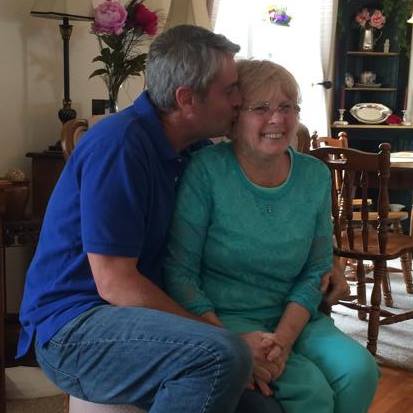
Although I love my mother dearly and wished I could be with her this weekend, as a pastor I have never made a big deal out of Mother’s Day during the worship service. I find it silly to give flowers to the oldest mother in the church based solely on the fact that they have outlived the other mothers who are just as cherished, some possibly even more so. And I sometimes find it disturbing to give a gift to the youngest mother who perhaps should have waited until she got her driver’s license before starting a family. And let’s be truthful. There are some people who should not have children, while there are others who would make wonderful mothers, but are prevented from becoming mothers by the unfairness of this fragmented world.

However, there is one way that I believe Mother’s Day can inform and help us this week, as our mothers remind us all of a truth that we too easily forget.

Carson and Sara once made a video slide show for Lori on Mother’s Day. One of the first captions they put in the video summed up the profound essence of what this day means: “Happy Mother’s Day. Without you, we would not be here.”

None of us could do anything, would have anything, or would be anything, and that includes being alive, without mom. And the same can be said about our relationship with God. Without our Heavenly Mother, we can do nothing. We would have nothing. And we would be nothing.

We must never forget that any good thing that as been accomplished has come about as gifts of God’s grace. God is the source of creation. God is the genesis of all goodness. We know what St. Augustine knew long ago; apart from God, no good can come.

Jesus said: “I am the vine. You are the branches. Those who abide in me and I in them, bear much fruit, because apart from me you can do nothing.”

This is both bad news and good. It is bad news for those who seek to improve the world on their own. The Psalmist knew this: “Unless the Lord builds the house, those who build it labor in vain.” But, it is good news for those who are connected to the love of God through Christ. With the power of God flowing through them like sap flowing through a vine, good fruits will develop.

So thank you, Mom, for teaching me this valuable lesson. Without you, I would not be writing these words. And without a connection to a Divine Mother, these words, like life itself, would have no meaning.

Recognizing Christ

Devotion shared by Amanda Phillips at the evening worship service following the Enid Welcome Table on April 30, 2017.

Luke 24:13-35 NRSV


The walk to Emmaus… a very popular story, because it’s relatable on so many levels. Some will read this story and see men so distraught and so in mourning, they do not recognize the Savior. That is very relatable. Deep in anguish and pain, how many of us have wondered where God is?

Some will read this story and see stubborn men who didn’t believe the women who went before them. (That’s what I see) That’s pretty relatable as well.

There are many “meanings” or “lessons” in this story…

I’d like to focus on this one:

30 When he was at the table with them, he took bread, blessed and broke it, and gave it to them.

31 Then their eyes were opened, and they recognized him; and he vanished from their sight.

They recognized him through the breaking of bread. They were blind until they shared a meal together. Their heartache and weariness lifted in sharing food with Christ. They’re eyes were opened.

Today was a very hard day for my family. We have said “congratulations” and “see ya soon” to our Associate Minister and friend, Rev. Shannon Speidel as she moves on to a new position with the Oklahoma Coalition of Churches. The last few weeks I have been walking through my life with deep sadness in my heart, so today, I tried to focus on all of the sharing.

Shannon shared Christ’s love first with my children when she began her ministry here. Always focused on serving God by helping others, she found ways to sow service into the children’s ministry. She worked with others to have the kids lead worship at nursing homes and serve homebound communion. She had these little people breaking bread and showing love to those who cannot attend church. They collected pet food for the SPCA and made doggie blankets. Her heart always on ways to help others. She shared her service and our eyes were opened and we recognized Christ.

Shannon continues to spend her ministry being an advocate for all people, LGBTQ and women in particular. Standing up for health and justice issues for those who are discriminated against and ridiculed. She shared her support for others and our eyes were opened and we recognized Christ.

Shannon wanted anyone at all who needed a meal to be able to come eat without strings attached. No hoops to jump through, no prerequisite, no religious requirements. If people are hungry, you just feed them. She worked very hard to keep everyone involved in this project focused and was vital in making sure that Enid Welcome Table became a reality. She shared a meal and our eyes were opened and we recognized Christ.

As she moves forward in her career I’m incredibly confident that she will continue to move mountains. It is our duty to keep sharing Christ’s love with all we meet as we continue forward here. Breaking bread with strangers, sharing the cup with all we meet, so that their eyes may be opened and through us they can recognize Christ.

We have a children’s worship service on Sunday morning called “Following Jesus.” During this worship we light a “Christ candle.” I tell the kiddos “it reminds us that He is with us as we hear the word of God.” At the end of the service we “change the light.” I take the candle snuffer and cover the candle until it goes out. Slowly I raise and swirl the snuffer to make beautiful swirls of smoke. As I do this, they hear something like this: “Now it’s time to change the light, because we know that the light of Christ isn’t really this candle and doesn’t stay in this room. The light is within us and goes with us as we share the love of God with others.”

Thank you Rev. Speidel for shining that light. Let us all move from this place and share God’s love so that eyes may be opened and they can see the risen Savior.

Embracing the Grace, Authenticity and Mission of Jesus: Thank You Rev. Speidel

Shannon

There is widespread agreement that if a church is to survive this century, then it must do what most churches resist doing. It must change. To avoid joining the thousands of churches that will die by the end of this century, I believe there are three major changes that many churches need to make. 

  1. Churches must wholeheartedly embrace the grace of Jesus.

Jesus prevented religious folks from throwing rocks as sinners, and so should we. Of all of the human organizations on this fragmented planet, the church should be a place where all people are welcomed to join a community of grace, love and forgiveness. Without fear of being judged, bullied, or ridiculed, all people should feel welcomed to come as they are and honestly and openly confess their sinfulness and brokenness, and then receive grace. Then, they should be encouraged to share that same grace with others. I believe all churches should be open and affirming, because a church that follows Jesus has no business being closed and condemning.

  1. Churches must wholeheartedly embrace the authenticity of Jesus.

Some church people have the reputation of being like the people Jesus criticized the most: hypocrites. Therefore, we must stop claiming to follow Jesus on Sunday morning while ignoring everything Jesus taught the rest of the week. This means that blessing the poor, standing up for the powerless, and fighting for those who hunger and thirst for justice should always be our priority. It means loving our neighbors as ourselves, selflessly and sacrificially, no matter the cost.

  1. Churches must wholeheartedly embrace the mission of Jesus.

Jesus never confined his ministry to the Temple or a synagogue. Church people must be willing to move out of the sanctuary into a hurting world. Instead of inviting people to come to church on Sunday, we should be asking people to be the Church everyday by doing the things Jesus did such as: eating and drinking with outsiders, feeding the hungry, welcoming the foreigner, becoming a friend to the oppressed, and being a healing presence for all who need wholeness.

The exceptional leadership that Rev. Shannon Speidel has given to our church as our Associate Minister for the past two years is exactly what we need if we are to continue to be a viable church, as she wholeheartedly embraces the grace, authenticity, and mission of Jesus. I am grateful for the way that her inclusive love for all people, her unwavering passion for social justice, and her bold desire to be the hands and feet of Christ out in the world has challenged us to be the church God is calling us to be.

I am also thankful that she will continue to be in a position to bless Oklahoma as she begins her ministry with the Oklahoma Conference of Churches. Churches across Oklahoma are fortunate to have a leader like Rev. Speidel who possesses the gifts, vision, passion and faithfulness that will help them not only survive, but thrive throughout the 21st century.

Easter People Behind Locked Doors

Andrew Finiish
As a Special Olympian, Andrew has run in many 1 mile “fun runs,” but he has always dreamed of finishing a 5k race. However, Down’s Syndrome and surgically-reconstructed knees have made it impossible. The good news is Easter transforms impossibility into reality.

1 Peter 1:3-9 NRSV

It’s the Season of Easter. The Lord is Risen. Christ is alive! Jesus is on the loose. The Messiah is on the move. And he’s coming for his disciples! He’s coming to offer them an incredible gift!

As our Epistle Lesson testifies:

“Blessed be the God and Father of our Lord Jesus Christ! By his great mercy he has given us a new birth into a living hope through the resurrection of Jesus Christ from the dead…” (1 Peter 1:3).

And where are the disciples?

The first verse of our gospel lesson this morning reads: “When it was evening on that day, the first day of the week, and the doors of the house where the disciples had met were locked…”

Jesus is alive. He is moving out in the world, and the disciples are inside a building, cowering behind locked doors.

Now, it is nighttime, a dangerous time in any city, and here in the city of Jerusalem on this night, maybe they had a good reason or two to lock their doors.

The most obvious reason being their fear that the religious leaders who organized to crucify Jesus would soon be coming after them. The ones who began plotting from the very beginning to put an end to Jesus and his message were quite possibly even now plotting to put an end to them.

So, who could blame them for locking the doors.

But then, there may be have been another reason those doors were locked.

Remember, Mary Magdalene has told them, “I have seen the Lord.”

And what do the disciples do? They lock their doors.

Could it possibly be that they did not know what kind of gift the Risen Christ was bringing to them: a new birth into a living hope through his resurrection?

Or could it be that they knew exactly the kind of gift Jesus was bringing?

After all, they were all witnesses to what had to taken place before Easter could happen: Before a new birth into a living hope could come, somebody had to pick up a cross.

So Jesus might be coming with the promise of new birth into a living hope, but before this new life can fully realized, there might be some more cross bearing to do.

And this was certainly no new concept for them. For they had heard Jesus say on numerous occasions: “to gain one’s life, one must first be willing to lose one’s life.”

They had heard Jesus say, the road to rebirth, the way to new life, the route to resurrection, the path to Easter, was very narrow and very few find it. For it’s a road of self-denial. It’s a way of self-expenditure. It’s a route of sacrifice. It’s a path of suffering.

So, when they heard that Christ was on the loose and he was coming with the promise of new birth into a living hope through his resurrection, of course they locked the doors.

Just like we lock our doors.

And my, my: The locks that we use! The barriers we create! The walls we build!

His way is just so radical, so revolutionary, so scandalous, we do all we can do to shut him out.

“I know Jesus said that he is ‘the way, the truth and the life,’ but we still prefer to do things our way, make up our own truth, live our own life.”

“I know Jesus said, ‘Blessed are the poor,’ but isn’t that the Salvation Army’s job?”

“I know Jesus never excluded anyone, but perhaps we ought not advertise that.”

“I know Jesus said ‘the first shall be last,’ but I still think we should put America first.”

“I know Jesus called women to be his disciples, and I am aware that whenever he had an opportunity, he elevated the status of women, but they really shouldn’t serve behind the table or preach behind a pulpit.”

“I know Jesus stopped the self-righteous from throwing rocks at a sinner, but if we are not careful we are going to make our church ‘a haven’ for all kinds sinners.”

“I know Jesus said that when we welcome the stranger we welcome God, but ‘pardon me, I believe you are sitting in my pew.’”

“I know Jesus said ‘forgive seventy times seven,’ but the Bible says those people are abominations!”

“I know Jesus said we could learn from Syrophoenicians and Samaritans, and he said, ‘Love your neighbor as yourself’ but surely he did not mean for us to love our Muslim neighbors!”

“I know Jesus said ‘there are other sheep who do not belong to this fold and we must bring them in also,’ but ‘You’re not a member of this church. So, what are you doing here?’”

“I know Jesus said feed the hungry, but we have to be fed too.”

“I know Jesus talked about being salt for the world, but are we going to let those people use our salt…and our pepper…and our sugar… and our sweet ‘n’ low?”

I want to suggest that it wasn’t just great fear that caused the disciples to lock those doors. It was also great courage.

For it takes some incredible nerve, some brave audacity, some serious brass, to lock the Risen Christ out of the building.

And sadly, ever since that first Easter evening, people who claim to follow the way of Jesus have been brazen in their attempts to thwart the way of Jesus.

Think about it. We have to be pretty bold to dare to reduce the meaning of the death-defying power of the resurrection. We have to be pretty brave to call ourselves “Easter People” and then water down the meaning of it.

I am grateful that church pews all over Enid were full last Sunday. However, I am afraid that the only reason many people came to church was merely to thank God that they, like Christ, will one day be resurrected to live forever. I am afraid the reason some church pews were so full on Easter Sunday was simply because “Easter People” wanted to remember Jesus’ resurrection and look forward to their own.

But if that is all Easter truly means, do you really believe those disciples would have locked those doors on that first Easter Sunday?

No, those doors were locked, because those disciples knew exactly what Easter means. They knew that Easter means the resurrection offers a living hope for this world, and not just for the next world. Easter is something to be lived today and freely shared with all who need re-birth and new life now.

But to do that, to offer that Easter hope to others, to truly live as Easter people, means that someone is going to have to pick up a cross.

It means that someone is going to have to deny themselves. It means someone is going to have to lose themselves. It means someone is going to have to open a door, leave a building, remove a barrier, tear down a wall, go outside, bend down to the ground, pick up a cross and walk in the steps of Jesus.

It means someone is going to have to share. It means someone is going to have to sacrifice. It means someone is going to have to suffer. It means someone is going to have to do something more than study a lesson, sit on a pew, sing a hymn and listen to a sermon.

So, the disciples, like you and like me, locked the doors.

Now listen to the good news:

When it was evening on that day, the first day of the week, and the doors of the house where the disciples had met were locked… Jesus came and stood among them.”

The good news is that the doors we lock, the barriers we create, the walls we build, will not thwart the way of Jesus! Despite our bold and brazen attempts to stop Jesus from coming, to shut him out, he’s still coming. And nothing is going to stop him or even slow him down.

And he is coming to lead his Easter people get out of the building, to pick up a cross and bring rebirth and new life to all whose lives have been diminished, to all those who have been de-humanized by poverty, disability, bigotry and hate.

And here is some really good news: To bring new life, by the grace of God, we may not have to hang on that cross. We might not have to shed any blood. We may not even have to get arrested. We just need to be willing to pick up a cross and carry it a little way. The Risen Christ will carry it the rest of the way.

Running 3.1 miles is nothing for Gary Hula. Gary has been running 26 miles before church on Sunday for the last several weeks in training for the Oklahoma Memorial Marathon. Gary can run 3.1 miles while reading the News and Eagle and drinking a cup of coffee!

But that is how far Gary usually runs while pushing someone with special needs for Ainsley’s Angels.  Just 3.1 miles. Takes Gary 20 minutes.

But after a 3.1 mile race last week, the mother of the 26-year-old man with surgically reconstructed knees and Down’s Syndrome, who rode in a running chair that this church purchased for just a few hundred dollars, said and I quote: “My son’s dreams have come to life.”

Can you hear the resurrection in that statement? Do you hear Easter in that mother’s voice?

The next day the risen Christ came and helped us to welcome some of the most impoverished people in this community for a meal in our Fellowship Hall. Now, we didn’t do that much. The Oakwood Country Club prepared all the food. All we had to do was warm it up and put it on some plates. We just had to show up, unlock a couple of doors, and invite people in. We just had to be kind to people, treat people as we would want to be treated.

But after serving that meal, one of the guests said to a volunteer: “Today, you have made me feel human again.”

Do you hear the rebirth in that statement? Do you hear the new life? Can you hear Easter in that woman’s voice?

The good news is that because the Lord is risen, because Christ is alive, because Jesus is on the loose in this world, because the Messiah is on the move, all we may have to do to be the Easter people the Risen Christ is calling us to be is to be willing to unlock a door.

Easter People

Welcome Table

The Easter Sunday timing of the Enid Welcome Table’s debut could not have been more appropriate.

The front doors of the church building swung open wide, as guests, some homeless, some extremely impoverished, all hungry, were greeted with smiles and words of welcome. As they walked into the fellowship hall, a host guided them to a table that was beautifully decorated with an Easter-themed table cloth and a spring flower bouquet centerpiece. Soft jazz  played from the sound system adding to the welcoming ambiance.

After the host fulfilled the guests’ drink orders, a waiter approached the table to read the menu that was displayed on the TV monitors in the front of the room. Guests had a choice between pork tenderloin, peel-and-eat Cajun jumbo shrimp, and baked chicken. Sides included sweet potatoes, roasted potatoes, a medley of roasted vegetables, macaroni and cheese, and deviled eggs. Desserts included lemon cake, cherry pie, apple pie and chocolate cupcakes.

The attentive wait staff promptly served the guests with generous portions and while keeping their drink glasses full.

Volunteers who had come to serve, some members of our church, some members of other churches, some members of no church, joined the guests at the tables to share dinner and conversation.

Upon experiencing the extravagant welcome, a genuine welcome devoid of any agenda, strings, or ulterior motives, one of the guests said to a volunteer: “You have made me feel human again.”

“You have made me feel human again.”

Let that sink in.

It was Easter Sunday, and someone said that she felt alive again. It was Easter Sunday, and someone said that she experienced new life. It was Easter Sunday, and someone said that they felt resurrected.

Christians often like to call themselves “Easter People.” However, I am afraid that what that means to many is that they, like Christ, will one day be resurrected to live eternally in heaven. I am afraid the reason some church pews are so full on Easter Sunday is simply because “Easter People” want to remember Jesus’ resurrection and look forward to their own.

However, what if being “Easter People” means something more?

What if the resurrection is not just a gift to remember or a gift to look forward to, but a gift to be experienced now? What if resurrection is a gift to be shared with others today? What if being “Easter People” means that we are people who offer the gift of resurrection to those whose lives have been diminished by the sin and evil in our world? What if being “Easter People means we are called to resurrect those who have been de-humanized by poverty, racism, classism, sexism, homophobia, or xenophobia?

What if being “Easter People” means that we are called to do much more than sit on a pew on Easter to thank God for the promise of God’s kingdom that is coming after the resurrection? What if being “Easter People” means that we are called to get off of those pews to bring the promise of God’s Kingdom that is coming now to those who need resurrection today? This Easter Sunday at Central Christian Church, that is exactly what being “Easter People” meant.

The First Easter Word


Easter Welcome

Sermon delivered at the 6 PM service  following the first Enid Welcome Table Meal, Easter, 2017

John 20:19-23 NRSV

The very first word that the risen Christ brought to his fearful and anxious disciples who denied and abandoned him was: “PEACE!” “Peace be with you!”

It was the same word that was proclaimed at his birth by the angels: “Glory to the God in the highest and on earth, peace!” And it was the last word that came from the cross: “Father, forgive them, for they know not what they do.”

“PEACE!” It is the word that every human being living in this fragmented world needs to hear from our risen Savior.

Thus, after Jesus pronounced the word to his disciples, he said, “As the Father has sent me, so I send you.”

The Church has been commissioned by none other than the risen Christ to share this word with others. “PEACE!” It is the word people need to hear from the church more than any other word, and it needs to be the very first word that they hear from the church.

However, sadly, even after nearly 2000 Easters, churches all over this world have ignored this commissioning. And tragically, the very first words that many hear from the church are words that denote the exact opposite of peace.

The first words they hear from many in the church are words of judgment and condemnation. They hear loud, angry, hate-filled rants and protests. They hear words judging them as not only sinners, but as “abominations.” In the name of God, they are condemned by those who justify their hate with the same type of Christ-less scriptural interpretation that was used to support sexism, slavery and racial discrimination.

They may hear reserved words of welcome to come in and sit on a pew, but they clearly get the message right away that they are not to expect to truly become a part of the church. They are not to expect to be able to use their gifts to serve with and alongside those who have been deemed worthy for service. They are not expected to be truly accepted, forgiven, and loved.

However, I believe the Risen Christ still speaks to his disciples today. He is still saying to us that first word of Easter, “PEACE;” and is still saying, “As the Father has sent me, so I send you.”

For God knows that there are people in every town, at every crossroad,  who hunger and thirst for a community of people in our world who have the audacity to truly live as followers of Christ who take the commission of their Risen Christ seriously to share “PEACE” with all people.

They are yearning for a church that seeks to be, not an institution or club of moral and devout people with right religion, right beliefs, right color and right lifestyles, but a church that seeks to be the living embodiment of the Risen Christ in this world, serving, loving, accepting and embracing the poor, the lost, the broken, the fearful, the grieving, those riddled with guilt and shame, and those whom society has rejected as outcasts, offering them the unlimited hope, unfettered grace and unreserved love that is in that first beautiful first Easter word, PEACE.