Freaking out in front of the Pastor

embarrassed young brunette covering her mouth with both handsI am working on a mission project with a group of men. We are building a handicap ramp for someone who is disabled. One of the men accidently hits his thumb with a hammer. And he says it: “S#IT!”

I look up and smile. Then it begins: “I am so, so sorry preacher! I can’t believe I said that in front of you! May the Lord forgive me!”

I am at dinner with a group of friends. Someone shares a shocking story. Someone else at the table says it: “D&MN!”

Then they turn to me, their face red with remorse and embarrassment, their hands covering their mouths, and they freak out: “Oops, I did not mean to say that word, especially in front of the pastor! Please accept my apology!”

I am standing in a long line at the grocery store with a friend. The person checking out is having trouble with their EBT card. My friend whispers: “That’s the problem with this country. Too many N*%%ERS on food stamps.”

I look at them startled. Then…well, then there’s nothing. Just silence. Like nothing at all happened out of the ordinary. No flushed cheeks. No apology.

During my entire ministry I have been told not to talk about racism. People tell me: “It just stirs things up.” “It creates division.”  And for the most part, like most white preachers in the South who like to avoid controversy, I have acquiesced.

Perhaps that is the reason that people become horrified with regret and overcome with embarrassment when they utter a harmless four-letter word in front of me, but act completely normal when they say a word that has been created for the sole purpose of harming others. Speaking out against racism is not going to suddenly change things; however, I am convinced that ignoring it, pretending that it does not exist, and keeping silent will change nothing.

Like removing a flag or a monument and changing a mascot, changing our vocabulary is not going to magically end hate in our world. Changing what is acceptable and what is unacceptable to say in front of your pastor is not going to suddenly bring about racial harmony. But isn’t it the least we can do?

My hope is that others will join me in speaking out against racism, at least until the “N-word” becomes more offensive than “the D-word,” “the S-word, and the “F-word,” and at least until all people freak out with shame and remorse if one day they ignorantly let the N-word slip out in front of their pastor.

Flip-Flopping the Message

flip flop

The following is an excerpt from:  Let the Children Come

Although our intentions were to share the love and grace of Christ with others, I believe the church has actually been guilty of doing the exact opposite. Simply put, with our words and our actions, we have oftentimes preached the gospel backwards, and in doing so, we have shared hate and judgment.

To share Christ with others, we often start with what is sometimes called the doctrine of original sin. Now, don’t get me wrong. I believe that all people are born into this world as sinners. I just don’t believe that is where we should begin the conversation or the sermon.

Our sermon usually has three points: 1) All people are sinners; 2) God sent Jesus to die for us; 3) If we believe this, then God will forgive us and love us as God’s children forever.

I think we should preach the same sermon, only flip-flop it and proclaim it the other way around.

I believe we should always begin with God’s love for all people. We should make our number one point that God loves us as God’s children and wants nothing more than to love us forever. The second point should be that God came through Jesus and loved us so radically, showered us with grace so extravagantly, so offensively, that people, most of them religious, nailed him to a tree. And we should make our third and final point that God did this while we were yet sinners.

Do you see the difference? Instead of preaching that all people are born on the outside of the love of God until they do something, say something, or pray something to earn forgiveness, we should preach that all people are actually born inside the love of God without doing, saying or praying a thing to earn it. Our words and actions only help them to believe this and to accept it.

Jesus put it this way: 1) For God so loved the world; 2) God gave God’s only son; 3) So that all whosoever believes may not perish by their sins but have everlasting life (John 3:16).

If we keep teaching this, continue preaching this with our words and deeds, if we keep making the church a place of extravagant grace and radical love, then, before you know it, we will start seeing the entire world differently. We will start seeing people differently. Instead of seeing people first as sinners who deserve hell, fire, and eternal damnation, we will begin to see all people first as God sees them: God’s beloved children.

God Remembers

Cash
Captain Christopher Cash

If I am to be truly honest with you, I must confess that I have my doubts. It’s just part of my fragmented human nature. This is why I love the Bible so. When I slip into the doldrums of doubt and despair I can pick up the Bible to discover that I am not alone.

Listen to these words of Isaiah to the people of Israel in exile:

“Thus says the Lord…I have answered you…I have helped you…I have kept you…I have given you….”  In other words, “I answered your cries in Egypt, I sent Moses to deliver you, I protected you in the wilderness, and I gave you a promised land.”

“And not only have I acted in the past, I promise to continue acting, reaching out and reaching in… giving you light in your darkness…feeding your hunger, quenching your thirst. I promise to protect, lead and guide you. I will transform mountains into roads, lift up highways and show you the way out of captivity…”

And what did the people say?  “Amen!”  No, not even close.

The people in exile responded to the voice of God the same way I suppose you and I sometimes respond—with a lot of doubt.

In verse 14 we read: “But Zion said, ‘The Lord has forsaken me, the Lord has forgotten me.’”

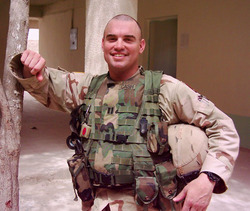
Fifteen years ago I became good friends with Christopher Cash, a member of the National Guard.

On October 1, 2003, his unit was deployed to Iraq. As the only person I personally knew in Iraq, I specifically remember praying for my friend Chris on the Sunday morning before Memorial Day the following year.

About a month later, I picked up the Saturday newspaper and read the headlines on the front page: “Captain Christopher Cash Killed in Iraq.” I tried my best to read the article, but couldn’t. I never made it pass the sub-title: “Cash leaves behind his wife, Dawn, and two children.”

The room started spinning. I felt sick to my stomach. I was lost.  And I had never felt more alone. With Zion I wanted to cry out, “The Lord has forsaken me. The Lord has forgotten me.”

This is why I love the Bible. I love the sheer honesty of it! In spite of everything I knew about God, what God has done, and what God promises to do, like Zion, I doubted.

Now listen to the good news: In verse 15, we read God’s response to our doubts.

“Can a woman forget her nursing child, or show no compassion for the child of her womb?  Even these may forget, yet I will not forget you. See, I have inscribed you on the palms of my hands…”

This weekend we honor those members of our armed forces who have paid the ultimate sacrifice. They have loved others supremely, selflessly. And we remember them.

However, the good news is that our God remembers them.

This is great news, for our remembering is shallow and weak. Our remembering is fraught with doubt, laden with despair. However, God’s remembering is deep and unfailing. God’s memory endures forever. God responds to our doubt with the assurance that our loved ones will never be forgotten by God, because they are literally in the very hands of God.

Phrases Churches Must Stop Saying

Excerpt from Spring Cleaning of Our Mouths for The Farmville Enterprise

wash+mouthBecause words have tremendous power, there are many words that I believe churches need to stop saying.

We’ve never done it that way before and You are in my seat?

When these words are spoken at church, they almost always mean that “new ideas, new ways of thinking, new approaches to ministry, and new people are not welcome here.” These words espouse a “This-is-my-church-my-house philosophy. And any words espousing that this is our house and not God’s house have the power to kill a church.

The Bible clearly says…

Whenever I hear this expression, I get a little nervous. People who use this expression are usually thinking: “There is only one interpretation of the Bible, and it is mine!”

Love the sinner and hate the sin.

These words infer that we can somehow separate the sin from the sinner; however, sin is so much a part of our DNA, so much a part of who we are in this fragmented world, that it simply cannot be avoided. And when we think that we have reached some sort of spiritual pinnacle that we can somehow avoid sin, we contradict who Jesus calls us to be by becoming arrogant, proud, snooty and judgmental. And we drive people away from the church in droves.

If you died today, do you know where you would spend eternity?

When we infer that we should follow Jesus only to selfishly receive some award instead of punishment, then we miss the whole point of who Jesus is and who he calls us to be. Jesus calls us not to save our lives, but to lose our lives. Jesus calls us to live a self-giving, self-expending life rooted in radical selflessness. Jesus never said: “Follow me and go to heaven.” He said: “Follow me and carry a cross.”

And then there are the classics:

God has God’s reasons or God doesn’t make mistakes or God will not put any more on us than we can bear or It’s God’s will and we will just have to accept it.

These words have caused countless people to leave the faith. There is no telling how many people have reached the conclusion: “If God is the one who caused my baby to die, if God is the reason behind my divorce, if God created my loved one to suffer, if God put all of these financial hardships on me, then I would be better off living in Hell for all of eternity than with a God like that.”

I believe too many churches have tried to teach the Christian faith while avoiding the pain and suffering of However, when we move too casually through the season of Lent to get to Easter, when we move too quickly through Holy Week, and sometimes even overlook Good Friday, we miss what may be the most important tenet of the Christian faith: Our God is a God who suffers. God is not seated on a throne far removed from the creation, pressing buttons, pulling levers, causing human misery, but our God is here in the midst of human pain, suffering with us. So, in a way, our God is still on the cross today. Our God is a God who grieves, agonizes, and bleeds. Our God is never working against us, but always working for us, creating and recreating, resurrecting, painfully doing all that God can do to wring whatever good can be wrung out of life’s most difficult moments.

Only Love Drives Out Hate

mlk_light_love1

I met a woman recently who said: “Jarrett, I cannot wait for you to meet my husband. He is a retired minister.”

“I would love to meet him,” I said. “I bet we have a lot to talk about.”

“You sure do!” she responded. “He hates a lot of things about church just like you!”

Initially, I responded to the woman by laughing and saying something like: “That’s right! I am certain that we will have a lot to talk about!” However, as I got in my car and drove back to my office, I thought about the tragedy of being primarily known in this world for what I hate.

If you have read my articles or listened to my sermons, you have heard me express some of my negative emotions regarding the church. I have criticized the church for being self-righteous, judgmental, exclusive, sexist, racist, homophobic, and ignorant. I have said that the church oftentimes looks more like a country club for the pompous than the Body of Christ doing the things Jesus did and loving the people Jesus loved. The reality is that there are many things about the church that I hate.

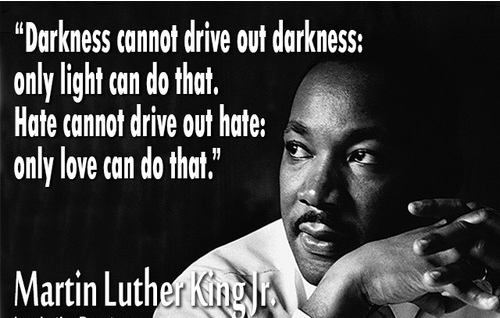
As I drove and reflected on the woman’s words, I was reminded of the words of Martin Luther King, Jr: “Darkness cannot drive out darkness; only light can do that. Hate cannot drive out hate; only love can do that.” And I ask myself: “Jarrett, what are you doing, what are you preaching and writing, how are you living, that shines the light of love?”

“Jarrett, What are you doing to be humble, accepting, and inclusive? What are you doing to do justice on the behalf of every person, to value the sacred worth of all people: male and female, black and white, Hispanic and Asian, gay and straight, open and close-minded, Christian and non-Christian? Jarrett, what are you doing to look like, act like, and be like Jesus in this world?”

If I can begin to work on these questions, maybe a time will come in my life when another person will approach me one day and say: “Jarrett, I cannot wait for you to meet my spouse. She is a retired minister. Her light shines in this dark world just like yours. She loves people and the church just like you!”

The Realness of Christmas

wounded children

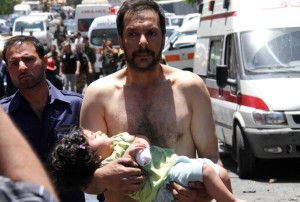
Instead of decorating my tree this year with Christmas music playing in the background, I decorated it while watching the nightly news. As I hung ornaments, I listened to the tragic story of a high school student killed in an automobile accident. As I turned on the lights on the tree, I glanced up to see pictures of mothers with their children escaping from Syria into refugee camps in Lebanon. I saw images of many children: some starving, others injured, some dying, others sick, all very afraid. I thought to myself, “I need to turn this depressing mess off and put on something Christmasy.”

Then it occurred to me. This is probably as close to Christmasy as it gets, for this is Christmas undecorated. This is real Christmas, and it is a shame that we try to cover it up with colorful paper and tie a bow around it. We string it with lights and decorate it. We romanticize and sentimentalize the whole Christmas scene with gleeful music and cheerful food.

Perhaps it is because in our shallow minds, the scene is majestic. It is glorious: angels flying in the night sky singing a heavenly chorus; a brilliant star rising in the east; a baby worshipped by shepherds and kings and even animals. In our nativity scene, there is no crying, no hunger, no disease, no anxiety, no fear, no mourning. Our nativity is a serene, sweet, sanitized scene.

However, this was not the reality of the first Noel. Christmas reality was not beautiful and was far from perfect. And no matter how hard we try, no matter how much energy we expend or how much money we spend; we cannot conceal the real harshness of it, the harsh realness of it. Christmas reality, says the prophet Isaiah is “like, a root out of dry ground.” Jesus was born among animals in a cattle stall and placed in a feeding troth with the stench of wet straw and animal waste in the air.

Yes, Kings, Magi or Wise Men came to worship the baby, but we like to forget that King Herod was using those eastern visitors to locate the baby so he could run a sword through him. And we forget the holocaust in Ramah, the innocent babies slaughtered, the desperate cries of anguish and despair from parents because there children were “no more.” We forget the escape to Egypt like homeless refugees. This is Christmas reality.

This is the reality of it, and this is the good news of it! The good news of Christmas is that there is nothing glamorous, glitzy sentimental, or romantic about it. The good news of Christmas is that God came into our depressing mess. God came into the real world, encountered real evil in the most real of ways, experienced real suffering and pain and died a very real death.

Someone who was suffering with terminal cancer once told me: “Although I cannot explain it, somehow, the sicker I am, the more pain I experience, the more hopeful I become. In the moments of my most immense suffering, God is the most real to me.”

Through the coming of God in Christ into a very real and broken world, we know that God knows something about real human suffering and real human misery. God knows what it feels like to feel forsaken by God. God is therefore able to relate to us in the most intimate of ways in those moments when life is the most real and the most broken.

Thank God something as depressing as the nightly news can actually be Christmasy.

Being Christmas

incarnation-feature

Christians claim to have an “incarnational faith.” That means we believe we have seen God, and we have beheld God’s glory. We believe the Word became fleshed and walked among us. Christians claim to know hope, peace, joy and love, because Christians claim to know the God who became enfleshed in the body of Jesus of Nazareth to give us those things. This is what Christmas is all about. And this is what Church is all about.

The Church is called to be the body of Christ, the very embodiment of Jesus Christ in this world. We are called to not only share the good news of Christmas with others, but we are called to be Christmas to others. We are called to be hope, peace, joy and love to a world that desperately needs it.

We reaffirm this calling each time we share the bread and the cup of Holy Communion. In consuming the body and blood of Christ, we reaffirm that we are Christ’s body and Christ’s blood in this world. We remind ourselves that we are the manifestation of God in the world. We commit ourselves to being the enfleshed presence of God in this world. We dedicate ourselves to being Christmas.

Thus, these are the questions that I believe every church needs to continually ask: When people encounter our church, do they encounter God?  Do they encounter the embodiment of Jesus Christ?

When people hear us, do they hear hope? Or do they hear despair?

When people see us, do they see peace? Or do they see conflict?

When people come near us, do they sense joy? Or do they sense fear?

When people touch us, do they feel loved? Or do they feel judged?

When people meet us, do they meet God? Do they meet the Christ? And do they want to join us in being Christ to others?

When people encounter us, do they encounter Christmas?

Give Thanks in All Circumstances

eeyoreThe Apostle Paul admonishes us to “rejoice always, pray without ceasing, give thanks in all circumstances; for this is the will of God in Christ Jesus for you.” (1 Thes. 5:16-18).

When life is good to us, it is easy to be thankful. We are thankful for the beauty of each day. We give thanks for the splendor of autumn and for the crispness in the air. We are thankful for cold mornings, the warmth of the sun at noon and for the brightness of the moon at night. We are even thankful for the more simple things in life: the excitement of football games, for warm cookies and cold milk and sweet potato pie, for movie theaters, for popcorn, for restaurants, for the pleasure received from Christmas shopping and for the brilliance of Christmas lights. When life is good, when life is happy, it is very easy to give thanks.

However, when life is cruel, and when life is miserable, thankfulness is something that comes hard. Autumn appears drab. The air seems stifling. Cold mornings only symbolize the frigid callousness of living. The sun is an annoying glare. The moon is irrelevant. Football and basketball games become pointless. Cookies and milk and pie are petty.

When your child is in the hospital, when your mother has just been buried, when your spouse is undergoing surgery, when you hear words from the doctor like cancer and Alzheimer’s— restaurants become mundane, movie theaters and popcorn are trivial. When you are laid off from work, when you are behind on your mortgage, when you are struggling to just buy groceries—Christmas shopping becomes oppressive and Christmas lights appear dismal.

So, how in the world are we ever to do the will of God by rejoicing always and giving thanks in all circumstances?

In Philippians 1, we read how Paul himself did it during his imprisonment. Alone in a dark, dank prison cell, with being beheaded as his apparent destiny, Paul rejoiced. But, notice that Paul did not rejoice or give thanks for being restrained in a prison. Paul did not give thanks for the morning or the air. Paul did not thank God for the sun, moon or stars. He did not rejoice for flowers or trees or cookies or milk or pie. Paul gave thanks and rejoiced in the only thing that he had left in that dark, clammy jail cell. Paul gave thanks and rejoiced for hope. Paul hoped that the gospel would be spread with even greater boldness because of his imprisonment. Paul hoped that through prayers, the Spirit of Jesus Christ would work out all things for the good. Paul hoped that God would wring whatever good could be wrung out of this, his most difficult hour.

Hope was the only thing that Paul had left. And hope was enough. Hope was all that Paul needed to give thanks and to rejoice in his miserable circumstance. The good news is: for persons with faith in Jesus Christ, who offers us a living hope, who promises to always be with us for our deliverance, whatever our circumstances may be, who promises us a new life even when our old lives end— thankfulness can be something that comes easy.

We may not be experiencing happiness. We may not be able to develop an extensive list of things in which we are thankful. But, on the list of every believer, even if there is only one thing, there is hope. Life can take away much and destroy much in our lives. But, there is no thing and no one that can take away our hope. And, hope is always enough. So, rejoice always, pray without ceasing, give thanks in all circumstances; for this is the will of God in Christ Jesus for you. Amen.

Grace of Froot Loops

Froot Loops

Excerpt from Check Your Oil for The Farmville Enterprise.

How many times have you heard “You don’t know what you’ve got until it’s gone”? You don’t know what you’ve got until a relationship ends, a moment is lost, or a freedom is taken away.

A woman suffering with cancer, who lost her ability to perform even the most mundane tasks, once told me: “It is amazing how much we take for granted every day. Oh, how I would give anything in the world to be able to get up out of this bed, walk into my kitchen and just pour me a bowl of Froot Loops.” She went on, “When I was healthy, when I could get out of bed and walk to the kitchen, when I could feed myself, when I could chew and swallow my food, I don’t believe I ever thanked God for something as boring as a bowl of Froot Loops.”

Who in the world even thinks about the awesome gift of being able to do something as mundane and as boring as pouring a bowl of Froot Loops? Someone who can longer pour a bowl of Froot Loops thinks about it.

Who in the world thinks about the miraculous gift of being able to walk? Someone who has lost the ability to walk.

Who in the world thinks about the gift of healthy lungs? Someone living with COPD.

Who in the world thinks about their kidneys or their liver? Someone on the way to a dialysis thinks about their kidneys. Someone living or dying with cirrhosis thinks about their liver.

And who in the world the world truly thinks about the miracle that is their life, the miracle that is this creation? People diagnosed with a terminal illness do. Those who have recently lost a loved one to death do.

In one of his parables, Jesus said that some foolish bridesmaids missed the whole dance, because they forgot to fill their lamps with oil and did not see the bridegroom when he showed up. Jesus ended the parable with the admonishment: “keep awake” (Matthew 25).

Keep awake. Check your oil. Keep your lamp burning. Don’t miss the dance. Keep watching and keep looking, recognizing that we are never promised tomorrow. Take nothing for granted. Don’t wait until it’s gone to know what you’ve got. Treasure your lungs, your kidneys, and your liver. Cherish the ability to walk into the kitchen and pour something as mundane and boring as a bowl of Froot Loops. Relish every taste in creation. Revere every sight and every touch in this world. For in life, nothing is ever mundane. It is never boring. It is all miracle. It is all gift. It is all grace.

A Prayer for Our Veterans

My grandfather, Eugene Gaston Banks, Sr., served in the US Coast Guard patrolling the North Atlantic during World War II.

O good and gracious God, the framers of our Declaration of Independence testified that you have endowed us with inalienable rights to life, liberty, and the pursuit of happiness.  And ever since they penned these words, there have been those who would like to strip these freedoms from us. This week, we remember all those who have defended these freedoms through their service in our armed forces.

Some of them served during World War II or the Korean War. Some served during the Vietnam War, in Grenada, or Panama. Some served during the Persian Gulf War, War in Afghanistan and the Iraq War. Some served during the Cold War, during the Cuban Missile Crises. And some served during a time of unusual peace. Some served on foreign battlefields in harm’s way, whereas some served stateside in relative safety.

Yet, all of them left behind and sacrificed much. They left behind friends, family and dreams. They left behind homes, possessions, even love. And they all sacrificed their health. Many still bear the scars from their service, spiritual, mental and physical. Many lie, even today, in our veterans’ hospitals or struggle for recovery in rehabilitation centers. They suffer from post-traumatic stress and survivor’ guilt; they yearn for peace in their souls. Some find themselves wandering hopeless and homeless in the land they defended.

And many sacrificed their very lives. They gave up their rights to life, liberty and the pursuit of happiness so we could have those rights.

For all of these, our veterans, we ask your blessing.

We also pray your blessing for family members and friends who have made great sacrifices to make their service possible. And we pray for families and friends who grieve the deaths of those who left to serve only to never return.

Jesus said that no one has greater love than to lay down one’s life for one’s friends. So for all our veterans who have been willing to lay down their lives for us, we ask your blessing.

Keep them in your care and grant them the peace that they sought to safeguard for others. As we honor our veterans, we also pray for peace everywhere. Teach your children of every race, creed and faith, in every land, the ways of peace, so that those who have sacrificed so much for peace and freedom will not have sacrificed in vain.

We pray all these things in the name of the Prince of Peace, our Lord and Savior, Jesus Christ.[i]

[i] This prayer was inspired by a litany prepared by Eileen Norrington, ministerial authorization coordinator, Parish Life and Leadership Ministry Team, Local Church Ministries, United Church of Christ, Cleveland, Ohio. Norrington is a veteran of the U.S. Navy Chaplain Corps.