When Monday Morning Comes

Mark 1:9-15 NRSV

One moment, Jesus is overcome with joy in the presence of God as the heavens were “torn apart” and the Spirit of God descends upon him “like a dove.” A voice comes from heaven: “This is my Son the Beloved, with whom I am well pleased.”

And then, without warning, “immediately,” says Mark, Jesus is driven into the wilderness for forty days, hurled into a place of trials and temptations, into a place where God seemed to be absent.

At one time, when I was much younger and more naïve, much less experienced in this world, this passage of scripture used to bother me. For what kind of God would fill Jesus with the light of holy love and joy one moment only to drive him into the dark wilderness in the next moment?

Well, as I have grown older, I no longer struggle with this question. Because the reality is that the Spirit of God does not have to drive us into a wilderness. We are already there. We are there because we are human, and life itself is a rollercoaster of joyous moments and wilderness moments. We encounter suffering and trials in life, not because God drives us into it, but because we are earthly creatures living in a fragmented world.

Like happens with you and me, one moment, Jesus is standing in presence of God. The next moment, he’s standing in a seemingly God-forsaken wilderness.

Last Sunday, we were invited to go the mountaintop with Jesus. It was a magnificent scene as we were standing in the very majestic presence of the Holy One, the creator of all that is. There, we were enveloped by Love, Love’s self.

But then, Monday morning came. It came for me personally when I woke to the news that my Uncle Ernie had died.

The unexpected and harsh news from my brother was especially tragic considering the recent death of Ernie’s beloved wife, my Aunt Ann, who died right after Thanksgiving. Uncle Ernie had been overwhelmed with grief and was having a difficult moving forward.

Like Jesus, one day we experience the holy presence of God, but then, Monday morning comes, and we are hurled into the wilderness.

Did you hear the good news in that sentence? “Like Jesus…” The good news of the Christian faith is that God understands. The good news is that God empathizes. The good news of the gospel is that God has experienced this world as we often experience it through the person of Jesus of Nazareth.

But there’s even better news as we read Mark’s gospel. It’s just one short sentence, but it is a beautiful sentence. Mark says: “And the angels waited on him.”

Angels, representing God’s providence and presence waited on Jesus. Suffering, struggle, and trial are present in the wilderness, but so is God! Throughout Jesus’ forty days, God was not far away, and God was not absent! God was with Jesus, ministering to him, serving him, waiting on him.

And the good news is that as angels were there for Jesus in his wilderness, we can find angels sent by God to be there for us.

Last Saturday, Uncle Ernie’s only child, my cousin Trey, had the joy of coaching the basketball team of his five-year old son, Cooper. Cooper was named after our beloved grandmother Sarah Jane Cooper. If you are a parent you may remember, it was one of those basketball games where the final score is something like 8 to 4. It was the second to last game of the season. During that game, Cooper scored his very first basket. In the moment the ball went through that hoop, knowing my cousin Trey and his love for basketball, I am sure he felt like the heavens had opened up, and the Spirit of God had descended upon him.

The very next day, Trey went to visit his Dad, who he had checked on every weekend since his mother died a couple months ago. Trey opened the front door and called, “Dad! It’s me Trey.” Hearing no answer, he walked into his father’s bedroom and found him lying face down in the bed unresponsive. Observing that he was barely breathing, he immediately called 911.

One day, Trey is experiencing heaven on earth coaching his son’s basketball game. The next day, he’s hurled into a wilderness.

Later that night, after being told by a doctor that his father’s death was imminent, Trey and his wife Kaylee got on the elevator and headed to the ICU floor. As soon as they stepped off the elevator, they immediately heard a kind, inqusitive voice from a nurse who was sitting at a desk: “Trey, is that you?”

The nurse then introduced herself to Trey and Kaylee as the granddaughter of Ms. Ava who lived next door to our grandmother when Trey was growing up. She said: “Trey, when I would visit my grandmother, I remember watching you and your father playing in your grandmother’s backyard.” She then talked about how much she loved our grandmother, so much so, that she named her daughter Sarah Jane after her. Trey said, “we named our son Cooper after her!

Trey said that Ms. Ava’s granddaughter then empathetically walked them to the room where his father was. She then went and found two recliners which she pushed into the room so Trey and Kaylee could sit Uncle Ernie’s bedside his father during his final hours.

The good news is that when we find ourselves in the wilderness, there are angels are among us, reminding us like a nurse with a daughter named Sarah Jane reminded Trey, that God never leaves us nor forsakes us. Even in the darkest experiences in this wilderness called life, God is always present.

The Rev. Fred Rogers put it this way: “When I was a boy and I would see scary things in the news, my mother would say to me, “Look for the helpers. You will always find people who are helping.”

This is especially good news this Sunday, because whether or not we are ready for it, Monday morning is coming.

On Monday morning, anxiety is usually your alarm. You are awakened with a list of countless worries. If tomorrow morning is anything like the last few mornings, added to our fretful list are the children who were injured in yet another horrific mass shooting. You worry about your own children, your grandchildren, great-grandchildren. You worry knowing that they are unsafe wherever they are, at a ballgame, at school, at a party, even at church. You grieve over the state of our country. You anguish that so many of your friends have acquiesced to the notion that nothing can be done to prevent this from happening again.

The good news, there are angels among us.

Angels like Kansas City Chiefs offensive guard Trey Smith who saw a frightened boy with his father during the shooting and used his WWE title belt to comfort the boy saying: “Hey buddy, you’re the champion. No one’s going to hurt you, man. We’ve got your back.” Then, after they were loaded onto a bus, he talked to the boy about wrestling to keep his mind off the frightening and chaotic scene.

There are angels among us like Chiefs running back Clyde Edwards-Helaire who also sheltered a boy during the shooting. The boy’s mother posted on social media: “Huge thank you to Clyde Edwards #25 for sheltering and getting [my son Zach] to safety… Clyde even went back to check on Zach to make sure he was still doing ok. What a great human being!”

And there are other angels among us living with a renewed determination to continue fighting for sensible gun laws, committed do doing more than sending thoughts and prayers.

This wilderness experience of Jesus is often called “the temptation of Jesus.” I believe we are sometimes tempted to believe that we can make it through our wilderness alone, on our own power. We are tempted to believe that our own physical power or even our own spiritual power can see us through our wilderness experiences.

However, we must be able to humbly recognize that we need another power. For if the Son of God needed angels to wait on him in his wilderness, how much more do we need angels to get through ours? How much more do we need God’s abiding presence? How much more do we need one another? How much more do we need those who have been called to be God’s transforming agents in this world, those who call themselves disciples fighting every day to make this world a more just and peaceful place to live, who are, even now, sitting all around us?

Which leads to this question: Come Monday, who might need us? Who might need us to wait on them, shelter them, calm and comfort them, fight for and vote for their safety.

It’s Sunday morning.  Gathered here in the presence of God, we are loved, and we are affirmed. The heavens are open. God’s Spirit fills this room, and God is speaking to our hearts.

In a few moments, we will receive the bread and the cup, and we will know beyond a shadow of a doubt that we are loved with a grace that is greater than our sins. We will pray. We will sing a hymn. And we will make commitments and our re-commitments. During the Benediction you will hear the wonderful words: “You are God’s beloved children, with whom God is well pleased.”

Yes, it is Sunday morning, and we are here in the very presence of God. But we can be certain of this:  Monday morning is coming. For some of us Monday morning may come this Sunday afternoon. As sure as we are here, the wilderness coming. The good news is: we will get through it. Something good will come out of it. Our fears will be relieved. Mercy will be given. Justice will prevail. Peace will come.  Love will win.

How can I be so confident?  Because when I look around this room, you know what I see?  I see angels.

Choose This Day

rile up the gov't

Growing up in church, I was taught that the Christian faith, and life itself, was primarily about a choice.

It is about a choice to accept Jesus as personal Lord and Savior or to reject Jesus. It’s about a choice to spend all of eternity in heaven with God and his angels or to forever burn in hell with the devil and his angels.

In church, I was also taught that I could not afford to wait to make this choice. I needed to make a decision before we finished singing the last hymn, because if I didn’t, the Lord could return or I might get killed in a car accident on the way home, and it would be too late. So, there was a sense of urgency instilled in me to make this choice.

I was also taught that if I didn’t make a choice, I was actually making choice. Not to choose was to choose.

For me, it wasn’t a very difficult choice to make. “Preacher, you are saying that if I choose to accept Jesus as my personal Lord and Savior, I get to live in paradise forever? But if I don’t, I am damned to hell for the same amount of time?” Well, preacher, how fast can you schedule my baptism?!

The problem is that the gospel writers never record Jesus presenting such a choice. Although, I’ve heard countless preachers point to our scripture lesson here in Luke 23, and try to say Jesus is presenting this choice, Jesus never does.

The irony is, that here in Luke 23, the chapter that has the story of the infamous thief on the cross that Jesus says will be with him in paradise, we are presented with a choice. And it is a choice that each person born into this world must make. We must choose our kingdom.

Jesus talked about “kingdom” more than almost anything else. Over 100 times in the Gospels Jesus announces that he is building the “Kingdom of God,” and implies almost every time that he needs people like you and me to help him. He taught us to pray: “Thy kingdom come. Thy will be done on earth as it is in heaven” (Matthew 6:10, KJV).

Jesus’ message compels us to make a choice to live, work, pray and love in ways that bring God’s Kingdom to this world. And, just like I was taught growing up in church, making this choice is an urgent matter. In fact, I believe it perhaps is more urgent today than ever.

And it is in Luke 23 we learn that it was this urgent message that put Jesus on the cross.

The assembly [of the Elders of the people, including the chief priests and the scribes] rose as a body and brought Jesus before Pilate. They began to accuse him, saying, “We found this man perverting our nation, forbidding us to pay taxes to the emperor, and saying that he himself is the Messiah, a king.”

Then Pilate asked him, “Are you the king of the Jews?”

He answered, “You say so.”

Then Pilate said to the chief priests and the crowds, “I find no basis for an accusation against this man.”

But [religious supporters of Caesar] were insistent and said, “He stirs up the people by teaching throughout all Judea, from Galilee where he began even to this place [even here in Jerusalem, here in the capital city!].

And when he learned that he was under Herod’s jurisdiction, he sent him off to Herod, who was himself in Jerusalem at that time. The chief priests and the scribes stood by, vehemently accusing him. Even Herod with his soldiers treated him with contempt and mocked him; then he put an elegant robe on him, and sent him back to Pilate (Luke 23:1-11).

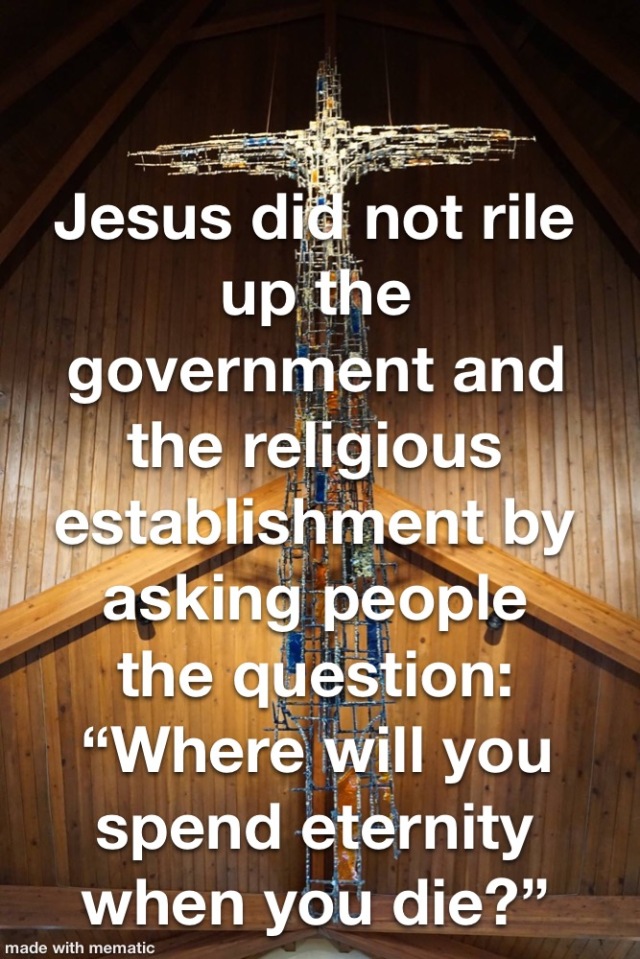
It is obvious that Jesus did not rile up the government and the religious establishment by asking people the question: “When you die, do you know where you are going to spend eternity?”

To understand exactly what Jesus is talking about when he talked about “Kingdom,” it is important understand something about the Kingdom into which he was born.

Rev. Joe Kay, UCC Minister from Ohio, describes the Kingdom of Caesar this way:

“It was a Kingdom ruled by the empire’s values of violence, dominance, supremacy, wealth, privilege, and self-interest. Life was cheap, and economic injustice was rampant.”

The empire’s leaders acted in narcissistic ways. As John Dominic Crossan notes in his book God and Empire, Caesar Augustus assumed the titles of “liberator,” “savior,” “redeemer,” and “lord.” He saw himself as the divinely chosen leader of the greatest empire in the world.

Caesar’s supporters praised him constantly and advanced his agenda. His base of support included religious leaders who were co-opted into doing the empire’s bidding in exchange for maintaining their own wealth, power, and privilege.

Religion and Rome were intertwined, working together to advance the empire. Then Jesus came along and challenged it all.”

In fact, this is exactly how his birth was announced by the Angels with the sentence:

“Glory to God in the highest and peace on earth to those with whom God is well pleased.”

As I mentioned during the season of Advent, this phrase is almost a direct quote from the decrees of Caesar Augustus.

Each time Augustus made an imperial decree to support the Roman occupation of the Near East, the following words opened the decree: “Glory to the most august Caesar (who was otherwise known as God in the Highest), and peace on earth to those with whom the god Augustus is well pleased.”

Thus, the Christmas angels sang the Emperor Augustus’ imperialistic words. When Jesus was born in Bethlehem, there was a royal decree: “Glory to God in the highest! There’s a brand new kingdom in this world!

Every time Jesus taught and preached about the Kingdom of God, Rev. Kay notes “he was essentially saying: you’ve already been born into Caesar’s kingdom, but now is the time to enter into a completely different realm. You need to be born again into God’s kingdom, into a realm that operates by values that are in stark contrast to the values of Caesar.”

Love rules in the place of selfishness.

Kindness in the place of cruelty.

Generosity in the place of greed.

Humility in the place of pride.

Social justice in the place of inequality.

Mercy in the place of fear.

And grace rules in the place of judgment.

It is important for us to understand that Jesus never talked about the Kingdom as if it were just some future event in the sweet bye and bye. He proclaimed that the Kingdom was already here—a place of unlimited love and unending compassion. A place where everyone is welcomed, especially the marginalized. A place where nobody is ever treated like an outsider. It is a place where even condemned thieves are forgiven and promised paradise.

It’s a place where healing is offered to all. It is a place where peacemaking is valued over warmongering, and where the lowly and the least are treated as the greatest.

The operating values of Caesar’s kingdom — power, greed, wealth, privilege, self-interest — are rejected, resisted and rebuked in God’s Kingdom.

And today, right now, we have a choice. Which kingdom will we choose? Whose values will we live and enact and advocate in our communities and our world?

It can’t be both. And as much as we want to, we can’t try to live with one foot in both worlds — that does not and will not work. As Matthew remembers Jesus teaching, “no one can serve two masters.”

It’s either one or the other.

And like I learned growing up in church, we can not avoid choosing, because not to choose is to choose. To simply go along with the status quo is a choice to support those who rule over it and protect it. If we do not challenge Caesar, we are in league with Caesar — we have chosen his kingdom over God’s Kingdom.

Also, as I learned growing up in church, we cannot delay making a choice. We can not afford to wait. And it is not because we may get into a car accident on the way home from church this morning. It is because the times in which we live are too serious, the problems of this world are too great and the hate in our world is too strong.

Furthermore, Jesus said the kingdom of God is not a future event. It is here, and it is now. And we are invited to become part of it at this very moment.

We have a choice to make… today.

As Crossan puts it: “God’s kingdom is here, but only insofar as you accept it, enter into it, live it, and thereby establish it.”

And everyone is invited to join. There are no barriers, no borders, no walls. All are welcomed and all means all, but citizenship does come at a cost. Choosing to establish God’s Kingdom in this world is a much more difficult than choosing which kingdom you want to live in the next world. For God’s kingdom unavoidably confronts and challenges the many Caesars that are always in our world, along with their ardent supporters and their devoted religious minions.

And they’ll use every one of Caesar’s tools to protect their privilege and power — bullying, harassment, intimidation, self-promotion, lying, verbal and physical violence.”

The gospels tell us that the kingdom of Rome and its religious supporters conspired to get rid of Jesus and his message to establish the Kingdom of God. And the same thing happens today.

The supporters of Caesar have completely changed the message of Jesus. They have twisted the gospel and perverted the faith. They teach that the Kingdom of God is a future place we experience when we die, not a place we are to live today. They say that the gospel is about personal salvation, not world transformation. They preach that Jesus wants to enter our hearts, not enter Jerusalem, Little Rock or Washington DC.

And at times, it feels like Caesar’s kingdom is invincible, that it is Caesar who will have the final say. The good news is that Good Friday is always followed by Easter Sunday.

“And in every moment we have trouble recognizing God’s kingdom in our world and in our lives, Jesus says: Look a little closer, love a little stronger, believe a little deeper. And you will see, it’s right here.”

And Jesus invites us all to enter this place of life, love, and healing right now.

Let us pray together.

O God, may thy Kingdom come, thy will be done, on earth as it is in heaven. Amen.


https://sojo.net/articles/religion-and-power-were-intertwined-then-jesus-challenged-it-all?fbclid=IwAR0_D94N5pdJ2CFbIT4SVTzjPjAJc4-Xv70fQy2Di045VPOesGdkm4mmpek

Forward Together

If our can't fly run

Isaiah 43:16-21 NRSV

They say that hindsight is 20/20. Sometimes, it is easier to see more clearly what is really going on in the world when we are looking back. They say history is the best judge. I believe this is particularly true when it comes to faith.

The presence of God seems to be more recognizable when we look back.

Looking back, we say: “If it were not for God’s abiding presence, there’s no way I would not have gotten through that!” “During the storms of life, at the time it was difficult to see God, but looking back it was obvious that God was undeniably present.”

Looking back, we clearly see God’s hand during the divorce, through the sickness, in the miscarriage, at the death.

Looking back, we plainly see God helping us to learn from mistakes, grow from painful experiences.

Looking back, we see God working all things together for the good, wringing whatever good can be wrung out of life’s most difficult moments.

Looking back, we can see God, reconciling, creating, recreating, resurrecting.

Looking back, we say, “Yes, I am a better person today because what happened yesterday. Although, I could not see it at the time, that period of struggle was the best thing that happened to me.”

Which raises the question about today? Where is God in the present? What is God doing in our lives at this very moment? What is God up to in the world today? And the more important question, are we able to see it? Or do we have to wait 5-10-20 years to see it?

This may have been what was going on with the Israelites when Isaiah preached the sermon in our scripture lesson this morning.

Some scholars believe the Israelites were on their way back from exile in Babylon. They were on a long and treacherous journey through a desolate and dangerous wilderness. Food, water and shelter were scarce. Protection, minimal. So it was not uncommon for people die in the wilderness.

Then Isaiah proclaimed: “The same God of the great Exodus who liberated your ancestors from Egyptian slavery by making “a way in the sea, a path in the mighty waters” (Isa 43:16) promises to do something brand new: God will make a “way in the wilderness” (Isa 43:19).

“So, stop looking back on those good old days, where God’s presence was so clear, so evident and so real, because God is working even now to create good new days! Bring your faith in the God of the past into the present!” preached Isaiah.

Other scholars believe the prophet was addressing Israelites who had already made it back to Jerusalem, and instead of finding the home they remembered and loved, they found an abandoned city in ruins. Having made their dangerous journey through the wilderness, they found themselves in even more danger. Rather than the safety and comfort of home, they found themselves constantly threatened by enemies who had taken control of the land in their absence. The stories of Ezra and Nehemiah tell us how dangerous it was for the people who worked to rebuild the ruined city. At one point, Nehemiah encouraged everyone working on the rebuilding of the city to carry swords for protection (Neh. 4:17-18)!

So, the prophet was preaching: “You can’t go back, but the same God you clearly see in the past is about to do something brand new to help you move forward with God into a new day!”

But moving forward is almost always one of the most difficult things to do. Moving forward is scary. Perhaps that’s because, without the advantage of hindsight, it is more difficult to see God at work today and tomorrow than it does to see God at work in the past.

But moving forward is what our faith is all about, and it is what it has been about since the very beginning. Once Adam and Eve obtained the knowledge of good and evil, there was no going back, no undoing it. It’s like they say, once you see something there is no unseeing it.

But, in the shame of who they were and what they had become, hiding naked and exposed in the trees, God finds them, then with God’s own hands, makes garments of skin and graciously clothes them. Adam and Eve cannot go back to the good old days of blissful paradise, but now clothed with grace, by the very hands of God, they can go forward with God into good new days.

Cain kills his brother Abel and is excommunicated to the land of Nod. Cain can not undo what he has done. He cannot go back. But God promises to go with him into a new reality and marks him with grace.

The truth is: most of us right now desperately need to hear these words of God, “Behold I am doing a new thing.”

Isaiah understands this need. He is saying: “I know, life may not good for you right now. Some of you are doubting today that will see tomorrow. Although you have experienced the hand of God in your life before, it’s very difficult for you to see that holy hand now. It is hard for you to keep the faith and move forward.”

I believe it is this dilemma that is the death of many churches today. Churches can see God in the past, but they have difficulty seeing God in the present. Ask yourself: “What are the new things that God is working on with us here at First Christian Christian in Fort Smith? What new things is God leading us to do? What new places is God leading us to go.”

“What’s that did the preacher just say? Did he say “new things” and “church” in the same sentence?  New? Doesn’t he know if we’ve never done it that way before, it just can’t be done.

“Behold I am doing a new thing! Can you not see it?”

I believe this may be the most important question we can ask ourselves. “Can we not see it?” Are we capable of seeing the new thing that God is doing in our world? Are we able to open our eyes and see the new world unfolding before us? Are we ready for the new thing that God wants to do in us and through us?

This past week, I read an article that reminded me why this was so important.

On the week of the 51stanniversary of the assassination of Rev. Dr. Martin Luther King, Jr, the article pointed out that the majority of the nation today looks back with reverence and great fondness on Dr. King. We look back, and we can clearly see God at work in him and through him.

However, at the time of his death, Dr. King was one of the most reviled men in the United States. His message of liberation for people of color, Native people and poor people was widely rejected. According to a 1968 poll,75 percent of Americans disapproved of him.

Now, the majority of Americans who were not alive or adults in the 1960’s look back and would like to believe that we would have be in that 25 percent. But would we? Or, back in the mid-60’s would Isaiah’s words convict our hearts, “God is doing a new thing through this young black preacher from Georgia, can you not see it?”

After all, many of the conditions that he marched, boycotted and spoke out against still exist today. Some say that although we’ve made some progress, we have taking a giant step backwards in the last few years when it comes to racism, sexism, materialism and militarism.

And yet, even as we look back today on Martin Luther King Jr with great admiration, much of America condemns the activists today, in the same way he was condemned 51 years ago.

Many detest those today who are speaking out, sitting in, kneeling and marching against the same conditions. If you took a poll today, I believe you would find that the majority of the country disapprove of movements that are demanding justice for Black men, women, and children killed by police, proclaiming that Black Lives Matter. Most people are leery of people crying for justice for women in the #metoo movement. Most are indifferent to justice movements for immigrants and justice movements for Indigenous peoples like Standing Rock, as well as justice movements for trans, binary, and gender-nonconforming people.

Dr. William Barber, who is currently continuing the work of Dr. King’s Poor People’s Campaign, has his life threatened constantly.

Which makes us wonder. What would we have done if we were living in South Africa during Apartheid or Germany in the 1930’s? What would we have thought of Harriet Tubman, Frederick Douglass and Sojourner Truth, or even abolitionists like Barton Stone and Alexander Campbell?

And what would we have thought of that radical Rabbi named Jesus? What would would our conversations be around the dinner table after we heard the reports—of him breaking the laws of the Sabbath? Touching lepers? Including women as his disciples? Demanding that people sell all of their possessions and give them to the poor? What would be our response to his sermon that encouraged people to turn the other cheek, give the shirt off their back, forgive their enemies, love everyone and take up a cross? What would we have said in response to the news from the women who said that he was not dead, but had risen just as he said?

Would we have been able to see God at work in and through Jesus?

Sometimes we are ready to see something and sometimes we are not. Last week, we were reminded that the so-called “Prodigal” son had to hit rock bottom before he could hear God speaking to him. In today’s Hebrew scripture, Isaiah points out that, as wonderful as God’s new thing was, people may have a difficult time seeing it. Which begs the question: What makes us able to see God at work in the world?

Perhaps you heard the story about the guy who bought a pack mule? The seller of the Mule said: “This mule will understand every order you give him. All you need to do is tell him where he should go and what he should do, and he will do it every time.”

However, when the buyer got home and tried to get the mule to go forward, the mule refused. He couldn’t get the mule to take one tiny step forward. So he took the animal back to the original owner and said, “You lied to me. When I give him the simple command to go forward, this mule won’t move an inch.”

The seller looked at the mule, looked at the buyer, then picked up a two-by-four and whopped the mule on the backside and then said “go forward.” The mule went forward.

The buyer said, “what on earth did you do?”

The seller smiled. Then he said, “Well, sometimes you just have to do some dramatic to get the mule’s attention.”

I wonder if that’s applies to us too?

Whatever it takes, I pray that something gets the church’s attention today, right now, so that we are able to see God at work in our world, so we can join God in that work.

For behold God is doing a new thing. Can you not see it? And God wants us to move forward.

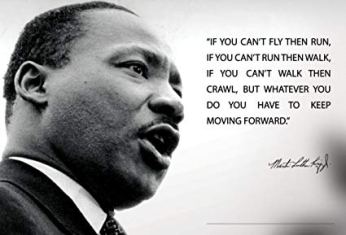
And in the words of Dr. King, if we can’t fly, let’s run. If we can’t run, let’s walk. If we can’t walk, let’s crawl. But whatever we do, let’s keep moving forward. Forward together, not one step back.


Holy Week

Emma

It happened 2,000 years ago, and it happens today.

Someone experiences suffering.

They love their neighbors as they love themselves.

They have a dream that love can change the world.

They heal. They teach. They unite. They march.

They speak truth to power.

They inspire.

But they also disturb.

Pushback comes.

Betrayal. Denial. Lies. Mocking. Humiliation. Degradation. Dehumanization.

Some of it comes in the name of God.

The good news is that Easter is coming.

Hope is rising.

And love will win.

Jesus, Guns and Demons

Prayer vigil

During the season of Lent, we are encouraged to prepare for Easter and the promise of new life. We are encouraged to take an introspective inventory of ourselves and remove those inward impediments that may hinder us from experiencing the good news of Easter, those things that could prevent Easter from transforming us into the people God has created us to be.

During this holy season of Lent, I believe God calls us to remove the demons in our lives that prevent this transformation. During Lent, we need to disturb, silence and rebuke the demons. Lent is a time for exorcisms.

I realize that most Americans may not put much stock in “demon exorcisms,” but after another school shooting, many would probably agree that there seems to be some demons at work in our country. And these demons are not just in the people who want to commit mass murder. They are in all of us. For something is terribly wrong when a school shooting fails to bring us together as a nation and only divides us further.

I believe the best way to disturb and silence the demons in our lives is to earnestly and prayerfully open our hearts to the teachings of Jesus, to make the teachings of Jesus our authority on all matters.

One day, Jesus was teaching in the synagogue in such an authoritative way that it disturbed a demon who was in the congregation. The demon that was inside of a man cried out in the middle of the sermon: “What have you to do with us, Jesus of Nazareth? Have you come to destroy us? I know who you are, the Holy One of God.” Then Jesus rebuked the demon, telling the demon to be silent and commanding it to come out of the man. We are told the demon obeyed Jesus immediately (Mark 1:21-28).

To prepare for Easter and the promise of new life, I believe the first thing we need to do is open our hearts to allow the authoritative teachings of Jesus to challenge us in such a way that it disturbs the demons within us.

While I served in Oklahoma, the local ministerial group had a monthly meeting and program. After a mass shooting, their program was entitled: Christians and Guns: An Oklahoma Perspective.

A good question is, “Why wasn’t such a program entitled, Christians and Guns: A Jesus Perspective?”

We’ve heard the Republican perspective and the Democrat perspective. However, if we truly want to experience new life this Easter, I believe we must open our minds and hearts to hear the Jesus perspective.

Claiming the Body of Jesus

cross

Sermon preached at St. Francis Xavier Catholic Church for the Ecumenical Good Friday Service, 2017 in Enid, Oklahoma.

John 19:38-42 NRSV

After Jesus is crucified, John speaks of two individuals who emerge from the shadows, exposing themselves, risking their anonymity, putting their reputations on the line, by claiming the body of Jesus.  The first is Joseph of Arimathea, a disciple of Jesus who had previously hid his faith in secrecy for what John calls “fear of the Jews.”  He was one of the Jewish authorities who never openly confessed their faith in Jesus because of fear of losing their political power and position in the synagogue.

And the second was Nicodemus. You may remember Nicodemus from John chapter 3. He had previously come to Jesus secretly by night, showing some interest in Jesus, but never making a public profession of faith.  However, now on Friday afternoon, in claiming the body of Jesus, the faith of both of these men is clearly exposed and made very public.

And as we read John’s account we notice that by coming out of the shadows, openly claiming the body of Jesus, these two men do much more than risk their anonymity and their reputation in their community.  They also put at risk their religion.  For touching the dead body of Jesus made them ceremonially unclean which meant that they would be unable to celebrate the Passover and the Sabbath with their families.

The extravagant amount of burial spices which weighed about a hundred pounds that the men bring to anoint Jesus’ body, tell us that these men also put at risk their riches. Along with the expensive spices, the linen burial clothes they used to prepare Jesus for burial were usually something worn only by people of wealth and prominence. The pristine condition of the garden tomb also underscores the extravagance of Jesus’ interment.

So in this story we see two persons who come out of the shadows risking reputation, religion and riches to claim the body of Jesus.

The question which should come to our minds is why?  Why risk anything for someone who is dead?  Why would Joseph and Nicodemus risk their reputation, their status in the community; their religion, their standing in their family; their riches, and their wealth for a lifeless corpse?

What was it that led these men to risk so much?  Well, one might ask: What would have happened to the body of Jesus if these men had not claimed the body of Jesus?  Well history tells us that after a Roman crucifixion, the unclaimed bodies were often left hanging on the cross to be picked apart by birds. And other times, the unclaimed bodies were simply thrown into the trash dump outside of town.

So these men, living in secret shadows, loving Jesus from afar, simply said, “enough is enough.”

We can no longer conceal our faith.  We can no longer mask our love.  We can no longer sit back and do nothing. We can not bear to let our Lord and our Savior’s body be defiled by being picked at by birds or thrown into a pile of trash.

We must do something.  Even if it means putting at risk every thing that we cherish, everything that we hold dear.  Even if it means risking our reputation, our religion (the way we have always done it anyway), all of our riches, we must act.  We can no longer stay in the shadows. Our love for our Lord demands that we claim his body:  that we remove him from the cross; that we prepare his body for burial, that we seal him in a rich man’s tomb.

It was love, pure and simple and powerful which caused these men to act on the behalf of Jesus by claiming his body risking reputation, religion and riches.

The irony here is that it was the same love which caused our God to act on our behalf.  The story of Joseph and Nicodemus is the story of our God.  Out of a high and holy place, our God said: enough is enough.  I can no longer love my creation from afar.  I can no longer watch my creation suffer and perish.  I can no longer keep myself from risking my all, from empting myself, from becoming a human being.  I can no longer keep myself from offering my creation all that I am and all that I have. I can no longer keep myself from pouring myself out.  I can no longer keep myself from loving my creation even to the point of death, even death on a cross.

Joseph and Nicodemus claimed the body of Jesus because they were filled with the divine love of God.

The question for us is this:  How long are we going to continue to live in the shadows?  How long until we open our hearts to the story of God’s love; to the divine love of God which wants to fill our souls, to be so overflowing with the love of God that we have to cry out: “enough is enough!   I can no longer sit back and do nothing, I must act. I can no longer love my Lord and my Savior from afar.  I must claim the body of Jesus, the body of Christ, for myself even if it means putting at risk the things I most hold dear.  Even if it means risking reputation, religion, and riches, I must share this pure and simple and powerful love with everyone I know. I can no longer let others suffer alone. I can no longer sit back and allow injustice to continue. I can no longer ignore inequality. I can no longer turn my back on those who are marginalized and ostracized. I can no longer keep my faith private.  I can no longer remain silent. I can no longer keep myself from giving all that I have and all that I am to the ones who are lonely, thirsty, cold and hungry.  Enough is enough!  I must claim the body of Christ!”

Well, what are we waiting for?  Are we afraid of what we might lose from risking so much?  Let’s look at what Joseph and Nicodemus lost by claiming Jesus’ body.  They really did not lose a thing.  Instead of losing their reputations, their good names, their names are remembered by the gospel writers and by you and me two thousand years later as the ones who risked everything to claim the body of Jesus.

How do we want to be remembered?  As someone who lived only for one’s self; accumulating a lifetime of reputation, religion and riches?  Or would we rather be remembered as one who because of so much divine love welling up inside of our heart, we risked it all to claim the body of Jesus?   By doing whatever we can to serve our Lord in our community and in our world.  By giving all that we have and all that we are to our Lord by loving others with the complete, divine love of God.

Crown of Thorns

Matthew 21:1-11 NRSV    nerve gas

Palm Sunday—it’s the spectacular day we celebrate the King of Kings’ triumphant entry into Jerusalem!  And in this world of so much suffering and pain, oh how we need a day like today!  Oh how we need to hear that Jesus Christ, our ruler and our king is coming through the gates to finally set things right, to take complete control of things. Oh how we need a day to reassure ourselves that no matter how bad life gets, no matter how distressed, fragmented and chaotic life becomes, and how hopeless it seems, Christ is large and in charge! “He’s got the whole world in his hands,” as we all like to sing.

Ok. Now, as we Disciples of Christ like to do, let’s get real for a moment. Let’s honestly think through this. Is the truth that “He’s got the whole world in his hands really that comforting?”

Although none of us good God-fearing, Bible-believing, church-going folks like to admit it, is this truth of God’s supreme providential power more than a little disturbing?

Think about those times you were reminded by someone, albeit with good intentions, that “God is in control.” When Lori and I lost our first child two months before the due date, people came up to us and said, “Don’t let this get you down. Just remember that God doesn’t make any mistakes.”

After the doctor gave you the news that the tumor was malignant, people came up to you and said, “Don’t worry, God knows what God is doing.”

When people learned that you were going to lose your job, they reminded you, “It is going to be alright, for God in control.”

At the graveside of a loved one, your friends and family lined up between you and the casket and whispered: “God has a reason for this.”

And very politely, we nodded. We even thanked them for their words with a hug or a handshake. But then, a short time later, after we dried our tears and came a little bit more to our senses, while we were sitting quietly at home or while we were out on a long drive, or maybe sitting in church, we began to reflect and to ponder those well-intended words. We began to think to ourselves: “If God is really sitting on some providential throne in complete control of this fragmented fiasco called life, this disastrous debacle called the world, then, really, just what type of ruler is this God? Just what type of king sits back and allows so much evil to occur in their kingdom, especially to people we are told the king loves.

The king of kings makes his triumphant entry—what is supposed to bring us great strength, peace and comfort, instead brings us frustration, anger and doubt.

Hosanna, the King is coming to save us—what is supposed to bring us assurance and hope brings us misery and despair. And we become tempted to join all those who will laugh and ridicule Jesus by the end of this week: “Umphh!  King of the Jews! Some King!”

I have said it before, and I do not mind saying it again—If God is the one who willed our first baby’s death, causes tumors to be malignant, gets us fired from our jobs, takes our loved ones from us, and sits back allowing such atrocities as the snuffing out of lives of little Syrian children being with nerve gas, then I really do not believe I want anything to do with a god like that!  I think I would rather join the millions of people who have chosen not to be in church on this Sunday before Easter.

But the good news is that I am here.

And I am here to proclaim with a confident voice God that God is not the type of King who decrees the death of babies, pronounces malignancies, commands layoffs and orders our loved ones to be suddenly taken from us. There is no doubt about it, Christ is King.  But thank God, Christ does not reign the way the kings of this world reign.

The reason I believe we allow ourselves to be tempted to give up on God in the face of evil is because we often forget that our God reigns not from some heavenly throne in some blissful castle in the sky. But our God reigns from an old rugged cross, on a hill outside of Jerusalem, between sinners like you and me.

I believe we oftentimes become despairing and cynical about God, because we forget that our God does not rule like the rulers of this world.

The kings of this world rule with violence and coercion and force. Earthly rulers rule with an iron fist: militarily and legislatively, and with executive orders. Worldly kings rule with raw power: controlling, dominating, taking, and imposing.

But, as the events that took place this week in Jerusalem 2,000 years ago remind us, Christ is a king who rules through self-giving, self-expending, sacrificial love. Christ is a king who rules, not from a distance at the capital city, not from the halls of power and prestige, but in little, insignificant, out-of-the-way places like Bethlehem and Nazareth, and Waukomis and Enid.

Our King doesn’t rule with an iron fist. Our King rules with outstretched arms.

Our King doesn’t cause human suffering from a far. Our King is right here beside us sharing in our suffering.

Our King possess what the late theologian Arthur McGill called a “peculiar” kind of power.

God’s power is not a power that takes. It is a power that gives.

God’s power is not a power that rules. It is a power that serves.

God’s power is not a power that imposes. It is a power that loves.

God’s power is not a power that dominates. It is a power that dies.

And as Arthur McGill has written, this is the reason that it is “no accident that Jesus undertakes his mission to the poor and to the weak and not to the strong, to the dying and not to those full of life.  For with these vessels of need God most decisively vindicates his peculiar kind of power, [a] power of service whereby the poor are fed, the sinful are forgiven, the weak are strengthened, and the dying are made alive.”[i]

Christ the King did not take our first child. The day our baby died, our King came and cried with us in that hospital room.

God did not cause the tumor. The day the doctor said the word “cancer” was a day of anguish for God as it was for us.

God did not create the layoff. The day you were told that your job was ending, God stayed up with you and worried with you all night long.

And God did not take your loved one.  When they died, something inside of God died too.

What we all need to learn are very different definitions of “king,” “rule,” “reign” and “power”—very different because they define the holy ways of the only true and living God, rather than defining our false gods and their worldly ways.

When life gets us down (and if we live any length of time at all in this world, it most certainly will), we need to remember the great truth of this day—The king has arrived. The king has entered the gates. And this king is has come to take his place on his throne, on an old rugged cross.  Do you see him reigning today? Do you see him bleeding, suffering, sacrificing, and giving all that God has to give from from the cross?

God does not make mistakes. God knows what God is doing. God is in control. God is king. But God’s throne is not made of silver and gold. God’s throne is made of wood and nails. God wears not a crown of jewels. God wears a crown of thorns.

This past week, I visited with Marion Batterman whose doctor just told him that he was dying. He said, “Pastor, my doctor gives me no hope. They said that my lungs are just about gone.”

I said, “Marion, I am so sorry.”

“Oh don’t be sorry he said. “Because my hope is not in my doctor! My hope is in my Lord!”

“So Marion,” I said, “Even when your lungs stop working completely…”

Marion finished the sentence, “I still have hope!”

No, he was not delusional. His mind was not clouded with medication. Marion was at peace, because his King reigns from a cross.

Marion was filled with hope, because his King is not far away from him seated a celestial throne removed from his agony. His King is seated at his very side suffering with him.

His King is not above his pain. His King is experiencing every bit of his pain.  His King is not willing or decreeing his death, his king is experiencing his death.

His King is not slowly taking his life away from him. His King is giving the King’s eternal life to him, pouring out the King’s holy self into him, and promises him every minute of every day to see him through his dying.

After he described an intensified intimacy that he now shares with his Lord, he then said something miraculous. With this hopeful joy in his smile and eternity in his eyes, he told me that he was a blessed man.

Think about that for a moment.

A man, barely able to breathe, nearing the end of his life, told me that he is blessed.

Aren’t we all?

[i] Arthur McGill, Suffering: A Test of Theological Method, 61-63.

Loosening the Bonds of Death

Lazarus

John 11:32-44 NRSV

John 11 is a great example of why I love the Bible. I love the Bible because the Bible is honest. The Bible is real. The Bible does not hide, cover up or try to sugarcoat the difficulties and even tragedy of life in this fragmented world.

I love that, because this world in which we live is sometimes incredibly painful. We live in a world surrounded by poverty and economic pain. We live in a world where the rich take care of themselves while taking advantage of the poor.

We live in a world where so-called “Christians” in the church are some of the meanest and most evil bullies we know. We live in a world where our loved ones suffer with all sorts of dreadful diseases. And we live in a world where we are continually reminded our own mortality.

Thus, I love John 11, for here in this very honest chapter, there is no denying the harsh reality of this fragmented existence we call life, especially in dealing with the most tragic aspect of this life: the death of a loved one.

Too many Christians, for many reasons would rather treat the tragedy of death as if it does not exist. We don’t want to talk about it.  And when we do, we try to deny the harshness, the sheer austerity of it. We do not even like to call it “death.” We would rather call it “passing away.”

We say things like: “there are worse things in this world than death;” however, in death there still exists an inescapable starkness that cannot be denied or ignored. When we are honest, we would admit that death is the most difficult thing about life. Losing someone we loved is the worst of all human experiences. We try to comfort ourselves by saying things like, “at least our loved one is no longer suffering.”  “At least she is now finally at peace.”  But if we are honest, just a second later, we find ourselves questioning why she had to get cancer and suffer in the first place. Why did they have to die as young as they did?

And we like to comfort ourselves by saying that he or she is in a far better place. But then a second later, we question why he or she would not be better here with us, at home, surrounded by family and love.

Yes, in John 11, there is no refuting the stark reality of death. Notice that Martha is absolutely horrified when Jesus commands the stone to be rolled back from the tomb. Her horror reminds us of something that we would rather ignore: the body was beginning to decay. The very sound of the words of verse 39 “Lord, already there is a stench, because he has been dead for four days” seems inappropriate to read from the pulpit. Dressed in our Sunday best on a beautiful spring morning, we don’t want to hear that!

But this is reality. This is truth.  And sometimes we simply do not want to hear the truth.

And sometimes we just think it is our Christian duty to be an example to the world, to the weak, to the unfaithful, how to be strong, how to put on a brave face and hold back the tears.

But notice in John 11 that there is no holding back.

Mary, the brother of Lazarus, weeps. The mourners who had gathered at the cemetery that day weep. Even Jesus himself weeps. The harsh reality of death and grief is evident everywhere.

We are told twice that Jesus “was greatly disturbed in spirit and deeply moved.” Is there really a difference there? That is like saying that Jesus was grieving and mourning.

Just looking at the tomb of Lazarus caused Jesus to burst into tears.  Even Jesus, who we believe is manifestation, the very embodiment of God, the creator of all that is, who became flesh to dwell among us, does not remain calm and serene as one unmoved and detached from the fragmented human scene. Jesus himself is deeply disturbed at death’s devastating force. There is no denying it or escaping it or muting it. Neither is there any dressing it up with euphemisms like “passing away” or “gone on to be with the Lord.”

John 11 also points out why Jesus grieved. In verse 36 we read: “So the Jews said, ‘See how he loved him.’”

It has often been said that the only way to miss pain in life is to miss love in life. Garth Brooks sings a song entitled “The Dance.” One line of the song goes: “I could have missed the pain, but I would have had to miss the dance.” Grieving only means that we have loved as our God has created us to love. The only way to never grieve is to never love. But to never love is to never truly live. As the song goes, the only way to miss the pain of loss is to miss the whole dance of life.

So, I believe John 11 gives each of us permission this morning to grieve. May we grieve long and deeply. May we never dare to run away from it.  May we never treat it as it was some stranger that we could send away, or deny that grief, because someone who doesn’t know any better thinks grieving means our faith is weak. Let us grieve what is lost. Grieve honestly, lovingly and patiently. Let us grieve until our cups are emptied.

However, (and here is the good news for all of us this day) as the Apostle Paul reminds us in his letter to the Thessalonians that those of us who call ourselves Christians should not grieve as others do who have no hope.  As Christians, our grief is real, but our grief is different. Our grief is not despairing, because as Christians, we possess hope because Jesus, who himself was not immune to grief and even death, always brings resurrection and new life.

Those of us who are not immune to grief and death need to again to hear Jesus’ prayer which came in a loud voice.  “Lazarus, come out.”

I heard a preacher once ask his congregation, “You do know why Jesus said, ‘Lazarus, come out’ and not simply ‘come out’ don’t you?  Because if he did not call Lazarus by name, if he did not say specifically, “Lazarus, come out, then every tomb in Jerusalem would have opened up that day!

We need to hear this voice and see this very real and foul, decaying corpse walking out of the grave, still wrapped in burial cloths, coming, at the voice of Jesus, to life.

And then I believe we need to hear again, and hear again loudly Jesus’ words: “Unbind him, and let him go.”  “Unbind him, and let him go.”  Lazarus is loosed from the bonds of death. He is freed from the shackles of his past. He is let go into a brand new future, liberated and set free.

Then, I believe we need hear John and Jesus himself tell us over and over that this event reveals the glory of our God. What we have in this story is much more than the resuscitation of one dead corpse by one man.

Always for John, miracles are much more. Miracles are always signs that point us to something greater. Thus this miracle is the revelation that the God in whom we serve and trust and love, this God who is not unmoved and detached from the human scene, is always a death-overcoming and life-giving God.

The good news that we need to hear is that this God is still working in our world today unbinding, letting go, loosing, freeing. God is here enabling us to confront death and grief, us to acknowledge it, to look it straight in the eyes, to see all of its harshness and starkness, and then be liberated from it.

And if God is here liberating us from the shackles of death, then there is nothing else in all of creation from which God cannot set us free.

From evil bullies bent on crushing our spirits.

A job that is draining the very life from us.

A relationship that is killing us.

Fears that paralyze us.

Disease that is destroying us.

Economic hardships that never seem to end.

Depression that never lets go.

One of the great things about being a pastor is how I have the awesome privilege to witness this good news all of the time.

Someone loses their job. They come to me believing it is the end of the world. But a year later, working a new job, they share with me that losing that job was the very best thing that could have happen to them.

Someone else comes to me and says that their marriage has fallen apart. And that they are partly to blame. They said they thought life as they knew it was over. But a few months later, they tell me that they are beginning realize that although they cannot go back to the good old days, they have plenty of good new days ahead.

Someone comes to me sharing their deepest fear: the fear of being known for who they really are; the fear of rejection and ridicule. Then I see them a short time later, and they tell me how they have been surprised by unconditional love and unreserved acceptance.

People call me to share their doctor’s grim diagnosis. They say that they had just received a death sentence. But a short time later, I visit with them, and they tell me that they are beginning to understand that being alive and whole have very little to do with physical well-being.

And then I have visited with countless people as they are facing what is certainly their final hours on earth, and I hear in their voices, and I see in their eyes a faithful awareness that there is nothing at all “final” about them.

Thus, like Lazarus, in this incomplete and fragmented world where death, divorce, disease and hate entomb us, we can be loosed. We can be freed, and we can be unbound.

We can come out and let go and celebrate the good news together: where there is incompleteness and brokenness, there can be wholeness. Where there is tyranny of the mind, there can be freedom of the heart. Where there is an imprisonment of the soul, there can be a liberation of the spirit. Where there is grief and despair there is hope. And where there is death and even decay, there is always life.

Let us pray together…

O God of New Life, may we be a church that shares this good news with all people, honestly and truthfully and faithfully. May we weep with those who mourn. May we be deeply moved with those who are afraid. And may we be deeply disturbed in our spirit with all who are suffering. Stay beside them. Befriend them. Accept them. Love them…until they are whole, liberated and fully alive now and forever through Christ our Lord. Amen.

Sunset or Sunrise

Sunset

This picture appeared recently in the Enid News and Eagle. The caption simply read: “Sunset.” However, at first glance, it is difficult to tell if it is a sunset or a sunrise.

As attendance, giving, and baptisms continue to decrease in North American churches, many are asking: “Is the sun setting or rising on the church?”

After posting the picture on facebook and posing the question, “Is it a sunset or a sunrise?” Rev. Dean Phelps, a facebook friend and long-time minister, wisely commented: “It all depends on when we wake up.”

Rev. Phelps was prophetically suggesting that if the church wakes up early, it could be a sunrise. However, if the church wakes up too late, it could be a sunset.

I believe it is a sunset if the church continues to slumber under the covers of the culture. I have called this embracing an “alternative gospel” or a “fake news Jesus.” It is a protective, safe, defensive religion that fears the other, and thus judges, excludes, and condemns the other. It is miserly with mercy, stingy with love, and tight-fisted with grace.

However, I believe it is a sunrise if the church awakes to pull back the covers of the culture to embrace the authentic gospel and good news of Jesus. We must awaken to discover our purpose to be a community of radical inclusion and extravagant grace. We must awaken to answer our call to love others as Christ loves us, unconditionally, unreservedly and fearlessly.

I believe it is a sunset if the church continues to dream of the glory days. Sadly, the dreams of many churches are either stuck some in distant past recalling fuller pews and bigger programs, or they are stuck in some heavenly future, fixed on pearly gates and streets of gold.

However, I believe it is a sunrise if the church awakens with eyes wide-open to see its mission in the here and now. We must awaken with our eyes focused on the present suffering of the entire creation, and then we must selflessly and sacrificially use our gifts, time and energy to be a movement for wholeness, healing and peace.

I believe it is a sunset if the church continues to hit the snooze button to rest in their comfort zones. Many churches have no desire to get up and go out, leaving their cozy environments behind. There is no interest to get outside of the security blanket of the sanctuary to do the hard work of feeding the hungry, clothing the naked, defending the marginalized, and breaking the bonds of injustice.

However, I believe it is a sunrise if the church will rise up from its comfort zone to go out into what can be a cold and dark world. We must awaken to be the embodiment of Christ in this world even if it means there is a cross involved, even if it means suffering for the sake of God’s creation.

Is it a sunset or a sunrise?

It all depends on when we wake up.

It Can’t Be the Messiah. Can It?

FullSizeRender

John 4:5-29 NRSV

With United Methodist Bishop William Willimon, I believe that the Bible is not so much an account of our search for God, as it is the amazing account of the extraordinary lengths to which God will go to search for us. Whether we know it or not, or can even begin to understand it or not, we are here this morning because we have been sought, we have been called, and we have been summoned. We are here because God has reached in, grabbed us, and led us here. We are here because God has pursued us. God is even now persuading, prodding and pulling us.

And I believe that the purpose of our worship is to condition us to pay attention to this, to admonish us to look over our shoulder, to help us to notice those little coincidences in our lives and those strange happenings.

For they may be a part of God’s continuing attempts to wrap God’s loving arms around us.

And these things, these coincidences, these strange happenings can occur anytime and in any place. As Jesus told Nicodemus, “The Spirit of God, like the wind, blows where it will”—whether or not we’re ready for it, looking for it, or even want it.

So, it would behoove us to stay alert, look, listen, always pay attention.

I believe the woman in our scripture lesson this morning teaches us how to pay such attention.

That fact alone teaches us something about the way God works. In the male-dominated society in which Jesus lived, especially in the area of faith and religion, Jesus uses a woman to teach us theology. Talk about the spirit of God blowing where it will!

In Jesus’ day, mainline Jewish rabbis simply did not speak to women about faith. However, Jesus was anything buy mainline. But one who always, very radically and counter-culturally, valued women and men equally.

Which brings us to another surprise. She was not only a woman; she was a Samaritan woman. And we know what Jews thought of Samaritans. They were known as pagans and foreigners. They were victims of racism, xenophobia, and bigotry.

Here, the radical words of the Apostle Paul are being fleshed out: “there is no longer Jew nor Greek, slave nor free, male nor female, but all are one in Christ Jesus” (Gal 3:28).

During her conversation with Jesus (which, by the way, is the longest recorded conversation that Jesus ever had with anyone), we also discover that she carries the stigma of divorce, as she has been remarried several times.

And, of course, she is astounded that this man, a Jew, talks to her, a Samaritan. In her eyes, she’s the wrong gender, wrong race, wrong religion. Yet, Jesus meets her where she is. Jesus initiates a conversation with her. Jesus reaches out to her. Jesus engages her.

And of all places, at a well!

It is important to understand that she isn’t there for Sunday School. She isn’t there for the 8am or the 10:15 worship service. She’s not even there for CWF. She is there doing the most ordinary of everyday tasks. She’s simply drawing water.

So, the first thing this woman teaches us is that God speaks to us, God reaches out to us, and God engages us when we least expect it, where we least expect it, and how we least expect it. God comes to us, unexpectedly, undeservedly in the most ordinary of ways.

Jesus then begins to teach her about something called living water and then tells her that he knows all about her; all of her failures, all of her disappointments, all of her grief which has been so much a part of her life.

She then runs all the way back home to tell everyone, “Come! See a man who has told me everything. He can’t be the Messiah. Can he?”[i]

Willimon has said: “She—Samaritan, woman, husbandless—thus becomes the precursor, the very first of all of us later preachers. She was the first to run to tell everyone about Jesus.”

And all she meant to do that day was to go out and get a bucket of water!

And here is the amazing part. She didn’t all of a sudden understand everything about who Jesus. She didn’t run back home singing the Gloria Patri and reciting the Lord’s Prayer. She merely left her encounter with Jesus with a simple, but very profound question: “He can’t be the Messiah. Can he?”

“He can’t be the Messiah. Can he?”  Do you hear it?  Listen again, “He can’t be the Messiah. Can he?

No, it’s not the words of some religious fundamentalist who has it all figured out. It’s more like the words of a innocent child. “He can’t be the Messiah, can he?”

Fifteen or so years ago, during the weeks leading up to Christmas, when my children would misbehave or fuss, when they were not looking, I remember making a fist and knocking on a wall or under the table.

Carson and Sara would immediately stop their fussing and ask, “Who is that? Someone’s knocking on the door.”

I’d get up, go to the door, open it, look around, and of course, not seeing anyone, I would shut the door and say: “It must have been Santa Claus! Don’t you know that this time of year he’s always watching?”

Sara Beth would say, “Nah uh! That wasn’t Santa Claus!” But a of second of silence later, she’d ask, “Was it?”

Can’t you hear it?  Like an innocent child, full of surprise and wonder and an unbridled hope, the woman at the well said: “He can’t be the Messiah. Can he?”

Do you hear it?

With Willimon, I hear a playful openness, a light flickering in the dark, a wonderful willingness to consider that God was larger than her presuppositions of God. I hear a courageous willingness to be shocked, surprised, and intruded upon. I hear a thirst for something to quench a longing soul.

I believe this is the problem with us grown-ups, especially we modern, mainline, mainstream church-goers. We simply say: “That can’t be the Messiah…period!

There is no openness to the possible potential that it might be, may be, could be, probably is.

We are so smart. We have things so figured out, we never question, “Can it? Was it? Is it?”

Even when we are at church, in a Bible Study or in worship, there is no real expectation that Jesus Christ, the Messiah and Savior of the world might actually show up.

To be honest with you, last Sunday, I was almost dreading coming to church. I was thinking: “Daylight Savings Time, Spring Break. Very few people are going to be at church today. And nothing good is really going to happen this Sunday.” I was also feeling a little disheartened that I had to make an announcement regarding our supplemental giving drive. Asking for more money makes me feel like I have perhaps failed at something.

The point is, last Sunday, when it came to church, I wasn’t feeling it.

But then, to my surprise, four people came forward during our final hymn asking to formally join the mission of our church to bless this community and world. One even offered to bless my family by taking us out to lunch after the service. And then, later in the week, I received a phone call with the news that someone believed in our church’s mission enough to make a sizable donation to be used anyway we believe God may be leading us.

And here it is, just one week later, and there’s this renewed, restored, replenished fullness in my soul. There’s this recommitment to share the love and grace of Christ with all people.

Now, I am aware many would say that those events were merely coincidences. Perhaps. However, as I have studied our scripture this week, like a light flickering in the dark, my heart has become open to the providential possibility that God was somehow involved. And the fullness that I feel in my soul is from this wonderful willingness to be shocked, surprised, and intruded upon by none other than the Messiah and Savior of the world, Jesus Christ himself.

Thinking on the words of the woman in our scripture this morning, I cannot help but to think: “It can’t be the Messiah. Can it?”

Can it possibly be that, here in this place last week, Jesus Christ was actually present? Could it be that he was coming to me through ordinary people, unexpectedly, undeservedly, bringing living water that quenches the deepest thirst of my soul.

Jesus, through this Samaritan woman, at the well, answers that question: “Yes, I am the Messiah. I am more alive and more present and more at work in this world than you ever thought possible. I am everywhere offering the wonder of living water, and those who drink of the water that I will give them will never be thirsty. The water that I give will become a spring of water gushing up to eternal life.”

One of the greatest things about being a pastor is sharing not only times of immense joy with a congregation, like childbirth with the Weibling family this week, but also sharing times of immense sorrow, like with Charlie Heller last week.

I look around this room and see people here who have experienced much sorrow, so much in this past year. I am certain that even getting up this morning and getting to this place was an arduous task for you. Some of you have recently lost a parent, a sibling, a spouse. Some of you have lost a child. You all have lost dear friends. Some of you have been diagnosed with cancer. Some have had to make the difficult decision to place a loved one in a nursing home. Some are grieving broken relationships, broken dreams, broken lives.

And people, including me, look at you and are amazed. We say, “We don’t know how you are making it.”

And yet, somehow, some mysterious way, you are making it. At the very least, something or someone has given you the sustenance to make it to this place this morning to possibly hear a hopeful word.

I look at you with the wonder of a wide-eyed child. And I think of the wonder of that woman from Samaria, and I ask, “It can’t be the Messiah…can it? Can it?


Commissioning and Benediction

Now, let’s go and get out on the road

to encounter ordinary people doing the most ordinary of things.

They may be dining at a restaurant, shopping for groceries, exercising at the gym, learning in a classroom, waiting to see the doctor.

They may be the server in a restaurant, the clerk at the store,

the trainer at the gym, the teacher in the classroom, the nurse, the doctor.

Their gender, their race, their religion—it doesn’t matter.

They may be a victim of prejudice or a beneficiary of privilege.

Meet them where they are. Engage them. Listen to them. Bless them.

And may the eternal well of God’s love be found in our encounters.

May the grace of Christ shine brightly through us.

And may the Spirit be with us on every hill, every plain, and in every valley.

[i] If my memory is correct, the words of this sermon were originally inspired and gleaned from a sermon written by William Willimon, possibly entitled, Look over Your Shoulder, in 2005.