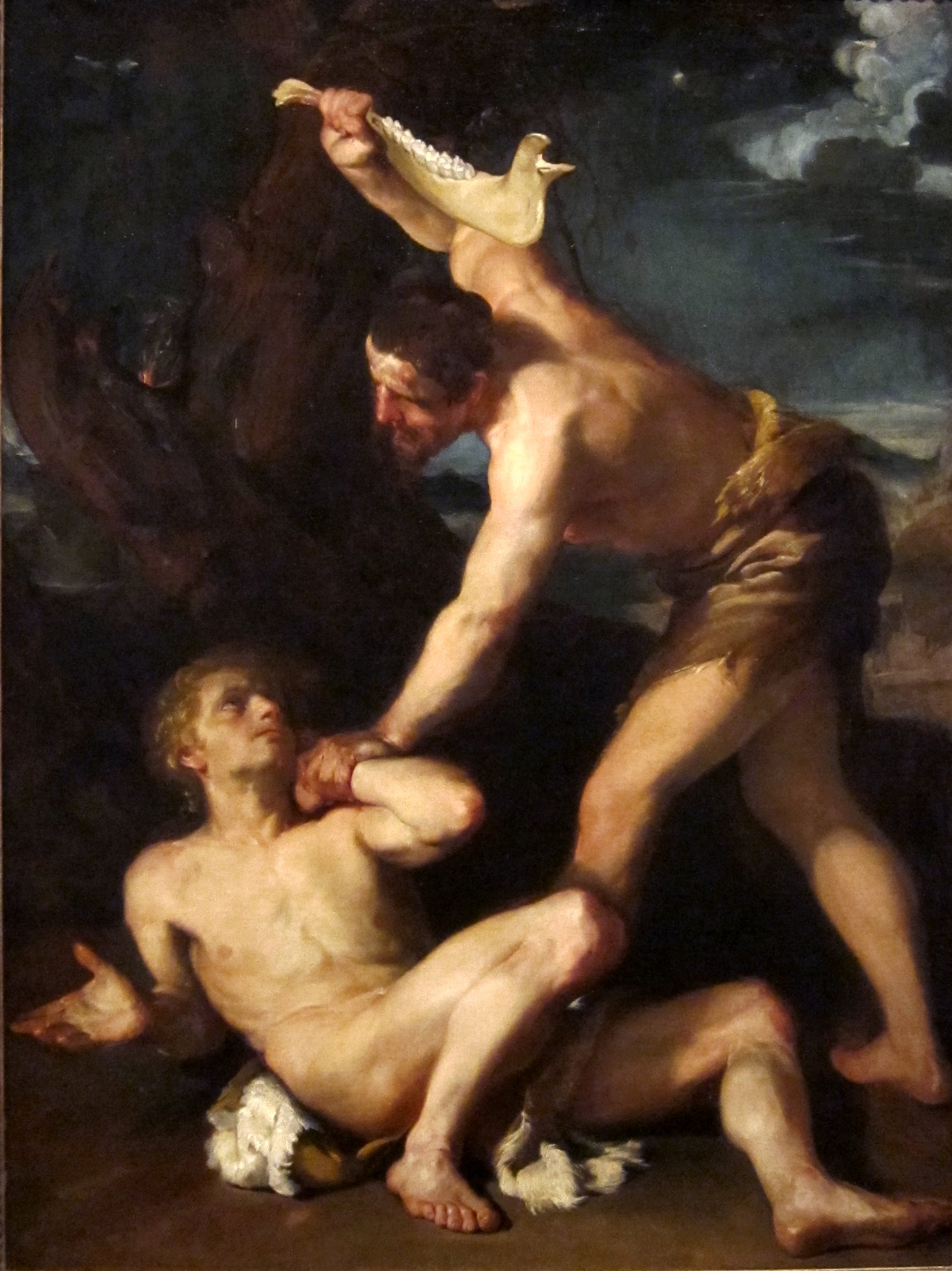
Grace in Genesis: Cain and Abel

cain and abel

Genesis 4:1-16 NRSV

I believe the story of the world’s first brothers has much to teach us about the unfairness of life. Cain and Abel were both hardworking men. At the time, they were holding down two of the most important jobs in the entire world, providing the sustenance needed for the propagation of humanity. Abel was a keeper of sheep, and Cain was a tiller of the ground. And although these important farmers did not yet have a First Christian Church in their town where they could gather each week for worship, both worshipped their creator as faithfully as they knew how.

Both Cain worshipped God, put God first in their lives, gave thanks to their creator for the gift of life by offering the best of who they were: the best of their talents, abilities, and gifts. Abel offered the firstborn from one of the sheep he tended, and Cain offered the produce of his field that he grew and harvested with his own hands.

Then Cain learns something that all of us who have lived in this fragmented world know all too well. Life is not fair. We are not told exactly what happened to cause Cain to believe that God loved Abel more than him, why Cain believed that his offerings to God were for all for naught, but we can certainly make what I believe are some very fair assumptions.

Maybe Abel enjoyed better health than Cain. Maybe he had less aches and pains, fewer allergies than Cain. Perhaps Abel was better looking, more athletic, faster, had nicer teeth and hair. Maybe he was a lot smarter than Cain. Maybe these other people who miraculously seemed to be around at the time, preferred Abel’s leg of lamb, rack of lamb, lamb stew or lamb chops over Cain’s broccoli, cauliflower, rutabaga, and carrots. Perhaps Abel had a nicer house, a bigger farm, finer clothes, or just a more comfortable life in general.

Whatever it was, Cain believed that Abel was more blessed, more favored, more accepted, and more loved by God. Thus, it became very obvious to all and especially to God that Cain was angry. And who could blame him? Life is not fair. For no reason, without any explanation, bad things happen to some very good people all the time. And likewise, without any rhyme or reason, some very good things happen to some very average or below average people all the time. And our natural inclination is to be angry at it all. Why, it is just second-nature.The Psalmist clearly understood this as we can feel the anger behind the words of the 73rd Pslam.

1 Truly God is good to the upright,*    to those who are pure in heart.  2 But as for me, my feet had almost stumbled;  my steps had nearly slipped.  3 For I was envious of the arrogant;  I saw the prosperity of the wicked.  4 For they have no pain;  their bodies are sound and sleek.  5 They are not in trouble as others are;  they are not plagued like other people.  10 Therefore the people turn and praise them,*  and find no fault in them.*  12 Such are the wicked;  always at ease, they increase in riches. 13 All in vain I have kept my heart clean  and washed my hands in innocence.  14 For all day long I have been plagued,  and am punished every morning.

Cain, like all of us living in this world filled with inequity and injustice, became angry. His countenance fell. Like second nature, Cain’s anger swelled inside of him, and everyone knew it, even God.

And God responds: “Cain, I can understand why you are angry. I really can’t blame you. For it is a natural, human response to the unfairness of this world. Therefore, it is not you being angry that I am worried about. I am worried about what you might be tempted to do with your anger, for sin is like a wild beast lurking at your door, and it craves to have you, to destroy you. So, Cain you need to master your anger, tame it, control it, transform the energy of your anger into a dynamism to do something good, something beautiful and wonderful to counter the injustice and inequity in our world, something constructive, something honorable, something amazingly gracious and loving.”

I believe that Christians have a tendency to believe that being angry is a sin; therefore, we go to great lengths to avoid anger. But in avoiding anger, I believe we can easily become disengaged, complacent, devoid of the passion and fire that I believe Jesus wants us to have. I believe the world needs more Christians to let our countenances fall and become consumed with passion to live with an amazing grace that counters the unfairness in of the world.

However, as the story of the world’s first two brothers teaches us, anytime we are angry, we need to be cautious, for as the Lord says, sin is always lurking at the door. Unfortunately, Cain allowed his anger to get the best of him, and he killed his brother Abel.

Then, this one who believed in fairness, this one who believed in justice, this one who believed that people should reap what they sow, clearly understood the dire consequences for his evil actions. There was no doubt he should be exiled, forced to live outside of his community. There was no doubt he deserved to be forever separated from God. And there, wandering alone without the God he worshipped, others would want to bring him to justice and repay him an eye for an eye and a tooth for a tooth. Cain can almost hear the drumbeats of justice and the shouts from the mob: “Cain, you took a life, and it is only fair that we take yours!”

Cain cries out: “O God, the punishment that I deserve is too much to bear!”

Now what happens next in this story should not surprise any of us who call ourselves Christian.

I hear many people say that the Bible paints two very different portraits of God. They say that the God of the Old Testament was a God of wrath, judgment and vengeance, a God of Hell, fire and brimstone; whereas, the God of the New Testament is a God of love, grace and mercy. I suspect this may be part of the reason that while some say they believe in love and grace, they make it very clear with their words and deeds, that they also believe in judgment and condemnation.

However, I believe God is the same yesterday, today, and tomorrow, and I believe God is love. I believe God will always be love, and I believe God has always been love. Many point to the story of Adam and Eve in Genesis 3 and talk about God punishing the first two humans by kicking them out of the garden; however, as I pointed out a couple of weeks ago in a sermon, the story is about the human consequences of knowing good and evil, and consequently, our shame. And it is a story about a God who deals with our shame by clothing us with grace, as God made garments of skin to cover Adam and Eve’s shame.

Furthermore, in the next chapter, when Cain, who deserves to die for killing Abel, fears that his life is over, God emphatically says, “Not so!” God then reaches down and puts a mark of grace on Cain. Moreover, God’s grace followed Cain, even in that place east of Eden called Nod, even in that place Cain believed to be outside of God’s presence.

Thus, proving in the very beginning of all that is, that there is not, has never been, and will never be, anything in all of creation that can ever separate us from the love of God.

And there, East of Eden in the land of Nod, you know I believe Cain still became angry at the unfairness of the world; however, I do not believe Cain ever again allowed that anger to get the best of him. I like to believe than having been marked by unearned grace, having received unconditional love and having been given undeserved mercy, it became almost second-nature for Cain to use the energy from his anger to counter the inequities and injustices of the world, no longer with hateful and murderous thoughts, but with the same grace, love and mercy that was given to him.

For Cain in the Old Testament had discovered the same good news the Apostle Paul, who wrote most of the New Testament had discovered, that where sin abounds, grace abounds even more. When he was once known as Saul of Tarsus and led in the persecution of Christians, Paul was also guilty of murdering the innocent. If anyone in the Bible deserved to die it was Paul. Killing Paul would be fair and just. Yet, through Christ Jesus, Paul was marked forever with an undeserved forgiveness, an amazing grace, and his mark is still being used to today to share this grace with people everywhere living East of Eden.

The story of the world’s first two brothers has much teach us about unfairness.  No, life is not fair. But the good news is, neither is grace. Thanks be to God.

Let us pray.

O God, thank you for your amazing grace that has been evident in this world since time began. Help us to share this good news with all people, in the name of Christ Jesus our Lord, Amen.

Grace in Genesis: Adam and Eve

adam and eve

Genesis 3 NRSV

How often have you watched a pet dog sprawled all out in the middle of the day, taking a nap, and thought to yourself: “Must be nice!?” Would you just look at Max or Buddy or Bella or Lucy? Not a single care in the world! They’re in paradise! No job. No bills to pay. No groceries to buy. No dishes to wash. Never has to stand in line at Wal-Mart. No knowledge whatsoever of good and evil. No knowledge of the conflict between Israel and Palestine. No knowledge of the plight of undocumented immigrants in this country. They know of no friends who forsook them or disappointed them. Unaware of any sick family members.  Absolutely ambivalent to the certainty that they will one day die. Unmindful that they are even a dog. And utterly oblivious to the reality that they are sprawled all out on the living room floor completely naked. No shame whatsoever.

Sounds to me like two of the first Bible characters we ever learned, the two who represent all of humanity, that still, even today, represent you and me: Adam and Eve. That is, before they ate that apple…or orange or peach or fig. Whatever it was, before they ate that fruit from the tree of knowledge, they were just happy-go-lucky animals sprawled all out in a paradise with no knowledge of good and evil whatsoever: no knowledge of death and disease; no awareness of pain and grief; not even a clue that they would ever have to work hard to make a living; unaware that they were broken, fragmented, and sinful creatures; unmindful that they were even human, humans who in their self-centeredness will continually disobey the Creator’s commands and abuse the creation which that had been graciously given.

And they were also unmindful of the danger that lurked in their own paradise, that crafty serpent: that symbol of everything chaotic and evil, that enigmatic, yet personal force of temptation that somehow, we have no explanation of why, was already present, preexisting and existing in the garden alongside of humanity. And because of this unholy force or presence or energy, the sordid self-centeredness of Adam and Eve, along with the knowledge of good and evil was suddenly made known. The shame of who they knew they were, the shame of what they had become and the shame of where they were going became almost too much for them to bear.

For who has not said: “I wished I never knew!” “I wished you hadn’t told me that!” “I would be so much better off if I just didn’t know!”  Sometimes ignorance is bliss. Sometimes ignorance is paradise.

However, Adam and Eve, humanity, each one of us, we live in a world where we all know way too much, where we’re too smart for our own good.  We live in a world with a full knowledge that all is broken, with a full knowledge of pain and suffering, stress and strife, sadness and grief. Furthermore, we live in a world where we know we are going to one day die.

We also live in a world where we make countless mistakes, and we know it. We are selfish, and we know it. We live to save our lives, protect our lives, look after number one at the expense of everyone else, and we know it. We know we have done some terrible things, and we know we have not done some good things, which is equally, if not more terrible. With our cursed knowledge, we can easily relate to the Apostle Paul’s words to the Romans:  “For I know that nothing good dwells within me, that is, in my flesh. I can will what is right, but I cannot do it.For I do not do the good I want, but the evil I do not want is what I do” (Romans 7:18-19).

And because we know, we live with a lot of shame. And we spend much of our energy, time and resources trying to cover it, hide it, masquerade it.

I have always been a terrible golfer, and because of that, I really have not played much in the last few years. However, when I used to play more, I would make sure I always wore the latest styles in golf apparel and footwear. I always had a new golf glove to wear and a nice golf bag with my shiny and very organized clubs. My thinking was: “If couldn’t play good, dadgummit, I was going to look good.”

Thus, I can easily relate to Adam and Eve on that cool evening when they ran, on that cool evening when they hid themselves from the presence of God whom they heard walking through the garden. Surely Adam and Eve know by now that you can run, but you cannot hide.

God then asks a question that is as liberating as it is frightening. It is a fascinatingly miraculous question when one considers the one who is doing the asking: “Where are you? Where are you? God, the creator of all that is, loves us so much that God yearns not only to be with us personally and intimately, but desires to be with us… where we are. Where we truly and honestly are, behind the masks and apparel, behind the allusions we have created, behind acts we portray.

As we sang today before communion: God wants to know of all the sins and griefs we bear. God wants to know our pain, our trials, our temptations, our trouble, our sorrows, and our every weakness. God wants to know if we are in a place where we are heavy laden, cumbered with a load of care, in a place where our friends despise or forsake us.

God calls out to Adam and Eve, to all of humanity, to each one of us: ‘Where are you? Because wherever you are, that is the place I want to be. So, please do not hide from me. Do not run away from me. Please, do not be afraid and do not be ashamed. I want more than anything else to know you, to know you for who you really are. You don’t have to come to me. Let me come to you, find you, be with you, walk alongside of you. Let me love you.”

Adam comes out behind the trees and responds, “But God I am naked!” All of me is uncovered, out in the open. My true colors are laid bare for the entire world to see. All of my failures, all of my fears, all of my brokenness, all of my self-centeredness, all of my mess is out there, completely exposed. You, O God, have created us to lose ourselves, and all I want to do is to find myself, to save myself, protect myself. God, I am a sinner, and what’s worse, now I know it. And I am so ashamed.

Then God does for Adam and Eve something that they cannot do for themselves. They cannot deal with their shame. They cannot deal with their sin. The reality of who they were, what they had become and where they were going was too much for them to bear.

As revealed in every act of Jesus of Nazareth, God responds to their shame by doing something amazing. God bends God’s self to the ground, uses God’s own hands, and creates garments of skin, and lovingly and very graciously clothes Adam and Eve.

I am reminded of the story of Jesus when the religious leaders bring a woman to him who was caught in the very act of adultery. The story seems to suggest that she was brought before Jesus naked, completely exposed, if not literally, most certainly figuratively. What horrifying shame this woman must have experienced. Jesus responds to her shame by bending himself to the ground, and writing something in the sand with his hands. We are not told what he wrote or why he wrote. Maybe he really did not write anything. Maybe it was just a gracious gesture to turn the eyes of the crowd, if just for a moment, off of the woman, so she could cover herself, pull herself back together. Then, after he revealed to the woman that he knew all about her, how he knew all her sin and shame, Jesus turns to the religious leaders and says: “Let those without sin and shame cast the first stone.” And in saying this Jesus clothes this poor woman, not with garments, but with grace.

God meets Adam and Eve where they truly are. They are naked, exposed. And what’s worse, unlike little Max or Buddy, Bella or Lucy sprawled out naked on your living room floor, Adam and Eve are naked and exposed, and they know it. All has been laid bare, and they could not be more frightened and ashamed.

And God responds to their nakedness, God responds to all of their fear and shame, by amazingly clothing them with grace.

And here is the good news. The good news is that the only thing that may be more frightening than being fully known, completely naked, exposed for who we really are, all our sins and griefs laid bare, is perhaps the prospect of never ever being fully known, the prospects of going through this life without anyone ever truly knowing us, and then accepting us, loving us, clothing us with grace. Thanks be to God that God wants to know us, every part of us, and then God still wants to love us and forgive us.

I believe with all of my heart that this is one of our primary purposes as a community of faith. First and foremost, we are to always be a community of grace. If people cannot come through our doors, take off their masks, stop the charade, and honestly lay bare all of their sin and all of their griefs, knowing that they will never be judged, looked down upon or condemned, then I do not believe we are a church. I am not sure what type of business we are, but we are not a church, we are not a community of grace. As a church we are to always be in the business of yearning to meet people where they are, so we can be with them, so we can walk alongside of them, so we can listen to them, learn from them, forgive them and love them.

As the church, we are to always be in the clothing business. We are to always be in the business of bending ourselves to the ground, using our own hands, our resources and our talents, to clothe one another, to clothe all people, with the grace of God in the name of Jesus the Christ.

Theology Trumps Technology

Carson Banks is a sophomore at the University of North Carolina at Wilmington where he is majoring in Religion/Philosophy and Film Studies

The following sermon was written and delivered  by my son Carson Banks for worship at the First Christian Church of Farmville, NC on July 6, 2014.

Micah 6:6-8 NRSV and Amos 5:21-24 NRSV

Since my junior year in high school, I have written a few research papers on what I had perceived to be the inevitable demise of organized religion. In my last paper, I concluded with many others that in order for the church to survive in the 21st century, change was necessary.

Many religious leaders see my generation as the “missing link” or the “solution” to the rapid decline in congregational attendance and participation in churches today. So to pull us in and encourage us to join their congregations, they’ve turned up the volume. They’ve brought in the big screens and projectors. Many have purchased strobe lights and fog machines. They’ve brought in Starbucks, donut shops, movie theaters and bowling alleys. Some churches have weekly raffles to give away gift cards, iPods, and gaming-consoles. They give out t-shirts, car decals, and frisbees that have the churches logo printed across the front. Many pastor-search committees have sought out young, “hipster-like” ministers (who preferably have at least one ear pierced and a very visible tattoo) to lead worship in casual and trendy clothing.

Church attendance is at an all-time low. Many churches are being forced to close their doors. So BJ, let’s turn up the volume here at First Christian. Trustees, call Krispy Kreme or Starbucks and see if they would be willing to set up a shop in the fellowship hall. Building and Grounds, bring in the big screens, fancy projectors, fog machines, and strobe lights and let’s bring this sanctuary into the 21st century. Let’s draw up plans to build a movie theatre and bowling alley in the basement. And finally, let’s get rid of our senior pastor who is visibly graying, wears that overly-formal robe, and who has no visible tattoos or piercings. Problem solved.

As many of you know, I will be moving to Wilmington in August to start the next chapter of my life at UNCW. Since I received my acceptance letter back in February, I have visited Wilmington a few times to get more familiar with the area.

Last Tuesday, I packed the cooler, loaded up the beach chairs, and picked up one of my good friends to spend the day touring the city. After driving around UNCW’s campus and the historic downtown area, we headed for the beach.

While we were sitting on the beach, my friend recognized one of her good friends from high school walking towards us. She stood up and ran towards her friend to greet her with a hug. They walked back over to me, and I introduced myself. Her friend’s name was Kayleigh.

Kayleigh lives in Wilmington and attends UNCW as a sophomore. When she discovered that I would be moving down in August, she asked me where I would be living, what I intended on majoring in, and if I had any other friends at UNCW. After I answered all of her questions, I asked her to tell me her story. Little did I know that our conversation was getting ready to take a turn.

Soon after telling me that she was living with her sister, she began to talk about her family. This lead Kayleigh to jump straight into her religious views. She explained that her views often clashed with her parent’s beliefs.

I learned that she grew up in a Christian home and that her parents were strong in their conservative religious beliefs. However, Kayleigh quickly admitted that she was not too sure of her beliefs. In fact, she told me that she completely avoids talking about religion when she is with her parents to steer clear from any condemnation or rejection.

I then asked her if she had ever visited any churches in Wilmington. She said she visited one church back in November. She described this church as “theatrical”with a very large stage, flashing lights, loud (up-beat) music, and big screens. She said she visited this church two times, her first, and her last. I was intrigued. I wanted to know what made her experience so awful. So I asked.

Kayleigh said that this church was “too religious.” She said that it seemed as though everyone leading the worship service was above her. It was almost as if they had something that she didn’t. I immediately knew which church she was talking about.

Back in March, when I was visiting a friend in Wilmington, I attended the same church. On Tuesday nights, they have a special worship service for college students. Being a college student and hearing that so many other UNCW students were attending, I decided to go.

The building was massive. It looked more like a shopping mall than a place of worship. As I walked in, I looked around and realized that even the inside was built like a shopping mall. To my right there was a coffee and donut shop, and a church gift shop to my left. I followed the rest of the students who were entering the sanctuary, or worship arena.

The music was loud. So loud that I could feel the beat of the drums in my chest. Lights were flashing. The stage was huge, as was the worship band. There were three massive screens above the stage that displayed live video of the worship band. I felt like I was at a concert.

The pastor’s message focused on the story of Jonah. He stressed the fact that Jonah did not listen to God’s calling and betrayed God. The pastor then asked the congregation to respond to this story. He challenged us college students to stand up if we had ever ignored God’s calling or if we felt as though we had betrayed God at some point in our life.

Now at this time, I was expecting the pastor to step down from the stage to stand with us, reminding us that everyone has ignored God’s calling at some point, and that we all have betrayed God, even the religious leaders. Instead, this pastor chose to stay where he was high above everyone else on the stage.

Out of the nearly 700 students in the room, only 50 students or so stood up in response to his challenge. Again, instead of coming down off the stage and asking everyone to stand with him, the pastor remained there high above everyone in the room. High up on a pedestal. He then asked those who were still seated to stand and walk towards the students that were now standing and lay their hands on them. Most of the students began to look around in shock. A few stood and obeyed his request. He then began to pray for those students who stood in shame.

Kayleigh experienced something very similar when she visited this church. When describing her visit, she was enraged. She exclaimed that these kind of churches must feel that our generation does not care about the content or overall message the churches reveal through worship. Kayleigh said that the flashing lights, loud music, free food, and gifts may attract students our age to visit, but they aren’t going to encourage us to stay. She went on to say that our generation is smarter than people think. Smart enough to realize what is happening and smart enough to stay away from it.

If churches want to encourage people of my generation to join them, they should stop spending energy and resources on extravagant technology, and focus more on practicing and preaching a better theology.

But this is not a new problem, nor is it a contemporary service problem. It is a problem that is also in more traditional churches like ours. Ancient Israel even had the same problem. The Book of Amos took place during a time when the people of Israel hit a spiritual low. Their values were lost in greed and wealth. At the expense of the poor, the wealthy and elite were becoming more and more powerful.

They thought that in order to please God and attract more people to worship, they had to do all of these technical things like presenting expensive offerings, play elaborate music with expensive instruments, and offer up the right and acceptable sacrifices. But they were missing the main point. In fact, all of these technical things infuriated God who spoke through Amos saying, “I hate, I despise your festivals, and I take no delight in your solemn assemblies.” Instead of spending their resources on technical and material things, God asked them to do one thing.

Amos spoke on behalf of God:  “…let justice roll down like waters…”In this, Amos is simply telling us to treat others equally and fairly. He then goes on by saying let “…righteousness [flow] like an ever-flowing stream.”In other words, love one another with a love that never pauses, never hesitates, never ends; a love that never gives up. It’s that simple.

We so often get caught up in the technicalities when reading scripture. Because we read into things way too much, we make scripture more complicated than it was intended to be and end up missing the main point. When Amos talks about righteousness, he’s talking about always doing the right thing on behalf of others with love. When he speaks of justice, he’s telling us to love all people equally.

Micah lists three things that God requires of us: do justice, love kindness, and walk humbly with your God. Do not stay where you are, but walk, be on the move. You are no better than anyone else, so step down from your pedestal and go out into the world and humbly walk with God, embracing all people with the love of God, especially the poor, outcast and marginalized.

Jesus summed up all of the laws into two: love God with all of your heart and love your neighbor as yourself. Two laws, one message: love.

Many problems face organized religion in the 21st century. I have spent a few years researching these problems in an attempt to discover possible solutions. But perhaps the solution was written for us in 750 BC. And maybe my generation is the “missing link.”Although the book of Amos was written nearly 3,000 years ago, it’s possible that the millennials who grew up in an age of technology, a generation that is so advanced in education and information, will be the generation that embraces the simplicity of what it means to be a disciple of Christ.

BJ, I do not believe we need to turn up the volume. Building and grounds, I don’t believe we need to bring in the big screens and fancy projectors. And no, thank God, strobe lights, fog machines, movie theaters, and bowling alleys are not necessary. Trustees, let’s hold off on the Starbucks and donut shop. We do not need to raffle off gift cards, iPods, or gaming consoles. There’s no need to order hundreds of t-shirts, car decals, and frisbees that have the churches logo printed across the front in order to bring people to Christ. And maybe, just maybe, we’ll even hold off on a having a pastor-search committee meeting and keep the old man. Hopefully, he still has a few more good years left in him.

If we the church, if we here at First Christian simply work together to “let justice roll down like waters, and righteousness like an ever-flowing stream…” If we will reach out to those around us in our community and in our world by meeting them where they are and help them in their times of need in the name of Christ; without pausing, hesitating, or giving up…If we step down off of our pedestal and admit that we are all sinners in need of grace and forgiveness…and if we truly welcome and love all people as Christ welcomes and loves all of us; then the church will not only survive, but the church may finally begin to look like Jesus, not only drawing people from my generation in, but drawing all people to Christ.

How Low Can You Go?

bac service

 Luke 14:7-11 NRSV

Looking around this room tonight fills me with so much hope for our world. For I look around and see a generation that is up and coming. I look around and see a room full of energetic youth with high ambitions. I look around and ask, “My God, how high can they go? How high can these young men and women, these future leaders of the world, go?

You were probably taught at a very early age that up high is where it is at, and no doubt you spent the first eighteen years of your lives trying to grow up, graduate high school and then possibly pursue an even higher education. All so you move up a little higher in this world. And after all of your graduations, you will work hard to make sure you are always upward bound: up for a promotion so you can move up the ladder. For up, up highis how our society measures success.

Up high, we are told, is where we will find our life, a life that is full, complete, satisfied, and abundant. Up high is where we are able rub elbows with others who also shaped up, grown up and moved up. Up high is where we find what we call the “in” crowd. They are the “up” and the “in” as opposed to the “down” and the “out.”

So we set goals that are high. We seek to make high marks, achieve high grades, meet high expectations.

The message of nearly every motivational speaker or life coach in America today is all about how to shape up and move up, aim high and soar high.

After all, who in their right mind would want to move in the opposite direction? Who wants to change directions from up high to down low? As the late Henri Nouwen one of my favorite preachers, has said: “Downward mobility [in our society] is not only discouraged, but even considered unwise, unhealthy or downright stupid.”

Can I get an “Amen?” Come on now, really? Who in their right mind would want to lower themselves? What mind must you have to want to humble yourself, move to and sit at the lowest seat at the table, lower yourself to the ground to wash another’s feet, descend down the economic ladder to relate to the poor, be with and love the down and out?

What kind of mind? As Adam Greene read a few moments ago, the mind of Christ.

When God chose to reveal to the world a life that is full, abundant and eternal, God’s will for all people, God chose a life of downward mobility. God emptied God’s self, poured God’s self out, humbled God’s self, lowered God’s self and came down. Down to meet us where we are, down to earth as a lowly baby, born in a lowly stable, laid down in a feeding troth to worshipped by down and out shepherds.

The scriptures do say that Jesus grew upward in stature; however, the gospel writers continually paint a portrait Jesus’ life as one of downward mobility. He is continually bending himself to the ground, getting his hands dirty, to touch the places in people that most need touching.

While his disciples seemed to always focus on privilege and honor and upward mobility, chastising little children who needed to shape up and grow up before they could come to Jesus, Jesus argued that the Kingdom of God actually belonged to such children.

While his disciples argued about who was going to be promoted, who was going to graduate to be the first in the Kingdom, Jesus frustrated them (and if we are honest, frustrated us) by doing things like moving down to sit at the lowest seat at the table, bending down to wash their feet, stooping down to welcome small children, crouching down to forgive a sinner, reaching down to serve the poor, lowering himself down to accept the outcast, touch the leper, heal the sick, and raise the dead.

While others exercised worldly power to graduate and move up, climb up, and advance, Jesus exercised a strange and peculiar power that always propelled him in the opposite direction. It is not a power that rules but is a power that serves. It is not a power that takes but is a power that gives. It is not a power that seizes but is a power that suffers. It is not a power that dominates but is a power that dies.

And nearing the culmination of his downward life, to save the world, Jesus went to highest seats of power in the capital city of Jerusalem, not on a white stallion with an elite army of high ranking soldiers, but riding a borrowed donkey with a handful of ragtag students who never even got a GED. The whole scene of Jesus riding that donkey, in the words of Henri Nouwen, looks “downright stupid.”

This is the narrow and seemingly foolish way of downward mobility, the descending way of Jesus toward the poor, toward the suffering, the marginalized, the prisoners, the refugees, the undocumented, the lonely, the hungry, the dying, the tortured, the homeless–toward all who thirst and hunger justice and compassion.

And what do they have to offer? Those who are down and out in our world cannot offer success, popularity, riches, or worldly power, but they do offer the way to life, full, complete, abundant and eternal.[i]

So tonight, filled with hope for the world as I look around this room asking, “My God, how high can these young men and women, these future leaders of the world go?” I am also asking with even greater hope for the world and the Kingdom of God, “My God, how low can they go? How low can these young men and women, these future leaders of the world, these future leaders of the church go? How low can they go to fulfill the divine purposes that you have for each of their lives?

My hope is that you are here tonight, not to ask God to help you move up to be with the “in” crowd. Not to find something here in worship that will make you more successful, more affluent, climb a little higher. I hope you are not even here looking to be uplifted or to be more upbeat or for some kind of upstart to get this new chapter in our life headed on an upswing. My hope is that you are here in worship tonight because you have chosen to move in the opposite direction.

My hope is that you will always want to continually go down, get low, lose yourselves, die to yourselves, to live for Christ. For you have heard, and you have believed Jesus when he said: “Anyone who wants to become great among you must be your servant, and anyone who wants to be first among you must be your slave, just as the Son of Man came, not to be served, but to serve, and to give his life as a ransom for many (Matthew 20:25-28).

Although it sounds good to be a part of the up and coming generation, my hope is that you will be a generation that is always down and going. May you always go down, get low, sacrificially and selflessly. And then go out bending yourselves down to the ground if you have to, to touch the places in people that most need touching. May you go out and stoop down to welcome and accept all children, to love on those in hospitals and nursing homes. May you go out and reach down to serve the poor, lower yourselves down to accept the outcast and the marginalized, and may you get low, get down on your knees to pray for the grieving and the lost.

And, there, as low as you can go, may you truly find your life, your purpose in this world, one that is full, complete, satisfied, abundant and eternal.


[i] The sermon is inspired by this paraphrase from Henri Nouwen, Here and Now, 138-139.