Born Holding Hands

Twins holding hands at delivery

John 14:15-21 NRSV

Three years ago on Mother’s Day, a rare set twins were born. They were called mono, mono twins, meaning that they shared the same amniotic sac and thus were in constant contact with one another. However, it was not the mono, mono rarity that got them so much attention. Jillian and Jenna Thistlewaite were born holding hands.

One of the most popular songs when I was born back in 1966 was entitled, Born Free. “Born free, as free as the wind blows, as free as the grass grows, born free to follow your heart.”

It’s a nice song. However, Jillian and Jenna reminded us of the truth. We were not born to be independent and free, but we were born to be bound to, dependent on, one another. We were born to need one another. Jillian and Jenna reminded us that Christ has commanded us to love one another, to link up with mutual care and concern for one another, and to feel responsibility for one another. We were born to live in community.

We were not born free, as the song goes. We were born holding hands.

This should not surprise even the most casual observer of the human condition. The human animal is dependent upon his or her parents longer than any other animal on the face of the earth. We humans are born as frail, vulnerable, needy and very dependent creatures. Other animals are born with a more robust set of instincts. Within a few days after birth, a few hours for some, other animals are out and about, exploring the world on their own two or four feet; but not humans. We remain dependent for years, needing parental instruction for just about everything that makes us human in the first place. The truth is that we were created to be dependent.

In today’s gospel lesson, Jesus is preparing to leave his disciples.  But notice how he says goodbye. Does he say to them: “Congratulations, I’ve taught you well! You are now free to be on your own. Good luck with that”?

No, Jesus says, “I will not leave you orphaned.”  “I’ll give you another advocate.”  And this “advocate” will be the Holy Spirit who is to be the same counselor, comforter and guide that I have been with you.”

Jesus is preparing to leave, but he promises that he will not leave his disciples alone. He does not expect them to freely find their own way. He tells them that this companion, this Holy Spirit, “will abide with them, and will be in them.” In other words, they will have the same intimate, personal connection with the Advocate that they have enjoyed with Jesus.

Jesus promises to never leave his disciples alone, and with that promise comes the responsibility to keep his commandments, which Jesus said could be summarized in two: “Love God with all of your heart, soul, strength and mind, and love your neighbor as yourself.” Jesus wants the disciples to ensure that none of their neighbors ever feel alone or unloved. They are commanded to remember how they were born, to be in relationship with others, linking up with one another in mutual care and concern, always feeling responsibility for one another.

Jesus understood that human beings, like perhaps no other animal on earth, share a primal need for community. And Jesus understood that God wills for no one to ever be alone.

The pain of loneliness is so great that many have likened it to Hell itself. C. S. Lewis once wrote about waking up in the middle of the night, and not being able to go back to sleep. He was living alone at the time; and as he lay there in utter darkness, and with no one to whom to relate, it dawned on him that such a condition was the antithesis of what it meant to be a vibrant human being. Then the thought struck him,

“What if I had to live on in this kind of vacuum forever?” Such a prospect appeared more fearful than a thousand burning hells. Then he realized that this kind of aloneness was the logical end of not loving or of refusing to relate.[i]

T. S. Elliot once wrote these words about loneliness:

There was a door, and I could not open it. I could not touch the handle. Why could I not walk out of my prison? What is Hell? Hell is oneself, Hell is alone, the other figures in it merely projections.

There is nothing to escape from and nothing to escape to. One is always alone.[ii]

No wonder the first thing in the creation that God said was “not good,” says Genesis, was loneliness.

During the same week that the Thistlewaite twins were born, I visited someone in the nursing home who was sound asleep when I arrived in her room. Her roommate heard that I was having trouble waking her up, and spoke up with a soft voice through the curtain that divided the beds: “She has been sleeping like that for hours.”

Being polite, I acknowledged her, “Hey! How are you doing today?”

The way she barely responded let me know right away that she was not well. So I went around the curtain to her bedside.

“How long have you been in the nursing home?” I asked.

“Three years,” she said.

“Three years! My goodness. Well, why are you here?” I asked.

She said, “I can no longer walk. I cannot even get out of this bed.”

She then told me that she had been a victim of domestic violence. “My second husband beat me and beat me and beat me. He messed up my back, my hip and my legs.”

“I am so sorry to hear that! Have you had surgery?”

“Oh, yes, I have had many surgeries, but none of them did any good.”

Do you have any children?”

She said, “I have two boys. One though lives in Oklahoma City. He is a pilot. The other lives closer. He is the only one who comes to see me.”

I asked: “Are you a member of a church?”

Tears began to well up in her eyes as she responded: “I tried to join a church one time, but I was always black and blue from the beatings my husband would give me. I reckon that because of that, people did not accept me. At least, I never felt that they accepted me.”

As tears now streamed down her cheeks, she got louder and said, “But I wanted nothing in my life more than to be a part of a church, to have a church family, to be accepted.”

I asked, “So you have never had a pastor?”

She shook her head “no.”

Now, how else could I have responded? What else could I have said? There was only one thing that I could have said. I was not free to say anything else, for I had been commanded by my Lord and Savior to say it. I pulled a business card from my pocket and said, “Well, you have a pastor now.”

I then reached down and took her hand, and holding hands, we prayed together. After the prayer, I told her that I was going to my car where I had some more information about our church for her. When I came back, she was holding the card that I had given her, sobbing. She looked at me with a smile and thanked me as if I had given her a million dollars.

May we never forget that each human born in this world was born to hold hands with another. No one is ever born to be alone. Everyone needs to be accepted. Everyone needs to be loved. Everyone needs to be a part of a family. Everyone needs to believe that their life matters to someone. Every one needs to be understood. Everyone needs to be able to pray the prayer of the seventy-third Psalm: “O God, I am never away from you, always with you, for you hold my right hand.”

Today is Senior Sunday. We do not have this service this morning to say: “Congratulations, you have been taught well. You are now free to be on your own! Good luck, with that!”

No, this morning, like every Sunday morning, we have gathered this morning acknowledging our dependency on one another and on God. We are here to be a part of something that is bigger than ourselves. We are here seeking to move away from selfishness and towards selflessness, away from loneliness and towards community. We are here to hold hands with one another and to hold hands with God.

We are here to help each other die completely to self, to deny the self-centeredness that C.S. Lewis said leads to “a thousand burning hells.” We are here to remind ourselves that we have been born again, not to be free, but to be dependent on God and one another as we seek to keep the commandments of Christ to love our neighbors as ourselves.

Emily Angleton, Meg Bloom, Molly Bloom, Hunter Evans, Sarah Johnson, and Brent Tilley…

Wherever you go, know that you are never alone. Know that you will always have a home here. You will always have a family here. You will always have a community of grace here. And remember you have been called to share the community we experience here, to share the love of Christ that binds us together here, with all people.

Be thankful not only for what you have already learned, but for the opportunities that lay before you to continue learning, to continue to be seekers of truth and knowledge; and may you use truth, never for selfish advantage, but to be advocates of acceptance and justice for all people.

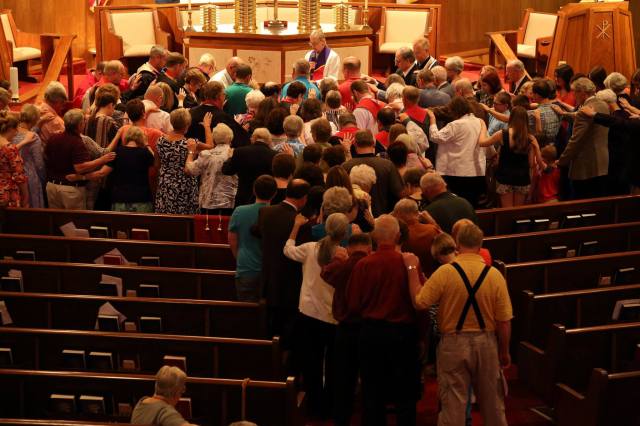
Now, at this time, may we all reaffirm our commitment to love one another, to love these graduating Seniors, to link up with one another in mutual care and concern, and be responsible for one another, to live in community, to truly be a family of faith, by taking the hand of the person sitting next to you. For the sake of these graduates and for our community, let us follow the lead of Jillian and Jenna Thistlewaite, as we pray together.

O God, thank you for the high school graduates of our community.

Bless them as they seek to die to self and follow you daily.

May they remember that they are never alone. For we are and will always be family to them.

And we ask your blessings upon all of us here as we hold hands and commit ourselves be a community, a family of faith for each other.

And may we continue to recognize that there are many in our world,

in our town, who are experiencing the burning Hell of loneliness,

those who have never been accepted, welcomed, loved by others.

May we commit ourselves today to reach out to them with grace,

accept them, love them, and take them by the hand,

until they know the love of Jesus Christ

who does not want to leave any person orphaned. Amen.

[i] Claypool, John. God Is an Amateur (Cincinnati: Forward Movement Publications, 1994), 32

[ii] William P. Tuck, When You Are Lonely


Easter People Behind Locked Doors

Andrew Finiish
As a Special Olympian, Andrew has run in many 1 mile “fun runs,” but he has always dreamed of finishing a 5k race. However, Down’s Syndrome and surgically-reconstructed knees have made it impossible. The good news is Easter transforms impossibility into reality.

1 Peter 1:3-9 NRSV

It’s the Season of Easter. The Lord is Risen. Christ is alive! Jesus is on the loose. The Messiah is on the move. And he’s coming for his disciples! He’s coming to offer them an incredible gift!

As our Epistle Lesson testifies:

“Blessed be the God and Father of our Lord Jesus Christ! By his great mercy he has given us a new birth into a living hope through the resurrection of Jesus Christ from the dead…” (1 Peter 1:3).

And where are the disciples?

The first verse of our gospel lesson this morning reads: “When it was evening on that day, the first day of the week, and the doors of the house where the disciples had met were locked…”

Jesus is alive. He is moving out in the world, and the disciples are inside a building, cowering behind locked doors.

Now, it is nighttime, a dangerous time in any city, and here in the city of Jerusalem on this night, maybe they had a good reason or two to lock their doors.

The most obvious reason being their fear that the religious leaders who organized to crucify Jesus would soon be coming after them. The ones who began plotting from the very beginning to put an end to Jesus and his message were quite possibly even now plotting to put an end to them.

So, who could blame them for locking the doors.

But then, there may be have been another reason those doors were locked.

Remember, Mary Magdalene has told them, “I have seen the Lord.”

And what do the disciples do? They lock their doors.

Could it possibly be that they did not know what kind of gift the Risen Christ was bringing to them: a new birth into a living hope through his resurrection?

Or could it be that they knew exactly the kind of gift Jesus was bringing?

After all, they were all witnesses to what had to taken place before Easter could happen: Before a new birth into a living hope could come, somebody had to pick up a cross.

So Jesus might be coming with the promise of new birth into a living hope, but before this new life can fully realized, there might be some more cross bearing to do.

And this was certainly no new concept for them. For they had heard Jesus say on numerous occasions: “to gain one’s life, one must first be willing to lose one’s life.”

They had heard Jesus say, the road to rebirth, the way to new life, the route to resurrection, the path to Easter, was very narrow and very few find it. For it’s a road of self-denial. It’s a way of self-expenditure. It’s a route of sacrifice. It’s a path of suffering.

So, when they heard that Christ was on the loose and he was coming with the promise of new birth into a living hope through his resurrection, of course they locked the doors.

Just like we lock our doors.

And my, my: The locks that we use! The barriers we create! The walls we build!

His way is just so radical, so revolutionary, so scandalous, we do all we can do to shut him out.

“I know Jesus said that he is ‘the way, the truth and the life,’ but we still prefer to do things our way, make up our own truth, live our own life.”

“I know Jesus said, ‘Blessed are the poor,’ but isn’t that the Salvation Army’s job?”

“I know Jesus never excluded anyone, but perhaps we ought not advertise that.”

“I know Jesus said ‘the first shall be last,’ but I still think we should put America first.”

“I know Jesus called women to be his disciples, and I am aware that whenever he had an opportunity, he elevated the status of women, but they really shouldn’t serve behind the table or preach behind a pulpit.”

“I know Jesus stopped the self-righteous from throwing rocks at a sinner, but if we are not careful we are going to make our church ‘a haven’ for all kinds sinners.”

“I know Jesus said that when we welcome the stranger we welcome God, but ‘pardon me, I believe you are sitting in my pew.’”

“I know Jesus said ‘forgive seventy times seven,’ but the Bible says those people are abominations!”

“I know Jesus said we could learn from Syrophoenicians and Samaritans, and he said, ‘Love your neighbor as yourself’ but surely he did not mean for us to love our Muslim neighbors!”

“I know Jesus said ‘there are other sheep who do not belong to this fold and we must bring them in also,’ but ‘You’re not a member of this church. So, what are you doing here?’”

“I know Jesus said feed the hungry, but we have to be fed too.”

“I know Jesus talked about being salt for the world, but are we going to let those people use our salt…and our pepper…and our sugar… and our sweet ‘n’ low?”

I want to suggest that it wasn’t just great fear that caused the disciples to lock those doors. It was also great courage.

For it takes some incredible nerve, some brave audacity, some serious brass, to lock the Risen Christ out of the building.

And sadly, ever since that first Easter evening, people who claim to follow the way of Jesus have been brazen in their attempts to thwart the way of Jesus.

Think about it. We have to be pretty bold to dare to reduce the meaning of the death-defying power of the resurrection. We have to be pretty brave to call ourselves “Easter People” and then water down the meaning of it.

I am grateful that church pews all over Enid were full last Sunday. However, I am afraid that the only reason many people came to church was merely to thank God that they, like Christ, will one day be resurrected to live forever. I am afraid the reason some church pews were so full on Easter Sunday was simply because “Easter People” wanted to remember Jesus’ resurrection and look forward to their own.

But if that is all Easter truly means, do you really believe those disciples would have locked those doors on that first Easter Sunday?

No, those doors were locked, because those disciples knew exactly what Easter means. They knew that Easter means the resurrection offers a living hope for this world, and not just for the next world. Easter is something to be lived today and freely shared with all who need re-birth and new life now.

But to do that, to offer that Easter hope to others, to truly live as Easter people, means that someone is going to have to pick up a cross.

It means that someone is going to have to deny themselves. It means someone is going to have to lose themselves. It means someone is going to have to open a door, leave a building, remove a barrier, tear down a wall, go outside, bend down to the ground, pick up a cross and walk in the steps of Jesus.

It means someone is going to have to share. It means someone is going to have to sacrifice. It means someone is going to have to suffer. It means someone is going to have to do something more than study a lesson, sit on a pew, sing a hymn and listen to a sermon.

So, the disciples, like you and like me, locked the doors.

Now listen to the good news:

When it was evening on that day, the first day of the week, and the doors of the house where the disciples had met were locked… Jesus came and stood among them.”

The good news is that the doors we lock, the barriers we create, the walls we build, will not thwart the way of Jesus! Despite our bold and brazen attempts to stop Jesus from coming, to shut him out, he’s still coming. And nothing is going to stop him or even slow him down.

And he is coming to lead his Easter people get out of the building, to pick up a cross and bring rebirth and new life to all whose lives have been diminished, to all those who have been de-humanized by poverty, disability, bigotry and hate.

And here is some really good news: To bring new life, by the grace of God, we may not have to hang on that cross. We might not have to shed any blood. We may not even have to get arrested. We just need to be willing to pick up a cross and carry it a little way. The Risen Christ will carry it the rest of the way.

Running 3.1 miles is nothing for Gary Hula. Gary has been running 26 miles before church on Sunday for the last several weeks in training for the Oklahoma Memorial Marathon. Gary can run 3.1 miles while reading the News and Eagle and drinking a cup of coffee!

But that is how far Gary usually runs while pushing someone with special needs for Ainsley’s Angels.  Just 3.1 miles. Takes Gary 20 minutes.

But after a 3.1 mile race last week, the mother of the 26-year-old man with surgically reconstructed knees and Down’s Syndrome, who rode in a running chair that this church purchased for just a few hundred dollars, said and I quote: “My son’s dreams have come to life.”

Can you hear the resurrection in that statement? Do you hear Easter in that mother’s voice?

The next day the risen Christ came and helped us to welcome some of the most impoverished people in this community for a meal in our Fellowship Hall. Now, we didn’t do that much. The Oakwood Country Club prepared all the food. All we had to do was warm it up and put it on some plates. We just had to show up, unlock a couple of doors, and invite people in. We just had to be kind to people, treat people as we would want to be treated.

But after serving that meal, one of the guests said to a volunteer: “Today, you have made me feel human again.”

Do you hear the rebirth in that statement? Do you hear the new life? Can you hear Easter in that woman’s voice?

The good news is that because the Lord is risen, because Christ is alive, because Jesus is on the loose in this world, because the Messiah is on the move, all we may have to do to be the Easter people the Risen Christ is calling us to be is to be willing to unlock a door.

Remember Your Baptisms!

Baptism

Romans 6:1-5 NRSV

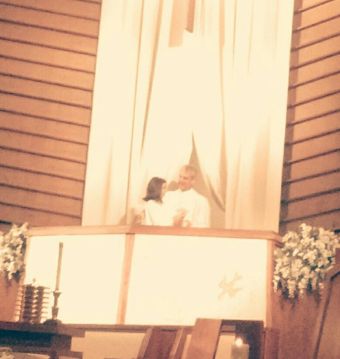
I love a baptismal service on Easter Sunday morning! I love it, because I believe one of the greatest things we can do on Easter Sunday morning is to listen again to the words of the Apostle Paul that are etched onto our baptistery, and remember our baptisms!

As a pastor who has been blessed with the opportunity to remember many baptisms, I will never forget one particular Sunday I walked into the waters of a baptistery like ours.

It was the Sunday after Hurricane Floyd flooded the first house Lori and ever purchased in eastern North Carolina.

I had been wading in waist deep water that Thursday and all day Friday. And then that Sunday morning, one of the first things that I did was to climb down those steps into waist deep water.

I’ll never forget the first words I spoke.  I looked out into the congregation from that baptistery, and I said, “You know, standing here this morning in waist deep water is the last place I wanted to be this morning.”

But I then said, “But it may also be first place I need to be this morning!”

Before that Sunday, baptismal water had always represented purity and refreshment to me. It was a water which cleansed one’s spirit and refreshed one’s soul. It was a renewing, invigorating water, life-giving water. Baptismal water was to me like the water from a spring welling up into eternal life from which we could drink and never thirst again.

However, on that particular Sunday, that water came to represent to me something more, something dreadful, something heinous, something sinister. That water came to symbolize destruction, despair; it came to symbolize death.

To the church in Rome, the Apostle Paul said: “Remember that you have been buried with Christ by baptism into death.”

You know what this means don’t you?  It means Paul’s house must have flooded too!

Well, probably not. But it does means that Paul understood the destructive forces of sin and evil in our world. It means the apostle Paul understood water to be symbolic of of those chaotic forces, evil forces in our world that seek the drain the very life out of us.

For many of that day, water was a very fitting for symbol for death, as many lost loved ones at sea, folks who who traveled out on the water, encountered a storm and never returned. Therefore, water was something to fear. Water was something to dread.

This is why the picture of Jesus walking on water is so inspiring.  Jesus was doing much more than walking on water. Jesus was walking all over the forces of evil like they did not even exist.

This is why when John gives a list of things which we are not going to find in heaven in the 21st chapter of Revelation, “no more sea,” is the first thing on his list. Before no more crying, no more pain, and no more mourning, John says there will be no more sea. One day there will be no more of anything more to fear or dread.

My hope on this Easter Sunday is that Braylen, Brenden, Ethan, Caden, Ashton, Rhianna, Brooke and Angie will always remember their baptisms—Remember that they who have been buried with Christ into death, have also been raised with Christ to walk in the newness of life.

And may each of us remember our baptisms. May we remember that we went under the water, but may we especially remember that we also came up out of that water.

We came out of the water symbolizing that in this world of evil and sin, with Christ we can be more than conquerors.

We came up out of the water symbolizing that in spite of those who attempt to drain the very life of us, in spite of those who never cease in persecuting us, we can do all things through Christ who strengthens us.

We came up out of the water symbolizing that despite the many storms of life that come our way, death, divorce disease, there is nothing in all of creation: no rulers, no powers, no things present, no things to come, no height, no depth and not even death, that will ever be able to separate us from the love of God through Christ Jesus our Lord.

We came up out of the water symbolizing that in all things, God works for the good for those who love God and are called according to God’s purpose.

We came up out of the water symbolizing that when we face uncertain days, even death, we will possess the grace to always remember our baptisms and the glorious message of Easter that our baptisms proclaim!

Sudden Sunday Surprise

He is not here

Sermon preached at the Easter Sunrise Service, Central Christian Church, Enid, Oklahoma.

Matthew 28:1-10 NRSV

There is no doubt that the surprising events which took place on Friday had left the disciples in a state of shock and disbelief.  The King of the Jews, the Son of God, the one who would finally bring them liberation from the Romans was crucified like a common criminal.  They were all taken off guard as all of their hopes, all of their dreams suddenly vanished.

They found themselves in the same state of mind you and I find ourselves when our lives are often surprised by evil.  When the telephone rings in the middle of the night.  And it is not the wrong number.  When we hear words from our employers like “cutting back, laying off, letting go,” or words from our doctors like “cancer, inoperable, terminal.”

 “No, it can’t be!”  “I don’t believe it!”  “This is not happening!”

Then as Sunday morning was dawning, maybe not part of the original twelve because of the sexism that has been so apparent in the history of humankind, but two of Jesus’ disciples nonetheless, Mary Magdalene and another Mary went to see the tomb, trying to comprehend what had happened, still trying desperately to believe it and somehow accept it.

And then it all seemed to happen again.  For that is how evil works in our world. When evil surprises us it does it in clusters. Some people say that it always comes in three’s. Other say, “when it rains pours.”

And suddenly, suddenly a word which always denotes surprise, shock and awe: there was a great earthquake.

“Not again!”  ‘Please no more.  There is just so much we can stand.”

But then in the midst of their confusion, shock, and bewilderment, an angel of the Lord descended from heaven and came and rolled back the stone and sat on it.  It so surprised the guards at the tomb, that they fell down on the ground like dead men.

But the angel said to the women, “Do not be afraid; I know that you are looking for Jesus who was crucified. He is not here. For he has been raised, as he said. Come, see the place where he lay. Then, go quickly and tell his disciples. “He has been raised from the dead, and indeed he is going ahead of you to Galilee; there you will see him.  This is my message for you.”

“So they left the tomb quickly with fear and great joy.”  There’s a paradox, isn’t?  Fear and joy. It lets us know that the women are still somewhat shocked. For they have been saturated with surprise!

Then, “Suddenly,” (there’s our surprising word again).  “Suddenly, Jesus met them and said, “Greetings!”  Surprise of all surprises!  “And they came to him,” and did the only thing they could do, “They took hold of his feet, and worshiped him.”  Then Jesus said, “Do not be afraid; go and tell my brothers to go to Galilee; there they will see me.”

Hold on!  I thought the women were in Galilee. For that is what the angel had said, “He is going ahead of you to Galilee, there you will see him.” The angel even bolsters these instructions by saying, “This is my message to you.” But where do they see Jesus?

They see Jesus somewhere along to road to Galilee.  The angel was wrong.  For the women did not have to wait to see Jesus.

I believe this is even more good news for us on this early Easter morning.

If angels do not know exactly when or where Jesus will appear with a presence and with words that compel us to take a hold of his feet and worship him, how can any of us presume to know?

Therefore, we should never be despairing, that is, we should never believe that things have gotten so bad Jesus will not come.

The wonderful truth is that when our lives are suddenly surprised by evil, Christ will always come, perhaps when we least expect it, maybe when we are least aware of it, and surprise us with words of love, words or peace, words of grace, words of assurance and words of salvation.

If we keep our eyes peeled to it and our hearts open to it, Christ will suddenly catch us off guard with his wonderful, hopeful, life-giving presence.

And we must never forget that since we are his followers, since we are called to be the Body of Christ in this world, we are commissioned to surprise all those who need surprising with the astounding love and amazing grace of God.

Crown of Thorns

Matthew 21:1-11 NRSV    nerve gas

Palm Sunday—it’s the spectacular day we celebrate the King of Kings’ triumphant entry into Jerusalem!  And in this world of so much suffering and pain, oh how we need a day like today!  Oh how we need to hear that Jesus Christ, our ruler and our king is coming through the gates to finally set things right, to take complete control of things. Oh how we need a day to reassure ourselves that no matter how bad life gets, no matter how distressed, fragmented and chaotic life becomes, and how hopeless it seems, Christ is large and in charge! “He’s got the whole world in his hands,” as we all like to sing.

Ok. Now, as we Disciples of Christ like to do, let’s get real for a moment. Let’s honestly think through this. Is the truth that “He’s got the whole world in his hands really that comforting?”

Although none of us good God-fearing, Bible-believing, church-going folks like to admit it, is this truth of God’s supreme providential power more than a little disturbing?

Think about those times you were reminded by someone, albeit with good intentions, that “God is in control.” When Lori and I lost our first child two months before the due date, people came up to us and said, “Don’t let this get you down. Just remember that God doesn’t make any mistakes.”

After the doctor gave you the news that the tumor was malignant, people came up to you and said, “Don’t worry, God knows what God is doing.”

When people learned that you were going to lose your job, they reminded you, “It is going to be alright, for God in control.”

At the graveside of a loved one, your friends and family lined up between you and the casket and whispered: “God has a reason for this.”

And very politely, we nodded. We even thanked them for their words with a hug or a handshake. But then, a short time later, after we dried our tears and came a little bit more to our senses, while we were sitting quietly at home or while we were out on a long drive, or maybe sitting in church, we began to reflect and to ponder those well-intended words. We began to think to ourselves: “If God is really sitting on some providential throne in complete control of this fragmented fiasco called life, this disastrous debacle called the world, then, really, just what type of ruler is this God? Just what type of king sits back and allows so much evil to occur in their kingdom, especially to people we are told the king loves.

The king of kings makes his triumphant entry—what is supposed to bring us great strength, peace and comfort, instead brings us frustration, anger and doubt.

Hosanna, the King is coming to save us—what is supposed to bring us assurance and hope brings us misery and despair. And we become tempted to join all those who will laugh and ridicule Jesus by the end of this week: “Umphh!  King of the Jews! Some King!”

I have said it before, and I do not mind saying it again—If God is the one who willed our first baby’s death, causes tumors to be malignant, gets us fired from our jobs, takes our loved ones from us, and sits back allowing such atrocities as the snuffing out of lives of little Syrian children being with nerve gas, then I really do not believe I want anything to do with a god like that!  I think I would rather join the millions of people who have chosen not to be in church on this Sunday before Easter.

But the good news is that I am here.

And I am here to proclaim with a confident voice God that God is not the type of King who decrees the death of babies, pronounces malignancies, commands layoffs and orders our loved ones to be suddenly taken from us. There is no doubt about it, Christ is King.  But thank God, Christ does not reign the way the kings of this world reign.

The reason I believe we allow ourselves to be tempted to give up on God in the face of evil is because we often forget that our God reigns not from some heavenly throne in some blissful castle in the sky. But our God reigns from an old rugged cross, on a hill outside of Jerusalem, between sinners like you and me.

I believe we oftentimes become despairing and cynical about God, because we forget that our God does not rule like the rulers of this world.

The kings of this world rule with violence and coercion and force. Earthly rulers rule with an iron fist: militarily and legislatively, and with executive orders. Worldly kings rule with raw power: controlling, dominating, taking, and imposing.

But, as the events that took place this week in Jerusalem 2,000 years ago remind us, Christ is a king who rules through self-giving, self-expending, sacrificial love. Christ is a king who rules, not from a distance at the capital city, not from the halls of power and prestige, but in little, insignificant, out-of-the-way places like Bethlehem and Nazareth, and Waukomis and Enid.

Our King doesn’t rule with an iron fist. Our King rules with outstretched arms.

Our King doesn’t cause human suffering from a far. Our King is right here beside us sharing in our suffering.

Our King possess what the late theologian Arthur McGill called a “peculiar” kind of power.

God’s power is not a power that takes. It is a power that gives.

God’s power is not a power that rules. It is a power that serves.

God’s power is not a power that imposes. It is a power that loves.

God’s power is not a power that dominates. It is a power that dies.

And as Arthur McGill has written, this is the reason that it is “no accident that Jesus undertakes his mission to the poor and to the weak and not to the strong, to the dying and not to those full of life.  For with these vessels of need God most decisively vindicates his peculiar kind of power, [a] power of service whereby the poor are fed, the sinful are forgiven, the weak are strengthened, and the dying are made alive.”[i]

Christ the King did not take our first child. The day our baby died, our King came and cried with us in that hospital room.

God did not cause the tumor. The day the doctor said the word “cancer” was a day of anguish for God as it was for us.

God did not create the layoff. The day you were told that your job was ending, God stayed up with you and worried with you all night long.

And God did not take your loved one.  When they died, something inside of God died too.

What we all need to learn are very different definitions of “king,” “rule,” “reign” and “power”—very different because they define the holy ways of the only true and living God, rather than defining our false gods and their worldly ways.

When life gets us down (and if we live any length of time at all in this world, it most certainly will), we need to remember the great truth of this day—The king has arrived. The king has entered the gates. And this king is has come to take his place on his throne, on an old rugged cross.  Do you see him reigning today? Do you see him bleeding, suffering, sacrificing, and giving all that God has to give from from the cross?

God does not make mistakes. God knows what God is doing. God is in control. God is king. But God’s throne is not made of silver and gold. God’s throne is made of wood and nails. God wears not a crown of jewels. God wears a crown of thorns.

This past week, I visited with Marion Batterman whose doctor just told him that he was dying. He said, “Pastor, my doctor gives me no hope. They said that my lungs are just about gone.”

I said, “Marion, I am so sorry.”

“Oh don’t be sorry he said. “Because my hope is not in my doctor! My hope is in my Lord!”

“So Marion,” I said, “Even when your lungs stop working completely…”

Marion finished the sentence, “I still have hope!”

No, he was not delusional. His mind was not clouded with medication. Marion was at peace, because his King reigns from a cross.

Marion was filled with hope, because his King is not far away from him seated a celestial throne removed from his agony. His King is seated at his very side suffering with him.

His King is not above his pain. His King is experiencing every bit of his pain.  His King is not willing or decreeing his death, his king is experiencing his death.

His King is not slowly taking his life away from him. His King is giving the King’s eternal life to him, pouring out the King’s holy self into him, and promises him every minute of every day to see him through his dying.

After he described an intensified intimacy that he now shares with his Lord, he then said something miraculous. With this hopeful joy in his smile and eternity in his eyes, he told me that he was a blessed man.

Think about that for a moment.

A man, barely able to breathe, nearing the end of his life, told me that he is blessed.

Aren’t we all?

[i] Arthur McGill, Suffering: A Test of Theological Method, 61-63.

Loosening the Bonds of Death

Lazarus

John 11:32-44 NRSV

John 11 is a great example of why I love the Bible. I love the Bible because the Bible is honest. The Bible is real. The Bible does not hide, cover up or try to sugarcoat the difficulties and even tragedy of life in this fragmented world.

I love that, because this world in which we live is sometimes incredibly painful. We live in a world surrounded by poverty and economic pain. We live in a world where the rich take care of themselves while taking advantage of the poor.

We live in a world where so-called “Christians” in the church are some of the meanest and most evil bullies we know. We live in a world where our loved ones suffer with all sorts of dreadful diseases. And we live in a world where we are continually reminded our own mortality.

Thus, I love John 11, for here in this very honest chapter, there is no denying the harsh reality of this fragmented existence we call life, especially in dealing with the most tragic aspect of this life: the death of a loved one.

Too many Christians, for many reasons would rather treat the tragedy of death as if it does not exist. We don’t want to talk about it.  And when we do, we try to deny the harshness, the sheer austerity of it. We do not even like to call it “death.” We would rather call it “passing away.”

We say things like: “there are worse things in this world than death;” however, in death there still exists an inescapable starkness that cannot be denied or ignored. When we are honest, we would admit that death is the most difficult thing about life. Losing someone we loved is the worst of all human experiences. We try to comfort ourselves by saying things like, “at least our loved one is no longer suffering.”  “At least she is now finally at peace.”  But if we are honest, just a second later, we find ourselves questioning why she had to get cancer and suffer in the first place. Why did they have to die as young as they did?

And we like to comfort ourselves by saying that he or she is in a far better place. But then a second later, we question why he or she would not be better here with us, at home, surrounded by family and love.

Yes, in John 11, there is no refuting the stark reality of death. Notice that Martha is absolutely horrified when Jesus commands the stone to be rolled back from the tomb. Her horror reminds us of something that we would rather ignore: the body was beginning to decay. The very sound of the words of verse 39 “Lord, already there is a stench, because he has been dead for four days” seems inappropriate to read from the pulpit. Dressed in our Sunday best on a beautiful spring morning, we don’t want to hear that!

But this is reality. This is truth.  And sometimes we simply do not want to hear the truth.

And sometimes we just think it is our Christian duty to be an example to the world, to the weak, to the unfaithful, how to be strong, how to put on a brave face and hold back the tears.

But notice in John 11 that there is no holding back.

Mary, the brother of Lazarus, weeps. The mourners who had gathered at the cemetery that day weep. Even Jesus himself weeps. The harsh reality of death and grief is evident everywhere.

We are told twice that Jesus “was greatly disturbed in spirit and deeply moved.” Is there really a difference there? That is like saying that Jesus was grieving and mourning.

Just looking at the tomb of Lazarus caused Jesus to burst into tears.  Even Jesus, who we believe is manifestation, the very embodiment of God, the creator of all that is, who became flesh to dwell among us, does not remain calm and serene as one unmoved and detached from the fragmented human scene. Jesus himself is deeply disturbed at death’s devastating force. There is no denying it or escaping it or muting it. Neither is there any dressing it up with euphemisms like “passing away” or “gone on to be with the Lord.”

John 11 also points out why Jesus grieved. In verse 36 we read: “So the Jews said, ‘See how he loved him.’”

It has often been said that the only way to miss pain in life is to miss love in life. Garth Brooks sings a song entitled “The Dance.” One line of the song goes: “I could have missed the pain, but I would have had to miss the dance.” Grieving only means that we have loved as our God has created us to love. The only way to never grieve is to never love. But to never love is to never truly live. As the song goes, the only way to miss the pain of loss is to miss the whole dance of life.

So, I believe John 11 gives each of us permission this morning to grieve. May we grieve long and deeply. May we never dare to run away from it.  May we never treat it as it was some stranger that we could send away, or deny that grief, because someone who doesn’t know any better thinks grieving means our faith is weak. Let us grieve what is lost. Grieve honestly, lovingly and patiently. Let us grieve until our cups are emptied.

However, (and here is the good news for all of us this day) as the Apostle Paul reminds us in his letter to the Thessalonians that those of us who call ourselves Christians should not grieve as others do who have no hope.  As Christians, our grief is real, but our grief is different. Our grief is not despairing, because as Christians, we possess hope because Jesus, who himself was not immune to grief and even death, always brings resurrection and new life.

Those of us who are not immune to grief and death need to again to hear Jesus’ prayer which came in a loud voice.  “Lazarus, come out.”

I heard a preacher once ask his congregation, “You do know why Jesus said, ‘Lazarus, come out’ and not simply ‘come out’ don’t you?  Because if he did not call Lazarus by name, if he did not say specifically, “Lazarus, come out, then every tomb in Jerusalem would have opened up that day!

We need to hear this voice and see this very real and foul, decaying corpse walking out of the grave, still wrapped in burial cloths, coming, at the voice of Jesus, to life.

And then I believe we need to hear again, and hear again loudly Jesus’ words: “Unbind him, and let him go.”  “Unbind him, and let him go.”  Lazarus is loosed from the bonds of death. He is freed from the shackles of his past. He is let go into a brand new future, liberated and set free.

Then, I believe we need hear John and Jesus himself tell us over and over that this event reveals the glory of our God. What we have in this story is much more than the resuscitation of one dead corpse by one man.

Always for John, miracles are much more. Miracles are always signs that point us to something greater. Thus this miracle is the revelation that the God in whom we serve and trust and love, this God who is not unmoved and detached from the human scene, is always a death-overcoming and life-giving God.

The good news that we need to hear is that this God is still working in our world today unbinding, letting go, loosing, freeing. God is here enabling us to confront death and grief, us to acknowledge it, to look it straight in the eyes, to see all of its harshness and starkness, and then be liberated from it.

And if God is here liberating us from the shackles of death, then there is nothing else in all of creation from which God cannot set us free.

From evil bullies bent on crushing our spirits.

A job that is draining the very life from us.

A relationship that is killing us.

Fears that paralyze us.

Disease that is destroying us.

Economic hardships that never seem to end.

Depression that never lets go.

One of the great things about being a pastor is how I have the awesome privilege to witness this good news all of the time.

Someone loses their job. They come to me believing it is the end of the world. But a year later, working a new job, they share with me that losing that job was the very best thing that could have happen to them.

Someone else comes to me and says that their marriage has fallen apart. And that they are partly to blame. They said they thought life as they knew it was over. But a few months later, they tell me that they are beginning realize that although they cannot go back to the good old days, they have plenty of good new days ahead.

Someone comes to me sharing their deepest fear: the fear of being known for who they really are; the fear of rejection and ridicule. Then I see them a short time later, and they tell me how they have been surprised by unconditional love and unreserved acceptance.

People call me to share their doctor’s grim diagnosis. They say that they had just received a death sentence. But a short time later, I visit with them, and they tell me that they are beginning to understand that being alive and whole have very little to do with physical well-being.

And then I have visited with countless people as they are facing what is certainly their final hours on earth, and I hear in their voices, and I see in their eyes a faithful awareness that there is nothing at all “final” about them.

Thus, like Lazarus, in this incomplete and fragmented world where death, divorce, disease and hate entomb us, we can be loosed. We can be freed, and we can be unbound.

We can come out and let go and celebrate the good news together: where there is incompleteness and brokenness, there can be wholeness. Where there is tyranny of the mind, there can be freedom of the heart. Where there is an imprisonment of the soul, there can be a liberation of the spirit. Where there is grief and despair there is hope. And where there is death and even decay, there is always life.

Let us pray together…

O God of New Life, may we be a church that shares this good news with all people, honestly and truthfully and faithfully. May we weep with those who mourn. May we be deeply moved with those who are afraid. And may we be deeply disturbed in our spirit with all who are suffering. Stay beside them. Befriend them. Accept them. Love them…until they are whole, liberated and fully alive now and forever through Christ our Lord. Amen.

A Movement for Wholeness in a Fragmented World

DOC Identity

John 9:1-41 NRSV

Let’s think for a minute what it did for this poor blind man when the disciples began a theological debate over his blindness.

“So, they tell us that you were born blind?  Well, let’s get out our Bibles and Sabbath Day School Quarterlies, and see if we can find some theological reasons for your blindness. Of course, everyone knows it is because of sin. But since you were born blind, perhaps it is not so much your sin as much as it is the sin of your parents.”

Yes, I’m sure all of that theologizing and rationalizing and Bible Study did absolute wonders for that poor man. I am sure he really appreciated it!

But how often have we’ve been guilty of doing the same. For some reason, because we are Christian, we believe it is our holy responsibility to try to explain human suffering in light of our faith in God.

When the earthquake and Tsunami struck Japan several years ago, I heard some preachers say that God was judging that area of the world because Christianity was not the prominent religion.

         When the terrorists destroyed the World Trade Center Towers on 9-11, some preachers said that corporate greed was to blame.

When Hurricane Katrina devastated New Orleans and Gulfport, Mississippi, many blamed it on all the new casinos that had been built in along the Gulf Coast.

And whenever there is an outbreak of strong storms, especially strong storms with tornadoes, I have heard many Christians say, as I am certain we will hear them say in the next couple of months: “God must be trying to get our attention!”

For whatever reason, when suffering occurs, we believe that God must have had some pretty good reasons to allow it.

In the face of human suffering, two predominate responses are echoed by the church.

The first response is the one I usually hear from the TV evangelists. It is the response of those in our text this morning. God is sitting at the command center in complete control of every earthly thing that happens. God has got a plan for the world, and it’s a good plan, and we human beings need to trust that plan. Even if people suffer, we shouldn’t question the plan or God’s judgments. Because God’s judgments are always just. You just have to have faith and believe God has God’s reasons. God has a driving purpose for everything that happens in this world.

The other response comes from some liberal scholars. And that is one of silence. They say that God is completely unknowable. Life, and the suffering that comes with it, is utterly mysterious. It is ok to question God, to ask “why?” But we simply have no answers to any of our “why” questions. Silence.

Frankly, I find both of these responses to human suffering to be troubling.

First of all, those who believe God has some kind of divine, driving purpose behind every evil thing that happens in this world, in my estimation, paint a very evil, mean portrait of God.

And those who respond only with only silence, those who refuse to say anything or do anything in response to human suffering paint a very detached, indifferent portrait of God. God is watching us, but as Bette Midler sings, “God is watching us from a distance.” God is reduced to this mysterious abstraction devoid of any real meaning.

The gospels, however, paint a very different image of God through the words and works of Jesus, who we believe to be the incarnation of God—which means that if we want to know how God responds to human suffering, all we have to do is look to Jesus.

I believe the life, suffering and death of Christ teach us that when a landslide shook the earth in Washington State a few year ago, so quivered the very heart of God. Last year, as the flood waters swelled in Southern Louisiana and North Carolina, tears welled up in the eyes of God

As the livelihood of many were suddenly poured out, so emptied the very self of God. God was not causing the evil, neither was God unmoved by it.

This is where I believe our gospel lesson this morning is especially helpful. When Jesus is questioned about this man’s lifetime of suffering by his disciples, Jesus really doesn’t answer the question, but he certainly isn’t silent or detached.

Jesus responds by saying that this is a good opportunity, not for theological debate, not for some long discussion theodicy (the problem of evil), not to assign blame or responsibility; but rather, it is an opportunity bend to the ground, spit in the dirt, and get his hands dirty, so that the glory of God might be revealed.

Jesus responds to a fragmented world by becoming involved, even if it means some work, even if it means rolling up his sleeves, lowering himself to the ground, and getting his hands dirty to touch the places on others that most need touching. Jesus responds to a fragmented world by becoming a movement for wholeness—bending, stooping, humbling himself to the ground—working, touching, healing, restoring.

And with that, a huge argument ensues.

But notice that Jesus refuses to engage in the argument. Jesus doesn’t have time for that. Jesus is not interested in doctrinal debate or theological speculation. Jesus is interested in simply being there with the man, for the man; thus, revealing the peculiar glory and power of our God.

I think it is interesting that the great Southeast-Asian Tsunami of the last decade struck the day after Christmas. One of the world’s worst natural catastrophes took place the very first day after the church’s celebration of the Incarnation, the celebration of the good news that our God did not remain silent, aloof and detached from us. Our God came to the earth, became flesh, became a part of the earth, to be with us. Our God is a God who descends to us. Our God is a God who bends, who stoops to the earth to be for us. Our God is a God who has selflessly and sacifcially chosen to suffer with the creation.

The story of this healed blind man comes in the same Gospel of John that begins, “In the beginning was the Word…and the Word was made flesh…and we beheld his glory.”

The great, grand glory of this God who became flesh with us is not that God is in complete control of everything earthly thing that happens, and it is not that God has an explanation or a reason or a driving purpose for everything that happens to us, but rather that God is Emmanuel, God here with us.

In the face of our suffering, our God reaches in and reaches out to us, bends to the ground, gets God’s hands dirty, and touches us.

And then God calls us to do the very same.

Every year as Holy Week approaches, I think about the worshippers of the Goshen United Methodist Church in Piedmont, Alabama.

It was Palm Sunday in 1994.

About midway through the worship service at 11:35 am, as the choir began to sing, a tornado ripped through the church building destroying it completely.

Eighty-three out of the 140 worshippers who attended the service that day were seriously injured. Twenty-one worshippers were killed. Eight of the dead were little children—children who had just walked down the aisle waving their palm branches.

There was absolutely no driving purpose, no theological explanation for that tragedy, except for the fact that we live in fallen, broken, unfair and sometimes senseless world where tornados, tsunamis, hurricanes, landsides, heart disease, dementia, and cancer can develop and arbitrarily destroy.

Thankfully, Christians from all over the world didn’t just talk about that tragedy in their Sunday School classes, trying to figure out if there was some reason God allowed it. They responded to that great tragedy by emulating the God revealed to us in Christ, by bending themselves to the ground, getting their hands dirty, to raise that church out of the rubble. Christians everywhere imitated their Savior by suffering with and being with the grieving. Doing whatever they could do to bring hope, wholeness, and restoration.

On the church’s website today, you will find these words:

 After the tornado, we received many gifts from all over the world. They lifted us up and helped us to know that we are not alone. Among those gifts were a banner and a painting of Jesus walking on turbulent waters. These and other gifts are reminders that God is with us through our storms, and with His help we will rise above them and be stronger because of them. We can now affirm the truth of the message that is contained on a plaque and in the words of a song: ‘Sometimes God calms the storm. Sometimes, …the storms rage, and God calms the child.’

And in the end, isn’t that much better than any theological explanation?

Let us pray together…

When Jesus was asked about the reason for human suffering, he did not answer the question. He did not get into a theological debate. He did not assign blame or responsibility. Instead, he chose to be a movement for wholeness in this fragmented world by bending to the ground and getting his hands dirty to bring about healing and  restoration. In the wake of the storms of our lives, may we do the same. Amen.

It Can’t Be the Messiah. Can It?

FullSizeRender

John 4:5-29 NRSV

With United Methodist Bishop William Willimon, I believe that the Bible is not so much an account of our search for God, as it is the amazing account of the extraordinary lengths to which God will go to search for us. Whether we know it or not, or can even begin to understand it or not, we are here this morning because we have been sought, we have been called, and we have been summoned. We are here because God has reached in, grabbed us, and led us here. We are here because God has pursued us. God is even now persuading, prodding and pulling us.

And I believe that the purpose of our worship is to condition us to pay attention to this, to admonish us to look over our shoulder, to help us to notice those little coincidences in our lives and those strange happenings.

For they may be a part of God’s continuing attempts to wrap God’s loving arms around us.

And these things, these coincidences, these strange happenings can occur anytime and in any place. As Jesus told Nicodemus, “The Spirit of God, like the wind, blows where it will”—whether or not we’re ready for it, looking for it, or even want it.

So, it would behoove us to stay alert, look, listen, always pay attention.

I believe the woman in our scripture lesson this morning teaches us how to pay such attention.

That fact alone teaches us something about the way God works. In the male-dominated society in which Jesus lived, especially in the area of faith and religion, Jesus uses a woman to teach us theology. Talk about the spirit of God blowing where it will!

In Jesus’ day, mainline Jewish rabbis simply did not speak to women about faith. However, Jesus was anything buy mainline. But one who always, very radically and counter-culturally, valued women and men equally.

Which brings us to another surprise. She was not only a woman; she was a Samaritan woman. And we know what Jews thought of Samaritans. They were known as pagans and foreigners. They were victims of racism, xenophobia, and bigotry.

Here, the radical words of the Apostle Paul are being fleshed out: “there is no longer Jew nor Greek, slave nor free, male nor female, but all are one in Christ Jesus” (Gal 3:28).

During her conversation with Jesus (which, by the way, is the longest recorded conversation that Jesus ever had with anyone), we also discover that she carries the stigma of divorce, as she has been remarried several times.

And, of course, she is astounded that this man, a Jew, talks to her, a Samaritan. In her eyes, she’s the wrong gender, wrong race, wrong religion. Yet, Jesus meets her where she is. Jesus initiates a conversation with her. Jesus reaches out to her. Jesus engages her.

And of all places, at a well!

It is important to understand that she isn’t there for Sunday School. She isn’t there for the 8am or the 10:15 worship service. She’s not even there for CWF. She is there doing the most ordinary of everyday tasks. She’s simply drawing water.

So, the first thing this woman teaches us is that God speaks to us, God reaches out to us, and God engages us when we least expect it, where we least expect it, and how we least expect it. God comes to us, unexpectedly, undeservedly in the most ordinary of ways.

Jesus then begins to teach her about something called living water and then tells her that he knows all about her; all of her failures, all of her disappointments, all of her grief which has been so much a part of her life.

She then runs all the way back home to tell everyone, “Come! See a man who has told me everything. He can’t be the Messiah. Can he?”[i]

Willimon has said: “She—Samaritan, woman, husbandless—thus becomes the precursor, the very first of all of us later preachers. She was the first to run to tell everyone about Jesus.”

And all she meant to do that day was to go out and get a bucket of water!

And here is the amazing part. She didn’t all of a sudden understand everything about who Jesus. She didn’t run back home singing the Gloria Patri and reciting the Lord’s Prayer. She merely left her encounter with Jesus with a simple, but very profound question: “He can’t be the Messiah. Can he?”

“He can’t be the Messiah. Can he?”  Do you hear it?  Listen again, “He can’t be the Messiah. Can he?

No, it’s not the words of some religious fundamentalist who has it all figured out. It’s more like the words of a innocent child. “He can’t be the Messiah, can he?”

Fifteen or so years ago, during the weeks leading up to Christmas, when my children would misbehave or fuss, when they were not looking, I remember making a fist and knocking on a wall or under the table.

Carson and Sara would immediately stop their fussing and ask, “Who is that? Someone’s knocking on the door.”

I’d get up, go to the door, open it, look around, and of course, not seeing anyone, I would shut the door and say: “It must have been Santa Claus! Don’t you know that this time of year he’s always watching?”

Sara Beth would say, “Nah uh! That wasn’t Santa Claus!” But a of second of silence later, she’d ask, “Was it?”

Can’t you hear it?  Like an innocent child, full of surprise and wonder and an unbridled hope, the woman at the well said: “He can’t be the Messiah. Can he?”

Do you hear it?

With Willimon, I hear a playful openness, a light flickering in the dark, a wonderful willingness to consider that God was larger than her presuppositions of God. I hear a courageous willingness to be shocked, surprised, and intruded upon. I hear a thirst for something to quench a longing soul.

I believe this is the problem with us grown-ups, especially we modern, mainline, mainstream church-goers. We simply say: “That can’t be the Messiah…period!

There is no openness to the possible potential that it might be, may be, could be, probably is.

We are so smart. We have things so figured out, we never question, “Can it? Was it? Is it?”

Even when we are at church, in a Bible Study or in worship, there is no real expectation that Jesus Christ, the Messiah and Savior of the world might actually show up.

To be honest with you, last Sunday, I was almost dreading coming to church. I was thinking: “Daylight Savings Time, Spring Break. Very few people are going to be at church today. And nothing good is really going to happen this Sunday.” I was also feeling a little disheartened that I had to make an announcement regarding our supplemental giving drive. Asking for more money makes me feel like I have perhaps failed at something.

The point is, last Sunday, when it came to church, I wasn’t feeling it.

But then, to my surprise, four people came forward during our final hymn asking to formally join the mission of our church to bless this community and world. One even offered to bless my family by taking us out to lunch after the service. And then, later in the week, I received a phone call with the news that someone believed in our church’s mission enough to make a sizable donation to be used anyway we believe God may be leading us.

And here it is, just one week later, and there’s this renewed, restored, replenished fullness in my soul. There’s this recommitment to share the love and grace of Christ with all people.

Now, I am aware many would say that those events were merely coincidences. Perhaps. However, as I have studied our scripture this week, like a light flickering in the dark, my heart has become open to the providential possibility that God was somehow involved. And the fullness that I feel in my soul is from this wonderful willingness to be shocked, surprised, and intruded upon by none other than the Messiah and Savior of the world, Jesus Christ himself.

Thinking on the words of the woman in our scripture this morning, I cannot help but to think: “It can’t be the Messiah. Can it?”

Can it possibly be that, here in this place last week, Jesus Christ was actually present? Could it be that he was coming to me through ordinary people, unexpectedly, undeservedly, bringing living water that quenches the deepest thirst of my soul.

Jesus, through this Samaritan woman, at the well, answers that question: “Yes, I am the Messiah. I am more alive and more present and more at work in this world than you ever thought possible. I am everywhere offering the wonder of living water, and those who drink of the water that I will give them will never be thirsty. The water that I give will become a spring of water gushing up to eternal life.”

One of the greatest things about being a pastor is sharing not only times of immense joy with a congregation, like childbirth with the Weibling family this week, but also sharing times of immense sorrow, like with Charlie Heller last week.

I look around this room and see people here who have experienced much sorrow, so much in this past year. I am certain that even getting up this morning and getting to this place was an arduous task for you. Some of you have recently lost a parent, a sibling, a spouse. Some of you have lost a child. You all have lost dear friends. Some of you have been diagnosed with cancer. Some have had to make the difficult decision to place a loved one in a nursing home. Some are grieving broken relationships, broken dreams, broken lives.

And people, including me, look at you and are amazed. We say, “We don’t know how you are making it.”

And yet, somehow, some mysterious way, you are making it. At the very least, something or someone has given you the sustenance to make it to this place this morning to possibly hear a hopeful word.

I look at you with the wonder of a wide-eyed child. And I think of the wonder of that woman from Samaria, and I ask, “It can’t be the Messiah…can it? Can it?


Commissioning and Benediction

Now, let’s go and get out on the road

to encounter ordinary people doing the most ordinary of things.

They may be dining at a restaurant, shopping for groceries, exercising at the gym, learning in a classroom, waiting to see the doctor.

They may be the server in a restaurant, the clerk at the store,

the trainer at the gym, the teacher in the classroom, the nurse, the doctor.

Their gender, their race, their religion—it doesn’t matter.

They may be a victim of prejudice or a beneficiary of privilege.

Meet them where they are. Engage them. Listen to them. Bless them.

And may the eternal well of God’s love be found in our encounters.

May the grace of Christ shine brightly through us.

And may the Spirit be with us on every hill, every plain, and in every valley.

[i] If my memory is correct, the words of this sermon were originally inspired and gleaned from a sermon written by William Willimon, possibly entitled, Look over Your Shoulder, in 2005.

Too Smart for Our Own Good

The Shack

John 3:1-17 NRSV

In today’s gospel lesson a very knowledgeable and prominent leader of Israel comes to Jesus seeking to discover who Jesus is and what Jesus is all about. Poised and confident, the educated and sophisticated Nicodemus begins his conversation with Jesus: “Now, we know that you are…”

He begins his conversation from the same place that most of us mature, experienced, long-time students of Sunday School often begin our conversations about God: from the things we know, the things we have figured out… or think we think we have figured out:

“Now we know that you are…”

And it’s from there that the conversation gets all confused, confounded and convoluted. Jesus begins talking to Nicodemus about birth, but poor Nicodemus thinks Jesus is talking about literal, physical birth. Jesus starts talking about the Spirit, but poor Nicodemus thinks Jesus is talking about the wind.

I think it is very interesting that Nicodemus comes to Jesus at night. Because in just a few moments with Jesus, we learn that when it comes to God, when it comes to this mystery that we call faith, Nicodemus is in the dark in more ways than one. Nicodemus comes to Jesus confident and assured, but by the time Jesus gets finished with him, Nicodemus is astounded and dumbfounded, mumbling, “Uh, how can this be?”

Nicodemus has a problem.  And perhaps Nicodemus’ problem is in the very way he came to Jesus in the first place: “Now we know that…”

And maybe that is precisely our problem: “Now we know that…”

Our problem is that we know. And I suppose we can’t help it. After all, we are modern, some say we are even post modern folks who know a lot!

We live in what they call the information age. If there’s something we don’t know, we can just Google it or YouTube it, and in a few simple clicks of a mouse, we know. With WebMD and Wikipedia, there is hardly anything that we cannot understand or easily explain.

Perhaps this is why we try to approach God the way we do. We believe God is to be understood and easily explained.

It is no wonder those on the outside of the church often accuse those of us who are on the inside of the church of being “know-it-alls” when it comes to religion.  They believe that we think we have God all figured out. There are some that think that the reason we are here this morning is because we are God-experts.

And maybe that is why some  they are not here with us this morning.

One day, I was introduced to someone who knew that I was a pastor. I think he wanted to shock me when shook my hand and said, rather proudly, “Well, I’m an agnostic.” Which means that he did not know what he believed about God.

I think I shocked him when I responded, “Well, I have my moments when I am an agnostic too.”

I then said: “If people were honest they would admit: Some people are agnostic all of the time, and all are agnostic some of the time.”

The reality is that what we should be doing here, in this place every Sunday morning, is acknowledging together how little we really know and how much we have to learn, instead of coming here to have everything we think we know about God reaffirmed.

We gather ourselves together to acknowledge the great truth, that when it comes to the mystery that is God, we are all, as God told Mack in the movie The Shack, “idiots.”

“If the shoe fits,” She said.

The truth is that the God we worship is much larger than our imaginations. God is bigger and more alive than we can ever possibly comprehend.

I believe this is one of the reasons some preachers are telling their congregations to avoid the movie The Shack (a movie by the way I highly recommend) And there are many reasons: like maybe Jesus as a Middle Eastern man, if you can imagine that; also, God’s love for humanity compelling Her desire to redeem all people.

But perhaps they are most upset by the way the movie may cause some to question everything they thought they knew about God. Many preachers can not handle God saying to Mack: “I am not who you think I am” and “You misunderstand the mystery.”

But to me, that sounds a little like Jesus’ conversation with Nicodemus (John 3:1-17).

Like Nicodemus, we think we know who God is, how God acts and what God desires. But after we truly encounter the Divine, we might learn that we are, well, idiots.

I heard one preacher you say, “If you want to know something about Jesus, don’t watch The Shack, instead watch the more biblical movie, The Son of God.

But, a few years ago, I remember walking out of the showing of The Son of God when it ended feeling disappointed. For I do not believe there is anyway anyone can capture the essence of who Jesus is and present it in a one-hundred and forty-minute cinematic presentation. I told someone that I have been preaching about God is for over thirty years, and I have not even begun to scratch the surface of who God is!

United Methodist Bishop William Willimon, commenting on how some reduce God to something we can easily understand, said: “You can’t define this God, put this God in your pocket, or on a leash and drag God around with you. Life with this God is an adventure, a journey, a leap into the unknown, an expectation that, among even the most regular attendees among us, there will be surprises, jolts, shocks.”[1]

How often have we gathered around this table confident that we know exactly what is going on?

Catholics, and some Episcopalians are all so mysterious, always insisting on calling it Holy Communion or the Holy Eucharist.

Some of us, though, prefer to simply call it “Supper.” Some believe that something mysterious takes place as they eat this meal. They call it transubstantiation. We only believe it is a dry little cracker and tiny sip of grape juice and an act of remembrance that is confined to our limited and finite minds.

But what if there is more going on here this morning than we can see, touch or taste or even remember?

When we gather around the Lord’s Table, what if there is more going on here than meets the senses? What if there is some mysterious communion or a very holy fellowship happening here?

Sharing what we merely call a “supper,” what if we are surprised to discover that we are somehow invited to join the same fellowship that is mysteriously and inexplicably enjoyed between the Father, Son and Holy Spirit?

In and around this table, what if there is something afoot, something happening— something moving, inviting, healing; something strengthening, loving, forgiving; something saving, calling, challenging, commissioning?

We thought that we have come to remember a life, a death and a resurrection, but I believe we could leave having been caught up in that life and death and transformed by that resurrection.

As Willimon has said, “For, that is our God at our God’s best. That night as Nicodemus talked with Jesus, he began with what he knew. And he ended with questions about what he did not know. He arrived fairly confident that he had a good grasp of, [a good hold on] who Jesus was; [he left surprised,] having been encountered and held by the mysterious, majestic Holy Spirit of God in the flesh.”[2]

This morning, when we awoke, we thought we knew what we were doing. We thought we were going to get up, get dressed and simply go to church, sing a few hymns, have the Lord’s Supper, listen to a choir sing and a sermon preached. Then we would leave, get some lunch and come back home unmoved and unchanged, to watch a little more basketball.

However, when got here, we realized that we did not know it all.

We were shocked when a song spoke to us.

We were surprised when a small wafer and tiny cup filled us.

We were jolted when a word challenged us.

We were startled when someone that we did not even know looked at us and blessed us.

And we were amazed when God, the Creator-of-All-that-Is, somehow, someway that we do not understand, called us by name and told us that She is especially fond of us.

And we were absolutely astounded as Christ himself came and wrapped his arms around us as the Holy Spirit breathed new life into us.

[1]Quote and interpretation of Nicodemus’ first words to Jesus “We know” came from William H. Willimon, We Know (PR 34/2; Inver Grove Heights Minnesota: Logos Productions, Inc., 2006), 49.

[2] Ibid.

Keeping the Way of the Young Pure

support-process-sc370x200-t1360346453-2Psalm 119:1-9 NRSV

He was a poor, pitiful thing. His mother was in labor for nearly a week before he was finally born. His head, so severely malformed from the length of the labor, worried his parents who took him to several specialists for testing.

When he was five years old, public schools had just integrated. And because his parents thought he might have some special needs, they felt it was best for him to attend a small, private kindergarten. His young teachers didn’t seem to be too alarmed that he was the only one in class who could not speak any intelligible words, telling his parents that they just had to learn a new vocabulary to communicate with him.

“Duh-ee” meant he was “thirsty.” “Uh-ee” met he was “hungry.” And “wuh-ee,” meant he was “sleepy.”

Although his parents considered holding him back for another year of kindergarten, they reluctantly enrolled him in a public school the next year. They also worried about the “colored people” who they believed were still “stirring things up” three years after the assassination of Martin Luther King Jr.

His first grade teachers, Mrs. Banks and Mrs. Tomlin, immediately noticed his developmental delay and called a meeting with his parents, the school nurse, and a speech therapist.

The nurse said that it was obvious that the little boy was literally “tongue-tied.”  He was born with extra tissue under his tongue that had attached his tongue to the bottom of his mouth limiting movement. The little fella would need surgery.

Immediately following the procedure, his teachers called his parents to check on him. For you see, teaching was not just their job. It was their passion.

The little boy soon started speech therapy that was fully funded through the school, that he would continue until junior high.

He missed several hours of class a week for speech therapy, but each of his teachers—Mrs. Green in the second grade, Mrs. Price in the third, Mr. Riggs in the fourth, Mrs. Jones in the fifth, and Mrs. Welch in the sixth—would spend extra time with him to make sure he never lagged behind.

And because of their compassionate determination, although he could not speak one intelligible word when he entered the first grade and took speech therapy until the seventh grade, he never failed a grade. In fact, he would graduate from high school as one of the youngest students in his class.

By the time he entered high school, two teachers in particular noticed that years of struggling to speak had left him with a very low self-esteem. Mr. Godfrey, a P.E. teacher and coach, and Mr. Casey, a math teacher, coach, and Scout leader, donated even more of their time offering a basketball camp. They asked the boy to attend.

He loved it! As his skills improved, so did his confidence.

Every camper was encouraged to try out for the JV squad, which the boy did. He made the first but, but failed to make the final cut. A few days later, Mrs. Snowden, his history teacher, who also donated her time after school directing school plays and musicals, asked to speak with him after class.

It was if she noticed that he did not make the basketball team, when she asked him: “Have you ever considered joining the drama club?”

“The shy little boy shook his head and said, “No, but I will.”

While he was in tenth grade, he took Mrs. Snowden’s drama class where he was asked to read various lines of a play. Not only did he have trouble reading with any expression, he constantly struggled to pronounce certain words. Yet, Mrs. Snowden persisted.

In the eleventh-grade, she asked him to audition for a play. And to his surprise, she cast him in one of the lead roles of a western comedy entitled, Blazing Guns at Roaring Gulch. His character was Bill Filbert, a very funny, bumbling, fumbling character that stumbled and stuttered his words. I suppose she thought that if he mispronounced anything on stage, the audience will just assume he was “in character.”

Well, something happened to him when he stepped onto that stage for the first time as Bill Filbert. After he recited his first comedic line and heard the audience respond with a roar of laughter, this light suddenly came on. A strange yet euphoric confidence flooded every part of his being, and the young man stole the show; at least that’s how he felt when he returned to school the next day, when all of his teachers sought him out and praised him:

Mr. Corbett, Mrs. Corbett, Mr. Short, Mr. Lewellan, Mrs. Tice, Mr. Newbern, Mrs. Newbern, Mrs. Casey, Mr. Griffiths, Mr. Gregory, Mrs. Acker, Mr. Cowan, Mrs. Cowan, Mr. Williams and many more.

That weekend, he saw teachers from Junior High: Mr. Bohannon, Mrs. Lindsay, Mr. Templeton, and Mrs. Wellons. Each congratulated him on his fine performance.

And you know rest of the story.

The little boy who couldn’t articulate a single word in the first grade now makes his living speaking before a congregation in Enid, Oklahoma. And although he has this almost foreign, southern accent, and still mispronounces a word every now and again, even names of some of the congregants, a few folks keep showing up Sunday after Sunday to listen to speak.

All because public school teachers lived out Psalm 119:9, by guarding my life, keeping my way pure, in other words: clearing the way, offering me an equal opportunity to succeed.

With 176 verses, Psalm 119 is the longest chapter in the entire Bible. It uses repetition and the Hebrew Alphabet, two tried and true teaching methods, to teach an important lesson about the importance of “walking in the law of the Lord.”

And what is the law of the Lord?

Well, because we are Christian, we look to Jesus for that answer.

Jesus, who was often called “Teacher,” taught that the entire law of God can be summed up in two laws: “Love God and love your neighbor as yourself.” The Good Teacher, and the prophets before him, also taught that at the heart of it was caring for our most vulnerable neighbors: the least, the poor, the widow, the orphan, and of course, children.

You want to know how a shy, nearly non-verbal child, can grow up to make a living as a public speaker?

Because someone guarded his life, kept his way pure, according to what is at the heart of law of God.

And here’s another question: If at the heart of the law of God is guarding the way of the our most vulnerable neighbors, which includes our young, why are our school teachers among the least paid professionals in our state?

This week this guy told the Super Bowl would make a great sermon illustration.

I said, “What do you mean?”

He said: “Man, I’m talking about Tom Brady! He never gave up! He kept persisting, kept fighting until victory was at hand.”

I replied: “If I am going to talk about the Super Bowl, I am think I am going to ask why our society values professional athletes and the likes of Lady Ga Ga more than we value teachers?

“Something is wrong when entertainers are the highest paid professionals and educators are the lowest paid. Are those who entertain us really worth more to us than those who care for the most vulnerable among us?”

And why do so many seem to be perfectly okay with taking money away from schools who serve every child of every race, creed, color, and class to fund schools that are more segregated and religiously isolated?

Is it possible, that as a whole, we’ve decided to ignore the Word of God. Or, as I suggested last week, we’ve decided to completely replace it with a sweeter version?

The way we value our public school teachers, many who go way beyond what is expected to help give a child a chance, is sin, plain and simple. It is against the very heart of the law of God.

A re-writing of our scripture lesson that might be most appropriate for us today might go like this:

Cursed are those who are guilty for failing to walk in the law of the Lord.

God, you have commanded that your laws be kept diligently, but we have chosen to value entertainers over educators, greed over the gospel, sin over your statutes, and self-interest over equal opportunity.

We are put to shame. Our eyes are blind to your commandments.

Discounting your righteous ordinances, O Lord, we curse you with our injustice.

So what can we expect?

But to curse the way, the future, of our young,

By ignoring them against your word.

What must we do as a church to turn this around, to guard and to make the way pure for our young?

We can continue to support our Cub Scouts, Boy Scouts and Girl Scouts and organizations like Youth and Family Services. We can continue to collect school supplies in August and coats in December. But we can also do more.

Shannon, John and I are a part of a group called Pastors for Oklahoma Kids who suggest the following:

We must recognize that education improvement and reform is necessary…in order to properly fund and resource our teachers, schools, and students. But we should reject the false notion that schools are “failing” or not caring for our students. We [must] urge a halt to the demonization of public schools and to anti-public school rhetoric.

We [must understand] free public education is a moral good [it is at the heart of the law of God], that is vital to [Oklahoma’s] well being and requires adequate investment to ensure thriving communities.

We [must] believe public school children are God’s children who deserve the nurture of a good society, the prospect for a good education and the equal opportunity for a good life.

[As a congregation committed to the principle of the separation of church and state, we must work to] to keep public schools free from coercive pressure to promote any sectarian faith.

We must not allow free public education…[to become] a marketplace of financial gain for the few… [And we must] stand to end to this profiteering of Oklahoma’s most vulnerable.

We [must] resolve to be committed to a just society…to ensure that every child has an opportunity for a good education and that public schools have the resources necessary to provide such an opportunity, achieving the highest standards possible.

[We must] pray for public schools;

[We must] show our support for public schools through worship services that affirm all school-related personnel;

[At the same time we must] advocate for a high wall of separation between church and state that is critical to good public education…

[We must] challenge [all voices, but especially those] religious voices who demonize public education.

And finally, we must spread the word that standing up for our most vulnerable citizens is at the very heart of the supreme law of God, and failing to do so is sin, pure and simple.

And maybe that guy had a point regarding the Super Bowl:

“We need to be like Tom Brady and never give up. We need to keep persisting, keep fighting, until victory is at hand.”


For more information please go to: Pastors for Oklahoma Kids