Accepting a Topsy-Turvy Gospel

Brett Medal

Mark 10:35-45 NRSV

We live in in some very dark times. These are difficult days to be a minister. These are difficult days to be the church. These are tough times to raise children. It is more than evident that the spirit of the anti-Christ is in this world. The spirit of the anti-Christ seems to have a grip on this nation, and it has even infiltrated the church. False prophets are everywhere.

Of course, this is nothing new. John put it in words 2,000 years ago:

Beloved, do not believe every spirit, but test the spirits to see whether they are from God; for many false prophets have gone out into the world. 2By this you know the Spirit of God: every spirit that confesses that Jesus Christ has come in the flesh is from God, 3and every spirit that does not confess Jesus is not from God. And this is the spirit of the antichrist, of which you have heard that it is coming; and now it is already in the world.

As Disciples of Christ were creating a movement to return to the simple teachings of Jesus in the 19thcentury, German philosopher and cultural critic Friedrich Nietsche were denigrating those teachings calling them “a slave morality.”

Nietshche noted that Christianity seemed to be most popular among the people in his day who were at were at the bottom— the poor, women, children, people with disabilities, people of color, and slaves. He accused Christianity of giving hope to those at the bottom and offering very little to those at the top.

His criticism served as a warning to the church: “If you are not careful, if you keep teaching the Gospel of Jesus, you might fill your churches up with the wrong type of people.”

So, the false prophets went to work. Rejecting the gospel of Jesus, they began to preach and teach the antitheses of Jesus. “God only helps those who help themselves,” they declared. “Women should be submissive to men, at home, in the work place, in government and in the church,” they asserted. “Children should be seen and not heard and can be exploited for their labor,” they affirmed. “Jesus was a white man,” they pronounced in artistic portrayals. “God’s Word sanctions slavery,” they argued.

Today, an anti-Christ spirit still haunts this land. “They are lazy and entitled,” they tweet. “Her voice is too shrill” they post. “They are too young to have a voice!” they shout. “We need to stop the caravan!” they clamor. “God calls them abominations,” they preach.

When Jesus first predicts what would have to suffer and die, the disciples immediately reject it.” Simon Peter pulls Jesus aside and strongly rebukes him. When he makes his second prediction, the disciples “jostle for position” arguing with one another: “who is the greatest.” And now, after a third and more detailed prediction of what was going to happen to him, James and John approach Jesus “on the sly” and say: “[Do us a favor and grant us to sit, one at your right hand and one at your left, in your glory.”

Jesus had just laid all of the cards out on the table—the condemnation, the mockery, the spitting, the flogging, the death—and James and John seem to accept none of it. The two of them had no clue that the ones who would end up on Jesus’ right and his left would be hanging on crosses!”

When the ten become angry with James and John for making their request, Jesus realizes that they are still confused about the nature of God’s Kingdom.  So as New Testament Scholar Martin Copenhaver has said, “he does a little remedial work with them.”  Changing the subject from the ultimate act of self-giving love on the cross, Jesus talks about other forms of self-giving.  Once again, Jesus reverses our expectations, and says that to be great is to be a servant, even as he came himself to be a servant.


Last week, I said Jesus’ teachings turns our word upside down.

  • The first shall be last and the last shall be first.
  • To save ourselves we must lose ourselves.
  • To live we must die.
  • To get back at you enemies, love them.
  • To obtain riches, give everything you have to the poor.
  • A woman’s two copper coins, worth only a few cents, has more value than large bags of money that others put into the temple treasury.
  • The eyes of the blind see more clearly than the eyes of those with 20/20 vision.
  • The poor are filled with good things, whereas the rich are sent away empty.
  • A poor beggar named Lazarus is resting by Abraham’s side, whereas the rich man is begging for mercy.
  • A tax collector leaves the worship justified, whereas the Pharisee does not.
  • The grown-up religious leaders are like poisonous snakes, whereas little children are like the kingdom of God.
  • Foreign Samaritans are role models, whereas a priest and a rabbi are not.
  • The prodigal son gets a pair sandals, a ring, a fatted calf, a big party with music and dancing, whereas the responsible son gets nothing.
  • Religion is condemned, whereas sin is forgiven.
  • The female disciples are the first to proclaim: “He is risen!” whereas the male disciples are cowering behind locked doors.

Copenhaver observes: “The lesson [in Mark chapter 10] bears repeating, because we are continually trying to straighten up the order of things that Jesus turned topsy-turvy.”

I have experienced this on more than one occasion working with Ainsley’s Angels. I believe that the Ainsley’s Angels’ mission of radical inclusion mirrors the topsy-turvy teachings of Jesus. And because of that, the mission is sometimes rejected.

I have been told by race directors that our children and adults who are differently-abled are not welcomed at their races. We “create too much angst to be in their race,” they said. “Only the physically-abled and the physically-fit should be in a marathon,” some runners grumbled. Others have said that we are what is wrong with this nation, that “not everyone deserves a trophy or deserves to be in a marathon.”

The good news is that there are many people who have accepted the radical, topsy-turvy Gospel of Jesus. They have stood firm and have rejected the spirit of the anti-Christ that is in our land and are following the radical way of Christ.

There’s a church and a community that is helping to send a young man with Cerebral Palsy, Epilepsy and Autism to the Marine Corps Marathon in Washington DC. This is a marathon in our nation’s capital called “The People’s Marathon.” And it’s a marathon that is more than happy to include him.

There is a church that begins their worship service uplifting and dedicating small little children, because they know they are the keys to the Kingdom of God. And there are parents and grandparents who are willing to sacrifice everything for those children.

There is a church that has ordained both men and women as ministers, ministers who have never lorded over their congregations, but selflessly served alongside their congregations.

The good news is there are several churches in this city that are open and affirming to all people regardless of race, ability, gender identity, sexual orientation, or political affiliation.

The good news is there are people everywhere who have heeded Jesus’ command to feed the hungry, give drink to the thirsty and welcome to the stranger.

There are volunteers who have left the comfort of home to help survivors of recent hurricanes.

There are teachers, social workers, and childcare workers, who sacrifice much to educate, protect and care for the children of this world.

There are people with empathy who are marching and organizing and giving all that they have to create a nation with less racial, social, economic and environmental injustice.

There are people who believe Black Lives Matter, and of course, they also believe Blue lives matter, as they have created an organization called PACE, Police and Community Engagement that creates safe place for conversation.

There are law enforcement officers and firefighters who are willing to lay down their lives to protect and serve their communities.

There are artists who are imagining a more just and equitable world.

There are women refusing to be kept silent by patriarchal powers of oppression.

There are children speaking truth to power by saying “enough is enough” to violence.

There are soldiers still willing to sacrifice their lives for liberty and justice for all.

There are elderly who spend their well-earned retirement volunteering at the hospital.

There are voters who care about the things Jesus cares about who are going to the polls.

Dan Rather has noted: “[There’s] the city bus driver who waits patiently for an elderly rider, the crossing guard who gives the children a bright smile, the doctor who volunteers to treat the homeless, the ranger in a national park who introduces a city kid to the wonder of tall trees.”

In other words, although many have surrendered to the spirit of the anti-Christ, rejecting the teachings of Jesus for possessions, position, privilege and power, there are many who have accepted this Topsy-Turvy Gospel—And because of that, a light shines in the darkness.

Thanks be to God.

On the Side of Children

Florence Track

Mark 9:30-37 NRSV

Hurricane Florence was first predicted to come ashore in southeast North Carolina and then take a take a northwestern path. This was a dire prediction for my friends and family who live in northeastern North Carolina as they were prepared to experience the most dangerous quadrant of the storm. It looked like Florence was going to take the same path of Hurricane Floyd, the storm that flooded our home in 1999.

However, just a couple days before the storm made landfall, the prediction changed. It was still going to come into southeastern North Carolina, but then it would take a turn towards the south before moving westward before heading North. It was this change that spared my friends and family living in the northeastern part of the state.

Last Sunday, I read the following post on facebook:

It is not that the weatherman missed the prediction. It is that God spared us from the worst.

The statement immediately received nearly 50 likes and drew comments like:

Amen.

God answers prayers.

God answers prayers. And not just prayers, but prayers in numbers.

God protected us.

We are blessed.

I understand in part why they posted it. Things could have been so much worse, and they were grateful, and they were grateful to God..

However, I could not help but to think: “I hope no one in Wilmington, Fayetteville, New Bern, Lumberton or Kinston reads this.”

Then came obvious, disturbing questions:

Were the prayers from the people living in those devastated cities not answered? Or were there was just not enough people in those cities praying? Did they have a higher number of people praying in northeastern NC?

If God could spare northeastern NC by turning the storm, why didn’t God just turn the hurricane out to sea before it made landfall and spare everyone? Did God favor one side of North Carolina over another?

I suppose many would tell me that I am not supposed to question God. “God has God’s reasons,” they say. “It is just God’s will and we have to accept it,” they say.

But I am not the first one to ask such questions. In Luke 13, we read people asking Jesus if the Galileans who were massacred by Pilate were killed because of some sort of sin in their life. Or if the Jews were killed when the tower of Siloam fell, perhaps during a storm, because of something they did or did not do.  Jesus emphatically answered them: “No, I tell you.”

Throughout time, it has been very popular to believe that it is always God’s will if someone comes to power, no matter how horrible that person is. It is God who causes earthquakes, sends tornadoes, and steers Hurricanes, sparing some while destroying others.

This very popular but what I would call very “twisted” theology becomes even more disturbing when one considers the children.

On Monday of this week, in Union County, North Carolina, where Lori and I both attended college, the body of 1-year old Kaiden Lee-Welch was found. According the sheriff’s department, she was swept away in rushing waters from a creek that had overflowed.

Last Sunday, in Dallas, North Carolina, just a few miles from where Lori was born and raised, 3-month-old Kade Gill died after a tree fell into a family’s mobile home and struck the boy and his mother as they sat on a couch.

The very first death I remember being reported occurred soon after the Hurricane made landfall on that Friday in Wilmington.  A 7-month-old baby was killed, also by a tree that fell into a home.

What kind of God steers a hurricane on a path that kills little children? It is certainly not the God that is revealed in words and works of Jesus, the one who welcomed the children, the one who said that it was better for one to tie a millstone around one’s neck and be cast into the sea than to cause any child to stumble.

So, why do so many still insist that God is the reason that some are spared from Hurricanes and others, even little children, are not?

I believe this morning’s scripture lesson possibly holds the answer.

Mark 9:30: “They went on from there and passed through Galilee. He did not want anyone to know it;”

He didn’t want anyone to know the truth. Perhaps he was afraid that like so many Christians today, they could not handle the truth. The truth that “the Son of Man is to be betrayed into human hands, and they will kill him….”

Verse 32: But they did not understand what he was saying and were afraid to ask him.

One reason some of us insist God is sending and steering Hurricanes is that we still have a difficult time accepting the truth that God suffers. We do not understand the suffering of God, and we are afraid to ask him. We are afraid, because if God is a God who suffers, then those of us who are created in the image of God, are also created to suffer.

I believe that God’s hand can be seen in the desolation of Hurricane Florence; not causing or controlling the storm, but in those who suffer while responding to the storm—the firefighters, police, paramedics, soldiers, doctors, nurses, pastors, counselors and utility workers; those who have left the comfort and safety of their homes to give of themselves to serve their neighbors in need. The hand of God can be seen the suffering servants of God who are doing all that they can do to bring healing, peace and restoration.

Verse 33 & 34: Then they came to Capernaum; and when he was in the house he asked them, ‘What were you arguing about on the way?’

But they were silent, for on the way they had argued with one another who was the greatest.”

And there it is.

Perhaps this is the true reason that people are quick to say God controls the path of Hurricanes. People still like to make the argument that they are the greatest—

“I am great, for God hears my prayers. I am great, for God spared my house. I am great, for my home did not flood. I am great, for no one in my family was killed. I am great, for am not suffering.”

Verse 35: He sat down, called the twelve, and said to them, ‘Whoever wants to be first must be last of all and servant of all.’

Jesus says, “No, I tell you, avoiding suffering is not an indication that you are great. No I tell you, being in a state of comfort and safety does not mean you have God’s stamp of approval on your life. No, I tell you, being spared from a storm is not a sign that you are blessed.”

No, I tell you, if you want to be great, if you want God’s stamp of approval, if you want to be blessed by God, you must be willing to sacrifice, put yourself last, place the needs of others ahead of your own needs, be a servant, suffer with those who are grieving, agonize with those who feel forsaken, betrayed and powerless.

Verse 36 & 37: Then he took a little child and put it among them; and taking it in his arms, he said to them, ‘Whoever welcomes one such child in my name welcomes me, and whoever welcomes me welcomes not me but the one who sent me.’

In other words, Jesus said: Do you want to be great? Do you want to be on the side of God? Then, don’t take the side of the powerful, the privileged and the protected. Instead, always take the side of the most vulnerable among you. Take the side of children who are so precious and fragile, whose lives are threatened or lost. Take the side of women who have been unheard, whose lives are disregarded and degraded. Take the side of victims who have been blamed, whose lives have been disrespeceted and diminished.

As the Proverbs declare:

Speak out for those who cannot speak, for the rights of all the destitute. Speak out, judge righteously, defend the rights of the poor and needy (Proverbs 31:8-9).

So, where was God in Hurricane Florence? Contrary to popular theology, God was on the side of those who experienced the worst of the storm. God was on the side of the children who were swept away. God was on the side of the babies who were crushed. God was on the side of the elderly who drowned. God was on the side of forty-two of God’s beloved who died in the storm.

Where was God in the storm? God was on the side of Windy Newton and Nicolete Green who drowned in the back of a sheriff’s van as they were being transported to a mental health facility. God was on their side feeling their fear, knowing their terror, experiencing their confusion, tasting their deaths.

What was God doing during Hurricane Florence? God was suffering. God’s self was being broken. God’s self was pouring out. God was grieving with those who lost their loved ones, hurting with those who lost property, agonizing with those whose homes were destroyed, distressing with those whose livelihoods were lost.

And the good news is: because God was present, so was life—life—hopeful, abundant and eternal.

God was there to begin the holy work of transforming the anguish into peace, the despair into hope and the deaths into life.

And God is with all of us who choose to follow the Lord in this holy work. God is with us when we become suffering servants, putting the needs of others ahead of our own, giving sacrificially to Hurricane relief through our church, planning or supporting mission trips to the devastated areas.

And God is with us at this very moment. Because as we gather around this table in communion with Christ, we are joined with the trials and sufferings of all people.

This morning we pray that through Christ we too would be with those who endured the wind, rain, and flooding.

As we come to this Table, may Christ’s presence be known to all those who are suffering from the storm, just as He makes His presence known in the breaking of the bread and the sharing of the cup – at this Table and around the world, in every nation, among every people.

These are the gifts of God for God’s people! After we sing our hymn of communion, let us receive them with joy, gratitude and hope.

Mercy Triumphs Judgment

Nouwen

James 2:1-17

Inclusion. Acceptance. Mercy. Kindness. Compassion. Love. We know that God wants it. We know that this is God’s will for the world.

Exclusion. Discrimination. Prejudice. Meanness. Indifference. Hate.  We know that God disdains it. We know this is not what God wills for this world.

And we know that if we do not live like we believe that mercy always triumphs judgment, then we do not live like we really believe in our glorious Lord Jesus Christ. We do not live like we believe in the one who lived and died extending mercy to the poor and the marginalized.

We know we are not perfect. We know we are going to make mistakes in this life. Therefore, to please our God, to live as believers in our glorious Lord and Savior, if we are going to err, we have decided to to err on the side of mercy. To please our Creator, we have decided to err on the side of grace. We have chosen to err on the the side of love.

But do we know whythis pleases our God so much? Do we know whyJesus lived and died showing us that mercy always triumphs judgment? Do we know why he directed his ministry toward those who were in the most need of mercy?

I believe one word in our scripture lesson reveals the answer. It is in verse 5.

”Listen, my belovedbrothers and sisters…”

Did you hear it?  Beloved. We are God’s “beloved.” God loves us. God loves us; and therefore, God wants what is best for us. God loves us and wants us to live lives that are full, whole and blessed. As the prophet Jeremiah proclaimed: “For thus says the Lord, …surely I know the plans I have for you, says the Lord, plans for your welfare and not for harm, to give you a future with hope.”

And what is that plan? What is God’s plan to bless us?

The plan is what Jesus called the greatest commandment: that we love our neighbors as ourselves; and as the prophets, as Jesus and as the apostles like James teach us, that we love especially our poor neighbors.

Because as much as we might be tempted to believe it, as much sense as it might make to our flawed minds, James says, our hopeful future is not found by showing prejudicial treatment, extending a prejudicial welcome to our rich neighbors.

If we want to experience the promise of the Kingdom that God, if we want to experience life as God intended it, if we want to be blessed, then we need to love those that God has chosen to be heirs of that blessed Kingdom.

If we want to be blessed, we need to welcome and accept, include, those our culture disses. You know the dissed: the disenfranchised, the disrespected, the disqualified, the disheartened, the disdained, the disowned, and the disabled. For God uses those the world disses to bless us, to give us a future with hope.

This is the reason I no longer believe in using the word “disability” to describe persons who are living with blindness, deafness, quadriplegia, cerebral palsy, or other syndromes.

Consider the definition of “dis” in our English dictionary: to “have a primitive, negative or reversing force.” Discredit. Disengage. Disavow. Disappoint. Distrust.

Therefore, when we call a person disabled, it is like we are saying that they have an inherently negative ability to bless us, to make our lives better, to contribute to society, to have a positive impact on our word, to build up the body of Christ, to give us a future with hope.

This is why we have historically and literally pushed them to the margins. We have institutionalized them, separated them, ostracized them. Nazi Germany euthanized them.

And by excluding them from our lives, we’ve missed our loving God’s plan to bless us.

Henri Nouwen, one of my favorite Christian writers, was a priest, an esteemed writer and brilliant teacher in prestigious universities like Harvard and Yale.

However, he says that it was a desire to follow his Lord which prompted him to leave the Ivy League to spend the rest of his life serving as a chaplain to a wonderful community of people with different emotional, mental and physical abilities in Toronto.

In one of his many books, Nouwen tells a story about Trevor, a man in that community who was dealing with such severe mental and emotional challenges that he had to be sent to a psychiatric facility for another evaluation. As the chaplain, Henri wanted to visit him, so he had his secretary call the hospital and make an appointment.

When the higher-ups in that hospital discovered that it was the infamous Henri Nouwen, the renowned author and teacher from Yale and Harvard University who was coming, they asked if they could set up a special lunch with him in the “Golden Room”—this special meeting room at the hospital. They said that if Nouwen could come and say a few words, they would like to invite some of their most respected doctors and some esteemed clergy from the community to the special luncheon.

Nouwen thought to himself, “Oh Trevor has never missed a meal! He would love that!” So he agreed.

When he arrived, they took him to the Golden Room, but Trevor was nowhere to be seen. Troubled, he asked where Trevor was.

“Oh,” said an administrator, “Trevor cannot have lunch here. Patients and staff are not allowed to have lunch together. It’s too risky. Besides, no patient has ever had lunch in the “Golden Room.”

By nature, Henri was not a confrontational person. He was meek and very gentle. However, guided by the Spirit of the God who has chosen those the world has dissed to inherit and share the Kingdom of God, the thought came to his mind: “Include Trevor. Whatever you do, you mustinclude Trevor. Trevor needs to be here.”

So, Henri swallowed hard, he turned to the administrator and said, “But the whole purpose of my coming here today was to have lunch with Trevor. So, if Trevor is not allowed to attend the lunch, I will not attend either.”

Well, the thought of missing an opportunity for a lunch with the great Henri Nouwen was too much for them to bare, so they quickly found a way for Trevor to attend.

When they all finally gathered together, what the administrators had feared came to fruition. At one point during the lunch, while Henri was talking to the person at his right, he didn’t notice that Trevor, who was seated to his left, had stood up, lifting his glass of Coca-Cola in the air.

“A toast! I will now offer a toast,” Trevor said to the group.

The administrators were embarrassed, but had this look like “we knew this was a bad idea.” Everybody in the room got quiet and very nervous. What in the world was Trevor going to say?

Then Trevor, this deeply challenged man in a room full of PhDs and clergy, started to sing, “If you’re happy and you know it, raise your glass. If you’re happy and you know it, raise your glass…”

No one knew what to do. It was all so awkward. Here was a man with a level of challenge and brokenness, they could not begin to understand, yet he was beaming! He was absolutely thrilled to be there. He was so happy!”

So they started to sing. Softly at first, and then louder and louder until all of the doctors and all of the clergymen and Henri Nouwen were practically shouting, “If you’re happy and you know it, raise your glass.”

Henri went on to give a talk at the luncheon, I am certain his words were brilliant, as they always were, but the moment everyone remembered, the moment that blessed them the most, the moment God spoke most clearly, was through the person they all would have said was the least likely to speak for God.[i]

In his first sermon Jesus preached it. “Blessed are the merciful.” Blessed are those who believe and live as if they know mercy triumphs judgment.

This is the reason I no longer use the word “disabled” to describe persons with different abilities.

However, I still believe in using the word “disabled.”

But, it’s not the palsy, the syndrome, or the genetic anomaly that is disabling.

It is the exclusion that disables. It is the fear and the judgment and the prejudice that disables. It’s the constant stares, the negative remarks, the looking away, the shunning and the indifference that are disabling.

We are disabled when we disable others.

Our ability is “dissed” when we are unable to see the holy worth, the divine light, and the image of God in another. Our ability is “dissed” when we are unable to recognize the many gifts and different abilities that another has been given by our loving God to bless our lives and make this world amazing.

The good news is that our God loves us and wants to bless us, not diss us. God loves us and wants us to live full lives with meaning and joy. God loves us and wants us to have a future with a hope. And God has a plan to accomplish this divine will.

This is why the prophets, the apostles, and Jesus implore us over and over again to love our neighbors as we love ourselves, especially those who we characterized as poor, poor in cash, poor in health, poor in status, and poor in ability. This is why God commands us to live lives of inclusion, acceptance, kindness, and compassion, knowing that mercy always triumphs judgment.  Let us pray together.

O God, help us to do your will. Help us to live lives of inclusion. acceptance. Fill us with your mercy, kindness, compassion and love. Help us to live lives blessed by your love.  Amen.

After we sing our hymn of communion, all are invited to share a meal from this table, especially those our culture dissess. We will eat and drink and be blessed and transformed together.

Commissioning and Benediction

Go now and find those the culture disenfranchises, disrespects, disqualifies, disheartens, disdains, disowns, discredits, disengages, disavows, disappoints, distrusts and disables.

Go find them and love them.

See the the holy worth, the divine light, and the image of God in them. Recognize the many gifts and different abilities that they have been given by our loving God to bless our lives and make this world amazing.

[i]John Ortberg, in the sermon, “Guide.” Preachingtoday.com.

Bread from Heaven


Bobby Hodge
Bobby Hodge, Jr and Bert Warren. Bert is an Angel Runner and pushes Bobby in races today.

John 6:25-35 NRSV

With the newspaper article that came out on Monday, and with our One-Year Anniversary Dinner and 5k coming up next weekend, many people have recently asked me, “How did you get started with Ainsley’s Angels?”

I have always enjoyed running. I know this may seem strange to many, but there’s perhaps nothing I like more than waking up at 4:30 am to lace up my running shoes and run 5 or 10 miles.

I love the way running makes me feel. I love the endorphins that it gives me. I love the way it keeps me relatively thin. I love the way running allows me to enjoy nature. I love the way it gives me opportunities to see some glorious sunrises. I love the way running gives me opportunities to make new friends. I love sense of accomplishment completing a race gives me.

Do you notice a common theme here?

“Me, me, me.” “I, I, I.”

I must confess. I run for many selfish reasons.

Running for all of these physical benefits might be what Jesus called: “working for bread that perishes.” This bread might help me endure temporarily, but not eternally.

However, thanks to a wonderful organization called “Ainsley’s Angels,” three years ago, I was given the opportunity to taste a slice of bread from another loaf. Another runner, and a member of our church, Bethann Wilkie, was contacted by Ainsley’s Angels inquiring if she knew anyone who was differently-abled who might enjoy riding in a race. She called me and asked me if I thought Bobby, a member of our church with Cerebral Palsy, might be interested.

I will never forget my response: “Bobby? He’s 48 years old! Why in the world would he want us to push him in stroller! Naw, I don’t think he would be interested.”

She said, “Would you at least go over to his house, show him some pictures and videos, and ask him.”

I said, “I will, but I cannot imagine him being interested.”

I went over to his house, showed him some pictures and a video. This was late November of 2015. I told him there was a race coming up on December 6 that we could be in.

Then Bobby, who has never taken one step in his life, looked at me with this indescribable expression of excitement and said, “Jarrett Banks (Bobby always calls me by my first and last name), Jarrett Banks, you mean to tell me that I can be in a race!?!”

Shocked by his response, I remember grinning from ear to ear, shaking my head saying: “Yes, you can!

“Okay!” he shouted, “I never thought I could be in a race!”

After talking it over with his parents, I told Bobby that we would get a chair and take him on a training run before we register him for a race that was coming up in about three weeks. Ainsley’s Angels delivered Bobby’s chair at church the following Sunday. It was a cold and rainy day, so we ended up pushing him up and down a hallway in the education building though. Bobby loved it.  After checking the weather forecast, Bethann and I we made an appointment to meet Bobby in his home the following Thursday at 3pm to take a 3-mile test ride.

Bethann met me at the church, and we ran with the chair to Bobby’s house which was just a few blocks away. We rolled right up into the carport and found him sitting on the floor inside the door.

He hollered out, “Mama, Jarrett Banks and Bethann are here!”

His mother came to the door and said, “It is about time you got here!”

I said, “We’re not late, are we?”

She said, “No, but he has been sitting here on the floor waiting for an hour! You would think it is Christmas morning! This is all he has talked about!”

We loaded Bobby in the chair and started out. I don’t even think we got a block down the road when Bobby spoke up, “Jarrett Banks, my neighbor who lives right here doesn’t know about this. We need to tell her.”

I said, “Okay, when we get back from our run, we’ll tell her.”

He said, “Jarrett Banks, I think we need to tell her right now!”

For you see, whenever one is included, whenever one is accepted, whenever one is empowered, whenever one is loved, they cannot wait to tell someone about it!

So we pulled up on the sidewalk that led to her front porch and rang the door bell. As soon as she came to the door, Bobby started telling her all about it: “Hey, you will not believe this, but I am going to be in a race! This is my preacher Jarrett Banks and Bethann. I never thought I could be in a race before, but now I am!”

She graciously responded, “That is amazing Bobby! I am so happy for you!”

“Maybe you can come and watch me in the race!” Bobby said.

“Jarrett Banks, when is the race?”

Thrilled that I Bobby was so excited I smiled and said, “It is December 6.”

She smiled and said, “Well, I will have to see if I can be there!”

Bobby said, “Okay!”

I said, “Bobby, we have to go if we want to finish this run before it gets dark!”

He said, “Okay!” So off we went.

I think we made it two more blocks, when he said, “Jarrett Banks. My neighbor who lives right here does not know about this either.”

So, up on the side walk we went. I rang the door bell. She came onto the porch. Then Bobby started, “You will not believe this, but my preacher and I are going to be in a race!”

“That is wonderful Bobby! I love your new chair.”

“You need to come and watch us in this race? And so on and so on.

It was then I said, “Bobby, we really need to finish this training run before the sun goes down and it starts getting cold. Let’s wait until later to tell others about it.”

Bobby said, “Okay!”

For about two miles, Bobby laughed at every bump we went over. He waved at every passing car. And he pointed out all of the places the sidewalks needed ramps in the curbs at the end of a block. Every time we passed someone’s house he knew, he would tell me that we were going to have to come back and tell them, “’cause they don’t know about this.” I think he told us umpteen times “Jarrett Banks, Bethann run faster.”

After about two miles, Bobby got quiet. For about a quarter of a mile he didn’t make a sound. Bethann and I were quiet too. Running a little faster pace, we were just trying to breathe!

Then Bobby broke the silence, “Jarrett Banks, I know you are going to be mad at me.”

I said, “Bobby, I will never be mad at you.”

“Okay!” Then he said. “My Nanny does not know about this. We need to show her.”

Assuming he was talking about one of his caregivers, I asked, “Well, where does your Nanny live?”

He said, “Okay! I will show you!” We went about a block when he said, “Turn right here.” A few moments later he said, “Turn right here.” We did. Then he said, “Turn left.”

We pulled right up into a cemetery. We didn’t go very far, when he said, “Jarrett Banks, stop right here.” Bobby then pointed to the headstone of his grandmother who passed away in 1989.

As soon as we pulled up to the headstone, Bobby said, “Nanny, you will not believe this! But I am going to be in a race! Nanny, I never thought I could be in a race before! But this is my preacher, Jarrett Banks, and this is my friend Bethann, and they got me this chair, and Jarrett Banks, when is that race?”

Overwhelmed with emotion, I could barely speak, “It’s December 6th.”

It was then he said: “Nanny, please tell God to tell the Angels watch over me and my preacher Jarrett Banks and Bethann in this race and keep us safe, and take care of my dog that died.”

And I believe that was the moment I tasted it: holy manna, true bread from heaven that endures for eternal life.

And once you have tasted this bread, once you have allowed this Holy manna to feed your soul and fill your heart, there is just no going back to any ordinary bread that perishes.

This was the day Bethann and I both became Ainsley’s Angels. For how could we ever lace up our shoes and run for any selfish gain again? Bethann currently serves as the Ambassador for Ainsley’s Angels in Greenville, North Carolina.

And the good news is that you don’t have to run and push a full grown man in a stroller to receive this bread from heaven.

This bread is offered each time we love our neighbors as we love ourselves, every time we meet someone’s need, every time we forgive someone who has wronged us, every time offer grace, extend mercy and show kindness.

We can taste this bread when we feed the hungry.

We consume this bread when we give drink to the thirsty.

It fills us when we welcome the stranger. It feeds us when we defend the rights of the oppressed.

It satisfies us when we accept and empower the differently-abled.

It nourishes us when we love others the way Jesus loves us, selflessly, sacrificially, graciously.

And once you have tasted this bread from heaven, there is no going back. Our tastes change, our thirst is transformed, and we experience a different type of hunger all together. Our temporal hungers fade away.

Money and possessions no longer matter. Spiritual wholeness becomes more important to us than physical healing. The needs of others become more important than our own needs.

The way we measure success also changes, even in the church. The number of people that are serving the community every day becomes more important than the number of people attending the service on Sunday morning. The number of people who are out in the community doing what Jesus taught becomes more important that the number of people who are sitting in Sunday School studying his teachings. Following Jesus becomes more important than worshiping Jesus.

And we become convinced that this bread of God is that which comes down from heaven and gives life to the world, to a world that doesn’t even know that this bread exists. The world hungers, yet knows not what it hungers for.

And we are given this holy sense of urgency.

As Bobby would say, “They don’t know about this! And we need to tell them, and we need to tell them now.”

We need to tell them that Jesus is the bread of life. We need to show them that the way of Jesus is the way to life, abundant and eternal, and whoever comes to Jesus, will never be hungry, and whoever believes in Jesus will never be thirsty. Amen

More Than Enough

Anthony Baptism

John 6:1-21 NRSV

It is believed that St. Francis of Assisi once said: “Preach the gospel at all times. When necessary use words.”

I believe the baptism of Anthony Truong preached this morning’s gospel lesson from John this morning without using a word.

People had gathered together “because of the signs that Jesus was doing for the sick”: for people who could not see, for people who could not hear, for people who could not talk, and for people who could not walk.

Then came a logistical conundrum.

Jesus said to Philip, “Where on earth are we going to buy enough bread to feed all of these people?”

“There’s just no way,” answered Philip. “Six months wages would not be enough to feed this crowd!”

Andrew spoke up and said, “But there’s this boy here!”

I like that. “But there’s this boy here. He has 5 loaves and two fish, but not enough to feed five thousand people.”

However, the good news is that although what the boy possessed did not seem like enough, with Jesus, it was actually more than enough!

After everyone ate (notice verse 11 and 12) “as much as they wanted” until they were “satisfied,” the left overs filled twelve baskets!

When Anthony expressed his desire to be baptized, we were also faced with a logistical conundrum.

Someone said: “How are you going to have enough strength to carry Anthony up and down those baptistery steps, baptize him, and then carry him back up and down so he can dry off, get dressed and be back in the service before communion. There’s just no way.”

I started thinking: “Maybe we could baptize him by pouring water on his his head; that way, he would not have to get into the baptismal pool.” So I asked Anthony. To which he responded and I quote, “No, I want to go all the way.”

So to the question of “how are you going to make this happen,” my answer is: “But there’s this boy here!”

“But there’s this boy here, and although the faith that he possesses may not seem like enough, I have a feeling that it is more than enough!”

As soon as the newsletter was emailed on Tuesday announcing the baptism, John Mundy, Steve Parke, Randy Alexander, and Dan Marshall immediately agreed to help with the baptism to make sure it was more than enough.

The good news is that this is exactly how our God loves to work in our world. When there seems to be no way, God loves to make a way. When it seems like it is not enough, God makes not just enough, but more than enough!

Our Hebrew lesson this morning from 2 Kings 4 illustrates this good news: During a famine a man brings the prophet Elisha a prophet’s tithe: Twenty loaves of bread and some fresh ears of grain in a sack.

Elisha accepts the tithe, but says, I want you to take this food and give it to the poor.

It is then the man points out the logistical conundrum: “But there’s just no way. There is not enough food here to set before a hundred people.”

But Elisha assures the man, “Because of your great faith in bringing this tithe during a famine, I have this feeling that it is more than enough.”

The man set the food before the people, and sure enough, there was not only enough, but it was more than enough, as they had leftovers.

This good news was also experienced by Elisha’s predecessor Elijah.

In 1 Kings 17, the prophet Elijah is sent by the Lord to visit a woman widow in Zarephath who will feed him when he arrives.

When he comes to the gate of the town, just as the Lord had said, he meets a widow who is gathering a couple of sticks to build a fire for dinner. He called to her and said, “Pour me a glass of water. And while you are at it, bring me a morsel of bread.”

Confronted with a logistical conundrum that has life and death consequences, she said, “As the Lord your God lives, I have nothing baked, only a handful of meal in a jar, and a little oil in a jug.” In other words, “There’s just no way. I simply do not have enough for you in this famine.”

Elijah says: “Do not be afraid.”

Old Testament Professor Katherine Schifferdecker imagines her saying:

“Easy for you to say! You’re not the one preparing to cook one last meal for yourself and your son before you die. You’re not the one who has watched your carefully-hoarded supply of flour and oil relentlessly dwindle day-by-day, week-by-week, as the sun bakes the seed in the hard, parched earth and the wadis run dry. You’re not the one who has watched your beloved son slowly grow thinner and more listless.”

“Elijah said to her, ‘Do not be afraid; go and do as you have said; but first make me a little cake of it and bring it to me, and afterwards make something for yourself and your son” (1 Kings 17:13).

“How dare this man of God ask me for bread, knowing that I have so little? Who does he think he is, asking me for bread before I feed my own child? There’s no way. I told him that I have only “a handful of meal, a little oil, and a couple of sticks. There’s not enough. And Death waits at the door.”

Then the good news:

For thus says the Lord the God of Israel: The jar of meal will not be emptied and the jug of oil will not fail until the day that the Lord sends rain on the earth.’ She went and did as Elijah said, so that she as well as he and her household ate for many days. The jar of meal was not emptied, neither did the jug of oil fail, according to the word of the Lord that he spoke by Elijah (1 Kings 17:14-16).

There was not only enough. There was more than enough.

Diagnosed with scoliosis, the doctors wanted to perform surgery when you were 12 years old. During the surgery you suffered a spinal stroke that left you paralyzed from the waist down. Some thought there was no way. They said, “there’s just not enough left.” But, you didn’t give up. You kept going. You kept fighting, and you kept living. You joined a wheelchair basketball league. You stayed in school. You went to church. And six years later you joined Ainsley’s Angels and completed a 5k and a 15k. Soon after that 15k, you ended back into the hospital for the second time with a severe infection. On a respirator for nearly three weeks, some feared there might not be enough antibiotics, love or faith to see you through. They feared you might be running out of sticks, your jar was almost empty, your jug was beginning to fail.

But the good news is that you came back, and you came back strong. You completed not one but three more 5ks. You enrolled in college. You joined a church. And this morning you were baptized symbolizing that not only did you have enough sticks, enough meal in you jar, enough oil in your jug, you had more than enough.

And the amazing news is that there are countless more stories just like Anthony’s in this room. Your marriage failed. Your son was killed. A child died. You lost your job. You lost a business. You lost your home. You became addicted to alcohol or drugs. You received a grim diagnosis. People said there was no way. They said you were all about out of sticks. However, you never lost your sense of gratitude. You kept the faith.  In the face of your suffering you continued to worship and thank God for the gift of life. Somehow, some miraculous way, your jar never emptied and your jug never failed, and you have always found that you always seem to possess a great big pile of sticks! And not just enough sticks, but more than enough.”

Not only does the baptism of Anthony this morning proclaim the text about Jesus having more than enough to feed 5,000 people, it also proclaims last part of our text about Jesus walking on water.

It was the Sunday after Hurricane Floyd flooded the first house Lori and ever purchased in eastern North Carolina. To say that we had a logistical conundrum would be making an understatement.

I had been wading in waist deep water that Thursday and all day Friday trying to salvage our possessions. And then on that Sunday morning, can you believe that one of the first things that I did was to climb down the steps of our baptistery into waist deep water to baptize a new member of the church?

I’ll never forget the first words I spoke. I looked out into the congregation from that baptistery, and I said, “You know, you would think that standing in waist deep water is the last place I would want to be this morning. However, it is actually the first place I need to be this morning!”

I then said: “Before today, baptismal water had always represented purity and refreshment to me. It was a water which cleansed one’s spirit and refreshed one’s soul. It was a renewing, invigorating water, life-giving water. However, on this particular Sunday, this water represents to me something more, something dreadful, something heinous, something sinister. This water symbolizes destruction, despair and death.”

I believe Paul understood the destructive forces of sin and evil in our world and that water was symbolic of of those chaotic forces. This is why he wrote to the church in Rome: ‘Remember that you have been buried with Christ by baptism into death.’

And this is why the picture of Jesus walking on water in the darkness amidst howling winds and crashing waves is so inspiring. Jesus was doing much more than walking on water. That would be enough in itself. Jesus was walking all over the forces of evil like they did not even exist. Which makes it more than enough.

This morning, Anthony, was buried with Jesus into death, and he rose from death into the newness of life, symbolizing that he will always have more than enough to conquer any storm, flood or chaotic force that might come his way.

And the good news is that God is still walking on water. God is still raising people up. God is still serving bread. God is still filling jars and replenishing jugs, and in God’s kingdom, the sticks that fuel the fire of the Holy Spirit never run out. So do not be afraid. Despite every logistical, physical or spiritual conundrum we face, there will always be enough. No, in God’s abundant mercy, there will always be more than enough. Thanks be to God.


Take a Vacation

Hammock

Mark 6:30-34, 53-56 NRSV

A couple of weeks ago, we were reminded that God does not work alone in this world, and God has never worked alone in this world. Since the beginning, God has always used human beings, very ordinary people, folks like you and me, to accomplish the divine purposes for this world: God’s work of healing and justice, grace and love, mercy and peace. God uses people like you and me and the unique gifts that God has given us to respond to the needs of a hurting world.

Last week, I called loving this world as Christ loves this world a “dance”—a dangerous dance of sacrificial, self-expending service. And I said that God is calling each of us to enter that dance, to get busy selflessly pouring ourselves out into the world

These texts of scripture from Mark 6 have come at just the right time as we are currently encouraging members of our congregation to sign up to serve on a ministry team. And during this next year, I expect us to be very busy disciples being a blessing in our community.

In this morning’s scripture lesson, we notice that Jesus and his disciples have also been very busy.

They had just returned from a mission trip where they were busy using their gifts for ministry. They came back and reported to Jesus “all that they had done and taught.”

And notice how Jesus responds. “Good, don’t stop! Let’s keep going! Let’s keep working!” No, he says: “Come away to a deserted place all by yourselves and rest for a while.” In other words: “It’s time to take a vacation.”

Mark says that Jesus commanded this vacation because “many were coming and going, and they had no leisure even to eat.” So they went away in the boat to a deserted place by themselves.

Sounds pretty good doesn’t it? Getting away on a boat, on some cruise to some far-off peaceful place!

But when they get there, it is anything but peaceful, and Jesus and his disciples are forced to spring into action once more to meet the needs of others.

Later, when they cross over to the other side of the lake (perhaps in one more attempt to get away from the crowds), the “people at once recognized him,” so Jesus and his disciples had to go right back to work. Because this is what Jesus’ disciples do. They work, they serve, they love their neighbors by meeting the needs of their neighbors.

Hopefully, as we answer the call of Jesus to do ministry here in our community, to follow the way of Jesus by being a people who are on the move, loving kindness and doing justice while walking humbly, we are going to be a very busy disciples.

But, here in this text, if we are truly going to be the people Jesus is calling us to be, I believe we must hear another call of Jesus. It is the call to relax, slow down, take it easy, take some time off, turn the cell phone off, forget your worries, and go somewhere and get away from it all. It is the call to take a vacation.

Now you are probably thinking: “Finally, something that Jesus commands me to do that I might be actually good at! Jesus says, ‘Relax, take a break, take a vacation.’ Sign me up right now!”

But I’m not so sure this is as easy as it sounds. For it has been my experience that it is the most sincere, dedicated, and earnest disciples who are the worst when it comes to honoring the Sabbath, taking time off to just rest.

But I believe honoring the Sabbath is something that is absolutely essential, not only for our bodies, but for our salvation.

I’m sure that we do not intend to do this, but our disregard of the Sabbath, our busyness and ceaseless activity, might give the impression that we believe that it is up to us to do good, or good will not be done. It is up to us the set the world right, or the world is lost. Behind our busyness may be the blasphemous belief that we are the saviors of the world; we are the solution to what ails the world, because we have all the answers.

The truth is, not taking a Sabbath and trusting that God is God and we are not, can be very dangerous, not only to ourselves, but to the world in which we live.

Thus, I hope that in my recent sermons you did not hear me say that God created the world, but has now left it entirelyup to us!

For our God not only created the world; our God is still creating. Our God not only sent and resurrected Jesus, but our God is still resurrecting, and is still sending God’s self to us through God’s Holy Spirit. Our God is not dead, inactive or ineffective. Contrary to our Deist founding fathers, our God did not create the universe and then go on some cosmic vacation.

And because of that, the good news is that we cango on vacation. Because God is continually acting, we can relish times of inactivity, reflection, and the good grace of doing absolutely nothing.

Now, I am by no means inferring that it is okay to sleep in on Sunday morning and skip church. For I believe here in this place, our Sunday worship can actually be a sacred time of rest.

While we do a lot of activity during this hour, little of it is useful, productive, or essential as the world defines these matters. We call this place a sanctuary. It is a safe-haven from our worries, an escape from the rat-race of life. We are here relaxing, resting, simply enjoying being with one another and with God.

Some, who I see nodding off when the sermon begins every Sunday may even relax here a little too much!

But I believe that’s okay. Because Christians have always believed that these Sunday mornings are a foretaste of eternity when we shall have nothing better to do but to rest from our labors, to relax, and enjoy being in the presence of God, not just one day a week on Sunday, but forever. Our destiny is rest in in the hands of God: Sabbath rest forever.

Sabbath rest is a great tribute to God. For it declares that our ultimate destiny is not in our hands. Our ultimate salvation is not the result of our vigorous, hard work, or even what we think is our good, holy work. The significance of our lives is in what God is doing, never in what we are doing.

Now, I know that this flies in the face of what I often preach; that church is where we come to get encouraged to make a commitment to pick up our crosses to serve God in this world. That’s why the last hymn we sing is called a hymn of commitment or a hymn response. It is a hymn of action. That’s why we end our services with a commissioning, as well as a benediction.

But church should also be a place of rest. We come here to celebrate not only what we have done, but to glorify what God has done in Christ, to rest assured in the grace of Christ.

One of my favorite preachers, Barbara Brown Taylor, reminds us that the commandment about the Sabbath is the longest of all the commandments. More is written about the Sabbath in the Hebrew Scriptures than any other commandment.

And she points out that the Sabbath is the only one of God’s creations called “holy.” Everything else is called “good.” Only the Sabbath is called “holy.” She points out that the sanctification of time preceded the sanctification of persons or the sanctification of places. People were not sanctified until they became the chosen people. Places were not sanctified until the Tabernacle was built. The Sabbath, however, was the first and truest medium of God’s presence and holiness.

This is why after Jesus’ disciples report to him all the good things that they have accomplished as his ministers in the world, Jesus invites them, permits them, commands them, to get away from the press of the crowds to relax, rejuvenate, and be restored.

We stress the other commands of Jesus: Love your neighbor, pray for your enemies, feed the hungry, heal the sick, free the oppressed. Why not equally stress the command to rest?

The good news for us this day is that Jesus commands us to take a vacation! The good news for us is that the good Shepherd wants to lay us down beside some still waters and restore our souls.

Do you know what would be a good idea? While we are encouraging every member to serve on a ministry team, what if we started a Sabbath ministry team that will help us all take a vacation! Seriously, let’s start a ministry team to plan a Caribbean or Alaskan cruise!

We can do God’s work as it is entrusted to us. We can work hard to be salt and light to the world. We can do justice. And then we can take a Sabbath, resting secure that the most important work is God’s work. Thank God that the world is not in our hands. The future is not solely ours to determine.

So, if you have not yet taken a vacation, gone some place to get away from it all, experienced a change in scenery, seen the ocean or climbed a mountain, taken a break from all of your work and worries, I hope that you will do it soon. After all, Jesus permits, invites, and commands us all to rest!

Dangerous Dancing

Dance

2 Samuel 6:1-5; 12b-19 NRSV

Mark 6:14-29 NRSV

The first test that I took in seminary is called the Myers-Briggs test. It is a test that identifies your personality-type. After taking the test, I met with my professor who saidL “I have good news, and I have bad news. The good news is that you are an extrovert. You love people. And if you are ever going to be a pastor, then loving people certainly has some advantages. However, the bad news is that it also has some disadvantages. You love people, which means your probably want people to love you. And this is where extroverted preachers like yourself tend to get into trouble. You need to be careful as a preacher that you are preaching to please God and not just to please your congregation.”

That may be the primary reason that I have chosen to use a tool we call the Revised Common Lectionary. It is designed to help the preacher preach the entire Bible, and not just the parts of the Bible that might endear him or her to a congregation.

But I must admit, first thing, every Monday morning, I read the lectionary texts, hoping and praying that it might lead me to preach what we preachers like to call a “sugar-stick sermon,” something that will bring comfort rather than challenge, consolation rather than confrontation, something that will cause people to come up to me afterwards in the Narthex and say: “Thank you for that delightful sermon, pastor. We just love you!”

So, you can imagine my consternation this past Monday morning when I read the gospel lesson about the fate of our old friend John the Baptist, that eccentric character from the Advent season that gets us ready for Christmas every year, that one who prepared the way of the Lord by faithfully preaching the truth in the wilderness, that one who also preached truth to power by calling out the immorality of the King.

And what does he get for faithfully standing for the truth of the Word of God? He gets his head served up on a silver platter.

So, on Monday morning, I said to myself. “Ah man! Nobody wants to hear that!” I think I’ll preach from the Old Testament this week. Let’s see, it is from 2 Samuel, chapter 6.

After King David led a great army to return the Ark of the Covenant to Jerusalem from the Philistines, David and his army were so overcome with emotion that they engaged in festive dancing.

The scripture tells us that David danced before God “with all his might.” He danced before God with all that he had and with all that he was, as he was utterly and completely overcome by the joy of God.

Now, this is more like it! Here’s something that will preach! My sermon can be entitled: “Let’s Dance!” And the people will love it!

David danced, affirming the rule of God. David danced, consumed by the Word of God. David danced a dance of total self-surrender. David danced, holding nothing back. David danced giving all that he had and all that he was to God.

Oh, who is not going to love this! David’s dance is certainly better than the dance of Herodias in our gospel lesson this morning!

But then, just when I felt a happy sugar-stick sermon coming on, I read this: “And Michal despised David for it.”

Michal, David’s wife, looked out the window at David’s exuberant dancing in the street and despised him for it.

I like the congregational response that is printed in our order of service after the scripture lesson is read on Sunday mornings: “This is the Word of God for the people of God. Thanks be to God.” However, sometimes, I think we should add: “Whether we like it or not, this is the Word of God for the people of God. Thanks be to God.”

The truth is, whether we like it or not, the dance of the gospel is a dangerous dance. The dance of the gospel is a disturbing dance. The dance of the gospel is a dance that is despised by many. The active affirmation of the rule of God does not set well with the Michals and the Herods of the world. In fact, people are likely to lose their heads if they claim too much for the gospel.

The dance of prosperity preachers are much easier steps to follow. The message of false prophets who distort the gospel of Christ as nothing more than a little dose of “chicken soup for the soul” is much easier to swallow. If we just get ourselves right with the Lord, if we would just straighten up and pray right and live right, good health and great wealth will come our way. If we just accept Jesus as our Lord and our Savior, everything is going to be alright.

However, the dance of the gospel is radically different. The dance of the gospel contains steps to the beat of a different drum. If we get right with the Lord, if we pray right and live right, if we lose all inhibitions and all restraint, if we completely surrender ourselves to the rule of God, if we love others as Christ loves others, if we allow the Word of God to challenge us, confront us, consume us, to control us, then suffering is inevitable.

For the dance of the gospel is a dance of self-surrender to a very radical drum beat. It is a beat of sacrifice. It is a beat of selflessness. It is a beat of self-expenditure. It is a beat of love and of grace.  And to world, as the Apostle Paul warned the Corinthians, if we let go and dance to this beat, we are certain to look pretty foolish.

We may look like a fool…

…when we offer friendship to someone who can not offer us anything in return.

…when we spend valuable time volunteering at the hospital, serving lunch in a soup kitchen, visiting someone in prison or working in a homeless shelter.

…when we love our enemies, when we give the shirt off our backs to complete strangers.

…when we give sacrificially and consistently to a church that is always encouraging us to give even more.

…when we speak truth to those in power.

And we might look foolish anytime we love anyone with the self-expending love of Christ—whenever we love someone without inhibitions, without restraints, and without reservations.

I believe this is the dance of the gospel. It is a dance of immense joy, but also a dance of enormous suffering. For the Herods and Michals of the world despise this dance. And they will do everything in their power to stop this dance.

We have all heard their voices, echoes that discourage such dancing:  “Don’t get too close to him. Don’t give your heart to her. As human beings they will only let you down.”

“Don’t bother with church. The giving never ceases. The work never ends. The disappointments never stop.”

“Don’t love that man.  He has done absolutely nothing to deserve it.  And he will probably never be able to reciprocate. Don’t love that woman. She is poor and destitute. She is too needy. She will demand too much.”

The voices Michal and Herod say: “Don’t give yourself away to another. Loving like that is too risky. It leads to too much pain, heartache and grief.”

However, there is another voice.  A voice which was heard by David and by John the Baptist. It is a voice that says: “Dance!  Hold nothing back.  Give yourself away. Surrender yourself to beat of the heart of the gospel.  Love. Love honestly and deeply. Love courageously and graciously.  Lose yourself.  Empty yourself.  Pour yourself out.”

Will this love cause pain? It will cause enormous pain. But the joy of God which will consume you will be so immense the suffering will be well worth it. So, dance.

Garth Brooks once sang a song entitled “the dance.” There’s a line in that song that goes, “I could have missed the pain, but I would have had to have missed the dance.”

Loving others will inevitably bring pain.  However, never loving to avoid that pain is never really living.  There is no joy being a wallflower on the wall of life.

The Revised Common Lectionary has a gospel and a Hebrew lesson. It also has a Psalm.

The Psalm for this week is the 24thPsalm. As we avoid the dance of false prophets with steps that are easier to follow and join the dance of the gospel, even if it brings us pain, may we remember these hopeful words:

The earth is the Lord’s and all that is in it, the world, and those who live in it; for he has founded it on the seas, and established it on the rivers. Who shall ascend the hill of the Lord? And who shall stand in his holy place?

Those who have clean hands and pure hearts, who do not lift up their souls to what is false… They will receive blessing from the Lord, and vindication from the God of their salvation.

So, let’s dance!  Let us go out and dance in the streets of our world consumed and controlled by the Word of God, the radical beat of the gospel of Christ! Be warned, we might look like fools, people will despise us, and we will suffer for it. However, the blessings we receive from the Lord, our vindication from the God of our salvation, is well worth it.

Called to Ministry

MISSION TRIP 2018

Mark 6:6B-13 NRSV

I think we sometimes need to be reminded of the peculiar way that the Kingdom of God was started in this world, to be reminded how Jesus began his ministry on this earth ushering in the reign of God. As the Son of the Most High, the Alpha and the Omega, the eternal Word who became flesh, the one through all things came into being and the Messiah of the world, do it all by himself?

He certainly could have. But instead, he goes out, finds, and calls together a group of some of the most ordinary people in the world to do get the Kingdom started. And not only were they ordinary, they were also

imperfect. They stumble, fumble and bumble behind Jesus proving over and over that they have very little idea of who Jesus was and where Jesus was taking them. Yet, this is how God works in our world. It is the way God has always worked.

In Genesis, we read that God creates the world: the mountains and seas; the valleys and streams; every animal, every living thing in the water, in the air and on the land; the sun, moon, stars and all that lies beyond. Then, God creates human beings, gives them a garden, telling them to look after it and tend to it.

It is as if God says, “You know, I have really enjoyed creating all the beauty and order in this world. Of course, I could take care of it all myself, but I want to see you do it.”

Likewise, Jesus comes into the world making all things new, creating, recreating, reordering; ushering in the Kingdom of God. He touches and heals, welcomes and includes, defends and forgives, turns water into a lot of wine and a small basket of food into a great feast, all as a sign of that Kingdom of God was coming. He redeems and restores the lives of the lost, the poor and the marginalized. He chastises judgmental religion and exorcises demonic forces.

And then it is as if he says, “You know, I’ve enjoyed doing the holy work of God, demonstrating the reality of God’s reign, but now I want you to do it for yourselves. Now, it’s your turn. I am commissioning you to do my work in the world.”

Today’s scripture lesson is this commissioning. I believe it’s important to notice here that Jesus sends them out to do exactly what he himself does: to preach, teach, heal, and to overcome evil.

And Jesus chooses people who to these things who, as far as we can tell in Mark’s Gospel, have no apparent qualifications to do these things. Their only qualification is that they are chosen and commissioned by Christ. And that is enough.

If we are to be the church God is calling us to be, it is imperative for us to recognize the fundamental truth that God does not work alone. Our God is in the business of calling disciples, calling ordinary folks like me and you, and commissioning them to be his ministers in this world.

It’s important for us to realize that all of us are ministers—those to whom Jesus has delegated the work of God. My job as senior minister, at best, is a coordinator, and an encourager and an equipper of you, the ministers.

After finding out that Lori was going into the hospital this past week for a procedure, someone came up to me this week and said, “Jarrett, as our minister, you come and pray for us when we have surgery, but who comes and prays for you when you have surgery?” I said, “I’m lucky, for I have an entire congregation of ministers who pray for me.”

One of my favorite preachers, Barbara Brown Taylor, has written a wonderful meditation on ordination and preaching, stressing the importance of the preaching of all Christians.  It’s called The Preaching Life.  In it, she writes:

Somewhere along the way we have misplaced the ancient vision of the church as a priestly people—set apart for ministry in baptism, confirmed and strengthened in worship, made manifest in service to the world. That vision is a foreign one to many church members, who have learned from colloquial usage that ministermeans the ‘ordained person,’ in a congregation, while lay personmeans ‘someone who does not engage in full-time ministry.’ Professionally speaking that is fair enough—but speaking ecclesiastically, it is a disaster. Language like that turns clergy into purveyors of religion, and lay persons into consumers, who shop around for the church that offers them the best product.

Taylor writes of the need to revive Martin Luther’s vision of the priesthood of all believers, who are ordained by God at baptism to share Christ’s ministry in this world.

Nowhere in the scriptures do we find God saying: “Go into the world and make nice Christians out of people. Bring them into the church so they can sing some hymns, pray and listen to a sermon that will make them feel like they are good, religious, moral people who are on their way to heaven. Form a type of club. Hire a full-time club president to be there for the comfort, security and entertainment of the club members.

No, what we do find in scriptures is Jesus instructing us to go forth into the world and make disciples. And what do disciples do? Sit on a pew every Sunday? Sing, pray, and dream about heaven? No, they do what Jesus did. They preach, and they teach. They welcome, and they include. They accept, and they forgive. They clothe, and they feed. They heal, and they fight injustice. They love, and then, they love some more.

But you say, “I can’t do those things. I can’t preach. I am no preacher. That’s why we pay you to be the “preacher!”

Barbara Brown Taylor continues writing: “

While preaching and celebrating the sacraments are two particular functions to which I was ordained, they are also metaphors for the whole church’s understanding of life and faith…Preaching is not something that an ordained minister does for 20 minutes on Sundays, but what the whole congregation does all week long; it is a way of approaching the world, and of gleaning God’s presence there.

We are all preachers, and whether or not you realize it or not, some of you have been preaching all week.

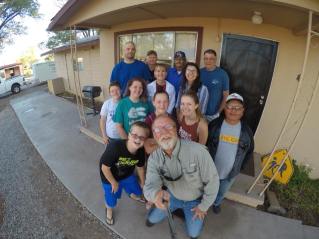
Our mission team has been preaching the gospel of Christ every day this week in New Mexico with hammers and nails and screws and saws, helping to add on a room to a church building in addition to leading a Vacation Bible School.

Some of you preach the grace of Christ every week by working with recovery programs such as Alcoholics Anonymous.

Some of you preach the love of Christ mentoring young people as a Boy Scout leader or camp director.

Some of out preach good news of Christ to the poor by making distributing sandwiches to the food insecure through the sack lunch program.

Some of you are physicians who preach the healing of Christ to people who are suffering. Some preach the hope of Christ to people who are homeless. And some preach the comfort of Christ my volunteering at the hospital.

Although you do not get paid by your employer to preach, some of you preach every day at work and at home. Many of you preach a sermon of unrestricted grace to a co-worker, a sermon of unconditional love to a customer, a sermon of undeniable hope to a friend, to a neighbor, even to a stranger.

And many more of you; although you had other places to go, other things to do (some of you no doubt even felt like staying home), you got up this morning to come to this place of worship. You didn’t know it, but your smile this morning made someone else smile. The handshake that you offered was heartfelt. The hug you gave was sorely needed. Your simple words of greeting brought someone encouragement and another peace.

Mark’s gospel teaches us when you do all these things in the name of Jesus, then you are ministering. Yes, I’m happy to say that some of First Christian Church’s best preaching does not come from this pulpit on Sunday mornings. But it comes from the people in the pews who have answered their calling to be preachers every day of the week.

These are serious times, and Jesus is calling. He is calling ordinary people like me and you everyday to do ministry. Where has Jesus called you to ministry?  What is the work you are equipped and called to do? There is perhaps no more important question. For it is simply the way our God works, the way God has always worked in this world.

Let us pray:

O God, you do not work alone in this world. You reach out and call ordinary folk to be your disciples. We thank you for your graciousness in calling us. Give us what we need to be faithful disciples. You have given us good work to do. Keep giving us the gifts we need to keep doing your work. In the name of Jesus, Amen.

Invitation to Communion

As we sing our hymn of communion, may we open our minds and  hearts so that we may hear the voice of Jesus—calling us and commissioning us to be his disciples, God’s representatives, God’s ministers in this world. All are invited to receive these elements representing the body of Christ because all are called to be the body of Christ.

He Touched Me

Hisham Yasin dinner

Mark 5:21-43 NRSV

I believe one of the most troubling things about the children who have been separated from their parents at the border is when we learned that the case workers and childcare workers were not aloud to touch the children. Sadly, with the prevalence of physical abuse in our world, perhaps we can understand why. However, we also understand that not touching them can also be a form of physical abuse. So much so, when some of the childcare workers confessed in an interview to breaking the rules and hugging the children who were in their care, we said, “Well, good for them!”

It should be no surprise to us when we learn that our God is a God who uses the physical as a means of grace. Today’s scripture lesson, with its repeated theme of physical touching, is a perfect example.

Through the act of touching, a woman is made whole, and God’s healing power is released.

In these stories, through the power of the physical touch, barriers of society and tradition are crossed. Rules and laws are broken. The woman in the story is ceremonially unclean. It is against the rules to touch her and it is against the rules to touch her. And notice, that she is also unnamed. Then, notice what happens after the woman breaks the law, reaches out and touches Jesus.

Jesus asks, “Who touched me?” desiring to know the woman who touched him, he reaches out and touches her. He commends her faith and calls her “daughter.” Through the grace of physical touch, the woman who was once unclean has been made whole. And the woman who was once unnamed has become a child of God.

In the second part of the story, the corpse of the girl is ritually unclean. Like the woman with the hemorrhage, this girl’s body is also untouchable. Yet, Jesus does the unthinkable and reaches out and touches the girl’s body nevertheless. In taking the girl’s hand, in touching the girl, Jesus reaches across the boundaries of society but also boundaries of death. And her life is restored.

About fifteen years ago, I attended a conference for pastors at Princeton University in New Jersey with the two ministers I met in Memphis a month or so ago.  During our free time, we thought it would be exciting to board a train and visit the Big Apple. Before we left the conference, several frequent travelers New York City, who were also attending the conference, gave us some advice.

“When you are in the city, don’t look anyone in the eyes,” they said.  “Don’t speak to anyone.” “Don’t point, at anyone or anything.”  If you point at a building, someone may think you are pointing at them, and there may be trouble. And whatever you do, don’t touch anyone. Don’t get close to anyone!”

Being a first timer in the big city, and desiring not to be shot or cut or punched in the face, I decided that I better heed this advice.

As we were standing at one intersection in Times Square, waiting for the pedestrian light to turn green so we could cross, I noticed everyone in front of me, looking back over their shoulders. I turned around to see what they were looking at and saw a very elderly man with a long white beard, dressed as if he was homeless. With one hand on his grocery cart, he was bending down and picking up a slice of pizza he had dropped on the sidewalk with his other hand. After he picked it up we all watched as he went to take a bite as he walked down the road.

“Look, he’s going to eat it,” someone said.  But before he could get it to his mouth, he dropped it again. The crowd laughed and jeered.  We watched him yet a third time, pick up the pizza, put it to his mouth only to drop it again.  The light turned green, the and off we went.

Later, we were walking up several flights of stairs as we exited the subway.  My friend, Cary was in front of me and my friend, Steve was behind me.

Up ahead of us I noticed a frail-looking African-American man struggling to pull a large suitcase up the stairs. Cary walked passed the man. I walked passed the man, who I heard grunting with each step, watching out of the corner of my eye, dragging the suitcase behind him. “Should I help him,” I thought to myself.  “No, he might get the wrong idea.” “He might think I’m trying to steal it or something.” I kept walking.

Steve, however, who was behind me, took a risk. Not knowing if the man even spoke English, he asked, “Do you need some help?” As Steve reached out and touched the end of the suitcase, the man immediately gave Steve a fearful, mean glance.  But then, he smiled. I watched as he smiled most hopeful kind of smile, and said, “thank you.” Steve, picked up the suitcase and helped the man out of the subway. At the top of the stairs, the man reached out his arm, looking like he wanted to hug Steve. He stopped just short of a hug and patted Steve on the back, saying, “Thank you. God bless you.”

Once again, God used the physical as a means of grace.  Steve reached out and touched and the power of God, the amazing grace of Jesus Christ was released.  Fear was transformed into joy. We all felt it.

As long as I live, I’ll always wonder what might have happened if I had purchased that homeless man another slice of pizza. I’ll always dream of the possibilities, of what might have transpired, if I ate a slice of pizza with him.  I’ll always think of the grace that might of come, the salvation that might have happened, through the simple act of reaching out my hand to that poor solitary soul who was struggling to survive.

Because our God is a God who uses the physical as a means of grace.

Look at your hands.  They are sacred.  They are holy.  They are the means of God’s grace. The simple act of touching is powerful.  It is sacred, and it is holy, maybe especially so if that touch reaches across barriers of society and tradition.

This past week I received a little push back when I posted a picture of myself with Hisham Yasin with our lunch plates and wrote a caption: “breaking bread with my Muslim brother.”

“How can you call a Muslim, who does not believe Jesus Christ is the Messiah, the Son of the Living God, your brother?” They asked.

I then shared with them the story of how I became Hisham’s brother. I said, “The first that I did was to break all sorts societal and traditional barriers by visiting with him in his office.”

During that visit I quickly learned that when it came to religion or politics or philosophy, even sports, Hisham and I agreed on very little. However, I learned that there was one thing that we did agree on. And that is that inclusive love has the power to change the world.

He offered me some dried figs and a delicious glass of herbal tea. He quoted passages from the Qur’an. I quoted Jesus. During our conversation he kept struggling with what to call me. Sometimes he would call me “preacher,” but sometimes he would call me “pastor.” I really got him confused when he just stopped halfway through our conversation, and asked me, “what do you like to be called?”

“Because I am more than a preacher and more than someone who give pastoral care, I guess I prefer ‘minister.’”

During the rest of the conversation, I think he called me all three titles.

After our visit, I reached out my hand to shake his. He immediately reached out both of his hands to hug me. As he gave me this great big hug, he said, “I don’t know to call you preacher, pastor or minister, so from now on, I just call you “brother.”

Now, at that moment, I reckon I could have pushed him away from me saying, “Now wait one minute, Mister, you are not my brother, for you do not believe Jesus is the Messiah, the Son of God, and Savior of the world!”

But thank God I chose instead to break traditional and societal rules, by hugging him back saying, “I love you brother,” to hear him say, “I love you my brother.” I chose to allow God to once more use the physical as a means of grace. And the power of God, the amazing grace of Jesus Christ was released. I felt it. And I believe Hashim felt it.

This, my friends, is what our world needs. We need to reach past all of the barriers that we erect between ourselves and our neighbors— political, religious, racial, ethnic, economic. We need to reach out and touch them. We need to allow them to touch us. We need to join hands, link arms, rub elbows and see that we have more things in common than the things that separate us. We need to see in the words of James Taylor, that ;there are ties between us, all men and women living on the Earth, ties of hope and love, sister and brotherhood.”

Every Sunday morning, when we gather around this table and affirm the grace of the physical. When we consume physical elements of grain and grape, resprenting the body and blood of Christ, we affirm that we have been touched by God through Christ. We affirm that through his touch, we have been made whole. Through his touch, we have all become children of God. But more than that, in consuming the body and blood of Christ, we acknowledge that we are his body and his blood. We are the body of Christ. Our hands are of Christ in this world. Our hands are sacred, and they are holy. They are means of God’s grace. They have the power to heal this broken world. They have to power to accept, to welcome, to love, and to make this world a better place.

After we sing our hymn of communion together, all are invited to consume the physical elements of grain and grape, receive grace, and renew the commitment to be the hands of Christ in this world.

Commissioning and Benediction

Go from this place and remember that, in the words of Teresa of Avila, “Christ has no body on this earth but yours…Yours are the eyes through which the compassion of Christ looks out on a hurting world; yours are the feet with which he goes about doing good; yours are the hands with which he is to bless now.”

The Church Is in the Clothing Business

welcome-1024x493

Genesis 3 NRSV

How often have you watched a pet dog sprawled all out taking a nap in the middle of the day, and thought to yourself: “Must be nice!” Would you just look at Max or Buddy or Bella or Lucy? Not a single care in the world! No job. No bills to pay. No groceries to buy. No dishes to wash. Never has to stand in line at Wal-Mart. No knowledge whatsoever of good and evil. No knowledge of the conflict between Israel and Palestine. No knowledge of children being separated from their families at the border, of the opioid drug crises, of people living in poverty, or people living with mental illness. They know of no friends who hurt or desert them. They’re unaware of any sick family members, ambivalent to the certainty that they will one day die, unmindful even that they are a dog, and oblivious to the reality that they are sprawled all out on the living room floor completely naked. No shame whatsoever. They’re in paradise.

Sounds to me like the two who represent all of humanity, who even today, represent you and me: Adam and Eve. That is, before they ate that apple…or that orange or that peach or that fig or that banana. Whatever it was, before they ate that fruit from the tree of knowledge, they were just happy-go-lucky animals sprawled all out in a paradise with no knowledge of good and evil whatsoever: no knowledge of death and disease; no awareness of pain and grief; not even a clue that they would ever have to work hard to make a living; unaware that they were broken, fragmented, and sinful creatures; unmindful that they were even human, humans who in their self-centeredness will continually disobey the Creator’s commands and abuse the creation which that had been graciously given.

And they were also unmindful of the danger that lurked in their paradise, that crafty serpent: that symbol of everything chaotic and evil, that enigmatic, yet personal force of temptation that somehow, we have no explanation of why, was already present, preexisting and existing in the garden alongside of humanity. And because of this unholy force or presence or energy, the sordid self-centeredness of Adam and Eve, along with the knowledge of good and evil was suddenly made known. The shame of who they now knew they were was almost too much for them to bear.

For who has not said: “I wished I never knew!” “I wished you hadn’t told me that!” “I would be so much better off if I just didn’t know!”  Sometimes ignorance is bliss. Sometimes ignorance is paradise.

Paradise is lost as Adam and Eve, humanity, each one of us, live in a world where we know way too much, where we’re too smart for our own good. We live with the knowledge that all is broken, with a knowledge of pain and suffering, stress and strife, sadness and grief. Furthermore, we live in a world where we know that one day, we are all going to die.

We also live in a world where we make countless mistakes, and we know it. We are selfish, and we know it. We live to save our lives, protect our lives, look after number one at the expense of everyone else, and we know it. We know we have done some terrible things, and we know we have not done some good things, which is equally, if not more terrible. With our cursed knowledge, we can easily relate to the Apostle Paul’s words to the Romans: “For I know that nothing good dwells within me, that is, in my flesh. I can will what is right, but I cannot do it.For I do not do the good I want, but the evil I do not want is what I do” (Romans 7:18-19).

And because we know, we live with a lot of shame. And we spend much of our energy, time and resources trying to cover it, hide it, masquerade it.

I have always been a terrible golfer, and because of that, I really have not played much in the last few years. However, when I used to play more, I would make sure I always wore the latest styles in golf apparel and footwear. I always had a new golf glove to wear and a nice golf bag with my shiny and very organized clubs. My thinking was: “If I wasn’t a good golfer, dadgummit, I was going to look like a good golfer!”

Thus, I can easily relate to Adam and Eve who worked hard to cover up the truth of who they were with those fig leaves, when they ran and hid themselves from the presence of God whom they heard walking through the garden. Surely, Adam and Eve know by now that you can run, but you cannot hide.

God then asks a question that is as liberating as it is frightening. It is a fascinatingly miraculous question when one considers the one who is doing the asking: “Where are you? Where are you? God, the creator of all that is, loves us so much that God yearns not only to be with us personally and intimately, but desires to be with us… where we are. Where we truly and honestly are, behind the masks and apparel, behind the allusions we have created, behind acts we portray.

As the old hymn goes: God wants to know of all the sins and griefs we bear. God wants to know our pain, our trials, our temptations, our trouble, our sorrows, and our every weakness. God wants to know if we are in a place where we are heavy laden, cumbered with a load of care, in a place where our friends despise or forsake us.

God calls out to Adam and Eve, to all of humanity, to each one of us: ‘Where are you? Because wherever you are, that is the place I want to be. So, please do not hide from me. Do not run away from me. Please, do not be afraid and do not be ashamed. I want more than anything else to know you, to know you for who you really are. You don’t have to come to me. Let me come to you, find you, be with you, walk alongside of you. Let me love you.”

Adam comes out behind the trees and responds, “But God I am naked! All of me is uncovered, out in the open. My true colors are laid bare for the entire world to see. All of my failures, all of my fears, all of my brokenness, all of my self-centeredness, all of my mess is out there, completely exposed. You, O God, have created us to lose ourselves, and all I want to do is to find myself, to save myself, protect myself. God, I am a sinner, and what’s worse, now I know it. And I am so ashamed.”

Then God does for Adam and Eve something that they cannot do for themselves. They cannot deal with their shame. They cannot deal with their sin. The reality of who they had become was too much for them to bear.

As revealed in every act of Jesus of Nazareth, God responds to their shame by doing something amazing. God bends God’s self to the ground, uses God’s own hands, and creates garments of skin, and lovingly and very graciously clothes Adam and Eve.

God meets Adam and Eve where they truly are. They are naked, exposed. And what’s worse, unlike little Max or Buddy, Bella or Lucy sprawled out naked on your living room floor, Adam and Eve are naked and exposed, and they know it. All has been laid bare, and they could not be more frightened and ashamed.

And God responds to their nakedness, God responds to all of their fear and shame, by amazingly clothing them with grace.

And here’s the good news. The only thing that may be more frightening than being fully known, completely naked, exposed for who we really are, all our sins and griefs laid bare, is perhaps the prospect of never ever being fully known, the prospect of going through this life without anyone ever truly knowing us, and then accepting us, loving us, clothing us with grace. The good news is that God wants to know us, every part of us, and then God still wants to love us and forgive us.

I believe with all of my heart that this is one of our primary purposes as a community of faith. First and foremost, we are to always be a community of grace. If people cannot come through our doors, take off their masks, stop the charade, and honestly lay bare all of their sin and all of their griefs, knowing that they will never be judged, looked down upon or condemned, then I do not believe we are a church. I am not sure what type of business we are, but we are not a church, we are not a community of grace. As a church we are to always be in the business of yearning to meet people where they are, so we can be with them, so we can walk alongside of them, so we can listen to them, learn from them, forgive them and love them.

As the church, we are to always be in the clothing business. We are to always be in the business of bending ourselves to the ground, using our own hands, our resources and our talents, to clothe one another, to clothe all people, with the grace of God in the name of Jesus the Christ.