A Message to Graduates: How Low Can You Go?

Carson Graduation

Luke 14:7-11 NRSV

Today, all over this country, high school and college graduates are beacons of hope in a dark world! It has been said that they belong to a generation that is “up and coming.” They refuse to be silent. They are passionate, relentless, determined youth with high ideals and high ambitions to change the world! I look at how they are courageously standing up and speaking out, inspiring us to be a better a better people, and I ask, “My God, how highcan they go?”

They were probably taught at a very early age that up highis where it is at, and no doubt, they spent the first eighteen years of their lives trying to grow up, graduate highschool and then possibly pursue an even highereducation. All so they move upa little higherin this world, keep climbing to make sure they are always upward bound: upfor a promotion so they can move upthe ladder. For up, up high is how our society measures success.

Up high, we are told, is where we will find our life, a life that is full, complete, satisfied, and abundant.Up highis where we are able rub elbows with others who also shaped up, grownupand moved up.Up high is where we find what we call the “in” crowd. They are the “up” and the “in” as opposed to the “down” and the “out.”

So, we set goals that are high. We seek to make high marks, achieve high grades, meet high expectations.

The message of nearly every motivational speaker or life coach in America today is all about how to shape upand move up, aim high and soar high.

After all, who in their right mind would want to move in the opposite direction? Who wants to change directions from up high to down low?  As the late Henri Nouwen one of my favorite preachers, has said: “Downward mobility [in our society] is not only discouraged, but even considered unwise, unhealthy or downright stupid.”

Can I get an “Amen?” Come on now, really? Who in their right mind would want to lower themselves? What mind must you have to want to humble yourself, move to and sit at the lowest seat at the table, lower yourself to the ground to wash another’s feet, descend down the economic ladder to relate to people who are poor, be with and love people who are down and out?

I think we know what mind.

When God chose to reveal to the world a life that is full, abundant and eternal, God’s will for all people, God chose a life of downward mobility. God emptied God’s self, poured God’s self out, humbled God’s self, lowered God’s self and came down. Down to meet us where we are, down to earth as a lowly baby, born in a lowly stable, laid down in a feeding troth to worshipped by down and out shepherds.

The scriptures do say that Jesus grew upward in stature; however, the gospel writers continually paint a portrait Jesus’ life as one of downward mobility. He is continually bending himself to the ground, getting his hands dirty, to touch the places in people that most need touching.

While his disciples seemed to always focus on privilege and honor and upward mobility, chastising little children who needed to shape up and grow up before they could come to Jesus, Jesus argued that the Kingdom of God actually belonged to such children.

While his disciples argued about who was going to be promoted, who was going to graduate to be the first in the Kingdom, Jesus frustrated them (and if we are honest, frustrated us) by doing things like moving downto sit at the lowest seat at the table, bending downto wash their feet, stooping downto welcome small children, crouching downto forgive a sinner, reaching downto serve people who are poor, lowering himself downto accept people who had been cast out of their community. He was always always getting down, to touch the leper, heal the sick, and raise the dead.

While others exercised worldly power to graduate and move up, climb up, and advance, Jesus exercised a strange and peculiar power that always propelled him in the opposite direction. It is not a power that rules but is a power that serves. It is not a power that takes but is a power that gives. It is not a power that seizes but is a power that suffers. It is not a power that dominates but is a power that dies.

And nearing the culmination of his downward life, to save the world, Jesus went to highest seats of power in the capital city of Jerusalem, not on a white stallion with an elite army of high ranking soldiers, but riding a borrowed donkey with a handful of ragtag students who never graduated from anything. The whole scene of Jesus riding that donkey, in the words of Henri Nouwen, looks “downright stupid.”

This is the narrow and seemingly foolish way of downward mobility, the descending way of Jesus toward the poor, toward the suffering, the marginalized, the prisoners, the refugees, the undocumented, the lonely, the hungry, the dying, the tortured, the homeless—toward all who thirst and hunger justice and compassion.

And what do they have to offer? Those who are down and out in our world cannot offer success, popularity, riches, or worldly power, but they do offer the way to life, full, complete, abundant and eternal.[i]

So today, as we recognize and pray for our graduates, as our hearts are filled with hope, and we ask, “My God, how high can these young men and women, these future leaders of the world go?” We are also asking, with perhaps even greater hope for the world and the Kingdom of God, “My God, how lowcan they go? How low can these young men and women, these future leaders of the world, these future leaders of the church go? How lowcan they go to fulfill the divine purposes that God has for each of their lives?

My hope is that each graduate who is being recognized in churches all across are country today is in church not to help them move up to be with the “in” crowd,” or there to find something in worship that will make them more successful, more affluent, climb a little higher. I hope they are not even in church looking to be uplifted or to be more upbeat or for some kind of upstart to get this new chapter in their life headed on an upswing.

My hope is that they are in worship because they have chosen to move in the opposite direction.

My hope is that they want to find ways to climb down, to get low, to lose themselves, to die to themselves and live for Christ. For they have heard, and they have believed Jesus when he said: “Anyone who wants to become great among you must be your servant, and anyone who wants to be first among you must be your slave, just as the Son of Man came, not to be served, but to serve, and to give his life as a ransom for many (Matthew 20:25-28).

Spencer Allen, Jamie Pape, Jason Pryor and Kourtney Williamson, although it sounds good to be a part of the up and cominggeneration, my hope is that you will be a generation that is always down and going. May you always go down, get low, sacrificially and selflessly. And then go out bending yourselves down to the ground if you have to, to touch the places in people that most need touching. May you go out and stoop down to welcome and accept and serve all children: children who are sick, children with different abilities. May you go out and crouch down to care for the sick and the elderly. May you go out and reach down to serve the poor, lower yourselves down to accept people who are marginalized, and may you get low, get down on your knees to pray for people who are grieving and the lost.

And, there, as low as you can go, may you truly find your life, your purpose in this world, one that is full, complete, satisfied, abundant and eternal. Amen.

INVITATION TO COMMUNION

Each Sunday, we gather around a table to get our minds right. To open our minds, focus and refocus our minds, even blow our minds wide open if we have to, to let the same mind be in us that was in

in Christ Jesus,

who, though he was in the form of God,

did not regard equality with God as something to be exploited,

but emptied himself, taking the form of a slave,

being born in human likeness. And being found in human form,

he humbled himself

and became obedient to the point of death—even death on a cross (Philippians 2:5-8).

Commissioning and Benediction

Go out bending yourselves down to the ground if you have to, to touch the places in people that most need touching. Go out and stoop down to welcome and accept and care for all children, to love on those in hospitals and nursing homes. Go out and reach down to serve the poor, lower yourselves down to accept the outcast and the marginalized, and may you get low, get down on your knees to pray for the grieving and the lost.

And, there, as low as you can go, may you truly find your life, your purpose in this world, one that is full, complete, satisfied, abundant and eternal. Amen.

[i]The sermon is inspired by this paraphrase from Henri Nouwen, Here and Now, 138-139.

Mirroring the Self-Giving Love of the Triune God

reclaiming jesus

2 Corinthians 13:11-13 NRSV

We Americans are often guilty of trivializing things that are important. Consequently, survivors of loved ones who gave their lives for their country often struggle during the Memorial Day Weekend, and rightly so. For it can sometimes be difficult to tell if Americans truly know what Memorial Day is about.

Is it about the end of the school year and the beginning of summer? Is it about going to the beach, the river, or the lake? Is it about playing golf, having a cookout, or opening the backyard swimming pool? Is it about red-tag sales at the mall or some other self-fulfilling activity?

No, it is about sacrifice. It is about self-denying, self-expending love. It is about people giving all that they had to give, for they so loved their country more than self.

This weekend is about honoring those who died for us, and it is about praying for those they left behind. It is also a time to recommit ourselves to those who continue to selflessly fight evil in our world, evil that demeans, devalues and destroys human life and sometimes does it in the name of God.

May God forgive us for forgetting what this weekend is all about or watering it down for our own selfish gain.

I am afraid that we have done the same thing to the Christian faith. Consequently, followers of Jesus everywhere struggle, and rightly so. For it can sometimes be difficult to tell if Christians really know what the gospel is about.

Is it about judging and condemning others who believe and live differently? Is it about pure beliefs and possessing an attitude of superiority? Is it about having the right to discriminate and treat others who differ from us as second class citizens? Is it about banning people of other faiths from our communities? Is it about depleting our natural resources because we believe the Lord is returning and the world is ending in our lifetime? Is it all about going to heaven one day or on some other self-absorbed venture?

No, our faith is about sacrifice. It is about self-denying, self-expending love. It is about a God giving all that God has to give, for God so loved this world more than God’s self.

Thus, faith is about honoring a God who died for all. It is about recommitting daily to continue to selflessly fight the evil in our world, evil that seeks to demean, dehumanize and destroy human life and sometimes does it in the name of God.

Monday is Memorial Day. May we remember what it is truly about. And everyday is the day the Lord has made. May we remember how God is made known to us, relates to us, and loves us, and how God calls us to make ourselves known to, relate to and love the world.

This is where I believe the doctrine of the Holy Trinity can really help us—Three persons in one. Throughout the centuries, people have been trying to explain this complexity in simplistic language.

You have probably heard that God is like a pie. You can cut a pie into three pieces, but it’s still one pie. Or God is like many of us. I’m a brother, a father, and a son, but I am still one person. Or God is like water, and water has many forms: steam, ice, and liquid, but it is still water.

However, I believe each of these descriptions only scratch the surface of who our God truly is. It is only a watered-down, version of who our God is. Furthermore, it is defining God based on our understanding of the world, instead of allowing our understanding of God to define the world.

God, the creator of all that is, the power behind our universe, gave God’s self, emptied God’s self, poured God’s self out and became flesh and dwelt among us through Jesus Christ.  And Jesus Christ, while he was on this earth, gave himself back to God by becoming obedient to God even to death, even death on the cross. But before he left us on this earth, he promised not to leave us orphaned, he promised to be with us always by giving himself back to us through the Holy Spirit.

Do you see the one characteristic of the Holy Trinity which stands out?  God gave God’s self through the Son. The Son gave himself back to the Father. And God once more gives God’s self back through the Holy Spirit. God is a self-giving God. God is a God who loves to give to others the very best gift that God has to give, the gift of God’s self.

God is a giver. That means that God is not a taker. For givers are never takers.

Isn’t interesting that many Christians, often characterize God as a taker? Again, I think it is because we like to create a God in what we want our image to be, instead of allowing the image of God to define and guide us.

For example: How many funerals have we attended and heard the phrase: “God took her home or God was ready to take him?”

We have all lost loved ones to death. But the Trinity teaches us that Lord did not take them. For givers are not takers. A more accurate way of describing what happened to our loved ones when they breathed their last on this earth is that God wholly, completely and eternally, gave all of God’ self to them.

When we experience the heartache and heartbreak of this fragmented world, there is one thing of which we can be certain, God is here with us, not taking, but giving us all that God has to give, the best gift of all, the gift of God’s self.  If we don’t know anything else about God, we can know this. For it is God’s very nature.

As we renew our discipleship mission as a church, let us renew our commitment to mirror our God by living not as takers, but as givers.

For I believe with all of my heart that mirroring the self-giving love of God that is revealed to us in the Holy Trinity can help us reclaim the gospel that has been high-jacked by people who prefer to live in this world on their terms instead of on God’s terms.

Mirroring the self-giving love of God can help us recover our faith that has been co-opted by takers, by people who have used and misused the name of God for their own selfish gain

For if we mirrored the Triune God as self-giver, think of how everything would change.

Think of how our Christian faith would change. Our faith would not be about what we can take from God—healthier marriages, stronger families, deeper friendships, peace, security, comfort, a mechanism to overcome trials or to achieve a more prosperous life, or even gain an eternal life.

Our faith would be what we can give back to the Holy Giver—namely all that we have and all that we are, even if it is costly, even if it involves risk, danger and suffering, even if it involves the loss of relationships, stress on our marriages, sleepless nights, a tighter budget, even if it involves laying down our very lives.

Church. Church would not be about what we can take from it. It would not be about getting fed, experiencing some peace, attaining a blessing or receiving some inspiration to help us through the week.

Church would be about opportunities for self-giving. Church would be about feeding the hungry, working to bring peace, being blessing to our communities and inspiring the world. Church would no longer be a place that we go to on Sunday, but who we are every day of the week, the body of Christ, the very embodiment of holy self-giving love in the world. Church would not be a way to for us to get some Jesus. Church would be way we allow Jesus to get us to love our neighbors as we were created to love.

And our neighbors. We would look to our neighbors, not for what they can give us, not for what we can take from them, or how we can use them, but for what we may be able to offer them, especially those things that others are constantly robbing them of in order to support their dominance and superiority over them—their dignity, their equality, their value as human beings created in the image of God, their hope, their freedom, their justice.

We would look to our city, our state and our nation, not for what we can selfishly take from it, but for how we can selflessly give to it to make it a more just place for all.

The environment would not be something for us to take from, plunder and exploit for our own selfish wants, but something for which we sacrificially care for, respect, nurture and protect.

I believe if we would truly mirror the triune image of our God as givers instead of as takers, God’s kingdom would fully and finally come on earth as it is in heaven.

Mirroring the triune image of God as self-givers can rebuild a broken world.

Mirroring the triune image of God as self-givers can correct a distorted moral narrative.

Mirroring the triune image of God as self-givers can heal sick religion.

Mirroring the triune image of God as self-givers can bring down walls and break the chains of injustice.

Mirroring the triune image of God as self-givers will erase racism and sexism. It will end sexual harassment and assault.

When we mirror the triune image God as givers, all hate, bigotry, and violence will pass away, and all of creation will be born again.

When we mirror the triune image of God as givers, liberty and justice and peace will come, and it will come for all.

When we mirror the triune image of God as givers, the words of the prophet Isaiah will be fulfilled:

Many peoples shall come and say,
‘Come, let us go up to the mountain of the Lord,
to the house of the God of Jacob;
that he may teach us his ways
and that we may walk in his paths.’
…[Then] they shall beat their swords into ploughshares,
and their spears into pruning-hooks;
nation shall not lift up sword against nation,
neither shall they learn war any more (Isaiah 2:3-4).

Love One Another

Tolerate

1 John 3:16-24 NRSV

It the Fourth Sunday of Easter, like the very first disciples we have gathered together on the first day of the week to be with our family of faith.  Why? There are certainly a lot of other places we could be this morning.  But here we are.  We are here, together as a community of faith, because like the very first disciples, we have seen the risen Lord!

Somewhere along the way, probably during some of our weakest moments, those moments of pain and despair, those moments of great anxiety and fear, those moments of hunger and thirst, when we needed him the most, the risen Christ showed up. He inexplicably came into our lives, stood in our presence, and filled us with a grace greater than our sin and a peace greater than our understanding.

So here we are, gathered together on this first day of the week, assembled in this place as those who have seen the risen Christ, as those who have experienced the marks of his suffering. We’re here because we believe in Easter. We believe in the wonderful good news that Christ is alive and, even more than that, he is alive for us.

So here we are.  Now the question is: what are we supposed to do? How are we to live as Easter people?

There is no more direct answer to this important question than the answer that is found in the book we call 1 John.

When I was in seminary, I had to take two semesters of Biblical Greek and at least one semester of Hebrew. In my first year of Greek, the first book of the New Testament that our professor had us to translate was 1 John.

Why 1 John?  Because in all the New Testament, the Greek in 1 John is the most simple and direct. There are no complex, convoluted arguments, no long clauses or other linguistic difficulties that make the translation of some of the other New Testament books a nightmare. 1 John is simple and to the point. In fact, I can sum up the entire book in basically three words: “Love One Another.”

Three of the most simple, most direct, but at the same time, most difficult and complex words ever put together in one command. Yet, this is how God expects believers in the risen Christ to respond to Easter.

Love one another. It is difficult and complex because the “one another” we are supposed to love is not just our friends and family, but also those who have misused and mistreated us. We are commanded to love those who look, believe, behave, and live differently than we.

So, although we have this direct commandment to love one another, we still think, “Surely God must have meant something else.” For it really doesn’t make any sense. We don’t even think it is possible. And let’s face it. There are just some people in this world that are impossible to love.

We can understand God saying something like, “You know, in this fragmented world of sinners, let us learn to live with each other.”  Now that’s a good commandment! Despite our differences, let’s just get along! Live and let live.

What about “Be tolerant.”  I like that commandment.  I don’t have to like him, but I guess I can somehow tolerate him. I suppose I can in someway put up with her.

What about “love the sinner and hate the sin.” Ooh, that’s a good one! I can love ‘em, and at the same time, I can hate everything about them! I am pretty sure I can handle that.

How about, “Let bygones be bygones.” I like that. We’ve got to move on. We can’t nurture our resentment forever. It’s not healthy. We need to get over it. Although that is sometimes easier said than done, I think I can obey that commandment.

But the scriptures say considerably more than that. “Love one another.” And here in 1 John, it is a direct command.

Unable to obey this command, many today have reduced our faith to some sort of selfish, personal and private spirituality. People are fond of calling themselves “spiritual.” And when they say they love one another, I suspect they are only talking in some spiritual sense that is never fleshed out in a tangible way. 1 John reminds us that we need to recover a love that compels us to physically lay down our lives for one another, never refusing to help a brother or sister we see in need. We need to love, not in word or speech by in truth and action.

Rev. Dr. William Barber, puts it this way: “If you say you are full of the Holy Spirit, but if your spirit doesn’t lead you to speak up against injustices and oppression, then your spirit is suspect.”

Yesterday, I counseled a couple planning getting married. I pointed out that nowhere in the ceremony will the minister ever ask you if you are “in love with one another.” As if love is some kind of spiritual thing. No, you will be asked, “Will you love? Do you promise to love?” Because love is not a feeling. Love is action.

This summer, I will celebrate the 30-year anniversary of the day that I promised before God and a congregation to love Lori. Thirty years. That’s a lot of years. That’s a long time.  And I know, so before she says it, I’ll say it for her—it’s been even longer for Lori.

When you really love another, you have this wonderful capacity to always look at best that is in that another. I know Lori does that with me, or she wouldn’t be with me today. When I do all those things that annoy her, that get on her last nerve, she somehow has the ability to look past it. And in so doing, my weaknesses, my quirks, and all of my shortcomings grow small, while my virtues, the few that I have, grow large. That is love.

Love necessitates that no matter what the other has done to disappoint us or hurt us, we focus on the positives. Love compels us to look for mitigating circumstances or to devise strategies whereby we earnestly attempt to see the other in the very best light.

If another hurts us, love compels us to ask ourselves questions like, “I wonder what’s going on in his or her life that made him or her treat me this way?” or “I have certain ways about me that antagonize others. I wonder how I antagonized him?” or “I have gotten a lot of good breaks in my life. I wonder what bad breaks she got that makes her view me in this way?”

Because once we decide that love is not an option, once a war begins, once we decide that we can’t look past another’s shortcomings, we free ourselves to demonize the other. In war, all moral bets are off. Once the shooting starts, we free ourselves to only see the worst in the other. You know the old saying?  In war, we actually kill our enemies twice.  First, we kill any shred of humanity in them, and then we kill them with bullets.

But First John tells us to love one another. This means that when we are wronged, all moral bets are not called off.  In fact, according to this ethic, it is precisely when we are wronged that the true moral test begins.  Elsewhere, the scriptures remind us that if we love those who show love to us, what is that?

Why are we commanded to love this way?  Why does Easter demand such a thing?

Because when the risen Christ showed up, when he came to us offering us a grace greater than our sin and a peace greater than our understanding, we realized that although we had betrayed, denied and abandoned God, God, in Christ, loves us.

God not only puts up with us, gets along with us, tolerates us, but God loves us. God doesn’t love us and hate our sin, because love doesn’t keep account of our wrong doings. God looks past our failures. God sees the very best that is about us, and then calls that best that is within us all to come out. God loves us, and therefore commands us to love one another. “If I have loved you, then you should love others.”

And that’s exactly what we’re going to do!

When they mistreat us, we’re going to love ’em.

When they use us, we’re going to love ’em.

When they hate us, we’re going to love ’em.

When they are unlovable, we’re going to love ’em.

When they belong to another faith, we’re going to love ’em.

When they have no faith, we’re going to love ’em.

When they have polar opposite political views, we’re going to love ’em.

When their sexuality differs from ours, we’re going to love ’em.

When they are differently abled, we’re going to love ’em.

When their race, ethnicity, language or citizenship differ from ours, we’re going to love ’em.

When they’re sick, we’re going to love ’em.

When they’re hungry, we’re going to love ’em.

When they’re afraid, we’re going to love ’em.

When they’re lonely, we’re going to love ’em.

For richer, for poorer, in sickness and in health, for better or for worse, we’re going to love ’em, because we have seen the risen Lord. We’re going to love ’em, because we believe in Easter. We’re going to love ’em because we’ve experienced a divine, unconditional love— A love that demands us, compels us, and commands us to love one another in truth and in action.  Let us pray together.

O God, teach us how to love as you have loved us. Teach us to love the unloved and the unlovable. Teach us to see others as you see them; teach us to see ourselves in the light of your forgiving, forbearing love.  In the name of the risen Christ we pray.  Amen.


Invitation to the table

As we come to these moments of communion, none of us is “pure and blameless.” But because of the grace, love, and forgiveness of Jesus lavishly showered on each one of us, we can come to the table of the Lord without fear or hesitation, trusting that God’s grace revealed in Jesus creates a welcome space for all to come, confessing and trusting in Jesus as Lord and Savior.

Lifted up for Service


cialis

Mark 1:29-39 NRSV

These few verses found in the end of the first chapter of Mark paint a beautiful portrait of who our Lord is, how our Lord acts, and what our Lord desires. Listen to them again, carefully, prayerfully…

“As soon as they left the synagogue, they entered the house of Simon and Andrew, with James and John. Now Simon’s mother-in-law was in bed with a fever, and they told him about her at once.”

Do you hear the urgency in this passage? “As soon as they left…” “…at once.”

I hear a lot of people talk about God’s timing. They say that God will bring healing or restoration in God’s own time. They say that God’s time is usually not our time. And they say that God has reasons for God’s delay. I believe this passage teaches us that the Lord wants to heal us and restore us now: not tomorrow, not some day or one day, but today, right now, “at once.” It is not the Lord’s will for any of us to ever be sick, broken, or even have a fever.

Therefore, if we are sick or broken, if we are suffering in any way, we must understand that it is not because God has some twisted reason or some purpose-driven plan for it. And since suffering is not the will of God, and since we are loved by God, we can know that when we suffer, God suffers with us and is doing all God can do to bring healing, wholeness and restoration.

“He came and took her by the hand…”

Perhaps more than anything else, I believe it is the will of our Lord to come to us and take us by the hand. When I was a child I learned a wonderful song:

Put your hand in the hand of the man who stilled the water

Put your hand in the hand of the man who calmed the sea

Put your hand in the hand of the man from Galilee

Our problem is that we put our hands in so many other places to receive wholeness.

Instead of putting our hand in the hand of the Lord we put our hands to work. We believe that if we can somehow work hard enough, serve diligently, industriously, thoroughly, and persistently enough, then we can achieve or earn wholeness or peace.

This may be the greatest sin of most of us.

We put our hands, our trust in our own selves instead of in the hands of the only one who can save us. Ephesians chapter two teaches us: “For by grace we have been saved through faith, and this is not our own doing; it is the gift of God— not the result of works, so that no one may boast.”

Instead of putting our hand in the hand of the Lord, we also put our hands in the hands of others. My granddaddy was not a pastor, preacher, or a scholar, but he was sometimes quite the theologian. One thing that he said, and said often was: “There’s only one man that you can trust in this world, and that is the Good Lord.”

However, many of us put our trust in the hands of so many others. We put our hands in the hands of the government, we put our hands in the hands of our friends and neighbors, even in the hands of the church. Then we become disillusioned when they sooner or later disappoint us. The 118th Psalm reminds us:

It is better to take refuge in the Lord

than to put confidence in mortals.

It is better to take refuge in the Lord

than to put confidence in princes.


And instead of putting our hand in the hand of the Lord, we also put them in our own pockets. We put our trust in our wealth and our material possessions. Our sense of well-being, wholeness and security comes from our bank accounts, 401-k’s, our homes, automobiles and clothing. In chapter six of the Gospel of Matthew we read the warning:

“Do not store up for yourselves treasures on earth, where moth and rust consume and where thieves break in and steal; but store up for yourselves treasures in heaven, where neither moth nor rust consumes and where thieves do not break in and steal.”

The good news for all of us this day is that Jesus, the Son of the God of Heaven is coming to us, and he wants to take us by the hand and give us a peace that the world simply cannot give (John 14:27).

“Jesus came to her, took her by the hand, and lifted her up.”

When we put our hand in the hand of the Lord, the Lord lifts us up. Preacher and Princeton Theological Seminary professor Nancy Gross says this is good news because “There is no shortage of “down” from which people need to be lifted up.”

Down today are all those things that the young people in the Scouts of America seek to emulate:

Trust and loyalty are down. Helpfulness and politeness and kindness are down. Respect for the law is down. Fiscal responsibility, a clean environment, courageous leadership and reverence are all down.

And in the middle of one of the worst flu seasons on record, many are down with sickness.

The good news is when we are down in the dumps, down with despair, down with disease, down with a fever, when we put our hand in the hand of Jesus, Jesus always lifts us up!

Now, as much as we might like to do so, now is not the time to sing a hymn, break some bread, sing another hymn and go home. Because our scripture text doesn’t end here.

“Then the fever left her, and she began to serve them” (Mark 1:31).

When we put out hand in the hand of Jesus, we are lifted up. We receive wholeness. We receive peace. We receive salvation. Then, we serve. We are lifted up for a specific purpose: to serve.

Jesus makes us whole not only for ourselves alone, not soley to help us feel better, more hopeful, more happy, more peaceful and more alive, not solety to help us get through a hard week at school, at work or at home. We are lifted up for service to others.

I believe a major problem with the Christian faith today is that many have a very selfish understanding of salvation. Our faith has been reduced to some kind of ticket to heaven, some sort of divine stamp of approval, or some kind of new drug to make our lives better, fuller, richer.

Have you noticed that every other television commercial that comes on the air is an ad touting the benefits of a new prescription drug? There is a new drug available for whatever it is that might ail you!

Are you tired of being tired? Do you have trouble going to sleep? Do you have difficulty waking up? Is your hair falling out? Do you have a going problem or a growing problem?  Are you overweight but love to eat?  Do you need to put some excitement back into your relationships? Do you read the story of the the three little pigs and wolf who huffs and puffs only to have your granddaughter say, “That sounds like you grandpa!” No matter what you’ve got, there is a new pill created just for you.

And then, in nearly every commercial, after the person begins taking what they asked their doctor to prescribe, there is all of this exuberant celebration: dancing in the streets; jumping up and down; digging for clams; running around in the yard with their dog and your water hose; even sitting outdoors and watching the sunset while holding hands with their significant other in separate bathtubs!

I oftentimes wonder if this is not how we oftentimes promote our faith. If you channel surf through the religious channels, you will find that there is no shortage of preachers who sound like they are spokespeople for some new drug. “Are you down and out?  Are you drowning in a sea of debt? Are you empty inside? Does your love life need a boost? Then pick up the phone and make your pledge, send in your check, and sit back and wait for God to pour out God’s blessings!  Wait for God to give you a reason to celebrate!”

I am not exactly sure, but I suspect that is what many people were thinking when they were following Jesus throughout Galilee. Listen to how the Sermon on the Mount begins: “And great crowds followed him from Galilee, the Decapolis, Jerusalem, Judea, and from beyond the Jordan.”  Folks had come out from all over to follow Jesus with these expectations that Jesus was going to somehow make their lives better

And listen to what Jesus says:

Are you 40 years old and wonder where your life is going? Are you feeling blue?  Do you need help raising your children? Does your marriage need a boost?

No, instead, Jesus says things like, “For the gate is narrow and the road is hard that leads to life, and there are few who find it.”

The crowd gets really quiet!  Someone whispers, “I know he didn’t say ‘hard,’ did he?  I thought Jesus was all about making things easy. What’s he talking about?

And he’s not finished. “Love everyone, including your enemies. Pray for those who persecute you. Forgive those who have wronged you. Don’t judge. Accept others as I have accepted you. Deny yourself. Pick up your cross and follow me. Die to yourself.”

I am afraid that churches are so desperate to attract people that they have been willing to trivialize and water down the gospel. So much so that the salvation that many churches are preaching is no different than the salvation that is being preached by the prescription drug industry.

May God forgive the church for implying that we need Jesus in our life to lift us up… period. Just lift us up. And implying Jesus will make our lives easier, fix everything that is wrong with us, put a little lilt in our voices, a little sunshine in our souls.

Because the chances are very good that when we put our hand in the hand of the man from Galilee, our lives will become even more difficult than they were before.

It is the will of the Lord to come to us, and to come to us immediately, without delay, with as sense of divine urgency, to take us by the hand, lift us up, and make us whole, for one purpose and for one purpose only: service, self-denying, self-expending, sacrificial service.

Let us pray together.

O God, as Christ took Simon’s mother-in-law by the hand, take our hands. Make us whole. Lift us up to be the church you are calling us to be in this world. Amen.


Invitation to Communion

Do you need to be lifted up? Are you down in the dumps, down with despair, down with disease? Have you been down with a fever? If so, gather around this table and put your hand in the hand of Jesus. He will lift you up. But he won’t stop there. The bread which he says is his body given is going to lift you up to selflessly give your own bodies as sacrifice. As he pours and lifts the cup he is going to lift you up to sacrificially pour yourself out for others.

Let us prepare to be to be lifted up for service as we sing together.


Commissioning and Benediction

He’s coming to you. He’s coming without delay. He’s coming immediately, with a divine urgency. He’s coming reaching in and reaching out his hand.

So, go ahead, right here and now, put your hand in the hand of the man from Galilee. He will lift you up. He will make you whole. For service.

As you go and serve, may the Lord bless you and take care of you; may the Lord be kind and gracious to you; may the Lord look on you with favor and give you peace.

Ripping Open the Heavens

Mark 1:4-11 NRSV  Dove

If you were to ask me what my favorite part church is, I would say that it the service of Christian baptism. I have always said that it is a good day when the preacher comes to church on Sunday with a Bible in one hand and a bathing suit in the other.

Thus, I love this day on the Christian calendar that we call The Baptism of the Lord. Although I would much rather be getting wet this morning, and getting some of you even wetter, this day at least gives me the opportunity to reflect on the wonderful service of baptism.

Baptism is about is essentially about grace. Baptism is about new beginnings, fresh starts, and clean slates. Baptism is about dying to the old, broken self and rising to a new, better self. Baptism is about the confession, forgiveness and washing away of sins. It is about coming to know that there’s nothing in heaven or on earth that can ever separate us from the love of God. Baptism is about knowing God is with us, not away from us, for us, not against us.

Baptism is about initiation into the Kingdom of God. Baptism is a commissioning to be the body of Christ in this world, the hands, legs, feet and mind of Jesus on this earth. There is a reason that baptism is often called a sacrament. Baptism is sacred. It is holy. It is grace, free and unfettered.

There is perhaps nothing in the church that is more beautiful than baptism. How ironic is it then that some in the church have taken baptism and have created something very ugly. Throughout church history, baptism has created more controversy, schisms and arguments than perhaps any else.

Throughout my own ministry, I have seen people angrily walk out of church meetings over it. I have even seen people who have transferred their membership to another church over it. I know people who have written nasty emails, made harassing phone calls, and started vicious rumors—all over arguments about baptism. I know of churches that have even split over baptism.

I have had staff members threaten to resign if we changed our church’s bylaws to accept members who were baptized by sprinkling. In their eyes, they simply did not get wet enough to join God’s Kingdom. I have heard people argue that some were not old enough, mature enough, good enough, sincere enough, or even married enough to be baptized.  A pastor friend of mine from Concord, North Carolina, was kicked out of the Baptist State Convention because a couple of folks he baptized were not straight enough. I even know people who have gotten upset, because the people being baptized in their church were not white enough.

The irony is that we have taken something beautiful that is essentially about God’s free and unfettered grace for all people, and created something incredibly ugly by placing restrictions, limitations and conditions on it. There have been more rules and regulations written in the bylaws of churches about baptism than any other service of the church.

Some churches believe that you can only baptize in a flowing creek or a river (the water has to be moving) because that was how Jesus was baptized. A stagnant pond, lake, and of course, a baptismal pool will simply not do. Some people believe you can only baptize when the church is gathered for a worship service. And most people believe that a baptism can only be performed by an ordained minister, who is, of course a male.

And once a person’s baptism has been accepted and approved, sanctioned by church officials as worthy of the grace of God, then one can use his or her baptism as an admission ticket to become a full-fledged member of the church. They can take communion, serve on a committee, become a voting member of the church board, and of course, one day, go to heaven.

Pastor Karoline Lewis once preached a sermon to her congregation emphasizing that baptism is not something that we do, but something that God does. She said that when we baptize someone in the name of God, we believe that it is God who is actually doing the baptizing. And she insinuated that when we make baptism something that we do, that we control, then we pervert the very intentions God has baptism.

After the sermon, a woman who was in her nineties approached her. “Karoline,” she said, “Is that really true?”

“What?” the pastor answered.

Hazel responded, “That God baptizes you.”

“Yes, it’s true. This is what we believe. Why?”

Hazel then told her about her sister who was born several years before she was born. Her sister was born very ill in the home and never left the house because she was so sick. The family knew she would not live long. She only lived two months. Right before she died, Hazel says that her mother took her sister into her arms and lovingly baptized her.

When Hazel’s parents went to the pastor of their church where they had been lifelong members to plan the funeral, the pastor refused to hold the funeral in the sanctuary because he had not baptized the baby. The funeral was held in the basement of the church.

Hazel, almost a hundred years later, then asked her pastor, “Karoline, does this mean my sister is OK? Is she really OK?”

“Yes,” she said. “Your sister is OK.”

There was Hazel standing in front of her pastor, weeping for the sister she never knew, crying tears of relief and grace.

This is what happens, says Karoline, this is the ugly consequences of placing limitations on the grace of God.

Of course, such restrictions and limitations on God’s grace is nothing new. The Jewish law was full of rules and regulations controlling who can and who cannot have access to God. Throughout history people of all cultures have sought to control and tame the grace of God.

This is why we need to be reminded of Jesus’ baptism. First of all, it did not occur in a controlled environment such as a baptismal pool or font in the confines of a religious building, but out in the untamed, wide-open wilderness.

And we are told that when Jesus came up out of the water the heavens were suddenly “ripped” or “torn” apart. The imagery describes a God who cannot take the separation any longer. God has had all that God can stand and rips the heavens apart.

The question for us this morning is: If the heavens were closed, whod do you think closed them? Who placed the restrictions and limitations on God’s grace? Who placed the barriers between God and people? Who created systems and structures to mediate God’s presence? Who is it that has insisted on certain rituals and beliefs to regulate God’s grace, to control God’s love, not for the sake of good order (like we tell ourselves and those we wish to exclude), but for the sake of our own power?

As a minister, I could write a book about the trouble I have gotten myself into over the years for baptizing people outside the controlled confines of the church’s bylaws. I have baptized people on days other than Sundays in places other than church buildings. I have baptized people in rivers, in swimming pools, in small ponds, even in the Atlantic Ocean. I baptized one man with his head laid back in the basin of a sink at a nursing home, trusting that it is God, and not me, who is actually doing the baptizing. It is God, and not me, who rips the heavens apart to shower God’s people with grace.

This is why I honor, respect and accept all baptisms—sprinkling, dunking, pouring, infant, adolescent and adult. And I believe baptisms can be performed by any Christian, clergy or laity, male or female. I do not believe people ever need to be re-baptized because some self-appointed or otherwise-appointed baptismal authority believes their baptism somehow did not “take,” failed to meet certain clerical requirements, or was not sincere enough or wet enough. There is but one Church, one Lord, one faith, and one baptism.

This is of course the reason why I welcome all people to the Lord’s Table, because, well, the last time I checked, it’s the Lord’s Table. While some ministers only extend the invitation to those who have been baptized a certain way, I cannot, nor can I imagine Jesus turning anyone away.

When we take a something as beautiful as the service of baptism as it was performed in the wide-open wilderness, with God ripping apart the heavens to get to God’s Son, to get to God’s people, to reveal God’s love and grace to the world, and we turn it into something that is restrictive, legalistic, divisive and exclusive, into some sort of qualifying test for membership, communion, and salvation, then we have missed the whole point of who God is and who we are called to be as God’s Church.

However, when we begin to understand that at our baptisms, whether we were a tiny infant or a grown adult, whether we were sprinkled, dunked or poured upon, whether by clergy or by laity, by male or by female…

When we begin to understand that God, the creator of all that is, ripped open the heavens at our baptisms to come close enough to us so we could feel God’s breath and hear God say: “I love you. I have always loved you. And there is nothing that can ever limit, restrict, tame or constrain this love. There is nothing in heaven or on earth that will ever separate you from this love. I know all of your shortcomings, and I forgive you. I am with you, and I will always be with you. You are my beloved daughter. You are my beloved son. You are my Church. You have the grace and the power to be my hands and feet in this world!” …

When we understand this good news, then our baptisms become what they were always intended to be: free, unfettered, abundant grace, and then we can begin to be the people we were intended to be.

Thank you, God, for blessing us with memories of Jesus’ baptism and ours. Thank you for removing all of the things we have created to separate us from your grace. Help us to go forth with your calling, direction and blessing to share this grace with all people. Amen.


Commissioning and Benediction

Go now into the world remembering that God, the creator of all that is, has ripped the heavens apart to shower all God’s people with grace. Go and share this good news with all people. May the abundant love of God, the unfettered grace of Christ, and the communion of the Holy Spirit be with us all. Amen.


We Need a Little Christmas Right this Very Minute

john the baptist

Living in a nation where greed, racism and bigotry make Christians blind to all kinds evil, even overlooking accusations of child molestation, I cannot help but to think that what we need more than anything else is a little Christmas, right this very minute!

The gospels tell us that in order to get a little Christmas, we first need to get a little John the Baptist, a voice crying out in the wilderness telling people the God’s honest truth.

They tell us that “multitudes” went to hear the truth, even though they knew that sometimes the truth hurts. However, they instinctively knew that it was the truth that was going to set them free.

John preached something like: “You are not right. Some part of you needs to be cut off; something inside of you needs to be burned away.”

From his prolific sermon illustrations, “the fire, the ax, and chaff,” John was preaching that before something can be born anew, something rotten has to die. Before healing can take place, something sick has to be removed. As the “Me Too” movement has taught us in recent weeks, before something can be restored, someone needs to resign.

And as John preached with brutal honesty, the eyes of the blind were opened, and the first thing they saw was a little Christmas.

As we prepare this place of worship for Christmas, making a way for Christ, may we search our souls, asking what we must we do to prepare our hearts for the coming of Christ.

As we decorate this place with poinsettias, remembering the star that signaled love being born in a town called Bethlehem, may all indifference perish, may silence in the face of evil pass away, may all complacency be banished, as we stand up and speak out for the inclusive love of Christ to be born in right here in our town.

As we decorate this place with wreaths signifying the never-ending reign of Christ, may all despair and resignation die, as we resist to fight hate and persist to do justice in our world knowing that the love of God never ends.

As we decorate this place with mistletoe known throughout the world as the plant of peace, may the fear that divides us be removed, as we do what we can, where we can, however we can, to work for peace on earth.

As we decorate this place with holly and ivy, may all self-righteousness and spiritual pride and any feelings of superiority be cut off, as we cling to divine strength.

As we decorate this place with the fire of candles, may all prejudice be burnt away, as we light up our world with grace.

May our lights shine honestly, pointing out all of our failures and flaws, yet giving us the mercy to be better and do better.

May our lights shine so brightly that the eyes of all people are able to see a little Christmas.

Who Is Your King?

paris

John 18:33-37 NRSV

Jesus has been arrested for his actions and his teachings and has already been questioned by Caiaphas, the high priest. Because the sad truth is, that in this world, when you love all people and teach others to love all people, there will always be some people, probably religious, who will want to kill you. It is now Pilate’s turn to question him.

“Are you the King of the Jews?”

Jesus is the King. But as he told Pilate, Jesus is a different kind of King, for his kingdom “is not from this world.” He adds: “If my kingdom was from this world, my followers would be fighting to keep me from being handed over to the Jews. But as it is, my kingdom is not from here.”

And, if we are honest, this makes those of us living in this world very uncomfortable. But that is Jesus. He comforts the afflicted of this world and afflicts the comfortable of this world. Whether we like to admit it or not, the truth is, we have grown rather fond of the kings and kingdoms of this world.

We prefer the kingdoms in this world that “would be fighting” to keep Jesus “from being handed over to the Jews.”

We prefer “an eye for an eye and a tooth for a tooth.” We prefer “You’ll have to pry my gun from my cold dead hands.”

We prefer “It’s not our job to judge the terrorists. It’s our mission to arrange the meeting.”

We prefer “I hear you, and the ones who knocked down these buildings will soon hear from all of us!”

We prefer “the statue of Liberty…shaking her fist.”

The truth is that we prefer answering violence with more violence. We believe combating hate with more hate. We believe in fighting for what we believe, even for Jesus.

We believe in coercing our convictions, imposing our opinions, forcing our beliefs, and we don’t care who it offends or even destroys in the process.

We prefer a kingdom where we say it loudly and proudly that “we eat meat; we carry guns; we say Merry Christmas; we speak English, and if you don’t like it, get the heck out.”

We prefer a kingdom where we do unto others as they do unto us.

We prefer a kingdom where we love and help only those who we believe deserve our love and help.

We prefer a kingdom where people know their places and have earned those places.

We prefer a kingdom where people put the needs of their own before the needs of a foreigner.

We prefer a kingdom where we love ourselves, while our neighbors fend for themselves.

Jesus is implying that there are two types of kings. There are the kings of this world, and then there is the king from another world. And Jesus is asking Pilate and Jesus is asking you and me: Who is your king? Who do you say that I am? Am I your King? Is your king from another world or is your king from this world?

One king offers safety and comfort;

One king promises persecution, saying if you follow him, people will rise up and utter all kinds of evil against you.

One king offers security;

One king demands risk.

One king endorses greed and prosperity;

One king fosters sacrifice and promotes giving it all away.

One king caters to the powerful, the wealthy and the elite;

One king blesses the weak, the poor and the marginalized.

One king accepts only people of like-mind, like-dress, like-language, and like-faith;

One king accepts all people.

One king is restrictive with forgiveness;

One king is generous with it.

One king controls by fear;

One king reigns with love.

One king rules by threat of punishment;

One king rules with the promise of grace.

One king governs by imposing;

One king leads with service.

One king throws rocks at sinners;

One king defends those caught in the very act of sinning.

One king devours the home of the widow;

One king offers her a new home.

One king turns away the refugee;

One king welcomes the refugee, for he, himself, was a refugee.

One king destroys his enemies with an iron fist;

One king dies for his enemies with outstretched arms.

For one king’s throne is made with silver and gold;

One king’s throne is made with wood and nails.

One king wears a crown of rubies and diamonds;

One king wears a crown of thorns.

So, of course the powers that be, the kings of this world, arrested the king “whose kingdom is not from this world.” Of course they tortured this king, spat on this king, mocked this king and crucified this king, this king from a foreign realm. Of course they tried to bury this king and seal this king’s tomb up with a stone.

But hate could not defeat this king. Bigotry could not stop this king. Religion and patriotism could not overthrow his throne. This king would rise again. But not the way the kings of this world rise. Despite the desires of his followers or the lyrics of their songs, there was no thunder in his footsteps or lightening in his fists. There were no plagues, fire, brimstone, or flood. There was no shock and awe or violence of any kind.

For this king understood what, sadly, few since have understood, and that is:

The ultimate weakness of violence is that it is a descending spiral, begetting the very thing it seeks to destroy. Instead of diminishing evil, it multiplies it. Through violence you may murder the liar, but you cannot murder the lie, nor establish the truth. Through violence you may murder the hater, but you do not murder hate. In fact, violence merely increases hate. So it goes. Returning violence for violence multiplies violence, adding deeper darkness to a night already devoid of stars. Darkness cannot drive out darkness: only light can do that. Hate cannot drive out hate: only love can do that.

Reverend Doctor Martin Luther King Jr.

Consequently, this king arose from the darkness of the grave, powerfully, yet unobtrusively; mightily, yet unassumingly; leaving room to recognize him or not to recognize him, leaving room to believe in him or to doubt him, to reject him or to follow him. This king drove out the darkness, not with more darkness, but with light. This king drove out the hate, not with more hate, but with love.

So, how do we live in these dark days of November 2015?

It all depends on who your king is.

This past Monday, Antoine Leiris, who lost his wife in the attacks in Paris, proclaimed to the world which king he chooses to serve. He shared it in beautiful tribute to his wife on Facebook, promising to not let his 17-month-old son grow up in fear of ISIS.

Friday night you took away the life of an exceptional human being, the love of my life, the mother of my son, but you will not have my hatred…

I do not know who you are, and I do not wish to…

If this God for whom you kill so blindly has made us in His image, every bullet in the body of my wife will have been a wound in His heart…

So I will not give you the privilege of hating you. You certainly sought it, but replying to hatred with anger would be giving in to the same ignorance which made you into what you are. You want me to be frightened, that I should look into the eyes of my fellow citizens with distrust, that I sacrifice my freedom for security. You lost. I will carry on as before.

The good news is that our king does not have to be Pat McCory and our King does not have to be Barak Obama.

If we choose, our king will never be Donald Trump or Ben Carson, and our king will never be Bernie Sanders or Hillary Clinton.

For their kingdoms, like all of the kingdoms of this world, are flawed and dark, and the peace they offer is temporary. Their reigns are fleeting.

If we choose, our king is and will be the one whom the prophet Daniel speaks:

As I watched,

thrones were set in place,

and an Ancient One took his throne;

his clothing was white as snow,

and the hair of his head like pure wool;

his throne was fiery flames,

and its wheels were burning fire.

A stream of fire issued

and flowed out from his presence.

A thousand thousand served him,

and ten thousand times ten thousand stood attending him.

The court sat in judgement,

and the books were opened. As I watched in the night visions,

I saw one like a human being

coming with the clouds of heaven.

And he came to the Ancient One

and was presented before him.

To him was given dominion

and glory and kingship,

that all peoples, nations, and languages

should serve him.

His dominion is an everlasting dominion

that shall not pass away,

and his kingship is one

that shall never be destroyed.

Daniel 7:9-10, 13-14

Gone out of the Religion Business

GoingOutOfBusinessHebrews 10:11-25

This morning, I wonder how many of you could answer the following question if you were on television playing for one million dollars. You’ve already used all of your lifelines. You can no longer poll the rest of the congregation or use your friends at AT&T to telephone a friend.

Which of the following is not a religion?

a. Running Marathons

b. Investing in the Stock Market

c. The Atkins Diet

d. The Christian Faith

Again, you can only choose one. All life lines have been exhausted. Which is not a religion?  If you said, “d. the Christian faith,” and that was your final answer, you just won one million dollars!

The wonderful truth about our faith is that it is not a religion. No matter what some may tell you, the church is not in the religion business.

While I was pastoring a church back in 1993, a deacon asked me where I saw myself in twenty years. I told him that I believed that I would still be pastoring a church somewhere.

He laughed out loud.

“What’s so funny?”

“I see you more as the type who might be teaching in some college somewhere, or playing a college professor in a TV commercial. I don’t think you are going to be a pastor.”

“Why do you say that?”

He said, “For one thing, pastors are generally religious people. And you, my friend, are not very religious!”

What this deacon failed to realize was that the church is not in the religion business. The truth is, the last thing a Christian pastor should be, is religious.

Let me share with you what I think is a good definition of religion.  This comes from Robert Capon. 

Religion is the attempt by human beings to establish a right relationship between themselves and something beyond themselves which they think to be of life-giving significance.

William Willimon has said: 

Religion is the human attempt to get a handle on the key to life, to plug in to power, to find the program that leads to happiness, meaning, self-esteem, or whatever it is that gives a person life.

And the strange thing is: that key, power or program may have absolutely nothing to do with God. Before my knee surgery, Lori used to say that I ran religiously. She has said that I read Runner’s World magazine like I read the Bible. I read it religiously every month, trying my best to run faster, achieve good health and look better so I can enjoy the good life!

We have all observed the religious habits of others. “He studies the Wall-Street Journal religiously.” “She sanctimoniously follows the Atkin’s diet.” “He works 60 hours a week, religiously.” “He plays golf, religiously.”

The truth is many of us are doing all we can do, working out, eating right, studying, going to work, following a regimen, all with the same goal: to achieve life! We do it for ourselves, but we also for that something which is beyond ourselves: low blood pressure and cholesterol, smaller hips, a house on the river, for that something which will grant us fulfillment and satisfaction. So, it’s possible to be a religious fanatic and have absolutely nothing to do with God.

However, for some of us, religion is all about God. There are those of us who feel that we must be religious to get right with God. Religion is viewed as something that people work at in order to have a correct relationship with God. If we can say the right prayers, believe in the right creed, behave the right way, avoid the right sins, then we can be right with God. If we can conduct our lives based on high moral and ethical standards, we can place ourselves in a right relationship with God and achieve abundant and eternal life.

Willimon says that the bad news is that we human beings are always flunking religion. No matter how hard we work at religion we can never get it right. For years I had been following the advice of Runner’s World magazine by eating salmon every chance I can got for those omega three fatty acids for my heart. I used to eat the stuff all the time. Lori once said she thought I was going to turn into a salmon. Well, in an issue not that long ago, I learned that if the salmon is not caught wild, straight from the ocean, it will probably give you cancer. Turns out, the farmers who raise the fish feed it these food pellets which are laced with cancer-causing chemicals. No matter how hard we try, we can never get it right.

They used to say that eating bacon and eggs every morning will make you fat and kill you. Now, they say it is that bagel which is going to make you fat. They used to tell us we could get thin by snacking on rice cakes, now they tell us its best to snack on pork rinds. We can’t win! Religion is always a one-way ticket to failure.

Take the religion of golf. You master your irons and start slicing with your woods. You drive long and straight with your driver, hit your iron and land on the green in two, and then you three-putt. That is part of the reason golf is so addicting. It is a one-way ticket to failure. You make a bad shot and it makes you mad. You make a good shot and it makes you mad, because you wonder why you can’t hit it like that every time!

The truth is: at religion, the harder we try, the greater we fail. We can eat all of the right foods and exercise every day of the week and still need knee surgery.

We can place all of our time and energy into our careers, going to work early and leaving work late, and still be unappreciated and miserable.

And when you finally arrive at the place where you think you have it right with God. You finally believe you have got it right in the ethics and morality department, guess what? It usually leads to pride and arrogance. I had a church member tell me one day, “I am the most humble person in this church!”

Sure you are.

The good news of our scripture lesson this morning is that God came into the world through the person of Jesus Christ to put an end to religion.  Hebrews notes that the priests stood before God in the temple. Of course they stood. There was no time to sit. There is no chair in the holy of holies. Think about it: I know if a priest is going to be setting things right between God and my sin, he’ll never have a chance to sit down! The poor priest will constantly have to be running back and forth between my sin and God’s salvation.

No matter how great and sincere my sacrifice is when I go to the temple, my sin is still going to get the best of me before I can get back to my car. The poor priest is never going to get a day off. He’s never going to be able to sit down. That’s why we read: “And every priest stands day after day at his service and again the same sacrifices that can never take away sins.”

In contrast to the posture of the priest who is always standing, notice what Jesus is doing? Jesus is sitting. “When Christ offered for all time a single sacrifice for sins, he sat down at the right hand of God.”

The veil in the temple, separating us from God was torn in two at his death. In this great gift of God’s self, God put religion out of business. And now, Jesus is sitting down.

Consequently, there is no point of us getting on some treadmill of right thoughts, right speech, right actions, because that right relationship we so desperately seek has already been made right by God. We have to only trust that God has indeed done what was needed to be done through Christ. This is why our church teaches “no creed but Christ.” Being a member of this church is not about believing this set of principles or that set of ideals, that biblical interpretation or this style of worship. It is about believing and following the Christ.

That is why we call it the gospel. It is good news. If we called it religion, it would be bad news. Religion would mean that there was still some secret to be unlocked, some ritual to be gotten right, some law to obey, some theology to grasp, or some little sin to be purged. Praise God, in Jesus Christ, this thing called sin between us and God has been made right. Thank God the church has gone out of the religion business!  If it hadn’t, there is no doubt in my mind that I would be in some other line of work by now!

This is why extremist or fundamentalist religion is wrong and dangerous, whether it is fundamentalist Muslim religion or fundamentalist Christian religion. Religious extremists believe that their salvation and the salvation of the world is dependent on the laws they believe, the laws they teach and the laws they obey. That Is how they can justify shooting people in a marketplace, in a school, or in a church, or blowing up a plane, a restaurant, a theater, an abortion clinic or a building with a daycare center. And this is how they can justify creating a fuss if others do not believe as they believe. They believe it is their God-ordained, religious duty to force their beliefs on others to keep themselves right with God.

The good news is, unlike the priests who are standing, running around, creating a fuss, trying to get it right, Jesus is sitting down. His work is done. The work of religion is out of business. We accept salvation trusting that Jesus has already done the work for us.

Think about that. Because I know that are some of you who still believe that what we do here in the church is religious. You have never professed faith in Christ through baptism because you are waiting until you somehow get it right yourselves. You’re busy running back and forth to altars of good heath, right conduct and correct thinking. I invite you to come and realize that God has already made it right through Jesus Christ. I invited you to take a good look at Jesus this morning.

There he is. He’s sitting down.[i]

[i] Inspired from a sermon written by William Willimon.

On the Way

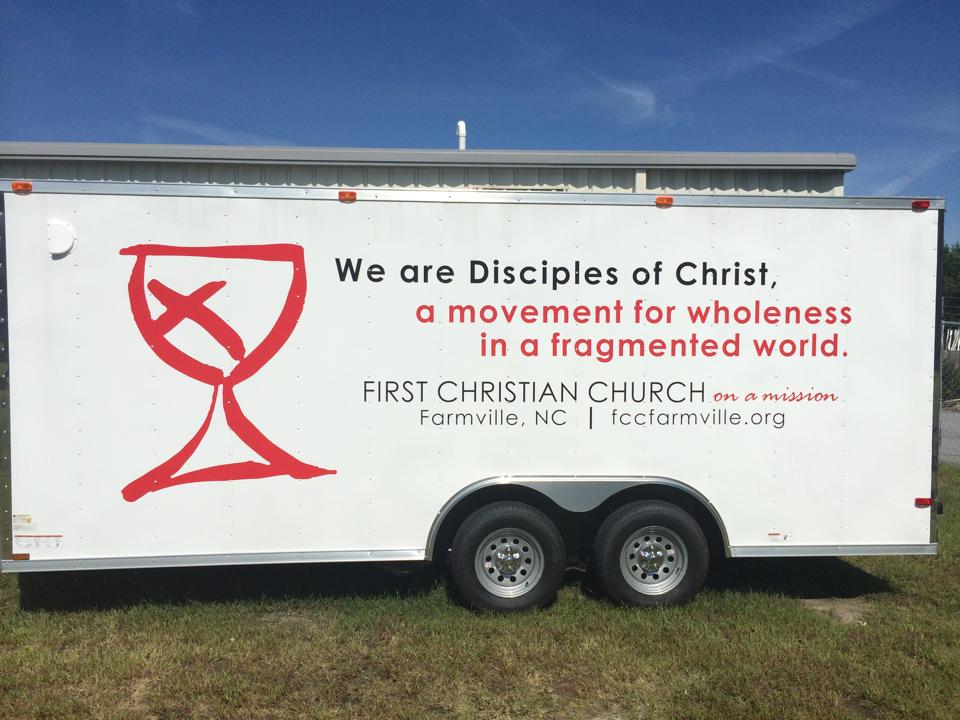
Our Missions Trailer that was recently purchased to help our church get moving on the Way.

Mark 10:46-52 NRSV

The first thing we learn from our scripture lesson this morning is that Jesus and his disciples are with a large crowd, and they are on the move. They were on the way. Jericho was not the final destination. There is one last stop to make. Jerusalem: Where furious religious leaders offended by the good news of the gospel, ashamed of the grace of the gospel, have been plotting to put an end to it all. Jerusalem: Where a selfless Jesus is prepared to sacrifice his very life for the sake of others.

It is on this way, this way of self-denial and self-giving, that Jesus is confronted by a man in great need. His name is Bartimaeus. He is not only blind, he is also a beggar. He is helpless, and he is poor. He is disabled, and he is marginalized. Because many believed there must be some purpose driven reason for his blindness, he has been judged and he has been demonized. And, in desperation, he is waiting for Jesus on the side of the road. He is waiting for justice, and he is waiting for grace.

He jumps up and pleads: “Jesus, Son of David, have mercy on me!”

And notice the actions of the crowd. They try to silence him. They simply don’t want to hear his cries.

Does that sound familiar?

Have you ever been on the way somewhere, met someone, nodded your head and asked: “How you doin’?” It’s a stereotypical pleasantry, an informal greeting. You expect them to nod back, and say something like, “Good, how you doin’?”

But then, to our surprise, the person doesn’t answer the way we expect them to answer, the way we want them to answer, the way we believe they should answer. No, this person decides to unload on you. She has all of these aches and pains, all of these troubles and frustrations, all kinds of maladies that you label as TMI, too much information.

We don’t like that TMI, especially when the TMI has to do with suffering.

I believe this is one of the reasons why we do not eagerly visit someone who has some sort of disability. We might go, but we don’t want to go. Perhaps it threatens us to be around people who are suffering. Because their circumstances are a reminder of how vulnerable all of us are. We know that if it could happen to them, it could happen to us, or to one of our loved ones. So, we prefer to keep the sick, the troubled, the unfortunate, and the disabled out of sight, thus out of mind.

I admire companies like Target and Whole Foods who make it their mission to hire disabled persons. Fortunately, there are many advocates today for the disabled and others who have been marginalized by society who are urging them to come out, to come forward, to speak up, and to seek equity and equality.

This blind beggar does just that. Despite the crowd who “sternly orders him to be quiet,” the man keeps yelling at Jesus, “Son of David, have mercy on me!” “Son of David, have mercy on me!”

And the good news is that Jesus hears his voice. Jesus stops. And Jesus calls him to come over.

Jesus asks, “What do you want me to do for you?”

Not surprisingly, blind Bartimaeus says, “My teacher, let me see again.”

And Jesus does just that. He says, “Go, your faith has made you well.”

Then Mark says something that he does not say when recounting any other healing story. Out of all the folks that were healed in Mark’s gospel, Bartimaeus is the only one who chooses to follow Jesus “on the way.”  Out of all the people who were healed by Jesus, Bartimaeus is the only one who becomes a disciple and follows Jesus on the way to Jerusalem; on the way to the cross; down the road of sacrifice and self-denial and suffering; down the road of grace, mercy, justice and eternal life.

Thus, what we have here in this text is not just another miraculous healing story, but a wonderful story of discipleship. And guess what? It’s not just a story about one blind beggar. It is a story about you and me.

For I believe we have a tendency to come to Jesus asking him to heal us, solve our problems, fix what’s wrong with us. We come to Jesus saying: love me, feed me, and make me happy. Give me some sense of fulfillment. We come to church hoping that we might get something out of Jesus, that he might give us a semblance of peace and joy. We come to Jesus seeking help, security and spiritual bliss.

But how many of us come to Jesus because we are truly willing to follow Jesus as a disciple, especially to those places that we know Jesus is heading?

After restoring Bartimaeus’ sight, Jesus tells him that he can go on his way. And who would blame Bartimaeus if he turned around right then to go on his way? Think of all the places he might want to go! Think of all the sights that he might want to see with his new eyes!

Bartimaeus could have gone home with his new found faith in and love for Jesus. He could have been content knowing that Jesus heard his cries, restored his sight, and gave him salvation.

But no, Bartimaeus doesn’t go his way.

Bartimaeus goes Jesus’ way.

Bartimaeus chooses to follow Jesus. Where? Toward Jerusalem. Toward suffering. Toward rejection. Toward a mission of love, mercy and justice. Toward the cross.

The irony here is that Bartimaeus is introduced to us in this story as a blind man. However, if we are honest, I believe we would have to admit that, in many ways, Bartimaeus may see Jesus better than we do.

Bartimaeus teaches us that this thing we call Christianity, this thing we call church, is about following Jesus. Jesus is not looking for people who merely want to be healed, made stronger, see more clearly and fed by him. Jesus is not looking for people who simply want to agree with him, believe in him, or admire him. Jesus is not looking for people who only want to read about him or study him or even worship him. Jesus is looking for people who truly desire to follow him.

In C.S. Lewis’ classic novel, The Screwtape Letters, the devil advises an apprentice demon that the main way to keep people from the Christian faith is to prevent the potential convert from doing anything.

The devil says that the main thing “is to prevent his doing anything. As long as he does not convert it into action, it does not matter how much he thinks about this new repentance. Let the little brute wallow in it. Let him, if he has any bent that way, write a book about it…. Let him do anything but act. No amount of piety in his imagination and affections will harm us if we can keep it out of his will. As one of the humans has said, active habits are strengthened by repetition, but passive ones are weakened. The more often he feels without acting, the less he will be able to ever act, and in the long run, the less he will be able to feel.”

To the dismay of the devil, Bartimaeus put his faith into action and followed Jesus, even toward Jerusalem.

In just a few moments this church is going to have what we call an invitation. Some churches call it an altar call. It is a practice that was started in many protestant churches during the turn of the 20th century. Those who wish to dedicate or rededicate their lives to Christ or become a member of the church are invited to come down to the front as a public sign of their commitment.

Sometimes, this practice has been emotionally manipulative. Preachers have used guilt and other forms of pressure to get people to walk the aisles. Sometimes the act has had little substance or consequence. Because of this, the invitation or the altar call has been dropped in many churches and is very rare in most denominations.

Well, I’m not ready to drop it, because I believe, despite its misuse, the invitation keeps reminding us that it is not enough for us to come together on Sunday morning to get something out of Jesus: a sense of well-being, as sense of peace, a feel-good feeling of spiritual bliss. It reminds us that the point of it all, the point of Christianity is to follow Jesus, to give our lives to Jesus, to stumble after him along the way, even to Jerusalem.

Some of us are doing just that. We are here today because we have been encountered by Jesus and we are trying our very best to follow him along the way. And that’s good. Some of us are going to be going to West Virginia this week to do some of the things that Jesus commanded us, namely to provide shelter for some of our poorest neighbors. Others are making the commitment to go to South Carolina next month to do what we can to help victims of the recent record flooding. Jameson Cowan is following by literally picking up his cross to defend the cause of freedom through service in the United States Marine Corps. And many more of us have committed to serve on various ministry teams through the church.

But some of us have yet to commit. We have yet to follow. The question then is: will those of us who have not quite yet been on the way with Jesus, will we, like blind Bartimaeus, summon the courage, stand up and not be ashamed, be willing to give and to sacrifice and follow him on the way?

On the way down the selfless, self-giving road of discipleship;

On the way to hear and answer the cries of the disabled and the marginalized;

On the way to defend liberty on the behalf of the oppressed;

On the way to speak words of healing to the sick;

On the way to offer grace to sinners;

On the way to put our arms around the troubled and offer hope to the despairing;

On the way to feed the hungry, clothe the naked, visit the imprisoned;

On the way to Jerusalem, where resistance, and even a cross awaits.

Come Home

prodigal_son

Hebrews 4:12-16 NRSV

A huge issue facing the church today is authenticity, or more specifically, a lack of authenticity.

People say that churches are full of people who pretend like they have it all together. Churches are full of fake smiles and phony piety. Churches are full of folks who act like they have all of the answers, have everything on earth and even in heaven all figured out.

Almost every week, I will hear at least one person ask: “Why can’t Christians just be real?” Someone once asked: “Why can’t people act the same way in church that they act at home?”

I believe the reason many Christians are so fake is that we still have a problem with the good news of the gospel we call grace. We have a difficult time believing that God truly loves us, accepts us, and welcomes us just as we are.

Because, it seems too good to be true.

I believe we Christians have a difficult time being authentic, making ourselves at home, because we have a difficult time accepting that the extravagant, amazing grace of Christ that welcomes us to be real; and because of that, we also have difficult time sharing grace. So, not only do we hide or deny our sins, we are quick to point out the sins of others. Consequently, we have gotten this reputation in the world for not only being fake, but also judgmental.

Indeed, the word of God is living and active, sharper than any two-edged sword, piercing until it divides soul from spirit, joints from marrow; it is able to judge the thoughts and intentions of the heart. And before him no creature is hidden, but all are naked and laid bare to the eyes of the one to whom we must render an account (Hebrews 4:13-13).

Indeed, but sadly, I believe this is where most folks in the church stop reading the Bible. We cannot even think about laying all of our sins bare before the Lord. So we cover it up, hide it, deny it and try to justify it.

And it is obvious to our friends and to everyone we encounter that we phony.

So listen again to the good news:

Since, then, we have a great high priest who has passed through the heavens, Jesus, the Son of God, let us hold fast to our confession. For we do not have a high priest who is unable to sympathize with our weaknesses, but we have one who in every respect has been tested as we are, yet without sin. Let us therefore approach the throne of grace with boldness, so that we may receive mercy and find grace to help in time of need (Hebrews 4:14-16).

But it sounds too good to be true. Doesn’t it? It is almost difficult to hear.

Let us hold fast to our confession. In other words, let us get real and be real. Let us lay bare our sins and authentically approach the throne of judgement.

Wait minute, it doesn’t say that. Does it?

Let us lay bare our sins and authentically approach the throne of grace.

That’s what it says.

And let us do it fearfully.

No, that’s not what it says.

Let us do it with boldness.

That’s what it says.

So, that we may receive our punishment and find correction.

Nope.

So that we might receive mercy and find grace in the time of need. It’s like coming home. Coming home where we can be real, authentic, yet still be accepted and loved.

But it is sounds too good to be true. Doesn’t it? It is all so extravagant, so amazing. It is difficult for us to read, hear and comprehend.

I believe Jesus knew that we would have a hard time with this. That is why I believe he prepared us for it by telling so many stories.

There was a father who had two sons. The youngest had the amazing gall to demand his inheritance so he could leave home. As the youngest, this disrespectful son had no claim to anything of his father’s. Who did he think he was?

Then the truly amazing part: The father takes his “whole living;” (notice how extravagant this is) the scriptures say that he takes all that he has, and gives it to the boy who slips into the “far country” where he wastes every red cent on selfish living. It is only when he finds himself in the time of his need that the boy decides to go back home.

This is where the story gets even more amazing.

“And while he was a long way off,” the father saw him and ran and embraced him.”

Think about this for a moment.

How did the father see him “a long way off?”

Because the father had been looking for him.

Every day this father sat on his front porch gazing down the road, grieving but hoping and praying that his child would one day come home.

And when he finally came home, he ran to him and cried out: “Come and celebrate with me. My child who was dead is now alive!”

I wonder how long the father waited for his dead son’s homecoming. I wonder why the father waited. For all he knew, his son was dead. Can’t you almost hear his concerned friends and neighbors, or maybe even his preacher, telling him: “Old man, it’s time for you to move on. Old Man, you’ve got to get past this. You’ve got to face the facts. He’s not coming back. You got to get over it. Concentrate on your older boy who is still here with you.”

But the father, amazingly, still waited. Most of his friends probably thought he was crazy. Such excessive, extravagant waiting was hard for them to believe.

After all, he really did not know that his son was ever coming home. A young kid with a pocket full of cash first time away from home was an easy target to any would-be thieves and murderers. Remember the story of the Good Samaritan?

Still the father patiently, amazingly waited. Every day he kept looking down the road in front of his house. Straining to see, hoping to see his son coming home.

We call this the story of the prodigal son. But William Willimon says that if the word “prodigal” means “extravagant” or “excessive” or “amazing,” it should be called the story of the prodigal father. For when the boy left home, the father extravagantly gave him his entire savings. While he was gone, his friends and neighbors would say that the father excessively waited. And when the boy at last came home, the father extravagantly threw a huge party, holding nothing back. The father loved his son prodigally when he left home, he loved him amazingly while he was away from home and he loved him extravagantly when he returned home with a fatted calf, a new robe and sandals, a ring, and festive music and dancing.

It all seems too good to be true

It is a story of extravagant, excessive, prodigal love. It is a story of amazing grace.

And the good news is that Jesus’ story of the prodigal father is the story about his prodigal Father. And it is the story about our prodigal Father. Our God is a God who, when it comes to grace and love, holds absolutely nothing back.

I know, the truth sounds too good to believe, but it is the truth.

Our God waits, with confidence that the far country of sin and death shall not be the last word. Our God waits, ready to welcome us home with a celebration that is more than we deserve, not because of who we are, but because of who God is, namely a prodigal father.

One of the greatest things about this story told by Jesus is that it does not have an ending. Have you ever noticed that? We wonder if the younger boy ever learned from his mistakes and grew up to be more responsible. We wonder if the older brother ever let go of his resentment. We don’t know. All we know is that both boys are finally safe, at home with the father.

Willimon suggests that perhaps the reason the story does not have an ending is because this story is eternal. We know when the party began. But for all we know, the party never ended. Maybe this is a scene of what we all have to look forward to. An eternal homecoming celebration for those daughters and sons who once were dead but are now alive, who once were lost but now are found.

After our service this morning, you are invited to a homecoming celebration that has been waiting for you that Joan Smith, once called “a true vision of the Kingdom of Heaven.”

When you see the large amount of food that has been prepared for you this day, it may cause you to pause. It is so excessive, so extravagant, you may have trouble believing it. It will seem too good to be true.

But before this service is over, you are invited to another homecoming celebration that has also been waiting for you. In fact, this homecoming celebration is waiting for you each week. The meal is small. It’s just a tiny cracker and a sip of juice; however, when you understand the meaning of it, the truth of it, the love and grace of it, the extravagance and the excessiveness of it, it may also give you pause. For you may have trouble believing it. It will seem too good to be true.

But the good news is that it is true. For it is the truth. It is the good news of the gospel. It is amazing grace, and it is for you.

So, come home and hold fast to your confession.

Come home and be as real and as authentic as you can be.

Come home with all of your sins laid bare.

Come home and approach the throne of grace with boldness.

Come home because you will not be turned away from it.

Come home because nothing in heaven or on earth can separate you from it.

Come home, because this celebration has been prepared for you, even while you were still a long way off.

Come home, because this table has been set for you even while others have judged you, have condemned you, have given up on you, and even have written you off for dead.

Come home, because your God has not given up on you.

Come home, because your God has been waiting for you.

Come home, because his body has been broken for you.

Come home, because his blood has been shed for you.

Come home, because Christ has died for you.

Come home, because Christ has been raised for you.

Come home, because the baptistery has been filled for you.

Come home, because the Word of God is alive and active for you.

Come home and receive extravagant and excessive mercy.

Come home and find amazing and prodigal grace…

this day and forevermore.