No Time to Waste


jesus_facepalm

Luke 9:51-62 NRSV

When it comes to writing a sermon, I don’t know which is more difficult: Trying to figure out from the biblical text a message from Jesus for us today, or trying to figure out how to relay that message without being forced to leave town.

And in the case of our gospel lesson this morning, how to relay the message from Jesus without sounding like a complete jerk.

Jesus’ face is set toward Jerusalem. He is on a mission following a selfless, self-expending, sacrificial way of love and grace. And in following this narrow and difficult way, he seems to be rather exasperated by the lack of support and understanding around him. So much so, that I almost titled this sermon: “Grumpy Jesus.”

Jesus’ journey towards Jerusalem doesn’t to get off on the right foot, as he receives word that there no hospitality awaiting him in the village of the Samaritans. No room for him in the inn, or this time, even in a stable. This is not surprising considering the Samaritans and Jews mutual animosity; yet knowing Jesus’ love that has no borders, Jesus is obviously frustrated here. But perhaps he is more frustrated by his disciples’ response.

James and John, bless their hearts, ask Jesus if he wants them to reenact a scene from 2 Kings by asking God to rain down fire from heaven and wipe out the entire Samaritan village!

Really? Have they been listening to anything that Jesus, the “Peace-Be-with-You-Love-Your-Enemies” Rabbi, has been teaching them?

Rick Morley, an Episcopal Priest from New Jersey, says that this is like “one of those moments at Thanksgiving when your crazy uncle says something so ridiculously inappropriate that everyone just turns and stares with their mouths agape.”

After James and John’s outrageous question, he imagines Jesus doing one of these (face palm).

Of course, Love-Incarnate, the Prince of Peace, immediately rebukes them and their idiocy!

Then, we have a series of three encounters of would-be disciples. Interestingly enough, especially in light of what the disciples just said, the three encounters may remind us of the three passed by a man in the ditch in what we call the parable of the Good Samaritan in which Jesus lifts up a Samaritan as an example for all of us.

The first would-be disciple comes, and without Jesus asking him, presents himself as the perfect candidate: “I will follow you wherever you go!”

Now, what is not to like about that! I know I am never turning anyone away who comes forward during the hymn of commitment saying, “I want to follow Jesus wherever he goes!” I am signing that person up immediatly! No more questions need to be asked!

Yet, Jesus, perhaps still exasperated because he had no place to spend the night in that Samaritan village, and by his disciples’ failure to get anything he has been teaching, says: “Foxes have holes, and birds of the air have nests; but the Son of Man has nowhere to lay his head.” “Okaaaay, Jesus. I will check back with you when you have had your coffee!”

Jesus then encounters another and invites him to follow him. He agrees to follow, but then asks permission to go and bury his father first. A very reasonable, loving, even faithful request. It was his part of fulfilling God’s law to “honor your father and mother.”

Then, if you thought the “Foxes have holes and birds of nests” comment was snarky, Jesus: “Let the dead bury their own dead; but as for you, go and proclaim the Kingdom of God.”

Now, he is really sounding grumpy.

C’mon Jesus. I know you are upset that you have no where to lay your head. I know no one in that Samaritan village welcomed you into their home. I know your disciples are idiots. They are incredibly irritating, to say the least. I know that when it comes to embracing your way of love and grace, they don’t have a clue. But the poor man just wants to bury his father! What can be wrong with that? Isn’t honoring our parents part of discipleship? Isn’t taking some time to grieve over the loss of a loved one something God would want us to do?

Then, Jesus encounters the third would-be follower, who like the first one, also volunteers without being asked. But first he wants to go and say good-bye to his family, perhaps to let his children know why Daddy wouldn’t be home for a while. Again, sounds like a reasonable request. Even Elijah allowed Elisha to say good-bye to his parents when Elijah chose Elisha to be his disciple while he was plowing his field (1 Kings 19:19-21).

But grumpy Jesus is not having it. Echoing the calling of Elisha, he says, “No one who puts a hand to the plow and looks back is fit for the Kingdom of God.”

Look Jesus. I know you are upset. I know you’re tired. I remember that just last week you were trying to sleep on that boat only to be awakened by a storm. And as soon as you stepped out on the land you were confronted by a man possessed by demons. Then, although you were exhausted, you healed him only to be unappreciated and run out of town! Jesus, I know you have no where to lay your head. I know you are frustrated. I know the disciples that you have been training to be compassionate, loving, forgiving and peaceful want to rain down fire and take out an entire village. I know you have your face set on Jerusalem and all the suffering that is to come. But come on, Jesus, take it easy. Let this man say good-bye to his family. And for God’s sake, let this one bury his father!

This is what I feel like saying. But this is Jesus. This is the eternal Word made flesh. This is the Son of God. Thus, my faith tells me that there has to be something more going on here—something more than a little fatigue, frustration and fear.

His face is set toward Jerusalem. This infers that he knows the that his time on earth is very short. And he knows that if he is going to usher in the Kingdom of God before he dies, as master preacher Karoline Lewis has said: “there is not a moment to lose.”[i]

The same is true for us. The reality is, our time here is also very short. And if we want to make a difference for the Kingdom of God while we are here, there is no time to waste.

But maybe this appearance of grumpiness is not about Jesus at all. For what we know about Jesus, he was always teaching by word and by example to deny self and to lose self. So, perhaps Jesus is not thinking about his own circumstance at all.

Perhaps he had in mind other circumstances and people who needed to know and to experience the love of God. Not next week, not tomorrow, not even later that afternoon, but at that very moment. Perhaps Jesus knew that, not for him, but for others, for many, there was not a moment to lose. Every second counted, every minute mattered.

So, this appearance of grumpiness is actually a holy urgency, a sacred stress if you will, fueled by a divine love with a height, a depth, a width and a breadth that we can only begin to understand. Perhaps Jesus knew that for God’s kingdom to come to those who need it the most, there is not a moment to lose.

Jesus knew that for those who need God’s love, for those who need compassion, healing, forgiveness, and restoration, there is no time to waste.

There is not a moment to lose –

For those who are poor, for those who hunger, for those who weep, for those who are hated, insulted, excluded and rejected (Luke 6:20-22).

There is not a moment to lose –

For those Samaritans who believe they have lost favor with God (Luke 10:25-29);

For a woman who had been crippled for eighteen years (Luke 13:10-17);

For a man who had been suffering with dropsy. Jesus healed him on the Sabbath in the presence of the Pharisees (he didn’t wait until the next day when it was lawful), proving, there is not a moment to lose (Luke 14:1-4).

There is not a moment to lose –

For the rich man who thought he was blessed because he was rich. For the poor man who thought he was cursed because he was poor (Luke 16:19-31);

For the ten lepers who approached Jesus in a region between Galilee and Samaria (Luke 17:11-19);

For the blind beggar sitting beside the roadside near Jericho (Luke 18:35-43).

There is not a moment to lose –

For a man named Zacchaeus who defrauded the poor;

For all of the poor people he defrauded (Luke 19:1-10);

Jesus is frustrated, because there is not a moment to lose –

For an entire world that feels rejected, cursed and lost;

For children of asylum-seekers separated from their parents;

For asylum-seekers drowning in rivers and thirsting in deserts;

For children confined in for-profit, inhumane detention centers.

Jesus is exasperated, because there is not a moment to lose –

For LGBT teens who are contemplating suicide;

For all children who suffer from neglect and abuse;

For girls who are raped and then denied healthcare;

For boys who are taught that it is okay to objectify girls;

For the person with a disability who feels like the whole world, even God, is against them.

Jesus is stressed, because there is not a moment to lose –

For the one dying in a nursing home all alone;

For those who have to make the choice every week to either buy their medication or to buy groceries;

For those unjustly locked away in our prisons because of their economic status or skin color;

For nations on the brink of war.

Jesus is grumpy, because there is not a moment to lose –

To respond to climate change that threatens God’s good earth;

To end the destructive pollution of the planet with plastics and carbon.

And Jesus has his palm planted on his face today, because many of his disciples still don’t have a clue. Some still want God to rain down fire and brimstone on those who believe and live differently. And many would-be-followers still have no sense of urgency to be witnesses of love, peace and justice.

In a sermon, Raquel Lettsome, an AME preacher from New York points out:

We tend to wait for God’s action [or somebody else’s action] rather than getting our [own] feet wet.

Are you at the Red Sea, waiting for God to do something? Or are you at the Jordan River, willing to get your feet wet so as to enter into the promised land?

Are you waiting for someone else to speak justice? To call for righteousness? Or will you embrace the moment and proclaim the promise of God’s favor?

Are you waiting for others to stand up for those our world rejects and reviles? Or will you seize the moment and say God’s love is for all?

Whatever we do, may we know that every moment counts. Every minute matters. There is no time to waste.

Let us pray.

Create in us a new heart of compassion, a new sense of urgency, as Christ has called us to be servants of love and grace in this very moment. Enable us to truly be your disciples, O Christ. AMEN.

Invitation to the Table

The needs of our world are so great, that Jesus needs all of us. That is why all are welcomed to be served and to serve from this table sharing the love and grace of God with all.

Commissioning and Benediction

Go ahead and get grumpy.

Feel frustration.

Experience exasperation.

Sense some sacred stress.

Because there is a suffering world out there that needs the Jesus that you follow,

the Jesus that is in you and the Jesus who wants to speak and work through you.

And there is not a moment to lose.


[i]https://www.workingpreacher.org/craft.aspx?post=4679

 

Deviled Ham

torches2

Luke 8:26-39 NRSV

Today’s gospel lesson is one of my favorite stories of Jesus. There is just so much from which to glean from all of the rich symbolism in this story.

Then they arrived at the country of the Gerasenes, which is opposite Galilee.

The opposite of Galilee. The opposite of home. The opposite of familiarity. The opposite of comfort. The opposite of sanctuary.

I believe it is important for the church today to note that the man in this story would have never had an encounter with Jesus, an encounter that brought him liberation, healing and restoration, if Jesus and his disciples stayed in Galilee.

This is one of the reasons I am so grateful for our Disciples Women Fellowship that has chosen to serve at Hope Campus twice a month. If we want to follow Jesus as his disciples, the church must be willing to leave the sanctuary to encounter people who need the liberation, healing and restoration that we know the love of God can bring.

As he stepped out on land,

Jesus and his disciples had just encountered a storm out on the lake, and now, as soon as Jesus steps out of the boat, they encounter a different kind of storm.

 a man of the city who had demons met him.

A man of the city—reminds me of another story of Luke, when “a woman of the city who was a sinner,” anoints Jesus’ feet. Right away, we get the suspicion that this man had a sinful reputation.

For a long time, he had worn no clothes, and he did not live in a house but in the tombs.

And here is where we begin to get the picture that this man of the city is not the only sinner in this story. He is unnamed, naked, and homeless, and he lives among the dead. He is treated as if he was no longer alive, as if he did not exist. He is fully debased, degraded and dehumanized with no rights, no privileges, no power, and no place whatsoever in society.

 Jesus then asked him, “What is your name?” He said, “Legion”; for many demons had entered him.

He has been driven to the margins of life by the Legion. Legion is a technical term for a division of the Roman Army. Thus, it is revealed that this man is a victim of the Roman Empire and its oppressive systems that do great harm to people like him.

We don’t know exactly what that means, “people like him,” but, sadly, we could make some good guesses:

Could it be that he spoke a foreign language? Was he an undocumented immigrant or refugee? Perhaps he had a different skin color? Maybe he practiced some kind of minority religion? Did he have cerebral palsy, autism, a Traumatic Brain Injury, down’s syndrome, or post-traumatic stress disorder? Did he suffer with seizures? Could it be that he suffered with some sort of mental illness? Might it be that he was gay or transgendered?

Not only is he a victim of unjust political systems, he is also a victim of his community. Unfortunately, that is the power of government: if the state leaders are against you, then it gives permission for society to be against you.

He’s labeled “demon possessed” which means he has been fully “other-ized.”

There is no evidence that he has ever harmed anyone, yet, he is “bound with chains and shackles” and “kept under guard.”

He is not to be counted in the census. There is no path to citizenship, no process to appeal. There is no grace.In an act of gross dehumanization, he is forced to live among the dead until he dies.

This is the evil of our world. It is not a spirit that might make us take off all of our clothes and take up residence in a cemetery. No, the evil of this world is the the chaining of this man, the oppression of this man, the dehumanizing treatment of this man, treating him as if he did not exist among the living, shackling him naked in a graveyard, is the true demonic evil in this story.

And for Jesus and his followers, this type of evil should always be brought out and driven out. Jesus is never happy when any person is demeaned, degraded, dehumanized and excluded from community. Whenever Jesus encounters chains, Jesus breaks the chains. The good news is that every time we draw a line that keeps people out, Jesus is with the people on the other side of that line.

This demonic evil, this anti-Christ spirit that possessed the state and the culture to oppress this man is further revealed in the fascinating account of the demons leaving the man and entering a herd of pigs that were minding their own business, innocently feeding on a hillside. As soon as the pigs get infected by the demons, they immediately rush down a steep bank, and they drown in the lake.

I once heard a preacher joke that it is right here in this story that we have the first recorded instance of “deviled ham.”

I know, it’s a terrible joke. Sounds like the kind of thing we might hear Jim Creekmore might say. The poor pigs. What did they do to deserve to become agents of evil? And how could Jesus do such an inhumane thing to any of God’s beloved creatures?

However, we soon discover that these poor pigs were infected with evil long before Jesus showed up.

Notice what happens when Jesus liberates this man (verse 37). When they find the man is liberated, do all the people thank Jesus? No, all the people, “all the people in the surrounding country beg Jesus to leave their presence.”

The demonic evil here is not only the oppression of this man by unjust political systems and a fearful culture, but that the people valued their pigs more than the man’s liberation. The people would rather keep their pigs, their income, their stock values, their privilege and power, rather than see this man set free. This is what made this herd of ham so deviled.

If it means losing some pigs, keep the man shackled.

If it means losing some pigs, crucify the liberator.

If it means losing some pigs, succeed from the union.

If it means losing some pigs, assassinate the preacher.

If it means losing some pigs, suppress the vote.

If it means losing some pigs, oppose the minimum wage.

If it means losing some pigs, then ban foreign nationals of another religion. Separate families. Close the border.

If it means losing some pigs, then resist equality, forget fairness and defend discrimination.

If it means losing some pigs, then keep quiet. Stay silent and stay put. Learn to live with injustice.

If it means losing some pigs, then stomach the murder of children. Be okay with torture. Endure endless war.

If it means losing some pigs, then water down the gospel. Ignore evil. Neglect the poor. Send the stranger away. Don’t feed the hungry. Don’t heal the sick, and whatever you do, don’t do anything to follow the sacrificial way of Jesus. Don’t love others as you love yourselves.

If it means losing some pigs, keep the man naked, chained and guarded.

The truth is, that whenever a person or a group is liberated from oppression, there is another person or group that has some deviled ham to lose, some things that they value more than another’s freedom.

So, a good question for us is, what is our deviled ham? What do we value more than another’s freedom?

Patriarchy? White supremacy? Heterosexism? Religious superiority? Homogenous cities and neighborhoods? Homogenous churches? Cheap fast food? Inexpensive coffee? Inexpensive clothing? Easy and quick access to guns?

Another question is: are we ready to leave Galilee? Leave the familiar and the comfortable in order to bring liberation, healing and restoration to another. Are we willing to leave home so others can have a home?

The man from whom the demons had gone begged that he might be with him; but Jesus sent him away, saying,

“Return to your home, and declare how much God has done for you.” [Restored to his community,] he proclaimed throughout the city how much Jesus had done for him.

Desiree Adaway, a consultant, trainer, and coach who helps to build equitable and inclusive working environments in companies and organizations including: IBM, United Airlines, The Girl Scouts, and Rotary International, writes:

We are all socialized into systems that oppress.

We learn to accept oppression as normal.

We are born into a social system which teaches us to accept things as they are.

We are rewarded for accepting things as they are.

We are congratulated for accepting things as they are.

We become “model members of society” when we accept things as they are.

We gain comfort, money, connections and power when we accept things as they are. People who go against the grain, pay the price.

I know [there’s] a tiny voice deep in your heart is saying “I do not oppress people.”

That might be true, you may not actively oppress others- but here is the reality- oppression is still happening, because this cycle and the systems they support continue to run uninterrupted.

Oppression is the norm, not the exception.

Justice is the exception, not the norm.

Institutions influence individuals and individuals influence institutions.

This process is pervasive, consistent, circular, self-perpetuating, and invisible.

The simplest thing to do is nothing.

But we have failed to realize that we have become participants in our own oppression by doing nothing.

Will you take responsibility for the oppression that continues? Will you stand up and confront the systems, rules, and norms?

How, where, and when you confront injustice is irrelevant, as long as you do it.

You and I are responsible for interrupting oppression. We are responsible for dismantling it. We are responsible for creating new systems and ways to share social power.

Society will not transform itself. We have to break the chains.

We all have to pay the price, so that can happen.

Let’s get to work y’all, because freedom ain’t free.[i]

[i]https://desireeadaway.com

Let’s Dance: Joining the Dance of the Trinity

dad and children

Romans 5:1-5 NRSV

It is fascinating to read the letters between Barton Stone and Alexander Campbell regarding the doctrine of the Holy Trinity. It is obvious that Stone had a more difficult time accepting the Trinity than Campbell. Stone writes:

On this doctrine many things are said, which are dark, unintelligible, unscriptural, and too mysterious for comprehension. Many of these expressions we have rejected…

I wonder if Stone’s problem was that he was trying to comprehend the Trinity in the first place. Maybe the Trinity is something to be lived, more than learned, something to be experienced more than explained, something or someone with whom to relate more than to understand.

Modern Trinitarian thought uses a word spoken by Gregory of Nazi-anzus and Maximus the Confessor to describe how three can be one. These ancient thinkers of the fourth and fifth centuries referred to the inner life and the outer working of the Trinity as peri-co-reses, which means literally in the Greek, “to dance.” They were suggesting a dynamic, intimate relationship shared by the Father, the Son and the Holy Spirit.

Thus, I don’t believe the Trinity is not a doctrine to learn. It is a connection to be enjoyed. It is to be encountered more in relationship than in religion. It is something that is unseen yet true, inexplicable yet real. It is more surreal than literal, more actual than factual.

The late author and lecturer Phyllis Tickle tells the following story that I believe speaks to the mystery of the Trinity. She was addressing a Cathedral gathering on the historicity of the Virgin Birth. She recounts:

The Cathedral young people had served the evening’s dinner and were busily scraping plates and doing general clean-up when I began the opening sections of the lecture I had come to give.

The longer I talked, the more I noticed one youngster—no more than seventeen at the most—scraping more and more slowly until, at last, he gave up and took a back seat as part of the audience.

When all the talking was done, he hung back until the last of the adults had left. He looked at me tentatively and, gaining courage, finally came up front and said, ‘May I ask you something?’

‘Certainly,’ I said. ‘What about?’

‘It’s about that Virgin Birth thing,’ he said. ‘I don’t understand.’

‘What don’t you understand,’ I asked, being myself rather curious by now because of his intensity and earnestness.

‘I don’t understand,’ he said, ‘what their problem is,’ and he gestured toward the empty chairs the adults had just vacated.

‘What do you mean?’ I asked him.

‘Well,’ he said, ‘it’s just so beautiful that it has to be true whether it happened or not.’

So I believe it is with the Trinity. This dynamic, intimate relationship, this holy dance, shared by the Father, Son and Holy Spirit is so beautiful that it has be to true, whether it is the most accurate description of the image of God or not.

C. S. Lewis once wrote:

All sorts of people are fond of repeating the Christian statement that ‘God is love.’  But they seem not to notice that the words ‘God is love’ has no real meaning unless God contains at least two Persons. Love is something that one person has for another person. If God was a single person, then before the world was made, [God] was not love…

And that, wrote Lewis,

is perhaps the most important difference between Christianity and all other religions: that in Christianity, God is not a static thing—not even a person—but a dynamic, pulsating activity, a life, almost a kind of drama. Almost, a kind of dance…

There it is again: a dance. The Trinity is an activity. It’s something moving, something to be experienced, something to be lived.

Lewis continues:

And now, what does it all matter?  It matters more than anything else in the world. The whole dance, or drama, or pattern of this Three-Personal life is to be played out in each one of us: (or putting it the other way around) each one of us has got to enter that pattern, take his [or her] place in that dance. There is no other way to the happiness for which we were made.

Trappist Monk Thomas Merton once said:

To say that I am made in the image of God is to say that love is the reason for my existence, for God is love. Love is my true identity. Selflessness is my true self. Love is my true character. Love is my name.”

In other words, this holy dance of self-giving love of the Father, Son and Holy Spirit is where we can find our holy purpose.

So, on this Trinity Sunday, I am not proposing we should understand the Trinity as much as we should appreciate it, celebrate it, and discover ways to participate in it—discover ways we can enter into the sacred dance by doing all we can, with all that we have and are, to selflessly love one another.

I believe we are given opportunities everyday to dance this holy dance during our lifetimes. The church itself, the relationships we share here, is one such opportunity.

However, for me personally, no dance has been richer or has emulated the divine dance more fully than the dance of fatherhood.

Before my children existed, I loved and was loved. And it was out of a mutual self-giving love they were both born.

I will never forget holding Carson and Sara in my arms, shortly after they were born and contemplating my love for them. Before they came to be, I thought I knew what love was, when in reality, I didn’t have a clue. I had no idea that I could ever love another so deeply, so completely, so persistently. Although I had always sought to love others as myself, as my own flesh and blood, until my children came along, I never knew I could truly love another more than self.

Consequently, it was not enough to just bring them into the world, to father them. No, my love for them demanded so much more. It demanded me to actually give all that I had give to them, for them.

I was far from perfect. At times I could be selfish, self-absorbed. It was on more than one occasion I heard their mama sing:

And the cat’s in the cradle and the silver spoon

Little boy blue and the man in the moon

‘When you coming home, dad?’

‘I don’t know when’

But we’ll get together then

You know we’ll have a good time then.

But there were times when I gladly sacrificed. There were times I gave my all. There were moments when I rose to the occasion. I protected, and I nurtured. I did my best to teach and to guide with words and through example. And I always loved them just as they were, graciously, generously, unconditionally. There wasn’t anything I wouldn’t do for them; no place I wouldn’t go.

I took them to school and I picked them up. I coached basketball and baseball. I went roller skating and snow skiing. I learned how to made cookies, waffles and doughnuts from scratch. There were football games, soccer games, carnival games, birthday parties, baptisms, orthodontist appointments, dance recitals, trips to the beach, trips to the emergency room, bicycle rides, rollercoaster rides, summer vacations, cross-country 5ks, awards ceremonies, concerts and graduations. Yes, there were graduations.

And now they are hundreds of miles away. I am no longer present physically, but I am still very much there emotionally, you might say spiritually. They are on their own now, yet they are still mine.

And just as it was not enough to bring them into the world, it is also not enough to raise them and teach them only to leave them to their own devices. No, my love still demands more. Our relationship is not over. In a wonderful way, it is a new beginning. I am no less their father. Maybe I am even more so. I know my concern, my desire to protect, my suffering, has not diminished.

A week ago, a friend of Carson’s from Oklahoma City needed help moving to Atlanta, so she bought him a one-way plane ticket to Oklahoma City. Last Sunday morning, while I was preaching, Carson and his friend passed through Van Buren heading East on Interstate 40. Unable to see him, the pain I experienced was indescribable. And my heart broke this past Thursday, as Sara celebrated her first birthday in 22 years without us.

My desire to be there for them, to do anything for them, to even die for them is now as great as it has ever been, if not more so. They will always be a part of me. I am in them and they are in me. I will always be there for them. My love for them is forever.

This is probably as close as I will ever come to knowing the height, depth and width of the love of the God who created me, became flesh and taught me how to live and love, and whose Spirit is always with me.

The good news is, said Jesus in the Sermon on the Mount, if we who have have a tendency to be selfish know how to love our children, how much more does God love us? (Matthew 7:11)

No wonder the Apostle Paul was able to share such confident hope with the Romans in the midst of his suffering! If God’s love for us that we experience in the dynamic dancing relationship that is the Father, the Son and the Holy Spirit is anything like an imperfect father’s love for his children, surely we can boast in our hope of sharing the glory of God.

If we have peace with God who not only graciously brought us into the world, but sacrificially showed us the way to life, and promises to never leave nor forsake us, surely we can boast in our sufferings.

If we know that the love that God has for us always demands for God to love us more, then surely our hope will never disappoint us.

Thus, when we feel like falling apart, we can keep it together. When we feel like giving up, we can keep going. When we feel like fighting, we can forgive. When we feel nothing, we can love. And when we feel like doing nothing, we can dance.

Yes, Barton Stone, this dance is a mystery. But it is a mystery that has happened and is happening to us. We can’t comprehend it. But we can join it. We can live it. Today and forever.

This Old Man Has a Dream

robed

Acts 2

Mark 6:6-13

Last week, I talked about how the church, as an institution, seems to have lost its focus and purpose in the world. These days, it is an understatement to say that it’s floundering more than it’s flourishing. The model and structure of the church that baptized and made numerous new disciples of Jesus in the 20th century seems incredibly inept here in the 21st century.

If we want to fulfill the great commission to make new disciples, many believe we must come up with a new model, or new models, new expressions of doing and being the church, the gathered and sent people of God in the world.

I believe that what the institutional church needs more than anything else is a movement of the Holy Spirit. We need the same Spirit that gave birth to the church at Pentecost in the first century to give it a rebirth in the 21st century. That’s right, you heard me, I am saying that I believe the church needs to be born again!

On the day of Pentecost, Peter described the movement of God’s spirit by quoting the prophet Joel:

These are the days God says:

I will pour out my Spirit upon all flesh,

and your sons and your daughters shall prophesy,

and your young men shall see visions,

and your old men shall dream dreams (Acts 2:17).

During our graduate recognition service a few weeks ago, I talked about the importance of listening to young people who have essentially given up on the institutional church. I said we need to listen to the visions of these young people who believe the church, in the form that it is in today, is actually doing more harm in the world than good.

But I also believe we need to listen to the dreams of older folks, those who were raised in the 20th century church, introduced to Jesus in the 20th century church, raised their children in the 20th century church, but today are frustrated by the fact that their children have no interest in being a part of it.

Well, it’s Pentecost Sunday, and this old man has a dream!

This old man who has been attending church for nearly 53 years, and has served churches on staff for 33 of those years has a dream!  And I believe today, Pentecost Sunday, is the perfect opportunity for this old man to share it.

When I dream about how the church needs to be born again today in order to recover its purpose in the world (which Jesus said was to baptize and to make disciples who follow his teachings), I am constantly drawn to Mark 6:6-13, the account of Jesus sending out his disciples into the world for the very first time—on the first mission trip—to do the very same things in the world that Jesus was doing.

Mark 6:6 reads:

6aAnd he was amazed at their unbelief. 

I wonder if Jesus is amazed at our unbelief today. Having been a part of the church my entire life, I know I am often amazed how many in the church today really do not seem to believe that we are called to live, love and serve in the selfless, sacrificial way of Jesus. Many just believe we’re supposed to accept Jesus, receive Jesus, study Jesus, and worship Jesus; not actually follow Jesus.

I wonder if Jesus is amazed by the number of people who believe the Kingdom of God is just some place we go after we die, instead of something we are supposed to work at, to give of ourselves to, to pour ourselves out, to create here on earth.

I wonder if Jesus is amazed every time we pray, “Thy kingdom come on earth as it is in heaven,” and then don’t do a thing to make it happen!

I also wonder if Jesus is amazed at our unbelief in the transforming power of the Holy Spirit—the belief that although we cannot go back to the good old days when our church pews were filled with people, we can be led by the Spirit forward into good new days. We can be led out into the world baptizing and making new disciples, doing more than we ever dreamed we could to bring God’s kingdom to this earth.

I wonder how many people in the church truly believe that our best days of doing church, being church in this world are not behind us, but before us?

6bThen he went about among the villages teaching.

Notice that Jesus never stayed in one place. He was constantly on the move, going from village to village teaching, healing and restoring. He never set up shop in one building, or on a campus with five buildings, and expected people to come to him to get fed, receive a blessing, or be restored. No, he always went out to them to feed, bless and restore. And he expects his disciples to do the very same thing.

7He called the twelve and began to send them out two by two, and gave them authority over the unclean spirits. 

Jesus never intended to be on a mission to transform and save the world by himself. He called and gave authority to disciples to join him. He sent them out doing the very things that he did, some very big things like: challenging the unclean spirits of greed, materialism, poverty, sexism, racism, sickness, exclusion, and oppression. Jesus gave his disciples the power and the authority to change the world!

I wonder how many in the church today, sitting in their half empty sanctuaries, truly believe they have the power and the authority to change the world?

8He ordered them to take nothing for their journey except a staff; no bread, no bag, no money in their belts; 9but to wear sandals and not to put on two tunics. 

When Jesus sent his disciples out to be the church in the world, he ordered them to travel light, to keep it simple, and to stick to the basics. Disciples should leave behind all of their baggage: anything that might slow them down, deter their mission, or enable them to get too comfortable in one particular place. Jesus said that if they want to be his disciples in the world, they must leave some things behind.

And notice that Jesus said that they are to take no bread. Could that mean that Jesus wants them to go out and share a meal with others? Could that mean that he wants them to share a table with others, with perhaps strangers, and break bread?

10He said to them, ‘Wherever you enter a house, stay there until you leave the place. 11If any place will not welcome you and they refuse to hear you, as you leave, shake off the dust that is on your feet as a testimony against them.’ 

Jesus said disciples who are sent out to encounter and love the world can expect failure. If disciples are following Jesus, and if they are taking his inclusive and unconditional love and grace out to the people, they will not be received by everyone. But they should never let that discourage or stop them. They should peacefully keep moving and keep doing what they have been called to do.

12So they went out and proclaimed that all should repent. 

Disciples go out and proclaim that all should repent of their selfish, self-centered, self-preserving ways. However, proclaiming such repentance is impossible if the disciples are not first willing to repent of their own misguided ways, ways that are about preserving old structures, old traditions, ways that are solely about serving some institution rather than serving all people.

13They cast out many demons, and anointed with oil many who were sick and cured them.

As I said, disciples have the power to do some pretty big things. They stand up and speak out against evil forces. They restore, and they heal, and they forgive. They are a literal movement for wholeness in a fragmented world.

This is my dream for the church in the 21stcentury. It’s right here in this simple account of Jesus sending the disciples out into the world.

Yes, it’s Pentecost Sunday, and this old man has a dream!

I have a dream – that the church would once again believe that its main and only purpose in this world is to follow Jesus, to be his disciples, and to go out into all the world to make, not new church members who want to serve the church, but new disciples who want to follow the selfless way of Jesus to serve a world in need.

Yes, this old man has a dream.

I have a dream – that the church’s annual Mission Trip—you know, the one of which the participants said was the highlight of their year, the very best thing they did all year long through the church— I have a dream that the church’s annual mission trip was not just one week a year but was actually 52 weeks a year! I have a dream that church itself was a Mission Trip!

This old man has a dream – that the church will one day truly leave its buildings to move from place to place, village to village, to teach the selfless, restorative, healing love of God to all people with words and deeds. I have a dream that one day the church will stop talking about getting outside of the walls of the sanctuary and actually get outside of them!

Think of how much better our worship would have been on the Sunday before Memorial Day, if we set up a tent and worshipped near the edge of the rising flood waters. Perhaps had a cook-out after the service, and then helped residents in the area by feeding them lunch and filling sandbags.

This old man has a dream – that the church will one day leave behind all of its baggage—anything that is not about loving this world as Jesus loved it, being people of grace and kindness and mercy and justice, and making new disciples who do the same thing.

I have a dream – that the church will leave behind its love for the nostalgic memory of the way things used to be, its pining to return to the good old days and will get together to dream new dreams and embrace a new vision, and move forward into good new days.

This old man has a dream –  that the church will somehow learn to keep the faith simple by sticking to the basics, like simply loving others as Jesus loved others.

This old man has a dream – that the church will be a courageous, risk-taking, peace-making, justice-creating movement that’s never afraid to go to new places, even to those places it is not welcomed.

This old man has a dream –  that the church will one day finally repent and change its ways selfish ways that focus on going to heaven, receiving a blessing and being fed, to embrace a selfless way that focuses on being in, blessing and feeding the world.

This old man has a dream –  that the church will catch a new vision of how to be church, how to be a mission of selfless love following Jesus wherever he leads.

This old man has a dream – that the church will truly be about baptizing and making new disciples, teaching them to do the things Jesus did, instead of spending all of their energy and time trying to keep its old members happy.

This old man has a dream where the church no longer has any members.

It only has disciples.

This old man has a dream – that the church, the Body of Christ, God’s gathered and sent people, will be born again by the Holy Spirit to be a literal movement for wholeness transforming the world into the Kingdom of God.

Now, do you want to hear the good news?

The good news is that when this old dreamer looks around the room, I have hope that, as a prophet named John Lennon once sang: “I’m not the only one.”


Get Your Heads Out of the Clouds

River Valley Strong

Acts 1:6-11 NRSV

The risen Christ had been telling his disciples for months that he would one day leave them, and in today’s lesson, the read where time had come. But before he departed, they asked him: “When will you come again and restore the kingdom to Israel?”

Jesus replied: “It is not for you to know the time or the period…But you will receive power when the Holy Spirit has come upon you; and you will be my witnesses in Jerusalem, in all Judea, and Samaria, and to the ends of the earth.”

With those words, he ascended into heaven and left them standing there, looking up into the clouds.

And while they had their heads in the clouds, suddenly, two men in white robes show up. They said: “You Galileans, why do you stand there looking up toward heaven?”

Jesus’ followers were instructed to get their heads out of the clouds. They didn’t need to be alarmed about the departure of Jesus, because one day, God’s kingdom would fully come, and day would come when love would finally win. The disciples did not know when, but they didn’t need to know.

“All you need to know,” said the angels, “is that the Kingdom is coming. Love will eventually win, and here’s the thing, you are going help to make that happen! That is, if you get your head out of the clouds and keep loving this world as Jesus loved this world, keep being his “witnesses to the ends of the earth.”

I believe this wonderful Ascension story has much to teach today’s church that seems to have its head in the clouds. I hear it almost every day: that the church seems to have lost its focus, its vision and its purpose in our world.

And there are several clouds that our heads seem to be stuck in these days.

First, there are still too many Christians today whose main, and really only focus as a Christian, is going to heaven. The faith in Jesus that they profess is nothing more than a ticket to escape this world. Thus, their faith is private, something they possess, hold on to, not something that is actually lived or shared with others.

I believe our scripture lesson this morning is a direct command from God to get our heads out of the clouds, get our minds off going to heaven, and come back down to earth and to do something for this world. Give something, create something, be something that will make a positive difference in the world.

Come back down to earth and go to Jerusalem. Go all the way to Little Rock and Washington DC and be moral witnesses. Why are all of you hunkered up in one place? Don’t close yourself up in a sanctuary of comfort and security. Go into all of Judea. Go all over the River Valley, and even into places that you do not want to go, like Samaria. Go into the muddy, flooded neighborhoods along the Arkansas River. Be witnesses to the ends of the earth to the good news of the love of God that Jesus revealed to you.

Another cloud that Christians have had their heads into ever since the Emperor Constantine wed Christianity with the Roman Empire is the cloud of worldly power and control. But perhaps it started right here at Jesus’ ascension into heaven: “Tell us Jesus, when are you going to restore the Kingdom to Israel?”

The desire and temptation to gain worldly power and control is strong. Today, we see the minds of Christians clouded and their souls corrupted in their embrace of greed, materialism, dishonesty, pride, all kinds of bigotry, even a little Nazism, in order to gain some dominance.

Being in a cloud is perhaps the best way I can describe what is happening today—A follower of the Jesus who emulated love and commanded love, must have their heads in some kind of deep demonic fog for them them to believe that religious liberty in this country gives them the license, not to love their neighbors, but to discriminate against some of their neighbors and cause them harm.

Many are shocked that followers of Jesus think this way today, but I suppose this is nothing new. Our nation has seen this ugly cloud before. It’s the same evil fog that not that long ago blanketed this nation that made it possible for followers of Jesus to believe that religious liberty was a license for them to not only demean and dehumanize people, but to actually own people as slaves..

“Get your head out of the clouds,” said the angels. Stop focusing on any power of this world that dominates, discriminates and divides; and instead, focus on the peculiar power of Jesus, the power that the Holy Spirit will give you, the power that gives generously, serves selflessly and loves graciously.

And there’s another cloud that I fear many Christians have their heads stuck in these days. And when I say stuck, I mean really stuck. And it is perhaps the darkest, most sinister cloud of them all. It is the cloud of the institutional church.

We are stuck in the pipedream of the way things used to be. Our minds are clouded by some hazy sentimental memory of church. And we have fully accepted the delusion that if we put all of our focus on serving the church the way we used to and getting others to join us to serve the church in this same way, then we can somehow get back to the way it was.

Consequently, our focus is on being what we believe is good member of a church, rather than on being a faithful disciple of Jesus.

Our focus is on maintaining and preserving structures, systems and traditions, rather than on following Jesus without any limitations, restrictions or hesitation.

Our focus is on serving the institution, rather than on serving people.

Our focus is on trying to figure out how to get people to come to us and support us, rather than on creating new ways we can go out to them and support them.

Thus, our focus has been on building attractive buildings and on maintaining those buildings, rather than building the kingdom God and expanding that kingdom.

This week, I have heard more than one person say that this historic flood has brought out the best in Fort Smith. I believe that is because, for at least a week, we got our heads out of the clouds.

We left behind our focus on going to heaven by literally and figuratively bending ourselves down to the earth to love our communities affected by the flood.

We left behind our lust for a power that dominates, discriminates and divides by embracing the sacrificial power of Christ that unconditionally and unreservedly gives, serves and loves.

We left behind our churches, temples and mosques. We got outside the walls of our religious institutions, traditions and beliefs, and we went out into our neighborhoods to simply love others as Jesus loved others.

Yes, this week, the focus of Fort Smith couldn’t have been more unclouded. It couldn’t have been sharper, clearer or purer.

The good news is: I believe that the week that has brought out the best in Fort Smith has something holy to teach us about how to bring out the best in the church. It won’t take us back to the good old days when our sanctuaries were full on Sunday mornings, but it will take us forward, out of our sanctuaries, into good new days.

It is the lesson to get our heads of the clouds. It is a challenge to leave behind some of the things that we thought were important, even sacred, to follow Jesus wherever he leads us.

Here’s our challenge:

Are we willing to leave behind our focus on going to heaven? Are we willing to follow Jesus as a disciple, not for some future reward, and certainly not to avoid some form of punishment, but simply because we believe Jesus is the most unclouded, the most clear and the most pure revelation of God’s love?  I heard someone once say: “If the fear of eternal damnation is the only thing keeping you from being a bad person, you are already a bad person!”

Are we willing to leave behind our focus for worldly power? Are we willing to transform this world not by imposing our beliefs on others, legislating our morality, but through selfless and sacrificial love— by loving, living and serving the way Jesus loved, lived and served? Are we willing to work alongside, not only those who believe like us and dress like us, not only the pretty and the powerful, but also those who believe very differently, those who are rough-around-the-edges, and those who are poor?

And here’s perhaps our most difficult challenge: Are we willing to leave behind focus on institutional church? Are we willing to leave behind the way we have always done things: old polities of how to be good church members that may be obstructing our focus on how to good disciples of Jesus? Are we willing to leave behind every part of church that is preventing us fulfilling the great commandment to love our neighbors and the great commission to make new disciples?

In the play, Inherit the Wind, one of the characters says: “He got lost.  He was looking for God too high up and too far away.”

The good news is that I believe we can regain our holy vision and our divine purpose when we redirect our gaze from the heavens, from worldly power, and even from the way we’ve always done things inside the institutional church, and focus on serving people and the meeting the needs of the world.

When we understand that faith in the love of God is not some ticket to heaven, that it was never intended to be coerced or used to control, or to only be experienced inside these walls, but faith is something that is to be lived everyday and shared with all, to the ends of the earth, starting right here in the River Valley with our neighbors who need us right now, then I believe we will regain the power of the Holy Spirit which can transform the world.

Go and Get You Some Glory

Class 2019

John 13:31-35 NRSV

During a recent concert here in Van Buren, in between songs, the musician interacted with the audience with some back and forth exchange. It must have been obvious to the musician that one group was there to celebrate an occasion. Perhaps a birthday or an anniversary. So he asked: “What are you guys here celebrating tonight?”

A young man sitting at the table shouted out, “It’s my graduation!”

The musician responded: “Oh, your graduation? Well, congratulations! Where are you graduating from?”

“UFAS!” shouted the graduate.

“That is wonderful! Now, it is time for you to go and get you some moneeeeeeeeey!”

Of course, everyone laughed, clapped and cheered! I even leaned over to my son Carson and said, “That’s right! You go get you some money, Carson!”

For that’s what parents want of our children do we not? We want them to get a good education so they will not only be self-sufficient, but they will be successful. We want them to be able to afford nice things and live in nice places.

But almost as soon as I said it— “Go out and get you some money”—before the cheers and the clapping had time to die down, I knew there was something wrong with those words. And then, I could almost hear the words of Jesus:

Do not store up for yourselves treasures on earth… but store up for yourselves treasures in heaven, where neither moth nor rust consumes and where thieves do not break in and steal (Matthew 6:19-20).

No one can serve two masters; for a slave will either hate the one and love the other, or be devoted to the one and despise the other. You cannot serve God and wealth (Matthew 6:24).

Yeah, I am certain there’s now way Jesus would have shouted out: “Now, go out and get you some money!” And am even pretty certain he wouldn’t have laughed, clapped or cheered.

Now, I realize that there are some preachers you see on TV who would disagree with me here. Sitting on their opulent gold sofas, I have heard them point to scripture like our gospel lesson this morning to justify their prosperous and luxurious life-style.

“Look,” they say, “Jesus himself said: ‘Now the Son of Man has been glorified…’ That means Jesus came to earth and was ‘glorified.’ And if Jesus was glorified, then that means that God want us to be glorified too!”

Then they point to their mansions and their private jets and their gold watches and rings of every finger as signs of God’s glory. And I have seen them look into the camera and say something like: “And God wants you to go out get you some glory! And if you send me some of your money, you will get it!”

Although the word “glory” might suggest worth and value, I believe Jesus’ had something very different in mind.

The Greek word “glory” is doxaa, whichliterally means “reputation.” It is the root word of our word “doxology.” When used as a verb, it means to enhance one’s reputation. To glorify is to praise, honor or recognize someone to the extent that they have a reputation for greatness. It means to assign honor, prestige and fame to someone. So EVERYONEwill know who they are.

And while the world may glorify the rich and the famous, Jesus was talking about another kind of fame and glory. This reputation has nothing to do with having a lot of money and material possessions.

Jesus says, “Here’s the reputation, here’s the glory, I want you to have:

I give you a new commandment, that you love one another. Just as I have loved you, you also should love one another. (Listen to this) By this EVERYONEwill know that you are my disciples, if you have love for one another.

In other words Jesus says: “I want you to be famous! I want you to be recognized. I want you to be renowned the world over. I want you to be glorified. I want EVERYONE to know that you have the reputation of being my disciples. And you do this by simply loving others as I have loved you.

St. John of the Cross wisely wrote:

In the twilight of life, God will not judge us on our earthly possessions and human successes, but on how well we have loved.

My hope for the class of 2019, and I believe God’s desire for you, is that you will get up and go out and get you some glory. I want you to get up and go out and love others in such a way, the very same way Jesus loved others, so that EVERYONE will know that you are his disciples.

Because today, what this world needs now more than anything else is for everyone to know the transforming love of Jesus. What this world needs now is change. What this nation needs now is change. And it is a change that you have the power to bring. For our reputation as a nation has certainly been diminished in the world these days. Our glory days seem to be over.

My Disciples of Christ friend and colleague, the Rev. Dr. William Barber, has made this challenge to the class of 2019:

I’m here to tell you, if you graduate and get up and get together and get involved, love can take on hate, mercy can take on meanness, justice can take on injustice, truth can defeat lies. You cannot merely get a job and a car and quarantine your life. Your graduation is more than just getting another slice of materialism. You must stand against injustice and be part of reviving the heart of this nation.

There are too many people in this world who are living their lives without any glory, without any reputation at all. Well, for the very few who know them, they have the reputation of keeping to themselves, minding their own business, being self-centered or just too afraid to step out and step up. Some would like to see the world change, but they are sitting safely back, waiting for someone else to go get the glory.

Yes, Class of 2019, what this world needs is more people who want to some glory!

We need more people who are willing to step up and step out, to put themselves out there, to put their reputation on the line, to run for office, to start a non-profit, to speak truth to power, to serve selflessly, to love this world as Jesus loved this world. We need more people to be the change, be the solution, and be the church this nation needs.

I am now going to address something that may be a very sensitive subject, especially here, in this place, during this hour. It is the subject of church.

It is no secret that the majority of high school and college graduates today and church do not mix.

According to a recent Barna Research poll, 59% of Millennials (that’s 22-35 year olds) who were raised in church have since dropped out of church completely. Only 2 in 10 Americans under 30 believe that attending a church is worthwhile. And here’s what might be the most frightening statistic: 35% of Millennials believe the church today does more harm in the world than it does good.

Nearly all church growth experts agree that this means that church as we know it today, in the form that it is in today, will slowly cease to exist in 50 years.

I had an opportunity to have lunch with Nadine Burton our Regional Minister this past Wednesday. When I asked her how she has been doing, she responded: “On most days I feel like a real estate agent more than I feel like I am a minister.” I was afraid to ask, but asked anyway, “Because so many churches are closing and selling their property?” She said: “yes.”

Now, here’s the sensitive part that I was warning you about. I do not blame the Millennials for the church’s decline. And I don’t blame Millennials for dropping out of church. For I believe the church today has a long way to go to prove that it is a worthwhile venture. Much has to change in the church today if it is going to look like the the authentic embodiment of Christ in this world. The church today has undergo a drastic and dramatic transformation to love like, give like, and live like Jesus.

I think we need to face the hard and painful truth that the church, in its current form, does not have a very good reputation in the world. The church today has lost much it’s glory. And I believe that is the reason the heart of this nation is so very sick today.

But here’s the good news. Although our glory days have greatly diminished, I do not believe our glory days are over.

So, here’s what I am here to say to the class of 2019 on behalf of the church: “I want you to go and get you some glorreeeeeeee!” I want you to get up, stand up and speak up to transform the church. If the church is not what you think the church should be, I want you to do the work to reshape it. I want you to teach us how to love others as Jesus in loved others in such a radical way, EVERYONE will know we are disciples of Christ.

Now, I am aware that not all churches will listen to you. Not all pastors want to hear from you. I understand that. That is why you are dropping out. That is part of the reason you believe attending church is a waste of your time. And that is why our regional minister can continue to expect to be in the real estate business.

But I believe that this church, the First Christian Church in Fort Smith, wants to hear from you. I know this pastor wants to listen to you. I want to work with you to help bring glory back to the church, to help restore the church’s reputation in the world.

And I believe with all my heart that your generation will one day have the reputation, the glory, of saving the church, and thus, quite possibly, saving this nation.

For Easter to Happen, Somebody Needed to Pick Up and Carry a Cross

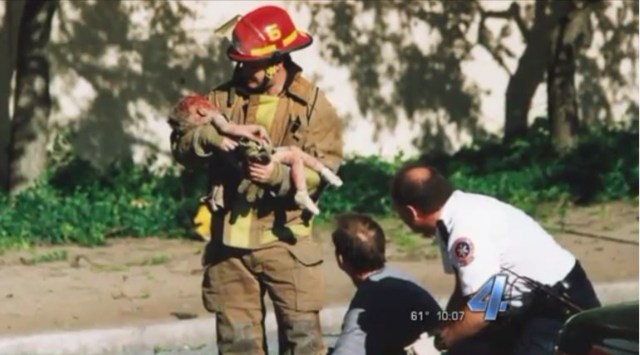
oklahoma city bombing firefighter baby

Luke 24:1-12 NRSV

It is Easter Sunday! Resurrection morning has dawned. New life is being born! Something wonderful has been lost, but something magnificent is being gained.

However, on this Sunday of Sundays, I believe it is important for us to realize that before we can experience new life, before we can celebrate resurrection, before we can sing alleluias, before love can win, somebody needed to pick up and carry a cross.

And the sad thing is that there are very few of Jesus’ disciples who understand this. They do not understand it today, and they did not understand it 2,000 years ago.

Although Jesus continually taught that to gain our lives, we must be willing to lose our lives, that Easter could not happen without some self-denial, that resurrection could not come without some self-expenditure, that new life could not be born without some sacrifice, that love could not be won without some suffering, that the the light of Sunday morning could not  dawn without the darkness of Good Friday, when the time came for the disciples to follow Jesus all the way to the foot of the cross, most all of them very selfishly fled to save their lives.

One would betray Jesus. Another would deny that he even knew Jesus. Nearly all would desert him. In spite of Jesus’ continual call to pick up a cross and follow him, most of the disciples never got it.

However, there were a few disciples who did get it. There were a few who were willing to carry a cross. There were a few who chose to live selflessly and to love sacrificially. There were a few who faithfully followed Jesus all the way to Golgotha.

Although the intrinsic sexism of this world’s history has caused many in the church to overlook these faithful disciples, the good news is that all four Gospel writers did not.

In Luke 8 we read these words: Afterward [Jesus] journeyed from one town and village to another, preaching and proclaiming the good news of the kingdom of God. Accompanying him were the Twelve and some women…Mary, called Magdalene… Joanna…Susanna, and many others…” These women helped support Jesus and the twelve “out of their own means.”

And on Good Friday, when none of the male disciples could be found, Mark 15 reads: “There were also some women looking on…among whom were Mary Magdalene, and Mary the mother of James, Joses, and Salome.

In Matthew 27 we read: “Among them [gathered at the foot of the cross] was Mary Magdalene, and Mary the mother of James and Joseph, and the mother of the sons of Zebedee.

In John 19:25 we read where all the male disciples fled: “But standing by the cross of Jesus were His mother, and His mother’s sister, Mary the wife of Clopas, and Mary Magdalene.

There are many problems with Christianity today. However, I believe one of the biggest problems with our faith today, especially here in North America, is that we have too few Mary Magdalenes.

There are too few people who understand that authentic faith, true discipleship, always involves a cross. It always involves answering a call, taking a risk, denying oneself, going against the status quo, pushing the boundaries, stepping way outside one’s comfort zone.

A problem with the church today is there are too many Christians who believe they can sing “alleluias” on Easter Sunday without going through some suffering on Good Friday, who believe they can experience some new life without death to self, who believe they can somehow rise up from the waters of baptism without getting their hair wet, who believe they can serve Jesus without getting their hands dirty.

What this world desperately needs needs right now, and what the church needs more than anything today, are more disciples like Mary Magdalene. For Mary Magdalene understood that when Jesus called people to be his disciples, Jesus was always clear that there would be a cross involved.

I think this is the reason that Mary Magdalene is remembered today by Matthew, Mark, Luke and John. This is the reason she is mentioned by name by the gospel writers more than any other apostle. And this is the reason that today, on this Easter Sunday morning, Christians all over the world will hear her name mentioned as they gather to worship.

Some will hear her name as Mark 15 is read: “Mary Magdalene and Mary the mother of Joses were looking on to see where Jesus was laid.”

Some will hear her name as Matthew 28 is read: “Now after the Sabbath, as it began to dawn toward the first day of the week, Mary Magdalene and the other Mary came to look at the grave.”

Some will hear it as Mark 16 is read: “When the Sabbath was over, Mary Magdalene, and Mary the mother of James, and Salome, bought spices, so that they might come and anoint Him.”

And others will hear it as John 20 is read: “Now on the first day of the week Mary Magdalene came early to the tomb, while it was still dark, and saw the stone already taken away from the tomb.”

Just as Mary Magdalene had given what she had to support Jesus’ life, Mary was still doing all she could for Jesus in death.

And because she always selflessly pouring herself out, because she kept giving, kept sacrificing, kept risking, serving, bending, expending, anointing, because she was the most faithful of all of the disciples, because she not only sacrificially followed Jesus all the way to the cross, but courageously followed him all the way to the grave, because she followed him to the very end, she was the first person on earth to see the risen Lord.

Mark 16:9 reads: “Now after He had risen early on the first day of the week, He first appeared to Mary Magdalene…”

And in John 20:18 we read where it was Mary Magdalene who first proclaimed the good news of Easter, speaking five simple words that changed the world forever: “Mary Magdalene came, announcing to the disciples, ‘I have seen the Lord.’”  Not only was she the first person to see the Lord, she was the first person to proclaim the world-changing, earth-shaking, life-saving good news of Easter to the world!

Mary Magdalene was the very first to preach the glorious good news of resurrection on Easter Sunday, because she stayed with Jesus until the very last in his suffering and death of Good Friday. Easter happened for Mary because she had answered a call to follow Jesus, and she followed Jesus all the way.

Observing Good Friday this year was a surreal experience for many Americans, as it fell on April 19, the day of the terrorist bombing in Oklahoma City.

The story of one survivor, Terri Talley, exemplifies the suffering experienced by our nation, as well as how new life was raised out of the ashes through those who were willing to pick up and carry a cross.

Employed by the Federal Employee’s Credit Union on the third floor of the Murrah Federal Building, that morning was extremely busy for Terri. She had just returned to work after spending several days away, and a stack of paperwork waited for her.

Catching up on work, Terri took a moment that morning to chat with her good friend and coworker Sonja Sanders. “For her, it was a big day. She had just been promoted into management,” states Terri, who is certain she was the last person to have spoken with her friend.

What seemed like just moments afterward, everything changed. At 9:02 am, thousands of pounds of explosives, assembled in the back of a Ryder moving truck parked in front of her office building, exploded.

Terri recounts: “I fell from the third floor to somewhere around the basement level. It was really really fast. It was so fast that I didn’t really know what had happened. The suction pulled me down so quickly.”

Surrounded by noise Terri says, “When I came to the first time, I thought: ‘This is a really bad dream. I will just go to sleep and when I wake up everything will be okay.’ But when I came to [again], everything wasn’t okay. I thought that I must have been in a really bad wreck, and I must be [pinned in the wreckage], because I couldn’t see anything. I couldn’t move. I couldn’t even scream for help. I would try, but I was really squished. And I thought to myself: ‘I hope someone finds me.’”

Terri was found by a firefighter who almost overlooked her. [Like being sealed in a tomb] she was completely encased in concrete and granite. Terri says: “There was just a little hole and a little piece of me was showing. He touched me and … started screaming: ‘Hey! I have a live one here, and I need some help!'”

After much hard work, Terri was freed and rushed to a nearby hospital, where her injuries were identified: temporary blindness, a concussion, temporary amnesia, a cracked first vertebra in her neck, a broken right ankle, skin damage on her foot, and multiple abrasions. During her seven days in the hospital, and for weeks following, a sense of shock permeated her life.

However, today, she has this powerful message for the world:

I always tell [even] the littlest of kids: ‘Don’t think that there is nothing you can do, because kids would color pictures and send me notes. Those made me feel like people were really thinking about me. You can always do something, no matter what age you are.’[i]

This illustrates that to experience Easter Sunday, we have to have a Good Friday.

Before new life could be experienced, before resurrection could be celebrated, before “alleluias” could be sung, before love could be won, somebody needed to pick up and carry a cross.

-First Responders needed to run toward an explosion.
-Firefighters needed to go into a burning building.
-Doctors and nurses needed to give all that they had to give.
-Friends and family and church members needed to pray.
-And little children needed to pick up some crayons and color a picture.

To make Easter happen for someone–today, right here, right now–we can all do something, be something, risk something, sacrifice something, give something, create something.

We can all pick up and carry a cross.

We can feed someone who is hungry.

Visit someone who is lonely.

Love someone who is hurting.

Include someone who has been left out.

We can mentor someone who lives in a foster home.

Care for someone who is sick.

Forgive someone who has made mistakes.

Believe someone who has been abused.

We can share grace with someone who faces discrimination.

Stand up for someone victimized by injustice.

Speak out for someone devalued by oppression.

We can stay close by and anoint someone who is dying.

Be a friend to someone who is grieving.

With the spirit of Mary Magdalene, let’s keep the faith, and let’s keep the faith going, keep it moving forward, all the way to the foot of the cross, through the betrayals, through the fear, through the denials, through the suffering, through the shame, all the way to the grave, even to a tomb that has been sealed by granite or concrete.

Let us keep doing whatever we can, with whatever we have, wherever we are, to love one another until the entire world is able to sing:

“Alleluia! Alleluia! I have seen the Lord!”


[i]https://www.nps.gov/okci/learn/historyculture/stories.htm

Choose This Day

rile up the gov't

Growing up in church, I was taught that the Christian faith, and life itself, was primarily about a choice.

It is about a choice to accept Jesus as personal Lord and Savior or to reject Jesus. It’s about a choice to spend all of eternity in heaven with God and his angels or to forever burn in hell with the devil and his angels.

In church, I was also taught that I could not afford to wait to make this choice. I needed to make a decision before we finished singing the last hymn, because if I didn’t, the Lord could return or I might get killed in a car accident on the way home, and it would be too late. So, there was a sense of urgency instilled in me to make this choice.

I was also taught that if I didn’t make a choice, I was actually making choice. Not to choose was to choose.

For me, it wasn’t a very difficult choice to make. “Preacher, you are saying that if I choose to accept Jesus as my personal Lord and Savior, I get to live in paradise forever? But if I don’t, I am damned to hell for the same amount of time?” Well, preacher, how fast can you schedule my baptism?!

The problem is that the gospel writers never record Jesus presenting such a choice. Although, I’ve heard countless preachers point to our scripture lesson here in Luke 23, and try to say Jesus is presenting this choice, Jesus never does.

The irony is, that here in Luke 23, the chapter that has the story of the infamous thief on the cross that Jesus says will be with him in paradise, we are presented with a choice. And it is a choice that each person born into this world must make. We must choose our kingdom.

Jesus talked about “kingdom” more than almost anything else. Over 100 times in the Gospels Jesus announces that he is building the “Kingdom of God,” and implies almost every time that he needs people like you and me to help him. He taught us to pray: “Thy kingdom come. Thy will be done on earth as it is in heaven” (Matthew 6:10, KJV).

Jesus’ message compels us to make a choice to live, work, pray and love in ways that bring God’s Kingdom to this world. And, just like I was taught growing up in church, making this choice is an urgent matter. In fact, I believe it perhaps is more urgent today than ever.

And it is in Luke 23 we learn that it was this urgent message that put Jesus on the cross.

The assembly [of the Elders of the people, including the chief priests and the scribes] rose as a body and brought Jesus before Pilate. They began to accuse him, saying, “We found this man perverting our nation, forbidding us to pay taxes to the emperor, and saying that he himself is the Messiah, a king.”

Then Pilate asked him, “Are you the king of the Jews?”

He answered, “You say so.”

Then Pilate said to the chief priests and the crowds, “I find no basis for an accusation against this man.”

But [religious supporters of Caesar] were insistent and said, “He stirs up the people by teaching throughout all Judea, from Galilee where he began even to this place [even here in Jerusalem, here in the capital city!].

And when he learned that he was under Herod’s jurisdiction, he sent him off to Herod, who was himself in Jerusalem at that time. The chief priests and the scribes stood by, vehemently accusing him. Even Herod with his soldiers treated him with contempt and mocked him; then he put an elegant robe on him, and sent him back to Pilate (Luke 23:1-11).

It is obvious that Jesus did not rile up the government and the religious establishment by asking people the question: “When you die, do you know where you are going to spend eternity?”

To understand exactly what Jesus is talking about when he talked about “Kingdom,” it is important understand something about the Kingdom into which he was born.

Rev. Joe Kay, UCC Minister from Ohio, describes the Kingdom of Caesar this way:

“It was a Kingdom ruled by the empire’s values of violence, dominance, supremacy, wealth, privilege, and self-interest. Life was cheap, and economic injustice was rampant.”

The empire’s leaders acted in narcissistic ways. As John Dominic Crossan notes in his book God and Empire, Caesar Augustus assumed the titles of “liberator,” “savior,” “redeemer,” and “lord.” He saw himself as the divinely chosen leader of the greatest empire in the world.

Caesar’s supporters praised him constantly and advanced his agenda. His base of support included religious leaders who were co-opted into doing the empire’s bidding in exchange for maintaining their own wealth, power, and privilege.

Religion and Rome were intertwined, working together to advance the empire. Then Jesus came along and challenged it all.”

In fact, this is exactly how his birth was announced by the Angels with the sentence:

“Glory to God in the highest and peace on earth to those with whom God is well pleased.”

As I mentioned during the season of Advent, this phrase is almost a direct quote from the decrees of Caesar Augustus.

Each time Augustus made an imperial decree to support the Roman occupation of the Near East, the following words opened the decree: “Glory to the most august Caesar (who was otherwise known as God in the Highest), and peace on earth to those with whom the god Augustus is well pleased.”

Thus, the Christmas angels sang the Emperor Augustus’ imperialistic words. When Jesus was born in Bethlehem, there was a royal decree: “Glory to God in the highest! There’s a brand new kingdom in this world!

Every time Jesus taught and preached about the Kingdom of God, Rev. Kay notes “he was essentially saying: you’ve already been born into Caesar’s kingdom, but now is the time to enter into a completely different realm. You need to be born again into God’s kingdom, into a realm that operates by values that are in stark contrast to the values of Caesar.”

Love rules in the place of selfishness.

Kindness in the place of cruelty.

Generosity in the place of greed.

Humility in the place of pride.

Social justice in the place of inequality.

Mercy in the place of fear.

And grace rules in the place of judgment.

It is important for us to understand that Jesus never talked about the Kingdom as if it were just some future event in the sweet bye and bye. He proclaimed that the Kingdom was already here—a place of unlimited love and unending compassion. A place where everyone is welcomed, especially the marginalized. A place where nobody is ever treated like an outsider. It is a place where even condemned thieves are forgiven and promised paradise.

It’s a place where healing is offered to all. It is a place where peacemaking is valued over warmongering, and where the lowly and the least are treated as the greatest.

The operating values of Caesar’s kingdom — power, greed, wealth, privilege, self-interest — are rejected, resisted and rebuked in God’s Kingdom.

And today, right now, we have a choice. Which kingdom will we choose? Whose values will we live and enact and advocate in our communities and our world?

It can’t be both. And as much as we want to, we can’t try to live with one foot in both worlds — that does not and will not work. As Matthew remembers Jesus teaching, “no one can serve two masters.”

It’s either one or the other.

And like I learned growing up in church, we can not avoid choosing, because not to choose is to choose. To simply go along with the status quo is a choice to support those who rule over it and protect it. If we do not challenge Caesar, we are in league with Caesar — we have chosen his kingdom over God’s Kingdom.

Also, as I learned growing up in church, we cannot delay making a choice. We can not afford to wait. And it is not because we may get into a car accident on the way home from church this morning. It is because the times in which we live are too serious, the problems of this world are too great and the hate in our world is too strong.

Furthermore, Jesus said the kingdom of God is not a future event. It is here, and it is now. And we are invited to become part of it at this very moment.

We have a choice to make… today.

As Crossan puts it: “God’s kingdom is here, but only insofar as you accept it, enter into it, live it, and thereby establish it.”

And everyone is invited to join. There are no barriers, no borders, no walls. All are welcomed and all means all, but citizenship does come at a cost. Choosing to establish God’s Kingdom in this world is a much more difficult than choosing which kingdom you want to live in the next world. For God’s kingdom unavoidably confronts and challenges the many Caesars that are always in our world, along with their ardent supporters and their devoted religious minions.

And they’ll use every one of Caesar’s tools to protect their privilege and power — bullying, harassment, intimidation, self-promotion, lying, verbal and physical violence.”

The gospels tell us that the kingdom of Rome and its religious supporters conspired to get rid of Jesus and his message to establish the Kingdom of God. And the same thing happens today.

The supporters of Caesar have completely changed the message of Jesus. They have twisted the gospel and perverted the faith. They teach that the Kingdom of God is a future place we experience when we die, not a place we are to live today. They say that the gospel is about personal salvation, not world transformation. They preach that Jesus wants to enter our hearts, not enter Jerusalem, Little Rock or Washington DC.

And at times, it feels like Caesar’s kingdom is invincible, that it is Caesar who will have the final say. The good news is that Good Friday is always followed by Easter Sunday.

“And in every moment we have trouble recognizing God’s kingdom in our world and in our lives, Jesus says: Look a little closer, love a little stronger, believe a little deeper. And you will see, it’s right here.”

And Jesus invites us all to enter this place of life, love, and healing right now.

Let us pray together.

O God, may thy Kingdom come, thy will be done, on earth as it is in heaven. Amen.


https://sojo.net/articles/religion-and-power-were-intertwined-then-jesus-challenged-it-all?fbclid=IwAR0_D94N5pdJ2CFbIT4SVTzjPjAJc4-Xv70fQy2Di045VPOesGdkm4mmpek

Forward Together

If our can't fly run

Isaiah 43:16-21 NRSV

They say that hindsight is 20/20. Sometimes, it is easier to see more clearly what is really going on in the world when we are looking back. They say history is the best judge. I believe this is particularly true when it comes to faith.

The presence of God seems to be more recognizable when we look back.

Looking back, we say: “If it were not for God’s abiding presence, there’s no way I would not have gotten through that!” “During the storms of life, at the time it was difficult to see God, but looking back it was obvious that God was undeniably present.”

Looking back, we clearly see God’s hand during the divorce, through the sickness, in the miscarriage, at the death.

Looking back, we plainly see God helping us to learn from mistakes, grow from painful experiences.

Looking back, we see God working all things together for the good, wringing whatever good can be wrung out of life’s most difficult moments.

Looking back, we can see God, reconciling, creating, recreating, resurrecting.

Looking back, we say, “Yes, I am a better person today because what happened yesterday. Although, I could not see it at the time, that period of struggle was the best thing that happened to me.”

Which raises the question about today? Where is God in the present? What is God doing in our lives at this very moment? What is God up to in the world today? And the more important question, are we able to see it? Or do we have to wait 5-10-20 years to see it?

This may have been what was going on with the Israelites when Isaiah preached the sermon in our scripture lesson this morning.

Some scholars believe the Israelites were on their way back from exile in Babylon. They were on a long and treacherous journey through a desolate and dangerous wilderness. Food, water and shelter were scarce. Protection, minimal. So it was not uncommon for people die in the wilderness.

Then Isaiah proclaimed: “The same God of the great Exodus who liberated your ancestors from Egyptian slavery by making “a way in the sea, a path in the mighty waters” (Isa 43:16) promises to do something brand new: God will make a “way in the wilderness” (Isa 43:19).

“So, stop looking back on those good old days, where God’s presence was so clear, so evident and so real, because God is working even now to create good new days! Bring your faith in the God of the past into the present!” preached Isaiah.

Other scholars believe the prophet was addressing Israelites who had already made it back to Jerusalem, and instead of finding the home they remembered and loved, they found an abandoned city in ruins. Having made their dangerous journey through the wilderness, they found themselves in even more danger. Rather than the safety and comfort of home, they found themselves constantly threatened by enemies who had taken control of the land in their absence. The stories of Ezra and Nehemiah tell us how dangerous it was for the people who worked to rebuild the ruined city. At one point, Nehemiah encouraged everyone working on the rebuilding of the city to carry swords for protection (Neh. 4:17-18)!

So, the prophet was preaching: “You can’t go back, but the same God you clearly see in the past is about to do something brand new to help you move forward with God into a new day!”

But moving forward is almost always one of the most difficult things to do. Moving forward is scary. Perhaps that’s because, without the advantage of hindsight, it is more difficult to see God at work today and tomorrow than it does to see God at work in the past.

But moving forward is what our faith is all about, and it is what it has been about since the very beginning. Once Adam and Eve obtained the knowledge of good and evil, there was no going back, no undoing it. It’s like they say, once you see something there is no unseeing it.

But, in the shame of who they were and what they had become, hiding naked and exposed in the trees, God finds them, then with God’s own hands, makes garments of skin and graciously clothes them. Adam and Eve cannot go back to the good old days of blissful paradise, but now clothed with grace, by the very hands of God, they can go forward with God into good new days.

Cain kills his brother Abel and is excommunicated to the land of Nod. Cain can not undo what he has done. He cannot go back. But God promises to go with him into a new reality and marks him with grace.

The truth is: most of us right now desperately need to hear these words of God, “Behold I am doing a new thing.”

Isaiah understands this need. He is saying: “I know, life may not good for you right now. Some of you are doubting today that will see tomorrow. Although you have experienced the hand of God in your life before, it’s very difficult for you to see that holy hand now. It is hard for you to keep the faith and move forward.”

I believe it is this dilemma that is the death of many churches today. Churches can see God in the past, but they have difficulty seeing God in the present. Ask yourself: “What are the new things that God is working on with us here at First Christian Christian in Fort Smith? What new things is God leading us to do? What new places is God leading us to go.”

“What’s that did the preacher just say? Did he say “new things” and “church” in the same sentence?  New? Doesn’t he know if we’ve never done it that way before, it just can’t be done.

“Behold I am doing a new thing! Can you not see it?”

I believe this may be the most important question we can ask ourselves. “Can we not see it?” Are we capable of seeing the new thing that God is doing in our world? Are we able to open our eyes and see the new world unfolding before us? Are we ready for the new thing that God wants to do in us and through us?

This past week, I read an article that reminded me why this was so important.

On the week of the 51stanniversary of the assassination of Rev. Dr. Martin Luther King, Jr, the article pointed out that the majority of the nation today looks back with reverence and great fondness on Dr. King. We look back, and we can clearly see God at work in him and through him.

However, at the time of his death, Dr. King was one of the most reviled men in the United States. His message of liberation for people of color, Native people and poor people was widely rejected. According to a 1968 poll,75 percent of Americans disapproved of him.

Now, the majority of Americans who were not alive or adults in the 1960’s look back and would like to believe that we would have be in that 25 percent. But would we? Or, back in the mid-60’s would Isaiah’s words convict our hearts, “God is doing a new thing through this young black preacher from Georgia, can you not see it?”

After all, many of the conditions that he marched, boycotted and spoke out against still exist today. Some say that although we’ve made some progress, we have taking a giant step backwards in the last few years when it comes to racism, sexism, materialism and militarism.

And yet, even as we look back today on Martin Luther King Jr with great admiration, much of America condemns the activists today, in the same way he was condemned 51 years ago.

Many detest those today who are speaking out, sitting in, kneeling and marching against the same conditions. If you took a poll today, I believe you would find that the majority of the country disapprove of movements that are demanding justice for Black men, women, and children killed by police, proclaiming that Black Lives Matter. Most people are leery of people crying for justice for women in the #metoo movement. Most are indifferent to justice movements for immigrants and justice movements for Indigenous peoples like Standing Rock, as well as justice movements for trans, binary, and gender-nonconforming people.

Dr. William Barber, who is currently continuing the work of Dr. King’s Poor People’s Campaign, has his life threatened constantly.

Which makes us wonder. What would we have done if we were living in South Africa during Apartheid or Germany in the 1930’s? What would we have thought of Harriet Tubman, Frederick Douglass and Sojourner Truth, or even abolitionists like Barton Stone and Alexander Campbell?

And what would we have thought of that radical Rabbi named Jesus? What would would our conversations be around the dinner table after we heard the reports—of him breaking the laws of the Sabbath? Touching lepers? Including women as his disciples? Demanding that people sell all of their possessions and give them to the poor? What would be our response to his sermon that encouraged people to turn the other cheek, give the shirt off their back, forgive their enemies, love everyone and take up a cross? What would we have said in response to the news from the women who said that he was not dead, but had risen just as he said?

Would we have been able to see God at work in and through Jesus?

Sometimes we are ready to see something and sometimes we are not. Last week, we were reminded that the so-called “Prodigal” son had to hit rock bottom before he could hear God speaking to him. In today’s Hebrew scripture, Isaiah points out that, as wonderful as God’s new thing was, people may have a difficult time seeing it. Which begs the question: What makes us able to see God at work in the world?

Perhaps you heard the story about the guy who bought a pack mule? The seller of the Mule said: “This mule will understand every order you give him. All you need to do is tell him where he should go and what he should do, and he will do it every time.”

However, when the buyer got home and tried to get the mule to go forward, the mule refused. He couldn’t get the mule to take one tiny step forward. So he took the animal back to the original owner and said, “You lied to me. When I give him the simple command to go forward, this mule won’t move an inch.”

The seller looked at the mule, looked at the buyer, then picked up a two-by-four and whopped the mule on the backside and then said “go forward.” The mule went forward.

The buyer said, “what on earth did you do?”

The seller smiled. Then he said, “Well, sometimes you just have to do some dramatic to get the mule’s attention.”

I wonder if that’s applies to us too?

Whatever it takes, I pray that something gets the church’s attention today, right now, so that we are able to see God at work in our world, so we can join God in that work.

For behold God is doing a new thing. Can you not see it? And God wants us to move forward.

And in the words of Dr. King, if we can’t fly, let’s run. If we can’t run, let’s walk. If we can’t walk, let’s crawl. But whatever we do, let’s keep moving forward. Forward together, not one step back.


Turn Yo Sef ‘Roun Now

we alone get to choose

Luke 13:1-9 NRSV

Most of you know that I had the opportunity to serve with a congregation in Baton Rouge for three years.

One of the great things about living in southern Louisiana were the countless stories I heard about two infamous Cajuns named Boudreaux and Thibodeaux.

Reverend Boudreaux was the part-time pastor of the Boondock Bible Church and Pastor Thibodeaux was the minister of the Backwoods Gospel Church located directly across the road. One day, they were both standing out by the road in front of their churches, each pounding a sign into the ground as fast as they could. The sign read:

Da End is Near
Turn Yo Sef ‘Roun Now
Afore It Be Too Late!

As soon as the signs got into the ground, a car passed by. Without slowing down, the driver leaned out his window and yelled as loud as he could: “You bunch of religious nuts!”

Then, from the curve in the road they heard tires screeching and a big splash.

The Reverend Boudreaux yells at Pastor Thibodeaux across the road and asks:

“Do ya tink maybe da sign should jus say ‘Bridge Out’?”

Now, because I am a seminary-educated minister that has spent the bulk of my ministry preaching from mainline, city pulpits, I have always sought to differentiate myself from the so-called religious nuts. The repent-or-be-sent, turn-or-burn, reach-for-the-sky-or-fry, get-saved-or-get-microwaved style of preaching has never been a part of my repertoire.

Thus, when I preach a passage of scripture like our gospel lesson this morning, I have steered away from any interpretation that sounds like what Jesus is actually saying here is: “The end is near! Ya betta turn yo sef ‘roun now! A fore it be too late!”

For example, I have used this passage as an opportunity to have a deep, theological discussion on the problem of evil. I have said that here, in this passage, we have two basic types of evil in the world. There is natural evil, and there is personal evil.

The tower of Siloam, I have said, represents natural evil. In this fragmented world, sometimes tornadoes and floods destroy property and take lives.

And the Galileans massacred by Pilate, represent personal evil. In this broken world, sometimes a broken person will grab a gun, then walk into a peaceful of worship begin shooting everyone in sight.

And with Jesus’ very emphatic response, “No, I tell you!” Jesus is saying that God does not will such tragedy because of human sinfulness or any other reason. In this imperfect world, sometimes bad things happen to very good people, and there is no divine explanation or driving purpose for it.

However, maybe, to avoid sounding like a religious nut, I have actually missed the very simple point of this passage which is, “The end is near. Ya betta turn yo sef ‘roun now! A fore it be too late!”

Maybe the point that Jesus is really trying trying to make here is: “Unless you repent, you will perish.”

You have a little more time, but unless you start producing some figs, start bearing some fruit, at least start sprouting a bloom or two, you are going to die.

“But, Dr. Banks, that sounds too much like the hell, fire and brimstone sermons of those country backwoods churches, and you know that we moderate, mainline, sophisticated churches are way too smart for that.”

However, I have a feeling that through this passage Jesus is arguing that we may be too smart for our own good!

Luke tells us that people had gathered together, and they started doing what people do best when they gather together, even in the church. They began to gossip, especially about the sinfulness of others, the sinfulness of “those” people. “Those” people who had this tower tragically collapse on top of them.

Sadly, I believe this may be the only reason some people go to church these days: to hear about the sins of all those who are not in church, to feel good, religious, superior, righteous.

And Jesus is emphatic, “No, I tell you!”

It is as if he is saying: “You better stop judging your neighbors and start taking a look at yourselves. Stop worrying about the speck in your neighbor’s eye and worry more about the log in your own eye. Look, bad things happen this world. People die. It’s not a matter of degrees of rightness or wrongness, sin or sainthood. Everyone dies. And one day, you are going to die. So, you better repent. You better change. Ya better turn yo sef roun now. A fore it be too late!

And to drive the point home, Jesus tells the story about a fruitless fig tree. And the moral of the story is simple. Bear fruit or die.

Reverend Sharron Blezard believes this text is begging the church today to ask: “What are we doing to bear fruit, to bloom where we’ve been planted?”

She says that far too many congregations are merely existing like a barren fig tree, wasting the soil. There are no signs of any fruits, no promise of any blooms. These churches exist primarily to get together, and sadly to do what people do best: to gossip, to talk about the sinfulness of those outside the church, to lament about the moral decay of society, and to pine for the return of good old days.

And they’ve lost hope. They’ve grown too weary, too worn down, too disheartened to invest the energy, creativity, and passion to share the Good News of Jesus with a broken and hurting world. While many congregations do provide a place to take care of one another, they have no sense of mission to be the Body of Christ that is sent by God into the world bearing fruit.

She says, think of it this way: fruit always “grows outward from the plant into the light. So, too, a healthy church grows outward.”

Several years ago, my mother gave me a Rose of Sharon root. She told me to plant it, and it would grow to be one of the most beautiful plants in my yard, with its flowers blooming all summer long.

After planting the root, the plant grew, it did not produce a single bloom that summer. I called Mama and said, “I think you must have given me a dud.”

She said, “Oh no. It’s not a dud. It just needs a little TLC. You may need to dig around it, give it a little fertilizer. You may even need to dig it up all together and plant it in better soil. Make sure it is in soil that can soak up water and is growing in a place where it can get good light.”

As always, I did what Mama told me to to do. I ended up transplanting it to a spot that had better topsoil. I kept an eye on it, watered it, cared for it, and the next year, just like mama said, it produced the most beautiful blooms all summer long.

From the short time that I have known you, it is obvious that God has given this church many good gifts. The talents and resources that are here are astounding. There is not one dud in this room. And because of that, God expects us to be fruitful with those gifts. God expects our church to bloom.

I believe Jesus is asking us to take a lesson from a barren fig tree. To bloom and bear beautiful fruit will require some work, some sacrifice. We may need to dig around, put out some fertilizer, even transplant a thing or two. It may take some cutting back, pruning, shaping and nurturing.

Yes, it is scary. It is difficult. It is risky. But, Jesus says that it is the only way to life, the only way to bear fruit that nourishes the world.

Eddie Hammett, my friend and church consultant, loves to say that Christians need to stop going to church, and start beingthe church.

I believe he is talking about the difference between a church that is inward focused, therefore barren, and one that is outward focused, therefore bearing fruit for the world.

Hammett says:

Going to church is routine and easy. Being church in the world is challenging, difficult and calls for prayerful intentionality. Going to church keeps us safe…. Being the church makes us uncomfortable and challenges us to learn to BE salt, light and leaven. Going to church is familiar….Being the people of God as church is unfamiliar to many and overwhelming to most. May we press on in the faith…

And as much as I may want to avoid sounding country-fied religious nut in the boondocks and speak only articulate, sophisticated words that make us comfortable from this mainline pulpit in the middle of the city, maybe what we really need to hear is that the time is coming, the day is approaching, as it was for that barren fig tree, there’s going to be an accounting.

What we really need to hear is that we must bear fruit or die. What we really need to hear is: “The end is near, so ya betta turn yo sef ‘roun now! A fore it be too late!”

May we use the gifts God has given us to press on in the faith, step up and out in our discipleship, do the hard work of getting out the fertilizer and the shovel, doing some digging, getting our hands dirty to produce something sweet.

In the words of John Pavlovitz: “For in the end, when our time here on this earth is done, the world will be more or less kind, gentle, loving, joyous, peaceful generous and good because of our presence here, and we alone get to choose.”

There’s a big world out there, a world that is thirsting and hungering for the love of God. May we go out and bloom, bearing fruit in the image of Christ.

O God, forgive us for sometimes softening your words to make them more comfortable for our itching ears. Grant us a spirit of selflessness where we are selfish, a spirit of courage where we are afraid, and a spirit of urgency where we are complacent. Help us to change where we need to change, to work where we need to work, and to bloom, to bear fruit in a world that hungering and thirsting for your love.