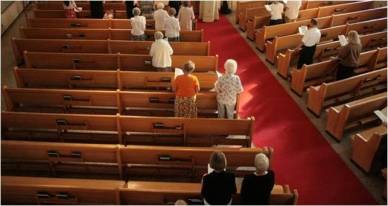
Bright-Eyed and Bushy-Tailed

Life is short

Luke 9:28-36 NRSV

One day, mama called me to tell me that her favorite first cousin had passed away.  He was only 63.  I then shared with her that I had just received news that a good friend who was in my class from college died very suddenly that week. I then proceeded to offer my sincere empathy.

It was then that mama started preaching as only my mama can.  There is never any sugar-coating with mama. It is always and only the truth and that truth comes at you so hard, sometimes is like getting hit upside the head!

Mama said, “Jarrett, your life could end any day just like that.”

I then heard this clicking sound. I said, “Mama, what is that.”

She said, “That was me snapping my fingers.”

“Jarrett, life is just a vapor, so you better be sure they make the most the little time you have left.”

As much as it pains me to admit it, the truth is, mama could not be more right.  She always speaks the truth whether or not she thinks I can handle the truth. This journey, this trip, this ride we call life is a relatively short one. And it would be a shame for any of us to miss it.

A preacher tells a story of sitting on airplane waiting to take off.  His seat number was 14D. The woman next to him sat in 14E.  No two seat mates could have ever been more different.

From her dress you could tell she was far from sophisticated. His finely pressed suit and shining shoes reflected affluence and sophistication. From her talk you could tell she was but a simple country woman.

He sat there beside her with his leather brief case and laptop computer.  She was surrounded by all kinds sacks and bundles.

It was obvious that she hadn’t had much experience with flying. “I don’t do this much,” she grinned. “Do you?”

He politely nodded a “yes.”

“Well, aren’t you lucky, that must be a lot of fun,”  She said.

He groaned—for he knew that it was going to be a long flight.

She volunteered that she was going to Dallas to see her son. And she filled in all the blanks—the boy has had the flu, a stomach virus really.  He’s had stomach problems every since he was a baby.  He has a back lab. The dog’s name was Wilbur. Wilbur is such a good dog. A little hand-full when he was a puppy, but now a lot calmer. As the plane climbed, she looked and pointed out the window. “Ooooooh—would you look at those trees down there; they look just like peat moss.”

People turned around in their seats and stared.  The preacher next to her wanted to crawl under his seat.

The flight attendant came by asking what they’d like to drink.  He quietly asked for a coffee.  His seat mate asked a second time about the choices. “Now tell me again what you’ve got.”

When her drink came she said she didn’t know that apple juice came in cans, but it sure was delicious. “I thought it only came in a great big jug.  I wonder if they got these little cans at the Winn-Dixie.”

And when the sandwich came by she said in way too loud a voice: “Why there’s even a little packet of mayonnaise in here.  Isn’t that cute?”

This went on the whole flight. The little woman did not miss a thing.

The preacher said that the men in front of them were discussing a business trip to Japan. The fellow behind them must have been a nervous wreck for he kept ordering two beers at a time. The woman across the aisle had important-looking papers stacked all around her. And as he opened his laptop and began to work, it occurred to him that the only person on the whole plane who was truly enjoying the trip was the crazy woman sitting next to him.

When the plane finally landed, she turned and said, “Now wasn’t that a fun trip?”  And as he watched her head down the aisle and leave the plane, he began to wonder: What was it that she had that he didn’t have?  What was it that she knew that he didn’t know?  Why had she enjoyed the whole trip from beginning to end while he was absolutely miserable?

Jesus took three disciples up to the top of a mountain. It was the midpoint in Jesus’ journey. The clouds were hanging over his ministry. The Pharisees and Saducees were making it increasingly difficult for him.  His disciples were constantly bickering with one another. Jesus was beginning to talk to them about suffering, Jerusalem and the cross. He talked about saving one’s life by losing it. He talked about dying to self to live forever.  And the disciples didn’t really understand any of it.

And then Jesus took Peter, James and John to very top of a high mountain, and there on the mountaintop something happened.  We’re not sure what occurred, but they called it transfiguration, which means transformation, change, metamorphosis. They began to see things that they had never before seen; more importantly, they began to see Jesus in a way that they had had never before seen.  Even Jesus’ clothes were transformed.

Then God spoke, saying, just as he did at Jesus’ baptism: “This is my son, the beloved…Listen to him.”  Listen.

This encounter turned the disciples inside out. It changed their lives and they were never quite the same again.

Now, you may be wondering what this story of Jesus has to do with the woman and the preacher on the airplane.  The answer is: Absolutely everything.

Roger Lovette has said that there comes a time when all of us need to disengage. From time to time all of us need to stop, look and listen.  We need to quit doing and just be. That’s very difficult for most of us living in the 21st century. For most of us believe we always gotta be busy doing something.

Robert Fulghum tells about a woman who was so stressed out she went to see a psychiatrist. After listening to her for a long time, he wrote out a prescription and handed it to her. She read the words the doctor had written: “Spend one hour on Sunday watching the sunrise while walking in the cemetery.”  Against her better judgment she followed the advice. One Sunday morning, as the sun came up, she stood in a cemetery, listening to the birds and watching the world come alive all around her. On that morning, she found herself back in touch with her life again.

We need to open our eyes to truly see the miracle of this wonderful journey we call life. On her journey, the woman on the plane saw. And the preacher sitting beside her missed the whole experience.

2 Peter 1:16 reads: “We have been eyewitnesses to majesty.”  What a wonderful thing to say about the Church!  One paraphrase says: You do well to pay attention. For when we pay attention, everything changes.  We may see things that we’ve never seen before.

Frederick Buechner has said in one of my favorite quotes:

if you really keep your eyes peeled to it and your ears open, if you really pay attention to it, even in the most limited situations, God through life itself has something to teach you.”  “Taking your children to school.  Kissing your wife goodbye.  Eating lunch with a friend.  Trying to do a decent day’s work.  Hearing the rain patter against the window. There is no event so commonplace that God is not present within it, always hiddenly, always leaving room to recognize him or not to recognize him, but all the more fascinatingly because of that, all the more compellingly and hauntingly.

Buechner continues:

If I were called upon to state in a few words the essence of everything I was trying to say as a novelist and a preacher it would be something like this: Listen to your life.  See it for the fathomless mystery that it is.  In the boredom and pain of it no less than in the excitement and gladness:  touch, taste, smell your way to the holy and hidden heart of it, because in the last analysis, all moments are key moments, and life itself is grace.

When we pay attention to life, everything changes. We are given a brand new perspective. The transfiguration text says that when it was all over the disciples saw only Jesus.  The disciples were able to see the big picture. They remembered God had said, “This is my beloved Son.”  Thus, even when Jesus suffered, they would later understand that God was in it.  Even if it did not work out the way they thought it would—God was in it.  Not causing the pain, not willing the suffering, but present, working in it, transforming it, changing it, resurrecting it.

Very slowly they began to see this was a large thing, —this Jesus, this thing called discipleship, this thing called the church, this glorious thing called life.  And it was all sheer grace—unmerited, undeserved.  And everything changed.

Before I started running with Ainsley’s Angels, I would play golf with a group of retired men from my church. Most were in their mid to late-seventies, some in their eighties. One was ninety.

One sunny morning, as I walked up to join the group at the tee box, I remember making as casual remark: “It sure is a beautiful day, isn’t it?”

One of the men said, “Preacher, every day I wake up is a beautiful day.”  The other retired gents were quick to respond by saying, “Amen.”

Like the woman on the plane, the woman in the cemetery and the disciples on the mountain, those retired golfers saw it, they saw it.  My prayer is that all of us will be able to see it too. May we take some time to stop, look, and listen. May we slow down and pay attention. Open our eyes to see the sheer grace of it all. And then thank God for it. And live our lives being eternally grateful for it. Taking nothing for granted.

Life is short.  Life is a vapor. Our lives are going to be over before we know it.  Just like that (snap fingers).  I pray that none of us miss it.
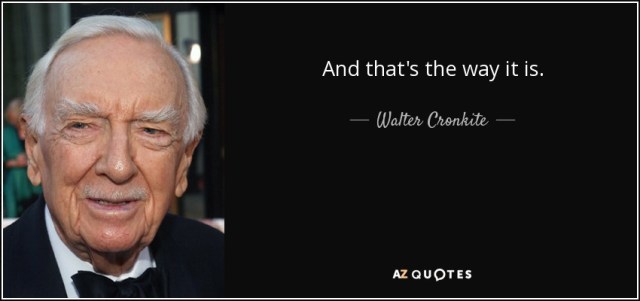
The Real World

Walter Cronkite

Luke 6:17-26 NRSV

Dishonest, greedy politicians. Drug addiction. Gun violence. Russian collusion. Racist public policies. Perpetual war. Poverty. Haitian protests. Homelessness. Immorality. Inequality. White Christian Nationalism. Child abuse. Climate Change. Bigotry. Mental illness. School shootings. Sexism. Suicide. Sick religion.

Billy Joel once sang: “We didn’t start the fire. It was always burning since the world’s been turning.”

In other words, this is the way it is, and this is the way it has always been. This is reality. As Walter Cronkite used to sign off after talking about

Watergate, Vietnam, Charles Manson, Patty Hearst and the murder of John Lennon: “That is the way it is.” In other words: This is the real world.

Which raises a very important question: What is reality? And who gets to define reality. Who gets to say what is real in a world where, in the words of Plato, there is obviously “more shadow than truth?”

The world is forever telling hopeful, progressive Christians like myself to “get real.”  “Bleeding heart preachers like you are out of touch with the real world.” “Things are not getting any better.” “He’s never going to change.” “She is not going to ever be able to take care of herself.” “Preacher, you are wasting your time.”

“You know, I think faith in God is fine and all, belief in a higher power of love and justice is okay, but sometimes you just got to get real.”  “You say what now? That selfless, inclusive love can change the world? That love wins?” “Preacher, it’s like you are living in another world.” “You need to come off of all that progressive idealistic thinking and hoping and believing and face the facts!”

The world is forever telling people like me: “Wake up ‘cause you must be dreaming.” “Open your eyes man.” “Hello?!” “Get your heads out of the clouds, and get real.”

All of which begs my prior question: “What is real? What on earth is reality?” “What are the real facts of life?” And “Who gets to say what is real?”  Who gets to define reality?” “Who gets to name the facts of life?”  “Who is ultimately in charge of this world in which we live?” “Who gets to say the reason we are all here and the direction the world is heading?”

Do we really come into this place Sunday after Sunday to escape from the real world? After all, we do call it a “sanctuary.” When we enter this sacred space where all are welcomed, accepted and loved equally and unconditionally, are we entering into some sort of never-never land? What are we really doing here in this hour with all of our singing and hoping and praying and preaching and eating and drinking from this table?

Maybe it would help us to listen again to one of Jesus’ very first sermons. Now, you might think that Jesus would use his first sermon to tell us what to do. For isn’t that the purpose of a sermon? To learn what we must do in order to live a better life? You come to this sanctuary every Sunday to get some advice on how to survive out there in the real world.” Right?

But this doesn’t seem to be the purpose of this sermon in Luke. Jesus is not telling people what to do out there in the real world. Instead, Jesus is defining the real world. Jesus is telling the crowd what’s what. “Here are the facts” says Jesus. “This is the way life is.” “This is the real world.”

Jesus begins his sermon by pointing out the people in the world who are blessed. Jesus doesn’t tell people what they must do in order to be blessed; rather, he simply announces that certain people in this world are blessed. The entire first half of Jesus’ sermon is simply a list of facts.  He’s simply stating the facts of life. He’s telling us the way things really are in the real world.  In one of his very first sermons, Jesus is defining reality.

And it was as obvious to his first hearers as it is as obvious to us today, that according to Jesus, the way things really are in the real world is nowhere close to the way we thought they were. In a few simple statements, Jesus turns the whole world completely upside down. If you thought God was in the business of damning the sinner and rewarding the saint, Jesus says: “You better think again!”

Blessed are the poor—the same people whom we overlook, disregard, despise and consider failures, worthless. Blessed are the mothers who can barely take care of themselves, much less their children. Blessed are the fathers who are doped up and locked up and all together messed up.

Blessed are the hungry—the same hungry people who we know must be lazy or inept. Blessed are the ones who we think are always looking for a hand-out instead of a hand-up. Blessed are the unwaged and unemployed who we believe are solely responsible for most of their misery.

Blessed are those who weep—the same whiners and complainers who are always acting like they’ve had it worse than everyone else. Blessed are those who think they are the only ones in the world with problems. Blessed are those self-centered crybabies who believe the whole world should stop and join their little pity party.

Jesus says, that reality is, the God’s honest truth is, that God blesses those in the world whom we tend to curse.

I expect it was a shock for all the good, church-going, Bible-believing people of that day when Jesus completely shattered their old image of God and the world by introducing them to a brand new world. A brand new way of seeing things. A brand new reality.  A new creation.

Perhaps this is why Jesus begins his sermon by healing everyone who came forth and touched him. The mass healings were a sign that a new world, a brand new reality, was breaking into the old world where those on the bottom are brought to the top. In this new reality, those who are poor and those who are weeping are put at the center of what God is up to in our world.

No, in defining reality in this sermon Jesus does not tell us to go out and do anything. However, by implication, Jesus’ words lead all of us to think of some things that we need to do, to think of some places that we need to go, to think of some people that we need to see.

But we do not do these things or go to these places or see these people because Christ commands us to in his first sermon. We do not visit the nursing homes or the hospitals, we do not feed the hungry, we do not help a stranger clean-up her house, we do not give generously to the mission and ministry of the church because Jesus tells us to.

We do these things and go to these places and give of ourselves, because of the way we now know the world to be.

We rebuke dishonest, immoral, and greedy politicians who hurt the poor so we can get in line with what’s what.  We stand against racism and all kinds of bigotry to get real. We detest division and seek unity to get in step with the facts of life.

We deplore the worship of guns and all apathy towards war and all violence to get grounded in the truth.

We welcome and include children, we fight mental illness, and all sorts of addiction, we support healthcare for all, and we are good stewards of this earth, not merely because we believe Jesus leads us to do those things, but because we want our feet planted deep in the real world, in the new reality that Christ has revealed to us. We love our neighbors as ourselves, because we believe God’s got the whole world in God’s hands.

William Willimon tells the story of nurse who works with seriously ill cardiac patients. Most of her patients were born with defective hearts. She assists in the surgery and the care of people whose hearts have all but given out. Many of her patients do not make it through the very delicate and risky surgery. And most of the ones who do pull through the surgery have a very difficult time in recovery. They are prone to infection and a host of complications. It can be a depressing and very draining job.

As her pastor, one day Willimon asked her, “How do you do it? How do you keep going?”

Without hesitation the nurse replied: “Walks in the park.” She then explained, “I take an hour off for lunch every day and go for a stroll in the nearby park. And there I see people everywhere who are happy and healthy. I see children laughing and playing, and I see older people sitting on benches enjoying being with one another. I am thereby reminded that this is how things are meant to be. This is the real world. And this is what keeps me going day after day in hospital.”

Are her walks in the park an escape from reality? Some trip into never-never land?  No, they are for her, a realistic engagement with the reality of the way things are supposed to be. And these engagements keep her going in an oftentimes shadowy world where it is easy to forget what’s what.

That is, of course, one of the main reasons we come to this place Sunday after Sunday—to be reminded of what’s what, to get a grip, to capture a vision, to receive a picture of reality now that God through Jesus Christ has reached out to us. We come to this place, to this sanctuary, not to escape from reality, but to get real.

We come as shameful, sinful human beings who are unable at times to look ourselves in the mirror, and we receive grace and forgiveness.

We come feeling loathed and despised and lonely, and we find acceptance and love.

We come broken and sick and tired and weak, and we are given healing and wholeness.

We come with pain and grief and despair, and we are offered assurance and hope.

We come floundering and meandering, and we receive a purpose.

We come to this place failing and fading and dying, and we are gifted with life abundant and eternal.

That, my friends, is the way it is.

This is reality now that God through Jesus Christ has come into our world.  May we all have the grace this day and every day to get real, to live in this reality and to share this reality with all people.

  O God, grant us the grace to see the world as it really is, the world as you intend it to be, the world you are working to create for us. Keep revealing to us your intent for the world and for our lives. Then, help us to live in the light of that vision. Help us to align our lives with the true shape of reality, this day and always. Through Christ our Lord. Amen.

A Word from the Lord

medicare-coverage-helpline-make-sure-featuring-joe-namath-large-5

Luke 4:14-29 NRSV

Tom Long tells the story of an incident that occurred in a church one Sunday morning in Charlotte, North Carolina. The minister had just finished reading the scripture lesson and was taking a deep breath before launching into the sermon when suddenly, a man, a complete stranger, stood up in the balcony and startled everyone by proclaiming in a clear, loud voice: “I have a word from the Lord!”

Shoulders tensed and heads swiveled around and upward to see the source of the interruption.

What “word from the Lord” did this man possibly have to bring to the people on that day?

Well, no one will ever know, for the ushers, says Long, “bounded like gazelles” up to that balcony, and before the man could utter another word, they had escorted him down the stairs and out the front door.

Now, with Long, I don’t blame them. I understand. The apostle Paul said we ought to do things with some semblance of order, and his was way out of order. Who knew what this guy had in mind. But it does cause me to wonder a little bit.

Isn’t it strange? Sunday after Sunday countless preachers in innumerable pulpits spread out their sermon notes, clear their throats, and begin their sermon, saying, or at least implying, that they have a word from the Lord. And nobody tenses. No heads swivel in alarm. No ushers leap into action. Instead, people sit back in their pews, crease their bulletins, silently check their watches, and settle back for the sermon. For that is what you came here for, right?  A sermon. Not a word from the Lord.[i]

This is exactly how it was on that Sabbath day in Nazareth. Joseph’s son Jesus was home for the weekend and had been asked to read the scripture lesson from the prophets and to preach the sermon. The congregation knew Jesus well. They knew his parents and remembered him as a little boy. They were no doubt proud of the reports that had filtered down from Capernaum and other towns about his preaching and teaching. So, they settled back in their pews to hear what this articulate young man had say. What were they expecting? A sermon. Right? Not a word from the Lord.

Part of the reason I believe we expect a sermon instead of “a word from the Lord” is that as much as we do not like admitting it, we really would prefer not to hear such a word. We prefer a simple sermon. We prefer some nice religious words, some nice sweet thoughts to help get us through the week. What we expect is a little “chicken soup for the soul.”  Some good advice to help make our lives run a little more smoothly, some encouraging words to help get us through the week.

A word from the Lord is completely different. A word from the Lord is disruptive. A word from the Lord is uncomfortable. A word from the Lord can be painful.

A sermon can be can be easily forgotten and even completely ignored. But, a word form the Lord must be heeded. A word from the Lord is sharper than any two-edged sword. For a word from the Lord is news, real news. It is news that turns our whole world upside down. A word from the Lord changes everything and forces us to adjust our lives to that change.r

It has been said that most people who pick up the newspaper every morning or watch the evening news are not so much interested in the news as they are in confirming that the world is pretty much the same as it has always been. “Democrats are still not cooperating with the Republicans and vice versa.” “Politicians are still lying.” “The New England Patriots are in the Super Bowl, again.” Yep, that’s the way the world is, it’s the way it always has been and the way it always will be.”

I am afraid that is why many of us come to church. We do not go to church to hear any real news. Instead, we go to church to have the things that we have always believed about God confirmed. We listen to the sermon to have the way we have been practicing our faith all of these years affirmed. We’d really prefer not to hear anything new. We’d rather not hear anything that challenges our beliefs, calls the way we practice our faith into question or creates any urgency to change. We are really not interested in hearing any real news.

For real news is unexpected. Real news is surprising. Real news is disturbing. Real news means the world is not the same as it was yesterday; therefore, I cannot live my life in the same way. A word from the Lord is real news.

It is news that demands change. It is news that demands a complete reordering of priorities. It is news that causes us to see the whole creation in a brand new way. It is news that moves us and mobilizes us to take some kind of action. It is news that often requires sacrifice. It is news that necessitates us doing things that we do not want to do and going to places that we do not want to go.

So, thanks but no thanks. Preacher, I think I’ll be just fine with a simple sermon instead. Either say some words to reaffirm what I already believe or maybe give me a little antidote that might help me live a happier, healthier life. Give me some good ideas that might fix some of the things that are ailing me.

I am afraid that, for some people, going to church is like heeding the advice of Joe Namath by calling the Medicare Coverage Helpline. People go to listen to the preacher tell them about all of the benefits they deserve, benefits they are eligible for as a Christian.

By the way, “Does anyone really believe Joe Namath needs rides to  medical appointments?”

I am not exactly sure, but I suspect that is what many people were probably expecting when they showed up to hear Jesus’ first sermon back in hometown Nazareth. They came expecting a sermon, to have what they already knew reaffirmed or to find out some benefits God offers them that they didn’t know about, maybe to get a little pat on the back, a little stroke of the ego, a little feel-good-pick-me-up to get them through the week, not a word from the Lord.

So, when Jesus stood up and began to speak, no shoulders got tense. No ushers tried to muscle him out into the street. People smiled and whispered to one another how proud they were of this their product, and how Mary and Joseph must be tickled pink to have such a fine son.

They came expecting a little sermon. But instead of a sermon, they got a word from the Lord. Jesus began to say things like, “For the gate is narrow and the road is hard that leads to life, and there are few who find it.”

The crowd gets really quiet!  Someone whispers, “I know he didn’t say ‘hard,’ did he? I thought God was all about making things easy! I thought sermons were about making us happier.”

Jesus continues:

“Love your neighbor, including your enemies. Be a blessing to the poor and to all who hunger and thirst for justice. Stand up for the liberty of those oppressed and bullied by culture. By the way, people will persecute you for that, utter all kinds of evil against you for that, but pray for those who persecute you. Forgive those who have wronged you. Don’t judge. Accept others as I have accepted you. Deny yourself. Pick up your cross and follow me. Die to yourself. Don’t just hear these words, but do these words.”

And then, his words began to sink in. “Today, this scripture is fulfilled in your hearing.”  Today.Not yesterday, not in times gone by, not someday, but today.  Fulfilled.  Not read nicely, heard sweetly, or barely remembered, but fulfilled. In yourhearing. Not in somebody else’s. Not just in Abraham’s, Moses’, Elijah’s, and Deborah’s, but in you.

And the Word of the Lord was also not just for them. Jesus said it was for all people. It was also for outsiders, foreigners, those marginalized by society, widows and lepers and others who were not a part of their synagogue, their faith, or even their culture.

And it then became obvious that this was not just another simple sermon. This was a word from the Lord. This was news. Real news. God had come. God is present. Here. Now. Today. God is here, and God’s love is for all people, even for the lepers of Syria in and the widows in Sidon.

The world was now changed, for the Word of God had come, and the Word had come for all people. The Word of God had been made flesh and was now present in all its demanding fullness. And you could fight it, you could try to hurl its presence off a cliff, or you could accept it, you could follow it, but there was no way on earth you could ignore it.

Each Sunday morning, our worship should be about the gospel truth, the amazing good news, that God is alive and present to us this day, as alive and present here as Jesus was to those worshippers in Nazareth. Thus some shoulders here this morning should be a more than a little tense, for God has work for us to do!

God is here! God’s kingdom is now! God speaks words of love and of grace, of mission and of purpose, of vocation and of duty, that are fulfilled in our hearing. Words that, if we listen and respond, will send us out from the pews into the public square to transform our world.

[i]https://www.cathedral.org/worship/sermonTexts/tl080601.shtml


Church Growth Epiphany

empty pews

Ephesians 3:1-12 NRSV

These days every civic organization, every service club and every church is talking about it. Every week when they meet together and look around the room at the empty chairs and pews that were once filled with people, it is obvious to everyone that something needs to be done.

“We need to do something to reach more people.” “We need to change something increase our numbers.” “We need to expand our club.” “We need to grow our church.” And sadly, we need to grow not so we can do more things, change more lives, make more of a difference in the world; no, we need to grow just so we can maintain what we have. We need to grow so we can just keep doing what we’ve always been doing. We need to grow to just prevent us from dying.

This was the focus of our weekly Kiwanis meeting this past Thursday. And it will be the focus of our church meeting tonight, as it is the focus of countless churches across America today.

Yes, these days, the church has a lot in common with civic organizations and service clubs everywhere.

However, there is one main difference. And we have a word for that difference, and that word is “Epiphany.”

By the sixth day in January, the culture has moved well past Christmas.People have returned to work. Kids are back in school. And Wal-Mart has replaced Christmas decorations with gas grills and lawn mowers.

The church, on the other hand, insists on a full 12 days after Christmas Day to remember the visit of the Wise Men, gentiles from a foreign land, to the young Jewish Christ Child.

First recognized in the fourth century, Epiphany celebrated the revelation that the wall that was thought to divide humanity from divinity has been torn down. Epiphany celebrated what we call the incarnation, the mystery of the Word becoming flesh, of God becoming human, the revelation that Jesus was God and God was Jesus, the revelation that in Christ, God became one with humanity, the revelation that no wall, no barrier, no temple curtain, no obstacle in all of creation can separate us from God.

The revelation of this unity prepared the way for another unity, that is Gentiles, as represented by the Gentile Magi, should be one with Israel. This made it clear: Along with the wall that separated God and humankind, any wall of religion or politics that separated Gentiles from Jews, or separated anyone from the promises of God, should be torn down at once.

This is what Paul is proclaiming in our Epistle lesson this morning, and it is the revelation he began proclaiming in the first two chapters of Ephesians as he declares to his Gentile readers and hearers that they have been chosen by God for adoption.

“Adoption”—it is a wonderful word Paul uses to make the point that we do not have to be born into the people of God to be the people of God. It means that all are God’s chosen people. Although Gentiles thought they were separate from God, Christ reveals that they are not. As the Divine and the human became one in the incarnation, the entire human family is one in Christ.

Paul points out that it is because of his proclamation of this Epiphany that he is now a prisoner. We read in Acts that Paul is locked up because his inclusive message breached the walls erected by the religious powers-that-be. They accused him of teaching “against the law” and “bringing Greeks into the Temple” (Acts 21:28).

Can you imagine a preacher being accused today of teaching against the law by bringing a certain group of people into the church?

I think you can.

I believe this is the reason that Paul says that in former generations this revelation was not made known. No one had the courage to preach such radical inclusion.

Notice that Paul not only has the courage to preach it, but he seems undaunted by his circumstances in prison. That is because, for Paul, Epiphany is not just one day, or even a season, but Epiphany is his very purpose. He preaches and doesn’t mind being imprisoned because God has revealed this revelation to him giving him a holy purpose to share it with the world!

Through Paul’s courage, the Spirit has revealed what has always been the eternal plan of God, that the Gentiles are fellow heirs, fellow members of the same body, fellow participants in the promises of the gospel.[i]

When the church tears down the the walls that divide us, when we welcome and include all people, and all means all, then the church proclaims the creative diversity of God’s eternal wisdom. As we welcome and include and add to our membership different races, classes, and genders, we proclaim the mystery of God who brings all of God’s creation together by becoming human, by becoming a Jewish baby worshipped by Gentile kings from the East.

So, although we have much in common with civic organizations and service clubs these days that need to grow, that need to add to their memberships in order to survive, there is a major difference, and we call that difference “Epiphany.”

We should grow as a church. We should intentionally work to add to our numbers. We should all do all that we can do to fill these pews; however, it is not so we can pay our bills. It is not so we can keep up our property or care for our buildings. It is not so we can keep the staff we have or even pay the preacher. We should grow as a church, because this is our holy purpose, this is our divine calling. And it has always been a part of God’s eternal plan.

As a pastor, I have been to many church growth conferences and seminars. In almost everyone, the leader points out the number of churches that are closing their doors for good and selling their property. And the point is usually made that most churches are not willing to change anything, not willing to do the work they need to do to grow the church, until they wake up to the reality that if they don’t change, if they don’t grow, they too will soon die.

However, I pray this is not our motivation for concentrating on church growth in 2019. Avoiding shutting down the church like the government should not be our reason for welcoming, including, adopting more people into our church family. The fire that needs to be lit under us to do the work to grow our church must come from another place.

What I believe we need is a church growth Epiphany.

We need a church growth Epiphany that wakes us up to what has always been the eternal plan of God; that is, the promise of the gospel, the unconditional love of God, is for all people.

We need a church growth Epiphany that wakes us up to the radical inclusiveness of God’s love, especially for people who have always felt outside of God’s grace.

We need a church growth Epiphany, an awareness that this revelation has not always been taught, and in many churches today, is still not being taught, so it is up to us who have received this revelation to proclaim it boldly and loudly.

We need a church growth Epiphany that reminds us we are on a courageous mission trying to selflessly follow the way of a brown-skinned, Jewish Palestinian refugee who gave his life trying to tear down the political walls of hate and bigotry and to put an end to the divisiveness and exclusivity of religion.

We need a church growth Epiphany that refuses to build any wall that separates us from people who do not look like us, dress like us, or even believe like us.

We need a church growth Epiphany that this inclusive work is not for the fearful or the cowardly as this work has put many apostles in prison and has gotten many preachers fired. We need to be willing proclaim the inclusive good news of the gospel even when our neighbors and members of our own family ridicule us, try to shame us and shun us.

We need a church growth Epiphany that is continually and courageously reaching outward, beyond, as far away as the Wise Men were from Bethlehem when they first saw the star, to welcome and adopt all people into our family to join our mission of inclusive love and grace, mercy and justice.

We need a church growth Epiphany of the eternal plan of God to love, include and save all people. Because if we try to grow for any other reason, if we try to fill these pews in order to pay the bills, to keep up the property or to compensate the staff, we will die as a church. We will surely die.

Even if we add 1,000 new members, even if we begin ending each church year with a budget surplus, if we grow only to maintain and preserve what we have rather to fulfill our mission as bold proclaimers of the promise of the gospel of Christ for all people, we may live on as a club, but we will be dead as a church.

May it never be so.

[i]http://www.workingpreacher.org/preaching.aspx?commentary_id=1507

I Smell Smoke

Pentecost fire

Luke 3:15-17 NRSV

Let’s be honest. Church, even as Christmas approaches, can be a pretty boring experience. Each Sunday we sit in the same pew, follow the same order of service, look at the back of the same ol’ heads, sing the same hymns, say the same prayers, and hear a sermon that we’ve already heard before.

I remember as a child doing all kinds of things to do to pass the time. I remember counting the number of times the preacher would wipe the sweat off his forehead with his handkerchief. I also remember holding mama’s hand and playing with her jewelry, turning the rings on her fingers, messing with her bracelets. And when she would get tired of all of that, I would just sit there and twiddle my thumbs, while secretly hoping and praying, begging for something, anything to happen.

Lord, if you love me, why don’t you send mouse running down the aisle, or through the choir loft? And Lord, if you really love me, maybe a cat chasing the mouse! How about bird swooshing through the front door!  Please, Lord, let something happen, something, anything!

I’ll never forget that Sunday my prayers were answered. In the middle of the typical, predictable service, while we were singing the offertory hymn, we began to smell this smell. It was hard to tell what it was, a burnt, smoky kind of smell. Then came the whispering. The hymn became more mumbling than singing. I heard Daddy whisper, “I think I smell smoke.”  Mama whispered back, “Gene, where there’s smoke there’s fire.”

Then, in the middle of the half-hearted singing and murmuring, someone in the congregation, shouted: “Fire!”

We then did what most folks do when someone yells, “fire,” in a crowded building. We got out.

We evacuated the sanctuary, but only to discover, there wasn’t really a fire. The furnace had simply over heated or something.

It was one of the best worship services that I’d ever attended!

As a pastor, there have been many a Sunday I’ve thought about that exciting day in church and secretly wished that it would somehow be repeated. In the middle of the service, oftentimes in the middle of my sermon, I have thought, what we need is somebody, anybody to stand up in this place and yell “fire” to just to create a little bit of excitement.

Well, this week, we’re in luck, because somebody is coming that is going to do just that! In the middle of our order of service that hasn’t changed in decades, comes this shocking introduction by John the Baptist:

“I baptize you with water; but one who is more powerful than I is coming; He will baptize you with the Holy Spirit and fire.

I believe we really need to hear these words, because of how these words cut across the grain of why most of us, especially us grown-ups come to this predictable place to worship Sunday after Sunday. Children may still pray for something exciting to happen at church, but we adults, we know better. We know that nothing ever really happens here. Nothing ever changes. If we’ve never done it that way before, then we’re not going to be doing it anytime soon. And you know something? We like it that way.

We come here seeking a place of comfort and quiet consolation. Because after all, our lives are always on fast-forward, a real-rat race, always moving, constantly changing. So, each Sunday we gather here, to sit down, to stop, to center ourselves, to get grounded, to touch base with that which is stable and dependable, even if it issometimes boring.

In our fast-paced world where we have grown accustomed to burning the candles at both ends, especially during these weeks before Christmas, we like to come to this place Sunday after Sunday to slow down, cool down, quiet down and settle down. In a world ablaze with constant change and ceaseless activity, we need a place, if just for an hour, to just chill out. So here we are. The problem is: here comes someone who does something as audacious as yelling “fire” crowded building!

When we least expect it and perhaps least desire it, John the Baptist stands up and says, “Someone who is more powerful than me is coming, and he is coming with fire!”

Moses had just killed a man in Egypt. He’s a fugitive, a sinful human being floundering in the middle of nowhere without a purpose. Then, out of nowhere, comes, you guessed it, fire!  A bush bursts into flames. Then comes a voice that lights a fire under Moses. “I’m sending you Moses to stand up to the Pharaoh, to the powers that be, to give liberty to the oppressed!”

And John says that Jesus is coming to those of us today who just want to unwind and relax, “I’m consumed with that “burning-bush” blaze and I intend to light a fire under you. I intend for you to rise up, speak up and speak out on the behalf of refugees and migrants, to proclaim with your words and actions liberty and justice for all.

The children of Israel were freed by Moses from Egyptian slavery.  But shortly thereafter, in the wilderness, they began complaining, “You know, at least as Pharaoh’s slaves, we had three meals a day. At least the status quo gave us some stability, some sense of security. But now, here in the dangerous wilderness, we don’t know where we are going or what we are doing.”

Do you remember the response of God?

God said, “You poor, poor babies. I’m so sorry. Let me slow things down a bit and let you build a comfy and cozy sanctuary from the wilderness. Let me give you some nice padded pew cushions, so you can sit down and take a load off. I’ll send you a good preacher to sooth your spirits, ease your minds.”

No, God said, “I’ll give you fire, a pillar of fire leading you out into the darkness, driving you towards your purpose, pulling you into my future. I’m giving you fire to lead you to be the people I am calling you to be out in the wilderness.

And here comes John, saying to those of us today who just want to sit back and lay back, “Jesus is coming and he is kindling that same Exodus fire. And he’s going to light you up and show you gifts you never even knew you had, reveal opportunities your never dreamed possible, and take you to places you’ve never been!”

When the prophet Daniel describes the throne of God, he doesn’t describe a reign that is stationary and static, immovable and immobile. No, the prophet says that God sits on a throne with wheels, active, on the move, going places. And they are not just any wheels. Daniel says that they are wheels of blazing fire.

And here comes John saying to all of us who prefer to be set in our ways, secure in our beliefs, Jesus is coming on a chariot with those same wheels of fire to change your ways, challenge your assumptions and move you to take action.

The disciples were gathered together after Jesus had left their presence. They were just following the order of worship, going through the motions. The ushers were making sure everyone had a bulletin, everyone’s comfortable and seated, doors shut, typical boring service, then, at some point, perhaps in the middle of the offertory hymn, the building began to rumble, the windows started rattling, the doors swung open, and somebody shouted, “fire!”

We call that day the day Pentecost, the day the Holy Spirit showed up as fire. William Willimon says that on that day, “the church was born in the crucible, in the furnace of God’s fire.

[And here comes Jesus, saying to those of us today who have come to this place to check out and chill out], My Spirit is ablaze with that same Pentecostal fire and I’m looking for a few good men and women here who are combustible!’”

The truth is, when our church becomes nothing but a safe, static sanctuary, a place of secure stability where nothing ever changes, where we can cool off, cool down and just for sixty-minutes a week, chill out, we are not fulfilling our purpose as the children of a dynamic, moving God. We are not the incendiary force that Jesus ignites us to be. And we are one boring sight—to God as well as to the world.

Yet, when we be become ignited, fired up, disrupted, when we allow ourselves to be engaged by the Christ, when we truly decide to not just worship Jesus in here but to follow Jesus out there, to not just go to church but to be the church, when we move our church out of the sanctuary into the world, each of us using the gifts we have been given by the fiery Holy Spirit to serve him, to truly love all people as we love ourselves, to meet the needs of our community; when we lose ourselves and become caught up in the movement of God, we become a purifying and warming blaze, and it is, I promise you, a glorious site to behold, to God, as well as to the world.

The question today is: Will First Christian Church accept a baptism of unquenchable fire? I believe I know the answer to this question. For today, here in this place, the good news is:

I smell smoke.

It’s the End of the World as We Know It

its the end of the world as we know it

Luke 21:25-36 NRSV

December is here. The Advent Season has arrived. As Luke says, it’s time to “be on guard.” “It’s time to be alert.” “The Son of Man is coming!” It’s time to get ready! It’s time to make some preparations! It’s time to get our homes, this church and this city looking more like Christmas!

In just a few weeks, wherever we are, standing in line at Wal-Mart, sitting in the office or sitting in church, people will start asking us the question, “Are you ready?” “Are you ready for Christmas?”

Of course, what they mean is: “Have you finished all of your Christmas shopping? Have you purchased all of our groceries? Have your wrapped all of your presents? Is your house decorated?”

But the question that we probably should be asking, and especially be asking here in church is: “Are we ready for Jesus?” “Are we really ready for the Advent of the Messiah? Are we really ready for the gospel, the good news, of Jesus Christ?”

“The gospel”—that’s what Christmas is all about, isn’t it?

The problem is that it is this word, “gospel,” is one of those words that we have heard and used so much as Christians, that it’s meaning has been distorted, diluted and even lost.

For some the word “gospel” only means some kind of individual, private relationship. It means the forgiveness of personal sins. It’s an individual’s ticket to heaven. It means that a personal transaction can be made with Jesus to avoid going to hell.

For others, the word “gospel” means the “right thinking about the Christian faith.” When some say “gospel,” they mean the body of doctrine that a person is expected to believe to be a true Christian. It’s a list of things we are supposed to be against as Christians, and most of it is individual, personal things.

However, the truth is that if we take the Greek word, evangelion, the word we translate “gospel,” many theologians agree that the word would best be translated as “revolution.”

In Jesus’ day, it meant “good news.”  But evangelionwas not just any good news. And it was never understood as individual, personal good news. But was good news that had political and social significance.

When one nation was at war with another, fighting for its civic freedom, evangelionor “gospel” was what was the report that was brought to the General. “Good news, the battle has been won!”

Or when a son was born to the king, ensuring the political stability of the kingdom, evangelion or “gospel” was what they announced to the public.  “Good news! A child has been born to the king. Our reign is secure.”

Mary’s gospel song at the news of Jesus’ birth is an example of such good news proclamation. “My soul doth magnify the Lord.” The good news, the evangelion continues: kings are being cast down from their thrones, the hungry are taking over, and the rich are being sent away empty.”

Her song is nothing less than a battle cry!

The song of her kinsman Zechariah at the birth of his and Elizabeth’s son, John the Baptist, is a similar gospel song: “as he spoke through the mouth of his holy prophets of old, that we would be saved from our enemies and from the hand of all who hate us…”

And when that baby grew up, when John began his own preaching in the wilderness, Luke literally described it as “gospeling.”  And what was the nature of his gospel or` good news? “Even now the axe is lying at the root of the trees; every tree therefore that does not bear good fruit is cut down, and thrown into the fire.”

“And the crowds asked him, ‘what then should we do?’  In reply he said to them, ‘whoever has two coats must share with anyone who has none; and whoever has food, must do likewise.’”

In his very first sermon, Jesus proclaimed, in terms almost identical to John’s, that “the kingdom of heaven is near,” and then more precisely, “The Spirit of the Lord is upon me, because he has anointed me to bring good news to the poor. He has sent me to proclaim release to the captives and recovery of sight to the blind, to let the oppressed go free, to proclaim the year of the Lord’s favor.”

And by the way, this year of the Lord’s favor, this acceptable year, is what is called in Leviticus “the year of Jubilee.”

According to Leviticus, slaves and prisoners would be freed, debts would be forgiven, and the mercies of God would be particularly manifest.

It would involve turning the world upside down, the redistribution of wealth and power.

Do you detect a pattern to this good news?  When God comes into the world, when God moves against the present order, it is always good news for the poor and the oppressed, and bad news for the proud and the powerful—it’s political, economic, social good news, much more than individual, personal good news.

Evangelion means the end of the world as we know it.  Evangelion is what is described in our scripture lesson this morning: “There will be signs in the sun, the moon, and the stars, and on the earth distress among the nations.” Our Savior is the one who saves the world by disrupting the old order of things and bringing a brand new order. And his reign, his dominion, is going to be so adversarial toward dominion of the powers-that-be, that his work among us is nothing less than a revolution.

No wonder that there were many in Judea that thought that good news really didn’t sound that good news at all.

No wonder John the Baptist ended up dead shortly after his sermon.

No wonder Jesus himself found himself hanging on a cross between two thieves just three years after first announcing this good news.

This is the good news of the gospel. This is the good news that John and Jesus, Mary and Zechariah proclaimed. It is not individual, personal good news that changes our hearts saves our souls. It is revolutionary good news that changes everything and saves the world!

Which begs the questions: Is this our idea of good news?

I suppose that the main difference between good newsand bad newsis where you happen to be standing when you get the news.

Here I stand. My life, my world is not too shabby. It’s a pretty good world, a pretty good life. I’m benefiting fairly well from the present order. I am pretty well-fixed, fairly secure, quite cozy. I have warm clothes, a warm home, a warm car, and warm food to eat and drink. I have never felt oppressed, hated, or discriminated against. I don’t need a revolution. And I don’t really want a revolution, especially if that revolution will come cause me to sacrifice something in my life, if it is going to mean the end of my world as I know it.

No wonder the meaning of the word gospel has been changed over the years from revolutionary good news to merely individual, personal good news.

“Good news!  The Messiah’s coming and he’s going to finally set right what’s wrong with this world!  He’s going to do justice where injustice has been done!” “He is going to change everything! He’s turning this world upside down. “It’s the end of the world as we know it!”

“Well, please forgive me for not rushing over to Bethlehem for the party!”

When Jesus was born, according to Luke, people like me missed the whole thing. The angels’ heavenly message of evangelion came to none of them. Rather, the heavens split open, songs filled the air, and an angelic army appeared to who?  To lowly, poor shepherds out in the fields working the night shift.

And the angels sang: “Glory to God in the highest and peace on earth to those with whom God is well pleased.” Did you know that this phrase is almost a direct quote from the decrees of Caesar Augustus, one of the world’s most powerful and ruthless dictators?

When Augustus made some imperial decree to support Roman occupation of the Near East, the following were the words which opened the decree: “Glory to the most august Caesar (who was otherwise known as God in the Highest), and peace on earth to those with whom the god Augustus is well pleased.”

Do you see what’s going on here? Christmas angels now sing the Emperor Augustus’ imperialist words. When Jesus was born in Bethlehem, there was a royal decree: “Glory to God in the highest. There’s a new king on the throne, and Jesus Christ is King!” Therefore, Augustus is not.

Love is King. Selfishness is not.

Generosity is King. Greed is not.

Humility is King. Pride is not.

Social justice is King. Inequality is not.

Mercy is King. Putting yourself first is not.

Grace is King. Judgment is not.

Selflessness, sacrifice and self-expenditure is King. Self-protection and self-preservation is not.

Being a church that is about feeding the hungry is King, coming to church to get fed ourselves is not.

It’s the end of the world as we know it.

It’s good news.  I guess.

Let us pray together.

Come Lord Jesus. Expectantly, eagerly, we await your advent among us.  And when you come, give us the courage to receive you, to open our doors to you, and to open our hearts.  Give us the grace to receive you as you are, not as we would imagine you to be.  Give us the strength to step up, to let go, to move out, and to become citizens of your reign.  Amen.

For God So Loves the World

earth_heart

Luke 21:5-19 NRSV

Since the presidential election, I have heard many predict the end of the world. And before the election, TV evangelist Jim Bakker even said that if Hillary Clinton won, next month we would be celebrating our very last Christmas. I have heard Rev. Billy Graham say more times than I can count that he believed the end of the world was coming in his “lifetime.” That’s rather scary coming from a man who celebrated his 98th birthday this past Monday!

Even before this nasty presidential campaign, the Barna group found 4 in 10 Americans, and 77 percent of evangelical Christians, believe “the world is now in so called “biblical end times.”[i]

So, in spite of what we may think about this subject, this morning, perhaps more than ever, we need to hear what Jesus has to say about the end of days.

About “the destruction of it all,” in verse 7, we read where they ask Jesus: “When will this be, and what will be the sign that this is about to take place?”

In verse 8 we read Jesus’ answer: “Beware that you are not led astray.”

Then Jesus specifically warns us to stay away from those who claim to be holy and say, “The time is near.” Jesus says, “Do not go after them.” Do not follow them. Do not listen to them. Do not pay them any attention!

Well, glory halleluiah! Because with all the troubles in this world, I really don’t want to preach about the Zombie Apocalypse today. So, Amen Jesus! Let’s move on to some more pleasant things!  Let’s get onto a happier, more cheerful subject! Enough of all this gloom and doom, misery and woe!

Ok, now let’s listen to what Jesus has to say next! Hopefully, it will be something much more uplifting than World War III! If it’s not the end of the world, perhaps he still has something to say that will turn our eyes, if just for fifteen minutes, away from the suffering of this world.

“But before all this occurs, they will arrest you and persecute you. They will bring you before synagogues and governors.”  “You will be betrayed even by parents and brothers, by relatives and friends; you will be hated by all because of my name; and they will put some of you to death.”

Come on, Jesus! Are you serious?

But I guess if we have been reading and listening to Luke, we should not be that surprised. It is as if Jesus is saying:

“Do not worry so much about the tribulations that will come with the end of the world; because, if you are following me, if you are faithfully living as my disciple, if you have fully committed yourself to carrying a cross, if you are truly serving those I call you to serve, if you are working to build my kingdom on this earth by building safe communities that preach good news to the poor, and speak truth to power while defending the powerless and standing up for rights of the marginalized, welcome the foreigner while respecting other faiths, provide quality and equitable education for children so they can one day earn a fair wage, take care of the sick and advocate for those with exceptional needs, if you are working for my justice and my wholeness in this fragmented world, then there is no need for you to fret over the end of days. . . because you are going to stir up plenty of trouble to worry about today!”

“Because you are truly living for me by loving this broken and suffering world as much as I love this world, you will sacrifice much. People will try to break you, and you will suffer. Organized religion will resist you. The state might arrest you, and you will certainly be hated. You will be defriended by friends and disowned by family.”

Matthew remembers Jesus saying on another occasion: ‘So do not worry about tomorrow, for tomorrow will bring worries of its own. Today’s trouble is enough for today (Matthew 6:34).

Then Jesus adds: “But this will give you an opportunity to testify.”

Jesus seems to be saying here: “Don’t focus so much on the end days. Don’t dwell on the impending doom and demise of it all, but instead, focus on the opportunities that you have today in this hurting world ‘to testify,’ to selflessly and sacrificially serve me by serving others.”

I believe Jesus is saying: “It might be ok to think and dream about leaving this troubled world behind one day. It is fine to have the hope that someday, somehow, some way there’s going to be no more evil to fight. It is wonderful to know a time is coming when there is going to be no more mourning, crying, pain, presidential elections, and death. However, if avoiding Hell is the only reason you are Christians, then you have missed the whole point of who I am and who you are called to be as my disciples.”

I believe Jesus is saying to us today: “Don’t go to church looking to avoid a suffering world. Go and be church bearing the sufferings of this world. Don’t go to church looking for some fire insurance. Go and be church allowing me lead you into the fire! Don’t go to church to escape a world going to Hell. Go and be church committed to loving the Hell out of this world, even if it gets you killed.”

This is exactly why I believe so many Christians are tempted “go after” those who love to preach about the end of days, especially those who say that it is coming in our lifetimes. For it is far easier to believe that God has already given up on this world.

It is much easier to look at the nastiness of this past election and believe that it is all a part of God’s divine plan, a preview of things to come! It is easier to believe that earthquakes and hurricanes and tornadoes and poverty and war, political corruption and terrorism, amplified racism and sexism, a divided country, are all part of God’s apocalyptic will; it is easier to accept that God has already given up on the world, so we might as well give up too; than it is to believe that God calls us to selflessly suffer alongside those who are suffering.

It would be much easier to believe that Christianity is only about getting a ticket to heaven to escape this troubled world and its problems, than it is to believe that our faith is about serving those who are troubled in this world.

British scholar Lesslie Newbigin comments: “In an age of impending ecological crises,” with the “threat of nuclear war and a biological holocaust” Christians everywhere have “sounded the trumpet of retreat.” They have thrown their hands u and have given up on the world. Their faith in Jesus has become merely a private, spiritual matter. Faith is only something they possess, something they hold on to, to insulate them from the sufferings of this world and to someday use as their ticket out here.

In the meantime, they withdraw into safe sanctuaries looking forward to a new heaven and a new earth. And they listen to angry sermons by angry preachers condemning the current world to Hell in a hand basket.

And giving up on this world is really nothing new. At the turn of the first century, Jews, called Gnostics, had a similar view of the world. Everything worldly, even the human body itself, was regarded as evil.

And maybe they had some pretty good reasons to believe that way, because regardless of what some may believe, things in the world did not start going bad with this presidential campaign. The truth is: things have been pretty rough in this world ever since that serpent showed up in the garden.

At the turn of the first century, Jews were a conquered, depressed people, occupied the Romans. And they were terrorized daily by a ruthless, pro-Roman King named Herod—a king who would stop at nothing to have his way, even murder of innocent children. The Gnostics looked at the world and their situation and came to the conclusion that they were divine souls trapped in evil bodies living in a very dark, God-forsaken, God-despised world.

However, the good news is that the Sunday after next begins the season of Advent, the season that we remember that it was into a very dark, and seemingly God-forsaken, God-despised world, that something mysterious happened that we call Christmas. A light shone in the darkness proving in the most incredible and inexplicable way that this world is anything but God-forsaken or God-despised!

The good news is God loves this world so much that God emptied God’s self and poured God’s self into the world. God came and affirmed, even our fleshly existence as God, God’s self, became flesh. And God came into the world not to condemn the world, but to save the world. For so God loves the world that God came into the world and died for the world.

Thus, the message that we all need to hear today is not that the end is near as God believes the world is worth destroying, it is that something brand new can happen, a light can still shine in the darkness, because God believes this world is worth saving. God believes this world is still worth praying for, working for, fighting for, suffering for. God still believes that this world is worth dying for.

As the body of Christ in this world, we are not called to retreat from the world and its troubles, but we are called to love this world, to do battle for this world, to even die for this world. We are called to be a selfless community of faith in this broken world. And, no matter the cost, we are called to share this good news “for God so loves this world” with all people.

And the good news is: though we might be arrested by the state and get some push back from organized religion, though we are betrayed by family and friends, though we are hated and could even be put to death, God promises that not a hair on our head will perish, and by our endurance, we will gain our souls. Thanks be God.

[i] Read more at http://www.wnd.com/2013/10/billy-graham-sounds-alarm-for-2nd-coming/#Y8RpIeMpqqHd8uRF.99

[ii] Leslie Newbigin, The Gospel in a Pluralistic Society, 113.

Keep at It

Dont-Give-Up

Children’s Sabbath, Central Christian Church, Enid, OK

Luke 18:1-8 NRSV

We are certainly a church that is on the move. And many of you have been moving, you’ve been working, praying, serving, and giving in this community for years, if not for decades. Although you might not always feel like it, you keep your head up and you keep going. Although the way is sometimes very difficult, in many of you, there is surrender, no concession, no throwing in the towel. And not only is there not any backing down, there’s no slowing down. There’s not only no giving up, there’s no easing up.

But as your pastor, as a shepherd who has been entrusted with the task to take care of the flock, sometimes I get a little concerned about you.

Don’t you ever look around at the sheer enormity of the task before you as disciples and get a little discouraged? Don’t you ever stop and think:

“You know, I have been working my entire life to change the world in the name of Christ. I have attended countless choir rehearsals. I have raised thousands if not hundreds of thousands of dollars for missions. I have given an equal amount or more to the church through my tithes and offerings. I have sat through who knows how many committee and board meetings. I have visited the sick, tutored students, loved the grieving, fed the hungry and shared the grace of Christ with everyone I know. But when I look around my world, very little has changed. Not only has it not gotten better, I think it has actually gotten worse!

I have done so much for children. I have kept the nursery. I have taught Sunday School, worked Vacation Bible School, chaperoned church camps, and participated in more Easter Egg Hunts and Trunk-or-Treats than I could possibly count. But when I look at the plight children in our world today, there are days that I just want to give up.”

Do you ever think that? Do you ever consider that in America…

Every 8 hours a child completes suicide.

Every 3 hours a child or teen dies from a gun.

Every 85 seconds a baby is born to a teen mother.

Every 67 seconds a baby is born without health insurance.

Every 47 seconds a child is abused or neglected.

Every 29 seconds a child is born into poverty.

Every 17 seconds a child is arrested.

Every 8 seconds during the school year a public high school student drops out.

Every second and a half during the school year a public school student receives an out-of-school suspension.

And do you ever consider, that in Oklahoma, when it comes to childhood poverty we rank 32nd out of 50 states.

When it comes to the percentage of kids who graduate from high school, we are worse at 44th.

And if you are woman who graduates from high school, even college, don’t get expect to make as much as a man as we rank 44th in the nation.

When it comes to births to women between the ages of 15-19, we rank 49th

When it comes to the percentage of children living apart from there parents, we’re dead last 50th

And when it comes to households that use high-cost, high-risk forms of credit to make ends meet, including payday loans, automobile title loans, refund anticipation loans, rent-to-own, and pawning, we rank at the bottom at 50th

So, it is no wonder we might be tempted to believe that maybe all of this work we are doing for Jesus is just a big waste of time! After all, it was Jesus himself who said that we would always have the poor with us.”

So let’s be real for a moment.  Let’s face it. Sometimes there can nothing more discouraging that being a part of a church, especially a church that strives to follow the difficult demands of our Lord.

That’s because, as disciples, God has as commanded us to do great things in the name of Christ who taught us to pray for God’s kingdom to come on this earth as it is in heaven for all God’s children.  And where great things are commanded, there is great opportunity for failure and disappointment.

The needs of children in this world are so vast. The needs of children in this community are so great. And our resources seem so limited.

This is when I believe we all need to be reminded of the story of the persistent widow and the cold, heartless judge.

To say this judge was not a people person nor the church type would be putting it mildly. The widow had some type of opposition in her life, like we all have opposition—opposition that discourages us, tempts us to give in and give up. And every time this widow would go to this judge for help, the judge, remaining true to his character refused to help her.

However, like a small child, she kept persisting until one day the judge had had enough.

He said, “Though I have no fear of God and no respect for anyone, yet because this widow keeps bothering me, I will grant her justice, so she may not wear me out by continually coming.”

Then, Luke said, if a crooked judge honors persistence, how much more will God who has always been persistent in loving us honor it?

This story teaches us that God wants us to be persistent! God wants us to keep at it, never let up, never surrender, never throw in the towel.

And no, we may not be able to change the world, but God wants to keep trying, to keep forging ahead, keep the faith until Jesus returns to change it forever!

It is not our business to change the world. That’s God’s business. Our business is to practice charity, to do works of compassion, to give of ourselves, to love and to forgive one another, and not to worry about the ultimate good that we do, the ultimate outcome. The ultimate outcome: that’s God’s business. Our business is to simply do what we can, where we can, when we can, to witness that God’s reign is coming, bit by bit, step by step, even in us.  And our business is to be persistent in this, to keep at it.

We need to remember Jesus’ words, “In as much as you have done it unto the least of these, in the least of ways, you have done it to me.”

Elsewhere he did say, “The poor you will have with you always, (but then he said) you will have me with you always.”  That is, you will always have the poor with you, to love as you loved me.  So, love the poor as you have loved me. Do for them, as you have done for me. Keep at it even when you don’t see me. In other words, we are to be persistent in God’s work, even when we don’t see results, even when it is not easy.

No, despite all the money we raise and give to missions, we are not going to solve all the problems in Oklahoma.  But we’re going to keep giving.

Despite all of our Civitan dances for children with exceptional needs, we are not going to be able to spread joy to every child, but we are going to keep dancing.

Despite our efforts, we may not ever be able to feed every hungry person in this community but through our continued support Loaves and Fishes, Our Daily Bread and a new ministry we are calling the Enid Welcome Table, we’re going to keep feeding.

Despite our good work with CDSA and Youth and Family Services, we are not going to prevent every teenage pregnancy, but by the grace of God, we are going to working.

Despite our Suicide Intervention Classes, we are not going to prevent every suicide, but we are going to keep teaching.

Despite our proclamation of peace and love, we will not end all war or even all gun violence, but we are going to keep preaching.

Despite our gracious hospitality every Sunday in this place, we will not be able to welcome every child in our community who stands in desperate need of God’s grace, but we are going to keep being open and affirming.

Despite taking a stand for justice, there will continue to be inequality and discrimination in our world, but we are going to keep standing up and we are going to keep speaking out.

Despite all the hard work we do in and through this church, people in the church are still going to disappoint us and discourage us, but we are going to forever be persistent and never lose heart.

And then we are going to keep praying. Keep asking God to take our meager, small efforts and use them. We ask God to do for us that which we cannot fully do for ourselves.

And then we will be given the grace to keep at it.  To keep giving—to keep working—to keep trying—until that day comes when God’s kingdom will fully come for all children and God’s will will finally be done on this earth.

A Bunch of Losers

forest-gump1

Luke 14:25-33 NRSV

I have heard people say that one of the reasons that they do not belong to a church is that the church is nothing more than a “bunch of losers.” They say we are weak, and we weaklings find strength in numbers. They say we cannot handle life on our own, so we use religion, faith, and church as a crutch to help us get along in this broken world.

Now, as bad as it might be for us to hear this, these critics of faith and religion may have a point. Sadly, their critique of Christianity, especially here in North America, may be justified.

To understand where they are coming from, all we have to do is turn on our TVs at almost any time of the day. There we will find countless preachers with great hair, bright smiles and big dimples promoting a health- wealth-and-prosperity gospel offering strength to the weak. Or we only have to walk into any Christian bookstore and see the shelves that are literally full of books promoting this message of self-help and good fortune.

I believe this is the reason Jesus may have become a little irritated with the large crowds that often followed him during his earthly ministry. One day, noticing the growing number of people following behind him, like a scene in Forrest Gump, Jesus suddenly stops, turns to the masses and says something like: “Do you people really know what this is all about?” Like someone asked me when I first moved to Enid, “Do you really know what you are getting yourselves into here?”

“Because I am not so sure the crowd would be this large if you really knew!” says Jesus. “Do you really understand what you are signing up for here? Do you really get this journey called, ‘discipleship’? Because, I have a sinking suspicion that most you do not have a clue.”

I suspect that the large crowds were following Jesus that day for much of the same reasons some people attend church today. They were looking to get something out of it. Some sort of blessing, reward, some kind of direction, perhaps a better handle on things, a little attention, keys to a better, more successful and prosperous life. They were looking to strengthen their families, be a more productive businessperson, get a leg up, receive a helping hand, get a little boost, a shot in the arm, a pat on the back and maybe just a little dose of something to help feel a little bit better, at little more righteous, a little more holy than all of those people who were not following Jesus.

As the church critics and cynics say, “They were merely looking for a crutch to help them to cope with everyday living. They were a bunch of losers looking for something, anything, to help them become winners. Because after all, isn’t that what God is all about: winning?

And noticing what was going on, Jesus stops in his tracks, turns and says to them, “You people really do not get this, do you? This journey called discipleship is not about making your family stronger. In fact, this could tear your family apart. This is not about making you feel superior or more holy than the ones who are not following. This journey will humble you! It will bring you down to your knees! This is not about self-help. It is about denying self. And this is certainly not about obtaining any keys to a more successful and productive life. It is not even about helping you cope or get a better grip on your life as it is. This is about losing your life. This is not about winning. This journey called discipleship is about losing.

So if you really want to follow me on this journey, you better think long and hard about it. Because this journey is not about receiving any reward or gain. In fact, the opposite is true. This journey is going to cost you. And it is going to cost you every possession you have. And guess what, there is even a cross involved. And you, my friend, are going to carry it.  So you better do some calculations, you better do a good ol’ gut check, you better look yourself in the mirror and ask yourself if you really have what it takes to follow me on this journey. For this journey is not for the weak, the timid or the reluctant. It is for the courageous and the heroic. Some say that it is for the crazy and the foolish.

So, if you are a loser looking for something to make you a winner, this may not be for you. But if you are an ordinary person who really wants to find true life, life the way God intends for it to be, I am looking for a few good people who are willing to take some risk and lose it all!

This church has two wonderful practices that define who we are as the Disciples of Christ. The first one is what we call Believers Baptism. One of the reasons that we do not baptize infants is because we recognize that there is some cost involved to becoming one of Jesus’ disciples. Although the gift of salvation is a free gift of God’s grace, and there is nothing we can do to earn it or deserve it, walking with Jesus as disciples is a risky and costly venture. So, we wait until a child is of an age where they can weigh and calculate that cost. We call it the “age of accountability.”  They have to be able to do some accounting. And that age is different for different children.

The second practice that defines who we are as Disciples of Christ is Communion. Every Sunday we remind ourselves of the cost that is involved on this journey we call discipleship. We break bread remembering that God through Jesus loved this world and all of us in it so much that he was willing was willing to suffer greatly for us. We share a cup representing the blood of Christ remembering that God’s love for us compelled God to pour God’s self out, empty God’s self through the life and death of Jesus Christ.

And we are reminded that we as disciples are called to take this same journey, carry our own crosses. We come to church not in search of some crutch to help our broken selves, but to be reminded that we are called to be willing to break ourselves for others, suffer with and for others. We come to church not looking for something to help us improve life, but for the courage and the opportunity to pour our lives out to help others.

I firmly believe that fully embracing this identity is the only way we are going to change the way the local church and the Christian faith is often perceived by those people who have all but given up on organized religion. Instead of being a bunch of losers looking for the church to help us become winners, we need to be a bunch of ordinary people who are willing to be a bunch of losers, willing to lose our very selves.

Then, we will not only have life the way God intends for it to be, we will be the witness to the world of the love that God calls us to be. And if we pay attention, there are examples of this witness all around us.

I have a friend in Raleigh who left a good paying job to become the pastor of a group of homeless men and women. He looks to the generosity from friends scattered all over the country to pay for a roof over his head and to put meals on his table. Loving God more than self, he gave up much, risked much and lost much to love a group of people who can offer him little in return.

There are people right here in this room who have given up much to not only do missions in other parts of the world like Peru and the Dominican Republic, but also right here at home. You give of yourselves constantly to minister to the poor and needy here through Loaves and Fishes or Our Daily Bread. Others here could have chosen more lucrative careers, but instead you answered a call to serve others as social workers, school teachers, nurses and other service oriented professions. Others have sacrificed much to provide for children, other family members, and even friends or employees who have exceptional needs.

Just this week, some of you gave up, lost an entire Wednesday evening, as you did yard work for people who needed it through Hearts for Care.

So to all of the church skeptics and critics, I want to say this: I understand that no one wants to be associated with a bunch of whiney losers who are always looking to get something, to find something to make their lives better or to get something just to help them cope. And I know that is why some people in the church are very attracted to the health and wealth evangelists and the always-smiling prosperity preachers.

However, I belong to the Central Christian Church of Enid, Oklahoma, a church that is full of a bunch of losers of another sort: a bunch of courageous and faithful losers who have made a commitment to always strive to love God and others more than self; a bunch of self-denying, selfless losers who are willing to risk it all to put the needs of others over their own needs and wants.

And no, we are not perfect. We all have our selfish moments. But we have decided to try our best with the help of God and each other to follow Jesus on a risky journey called discipleship— a journey of self-denial, self-giving and sacrifice, believing that it is the only journey that leads to real life, life that is truly abundant and eternal.

We believe “losing” is what “winning” really looks like. And yes, as crazy and as foolish as it may seem, we do know what we have gotten ourselves into!

For the Least of These or for the Exalted of Us?


Debbie Berg finish

Luke 14:1, 7-14 NRSV

During the three three years that I took a break from local church ministry, I had a taste of what some of you refer to as “the real world.” You might say that was pursuing the American dream, chasing the almighty dollar.

I worked in the development office for a small university which meant that my job was to raise money. I was continually seeking to locate and to build relationships with some of the wealthiest people in the area with the sole purpose of getting them to freely and enthusiastically open up their checkbooks.

And then some friends and started a small business, manufacturing and selling products to the electrical construction industry with the same exact purpose, trying to get some of the largest electrical distributors in the United States to write us some very large checks.

So, for three years, I traveled the country, by car, pickup truck and plane, on a continuous quest, searching high and low, scouring the landscape, and at all times, during an economic recession, looking for the next prospect, that next big donor, that next big customer, that new big account, all with the purpose of growing, advancing, and expanding an institution or a company.

And during those three years, driving many a mile, flying in many a plane, and speaking with many a person, I had the opportunity to talk with others about, and to reflect on, the current state of the local church, which, like our nation’s economy at the time, was in sort of a recession of its own.

It is news to no one that local church membership in North America has been in a state of perpetual decline for most, if not the entirety of my lifetime. These days, people just don’t seem to want to go to church anymore. Consequently, many churches have simply given up trying to grow, advance or expand. They are just trying to survive. Hold on. Maintain. Keep the piano tuned and lights on.

And during my travels, I also had some time to reflect on the current role of the pastor of a local church, at least the way that I had always approached the role; which, quite frankly, was very similar the way that I approached business in the so called “real world.”

As a pastor, I had often been on a constant search, scouring the landscape, at all times, during a church membership recession, looking for that next wealthy prospect, that next big giver, that next new member who will come into the church, open up their checkbooks to help pay for our programs, fund some needed renovations, finance a new roof, and perhaps most imporantly, support my salary.

“What did I hear you say?  A doctor has moved into your neighborhood? Well, give me her name and address and I’ll be sure to pay her a visit! We’ll give her and her family free meal tickets to Wednesday night suppers for a month!”

“You say, ‘An attorney has opened up a new practice in town?’ Well, I need drop by his office this right away! Invite him to the next Men’s Breakfast!  I wonder if he has any children. More children with well-to-do parents will help us attract even more children with their well-to-do parents.  After all, we need to keep growing, advancing and expanding! Well, to be honest, we need them just to maintain, keep our programs going, keep the utilities paid, keep the AC on and our doors open. And we have to keep searching, keep seeking, keep inviting, keep persuading, keep trying to find people, and not just any people, people with some means, people with some resources, folks with some wherewithal!”

But then we read Jesus, and we quickly learn that he does not care too much for our real-world way of growth, expansion, and advancement, especially when it comes to building the Kingdom of God.

Jesus says when you are sending out invitations, don’t send them to the well-to-do folks that can offer you something in return. Don’t invite your friends and your neighbors, you know, the folks who look like you, dress like you, think like you, and have the same if not more income as you. Instead, invite the poor, the crippled, the lame and the blind. Invite even those who can in no way pay to support the church’s budget and donate to the organ fund.

The holy wind of the Spirit is calling, says Jesus: “Invite, welcome, include and love those society considers to be the least among us: the unfortunate and underprivileged, the ostracized and outcast, the deprived, downtrodden and derelict, the poor and the pitiful. Greet, accept and receive the stranger. Quench the thirsty. Heal the broken. Feed the hungry. Protect the bullied. Care for the dying. Befriend the friendless. Forgive the wrongdoer. Love the sinner. Be the embodiment of my Holy Spirit in this broken world.”

I have told you before, and I still believe it today. People are not leaving the church because they are leaving Jesus. I believe the vast majority of people love Jesus and I believe sincerely would like to follow Jesus. The problem is that when they come to church, they simply do not find Jesus.

Where then can Jesus be found? When does Jesus appear in our churches?  One day a crowd of people asked Jesus, “When did we see you.” Jesus responded, “when you loved and cared for the least of these” (Matthew 25).

Jesus says that if you want people to see him, we must welcome, include, accept and minister to the least, to those who cannot offer us anything in return. I understand that this is very difficult to hear, especially in the midst of a membership recession.

“Forget about yourselves,” says Jesus, “Forget about self-preservation, forget about reaching folks that might be able to help us with our programs, balance our budget, pay our utilities and support salaries.”  And notice that he even says that we might have to wait to be rewarded, not in this life, but at the resurrection.” There may be nothing more difficult than hearing this. Except for maybe doing this!

But here’s the good news. I believe that there are people everywhere, some may be your friends, relatives or rich neighbors, who are still searching for a group of believers that not only hears these words of Jesus, but actually has the courage to act on them. They have all but given up on organized religion; however, they are still hoping that there is a church that exists somewhere in this broken world that looks and acts like Jesus.

If you are my friend on facebook…and if you are not, you should be. And and if you are not on facebook period, opening up a facebook right now is worth it, just to be my friend to see some the things that I have been posting lately regarding Ainsley’s Angels of America.

Ainsley’s Angels are groups of runners that includes children and adults with exceptional needs in 5k races, 10k races, or even in marathons all over the country. Welcoming and including and sharing joy with children and adults with exceptional needs is such a holy work; it is such a pure mission, such a selfless act; it’s such a Christ-like grace… that guess what? People everywhere are asking how they can be apart of this!

Listen to this, because I can’t make this stuff up. Through just a through a few posts on Facebook during the last two weeks, we have raised over two thousand dollars and recruited a team of dedicated Angel Runners. Everyday our numbers keep growing. Runners are calling. Walkers are calling. Even couch potatoes, who now, because of what they have seen on Facebook, want to be runners are calling. And of course, parents of children with special needs are calling.

We had a funeral here a few weeks ago. When the funeral director saw the chairs designed to include children with exceptional needs we had displayed in our gathering area, he walked into my office and handed me a check for $500.

I didn’t call the Enid Civitan Club. They called me. They didn’t ask me to come and be the program for them. I am not sure if they even saw the chairs in our gathering area. But they called to say they wanted to donate $1,000.

And people are calling me asking me to be their programs. During the next month I have been asked to speak at 2 Ambuc clubs, the Kiwanis Club, and even the Corvette Club. And I didn’t ask to speak at any of those clubs.

With support like this, do you know what I think? I think I could start a church!

Simply because I am involved in something that looks like Jesus: Reaching out to, welcoming, including, sharing joy with, those society considers to be the least among us.

And everywhere church people are asking, “Why does it seem that people just don’t want to go to church anymore?”

However, have you ever thought that maybe people not going to church is actually a good thing!

Because maybe church is not some place to which we are supposed to go. Maybe church is something we are supposed to be.

So, instead of inviting others to go to church, perhaps we should be inviting them to be the church, saying: “Join us to be the embodiment of Jesus Christ in this broken world with a burning passion for the disabled and the powerless, for the left out and the left behind, for the poor and the bullied. Come and join us to be the body of Christ as we humbly seek to care more about ‘the least of these,’ and care less about ‘the exalted of us’. Go and be something and do something that is truly holy, pure and selfless.”