Jesus in Vegas and Enid

Luke 13:10-17 NRSV

Many of you have not heard the story of how I made the transition from Baptist to Disciples of Christ, and why I moved to Enid, America. So, this morning, I thought I’d tell ya.

After being serving as a Baptist minister for over 25 years, I reached that point that pastors are warned in seminary about: “burn-out.” And left the ministry for a short time.

Now, because of time, I can’t give you all the reasons if felt like I needed a break from pastoral ministry. So, I will just sum it up with a statement that I made repeatedly before I left the church. I said, “For at least six months before I die, I want to do all I can to be a follower of Jesus, and I no longer feel like I can do that as a pastor of a church.

You might say that I had grown into a church cynic, someone who had all but given up on organized religion.

As the pastor and spiritual leader of the church maybe some of it was my fault, but for me, the church no longer looked like Jesus. It didn’t look like a a group of people committed to be on a mission for others, but looked more like some type of religious club created for the members, to make them feel holier and superior than others.

And of course there were other reasons for my burn-out. I was constantly getting in trouble for breaking all of the religious and cultural rules, the club rules, like refusing to re-baptize Methodists and Presbyterians as a requirement for church membership because when they were baptized in their church people in my church said they were not old enough or did not get wet enough.

Mike Huckabee, former pastor and Arkansas governor, wrote about why he resigned from the church to enter politics. He states: “I had been growing restless and frustrated in the ministry,” As a young minister, he said he envisioned himself as “the captain of a warship leading God’s troops into battle.” But he said, what the people really wanted was for him “to captain the Love Boat, making sure everyone was comfortable and having a good time.”

So, like Mike Huckabee, I left the ministry. But instead of going into politics, I worked a little in Higher Education. Then a good friend of mine who was an electrical contractor asked me if I wanted to help him start a small business. He had designed a tool that can be carried in the back of a pick up truck, a tool that you could assemble in 10 minutes and take down or pick up and set up to a 40-foot light pole.

We applied for a patent and took it to National Electrical Contractor’s Association’s Convention in San Diego where we won an award for one of the best new tools in 2011 for the electrical construction industry.

We filed to trademark the name of this tool (and here is why you have never heard this story before). Because the tool enables you to lift the pole and walk with it until it is ready to be set, we called it the Pole Dancer.

So I went from being a preacher to Pole Dancer. Lori says I went from saving souls to raising poles. For three years I traveled all over the country demonstrating and selling Pole Dancers.

Now, as I was traveling, I got to meet a lot of people, and I quickly discovered that the majority of people in this country do not belong to a church. Some have never belonged to a church. But I met many who were raised in the church, but had reached a point where they had given up on the church. They said some of the same things that I said about the church, that they simply did not see Jesus in the church.

They would quote the Bible to me saying, “although Jesus said do not judge and let those without sin cast the first stone, churches are filled with some very judgmental people!” They’d say: “Churches are all about themselves. All about making money, building large buildings.”

Well one day, I got a call to do a Pole Dancer demonstration in Las Vegas. Sin city. Perfect place for a Pole Dancer, I thought. The city that people say represents everything that is depraved about us.

That’s right, your pastor traveled to Las Vegas with a Pole Dancer.

Early one morning, I went for a run on the Las Vegas strip. The streets were already crowded with people. Some were shopping. Some were on their way to another casino. While others were on their way to do who knows what to fulfill their most selfish desires.

As I ran along, I noticed that all of the electronic billboards suddenly changed at once displaying a picture of a young man with words that read, “David Vanbuskirk. 1977-2013. Las Vegas Police Search and Rescue Officer.” I later read that Vanbuskirk died while rescuing a hiker stranded in an off-limits area of a mountain northwest of Las Vegas when he fell from a helicopter hoist line.

I ran a few more blocks until I noticed that the people walking up and down the busy sidewalks began to stop and peer down the street that was suddenly empty of traffic. The entire Las Vegas strip, which just a few seconds earlier was booming with the sounds of automobiles and of people enjoying their selves, became profoundly silent. Men began to remove their hats. A woman covered her heart with her hand. A little boy, sitting on his father’s shoulders, saluted. I stopped running. And with everyone else, my eyes turned toward the street where we watched and listened as a very long police motorcycle motorcade produced the only sound on the hushed strip. The motorcade was followed by a white police pick-up truck carrying a flag-draped casket.

After the processional, people remained silent and still for several more minutes. Some bowed their heads. Others wiped tears from their eyes. Others embraced their loved ones.

This is when I believe I heard the voice of God clearly calling me to go back into the ministry. At this time the First Christian Church of Farmville had already asked me to do some pulpit supply for them and there were whispers about me becoming their interim.

And there on the Las Vegas Strip, as the casket of Vanbuskirk passed by, God was speaking loudly and clearly to me, revealing that there is something within all of us, deep within our most selfish, indulgent and decadent selves, even in the heart of “sin city,” that yearns to associate with those who love others more than self, with those who humbly, courageously and sacrificially serve, expecting absolutely nothing in return.

There is something within even the most devout church cynic, even within the ones who have all but given up on organized religion, that desires to be more like Jesus. And they are hoping that somewhere, somehow, some way, a church exists in this broken world that looks more like the self-denying mission of Jesus than some sort of religious club.

I thought about the circumstance of this police officer rescuing that stranded hiker. I am sure he did not know anything about that hiker. He didn’t know whether the hiker was male or female, rich or poor, gay or straight, documented or undocumented, Muslim or Christian, black, brown or white, English-speaking or Spanish-speaking.

He didn’t know whether or not this person would ever really contribute to society or even one day give to the Fraternal Order of the Police.

He just knew that the hiker was stranded and needed help. The hiker was probably afraid. The hiker was probably hungry, thirsty, perhaps wounded. And Vanbuskirk was called to offer peace, give food, provide food and bring healing.

Vanbuskirk wasn’t worried about breaking any religious or cultural rules. He was only worried about rescuing the perishing, saving the lost.

It was in that moment, that I made a promise to God. “God, if you give me an opportunity to serve as a pastor again, I am going to do all that I can do to lead your people to love others more than self, to serve humbly, courageously and sacrificially, graciously, expecting absolutely nothing in return.

God, I will lead your church with great worship services, but more importantly, I will lead your people to worship you with great service to their community. And I will lead them to do it with no strings attached whatsoever.

I will comfort the fearful, feed the hungry, give drink to the thirsty, heal the wounded, not because they might believe like I believe, contribute to the budget, or even attend one of my sermons, but simply because they need help.

And I will lead without prejudice, without judgment. I will lead the church to love all people, and all means all.”

So that’s why I am here.

Like the the Disciples of Christ Church in Farmville, North Carolina, I believe I have found here, in Enid, America, a congregation that wants to be the type of church that even the most devout church cynic can appreciate and even yearn to be a part of.

Burning Down the House

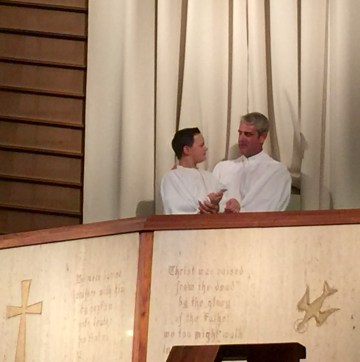
Jackson Weibling Baptism

Luke 12:49-53 NRSV

I’ll never forget what the youth minister said to me right after I bought a brand new car back in 2003. It was a time when I was not a very happy person.

My father-in-law had just died. As a senior minister, I was coming to the harsh realization that it was absolutely impossible to please everyone. The youth minister knew this.

It was during this time I traded in my pick up truck that was just a few years old. The youth minister said, “Jarrett, when most people get a little blue, they might go to the mall a buy a new outfit or get a new pair of shoes, maybe a new piece of furniture, but you go out and buy a brand new car!”

At the time I remembering justifying the purchase by saying that my truck got poor gas mileage, and it just wasn’t very practical driving back and forth to the hospital. I needed something smaller, more economic.

But the reality is that the youth minister had a pretty good point. I, like so many American consumers, thought that I could maybe buy me a little bit of happiness. I could perhaps purchase me a little bit of fulfillment.

We buy new furniture. We hang new clothes in our closet. We park a new car in the garage. And we might even buy a whole new house. But guess what? We are still unhappy. Things at home are still not right. Our spouse is still distant. The relationship with our children is still not what it should be. And our souls are still filled with discontent. On the outside our home looks beautiful and whole, but on the inside our home is broken and is in danger of falling completely a part.

So what do we do? We do what I suppose most good God-fearing Americans do. We go to church. We say: “Maybe that is what is missing in my life. Perhaps the church is the solution to building a happy home, the key to good relationships, the key to my happiness and my fulfillment.”

So we come to this place. We attend Sunday School. We come to worship. We sing and we pray and we listen, and we take communion, and we sing and we pray.

After the first week, nothing really changes in our lives. But we realize that what’s broke didn’t break overnight, so it probably wasn’t going to be fixed over night. So we do it again the next Sunday, and the next and the next. We even start having family devotions, holding hands and saying grace at our meals and praying at bed time. But, still, nothing at home changes.

We’re still struggling. We’re still lost, and the confusion is painful. We are still unhappy. Things are still not right.

Why? Why hasn’t religion worked? Why haven’t things gotten better? We got Jesus. He’s supposed to help our families. He’s supposed to be the glue that keeps us together, right? After all, you know what they say?  The family that prays together stays together, right?  Well, according to our scripture lesson this morning, not necessarily. In fact, according to Luke, Jesus may be more of a home-wrecker, than he is a home-maker.

Jesus said, “I came to bring fire to the earth, and how I wish it were already kindled!  Do you think I have come to bring peace to the earth? No I tell you, but rather division!”  Luke even softens this a bit for us, for in Matthew Jesus sounds downright violent: “I come not to bring peace, but a sword!”

“I will divide father against son and son against father, mother against daughter and daughter against mother, mother-in-law against her daughter-in-law and daughter-in-law against mother-in-law.”

St. Francis of Assisi became a knight in the wars with Perugia and had a promising future ahead of him. His father was proud of his son, but the problem was that Francis kept going to church and praying and asking God what he wanted him to do. Over time, he became convinced that God did not want him to be a French troubadour or a dashing knight, but rather to be a follower of Christ, a genuine disciple. God wanted Francis to serve the poorest of the poor.

Francis heard the scripture say, “Sell all that you have and give it to the poor” and with a startling naïveté he said, “Okay.” And he sold all that he had and gave it to the poor.

But his father took exception, for what the boy gave away really wasn’t his but was given to him by his father, who had no urge to take the Bible literally.  He threw Francis in jail, then took him to court.

It was then Francis said, “No longer is Pietro Bernardone my father, for, from now on, my father is in heaven.”

Sometimes, Jesus sets father against son and son against father.

But that is not the same Jesus that we go to church to get. Is it?

We go to get a different kind of Jesus, a Jesus of our own making.

For many of us, our faith is just one more materialistic thing we own. Many Americans have trivialized Christianity to the point that Jesus has become just another commodity that is supposed to make our lives easier, better, more productive. That’s why we go to church. We go to get this product called “Jesus” to make us feel better. He’s like a new pair of shoes, a new outfit, a new piece of furniture, or a brand new car. He is something that fulfills our desires, our wants, our needs. He is something that helps us to do the things we want to do in life.

But as nine-year old Jackson Weibling told me about his baptism that we are celebrating this day: “Having Jesus in my life means that I can no longer do the things that I want to do, but only the things that God wants me to do.”

Rev. Marianne Williamson once said, “When you ask God into your life, you think God is going to come into your psychic house, look around and see that you just need a new floor or better furniture, and that everything just needs a little cleaning—and so you go along for the first six months thinking how nice life is now that God is there. Then one day you see that there a wrecking ball outside. It turns out that God actually thinks your whole foundation is shot and you’re going to have to start all over from scratch.”

Our problem is that we have so trivialized Jesus, we think of Jesus as someone who comes knocking on our door with a bouquet of fresh flowers to brighten the whole house up when in reality, Jesus comes knocking with a flamethrower to ready to burn the whole house down.

We thought that all we needed was a little bit of family prayer time.  So we prayed for two minutes a day. And it didn’t work. We were still cold.  Why?  Because we can’t pray for two minutes a day, patch that prayer onto an otherwise unchanged life and expect it to be different.

Jesus does not come into our lives so our behavior will just be a little different, but so that everything will be transformed. Jesus is not some sweet commodity we can pick up at church to bring home and meet our needs and fulfill our desires. Jesus comes to change our needs and transform our desires!

And we don’t get Jesus. Jesus is not something that can be got. It is Jesus who gets us.

If Jesus is something or even someone that we get, then the church really does become just another product whose members are merely consumers. Thus, like going to a store, the spa, or the local cineplex, church becomes some place we go to get something. Some go to get fed. Others go to get nurtured and pampered. Some go to get entertained.

However, if it is Jesus who gets us, if Jesus is about us giving ourselves to the God revealed in Christ, then church means a radical, self-denying, sacrificial way of living.

If Jesus is about giving one’s life away, then the church becomes something much more than a self-help center offering self-improvement workshops.

Sunday school and Wednesday Night Fellowships become less of a time to get fed, physically and spiritually, and more of a time to pray for others, celebrate the joys of life with others, and even suffer with others. It becomes a time to build a community of selfless love and forgiveness with others. Bible study becomes less of a time to acquire more biblical knowledge than others and more of a time to consider how the scriptures inform our service to others.

Sunday morning becomes less about what God has to offer us and more about what we have to offer God. When we eat the bread, we do not consume it. When we drink from the cup, we do not merely swallow it. We allow it to consume and swallow us, every part of us. And we commit ourselves to presenting our own bodies as living sacrifices, pouring our very selves out for others in the name of the God who emptied God’s self out for us.

And every day of the week, we become much more than Christians who possess exclusive tickets to heaven in hand. We become the Light, even the fire of the world.

So for all of us who have been settling for an innocuous faith:  look out the window. The torch is lit. The wrecking ball is swinging. So let’s get out of the house!  Let it do its work. Let it bring destruction of all that holds us back form God. Let it all burn down to the ground. Then let our lives be rebuilt on the only foundation that can give us life.

When God Refuses to Listen

NotListening1

Isaiah 1, 10-20 NRSV

I like to be honest from this pulpit. I like to be real. So let’s be really honest this morning. Have you ever prayed and had the feeling that God’s not listening?

You come to this place of worship and you go through all of the motions. You sing all of the hymns. You actually pray during the moment of silence, instead of spending those moments planning the rest of your day. You listen reverently to the choir’s anthem, and like few people, you even listen intently to every word of the sermon. But as the organist begins playing the prelude, you wonder if it was all just a big waste of time.

I believe this is a reason some people stay home on Sunday mornings. They are not getting through to God and God isn’t getting through to them. And Randy, as the Choir Director, guess what? Sometimes, they say it is your fault. They say that the music just doesn’t inspire them. But most of the time, it is the preacher’s fault. They usually say something like, “I am just not being fed anymore at that church.” Have you heard that before?

Well, Randy, I have some good news for us! Isaiah suggests that their belief that worship is a waste of their time, that God is not listening, is not the choir director’s fault, and it may not be the preacher’s fault either.

Isaiah says that the reason that you may feel like worship is not bringing you close to God, the reason you don’t feel like God is listening, the reason that you feel like God has not heard a word you’ve said is because God has not been listening to a word you’ve said.

Now, I believe that the entire Bible and Jesus himself came and taught us that God operates by something we call grace. Salvation, and prayer for that matter, conversation with God, a personal relationship with God can not be earned, and it is in no way deserved. “We are saved by grace and not works lest anyone should boast.” I know that.  And I believe that with all of my heart.

However, Isaiah says that if we truly want to know that God is listening to us, if we truly want to feel close to God, if we want our worship on Sunday to mean something, there are some things that we must do.

And if we don’t do those things, according to Isaiah, God might respond to our worship this way: “What are your services to me? I have had it up to here, I am sick to my stomach of all your worship! I have no desire for any of it. Stop tramping into my courts. And I have had enough of your preacher with his fancy robe who thinks he is all that with all of his seminary degrees. Your prayers, your hymns, they have become a burden to me. I have stopped listening!”

So, according to Isaiah, what must we do to be heard by God?

Put away the evil of your deeds. Pursue justice and champion the oppressed, give the orphan his rights, plead the widow’s cause.

If we want to be heard by God, if we want worship to be meaningful, Isaiah says that we better doing what we can help the most vulnerable members of our community.

My friend Rev. Dr. William Barber has he wonders why we spend so much time doing the things about which “God says so little” while doing so little of the things about which “God says so much.”

I wonder if Isaiah is suggesting that the church might re-evaluate our committee meetings. Like any congregational-led church, we have a lot of committee meetings here. Isaiah may want us to ask: “What has been the subject of your longest, most arduous church meeting? What was the agenda of that meeting that caused your spouse at home to worry about you, or even question your whereabouts, because they thought you should have been home hours earlier?”

Was it about how our church could could advocate for those in our community who feel oppressed? Was it about meeting the needs of children who do not have the support of family? Was it about defending the rights of widows or the rights of the most vulnerable members of our community? Was the agenda something about which God says so much? Or was the agenda something about which God says so little?

Rev. Michael MacDonald writes that many Christian Americans not only never have any lengthy church meetings about how they can better serve the poor, they just simply have a bad attitude about serving the poor. So bad, that many folks probably wished they had the license to rewrite the many scriptures which speak for the poor.

I would argue that many people actually believe they have such a license. Because as a pastor, it has been my experience that whenever I have spoken on behalf of the poor and the vulnerable, someone almost always accuses me of being a “liberal.” Then, they will something like, “The Bible says that God helps those who help themselves.”

When in fact, the overall message of the Bible says nothing close to that. Aesop’s Fables say that. Benjamin Franklin said that. Thus, I want to respond: “Who’s the liberal here? The one who is conserving the Judeo-Christian teachings of the Scriptures to help the poor, or the one who is re-writing the scriptures with the words of a fable or Deist Ben Franklin?”

For example: This is how McDonald said some Americans would rewrite the story of the Good Samaritan:

The lawyer asked, “And who is my neighbor?”

Jesus replied, “Now by chance a priest was going down the road from Jerusalem to Jericho and saw a man who was hungry and ill clad.  He thought about stopping to help him, but decided that the man had probably been planted there by advocates for the homeless, so he walked by on the other side lest he give encouragement to those who wanted to divide society along class lines in order to gain political power for themselves.

So, likewise a Levite, when he came to the place and saw him, thought about helping him. But the Levite was afraid that he would rob the man of his independence, and he could plainly see that the man had sandal straps by which to pull himself up. So, he too, passes by on the other side.

But a Samaritan came near him and was moved by self-righteous pity. The Samaritan bandaged his wounds pouring oil and wine on the, no doubt as a publicity stunt to make his own self feel good and look good before his peers.

Then the Samaritan put the man on his own animal and brought him to an inn. The next day, he took out two denarii, gave them to the innkeeper and said, “Take care of him; and when I come back, and will repay you whatever more you spend,” thus encouraging the injured man to live like a parasite off other people’s hard-earned wealth.

Which of these three do you think was a neighbor to the man?  The lawyer said, “[Well of course] the two who showed him mercy by walking by on the other side.”

And God says, “You can pray without ceasing but I won’t be listening. I won’t listen to those of you who pervert justice, those of who champion the cause of the rich and powerful, those of you who take advantage of the powerless. God ahead, have yourselves a worship service, have three of them, but I won’t be there.” God says, “I simply don’t listen to the prayers of those who are all about feeding themselves while orphans and widows, the disadvantaged and the vulnerable, go hungry.”

I believe Baptist evangelist Tony Campolo is right when he says that the one thing every Christian should do is not only write a check to help the poor, but help the poor in such a way that we actually build a relationship with them, get to know them on a personal level.

This is what I want to do when we begin feeding the food insecure later this year as the prelude to a new worship service. I don’t want to merely hand them a brown paper bag lunch out the back door, with perhaps a scripture verse stapled to it, or a religious tract thrown inside of it, and then encourage them to go someplace else to eat it, out of sight, out of mind.

I want us to sit down at the table with them, get to know them, listen to them, love them, befriend them, be family to them. Let them know that you are willing to fight for them, defend their rights and plead their case. Be there to help them become the person that God is calling them to be.

Campolo says, in a way that only a good ol’ Baptist could say it, that one important reason that Christians should want to do this is because on the last day, when we are standing before the Great Judge, as God is separating the sheep from the goats and points to us and asks the question, “When have you clothed the naked, fed the hungry, given drink the thirsty, when have you shown generosity to the least of these my brothers and my sisters?”—That is when you are going to want to have the new friend we met around that table standing beside us, and we are going to want to be able to turn to them with confidence, pat them on the back, and say with a smile, “Go ahead, you tell it.”

Do you want to come to this place on Sunday morning and really have an encounter with God? When Terri begins playing the Postlude, do you want to know that you have actually communed with the creator of all that is? Isaiah, and I believe Jesus says, that will depend on how you commune with the most vulnerable members of our community.

Do This and Live

dallas shootings

Luke 10:25-37 NRSV

Sometimes preachers can begin preparing their sermon too early. I began working on this sermon more than a week ago. I chose the theme, the point and the title of the sermon early Tuesday morning.

As you can probably tell by the title of my sermon, “Do This and Live,” the point of my message this morning was going to be that it is high time for Christians to put our faith into action.

In the beginning of Luke 10, we read Jesus saying to seventy of his followers: “the harvest is plentiful but the laborers are few.” Then he commissions them to do some pretty big things: bring peace to the people, cure the sick, work to bring the kingdom of God near.

This was going to be my sermon.

I was going to tell the story of the Good Samaritan, tell how he overcame his fear of the other, how he reached out and reached down to help him in his time of distress, and then I was going to quote Jesus, by saying: “Go and do likewise.” “Do this and live.”

I was going to say that it is time for us act, to go and do likewise.

I was going to say that the Samaritan did not merely wish the man lying in the ditch well. He did not just send his thoughts and his prayers. He didn’t mull over the situation, consider  the risk involved, ask whether or not his insurance would cover it. He just acted.

I was going to encourage you to be the church that Shannon often describes as one that is “on the move.”

I was going to admonish you to move beyond thoughts and prayers, study and contemplation, to be more committed than ever to truly be a movement for wholeness in this fragmented world.

A movement. Not a team of thinkers.

A movement. Not philosophy class.

A movement. Not a club of theorists.

A movement. Not a group of day dreamers.

A movement. Not a church of well-wishers.

A movement, a body of doers, doing all that we can, when we can, with all that we have been given,

working for wholeness in a creation that is broken,

working for justice in systems of inequality,

working for mercy and grace in a society of bigotry and prejudice,

working for peace in a culture of war and violence,

working for truth in a nation of politics,

working for love in a world of hate,

working for hope in a world of despair.

However, after the horrific events continued to unfold this week, I went back to our scripture lesson to read it once more in the light of what has been a horrendous week for our country.

Surely, God has something else to say to us this week.

The first time I read the story, I read it the way many read it. By understanding that God wants us to see ourselves in that Good Samaritan, that God wants us to overcome our fear of the other and act to truly love others as we love ourselves. God wants us to courageously go out, reach out and reach down to help those who have been left behind, put down, beaten up.

But after a week in which we witnessed 250 murders in Baghdad, the murder of two African Americans in Baton Rouge and St. Paul, and the murders of five police officers in Dallas, I began to read the text differently.

Instead of seeing ourselves in that Good Samaritan, perhaps God needs us to acknowledge today that we are more like one who has been robbed, beaten, and left bleeding, half-dead in a ditch on the side of a wilderness road.

That is where I believe we truly are as Americans today. We have been robbed: robbed of pride and dignity, robbed of trust and hope, and robbed of peace and security. We have been beaten: beaten by racism and hate, beaten by terrorism and violence, and beaten by confusion and despair. And we are bleeding. We are bleeding tears, bleeding fear, and bleeding anger.

And honestly, we are currently unable to act sensibly, unable to move courageously, and certainly unable to be any semblance of a movement for wholeness, because we ourselves are not whole. We are broken, barely making it, not knowing whether we might live or die.

And one by one, people are passing us by. Friends are disappointing us, and even people of faith are letting us down. We are being treated as if our lives do not matter.

But here is the good news:

The good news is that someone is coming towards us. Someone is coming very near to us. Although we cannot comprehend it, we sense his presence.

He is but a stranger to us. His ways are not our ways. He comes from a foreign land. He is one who has been despised and rejected by the world, a man of sorrows held in low esteem.

But when this strange one sees us, as he becomes acquainted with our suffering, he is immediately moved with compassion. He is moved thoroughly and deeply.

We have been beaten so badly, he does not recognize if we are black or white, Jew or Muslim, male or female.

Yet, he suffers with us, and he suffers for us. His empathy towards us brings him down to his knees. We can feel his warmth. We perceive his empathy. And then, kneeling beside us, with his own hands, he tends to the places where we have been hurt. He stops the bleeding. He cleanses our lacerations. A costly wine poured out. Carefully, attentively and lovingly, he bandages all of our wounds.

He then puts his arms around us. Although we still cannot make out his face, cannot comprehend his actions, we instinctively know that we can trust him. We can trust him. So we put hands around his neck as he picks us up.

He picks us up and carries us until we reach a safe place, a place where no one judges us, a place where we are welcomed and accepted just as we are.

He stays beside us and continues to care for us. He gives us warm bread and something refreshing to drink. He stays with us through the darkness of the night, holding us, loving us, assuring us that we will not only have life, but we will have life abundantly, assuring us that a new day will dawn and we will be a part of it.

And when that day comes, he sacrificially pays the price for our care, for our healing, for our salvation. And then he places us in the hands of others who will care for us, shepherd us, love us as he loved us.

He then tells us that he must go, but before he departs, he makes a promise. I will come again. I will surely come again, and whatever your debt may be, I will take care of it. I will pay it in full. I will forgive it fully, completely. Grace will be yours not only today, but forever.

And our cups runneth over. We are healed, made whole. We have been saved. For we have never experienced such a love, a love without conditions, a grace without limits, a mercy without reservations.

This afternoon, our church is partnering with Youth and Family Services to host a back to school bash for foster children living here in Garfield County. We will have games, provide haircuts, and give out book bags with school supplies. Most of all, we will give them our love.

We will let them know that today they come to a safe place. A place where no one will judge them, a place where they will be accepted and welcomed.

We will let them know that there is a community here that will hold them, love them unconditionally, share mercy with them unreservedly, and offer grace to them with no strings attached whatsoever.

We are not going to merely offer these foster kids our thoughts and prayers. We are not going to just wish them well. We are going to act.

And we are going to continue these acts of grace with others in our community who find themselves in need. We are truly committed to be a church on the move.

However, before we can do this, before we can be a body of doers, before we can go and hold others in the light of Christ, a light that will certainly drive away the darkness, I believe we first need to be held in that light ourselves.

Before we can envelop others with a love that will drive out the hate, we first need to know that we have been embraced by such a love. Before we can become a movement for wholeness, we first need to be made whole.

And if we do this, accept this love, receive this grace, allow this mercy to take a hold of us, pick us up, heal us, redeem us, and transform us, if we do this, we will live.

And then, we can share this life with others. We can truly be a movement for wholeness in a fragmented world.

Come, Lord Jesus. Come quickly.

Nourishment in the Wilderness

run and not be weary

1 Kings 19:1-8 NRSV

Luke 8:26-39 NRSV

Poor Elijah didn’t know if he wanted to live or die. Look at verse 3: “Then he was afraid; he got up and fled for his life.” Then look at verse 4: “It is enough; now, O Lord, take away my life…”

One verse he wants to live, for he’s running to save his life. And in the very next verse, he prays to God that he might die.

Can you relate? Have you had moments like that?

The good news comes in verse 5: “Suddenly an angel touched him and said to him, ‘Get up and eat.’ He looked, and there at his head was a cake baked on hot stones, and a jar of water. He ate and drank, and lay down again. The angel of the Lord came a second time, touched him and said: ‘Get up and eat, otherwise the journey will be too much for you.’ He got up, and ate and drank; then he went in the strength of that food forty days and forty nights to Horeb the mount of God.”

The good news is that when the journey is too much for us, when we don’t know whether we want to live or die, God comes to us, and gives us the strength we need to make it through.

On this Father’s Day, I am reminded of the words of Jesus when he said: “Is there anyone among you who, if your child asks for bread, will give a stone? Or if the child asks for a fish, will give a snake? …how much more will your Father in heaven give good things to those who ask him! (Matthew 7:9-11)

It was Isaiah who prophesied: “He gives power to the faint, and strengthens the powerless. Even youths will faint and be weary, and the young will fall exhausted; but those who wait for the Lord shall renew their strength, they shall mount up with wings like eagles, they shall run and not be weary, they shall walk and not faint.” (Isaiah 40:29-31).

The Apostle Paul confidently proclaimed: “I can do all things through him who strengthens me” (Phil 4:13).

The good news is that when we have those moments when we don’t know if we are going to make it or even if we want to make it, God comes to us, nourishing us with the strength we need to do all things.

Now, before we say: “Amen, let’s sing a hymn, have some communion, and go home happy!” I believe we need to hear a little more.

When we read the Bible, study the Bible, interpret the Bible, context is everything. It is a bad practice, and it can be right down dangerous, to lift verses out of their contexts.

And people do it all the time, especially with the verses that I just read. I have seen these verses on coffee mugs or desk calendars, as if they were written as promises to help us have a good day at work.

These verses are all over the walls of the YMCA as if they were written to help us have a good work out. As a runner, I have seen them on written on the shirts of other runners during a marathon. “Run and not grow weary – Isaiah 40:31”; “I can do all things through Christ who strengthens me –  Philippians 4:13”

But when we put these verses in their contexts, we come to understand that when Isaiah was talking about running, he wasn’t talking about running a marathon. When Paul was talking about strength, he wasn’t referring to the bench press. And Elijah was not visited by an angel with hot fresh baked bread and a cold jar of water, because he had just finished a Tai Chi workout.

I believe our lectionary gospel lesson has something very valuable to teach us about our context. It is from Luke, chapter 8 beginning with verse 26.

It is the story about Jesus confronting a man living with demons who was chained and shackled in a cemetery.

Now, we don’t know why they put chains on that man and forced him to live among the dead. But I believe we could take some pretty good guesses. Perhaps he had a different skin color than most people in his town. Maybe he practiced some kind of minority religion. Could it be that he spoke a foreign language? Could it be that he was mentally ill? Might it be that he was gay?

Whatever the reason, it is obvious to me that the chaining of this man, the oppression of this man, the dehumanizing treatment of this man as if he did not even exist among the living, shackling him in a graveyard, is the true demonic evil in this story.

And notice what happens when Jesus liberates this man (verse 37). When they find the man is set free, do they all fall down and worship Jesus? Do they make a commitment to follow Jesus? No, all the people, “all the people in the surrounding country beg Jesus to leave their presence.”

It is very important to remember that when Paul proclaimed the gospel for not only the Jews, but also for the Gentiles; when he baptized a woman named Lydia and others discovered his friend Philip baptized an Ethiopian Eunuch; when Paul, like Jesus, met people where they were, ate what they ate, drank what they drank; when he said things as audacious as in Christ there is neither Jew nor Greek, slave nor free, male or female, but all are one in Christ Jesus, the people did not vote him Citizen of the Year.

Thus, when Paul penned those words: “I can do all things through him who strengthens me,” he wasn’t talking about completing a “couch to 5k program.” He wasn’t talking about having a good day at work or even working out some personal problems. He was talking about keeping the faith in the midst of a persecution that we better believe is coming if we live like Jesus, work like Jesus, and love like Jesus. And he was talking from a prison cell.

For the truth is: whenever we love all people, and teach others to love all people, especially those people who have been degraded, dehumanized, and put away by society, there will always be people in society who will degrade, dehumanize, and try to put us away.

Whenever we oppose bad religion, fight injustice, speak out against hate, and preach the grace of a savior who loved all, died for all, and conquered evil for all, we can expect persecution.

There is a much talk about Christianity being the most persecuted religion in the world today like that is a bad thing. But that type of thinking seems to go against the very words of Jesus who said, “Blessed are you when people revile you and persecute you and utter all kinds of evil against you falsely on my account. (Matthew 5:11).”

I believe the entire biblical witness points out that if we are not being persecuted in this world, then we better question whether or not we fulfilling our mission as people of faith.

The good news is, that the entire biblical witness also promises that when we are persecuted, God shows up. God feeds our bodies, nourishes our souls and gives us the strength we need to see this selfless, sacrificial journey through.

It was in the sermon on the mount that Jesus said that the Father will give his children good things to eat, not so they could live happy and satisfied lives, but after he commanded them: love your enemies, forgive seventy times seven, be light, be kind, don’t judge, turn the other cheek, don’t love money or possessions, go the extra mile and give the shirt off your back. Because Jesus knew that when we do those things, then we better be praying for some strength, because we’re certainly going to need it.

And notice that the angel came to Elijah with a cold jar of water and freshly baked hot bread, not to help him to deal with personal problems, but to climb up on a mountain to continue to stand against bad religion and false prophets.

And Isaiah said that God will renew the strength of God’s people not to deal with the heat and humidity of an Oklahoma summer, but to deal with the heat they will face after they “prepare the way of the Lord in the wilderness, and make straight in the desert a highway for our God;” after they “lift up every valley, and make every mountain and hill low;”

God will renew the strength of God’s people after they break the silence and cry out saying that “the word of our God will stand forever.”

God will renew the strength of God’s people after they get up and climb up to “a high mountain and lift up their voice to be the herald of good tidings to all people.”

Isaiah says that when we stand up, and speak up, it is then that the Lord will come and renew our strength. It is then we shall mount up with wings like eagles. We shall run and not be weary. We shall walk and not faint.

The truth is that when we are truly following Jesus, selflessly, and sacrificially carrying our crosses—when we are truly loving our neighbors as ourselves, all of our neighbors—when we unashamedly proclaim the word of God, the gospel of Christ, challenging injustice and speaking against hate—when we do these things, we can always expect some persecution. It can get so bad that we won’t know whether we want to live or die.

The good news is that it is then that we can always expect God to show up. We can expect a tiny sip of water and a bite of bread, or a little cup of juice, and a small cracker, to give us what we need to make it, to keep the faith, to do all things through Christ who gives us strength.

Sinners Welcome

sinners only

Luke 7:38-8:3 NRSV

Our gospel lesson is not only being read in churches all over the world today. It is being lived.

Today, sinners—some sick and tired, some broken and afraid, some young and naïve, some middle-aged and stressed, some old and in pain, and some severely wounded by racism, sexism, ageism, by all kinds of bigotry and evil spirits—today, sinners (look at verse 37) are still “learning” that Jesus is at the table, and they are still coming to worship at his feet.

A known sinner comes to Jesus, perhaps because she had learned the stories of Jesus welcoming and including, defending and saving, forgiving and healing other women who had injured by the evil of this world and counting them among his disciples: Mary Magdalene, Joanna, Susanna and many others.

The good news is that Jesus is still at the table today, and Jesus is still working in our world saving and forgiving, welcoming and liberating, and people are still learning about him. They are learning about a grace without limits and a love without conditions, and they are coming. They are coming honestly and openly. They are coming with humility, and they are coming with tears. They are coming saying “yes!” to this Jesus.

They are saying “yes” to this table, to the bread broken and to the cup poured-out. They are saying “yes” to the forgiveness of sin and the deliverance from evil. They are saying “yes” to loving their neighbors as themselves, to treating others how they wish to be treated. They are saying “yes” to fighting the demonic evil that is so much a part of our world today, and they are saying “yes” to welcoming others to the table as they have been welcomed to the table, graciously, lovingly, honestly, openly.

But when the one with religion saw what was going on at the table (see verse 39), “he said to himself,” which probably means he shook his head, or rolled his eyes. When he saw her with all of her sin at the table saying “yes” to Jesus, he said “no!”

The good news is that all over the world today, sinners are coming to the table, and they are coming saying “yes!” to Jesus.

The bad news is that there are people in churches today who are watching this, and they are saying “no!”

Last week, I learned of an Elder who has quit going to his church, because he didn’t like the way some of the new, younger Elders dressed on Sunday morning.

The same week, I learned of a couple leaving a church, because the church had too many of “those people” in it.

This week, I received a Facebook message from a woman who was told by her pastor that she could continue to give her money to the church, attend Sunday School and worship in the church, but she would never be able to serve in any leadership role.

And this week, I met two young women and a young man who told me that they want more than anything else in life to follow Jesus, but when they tried to find a church, it was made very clear to them by the people in the church that they were not welcomed.

Those with sin are saying “yes” to Jesus, and those with religion are shaking their heads, rolling their eyes, and saying “no.”

Jesus responds to the head-shaking and the eye-rolling and he naysayers by telling a story.

“A certain creditor had two debtors; one owed five hundred denarii, and the other fifty.

When they could not pay up, he canceled the debts for both of them. Now which of them will love him more?”

Simon answered, “I suppose the one for whom he canceled the greater debt.” And Jesus said, “You have judged rightly.”

Then turning towards the woman, he said to Simon, “Do you see this woman? I entered your house; you gave me no water for my feet, but she has bathed my feet with her tears and dried them with her hair. You gave me no kiss, but from the time I came in she has not stopped kissing my feet. You did not anoint my head with oil, but she has anointed my feet with ointment.

Therefore, I tell you, her sins, which were many, have been forgiven; hence she has shown great love. But the one to whom little is forgiven, loves little.”

In other words, this religious one who says “no” to the sinner who was saying “yes” to Jesus simply did not see himself as a sinner in need of grace. Jesus is saying that the amount of love people give is directly related to the amount of grace they believe they need.

While I was in college, I had the opportunity to serve with the First Baptist Church of Marshville, North Carolina as their Youth Director.

Almost every Sunday, Sam and Sue Goodwin, whose daughter Sally was in the youth group, would invite Lori and me to their home for Sunday dinner. Sam and Sue cared for Sue’s homebound mother who lived with them.

After we had lunch, Lori and I would always go to her room where she was confined to a bed, and visit with her a little before we left.

Right after I graduated from college in 1988, Lori and I were married. Since Lori had one more year in college, I served with that church one more year before moving to Louisville, Kentucky to attend seminary.

I will never forget our final Sunday dinner at the Goodwin home. As was our custom, after dinner, we went to see Sue’s mother. As we walked in her, she asked if she could speak with me privately.

I said, “Of course.”

She then asked me to shut the door and come over and have a seat in the chair beside her bed.

I looked a Lori, shrugged my shoulders and somewhat nervously did what she asked.

She said, “Jarrett, I want you to do me a favor.”

I said, “Yes, ma’am. What can I do for you?”

She said, “Before you leave to go to seminary to study to be a preacher, I sure wish you’d marry that girl.”

I said, “Don’t you remember? Lori and I got married last year.”

With a great big sigh, she said, “Oh, I am so relieved. I was so afraid you were going to seminary to live in sin!”

Bless her heart, I am certain, that if she really thought about it, she would have known that there was absolutely nothing I could do, no ceremony in which I could participate, no laws I could abide, and no lifestyle to which could adhere that could ever keep me from living in sin. You can ask my wife. Getting married did not stop me from living in sin!

But thank God, that where my sin is great, God’s grace is greater.

And Jesus says that when we realize this truth, that all of us live in sin and fall short of the glory of God, that all stand in desperate need of God’s grace, then we will instinctively love and accept all sinners who are saying “yes” to Jesus instead of shaking our heads, rolling our eyes, and saying “no.”

And when a church realizes that we are all sinners in need of God’s grace, then that church never only loves a little, grudgingly, reservedly, cautiously, and comfortably. But it becomes a church that always loves a lot, generously, unconditionally, recklessly, and even painfully.

At the end of the service a few weeks ago, I said that people often make the mistake of not joining a church because they feel they are too sinful. They need to get right with themselves, get right with their neighbors, and get right with the Lord, deal with some of this sin in their life, before they join the church.

I said then, and I will say now: “That is the worst reason in the world not to join the church!”

For the only requirement to join the church is the acknowledgement you are a sinner and need Jesus. That’s it. You come just as you are confessing your sins and your need of God’s grace through Jesus Christ. There is no other requirement.

I have also said that, sadly, there are people in some churches who fail to meet this requirement. They simply do not regard themselves as sinners. They don’t need grace, because they feel that they have somehow earned God’s love with right beliefs, right thoughts and right lifestyles. And they believe they are a little bit better than those who have not earned it. Thus they are very quick to judge, criticize or demean anyone who might believe, think, or live differently.

When I my hair was darker and my sermons were crasser, I got into a little trouble one day when I preached a sermon entitled: The Church Is Not for Everyone. I got into trouble because that goes against everything I usually preach. However even today, although my hair is grayer, and I try to be more articulate, I still believe there is an element of truth in that statement: The Church Is Not for Everyone.

For how else does one explain the amount of hateful things that are said and done today in the name of God, or in the name of the Church? How else do you explain the little amount of love that is shared by some churches today?

And how else do you explain that there will be preachers standing in pulpits all over this country this very hour blaming the victims of the evil terrorist attack in Orlando, saying the most hateful, evil things in the name of God.

Obviously, there are people in some churches who simply do not belong, because they fail to meet the only requirement for church membership; that is, confessing that they are sinners in need of God’s grace.

In that sermon, I suggested that it might be a good idea to have a special invitation at the end of the service one day. It will be a special invitation, because instead of inviting people to join the church, people would be invited to leave to leave the church. “Go, get out, and don’t come back until you realize you’re a sinner like the rest of us!”

Sounds harsh I know. But if we did this, maybe the church would love a lot more and hate a lot less.

Thank God, that today here at Central Christian Church, to this table, Jesus invites sinners, all sinners, only sinners. And sinners are coming, saying “yes.” And no one here is saying “no.” For today, the gospel is not only being read in this place, it is being lived. Thanks be to God.

You Never Know

Pentecost fire

Acts 2:1-21 NRSV

“You never know!” There are a couple different places I hear these three powerful words.

One place is in the midst of chaos and pain. It is a phrase that is frequently heard in hospitals or at funeral homes. It usually comes after an accident, a diagnosis, or sudden death. It comes after the telephone rings in the middle of the night, and it is not the wrong number. It comes when we hear words from our employers like “cutting back,” “laying off,” letting go,” or words doctors like “cancer,” “inoperable” and “terminal.”

“You never know when life might change, and change dramatically. You never know what each day will bring. You never know what tomorrow is going to be like. You never know from one day to the next. All of a sudden, in a blink of an eye, your whole world can change.  You just never know.”

Then the other place that I oftentimes hear these words is when God suddenly takes us by surprise. We think we have life all figured out. We think we finally have a plan our lives. Then God somehow, some mysterious way reminds you that God is the one with the plans. Someone once asked me: “Do you know how to make God laugh?”  Make a plan.

It was only one short year ago. We had just bought a new house in Farmville, North Carolina. We told several members of our church family that we were there to stay. “Eastern North Carolina is our home,” we said. “We have no plans to ever move again,” we said. Well, you never know.

This type of surprise is what I would call a God-ordained surprise, a divine, holy surprise. I think it would also be fair to call it a “Pentecostal surprise.”

Pentecost, that time and place when and where “suddenly” (“suddenly”—now there’s a good Pentecostal word, a word that denotes great surprise), “suddenly a sound like the blowing of a violent wind came from heaven and filled the whole house.”

Then they saw what seemed to be tongues of fire that separated and came to rest on each of them. All of them were filled with the Holy Spirit and began to speak in other tongues as the Holy Spirit enabled them.

You just never know.

But that is not the only thing that surprised them.

Now there were staying in Jerusalem God-fearing Jews from every nation under heaven. 6 When they heard this sound, a crowd came together in bewilderment, because each one heard their own language being spoken. 7 Utterly amazed, they asked: “Aren’t all these who are speaking Galileans? 8 Then how is it that each of us hears them in our native language?

You just really never know do you

It’s what Joel was talking about when he said, young men will see visions and old men will dream dreams and sons and daughters will prophesy.  You never know.

I believe this is exactly what Jesus was trying to explain to Nicodemus when he was describing the life of the believer. It is what happens to a person when that person no longer lives by the flesh but by the spirit of God living in them.

We read in John’s gospel:

“You should not be surprised at my saying, ‘You must be born anew.’  The wind blows wherever it pleases. You hear its sound, but you cannot tell where it comes from or where it is going. So it is with everyone born of the Spirit.”

In other words, “Nicodemus, if you are born of the Spirit, if you are filled with the Spirit, and if you are led by the Spirit, I can promise you this old friend, you will never be bored.  Cause you just never know.

Last Sunday, since it was Mother’s Day, I had a longer than usual phone conversation with my mother. She told me that she had just started babysitting a two-year old little boy, while the boy’s father, who suffers with bells palsy, goes to his part-time job. My mother, whose grandchildren are all grown, who is not in the best of health, is now caring for a toddler almost daily, ministering to a young family in need in a way she could have never dreamed.  You never know.

My sister called me later that day. We talked about mama taking care of this little boy, how she is helping out this struggling family.  It was then my sister said, “Oh Jarrett, Mama is not helping them out as much as they are helping her. That little boy has given mama a reason to get up in the morning. That boy is what keeps mama going. That boy and that family is ministering to mama. You never know.

You never know when God reveals greater purpose for your life, a purpose that is bigger than your life, plans that are bigger than your plans. You never know when your life might change and change dramatically.

One Sunday Jesus rides into Jerusalem celebrated as King of the Jews by children with palm branches singing Hosanna. A few days later the shouts of Hosanna turn into shouts of “crucify him, crucify him.”

On Sunday they throw you a parade. On Friday they crucify you between two thieves and bury you in a tomb.

But here is the good news, “Although your world is turned completely upside down, even if you are buried in a tomb that is sealed with a stone, the good news is, are you ready?  The good news of our faith is: “you never know.”

Mary Magdalene and the other Mary, trying to comprehend what had happened, how in a blink of an eye, their whole world changed, went to see the tomb.

And before they knew it, it happens.  “Suddenly (there’s that great Pentecostal word again), there was a great earthquake.  And in the midst of their surprise, an angel of the Lord descended from heaven and came and rolled back the stone and sat on it and surprised them even more. You never know.

The angel said to the women “Do not be afraid; I know that you are looking for Jesus who was crucified. He is not here.  For he has been raised, as he said. Come, see the place where he lay. Then, go quickly and tell his disciples. “He has been raised from the dead, and indeed he is going ahead of you to Galilee; there you will see him. This is my message for you.”

“Then, we are told, “Suddenly, Jesus met them and said, “Greetings!”  “And the women came to him,” and did the only thing they could do, “They took hold of his feet, and worshiped him.” Then Jesus said, “Do not be afraid; go and tell my brothers to go to Galilee; there they will see me.”

Hold on! I thought the women were in Galilee.  For that is what the angel had said, “He is going ahead of you to Galilee, there you will see him.”  The angel even bolsters these instructions by saying, “This is my message to you.”  But where do they see Jesus?  Somewhere along to road to Galilee.  The angel’s wrong. The good news of the gospel is: even the angels just never know.

And listen, if the angels do not know exactly when or where the Risen Christ will suddenly appear with a presence and with words which cause us to take a hold of his feet and worship him, how can any of us presume to know?

Thus, as Christians we should never despair, that is, we should never believe that things have gotten so bad that the Holy Spirit of the risen Christ might not show up. Because we never know.

The good news is that when our lives are suddenly surprised by evil, Christ will always come, suddenly, perhaps when and where and in ways we least expect it, but he will suddenly come nonetheless and surprise us some more.

The risen Christ will suddenly come and change our world forever. And Christ will do so until that day comes when the Spirit utterly amazes all disciples with the undeserving gift of eternal life, a life that is so amazing and so wonderful, that until we experience it, we will never know.

Until that day comes, the Holy Spirit is here. The Holy Spirit is here touching each person in this place. Calling each person here to use his or her gifts to be the embodiment of the living Christ to meet the needs of people in our community and in our world in ways we’ve never dreamed.

Think of what would happen if every believer in this church truly answered this call of God’s Spirit, truly believed that the Holy Spirit has a greater purpose for your life, a purpose that is bigger than your life, plans that are bigger than your plans, a purpose that will not only bring you a sense of fulfillment and satisfaction, but one that will be the reason you get up in the morning.

Imagine what this church would look like, how this community would change if every believer suddenly commits him or herself to follow the Holy Spirit of Christ wherever he leads.

Well, you just never know!

This Church Is Going Down

downward

Luke 4:1-13 NRSV

Before coming to be the senior minister of this church, I should probably let you know that I checked your references.

One reference said: “Since losing their beloved pastor John Mclemore, who retired in November and passed away last year on Valentine’s Day, things have been very difficult for the church. John could relate to his congregation like few pastors today can. And they loved him for it. They lost a good man. However, there are still some very good people still that church, and Central has all of the makings to rise back up.”

Another said: “Several people recently joined the church. So, I think Central Christian Church is on an upswing!”

Someone from the Disciples of Christ office in Indianapolis said: “I believe Central Christian Church has to potential to once more be an “up and coming” church in our denomination.

Now, I will be the first to admit that your references sounded pretty good. It sounded positive. Obviously it sounded like the type of church that I would like to be a part of: “A church on its way up”; “on an upswing”; “up and coming.”

Because that is how our society measures success. Success in our world means things are moving ‘upward.”

We are taught at a very early age that “up” is where it is at, and we spend the first twenty years of our lives trying to grow up. Then we go to college in order to move up a little higher. And after graduation we work hard to make sure we are still upward bound: up for a promotion so we can always move up the ladder.

Up, we are told, is where we will find our life, a life that is full, complete, and abundant. Up is where we are able rub elbows with others who also shaped up, grown up and moved up. They are what we call the “in” crowd. They are the “up” and the “in” as opposed to the “down and the out.”

So when I heard others describing this church as one that has the promise to move “up,” of course, I got excited.

And, I suppose, if you look at us on the surface, there are many things about us that are up. Attendance is up. Participation is up. People here seem to be upbeat, uplifted, you seem to have taken an upturn. And that sounds good, doesn’t it?

Being “up” sounds so good, that many churches have actually named their churches “Upward.” If you go on the Google, you will find an Upward Baptist Church, Upward Presbyterian, Upward Methodist, Upward Pentecostal, and yes, even an Upward Christian Church. There is also Christian sports program for young people, with basketball, flag football, soccer and cheerleading, called, you guessed it, “Upward Sports.”

The premise behind almost every Christian best-seller in the bookstore and the message of nearly every popular preacher in America is all about how to shape up and move up, get uplifted and be upbeat.

Thus, it sounds very positive when people say we are a church that is on its way up; that we are up and coming, that we are on an upswing, that we are a church with upward mobility.

However, as the pastor of this church, I would argue that, here at Central Christian Church, it can also be said that the exact opposite is true. It could be said that this church is actually on its way down.

In fact, as one really gets to know this church, gets to know its people, its passions, its love for God and for others, I believe it becomes very obvious that that there is far more here that is going downward than upward.

Now, I realize that sounds rather disconcerting. For nobody wants to go downward. For guess what happens when you go on the Google and look for churches with the name “Downward?” They’re not any. Just like there are no Christian or any sports leagues called “Downward Sports.”

As Henri Nouwen, one of my favorite pastors has said: “Downward mobility [in our society] is not only discouraged, but even considered unwise, unhealthy or downright stupid.”

Yet, that is exactly where I believe we as a church are heading. And guess what? On this First Sunday in Lent, this is actually some very good news.

For on this Sunday, we remember that at the beginning of the ministry of Jesus, at the beginning of his journey to Jerusalem, Jesus resisted the temptation to embrace any type of ministry that was not one with downward mobility.

Notice verse 5: “The devil led him up…”

And again in verse 11: The devil said that the hands of angels would bear Jesus “up.”

Jesus was Savior. But he was a different kind of savior. Jesus was King, but he refused to succumb to the temptation to rule from on high like the Kings of this world. Jesus was a King from another world, sent by a God who chose to reveal divine love through a life of downward mobility.

When God chose to reveal to the world God’s holy power over sin and evil, a power that is even victorious over death itself, God emptied God’s self, poured God’s self out, humbled God’s self and came down, down to meet us where we are, down to earth through a tiny baby, laid down in a manger, to be worshipped by down and out shepherds.

The scriptures do say that Jesus grew upward in stature; however, the gospel writers continually paint a portrait Jesus’ life as one of downward mobility. He is continually bending himself down to the ground, getting his hands dirty to touch the places in people that most need touching.

While his disciples seemed to always focus on privilege and honor and upward mobility, chastising little children who needed to shape up and grow up before they could come to Jesus, Jesus argued that the Kingdom of God actually belonged to such children.

While his disciples argued about who was going to be promoted to be first in the Kingdom, Jesus frustrated them (and if we are honest, frustrated us) by doing things like stooping down down to welcome small children, moving down to sit at the lowest seat at the table, bending down to wash their feet, crouching down to forgive a sinner, reaching down to serve the poor, lowering himself down to accept the outcast, touch the leper, heal the sick, and raise the dead.

And nearing the culmination of this downward life, Jesus, the savior and King of the world, made his triumphant entrance into Jerusalem to liberate God’s people, not on some white war stallion that made its way up the equestrian ladder, but on a borrowed donkey. And he rode into Jerusalem not with an elite army that had advanced up the ranks in some up-and-coming militia, but came in with an army of rag-tag students who had no idea what they were doing or where they were going.

The whole scene, in the words of Henri Nouwen, looks “downright stupid.”

While others exercised worldly power to move up, climb up, and advance, Jesus exercised a strange and peculiar power that always propelled him in the opposite direction. It is not a power that rules. It is a power that serves.

It is not a power that takes. It is a power that gives.

It is not a power that seizes. It is a power that suffers.

It is not a power that transforms stone into bread to feed his body. It is a power that transforms his body into living bread to feed the world.

It is not a power that commands angels to save himself. It is a power that gives himself away.

It is not a power that dominates from some high place in glory. It is a power that dies in a low place called Golgotha.

This is the narrow and seemingly foolish way of downward mobility, the descending way of Jesus toward the poor, the suffering, the marginal, the prisoners, the refugees, the lonely, the hungry, the dying, the tortured, the homeless–toward all who thirst and hunger justice and compassion.

What do they have to offer? Not success, not popularity, not riches, not worldly power, but the way to life, full, complete, abundant and eternal.[i]

And the good news is that as I look around this room, I see people who are committed to traveling this same downward path.

I see people who have chosen to be here this morning, not to move up to be with the “in” crowd. Not to get something here in worship that will make you more successful, more affluent, climb a little higher. You are not even here looking to be uplifted or to be more upbeat or for some kind of upstart to get your life headed on an upswing. I see people here who have chosen to move in the opposite direction.

I see a room full of people who are here not to get something, but to give something, not to be served by programs, but to serve on a mission.

Because you have heard, and you have believed Jesus when he said: “You know that among the gentiles the rulers lord it over them, and great men make their authority felt; among you this is not to happen. No; anyone who wants to become great among you must be your servant, and anyone who wants to be first among you must be your slave, just as the Son of Man came, not to be served, but to serve, and to give his life as a ransom for many (Matthew 20:25-28).

May this always be who we are as a church. Although it may sound good to be a church that is “up and coming,” may we always be a church that is “down and going.”

May we always go down, humbly, sacrificially and selflessly. And then may we go out, bending ourselves down to the ground if we have to, to touch the places in people that most need touching. May we go out and stoop down to welcome all children. May we go out and reach down to serve the poor, lower ourselves down to accept the outcast. May we go out and get down on our knees to pray for and suffer with the sick and the despairing. And as I saw at the Civitan Dance this Friday night, may we always be a church that is ready to get down, drop it down, to get as low as we can go, with any in our community who have special needs.

So, the next time you hear someone say that your church is on the way up, that we are on an upswing, you need to correct them by saying, “No, Central Christian Church is where it is all going down.” And down, not up, is where we have found our life: a life that is complete, full, abundant and eternal.

When God Calls

called

Jeremiah 1:4-10 NRSV

Almost every Sunday, I stand from a pulpit and say something about the calling of God. I say things like, “God is calling us to use our gifts.” “God is calling us to this mission or that mission.” “God is calling us to catch fire and light up this city.” God is calling.

Oftentimes, I talk about this “calling” when I pray. “God, you have called us to this place.” “God, you call us to be your servants.” “God, you call us to live a self-denying life of discipleship.”

And on many Sundays we even sing about this calling. “Jesus is tenderly calling.” “I can hear my Savior calling.”

It is the kind of language that I use when my North Carolina beach loving friends ask me: “Why did you move from a place that is a little over an hour’s drive from the ocean to land-locked Oklahoma? Do you have family there? Do you have good friends there? Do you owe someone a favor there? Did you lose some kind of bet?”

“No, I am here because I believe God has called me here.” “God called me to go to seminary.” “God called me to be a pastor.” “God called me to serve with the Central Christian Church in Enid.” God called.

But what are we really saying when we speak of God this way? What is this call of God? Why does God call? How do we recognize God’s call? And more importantly, how do we answer God’s call?

I do not believe there is any better place to examine the nature of God’s “calling” than these first few verses of the book of Jeremiah:

Now the word of the Lord came to me saying, ‘Before I formed you in the womb, I knew you, and before you were born I consecrated you.’

It should be noted that the very first word of this prophetic book that we call Jeremiah belongs to God. The prophet’s words begin, not with the prophet having some word inside of him that needs to be expressed, but rather with God’s word coming to him. This is what Martin Luther referred to as “the external word,” a word that is not self-derived, but a word that comes as an intrusion, oftentimes a surprise, a gift from the outside, a word from a God who says: “I want to transform the world, and guess who I am calling to help me do it!”

Therefore, it is a misnomer when we speak of this book of the Bible as “The Book of Jeremiah,” as if this book were mostly about the words of one man. It is perhaps better entitled, “The Book of God,” for it is God who begins the conversation.

In the beginning, Jeremiah sets the record straight that the words, the mission, and the direction of Jeremiah’s life was God’s idea before it was Jeremiah’s idea. “I knew you before you knew you,” says the Lord.

I believe this is one of the most important theological concepts that the church needs to recover today. Our worship, our mission, our purpose as a church is not about us. This, what we are doing right here and now is not something that we created for ourselves. Central Christian Church was God’s idea before it was our idea.

William Willimon once put it this way: “[Church] is primarily about learning to suppress some of our self-concern and cultivate more God-concern.” Thus, Sunday worship is a blessed opportunity to look beyond ourselves, to get outside ourselves, to hear and to embrace and to follow the external Word.

But notice how Jeremiah responds to this external word. When he hears it, he has a hard time accepting it and even a more difficult time following it. For his very first words in response to the word of God are words of resistance:

Ah, Lord God!  Truly I do not know how to speak, for I am only a boy.

Hmmm. If the external Word of God is anything like the way most preachers these days describe it, why in the world would Jeremiah resist it? For who in their right mind turns down some chicken soup for the soul? Who refuses to take a little pick-me-up-feel-good vitamin to help get you through the week? Who says “no” to words that meet needs and fulfill desires? Who rejects a God who is all about making us happy, healthy, comfortable and prosperous?

And Jeremiah is not alone. He’s not the only one in the Biblical witness who has trouble accepting this divine Word. Remember when God called Sarah? She spat out her coffee and laughed out loud: “Ah Lord God, I am much too old for such a calling!” Remember when God called Moses? “Ah, Lord, God, not me! I am not very good at public speaking.” Remember when God Mary: “Ah, Lord, God, not me! How can this be? I am much too young for such a calling!”

Why the resistance? Why do they all try to argue their way out of it?

Could it be that they all knew just enough about God to know that this word, this external Word, this divine Word was not about them, or even for them, thus it was bound to make their lives more difficult.

But notice that God not phased by Jeremiah’s resistance and continues calling, commanding Jeremiah to “go.” But promises that in spite of the persecution that he will no doubt receive for going out, for standing up and for speaking out, God would be there each time to rescue him.

Now, there is no way that I can go into all of the horrible things that happened to Jeremiah along the way and still keep this sermon under twenty minutes. He was scorned by community leaders. He was beaten and bullied by organized religion. He was physically assaulted by his own family. He was put in prison by the government. And he had his life threatened more than once.

And each time, God did come to his rescue. Well, sort of. For each time Jeremiah got knocked down, God came and picked him up, but only to immediately call out to him once more: “Go!  Get up and go young Jeremiah, for:

Today I appoint you over nations and over kingdoms, to pluck up and to pull down, to destroy and to overthrow, to build and to plant.

No wonder Jeremiah is continually persecuted! Change is never painless. In order for something to be planted, something must be plucked up. The word that brings new life is also the word that destroys and overthrows. As we’ve learned earlier this month, oftentimes the Word of God comes as fire. Henri Nouwen once wrote that our God is one who is continually calling us to go into “unknown, undesirable and painful places.”

After all, this Word, this external Word, this divine call is not about us. This call is not about meeting our needs; for if it has anything at all to do with our needs, this Word is about rearranging our needs. This call is not about fulfilling our desires; for if it has anything at all to do with our desires, it is about transforming those desires. This call is about what God desires and what God needs from ordinary people like you and me to build God’s kingdom on this earth.

Thus, I believe the church must be very careful when we talk about our ministry and mission.

During our wonderful leadership retreat that Rev. Speidel facilitated a week ago, I heard many say that they desired to come up with some ministries that would bring in new people to Central and fill up this sanctuary.

I believe that is a very good desire. It is my desire. However, I wonder if we are ever going to fill this sanctuary again, one of the first things we might need to stop saying is that we desire to fill this sanctuary. After all, this thing called “church” is not about what we desire. It is first and foremost about being called by an external, divine Word.

Let’s have the very best, the most active and the most theologically sound ministry with children and youth in this city. But not because we want to attract and bring in new young families to our church who will come in and help make our church more exciting. Let’s all use our gifts, selflessly and sacrificially, to build a great ministry with our youth and children because we have been called to do so. Because we have heard an external word, saying that “unless one welcomes little children, they do not welcome me.”

Let us love and respect our neighbors who do not belong to a church, meet them where they are, build relationships with them, earn their trust, care for them, be their friends, rejoice with them, even suffer with them, not because they might start coming to church with us, take our place on some committee or begin putting dollars in the offering plate, but because we have been called to love them. We have heard an external Word to “love our neighbors as ourselves.”

Let us give the poor and the hungry a chicken sandwich, treat a stranger like family, give someone who is cold a new coat, offer assistance to those who have been imprisoned, not because they might pray with us, one day believe like us, worship like us, dress like us and act like us, not because they may one day help us or even help themselves, but because we have been called to do this. We have heard an external word to do it unto the least of these our sisters and brothers.

Let us go an visit residents in the nursing homes. Embrace them. Send cards to them. Visit them. Prepare meal for them. Not because cooking or going to the nursing home makes us happy. Not because being nice to someone in the nursing home might one day get us or the church a special gift, but because we have been called to be family to them. We have heard an external word to take care of widows and all who are lonely and destitute.

You want to bring more people into the church? Then maybe we need to stop saying or even thinking that we want to bring more people into the church.

And just go. Go and selflessly and sacrificially use the gifts God has given us to share the love and grace of Christ with others for no other reason except that is what we have been called to do.

Just go and love one another with a love that is so radical and with a grace that is so socially unacceptable that it will cause people to ridicule us asking:

“Why on earth are you treating them that way? Are they friends of yours? Are they family?  Are you returning a favor? Did you lose a bet? Or do you expect them to reciprocate by doing something for you?”

And we respond: “No, we love them like that, because that is simply what we have been called to do. For each Sunday morning our church gives us this blessed opportunity to look beyond ourselves, to get outside ourselves, so we can hear and embrace and follow the divine, external Word.”

Well, I’ve preached long enough this morning. I realize that at this point this sermon seems to be unfinished. It seems to be lacking something. That’s because it is. This is a sermon that doesn’t have a conclusion—yet. That’s because we are going to write the conclusion.  It’s a sermon that each of us who are being called today are going to have to finish ourselves.

I’ve walked you through the story of Jeremiah’s calling, a story that began with God. Our story also begins with God. God is here and God is calling. How will we respond?

A Word from the Lord

cialis

Luke 4:14-29 NRSV

Tom Long tells the story of an incident that occurred in a church one Sunday morning in Charlotte, North Carolina. The minister had just finished reading the scripture lesson and was taking a deep breath before launching into the sermon when suddenly, a man, a complete stranger, stood up in the balcony and startled everyone by proclaiming in a clear, loud voice: “I have a word from the Lord!”

Shoulders tensed and heads swiveled around and upward to see the source of the interruption.

What “word from the Lord” did this man possibly have to bring to the people on that day?

Well, no one will ever know, for the ushers, says Long, “bounded like gazelles” up to that balcony, and before the man could utter another word, they had escorted him down the stairs and out the front door.

Now, with Long, I don’t blame them. I understand. The apostle Paul said we ought to do things with some semblance of order, and his was way out of order. Who knew what this guy had in mind. But it does cause me to wonder a little bit.

Isn’t it strange? Sunday after Sunday countless preachers in innumerable pulpits spread out their sermon notes, clear their throats, and begin their sermon, saying, or at least implying, that they have a word from the Lord. And nobody tenses. No heads swivel in alarm. No ushers leap into action. Instead, people sit back in their pews, crease their bulletins, silently check their watches, and settle back for the sermon. For that is what you’re expecting isn’t it?  A sermon. Right? Not a word from the Lord.[i]

This is exactly how it was on that Sabbath day in Nazareth. Joseph’s son Jesus was home for the weekend and had been asked to read the scripture lesson from the prophets and to preach the sermon. The congregation knew Jesus well. They knew his parents and remembered him as a little boy. They were no doubt proud of the reports that had filtered down from Capernaum and other towns about his preaching and teaching. So, they settled back in their pews to hear what this articulate young man had say. What were they expecting? A sermon. Right? Not a word from the Lord.

Part of the reason I believe we expect a sermon instead of “a word from the Lord” is that as much as we do not like admitting it, we really would prefer not to hear such a word. We prefer a simple sermon. We prefer some nice religious words, some nice sweet thoughts to help get us through the week. What we expect is a little “chicken soup for the soul.”  Some good advice to help make our lives run a little more smoothly, some encouraging words to help get us through the week.

A word from the Lord is completely different. A word from the Lord is disruptive. A word from the Lord is uncomfortable.

A sermon can be can be easily forgotten and even completely ignored. But, a word form the Lord must be heeded. A word from the Lord is sharper than any two-edged sword. For a word from the Lord is news, real news. It is news that turns our whole world upside down. A word from the Lord changes everything and forces us to adjust our lives to that change.

It has been said that most people who pick up the newspaper every morning or watch the evening news are not so much interested in the news as they are in confirming that the world is pretty much the same as it has always been. “Democrats are still not cooperating with Republicans and vice versa.” “It’s going to be windy today, again.” “There was another small earthquake in Fairview.” “The Cleveland Browns and the Detroit Lions are still not going to the Super Bowl.” “Yep, that’s the way the world is, it’s the way it always has been, and it is the way it always will be.”

I am afraid that is why many of us come to church. We do not go to church to hear any news. Instead, we go to church to have the things that we have always believed about God confirmed. We listen to the sermon to have the way we have been practicing our faith all of these years affirmed. We’d really prefer not to hear anything new. We’d rather not hear anything that challenges our beliefs, calls the way we practice our faith into question or creates any urgency to change. We are really not interested in hearing any real news.

For real news is unexpected. Real news is surprising. Real news is disturbing. Real news means the world is not the same as it was yesterday; therefore, I cannot live my life in the same way. A word from the Lord is real news.

It is news that demands change. It is news that demands a complete reordering of priorities. It is news that causes us to see the whole creation in a brand new way. It is news that moves us and mobilizes us to take some kind of action. It is news that often requires sacrifice. It is news that necessitates us doing things that we do not want to do and going to places that we do not want to go.

So, thanks but no thanks. Preacher, I think I’ll be just fine with a simple sermon instead. Either say some words to reaffirm what I already believe or maybe give me a little antidote that might help me live a happier, healthier life. Give me some good ideas that might fix some of the things that are ailing me.

I am afraid we often want a sermon to be like some new prescription drug that has just been FDA approved. Much like the ones whose benefits are being touted these days on nearly every other television commercial.

Do you have frequent heartburn? Are you tired of being tired? Is depression making you depressed?  Do you have trouble going to sleep? Do you have difficulty waking up? Do you want to avoid diet and exercise? Do you want to lose weight and still enjoy the foods you love? Is it painful for you to walk your dog? Is your hair falling out? Do you have a going or a growing problem? Do you need to put some excitement back into your relationships?

And then, in nearly every commercial, after the person begins taking what they asked their doctor to prescribe, there is all of this exuberant celebration: dancing in the streets; jumping up and down; digging for clams; running around in the yard with your dog and your water hose; even sitting outdoors and watching the sunset while holding hands with your significant other in separate bathtubs!

As a pastor, I oftentimes wonder if this is not how we oftentimes promote church. If you channel surf through the religious channels, you will find that there is no shortage of preachers who sound like they are spokespersons for some new drug. “Are feeling depressed?  Are you drowning in a sea of debt? Are you empty inside? Does your marriage need a boost? Then pick up the phone and make your pledge, send in your check, and sit back and wait for God to pour out God’s blessings!”

I am not exactly sure, but I suspect that is what many people were probably expecting when they showed up to hear Jesus’ first sermon back in hometown Nazareth. They came expecting a sermon, a little pat on the back, a little stroke of the ego, a little feel-good-pick-me-up to get them through the week, not a word from the Lord.

So, when Jesus stood up and began to speak, no shoulders got tense. No ushers tried to muscle him out into the street. People smiled and whispered to one another how proud they were of this their product, and how Mary and Joseph must be tickled pink to have such a fine son.

They came expecting a little sermon. But instead of a sermon, they got a word from the Lord. Jesus began to say things like, “For the gate is narrow and the road is difficult that leads to life, and there are few who find it.”

The crowd gets really quiet!  Someone whispers, “I know he didn’t say ‘difficult,’ did he? I thought God was all about making things easy! I thought sermons were about making us happier.”

Jesus continues:

“Love your neighbor, including your enemies. Be a blessing to the poor and to all who hunger and thirst for justice. Stand up for the liberty of those oppressed and bullied by culture. By the way, people will persecute you for that, utter all kinds of evil against you for that, but pray for those who persecute you. Forgive those who have wronged you. Don’t judge. Accept others as I have accepted you. Deny yourself. Pick up your cross and follow me. Die to yourself. Don’t just hear these words, but do these words.”

And then, his words began to sink in. “Today, this scripture is fulfilled in your hearing.”  Today. Not yesterday, not in times gone by, not someday, but today.  Fulfilled.  Not read nicely, heard sweetly, or barely remembered, but fulfilled. In your hearing. Not in somebody else’s. Not just in Abraham’s, Moses’, Elijah’s, and Deborah’s, but in you.

And the Word of the Lord was also not just for them. Jesus said it was for all people. It was also for outsiders, foreigners, those marginalized by society, widows and lepers and others who were not a part of their synagogue, their faith, or even their culture.

And it then became obvious that this was not just another simple sermon. This was a word from the Lord. This was news. Real news. God had come. God is present. Here. Now. Today. God is here, and God’s love is for all people, even for the lepers of Syria in and the widows in Sidon.

The world was now changed, for the Word of God had come, and the Word had come for all people. The Word of God had been made flesh and was now present in all its demanding fullness. And you could fight it, you could try to hurl its presence off a cliff, or you could accept it, you could follow it, but there was no way on earth you could ignore it.

Each Sunday morning, our worship is about the gospel truth, the amazing good news, that God is alive and present to us this day, as alive and present here as Jesus was to those worshippers in Nazareth. Thus some shoulders here this morning should be a more than a little tense, for there is work for us to do!

God is here! God’s kingdom is now! God speaks words of love and of grace, of mission and of purpose, of vocation and of duty, that are fulfilled in our hearing. Words that, if we listen and respond, will send us out from the pews into the public square to transform our world.

[i] https://www.cathedral.org/worship/sermonTexts/tl080601.shtml