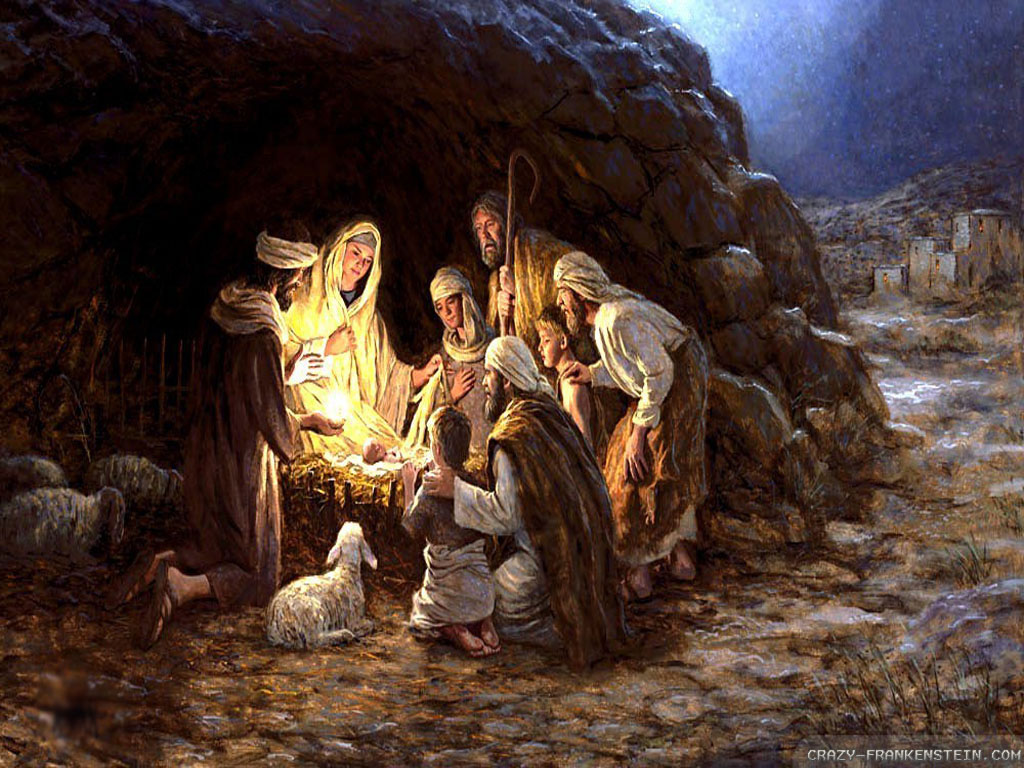
Because of Christmas Day!


John 1:1-14

In the beginning was the Word, and the Word was with God, and the Word was God. He was in the beginning with God. All things came into being through him, and without him not one thing came into being. What has come into being in him was life, and the life was the light of all people. The light shines in the darkness, and the darkness did not overcome it.

There was a man sent from God, whose name was John. He came as a witness to testify to the light, so that all might believe through him. He himself was not the light, but he came to testify to the light. The true light, which enlightens everyone, was coming into the world.

He was in the world, and the world came into being through him; yet the world did not know him. He came to what was his own, and his own people did not accept him. But to all who received him, who believed in his name, he gave power to become children of God, who were born, not of blood or of the will of the flesh or of the will of man, but of God.

And the Word became flesh and lived among us, and we have seen his glory, the glory as of a father’s only son, full of grace and truth.

This past week, a lot of people have asked me: “Are you having church on Christmas day?”

My response was that Christmas Day should be so important to the life of the Christian, we should be in church every year on this holy day, and not just when it happens to fall on Sunday once every seven years!

The reason we lead worship which begins with Advent and ends with Christ the King Sunday, is because we believe the life of the Christian should be governed, directed and guided by the birth, life, death and resurrection of Jesus. Our lives as Christians begin and end on this earth with this birth that we celebrate on Christmas Day.

The words of one of my favorite Christmas carols go like this: “Long time ago in Bethlehem, so the Holy Bible say, Mary ‘s boy child Jesus Christ was born on Christmas Day. Hark, now hear the angels sing, a king was born today. And we will live forevermore, because of Christmas Day.”  Because of Christmas Day.

The good, glorious news of this holy morning is that we know who our God is, how our God acts and what our God desires; we know who we are, how we should act and what we should desire, because of Christmas day.

Left to our own devises, we could not get close to God, so on Christmas Day God came close to us. Our God who was thought to be distant became as close as God could possibly be to us—becoming one of us—becoming flesh to dwell among us, giving us the best gift that God had to give, the gift of God’s self. Thus, as Christians we know how to live.  And we know how to die. Because of Christmas Day.

Just think about it! When we lose a loved one to death or encounter evil in this world, we grieve, but how can we grieve with hope and assurance? How do we grieve with a peace that is truly beyond understanding? How do we know that God is always a giver and never a taker?  Because of Christmas Day!

Because on this day, God proved to the world how far God is willing to go to give us life! God loves us so much that God emptied God’s self, poured God’s self out to us and for us through a vulnerable little baby born in a stable who grew into a man show us the way to life, abundant and eternal. And although we rejected not only this way, but also him; although spat upon him, tortured him and killed him by nailing him to a tree, God brought him back to life for the very ones who crucified him—revealing in a real and powerful way that God will never give up on us. God will never forsake us. God will always be there for us, forgiving us, loving us, transforming our despair into hope and our deaths into life.

One day, someone asked me why I don’t preach more about the judgment of God, the wrath of God, and preach less about the love and the grace of God. How can I preach with confidence that God is never using the pain of this world to punish us for our sins, but God is always here with us loving us and forgiving us and doing whatever God can do to work all things together for the good? Because of Christmas Day!

Because God came into the world in Jesus to heal the sick, give sight to the blind, eat and drink with sinners, forgive the adulterer, and promise a thief paradise.

Why is our invitation to communion wide-open to all people every Sunday morning? Why are we compelled to love others and share with others so freely and so unconditionally?

To others—to those others who do not deserve our love and have not and will not earn our love—to those others who may reject our love and even abuse our love. Why do we keep on sharing with and keep on loving those who may never share with us and love us?  Because of Christmas Day.

Because God was born to an underserving woman named Mary, was worshipped first by undeserving shepherds, called undeserving fishermen to be his disciples and died for undeserving people like me and you.  Because we have received grace, we are compelled to extend grace.  Because we have been forgiven, we are compelled to forgive. Because of Christmas Day.

“Long time ago in Bethlehem, so the Holy Bible say, Mary ‘s boy child Jesus Christ was born on Christmas Day. Hark, now hear the angels sing, a king was born today. And we will live forevermore, because of Christmas Day.”

Because of Christmas Day.

Whom God Favors

dirtyshepherds

The very first ones on earth to hear the pronouncement of Christmas were shepherds.  Who were these shepherds?   It is accurate to say that they were folks that the popular religious people knew would never “inherit the kingdom of God.”

This is not easy for most of us to hear.  For most of us have a tendency to romanticize the shepherds.  After all, we have been raised in the church with our innocent children depicting shepherds wearing bathrobes in adorable Christmas plays.  And for most of us church folk, shepherding evokes a very positive and pastoral image.  We think about the Old Testament images of the shepherd king David.  We think about the beautiful green pastures and still waters and the protection of the rod and staff of the twenty-third Psalm.  And, of course, we think about Jesus Himself as being the “good shepherd.”

However,  the reality is that shepherding was a most despised occupation.  Mercer New Testament Professor Alan Culpepper writes:  “In the first century, shepherds were scorned as shiftless, dishonest people who grazed their flocks on others’ lands.”  Therefore, it would not be too great of a stretch to give shepherds the current degrading designation: “illegal aliens.”

And why were these people involved in such a despised occupation?  The theology of the day would say, “because of sin, of course.”  They were who they were because of either their own sin or the sins of their parents.  In the eyes of popular religion, the shepherds were poor, immoral sinners.

Fred Craddock writes that the shepherds belong to the Christmas story “not only because they serve to tie Jesus to the shepherd king, David (2 Sam 14:23, 21) but because they belong on Luke’s guest list for the kingdom of God: the poor, the maimed, the blind, the lame (Luke 14:13, 21).

The very first people in history to receive the birth announcement of the messiah, the very first ones on earth to celebrate Christmas are sinners; they are the despised, the lowly, the immoral and the outcast.

This is why the angels pronounce the good news of Christmas is great joy for ALL the people.  Culpepper writes:  “The familiarity of these words should not prevent us from hearing that, first and foremost, the birth of Jesus was a sign of God’s abundant grace.”  The birth is a sign that God is on the side of ALL people—even the most despised, the most lowly, the most immoral, the most outcast, the most alien, and the most illegal .  Jesus came even for those who find themselves standing on the outside of the community or church.

And in what form does this sign appear?   The savior was coming into the world through a poor peasant woman to lay in a manger, a feeding trough made for animals.  And it is this humble scene that sets the stage for his entire life on earth.  Jesus, the savior of the world was born and lived and even died on the fringes, on the margins of society—underscoring the truth that the good news has come into the world for ALL—maybe especially to the marginalized.

Page Kelly, my Old Testament professor at Southern Seminary, used to love to say that the biblical symbol for God’s justice on this earth was not a blind woman holding a set of scales.  “It was one of the Old Testament prophets holding a set of scales with his eyes bugged out and his long bony finger mashing down on the side of the poor.”  –Favoring those who have always been despised and marginalized by society.

Sounds a little like the Angels’ song:  “Glory to God in the highest heaven, and on earth peace among those whom he favors.”

“But God does not have favorites!” we say.  Arguing that God’s grace is all-inclusive, some ancient manuscripts even omit, “among those whom he favors.”   Fred Craddock says that interpreting this passage all depends on where you put the comma.  The original Greek was without punctuation.  Thus, one could read:  And on earth peace among those (comma), all those who inhabit the earth, whom God favors—making it the song all-inclusive.

But then we have the Song of Mary.  In the Magnificat, Mary sings, “My soul magnifies the Lord, and my spirit rejoices in God my Savior, for he has looked with favor on the lowliness of his servant.”  And this favoritism does not appear to be all-inclusive for “he has brought down the powerful from their thrones, and lifted up the lowly.  He has filled the hungry with good things, and set the rich away empty” (Luke 1:46-48, 52-53).

So, maybe just maybe, those folks, who for whatever reason, cause people to judge as unworthy of “inheriting the Kingdom of God,” are not the ones who have the problem.

Now, here’s the good news.   And it just so happens that I heard it while visiting an Alzheimer’s patient in the nursing home who does not remember who I am.  There are some days when she does not know who her husband is, but amazingly, she has never forgotten who her Lord and Savior is.  As soon as I entered her room, she read me the front of Christmas card that she was holding in her hand.  “Jesus—in the incarnation, God showed us mercy.”

The good news is that when we realize that we stand in desperate need of God’s mercy, when we realize that apart from the grace of Christ, we are all outsiders, we are all poor, alien, sinful, immoral, when we realize that the shepherds are our brothers, then the joy and peace that is Christmas, that is salvation, is ours.

Wake Forest theologian Frank Tupper commented on Luke’s story of the Good Samaritan stating, “We are all half-dead men or women lying in a ditch somewhere east of Eden—beaten so badly by the sin and evil of this world that no one can tell if we are rich or poor, slave or free, male or female.”

And the news even gets better.  When we realize that we are sisters and brothers to the shepherds, the outsiders, the lowly and despised, the poor and the weak, when we reach out and offer them our bread, our drink, our clothing, our presence, our touch, our love, when we reach out and take in, then the Song of the Angels still fill the skies singing with the comma in just the right place—“Glory to God in the highest, and peace on earth, among all who inhabit it, whom God favors.”

Joy to the World!

Joy-of-Christmas

The angel told the shepherds, “Do not be afraid, for see, I am bringing you good news of great joy for all the people: to you is born in the city of David a Savior who is the Messiah, the Lord.”

Yet, we oftentimes have a problem with joy.  Happiness is what we really desire.  Ever since Thomas Jefferson paraphrased John Locke in the Declaration of Independence that the rights of every person are “life, liberty, and the pursuit of happiness” we Americans have made happiness our foremost goal in life.  We want to be happy, and we want to be happy now!

I believe this is why television evangelists who preach health, wealth and happiness are so popular in our culture.  I also believe this is why depression is so prevalent, especially during the holidays.

I once heard someone say that happiness is like a shallow stream of water in the winter and spring.  It rapidly trickles along, singing very loudly as it flows downstream.  However, in the summer, the stream dries up leaving a cracked, parched ground.

Joy, on the other hand, is like a very deep river.  Unlike the loud singing of the stream, because of its depth, joy is quiet, almost motionless as it moves downriver oftentimes unnoticed.  Joy never dries up, even in the driest months of the year.

The gift of joy runs much deeper than the shallow gift of happiness.  Happiness is on the surface.  Joy, however, runs deep.

True Christmas is the gift of joy.  We are not celebrating the shallowness of God who only scratches the surface of humanity.  We do not celebrate God gazing down from some lofty place to only nod or wink in humanity’s direction.  We celebrate the truth that God came down to be with humanity and to be humanity.  We celebrate the deep, inmost humility of God that called God to empty God’s self and to become involved with humanity even to the point of dying for humanity.

Christmas is anything but shallow.  No wonder the angel said Christmas is good news of “great joy” and not “happiness.”

Finding Hope in the Holidays

christmas-hope

Jingle Bells and sleigh rides and chestnuts roasting on an open fire—a Jewish people oppressed by the Romans; living in captivity, traveling great distances to pay taxes to another nation.

Candy Canes and Christmas Trees and toys for every child—an anxious and agonizing night of labor without a doctor; the painful birth of a child who did not belong to either parent.

Jolly O St. Nicholas and cute little elves and eight flying reindeer—Poor, toothless, smelly, unshaven shepherds huddled around a wrinkled baby in a barn behind an inn with no vacancy.

The sweet fragrance of candles and the pleasing aroma of pine and fir—the foul stench of animal waste and the raw odor of wet straw.

Coming home to Christmas caroling on the lawn, stockings on the mantle and wreaths on the windows—the desperate escape to Egypt like homeless refuges; the slaughter of innocent children by Herod’s sword.

Pumpkin and Pecan pies, smoked ham and deviled eggs, the exchange of gifts wrapped with brightly colored paper and a bow—the disciple’s betrayal and denial, the arrest and the persecution, the crucifixion and the death and the tomb.

Have you ever wondered why we’ve reduced the realness and the harshness of true Christmas into an occasion to feel at home with—a sentimental time of warmth and coziness?   Perhaps it is because true Christmas frightens us.  Perhaps we are afraid of who it calls us to be and where it calls us to go.  So, maybe without realizing it, we conceal it.  We string it with lights or put a bow on it.

We take the cold, harsh, simple manger scene, and we decorate it.  Although there is no mention of three kings in the Bible, only Magi, foreign astrologers, who appear in Jesus’ house months after his birth, we insist on embellishing our nativity scene with kings.  We want majesty.  We want glory.

Although there was no star hovering over that stable (the star appeared later with the Magi) we hang it there anyway.  We want splendor, so our nativity scene, by golly, is going to have a star!

Our nativity scene is quite unlike that cold night in Bethlehem.  Our nativity scenes have royalty, a star, beaming halos on everyone.  Our Nativity Scenes have shepherds who bear little or no resemblance to poor rural farmers who work and live in fields.  Our shepherds look more like church choir members preparing for a cantata.  In our scene, the animals, why, the animals are smiling!  Our scene has a little drummer boy!

Because of our fear of it, our Christmas looks nothing like the harsh reality of that night in Bethlehem.  The night God came.  The night God was born homeless in a stable with animals and poor shepherds to later be crucified with loathsome criminals.

True Christmas scares us for who it calls us to be and where it calls us to go.  For true Christmas looks more like the make-shift houses of card board boxes in dark alleys for the destitute homeless.  True Christmas smells more like a nursing home or perhaps a prison cell. True Christmas feels more like the cold, wilted hand of a dying AIDS victim, or the confused, wearied face on an Alzheimer’s patient.  True Christmas tastes more like the bitterness of loneliness—it is as sour as cancer, it is as bland as death.

During the last few Christmases before my maternal grandmother died, Nana stopped purchasing a live Christmas tree.  She would go into the attic and bring a very small, two-foot tall, artificial, plastic tree that was already decorated, place it on the top of her television set and just plug it in.  It was the only decoration in the house.

As grandchildren, we thought we understood.  We thought that as Nana got older, no longer possessed the energy or the strength to decorate her homes as she once did.

However, as I have grown older and as I have experienced more than my share of the harsh reality of living in a fallen and broken world, I have decided that my grandmother’s meager Christmas decoration was not a consequence of someone becoming tired and weak, but the outcome someone of grasping the genuine hope of Christmas.

Maybe, just maybe, Nana had grown to a point in her life when trying to cover up the true story of Christmas ran counter to what she actually needed.  Maybe, in recognizing her own brokenness, her own limitations, and her own frailties, the story which we all fear and try every year to conceal became her only source of hope.

On that night in Bethlehem, in that meager stable, God came into a broken world of suffering and pain.  God came to an oppressed people living in captivity.  God came and experienced the pain and the heartache and heart break that we all experience in life.  In the words of the prophet, God was “despised and rejected by others; a man of suffering and acquainted with infirmity.”

In her own suffering and in her own infirmities, perhaps my grandmother grew to no longer fear the true Christmas story.  She no longer felt the need to try to conceal it, to cover it up with lights and ornaments, but only felt the need to embrace it.

I’ll never forget what my grandfather said a couple of weeks before he passed away.  It was around the first week of December—a year and a half after Nana died.  Like her, he had been suffering for a year with lung cancer.

I asked, “What do you want for Christmas this year?”  Granddaddy responded, “You don’t have to get me anything this year.  Because I’m afraid I won’t be here this Christmas.”

“Granddaddy, don’t talk like that!”  I said.

“No, son, Look at my house.  I didn’t even bring Nana’s tree down this year.  The only thing that matters to me this Christmas is that God came to this earth and lived and died for me.  That’s the only gift I need.”

Granddaddy died on the 21st of December.

That year Nana’s tree stayed in the attic.  Not because he was too old and too weak to bring it down.  But because to Granddaddy, that year, that year without his wife, that year fighting his cancer and facing his death, that year recognizing who he truly was as a fallen, broken, human being, that year, if he was to have any hope in the holidays, he needed to remember the true story of Christmas. He needed to recognize the unembellished simplicity of it.  He needed to see the unadorned grace of it.  For Granddaddy, and perhaps for you and me, if we are to find any hope in the holidays, the true story of Christmas is best left undecorated.

Keeping Christ in Christmas

a war on christmasChristmas means that God humbly lowered God’s self, emptied God’s self, poured God’s self out by becoming flesh and dwelling among us and among others.

Christmas means that God came to us and others, met us and others, and loved us and others where we are and where they are. Christmas is undeserved and unearned by all. Christmas is grace for all. Christmas is gift for all.

God did not wait for humankind to come to God. God did not wait until we got ourselves right or our religion right. God did not wait until we had the right faith, enough faith or any faith. God came in spite of ourselves and accepted us and loved us nonetheless.

Then tell me why—why anytime, but why especially this time of the year—why would anyone who claims to celebrate the true meaning of Christmas treat others (those with other beliefs, other faiths and other religions) with condemnation, arrogance and disrespect.

And why would anyone who truly wants to keep “Christ” in Christmas become so angry as to declare “war” against anyone who treats others with grace, humility, and respect.

For more see: There’s a War on Christmas – Just Not the One You Think

World-Affirming Christmas

star-of-bethlehemExcerpt from  Heaven Can Wait

British scholar Lesslie Newbigin once looked at our dark world and the state of the Church and made the following assessment: “In an age of impending ecological crises,” with the “threat of nuclear war and a biological holocaust” many Christians have retreated into a “privatized eschatology.”  That means, that the only hope many Christians possess is “their vision of personal blessedness for the soul after death.”

Christians everywhere, in the words of Newbigin, have “sounded the trumpet of retreat.” They have thrown their hands in the air and have given up on the world. Their faith in Jesus has become solely and merely a private matter. Faith is only something they possess, something they hold on to, that they can someday use as their ticket out this God-forsaken place. In the meantime, they withdraw into safe sanctuaries and look forward to that day “the roll is called up yonder.”  And they listen to angry sermons by angry preachers condemning the world to Hell in a hand basket.

Giving up on the world is really nothing new.  At the turn of the first century, Jews called Gnostics had a similar view of the world.  Everything worldly, even the human body itself, was regarded as evil.  And maybe, they too, had some pretty good reasons to believe that way, because regardless of what some may believe, the world did not start growing dark when Kennedy was assassinated or when the Trade Center Towers fell. The truth is: This world has been dark ever since that serpent showed up in the garden.

At the turn of the first century, Jews were a conquered, depressed people, occupied the Romans.  They were terrorized daily by a ruthless, pro-Roman King named Herod—a king who would murder innocent children to have his way.  The Gnostics looked at the world and their situation and came to the conclusion that they were divine souls trapped in evil bodies living in a very dark, God-forsaken, God-despised world.

In this season of Advent, we remember that it was into a very dark world that something mysterious happened that we call Christmas. A light shone in that darkness proving in the most incredible and inexplicable way that this world is anything but God-forsaken or God-despised!

God loves this world so much that God emptied God’s self and poured God’s self into the world. God came and affirmed, even our fleshly existence as God, God’s self, became flesh. And God came into the world not to condemn the world, but to save the world. For so God loved the world that God came into the world and died for the world.

Thus, the message that we all need to hear today and hear often is NOT that God believes the world is worth forsaking, but God believes this world is worth saving! God believes the world is still worth fighting for! God still believes that this world is worth dying for!

As the body of Christ in this world, we as the church are not called to retreat or withdraw from the world and its troubles, but are called to love this world, to do battle for this world, to even die for this world.  We are called to be a selfless community of faith in this broken world. And, no matter the cost, we are called to share this good news of Christmas all year long!

The Christmas Disparity

baby-jesus-christmas-nativity-wallpapers-1024x768Have you ever thought about the stark disparity of the first Christmas and the way our culture celebrates Christmas?

Stockings hung on the fireplace; a wreath on the door, presents wrapped under a tree—A baby born in a stable and placed in a feeding troth; homeless refugees fleeing to a foreign land; the slaughter of the innocent.

The scent of fresh-cut cedar and fir; the aroma of warm gingerbread; the smell of candy canes and tangerines—the stench of animal waste; the smell of wet straw; the repugnant odor of poor, unbathed shepherds.

Jingle Bells, Rudolph, and Frosty the Snowman; the tolling of church bells; the laughter of children playing—The disappointment in an innkeeper’s voice; the painful cries of a night of labor; the wails of grief from parents holding their dead babies.

Why the disparity?

Could it possibly be because we are frightened by who true Christmas calls us to be and where true Christmas calls us to go?

Perhaps this is why we go to great lengths every year to cover it up. This is why we decorate it. This is why we tie a bow around it and string it with lights.

True Christmas looks more like the rejected homeless sleeping on the street, the grief-stricken eyes of mourners, and the wearied and anxious faces of refugees.

True Christmas smells more like the stench of a dank prison cell, the foul odor of a nursing home, and the uncleanliness of the very poor.

True Christmas sounds more like the cries of a distraught Alzheimer’s patient, the moaning of an AIDS patient, and the sobbing heard at a funeral.

This year, may we see through the wrappings, glitter and lights and BE the people that Christmas calls us to be and GO to the places Christmas calls us to go.

Seeing the World Through the Eyes of Christmas

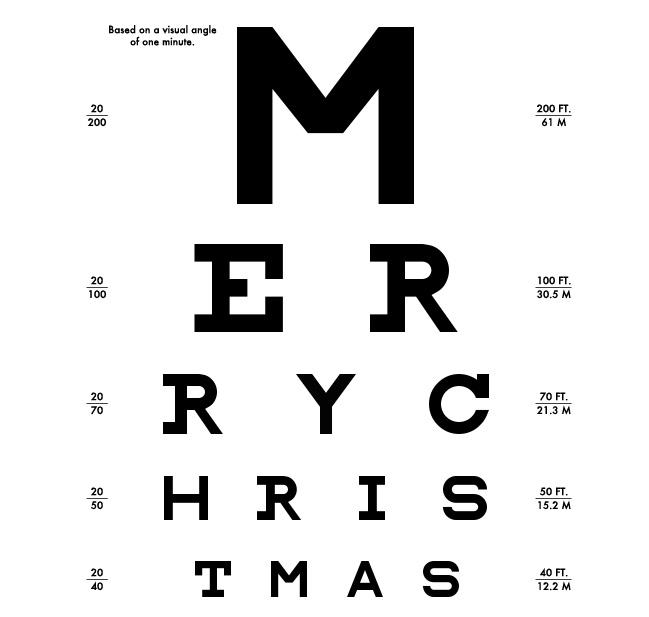
christmas eye chartMy graying hair is not the only thing that tells my age. If there is not a considerable amount of light in a room, my vision is significantly impaired. And trying to read something in the dark? Forget about it! Eating out the other night, I picked up a lighted candle that was on my table and nearly burned down the restaurant trying to read the menu! I charred part of the menu, but thankfully, there were no flames.

So to prevent the pastor of First Christian Church from one day being arrested for arson, I have decided to keep a little pocket-light on my key chain at all times. Because looking at the dark world through 47 year-old eyes is becoming more difficult by the day, and especially by the night.

Figuratively speaking, looking at our dark world with frail, finite eyes can sometimes be even more difficult. Some days, everywhere we look, we only see darkness and despair.

On Christmas Eve churches all over the world will gather together to celebrate Christmas by lighting candles to celebrate the Light of the World who has come to shine light into our darkness. This Light has changed the way we see ourselves and this world forever. Instead of looking at the world with frail, finite eyes, with faith we are able to look at the world with the eyes of Christmas.

Looking at the world with the eyes of Christmas means believing God is here with us and has identified with us. God knows what it is like to be a human being. God shares in our joy, but God also shares in our suffering. God doesn’t cause our misery; God feels our misery.

Looking at the world with the eyes of Christmas also means believing that God is working in the world bringing order out of the chaos, triumph out of defeat, and life out of death.

Looking at the world with the eyes of Christmas means believing that God is very much a part of our world and our lives, shining light in the darkness, giving joy where there is sorrow, bringing peace where there is confusion, granting forgiveness where there are mistakes, sharing love where there is hate, and giving hope where there is despair.

Like a 47 year-old turning on a pocket light to read a menu, Christmas adjusts our focus and sharpens our vision, and we begin to see the whole creation in a brand new Light. Misery becomes opportunity. Strangers become family. Enemies become friends. Everyday becomes gift.

Christmas Born in Straw

7352204-baby-jesus-asleep-in-the-manger

John Scott once wrote: “We are not to picture Jesus as a modern baby lying with nothing on but a diaper…but as a baby in ‘swaddling cloths,’ the long narrow strips of bandage wrapped round his limbs and body making free movement impossible…Is it not almost unbelievable that the Creator, on whose freedom and power we all depend, should allow himself to be bound, and to lie in helpless weakness in the straw?”

The true message of Christmas is that God was born into our world naked, defenseless, and vulnerable. How ironic then is our consumeristic perversion of it!

The Messiah, bound in a feeding troth—while December shopping malls exhibit a celebration of our capitalistic freedom to make and spend as much money as we desire.

The Savior of the World, born in a barn to peasants—while our homes and tables exhibit an extravagant excessiveness associated with royalty.

God, humbled, emptied and poured out—while Christians use Christmas to exert their power, control and authority, especially over others who have different faiths.

Christmas challenges us to acknowledge that God’s ways are not our ways. While we perceive Christmas as an opportunity to get our own way, through the true message of Christmas I believe God is trying to show us another way.

This is why I believe it is so important to attend and invite others to our worship services and activities during Advent and Christmas. For amid the clamor of consumerism and selfishness, in our worship we will hear a call to sacrifice and selflessness. Amid the noise of narcissism and pride, through our acts servitude we will sing carols of humility and sharing.

And may the world look at us and see not a Crusader born with a silver spoon in his mouth and a sword in his hand, but a baby whose limbs were bound and whose bed was straw.

Being the Embodiment of Christ – “Forgiveness”

I want to begin a several-part series entitled: “Being the Embodiment of Christ.” I want to explore ways that our church can overcome past mistakes, the mistakes of our church as well as the mistakes of the Church (and that is Church with a big “C”). There is no doubt that many of these mistakes have not only wounded the church’s witness, but they have actually wounded the faith of many. I believe we simply must accept responsibility for some of the reasons that people are all but giving up on organized religion these days.

Therefore, I would like to begin this series with a confession and with an appeal for forgiveness. As part of the Body of Christ, we confess that we have not always modeled the life and teachings of Jesus. We have been selfish, self-righteous and judgmental. Like the Pharisees in Jesus’ day, we have often been purveyors of bad theology. We have neglected the poor “at our gate” (Luke 16:20). When God has called us to speak out for justice in our world, we have been silent. When God has called us to stand for peace, we have taken a stance for war. Although we say we believe we will go to heaven to one day to worship with every race and tribe (Revelation 7:9), we prefer a worship that is segregated.

This is by no means a complete list of our sins. However, we believe it is a good start. And we choose to start this process of reconciliation within community. Instead of giving up on the church, we commit ourselves more fully to the church. As Rev. Lillian Daniel has said, “Community is where the religious rubber meets the road. People challenge us, ask the hard questions, disagree, need things from us, require our forgiveness. It’s where we get to practice all the things we preach” (Going Solo). As we ask to be forgiven for our many trespasses, we recommit ourselves to being a community of grace and forgiveness forgiving the trespasses of each other.

One of my favorite preachers and authors, Frederick Buechner, has written some of the best words on the subject of forgiveness that I know:

forgivenessTo forgive somebody is to say one way or another, “You have done something unspeakable, and by all rights I should call it quits between us. Both my pride and my principles demand no less. However, although I make no guarantees that I will be able to forget what you’ve done, and though we may both carry the scars for life, I refuse to let it stand between us. I still want you for my friend.”

To accept forgiveness means to admit that you’ve done something unspeakable that needs to be forgiven, and thus both parties must swallow the same thing: their pride.

This seems to explain what Jesus means when he says to God, “Forgive us our trespasses as we forgive those who trespass against us.” Jesus is not saying that God’s forgiveness is conditional upon our forgiving others. In the first place, forgiveness that’s conditional isn’t really forgiveness at all, just fair warning; and in the second place, our unforgiveness is among those things about us that we need to have God forgive us most. What Jesus apparently is saying is that the pride that keeps us from forgiving is the same pride that keeps us from accepting forgiveness, and will God please help us do something about it.

When somebody you’ve wronged forgives you, you’re spared the dull and self-diminishing throb of a guilty conscience.

When you forgive somebody who has wronged you, you’re spared the dismal corrosion of bitterness and wounded pride.

For both parties, forgiveness means the freedom again to be at peace inside their own skins and to be glad in each other’s presence. ~originally published in Wishful Thinking and later in Beyond Words

Being a community of grace and forgiveness–I believe it is a great start to begin overcoming the mistakes of our church and of the Church. The truth is, we have to start being such a community if we ever want to welcome back those who have left the church or welcome for the first time those who have never considered being a part of the church. And we absolutely have to be such a community if we want to ever come close to becoming the church that God is calling us to be.