Grateful to Be Done with Religion

done

Hebrews 10:11-25 NRSV

I am done. I give up. I have nothing left. I just can’t do this anymore. It’s over. No matter how hard I try, nor how much I put into it, I can never get it right.

And I know that I am not the only one. In fact, do you know what the fastest growing “religious” group in America is called?  They are called “the Dones.” At one time, they tried religion. But now they are done.

But here’s the good news—here’s what may be the best reason to be grateful this Thanksgiving: The wonderful truth about the Christian faith is that it is not a religion. No matter what anyone may tell you, the church is not a religious organization.

While I was pastoring a church right out of seminary back in 1993, a deacon in our church asked me where I saw myself in twenty-five years. Although I didn’t mention Arkansas, I told him that I believed that I would still be pastoring a church somewhere.

He laughed out loud.

“What’s so funny?”   I asked.

“I see you more as the type who might be teaching in some college somewhere. I don’t think you are going to be a pastor.”

“Why do you say that?”

He said, “For one thing, pastors are generally religious people. And you, my friend, are not very religious!”

What this deacon failed to realize was that the church is not a religious organization. And the last thing a Christian pastor should be is religious.

Let me share with you what I think is a good definition of religion.  It comes from the late Episcopal Priest Robert Capon: “Religion is the attempt by human beings to establish a right relationship between themselves and something beyond themselves which they think to be of life-giving significance.”

Now, for some people religion has absolutely nothing to do with God.

For example, some say that I run religiously. I have heard my wife tell me that I read Runner’s World magazine like the Bible. I read it religiously to reach beyond myself, to run faster, achieve good health so I can enjoy the good life!

We’ve observed the religious habits of others. “He studies the stock-market religiously.” “She sanctimoniously follows a low-carb diet.” “He works 60 hours a week, religiously.” “He plays golf, religiously.”

We work out, eat right, study, go to work, follow a regimen, all with the same goal: to achieve life! So, it’s possible to be a religious fanatic and have absolutely nothing to do with God.

However, for some, religion is all about God. There are those who feel that we must be religious to get right with God. The main reason they go to church is to work on their relationship with God. They believe if they say the right prayers, believe in the right creed, behave the right way, avoid the right sins, then they can be right with God and God will bless them. If they can conduct their lives in a certain way, they can place themselves in a right relationship with God and achieve abundant and eternal life.

The bad news is that we human beings are always flunking religion.  No matter how hard we work at religion we can never get it right.

We can read all about running and how to run fast, but we will probably get injured.

We can study the Wall-Street Journal religiously and still make a bad investment.

We can religiously follow a diet and still gain weight.

We can place all of our time and energy into our careers, going to work early and leaving work late, and still be unappreciated and miserable.

And when we finally arrive at the place where we think you we have it right with God. When we finally believe we’ve got it right in the religion department, guess what? It only leads to pride and arrogance. A church member once told me, “I am the most humble person in our church!”

Sure you are.

In his wonderful book Unafraid: Moving Beyond a Fear-Based Faith, Benjamin Corey writes about a strange encounter with someone who was religious.

Upon meeting the gentleman, he wondered whether he could ask me a few questions to determine what kind of Christian I was. For some reason, I agreed—and ended up quickly regretting my decision, because the two questions out of his mouth were: “Do you spank your kids? And “Do you think gays are going to hell?”

I was like, “Wait…what kind of survey is this?” I should have known that this True Christian Surveywasn’t going anywhere, but in that moment I was foolish enough to answer his questions.

When I answered “no” on both counts, and answered another question to indicate that I did not believe in the rapture, the gentlemen told me that the reason why I was an adoptive father instead of a biological father was because God was refusing to bless me with children.

The good news of our scripture lesson this morning is that God came into the world through the person of Jesus Christ to put an end to such nonsense, to put an end to religion.

Hebrews notes that the priests stood before God in the temple. Well, of course they stood. There was no time to sit. There is no chair in the holy of holies.

And I know if a priest is going to be setting things right between God and my sin, he’ll never have a chance to sit down! The poor priest will constantly be running back and forth between my sin and God’s salvation.

No matter how great and sincere my sacrifice is when I go to the temple, my shortcoming as a fragmented human being are not going to disappear. The poor priest is never going to get a day off. He’s never going to be able to sit down. That’s why we read: “And every priest stands day after day at his service and offers again the same sacrifices that can never take away sins.”

Now contrast the posture of the priest to Jesus. Notice what Jesus is doing? Jesus is sitting down. “When Christ offered for all time a single sacrifice for sins, he sat down at the right hand of God.”

The veil in the temple, separating us from God was torn in two at his death. And through this great gift of God’s self, God revealed to the world that we should be done with religion.  Jesus is sitting down.

Consequently, there is no point of us getting on some treadmill of right thoughts, right beliefs, right speech, right actions, because that right relationship we so desperately seek has already been made right by God.

We have to only trust that God has indeed done what was needed to be done through Christ.

This is why our church teaches “no creed but Christ.” Being a member of this church is not about believing in this set of principles or that set of ideals, in that biblical interpretation or in this style of worship. It is about trusting and following Jesus.

That is why we call it the gospel. That is why we call it good news. If we called it religion, it would be bad news. Religion would mean that there was still some secret to be unlocked, some ritual to be gotten right, some law to obey, some theology to grasp, or some little sin to be purged.

This Thanksgiving, I thank God that through Jesus Christ this thing called sin between us and God has been made right. Thank God that the church is not a religious organization!  If it hadn’t, as irreligious as I am, there is no doubt in my mind that I would be in some other line of work by now!

The good news is, unlike the priests who are standing, running around, working hard, trying to get it right, Jesus is sitting down. His work is done. Religion is finished. We accept salvation trusting that Jesus has already done the work for us. Our relationship with God has been made right through him.

So, instead of spending holy moments working on our relationship with God, we can spend some sacred time working on our relationships with others, loving others as we love ourselves.

Now, don’t get me wrong. We don’t need religion, but we still need church. However, we don’t need church to get right with God. We need church to discover ways we can get right with our neighbor. Because what this world needs is not more people who say they love God, but more people who love their neighbor with the unconditional, unreserved love of Jesus. We are free. We are free from fear. And we are free to love.

I know that there are some who still believe that what we do here in the church is religious. They have never stepped out to follow Christ, to share the love of Christ with others, because they are waiting until they somehow get it right themselves. They are busy trotting back and forth to the altars of right beliefs, right thinking and right praying.

But this morning I am inviting all to come and realize that God has already made it right through Jesus Christ. I invite all to take a good look at Jesus this morning.

There he is. He’s sitting down.[i]

Thanks be to God.

Invitation to the Table

Each one is now invited to be served the bread and the wine of this table representing the broken body, and outpoured life of God.

There is absolutely nothing you can do to earn a rightful this table. There are no right words, right actions, or right beliefs. The good news is that when we could not make things right with God, God, through the sacrifice of Christ, revealed to the world that things have been made right. May we reflect on the sacrifice of God as we remain seated and sing together.




[i]Inspired from a sermon written by William Willimon.

Accepting a Topsy-Turvy Gospel

Brett Medal

Mark 10:35-45 NRSV

We live in in some very dark times. These are difficult days to be a minister. These are difficult days to be the church. These are tough times to raise children. It is more than evident that the spirit of the anti-Christ is in this world. The spirit of the anti-Christ seems to have a grip on this nation, and it has even infiltrated the church. False prophets are everywhere.

Of course, this is nothing new. John put it in words 2,000 years ago:

Beloved, do not believe every spirit, but test the spirits to see whether they are from God; for many false prophets have gone out into the world. 2By this you know the Spirit of God: every spirit that confesses that Jesus Christ has come in the flesh is from God, 3and every spirit that does not confess Jesus is not from God. And this is the spirit of the antichrist, of which you have heard that it is coming; and now it is already in the world.

As Disciples of Christ were creating a movement to return to the simple teachings of Jesus in the 19thcentury, German philosopher and cultural critic Friedrich Nietsche were denigrating those teachings calling them “a slave morality.”

Nietshche noted that Christianity seemed to be most popular among the people in his day who were at were at the bottom— the poor, women, children, people with disabilities, people of color, and slaves. He accused Christianity of giving hope to those at the bottom and offering very little to those at the top.

His criticism served as a warning to the church: “If you are not careful, if you keep teaching the Gospel of Jesus, you might fill your churches up with the wrong type of people.”

So, the false prophets went to work. Rejecting the gospel of Jesus, they began to preach and teach the antitheses of Jesus. “God only helps those who help themselves,” they declared. “Women should be submissive to men, at home, in the work place, in government and in the church,” they asserted. “Children should be seen and not heard and can be exploited for their labor,” they affirmed. “Jesus was a white man,” they pronounced in artistic portrayals. “God’s Word sanctions slavery,” they argued.

Today, an anti-Christ spirit still haunts this land. “They are lazy and entitled,” they tweet. “Her voice is too shrill” they post. “They are too young to have a voice!” they shout. “We need to stop the caravan!” they clamor. “God calls them abominations,” they preach.

When Jesus first predicts what would have to suffer and die, the disciples immediately reject it.” Simon Peter pulls Jesus aside and strongly rebukes him. When he makes his second prediction, the disciples “jostle for position” arguing with one another: “who is the greatest.” And now, after a third and more detailed prediction of what was going to happen to him, James and John approach Jesus “on the sly” and say: “[Do us a favor and grant us to sit, one at your right hand and one at your left, in your glory.”

Jesus had just laid all of the cards out on the table—the condemnation, the mockery, the spitting, the flogging, the death—and James and John seem to accept none of it. The two of them had no clue that the ones who would end up on Jesus’ right and his left would be hanging on crosses!”

When the ten become angry with James and John for making their request, Jesus realizes that they are still confused about the nature of God’s Kingdom.  So as New Testament Scholar Martin Copenhaver has said, “he does a little remedial work with them.”  Changing the subject from the ultimate act of self-giving love on the cross, Jesus talks about other forms of self-giving.  Once again, Jesus reverses our expectations, and says that to be great is to be a servant, even as he came himself to be a servant.


Last week, I said Jesus’ teachings turns our word upside down.

  • The first shall be last and the last shall be first.
  • To save ourselves we must lose ourselves.
  • To live we must die.
  • To get back at you enemies, love them.
  • To obtain riches, give everything you have to the poor.
  • A woman’s two copper coins, worth only a few cents, has more value than large bags of money that others put into the temple treasury.
  • The eyes of the blind see more clearly than the eyes of those with 20/20 vision.
  • The poor are filled with good things, whereas the rich are sent away empty.
  • A poor beggar named Lazarus is resting by Abraham’s side, whereas the rich man is begging for mercy.
  • A tax collector leaves the worship justified, whereas the Pharisee does not.
  • The grown-up religious leaders are like poisonous snakes, whereas little children are like the kingdom of God.
  • Foreign Samaritans are role models, whereas a priest and a rabbi are not.
  • The prodigal son gets a pair sandals, a ring, a fatted calf, a big party with music and dancing, whereas the responsible son gets nothing.
  • Religion is condemned, whereas sin is forgiven.
  • The female disciples are the first to proclaim: “He is risen!” whereas the male disciples are cowering behind locked doors.

Copenhaver observes: “The lesson [in Mark chapter 10] bears repeating, because we are continually trying to straighten up the order of things that Jesus turned topsy-turvy.”

I have experienced this on more than one occasion working with Ainsley’s Angels. I believe that the Ainsley’s Angels’ mission of radical inclusion mirrors the topsy-turvy teachings of Jesus. And because of that, the mission is sometimes rejected.

I have been told by race directors that our children and adults who are differently-abled are not welcomed at their races. We “create too much angst to be in their race,” they said. “Only the physically-abled and the physically-fit should be in a marathon,” some runners grumbled. Others have said that we are what is wrong with this nation, that “not everyone deserves a trophy or deserves to be in a marathon.”

The good news is that there are many people who have accepted the radical, topsy-turvy Gospel of Jesus. They have stood firm and have rejected the spirit of the anti-Christ that is in our land and are following the radical way of Christ.

There’s a church and a community that is helping to send a young man with Cerebral Palsy, Epilepsy and Autism to the Marine Corps Marathon in Washington DC. This is a marathon in our nation’s capital called “The People’s Marathon.” And it’s a marathon that is more than happy to include him.

There is a church that begins their worship service uplifting and dedicating small little children, because they know they are the keys to the Kingdom of God. And there are parents and grandparents who are willing to sacrifice everything for those children.

There is a church that has ordained both men and women as ministers, ministers who have never lorded over their congregations, but selflessly served alongside their congregations.

The good news is there are several churches in this city that are open and affirming to all people regardless of race, ability, gender identity, sexual orientation, or political affiliation.

The good news is there are people everywhere who have heeded Jesus’ command to feed the hungry, give drink to the thirsty and welcome to the stranger.

There are volunteers who have left the comfort of home to help survivors of recent hurricanes.

There are teachers, social workers, and childcare workers, who sacrifice much to educate, protect and care for the children of this world.

There are people with empathy who are marching and organizing and giving all that they have to create a nation with less racial, social, economic and environmental injustice.

There are people who believe Black Lives Matter, and of course, they also believe Blue lives matter, as they have created an organization called PACE, Police and Community Engagement that creates safe place for conversation.

There are law enforcement officers and firefighters who are willing to lay down their lives to protect and serve their communities.

There are artists who are imagining a more just and equitable world.

There are women refusing to be kept silent by patriarchal powers of oppression.

There are children speaking truth to power by saying “enough is enough” to violence.

There are soldiers still willing to sacrifice their lives for liberty and justice for all.

There are elderly who spend their well-earned retirement volunteering at the hospital.

There are voters who care about the things Jesus cares about who are going to the polls.

Dan Rather has noted: “[There’s] the city bus driver who waits patiently for an elderly rider, the crossing guard who gives the children a bright smile, the doctor who volunteers to treat the homeless, the ranger in a national park who introduces a city kid to the wonder of tall trees.”

In other words, although many have surrendered to the spirit of the anti-Christ, rejecting the teachings of Jesus for possessions, position, privilege and power, there are many who have accepted this Topsy-Turvy Gospel—And because of that, a light shines in the darkness.

Thanks be to God.

Sharing the Suffering and the Glory – A Commissioning Service for Elders and Congregation

commissioning

1 Peter 5:1-4 NRSV

This morning, I want to us to take a careful look at these words from 1 Peter.

Now as an Elder myself,

Did you know that as the pastor of this church, I am considered to be an Elder? I am. Thus, the responsibilities of Elders in the church are very similar to my responsibilities as the Senior Minister. I have often said that the Elders of the church are best described as “co-pastors.” The pastor and the Elders form a wonderful ministry team of the church.

And did you know, that as a church that has always believed in Martin Luther’s doctrine of the Priesthood of All Believers, we believe that every member of our church is a co-minister? When a minister laid his hands on you in baptism, we believe you were ordained or set a part for ministry. We call ourselves Disciples of Christ. We believe we have been called to be disciples just like Peter was a disciple. Thus, this passage in 1 Peter regarding Elders is applicable to every member of this church.

and a witness of the sufferings of Christ.

Now, Peter actually witnessed the sufferings of Christ; however, as Elders and ministers of the church today,

we also bearwitness to the sufferings of Christ, by becoming suffering servants with the congregation.

With the Apostle Paul, we believe when one member of the body suffers, the entire body suffers. We grieve with those who are mournful. We worry with those who are anxious. We are afraid with those who are fearful. We cry with those who are despairing.

as well as one who shares in the glory to be revealed,

but at the same time, we share the glory that is coming.

As Paul also says, we grieve, but we do not grieve like those who have no hope.

We suffer, but we know all things will work together for the good.

We are worry but we know that nothing in all of creation will separate us from the love of God.

We are afraid, but we know we can do all things through Christ who strengthens us.

We cry, but we know that love will win.

Therefore, we are in all times and in all places encouragers.

We possess a spirit of positivity, reassuring others that although we cannot go back to the good old days, good new days are always ahead.

We always work out bring out the best that is in others.

We work to embolden the image of God, the spiritual gifts, and the holy purpose that is within all people.

I exhort the elders among you to tend the flock of God that is in your charge,

 Elders, ministers, and all disciples are best described as shepherds.

After asking Peter three times, “Do you love me?” Jesus says, “Feed my lambs, look after my sheep, feed my sheep.”

Now, we might hear this in a very individualistic way as it seems like Peter is being sent out on a lone, heroic mission.

However, when Jesus speaks of shepherding, he does not want us to think about a brave, lone shepherd who his sent out to bless the world.

No, with Jesus, ministry is always a communal experience.

Mark’s Gospel informs us that when Jesus commissioned the disciples, when he sent them out into the world, he sent them out in pairs.

Jesus does not intend for us to bear the good news on our own. We are called to proclaim the gospel, to tend to the flock, to meet the needs of others, together, in community.

exercising the oversight, not under compulsion but willingly, as God would have you do it

Elders and other church members in some churches (not this church of course) only read part of this verse.

They exercise oversight. Which they interpret as being in control.

They believe the congregation should be submissive to their leadership. They act as if they are the bosses of the church.

However, the verse continues: “exercising the oversight…willingly, as God would have you do it.”

In speaking about his own his own shepherding ministry, Jesus says:

“I am the good shepherd. I know my own, and my own know me, just as the Father knows me, and I know the Father; and I lay down my life for the sheep.”

Jesus is describing a ministry that is not only a communal experience. It is also a mutual experience.

In the book that has perhaps influenced my ministry the most, Henri Nouwen writes that Jesus wants us to minister as he ministers (In the Name of Jesus).

“He wants us to feed his sheep and care for them, not as ‘professionals’ who know their clients’ problems and take care of them, but as vulnerable brothers and sisters who know and are known, who care and are cared for, who forgive and are forgiven, who love and are being loved.”

Somehow we have come to believe that ministry requires a safe distance from those we are called to serve. Medicine, psychiatry, and social work all offer us models in which ‘service’ takes place in a one-way direction. Someone serves. Someone else is being served. [And we best not confuse the two!]

But how can anyone lay down their life for those with whom they are not even allowed to enter into a deep, personal relationship?

Laying down your life means making your own faith and doubt, your own hope and despair, your own joy and sadness, courage and fear available to  [all] as ways of getting in touch with the Lord of life.”

Nouwen continues:

“We are not the healers. We are not the reconcilers. We are not the givers of life. We are sinful, broken, vulnerable people who need as much care as anyone we care for.

The mystery of ministry is that we have been chosen to make our own limited and very conditional love the gateway for the unlimited and unconditional love of God.”

Therefore, ministry they way God would do it, shepherding the way Jesus would do it, must be mutual.

—not for sordid gain but eagerly. Do not lord it over those in your charge,

We do this not for power or control, but because we are eager to follow the way of Jesus, the good Shepherd.

Nouwen points out:

When another cannot know someone who is caring for them, “shepherding quickly becomes a subtle way of exercising power over others and begins to show authoritarian and dictatorial traits.”

The ministry and leadership of Jesus is radically different.

To use Robert Greenleaf’s term, it is a “servant-leadership,” in which the leader is a vulnerable servant who needs the people as much as the people need her or him.

but be examples to the flock

We are to live as mentors to one another. When we see something that needs to be done, we do not wait for others to act. We do not sit back saying, “I wished the pastor would do this or address this.” But as servant leaders, as shepherds, as a priestly people, we take the initiative.

We model for others what the prophet Micah calls the requirements of our God. We love kindness. We do justice. And we walk humbly.

This is especially important as we live in a culture where the exact opposite is often modeled, and oftentimes modeled in the name of God.

I cannot think of any other time in my ministry where the words of another prophet have been more applicable:

Ah, you who call evil good

and good evil,

who put darkness for light

and light for darkness,

who put bitter for sweet

and sweet for bitter! (Isaiah 5:20)


We must model for the world what it means to be a follower of Jesus.

We give sacrificially. We serve selflessly. We love our neighbors. We confess our sins. We trust in God’s grace. We offer grace to others. We liberate people who are oppressed. We welcome children. We proclaim the gospel, and if necessary, we use words.

And when the chief shepherd appears,

When we proclaim the gospel with our words and deeds, we have the hope that we will see Jesus, our chief shepherd, our chief Elder.

In Matthew 25, we read a parable where people are asking Jesus when they saw him: “Lord, when was it that we saw you?”

He answered:

“I was hungry and you gave me food. I was thirsty and you gave me something to drink. I was a stranger and you welcomed me. I was naked and you gave me clothing. I was sick and you took care of me. I was in prison and you visited me.Truly I tell you, just as you did it to one of the least of these who are members of my family, you did it to me.”

 you will win the crown of glory that never fades away.  

When we shepherd, when we tend to the sheep, when we minister to God’s children, when we love our neighbors as ourselves, not only do we see Jesus, but we participate in something divine that is eternal, something holy that has no end, something sacred that is forever.

Words Create Worlds

words have power

James 3:1-12

I try to talk to people every week who never attended church, or who no longer attend church. And when I ask them why they are not a part of church, they often tell me that they have been deeply hurt by the church. “How?” I ask. “By words,” they say.

The truth is: words have tremendous power. The Epistle of James says it well. Allow me to read it again:

How great a forest is set ablaze by a small fire! And the tongue is a fire. The tongue is placed among our members as a world of iniquity; it stains the whole body, sets on fire the cycle of nature, and is itself set on fire by hell. For every species of beast and bird, of reptile and sea creature, can be tamed and has been tamed by the human species, but no one can tame the tongue—a restless evil, full of deadly poison. With it we bless the Lord and Father, and with it we curse those who are made in the likeness of God. From the same mouth come blessing and cursing. My brothers and sisters, this ought not to be so (James 3).

Nathan Parrish, a friend of mine and pastor in Winston-Salem, North Carolina, said that one Sunday after worship, he asked a father how football practice went that week for his son who was playing Middle Football for the first time. He said that his son came home after the game Thursday night really upset. He said that the coach said that “he hit like a girl.” My friend Nathan responded: “The message starts early doesn’t it?”

He asked: “What do you mean?”

Nathan said: “Our children learn it while they are young, don’t they? That females are the weaker sex and need to be kept in their place.”

Laura Johnson, the former pastor of Broad Street Christian Church in New Bern, North Carolina, an area that has been devastated this weekend by hurricane Florence, has said that as a female pastor people give her qualified compliments all the time: “Laura, that was a great sermon…for a woman.” “Laura, you are a good pastor, for a girl.”

The message starts early, and it is pervasive. The words are heard in school and in many churches. Through patriarchal language, through the exclusive use of male pronouns to refer to God, the insinuation is made that men are somehow closer to God than women. Thus, in many churches, only men can be the leaders, as women are pushed to a more subservient place in the church.

Words indeed have great power.

This is why alarm bells should go off in our moral consciences when we hear people with power use words like “infestations,” “animals,” “aliens,” “dogs,” and “illegal,” to describe groups of people. Words have power to degrade, demean and dehumanize those made in the likeness of God. Adolf Hitler knew this when he referred to Jews as “rats” in Nazi Germany.

As we read this scripture in James, we can realize that James is making a fascinating connection between speech and creation. In verse nine, we reminded that we were created according to the likeness of God as revealed in the first chapter of Genesis. James is making the comparison that as God created the world with speech, we, like God, also have the power to create with our speech.

In verse seven we read that the “beast and bird, reptile and sea creature” are tamed by humans. This echoes Genesis creation account where human beings are given the power of speech to name all of the living creatures. James reminds us that the first and most important gift distinctive to humans is this power to name, this power to create language.  James is saying that with language and speech we are given to power continue God’s own creative activity in our world.

The truth is, with speech and language, we possess a world-creating power. New Testament scholar Luke Johnson put it this way: “the world as it emerges moment by moment from God’s creative energy…is reshaped and given its meaning by human language, whose symbols enable us both to comprehend the world as meaningful and to interpret it.”

Thus, I believe a very important question for us is this: How are we as the church creating, how are we reshaping and how are we giving meaning to our world with our language?

What about when we say:  We’ve never done it that way before, or worse, You are in my seat?

When these words are spoken at church, they almost always mean “new ideas, new ways of thinking, new approaches to ministry, and new people are not welcome here.” There was a great book written nearly forty years ago that many churches that are closing their doors for good today failed to read. It was called The Seven Last Words of the Church: We’ve Never Done It that Way Before.”

The Bible clearly says…

Whenever I hear this expression, I get a little nervous, especially when I hear it from politicians who would like to transform the United States into a Theocracy. They want to take the laws of God found in the Bible and make them the laws of the land.

While a theocracy may sound good to many Christians at first, it really all depends on who Theo is, doesn’t it? Who gets to pick and interpret the laws that they want others to obey? Whenever people talk about enforcing or legislating biblical morality, they are almost always thinking: “There is only one interpretation of the Bible, and it is mine!”

Love the sinner and hate the sin.

 These words infer that we can somehow separate the sin from the sinner; however, sin is so much a part of our DNA, so much a part of who we are in this fragmented world, that it simply cannot be avoided. And when we think that we have reached some sort of spiritual pinnacle that we can somehow avoid sin, we contradict who Jesus calls us to be by becoming arrogant, proud, snooty and judgmental. And we drive people away from the church in droves.

If you died today, do you know where you would spend eternity?

When we infer that following Jesus should only be done for purely selfish reasons, to receive some reward instead of some punishment, then we miss the whole point of who Jesus is and who he calls us to be. Jesus calls us not to save our lives, but to lose our lives. Jesus calls us to live a self-giving, self-expending life rooted in radical selflessness. Jesus never said, “Follow me and go to heaven.” He said, “follow me and carry a cross.”

And then there are the classics:

God has God’s reasons.

God does not make mistakes.

God will not put any more on us than we can bear.

It’s God’s will and we will just have to accept it.

This language has probably caused more people to leave the church, and leave God, than any other spoken words. There is no telling how many people have reached the conclusion: “If God is the one who caused my baby to die, if God is the reason behind my divorce, if God created my loved one to suffer, if God put all of these financial hardships on me, if God send this hurricane, if God is sending these flood waters in my house then I would be better off living in Hell for all of eternity than with a God like that.”

I believe many Protestant churches, in an attempt to distance themselves from Catholicism, have tried to follow Jesus while avoiding the pain and suffering of Jesus. We look at the crucifix and say, “My Lord is not on the cross! He is living today in heaven! However, when we we do that, we miss what may be the most important tenet of the Christian faith: that our God is a God who suffers.God is not seated on some throne far removed from the creation sending hurricanes to North Carolina or blowing up houses in Massachusetts. God is not pressing buttons, pulling levers, causing human misery, but our God is here in the midst of human pain, suffering with us, alongside us. So, in a way, our God is still on the cross today. As long as there is human life, our God is still emptying God’s self, pouring God’s self out. Our God is a God who grieves, agonizes, and bleeds. Our God is never working against us, but always for us, creating and recreating, resurrecting, doing all that God can do to wring whatever good can be wrung out of life’s most difficult moments.

Our language has the power to paint a Christ-like portrait of God, and our language as the power to paint an anti-Christ portrait of God.

Our language has the power to create a world where people are oppressed and cursed, and our language has the power to create a world where people are treated with equity and are blessed.

Our language has the power to create a world that dishonest, deceitful, and despairing, a world that is mean, cold and dark. And our language has the power to create a world that is honest and sincere, a world that is kind, empathetic and hopeful.

Let me illustrate this. Joyce Williams was a member of one of my churches who used to always greet me with the following words: “I love you Jarrett Banks.” She would always say it just like that. When she passed away, almost everyone who knew her said the same thing, that she would extend the same greeting to them: “I love you…” and then said their first and last name. So, that is how we concluded her memorial service. I had everyone who was present to turn to the person next to them, introduce themselves if they did not know them, and then say, “I love you,” followed by saying their name.

Let’s do that this morning.

Let us pray.

O God, help us all to realize that like You, we have the power to create worlds with our words.  We thank You for this gift, but ask that you help us to always remember that with this gift comes a great responsibility.  As Your sons and daughters, may we use our language to create a world of peace, justice, love and respect. In the name of Jesus. Amen.


There is a word that I always use at this time to invite you to share the meal from this table. That word is “all.” Sometimes I even define that word by saying, “all means all.” It is my hope that this simple word, all, is helping too create a brand new world: a world of acceptance, a world of grace, a world of inclusion, and a world of love. May we prepare to live in such a world, to eat and drink in this world, as we remain seated and sing our hymn of communion.

COMMISSIONING AND BENEDICTION

Go now into the world remembering that every species of beast and bird, of reptile and sea creature, can be tamed and has been tamed by the human species, but no one can tame the tongue—a restless evil, full of deadly poison.

With it we bless the Lord and Father, and with it we curse those who are made in the likeness of God. From the same mouth come blessing and cursing.

So go and speak only wonderful words of life that point others to the love and the grace of our Lord and Savior, Jesus Christ. And may the love of God, the grace of Christ and the communion of the Holy Spirit, be with us all. Amen.

Lifted up for Service


cialis

Mark 1:29-39 NRSV

These few verses found in the end of the first chapter of Mark paint a beautiful portrait of who our Lord is, how our Lord acts, and what our Lord desires. Listen to them again, carefully, prayerfully…

“As soon as they left the synagogue, they entered the house of Simon and Andrew, with James and John. Now Simon’s mother-in-law was in bed with a fever, and they told him about her at once.”

Do you hear the urgency in this passage? “As soon as they left…” “…at once.”

I hear a lot of people talk about God’s timing. They say that God will bring healing or restoration in God’s own time. They say that God’s time is usually not our time. And they say that God has reasons for God’s delay. I believe this passage teaches us that the Lord wants to heal us and restore us now: not tomorrow, not some day or one day, but today, right now, “at once.” It is not the Lord’s will for any of us to ever be sick, broken, or even have a fever.

Therefore, if we are sick or broken, if we are suffering in any way, we must understand that it is not because God has some twisted reason or some purpose-driven plan for it. And since suffering is not the will of God, and since we are loved by God, we can know that when we suffer, God suffers with us and is doing all God can do to bring healing, wholeness and restoration.

“He came and took her by the hand…”

Perhaps more than anything else, I believe it is the will of our Lord to come to us and take us by the hand. When I was a child I learned a wonderful song:

Put your hand in the hand of the man who stilled the water

Put your hand in the hand of the man who calmed the sea

Put your hand in the hand of the man from Galilee

Our problem is that we put our hands in so many other places to receive wholeness.

Instead of putting our hand in the hand of the Lord we put our hands to work. We believe that if we can somehow work hard enough, serve diligently, industriously, thoroughly, and persistently enough, then we can achieve or earn wholeness or peace.

This may be the greatest sin of most of us.

We put our hands, our trust in our own selves instead of in the hands of the only one who can save us. Ephesians chapter two teaches us: “For by grace we have been saved through faith, and this is not our own doing; it is the gift of God— not the result of works, so that no one may boast.”

Instead of putting our hand in the hand of the Lord, we also put our hands in the hands of others. My granddaddy was not a pastor, preacher, or a scholar, but he was sometimes quite the theologian. One thing that he said, and said often was: “There’s only one man that you can trust in this world, and that is the Good Lord.”

However, many of us put our trust in the hands of so many others. We put our hands in the hands of the government, we put our hands in the hands of our friends and neighbors, even in the hands of the church. Then we become disillusioned when they sooner or later disappoint us. The 118th Psalm reminds us:

It is better to take refuge in the Lord

than to put confidence in mortals.

It is better to take refuge in the Lord

than to put confidence in princes.


And instead of putting our hand in the hand of the Lord, we also put them in our own pockets. We put our trust in our wealth and our material possessions. Our sense of well-being, wholeness and security comes from our bank accounts, 401-k’s, our homes, automobiles and clothing. In chapter six of the Gospel of Matthew we read the warning:

“Do not store up for yourselves treasures on earth, where moth and rust consume and where thieves break in and steal; but store up for yourselves treasures in heaven, where neither moth nor rust consumes and where thieves do not break in and steal.”

The good news for all of us this day is that Jesus, the Son of the God of Heaven is coming to us, and he wants to take us by the hand and give us a peace that the world simply cannot give (John 14:27).

“Jesus came to her, took her by the hand, and lifted her up.”

When we put our hand in the hand of the Lord, the Lord lifts us up. Preacher and Princeton Theological Seminary professor Nancy Gross says this is good news because “There is no shortage of “down” from which people need to be lifted up.”

Down today are all those things that the young people in the Scouts of America seek to emulate:

Trust and loyalty are down. Helpfulness and politeness and kindness are down. Respect for the law is down. Fiscal responsibility, a clean environment, courageous leadership and reverence are all down.

And in the middle of one of the worst flu seasons on record, many are down with sickness.

The good news is when we are down in the dumps, down with despair, down with disease, down with a fever, when we put our hand in the hand of Jesus, Jesus always lifts us up!

Now, as much as we might like to do so, now is not the time to sing a hymn, break some bread, sing another hymn and go home. Because our scripture text doesn’t end here.

“Then the fever left her, and she began to serve them” (Mark 1:31).

When we put out hand in the hand of Jesus, we are lifted up. We receive wholeness. We receive peace. We receive salvation. Then, we serve. We are lifted up for a specific purpose: to serve.

Jesus makes us whole not only for ourselves alone, not soley to help us feel better, more hopeful, more happy, more peaceful and more alive, not solety to help us get through a hard week at school, at work or at home. We are lifted up for service to others.

I believe a major problem with the Christian faith today is that many have a very selfish understanding of salvation. Our faith has been reduced to some kind of ticket to heaven, some sort of divine stamp of approval, or some kind of new drug to make our lives better, fuller, richer.

Have you noticed that every other television commercial that comes on the air is an ad touting the benefits of a new prescription drug? There is a new drug available for whatever it is that might ail you!

Are you tired of being tired? Do you have trouble going to sleep? Do you have difficulty waking up? Is your hair falling out? Do you have a going problem or a growing problem?  Are you overweight but love to eat?  Do you need to put some excitement back into your relationships? Do you read the story of the the three little pigs and wolf who huffs and puffs only to have your granddaughter say, “That sounds like you grandpa!” No matter what you’ve got, there is a new pill created just for you.

And then, in nearly every commercial, after the person begins taking what they asked their doctor to prescribe, there is all of this exuberant celebration: dancing in the streets; jumping up and down; digging for clams; running around in the yard with their dog and your water hose; even sitting outdoors and watching the sunset while holding hands with their significant other in separate bathtubs!

I oftentimes wonder if this is not how we oftentimes promote our faith. If you channel surf through the religious channels, you will find that there is no shortage of preachers who sound like they are spokespeople for some new drug. “Are you down and out?  Are you drowning in a sea of debt? Are you empty inside? Does your love life need a boost? Then pick up the phone and make your pledge, send in your check, and sit back and wait for God to pour out God’s blessings!  Wait for God to give you a reason to celebrate!”

I am not exactly sure, but I suspect that is what many people were thinking when they were following Jesus throughout Galilee. Listen to how the Sermon on the Mount begins: “And great crowds followed him from Galilee, the Decapolis, Jerusalem, Judea, and from beyond the Jordan.”  Folks had come out from all over to follow Jesus with these expectations that Jesus was going to somehow make their lives better

And listen to what Jesus says:

Are you 40 years old and wonder where your life is going? Are you feeling blue?  Do you need help raising your children? Does your marriage need a boost?

No, instead, Jesus says things like, “For the gate is narrow and the road is hard that leads to life, and there are few who find it.”

The crowd gets really quiet!  Someone whispers, “I know he didn’t say ‘hard,’ did he?  I thought Jesus was all about making things easy. What’s he talking about?

And he’s not finished. “Love everyone, including your enemies. Pray for those who persecute you. Forgive those who have wronged you. Don’t judge. Accept others as I have accepted you. Deny yourself. Pick up your cross and follow me. Die to yourself.”

I am afraid that churches are so desperate to attract people that they have been willing to trivialize and water down the gospel. So much so that the salvation that many churches are preaching is no different than the salvation that is being preached by the prescription drug industry.

May God forgive the church for implying that we need Jesus in our life to lift us up… period. Just lift us up. And implying Jesus will make our lives easier, fix everything that is wrong with us, put a little lilt in our voices, a little sunshine in our souls.

Because the chances are very good that when we put our hand in the hand of the man from Galilee, our lives will become even more difficult than they were before.

It is the will of the Lord to come to us, and to come to us immediately, without delay, with as sense of divine urgency, to take us by the hand, lift us up, and make us whole, for one purpose and for one purpose only: service, self-denying, self-expending, sacrificial service.

Let us pray together.

O God, as Christ took Simon’s mother-in-law by the hand, take our hands. Make us whole. Lift us up to be the church you are calling us to be in this world. Amen.


Invitation to Communion

Do you need to be lifted up? Are you down in the dumps, down with despair, down with disease? Have you been down with a fever? If so, gather around this table and put your hand in the hand of Jesus. He will lift you up. But he won’t stop there. The bread which he says is his body given is going to lift you up to selflessly give your own bodies as sacrifice. As he pours and lifts the cup he is going to lift you up to sacrificially pour yourself out for others.

Let us prepare to be to be lifted up for service as we sing together.


Commissioning and Benediction

He’s coming to you. He’s coming without delay. He’s coming immediately, with a divine urgency. He’s coming reaching in and reaching out his hand.

So, go ahead, right here and now, put your hand in the hand of the man from Galilee. He will lift you up. He will make you whole. For service.

As you go and serve, may the Lord bless you and take care of you; may the Lord be kind and gracious to you; may the Lord look on you with favor and give you peace.

Ripping Open the Heavens

Mark 1:4-11 NRSV  Dove

If you were to ask me what my favorite part church is, I would say that it the service of Christian baptism. I have always said that it is a good day when the preacher comes to church on Sunday with a Bible in one hand and a bathing suit in the other.

Thus, I love this day on the Christian calendar that we call The Baptism of the Lord. Although I would much rather be getting wet this morning, and getting some of you even wetter, this day at least gives me the opportunity to reflect on the wonderful service of baptism.

Baptism is about is essentially about grace. Baptism is about new beginnings, fresh starts, and clean slates. Baptism is about dying to the old, broken self and rising to a new, better self. Baptism is about the confession, forgiveness and washing away of sins. It is about coming to know that there’s nothing in heaven or on earth that can ever separate us from the love of God. Baptism is about knowing God is with us, not away from us, for us, not against us.

Baptism is about initiation into the Kingdom of God. Baptism is a commissioning to be the body of Christ in this world, the hands, legs, feet and mind of Jesus on this earth. There is a reason that baptism is often called a sacrament. Baptism is sacred. It is holy. It is grace, free and unfettered.

There is perhaps nothing in the church that is more beautiful than baptism. How ironic is it then that some in the church have taken baptism and have created something very ugly. Throughout church history, baptism has created more controversy, schisms and arguments than perhaps any else.

Throughout my own ministry, I have seen people angrily walk out of church meetings over it. I have even seen people who have transferred their membership to another church over it. I know people who have written nasty emails, made harassing phone calls, and started vicious rumors—all over arguments about baptism. I know of churches that have even split over baptism.

I have had staff members threaten to resign if we changed our church’s bylaws to accept members who were baptized by sprinkling. In their eyes, they simply did not get wet enough to join God’s Kingdom. I have heard people argue that some were not old enough, mature enough, good enough, sincere enough, or even married enough to be baptized.  A pastor friend of mine from Concord, North Carolina, was kicked out of the Baptist State Convention because a couple of folks he baptized were not straight enough. I even know people who have gotten upset, because the people being baptized in their church were not white enough.

The irony is that we have taken something beautiful that is essentially about God’s free and unfettered grace for all people, and created something incredibly ugly by placing restrictions, limitations and conditions on it. There have been more rules and regulations written in the bylaws of churches about baptism than any other service of the church.

Some churches believe that you can only baptize in a flowing creek or a river (the water has to be moving) because that was how Jesus was baptized. A stagnant pond, lake, and of course, a baptismal pool will simply not do. Some people believe you can only baptize when the church is gathered for a worship service. And most people believe that a baptism can only be performed by an ordained minister, who is, of course a male.

And once a person’s baptism has been accepted and approved, sanctioned by church officials as worthy of the grace of God, then one can use his or her baptism as an admission ticket to become a full-fledged member of the church. They can take communion, serve on a committee, become a voting member of the church board, and of course, one day, go to heaven.

Pastor Karoline Lewis once preached a sermon to her congregation emphasizing that baptism is not something that we do, but something that God does. She said that when we baptize someone in the name of God, we believe that it is God who is actually doing the baptizing. And she insinuated that when we make baptism something that we do, that we control, then we pervert the very intentions God has baptism.

After the sermon, a woman who was in her nineties approached her. “Karoline,” she said, “Is that really true?”

“What?” the pastor answered.

Hazel responded, “That God baptizes you.”

“Yes, it’s true. This is what we believe. Why?”

Hazel then told her about her sister who was born several years before she was born. Her sister was born very ill in the home and never left the house because she was so sick. The family knew she would not live long. She only lived two months. Right before she died, Hazel says that her mother took her sister into her arms and lovingly baptized her.

When Hazel’s parents went to the pastor of their church where they had been lifelong members to plan the funeral, the pastor refused to hold the funeral in the sanctuary because he had not baptized the baby. The funeral was held in the basement of the church.

Hazel, almost a hundred years later, then asked her pastor, “Karoline, does this mean my sister is OK? Is she really OK?”

“Yes,” she said. “Your sister is OK.”

There was Hazel standing in front of her pastor, weeping for the sister she never knew, crying tears of relief and grace.

This is what happens, says Karoline, this is the ugly consequences of placing limitations on the grace of God.

Of course, such restrictions and limitations on God’s grace is nothing new. The Jewish law was full of rules and regulations controlling who can and who cannot have access to God. Throughout history people of all cultures have sought to control and tame the grace of God.

This is why we need to be reminded of Jesus’ baptism. First of all, it did not occur in a controlled environment such as a baptismal pool or font in the confines of a religious building, but out in the untamed, wide-open wilderness.

And we are told that when Jesus came up out of the water the heavens were suddenly “ripped” or “torn” apart. The imagery describes a God who cannot take the separation any longer. God has had all that God can stand and rips the heavens apart.

The question for us this morning is: If the heavens were closed, whod do you think closed them? Who placed the restrictions and limitations on God’s grace? Who placed the barriers between God and people? Who created systems and structures to mediate God’s presence? Who is it that has insisted on certain rituals and beliefs to regulate God’s grace, to control God’s love, not for the sake of good order (like we tell ourselves and those we wish to exclude), but for the sake of our own power?

As a minister, I could write a book about the trouble I have gotten myself into over the years for baptizing people outside the controlled confines of the church’s bylaws. I have baptized people on days other than Sundays in places other than church buildings. I have baptized people in rivers, in swimming pools, in small ponds, even in the Atlantic Ocean. I baptized one man with his head laid back in the basin of a sink at a nursing home, trusting that it is God, and not me, who is actually doing the baptizing. It is God, and not me, who rips the heavens apart to shower God’s people with grace.

This is why I honor, respect and accept all baptisms—sprinkling, dunking, pouring, infant, adolescent and adult. And I believe baptisms can be performed by any Christian, clergy or laity, male or female. I do not believe people ever need to be re-baptized because some self-appointed or otherwise-appointed baptismal authority believes their baptism somehow did not “take,” failed to meet certain clerical requirements, or was not sincere enough or wet enough. There is but one Church, one Lord, one faith, and one baptism.

This is of course the reason why I welcome all people to the Lord’s Table, because, well, the last time I checked, it’s the Lord’s Table. While some ministers only extend the invitation to those who have been baptized a certain way, I cannot, nor can I imagine Jesus turning anyone away.

When we take a something as beautiful as the service of baptism as it was performed in the wide-open wilderness, with God ripping apart the heavens to get to God’s Son, to get to God’s people, to reveal God’s love and grace to the world, and we turn it into something that is restrictive, legalistic, divisive and exclusive, into some sort of qualifying test for membership, communion, and salvation, then we have missed the whole point of who God is and who we are called to be as God’s Church.

However, when we begin to understand that at our baptisms, whether we were a tiny infant or a grown adult, whether we were sprinkled, dunked or poured upon, whether by clergy or by laity, by male or by female…

When we begin to understand that God, the creator of all that is, ripped open the heavens at our baptisms to come close enough to us so we could feel God’s breath and hear God say: “I love you. I have always loved you. And there is nothing that can ever limit, restrict, tame or constrain this love. There is nothing in heaven or on earth that will ever separate you from this love. I know all of your shortcomings, and I forgive you. I am with you, and I will always be with you. You are my beloved daughter. You are my beloved son. You are my Church. You have the grace and the power to be my hands and feet in this world!” …

When we understand this good news, then our baptisms become what they were always intended to be: free, unfettered, abundant grace, and then we can begin to be the people we were intended to be.

Thank you, God, for blessing us with memories of Jesus’ baptism and ours. Thank you for removing all of the things we have created to separate us from your grace. Help us to go forth with your calling, direction and blessing to share this grace with all people. Amen.


Commissioning and Benediction

Go now into the world remembering that God, the creator of all that is, has ripped the heavens apart to shower all God’s people with grace. Go and share this good news with all people. May the abundant love of God, the unfettered grace of Christ, and the communion of the Holy Spirit be with us all. Amen.


Avoiding the Holiday Blues

holiday blues

The next six weeks on the calendar can be the gloomiest time of the year. The nights grow longer, the temperatures cooler. The way we celebrate during these weeks also has a tendency to bring us down.

If the holidays are all about preparing meals and parties… Then it will mean a ton of extra calories that will lead to weight gain, tighter clothes, and the blues.

If the holidays are all about children… Then it will be especially painful for those who have lost children, for those who have never been able to have children, and for those whose children are estranged. The holidays will mean lost dreams that will lead to anguish, regret and the blues.

If the holidays are all about family… Then it will be especially painful for those of us, who have lost loved ones this past year. The holidays will mean empty chairs at the table that will lead to grief, sorrow and the blues.

If the holidays are all about shopping and exchanging gifts… Then it will mean a lot of shopping that will lead to a lot of stress, debt and the blues.

No wonder this is the gloomiest time of the year for many.

However, if holidays are truly holy days, if they are all about giving thanks to the Giver of Life and Love… Then the holidays will mean grace.

If the holidays are all about the Holy gift of God’s self to us through a little baby named Jesus… Then the holidays will mean hope.

If the holidays are all about Emmanuel, God with us… Then the holidays will mean peace.

If the holidays are all about God who came to earth to reach out, heal and forgive… Then the holidays will mean love.

If the holidays are all about God, who through Jesus the Christ came to love this world unconditionally and inclusively… Then the holidays will mean joy.

So, let’s avoid the blues this holiday season by making the worship of the God of our Lord Jesus Christ a priority, so we can receive the good news of these holy days, and together, share it with others.

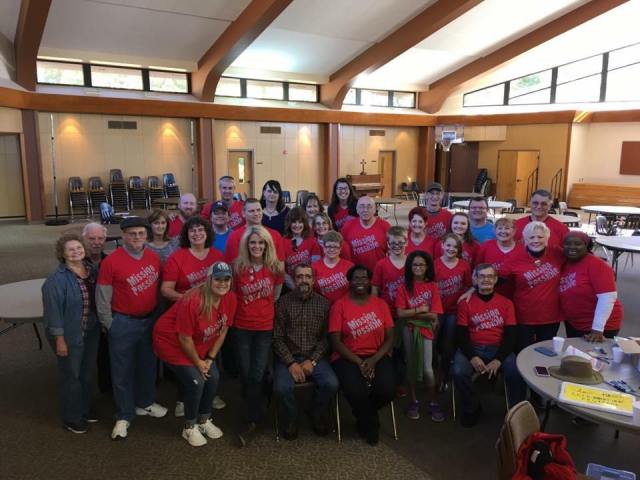
Mission Possible

shirt back

In a world of uncalled for meanness, is it possible to find people who believe they have actually been called to be on a mission to love kindness?

In a world of inequality and discrimination, is it possible to find people on a mission to do justice?

In a world of superiority and self-aggrandizement, is it possible to find people on a mission to walk humbly?

In a world of greed and selfishness, is it possible to find people on a mission to give rather than receive?

In a world of hatred and bigotry, is it possible to find people on a mission where diversity is valued?

In a world of violence and war, is it possible to find people on a mission that uses peace as a weapon?

In a world of indifference, is it possible to find people on a mission to empathetically care for others?

In a world of wealth and privilege, is it possible to find people on a mission to stand with the poor and marginalized?

In a world of divisive politics, is it possible to find people united on a mission of inclusion and respect?

In a world of alternative facts and fake news, is it possible to find people on a mission to live honestly, authentically, and unpretentiously?

In a world of bad religion, is it possible to find people who have little desire to be religious, yet yearn to be a mission to fulfill the greatest commandment to love one another?

Thanks to a group of folks that I have found who call themselves “Disciples,” I thank God that I know such a mission in this world is very possible!

shirt front

Halloween Masks and the Church

Some more Halloween thoughts…

Rev. Dr. Jarrett Banks's avatarJust Love

mc2

As a child, I had my share of nightmares.  The wicked witch from the “Wizard of Oz” would fly through my bedroom window to get me. Ronald McDonald and a gang of clowns, including Bozo and the Town Clown from Captain Kangaroo, would chase me down the road as I ran for my life. Even today, clowns still sort of freak me out. It might be why I prefer Wendy’s over McDonald’s.

However, the most frightening dream I ever had was the one where I was standing in the school cafeteria line. As I was on my way to the cash register to pay my 10 cents for my lunch and a carton of milk, I looked down to discover that I had somehow forgotten to dress myself that morning. I was as naked as I could be.

Now, I am not a psychiatrist, and I do not presume to…

View original post 226 more words

Halloween: O Holy Night

Some thoughts about Halloween…

Rev. Dr. Jarrett Banks's avatarJust Love

peanuts halloweenHalloween is sometimes called an evil or even a demonic holiday. However, I believe when we narrowly define demonic evil as fictional ghosts, goblins, and vampires that come out one night of the year, we may miss the true demonic evil that surrounds us every day—Greed, hate, racism, sexism, and all kinds of bigotry haunt our world day and night.

Furthermore, when one takes a close look at how our society observes All Hallows Eve, I believe one can reach the conclusion that Halloween may be the most holy night on the calendar. For example:

On what other evening of the year do we turn on our porch lights to welcome, not only friends and family, but all who may pass by?  All are welcomed and greeted with smiles and laughter, and “all” even includes witches, monsters and little devils. It does not matter who they are or from whence…

View original post 192 more words