Who Is Your King?

paris

John 18:33-37 NRSV

Jesus has been arrested for his actions and his teachings and has already been questioned by Caiaphas, the high priest. Because the sad truth is, that in this world, when you love all people and teach others to love all people, there will always be some people, probably religious, who will want to kill you. It is now Pilate’s turn to question him.

“Are you the King of the Jews?”

Jesus is the King. But as he told Pilate, Jesus is a different kind of King, for his kingdom “is not from this world.” He adds: “If my kingdom was from this world, my followers would be fighting to keep me from being handed over to the Jews. But as it is, my kingdom is not from here.”

And, if we are honest, this makes those of us living in this world very uncomfortable. But that is Jesus. He comforts the afflicted of this world and afflicts the comfortable of this world. Whether we like to admit it or not, the truth is, we have grown rather fond of the kings and kingdoms of this world.

We prefer the kingdoms in this world that “would be fighting” to keep Jesus “from being handed over to the Jews.”

We prefer “an eye for an eye and a tooth for a tooth.” We prefer “You’ll have to pry my gun from my cold dead hands.”

We prefer “It’s not our job to judge the terrorists. It’s our mission to arrange the meeting.”

We prefer “I hear you, and the ones who knocked down these buildings will soon hear from all of us!”

We prefer “the statue of Liberty…shaking her fist.”

The truth is that we prefer answering violence with more violence. We believe combating hate with more hate. We believe in fighting for what we believe, even for Jesus.

We believe in coercing our convictions, imposing our opinions, forcing our beliefs, and we don’t care who it offends or even destroys in the process.

We prefer a kingdom where we say it loudly and proudly that “we eat meat; we carry guns; we say Merry Christmas; we speak English, and if you don’t like it, get the heck out.”

We prefer a kingdom where we do unto others as they do unto us.

We prefer a kingdom where we love and help only those who we believe deserve our love and help.

We prefer a kingdom where people know their places and have earned those places.

We prefer a kingdom where people put the needs of their own before the needs of a foreigner.

We prefer a kingdom where we love ourselves, while our neighbors fend for themselves.

Jesus is implying that there are two types of kings. There are the kings of this world, and then there is the king from another world. And Jesus is asking Pilate and Jesus is asking you and me: Who is your king? Who do you say that I am? Am I your King? Is your king from another world or is your king from this world?

One king offers safety and comfort;

One king promises persecution, saying if you follow him, people will rise up and utter all kinds of evil against you.

One king offers security;

One king demands risk.

One king endorses greed and prosperity;

One king fosters sacrifice and promotes giving it all away.

One king caters to the powerful, the wealthy and the elite;

One king blesses the weak, the poor and the marginalized.

One king accepts only people of like-mind, like-dress, like-language, and like-faith;

One king accepts all people.

One king is restrictive with forgiveness;

One king is generous with it.

One king controls by fear;

One king reigns with love.

One king rules by threat of punishment;

One king rules with the promise of grace.

One king governs by imposing;

One king leads with service.

One king throws rocks at sinners;

One king defends those caught in the very act of sinning.

One king devours the home of the widow;

One king offers her a new home.

One king turns away the refugee;

One king welcomes the refugee, for he, himself, was a refugee.

One king destroys his enemies with an iron fist;

One king dies for his enemies with outstretched arms.

For one king’s throne is made with silver and gold;

One king’s throne is made with wood and nails.

One king wears a crown of rubies and diamonds;

One king wears a crown of thorns.

So, of course the powers that be, the kings of this world, arrested the king “whose kingdom is not from this world.” Of course they tortured this king, spat on this king, mocked this king and crucified this king, this king from a foreign realm. Of course they tried to bury this king and seal this king’s tomb up with a stone.

But hate could not defeat this king. Bigotry could not stop this king. Religion and patriotism could not overthrow his throne. This king would rise again. But not the way the kings of this world rise. Despite the desires of his followers or the lyrics of their songs, there was no thunder in his footsteps or lightening in his fists. There were no plagues, fire, brimstone, or flood. There was no shock and awe or violence of any kind.

For this king understood what, sadly, few since have understood, and that is:

The ultimate weakness of violence is that it is a descending spiral, begetting the very thing it seeks to destroy. Instead of diminishing evil, it multiplies it. Through violence you may murder the liar, but you cannot murder the lie, nor establish the truth. Through violence you may murder the hater, but you do not murder hate. In fact, violence merely increases hate. So it goes. Returning violence for violence multiplies violence, adding deeper darkness to a night already devoid of stars. Darkness cannot drive out darkness: only light can do that. Hate cannot drive out hate: only love can do that.

Reverend Doctor Martin Luther King Jr.

Consequently, this king arose from the darkness of the grave, powerfully, yet unobtrusively; mightily, yet unassumingly; leaving room to recognize him or not to recognize him, leaving room to believe in him or to doubt him, to reject him or to follow him. This king drove out the darkness, not with more darkness, but with light. This king drove out the hate, not with more hate, but with love.

So, how do we live in these dark days of November 2015?

It all depends on who your king is.

This past Monday, Antoine Leiris, who lost his wife in the attacks in Paris, proclaimed to the world which king he chooses to serve. He shared it in beautiful tribute to his wife on Facebook, promising to not let his 17-month-old son grow up in fear of ISIS.

Friday night you took away the life of an exceptional human being, the love of my life, the mother of my son, but you will not have my hatred…

I do not know who you are, and I do not wish to…

If this God for whom you kill so blindly has made us in His image, every bullet in the body of my wife will have been a wound in His heart…

So I will not give you the privilege of hating you. You certainly sought it, but replying to hatred with anger would be giving in to the same ignorance which made you into what you are. You want me to be frightened, that I should look into the eyes of my fellow citizens with distrust, that I sacrifice my freedom for security. You lost. I will carry on as before.

The good news is that our king does not have to be Pat McCory and our King does not have to be Barak Obama.

If we choose, our king will never be Donald Trump or Ben Carson, and our king will never be Bernie Sanders or Hillary Clinton.

For their kingdoms, like all of the kingdoms of this world, are flawed and dark, and the peace they offer is temporary. Their reigns are fleeting.

If we choose, our king is and will be the one whom the prophet Daniel speaks:

As I watched,

thrones were set in place,

and an Ancient One took his throne;

his clothing was white as snow,

and the hair of his head like pure wool;

his throne was fiery flames,

and its wheels were burning fire.

A stream of fire issued

and flowed out from his presence.

A thousand thousand served him,

and ten thousand times ten thousand stood attending him.

The court sat in judgement,

and the books were opened. As I watched in the night visions,

I saw one like a human being

coming with the clouds of heaven.

And he came to the Ancient One

and was presented before him.

To him was given dominion

and glory and kingship,

that all peoples, nations, and languages

should serve him.

His dominion is an everlasting dominion

that shall not pass away,

and his kingship is one

that shall never be destroyed.

Daniel 7:9-10, 13-14

A Pastoral Prayer for Mother’s Day

mothersdayprayerNote: The words of this pastoral prayer are adapted from a letter written by Amy Young to pastors.

Gracious God, Father and Mother of us all,

During this time, with our hearts and minds turned toward motherhood, we give you thanks for all those in our lives who possess the soul of a mother.

We give you thanks and celebrate with those in our community who have given birth this year, and we give thanks and anticipate with those in our community who are expecting a child.

We give thanks and pray for all mothers who are in the trenches with little ones every day and wear the badge of food stains and wearied bodies. And we pray for and mourn with those who have lost a child, for those who have experienced loss through accidents, sickness, DNCs, miscarriage, failed adoptions Or an unjust system. We pray for mothers who feel like their children are lost to drugs or other addictions.

We pray for and walk beside those who walk the hard path of infertility, fraught with pokes, prods, tears and disappointment. Forgive us when we say foolish things for we certainly do not mean to make this harder than it is.

We give you thanks for those who are foster moms, mentor moms, and spiritual moms – for this world so desperately needs them, perhaps more now than ever.

We give you thanks for and celebrate with mothers who have warm and close relationships with their children. And we pray for and sit with those mothers who have disappointment, heartache and distance with their children.

We pray for and grieve with all children who lost their mothers this year. And we pray for and acknowledge the experience of children everywhere who have experienced abuse at the hands of their mothers.

We pray for those who are single, yet long to be married and mothering their own children. We mourn that life has not turned out the way they have longed for it to be.

We pray for those who step-parent and walk with them on complex paths. And we pray for and grieve with all those who envisioned lavishing love on grandchildren, yet that dream is not to be.

We pray for, grieve with and rejoice alongside all those who will have emptier nests in the upcoming year.

We pray for those who placed children up for adoption. We ask you to bless them for their selflessness and comfort them as they hold that child in their heart.

O God, on this Mother’s Day, we pray that you help us to walk with all mothers, for mothering is not for the faint of heart, and on this day, we have real warriors in our midst.

Lifted up for Service

Scout_Sunday_2015_Logo

This sermon was preached for Scout Sunday at First Christian Church on February 8, 2015.

Mark 1:29-39 NRSV

These few verses found in the end of the first chapter of Mark, paint perhaps the most beautiful portrait of who our Lord is, how our Lord acts, and what our Lord desires. Listen to them again, carefully, prayerfully…

As soon as they left the synagogue, they entered the house of Simon and Andrew, with James and John. Now Simon’s mother-in-law was in bed with a fever, and they told him about her at once.

Do you hear the immediacy, the urgency in this passage? “As soon as they left…” “…at once.” I hear a lot of people talk about God’s timing. They say that God will bring healing or restoration in God’s own time. They say that God’s time is usually not our time. And they say that God has reasons for God’s delay. I believe this passage teaches us that the Lord wants to heal us and restore us now: not tomorrow, not some day or one day, but today, right now, at once. It is not the Lord’s will for any of us to ever be sick, broken, or even have a fever.

Therefore, when we are sick or broken, when we are suffering in any way, we must understand that it is not because God has some twisted reason or some purpose-driven plan for it. And since suffering is not the will of God, and since we are loved by God, then when we suffer, God also suffers and is doing all that God can do to bring healing, wholeness and restoration.

He came and took her by the hand…

Perhaps more than anything else, I believe it is the will of our Lord to come to us and take us by the hand. When I was a child I learned a wonderful song:

Put your hand in the hand of the man who stilled the water

Put your hand in the hand of the man who calmed the sea

Take a look at yourself and you will look at others differently

Put your hand in the hand of the man from Galilee

Of course, we put our hands in so many other places to receive wholeness, peace and security.

Instead of putting our hand in the hand of the Lord, we often put our hand, our trust, in our own hands. We believe that if we can somehow work hard enough, serve diligently, industriously, thoroughly, and persistently enough, then we can achieve or earn wholeness or peace. We put our hands, our trust in our own hands instead of in the hands of the only one who can save us. Ephesians chapter 2 teaches us: “For by grace we have been saved through faith, and this is not our own doing; it is the gift of God— not the result of works, so that no one may boast.”

Instead of putting our hand in the hand of the Lord, we also put our hands, all of our trust, in the hands of others. My granddaddy was not a pastor, preacher, or scholar, but he was sometimes quite the theologian. One thing that he said, and said often, was: “There’s only one man that you can trust in this world, and that is the Good Lord.”

However many of us put our trust in the hands of so many others. We put our hands in the hands of the government, in the hands of our friends and neighbors, even in the hands of the church. Then we become disillusioned when they sooner or later disappoint us. The 118th Psalm reminds us:

 O give thanks to the Lord, for he is good; his steadfast love endures forever. Out of my distress I called on the Lord; the Lord answered me and set me in a broad place. With the Lord on my side I do not fear. It is better to take refuge in the Lord than to put confidence in mortals. It is better to take refuge in the Lord than to put confidence in princes.

And instead of putting our hand in the hand of the Lord, we also put our hands in our own pockets. We put our trust in our wealth and our material possessions. Our sense of well-being, wholeness and security comes from our bank accounts, 401-k’s, our homes, automobiles and clothing. In chapter six of the Gospel of Matthew we read the warning:

Do not store up for yourselves treasures on earth, where moth and rust consume and where thieves break in and steal; but store up for yourselves treasures in heaven, where neither moth nor rust consumes and where thieves do not break in and steal. For where your treasure is, there your heart will be also.

The good news for all of us this day is that Jesus, the Son of the God of Heaven is coming to us, and he wants to take us by the hand and give us a peace that the world simply cannot give (John 14:27).

Jesus came to her and lifted her up.

When we put our hand in the hand of the Lord, the Lord lifts us up. Preacher and Princeton Theological Seminary professor Nancy Gross observes: “There is no shortage of “down” from which people need to be lifted up. Down today are jobs, wages, the economy, church membership, our hopes, and our children’s futures. Take your pick, add your own.” The good news is when we are down in the dumps, down with despair, down with disease, down with a fever, when we put our hand in the hand of Jesus, Jesus always lifts us up.

It is important to realize that being lifted up, being healed and being made whole, does not necessarily mean in the physical sense. I do not know of anyone who has suffered as much as Alawoise Flannagan. Right now, I do not know of anyone who is more down, more low physically than she. However, when I saw her this week, when she opened her eyes and miraculously asked me how my family was doing, I saw a woman who was more whole, more lifted up spiritually than anyone I know. It was evident that, even in the midst of great suffering, that Alawoise had placed her hand in the hand of the man from Galilee, and that man had lifted her up.

Then the fever left her, and she began to serve them.

It is very important to notice that when her fever left her, she got up and began to serve them. We are lifted up. We are healed. Then we serve. We are lifted up for service. Jesus makes us whole, not only for ourselves alone, not to simply feel better, more hopeful and more alive, but for service to others. As Ephesians chapter 2 reads: “God will enable us [lift us up] to continue on in righteousness and to do the good works which the Lord has appointed for us.”

Like Alawoise, John Barefoot also possessed spiritual healing and wholeness, a remarkable strength and joy in the midst of great suffering. At his memorial service, I pointed out that God did not lift him up, give him that strength and fill him with that joy just so he could watch a few more NC State ballgames on TV.

As it was evident to Gayle and Mark when Alawoise miraculously asked me how my family was doing, it was evident to all who encountered John—to all who saw his smile, heard his laughter, experienced his joy—that God was the source or his strength.

Right before Christmas, a group of parents and children from our church came to John’s house to sing Christmas carols. Some who were there, including me, were not a part of any church a couple of Christmases ago. We had been struggling with what we believed about the Church, what we truly believed about Christmas.

But there, standing around John’s bed with others from the church singing Christmas carols, through John, something miraculous happened. God spoke. As we watched John donning a Santa hat and wearing a smile that was so amazing that it had to be from Heaven, as we watched him sing along with the children the best that he could, with this amazing joy, a joy that had to come from God, Christmas became real. Faith became real. God became real. Church became holy.

There is no telling how many people have been served through Alawoise and John’s amazing strength and joy in the midst of suffering, through God’s amazing grace in the midst of their lives.

This morning, I want to thank the Boy Scouts who are present today for the unique manner you make our scripture lesson come alive each day in our world.

First of all, you are young. You are strong. When the Lord lifts you up, he can lift you high. But more importantly, you live your lives by a sacred oath or promise which begins: “On my honor, I will do my best.” And how do you do you your best?

By first doing your duty to God, by first putting your hand in the hand of Jesus, for that is the only way you can truly serve your country and to obey the Scout Law. For it is Jesus who takes you by the hand, lifts you up, gives you strength, keeps you mentally awake and morally straight so you can help other people, serve other people at all times.

Choosing to Listen

smart phone distractionsLuke 10:38-42 NRSV

I believe we can learn a great deal from remembering that Luke’s story about Jesus and these two women took place in the first century.  A Jewish woman named Martha invites a well-known Jewish Rabbi into her home. His name was Jesus. Apparently, Martha and her sister Mary were both single women living together—living in a time and place where single women have little or no societal worth. The mere fact that Jesus would even accept such an invitation would raise more than an eyebrow or two in this day and age.

Immediately, Mary, has the courage, or you might say the audacity, to sit down at the feet of this rabbi named Jesus to listen to what he had to say. Now, remember, this is not storytelling hour at your local library where little children and parents sit down on the floor to hear a fairytale or two. In this time period, only disciples were permitted to sit at the feet of a Jewish Rabbi. And disciples were always, always male.

So not only does Jesus elevate the status of women by accepting the invitation to enter the home of these two single women, he affirms their equality with men by allowing Mary to sit at his feet and listen to his teachings, making her one of his disciples.

This is one of the reasons I am honored to serve with this church. For in this church, there is absolutely no distinction between male and female, but all are one in Christ Jesus. Here, women teach, pray, serve communion, read scripture, lead ministry teams, are ordained to ministry, and preach from this pulpit.

And in our church, the worth of the woman has absolutely nothing to do with any man that they may or may not be married to. Here we believe all people are worthy because God created them, God loves them and God in Christ challenged and defied first century societal norms when he encountered them.

Luke also tells us that while Mary was listening to Jesus, Martha was busy, assumedly preparing dinner in the kitchen for their house guest. Luke says: “Mary, who sat at the Lord’s feet and listened to what he was saying. But [but, such a powerful word, but] Martha was distracted by her many tasks.”

Of course she was distracted by many things. Remember this was the first century, and there was a lot to distract a woman, especially in an ancient kitchen without all of the modern conveniences that make our lives so much easier, so much simpler so much less distractible. Because here and now, twenty centuries later, modern technology enables us to live free from all of those distractions…hold on. My phone is buzzing. I need to respond to this text. Sorry about that. Oh, just got an email.

Like I was saying, thank God life today is void of first century distractions. Would you look a there, it is going to be 74 tomorrow with thunderstorms and 22 degrees Tuesday night! Oh, and would you look at that. My new profile pic with Betty Lacoste has well over 50 likes now.

Luke says: “Mary, who sat at the Lord’s feet and listened to what he was saying. But Martha was distracted.”

Can you relate?

Life is full of distractions, perhaps more today than ever. Today we have on our very person all kinds of distractions as we carry not only our phones around with us, but our mail, our cameras and photo albums, our news and weather, our newspapers and magazines, and even our television and entertainment.

This past week, I had a wonderful opportunity to go to Christmount, a Disciples of Christ retreat and conference center up in Black Mountain. It was especially wonderful for me as it gave me the opportunity to get away, to sit down and to listen with very few distractions.

It was good, for just a few days, to get away from all of the busyness of life, even the busyness of this our church, to sit down and just listen.

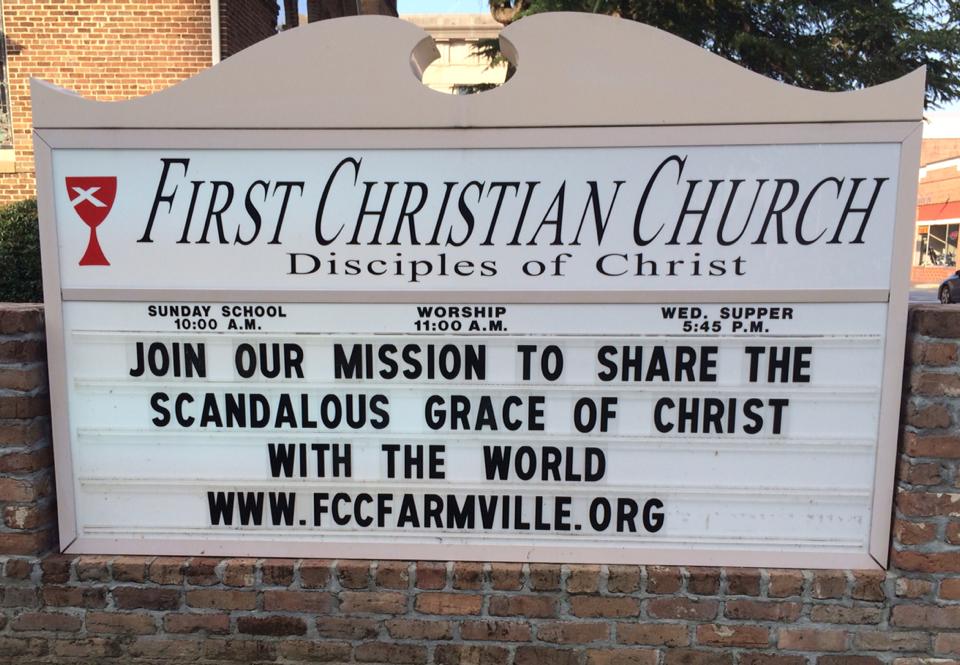
But that’s the one thing I love about this church: our busyness. Do you remember last year someone telling me that we had so much going on here, had so much on our church sign one time, that they had to pull over to read it. I said: “We have far too much going on here for twenty miles an hour!”

And I am proud of that. I am proud of you because like Jesus going into the house of two single women, this church has people talking. Everywhere I go in this town, I hear people talk about our extravagant hospitality and gracious welcome. And I hear people talk about how incredibly busy we are.

They say, “Jarrett, every time I ride by the Christian Church there are cars everywhere! I drive by sometimes at six in the morning and the parking lot is full of cars!” What in the world is going on over there?”

I say, “It is something going on all the time! We sometimes have people drive from Wilson and Greenville to run with our running group early on Sunday mornings. There are people working on our basement, our windows and our bricks. Before it got cold, you probably saw people working or picking vegetables in our community garden. We had a great Consecration Sunday which led to increasing our budget for 2015 over 25 percent. We had around 250 people attend Homecoming, and maybe twice that many to attend our Halloween festivities. New people are volunteering to serve meals on wheels, work in the soup kitchen and serve with Farmville Benevolent Ministries. The Quilters have been busy making quilts for people in the community who need our prayers. We have groups going to the Nursing home to sing and to lead devotions. Several of us just got back from West Virginia repairing the homes of folks living in extreme poverty. We just had a huge yard sale and dinner auction where we raised over 15,000 dollars so we can do more missions. We have started planning our Advent and Christmas activities, getting ready to once more host the Breakfast with Santa before the Christmas parade. We are collecting she box Christmas gifts for Samaritans’ Purse and coupon receipts to feed families during the holidays. And just this morning, at the Christian Men’s Fellowship breakfast, we talked about building a handicap ramp for someone in need in Farmville.”

“Jarrett, don’t you think you all are doing too much?” they say.

“Nooooooo,” I say, we believe Jesus is always telling us to go and to do. After he preached his first sermon on the mount, he said, “Blessed are those who hear these words of mine and does them, for they are like wise ones who build their house on the rock.”

“After Jesus told the parable of the good Samaritan, who stopped and extravagantly helped the man he found wounded lying in a ditch, Jesus said, ‘Go and do likewise.’”

After Jesus broke the bread, representing his broken body, after he shared the cup, representing his life outpoured, Jesus said, do this in remembrance of me. And when Jesus said ‘do this,’ we don’t believe he was only talking about observing the Lord’s Supper, we believe he was calling us to sacrificially break our bodies, calling us to selflessly pour ourselves out. And each Sunday we gather together to worship, we remind ourselves of this. So we are a church that goes, and we are a church that does.

Mary, who sat at the Lord’s feet and listened to what he was saying. But Martha was distracted by her many tasks; so she came to him and asked, “Lord, do you not care that my sister has left me to do all the work by myself? Tell her then to help me.” But the Lord answered her, “Martha, Martha, you are worried and distracted by many things; there is need of only one thing. Mary has chosen the better part, which will not be taken away from her.

I believe Jesus is saying that in all of our 21st century busyness, with all our email and texting and skyping, facebooking, and googling, with all of our running around, even with all of our ministry, our service, there are times when we need to slow down, stop, sit down at the feet of Jesus and listen.

Now, Martha was not doing anything wrong. She was doing what she was taught to do as a faithful Jew, serving the guest who had come into her home. She was practicing the hospitality that was taught over and over in her Bible. She was doing ministry. But Jesus suggests, it may do her more good to slow down, to stop and to listen.

I believe we do so many things well here because we have been doing them for years. Sometimes we don’t even need to think about it. And to be honest, we are sometimes tempted to believe we don’t need to pray about it. We just come, go to work, do what we need to do, and it gets done. And it gets done very well.

But what would happen if we stopped, sat down, and listened to Jesus. Listen, in the silence.

Silence

What is the Christ is calling you to do.

Silence

Who is the Christ calling you to be?

Silence

Where is the Christ calling you to go?

Silence

To whom is the Christ calling you to see today, to care for today, to love today?

Silence

Listen to the Christ. What is God calling our church to do? Who is God calling our church to be? Where is God calling our church to go?

Saving the Soul of the Church

These days, churches are not only in danger of losing their members, many are in danger of losing their souls.

There are some pastors who look at their pews on Sunday mornings and assume that the reason they are empty is because the vast majority of people today have rejected Jesus, as they believe much of this world is going straight to Hell. However, I believe that many who avoid church these days have actually accepted Jesus. They love Jesus and even want to follow Jesus. The problem is that they simply do not see Jesus in the church, and believe it is the church that is on the way to Hell.

I believe you can go to any main street in the heart of downtown of any city in America and ask people the following question: “What’s the first word that comes to your mind when you hear the word: “Jesus?”

People everywhere will respond: “loving,” “forgiving,” “compassionate,” “hospitable,” “selfless,” “sacrificial,” “humble, “radical.”

Then ask those same people: “What is the first word that comes to your mind when you hear the word: “Christian?”

They will respond: “mean,” “judgmental,” “insensitive,” “unwelcoming,” “selfish,” “self-centered,” “holier-than-thou,” “boring.”—words that describe the very antithesis of who Jesus is and who Jesus calls us to be as his disciples.

And sadly, those of us who are a part of the church know that there are many good reasons for these thoughts.

The church’s mission is to make disciples, to make followers of Jesus. How is that possible when many in the church are not following Jesus?

If the church wants thrive in these days…no, let me rephrase that… if the church wants to survive in these days…no, let me rephrase that once more… if the church these days wants to avoid going to Hell, then the church must answer Jesus’ radical call to be his disciples, to live as he lived, lovingly, graciously, compassionately, hospitably, selflessly, sacrificially, humbly and radically.


Defining Our Church

scandalous graceThe following article was written for The Christian Caller, the monthly newsletter of First Christian Church of Farmville

It is fall. That means that we are heading into the months of the year that seems to define who we are as a church.

Homecoming is October 12. On this day, we will open our doors wide and generously welcome our members, former members, and friends of our church with an extravagant meal on the grounds following the worship service.

Halloween at FCC is October 31. On this day, we will welcome the entire community to our church with a hot dog supper, fun Halloween games, and Halloween candy!

Fall Festival is November 8. On this day, we will once again swing wide our doors to welcome all to our annual yard sale, country kitchen, dinner and auction to raise money for various mission projects in our community and around the world.

Breakfast with Santa is December 13. On this day, we will welcome the community to our church with a breakfast and a chance to see Santa before the Farmville Christmas parade.

I believe each of these events defines our church and even differentiates us from other churches and organizations.

Homecoming defines us as a church with an extravagant welcome. When we open our doors, we swing our doors wide to graciously welcome all people. And we are not just going to shake a hand, give a friendly nod or even offer a little hug. We are going to prepare a place at our table and generously serve and feed others as if they are a part of our family.

Halloween at FCC defines us as a church with an unconditional welcome. Our Halloween party is not just for the children of our church and those they might invite. Our party is for all children. That includes: ghosts, goblins, mummies, vampires, witches, monsters, and even little devils.

Fall Festival defines us as a church with a missional welcome. All are not only welcomed to simply come to our church, but all are welcomed to be the church with us. All are welcomed to join us in our mission to minister to others locally, regionally and globally.

Breakfast with Santa defines us as a church with a community welcome. Our church has a passion for and long history of generously serving the town and people of Farmville.

Our church’s activities are not for us, nor are they about us. The focus is never inward, but always outward. Our mission is never self-serving, but always about serving others. It is never about getting, but always about giving. Furthermore, all of our activities are done in the name of the Christ who generously and extravagantly welcomes all people to His table.

Hmmm. Maybe it is not the activities of the coming months that define us after all.

We are defined by the Table that we gather around each Sunday morning and by the Christ who invites us all to that table.

Have You Seen the Ocean?

beach umbrella

“Jesus said, ‘Do you have eyes, and fail to see? Do you have ears, and fail to hear?” Mark 8:18 NRSV

For me, one of the best things about living in the East is our close proximity to North Carolina’s beautiful beaches. My heart hurts for those who say that they have never seen the ocean.

There are few things I love more than sitting in a beach chair under an umbrella in the summertime. I love the whole sensory experience of it: the sheer sight of the vastness of the ocean; the fresh smell of the salt air; the rhythmic sound of the waves breaking ashore; the way the cool sand feels on my bare feet, and the way the sea breeze feels on my skin; the refreshing taste of a cold drink and a pack of Nabs.

However, I believe that my love for the beach comes from another place. It comes from a deeper, higher place. It comes from a place that transcends the physical senses. It comes from a miraculously mysterious place. It is hard to explain, but to put it in simple “preacher” words: the beach can be a downright spiritual experience. I believe we have the ability to see the ocean with something other than our eyes.

The beach can reveal the truth that all of life is a mysterious and abundant gift of an amazing grace, impossible to earn and in no way deserved. It reveals a love that is unconditional, unreserved and very large.

Consequently, as I sit in the beach chair, breathing in the gracious enormity of it all, understanding that all of it is pure grace, my heart begins to fill with immense gratitude. Then, a moment of clarity comes. As a recipient of this grace, if I am truly grateful for it, if I truly believe it is all unearned and undeserved, if I truly believe it is grace, then I will instinctively live to lovingly share grace with all people, unreservedly, abundantly, and amazingly. I will give as I have been given.

And if I do not share grace with others? Or if I am reserved or stingy with it?

Then, although I have been to the beach countless times, maybe I have never truly seen the ocean.

How Low Can You Go?

bac service

 Luke 14:7-11 NRSV

Looking around this room tonight fills me with so much hope for our world. For I look around and see a generation that is up and coming. I look around and see a room full of energetic youth with high ambitions. I look around and ask, “My God, how high can they go? How high can these young men and women, these future leaders of the world, go?

You were probably taught at a very early age that up high is where it is at, and no doubt you spent the first eighteen years of your lives trying to grow up, graduate high school and then possibly pursue an even higher education. All so you move up a little higher in this world. And after all of your graduations, you will work hard to make sure you are always upward bound: up for a promotion so you can move up the ladder. For up, up highis how our society measures success.

Up high, we are told, is where we will find our life, a life that is full, complete, satisfied, and abundant. Up high is where we are able rub elbows with others who also shaped up, grown up and moved up. Up high is where we find what we call the “in” crowd. They are the “up” and the “in” as opposed to the “down” and the “out.”

So we set goals that are high. We seek to make high marks, achieve high grades, meet high expectations.

The message of nearly every motivational speaker or life coach in America today is all about how to shape up and move up, aim high and soar high.

After all, who in their right mind would want to move in the opposite direction? Who wants to change directions from up high to down low? As the late Henri Nouwen one of my favorite preachers, has said: “Downward mobility [in our society] is not only discouraged, but even considered unwise, unhealthy or downright stupid.”

Can I get an “Amen?” Come on now, really? Who in their right mind would want to lower themselves? What mind must you have to want to humble yourself, move to and sit at the lowest seat at the table, lower yourself to the ground to wash another’s feet, descend down the economic ladder to relate to the poor, be with and love the down and out?

What kind of mind? As Adam Greene read a few moments ago, the mind of Christ.

When God chose to reveal to the world a life that is full, abundant and eternal, God’s will for all people, God chose a life of downward mobility. God emptied God’s self, poured God’s self out, humbled God’s self, lowered God’s self and came down. Down to meet us where we are, down to earth as a lowly baby, born in a lowly stable, laid down in a feeding troth to worshipped by down and out shepherds.

The scriptures do say that Jesus grew upward in stature; however, the gospel writers continually paint a portrait Jesus’ life as one of downward mobility. He is continually bending himself to the ground, getting his hands dirty, to touch the places in people that most need touching.

While his disciples seemed to always focus on privilege and honor and upward mobility, chastising little children who needed to shape up and grow up before they could come to Jesus, Jesus argued that the Kingdom of God actually belonged to such children.

While his disciples argued about who was going to be promoted, who was going to graduate to be the first in the Kingdom, Jesus frustrated them (and if we are honest, frustrated us) by doing things like moving down to sit at the lowest seat at the table, bending down to wash their feet, stooping down to welcome small children, crouching down to forgive a sinner, reaching down to serve the poor, lowering himself down to accept the outcast, touch the leper, heal the sick, and raise the dead.

While others exercised worldly power to graduate and move up, climb up, and advance, Jesus exercised a strange and peculiar power that always propelled him in the opposite direction. It is not a power that rules but is a power that serves. It is not a power that takes but is a power that gives. It is not a power that seizes but is a power that suffers. It is not a power that dominates but is a power that dies.

And nearing the culmination of his downward life, to save the world, Jesus went to highest seats of power in the capital city of Jerusalem, not on a white stallion with an elite army of high ranking soldiers, but riding a borrowed donkey with a handful of ragtag students who never even got a GED. The whole scene of Jesus riding that donkey, in the words of Henri Nouwen, looks “downright stupid.”

This is the narrow and seemingly foolish way of downward mobility, the descending way of Jesus toward the poor, toward the suffering, the marginalized, the prisoners, the refugees, the undocumented, the lonely, the hungry, the dying, the tortured, the homeless–toward all who thirst and hunger justice and compassion.

And what do they have to offer? Those who are down and out in our world cannot offer success, popularity, riches, or worldly power, but they do offer the way to life, full, complete, abundant and eternal.[i]

So tonight, filled with hope for the world as I look around this room asking, “My God, how high can these young men and women, these future leaders of the world go?” I am also asking with even greater hope for the world and the Kingdom of God, “My God, how low can they go? How low can these young men and women, these future leaders of the world, these future leaders of the church go? How low can they go to fulfill the divine purposes that you have for each of their lives?

My hope is that you are here tonight, not to ask God to help you move up to be with the “in” crowd. Not to find something here in worship that will make you more successful, more affluent, climb a little higher. I hope you are not even here looking to be uplifted or to be more upbeat or for some kind of upstart to get this new chapter in our life headed on an upswing. My hope is that you are here in worship tonight because you have chosen to move in the opposite direction.

My hope is that you will always want to continually go down, get low, lose yourselves, die to yourselves, to live for Christ. For you have heard, and you have believed Jesus when he said: “Anyone who wants to become great among you must be your servant, and anyone who wants to be first among you must be your slave, just as the Son of Man came, not to be served, but to serve, and to give his life as a ransom for many (Matthew 20:25-28).

Although it sounds good to be a part of the up and coming generation, my hope is that you will be a generation that is always down and going. May you always go down, get low, sacrificially and selflessly. And then go out bending yourselves down to the ground if you have to, to touch the places in people that most need touching. May you go out and stoop down to welcome and accept all children, to love on those in hospitals and nursing homes. May you go out and reach down to serve the poor, lower yourselves down to accept the outcast and the marginalized, and may you get low, get down on your knees to pray for the grieving and the lost.

And, there, as low as you can go, may you truly find your life, your purpose in this world, one that is full, complete, satisfied, abundant and eternal.


[i] The sermon is inspired by this paraphrase from Henri Nouwen, Here and Now, 138-139.

October 2013 – Coming Home

DCF 1.0As I See It, FCC Newsletter, October 2013

This year, Homecoming at First Christian Church has a special meaning for me. As I shared in a recent sermon, during my three-year break from pastoral ministry, like many of us who have been a part of the church, I often felt the temptation to go solo with my faith.

On a Sunday morning run along the Tar River in Greenville, I would pray to God and enjoy being alive in God’s creation and think to myself, “This is the way to do church! There is no one to disagree with me or hurt my feelings. There is no one sharing their problems with me, making me uncomfortable, and taking up my time. And, I must confess, it was rather nice! However, I must also confess it was very selfish. It was arrogant, and it was self-righteous. The truth is: it was the very antithesis of who Jesus calls us to be as his disciples.

Someone recently told me that they quit going to church because they found church to be “depressing.”

I aked, “What do you mean?”

She responded, “Well, there I learn about people in town who are lonely, grieving, hospitalized, living in nursing homes, having financial hardships, struggling with daily life, and so on.” She then paused for a few seconds and said, “But I guess that is what being a disciple of Jesus is supposed to be about, isn’t it?”

I did not have to answer her.

So for me, this Homecoming means the rededication of my life to being a disciple of Christ. I am coming home. I am coming home to experience life with a family of faith where we are continually called upon to care for and even suffer for others. And I know of no better family to come home to than the First Christian Church of Farmville!

Like all families, there may be some disagreements, some hurt feelings, and even some resentments. Living life as a family can sometimes be burdensome and even depressing. However, we know it is where Jesus calls us to live and where we experience true life, abundant and eternal. We know, as I have discovered in recent weeks, it can be a taste of heaven.

Yes, this year, Homecoming has a special meaning for me. I hope it does for you too.

September 2013 – Expectations

change-architect-sign1As I See It, FCC Newsletter, September 2013

Change is always difficult due to the great amount of uncertainty involved. During the last few days, my family and I have wondered what the next twelve months would be like during this interim period, and I am quite certain that you have wondered the same.

I would like to help all of us by sharing a few of my expectations for you and some things I believe you can expect from me.

First of all, I expect you to feel free to ask me hard questions of faith and theology. That being said, I expect you to sometimes disagree with my answers. As Congregationalists who uphold the concept of the Priesthood of All Believers, it is our right to sometimes disagree with each other, even with the pastor. Notice that the title of my column is “As I See It” which implies that it may not be “as you see it.”

Secondly, I expect you to try your best to be the embodiment of the redemptive love of Christ in our broken world. As the Spirit leads us, even when we disagree, I expect us to lovingly and graciously work together in mission and ministry with the goal of using our gifts to be the family of faith that God wants us to be.

And finally, I expect you to feel free to call on your interim pastor whenever a need arises. Do not assume I already know. My cell phone will be published on the bulletins and in the newsletter.

And here are a few things you can expect from me. First and foremost, always remember that I am like most preachers, thus always expect me to never turn down anyone who invites me over or out to dinner!

More seriously, although I have been raised and educated as a Baptist, you a expect me to respect the principles and purposes of the Christian Church (Disciples of Christ). I have been very fortunate to serve with some wonderful, inclusive Baptist churches such as First Baptist Church here in Farmville. However, the Baptist churches with which I have served are quite rare in Southern Baptist life. Sadly, the Disciples of Christ statement of identity to “welcome all to the Lord’s table as God has welcomed us” is not a statement that is spoken in many Baptist churches. I have great affinity for this statement as well as all of the core values and principles of the Disciples of Christ, and you can expect me to uphold and share them with others.

Secondly, you can expect me to be there when a need arises. You can expect me to visit the sick and the homebound. You can expect me to be there in the hospital whenever a member has major surgery. You can expect me to visit prospective members and invite them into our fellowship. I am a pastor you can expect to visit and visit often.

You can expect me to work with and alongside the staff, committees, and the board of the church; not over or above them. You can expect me to preach well-researched, Christ-centered, biblical sermons. You can expect me not to have all of the answers to those hard questions of faith and theology. Sometimes my best answer will be: “I don’t know.” You can expect me to respect your interpretation of scripture and your views on certain issues. You can expect me to be human and make mistakes. Finally, you can expect me to rejoice with you and to suffer with you, to laugh with you and cry with you. You can expect me to love you.

I hope this helps us both as we embrace this wonderful change together. My family and I look forward to a loving relationship serving with you here in this community we call home. Oh, there is one more thing, if you are able and are in town, I expect to see you on Sunday mornings!