Peace Be with You: Remembering Albert Mosley

Albert Mosley 1 (3)In the sixteenth chapter, the 33rd verse of John’s gospel, we read words of Jesus that cannot be more true: “In the world you will have tribulation.”

Jesus didn’t say we might or we may have tribulation. Jesus said that we will have “tribulation.” Other translations read: “torment,” “trials,” “trouble,” “sufferings,” “distress” or “persecution.”

In this world, we will suffer. In this world, we will lose people we love, sometimes tragically. In this world, we will be injured, sometimes in terrible accidents. In this world, we will be diagnosed with sickness, sometimes with dreadful diseases. In this world, we will have failed relationships, sometimes divorce. Jesus said that in this world suffering is inevitable.

Albert Mosley could certainly testify to this truth.

Albert had just started high school here in Farmville when his father tragically committed suicide. Later, Albert, himself, would be critically injured on the football field. Years later, there would be the sudden and untimely loss of his mother, a risky back surgery, a grim diagnosis of Addison’s disease, broken relationships, the loss his best friend Ronnie Avery, incessant physical pain, diabetes, debilitating strokes and blindness.

Now, if this was the only testimony that Albert Mosley’s life could give, that in this world, we will have tribulation; then today would certainly be a sad and tragic day for all of us. However, the good news is that this was only a small part of Albert’s testimony.

Jesus said: “In this world, you will have tribulation.” Now, let’s read the entirety of this verse: Jesus said: “I have said these things to you, that in me you may have peace. In the world you will have tribulation. But take heart; I have overcome the world.” (John 16:33).

After Albert lost his father, Albert did not hesitate to courageously become the man of the house, take care of and look after his mother, his six siblings, maybe especially, his little sister, Donna. Albert resonated with the great song by Clarence Carter, “Patches,” intentionally becoming the one that his family could always depend upon.

In spite of the tragic loss of his father and the increased responsibilities for his family, Albert somehow miraculously managed to excel in school. And in spite of some very good reasons to be bitter and angry, Albert possessed such a sweet and loving disposition that the girls in this town affectionately called him “teddy bear.”

However, I am certain that no one called him a teddy bear on the football field. Albert was an exceptional athlete, a strong, ferocious hitter. Perhaps football became the outlet for some of some of his anger that he had to have harbored. He hit someone so hard one night when Farmville was playing at Ayden, that it put Albert in the hospital where he was in a coma for three weeks.

And yet again, although he had even more reasons to become angry or bitter at life, Albert took heart and persevered.

After he recovered, he finished high school and went on to Atlantic Christian College, where he again continued to excel, earning the prestigious Top Hat Award. After college he went on to get a Masters in Education degree at Old Dominion University. Upon graduation, he taught school briefly until he was quickly promoted to principal.

Later, he became Vice President of the Virginia National Bank in Franklin, Virginia and in 1982 was awarded the “Boss of the Year” Award from the Franklin Jaycees. He was also awarded the #1 Jaycee President Award in the state of Virginia.

Then, as Jesus promised all of us, more tribulation would come to Albert, this time in the form of sickness and disease. However, in spite of every tribulation in his life, Albert always miraculously found a way to persevere, to love his life, and to love others. You could see it on the dance floor when you watched him Shag, Twist or do the Gator. In spite of everything, Albert was still the sweet, pleasant, fun-loving teddy bear.

I met Albert twelve or thirteen years ago. He had retired and moved back to Farmville to be with the family he loved. He had experienced many more ups and downs in his life. I watched him grieve deeply when his friend Ronnie passed away, and I witnessed his health continue to decline. The truth is that I have watched him suffer perhaps more than anyone I know. I cannot count the times I have visited him in the hospital and doubted that he would ever make it home.

Yet, I never heard him, not one time, not even in the hospital or in the nursing home, ever complain or grumble. Even when he lost his eye sight, his ability to walk, his ability to swallow just a sip of Diet Pepsi, Albert remained positive. In fact, I never heard him say anything negative, about himself or anyone for that matter. Even in his darkest moments of life, he loved his life, and loved those who were in his life.

Bro was always more concerned about others, than he was himself, especially his siblings. No matter how sick he was, if you asked him, he was always fine. And then he would ask you about others.

Doctor J,” he would say, lying in the hospital, unable to see, blood sugar over 200; “Have you seen Donna? How’s ol’ Carson and Sara doing? How are things going at the church? I got to get myself straight so I can come back there.”

And nearly every time before I left his side, even in ICU after his debilitating stroke in November, he would miraculously say to me, “Peace be with you.” And the miracle was not only that Albert could speak those words of peace, but was how it was obvious to all that in spite of every tribulation, Albert actually possessed this miraculous peace. And he truly wanted to share it with others.

The only way that can possibly explain how Albert endured the tribulations of his life is that the God of Jesus, somehow, some miraculous way came to Albert, obviously since he was a young boy, and filled him with this peace that surpasses all human understanding.

The disciples of Jesus also knew something about the ups and downs of life. Like a star football player, a teddy bear that the girls adored, or the vice president of a bank, the disciples had experienced some very high moments in life. They were with Jesus when he healed the sick, gave sight to the blind and raised the dead. Some of them even went to the mountaintop with Jesus and stood with him in the very presence of God. They rode triumphantly into Jerusalem with Jesus as little children lined the streets waving their palm branches.

And the disciples certainly knew something about tribulation. They were with Jesus when he was arrested in the garden. Some betrayed him. Others denied him. They all deserted him. They had made mistake after mistake, and they knew it. And they watched in horror as the one for whom they left their families and all forms of worldly security be tried, tortured and crucified.

Three days later, John writes that they were cowering in fear in a locked room. Rumors were floating all over town that the body of Jesus had been stolen, and the ones who destroyed Jesus and had taken his body would soon come to destroy and take them.

So, there they were, cowering behind locked doors. They could not have been more afraid. They were not unlike: a small boy who discovers his father’s suicide; a star athlete who is severely injured on a football field; or a well-respected and successful professional whose declining health had stripped nearly everything from him.

Then Jesus comes. We can’t explain how. The doors are locked. The windows are barred. But Jesus somehow, some miraculous way comes; he stands among them, and says: “Peace be with you.”

And this is not some superficial word of peace that denies or overlooks human tribulation and suffering. It is a genuine word of peace that acknowledges the pain of life, recognizes the wounds of today, but also the certain hope of a better tomorrow. Jesus shows them the wounds in his side and in his hands and says again, “Peace be with you. As the Father has sent me, so I send you. When he had said this, he breathed on them and said to them, ‘Receive the Holy Spirit. If you forgive the sins of any, they are forgiven them; if you retain the sins of any, they are retained.’”

The disciples then went out and lived the rest of their lives sharing the grace and peace of Christ with others. And they shared it to the end, even in the face of great persecution, suffering and death.

This is how I will always remember Bro. Like the first disciples, Albert was an imperfect man who suffered much tribulation in this world. However, although I cannot fully explain it, it was obvious to all that knew him that Jesus, somehow, some miraculous way, came to him. Through the love and faithfulness of his wife Ginny, certainly; through the love of his family and friends, definitely; and through divine and mysterious ways that surpasses all human understanding, Jesus came to him and filled him with this genuine peace, and then, sent him out into the world forgiving others, loving others, sharing the peace of Christ with other.

Days before Albert died, Becky said that Albert asked her if Chester could maybe spend the night with him in the nursing home. Becky said, for the first time, I could tell that he was somewhat afraid. And who would not be? In a nursing home, blind, nearly paralyzed, dying: he had more reasons to be afraid than anyone.

However, Becky said that when Albert breathed his last breath on Tuesday, that she had never seen anything so peaceful. I drove her and Chester home from the nursing home that day, and she kept saying, all the way home, “Thank you God, thank you God.”

The good news for all of us is that we have the certain hope that, once more, when Albert experienced his final tribulation on this earth, somehow, some miraculous way, Jesus once again came to Albert, as Jesus had obviously came so many times before, and lovingly tugged Albert’s ear saying: “Peace be with you. Peace I leave with you; my peace I give to you. I do not give to you as the world gives. Do not let your heart be troubled, and do not let it be afraid” (John 14:27). Jesus came to him and filled him once more with a peace that is beyond all understanding, and this time, it is for eternity.

May this wonderful truth give peace to all of us who are still experiencing the tribulations of this world this day, tribulations that will continue in the days ahead. Through the memory of Bro, may we hear the risen Christ speak to us words that cannot be more true: “Peace be with you.”

I Need a New Drug

Cialis

Have you noticed that every other television commercial that comes on the air is an ad touting the benefits of a new prescription drug? There is a new drug available for whatever it is that might ail you!

Do you have frequent heartburn? Are you tired of being tired? Is depression making you depressed?  Do you have trouble going to sleep? Do you have difficulty waking up? Do you want to avoid diet and exercise? Is it painful for you to walk your dog? Is your hair falling out? Do you have a going or a growing problem?  Are you overweight but love to eat?  Do you need to put some excitement back into your relationships? No matter what you’ve got, there is a new pill created just for you.

And then, in nearly every commercial, after the person begins taking what they asked their doctor to prescribe, there is all of this exuberant celebration: dancing in the streets; jumping up and down; digging for clams; running around in the yard with your dog and your water hose; even sitting outdoors and watching the sunset while holding hands with your significant other in separate bathtubs!

As a pastor, I oftentimes wonder if this is not how we oftentimes promote the church.  \If you channel surf through the religious channels, you will find that there is no shortage of preachers who sound like they are spokespeople for some new drug. “Are you down and out?  Are you drowning in a sea of debt? Are you empty inside? Does your marriage need a boost? Then pick up the phone and make your pledge, send in your check, and sit back and wait for God to pour out God’s blessings!  Wait for God to give you a reason to celebrate!”

I am not exactly sure, but I suspect that is what many people were thinking when they were following Jesus throughout Galilee. Listen to how the Sermon on the Mount begins: “And great crowds followed him from Galilee, the Decapolis, Jerusalem, Judea, and from beyond the Jordan.”  Folks had come out from all over to follow Jesus.

And listen to what Jesus says:

Are you 50 years old and wonder where your life is going? Are you down and out and feeling blue?  Do you need help raising your children?  Does your marriage need a boost?

No, instead Jesus says things like, “For the gate is narrow and the road is hard that leads to life, and there are few who find it.”

The crowd gets really quiet!  Someone whispers, “I know he didn’t say ‘hard,’ did he? I thought Jesus was all about making things easy!”

Jesus continues:

“Love everyone, including your enemies. Be a blessing to the poor and to those who hunger and thirst for justice. Pray for those who persecute you. Forgive those who have wronged you. Don’t judge. Accept others as I have accepted you. Deny yourself. Pick up your cross and follow me. Die to yourself. Don’t just hear these words, but do these words.”

I am afraid that churches are so desperate to attract people that they have been willing to trivialize and water down the gospel. I am afraid that the salvation that many churches are preaching is no different than the salvation that is being preached in commercials about a new prescription drug.

May God forgive the church for sometimes implying that Jesus will make life easier, will fix everything that is wrong with us, will put a little lilt in our voices, a little sunshine in our souls, because the chances are very good that the message Jesus preaches will only make your life more difficult.

The Untouchables

BS and Joan on November 15, 2014
BS, Joan and me on November 15, 2014

Mark 1:40-45 NRSV

As was pointed out a couple of weeks ago, for Mark, Jesus is a teacher. He is a teacher with a new teaching, one with authority. Last week, when Jesus healed Simon’s mother-in-law, we were taught by Jesus that it is not God’s will for anyone to be sick or even have a fever. As Jeremiah prophesied: “For surely I know the plans I have for you, says the Lord, plans for your welfare and not for harm…”

I have said before, albeit somewhat selfishly, that I believe it is God’s will for all men to live to be over 100 years-old and perhaps be married to a much younger woman, which is, of course, perhaps the only way a man can get to a hundred.

However, living in this broken and fallen world, we rarely encounter people who have been so blessed. Because not everything that happens in this world is the will of God, we seldom encounter people with the vitality and longevity of BS and Joan Smith. That is why we are having a party today. This is why we are celebrating today as a community of faith. For their long life together is a special thing. It is a good thing. It is a God-willed thing.

Some of you may say, “Well, I don’t want to live to be 100.” I dare you to say that the last day of our 99th birthday if you look as good as BS Smith! You know who wanted to be a hundred? Well, this past Thursday, it was BS!

This morning, we are still in the first chapter of Mark, and Jesus is still teaching.

“A leper came to him begging him, and kneeling, he said to him…”

Can’t you just picture the desperation? You can almost see it: “begging,” “kneeling.” This picture teaches us that when we are desperate, when we are despairing, when we are anxious, we can always come to Jesus.

“If you choose, you can make me clean.”

Well, of course Jesus chooses. As we have already learned, Jesus never wills for anyone to suffer.

We are then told that Jesus is “moved with pity…” It is important to note that the Greek word here is a visceral, gut-wrenching word. Jesus was moved from deep within his soul. Jesus literally felt this man’s pain. Because he was suffering, Jesus also suffered. Some scholars have said that the word is better translated: “angry.” When Jesus encountered human suffering, it angered him.

Here, Jesus teaches us that God is moved by human misery and suffers with us. As I tried to say yesterday at Alawoise’s memorial service, God never willed for her have Parkinson’s disease. When Alawoise felt the very first symptoms of the disease, God felt it too, from deep within God’s very soul. So, of course, Jesus chooses for him to be made clean, whole and well.

Jesus immediately reaches out his hand and touches him, saying, “I do choose. Be made clean!”

Here is where the story gets interesting. It is interesting, because Jesus reaches out his hand and “touches” this one who was considered by faith and society to be “untouchable.”

Leprosy was the most feared and dreaded disease of Jesus’ day, one that always brought horror and despair. Leprosy is an indefinite and general term used for a whitish rash on the skin. Spots, sores and swelling may also be present. It was an uncomfortable disease; however, what made leprosy so feared was no so much what it did to a person physically, but what it did not a person socially. The disease excluded one from the general population, and thus, from the people of God.

Chapters 13 and 14 of Leviticus discuss the social side effects of this disease at great length. Because a person with leprosy was considered to be “unclean,” a leper had to wear clothes which had been torn so they could be easily recognized and avoided. Lepers also had to cover their mouths and cry “unclean, unclean” in the presence of others so no one would approach them. Eduard Schweizer comments that rabbis considered a leper to be a “living corpse.” They were alive, but not alive. They were here, but not here; in the community, but not a part of the community. They were unalive, unaccepted, and untouchable.

So, when Jesus was deeply moved, or angered at the man’s disease, he was angry not only by the physical pain of it, but by the social pain of it— how this dehumanizing disease took people out of community, how it made them social outcasts, outsiders, untouchables.

However, at least one person did not regard the leper as untouchable. Mark writes that Jesus reaches out his hand and touches him. And “immediately the leprosy left him and he was made clean.”

The passages that we have been studying the past few weeks teach us a lot about healing. We learn that Jesus is against all forms of suffering. Jesus wants to deliver us from afflicting spirits, break our simple fevers and cleanse us of our most dreaded diseases. But, notice in this morning’s lesson that after Jesus touches and heals the leper, he gives the leper some “stern” instructions.

“After sternly warning him he sent him away at once, saying to him, ‘See that you say nothing to anyone; but go, show yourself to the priest, and offer for your cleansing what Moses commanded, as a testimony to them.”

Although Jesus had made the man clean, he wanted him to follow through with the cleansing rituals that would restore him back into community. Yes, God is concerned about our physical well-being, but God is more concerned about our spiritual well-being and our acceptance into community. More than anything else, Jesus wanted this outsider to become an insider. Jesus wanted this untouchable to be touchable.

I think I speak for everyone when I talk about the admiration I have for BS and Joan Smith. Some might say, “Well, of course, you have. You have to admire couple who is 90 and 100 years old. However, it is not so much their physical age or physical vitality that I admire, as much as it is their determination to be in community. Almost every time I visit with them, they ask me about the well-being of others. How is “Jimmy Cowan? Have you heard from Joyce Letchworth? Tell me about Alawoise. How is Harold holding up?”

And on more than one occasion it has been one of them who actually informed me of a concern in the community. I can clearly hear BS asking: “Jarrett, did you hear about so-in-so? And with compassion obviously arching from deep within his soul, he shakes his head, and closes his eyes with almost an agony and anger and says: Shhhhhhhh.”

Both BS and Joan want to meet every new person than joins or even just attends our worship services. And they don’t just want to know their names. They want to know where they live, where they went to school, where they work; who are their parents? Who are their grandparents? They are genuinely interested in truly knowing them, loving them.

And BS constantly asks me about the whereabouts of certain people that he has missed from our gathered community of faith. “Jarrett, have you seen so-in-so? She has not been here in several Sundays. Jarrett, you need to go see her.”

And you should never be fooled by his poor eyesight and selective hearing, for he doesn’t miss a thing, especially when it concerns this, his community of faith.

And have you noticed something else about BS? He not only is concerned about you and others, he not only expresses his compassion and empathy for others, BS likes to reach out his hand and touch you. No matter who you are or where you are from, BS likes to hold your hand. For no one in BS’s book is an outsider. Through his eyes, it is as it is in the eyes of God, no one is untouchable. Everyone’s hand is to be touched, grasped, held. This morning, I am proud to say that BS and Joan are the epitome of who we are as a church.

For all are truly welcome here. This is indeed a safe place. We accept you as Christ accepts you: Just as you are. If you are sick, we pray for your healing. If you are grieving, we pray for your peace. Because we know that when you suffer, God also suffers, and because of that, we suffer.

And know this, here, in this place you will never be alone. Here in this sacred space, there will always be a hand to hold. For here, there are no outsiders. There are no untouchables. There is truly room at the table for all.

Mark continues: “But he went out and began to proclaim it freely, and to spread the word…and people came to [Jesus] from every quarter.”

May we go out this morning from this sacred place and do the same.

A Mother’s Love

Alawoise
Alawoise and Harold on their wedding day, April 18, 1958

The following was written for the memorial service for Alawoise Strickland Flanagan (July 29, 1935 – February 9, 2015)

In the very first chapter of our Bible, we have a beautiful portrait of the human vocation—a portrait of who we human beings were created to be, how we were created to live, during the relatively short time we have on this good earth.

So God created humankind in his image, in the image of God he created them; male and female he created them. God blessed them, and God said to them, ‘Be fruitful and multiply, and fill the earth… (Genesis 1:27-28a).

With our thoughts this hour on the enormous Flanagan family, perhaps one of the first things that we glean from this portrait of who we were created to be, and how we were created to live, is: “Be fruitful and multiply.”

Harold and Alawoise certainly fulfilled this part of the human vocation, and they wasted no time in doing so. It was on this day, Valentine’s Day in 1958, that Harold proposed marriage to his Valentine, Alawoise.

Before the luncheon today, I said, “Harold, let me get this straight. You proposed on Valentine’s Day and were married on April 18, of the same year?

Harold said, “Did you see her nursing school picture on the communion table?”

“No,” I said. “Not yet.”

He said,  “Well go look at that pretty girl, and you will understand why I did not want to wait.”

And “to be fruitful” they also did not wait as Jerry has often been called “a honeymoon baby.”

The beautiful family portrait on this table, this order of service with participation from some of the grandchildren, and this room filled with their offspring tell the rest of their story—a story of a two Valentines fulfilling their human vocation to “be fruitful and multiply.”

However, as beautiful as this story is, as beautiful as the Flanagan family is to this community and to our world, this is just a small part of Alawoise’s story. This is only part of her fulfillment of what it means to be human on this earth, a small part of her legacy. In Genesis we first read:

“So God created humankind in his image, in the image of God he created them; male and female he created them.”

The primary way that we fulfill our human vocation, is not to be fruitful, but to be, to live, in the image of God. The good news for all for us this day is that Alawoise more than fulfilled this purpose for which she was created. As the poem recited by her granddaughter, Leigh Kathryn, so beautifully described, Alawoise perhaps best lived in the image of her God as a mother.

In Deuteronomy 32:18 we read that the Israelites are asked to remember “the Rock” that “bore” them; the God who gave them “birth.”

Throughout the Old Testament, God is portrayed as the mother of Israel. It is God who gave birth to Israel and loves Israel as a mother loves her child, unreservedly, unconditionally, tenaciously.

Growing up in the Flanagan house, there was never any doubt that Alawoise was “the Rock” who could always be counted on to love her children in the same manner. Just ask anyone who ever tried to cross any of them! As it was spoken by the prophet Hosea of God and her love of Israel: She would “fall upon them like a [mama] bear robbed of her cubs…” (Hosea 13:8a).

She was the constant care-taker, and she was the perpetual protector. As a mother, she was tried and true. And, let’s face it, let’s be honest this afternoon, I don’t know about Gayle, but you boys often tried her.

Like the time Harold taught Mark to drive a truck. Mark, how old were you? Six or seven? In trying to reach the gas-peddle, Mark recalls slipping off the seat and stomping on the gas, all the while poor Scott was sitting up high on some hay bales in the back. Well, as you can surmise, he wasn’t sitting up there very long.

Alawoise was tried by you boys with multiple broken bones, stiches, car accidents, rattle snakes, even gunshot wounds. But her love, her devotion and commitment to you never wavered, always remained true.

Even up to the time she had to go to the nursing home, each time she heard the town’s siren go off, she instinctively possessed this hair-trigger panic button that would immediately do a family roll call, one that is reminiscent of the motherly words of Jesus himself recorded by the Gospel of Luke:

Jerusalem, Jerusalem, …How often have I desired to gather your children together as a hen gathers her brood under her wings…

Even during these past difficult months, almost each time I visited her, Alawoise would do a roll call, asking me about the whereabouts of her family. Even when she was not in her right mind, lying sedated in a hospital bed, she would oftentimes ask me to help her to take things like barbeque and fried chicken off the stove for her Harold and her children.

Jerry, Gayle, Scott and Mark, and Harold, Alawoise lived her life to take care of your needs, to protect you, to love you unreservedly, unconditionally and tenaciously, and in so doing, she fulfilled the purpose for which she was created: living in the image of her motherly God and her Lord and Savior.

Now, if this was her only legacy, I believe it would be enough. However, there is much more.

The motherly love of Alawoise was in no way limited to her husband and children, or even to her grandchildren and great-grandchildren. Alawoise possessed a desire to gather many others under her maternal wings. She welcomed an exchange student and many others into the hospitality of her home. She lived to provide plenty of food, clean clothes, and a clean bed for anyone in need.

Her motherly love was experienced by many of us who have gathered here this day. We experienced it through Alawoise as a Sunday School Teacher, a deacon, a school nurse or as a Cub Scout Den Mother.

This broad and expansive motherly love of Alawoise was perhaps most ostensibly experienced during her twenty-six years as director of nursing and later as administer for the Guardian Care Nursing Home in Farmville. She loved the patients of the nursing home with the same tenacity with which she loved her own children.

She had absolutely no tolerance for any nursing home employee who did not treat a patient with the compassion. On the behalf of her patients, she did not hesitate to even stand against the company just as the prophet Isaiah spoke of God standing for her children: Thus says the Lord: “For a long time I have held my peace, I have kept still and restrained myself; now I will cry out like a woman in labor, I will gasp and pant.”

Alawoise lived in the image of God by suffering alongside and standing up for the least of these our brothers and our sisters, those who are the weakest, the most vulnerable members of society.

And for all of us who mourn this day this is truly good news. Alawoise was lived in the image of God. This means that when Alawoise suffered during these last difficult years, God, like a loving mother, also suffered. It is important for us to realize that God did not cause her suffering. God did not give her Parkinson’s disease. For what mother would do that to their child. Jesus once asked:

Is there anyone among you who, if your child asks for bread, will give a stone? Or if the child asks for a fish, will give a snake? If you then, who are evil, know how to give good gifts to your children, how much more will your Father [or Mother] in heaven give good things to those who ask!

Like a woman in labor or a mama bear, suffering and fighting for her cubs, God suffered with and fought with Alawoise. God did not take Alawoise from us with Parkinson’s Disease as some may say, but when she was in her weakest, most vulnerable, broken state, God came to her and gave her the best gift God had to give—the gift of God’s complete self. Thus, the best way to describe what happened on Monday morning of this week is that God came. God did not take, but graciously gave God’s self to her— tenaciously, completely, finally, eternally.

I don’t believe there is any other way to explain the very last words she said to me. Just days before she died, after suffering more than anyone one deserves, she opened her eyes, and spoke, not words of complaint or bitterness, but words of a loving mother, or of a child who has been comforted by her heavenly mother, asking me, “And how is your family.”

And the good news is that God will do the very same for us. God will come to each of us in our grief, in our brokenness, to each of God’s beloved children, and comfort us. In Isaiah 66 we read:

You shall nurse and be carried on her arm and dandled on her knees. As a mother comforts her child, so I will comfort you; you shall be comforted in Jerusalem.

As Alawoise taught us by living her life in the image of God, it is in God’s very divine, maternal nature to extend God’s peace and comfort to us all, especially to those in need. It is the nature of our God to place those of us who are hurting this day in the shadow of God’s maternal wings.

I began my remarks this afternoon with some of the first words of our Bible. I would like to close my remarks with some of the last words of our Bible. Hear now these very maternal words from Revelation:

And I saw the holy city, the new Jerusalem, coming down out of heaven from God, prepared as a bride adorned for her husband. 3And I heard a loud voice from the throne saying, ‘See, the home* of God is among mortals. He will dwell* with them; they will be his peoples, and God himself will be with them;  he will wipe every tear from their eyes. Death will be no more; mourning and crying and pain will be no more, for the first things have passed away.

I am thankful, and I know that her family is thankful, that Alawoise fulfilled her human vocation on this earth by being fruitful and multiplying. But I believe we are more grateful this day that Alawoise fulfilled her vocation by living as she was created to live on this good earth: in the image of our motherly God who loves us all unreservedly, unconditionally, tenaciously, and eternally.

Lifted up for Service

Scout_Sunday_2015_Logo

This sermon was preached for Scout Sunday at First Christian Church on February 8, 2015.

Mark 1:29-39 NRSV

These few verses found in the end of the first chapter of Mark, paint perhaps the most beautiful portrait of who our Lord is, how our Lord acts, and what our Lord desires. Listen to them again, carefully, prayerfully…

As soon as they left the synagogue, they entered the house of Simon and Andrew, with James and John. Now Simon’s mother-in-law was in bed with a fever, and they told him about her at once.

Do you hear the immediacy, the urgency in this passage? “As soon as they left…” “…at once.” I hear a lot of people talk about God’s timing. They say that God will bring healing or restoration in God’s own time. They say that God’s time is usually not our time. And they say that God has reasons for God’s delay. I believe this passage teaches us that the Lord wants to heal us and restore us now: not tomorrow, not some day or one day, but today, right now, at once. It is not the Lord’s will for any of us to ever be sick, broken, or even have a fever.

Therefore, when we are sick or broken, when we are suffering in any way, we must understand that it is not because God has some twisted reason or some purpose-driven plan for it. And since suffering is not the will of God, and since we are loved by God, then when we suffer, God also suffers and is doing all that God can do to bring healing, wholeness and restoration.

He came and took her by the hand…

Perhaps more than anything else, I believe it is the will of our Lord to come to us and take us by the hand. When I was a child I learned a wonderful song:

Put your hand in the hand of the man who stilled the water

Put your hand in the hand of the man who calmed the sea

Take a look at yourself and you will look at others differently

Put your hand in the hand of the man from Galilee

Of course, we put our hands in so many other places to receive wholeness, peace and security.

Instead of putting our hand in the hand of the Lord, we often put our hand, our trust, in our own hands. We believe that if we can somehow work hard enough, serve diligently, industriously, thoroughly, and persistently enough, then we can achieve or earn wholeness or peace. We put our hands, our trust in our own hands instead of in the hands of the only one who can save us. Ephesians chapter 2 teaches us: “For by grace we have been saved through faith, and this is not our own doing; it is the gift of God— not the result of works, so that no one may boast.”

Instead of putting our hand in the hand of the Lord, we also put our hands, all of our trust, in the hands of others. My granddaddy was not a pastor, preacher, or scholar, but he was sometimes quite the theologian. One thing that he said, and said often, was: “There’s only one man that you can trust in this world, and that is the Good Lord.”

However many of us put our trust in the hands of so many others. We put our hands in the hands of the government, in the hands of our friends and neighbors, even in the hands of the church. Then we become disillusioned when they sooner or later disappoint us. The 118th Psalm reminds us:

 O give thanks to the Lord, for he is good; his steadfast love endures forever. Out of my distress I called on the Lord; the Lord answered me and set me in a broad place. With the Lord on my side I do not fear. It is better to take refuge in the Lord than to put confidence in mortals. It is better to take refuge in the Lord than to put confidence in princes.

And instead of putting our hand in the hand of the Lord, we also put our hands in our own pockets. We put our trust in our wealth and our material possessions. Our sense of well-being, wholeness and security comes from our bank accounts, 401-k’s, our homes, automobiles and clothing. In chapter six of the Gospel of Matthew we read the warning:

Do not store up for yourselves treasures on earth, where moth and rust consume and where thieves break in and steal; but store up for yourselves treasures in heaven, where neither moth nor rust consumes and where thieves do not break in and steal. For where your treasure is, there your heart will be also.

The good news for all of us this day is that Jesus, the Son of the God of Heaven is coming to us, and he wants to take us by the hand and give us a peace that the world simply cannot give (John 14:27).

Jesus came to her and lifted her up.

When we put our hand in the hand of the Lord, the Lord lifts us up. Preacher and Princeton Theological Seminary professor Nancy Gross observes: “There is no shortage of “down” from which people need to be lifted up. Down today are jobs, wages, the economy, church membership, our hopes, and our children’s futures. Take your pick, add your own.” The good news is when we are down in the dumps, down with despair, down with disease, down with a fever, when we put our hand in the hand of Jesus, Jesus always lifts us up.

It is important to realize that being lifted up, being healed and being made whole, does not necessarily mean in the physical sense. I do not know of anyone who has suffered as much as Alawoise Flannagan. Right now, I do not know of anyone who is more down, more low physically than she. However, when I saw her this week, when she opened her eyes and miraculously asked me how my family was doing, I saw a woman who was more whole, more lifted up spiritually than anyone I know. It was evident that, even in the midst of great suffering, that Alawoise had placed her hand in the hand of the man from Galilee, and that man had lifted her up.

Then the fever left her, and she began to serve them.

It is very important to notice that when her fever left her, she got up and began to serve them. We are lifted up. We are healed. Then we serve. We are lifted up for service. Jesus makes us whole, not only for ourselves alone, not to simply feel better, more hopeful and more alive, but for service to others. As Ephesians chapter 2 reads: “God will enable us [lift us up] to continue on in righteousness and to do the good works which the Lord has appointed for us.”

Like Alawoise, John Barefoot also possessed spiritual healing and wholeness, a remarkable strength and joy in the midst of great suffering. At his memorial service, I pointed out that God did not lift him up, give him that strength and fill him with that joy just so he could watch a few more NC State ballgames on TV.

As it was evident to Gayle and Mark when Alawoise miraculously asked me how my family was doing, it was evident to all who encountered John—to all who saw his smile, heard his laughter, experienced his joy—that God was the source or his strength.

Right before Christmas, a group of parents and children from our church came to John’s house to sing Christmas carols. Some who were there, including me, were not a part of any church a couple of Christmases ago. We had been struggling with what we believed about the Church, what we truly believed about Christmas.

But there, standing around John’s bed with others from the church singing Christmas carols, through John, something miraculous happened. God spoke. As we watched John donning a Santa hat and wearing a smile that was so amazing that it had to be from Heaven, as we watched him sing along with the children the best that he could, with this amazing joy, a joy that had to come from God, Christmas became real. Faith became real. God became real. Church became holy.

There is no telling how many people have been served through Alawoise and John’s amazing strength and joy in the midst of suffering, through God’s amazing grace in the midst of their lives.

This morning, I want to thank the Boy Scouts who are present today for the unique manner you make our scripture lesson come alive each day in our world.

First of all, you are young. You are strong. When the Lord lifts you up, he can lift you high. But more importantly, you live your lives by a sacred oath or promise which begins: “On my honor, I will do my best.” And how do you do you your best?

By first doing your duty to God, by first putting your hand in the hand of Jesus, for that is the only way you can truly serve your country and to obey the Scout Law. For it is Jesus who takes you by the hand, lifts you up, gives you strength, keeps you mentally awake and morally straight so you can help other people, serve other people at all times.

I’m Not Gay, But That Shouldn’t Matter

Very thoughtful article by a very thoughtful person!

educatemoore's avatarLinda's Bloughts

I am coming out as not gay.  That’s right. I am not gay.

Sounds strange to tell you that and yet, I felt I had to.  The need comes from the fact that due to how I look, how I dress, what I enjoy, how short my hair is and whom I support, suddenly puts me into the category of being gay and worse, non-Christian.  Why?

Why does it even matter who I am or what I believe?  Understand that this belief comes from years of researching scripture, questioning critics, and following Jesus’ Ministry.  I IMG_1812have a master’s degree from seminary. I have another masters in patient counseling. I have 15 plus years of studying scripture and its context.  I have 20 years of being a follower of Christ.  I should have the respect that is deserved from having delved into the words of God and actions of Jesus Christ…

View original post 1,809 more words

Why Follow Jesus?

Why

Mark 1:14-20 NRSV

My wife Lori has always taken after her father: easy going, cool, calm and collected. She is never stressed, uptight, and never in a hurry. She is deliberate, slow, methodical, a mull-it-over kinda girl. When our realtor handed us papers to sign for the sale of the house this week, although it has been on the market for six months, Lori said she needed another day to sleep on it.

I will never forget the first time I put my moves on her. It was the last Thursday night of May 1986. We were on the campus of Wake Forest University for a week of orientation for the Baptist State Convention’s Summer Youth Corps program. We were taking a crash course to learn in one week how to be a youth minister for the summer. Following a worship service that evening, I made eye contact with Lori and sashayed myself over to meet her on the other side of the room. With words that were as smooth 19 year old face, I asked her to go outside with me to take a walk. I then turned and walked toward the door with utmost confidence that she was going to be following right behind me. As soon as I got outside just knew I was going to turn around and see her standing there smiling from ear to ear. However, I turned only to discover that I was standing outside by myself.

I stood there all alone and waited. A couple of minutes passed by, seemed like a couple of hours. I peeked in the window and saw her just sitting there inside, like she had nowhere to go. Five more minutes passed. And just as I was about to turn and give up, go back to my room rejected and dejected, she finally came outside.

The fisherman who were called by Jesus responded in a very non-Lori way. Jesus did not have to wait. There was no hesitation, no reluctance, no qualms whatsoever on the part of the fisherman. When Jesus called, Mark says that they “immediately” followed him. And not only did they follow Jesus with immediacy, Mark also tells us that without any dillydallying or shillyshallying the fisherman left their families and their businesses to follow Jesus.

I believe this is the most perplexing part of our scripture lesson this morning. It begs the question: Why? Why did these fishermen immediately leave everything behind to follow this man named Jesus?

At first glance, we might assume that these fishermen simply did not have much to leave behind. We might assume that they were poor, destitute hobos where were fishing for their next meal. And any change in their life would be a good one. Any move in their life would be one in the positive direction. In their desperate circumstance, there was only one way they could go and that was up.

However, we learn in this story that this was certainly not the case, because hobos do not work with their fathers and hired hands. These were successful fishermen who had security working in a family business. They were like most Jewish men. They had a family. They had a wife. They probably had children. But as soon as Jesus called, they immediately left it all behind to follow.

So they mystifying question is “why?” Why would these fishermen forsake all that they were and all that they have to follow Jesus?

Well, we could suppose that these fishermen believed they would somehow be rewarded for following Jesus. There was something to be gained. However there is nothing in this text that would lead us to believe this is the case. And nowhere in the gospels are we ever told that Jesus promises these fishermen any reward. There is no promise of more money, more friends, more influence, or more respect. The other thing we know they are ever promised by Jesus is persecution and conflict.

Well, we might suppose that the disciples simply thought that fishing for people would somehow be more satisfying than fishing for fish. I have often heard this text preached contrasting the worldly occupation of fishing for fish with the more spiritual occupation of fishing for people. And I suppose I suppose that could sound rather altruistic.

The church I served in Winston-Salem had a men’s choir that sang on special Sundays. They proudly called themselves: “The Singing Fishermen.” Although many of them loved to actually fish, they also understood that Jesus had called them to also fish for people. They understood that God has called them to catch people, to rescue people from the sea, to bring them on board, put them in the boat to experience God’s grace, love and mercy.

However, there is nothing in our scripture lesson this morning that indicates that these fishermen are able to understand this concept. After years of reading and studying the words and works of Jesus, we can grasp it. But how can we possible expect these first disciples to grasp it? How can we expect these to who prove over and over that they fail to understand Jesus to grasp this? After fish are caught, they die. They are gutted, cleaned, and broiled or fried. Then they are eaten. So what happens to people when they are caught? Knowing these disciples, I suspect that they are much more than a little confused.

So we are left with the question: why? Why do these men leave everything they possess, their jobs, their families, all forms of security, to follow this man named Jesus? Why do they give up a family business with a very secure future for some business that is ill-defined at best?

New Testament scholar Beverly Gaventa comments that there is absolutely nothing in these verses that tell us why these fishermen do what they do, why they leave it all behind to follow this man whom they cannot understand, on a journey that will perplex and confuse them, to a destination that is unspecified.

Why do they act in faith without any hesitation? And what kind of faith is this? Gaventa writes: “It is not a faith that understands. It is not a faith that takes only calculated risks. And it is not a faith that seeks a reward.”

She continues: It is a faith that responds with immediacy to a call from outside, a call that must remain unclear for them, even frightening. Responding to Jesus provides the fishermen with no security, but rather with the promise of rejection and danger. But they respond nonetheless. Immediately, they follow Jesus. And we are still left scratching and shaking our heads asking: Why?[i]

Maybe this is the point that God wants us to take from this scripture passage. Could it be that our lives as disciples of Christ make too much sense?

Think about it. Is there any part of our lives that are as perplexing as the lives of the first disciples who forsook it all to follow? Do people ever look at who we are and how we act; do they ever look at our selflessness and sacrifice; do they look at our faithful and immediate response to our Lord, then scratch and shake their heads, asking: why?

Why did she agree so quickly to serve on that ministry team?

Why does he travel every year to Nicaragua?

Why does she want to go back to West Virginia?

Why does he give up a Saturday to build a handicap ramp?

Why are they bringing new underwear to church?

Why does she care so much for the poor?

Why does she visit the nursing home and spend valuable time with strangers?

Why does she tutor a kid that is not in any way related to her?

Why does he help prepare meals for people who have in no way earned it or even deserve it?

Why do they give sacrificially of their hard earned money to the church?

Why is he so kind?

Why is she so loving?

Why are they so forgiving?

Why are they so welcoming?

Why doesn’t he ever complain?

Why does he have so much joy in the midst of so much suffering?

Why did she go into the funeral home with so much hope?


And our only answer to these questions is because we have heard a call from outside. And with a faith that does not and cannot completely understand, we have responded to that call, and we follow.

[i] Sermon inspired from the comments of Beverly Gaventa, Texts for Preaching: A Lectionary Commentary Based on the NRSV—Year B, 1993.

Divine Strength of John Barefoot

Exodus 17:9-13 NRSV

In the 17th chapter of the Book of Exodus we read the amazing story of how the Israelites defeated of their enemy, the Amaleks. The Amaleks were a group of nomads who attacked the Hebrews in the desert of Mount Sinai during the Exodus from Egyptian slavery. The Amaleks swooped in on the Israelites and cowardly killed those who were lagging behind: the weary, the old, the weak and frail.

For that is what the enemies of life do. They can attack us at any time, during our strongest times when we are young, but perhaps more so, during our weakest times, often when we are older. Cancer, heart disease, and debilitating strokes swoop in on many during that precious period of life that we call retirement, during that period of life where we look forward to well-earned rest, respite, and recreation.

John Barefoot was not the first person to receive a new set of golf clubs as a retirement gift that he would never use due to sickness or a disability.

And when the enemies of this life attack us, we are faced with a choice. We can surrender to our enemies; we can succumb to their attacks; or, like an old Army veteran, we can stand our ground and fight.

“Moses said to Joshua, ‘Choose some men for us and go out; and fight with Amalek.”

After faithfully serving this country in the US Army, after devoting his life to what is now Southern States, after raising two beautiful children, Roger and Linda, after thirty years of service through this community through the First Christian Church, John began to suffer debilitating strokes. Many men, in John’s shoes, surrender and succumb to such illnesses, especially after retirement. After all, they are weary and old; they no longer lack the strength within to fight. They can reach down and dig deep; however, there is just nothing left. No amount of digging will see them through.

However, men with faith in the God of Abraham and Isaac, Moses and Joshua, men with faith in the God revealed in the Risen Christ, understand that true strength does not come from within, but comes from and by the grace of God.

Moses said to Joshua: “Choose an army and fight. I, myself, retired a long time ago from fighting. I left the army years ago. I am too old, too tired, but I will stand on the top of a hill and raise the staff of God with my hands and summon the grace and strength of God to defeat our enemy.”

So Joshua did as Moses told him, and fought with Amalek, while Moses, Aaron, and Hur went up to the top of a hill.

Whenever Moses held up his hand, Moses noticed that Israel prevailed; and whenever he lowered his hand, he noticed that Amalek prevailed. [This was a certain sign that it was God, and God alone, who was giving the Israelites the grace, perseverance and strength to defeat their enemy].

There can be no other explanation for the strength and the perseverance of John Barefoot, especially during these last years of his life. As I have said, many in John’s shoes would have surrendered and succumbed twenty-five years ago. Possessing no reason to live, no sense of purpose, and no strength to fight, many men die shortly after their retirement.

Many more men die shortly after their wives pass away. Several years ago when Audrey died, it would not have surprised anyone if John followed her soon after.

But John kept going, kept persevering, kept fighting. Many studies have been made to identify symptoms of depression or the giving up on life. People who give up and surrender to the enemies of life become detached and disengaged from the world around them. They no longer care what their neighbors are up to. They become disinterested in their church, the local and national headlines, and interestingly, they no longer care about sports.

John possessed none of these symptoms. John always looked forward to visits from his church family. He absolutely loved taking a stroll in his wheelchair around the neighborhood and even downtown so he could see the people he loved. He cared about what was going on in the world, and he was in no way, shape or form disengaged from sports. He was an avid fan and loved rooting for the Wolfpack of NC State and the Atlanta Braves.

It was obvious to everyone that John, though weak and weary, never gave up. For as Isaiah 40:29 reads, John was a living testimony that “God gives strength to the weary, and to him who lacks might God increases power.” And in the 73rd Psalm we read: “My flesh and my heart may fail, but God is the strength of my heart and my portion forever.” John Barefoot was a living example to all of this great truth.

Our story continues in Exodus: “But Moses’ hands grew weary; so Aaron and Hur took a stone and put it under him, and he sat on it. And Aaron and Hur held up the hands of Moses, Aaron on one side and Hur on the other, and the hands of Moses were steady until the sun set.”

God has always used others to do God’s work in this world. God calls each of us to minister to one another. God uses us to supply God’s strength to those who are weak, to keep them steady, to help them fight the good fight, to finish the race. Such was the case in this victory of Amalek. Moses did not possess the strength to keep his hands raised through the duration of the battle, so God sent him Aaron and Hur who brought him a rock to sit upon and then held up each of his hands.

God also sent John others to give him support when he was the most weary. Church members visited. He children cared for him daily. And caregivers from Silvercare came to John’s aid. You could say that they brought him a rock and steadied his hands until the sun set. Pam Johnson, Catherine Walker and Savilla Jones were to John like Aaron and Hur were to Moses.

“And the hands of Moses were steady until the sun set. And Joshua defeated Amalek and his army.”

God always supplies us with strength for a purpose. God supplied Moses with strength through Aaron and Hur for the purpose of defeating the enemy. Thus, God did not supply John with strength, send him a rock through Pam, Catherine, Savilla and others who visited him and prayed for him just so John could watch a few more ballgames on TV. As Ephesians chapter 2 reads: “God will enable us to continue on in righteousness and to do the good works which the Lord has appointed for us.”

As God supplied Moses with the strength to keep his staff raised through the battle to defeat the enemy and to reveal the source that strength, I believe God supplied John with strength. As it was evident to all who encountered John—who saw his smile, heard his laughter, experienced his joy—that God was the source or his strength.

barefoot

A month ago, a group of parents and children from our church came to John’s house to sing Christmas carols. One of the mothers that came with her children was someone who, just a couple of years ago, was not a part of any church. She said that she even avoided church and had many doubts about faith and the power of God.

But there, standing around John’s bed with others from the church singing Christmas carols, through John, something miraculous happened. God spoke. She said as she watched John donning a Santa hat and wearing a smile that was so amazing that it had to be divine, as she watched him sing along with the children the best that he could, with a joy, this amazing joy, a joy that had to come from heaven, she said that Christmas became real to her. Faith became real. God became real.

There is no telling how many people have been changed by God, how many battles have been won by God, how many of life’s enemies were defeated by God, through John Barefoot’s amazing strength in the midst of adversity, through John’s amazing joy in the midst of suffering, through God’s amazing grace in the midst of John’s life.

And the good news for us today is, that this same God, the God of Abraham and Isaac, the God of Moses and Joshua, the God revealed in the Risen Christ and in the life of John Barefoot, will give us strength in our grief, joy in our suffering and grace in our lives. God will send others: friends and family and church members to hold our hands, to keep them steady, until the sun sets, until the battle is won.

But the really good news is that the final battle, the battle with life’s final enemy has already been won. As Paul wrote to the Corinthians: “Death has been swallowed up in victory. O death, where is your victory? Where is your sting?”

The good news for all of us today is that as God has stood by John and has given him strength to battle the enemies of life, through our resurrected Lord, God has defeated death, and John is now and forever with his Lord.

May this good news help us now to live our lives as John lived his: Persevering with the strength of God, receiving help from friends and family who provide us a rock, living with the purpose of sharing the joy and the hope of the Lord with all people, until the sun sets here and rises forever in eternity. Amen.

Repeat the Sounding Joy

communionThe following was written by Alison Lord Stuart on January 12, 2015 for The Daily Reflector.

A good question to ask ourselves in the cold of January is just what will we take from Christmas into the New Year.  Maybe argyle socks, penny loafers, a cherished memory or an unspeakable loss.  Whatever it is that we fold in for the long journey, we will be different because of it.

Throughout December, I was mesmerized by certain words found in Joy To The World; “repeat the sounding joy.”  I have thought of the beauty wrapped into “sounding joy” and often wondered what it could be.  Then I heard it one morning at First Christian Church in Farmville and almost like an epiphany, I knew.  After the serving of Holy Communion, it was the sound of Communion cups being placed in pew holders. Similar, indeed, to the sound of pew benches being turned back after the serving of the same Sacrament. Both sounds indicating that our singular and corporate seeking of God’s forgiveness is fully present and fully heard.

For Believers, it is a majestic, full bodied, orchestration of sound.  The perfect balance; the fulcrum of falling short and being the beneficiary of unconditional love.  In a long week, month or year, it is a sound to be coveted. It is the sound of hope.

God’s will is that the discordance of our sin doesn’t have to be the end of our song or life story.  Forgiveness, strength and renewal are at God’s Table, there for the asking, freely given and freely received.

The sounding joy given to us by a Risen Savior is grace. It is in the wiping clean of our tarnished slates, in forgiving ourselves and others, and experiencing the dignity of a new beginning.  It is best heard when we rest our weary souls in the hollow of God’s hand, listen and repeat, repeat the sounding joy.

Only Love Drives Out Hate

mlk_light_love1

I met a woman recently who said: “Jarrett, I cannot wait for you to meet my husband. He is a retired minister.”

“I would love to meet him,” I said. “I bet we have a lot to talk about.”

“You sure do!” she responded. “He hates a lot of things about church just like you!”

Initially, I responded to the woman by laughing and saying something like: “That’s right! I am certain that we will have a lot to talk about!” However, as I got in my car and drove back to my office, I thought about the tragedy of being primarily known in this world for what I hate.

If you have read my articles or listened to my sermons, you have heard me express some of my negative emotions regarding the church. I have criticized the church for being self-righteous, judgmental, exclusive, sexist, racist, homophobic, and ignorant. I have said that the church oftentimes looks more like a country club for the pompous than the Body of Christ doing the things Jesus did and loving the people Jesus loved. The reality is that there are many things about the church that I hate.

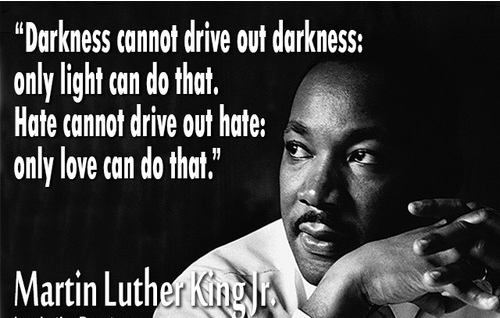
As I drove and reflected on the woman’s words, I was reminded of the words of Martin Luther King, Jr: “Darkness cannot drive out darkness; only light can do that. Hate cannot drive out hate; only love can do that.” And I ask myself: “Jarrett, what are you doing, what are you preaching and writing, how are you living, that shines the light of love?”

“Jarrett, What are you doing to be humble, accepting, and inclusive? What are you doing to do justice on the behalf of every person, to value the sacred worth of all people: male and female, black and white, Hispanic and Asian, gay and straight, open and close-minded, Christian and non-Christian? Jarrett, what are you doing to look like, act like, and be like Jesus in this world?”

If I can begin to work on these questions, maybe a time will come in my life when another person will approach me one day and say: “Jarrett, I cannot wait for you to meet my spouse. She is a retired minister. Her light shines in this dark world just like yours. She loves people and the church just like you!”