Grace in Genesis: Adam and Eve

adam and eve

Genesis 3 NRSV

How often have you watched a pet dog sprawled all out in the middle of the day, taking a nap, and thought to yourself: “Must be nice!?” Would you just look at Max or Buddy or Bella or Lucy? Not a single care in the world! They’re in paradise! No job. No bills to pay. No groceries to buy. No dishes to wash. Never has to stand in line at Wal-Mart. No knowledge whatsoever of good and evil. No knowledge of the conflict between Israel and Palestine. No knowledge of the plight of undocumented immigrants in this country. They know of no friends who forsook them or disappointed them. Unaware of any sick family members.  Absolutely ambivalent to the certainty that they will one day die. Unmindful that they are even a dog. And utterly oblivious to the reality that they are sprawled all out on the living room floor completely naked. No shame whatsoever.

Sounds to me like two of the first Bible characters we ever learned, the two who represent all of humanity, that still, even today, represent you and me: Adam and Eve. That is, before they ate that apple…or orange or peach or fig. Whatever it was, before they ate that fruit from the tree of knowledge, they were just happy-go-lucky animals sprawled all out in a paradise with no knowledge of good and evil whatsoever: no knowledge of death and disease; no awareness of pain and grief; not even a clue that they would ever have to work hard to make a living; unaware that they were broken, fragmented, and sinful creatures; unmindful that they were even human, humans who in their self-centeredness will continually disobey the Creator’s commands and abuse the creation which that had been graciously given.

And they were also unmindful of the danger that lurked in their own paradise, that crafty serpent: that symbol of everything chaotic and evil, that enigmatic, yet personal force of temptation that somehow, we have no explanation of why, was already present, preexisting and existing in the garden alongside of humanity. And because of this unholy force or presence or energy, the sordid self-centeredness of Adam and Eve, along with the knowledge of good and evil was suddenly made known. The shame of who they knew they were, the shame of what they had become and the shame of where they were going became almost too much for them to bear.

For who has not said: “I wished I never knew!” “I wished you hadn’t told me that!” “I would be so much better off if I just didn’t know!”  Sometimes ignorance is bliss. Sometimes ignorance is paradise.

However, Adam and Eve, humanity, each one of us, we live in a world where we all know way too much, where we’re too smart for our own good.  We live in a world with a full knowledge that all is broken, with a full knowledge of pain and suffering, stress and strife, sadness and grief. Furthermore, we live in a world where we know we are going to one day die.

We also live in a world where we make countless mistakes, and we know it. We are selfish, and we know it. We live to save our lives, protect our lives, look after number one at the expense of everyone else, and we know it. We know we have done some terrible things, and we know we have not done some good things, which is equally, if not more terrible. With our cursed knowledge, we can easily relate to the Apostle Paul’s words to the Romans:  “For I know that nothing good dwells within me, that is, in my flesh. I can will what is right, but I cannot do it.For I do not do the good I want, but the evil I do not want is what I do” (Romans 7:18-19).

And because we know, we live with a lot of shame. And we spend much of our energy, time and resources trying to cover it, hide it, masquerade it.

I have always been a terrible golfer, and because of that, I really have not played much in the last few years. However, when I used to play more, I would make sure I always wore the latest styles in golf apparel and footwear. I always had a new golf glove to wear and a nice golf bag with my shiny and very organized clubs. My thinking was: “If couldn’t play good, dadgummit, I was going to look good.”

Thus, I can easily relate to Adam and Eve on that cool evening when they ran, on that cool evening when they hid themselves from the presence of God whom they heard walking through the garden. Surely Adam and Eve know by now that you can run, but you cannot hide.

God then asks a question that is as liberating as it is frightening. It is a fascinatingly miraculous question when one considers the one who is doing the asking: “Where are you? Where are you? God, the creator of all that is, loves us so much that God yearns not only to be with us personally and intimately, but desires to be with us… where we are. Where we truly and honestly are, behind the masks and apparel, behind the allusions we have created, behind acts we portray.

As we sang today before communion: God wants to know of all the sins and griefs we bear. God wants to know our pain, our trials, our temptations, our trouble, our sorrows, and our every weakness. God wants to know if we are in a place where we are heavy laden, cumbered with a load of care, in a place where our friends despise or forsake us.

God calls out to Adam and Eve, to all of humanity, to each one of us: ‘Where are you? Because wherever you are, that is the place I want to be. So, please do not hide from me. Do not run away from me. Please, do not be afraid and do not be ashamed. I want more than anything else to know you, to know you for who you really are. You don’t have to come to me. Let me come to you, find you, be with you, walk alongside of you. Let me love you.”

Adam comes out behind the trees and responds, “But God I am naked!” All of me is uncovered, out in the open. My true colors are laid bare for the entire world to see. All of my failures, all of my fears, all of my brokenness, all of my self-centeredness, all of my mess is out there, completely exposed. You, O God, have created us to lose ourselves, and all I want to do is to find myself, to save myself, protect myself. God, I am a sinner, and what’s worse, now I know it. And I am so ashamed.

Then God does for Adam and Eve something that they cannot do for themselves. They cannot deal with their shame. They cannot deal with their sin. The reality of who they were, what they had become and where they were going was too much for them to bear.

As revealed in every act of Jesus of Nazareth, God responds to their shame by doing something amazing. God bends God’s self to the ground, uses God’s own hands, and creates garments of skin, and lovingly and very graciously clothes Adam and Eve.

I am reminded of the story of Jesus when the religious leaders bring a woman to him who was caught in the very act of adultery. The story seems to suggest that she was brought before Jesus naked, completely exposed, if not literally, most certainly figuratively. What horrifying shame this woman must have experienced. Jesus responds to her shame by bending himself to the ground, and writing something in the sand with his hands. We are not told what he wrote or why he wrote. Maybe he really did not write anything. Maybe it was just a gracious gesture to turn the eyes of the crowd, if just for a moment, off of the woman, so she could cover herself, pull herself back together. Then, after he revealed to the woman that he knew all about her, how he knew all her sin and shame, Jesus turns to the religious leaders and says: “Let those without sin and shame cast the first stone.” And in saying this Jesus clothes this poor woman, not with garments, but with grace.

God meets Adam and Eve where they truly are. They are naked, exposed. And what’s worse, unlike little Max or Buddy, Bella or Lucy sprawled out naked on your living room floor, Adam and Eve are naked and exposed, and they know it. All has been laid bare, and they could not be more frightened and ashamed.

And God responds to their nakedness, God responds to all of their fear and shame, by amazingly clothing them with grace.

And here is the good news. The good news is that the only thing that may be more frightening than being fully known, completely naked, exposed for who we really are, all our sins and griefs laid bare, is perhaps the prospect of never ever being fully known, the prospects of going through this life without anyone ever truly knowing us, and then accepting us, loving us, clothing us with grace. Thanks be to God that God wants to know us, every part of us, and then God still wants to love us and forgive us.

I believe with all of my heart that this is one of our primary purposes as a community of faith. First and foremost, we are to always be a community of grace. If people cannot come through our doors, take off their masks, stop the charade, and honestly lay bare all of their sin and all of their griefs, knowing that they will never be judged, looked down upon or condemned, then I do not believe we are a church. I am not sure what type of business we are, but we are not a church, we are not a community of grace. As a church we are to always be in the business of yearning to meet people where they are, so we can be with them, so we can walk alongside of them, so we can listen to them, learn from them, forgive them and love them.

As the church, we are to always be in the clothing business. We are to always be in the business of bending ourselves to the ground, using our own hands, our resources and our talents, to clothe one another, to clothe all people, with the grace of God in the name of Jesus the Christ.

Have You Seen the Ocean?

beach umbrella

“Jesus said, ‘Do you have eyes, and fail to see? Do you have ears, and fail to hear?” Mark 8:18 NRSV

For me, one of the best things about living in the East is our close proximity to North Carolina’s beautiful beaches. My heart hurts for those who say that they have never seen the ocean.

There are few things I love more than sitting in a beach chair under an umbrella in the summertime. I love the whole sensory experience of it: the sheer sight of the vastness of the ocean; the fresh smell of the salt air; the rhythmic sound of the waves breaking ashore; the way the cool sand feels on my bare feet, and the way the sea breeze feels on my skin; the refreshing taste of a cold drink and a pack of Nabs.

However, I believe that my love for the beach comes from another place. It comes from a deeper, higher place. It comes from a place that transcends the physical senses. It comes from a miraculously mysterious place. It is hard to explain, but to put it in simple “preacher” words: the beach can be a downright spiritual experience. I believe we have the ability to see the ocean with something other than our eyes.

The beach can reveal the truth that all of life is a mysterious and abundant gift of an amazing grace, impossible to earn and in no way deserved. It reveals a love that is unconditional, unreserved and very large.

Consequently, as I sit in the beach chair, breathing in the gracious enormity of it all, understanding that all of it is pure grace, my heart begins to fill with immense gratitude. Then, a moment of clarity comes. As a recipient of this grace, if I am truly grateful for it, if I truly believe it is all unearned and undeserved, if I truly believe it is grace, then I will instinctively live to lovingly share grace with all people, unreservedly, abundantly, and amazingly. I will give as I have been given.

And if I do not share grace with others? Or if I am reserved or stingy with it?

Then, although I have been to the beach countless times, maybe I have never truly seen the ocean.

Theology Trumps Technology

Carson Banks is a sophomore at the University of North Carolina at Wilmington where he is majoring in Religion/Philosophy and Film Studies

The following sermon was written and delivered  by my son Carson Banks for worship at the First Christian Church of Farmville, NC on July 6, 2014.

Micah 6:6-8 NRSV and Amos 5:21-24 NRSV

Since my junior year in high school, I have written a few research papers on what I had perceived to be the inevitable demise of organized religion. In my last paper, I concluded with many others that in order for the church to survive in the 21st century, change was necessary.

Many religious leaders see my generation as the “missing link” or the “solution” to the rapid decline in congregational attendance and participation in churches today. So to pull us in and encourage us to join their congregations, they’ve turned up the volume. They’ve brought in the big screens and projectors. Many have purchased strobe lights and fog machines. They’ve brought in Starbucks, donut shops, movie theaters and bowling alleys. Some churches have weekly raffles to give away gift cards, iPods, and gaming-consoles. They give out t-shirts, car decals, and frisbees that have the churches logo printed across the front. Many pastor-search committees have sought out young, “hipster-like” ministers (who preferably have at least one ear pierced and a very visible tattoo) to lead worship in casual and trendy clothing.

Church attendance is at an all-time low. Many churches are being forced to close their doors. So BJ, let’s turn up the volume here at First Christian. Trustees, call Krispy Kreme or Starbucks and see if they would be willing to set up a shop in the fellowship hall. Building and Grounds, bring in the big screens, fancy projectors, fog machines, and strobe lights and let’s bring this sanctuary into the 21st century. Let’s draw up plans to build a movie theatre and bowling alley in the basement. And finally, let’s get rid of our senior pastor who is visibly graying, wears that overly-formal robe, and who has no visible tattoos or piercings. Problem solved.

As many of you know, I will be moving to Wilmington in August to start the next chapter of my life at UNCW. Since I received my acceptance letter back in February, I have visited Wilmington a few times to get more familiar with the area.

Last Tuesday, I packed the cooler, loaded up the beach chairs, and picked up one of my good friends to spend the day touring the city. After driving around UNCW’s campus and the historic downtown area, we headed for the beach.

While we were sitting on the beach, my friend recognized one of her good friends from high school walking towards us. She stood up and ran towards her friend to greet her with a hug. They walked back over to me, and I introduced myself. Her friend’s name was Kayleigh.

Kayleigh lives in Wilmington and attends UNCW as a sophomore. When she discovered that I would be moving down in August, she asked me where I would be living, what I intended on majoring in, and if I had any other friends at UNCW. After I answered all of her questions, I asked her to tell me her story. Little did I know that our conversation was getting ready to take a turn.

Soon after telling me that she was living with her sister, she began to talk about her family. This lead Kayleigh to jump straight into her religious views. She explained that her views often clashed with her parent’s beliefs.

I learned that she grew up in a Christian home and that her parents were strong in their conservative religious beliefs. However, Kayleigh quickly admitted that she was not too sure of her beliefs. In fact, she told me that she completely avoids talking about religion when she is with her parents to steer clear from any condemnation or rejection.

I then asked her if she had ever visited any churches in Wilmington. She said she visited one church back in November. She described this church as “theatrical”with a very large stage, flashing lights, loud (up-beat) music, and big screens. She said she visited this church two times, her first, and her last. I was intrigued. I wanted to know what made her experience so awful. So I asked.

Kayleigh said that this church was “too religious.” She said that it seemed as though everyone leading the worship service was above her. It was almost as if they had something that she didn’t. I immediately knew which church she was talking about.

Back in March, when I was visiting a friend in Wilmington, I attended the same church. On Tuesday nights, they have a special worship service for college students. Being a college student and hearing that so many other UNCW students were attending, I decided to go.

The building was massive. It looked more like a shopping mall than a place of worship. As I walked in, I looked around and realized that even the inside was built like a shopping mall. To my right there was a coffee and donut shop, and a church gift shop to my left. I followed the rest of the students who were entering the sanctuary, or worship arena.

The music was loud. So loud that I could feel the beat of the drums in my chest. Lights were flashing. The stage was huge, as was the worship band. There were three massive screens above the stage that displayed live video of the worship band. I felt like I was at a concert.

The pastor’s message focused on the story of Jonah. He stressed the fact that Jonah did not listen to God’s calling and betrayed God. The pastor then asked the congregation to respond to this story. He challenged us college students to stand up if we had ever ignored God’s calling or if we felt as though we had betrayed God at some point in our life.

Now at this time, I was expecting the pastor to step down from the stage to stand with us, reminding us that everyone has ignored God’s calling at some point, and that we all have betrayed God, even the religious leaders. Instead, this pastor chose to stay where he was high above everyone else on the stage.

Out of the nearly 700 students in the room, only 50 students or so stood up in response to his challenge. Again, instead of coming down off the stage and asking everyone to stand with him, the pastor remained there high above everyone in the room. High up on a pedestal. He then asked those who were still seated to stand and walk towards the students that were now standing and lay their hands on them. Most of the students began to look around in shock. A few stood and obeyed his request. He then began to pray for those students who stood in shame.

Kayleigh experienced something very similar when she visited this church. When describing her visit, she was enraged. She exclaimed that these kind of churches must feel that our generation does not care about the content or overall message the churches reveal through worship. Kayleigh said that the flashing lights, loud music, free food, and gifts may attract students our age to visit, but they aren’t going to encourage us to stay. She went on to say that our generation is smarter than people think. Smart enough to realize what is happening and smart enough to stay away from it.

If churches want to encourage people of my generation to join them, they should stop spending energy and resources on extravagant technology, and focus more on practicing and preaching a better theology.

But this is not a new problem, nor is it a contemporary service problem. It is a problem that is also in more traditional churches like ours. Ancient Israel even had the same problem. The Book of Amos took place during a time when the people of Israel hit a spiritual low. Their values were lost in greed and wealth. At the expense of the poor, the wealthy and elite were becoming more and more powerful.

They thought that in order to please God and attract more people to worship, they had to do all of these technical things like presenting expensive offerings, play elaborate music with expensive instruments, and offer up the right and acceptable sacrifices. But they were missing the main point. In fact, all of these technical things infuriated God who spoke through Amos saying, “I hate, I despise your festivals, and I take no delight in your solemn assemblies.” Instead of spending their resources on technical and material things, God asked them to do one thing.

Amos spoke on behalf of God:  “…let justice roll down like waters…”In this, Amos is simply telling us to treat others equally and fairly. He then goes on by saying let “…righteousness [flow] like an ever-flowing stream.”In other words, love one another with a love that never pauses, never hesitates, never ends; a love that never gives up. It’s that simple.

We so often get caught up in the technicalities when reading scripture. Because we read into things way too much, we make scripture more complicated than it was intended to be and end up missing the main point. When Amos talks about righteousness, he’s talking about always doing the right thing on behalf of others with love. When he speaks of justice, he’s telling us to love all people equally.

Micah lists three things that God requires of us: do justice, love kindness, and walk humbly with your God. Do not stay where you are, but walk, be on the move. You are no better than anyone else, so step down from your pedestal and go out into the world and humbly walk with God, embracing all people with the love of God, especially the poor, outcast and marginalized.

Jesus summed up all of the laws into two: love God with all of your heart and love your neighbor as yourself. Two laws, one message: love.

Many problems face organized religion in the 21st century. I have spent a few years researching these problems in an attempt to discover possible solutions. But perhaps the solution was written for us in 750 BC. And maybe my generation is the “missing link.”Although the book of Amos was written nearly 3,000 years ago, it’s possible that the millennials who grew up in an age of technology, a generation that is so advanced in education and information, will be the generation that embraces the simplicity of what it means to be a disciple of Christ.

BJ, I do not believe we need to turn up the volume. Building and grounds, I don’t believe we need to bring in the big screens and fancy projectors. And no, thank God, strobe lights, fog machines, movie theaters, and bowling alleys are not necessary. Trustees, let’s hold off on the Starbucks and donut shop. We do not need to raffle off gift cards, iPods, or gaming consoles. There’s no need to order hundreds of t-shirts, car decals, and frisbees that have the churches logo printed across the front in order to bring people to Christ. And maybe, just maybe, we’ll even hold off on a having a pastor-search committee meeting and keep the old man. Hopefully, he still has a few more good years left in him.

If we the church, if we here at First Christian simply work together to “let justice roll down like waters, and righteousness like an ever-flowing stream…” If we will reach out to those around us in our community and in our world by meeting them where they are and help them in their times of need in the name of Christ; without pausing, hesitating, or giving up…If we step down off of our pedestal and admit that we are all sinners in need of grace and forgiveness…and if we truly welcome and love all people as Christ welcomes and loves all of us; then the church will not only survive, but the church may finally begin to look like Jesus, not only drawing people from my generation in, but drawing all people to Christ.

In God We Trust

in-god-we-trust-happy4

Hurricanes, disease, terrorism, war, recession, and bad religion surround us. Should we stress?  Should we panic?  Should we climb out on the ledge?

I guess it all depends on where we place our trust.

If we only trust Mother Nature, we will get wet, maybe even blown away.

If we only trust medical science, we might get a staph infection.

If we only trust the goodness of humanity, we will get disappointment and could get attacked.

If we only trust the government, we will never get to know peace.

If we only trust the stock market, banks, and free enterprise; well, we know what we’ll get.

If we only trust the church, we will certainly get hurt.

And if we only trust ourselves, we will get to be in need and always want.

However, if we put all our trust in the God who revealed God’s self through Jesus the Good Shepherd, we shall not want.

If we trust God who stilled the storms and fed the multitudes, we will get a restored soul on green grass beside still waters.

If we trust the God who bent down to wash another’s feet, stooped down to touch a leper, crouched down to forgive an adulterer, knelt down to serve the poor, we will get taught the paths of righteousness.

If we trust the God who wept at Lazarus’ grave and then spoke words of life, we will get light and hope in the shadowy valley of death.

If we trust the God who welcomed all to the table, especially the tax collectors and sinners, we will get a gracious banquet of acceptance, forgiveness and wholeness.

If we trust the God who spoke from the cross: “Forgive them,” we will get to look across the table and see a friend we once called an enemy, a sister or brother we once called a foreigner.

If we trust the God who identified with humanity, who is acquainted with human suffering, then we will get a comfort and a peace beyond understanding.

If we trust the God who turned 180 gallons of water into delicious wine, we will get a cup that overflows.

If we trust the God who would welcome a prodigal child home with an extravagant party consisting of a fatted calf, a robe and a ring, we will get goodness and mercy and a place in the house of the Lord forever.

LGBTQ+ Issues and the Church

(Revised June 2023)

INTRODUCTION

I am a cisgendered, heterosexual male born in 1966 to Southern Baptist parents who raised me in a conservative farming community in northeastern North Carolina. My pronouns are “He, Him and His.” I earned a Bachelor of Science degree from Wingate College, a North Carolina Baptist school, in 1988. I then attended The Southern Baptist Theological Seminary in Kentucky where I earned a Master of Divinity Degree in 1992. After serving as a pastor for over ten years, I received my Doctor of Ministry degree from Gardner-Webb University in 2005. I married my wife of 34 years in 1988 and have two children. My son is 28 and my daughter is 25. I am currently ordained as a Disciples of Christ minister.

The only thing that sounds strange to me in the introductory paragraph above is the word “heterosexual.” This may be the first time I have introduced myself as a heterosexual. When I meet another person for the first time, I never mention my sexual orientation. The word “sex” or any word containing this powerful, three-letter word is never used during any introduction.

Thus, before I begin this article on the topic of homosexuality, I wish to state how uncomfortable I feel when identifying other people with terms such as “homosexual.” First and foremost people are people. They are human beings. They are our family, our friends, our co-workers, our neighbors; and for those of us who belong to a church, they are our siblings in Christ. Their sexuality helps to define who they are; however, it is not the only thing that defines them. Furthermore, I am also uncomfortable using the term “issues” to discuss homosexuality, because in most situations, I do not believe there should be any “issue.”

I am writing this formal statement in response to a request from an old college friend. In May of 2014, I received the following message on Facebook messenger: “Jarrett, I pray all is well with you and yours. Over the past few months I have read many of your posts with interest regarding the issues of homosexuality as it relates to church and a life of faith. As I continue to dig and examine my own stance on these and other issues, I was wondering if you would mind spelling out your stance and the basis for it. I would appreciate it. Thanks in advance.”

I replied: “Although I have many thoughts on this subject that may appear in some of my sermons and writings, I have never written a concise statement dedicated solely to this issue. So thank you for encouraging me to do so.”

As a pastor since 1992, the fact that this is my first attempt to “spell out my stance” on LGBTQ+ issues as it relates to church and the Christian faith reveals not only the complexity of these issues, but also my fear of the powerful emotions that these issues invoke in others, especially in people of faith. As a pastor who lives paycheck to paycheck and seeks to avoid unnecessary conflict within the church that could stop a paycheck, there has always been a part of me that is fearful of the possible consequences of “spelling out my stance.” Yet, there is another part of me that believes that making such a statement is a necessary risk. Then, there is another part of me that realizes that the risk that I am taking by honestly and openly sharing my beliefs is insignificant when compared to the enormous risk my LGBTQ+ friends and family have taken through their honesty.

Thus, it pains me when I consider that my stance on these issues has changed very little since my seminary days in the early 1990’s, yet this is the first time I have “spelled them out.” During seminary, I was very aware that I would need to develop a stance if I was going to be a pastor the 21st century. Therefore, as a student, I studied the scriptures and read all that I could read on the subject to develop a stance. However, for over twenty-five years, for purely selfish reasons, I kept my stance rather private. There were times when I have touched on it in informal conversations, alluded to it in sermons, led a brief Bible study or two on it, and posted or tweeted a snippet here and there; however, I never “spelled it out” in black and white in a manner that is fully visible to the public. So, to all of my LGBTQ+ friends, and to family members and friends of LGBTQ+ persons, I sincerely apologize.

PREFACE

The first title of my blog Stumbling, Fumbling and Bumbling Behind Jesus aptly prefaces any “stance” that I take on any issue as it relates to faith. When it is about faith and theology, I do not have all the answers. I have not “arrived” as a Christian or as a Christ-follower. I like to think that I am on my way. Yet, along the way, I have the propensity to make many wrong turns and even break down on the side of the road. I have come a long way, but I still have a long way to go. For me, life is as mysterious as it is miraculous. The existence of God and the revelation of God through Jesus Christ is even more miraculously mysterious. God, the creator of all that is, is so large that I will never be able to wrap my mind around God. But I am comfortable with this. As Harry Emerson Fosdick has shared, I am at peace living “in a world where my life is surrounded by mystery than living in a world so small that my mind could comprehend it.”

My mind is not only small, but I believe it is also flawed. Whether one calls it “original sin” or “the Fall of Humankind” or just a “messed-up world,” I believe that all of creation is fragmented. Consequently, as a creature on this earth, I will always understand God and God’s will for the world as “seeing through a glass darkly” (1 Corinthians 13). And by God, I mean “the source of all that is.”

Yet, to give my life meaning, purpose, fulfillment and direction, I choose not to believe that God is completely unknowable. I believe life is in an inexplicable gift of grace, and I am compelled to express gratitude for this gift through a life of faith in the Giver, the Source of it all. I have chosen a meaningful life of faith in God opposed to a meaningless life of agnosticism, and I have specifically chosen a life of Christian faith in God. I often wonder if I would have chosen this faith if I was born to parents in a part of two-thirds of the world’s population that are not Christian. Nonetheless, I am glad that I have had the opportunity to make this choice, and I am grateful for the way that this choice informs my beliefs and enriches my life.

Consequently, my limited understanding of who God is, how God acts and what God desires is derived from the words and actions of Jesus as revealed in scripture. This understanding continues to grow, change and mature, even through my doubts, as I “stumble, fumble and bumble” behind this Jesus with others who are on the same journey.

Therefore, any “stance” that I take on any issue as it relates to the church and the Christian faith is flawed and incomplete. Yet, I believe that it is always beneficial to articulate current beliefs with the purpose of sharing them with the wider community of faith so those beliefs can be tested, challenged and grow.

ISSUE OF CHOICE

I begin with what I believe is the obvious presupposition that one’s sexual orientation is not a choice. I believe most persons who belong to the LGBTQIA community would not belong to this community if there was a choice involved. In fact, I have never met a queer person who did not tell me that at some point they wished they were attracted to the opposite sex or were cisgenderd to avoid the severe pain of rejection and condemnation from their friends, families and communities. I believe avoidance of this pain is the reason many queer people date and even marry someone of the opposite gender. I also do not believe in any psychological therapy or religious ritual that can change a person’s sexual orientation.

One day, I had lunch with a self-professed, former gay man who had been through a Christian program to become “reoriented.” During lunch, he proudly announced that he had been “reprogrammed” by God to be attracted to women, and he was currently “happily married” to a woman. However, during the conversation he also shared, “Now, don’t get me wrong. I am still tempted almost daily by men who I find sexually attractive.” As someone who can not fathom being sexually attracted to someone of the same gender, I did not deem his reprogramming very successful.

ISSUE OF SHAME

I believe any discussion on the LGBTQ+ community and the Christian faith must acknowledge the shame that is associated with sexuality within many Christian faith communities. Outside of the church’s traditional definition of marriage, all sexual acts, including masturbation, are often characterized as vulgar, nasty, and just plain wrong. Even sexual desire and arousal are regarded as something indecent or lewd.

Many churches denounce sex education to children in public school curriculums, yet they have been too prudish to have any open and honest conversation regarding human sexuality in the church. The “Song of Songs” or “Song of Solomon,” which is filled with descriptive sexual encounters, is seldom, if ever, read in the church as many find such content embarrassing, to say the least. As a Christian minister, I have upset people in the church by using the word “pregnant” to describe the mother of Jesus instead of simply saying “with child.”

In the home, many Christian parents avoid the “birds-and-the-bees” conversation with their children until it is much too late; that is, if they do not avoid it all together. Even living in a world saturated with mass media inundated with sexual images, Viagra and Cialis commercials running 24/7, many Christians are more comfortable living in some puritanical state of suppression or denial than acknowledging that our sexuality is an innate part of who we are as human creatures. Consequently, sexual indiscretions or “sins” are widely regarded by people in the church as more heinous and more perverted than other sins, and the thought of same-gender sexual contact stirs up strong emotions of detest and disgust.

The church must recognize the disproportionate weight that it assigns to perceived sexual sins and honestly accept that humans are sexual beings created to experience ourselves and to love others sexually. However, for this to happen, the church must learn to become willing to have an open discussion about human sexuality without shame and a misguided charge of emotions. Furthermore, many in the church should honestly admit that it is the perceived vulgarity of the images in their minds of same-gender genital contact that fuels part of the disgust they feel for persons who identify as gay.

ISSUE OF CELIBACY

Many people in the church teach that homosexuality is not a sin; however, homosexual acts are regarded as sins and should be avoided. Thus, they are able to accept a homosexual person’s orientation, but they disagree with their “lifestyle.” Consequently, they encourage gay people to abstain from same-gender sexual contact and to commit to living a celibate lifestyle. Although I believe there is a small fraction of a percentage of the human population that can, and probably should, commit to such a lifestyle, I believe it is wrong for any Christian, especially one who enjoys the intimacy and pleasures of sexual love, to encourage celibacy based solely on one’s sexual orientation. I believe it is blatantly arrogant to say, “You’re gay, so you can’t do that.”  It is also a preposterous suggestion. I believe that the studies of the struggle with celibacy among Roman Catholic priests and nuns teach us something very valuable about the importance of sexual love to a person’s mental, physical, and spiritual well-being.

ISSUE OF SIN

I often hear people say, “Love the sinner and hate the sin.” This implies that the sinner is somehow separated from the sin. Sin is reduced to a specific action that can be avoided. However, I do not believe sin is something that human beings living in a fragmented creation can avoid. Members of the church have asked me: “Pastor, if I go to Las Vegas and play the slot machines, will I be sinning?” My response is: “Even if you manage to somehow miraculously avoid walking through a casino while you are in Vegas and read the Gideon Bible in your hotel room every night; you will not be any less of a sinner than you already were.” Sin and brokenness are so much a part of this world and our lives, that there is no escaping it. The Jews once believed that sin could be avoided if 613 laws were obeyed. Not only is that a formidable task for any human, I believe Jesus would say even if one obeyed all 613 laws, they would not be any less of a sinner than the one who broke every law.

I have heard many people in the church use the euphemism “sexually-challenged” to describe members of the LGBTQ+ community. Every time I read or hear that, I want to respond: “Aren’t we all?”

I believe the church must understand that sin or fragmentation is a part of all of us, and there is no way we can escape that truth by avoiding certain acts or suppressing certain desires. I believe this is why Jesus said that those who have lust in their heart are just as sinful as those who commit adultery (Matthew 5:27-30). This is also why the Bible-believing religious people dropped their stones before the poor woman “caught in the act of adultery” when Jesus said, “Let those without sin cast the first stone” (John 8:7).

ISSUE OF BIBLICAL INTERPRETATION

Scripture is and has always been very important to me as I seek to follow the Christ that I believe is revealed in scripture. This faith in Christ begins with my reading and understanding of the written words. However my faith is not in the written words themselves, but in THE WORD that the written words reveal—the same WORD that was with God and was God and became flesh and dwelled among us (John 1).

I do not believe the Bible was ever meant to be read and followed by picking certain verses out of their context. I am fully aware of the seven passages in the Bible that some Christians pick out of context to condemn same-sex love, as I have studied them extensively (So, you don’t have to quote those in the comments below). I am also aware of many more passages in the Bible that have been picked out of context to support slavery, Jim Crow laws, apartheid, the suppression of women, and even genocide. Reading and interpreting the Bible can be a dangerous exercise. It should be done carefully while prayerfully keeping in mind the overall message that is being revealed.  In other words, scripture should always be interpreted.

Historical and Cultural Context

There are several ways that I interpret scripture. One way is in the light of the historical and cultural context in which the words were written. Although the Bible states that God made the sun stand still (Joshua 10:12), I realize that was written in a time when the sun was thought to circle the earth, so I interpret the passage accordingly. Although the Bible speaks of the earth having four corners (Isaiah 11:12), I realize that it was written at a time when the earth was believed to be flat. Although the Bible describes epileptic seizures as demonic possession (Mark 5), I realize that was written at a time before the advent of psychology in the 19th century.

As a Christian, I do not denounce science, but believe science to reveal truth about our world. Since I believe God to be the source of the world, I believe God to be the source of truth. Therefore, in the 21st century, I do not argue that the world is flat or that the sun revolves around the earth. I also do not practice demon exorcisms, and I do not believe for one minute that my college friend who suffers with severe epilepsy is possessed by a demon.

There was no knowledge of homosexuality as an orientation during the time period the Bible was written. Therefore, the word “homosexuality” does not occur anywhere in the Bible. Only words describing homosexual acts occur. In an age that was centuries behind any psychological or scientific understanding of sexual orientation, I believe some of the passages against same-gender sex were written with the understanding that all people are born with a heterosexual orientation. Therefore, the homosexual actions that are being condemned are actions of heterosexual persons. Thus, all homosexual acts were considered “unnatural” (Romans 1). Furthermore, such sexual acts were often committed to humiliate or dehumanize others. Thus, I believe some of the passages which are used to condemn homosexuality are actually condemning violent acts of degradation; not acts of self-giving love by two people of the same gender who are committed to loving one another.

I believe this is the sin most evident in the story of Sodom that we read in Genesis 19. The story reads:

The two angels came to Sodom in the evening, and Lot was sitting in the gateway of Sodom. When Lot saw them, he rose to meet them, and bowed down with his face to the ground. 2He said, ‘Please, my lords, turn aside to your servant’s house and spend the night, and wash your feet; then you can rise early and go on your way.’ They said, ‘No; we will spend the night in the square.’ 3But he urged them strongly; so they turned aside to him and entered his house; and he made them a feast, and baked unleavened bread, and they ate. 4But before they lay down, the men of the city, the men of Sodom, both young and old, all the people to the last man, surrounded the house;5and they called to Lot, ‘Where are the men who came to you tonight? Bring them out to us, so that we may know them.’

In the story, Lot extends gracious hospitality to two visitors (angels). These are considered to be unwelcomed outsiders or strangers by the people of the town. Verse four reads that “the men of the city” came and asked to “know” these men. “Know” is a biblical euphemism for sexual relations. Lot then “begs them not to act so wickedly.” Therefore, many have said that the wickedness of Sodom was homosexual behavior.

However, when one considers “both young and old, all the people, to the last man,” then it becomes obvious that this is a story of heterosexual persons desiring to have homosexual sexual relations for evil purposes. They desire to gang-rape these two outsiders as an act of humiliation to punish them for coming into their city. The wickedness of Sodom was violent acts of degrading inhospitality. Ironically, it is the same wickedness of many in the church who desire to mistreat and dehumanize homosexual people.

In the cultural context of scripture, I also understand that many of the laws of Moses (Leviticus 18, 20) were written to build a nation and to ensure that the Israelites were fruitful and multiplied. Therefore, since homosexual actions did not produce offspring, it was obviously condemned in the law. Semen, which was considered to be the source of future generations was understood as something very precious and was not to be wasted. This is why we read in Genesis 38 the story of God killing Onan for letting his ejaculate fall to the ground. Do I believe God really wants men to die if their semen is not always used for procreation? Of course not.

Jesus as a “Filter” in Interpreting Scripture

The main way I interpret scripture is as a follower of Jesus Christ. I confess Jesus as my Lord. This means that Jesus guides my interpretation of life itself. Jesus, then, becomes my criteria or my “filter” for interpreting all scripture. For me, Jesus is the fulfillment of all scripture (Matthew 5:17). Therefore, if a scripture passage is not in accord with the words and the works of Jesus, then I understand it as unfulfilled revelation.

There are countless examples of what I call “unfulfilled revelation” throughout the Bible. Because I seek to follow the way of Jesus, if my children every disrespected me, or if I ever smelled beer on their breath when they came home from a party, I never intended to follow the scriptures’ command by having them stoned to death in the town square. Deuteronomy 21:18-21 reads:

If someone has a stubborn and rebellious son who will not obey his father and mother, who does not heed them when they discipline him, then his father and his mother shall take hold of him and bring him out to the elders of his town at the gate of that place. They shall say to the elders of his town, ‘This son of ours is stubborn and rebellious. He will not obey us. He is a glutton and a drunkard.’ Then all the men of the town shall stone him to death. So you shall purge the evil from your midst; and all Israel will hear, and be afraid.

When I conduct pre-marital counseling sessions, I never advise the groom to stone his wife to death if it is discovered that she is not a virgin on their wedding night. Deuteronomy 22:20-21 reads:

If, however, this charge is true, that evidence of the young woman’s virginity was not found, then they shall bring the young woman out to the entrance of her father’s house and the men of her town shall stone her to death, because she committed a disgraceful act in Israel by prostituting herself in her father’s house. So you shall purge the evil from your midst.

I also do not believe adulterers should be stoned (Leviticus 20:10), nor someone who marries his mother-in-law (Leviticus 20:14), nor someone who belongs to another religion (Leviticus 27:29), nor anyone for that matter as I cannot envision Jesus stoning anyone. Therefore, when I read that same-sex acts are an abomination and those who commit such acts should be stoned to death (Leviticus 20:13), I simply say, “Thank God that Jesus has taught us a better way!”

Although the New Testament admonishes women to remain silent in the church (1 Cor 14:34), I dare not ask the women in my church to keep quiet. Not because I do not want to be fired, but because I do not believe Jesus wants them to remain silent. The Jesus revealed in scripture continually liberated women, making them disciples, allowing them to even sit at his feet (a place reserved for only male disciples of a Jewish Rabbi) as he interpreted the scriptures. Furthermore, although the New Testament admonishes slaves to obey their masters (Ephesians 6:5-9, Colossians 3:22, 1 Peter 2:18) my faith in Christ who loved and valued all people does not permit me to argue for the institution of slavery.

Throughout the gospel narratives, Jesus continually lifted up the lowly, stood on the side of the marginalized and outcasts, ate and drank at the table with presumed sinners, and offered unconditional love, extravagant grace and unearned forgiveness to all. Therefore, when I read scriptures that command the hate and stoning of homosexual people or the marginalization or oppression of any group of people, I understand it as being unfulfilled as it is in disagreement with the words and works of Jesus my Lord.

ISSUE OF NATURAL THEOLOGY

Natural Theology is widely used by Christians as an argument against same-sex relationships. Natural theology argues: “If it is natural, it is good. If it is unnatural, it is sinful.” This is why some Roman Catholics do not believe in contraception and discourage masturbation. Sex is for natural procreation; not unnatural recreation. However, I know of no one who believes that the only purpose of human sexual relations is for procreation. Most all understand that “making love” is important for intimacy and bonding in the relationships of persons committed to one another. There is no denying that my wife and I are closer and are more connected because of our sexual relationship. There is a good reason we call it “making love” as sexual intimacy makes the bond of love stronger. This is one reason we do not want our young teens to have sex. It is not only the risk of pregnancy that we fear, but also the risk of them becoming emotionally connected to another before they are ready for such intimacy and love.

The Natural Theology argument that heterosexuality is good because there exists a natural opportunity for procreation also falls short when one considers the violent act of rape. This argument follows to the logical conclusion that if the rape is heterosexual, and there are no contraceptives in place, then it is natural, and thus good.

The reality is that not all heterosexual acts are good. Some heterosexual acts are pure evil, such as rape and the exploitation of trafficked persons. Other heterosexual behavior, albeit non-violent, can be degrading and selfish. The church and society has been guilty of overlooking this reality. It is a tragedy that when I married my wife in 1988, it was still legal in the state of North Carolina for a man to rape his wife.

CONCLUSION: ISSUES OF GRACE AND LOVE

It is not the flaws in Natural Theology or even using Christ as the criterion for scriptural interpretation that truly informs my stance on this issue in the light of faith. For me, it comes down to my faith in the extravagant and oftentimes offensive grace of Jesus.

In Ephesians 1 we read these words: “He destined us for adoption as his children through Jesus Christ, according to the good pleasure of his will, to the praise of his glorious grace that he freely bestowed on us in the Beloved. In him we have redemption through his blood, the forgiveness of our trespasses, according to the riches of his grace that he lavished on us.”

I believe the entire Biblical witness testifies to this grace. It is a grace that lavishes. It is a grace that is extravagant, offensive and even appears overdone. The following are words I gleaned from a sermon by United Methodist Bishop William Willimon:

Cain killed his brother Able in the very first chapters of our Bible. And what does God do? God lavished Cain. Cain is exiled from the community because of his actions, but God promises to go with him to protect him (Genesis 4).

Moses killed an Egyptian, breaking one of the big Ten Commandments. But God chose that murderer to reveal those commandments to the world and to lead the Israelites out of bondage into the Promised Land (Exodus 2).

David not only committed adultery, but killed the husband of his mistress (2 Samuel 11). Yet, Matthew proudly announces David in Jesus’ genealogy (Matthew 1).

When it comes to forgiveness, when it comes to grace, when it comes to love, God lavishes. God always seems to overdo it. The riches of God’s grace are extravagant and even offensive.

The story of Jesus’ first miracle is a great example. When the wine gave out at a wedding party, what does Jesus do? He turns water into more wine. Not just some water into a little bit of wine. He makes, according to John’s estimate, about 180 gallons of the best-tasting wine they ever had. That sounds very gracious and extravagant to me. It also sounds like he may have overdone it a bit.

Then, there are all those stories that Jesus told. A farmer sows way too much seed. Most of it was “wasted,” falling on the wrong type of soil. But I suppose when sowing good seed in bad soil, you have to overdo it. You have to lavish the dirt with seed. And the seed that did manage to take root produced a harvest that is described as abundant.

The father of the prodigal son didn’t just welcome his returning son (who had committed untold sexual sins). That in itself is extravagant. But the father lavished the son. The father said to his servants, “Quickly bring out a robe—the best one—and put it on my son; put a ring on his finger and sandals on his feet.  And get the fatted calf and kill it, and let us eat and celebrate!

It wasn’t that the Good Samaritan stopped and helped the wounded man in the ditch. It was the way he stopped and helped. It was the way he lavished the man pouring expensive oil on his wounds. Then he put the wounded man in his car. He took the man to the hospital and told the doctors, “Forget about filing insurance! Here’s all my credit cards, my checkbook, everything. I’ll be back in a week, and if that’s not enough money to treat the man’s wounds, I’ll give you even more!”

The reason that so many of us attend church at Easter is because God lavished us. When God offered us the very best gift that God had to offer, the gift of God’s self through Jesus of Nazareth, we reciprocated that gift with the very worst that we had to offer, the cross. But three days later, God not only raised Jesus back to life, but God gave him right back to the very ones who nailed him to a tree.

There’s something built right into the nature of God, it would seem, that tends toward extravagance and abundance and excessiveness.

As people who have been called to inherit this nature, as the Body of Christ in this world, how do we live?  Are we stingy with our love?  Are we miserly with our forgiveness?  Do we scrimp on grace? Are we tight-fisted with the good news? Do we truly believe that the greatest commandment is to love God and our neighbor as ourselves? Do we truly believe that the greatest gift of all is love?

For me personally, the issue of LBTQIA persons, as it relates to the church and faith, all comes down to the following:

I am an imperfect man living in an imperfect world. I have chosen to give meaning to my life and to others by deciding to follow Jesus as a disciple. My discipleship is not perfect.  I stumble, fumble and bumble behind Jesus. I do not have all of the answers, and while I am attempting to follow Jesus, I am bound to make many errors in judgment. However, if I am going to make an error when it comes to loving, accepting, and embracing another, especially one who has been marginalized and demonized by society and the church, I have chosen to err on the side of grace, even if I overdo it.

There are two things I do every Sunday morning that informs my theology. One is praying the Lord’s Prayer. The second is sharing the Lord’s Supper. I pray “forgive our trespasses as we forgive those who trespass  against us.” I drink from a cup and remember Jesus’ words: “This cup is poured out for many for the forgiveness of sins.” I pray for forgiveness and I drink forgiveness and am reminded and challenged that as I am forgiven, I am called to forgive others.

Even if other Christians believe that I am wrong, and they firmly believe that, in God’s eyes, same-sex relationships are “an abomination,” I believe the overall message of the Bible persuades them to choose not to condemn, but to forgive. Choose not to hate, but to love. Choose not to restrain, but to lavish. Choose grace. Always choose to err on the side of graciously overdoing it.

Furthermore, for the very life of me, I can think of no harm that can come to the world or to the cause of Christ by overdoing it on the side of grace. I know of no lives that have ever been destroyed by overdoing it on the side of love. However, I am very aware of the irreparable harm and the deep wounds that come from withholding grace and restraining love as countless lives have been destroyed and lost to murder, war and suicide. The church has been embarrassingly and tragically guilty of doing tremendous damage to the world, as well as to the mission of Christ, by failing to follow Jesus’ simple command to love one another.

Of any human institution on this fragmented planet, the church should be a place where all people are welcomed to join a community of grace, love and forgiveness. Without fear of being judged, condemned and ridiculed, all people should feel welcomed to come as they are and honestly and openly confess their sinfulness and brokenness. And receive grace. Receive love. Receive salvation. And then share it with others. I believe that every church should be “open and affirming” because no church should never be “closed and condemning.”

ISSUE OF CHURCH LEADERSHIP

Sadly, the majority of churches exclude LGBTQ+ persons from church leadership. Current leaders of countless churches have judged their lifestyles as sinful, and thus unfit for leading others to love others. However, because I believe all Christians are sinners, yet God calls all people to do ministry, then I do not believe there is any issue whether or not a gay or transgendered person can be a leader in the church.

There is no doubt in my mind that LGBTQIA people, who have been mistreated and condemned by society and especially by the church, have a very powerful message of love and grace to offer the world. I believe they have something very valuable to teach all of us about the love and grace of Christ, as well as what it means to be fully human.

ISSUE OF SAME-SEX MARRIAGE       

“Biblical marriage” is convoluted to say the least. As far as we know, Jesus was not married. The Apostle Paul did not recommend marriage (1 Corinthians 7:8). Polygamy is endorsed by the Old Testament as a valid lifestyle for men (not women). The Old Testament is also full of archaic laws treating the woman as property in marriage. One law states that the wife is to be awarded to the husband’s brother in the event of the husband’s death (Deuteronomy 25:5). The Ten Commandments even treat the wife of a husband as property (Exodus 20:17).

Jesus spoke of marriage (Mark 10), but whenever he did, he did so to forbid divorce in order to protect the rights of the woman. Jesus valued women not as property but as children of God. Thus, when Jesus spoke of marriage, he was more concerned about the injustices that had been perpetrated against women within marriage than he was setting forth a prescription for marriage. Jesus spoke more about the importance of loving and upholding the rights of our vulnerable partners in marriage more than he spoke about males and females loving one another in marriage.

Many argue against same-sex unions stating that the purpose of marriage is for procreation. However, I cannot count the number of weddings I have officiated for couples who have surpassed the child-bearing age or are otherwise unable to have children. I have never said in any marriage ceremony that the purpose of the union is to bear children. What I do say is that “God has ordained the institution of marriage to guard, hallow and perfect the gift of love.”

If two adults love one another and desire to make a commitment to God to remain faithful to one another, to selflessly love and to cherish one another in a monogamous relationship until death parts them, to guard, hallow and perfect love, I cannot envision the Jesus that is revealed to me through scripture condemning such a desire nor preventing such a commitment. I have yet to officiate a same-sex marriage ceremony. However, in this fragmented world filled with such hate and loneliness, I will never stand as an obstacle to love.

ISSUE OF CIVIL RIGHTS

People in the church are using the Bible today in the 21st century to support the discrimination of homosexuals with the same type of biblical interpretation that people in the church used to support slavery in the 19th century and the Jim Crow laws of the 20th century. As a follower of the Jesus who continually stood up for the rights of the poor and disenfranchised, I believe the church should do everything in its power to stand up for the rights of all minorities, including homosexuals.

ISSUE OF TRANSGENDERED, BISEXUAL, ASEXUAL, QUESTIONING PEOPLE

This issue probably deserves another 6,000 words. However, because the original question that I am addressing is regarding homosexuality, I am going to sum my stance in only a couple of short paragraphs.

We live in a fragmented world. I believe each person in this world, including me, is fundamentally flawed. This is why we need grace. This is why we need love. This is why Jesus said he came into the world to save it, not condemn it (John 3:17).

The Southern Baptist Convention voted a few years ago to condemn transgendered people, as they have homosexuals and bisexuals (http://www.patheos.com/blogs/johnshore/2014/06/the-southern-baptist-convention-throws-transgender-people-under-the-bus/). Southern Baptists do not think they have made an error. They have no doubt about it. As I previously stated in the beginning of this document, I am hardly ever that sure of myself. However, I am sure of one thing. I believe in love. I believe God is love. I believe Christ exemplified and commanded love, especially toward those considered to be different, those that society marginalizes. I believe we were created for such love.

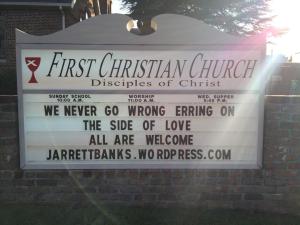
Again, if anyone thinks I am in error in dealing with this issue, I am perfectly okay with that; because if I am going to make errors in this world, I am always going to err on the side of love. I am going to err on the side of grace. And I am going to overdo it. I am going to do my best to love God and all of my neighbors. And all means all.


Risky Business

Cup-Cold-Water

Matthew 10:40-44 NRSV

Matthew Chapter 10 is perhaps one of the most demanding chapters in the entire Bible. In this chapter Jesus seems to stress how important it is that every member of the Kingdom of God realizes that he or she is called to do ministry. And he calls us to do some very demanding things.

Early in the chapter, we read that following Jesus is some very risky business. We are to go out into the world and come in contact with the sick and the dying. Encounter those possessed by pure evil. We are to leave behind our families, our homes, even our clothes!  Persecution is to be not only accepted, but welcomed!  We are to practice denying one’s self, losing one’s self to receive salvation.

We read it, and we think, “You know, I don’t think I am really cut out for this salvation business. I don’t have the gifts, the time, the energy, and quite honestly, nor the desire to be a disciple of Jesus.

Then we reach the end of the chapter and we read these words: “Whoever gives even a cold cup of water to one of these little ones—truly I tell you, none of these will lose their reward.”

Then we think: “Hey. You know, I think I might be able to handle this! I sure can’t heal the sick—I hate hospitals and I avoid nursing homes. I don’t have what it takes to minster to the poor. They make me nervous, make me feel dirty.

I can’t be with the dying. That is what Hospice is for. And I hate going to funerals. I never know what to say or what to do. I can’t leave my family behind. I can’t give up my wardrobe. And I don’t even like to think about losing my life.  But hey, I am all about sharing a cold cup of water!

Finally, Jesus! Something I can handle. I’ll tell you what I will do, Jesus. As soon as I get home from church this afternoon, I am going to hook up my water hose. Then I am going to I make a sign and put it out there by the faucet that reads: ‘Free cold drink of water for all who are thirsty!’ Maybe I am cut out to be a disciple of Jesus after all!”

For most of us, this is some very good news indeed. We who generally fail at casting out demons, who would rather stay in our pews than take the gospel out to the dying, who pamper our own families while others starve in the streets and who find praise far more satisfying than persecution, even we can open the doors of the kingdom of heaven through a simple act of hospitality as small as giving a thirsty stranger a cold cup of water.

Praise be to Jesus!” we say.  “I am going to just forget about all of that other stuff, that big stuff, that demanding stuff, that risky stuff Jesus talked about.  I’m just going to take Jesus at his word in Matthew 10:42 and run with it.  This is going to be my new favorite scripture verse.  This is my calling. This is my ministry. Cold cups of water for everyone!

I wonder though, if we aren’t missing something. For deep inside, we all know that all of us can do a lot better than that. We all know a cross or two we could bear. We could probably be giving more to the church and to others. We could all be a little less selfish, less materialistic.

True discipleship really cannot be as easy as passing out a few cups of water, can it? Are we really supposed to forget all about everything else that Jesus talked about?  All of that hard stuff about “turning the other cheek,” “loving our enemies,” and selling everything we have to give to the poor?”

Surely these are the marks of true discipleship.  These are the keys to the kingdom of heaven. A small act of inconsequential hospitality cannot compare to the risky business of battling the demonic, coming into contact with the sick, ministering to the dying and enduring persecution.

Jesus seems to disagree.  In a fragmented world such as ours, a simple act of kindness, a small gesture of welcome to a stranger, a little genuine hospitality is never an easy inconsequential act. In fact, it can be some very risky business and its consequences can be eternal.

Several weeks ago, I replied to an email from a complete stranger who wrote to thank me for something that I had written on my blog. I replied with a simple, hospitable, what-seemed-to-be-inconsequential “Thank you.”  A few days later we are friends on facebook. A couple of weeks later, I get a telephone call asking me to pray for him about a job opportunity in Charlotte. A week later, I am asked to drive to meet this stranger in Raleigh.

Before I left the house this past Monday to meet this stranger, I told Lori exactly where I was going. I called her when I arrived and told her that if she did not hear from me in a couple hours to call the police.

When I met him for dinner, he shared with me some his burdens, some of his pain and fears. He told me how he had often been condemned by the church for being different. I made myself vulnerable by sharing some of my burdens. Before we departed, we embraced, no longer as strangers, but as brothers who made a covenant suffer with and to pray for one another. I drove home wondering, “What on earth have I gotten myself into?”

In this kind of world, a world of walls and barriers, a world of violence and loneliness, a world of great diversity, replying to a simple email, a small gesture of hospitality, becomes a risky, prophetic act that has the power to change your life.

And Jesus said to go and do this. Go out, move out, and reach out to strangers. Love your neighbors. Yes, this world is very frightening beyond our walls. And the truth is our neighbors are downright scary. But our neighbors are also thirsty. Welcome, engage, touch. Make yourselves vulnerable to another. For there is no other way to fulfill the purpose for which you were created—to seek and make genuine peace in this world. This is discipleship. This is following the way of Jesus. It is done face-to-face, hand-to-hand, person-to-person. We cringe. Because we know that this kind of hospitality is risky. It involves openness and intimacy with another.

Offering a cup of water to others involves the risk of rejection, the risk of laughter, the risk of tears, and the risk of love. I’ve heard it said that the problem with others is that they are just so “other.” Others quite often can be different. Others may not like us.  Others might refuse our kindness. Others might wound us. Others might crucify us. And worst of all, others might change us.

The truth is that putting a welcome sign in the front yard beside the water hose is a downright dangerous activity.

coffee friends

On Friday morning, I went in to the church kitchen to get a cup of coffee. A woman from the cleaning service was in there preparing to mop the floor. Although I have seen her almost every week for the last nine months, I did not know her name. Before I really thought about it, considered the dangerous consequences of it, I asked this stranger, “Would you like a cup of coffee?” Somewhat shocked by my simple act of hospitality, she responded, “Yes, I would.” She then introduced herself to me over that cup as she introduced all of her children, a sick grandchild, a sister battling cancer. I filled a bag with squash and cucumbers from our garden, and I hugged this woman who I had hardly spoken to in nine months, this stranger that I had all but ignored, this woman who was no longer a stranger but a sister. And acknowledging the change, the miraculous transformation that had occurred, I thought, or maybe I prayed, “Good Lord, it was just one cup of coffee!”

Paraphrasing United Methodist Pastor William Willimon: This is the way of good Lord. For Jesus, through the smallest and simplest of ways, is always trying to change us, challenge us. He welcomes and accepts us only so we will welcome others, for not only their sakes, but also for our sakes.

This is the gift of community. This is why we were created.  It is the answer to our own sadness, our own loneliness and our deepest desires. Jesus knows we were not created to live in isolation, but created from the heart of a God who lives in a self-giving, loving communion with the Son and the Holy Spirit.

A heart that is so full of love that it cannot help but offer grace and redemption to all and call us all into this communion. And this communion grows. It grows when we offer kindness, gentleness, and mercy, when other lonely lives become wrapped up in our own, when God’s love that was given to us is extended to someone else. And before you know it, the small cup of water we offered to another becomes a cup of salvation, as barriers fall, hands touch, lives become entwined.

Getting involved with this kind of God, even when it seems small, safe and inconsequential is always a risky business with great consequences. And Jesus wants us to know that its consequences are eternal. Whether we are fighting demonic evil, healing the sick, caring for the dying, leaving behind our homes, our wardrobes, friends and family, being persecuted for our faith, or simply offering meager acts of hospitality to a stranger, we always risk finding salvation.

This is the great wonder of the gospel. When we reach out and accept and welcome others, when we touch another’s hand, embrace another, offer the grace of God to another, even in the smallest of ways, even in sharing a glass of water, even in replying to one simple email or offering one small cup of coffee, God welcomes us. When we encounter another, we find communion with God and receive the overflowing hospitality of the Father, and of the Son, and of the Holy Spirit.[i]


[i] Inspired and Adapted from William Willimon. “Risky Business,” Clergy Journal, Jun 26, 2005, vol 33, no 2, pp 53-56.

Tribute to Bill Lewis

William Horace "Bill" Lewis, Jr.
William Horace “Bill” Lewis, Jr.

2 Timothy 4:6-18 NRSV

In this fragmented and fragile world, friends, true friends, honest to goodness friends, friends that can be trusted, are hard to come by.

Before the Apostle Paul died he lamented to Timothy that only Luke had remained by his side, and, at first, no one came and supported him; all had deserted him.

Novelist S.E. Hinton spoke to this harsh reality of life when she wrote: “If you have two friends in your lifetime, you’re lucky. If you have one good friend, you’re more than lucky.”

There is no doubt that the reason that many of you are here this afternoon is because you have been “more than lucky.” You are here because in Bill Lewis, you had one good friend, an honest-to-goodness friend in whom you trusted.

As an attorney here in Farmville, Bill Lewis earned your trust. When you purchased your first house or refinanced another, you, like my family and I, trusted Bill to be at your side, read and translate all of the legal jargon of the contract, and to honestly look after your interests. You trusted in Bill to always give honest and wise counsel. With Bill you never needed a second opinion.

And whether you sold a business and made a fortune, or had to close a business and file bankruptcy, you trusted in Bill as your faithful confidant. And for some of you, Bill was one of the few, if not the only person in this world, in whom you trusted completely.

I personally experienced Bill’s unwavering faithfulness when I had the privilege of being the pastor of his father Horace. During each of my visits with Horace in the last years of his life, Horace never failed to mention how good Bill was to him: always bringing his lunch, stopping by each day, sometimes several times a day, to make sure his needs were being met. During the time in his life when he needed someone the most, Horace could always trust Bill to be a faithful son.

And Charissa, you could always trust Bill as a faithful husband. He was trusted as your protector: When you were traveling by car Charissa, he was always reminding you to keep your car doors locked and to make sure you always had enough gas in the tank.

And when you were traveling on foot and he was with you, he always made sure that he walked on the sidewalk between you and traffic (And, metaphorically, isn’t that exactly what he did for so many of us as our attorney?).

Charissa will also always remember trusting Bill as a teacher: the caring way he taught his step sons how to tie a tie; place the handkerchief in their coat pocket; how to shave; have manners at the table; respect other people’s property; always tell the truth; how to treat a girl; how to love and care for nature and animals; of the importance of appreciation for sports, history, family, traditions; being a Southern gentlemen; respecting one’s mother; the importance of obeying the law; how to play the guitar; how to shoot a gun as well as properly taking care of it.

Charissa, you also trusted him as a faithful provider: always putting the needs of others ahead of his own needs. Your needs, the needs of his girls, the needs of his step sons, his sisters, his Aunt Nell, his home, the needs of his friends and the needs of his clients were always more important than his own needs.

And all of us could always trust Bill’s honesty and impeccable integrity. I don’t know if she is actually going to do it or not, but Charissa would tell Bill that if she outlived him, she wanted to engrave “Honest Abe” on his headstone.

One day, Charissa lost her engagement ring. When she told Bill, he filed it with their insurance company. And soon after the check arrived, but before it was cash or deposited, Charrisa reached into her pants pocket as she was getting ready for work one morning, and felt, you guessed it, the ring. Charrisa said that Bill nearly broke his neck trying to get to the post office that day to return the check!

You do not need a preacher to tell you that such honesty and trustworthiness in this world is very rare. We can easily relate to S.E. Hinton when she said that we “more than lucky” to have just one such friend in this world. We completely understand the Apostle Paul when he said, “All deserted me. Only Luke remains at my side.” The reality is that honest to goodness people in this world are very rare.

And I believe there is a good reason for this.

Honesty and trustworthiness always comes with a price. This is something that we may not always realize and seldom think about. People who can be truly be trusted, people with impeccable integrity carry an enormous burden.

Charissa calls Bill one of the biggest worriers in the world. He constantly worried about his work, always wanting to make sure he did everything right and treated everyone fairly. He would often wake up in the middle of the night with his clients and their problems on his mind. And this worry and anxiety extended into his personal life as he continually worried about Charissa: her health, her needs, her care, and even for the needs and care of their pets. Are they safe? Had they been fed? Did they have fresh water? Are the outside dogs in their enclosures and are in the inside dogs safe inside, and if they are, where are they? Why don’t they come in here and get in bed with me? How about the cats? Charissa said when he came home, if he did not immediately see them, he would call each one by name asking me her if she had seen them during the day.

Caring for others, caring for all of God’s creation, being faithful, being trustworthy, being honest, is costly. This is why Jesus said, “For the gate is narrow and the road is hard that leads to life, and there are few who find it.” This is why the Apostle Paul said only Luke remained at his side. And this is why so many of us here count Bill Lewis as one of the very few people in this world in whom we know we could trust.

Now hear the good news. In his letter to Timothy, Paul writes: “All deserted me, but the Lord stood by me and gave me strength…I was rescued from the lion’s mouth.The Lord will rescue me from every evil attack and save me for his heavenly kingdom. To him be the glory for ever and ever. Amen.”

The good news is that even when we do not have anyone in whom to trust on this earth, we can trust in God.

The late L.D. Johnson’s wonderful book, The Morning After the Death, ends with these words about the faithfulness of God.

“God can be trusted!  In the last analysis, Christians have no more persuasive word.  God can be trusted.   That does not resolve all the mysteries or answer all the questions, but it gives us enough to build our lives around.  God is trustworthy.  He is Lord of life and death and He is to be trusted.”

The good news that helped Paul fight the good fight and finish his race was that God could be trusted. And the good news for each of us, especially those who have gathered here this afternoon is that God can be trusted.

God can be trusted when God says:

“I will keep you from all evil; I will keep your life. I will keep your going out and your coming in from this time on and for evermore.”

God can be trusted when God says:

“I will never leave nor forsake you. I am working all things together for the good. Neither death nor life, nor nothing in all of creation can separate you from my love.”

God can be trusted when God says,

“You will not die, but you will be changed, in a moment, in the twinkling of an eye, at the last trumpet.”

God can be trusted when God says,

“For this perishable body must put on imperishability, and this mortal body must put on immortality.”

God can be trusted when God says,

“One day the saying will be true: ‘Death has been swallowed up in victory.’ ‘Where, O death, is your victory? Where, O death, is your sting?’”

The Holy Spirit can be trusted when the Spirit says:

“I am filling you even now with a peace that is beyond all understanding.”

The Holy Spirit can be trusted when the Spirit says:

“I am with you always, even until the end of the age. I will intercede upon your behalf, I will hear your cries, understand your groanings.”

The Holy Spirit can be trusted when the Spirit says,

“I will dwell with you and in you and live through you.”

Jesus can be trusted when he says,

“Do not let your hearts be troubled.”

Jesus can be trusted when he says,

“I am going to prepare a place for you.”

Jesus can be trusted when he says,

“And if I go, I will come again and take you unto myself, so that where I am, you may also be.”

Jesus can be trusted when he says,

“I am the resurrection and the life. Because I live, you will also live.”

Jesus can be trusted when he says,

“Through me, even though you may die, you will live.”

Jesus can be trusted when he says,

“Peace I leave with you; my peace I give to you. I do not give to you as the world gives. Do not let your hearts be troubled, and do not let them be afraid.”

And just like with Bill Lewis, we know that such trustworthiness and faithfulness and impeccable integrity, comes with a great cost. Not only did it propel God to pour God’s self out, empty God’s self, and humble God’s self to become one of us, to become obedient unto death, even death on a cross, such divine faithfulness compels God, draws God, even today, to suffer with us, alongside us and for us.

Because God can be trusted, like Bill, I believe God worries about each of us. Like the clients of a faithful attorney, I believe we are constantly on the mind of God, day and night. God is very much concerned about the grief we are experiencing this day. God is greatly moved by the pain we feel this day.

And God promises to stay beside us, representing us like a faithful attorney, earning our trust as Bill earned it, standing between us and all sorts of traffic, fighting for us, as we continue the good fight, as we finish our race, and as we keep the faith until that day comes when we are reunited with our dear friend, Bill; our very good and faithful, friend, Bill; our honest-to-goodness friend, Bill.

How Low Can You Go?

bac service

 Luke 14:7-11 NRSV

Looking around this room tonight fills me with so much hope for our world. For I look around and see a generation that is up and coming. I look around and see a room full of energetic youth with high ambitions. I look around and ask, “My God, how high can they go? How high can these young men and women, these future leaders of the world, go?

You were probably taught at a very early age that up high is where it is at, and no doubt you spent the first eighteen years of your lives trying to grow up, graduate high school and then possibly pursue an even higher education. All so you move up a little higher in this world. And after all of your graduations, you will work hard to make sure you are always upward bound: up for a promotion so you can move up the ladder. For up, up highis how our society measures success.

Up high, we are told, is where we will find our life, a life that is full, complete, satisfied, and abundant. Up high is where we are able rub elbows with others who also shaped up, grown up and moved up. Up high is where we find what we call the “in” crowd. They are the “up” and the “in” as opposed to the “down” and the “out.”

So we set goals that are high. We seek to make high marks, achieve high grades, meet high expectations.

The message of nearly every motivational speaker or life coach in America today is all about how to shape up and move up, aim high and soar high.

After all, who in their right mind would want to move in the opposite direction? Who wants to change directions from up high to down low? As the late Henri Nouwen one of my favorite preachers, has said: “Downward mobility [in our society] is not only discouraged, but even considered unwise, unhealthy or downright stupid.”

Can I get an “Amen?” Come on now, really? Who in their right mind would want to lower themselves? What mind must you have to want to humble yourself, move to and sit at the lowest seat at the table, lower yourself to the ground to wash another’s feet, descend down the economic ladder to relate to the poor, be with and love the down and out?

What kind of mind? As Adam Greene read a few moments ago, the mind of Christ.

When God chose to reveal to the world a life that is full, abundant and eternal, God’s will for all people, God chose a life of downward mobility. God emptied God’s self, poured God’s self out, humbled God’s self, lowered God’s self and came down. Down to meet us where we are, down to earth as a lowly baby, born in a lowly stable, laid down in a feeding troth to worshipped by down and out shepherds.

The scriptures do say that Jesus grew upward in stature; however, the gospel writers continually paint a portrait Jesus’ life as one of downward mobility. He is continually bending himself to the ground, getting his hands dirty, to touch the places in people that most need touching.

While his disciples seemed to always focus on privilege and honor and upward mobility, chastising little children who needed to shape up and grow up before they could come to Jesus, Jesus argued that the Kingdom of God actually belonged to such children.

While his disciples argued about who was going to be promoted, who was going to graduate to be the first in the Kingdom, Jesus frustrated them (and if we are honest, frustrated us) by doing things like moving down to sit at the lowest seat at the table, bending down to wash their feet, stooping down to welcome small children, crouching down to forgive a sinner, reaching down to serve the poor, lowering himself down to accept the outcast, touch the leper, heal the sick, and raise the dead.

While others exercised worldly power to graduate and move up, climb up, and advance, Jesus exercised a strange and peculiar power that always propelled him in the opposite direction. It is not a power that rules but is a power that serves. It is not a power that takes but is a power that gives. It is not a power that seizes but is a power that suffers. It is not a power that dominates but is a power that dies.

And nearing the culmination of his downward life, to save the world, Jesus went to highest seats of power in the capital city of Jerusalem, not on a white stallion with an elite army of high ranking soldiers, but riding a borrowed donkey with a handful of ragtag students who never even got a GED. The whole scene of Jesus riding that donkey, in the words of Henri Nouwen, looks “downright stupid.”

This is the narrow and seemingly foolish way of downward mobility, the descending way of Jesus toward the poor, toward the suffering, the marginalized, the prisoners, the refugees, the undocumented, the lonely, the hungry, the dying, the tortured, the homeless–toward all who thirst and hunger justice and compassion.

And what do they have to offer? Those who are down and out in our world cannot offer success, popularity, riches, or worldly power, but they do offer the way to life, full, complete, abundant and eternal.[i]

So tonight, filled with hope for the world as I look around this room asking, “My God, how high can these young men and women, these future leaders of the world go?” I am also asking with even greater hope for the world and the Kingdom of God, “My God, how low can they go? How low can these young men and women, these future leaders of the world, these future leaders of the church go? How low can they go to fulfill the divine purposes that you have for each of their lives?

My hope is that you are here tonight, not to ask God to help you move up to be with the “in” crowd. Not to find something here in worship that will make you more successful, more affluent, climb a little higher. I hope you are not even here looking to be uplifted or to be more upbeat or for some kind of upstart to get this new chapter in our life headed on an upswing. My hope is that you are here in worship tonight because you have chosen to move in the opposite direction.

My hope is that you will always want to continually go down, get low, lose yourselves, die to yourselves, to live for Christ. For you have heard, and you have believed Jesus when he said: “Anyone who wants to become great among you must be your servant, and anyone who wants to be first among you must be your slave, just as the Son of Man came, not to be served, but to serve, and to give his life as a ransom for many (Matthew 20:25-28).

Although it sounds good to be a part of the up and coming generation, my hope is that you will be a generation that is always down and going. May you always go down, get low, sacrificially and selflessly. And then go out bending yourselves down to the ground if you have to, to touch the places in people that most need touching. May you go out and stoop down to welcome and accept all children, to love on those in hospitals and nursing homes. May you go out and reach down to serve the poor, lower yourselves down to accept the outcast and the marginalized, and may you get low, get down on your knees to pray for the grieving and the lost.

And, there, as low as you can go, may you truly find your life, your purpose in this world, one that is full, complete, satisfied, abundant and eternal.


[i] The sermon is inspired by this paraphrase from Henri Nouwen, Here and Now, 138-139.

Jesus Prays for Us

Jesus prayedJohn 17 NRSV

As a pastor, I have the wonderful privilege of sharing not only the best of life with people, but also the worst of life. I have the privilege to celebrate the joys of life as I will with Ashley Mozingo and Bryant Watson this week when they are married, and I have the privilege of suffering through the sorrows of life as I have this past week with Shirley Meeks as she buried her husband of 57 years.

Now, I do realize that may sound rather peculiar to call sharing the sorrows of others, a “privilege”; however, when you witness the miraculous strength and extraordinary courage; when you witness a faith that never fades, but only grows stronger in the midst of the suffering as I have, when you visit people amid suffering and leave feeling, not sad, but inspired and uplifted, you would understand why I call it a “privilege.”

Some of you know what I am talking about. There is no other word but “miraculous” to describe how some of you are you able to be here in this place today, and doing as well as you are doing, in spite of everything that you have been through. Some of you have lost persons that you love the most in this world. Some of you have suffered a heart-breaking divorce. Just this past year, some of you lost your job. Some of you have had major surgery. Some of you have been diagnosed with a chronic illness. Some of you have lost your siblings, and some have lost your very best friends. Yet, here you are. Somehow, some miraculous way you have survived, and you are somehow making it. And not only are you here, but your mere presence, your smile, your hugs, the faith and love that we see burning in your eyes is more of an inspiration to us than you can possibly begin to understand.

But how do you do it? How do any of us really do it?  How do we keep on keeping on in a world of gloom and doom?  How do we maintain our sanity in a broken world of sickness and strife?  How do we keep the faith in a world of doubt and disbelief?

Shirley Meeks who faithfully and graciously cared for William during this last difficult year as he suffered with cancer, told me that she believes she knows exactly how she has made it through, how she has remained so strong. Besides her sewing room where she would escape for a few moments during each day to create something with her hands, needle and thread, she said there was one other thing that has seen her through her suffering. Last Saturday, standing on her front porch she confidently said to me: “Jarrett, the Lord answers my prayers.”

One of the greatest things that happens to me as a minister, and it happens very frequently, is when I go to the hospital or to a home to minister to someone, and the person to whom I am ministering, ministers to me.

There is no doubt that Shirley believes in the power of prayer. Right before William passed away, his body began to shiver as if he had a chill. The very first thing that Shirley did was grab the prayer quilt that the women of the church had made for William, the one that the church had consecrated with prayer for William. She picked up that quilt and lovingly and graciously wrapped it around him.

Shirley is able to be here this morning because she believes in prayer. She believes the Lord hears her prayers and the prayers of her church family and friends. However, our scripture lesson this morning suggests that there may be much more to it than that!

For here we learn that Jesus, as he was preparing to leave this world, prayed for us. Think of that for a moment, God within the three persons of the holy Deity prays for us.

We read in 1 John 2 that we all have an advocate with God the Father, we all have someone on our side,  praying for us, supporting us and loving us. He is Jesus Christ the righteous.

The writer to the Hebrews assures us that “he is able for all time to save those who approach God through him, since he always lives to make intercession for them.” The writer is saying that Jesus lives to make intercession for us. Jesus lives today to pray for us (Hebrews 7:25).

The Apostle Paul in his letter to the Romans writes: “Likewise the Spirit helps us in our weakness; for we do not know how to pray as we ought, but that the very Spirit intercedes with sighs too deep for words.  And God who searches the heart, knows what is the mind of the Spirit, because the Spirit intercedes for the saints according to the will of God” (Romans 8:26-27).

If you ever worry that no one is praying for you, the apostle Paul says that you can stop worrying.  If no one earth is praying for you, Jesus certainly is. Jesus is our High Priest. He is our intercessor. He is our advocate. Christ lives today to pray for us. Even when we don’t know how to pray for others or for ourselves, even when we cannot find the words to pray, Paul says that the Spirit of God intercedes for us with sighs too deep for words.

This wonderful truth should be bring us great comfort. For sometimes the pain of life is so great, the grief is so overwhelming, that we don’t even know how to begin to pray. I have heard someone say that sometimes when the pain is so great, when they pray they don’t pray words at all. They simply “pray their pain.” They pray their pain and trust that Jesus hears, Jesus understands, Jesus intercedes and Jesus answers.

So, what does it truly mean for us to be prayed for by Jesus?  Let’s look again at the words found in our lesson this morning.

There are several petitions to God that are offered by Jesus on our behalf.  Because of time, I just want to point out two of them that I believe explains a lot.  First, Jesus asks that the Christian community exhibit the same oneness that exists between Jesus and the Father. There is an edifying mutuality which exists between Jesus and the Father. Each glorifies the other. John 15:8-10 reads:  “My Father is glorified by this, that you bear much fruit and become my disciples. As the Father has loved me, so I have loved you; abide in my love. If you keep my commandments, you will abide in my love, just as I have kept my father’s commandments and abide in his love.”

Jesus prays for us to share this oneness between Jesus and the Father by keeping his commandments to love others as he loves us.

As I met with Ashley and Bryant to plan their wedding celebration, we talked about love being more than a mere feeling, for feelings cannot be commanded. Jesus commands us to love others. He does not say love others, if you feel like it. If you have feelings for another, then love them. No, he says to love others. Love is always a verb. That is why I told Ashley and Bryant that they will never hear any minister ever ask in a wedding ceremony, “Are you in love” or “do you love” but always, “Do you promise to love.” Love is always action. Love is not a feeling, but Love is selfless, sacrificial service. Jesus prays that we will love one another.

Another petition offered to God by Jesus is that God sanctify the church. The verb translated “sanctify” here belongs to the cultic language of the Old Testament, where priests and animals were set apart for sacrifice.  And it belongs to the Holiness Code of Leviticus where the whole nation was directed to live as a special people separated for the service of God. Jesus prays that we will understand that we have been ordained, set apart, and sanctified for selfless, sacrificial ministry.

This is how I believe Shirley Meeks was able to minister to the minister. If God has ordained us for ministry, then God is always going to give us the strength and the courage we need to be an inspiration to others, to love others, even when we do not feel like it loving others, even in the face of suffering and grief. God is always going to do all that God can do to help us to love others, to be selfless servants to one another. For this is the prayer of Christ for each of us.

So, this is how I believe we do it. This is how we keep the faith in a broken world of doubt and disbelief. This is how we keep on keeping on in a world of gloom and doom. This is how we have been able to make it through this last year amid so much loss and grief. This is how we can be an inspiration to others amid the worst in life. We are prayed for. We are prayed for by others, but more importantly we are prayed for by Jesus Christ himself.  The Spirit of God is interceding for us with sighs too deep for words.  Jesus, our advocate, is praying that in this world of despair, we will abide in his love, and be sanctified and set apart for ministry.

Born Holding Hands

Twins holding hands at deliveryLast Sunday in Ohio, which just so happened to be Mother’s Day, a rare set of mono, mono twins, Jillian and Jenna Thistlewaite, were miraculously born holding hands.

One of the most popular songs when I was born back in 1966 was entitled, Born Free.  “Born free, as free as the wind blows, as free as the grass grows, born free to follow your heart.”

It’s a nice song.  However, when you take a good look at Jillian and Jenna Thistlewaite who were born this week holding hands, we learn something completely different. We were not born to be independent and free, but we were born to be very dependent on one another. We were born to need one another. Jillian and Jenna remind us that Christ has commanded us to love one another, to link up with one another in mutual care and concern, and to feel responsibility for one another. We were born to live in community.

We were not born free, as the song goes. We were born holding hands.

So, perhaps the worst kind of evil in this world is failing to accept one another. Or alienating another. Or living a self-absorbed, self-centered life.