Heaven Can Wait

END IS NEARLuke 21:5-19 NRSV

One of the great things about living in southern Louisiana were the countless stories about two infamous Cajuns named Boudreaux and Thibodeaux.

Reverend Boudreaux was the part-time pastor of a small, rural Baptist church and Pastor Thibodeaux was the minister of a Pentecostal church directly across the road. One day, they were both standing out by the road in front of their churches, each pounding a sign into the ground as fast as they could. The sign read:

Da End is Near
Turn Yo Sef ‘Roun Now
Afore It Be Too Late!

As soon as the signs got into the ground, a car passed by.  Without slowing down, the driver leaned out his window and yelled as loud as he could: “You bunch of religious nuts!”

Then, from the curve in the road you could hear tires screeching and a big splash.

The Reverend Boudreaux yells at Pastor Thibodeaux across the road and asks:

“Do ya tink maybe da sign should jus say ‘Bridge Out’?”

The last couple of Sundays the Christian calendar and the lectionary has led us to ponder the tough subjects of death, the resurrection of the dead and eternal life. And today’s gospel lectionary is on a similar topic: the end of the world.

Now, I have to be honest here, after the last two Sundays, I am really ready to focus on something else!  Besides, all this apocalyptic gloom and doom talk is really not for us mainstream, progressive, educated church types here on Main Street.

But this is just how the Church calendar works I guess. We are approaching the end of the calendar as next Sunday concludes the church year with Christ the King Sunday, emphasizing that when it is all said and done, in the end, Jesus Christ is King of Kings and Lord of Lords. So, I guess it makes sense that here, on this next to last Sunday of the church year, even we downtown Main Street church folks are asked to listen to sermon about the final judgment.

And, although we don’t like it, maybe we need to hear it. After all, in the last couple of years, chatter about the end of days seems to have spiked a bit with all of the Mayan doomsday predictions, super storms like last year’s Sandy and last week’s killer typhoon in the Philippians, numerous earthquakes and tsunamis, the global recession, nuclear tensions with North Korea and Iran, the constant threat of terrorism, and with the attention given by cable TV to doomsday preppers.

In September of this year, a poll by the Barna group found 4 in 10 Americans – and 77 percent of evangelical Christians – believe the “world is now living in the biblical end times.”[i]

So, in spite of what you may think about this subject, perhaps we need to hear what Jesus has to say.

About the destruction of it all, in verse 7, we read where they ask Jesus: “When will this be, and what will be the sign that this is about to take place?”

In verse 8 we read Jesus’ answer: “Beware that you are not led astray.”

Then Jesus specifically warns us to stay away from those who claim to be Christian and say, “The time is near.” Jesus says, “Do not go after them.” Do not follow them. Do not listen to them. Don’t pay them any attention!

Well, glory halleluiah!  Because after two Sundays preaching on death and the resurrection of the dead, I really don’t want to talk about the end of days! So, Amen Jesus! Preach it! Let’s move on to some more pleasant things! Enough of all this gloom and doom!

Ok, now let’s listen to what Jesus has to say next! Hopefully it is something more uplifting than death!

“But before all this occurs, they will arrest you and persecute you.”  “You will be betrayed even by parents and brothers, by relatives and friends; you will be hated by all because of my name; and they will put some of you to death.” “But “this will give you an opportunity to testify.”

Man! And we thought we were off the hook this week!

But if we have been reading and listening to Luke, we should not be that surprised. It is as if Jesus is saying, “Do not worry so much about the tribulations to come with the end of the world, because if you are truly following me, if you are faithfully living as my disciple, if you have fully committed yourself to carrying a cross, if you are really speaking truth to power, if you are serving those I call you to serve, if you are standing up for my justice and my wholeness in this fragmented world, then you have will enough trouble for today!

If you are truly living for me and loving this broken and suffering world as much as I love this world, you will sacrifice much. You may even lose your friends and family! Matthew remembers Jesus saying on another occasion: ‘So do not worry about tomorrow, for tomorrow will bring worries of its own. Today’s trouble is enough for today (Matthew 6:34).

Jesus seems to be saying here: “Don’t focus so much on the end days, don’t’ dwell on the impending doom and demise of it all but instead, focus on the opportunities that you have today in this hurting world ‘to testify,’ to selflessly and sacrificially serve me by serving and suffering for others.”

Jesus is saying: “It is perfectly is to think and dream about going to Heaven one day. It is fine to have the hope that someday, somehow, some way there’s not going to be anything more to fear or dread. It is wonderful to know a time is coming when there is going to be no more crying, no more pain, and no more death. It is great to sing those old hymns of faith, such as “When We All Get to Heaven,”  “Shall We Gather at the River,” and “I Can Only Imagine,” but if Heaven is the only place your hearts are, if going to Heaven and avoiding Hell is the only reason you are Christians, then you have missed the whole point of who I am and who you are called to be as my disciples.”

I believe Jesus is saying to us: “So don’t come to church looking to avoid a suffering world! Come to church and bear the sufferings of this world! Don’t come to church looking for some fire insurance. Come to church and let me lead you into the fire!”

This is exactly why I believe so many Christians are tempted “go after” those who love to preach about the end of days, especially those who say that it is coming in our lifetimes. For it is far easier to believe that God has already given up on this world. It is much easier to look at the destruction in the Philippines and believe that it is all a part of God’s plan, a preview of things to come! It is far easier to believe that earthquakes and hurricanes and tornadoes and poverty and wars are all part of God’s apocalyptic will than it is to believe that God calls us to selflessly and sacrificially suffer alongside those who are suffering.

It would be far easier to believe that Christianity is only about getting a ticket to heaven to escape this world than it is to believe that it is about selfless, sacrificial service.

British scholar Lesslie Newbigin comments: “In an age of impending ecological crises,” with the “threat of nuclear war and a biological holocaust” many Christians have retreated into a “privatized eschatology.”  That means, that the only hope that they possess, in the words of Newbigin, is “their vision of personal blessedness for the soul after death.”[i]

Christians everywhere, in the words of Newbigin, have “sounded the trumpet of retreat.” They have thrown their hands in the air and have given up on the world. Their faith in Jesus has become solely and merely a private matter. Faith is only something they possess, something they hold on to, that they can someday use as their ticket out here. In the meantime, they withdraw into safe sanctuaries and look forward to that day “the roll is called up yonder.”  And they listen to angry sermons by angry preachers condemning the world to Hell in a hand basket.

And giving up on the world is really nothing new.  At the turn of the first century, Jews called Gnostics had a similar view of the world.  Everything worldly, even the human body itself, was regarded as evil.  And maybe, they too, had some pretty good reasons to believe that way, because regardless of what some may believe, the world did not start going bad in our lifetimes. The truth is: it has been bad ever since that serpent showed up in the garden.

At the turn of the first century, Jews were a conquered, depressed people, occupied the Romans.  And they were terrorized daily by a ruthless, pro-Roman King named Herod—a king who would murder innocent children to have his way.  The Gnostics looked at the world and their situation and came to the conclusion that they were divine souls trapped in evil bodies living in a very dark, God-forsaken, God-despised world.

As I have mentioned, Next Sunday marks the end of the Christian calendar. The next Sunday begins the season of Advent, the very beginning of the church.

It is the season that we remember that it was into a very dark, and seemingly God-forsaken, God-despised world that something mysterious happened that we call Christmas. A light shone in that darkness proving in the most incredible and inexplicable way that this world is anything but God-forsaken or God-despised!

God loves this world so much that God emptied God’s self and poured God’s self into the world. God came and affirmed, even our fleshly existence as God, God’s self, became flesh. And God came into the world not to condemn the world, but to save the world. For so God loved the world that God came into the world and died for the world.

Thus, the message that we all need to hear today and hear often is not that the end is near as God believes the world is worth destroying, but it is that God believes this world is worth saving. God believes the world is still worth fighting for. God still believes that this world is worth dying for.

As the body of Christ in this world, we as the church are not called to retreat or withdraw from the world and its troubles, but are called to love this world, to do battle for this world, to even die for this world.  We are called to be a selfless community of faith in this broken world. And, no matter the cost, we are called to share this good news of Christmas all year long!


[i] Read more at http://www.wnd.com/2013/10/billy-graham-sounds-alarm-for-2nd-coming/#Y8RpIeMpqqHd8uRF.99

[ii] Leslie Newbigin, The Gospel in a Pluralistic Society, 113.

We Cannot Imagine

HeavenLuke 20:27-38 NRSV

One day in the sweet by and by, when we all get to heaven, in the resurrection of the dead, Jesus says we will “neither marry nor be given in marriage.” And today, some of us on this earth who are married, or have been married, sing or shout with a loud voice: “What a day of rejoicing that will be!”

Yes, for some of us with bad marriages, or have Exes that we don’t even want to talk about, this is some very good news! However, for those of us who love our spouses, and cannot imagine life without them, this news is rather disconcerting.

I am thinking specifically about those couples where you never see one without the other. I am thinking about those who have lived together so long that they not only begin to act alike and talk alike, but they actually begin to look alike. Couples who have been married 50, 60 or even 70 years. And when one passes away, the other usually follows very soon after—sometimes just months later; sometimes just days. And none of us are surprised! Not only could they not imagine life without one another, neither could we.

But there lies our real problem! We simply cannot imagine any life beyond this life. A few years ago, the group called Mercy Me, sang a very popular song about heaven entitled I Can Only Imagine. However, the truth is, that when it comes to the resurrection, when it comes to eternity, there is no way we can imagine. Even that popular song that says that we can has more questions in it than answers.

One of the reasons that we cannot imagine it is that eternal life is not something that happens because there is something intrinsic in our nature that makes it happen. It happens only because there something intrinsic in God’s nature that makes it happen. We cannot imagine it, because it is not of us. It is of God.

Some of the Sadducees did not believe in the resurrection, but many in the religious community did believe in the doctrine of the immortality of the soul. There was widespread belief that there is something within every human being that is eternal. When we die, our soul simply leaves our body and continues living in another realm. Heaven then is understood as a continuance of our present existence. So if we marry in this life, and our first spouse dies and we remarry, it makes sense to question who our spouse will be when we get to heaven. And if we remarry and our second spouse dies, and we remarry again, and that spouse also dies, and then we marry again, well, we’re going to have a real problem in the hereafter! You think you have problems now?

However, Jesus never talked about the immortality of the soul. Jesus talked about mortality and death and about the resurrection of the dead. As I said last week, when we face our deaths, because it is not God’s will for anyone to perish, it is in the very nature of God to resurrect and transform our deaths into a brand new life. It is just what God does.  It is who God is.

Therefore, in Revelation 21 we these hopeful words:

Then I saw a new heaven and a new earth; for the first heaven and the first earth had passed away. And I saw the holy city, the new Jerusalem, coming down out of heaven from God. And I heard a loud voice from the throne saying, ‘See, the home of God is among mortals. He will dwell with them; they will be his peoples, and God himself will be with them;he will wipe every tear from their eyes. Death will be no more; mourning and crying and pain will be no more, for the first things have passed away.’

And with our finite, mortal minds, we cannot imagine it.

The biblical revelation is clear:  Newness, a brand new beginning, a fresh start, a new life can come, but it comes only as a gift from the God of life, the God of the living, the creator of all that is. It cannot and does not come from those who cannot even begin to imagine it.

A very literal translation of the first line of Genesis is “In the beginning God began creating…”  William Willimon puts it this way: “Creation is not something that God did once and for all, but rather something that God continues to do in this world. God keeps making all things new. Day in and day out, God is actively involved with creation, intervening, interfering, renewing and doing battle the primordial chaos that threatens to undo creation. Creation continues as God keeps making something out of nothing.”[i]  This is just who our God is.

The key for us as people of faith in this ever-creating God is to come to understand that much of the pain and brokenness that we experience in this life is not the end, but only the beginning—the beginning of something wonderful that we cannot even imagine it.

We say we cannot imagine spending eternity without our spouses, without our children, without our friends. No we can’t. No more than a small child can imagine some of the pleasures of adulthood.[ii]

Try to explain to a child the immense joy that you receive sitting in front of your fireplace on cold mornings sipping a hot cup of coffee, listening only to sounds of sound of a soft blaze.  Try to explain to a youngster that has boundless energy the sheer gratification you experience rocking in a chair on your front porch at dusk, watching fireflies dance in your backyard.

“But mama, but grandma, but Nana, let’s go out there and try to catch some of them, put them in a jar.”

Think about the look you receive when you say, “No, honey, let’s just sit right here on this porch and quietly rock, breathe in the fresh air and just watch.”

No, just as a child cannot imagine what is pure heaven for adults, neither can we imagine the heaven God has prepared for us. The Apostle Paul put it this way,

But when the complete comes, the partial will come to an end. When I was a child, I spoke like a child, I thought like a child, I reasoned like a child; when I became an adult, I put an end to childish ways. For now we see in a mirror, dimly, but then we will see face to face. Now I know only in part; then I will know fully, even as I have been fully known (1 Cor 13).

But right now, we cannot imagine.  We can only trust that the God whose nature is to create and recreate and restore and resurrect will be faithful to God’s very nature.

And although I do not believe there is any way that we can fully imagine eternity, I do believe that we are privy here in our finiteness to glimpses of it. And I am not just talking about fireflies, coffee and fireplaces.

As a pastor, I have seen these glimpses, and though those glimpses might be like looking through a mirror, dimly, I have seen these glimpses often.  Someone loses a job.  They are overcome by depression and despair.  They think their world is coming to an end. They believe that life for them is over.  And I, as a pastor, try to minister to them the best way that I can.  I tell them that God will help them make something out of this mess.  God will make something good come from it.  They will be able to move on.  Things will get better.  And they, of course, cannot even imagine.

Then I check back with them in a few months, after they have landed a new job. And I hear them say things like: “Getting fired from that old job was the best thing that ever happened to me. I absolutely love my new job, and I have never been more happy!”

Someone else comes to me saying that their marriage was suddenly ending. They are completely devastated. They tell me that they feel like their life is over. Their marriage was the most important thing in the world to them, and now it was ending. They have no more reason to get up in the morning, no more reason to try to do a decent day’s work. They’re in utter despair.  Again, I try to reassure them. God will somehow, someway, work it out, help you get through this difficult time. God will work and wring whatever good can be wrung out of this horrible situation!”

“Preacher,” they say, “I cannot imagine.”

And then, a couple of years later, they fall in love again and remarry.  And I hear them say something like, “What I thought was the end of my life was only the beginning. And though I may never be able to go back to the good old days, I realize now that I have plenty of good new days ahead!”

Another comes to me and shares their doctor’s grim diagnosis. They use words like “terminal,” “inoperable,” and “untreatable.”  They say that life is over. Death is the only thing in their future. However, a short time later, as I visit them in the Hospice House, they let me know in a miraculous way that being fully alive and fully whole have absolutely nothing to do with physical well-being.

Who would have imagined?

A child dies. Then God steps in and miraculously begins working and creating and recreating and resurrecting. And untold dollars are raised in that child’s memory to fight a dreadful disease. And countless other children are saved.

Who could have imagined?

And the good news is that one day, when we face our final hours, with faith in the God of the living, the God of resurrection and restoration, that there is nothing final at all about them!


[i] Willimon, William. A quote found in some of my old sermon notes. Source uncertain.

[ii] Culpepper, Alan. Luke. The New Interpreters Bible, Volume 9 (Nashville: Abingdon Press, 1995), 390.

Faith in the God of the Living

obx_sunriseExcerpt from We Cannot Imagine

Luke 20:27-38 NRSV

What does having faith in the God of the living mean for you?

When he lost his job, he thought it was the end of the world. But a year later, working a new job, he now knows that losing that job was the very best thing that could have happened to him.

When her marriage fell apart, she thought that her life was over. But a few months later, she is beginning realize that although she cannot go back to the good old days, she has plenty of good new days ahead.

When the doctor gave him the grim diagnosis, he thought he had received a death sentence. But a short time later, he is beginning to understand that being alive and whole has very little to do with physical well-being.

And one day, when you face your final hours, you will become aware that, with faith in the God of the living, there is nothing “final” at all about them.

How God Always Responds to Death

Sermon Excerpt from Death at a Funeral

Luke 7:11-15

840-casket-before-burial

This is how I believe our God always responds to death: God does not will death. God does not ordain death. God is not sitting on a throne pushing buttons calling people home. Luke teaches us that when someone dies, God is moved very deeply.  It is a visceral reaction.  God is flooded with compassion for both the deceased and the living. God does not ignore death or accept death as a natural part of life, but on the contrary, God confronts death, recognizes the harsh reality of it, the sheer evil of it, and God is moved from the very depths of who God is.

Therefore, it is very inaccurate to ever say that in death: “God takes people home.” I have said many times that God is a giver not a taker. It is the very nature of who our loving God is. It is far more accurate to say that when any death occurs, no matter the age, no matter the circumstance, God confronts it. God is moved with compassion. And God doesn’t take, but gives God’s self completely, fully and finally to the one who dies and his or her grieving family.

God does not ignore death, or demean death, or simplify death saying, “This is all part of my purpose driven plan.”  Through Jesus, God does not let any death at a funeral simply pass by like it is somehow meant to be.  Through Christ, God is moved with compassion and sees death as a force contrary to God’s will and acts to overcome it. God always acts to transform death at a funeral into life at a funeral.

Halloween Masks and the Church

mc2

As a child, I had my share of nightmares.  The wicked witch from the “Wizard of Oz” would fly through my bedroom window to get me. Ronald McDonald and a gang of clowns, including Bozo and the Town Clown from Captain Kangaroo, would chase me down the road as I ran for my life. Even today, clowns still sort of freak me out. It might be why I prefer Wendy’s over McDonald’s.

However, the most frightening dream I ever had was the one where I was standing in the school cafeteria line. As I was on my way to the cash register to pay my 10 cents for my lunch and a carton of milk, I looked down to discover that I had somehow forgotten to dress myself that morning. I was as naked as I could be.

Now, I am not a psychiatrist, and I do not presume to know how to interpret dreams. I do not even know if dreams can be interpreted. But maybe those boyhood nudist dreams reveal something profound about human fear.

Maybe one of things we perhaps fear is to stand completely exposed before our peers. Maybe we are all somewhat afraid of revealing who we really are—warts and all.

On some Sunday mornings, someone who doesn’t know me very well might look at me and say: “The Reverend certainly has it all together. He is well-dressed, well-groomed, well-fixed.”

But under the façade and behind the smile, I know that there is little about me that should be revered. I am oftentimes selfish, proud, and I am flawed.

Maybe that is why Halloween still intrigues us today. On Halloween, we have permission to cover it all up, to pretend to be someone else. On Halloween, we can wear our masks shrouding the pain and the sin.

And if we are honest, we would admit that the masks rarely ever come off.

Perhaps we need to hear the truth of the gospel again: God loves us—warts and all. God loves us just as we are. And of all of the places in this world, the church should be a place where we can take off our masks, expose our flaws, reveal our pain, and know we will be accepted and loved.

Why Worship Seems Like a Waste of Time

Luke 18:9-14 NRSV

Why does the worship of God always seem to end up on the bottom of our list of priorities?  If there is almost anything else going on, any other place to go, any other activity to do, it takes precedence over our worship.  Fishing trip?—Oh, I can miss church for that.  A round of golf this Sunday?—No problem, I can easily skip church this week.  Run a marathon—I’m there. Missing worship?  No problem. But you’re the preacher! Don’t worry, I can work it out!

You know it and I know it, we’ll skip church to do just about anything else.  The sad truth is that sometimes we’ll even skip church so we can stay home and do absolutely nothing.  Out too late on Saturday night?—Not a problem, I can just sleep in on Sunday morning.

And when it comes to missing worship, just about any excuse will do. It’s too hot. It’s too cold. It’s too windy. It’s too rainy. It’s too bad outside and my bed is calling my name! It’s too nice outside and the beach is calling my name! It’s too cloudy. It’s too sunny. I’m too tired. I’ve just got too much energy and want to do something that is fun!

And we all know the reason why.  We don’t like to admit it, but we all know why.  Too often than not, worship just seems like a waste of time.  We get up and drag ourselves out of the bed, iron our shirt or blouse, get dressed, go through you-know-what to get the kids ready, drive to this place, climb up the steps, sit down, sing, pray, take communion, and listen to a preacher drone on and on—and for what?  What do we get out of it?  What’s it all for?

Twelve o’clock rolls around and nothing about us has really changed.  We really don’t feel any better. We don’t have a new desire to do any better, and we really don’t want to even be any better. We get in our car and drive home thinking about all of the other things we could have been doing instead of wasting our time sitting in church.

Why is this?  Why does the worship of God often seem like such a colossal waste of our time?  Why do we very seldom get anything out of it?

Maybe it’s the choir’s fault.  Someone sang off key.  That song sure wasn’t very uplifting.  It sounded more like a funeral dirge than an anthem.  Why can’t that choir ever sing anything that makes me want to tap my toes, clap my hands?

Maybe it was the organist’s fault.  She just wasn’t on today.  She played that thing today like she stayed out too late last night.  And that offertory, well it just didn’t do a thing for me!

But more than likely it was the preacher’s fault.  You call that a sermon!  I’d rather hear John Moore preach anytime. You’d think that with all of his experience and education, he could do better than that!  I just didn’t get a thing out of that message!

Well, I wished it was as easy as all that.

Perhaps you have heard the story about the man who left the worship service complaining.  He shook the preacher’s hand at the front door and grumbled: “That last song didn’t do a thing in the world for me!”  To which the preacher responded: “Who cares?!?  Because that song was not for you! It was for God.”

We must learn to get it through the self-centered, self-absorbed, big heads that worship is not God’s gift to us. Worship is our gift to God.  Worship is about giving; not receiving.  We do not come here on Sunday morning to get something out of it, but to give something through it, namely ourselves.  We come to offer God our hearts, minds, soul and strength.

However, that is not to say that God does not reciprocate. Through our worship of God, I believe there is something from God that we should receive. None of us should leave this place on Sunday morning empty.  Having come to give ourselves to God, I do believe we should leave full, blessed, forgiven, and according to our scripture lesson this morning— we should leave this place feeling “justified.”

But sometimes, that is just not the case is it?  Sometimes we do leave this place empty. Why?  Whose fault is it? This morning’s lesson is about two men who went to church to worship. Jesus says that only one of the men went back home “justified,” that is, made right with God, forgiven.  For the other, worship was a waste of time.  Why?

Let’s look at this story closer.

publican_and_phariseeBecause we have been listening to Jesus’ parables for eight weeks now, from the very outset we know Jesus is setting us up for one of his surprises. The Pharisee was a good person. He prayed a fine prayer. The works that he mentions in his prayer are excellent deeds. They are deeds that go far beyond the basic demands of Jewish law. Furthermore, this Pharisee thanks God for his good life, recognizing that even his virtues have come to him as gifts of God.

The publican is a bad person. He’s not exaggerating when he says that he’s a “sinner.”  His life’s work was fleecing the poor on the behalf of the Roman occupation government.  And because of it, he is hated by his fellow Jews.

The two men go to church. One—a good, bible-believing, church-going person with good and honest moral values.  The other—a despised collaborator with the oppressive Romans—a sinner and he knew it.  Guess which one goes home justified and which one merely wasted his time?

Jesus said that it is this despised Publican who went home from church that day full, blessed, forgiven and justified. Why?

We need to remember that every parable that Jesus ever told has one important thing in common. The purpose of the parable is to teach us something about God and God’s kingdom—how God acts, and what God desires.  Like worship, parables are not about us. Parables don’t tell us what we ought to do. Parables tell us what God, in Jesus Christ does.

So, this particular parable teaches us that there is simply something inalienable about our God that loves to forgive sinners. Our God always surprises us by embracing those, who, because of their sin, seem to be outside the boundaries of God’s love. Our God always surprises us by accepting and loving those people that the world, especially the religious people in the world, despises.

Do you want to get something out of worship?  Then we must understand that every aspect of what we do in this service on Sunday morning is an acknowledgement that we are all, every one of us, fallen, broken, sinful human beings in desperate need of God’s grace. Not one of us here is any better than any other.

We sing hymns to God.  Why?  Because singing is all we can do.  The gift of God’s grace—the gift of life, the gift of salvation, the gift of eternity can not be earned and can never be deserved.  We sing because we have been given gifts that we cannot repay.

We pray.  Why?  Because this gift of God’s grace draws us close to the Giver. We crave intimacy and communion with God. For without God, we would not be.

We celebrate the Lord’s Supper. Why? Because we remember that God, through Jesus, did for did for us what we cannot do for ourselves. We, through our deeds could not come close to God, so God through Christ came close to us. We break the bread and share the cup in remembrance that for love of us, God gave us the very best gift that God had to give—the gift of God’s very self.

We give monetary gifts.  Why?  Because we know that this is the best way to acknowledge that all that we have and all that we are and all that we will ever have and will ever be is a gift of God’s grace.

We listen to God’s Word.  Why?  Because we know that our sinful souls need to hear it and embrace it. We have fallen short of being the people that God has created us to be. We make bad choices. And we even mess up our good choices. We are lost in need desperate need of direction, and we are sinners in desperate need of forgiveness.  We need to hear God say: “I am with you and will always be with you. I am for you and will always be for you. I love you and will always love you.”

Two men went to the same church: same choir, same organist, same old tired preacher. One did everything right in life. He always did right by his friends, his community, his family. He could do no wrong. He prayed the most eloquent of prayers, and it was quite obvious to all that he was better than most—But when twelve o’clock rolled around, he wondered where in the world the preacher found his sermon. He wondered why the organist was so tired and why choir was so off key. He went home feeling as if he had wasted his entire Sunday morning.

The other man had made a mess of his life—at work, at home and with his friends, and he knew that no matter how hard he tried he was going to continue to make mistakes. He was a sinner and he knew it. He was better than no one. But when twelve o’clock came, he said to himself, “Well, I believe that right there was the best sermon I ever heard. The offertory today rocked.  And the choir, well the choir, never sounded so good.”

How to Get Something Out of Worship

worshipExcerpt from Why Worship Seems Like a Waste of Time

There is simply something inalienable about our God that loves to forgive sinners. Our God always surprises us by embracing those, who, because of their sin, seem to be outside the boundaries of God’s love. Our God always surprises us by accepting and loving those people that the world, especially the religious people in the world, despises.

Do you want to get something out of worship?  Then we must understand that every aspect of what we do in the service on Sunday morning is an acknowledgement that we are all, every one of us, fallen, broken, sinful human beings in desperate need of God’s grace. Not one of us is any better than any other.

Gaye Johnson: A Saint Remembered

all-saints-day-1A eulogy delivered to First Christian Church, November 3, 2005 by Jarrett Banks

When some of us who loved Gaye received word on Monday that she was gravely ill, call it superstition, call it childishness, or just plain silliness, some of us thought to ourselves and even said aloud, “Please God, don’t let this very good, very kind woman die on Halloween.”  For whatever reason, most people would tend to agree that there are perhaps better days on the calendar to pass away.

However, I do not believe a better day exists on any calendar, Christian or secular, for a woman as loving, as compassionate and, yes, as saintly, as Gaye Johnson to go to be with the Lord than November 1.  Because this day, the day that Gaye died, is the day Christians have historically and traditionally celebrated as All Saints’ Day.

It is the day that Christians throughout the centuries have marked to remember remarkable people of faith who have gone before us to be with the Lord.  And there’s no doubt in anyone’s mind that knew Gaye and loved Gaye that she was indeed a remarkable person of faith.

For six years, I had the wonderful privilege to work with Gaye, along with A.C. and Vivian Turnage, every second Tuesday of the month, passing out food to the needy and assisting people financially through Farmville Benevolent Ministries.  It was a wonderful privilege, not only to be able to serve the poor in our community, but to serve with this saint who indeed had the compassion for others of our Lord and Savior, Jesus Christ.

It takes a special person to volunteer and commit to such service each month.  Distributing food and helping folks pay rent and utility bills is enough to make anyone a saint in itself, but Gaye enjoyed going the extra mile.  She loved to bring a trunk load of jars of molasses.  Each month anywhere between thirty and fifty people would come by the community center, or where we currently are at Lost and Found, and get a small bag of groceries and then line up at the back of Gay’s Buick to get their molasses.  That’s something she did not have to do.  Giving them canned goods would have been a plenty.  But like her Lord, Gaye gave to all, especially to those who needed the most, abundantly and extravagantly.  Anyone who has ever tasted her chocolate pies knows a little something about Gaye’s extravagant love.

Indeed, this entire town has tasted of this extravagance as her ministry to others through Farmville Benevolent Ministries was not her only service to this town.  Many days after she left Farmville Benevolent Ministries, she would hurry to the community center to deliver meals on wheels.  She also volunteered in the soup kitchen and played Bingo with the residents of Farmville Healthcare.  Gaye volunteered reading to Kindergarteners who needed extra help through the FACTS program.  No, I can not think of any better day for this dear saint to go to be with her Lord who is now giving himself to her as she gave herself to others abundantly and extravagantly, than All Saints’ Day.

Everyone knows that we pastors are not supposed have favorites.  We are supposed to love everyone equally.  But I’ve got news for you, we pastors are human beings, and like all human beings, we have favorites.  To stay out of trouble, we just try our best to keep it undercover.  We just try to pretend that we love everyone the same.

With Gaye, I must not have done a very good job in pretending, because Pam has introduced me to every member of her family as Mama’s boyfriend.

There was nothing in the world that I would not do for my girlfriend, Gaye.  And I am not the only one who felt that way about this saint, named Gaye.  Many of you who were in this room last night saw an extraordinary sight as hundreds of people filled this room to let Gaye’s family know how much she has meant to them over the years.  But, for me personally, nothing was more extraordinary than seeing Gaye’s childhood friend, Dan Satterthwaite come though the line to speak to the family.  Last night, I said to Dan who has been very ill, very weak for a very long time, “Dan, I can’t believe you are here.”  He said, “I can’t do this for everyone, but I’d do anything for Stella, as I call her.”
As I said, Dan, grew with Gaye and became very good friends with Gaye’s husband Shane.  They hunted together and Gaye, Shane, Harriet and Dan loved to go and spend time at the beach together.

Not long, after Dan was diagnosed with his cancer almost two years ago, Gaye told me one Tuesday after Benevolent ministries, that when I went to the hospital to be sure to crawl up in the bed with Dan and give him a great big kiss on the cheek and tell him it is from me.

Well, like I said, I’d do anything for Gaye.  So I marched right up to the third floor in the WestTower, walked in Dan’s room, crawled in his bed and laid one on him.  You should have seen the look on his face!

He looked at me like, “Preacher, are you crazy?”  But when I told him that it was from his good friend Gaye, he said, “Well, that’s alright then.”  Now for all of you who know Dan, that’s more than enough to reveal how saintly this woman was.

But what truly revealed to me how saintly this woman was, when I went to see this woman in the hospital this past week, Gaye, so ill, that she had a sign placed on the door restricting visitors, one of he first things she asked me when I entered was how her ol’ buddy Dan was getting along.

Even when she was facing her own death, Gaye was still more concerned about others than she was about herself.

The First Christian Church, the entire community of Farmville, and yes, even this world, has experienced a great loss this week.  But if Gaye had to die, as one day, we will all have to die, there is no better day on any calendar for her pass away than November 1—All Saints’ Day.  For if there as ever been a Saint, Stella Gaye Johnson certainly was one.  Thanks be to God for the wonderful privilege of knowing and loving and being known and loved by this saintly woman.

Welcome Home! (Too Bad You Can’t Stay)

Luke 17:11-19 NRSV

On this exciting Homecoming Sunday morning, it is an honor and it gives me great joy to say to you: “Welcome home!”

We have been expecting you. In fact, we have been eagerly anticipating your arrival for weeks as we have pulled out all the stops!  You will notice we’ve moved benches to the breezeway to make the grand, cordial statement: “Welcome! Sit down, make yourselves comfortable, and stay awhile!”

The brick pavers have been pressure washed, which is our way of rolling out the red carpet! Fresh pine straw has been spread, the bushes have been trimmed, mums have been planted, and the doors have been painted. The planter out front looks like autumn. The sign outside is so clean, you could eat off it!  And speaking of eating, a pig is ready to be picked, the beef is tender, the chickens are fried, the casseroles are plentiful and the tea is sweet! Countless deserts are ready to be sampled! All of this to say to you this day, “Welcome home! Here you will find a most hospitable grace and an extravagant, unconditional love.”

But now that you are here, now that you are seated comfortably with your friends and neighbors, I need to give you a word of warning, and with all of the extravagant hospitality that is going on here this morning, this cautionary word may sound a bit strange, if not inhospitable. Here it goes: “Welcome Home! Too bad you can’t stay.”

LoiteringSit down and make yourself comfortable, but don’t get too comfortable.  Appreciate the budding flowers and the fresh pine straw, but don’t fall in love with it. Enjoy the sumptuous feast. Eat and drink until you are satisfied, but afterwards don’t expect to find a place around here to sprawl out and take a nap! Welcome home! But don’t make yourself at home. Because the One we worship this day, the One we have chosen to follow is always on the move!

Jesus certainly never made himself at home. Earlier, in Luke’s gospel we read Jesus saying: ‘Foxes have holes, and birds of the air have nests; but the Son of Man has nowhere to lay his head’” (Luke 9:58).

Jesus was on a journey and the first words of our scripture lesson this morning remind us what type of journey that was: “On the way to Jerusalem…”  Jesus was following a way of self-denial, self-giving, and sacrifice. He was on the way to the cross. The world, of course, calls this way a foolish way. Jesus called it the only way.

On the way to Jerusalem, Luke tells us that “Jesus was going through the region between Samaria and Galilee.” Talk about foolish. First of all, every good Jew knew when you traveled from Galilee to Jerusalem it is always best to take the Samaria-Bypass to avoid the unfriendly Samaritans. And Jesus, who had already been turned away from the Samaritans because, “his face was set towards Jerusalem” (Luke 9:53) knew going down any other road was considered to be very unwise.

Secondly, because the two countries bordered one another, going through a region between Samaria and Galilee makes about as much sense as going into a region between North Carolina and Virginia. Not only does Jesus take the road less traveled, Jesus takes it to some in-between place. Perhaps it was like some place outside of Fountain. Hang a left off of 258 and who knows what county you’re in! Wilson? Pitt? Edgecombe? Or somewhere in between?

And it is in this in-between pace, where boundary lines are blurred, Jesus starts to enter a village. Is it in Samaria or Galilee? Who knows? And it is there, at the edge of this village, where he is approached by ten lepers. Some from Galilee; others Samaria.

Leprosy is described by Leviticus 13 as a white rash or swelling on the skin. Leprosy may or may not itch and is not contagious. What made the disease so horrible was not so much the physical pain as it was the spiritual pain. Lepers were considered to be unclean like none other, thus forced to live outside of villages away from the general population. The ten lepers are living somewhere out on the edge of town when they see Jesus entering the village and cry out, “Jesus, master, have mercy on us.”

Jesus orders them to go show themselves to a priest so they could be restored immediately and welcomed back home to life within their communities. As they went, Luke says that they all were made clean. Then one of them, just one out of ten, one who just happened to be a foreigner, a Samaritan, returned praising God and thanking Jesus.

So you see? As welcomed as we are here in this place, as warm and as comfortable we may feel here, as sweet as the tea and the pecan pie tastes, Jesus wants all of us to get out of here!

Jesus wants us to get out here, leave home, to share the good news of God’s hospitable grace and the unconditional love we experience here with all people. And the gospel is specifically calling us to venture out, to leave our comfort zones, this place we call home, to minister to folks who feel very far from home. And the irony is that we do not have to go far from home to find them.

Our church has been invited to minister to the residents at the Heritage Nursing Home in Farmville each Sunday morning in November. When we go, guess who we will find?

We will find men and women who have lost track of time and space. Sometimes they have trouble discerning whether it is day or night, the weekend or a weekday, even discerning their current whereabouts. And there are folks like these are everywhere. They are in nursing homes and hospitals and some are at home, but are they far from home: countless people living somewhere in-between. Lines blurred; time and space, fuzzy.

No, you do not have to travel far to find people everywhere who have lost track of time and space due to depression, overwhelming grief, all types of sickness and pain, anguish, anxiety, addictions, financial stress, dementia, or the side effects of medication. They are lost and alone, grieving, suffering, despairing—living on the edge. Some may be incarcerated, imprisoned by the state, while others reside at in a perpetual imprisoned state. Some feel abandoned by family. Some feel abandoned by the church, and some even feel abandoned by God. Some are not sure if God is for them or against them. For a myriad of reasons, within their souls they are drifting, roaming far from home barely getting by in a foreign state of mind and spirit.

But Jesus, we like it…here!  We’re home and we’re comfortable. And not only does it make us uncomfortable to be around the lost, it discourages us. Jesus, we have gone out before. We have visited the hospitals. We have been to the nursing home. We have stood in line at the funeral home. We have sat for hours with our lost neighbors, and we have served countless meals to those living on the edge at the Soup Kitchen. We have even visited the prisons. Each time we went, we extended your grace and shared your love. But, here’s the thing Jesus, very few ever seem to be receptive.

Jesus says, “Odds are: only about one out of ten. And yes, it’s discouraging, but here’s the good news, when you find that one who is receptive, they may have something wonderful to teach you about faith in God and salvation.”

After Jesus asked about the other nine, and pointed out that it was a “foreigner” who returned to give thanks, Jesus tells the foreigner that his faith had made him well, or more literally, his faith had saved him, thereby making this foreign, estranged outsider living in a fuzzy, blurred-lined, in-between kind of place a lesson of salvation for us all.

Last month I had the privilege to visit with a beautiful woman during her last days on this earth at the Hospice Home in Greenville. She was only 64 years old. One day, I arrived around 4 in the afternoon. She looked at the clock and asked me why I had come to see her so early in the morning. Her mind, clouded by morphine, did not know if it was day or night.

That same week, during a visit with her daughter, the dying woman, with tears in her eyes, asked a very familiar question. She asked: “Lord, Why me?” The daughter thought to herself, “Yes, mama, why you? Why do you have to have the stupid disease? Lord, Why you?

Her mother then surprised her daughter by finishing her question. She asked: “Why me, Lord? Why am I so lucky? Why have so many people come to visit me while I have been sick? Why do I have such a loving family, such good friends? Why do I have such a wonderful life?

Instead of being bitter about the years she would not have, she was grateful to God for the years that she did have. Instead of being angry that she was leaving her beloved family and dear friends, she was grateful that she had devoted friends and family. Even in a state where lines were blurred, time and space—fuzzy, she recognized that all of life is but a gift of God’s inexplicable grace. And there in a foreign place, living on the edge in-between life and death she turned, thanked Jesus and praised God.

And her daughter knew, beyond a shadow of a doubt, that her mother was saved.

I believe Jesus pointed out that it was a foreigner whose faith had saved him as way of saying to us: “Dare to leave your comfort zone to minster to those who are struggling somewhere in a foreign state, but when you go, it is important to realize that you do not go as if you are one with all of the answers, possessing all of the faith, going out as if on a crusade to save all those with less faith. Because oftentimes, says Jesus, it is the one living on the edge, the foreigner, who can teach us a thing or two about faith in God and salvation.

The table has been set, the grounds have been prepared and the feast is ready! We cannot welcome you more. But just remember, you cannot stay here. Enjoy your dinner, your sweet tea and pecan pie, but if you want to be the church and the people that God is calling you to be, you’ve got to get out of here. You have to leave this comfort zone to share the hope, grace, love, good news and hospitality you experience here at home with all those who are very far from home.

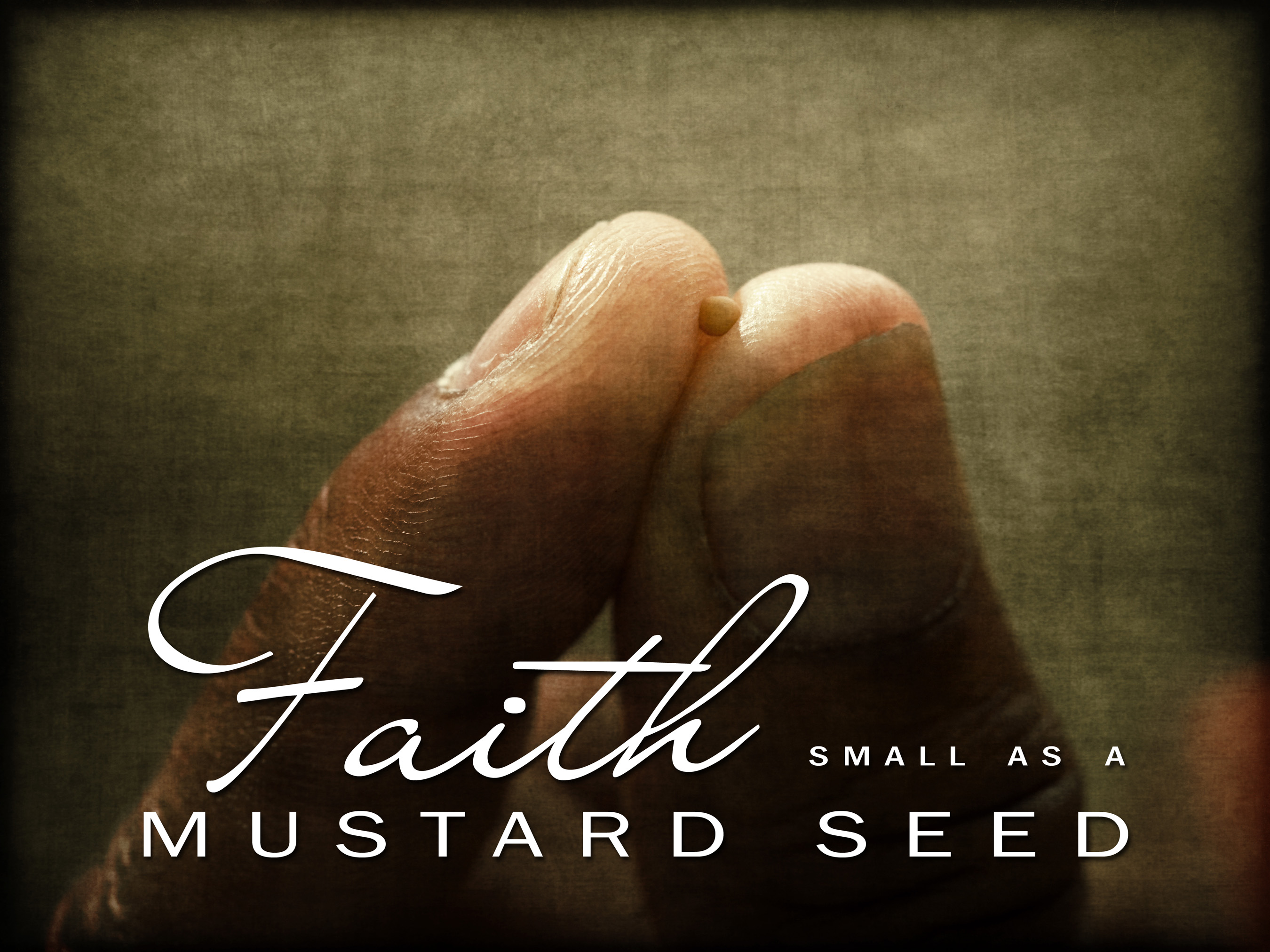
We’re Small, but We Can Do Some Big Things!

Mustard-Seed-Faith-by-CRILuke 17:3-6 NRSV

As Luke begins his gospel by addressing Theophilus, I want to begin the sermon this morning addressing Luke.

Dear Luke:

Thank you for your careful investigation and for the very orderly account you gave us so that we may know the truth concerning the life, death and resurrection of our Lord and Savior, Jesus Christ. However, on this World Communion Sunday, on the behalf of millions of Christians spread across this globe, and especially on the behalf of a handful of Christians here in Farmville, North Carolina, I would like to voice a concern that many of us have. (Sounds pretty tactful so far, don’t you think? Because here comes the boom!)

Luke, my dear brother in Christ, you are killing us. I mean, brother come on! For five weeks now you have been asking us to do some very big things! You have told us that if we want to be disciples of Jesus it is going to mean losing ourselves, denying ourselves, being a community that is always more concerned about others, about the outsider, than we are about ourselves.  It means having a strong passion for the poor, those we regard as “the least of these.” You have even told us that following Jesus involves a cross and we are going to have to carry it! Brother, come on!

Luke, during these five weeks, we have listened as you have shared some pretty outlandish parables of Jesus. And yes, although some revealed that there is nothing in this world that can separate us from the grace of God, which was rather comforting, they also re-emphasized that Jesus wants us to extend this same grace and to all people, which, quite frankly makes us rather uncomfortable. And last Sunday, you even had the audacity to bring Hell into it. You warned us that if we continued to believe that we were more blessed and favored than others, one day, we might find ourselves in flames begging one of those “others” for a sip of water!

So, come on Luke, enough already. We simply cannot take it anymore. We just can’t handle it. You are asking far too much from us! Being a community of love and forgiveness for all people is just too messy, too hard, too risky, and takes too much of our time. There’s just so much pride we can swallow at one time. And besides, we have enough of our own problems to worry about.

We have our own kids to take care of. Luke, I am not sure if you know about these things, but we have these things called soccer, football, volleyball, cross country, cheerleading and dance. And some of our kids have special needs, and then on top of that, there are our parents who are getting on up there in age with their own special needs. And did we mention that we have full-time jobs?

Oh, yes, there are some of us who are retired, but we too have our own needs. The truth is some of us are just too tired and too old to keep doing all these things that Jesus demands. You ask us to deny ourselves and carry a cross, when just trying to survive each day is like carrying a cross.

And Luke, have you seen our church lately? Have you seen how small we have become these days? We just don’t have the resources that we once had. So many good people have passed away. We have lost too many hard workers, too many teachers, too many people with some deep pockets, if you know what I mean. And have you seen our building? It is over 100 years old! So many repairs, renovations are needed. It is about all we can just do to keep it up.

So Luke, with all due respect, if you really need us to do more than we are doing now, if you want us to be more that we already are, if you really want us to reach out to others, sacrifice, be a community of love and forgiveness for all, and on top of all of that carry a cross, then something is gonna have to give. You are going to have to find a way to give us some more faith, because there is just too little left here. Sincerely, your friend and brother in Christ, Jarrett Banks

After Jesus finished speaking about the need to forgive people who have wronged them not once, but seven times, the disciples, like a crowd of exasperated members of a small, struggling old church in a small town in Eastern North Carolina, said: “Come on Jesus. You are killing us. Enough already. We simply cannot take it anymore. We just can’t handle it. You are asking far too much from us! If you really want us to do more, you need to “increase our faith” (Luke 17:5).

It is then that Jesus responded with some very good news: “If you had the faith the size of a mustard seed, you could say to this mulberry tree, ‘Be uprooted and planted in the sea,’ and it would obey you.”

And to really understand just how good this news is we need to understand something about the Greek language and the use of the word “if”. In the Greek, it is used two different ways. One is to express a condition contrary to a fact, “If I were you.” The second way is to express a condition according to the fact, “If God is for us, who can be against us.” Here, Jesus is using the latter. In the original Greek, Jesus was saying: “If you have faith as small as a mustard seed,” (And you do have it) then you can do some very big and miraculous things!

When the exasperated disciples got to a point when something just had to give, when they just did not believe they had enough of what it takes to be the people Jesus was calling them to be, they said: “Then, Jesus, increase our faith!”

Jesus responded: “Here’s the good news! I don’t have to increase it, because it only takes a little to do some very big things. And since, by the grace of God, you have a little, (you would not be following me if you didn’t) although your numbers are small, although you have very little left in the tank, in fact, I know that some of you are currently running on fumes, I have already given you what you need to do some very big things. If fact, as small as you are, as frail as some of you are, as uneducated and misinformed some are, although you constantly misunderstand what I have been teaching you, although some of you will even betray me, others will deny me, and when the going gets tough all may desert me, I have given you all that you need to change the world!

Night is falling. Jesus has been teaching out on a hillside. And the crowd that showed up that day, well, they were getting hungry.

The disciples with a little panic in their voices insist: “Jesus, there’s a thousand hungry people out there. We need to send them back to town so they can buy something to eat.”

Jesus asks, “But tell me what do you have?”

“Jesus, something’s got to give because we have very little. Just a few loaves and two miserable little fish.”

Jesus takes what they have, blesses it, breaks it, and gives it.  And, the good news is: it is enough.

However, that is not the end of the story.  Although that would be enough, there is more.  We read where “all ate and all were filled.”  They were all fulfilled, all satisfied.  They just didn’t receive something to “tie them over” until they got back into town.  They ate until they were full and satisfied.

But the story doesn’t even in end there.  They took up what was left over and 12 baskets were filled. The truth is: there was not enough.  There was more than enough. There was not only fulfillment and satisfaction, but there was a surplus. The good news is: This is simply the way it is with Jesus.

All of ye of little faith, those of us who complain that we are just too small, too old, too tired, to transform this church, to transform this community, and to change our world, this good news that Jesus always gives us more than enough is not new news to us.

Let’s take just a few minutes now and think about it.  Let’s go back in time several years. Remember that time before the divorce or separation, before the diagnosis, before you lost your job, before the flood, before the tornado, before the miscarriage, before the accident, before your child was lost, before your spouse died.  During that time before the pain, before the grief, imagine that God came to you in a dream and revealed every hardship you would have to endure in your life.  How would you have responded?

I know how I would have responded. God, you are killing me. There is just no way. Come on God, enough already. Something will have to give. There’s just no way I can do it. I simply do not have what it takes. If you really want me to make it, Lord, you are going to have to increase my faith!

And Jesus would say, “I don’t have to. I have already given you what you need.” And guess what, the good news is, and we knew it all the while, Jesus is absolutely right.

On this World Communion Sunday, we have gathered with Christians all over the world around a very small but very holy table. From this table, we take into our hands what may be one of the smallest, tiniest pieces of bread that we have ever held, and we put what resembles a mere crumb into our mouths, and we eat it.. And then we take the smallest of cups, and sip the smallest amount of juice.  It is just a small taste really, but the good news is: it is enough. No, the good news is: it is more than enough. Amen.