Welcome!

jesus_children_orthodoxGenesis 18:1-8 NRSV

Last week I said that the first four stories in our Bible are stories that are considered to be pre-history, that is before the call of Abraham and the history of God’s people. The story of Adam and Eve, Cain and Abel, Noah and the Flood and the Tower of Babel teach us some very important characteristics about who God is and how God relates to our world. They teach us that our God is a gracious, loving Creator who is committed to suffering with and for all people, people of every nation, race, color and creed.

The stories that follow in Genesis teach us what should be the very important characteristics of the people who claim to worship and serve this God.

Verse one of chapter eighteen is one of the most loaded verses in the entire Bible. “The Lord appeared to Abraham* by the oaks* of Mamre, as he sat at the entrance of his tent in the heat of the day.”

When you worship the Lord, the creator of all that is, the one who graciously loves and forgives, the one who is compassionately involved in the creation, stirred by it, moved by it, then you never know when the Lord may appear. It could be the most ordinary of days while you are doing the most ordinary of things, like sitting on your front porch in the heat of the day. You may or may not be in the right frame of mind to recognize the presence, but the presence is nonetheless real and nevertheless powerful.

Abraham is minding his own business in the middle of the day when, out of nowhere, three strangers appear on the street. Next, Abraham simply does what the Bible says the people of God do for others, he very welcomes them with a generous hospitality.

When he sees them, he does not safely call out to them from a distance. He does not cautiously walk over to them. And he certainly does not practically ignore them and allow them to walk on by. When he sees them, the scriptures say that he runs to meet them.

And when he encounters these strangers, he does not stand arrogantly over them, above them, but humbly bows himself to the ground before them and speaks to them like a servant.

“Please do not pass me by. Let me get some water and wash the dust off your feet. Let me make a place for you to rest in the shade. My wife, Sarah, bakes the best bread. Come and allow us to serve you. Then, you can continue your journey, refueled and refreshed.”

When the strangers agree to stay a while, Abraham can hardly contain himself. He runs back inside, “Hurry, Sarah, prepare three cups of choice flour, knead it, and bake a delicious cake. He then runs out back to the field and takes the best looking calf of the flock and has his servant prepare a delicious dinner. He brought it to them under the shade tree and waited on them while they ate.

And as verse one suggested, we later discover that these three strangers were actually angels, messengers from God. When we welcome the stranger, the Bible tells us, we may be welcoming God. When we welcome others, the Lord appears.

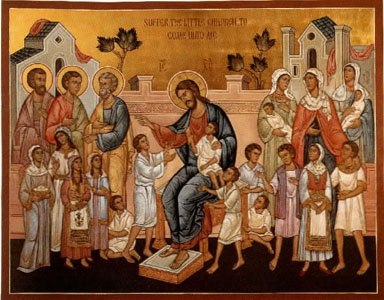
We also see this very clearly in the New Testament. In chapter 10 of Mark’s Gospel we read the following words of Jesus to the disciples, “Whoever welcomes you welcomes me, and whoever welcomes me welcomes the one who sent me” (Mark 10:40-42). In the previous chapter we read where Jesus took a little child in his arms, and said, “Whoever welcomes one such child in my name welcomes me, and whoever welcomes me welcomes not me but the one who sent me” (Mark 9:36-37).

And in Matthew we read Jesus’ words, “I was hungry and you gave me food; I was thirsty and you gave me a drink; I was a stranger and you welcomed me.”

Do you see the pattern here? Jesus said that when we welcome others, we are welcoming Jesus. And Jesus said when we welcome him, we welcome God.

When we open the doors of the church wide, when we invite others in, when we let them know that we are glad that they are here, we are welcoming the Lord himself.

There was once a monastery that had fallen on hard times. The order was dying out. There were only five monks left, the abbot and four others.

The monks feared that the monastery would have to be closed. In their desperation, they went out and sought counsel from a wise man they knew who lived in a hut in the woods that surrounded their monastery.

The wise man agreed to a meeting to talk with the abbot regarding the fate of their monastery. The meeting was very brief. The wise man said that he really did not have any great advice to give them, but he could say this: that the Messiah was among them.

The abbot returned to the monastery, where the monks were waiting eagerly to hear what the wise man had said. “Please tell us! What do we have to do to save the monastery?”  “Well,” the abbot replied, “the wise man was rather cryptic. He simply said that the Messiah is among us.”

“The Messiah is among us?” All of the monks scratched their heads. How could the Messiah be among them? As they pondered the meaning of these words, the monks soon began to think of each member of the order as a possible Messiah. They started to treat one another with tremendous respect and kindness. And when people came to visit, they treated each of them as if they could be the Messiah, too.

People from the surrounding area often came to picnic on the monastery’s beautiful grounds, to walk along the paths, and to pray in the chapel. The visitors were amazed by the welcome they received from the monks. There was an aura of respect and love that filled the place, making it strangely attractive, even compelling. Hardly knowing why, they began to come back to the monastery more frequently, to picnic, to play, to pray. They began to bring their friends to show them this special place. And their friends brought their friends. Some of the younger men who came to visit talked more and more with the old monks, and they began to join the order. So before long, the monastery had once again become a thriving order, and a vibrant center of light and love for people all over the realm.

When I first joined the conversations you were having a year ago to renovate our windows, to remove the stained plexiglass and replace it with a clear plastic so the windows could be seen from the street, I said that the need was not only aesthetic, as they looked horrendous, but it was also theological. To keep this beauty, the beauty of our Lord and Savior, inward, only unto ourselves, inside these walls was simply a theological travesty.

I have said recently that our education building needs to be renovated or at least refurbished. And like the windows, the need is not only aesthetic, it is also theological.

We have a great building and grounds committee; however, they cannot do it all by themselves. Our buildings are too old, have too many needs for just one committee to do it all by themselves. To be good stewards of our property, to make this a warm, welcoming place, we need to have many more work days like the one we had yesterday in the basement. I want to encourage you to walk through the education building, do it today if you have time, make sure you go upstairs, and ask yourself: what would you do to the building if you knew the Messiah was coming for a visit? Would you paint the walls? If so, what color? Would you paint the windows? Would you replace the ceiling tiles that are stained? Would your replace ceiling tiles that are missing?  What would the plaster in this room look like? Would it be chipped, stained, faded, discolored?

I want us to work hard in these nine months to finish the basement,  and make it a place of welcome for children; renovate our education building, and make it a warm and inviting place for all children; put up a playground right off of church street and make it a sign to the community that this church welcomes children; not so much because we want our church to look nice and pretty, not so much because we want to be proud when we invite over 100 children and their families here next June for the community Vacation Bible School, but because we take the words of Jesus very seriously when Jesus, holding a child in his arms, says, “Whoever welcomes one such child in my name welcomes me, and whoever welcomes me welcomes not me but the one who sent me” (Mark 9:36-37).

Fred Craddock, one of my favorite preachers, tells a story about going to church when he was a boy. He said that every Sunday morning, his mother took him to church with his sister. When the service was over, he said they followed their mother like little ducks out of the church. As the preacher stood at the door greeting folks, he would always say, “Mornin’ Mrs. Craddock.”  Then he would address the kids, “Good mornin’, Sonny. Good mornin’, Honey. The next Sunday, “Good mornin’ Mrs. Craddock, Good mornin’, Sonny. Good morning, Honey.” Every Sunday, “Good mornin’ Mrs. Craddock, Good mornin’, Sonny. Good morning, Honey.”

Then one day there was a new preacher. After he had been there a few weeks, as the Craddock family filed out of church, he said, “Good mornin’, Mrs. Craddock. Good mornin’, Fred.” And Fred Craddock said, “He was the best preacher we ever had, because there’s a big difference between Fred and Sonny.”

What a difference a genuine welcome makes. We all long for a place to call home. We all long for a place of welcome. Where we look around and it is obvious that someone cares about us, wants to know our names. Even the walls say they care.

As Disciples of Christ, we do not have a creed we follow. But we have a statement of identity. Part of it is on our church sign today. More than anything else, I want it to be the identity of this special place on the corner of Church and Main. I want it to be clear to all, not only through our actions and our words and our living, but also through our bricks and our mortar: “We welcome all to the Lord’s table as God has welcomed us.”

So let us commit ourselves to welcoming all, for when we welcome others with all that we are and with all that we have, we are welcoming God in the name of Christ Jesus our Lord. Amen.

We’re Able, but Are We Willing?

bridges not wallsLuke 16:19-31 NRSV

This morning, Jesus is telling another story to teach us something about the nature of God—who God is, how God acts, and what God desires. And as I said last week, we usually find that something in that part of the story that takes us by surprise, shocks us.

It is not difficult to find that moment in this morning’s lesson. But to fully grasp it we need to know a little background about original audience.[i] The Pharisees were notorious for believing and teaching some very bad theology. It is what we call “TV evangelist theology,” “the prosperity gospel” or the “health and wealth gospel.”  It means that we can find favor with God, and if we do, whether it is by living a pure and holy life or by giving generously to God “through a seed offering to the name and address displayed on your television,” then God will bless you with health and wealth. In fact, if you give regularly to their ministry, not only can you expect to receive an autographed copy of their new book, but you can expect to get unexpected checks in the mail! You will not only feel good that you are supporting a great ministry, but you may also be healed your disease or disability.

So here’s the thinking:

Have a lot of money, a great stock-portfolio, growing investments? Blessed. Living from one social security check to the next? Not blessed.

Have plenty of food, nice clothes and a nice car? Blessed. On food stamps, wear worn, old-fashioned clothes, drive a broken down heap? Not so much.

Have great healthcare, low co-pay and deductible? Access to great doctors? Blessed. No insurance, can’t remember your last check-up? Not so blessed.

Nice home? Blessed. Live in the projects? Not blessed.

Healthy and fit, training to run a 5k? Blessed. Sick, in a wheel-chair, homebound? Unblessed.

The sick and the poor, well, they’re just not living right. They make poor decisions in life. I hate to say it, but a lot of them deserve their plight.

The healthy and wealthy, well, evidently they have been living right. They make good and wise decisions, and because of that, they have caught the eye of God and found some divine favor. The poor? The sick? Well, they’ve caught the eye of God too!

And because of that belief, the Pharisees kept the poor and sick at a distance, outside of their circle of friends. They did everything they could do to keep a large gap between them. They were never invited into their homes and they cringed each time one would stumble into the synagogue.

So Jesus tells a story. There was a rich man from a big family who was well-dressed, well-fed and well-off, and of course lived in an exclusive gated community. And right outside of that gate, was this poor, hungry and sick man named Lazarus.

Lazarus would look through the gate and dream of being able to eat just the left-over scraps from the rich man. The only attention and care he received were from the neighborhood dogs that came and licked his wounds. How unblessed is that?

Well, one day, both men died. After all that’s what all men do, don’t they?  All of the money, good fortune in the world can not prevent it. So, no surprise there.

But hold on, because here it comes. The poor man, the man who was seemingly blessed not so much in life, is carried away by the angels to be with Father Abraham.

And, by this time, you know it is really coming. You can almost feel it! If the church pews had seatbelts, I’d be hearing a lot of clicks about now.

The rich man who had a stellar reputation in the community, the one who was seemingly very blessed in life, the one who always bragged to his friends down at the synagogue how good God had been to him, found himself being tormented in Hades.

C’mon Jesus, really?!? Really?

Really! He looks up and sees Abraham with Lazarus at his side and cries out, “Father Abraham, it’s hot as Hades down here! Please send Lazarus to visit me with just a drop of water!”

Abraham responds, “It’s too late. You are no longer able to be comforted. Besides, there is now this chasm, this gate, this wall separating you from us and us from you. And it has been fixed.

Now, isn’t that ironic? In life, the rich man who separated himself, who kept his distance, segregated and protected himself from the likes of people like Lazarus, is now eternally separated from him. And he is unable to do anything about it.

“Ok,” he says, “If I am unable, my five brothers who are still living are very able! Please send Lazarus to warn them so that they will not join me in this God forsaken place!”

Abraham responds: “They’ve already been warned in the scriptures.”

“But, Abraham, look, uh, I know my brothers, and I am afraid that they are not really into Bible Study, but if someone rises from the grave, then they might listen.”

“No,” says Abraham, “If they are not willing to listen to Moses and the prophets, neither will they be convinced, even if someone rises from the dead.”

Oh – my – word! Jesus is not just speaking to the Pharisees here, is he? Jesus is speaking to crowds of people gathered almost two-thousand years later on Sunday mornings at 11am who proclaim to know someone who has indeed rose from the dead.

It is too late for the rich man. He is no longer able to change—change his theology, change his heart, change his view of his neighbors living on the other side of the tracks. He is no longer able to tear down the wall and begin building bridges. And although his five brothers are able to change, we learn the sad and the scary truth that they are simply not willing to change.

And here we are, as able as those brothers. The truth is, we are more than able. For not only do we have Moses and the Prophets, we also have Matthew, Mark, Luke, John and Paul and the risen Christ himself. So, the scary question is: are we willing? Are we willing to change our theology, our hearts and our actions? Are we willing to tear down the walls and build some bridges?

Yes, we hear bad theology all of the time from the TV preachers, but we also hear it right here in the local church. And sometimes it comes out of our very own mouths.

When someone compliments us by telling us what a nice home we live in, or what a nice car we drive, or what a beautiful family we have, or how good we look for our age, we respond how we think all good Christians who go to church every Sunday should respond, “Well, the Lord has really been good to me.” “The Lord has really blessed me.”  And we even believe responding in such a manner might coax God into blessing us some more!

Through the story of the Rich Man and Lazarus, Jesus says that our wealth and our health and our nice teeth are not signs that we are God’s favorites. In fact, those things may be some of the bricks in the wall that separates us from those who are poor, sick and have never seen a dentist. And according to Jesus, if we do not do something about it, that wall, that chasm, will eternally separate us from God.

When someone who is doing the best they can to make ends meet, who is struggling to put food on the table and keep the lights on, hears someone who has it all proclaim, “Yes, the Lord sure has been good to me! The Lord has really blessed me!” what are they to think?  What else can they think except: “Obviously, for some reason or another, I am not one of God’s favorites.”

So, should those of us with good jobs, nice homes and a clean bill of health thank God for what we have? Absolutely! But should we interpret our nice things as a sign that God has looked down on us favorably, given us a nod and a wink—a pat on the back? Jesus says, absolutely not!

One week before Hurricane Katrina paralyzed the Gulf Coast, a young mother went into labor about 10 days before her due date. Although she needed a C-section, she delivered a healthy boy in a New Orleans hospital. She later interpreted having the baby 10 days early as a sign of God’s divine favor. She said, “God knew that if the baby was born on the due date, we would not be able to get to a hospital. So, God made the baby come early.”

There’s no doubt she should thank God the baby came early; however, Jesus says she needs to be very careful how she interprets and shares her story because, without knowing it, she may be building a wall or a chasm between her and someone else. For example, what is the New Orleans father to think whose baby did not come early, whose wife was unable to go to the hospital because of the flood, and because of that, lost not only his baby, but his wife too?  Did God favor one family over the other?

Jesus said, absolutely not! And if you think that because of your good fortune in life you are blessed, one day you might find yourself asking someone who was less fortunate than you in life for a sip of water!

Jesus also put it this way: the sun shines on the good and the evil and the rain falls on the just and unjust alike (Matthew 5:45).

One day Luke says that Jesus cried out, “How often have I desired to gather everyone together as a hen gathers her brood under her wings, but you were not willing!” (Luke 13:34).

The question for us this morning is this, “Are we willing to be gathered under the wings of grace[ii] and see all people, rich and poor as our brothers and our sisters. Are we willing to start building bridges or keep putting more bricks in the wall?”

The good news for us is, unlike the rich man in our story, it’s not too late. We are able, more than able. The question is, “Are we willing?”


[i]Cousar, Charles B.; Gaventa, Beverly R.; McCann, J. Clinton; and Newsome, James D., Texts for Preaching: A Lectionary Commentary Based on the NRSV–Year C (Louisville:  Westminster John Knox Press, 1994)

Craddock, Fred B., Luke, Interpretation. (Louisville:  John Knox Press, 1990)

Craddock, Fred B.; Hayes, John H.; Holliday, Carl R.; and Tucker, Gene M., Preaching Through the Christian Year, C (Valley Forge:  Trinity Press, 1994)

Culpepper, R. Alan, Luke, The New Interpreter’s Bible, Volume IX.  (Nashville:  Abingdon, 1995)