When the Bent-Over Stand Tall

Luke 13:10-17

There she was. Bent over for eighteen long years. Eighteen agonizing years of looking at the ground instead of the sky. Eighteen heartbreaking years of staring at her feet when she longed to see the stars. Eighteen years of neighbors passing by, some whispering, some staring, some mocking, and some pretending not to notice.

This one who was “bent over and not able to straighten up at all,” says Luke, had come to the synagogue to hear the teaching of a young rabbi named Jesus.

Listen again to verse 12, “When Jesus saw her…”

Let’s not miss that.

Before anyone else noticed her, Jesus saw her.

When the world looks away, Jesus sees. When society grows accustomed to suffering, Jesus stops.  When the culture calls suffering “normal,” Jesus calls it “wrong.”  When the world says, “nothing can change,” Jesus says, “oh, yes it can!”

This woman lived eighteen years under the weight of her condition.
But how many of us know people bent over for far longer than that?

Notice that Luke tells us that “a spirit” had crippled this woman. This was not some cartoon ghost floating around. Luke is naming the same thing John calls “the spirit of the antichrist,” the same thing Paul calls, “the spirit of slavery.” It’s the same spirit Mark called “Legion” pointing directly to Roman military occupation. It’s the same thing our ancestors called the spirit of Jim Crow. It’s the spirit of greed, the spirit of sexism, the spirit of pride and self-righteousness.

These spirits don’t float around in the air. They take root in systems and in structures. They show up in unjust laws, in hateful rhetoric, and in economic exploitation. When Jesus lays his hands on the bent-over, he is confronting not just sickness but the very spirit that says some people should stay bent over.

This is the spirit of oppression, the kind of spirit that settles in when the world tells you that bent down is all you will ever be. It’s the spirit that whispers, “Stay in your place.” It’s the spirit that says, “You don’t deserve healing. You don’t deserve dignity. You don’t deserve to stand tall.”

It’s the spirit that tells workers scraping by on minimum wage that they don’t deserve a living wage. It’s the spirit that tells people without health insurance that their lives are expendable. It’s the spirit that tells young Black men they are more likely to fill a jail cell than a college classroom. It’s the spirit that tells women, immigrants, trans and queer folk: “You don’t belong. You are less than. You should stay bent.”

The truth is that we are surrounded by the bent-over. And the tragedy is not just that people are bent. The real tragedy is that, like the synagogue leader in our story, the religious and political establishment today would rather preserve the systems that bend people over, than bring healing and transformation that makes the bent over stand tall.

That’s the ugly spirit that cripples this woman in the synagogue. And that’s the spirit that Jesus confronted in that synagogue. And that’s what really angers the religious leaders. Because when Jesus lays his hands on this woman, it’s not just a personal miracle. It’s a public exorcism. It is the casting out of a spirit that says bondage is normal. It is the overthrow of every lie that says any of God’s children should stay bent and broken.

Indignant that Jesus would not only heal on the Sabbath, but heal a woman, touching her, violating the rules of religious tradition, the religious leader scowls: “How dare you! Come for healing on any other day, but not on the Sabbath!”

But the Sabbath was never about rules. The Sabbath is about restoration. The Sabbath is God’s reminder that human beings are not machines. The Sabbath is the declaration that Pharaoh’s bricks and quotas and endless production do not have the final word.

The Sabbath is freedom. And Jesus, right there in the synagogue, calls out their hypocrisy by saying: “How can you untie your ox or donkey on the Sabbath but refuse to untie this woman from her bondage?”

Two years ago, during the Sunday School hour, to get to know the new pastor, we played this game called “Quiz the Pastor” where you were asked to write questions and place them in a box for me to draw and answer. Most of the questions were easy, like “what is your favorite dessert?” But I will never forget one of the questions: “What is the gospel?” I can’t remember how I answered that important question, but I should have answered by retelling this story in Luke 13.

Because Jesus answers that question in the synagogue that day when he talks about the Sabbath: If the Sabbath is for rest and restoration, then the people most in need of restoration, the ones most bent over, the ones most tied down and bound, are the very first who should taste its freedom.

I believe we must be clear: this story is not just about one woman with a bad back in Galilee. It is about all the places where people are bent over today. And it’s about all the ways our society tolerates suffering, because healing would disrupt business as usual.

We live in a nation where: patriarchy is untied while women are bowed down with fewer rights; corporations and billionaires are untied every tax season while workers stay bound; banks are untied from regulations while the poor stay bent beneath debt; guns are untied while active shooter drills bend school children beneath desks; autocracy is untied while gerrymandering and voter suppression bends down democracy; and much of the church in our country has been untied from any responsibility to make this world more loving, peaceful and just, as pastors preach about Jesus’ role in personal salvation while ignoring his role in social liberation.

The synagogue leader says to Jesus: “No, not today. It’s unacceptable to bring that in here!”

And Jesus responds with the gospel: “Not tomorrow but today is the day of liberation! Here and now is the acceptable place and time for all who are bound to be untied!”

And because of this gospel truth, the good news is we’ve seen bent-over people stand tall throughout history.

In 1968, the Memphis sanitation workers were bent under dangerous conditions and poverty wages, but they stood tall, carrying signs that said, “I Am a Man” until the world had to see their dignity.

A year later, Marsha Johnson and Sylvia Rivera were bent by poverty, police harassment, and transphobia, yet they stood tall at Stonewall and beyond, fighting for the dignity of LGBTQ+ people.

More recently, Greta Thunberg was bent by the loneliness of being a child confronting the climate crisis. She was mocked and dismissed by the powerful, yet she stood tall, sparking a global movement of youth demanding a livable planet.

And there have been countless others who have stood tall after being bent down: the farmworkers led by César Chávez, Desmond Tutu in South Africa, Martin Luther King Jr. in a Birmingham jail, and nameless mothers and grandmothers who kept marching, kept praying, and kept believing.

And every time they stood tall, strong men trembled. Every time they stood tall, chains cracked. Every time they stood tall, the Kingdom of God broke in just a little more.

The question is not whether Jesus can help people stand tall today. The question is whether we will join him. Will we dare to touch the wounds this world says are untouchable? Will we dare to lift up those our society keeps bent over? Will we dare to live like the Sabbath is real, that God’s rest and God’s restorative justice belong to everybody?

This is the vision of the Kingdom. Not just one person healed, but entire communities rising up, standing tall, rejoicing together with all.

Because, as Dr. Barber reminds us with the Poor People’s Campaign, when the bent-over stand tall, when the poor organize, when the oppressed resist, when the weary find their strength in faith, then the powers that profit from their suffering are put to shame.

That’s why the crowd rejoiced, and that’s why the rulers were humiliated. Because nothing frightens empire more than people who refuse to stay bent.

So, the question for us today is: Will we be content with a Sabbath that unties donkeys but leaves people bound? Or will we follow Jesus into the holy work of untying our neighbors, of lifting up the bent-over, of making straight what has been made crooked for too long by an anti-Christ spirit in our world?

The good news is that there’s another spirit in our world. The good news is that the spirit of the same Jesus who made that woman stand up is alive and moving today.

He is moving every time someone stands and demands living wages, every time someone stands and fights for universal health care, every time someone stands and calls for racial justice, and stands to end the scapegoating of and the cruelty to immigrants.

He is moving every time someone stands up and does something to help the bent-over stand tall.

And here’s the reality, because we are the body of Christ in this world, if we leave here today and do nothing, then the woman stays bent.

If we leave here today and stay silent, then Herod, and the religious powers who have forsaken the gospel to follow Herod, still win. If we leave here today and choose comfort over courage, then the powers will keep alive the lie that there is no alternative to the status quo.

But I declare to you today in the name of Jesus that there is an alternative! There is a better way! And it begins when the people of God stand tall, when they refuse to bow to Herod and refuse to look away from the suffering around us.

So, let us rise and stand up straight as that woman did. Let us lift our voices in praise, and let our praise spill into protest, and let our protest grow into policy, and let our policy become a new way of life.

Because when the church rises and stands tall, the world cannot stay bent! When God’s people stand up tall together, Herod trembles. And when the bent-over stand tall, that’s when the Kingdom of God breaks in!

So church, it’s time to rise and stand up!

It’s time to rise and stand up for justice!

To rise and stand tall for mercy!

Stand tall for peace! Stand tall love!

Stand until every child of God can stand tall and sing free!

May we always have the courage to see, the faith to act, and the love to untie any bond that keeps any one of God’s children bent down.

And may we rejoice with the crowd until every last one of us can stand tall and rejoice together. Amen.

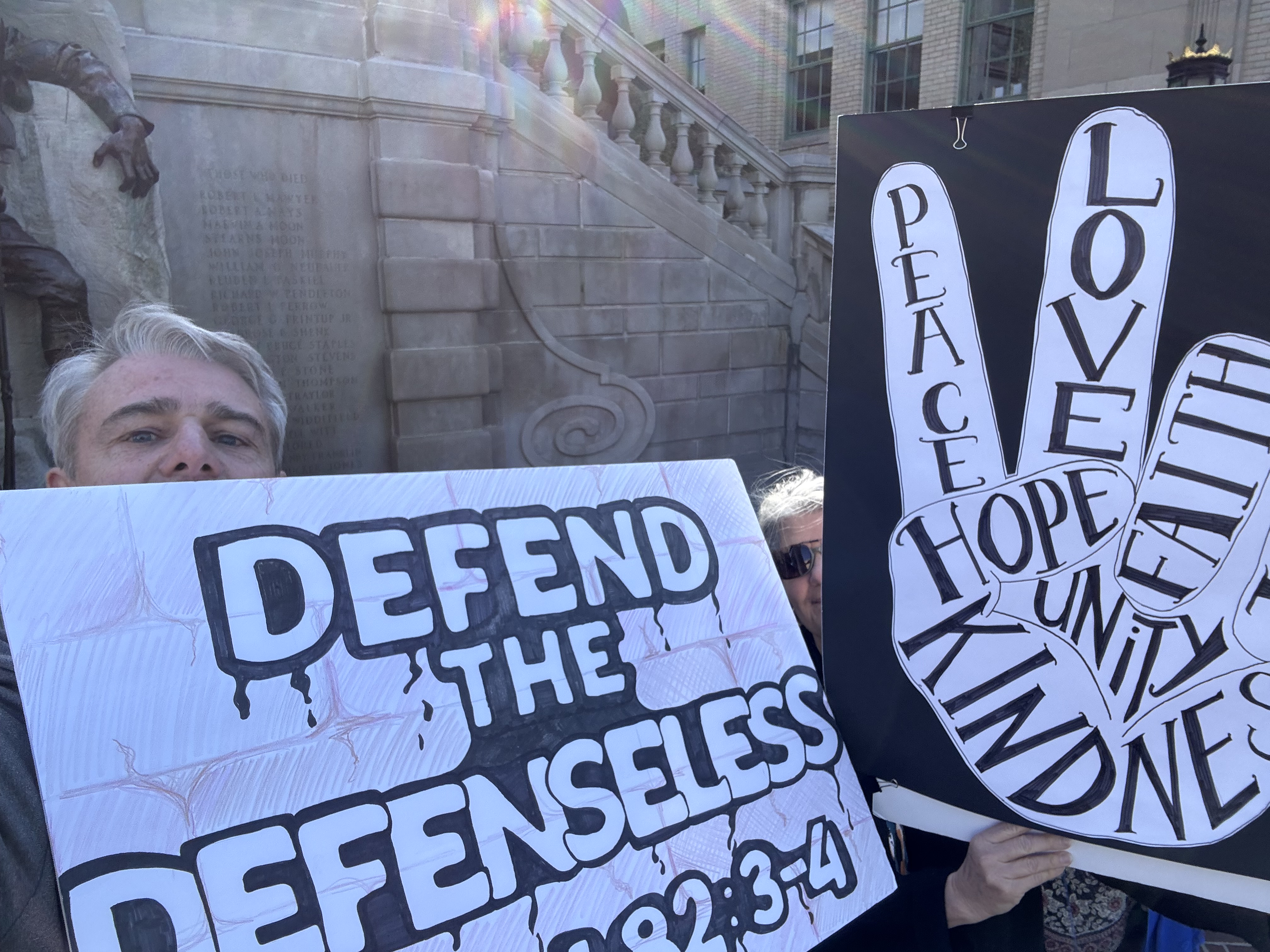
Palm Sunday Prayer

God of Love and Justice,

As we begin this Holy Week, some of us can remember a more innocent time when we possessed a more naïve understanding of the world.

Our thoughts were as innocent as the children who waved palm branches on this day.

We once listened to scripture retell the events of this week and wondered how on earth can the actions and attitudes of people change so dramatically in a just few days.

How can people enthusiastically choose to follow a nonviolent savior riding a donkey on Sunday, and in the same week, choose a violent insurrectionist to be their savior instead. How can people shout “Hosanna! Blessed is he who comes in the name of the Lord!” on Sunday, and days later, shout “Crucify him.”

But living in this current culture, we no longer wonder.

For we live in a nation where people claim to follow the way of Jesus on Sunday, but during the week, willfully choose to live a way that is the exact opposite.

Instead of blessing the poor, they curse the poor.

Instead of providing comfort to those who are mourning for their lives to matter, they tell them that their lives matter too.

The meek are oppressed; not blessed.

Those who hunger and thirst for justice are scapegoated; not filled.

The merciful are ridiculed.

The pure in heart are bullied.

The peacemakers are labeled “weak” and “stupid.”

And those who seek to follow the inclusive, unconditional, universal way of love that Jesus taught are persecuted for doing so by those who claim Jesus to be their Savior.

The singers of “Hosanna” deny food to the hungry. The wavers of palm branches deny healthcare to the sick. The triumphant deny children an equitable education. Workers are denied a living wage. The imprisoned are denied due process. Immigrants are tormented. Women are subjugated. Strangers are feared and sent away.

Truth and honesty are rejected in favor of misinformation and lies.

Nationalism is preferred over discipleship.

Greed is favored over generosity.

Retribution is supported over forgiveness.

Profit is chosen over the planet.

Guns are valued over children.

Kindness is mocked.

Equality is despised.

Diversity, equity, and inclusion are banned.

Empathy is called a sin.

So, Lord, on this Palm Sunday we pray for the strength to resist, for the courage to dissent, and for the resilience to defy the anti-Christ spirit that seems to have a hold on our world.

Be with us, O God, through the betrayal, the trial, the denials, the mockery, the flogging, the suffering, and the execution; that we like the women disciples, will remain faithful, purposeful, and peaceful all the way to the tomb.

In the shadow of death and grief, renew our spirits to courageously stand against the evil rulers, the authorities, and the powers of this dark world.

May we be resilient until the stone is rolled away, the bonds of death are broken, and the power of evil is defeated. May we remain faithful until love is finally won, peace is fully realized, and liberty and justice are enjoyed by all.

A Prophetic Response to School Shootings

Isaiah 35:4-7 NRSV

It was around 600 BC when a dystopian 1930’s-like dictator named Nebuchadnezzar was on a mission to make Babylon great again by building and renovating tall buildings. His armies invaded and occupied Assyria, Egypt, and Palestine, destroying Jerusalem. Judah had three kings during Nebuchadnezzar’s reign who were either taken as hostages or killed. The entire territory was desolated, and the Jewish people were exiled.

I imagine it was difficult, if not impossible, for those in exile to see any light in the darkness. And it was easy for them to resign themselves to the belief that things could not and would not get any better, to acquiesce to despair.

It is in this fearful time and dark place that a prophet named Isaiah reminds people of faith that they are called to speak out proclaiming words of courage to those with fearful hearts (Isaiah 35:4).

The phrase “those with fearful hearts” only scratches the surface in describing the people’s despair. Anathea Portier-Young, Professor of Old Testament at Duke Divinity School, points out that a more literal reading the Hebrew language is: “ones whose hearts are racing.” Isaiah calls people to proclaim a word of hope to people “whose hearts are racing.”

Perhaps we have all experienced something of what this professor describes when she writes:

The heart races. A hormone we call adrenaline or epinephrine courses through the bloodstream. It stimulates muscles, directs blood-flow, and accelerates metabolism. At the same time, it causes the senses to close in — the field of vision narrows and the world becomes strangely quiet. It is a stress response. It might energize the body for battle, or to run away. Or it might mimic paralysis.[i]

The Jewish people who had been terrorized by Nebuchadnezzar and forced into exile certainly knew something about this.

And today, the students and faculty of Apalachee High School, along with their families and friends in Georgia, tragically know something about this, along with every child in our country who has experienced active shooter drills teaching them to first run, then to hide, and then to fight, when someone with a gun comes to the school.

Every parent who has a school-aged child and every person who has a heart, knows something about a racing heart every time we are alerted with breaking news of another senseless school shooting.

And, like the Jewish people in exile, it has become difficult, if not impossible, to see any light in the darkness. We acquiesce to the despair, calling it “the new normal.” Even people of faith have no faith that things in this life can be any better, thus many have placed all of their faith and hope in an afterlife.

The only reason many folks are in church this morning is to make preparations to leave this God-forsaken earth for heaven, not to be inspired to do something to bring heaven to earth.

So today, perhaps more than ever, we need to hear a prophetic word, at least as much as the Jews in exile needed such a word. We need to hear someone like Isaiah calling faithful people to stand up to proclaim some prophetic good news to those today whose hearts are racing.

To understand the prophetic word that people of faith are called to proclaim today, it might be helpful talk about what the prophet does not say we are to proclaim.

Isaiah does not say: “Tell those with racing hearts that you are sending them your thoughts and prayers.”

Isaiah does not say: “Tell those with racing hearts that you hate what happened, but such evil is just ‘a fact of life.’”

Isaiah does not say: “Tell those with racing hearts that we live in a dangerous world full of ‘sick and deranged monsters,’ and instead of making common-sense laws to prevent them from attaining weapons of war, we actually need to make such weapons more accessible, even to our children, to protect us from the danger.”

The prophet doesn’t say: “Tell them that this is just the way it is, and things are not going to get any better, so we just need to accept it. Gun violence will always be the number one cause of childhood death in our country. We had 1,708 mass shootings last year, and we can expect more next year. This is the new normal, and there’s really nothing we can do about it, except to arm ourselves, lock our doors, continue to put our children through active shooter drills, maybe get them some bullet-proof back-packs, and display the Ten Commandments in classrooms.”

And Isaiah doesn’t say anything close to: “Tell the people that the reason they live in so much fear is because they have taken God out of their schools.”

In fact, the prophet says the exact opposite.

The prophet says:

Have courage and take heart because God is here, right here. God is coming to put things right and redress all wrongs. (Isaiah 35:4 The Message).

What bothers me the most about the state of the church today is not that the church has a difficult time articulating the prophetic good-news. It is not that it has clouded or even lost the message. What troubles me the most is that the church often proclaims a message that is the exact opposite of the good news that we are called to share, the antithesis of everything that the prophets proclaimed and Jesus taught, modeled and embodied.

Instead of loving our neighbors, we preach take care of yourself.

Instead of welcoming the stranger, we preach building a wall.

Instead of healing the sick, we preach denying their healthcare.

Instead of forgiving the sinner, we preach throwing rocks.

Instead of treating the poor like they are blessed, we preach treating them like they are cursed.

Instead of standing up for the marginalized, we preach calling them abominations.

We choose to favor the rich over the poor, greed over generosity, judgment over forgiveness, selfishness over sacrifice. We choose to embrace a lie and reject the truth. We choose the arrogant, the proud, the condescending and the self-important, while rejecting anyone who comes close to embracing a way of service and humility.

And instead of protecting our children, we’d rather protect our second amendment right.

Instead of sharing hope in God’s restorative justice, we’d rather share gloom and doom, hell, fire, and brimstone.

The message we proclaim is the exact opposite of the message of the prophets and Jesus. And this is why I don’t hesitate to say that the message that is proclaimed by many churches today is “anti-Christ.”

Anne chose to read this prophetic passage this morning using The Message translation of the Hebrew, because the NRSV translation we usually read translates the Hebrew word naqam into the English word “vengeance.” Verse 4 reads in the NRSV: “God will come with vengeance.”

Like Anne, I have a difficult time linking “vengeance” with the good news of God’s presence. To be honest, I almost chose not to preach this passage this morning when I first read it in the NRSV, as I choose to believe that God’s dealings with creation is restorative, rather than retributive.

This is why it is always good to take a close look at the original language when studying scripture. Biblical scholar Hendrik Peels points out that the Hebrew word translated “vengeance” in the NRSV literally means “the restoration of justice.” Thus, the meaning of the word is closer to what we call “restorative justice.” It means setting things right.

Isaiah is calling faithful people to proclaim to those with racing hearts: “Have hope for God has not abandoned you. This world is not God-forsaken. God is here with you, and God’s restorative justice is on its way. God is here working in our world, creating and recreating. God is addressing and redressing everything that is wrong in the world making it right.

Isaiah is saying to tell the people with fearful, racing hearts: “Be greatly encouraged for violence is not the new normal. Resignation to despair is not a fact of life. It does not have to be this way! For God is here! Justice has arrived! Love is coming, and love will win!”

With rich poetic language, the prophet says to the people with racing hearts: “Eyes that have been blinded will be opened.”

I hear:

Eyes that have been blinded by selfishness and greed will be opened! because I know that some of God’s people, some faithful disciples, who are shining a light.

Deaf ears that are unable to hear voices of mercy and peace will be unstopped! because I know some of God’s people who are proclaiming the truth.”

People who are feel paralyzed and powerless to bring about change will leap like deer all the way to the ballot box! because I know some disciples who are out in the streets preaching hope.”

Tell the people with racing hearts that those whose voices have been silenced by the loudness of hate, fear and privilege will break into song! Because followers of Jesus are going to be louder. Voices will be raised demanding that legislators enact common sense laws to protect all people society, especially those who are most vulnerable.

Tell the people with racing hearts that justice is coming like springs of water bursting forth in a wilderness! Streams of justice will flow in the desert!” because people are answering the call to heed the message of the prophets and to follow the non-violent, peace-making way of Jesus. People are speaking out passionately and prophetically with beautiful words of hope and transformation.

We are prophetically proclaiming to the people that when the scriptures talk about being born again, it applies to the entire creation!

“Hot sands will become a cool oasis and thirsty ground a splashing fountain, and even the jackals, even creatures regarded as lowliest of creatures, will have fresh water to drink. Barren grasslands will even flourish richly!”

Because no matter how bad things seem, we will never give out while working as God’s prophetic agents of restorative justice in this world. We will never give in to the darkness that surrounds us, and we will never give up on love and the power that it has to transform the world!

[i] https://www.workingpreacher.org/commentaries/revised-common-lectionary/ordinary-23-2/commentary-on-isaiah-354-7a-3