When Christ Is King

John 18:33-37 NRSV

Some of you may remember Yakov Smirnoff, the Ukrainian comedian, who was made famous in the 1980’s with the saying: “America: What a Country!”

When he first arrived in the United States, he was not prepared for the incredible variety of instant products in American grocery stores.

He once told the story of visiting a grocery store  just days after he came to America. He said:

“I love this country, I walked down one aisle and saw a jar of powdered orange juice—’just add water the jar’ said.  Isn’t that wonderful, just add some water and you get orange juice!”

He went on: “I walked down another aisle and saw a box of powdered milk. Just add water and you get milk.  Then ran across a box of powdered eggs. Just add water, and you get eggs.”

He said, “I then went down another aisle and saw a container that said, ‘Baby powder,’ and I thought to myself, ‘America: What a country!’”

I have wondered if those of us who have been a part of churches where infant baptism is not practiced are sometimes tempted to believe that when it comes to baptism. That all a congregation must do for someone to be made into a Christian, a follower of Jesus, is to just add some water. Just fill up the baptistry with water and get a person wet!  And before they can dry off, we are patting ourselves on the back saying: “Good job! We did it!! Our work as a church is now finished!” Hallelujah, praise the Lord!”

Consequently, the promises spoken and the commitments made during some baptismal events are solely made by the person being baptized. No promises are made by the congregation. The congregation’s work is over.

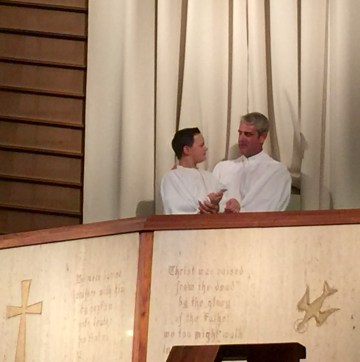
However, with the infant baptism that we just observed, it was only the congregation who made the promises, as precious little Phyllis Rose wasn’t able to promise anything. When an infant is baptized the work of the congregation is just beginning.

And, how appropriate is it in 2024 that we are making such commitments on this Christ the King Sunday, as commitments have never been more needed to following the peculiar, counter-cultural, other-worldly, other-realm way of life that Jesus decrees.

As Jesus reminded Pilate after he is arrested, when Christ is our King, our Kingdom, our truth, our worldview, our understanding of birth, life, and death, of meaning and purpose, is not from this world.

Jesus’ statement that if his followers were from this world, they would fight to keep him from being handed over, speaks to the hyper-masculinity of our current world.

Throughout world history, authoritarian tyrants have used hyper-masculinity as the solution to large, complex societal problems, such as some of the problems our country faces today: climate change, inflation, income inequality, loss of manufacturing, and the rise of artificial intelligence.

A history of sexual violence toward women and a felony record only helps such autocrats who claim that they alone have the manly strength to fix all that is wrong, offering a simple explanation for all problems of the nation: We are having these problems because there are these people who are making us weak, less masculine, like immigrants (who are polluting our blood) and LGBTQ people (who are polluting our sexuality and gender).

This reign of hyper-masculinity favors the super-rich, because as the poor continue to get poorer, instead of blaming the rich, the true source of their problems, they’ve been conned into blaming those who have polluted their sexuality and blood.

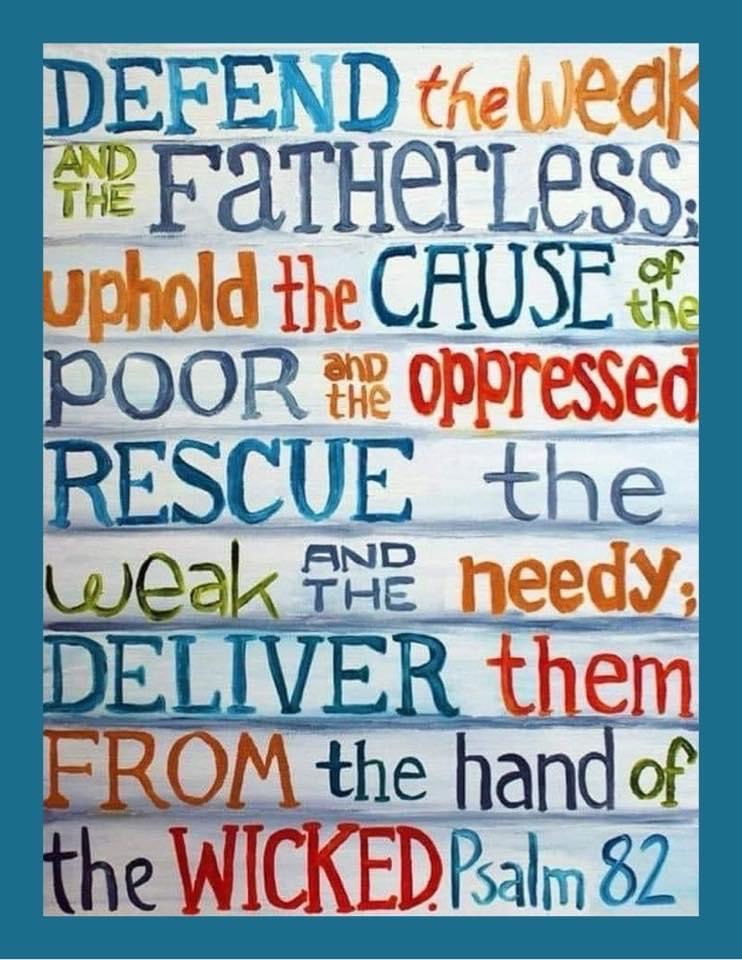
The reign of Jesus is the exact opposite, because the reign of Jesus heralds the truth that God favors the poor, the meek, and the peacemakers. The reign of Jesus heralds the good news that God favors those who hunger and thirst for justice and is on the side those who are grieving.

The reign of Jesus supports the most vulnerable, stands on the side of the marginalized, defends the rights of women, elevates the widow, and defends the Eunuch.

The reign of Jesus fills the hungry with good things and sends the rich away empty. The reign of Jesus casts down the powerful and lifts up the lowly and decrees that the Kingdom of God belongs to little children like Phyllis Rose.

This is why our commitments today through this service of baptism to guide Phyllis in the way of Jesus are so important. In a world where Phyllis will be bombarded with lies, made-up stories, and propaganda pulling her in the opposite direction, we as the church must be intentionally vigilant in our efforts to guide Phyllis in the gospel truth.

In a world where many do not understand Jesus’ kingship, and others, even those in the church, reject it outright, we’ve made promises before God today to demonstrate to Phyllis that Christ is our King. That the voice that we listen to has never sat on any earthly throne or ever once occupied the White House.

And the voice we listen to tells us that those in this world who have power over us, those who control our thoughts and our actions, are not the strong, the powerful, and the hyper-masculine. But they are the weak, the powerless, and the most vulnerable among us.

And that the perfect example of those with the most power in our lives, in our world, is the tiny precious infant we have baptized this day.

Because, when Christ is King, little children reign supreme.

When Christ is King, the least among us are the greatest, and the last are first.

When Christ is King the humble are exalted and the meek inherit the earth.

When Christ is King, there is no longer male or female, but all are one.

When Christ is King (in the beautiful words of feminist artist Judy Chicago), then…

All that has divided us will merge

And then compassion will be wedded to power

And then softness will come to a world that is harsh and unkind

And then both men and women will be gentle

And then both women and men will be strong

And then no person will be subject to another’s will

And then all will be rich and free and varied

And then the greed of some will give way to the needs of many

And then all will share equally in the Earth’s abundance

And then all will care for the sick and the weak and the old

And then all will nourish the young

And then all will cherish life’s creatures

And then all will live in harmony with each other and the earth.

And then everywhere will be called Eden once again

Amen.
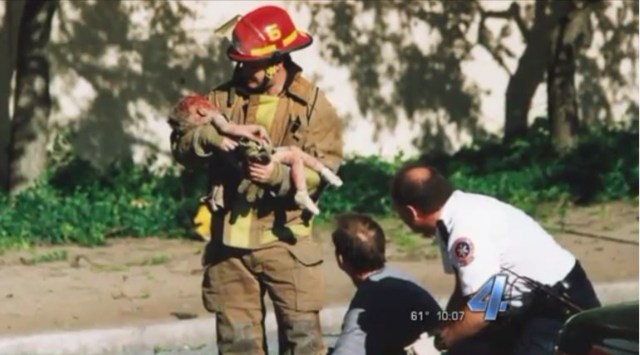
For Easter to Happen, Somebody Needed to Pick Up and Carry a Cross

oklahoma city bombing firefighter baby

Luke 24:1-12 NRSV

It is Easter Sunday! Resurrection morning has dawned. New life is being born! Something wonderful has been lost, but something magnificent is being gained.

However, on this Sunday of Sundays, I believe it is important for us to realize that before we can experience new life, before we can celebrate resurrection, before we can sing alleluias, before love can win, somebody needed to pick up and carry a cross.

And the sad thing is that there are very few of Jesus’ disciples who understand this. They do not understand it today, and they did not understand it 2,000 years ago.

Although Jesus continually taught that to gain our lives, we must be willing to lose our lives, that Easter could not happen without some self-denial, that resurrection could not come without some self-expenditure, that new life could not be born without some sacrifice, that love could not be won without some suffering, that the the light of Sunday morning could not  dawn without the darkness of Good Friday, when the time came for the disciples to follow Jesus all the way to the foot of the cross, most all of them very selfishly fled to save their lives.

One would betray Jesus. Another would deny that he even knew Jesus. Nearly all would desert him. In spite of Jesus’ continual call to pick up a cross and follow him, most of the disciples never got it.

However, there were a few disciples who did get it. There were a few who were willing to carry a cross. There were a few who chose to live selflessly and to love sacrificially. There were a few who faithfully followed Jesus all the way to Golgotha.

Although the intrinsic sexism of this world’s history has caused many in the church to overlook these faithful disciples, the good news is that all four Gospel writers did not.

In Luke 8 we read these words: Afterward [Jesus] journeyed from one town and village to another, preaching and proclaiming the good news of the kingdom of God. Accompanying him were the Twelve and some women…Mary, called Magdalene… Joanna…Susanna, and many others…” These women helped support Jesus and the twelve “out of their own means.”

And on Good Friday, when none of the male disciples could be found, Mark 15 reads: “There were also some women looking on…among whom were Mary Magdalene, and Mary the mother of James, Joses, and Salome.

In Matthew 27 we read: “Among them [gathered at the foot of the cross] was Mary Magdalene, and Mary the mother of James and Joseph, and the mother of the sons of Zebedee.

In John 19:25 we read where all the male disciples fled: “But standing by the cross of Jesus were His mother, and His mother’s sister, Mary the wife of Clopas, and Mary Magdalene.

There are many problems with Christianity today. However, I believe one of the biggest problems with our faith today, especially here in North America, is that we have too few Mary Magdalenes.

There are too few people who understand that authentic faith, true discipleship, always involves a cross. It always involves answering a call, taking a risk, denying oneself, going against the status quo, pushing the boundaries, stepping way outside one’s comfort zone.

A problem with the church today is there are too many Christians who believe they can sing “alleluias” on Easter Sunday without going through some suffering on Good Friday, who believe they can experience some new life without death to self, who believe they can somehow rise up from the waters of baptism without getting their hair wet, who believe they can serve Jesus without getting their hands dirty.

What this world desperately needs needs right now, and what the church needs more than anything today, are more disciples like Mary Magdalene. For Mary Magdalene understood that when Jesus called people to be his disciples, Jesus was always clear that there would be a cross involved.

I think this is the reason that Mary Magdalene is remembered today by Matthew, Mark, Luke and John. This is the reason she is mentioned by name by the gospel writers more than any other apostle. And this is the reason that today, on this Easter Sunday morning, Christians all over the world will hear her name mentioned as they gather to worship.

Some will hear her name as Mark 15 is read: “Mary Magdalene and Mary the mother of Joses were looking on to see where Jesus was laid.”

Some will hear her name as Matthew 28 is read: “Now after the Sabbath, as it began to dawn toward the first day of the week, Mary Magdalene and the other Mary came to look at the grave.”

Some will hear it as Mark 16 is read: “When the Sabbath was over, Mary Magdalene, and Mary the mother of James, and Salome, bought spices, so that they might come and anoint Him.”

And others will hear it as John 20 is read: “Now on the first day of the week Mary Magdalene came early to the tomb, while it was still dark, and saw the stone already taken away from the tomb.”

Just as Mary Magdalene had given what she had to support Jesus’ life, Mary was still doing all she could for Jesus in death.

And because she always selflessly pouring herself out, because she kept giving, kept sacrificing, kept risking, serving, bending, expending, anointing, because she was the most faithful of all of the disciples, because she not only sacrificially followed Jesus all the way to the cross, but courageously followed him all the way to the grave, because she followed him to the very end, she was the first person on earth to see the risen Lord.

Mark 16:9 reads: “Now after He had risen early on the first day of the week, He first appeared to Mary Magdalene…”

And in John 20:18 we read where it was Mary Magdalene who first proclaimed the good news of Easter, speaking five simple words that changed the world forever: “Mary Magdalene came, announcing to the disciples, ‘I have seen the Lord.’”  Not only was she the first person to see the Lord, she was the first person to proclaim the world-changing, earth-shaking, life-saving good news of Easter to the world!

Mary Magdalene was the very first to preach the glorious good news of resurrection on Easter Sunday, because she stayed with Jesus until the very last in his suffering and death of Good Friday. Easter happened for Mary because she had answered a call to follow Jesus, and she followed Jesus all the way.

Observing Good Friday this year was a surreal experience for many Americans, as it fell on April 19, the day of the terrorist bombing in Oklahoma City.

The story of one survivor, Terri Talley, exemplifies the suffering experienced by our nation, as well as how new life was raised out of the ashes through those who were willing to pick up and carry a cross.

Employed by the Federal Employee’s Credit Union on the third floor of the Murrah Federal Building, that morning was extremely busy for Terri. She had just returned to work after spending several days away, and a stack of paperwork waited for her.

Catching up on work, Terri took a moment that morning to chat with her good friend and coworker Sonja Sanders. “For her, it was a big day. She had just been promoted into management,” states Terri, who is certain she was the last person to have spoken with her friend.

What seemed like just moments afterward, everything changed. At 9:02 am, thousands of pounds of explosives, assembled in the back of a Ryder moving truck parked in front of her office building, exploded.

Terri recounts: “I fell from the third floor to somewhere around the basement level. It was really really fast. It was so fast that I didn’t really know what had happened. The suction pulled me down so quickly.”

Surrounded by noise Terri says, “When I came to the first time, I thought: ‘This is a really bad dream. I will just go to sleep and when I wake up everything will be okay.’ But when I came to [again], everything wasn’t okay. I thought that I must have been in a really bad wreck, and I must be [pinned in the wreckage], because I couldn’t see anything. I couldn’t move. I couldn’t even scream for help. I would try, but I was really squished. And I thought to myself: ‘I hope someone finds me.’”

Terri was found by a firefighter who almost overlooked her. [Like being sealed in a tomb] she was completely encased in concrete and granite. Terri says: “There was just a little hole and a little piece of me was showing. He touched me and … started screaming: ‘Hey! I have a live one here, and I need some help!'”

After much hard work, Terri was freed and rushed to a nearby hospital, where her injuries were identified: temporary blindness, a concussion, temporary amnesia, a cracked first vertebra in her neck, a broken right ankle, skin damage on her foot, and multiple abrasions. During her seven days in the hospital, and for weeks following, a sense of shock permeated her life.

However, today, she has this powerful message for the world:

I always tell [even] the littlest of kids: ‘Don’t think that there is nothing you can do, because kids would color pictures and send me notes. Those made me feel like people were really thinking about me. You can always do something, no matter what age you are.’[i]

This illustrates that to experience Easter Sunday, we have to have a Good Friday.

Before new life could be experienced, before resurrection could be celebrated, before “alleluias” could be sung, before love could be won, somebody needed to pick up and carry a cross.

-First Responders needed to run toward an explosion.
-Firefighters needed to go into a burning building.
-Doctors and nurses needed to give all that they had to give.
-Friends and family and church members needed to pray.
-And little children needed to pick up some crayons and color a picture.

To make Easter happen for someone–today, right here, right now–we can all do something, be something, risk something, sacrifice something, give something, create something.

We can all pick up and carry a cross.

We can feed someone who is hungry.

Visit someone who is lonely.

Love someone who is hurting.

Include someone who has been left out.

We can mentor someone who lives in a foster home.

Care for someone who is sick.

Forgive someone who has made mistakes.

Believe someone who has been abused.

We can share grace with someone who faces discrimination.

Stand up for someone victimized by injustice.

Speak out for someone devalued by oppression.

We can stay close by and anoint someone who is dying.

Be a friend to someone who is grieving.

With the spirit of Mary Magdalene, let’s keep the faith, and let’s keep the faith going, keep it moving forward, all the way to the foot of the cross, through the betrayals, through the fear, through the denials, through the suffering, through the shame, all the way to the grave, even to a tomb that has been sealed by granite or concrete.

Let us keep doing whatever we can, with whatever we have, wherever we are, to love one another until the entire world is able to sing:

“Alleluia! Alleluia! I have seen the Lord!”


[i]https://www.nps.gov/okci/learn/historyculture/stories.htm

More Than Enough

Anthony Baptism

John 6:1-21 NRSV

It is believed that St. Francis of Assisi once said: “Preach the gospel at all times. When necessary use words.”

I believe the baptism of Anthony Truong preached this morning’s gospel lesson from John this morning without using a word.

People had gathered together “because of the signs that Jesus was doing for the sick”: for people who could not see, for people who could not hear, for people who could not talk, and for people who could not walk.

Then came a logistical conundrum.

Jesus said to Philip, “Where on earth are we going to buy enough bread to feed all of these people?”

“There’s just no way,” answered Philip. “Six months wages would not be enough to feed this crowd!”

Andrew spoke up and said, “But there’s this boy here!”

I like that. “But there’s this boy here. He has 5 loaves and two fish, but not enough to feed five thousand people.”

However, the good news is that although what the boy possessed did not seem like enough, with Jesus, it was actually more than enough!

After everyone ate (notice verse 11 and 12) “as much as they wanted” until they were “satisfied,” the left overs filled twelve baskets!

When Anthony expressed his desire to be baptized, we were also faced with a logistical conundrum.

Someone said: “How are you going to have enough strength to carry Anthony up and down those baptistery steps, baptize him, and then carry him back up and down so he can dry off, get dressed and be back in the service before communion. There’s just no way.”

I started thinking: “Maybe we could baptize him by pouring water on his his head; that way, he would not have to get into the baptismal pool.” So I asked Anthony. To which he responded and I quote, “No, I want to go all the way.”

So to the question of “how are you going to make this happen,” my answer is: “But there’s this boy here!”

“But there’s this boy here, and although the faith that he possesses may not seem like enough, I have a feeling that it is more than enough!”

As soon as the newsletter was emailed on Tuesday announcing the baptism, John Mundy, Steve Parke, Randy Alexander, and Dan Marshall immediately agreed to help with the baptism to make sure it was more than enough.

The good news is that this is exactly how our God loves to work in our world. When there seems to be no way, God loves to make a way. When it seems like it is not enough, God makes not just enough, but more than enough!

Our Hebrew lesson this morning from 2 Kings 4 illustrates this good news: During a famine a man brings the prophet Elisha a prophet’s tithe: Twenty loaves of bread and some fresh ears of grain in a sack.

Elisha accepts the tithe, but says, I want you to take this food and give it to the poor.

It is then the man points out the logistical conundrum: “But there’s just no way. There is not enough food here to set before a hundred people.”

But Elisha assures the man, “Because of your great faith in bringing this tithe during a famine, I have this feeling that it is more than enough.”

The man set the food before the people, and sure enough, there was not only enough, but it was more than enough, as they had leftovers.

This good news was also experienced by Elisha’s predecessor Elijah.

In 1 Kings 17, the prophet Elijah is sent by the Lord to visit a woman widow in Zarephath who will feed him when he arrives.

When he comes to the gate of the town, just as the Lord had said, he meets a widow who is gathering a couple of sticks to build a fire for dinner. He called to her and said, “Pour me a glass of water. And while you are at it, bring me a morsel of bread.”

Confronted with a logistical conundrum that has life and death consequences, she said, “As the Lord your God lives, I have nothing baked, only a handful of meal in a jar, and a little oil in a jug.” In other words, “There’s just no way. I simply do not have enough for you in this famine.”

Elijah says: “Do not be afraid.”

Old Testament Professor Katherine Schifferdecker imagines her saying:

“Easy for you to say! You’re not the one preparing to cook one last meal for yourself and your son before you die. You’re not the one who has watched your carefully-hoarded supply of flour and oil relentlessly dwindle day-by-day, week-by-week, as the sun bakes the seed in the hard, parched earth and the wadis run dry. You’re not the one who has watched your beloved son slowly grow thinner and more listless.”

“Elijah said to her, ‘Do not be afraid; go and do as you have said; but first make me a little cake of it and bring it to me, and afterwards make something for yourself and your son” (1 Kings 17:13).

“How dare this man of God ask me for bread, knowing that I have so little? Who does he think he is, asking me for bread before I feed my own child? There’s no way. I told him that I have only “a handful of meal, a little oil, and a couple of sticks. There’s not enough. And Death waits at the door.”

Then the good news:

For thus says the Lord the God of Israel: The jar of meal will not be emptied and the jug of oil will not fail until the day that the Lord sends rain on the earth.’ She went and did as Elijah said, so that she as well as he and her household ate for many days. The jar of meal was not emptied, neither did the jug of oil fail, according to the word of the Lord that he spoke by Elijah (1 Kings 17:14-16).

There was not only enough. There was more than enough.

Diagnosed with scoliosis, the doctors wanted to perform surgery when you were 12 years old. During the surgery you suffered a spinal stroke that left you paralyzed from the waist down. Some thought there was no way. They said, “there’s just not enough left.” But, you didn’t give up. You kept going. You kept fighting, and you kept living. You joined a wheelchair basketball league. You stayed in school. You went to church. And six years later you joined Ainsley’s Angels and completed a 5k and a 15k. Soon after that 15k, you ended back into the hospital for the second time with a severe infection. On a respirator for nearly three weeks, some feared there might not be enough antibiotics, love or faith to see you through. They feared you might be running out of sticks, your jar was almost empty, your jug was beginning to fail.

But the good news is that you came back, and you came back strong. You completed not one but three more 5ks. You enrolled in college. You joined a church. And this morning you were baptized symbolizing that not only did you have enough sticks, enough meal in you jar, enough oil in your jug, you had more than enough.

And the amazing news is that there are countless more stories just like Anthony’s in this room. Your marriage failed. Your son was killed. A child died. You lost your job. You lost a business. You lost your home. You became addicted to alcohol or drugs. You received a grim diagnosis. People said there was no way. They said you were all about out of sticks. However, you never lost your sense of gratitude. You kept the faith.  In the face of your suffering you continued to worship and thank God for the gift of life. Somehow, some miraculous way, your jar never emptied and your jug never failed, and you have always found that you always seem to possess a great big pile of sticks! And not just enough sticks, but more than enough.”

Not only does the baptism of Anthony this morning proclaim the text about Jesus having more than enough to feed 5,000 people, it also proclaims last part of our text about Jesus walking on water.

It was the Sunday after Hurricane Floyd flooded the first house Lori and ever purchased in eastern North Carolina. To say that we had a logistical conundrum would be making an understatement.

I had been wading in waist deep water that Thursday and all day Friday trying to salvage our possessions. And then on that Sunday morning, can you believe that one of the first things that I did was to climb down the steps of our baptistery into waist deep water to baptize a new member of the church?

I’ll never forget the first words I spoke. I looked out into the congregation from that baptistery, and I said, “You know, you would think that standing in waist deep water is the last place I would want to be this morning. However, it is actually the first place I need to be this morning!”

I then said: “Before today, baptismal water had always represented purity and refreshment to me. It was a water which cleansed one’s spirit and refreshed one’s soul. It was a renewing, invigorating water, life-giving water. However, on this particular Sunday, this water represents to me something more, something dreadful, something heinous, something sinister. This water symbolizes destruction, despair and death.”

I believe Paul understood the destructive forces of sin and evil in our world and that water was symbolic of of those chaotic forces. This is why he wrote to the church in Rome: ‘Remember that you have been buried with Christ by baptism into death.’

And this is why the picture of Jesus walking on water in the darkness amidst howling winds and crashing waves is so inspiring. Jesus was doing much more than walking on water. That would be enough in itself. Jesus was walking all over the forces of evil like they did not even exist. Which makes it more than enough.

This morning, Anthony, was buried with Jesus into death, and he rose from death into the newness of life, symbolizing that he will always have more than enough to conquer any storm, flood or chaotic force that might come his way.

And the good news is that God is still walking on water. God is still raising people up. God is still serving bread. God is still filling jars and replenishing jugs, and in God’s kingdom, the sticks that fuel the fire of the Holy Spirit never run out. So do not be afraid. Despite every logistical, physical or spiritual conundrum we face, there will always be enough. No, in God’s abundant mercy, there will always be more than enough. Thanks be to God.


A Day for Fools

fool

John 20:1-18 NRSV

For the very first time in my lifetime, Easter is on April Fools Day, which presents the preacher with the perfect opportunity to point out the foolishness of it all.

The Apostle Paul outrageously asserts:

“The way of the cross is foolishness” to the world (1 Corinthians 1:18-31).

We proclaim Christ crucified, a stumbling block to Jews and foolishness to the Gentiles. God chose what is foolish in the world to shame the wise; God chose what is weak in the world to shame the strong.

We witnessed some of the foolishness last week. Jesus, the King of Kings and Lord of Lords, the Savior of the World, arrives in the capital city, not on a powerful war horse, not on a white stallion, not in a royal entourage, but bouncing in on the back of a borrowed donkey.

I believe ne of the most troubling things about our faith is the attempt by the church to try to deny or even conceal the foolishness of the gospel. Ashamed of to be labeled a fool, there is this tendency to take the all of the foolishness that is inherent in the gospel and re-package it as just another brand of worldly wisdom, common sense, something on which all Americans easily accept and agree.

A recent survey by Bill McKibben reveals that three-quarters of Americans believe the Bible teaches that “God helps those who help themselves.”[i]  However, that statement is from deist Ben Franklin; not the Bible.[ii] In fact, “God helps those who help themselves” is one of the most unbiblical ideas. It is Jesus who made the dramatic counter assertion: “Love your neighbor as yourself.”  But, deep down we prefer Ben Franklin don’t we?  Doesn’t sound so foolish.

Søren Kierkegaard, the great Danish theologian, writes: “Christianity has taken a giant stride into the absurd. Remove from Christianity its ability to shock, and it is altogether destroyed. It then becomes a tiny superficial thing, capable neither of inflicting deep wounds nor of healing them. It’s when the absurd starts to sound reasonable that we should begin to worry.” He goes on to name a few of Jesus’ shocking and foolish assertions: “Blessed are the meek; love your enemies; go and sell all you have and give it to the poor.”[iii]

Listen to some of the most popular preachers today. Christianity is not about absurdity; it’s about positive thinking. It’s about how to be successful and happy and satisfied and effective at home, at work and at play, in marriage, in friendships, and in business. There is no cross bearing. No Jesus bounding into Jerusalem on the back of a donkey. No foolishness. It’s no wonder the church today looks more like a country club than it does the living body of Christ.

Perhaps this tendency to rationalize the gospel has been with us since day one. Just listen to Mary and the way she rationalizes that first Easter morning when she saw that the stone had been removed.

So she ran and went to Simon Peter and the other disciple…and said to them, “They have taken the Lord out of the tomb…

Of course this is what must have happened. Anyone with a lick of common sense can deduce this. It would be foolish to believe anything else!

Mary stood weeping outside the tomb.

A very reasonable thing to do in this situation.

As she wept, she bent over to look into the tomb; and she saw two angels in white…

They said to her, “Woman, why are you weeping?”

She said to them, “They have taken away my Lord, and I do not know where they have laid him.”

“And I do not know…”

She almost confesses to her problem right there, that she “does not know,” but it becomes obvious she is still grounded in earthly wisdom, still constrained by common sense.

“I don’t know where they have laid him.”

“When she had said this, she turned around and saw Jesus standing there, but she did not know that it was Jesus

Of course it’s not Jesus. That would be absurd.

1Jesus said to her, “Woman, why are you weeping? Whom are you looking for?” Supposing him to be the gardener…

Of course he’s probably the gardener. That’s just good common sense.

 She says to him, “Sir, if you have carried him away, tell me where you have laid him, and I will take him away.”

A rational request, a reasonable appeal.

But the good news is that the risen Christ is continually liberating us from the restrictions of rational thought, reasonable assertions, and all of the limitations of human reason!

The Risen Christ is continually breaking the restraints of common sense, pushing the boundaries of human logic. He is continually calling us out of the world that we have all figured out to live in a new realm that many would regard as foolish.

And notice how is does it. He breaks the barriers of worldly wisdom, the presuppositions that Mary has of what is going on in this world and not going on in this world, by calling her by name.

Jesus said to her, “Mary!”

And for Mary, this is the moment she takes a great stride into the absurd, the moment her whole world is suddenly transformed. This is the moment Mary began walking by faith and not by sight.

In his second letter to the Corinthians, Paul writes these words:

[Jesus] died for all, so that those who live might live no longer for themselves, but for him who died and was raised for them.

From now on, therefore, we regard no one from a human point of view; even though we once knew Christ from a human point of view, we know him no longer in that way. So if anyone is in Christ, there is a new creation: everything old has passed away; see, everything has become new!

The Apostle Paul is writing about a miraculous change that has been wrought in his life because of the change that has been wrought in the world through God in Jesus Christ.

Paul is saying that at one time he understood Christ with the wisdom of mortals—as a great teacher, a fine moral example.

But now he is able to see in the death and resurrection of Christ, a radical shift in the entire world. In Christ, a new age has been inaugurated. The whole world has changed. Just as God brought light out of darkness in creation, God has now recreated the world in the life, death, and resurrection of Christ.

This is what the great theologian Moltmann was trying to point out when he said,

“We have attempted to view the resurrection of Christ from the viewpoint of history. Perhaps the time has come for us to view history from the viewpoint of the resurrection!”

Paul was saying that when Jesus was raised from the dead, the whole world had shifted on its axis. All was made new.

This is exactly what happened to Mary when the risen Lord called her by name.

 Mary recognizes the risen Christ, turns and says to him in Hebrew, “Rabbouni!” (which means Teacher).

And Mary experienced a transformation that was so real, that she was compelled to announce it to the world: “I have seen the Lord!”

You know, it’s one thing to experience something that you know the whole world thinks is foolish. But it takes foolish to a whole other level when you go out and share that something with the world.

But that is just what people who have experienced the good news of Easter do.

That is why on this April 1, when some look at us gathered here, praying and singing, preaching and baptizing, and say that everything that we are doing here today only confirms their preconceptions that this day is a day for fools, we smile, and we respond: “You have no idea just how foolish we are!”

How foolish? You ask.

Oh, we’re foolish enough!

  • We’re foolish enough to believe that the only life worth living is a life that is given away.
  • We’re foolish enough to believe the Kingdom of God belongs to the poor.
  • We’re foolish enough to believe those who hunger and thirst for justice will be filled.
  • We’re foolish enough to believe the last shall be first.
  • We’re foolish enough to believe that all things work together for the good.
  • We’re foolish enough to believe that nothing can separate us from the love of God.
  • We’re foolish enough to believe that this world can be a better place.
  • We’re foolish enough to believe that character still counts, morality still matters, and honesty is still a virtue and all three are still possible.

And we are foolish enough to take foolish to whole other level!

  • We’re foolish enough to love our neighbors as ourselves.
  • We’re foolish enough to forgive seventy times seven.
  • We’re foolish enough to turn the other cheek, go the extra mile, give the very shirt off our back.
  • We’re foolish enough to feed the hungry, love an enemy, welcome a stranger, visit a prison, befriend the lonely.
  • We’re foolish enough to stand up for the marginalized, defend the most vulnerable, and free the oppressed.
  • We’re foolish enough to call a Muslim our brother.
  • We’re foolish enough to believe that someone with Cerebral Palsy can run a marathon.
  • We’re foolish enough to believe students can build an affordable house for a family who struggles to make ends meet.
  • We’re foolish enough to get back up when life knocks us down.
  • We’re foolish enough to never give up, never give in, and never give out.
  • We’re foolish enough to believe that nothing can stop us, not even death.


Because, although it may seem absurd, Somebody loves us.

Somebody came and taught us to see the world in a brand new way.

Somebody picked up and carried a cross.

Somebody suffered.

Somebody gave all they had, even to the point of death.

Somebody arose from the grave.

And that same Somebody found us and called us by name.


[i]Bill McKibben, “The Christian Paradox,” Harpers Magazine, July 7, 2005.

[ii]Deism is a religious and philosophical belief that a supreme natural God exists and created the physical universe, and that religious truths can be arrived at by the application of reason and observation of the natural world.  Deists generally reject the notion of supernatural revelation as a basis of truth or religious teaching.

[iii]http://sojo.net/magazine/2007/08/foolishness-cross

Ripping Open the Heavens

Mark 1:4-11 NRSV  Dove

If you were to ask me what my favorite part church is, I would say that it the service of Christian baptism. I have always said that it is a good day when the preacher comes to church on Sunday with a Bible in one hand and a bathing suit in the other.

Thus, I love this day on the Christian calendar that we call The Baptism of the Lord. Although I would much rather be getting wet this morning, and getting some of you even wetter, this day at least gives me the opportunity to reflect on the wonderful service of baptism.

Baptism is about is essentially about grace. Baptism is about new beginnings, fresh starts, and clean slates. Baptism is about dying to the old, broken self and rising to a new, better self. Baptism is about the confession, forgiveness and washing away of sins. It is about coming to know that there’s nothing in heaven or on earth that can ever separate us from the love of God. Baptism is about knowing God is with us, not away from us, for us, not against us.

Baptism is about initiation into the Kingdom of God. Baptism is a commissioning to be the body of Christ in this world, the hands, legs, feet and mind of Jesus on this earth. There is a reason that baptism is often called a sacrament. Baptism is sacred. It is holy. It is grace, free and unfettered.

There is perhaps nothing in the church that is more beautiful than baptism. How ironic is it then that some in the church have taken baptism and have created something very ugly. Throughout church history, baptism has created more controversy, schisms and arguments than perhaps any else.

Throughout my own ministry, I have seen people angrily walk out of church meetings over it. I have even seen people who have transferred their membership to another church over it. I know people who have written nasty emails, made harassing phone calls, and started vicious rumors—all over arguments about baptism. I know of churches that have even split over baptism.

I have had staff members threaten to resign if we changed our church’s bylaws to accept members who were baptized by sprinkling. In their eyes, they simply did not get wet enough to join God’s Kingdom. I have heard people argue that some were not old enough, mature enough, good enough, sincere enough, or even married enough to be baptized.  A pastor friend of mine from Concord, North Carolina, was kicked out of the Baptist State Convention because a couple of folks he baptized were not straight enough. I even know people who have gotten upset, because the people being baptized in their church were not white enough.

The irony is that we have taken something beautiful that is essentially about God’s free and unfettered grace for all people, and created something incredibly ugly by placing restrictions, limitations and conditions on it. There have been more rules and regulations written in the bylaws of churches about baptism than any other service of the church.

Some churches believe that you can only baptize in a flowing creek or a river (the water has to be moving) because that was how Jesus was baptized. A stagnant pond, lake, and of course, a baptismal pool will simply not do. Some people believe you can only baptize when the church is gathered for a worship service. And most people believe that a baptism can only be performed by an ordained minister, who is, of course a male.

And once a person’s baptism has been accepted and approved, sanctioned by church officials as worthy of the grace of God, then one can use his or her baptism as an admission ticket to become a full-fledged member of the church. They can take communion, serve on a committee, become a voting member of the church board, and of course, one day, go to heaven.

Pastor Karoline Lewis once preached a sermon to her congregation emphasizing that baptism is not something that we do, but something that God does. She said that when we baptize someone in the name of God, we believe that it is God who is actually doing the baptizing. And she insinuated that when we make baptism something that we do, that we control, then we pervert the very intentions God has baptism.

After the sermon, a woman who was in her nineties approached her. “Karoline,” she said, “Is that really true?”

“What?” the pastor answered.

Hazel responded, “That God baptizes you.”

“Yes, it’s true. This is what we believe. Why?”

Hazel then told her about her sister who was born several years before she was born. Her sister was born very ill in the home and never left the house because she was so sick. The family knew she would not live long. She only lived two months. Right before she died, Hazel says that her mother took her sister into her arms and lovingly baptized her.

When Hazel’s parents went to the pastor of their church where they had been lifelong members to plan the funeral, the pastor refused to hold the funeral in the sanctuary because he had not baptized the baby. The funeral was held in the basement of the church.

Hazel, almost a hundred years later, then asked her pastor, “Karoline, does this mean my sister is OK? Is she really OK?”

“Yes,” she said. “Your sister is OK.”

There was Hazel standing in front of her pastor, weeping for the sister she never knew, crying tears of relief and grace.

This is what happens, says Karoline, this is the ugly consequences of placing limitations on the grace of God.

Of course, such restrictions and limitations on God’s grace is nothing new. The Jewish law was full of rules and regulations controlling who can and who cannot have access to God. Throughout history people of all cultures have sought to control and tame the grace of God.

This is why we need to be reminded of Jesus’ baptism. First of all, it did not occur in a controlled environment such as a baptismal pool or font in the confines of a religious building, but out in the untamed, wide-open wilderness.

And we are told that when Jesus came up out of the water the heavens were suddenly “ripped” or “torn” apart. The imagery describes a God who cannot take the separation any longer. God has had all that God can stand and rips the heavens apart.

The question for us this morning is: If the heavens were closed, whod do you think closed them? Who placed the restrictions and limitations on God’s grace? Who placed the barriers between God and people? Who created systems and structures to mediate God’s presence? Who is it that has insisted on certain rituals and beliefs to regulate God’s grace, to control God’s love, not for the sake of good order (like we tell ourselves and those we wish to exclude), but for the sake of our own power?

As a minister, I could write a book about the trouble I have gotten myself into over the years for baptizing people outside the controlled confines of the church’s bylaws. I have baptized people on days other than Sundays in places other than church buildings. I have baptized people in rivers, in swimming pools, in small ponds, even in the Atlantic Ocean. I baptized one man with his head laid back in the basin of a sink at a nursing home, trusting that it is God, and not me, who is actually doing the baptizing. It is God, and not me, who rips the heavens apart to shower God’s people with grace.

This is why I honor, respect and accept all baptisms—sprinkling, dunking, pouring, infant, adolescent and adult. And I believe baptisms can be performed by any Christian, clergy or laity, male or female. I do not believe people ever need to be re-baptized because some self-appointed or otherwise-appointed baptismal authority believes their baptism somehow did not “take,” failed to meet certain clerical requirements, or was not sincere enough or wet enough. There is but one Church, one Lord, one faith, and one baptism.

This is of course the reason why I welcome all people to the Lord’s Table, because, well, the last time I checked, it’s the Lord’s Table. While some ministers only extend the invitation to those who have been baptized a certain way, I cannot, nor can I imagine Jesus turning anyone away.

When we take a something as beautiful as the service of baptism as it was performed in the wide-open wilderness, with God ripping apart the heavens to get to God’s Son, to get to God’s people, to reveal God’s love and grace to the world, and we turn it into something that is restrictive, legalistic, divisive and exclusive, into some sort of qualifying test for membership, communion, and salvation, then we have missed the whole point of who God is and who we are called to be as God’s Church.

However, when we begin to understand that at our baptisms, whether we were a tiny infant or a grown adult, whether we were sprinkled, dunked or poured upon, whether by clergy or by laity, by male or by female…

When we begin to understand that God, the creator of all that is, ripped open the heavens at our baptisms to come close enough to us so we could feel God’s breath and hear God say: “I love you. I have always loved you. And there is nothing that can ever limit, restrict, tame or constrain this love. There is nothing in heaven or on earth that will ever separate you from this love. I know all of your shortcomings, and I forgive you. I am with you, and I will always be with you. You are my beloved daughter. You are my beloved son. You are my Church. You have the grace and the power to be my hands and feet in this world!” …

When we understand this good news, then our baptisms become what they were always intended to be: free, unfettered, abundant grace, and then we can begin to be the people we were intended to be.

Thank you, God, for blessing us with memories of Jesus’ baptism and ours. Thank you for removing all of the things we have created to separate us from your grace. Help us to go forth with your calling, direction and blessing to share this grace with all people. Amen.


Commissioning and Benediction

Go now into the world remembering that God, the creator of all that is, has ripped the heavens apart to shower all God’s people with grace. Go and share this good news with all people. May the abundant love of God, the unfettered grace of Christ, and the communion of the Holy Spirit be with us all. Amen.


Remember Your Baptisms!

Baptism

Romans 6:1-5 NRSV

I love a baptismal service on Easter Sunday morning! I love it, because I believe one of the greatest things we can do on Easter Sunday morning is to listen again to the words of the Apostle Paul that are etched onto our baptistery, and remember our baptisms!

As a pastor who has been blessed with the opportunity to remember many baptisms, I will never forget one particular Sunday I walked into the waters of a baptistery like ours.

It was the Sunday after Hurricane Floyd flooded the first house Lori and ever purchased in eastern North Carolina.

I had been wading in waist deep water that Thursday and all day Friday. And then that Sunday morning, one of the first things that I did was to climb down those steps into waist deep water.

I’ll never forget the first words I spoke.  I looked out into the congregation from that baptistery, and I said, “You know, standing here this morning in waist deep water is the last place I wanted to be this morning.”

But I then said, “But it may also be first place I need to be this morning!”

Before that Sunday, baptismal water had always represented purity and refreshment to me. It was a water which cleansed one’s spirit and refreshed one’s soul. It was a renewing, invigorating water, life-giving water. Baptismal water was to me like the water from a spring welling up into eternal life from which we could drink and never thirst again.

However, on that particular Sunday, that water came to represent to me something more, something dreadful, something heinous, something sinister. That water came to symbolize destruction, despair; it came to symbolize death.

To the church in Rome, the Apostle Paul said: “Remember that you have been buried with Christ by baptism into death.”

You know what this means don’t you?  It means Paul’s house must have flooded too!

Well, probably not. But it does means that Paul understood the destructive forces of sin and evil in our world. It means the apostle Paul understood water to be symbolic of of those chaotic forces, evil forces in our world that seek the drain the very life out of us.

For many of that day, water was a very fitting for symbol for death, as many lost loved ones at sea, folks who who traveled out on the water, encountered a storm and never returned. Therefore, water was something to fear. Water was something to dread.

This is why the picture of Jesus walking on water is so inspiring.  Jesus was doing much more than walking on water. Jesus was walking all over the forces of evil like they did not even exist.

This is why when John gives a list of things which we are not going to find in heaven in the 21st chapter of Revelation, “no more sea,” is the first thing on his list. Before no more crying, no more pain, and no more mourning, John says there will be no more sea. One day there will be no more of anything more to fear or dread.

My hope on this Easter Sunday is that Braylen, Brenden, Ethan, Caden, Ashton, Rhianna, Brooke and Angie will always remember their baptisms—Remember that they who have been buried with Christ into death, have also been raised with Christ to walk in the newness of life.

And may each of us remember our baptisms. May we remember that we went under the water, but may we especially remember that we also came up out of that water.

We came out of the water symbolizing that in this world of evil and sin, with Christ we can be more than conquerors.

We came up out of the water symbolizing that in spite of those who attempt to drain the very life of us, in spite of those who never cease in persecuting us, we can do all things through Christ who strengthens us.

We came up out of the water symbolizing that despite the many storms of life that come our way, death, divorce disease, there is nothing in all of creation: no rulers, no powers, no things present, no things to come, no height, no depth and not even death, that will ever be able to separate us from the love of God through Christ Jesus our Lord.

We came up out of the water symbolizing that in all things, God works for the good for those who love God and are called according to God’s purpose.

We came up out of the water symbolizing that when we face uncertain days, even death, we will possess the grace to always remember our baptisms and the glorious message of Easter that our baptisms proclaim!

Burning Down the House

Jackson Weibling Baptism

Luke 12:49-53 NRSV

I’ll never forget what the youth minister said to me right after I bought a brand new car back in 2003. It was a time when I was not a very happy person.

My father-in-law had just died. As a senior minister, I was coming to the harsh realization that it was absolutely impossible to please everyone. The youth minister knew this.

It was during this time I traded in my pick up truck that was just a few years old. The youth minister said, “Jarrett, when most people get a little blue, they might go to the mall a buy a new outfit or get a new pair of shoes, maybe a new piece of furniture, but you go out and buy a brand new car!”

At the time I remembering justifying the purchase by saying that my truck got poor gas mileage, and it just wasn’t very practical driving back and forth to the hospital. I needed something smaller, more economic.

But the reality is that the youth minister had a pretty good point. I, like so many American consumers, thought that I could maybe buy me a little bit of happiness. I could perhaps purchase me a little bit of fulfillment.

We buy new furniture. We hang new clothes in our closet. We park a new car in the garage. And we might even buy a whole new house. But guess what? We are still unhappy. Things at home are still not right. Our spouse is still distant. The relationship with our children is still not what it should be. And our souls are still filled with discontent. On the outside our home looks beautiful and whole, but on the inside our home is broken and is in danger of falling completely a part.

So what do we do? We do what I suppose most good God-fearing Americans do. We go to church. We say: “Maybe that is what is missing in my life. Perhaps the church is the solution to building a happy home, the key to good relationships, the key to my happiness and my fulfillment.”

So we come to this place. We attend Sunday School. We come to worship. We sing and we pray and we listen, and we take communion, and we sing and we pray.

After the first week, nothing really changes in our lives. But we realize that what’s broke didn’t break overnight, so it probably wasn’t going to be fixed over night. So we do it again the next Sunday, and the next and the next. We even start having family devotions, holding hands and saying grace at our meals and praying at bed time. But, still, nothing at home changes.

We’re still struggling. We’re still lost, and the confusion is painful. We are still unhappy. Things are still not right.

Why? Why hasn’t religion worked? Why haven’t things gotten better? We got Jesus. He’s supposed to help our families. He’s supposed to be the glue that keeps us together, right? After all, you know what they say?  The family that prays together stays together, right?  Well, according to our scripture lesson this morning, not necessarily. In fact, according to Luke, Jesus may be more of a home-wrecker, than he is a home-maker.

Jesus said, “I came to bring fire to the earth, and how I wish it were already kindled!  Do you think I have come to bring peace to the earth? No I tell you, but rather division!”  Luke even softens this a bit for us, for in Matthew Jesus sounds downright violent: “I come not to bring peace, but a sword!”

“I will divide father against son and son against father, mother against daughter and daughter against mother, mother-in-law against her daughter-in-law and daughter-in-law against mother-in-law.”

St. Francis of Assisi became a knight in the wars with Perugia and had a promising future ahead of him. His father was proud of his son, but the problem was that Francis kept going to church and praying and asking God what he wanted him to do. Over time, he became convinced that God did not want him to be a French troubadour or a dashing knight, but rather to be a follower of Christ, a genuine disciple. God wanted Francis to serve the poorest of the poor.

Francis heard the scripture say, “Sell all that you have and give it to the poor” and with a startling naïveté he said, “Okay.” And he sold all that he had and gave it to the poor.

But his father took exception, for what the boy gave away really wasn’t his but was given to him by his father, who had no urge to take the Bible literally.  He threw Francis in jail, then took him to court.

It was then Francis said, “No longer is Pietro Bernardone my father, for, from now on, my father is in heaven.”

Sometimes, Jesus sets father against son and son against father.

But that is not the same Jesus that we go to church to get. Is it?

We go to get a different kind of Jesus, a Jesus of our own making.

For many of us, our faith is just one more materialistic thing we own. Many Americans have trivialized Christianity to the point that Jesus has become just another commodity that is supposed to make our lives easier, better, more productive. That’s why we go to church. We go to get this product called “Jesus” to make us feel better. He’s like a new pair of shoes, a new outfit, a new piece of furniture, or a brand new car. He is something that fulfills our desires, our wants, our needs. He is something that helps us to do the things we want to do in life.

But as nine-year old Jackson Weibling told me about his baptism that we are celebrating this day: “Having Jesus in my life means that I can no longer do the things that I want to do, but only the things that God wants me to do.”

Rev. Marianne Williamson once said, “When you ask God into your life, you think God is going to come into your psychic house, look around and see that you just need a new floor or better furniture, and that everything just needs a little cleaning—and so you go along for the first six months thinking how nice life is now that God is there. Then one day you see that there a wrecking ball outside. It turns out that God actually thinks your whole foundation is shot and you’re going to have to start all over from scratch.”

Our problem is that we have so trivialized Jesus, we think of Jesus as someone who comes knocking on our door with a bouquet of fresh flowers to brighten the whole house up when in reality, Jesus comes knocking with a flamethrower to ready to burn the whole house down.

We thought that all we needed was a little bit of family prayer time.  So we prayed for two minutes a day. And it didn’t work. We were still cold.  Why?  Because we can’t pray for two minutes a day, patch that prayer onto an otherwise unchanged life and expect it to be different.

Jesus does not come into our lives so our behavior will just be a little different, but so that everything will be transformed. Jesus is not some sweet commodity we can pick up at church to bring home and meet our needs and fulfill our desires. Jesus comes to change our needs and transform our desires!

And we don’t get Jesus. Jesus is not something that can be got. It is Jesus who gets us.

If Jesus is something or even someone that we get, then the church really does become just another product whose members are merely consumers. Thus, like going to a store, the spa, or the local cineplex, church becomes some place we go to get something. Some go to get fed. Others go to get nurtured and pampered. Some go to get entertained.

However, if it is Jesus who gets us, if Jesus is about us giving ourselves to the God revealed in Christ, then church means a radical, self-denying, sacrificial way of living.

If Jesus is about giving one’s life away, then the church becomes something much more than a self-help center offering self-improvement workshops.

Sunday school and Wednesday Night Fellowships become less of a time to get fed, physically and spiritually, and more of a time to pray for others, celebrate the joys of life with others, and even suffer with others. It becomes a time to build a community of selfless love and forgiveness with others. Bible study becomes less of a time to acquire more biblical knowledge than others and more of a time to consider how the scriptures inform our service to others.

Sunday morning becomes less about what God has to offer us and more about what we have to offer God. When we eat the bread, we do not consume it. When we drink from the cup, we do not merely swallow it. We allow it to consume and swallow us, every part of us. And we commit ourselves to presenting our own bodies as living sacrifices, pouring our very selves out for others in the name of the God who emptied God’s self out for us.

And every day of the week, we become much more than Christians who possess exclusive tickets to heaven in hand. We become the Light, even the fire of the world.

So for all of us who have been settling for an innocuous faith:  look out the window. The torch is lit. The wrecking ball is swinging. So let’s get out of the house!  Let it do its work. Let it bring destruction of all that holds us back form God. Let it all burn down to the ground. Then let our lives be rebuilt on the only foundation that can give us life.

The Baptisms of Lydia and Traci

FullSizeRender-1

Acts 16:9-15 NRSV

I believe the baptism of a certain woman named Lydia, and the baptism of a certain woman named Traci, have much to teach us this day.

Luke tells the story the baptism of Lydia. It begins with Paul and Silas sharing the good news of Jesus in Troas, an Asian town situated across the Aegean Sea from the European district of Macedonia. Paul has a vision of a man in Macedonia pleading: “Come on over and help us.” Convinced by the vision that God was calling them to go and proclaim the good news in Europe, without hesitation, they sailed to Macedonia, went through Samothrace and Neapolis, eventually settling in the leading city of Philippi.

While they were there, Paul and Silas heard about a group of women that had been gathering for worship down by the river outside the gate. So when the Sabbath came, they went and found the women, sat down with them, and engaged them in a conversation.

Then Luke says that it was obvious that this one woman in the group, this woman named Lydia, was really paying attention to what Paul had to say. And then he says some very remarkable things about this woman. First of all, he points out that she is an Asian business owner from Thyatira. Secondly, because he says that “she and her household” were baptized, it’s evident that she was the head of her household.

Now, remember, this is the first century. It’s not a period known for women working outside of the home. Females were treated as second-class citizens and even as “property.” Males were the leaders, the heads of business and the heads of households. And yet, here is a woman who is the head of both.

And since she is the only one who is pointed out to be really paying attention to what Paul was saying, she also appears to be the head of that community of faith which gathered there each week by the river.

And this says Luke, this baptism of a foreign woman who shatters all cultural expectations, this baptism of a woman who lived life two-thousand years ahead of her time, the baptism of this woman as the first European Christian, is the result of a vision from God that came to Paul.

So, what in the world was God trying to say to Paul and Silas through that vision of a man saying, “Come to Macedonia, because I need some help!”

Could it be that God was saying: “Paul and Silas, I know you are clear across the sea on another continent, but I need you to get in a boat right now and set sail to Macedonia. I need you to come over here to Europe, make your way through Samothrace and Neapolis, all the way to Philippi, and help me, once and for all, show the world that through my love revealed in Christ Jesus who continually lifted up the status of women, elevated the foreigner, accepted the Eunuchs, and did something almost daily to shatter all cultural expectations, destroying the stigma of status, race, ethnicity, class, and sexuality, that in my kingdom, there no longer Jew nor Gentile, slave nor free, male nor female. Help me clearly make the statement that in Christ all are one.”

It is as if God is saying, “I know people have heard the stories of Jesus calling women to be counted among his disciples. I know the word is out that Mary and Joanna were the first ones to proclaim the good news Easter. I know many have heard about my disciple Tabitha and her works of kindness and gifts of charity. And I know that folks are hearing about the good work of sister Phoebe leading the church at Cenchreae; however, I am still afraid I am going to need some more help here in Europe. Because I have this bad feeling that if I do not do something as radical as making the first baptized Christian on this continent a strong woman like Lydia, some of these Europeans, not to mention their descendants, are still going to argue, even two-thousand years from now, that a woman has no business being at the head of a communion table, or being the head of a household, or even being the head of her own body.”

“And I know people have heard the story of the Good Samaritan, that despised foreigner who proved to be a holy neighbor to the Jewish man who who was beaten and left dead on the side of the road, but I have this terrible inkling that if I don’t make a foreigner the first European convert, some Europeans, not to mention their descendants, even two-thousand years from now, may still harbor all kinds of prejudices against those who are not of European descent. So, get yourself over here to Macedonia as fast as you can and help me baptize this certain woman named Lydia!”

I believe Paul may have Lydia in mind when he penned the following words to the church at Ephesus: “But now in Christ Jesus you who once were far off have been brought near by the blood of Christ. For he is our peace; …and has broken down the dividing wall… So he came and proclaimed peace to you who were far off and peace to those who were near; for through him both of us have access in one Spirit to the Father. So then you are no longer strangers and aliens, but you are citizens with the saints and also members of the household of God” (Ephesians 2).

Then, there is the baptism of Traci. Like Lydia, Traci is also a certain woman; however, fortunate for her, she has joined a church that has learned a thing or two from Lydia. For, here at Central Christian Church, the gifts of women are valued just as much as the gifts of men. Traci will be encouraged here to use her gifts to freely follow Christ wherever the Spirit leads.

Traci is not a foreigner. However, since she was not raised in our church, she was a stranger, an outsider to most of us. Therefore, I believe the baptism of Traci reminds us that we have been called by God to reach out beyond our walls and embrace others like Traci who did not grow up in this church, or any church for that matter, so that they will no longer be strangers.

It is as if God is saying: “I know people have heard the Great Commission of the Risen Christ to “be witnesses in Jerusalem, in all Judea and Samaria, and to the ends of the earth” making “…disciples of all nations, baptizing them in the name of the Father, Son, and Holy Spirit…” But I have this bad feeling, that if I do not stir the hearts of people like Traci, and draw them into the renewing waters of the church, enlarging and changing the congregation, then the church might be tempted to become so comfortable with the status quo that they grow apathetic, just uninterested in reaching out to welcome the stranger.

The Rev. Jesse Jackson Jr. told a story at the recent men’s retreat that reminded me of something that happened to my wife Lori a few months before we came to Oklahoma. Rev. Jackson said that he went to a Popeye’s Chicken restaurant one night to get him some chicken. He went through the drive through and ordered a Chicken Combo plate. And lo and behold, the person working the drive thru window told him that they were out of chicken.

Lori had the same experience with a Bojangle’s Chicken and Biscuit restaurant in North Carolina. She went to Bojangles, which is similar to Popeye’s or a Golden Chick, to get her some chicken, only to be told that they were out of chicken.

Lori came home and said, “I am so mad. Bojangle’s Chicken and Biscuits told me that they were out of chicken. She said, “I can understand if they run out of the mashed potatoes. I can maybe even sympathize a little with them if they run out of biscuits. But Bojangle’s, like Jesse Jackson said of Popeye’s, has got no business running out of chicken!”

The baptism of Traci reminds us what the church is all about. If a church is not continually working to break down dividing walls and to build bridges and relationships with those outside the church, with the goal of having several baptismal services a year like this one a year, then the church is like a Rib Crib opening their doors for business when they’re fresh out of ribs! Might as well close down and put a chain on the doors.

After Lydia is baptized, notice the first thing that she does. She extends a gracious welcome to Paul and Silas inviting them stay at her home. Her words following her baptism remind me of our identity statement as Disciples of Christ, “We welcome all to the Lord’s table as God has welcomed us.”

I was on facebook Friday night, and I read these words from Traci’s timeline that are so so reminiscent of Lydia’s words: “Please come and visit Central Christian Church. The service starts at 10:15 am. It is a great church.”

Lydia and Traci remind us that each person in this room who has been baptized, who has been welcomed by God through the gracious hospitality of Christ, should feel compelled by the Holy Spirit of Jesus to go out from this place and welcome all people.

Through the baptisms of a certain woman named Lydia and a certain woman named Traci, I believe God is saying to each of us: “Go out, reach out, tear down a wall, build a bridge, connect, engage, get on facebook, get in a boat if you have to, travel through the streets of places like Samothrace and Neapolis and Philippi and Enid and North Enid and East, West and South Enid, because I need some help! I need some help sharing the good news that all are welcome at my table.”

Baptism by Fire

baptism debate

Mark 1:9-11 NRSV

If you were to ask me what my favorite part church is, I would say that it the service of Christian baptism. I have always said that it is a good day when the preacher comes to church on Sunday with a Bible in one hand and a bathing suit and pair of dry underwear in the other.

Thus, I love this day on the Christian calendar that we call The Baptism of the Lord. Although I would much rather be getting wet this morning, and getting some of you even wetter, this day at least gives me the opportunity to reflect on the wonderful service of baptism.

Baptism is essentially about grace. Baptism is about new beginnings, fresh starts, and clean slates. Baptism is about dying to the old, broken self and rising to a new, better self. Baptism is about the confession, forgiveness and washing away of sins. It is about coming to know that there’s nothing in heaven or on earth that can ever separate us from the love of God. Baptism is about knowing God is with us, not away from us, for us, not against us. Thus, baptism is about living with a hope that is certain and eternal.

Baptism is about initiation into the Kingdom of God. Baptism is a commissioning to be the body of Christ in this world, the hands, legs, feet and mind of Jesus on this earth. There is a reason that baptism is often called a sacrament. Baptism is sacred. It is holy. It is grace, pure and unfettered.

There is perhaps nothing in the church that is more beautiful than baptism. How ironic is it then that some in the church have taken baptism and have created something very ugly. Throughout church history, baptism has created more controversy, schisms and arguments than perhaps any other ritual, service or rite.

Throughout my own ministry, I have seen people angrily walk out of church meetings over it. I have even seen people who have transferred their membership to another church over it. I know people who have written nasty emails, made harassing phone calls, and started vicious rumors—all over arguments about baptism. I know of churches that have even split over baptism.

I have had staff members threaten to resign if we changed our church’s bylaws to accept members who were baptized as infants or by sprinkling. In their eyes, they simply did not get wet enough to join God’s Kingdom. I have heard people argue that some were not old enough, mature enough, good enough, sincere enough, or even married enough to be baptized. A pastor friend of mine from Concord, North Carolina, was kicked out of the Baptist State Convention because a couple of folks he baptized were not straight enough. I even know people who have gotten upset, because the people being baptized in their church were not white enough.

The irony is that we have taken something beautiful that is essentially about God’s free and unfettered grace for all people, and created something incredibly ugly by placing restrictions, limitations and conditions on it. There have been more rules and regulations written in the bylaws of churches about baptism than any other service of the church.

Some churches believe that you can only baptize in a flowing creek or a river (the water has to be moving) because that was how Jesus was baptized. A stagnant pond, lake, and of course, a baptismal pool will simply not do. Some people believe you can only baptize when the church is gathered for a worship service. And most people believe that a baptism can only be performed by an ordained minister, who is, of course a male.

And once a person’s baptism has been accepted and approved, sanctioned by church officials as worthy of the grace of God, then one can use his or her baptism as an admission ticket to become a full-fledged member of the church. They can take communion, serve on a committee, become a voting member of the church board, and of course, one day, go to heaven.

Pastor Karoline Lewis once preached a sermon to her congregation emphasizing that baptism is not something that we do, but something that God does. She said that when we baptize someone in the name of God, we believe that it is God who is actually doing the baptizing. And she insinuated that when we make baptism something that we do, that we control, that we place limits and restrictions on, we pervert the very intentions God has for baptism, for God’s grace can never constrained.

After the sermon, a woman who was in her nineties approached her. “Karoline,” she said, “Is that really true?”

“What?” the pastor answered.

Hazel responded, “That God baptizes you.”

“Yes, it’s true. This is what we believe. Why?”

Hazel then told her pastor about her sister who was born several years before she was born. Her sister was born very ill in the home and never left the house because she was so sick. The family knew she would not live long. She lived about two months. Right before she died, Hazel says that her mother took her sister in her arms and lovingly baptized her.

When Hazel’s parents went to the pastor of their church where they had been lifelong members to plan the funeral, the pastor refused to hold the funeral in the sanctuary because he had not baptized the baby. The funeral was held in the basement of the church.

Hazel, almost a hundred years later, then asked her pastor, “Karoline, does this mean my sister is OK? Is she really OK?”

“Yes,” she said. “Your sister is OK.”

There was Hazel standing in front of her pastor, weeping for the sister she never knew, crying tears of relief and grace.

This is what happens, says Karoline, this is the ugly consequences restricting, placing limitations on the grace of God.

Of course, such restrictions and limitations on God’s grace is nothing new. The Jewish law was full of rules and regulations controlling who can and who cannot have access to God. Throughout history people of all cultures have sought to control and tame the grace of God.

This is why we need to be reminded of Jesus’ baptism. First of all, it was not in a controlled environment such as a baptismal pool or font in the confines of a religious hall, but out in the untamed, wide-open wilderness.

And we are told that when Jesus came up out of the water, that the heavens, according to some translations, were suddenly opened. Now there is a Greek word for open, but that word is not used in Mark 1:9. The word that is used means “ripped” or “torn” apart. The word describes a God who cannot take the separation any longer. God has had about all that God could stand and rips the heavens apart.

The question for us this morning is: who closed the heavens? Who placed the restrictions and limitations on God’s grace? Who placed the barriers between God and humanity? Who creates systems and structures to mediate God’s presence? Insist on rituals and formalities to regulate God’s grace, control the means of God’s love, not for the sake of good order (like we would like to think), but for the sake of our own power?

As a minister I cannot begin to tell you the amount of trouble I have gotten myself into over the years for baptizing people outside the controlled confines of the church’s bylaws. I have baptized people on days other than Sundays in places other than the church building. I have baptized people in rivers, in swimming pools, in small ponds, even in the Atlantic Ocean. I baptized one man with his head laid back in the basin of a sink at a nursing home, trusting that it is God, and not me, who is actually doing the baptizing. It is God, and not me, who rips the heavens apart to shower God’s people with grace.

For the same reason, I honor, respect and accept all baptisms—sprinkling, dunking, pouring, infant, adolescent and adult. And I believe baptisms can be performed by any Christian, clergy or laity, male or female. I do not believe people ever need to be re-baptized because some self-appointed or otherwise-appointed baptismal authority believes their baptism somehow did not “take,” failed to meet certain clerical requirements, or was not sincere enough or wet enough. There is but one Church, one Lord, one faith, and one baptism.

With Karoline Lewis and other ministers who understand that expansive abundance of God’s grace, I welcome all people to the Lord’s Table, because, well, the last time I checked, it’s the Lord’s Table. While some ministers only extend the invitation to those who have been baptized a certain way, I cannot, nor can I imagine Jesus turning anyone away.

What are we going to do? Require baptismal ID cards to be presented to the deacons before receiving communion? Are we to say to those who have not been baptized or not sure they have been baptized: “Sorry, you sitting there in the pew wondering if you have been baptized or not. When the plate of bread and tray of juice come to you, don’t take anything. Just politely pass it to the more worthy person sitting next to you who has the official seal of approval? Because, here at First Self-Righteous Church, we believe it is better to hedge our bets on the side of human reason and control rather than God’s abundant and unfettered grace.”[i]

When we take something as beautiful as the service of baptism as it was performed in the wide-open wilderness, with God ripping apart the heavens to get to God’s Son, to get to God’s people, to reveal God’s love and grace to the world, and we turn it into something that is restrictive, legalistic, divisive and exclusive, some sort of qualifying test for membership, communion, and salvation, then we have missed the whole point of who God is and who we are called to be as God’s Church.

However, when we begin to understand that at our baptisms, whether we were a tiny infant or a grown adult, whether we were sprinkled, dunked or poured upon, whether by clergy or by laity, male or female—When we understand that God, the creator of all that is, ripped open the heavens to come close enough to us so we could feel God’s breath and hear God say: “I love you. I have always loved you. And there is nothing that can ever limit, restrict or constrain this love. There is nothing in heaven or on earth that will ever separate you from this love. I know all of your shortcomings and all of your sins, and I forgive you. I am with you, and I will always be with you. You are my beloved son. You are my beloved daughter. You are my Church in this world”—When we understand this truth, this good news, then our baptisms become what they were always intended to be: pure, unfettered, abundant grace, and we can live with a hope that is as eternal as it is certain.

[i] Sermon inspired by: Karoline Lewis, Baptism of Our Lord, https://www.workingpreacher.org

Baptized into a Living Hope

two rainbows1 Peter 1:3-9 NRSV

They were yearning for the good old days—days when their lives were far less chaotic, days when their lives had some sense of routine, normalcy.  They had been through so much; overcome so many storms.  It was no way they could handle anymore.  At the ends of their ropes, they had simply had enough.

There they were, tired and broken.  No lights, no power, no heat. As soon as they half-way recovered from one storm, another storm was almost on top of them.

With the angry Red Sea before them and Pharaoh’s Army behind them, they cried out to Moses, “We would have been better off dying as slaves in Egypt than out here in the wilderness.  At least they had fine cemeteries back in Egypt to lay our tired, broken bodies.  Out here, we have nothing!”

They continued: “Moses, we can’t take it anymore.  We can’t handle any more stress.  We can’t face another storm.  Moses, we can’t take another step.  We can’t go on any further.  We can’t fight another fight.”

It is then that Moses gives them the good news.  I believe it is one of the most comforting verses in the Old Testament.  To all the people who could not go any further, who had reached the end of their ropes, he said: “You don’t have to take another step.  All you have to do is be still, and the Lord, the Lord will fight for you.” 

And fight the Lord did, making a pathway through their storm, through the middle of the sea.  But God did not stop there. That’s what’s so great about our God.  Our God never stops there.  God then provided the Israelites with an all-you-can-eat buffet of quail and bread from heaven, even cool, fresh water from a rock.  And in their dark, cold world, God said to them, “I will be your light.  I will be as a pillar of fire leading you through this storm.”

This is of course what we call the Exodus story—the story of God providing a way when people thought there was no way, the story of a God not only granting salvation and life, but granting it abundantly.  It is THE story of the Old Testament.  It is the one story of the Old Testament that best describes how our God works in this world.  There is something built right into the very nature of God to create something very good out of something very bad, and abundantly so.

It should not surprise us then that the Exodus story of the Old Testament directly corresponds with the THE story of the New Testament—the life, death and resurrection of Jesus Christ.  The story of God making a way, when there was no way, the story of God not only granting life, but granting it abundantly, the story in the New Testament that best describes how our God works in this world—creating and recreating, transforming and resurrecting.    

When wine gives out at a party, God not only turns water into a little bit of wine for one or two people.  God makes 180 gallons of wine for everyone.  When night is falling on a hungry multitude, God not only feeds 5,000 people, God feeds 5,000 people with an abundance left over.  When angry, sinful people crucified Jesus, God not only resurrected him to reign in heaven.  No, God didn’t stop there.  God resurrected him and gave him back to the very same people who killed him.  And promises that one day, they too will be resurrected.

And the good news is that this New Testament story, this story of resurrection, which in a way is a culmination of the great Exodus story, is not just a story or an event in history to remember, and it is not merely an event in our future we look forward to, it is an event to be lived in the present.  In 1 Peter we read, that God has given us a new birth, we have been baptized into a living hope through the resurrection of Jesus Christ from the dead.   

During this week’s winter storm, the second storm to cripple the South in four weeks, I was listening to the radio as people were calling in reporting damage, snow or ice accumulations, and sharing how they were coping. I don’t believe I will ever forget one woman who called in from South Carolina.  She said that a tree came down on her carport crushing her car and her husband’s truck.  And another tree is leaning on the back of the house.  She said, “We made a small pathway outside the back door so we can get outside.” 

The man on the radio asked her, “Do you have any place to go?  Can you go over to a friend or relative’s house?”

She said, “No, but we’re fine.  We have each other and the Lord is good.  I don’t have any power.  But thankfully my house has got a gas stove. And we have wood for the fireplace.  And I just made us a big ol’ pot of chicken ‘n dumplin’s!”

That is when the man on the radio said, “That’s one thing about us Southerners.  Our power can be knocked out.  Our cars destroyed.  Trees on the house.  Can’t get out the front door.  But, one thing’s for sure, we’re going to eat and we’re going to eat good!”

I laughed.  For I had been through enough hurricanes to know that was true.  I thought, “Yes, there’s probably no other place in a world where people go through a natural disaster and gain weight!”  However, I believe that radio jockey missed something else that was in that woman’s voice.

When that woman said, “The Lord is good.”  She was not referring to God being good raising Jesus from the dead in the past.  And she was not looking forward to one day in the future God being good and resurrecting her. She was talking about God being good in the present. In the midst of her storm, she had found a way when there was no way. She was taking a bad situation and making something very good come from it. She was living the hope of the resurrection, today.

This is especially good news for many of us.  For the snow and ice this week are just the least of our troubles.  We face so many storms. Crime seems be up as just in the past weeks we have seen both Southern Bank and Zippy’s robbed. And then there are the storms of sickness, cancer, heart disease, Parkinson’s disease, diabetes, auto-immune diseases—it’s everywhere we turn.  Someone we love is either diagnosed with something dreadful, or someone we love passes away.

And, at the ends of ropes, we feel like we cannot take another step. We cannot go any further. The good news is, that we don’t have to. God will fight for us right now, here in the present, and will make a way when it seems to be no way. God is here now, resurrecting and recreating and restoring filling us with the hope that although we cannot go back to the good old days, before the storm, before the diagnoses, before the accident, we can go forward with God into good new days.


Another man called into the radio station from Georgia this week to report that the sun was starting to peak through the clouds. And then he said, “And would you believe that there are two great big rainbows in the sky over the field behind my house!”

The radio jockey acted surprised, “really?” he said, “Two rainbows? How about that!”

But, from what we know about our God, none of us should have been surprised. Because that is just the way our God works.  God never stops at just one rainbow.

Benji, Anna, Johnathan and Jenny, your baptisms this morning, you rising up out of the water symbolize that no matter what storms come your way, you will always rise up. For God is going to be there, not to just remind you of something God did in the past–resurrecting Jesus, or something God is going to do in the future–resurrecting you.  God is going to be with you helping you live the resurrection in the present.  In the middle of your storm, there will always be a rainbow, and there is a good chance there may even be more than one.