


Matthew 3:13-17
No one likes to wait in line, whether it be at the drive thru, the grocery store, the doctor’s office, or even for supper at the church on Wednesday night. When I have been asked: “Preacher, what do you think hell is like?” I have often responded: “I think it’s like waiting in line. It’s like one long, hot crowded line.”
It’s why we go to Busch Gardens on a weekday, make the reservation at our favorite restaurant, and always, always, schedule an appointment with the DMV. It’s why we love the self-checkout lanes at Kroger, online banking, and the ability to pay for our gas at the pump.
That’s why we might find it crazy to discover that this is how Jesus began his public ministry. He doesn’t start with a miracle. He doesn’t open with a prayer or even begin with a sermon. He gets the whole thing started by standing in line.
Matthew tells us that Jesus comes from Galilee to the Jordan to be baptized by John. It’s hard to imagine how long that line was, as we read in verse five that “Jerusalem, and all Judea, and all the region around the Jordan, were going out to John” to be baptized.
I wonder how long Jesus waited in that line—the people he met, the conversations he had.
When Jesus finally gets to the front of the line, John scratches his head. For John knows his role. He knows who Jesus is. And he knows the script saying, “Jesus, this is crazy, you should be baptizing me!”
But Jesus refuses the script: “Let it be so now,” Jesus says, “for it is proper for us in this way to fulfill all righteousness.”
Which is Matthew’s eloquent of saying: “This is how God likes to do things.”
God does not look down on the creation from some lofty throne, watching us from a distance, as Bette Midler used to sing. God gets in line beside us.
The Holy One is not so above us that God has a Fast Pass or Quick Queue, to skip the line, to avoid human suffering. Through baptism, the God of Jesus, wades in the mud and even goes underwater with the people.
And it’s not just any water that Jesus is immersed. It’s the Jordan River. It’s the place where enslaved people once crossed into freedom and Pharaoh’s power was finally broken.
It’s in this historic river that John stands preaching repentance. But not the type of personal repentance you may have learned as a child in Sunday School. Growing up in my Baptist church I was taught that it primarily meant that you didn’t cuss, dance, drink, smoke, or chew, or go with boys and girls who do.
But John was preaching the type of repentance that will get your head served on a silver platter by the King Herods of the world. There, in the historic waters that symbolized the liberation of the Israelites, John was preaching a repentance that names immoral leaders, unjust systems, inequity, violence, and greed.
He calls out economic exploitation. He calls out religious complacency. And he lets all who have been wounded, discounted, or displaced by those in power know that God is on their side.
This is why people from all over the land were lined up that day, and this is why Jesus got in line, and waited his turn to be baptized.
Not to wash away his sins, but to join John’s movement of justice and liberation. And to be counted among those who are desperate, burdened, oppressed, and longing for change. He aligns himself with people who have been told, by empire and by religion alike, that they are the problem.
This is how God likes to do things. This is God refusing to remain aloof, floating somewhere in heaven above history. This is God rejecting a false righteousness that doesn’t dare get its feet muddy and a salvation that skips past suffering. The good news is that Jesus’ baptism is one of solidarity with all who suffer.
And this good news matters right now more than ever.
Because we are living in a moment when the privileged still look down on the poor. They preach responsibility downward while hoarding upward. Violence is accepted, truth is manipulated, and cruelty is justified.
We live in a world where immigrants are blamed instead of welcomed, the poor are shamed instead of protected, military force is justified as necessary instead of exposed as a failure of moral courage, and faith is used to bless it all, instead of denouncing it.
And it is into this moment, the gospel says: Jesus gets in line, steps into the mud, and enters the water. Not above the moment. Not even beside it. But immersed in it.
Baptized in the Jordan, Jesus resists domination by choosing humility.
He resists violence by choosing vulnerability.
He resists hierarchy by choosing to stand in line.
Jesus’ baptism in the Jordan is active, nonviolent, embodied resistance to everything in this world that denies human dignity.
And notice that this is when the heavens open up.
Not when Jesus proves himself with an inspiring sermon.
Not when he performs a miracle that impresses the multitudes.
And not when he conquers anything or anyone.
The heavens open up when Jesus gets in line, stands in the mud, and goes underwater with the people. This is when a voice can be heard: “This is my Son, the Beloved, with whom I am well pleased.”
Before sermons. Before healings. Before confrontations.
Before the cross. Before resurrection.
Before anything. God says, “Beloved.”
This is the foundation of everything that follows in the gospel story. Jesus does not do anything in his life or ministry to earn love, but does everything from love. It is love that informs everything.
And when we forget this, that it is all about love, church can become performance, and working for justice can become a burden. When we forget that it is all about love, we can start confusing violence, and even hate, with being with being faithful.
This is why Jesus’ baptism reminds us that before the work of liberation and justice can begin, belovedness comes first.
Because beloved people don’t need to dominate.
Beloved people don’t need to dehumanize.
Beloved people don’t need to lie or believe the lies to survive.
Beloved people can tell the truth in love.
Beloved people can get in line and stand with the suffering.
And beloved people can resist violence without becoming violent themselves.
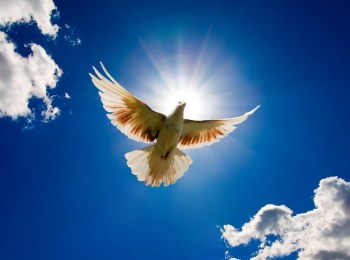
This is why the Spirit descends like a dove, and not like an eagle. Not like a sword or a bomb. But like a dove, a symbol of peace, revealing that when we accept our belovedness, we see that nonviolence is the shape of God’s power in the world.
This is why Jesus’ baptism is so important. For we live in a culture addicted another shape of power. We are taught that change only comes through force, domination, punishment, humiliation, and violence.
Jesus’ baptism teaches us that the reign of God on this earth does not advance by threatening and crushing enemies, but happens by creating beloved community. The kingdom does not come through fear, but through love. And the movement of God does not rise by lording over or climbing over bodies, but by getting in line and kneeling beside them.
So, what does this all mean for us, right here, right now?
It means if the church is following the way of the nonviolent Jesus, we cannot remain safe, secluded, and separated from the suffering of this world.
That means we cannot remain dry while the world is drowning.
It means we cannot sing about justice while refusing solidarity with those who experience injustice.
It means we cannot preach love, and not stand in line with people in places of grief, protest, and exhaustion, with poor people bearing the weight of policies that benefit the rich, with immigrants terrorized by the state, or with all those shaken by the killing of Renee Good—a mother, a neighbor, and a beloved human being whose death has rightly unsettled our conscience.
It means we must be willing to go into the waters where any person or group is struggling to breathe and boldly call the principalities and powers of darkness to repent.
And to do this faithfully, to do this nonviolently, we must listen again for that voice: not the voice of fear-mongering politics; not the voice of religious nationalism. But the voice that still speaks over muddy water and trembling bodies, saying: “Beloved.”
“You are my sons, my daughters, my children.”
You are not forgotten.
You are not disposable.
And you are not alone.
I stand with you.
You are important. You matter. You are beloved.
And if we believe in that voice, we will:
resist injustice without surrendering our humanity;
confront lies without becoming cruel;
and build movements rooted not in fear, but in belovedness.
Jesus gets in line, stands in the mud, and goes underwater so that we might rise, not above anyone, but together, side by side.
This is how Jesus says righteousness is fulfilled.
This is how God still does things in this world.
This is how the heavens are opened.
And this is how the world is changed.
So, as we leave this place this morning, the call of the gospel is both simple and demanding: stand in line.
Stand in line for justice when white supremacy still distorts our laws, our stories, and our sense of who belongs.
Stand in line for voting rights when democracy is attacked and weakened.
Stand in line for social justice when whole communities are denied dignity, safety, and opportunity.
Stand in line for equity when systems continue to benefit some while burdening others.
Stand in line against violence, in our streets, in our rhetoric, and in our policies, when force is treated as the answer instead of a failure of moral courage.
And today, we must stand in line in grief, lament, and protest, for Renee Nicole Good, whose life was taken by violence that never should have happened.
We must stand beside all who live in fear in their own homes, with all whose lives are endangered by power, control, and violence, and we must name this system that continues to terrorize and kill our neighbors as sin. We must refuse to be silent and commit ourselves to work for a world where such violence has no refuge.
We stand in line not above people, not ahead of people, but with people, all the people, especially those who have been pushed to the margins, silenced, or told to wait their turn.
We step in the mud and stand in line in, even when the line is long, even when they call us crazy, even if it feels like hell.
Because when we stand in line like Jesus did, we discover that this is where God stills shows up.
This where the heavens still open up.
This is where love is still heard
And this is the only way the world can still be changed.
Amen.



 Just Love