Seeing the Flag

confederate

Raised in the rural South and as a big Dukes of Hazzard fan, I grew up loving the Condederate Battle Flag. I was proud to be from the South and proud to be a country boy. The flag represented that pride for me.

I believe in free speech and would die for everyone’s right to proudly fly the Confederate Battle Flag on their personal property if they so choose. I do not believe that flying or displaying the flag makes one a racist any more than I believe that not flying it makes one not a racist.

As a white southerner, when I see the Confederate Battle Flag, I may see Southern history. I have the capacity to see Southern pride and heritage. I can see brave men a ho fought for and gave their lives for their homeland. That is what I see.

I think it is interesting that Jesus talked an awful lot about “seeing.” In fact, he talked more about blindness than he talked about sin. He was constantly asking his disciples: “Do you not see?” “Do you have eyes and fail to see.” Furthermore, it is obvious that when Jesus gives sight to the blind, he is symbolically giving sight to others, especially the religious folks of his day.

In the light of the tragedy in Charleston, I now see the flag differently. With many others, I believe I now see the flag more clearly, more wholly, and more honestly, as I now see it through the eyes of those who were murdered in that church. 

Since the tragedy, I have been reminded how the flag has been used and abused by hate groups, mainly by people who long to go back to the day when “black people knew their place.” l realize that the flag now has meanings that it was never intended to have. I also am reminded why the flag was raised at the South Carolina Capitol in the first place: as a symbol of opposition to the civil rights movement.

I also understand that it is a symbol. It is not a sign. It is not a historical marker. Unlike signs, symbols have a particular power to excite and to elicit. Unlike signs that give information invoking a response in the brain, symbols stand for something invoking visceral emotions in the heart and gut. So when I see the flag through the eyes of the victims in Charleston, I can understand the consternation that most of our African-Americans citizens have in the South when they see it. Seeing it on a bumper sticker, t-shirt, or flying in someone’s yard is one thing; seeing it flying by the government or endorsed on a license plate issued by the government that should be working for liberty and justice for all is quite another thing, especially if that government has a history of oppression.

As a Christian, I believe in the words of Jesus, “love one another as I have loved you” and “love your neighbor as yourself.” I believe we do that best by trying to put ourselves in the shoes of others, when we try to see the world through the eyes of others, especially through the eyes of the oppressed, the poor, the marginalized, the disadvantaged, the least of these our brothers and sisters.

And it is a shame that it took the slayings of nine people to help me see that.
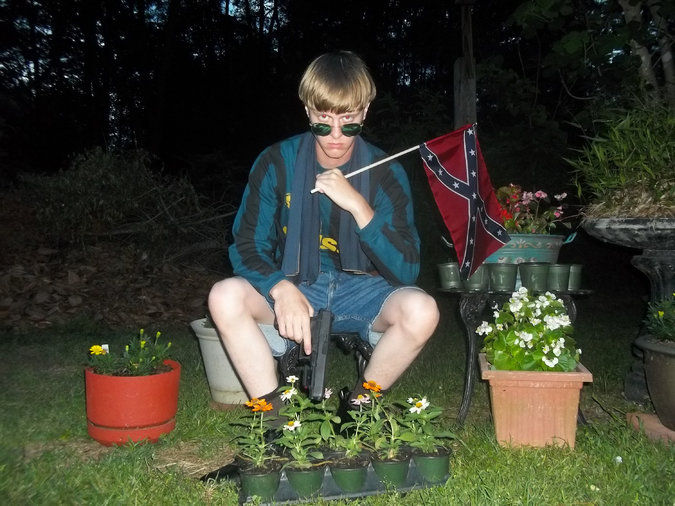
Charleston Wake-Up Call: Five Thoughts

dylann roofI have heard many people call the massacre in Charleston a wake-up call for our country. I believe it is specifically a wake-up call for predominately white churches in our country. As a pastor of a predominately white church in the South, here are five thoughts that have been awakened in me:

  1. We must wake up to the reality that racism is not only a wound from our country’s past, but it is a deadly virus that still plagues us today. White preachers, including myself, have been often afraid to use the “r-word” from our pulpits for fear of “stirring things up,” as if we might reignite some fire that was put out in the 1960’s, or at least by 2008, when we elected our first black president. We must wake up and boldly preach against racism, in all of its current manifestations that are ablaze today: personal racism; systemic racism; and the subtle racism that is prevalent in the workplace, in the marketplace and even in the church, for Jesus could not have been more clear when he said: “Love your neighbor as yourself.”
  2. We must wake up to the reality that preaching and working against racism is not “being political,” but it is being “Christian.” When voting districts are re-drawn to limit poor black votes or when laws are created that make it more difficult for poor black people to vote, we must stand up and boldly proclaim the message of Jesus who came to announce “good news to the poor.”
  3. We must wake up to the reality that hatred in this country is being defended by church folks who are calling it “religious freedom.” In the United States of America, where we believe all people are created equally, religious freedom never means the freedom to discriminate. Slave-owners used the same religious-freedom arguments in the nineteenth century to support slavery. Today, we do not tolerate people who want to own slaves, nor should we tolerate anyone or respect the views if anyone who wants to discriminate.
  4. We must wake up the reality that “the oppression of Christians” in this nation and the “war on Christmas” that we hear about every December has been manufactured by folks who loathe what makes our country great, that is our cultural, ethnic, religious and racial diversity. We need to also preach from our pulpits that it is this diversity that makes us look most like the portrait of heaven we find in the book of Revelation: “After this I looked, and there was a great multitude that no one could count, from every nation, from all tribes and peoples and languages, standing before the throne and before the Lamb” (7:9). We must wake up to boldly voice our opposition to the purveyors of fear who are calling on people to bear even more arms “to take our country back.” Furthermore, we must wake up and tell the folks in our pews to please shut up, when they start reminiscing about going back to the good old days of the 1950’s when we had prayer in school. We need to be able to say: “You know, I have many black friends, and I have never once heard them talk about wanting to go back to 1950.”
  5. We must wake up to the reality that the most segregated hours in our country occur on Sunday mornings. We must find ways to build bridges to bridge the gaps that we have created that prevent us from worshipping and serving together. To stand against racism, hatred and violence, to stand for social justice and equality for all, and to persuasively speak truth to power, we must do it side by side, hand in hand, as one body, one Church, serving one Lord.