This Ain’t No Cruise

Isaiah 1:1, 10-20

At this hour last Sunday, Lori and I had just been forced off the “Fun Ship” called “the Carnival Sunshine” which had returned to Norfolk from an 8-day Caribbean cruise.

Now, I only say “forced off” in jest, but there was a part of us that really didn’t want to get off that boat. For we had just experienced a week of extravagant leisure, a week where our biggest decisions were: The buffet or the dining room? The baked Alaska or the crème brûlée? The pool deck or the beach excursion? How many naps do I take today? Will I snooze in my cabin or out under a cabana?

And behind all this pleasure was our charming, enthusiastic cruise director, who just happened to be from just down the road in Danville.

He had the type of haircut, personality and southern accent that made me think: “You know, I can see myself in this line of work.”

Seriously, I believe I have what it takes to be a great cruise director. Smile big, talk fast, and make sure no one thinks too hard about what’s going on behind the scenes. Just keep the show going and the mood light, even if the ship is headed straight into a storm! Use my gifts of schmooze to keep everybody on board entertained, distracted, and happy.

And I can’t help but to think how many pastors out there, like me, are also well-suited for this type of work; and unfortunately, how many of them function more like cruise directors than pastors in their churches.

For how many sanctuaries have been turned into cruise lounges? How many chancels have been transformed into theatrical stages? How many sermons are just spiritual entertainment? How many worship services are designed to make people feel good but not do good?

A cruise director never challenges you. Cruise directors don’t convict you. They never ask you to change your life, to give up something, to sacrifice anything, to take any risk. On the contrary, they want you to avoid risk. A good cruise director is there to make sure the activities are safe, the music is right, the lights are warm, the drinks are flowing, and your conscience is quiet.

All while injustice rages on the shore.

The truth is that too many churches today have become floating sanctuaries of self-centered peace, enjoying smooth sailing while the poor are drowning in debt, depression, and despair.

The good news is, while I am convinced that I could be an excellent cruise director, and I’m still a little tempted to google their annual salary, the prophet Isaiah comes today to remind me that God did not call me to be a cruise director. God didn’t call me to keep the church comfortable, safe, and happy. God called me to speak truth that is often uncomfortable and even dangerous, as God calls us to live justice, to be the people of God in a dark world flooded with cruelty, corruption, greed and spiritual compromise.

Isaiah tells it like it is in today’s Hebrew lesson: God has absolutely no interest in our religious performances if it does not inspire justice. God isn’t impressed by our singing, our prayers, our preaching, or even our communion. God says, “I’m tired of your offerings. I’m sick of your noise. I am fed up with it all. All I want is to see how you treat the most vulnerable among you.”

And Isaiah’s not playing around:

Hear the word of the Lord, you rulers of Sodom! Listen to the teaching of our God, you people of Gomorrah!

Now, Isaiah’s not talking to pagans. He’s not talking to outsiders. He’s talking to the religious people, to the faithful folks: the worshippers; the tithers; the choir members; the Bible study attenders. And he calls them “Sodom and Gomorrah” because of how far they’ve drifted from whom they have been called to be.

They were faithful doing all the religious stuff: showing up for worship; observing the liturgical calendar and all the rituals; making sacrifices; offering prayers; singing hymns. But God…God wasn’t impressed.

I have had enough of your burnt offerings!
I do not delight in the blood of bulls…
Your new moons and your appointed festivals, my soul hates.
Even though you make many prayers, I will not listen.

God says:

You’re making a lot of noise, but you’re not being a movement.
You’re throwing parties for yourselves while the poor are languishing.
You’ve built a sanctuary, but not a shelter.
You’re singing and dancing all while the blood of the oppressed cry out from the streets.

You’ve made church a place of escape rather than engagement.
Your worship is more like a cruise rather than a call to action!

In other words, “You’ve turned my house into a Carnival Fun Ship!”

Jeremy, Mark, Judy, choir, hear me when I say there’s nothing wrong with beautiful music offered to God. Just as there is nothing wrong with well-prepared sermons or joyful gatherings. Verna, there’s nothing wrong with well-organized communion. And of course, there’s nothing at all wrong with having a big offering! But if all this beauty ever becomes a substitute for doing justice, it’s not worship, says Isaiah, it’s idolatry.

Pastors who succumb to the temptation to use their cruise-director gifts in the church want their congregants to enjoy the journey but do nothing to challenge the systems. They want their parishioners to put their hands in the air for Jesus, but never encourage them to lift a finger for the poor. They want their members to memorize the creeds, but forget about Medicaid, minimum wage, and mass incarceration.

A cruise director doesn’t ask you to sacrifice or leave your comfort zone. But a real pastor, a prophet, most certainly will.

Because that’s what God has called us to do.

God has called pastors to stand up with Isaiah and prophetically proclaim to our congregations:

“Cease to do evil and learn to do good; seek justice and rescue the oppressed, defend the orphan and plead for the widow.”

God has called us to constantly remind our congregations that that’s the kind of worship that God wants. Not empty rituals in the sanctuary, but radical righteousness in the streets. Not polished performance, but public accountability to the least of these.

Have you ever felt like God is not listening to your prayers?

Isaiah suggests that the reason we sometimes feel like God isn’t listening to our prayers is because God isn’t listening to our prayers!

Isaiah says that if we truly want to know that God is listening to us, if we truly want to feel God’s presence, if we want our worship to me meaningful, then we must do some things.

And if we don’t do those things, according to Isaiah, God might respond to our worship this way: “Stop tramping into my courts. And I have had enough of your preacher. His sermons, his prayers, your hymns, everything about your church, they have become a burden to me. And I have stopped listening!”

If we want our prayers to be received by God, Isaiah says that we better be doing what we can help the most vulnerable members of our community.

Frederick Douglass once said, “I prayed for freedom for 20 years, but God didn’t hear my prayer until I moved my feet.”

After marching in Selma for civil rights, Rabbi Abraham Heschel said, “I felt my legs praying.”

This sanctuary can be full of people who have gathered for God on Sunday morning, but if nobody’s using their legs to stand up for the marginalized come Monday, God says: “it means nothing.”

We can shout down the walls of Jericho, but if we never speak out against building a wall with the bricks of racism, God says: “Our hands are full of blood.”

We can post Bible verses all day on social media, but if we stay silent while fascism is in power, while Gaza is being ethnically cleansed, while LGBTQ youth are targeted, while immigrants are scapegoated, while healthcare is gutted, while workers are exploited, the planet is polluted, and while the single mother, the disabled neighbor and the black child are caught in the crosshairs of systemic sin, then our faith is just a lie.

True faith moves us out to the front lines, moving us from ceremony to solidarity, from pews to picket lines, from pulpits to protests.

So, let me take you back to that cruise.

Folks lounging on the deck. Others wading in the pool. Music playing. Bob Marley singing, “don’t worry about a thing ‘cause every little thing gonna be alright.” Food and drinks being served. Laughter in the air. The cruise director’s doing his job: keeping us all smiling, dancing, relaxed, full, and distracted.

Now, on vacation? That’s fine. But in church? That’s deadly.

And today, too many churches have gotten comfortable relaxing on the deck. Sunning themselves under the glow of cheap grace. Floating along on the sea of privilege. Sipping sweet spiritual drinks while the world is drowning just off the side of the ship.

I’m glad to see all of you here this morning, but if you’re looking for some comfort, this ain’t the place.

If you’re looking for some entertainment, you’re in the wrong room.

If you’re looking for somebody to tell you everything is fine, while the world is on fire, this ain’t that church, and I pray I ain’t ever gonna be that preacher!

Because although I believe I could be a good cruise director, I believe God has called me to be a pastor.

After a summer break, Java with Jarrett returns this week at a new location. And I can’t think of a better place to meet with the pastor. Located in the Givens bookstore, it’s called “the Troublemaker’s Café.”

Because as a pastor I have been called to keep reminding you: It’s time to get off the boat and into the deep, into the struggle, into the messy, risky, beautiful, troublemaking work of real worship. God has called us to be prophets of another way, to be builders of a better world, to be troublemakers for truth.

Listen again to these words:

Seek justice, rescue the oppressed, defend the orphan, plead for the widow.

That’s not vacation talk. That’s vocation talk. That’s God calling us to jump off the deck and into the deep waters of justice!

The good news for our world today is that God is still calling, still pleading, still inviting:

“Come now, let us argue it out. Though your sins are like scarlet, they shall be like snow.”

This is what the grace of God looks like. It’s not just to save us. It’s to change us. It’s not just to comfort us. It’s to call us forward, to remind us that the time for playing church is over, and the time for becoming the church is now!

So, here’s our challenge today:

If you’re looking for a cruise, this ain’t it!
If you’re looking to be entertained, you’re in the wrong place!
But if you’re ready to live your faith out loud…
If you’re ready to lift your voice against injustice…
If you’re ready to love your neighbor as yourself, not just in word but in deed, not just with your prayers, but with your legs, then this is the church for you!

Yes, the water’s deep. The waves can be scary. But Isaiah assures us that God will be with us! Because we’re not playing church here. We’re becoming the church!

And the world is waiting.

Amen.

All Are Welcome, but…

Homecoming sign

Matthew 22:1-14 NRSV

Jesus said that the Kingdom of God is like a King who hosted wedding banquet for his son. But today, let’s say that the Kingdom of God is like a church hosting their 160th Homecoming Celebration.

The church sent out invitations, publicized it in the newsletter, on their on their sign out front, on their website and all over social media. The invitation was generous: “A bountiful table has been set.” The invitation was inclusive: “All are invited.” And the hospitality promised to be extravagant: A fat cow grilled, a fat pig barbequed, and thirty fat chickens fried golden brown.

Now, most people who rode by the church and read the sign “made light of it” and never gave the invitation much thought at all. They simply continued down the road, some to their farms, others to their places of business, others to CVS or The Little Rocket. Most who came across it in their facebook newsfeeds continued to scroll down to look at funny pictures and videos that had been posted by their friends.

However, some people who read the invitation were rather offended by the inclusive welcome. “What do they mean, ‘all are invited.’? Do they really have the audacity to invite all? If I go, will I have to sit at the same table with the poor, the undeserving, the marginalized, tax collectors and sinners?”

Some became so offended by the invitation that they even had thoughts which proved that the preacher was right when he one day proclaimed: “When you truly love all people and try to convince others to love all people, there will always be some people, probably religious people, who will want to kill you.”

On the day of the feast, many were found to be unworthy as they refused the invitation because the very thought of attending any party with some people was too much to bear.

But many accepted the generous invitation. For they knew that the invitation to the table came not only from the church, but it came from the Lord Himself. So, they came. They came through doors that were opened wide and they came to a table made large by the Lord. They came, and they filled the sanctuary. They came, the good and the bad, saints and sinners. They came from all walks of life, with diverse backgrounds and different beliefs. But they came united by the same extravagant love, the love of their Lord who lived for all and died for all. They disagreed, but they were not divided. They came together in love, through love and by love.

The love which united their hearts was so amazing, so divine, so selfless and so sacrificial that it literally changed them. It changed them inwardly, and it changed them outwardly. Sorrow was turned into joy, stress was replaced by peace, and despair was changed into hope.

It was a radical transformation. Everyone in the sanctuary that morning was covered with grace. They were clothed by grace. It was as if they were all wearing it like a beautiful garment.

Hate was replaced by love. Pride was transformed into humility. Judgment was replaced by acceptance. And complacency was turned into passion. Simply accepting the invitation of the Lord was replaced by a commitment to follow the Lord. Simply admiring the Lord being a shallow observer of the Lord, being a casual fan of the Lord, was transformed into a deep and deliberate discipleship.

Someone sent me the following quote on facebook this week:

Most of us don’t mind Jesus making some minor change in our lives but Jesus wants to turn our lives upside down. Mere fans of Jesus don’t mind him doing a little touch-up work, but Jesus wants complete renovation. Fans of Jesus come to Jesus thinking tune-up, but Jesus is thinking overhaul.

I have heard United Methodist Bishop William Willimon say something like, “Jesus does not want to meet our needs; he wants to rearrange our needs. He does not want to merely fulfill our desires; he wants to transform those desires.”

One of my favorite quotes by Henri Nouwen is that Jesus wants to take us to places we would rather not go: dark, dangerous, dreadful places.

And on that day, that glorious Homecoming morning, the people came and were changed the the grace of it all. They were overhauled. They filled the sanctuary, united by love, ready and willing to follow their Christ wherever he leads.

Then comes the disturbing part of the parable.

But one of the guests at the Homecoming service that day was sitting there in his pew unchanged. He was just sitting there unmoved, unaffected by the extravagant grace of it all, the generous hospitality of it all.

And he was asked, “Friend, how did you come here and not be changed? How did you accept such a generous invitation, receive such an extravagant hospitality, receive such a divine love and an amazing grace, and not be transformed? How can you receive love and not love others? How can you receive grace and not extend grace to others?”

The man was speechless. And the congregation watched in horror as the deacons sprung into action. They went over to the man, picked him up, tied a rope around his feet and hands, and carried him out the front door.

And when the congregation turned back around to face the pulpit, the preacher matter-of-factly said: “Many are invited, but few are chosen.”

That is harsh! It is why I don’t like this parable. But should it surprise us?

A couple of chapters later we read something remarkably similar.

A King will say, “You that are accursed, depart from me into the eternal fire prepared for the devil and his angels; for I was hungry and you gave me no food, I was thirsty and you gave me nothing to drink, I was a stranger and you did not welcome me, naked and you did not give me clothing, sick and in prison and you did not visit me.” Then they also will answer, “Lord, when was it that we saw you hungry or thirsty or a stranger or naked or sick or in prison, and did not take care of you?” Then he will answer them, “Truly I tell you, just as you did not do it to one of the least of these, you did not do it to me.” And these will go away into eternal punishment, but the righteous into eternal life.

Jesus seems to be saying, “All are welcome, but…”

The invitation is inclusive. The hospitality is extravagant. The grace is generous. The love is divine. The doors are wide and the table is large. All are welcome, and “all” means “all”, the good and the bad, the sinner and the saint, all are welcome, but…

All are welcome to this Homecoming Sunday this morning, but there is something more going on here on than a gathering of friends and family, an observance the Lord’s Supper, the singing of hymns, the preaching of a sermon and sharing an extravagant meal on the grounds.

All are welcome, but there is no real acceptance without the acceptance of others.

All are welcome, but there is no real love without loving those who hunger for it.

All are welcome, but there is no grace without extending grace to those who thirst for it.

All are welcome, but there is no forgiveness without forgiving those who have trespassed against us.

All are welcome, but there is no Holy Communion without the offering of our own bodies, the pouring out of our own lives as living sacrifices.

All are welcome to the table, but there is no true sharing, no true fellowship, no true nourishment, without feeding the hungry.

All are welcome to put on the white robes of baptism, but there is no meaning in those garments without clothing the poor.

All are welcome, but there is no life, abundant or eternal, without the dying of self.

All are welcome, but there is no salvation without the cross.

All are welcome, but if there is no discipleship; if there is no desire to follow Jesus; no commitment to stand against the bullies of this world, to share hope with the victims of bullies everywhere; if there is no commitment to stand for the poor, the marginalized, and the outcasts; no desire to eat with tax collectors and sinners; no dedication to love the least of these our brothers and sisters; well then, the deacons might as well pick you up, bind your legs and arms, and carry you out the front door.

That is harsh. It is why I don’t like this parable. It is why I use the entirety of the Bible to interpret this part of the parable.

Now here’s the good news. As far as I know, there is not a deacon in this room who is prepared to pick anyone up and throw them out the door this morning. Each person in this room is different. We come from different backgrounds, different walks of life, and we have different beliefs. We are at different places in our journeys of faith. But we came through these doors this morning united by the same love: the extravagant love of our Lord who lived for all and died for all.

And listen to the good news in the words of the Apostle Paul concerning this love:

Jesus’ love is patient. Jesus’ love is kind; the love of Christ is not envious or boastful or arrogant or rude. The love of our Lord love does not insist on its own way; it is not irritable or resentful. The love of Christ does not rejoice in wrongdoing, but rejoices in the truth. The love of the Lord bears all things, believes all things, hopes all things, endures all things.[i]

So let us join God and keep loving one another with the patient love of our Lord and our Savior. And may this love always be with us as we continually seek to change to be the people and the church God is calling us to be. Amen.

[i] Gale Burritt Hagerty, a thoughtful Christian friend responded  with these words from 1 Cor 13 to the interpretation of Jesus as “belligerent” and “demanding” in the following quote: “Most of us don’t mind Jesus making some minor change in our lives but Jesus wants to turn our lives upside down. Fans don’t mind him doing a little touch-up work, but Jesus wants complete renovation. Fans come to Jesus thinking tune-up, but Jesus is thinking overhaul.”


Pastoral Prayer Inspired by Dietrich Bonheoffer

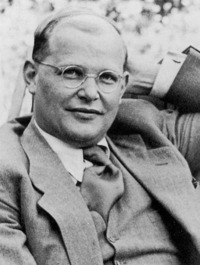
Dietrich BonhoefferDietrich Bonhoeffer did not have to help Jews escape Nazi Germany and flee to Switzerland.  After all, he was safe and sound in New York in the early 1940’s. He was free to stay in America and preach the gospel from the safety of a free church pulpit or teach New Testament in the peace and freedom of a university. But the gospel he preached compelled him to return to Germany and stand against Nazi aggression.

Before he was executed by the Nazis in 1945, he wrote the following words that I believe the American Church that is embedded in a narcissistic society needs to hear again and hear loudly:

Cheap grace is the preaching of….forgiveness without requiring repentance, baptism without church discipline, communion without confession…  Cheap grace is grace without discipleship, grace without the cross, grace without Jesus Christ living and incarnate. Costly grace is…the gospel which must be sought again and again. The gift which must be asked for, the door at which one must knock. Such grace is costly because it calls us to follow Jesus Christ.  It is costly because it costs us our lives. It is grace because it gives us the only true life.

The following pastoral prayer was inspired by Bonhoeffer’s timeless words:

O good and gracious God, we come to this place this morning to recommit ourselves to being faithful disciples of Jesus Christ our Lord and Savior. However, if we are ever going to truly follow Jesus, we will first need to repent of our sins that are derived from our love with what your servant Dietrich Bonhoeffer called “cheap grace.”

We gather in this place Sunday after Sunday to hear preaching that will remind us that we are loved and forgiven; not to hear that we need to change our selfish ways.

We gather to remember the way we came up out of the waters of our baptism to symbolize life abundant and eternal; not to remember our immersion into the waters to symbolize death to self.

We come to gather around a table to receive the gift of Holy Communion; not to confess our sins and our shortcomings.

We come to this place to receive grace and love; not to be encouraged to share grace and love with others.

We come here to worship at the foot of the cross; not to pick it up and carry it ourselves.

We come here to worship Christ in the safety and comfort of this sanctuary; not fully realizing that the Christ is actually alive today, present  here, calling us, prodding us, pulling us to follow him out into a risky and uncomfortable world.

So, O God, forgive us of our love for “cheap grace.” Help us to truly repent, turn from our wicked ways and seek to live for a grace, in a grace, and by a grace that is worthy of your sacrificial love for us, even if it is “costly.”

May we come to this place to seek this grace Sunday after Sunday. May we keep asking, keep knocking at your door, keep giving our lives away to you, keep denying ourselves, and keep looking to you for the strength we need to pick up our crosses and follow our Lord and our Savior wherever he leads. Because we know that this grace, although it costs us our very lives, is the only way to true life, abundant and eternal. We pray this in the name of Jesus Christ our Lord.  Amen.