When Christ Is King

John 18:33-37 NRSV

Some of you may remember Yakov Smirnoff, the Ukrainian comedian, who was made famous in the 1980’s with the saying: “America: What a Country!”

When he first arrived in the United States, he was not prepared for the incredible variety of instant products in American grocery stores.

He once told the story of visiting a grocery store  just days after he came to America. He said:

“I love this country, I walked down one aisle and saw a jar of powdered orange juice—’just add water the jar’ said.  Isn’t that wonderful, just add some water and you get orange juice!”

He went on: “I walked down another aisle and saw a box of powdered milk. Just add water and you get milk.  Then ran across a box of powdered eggs. Just add water, and you get eggs.”

He said, “I then went down another aisle and saw a container that said, ‘Baby powder,’ and I thought to myself, ‘America: What a country!’”

I have wondered if those of us who have been a part of churches where infant baptism is not practiced are sometimes tempted to believe that when it comes to baptism. That all a congregation must do for someone to be made into a Christian, a follower of Jesus, is to just add some water. Just fill up the baptistry with water and get a person wet!  And before they can dry off, we are patting ourselves on the back saying: “Good job! We did it!! Our work as a church is now finished!” Hallelujah, praise the Lord!”

Consequently, the promises spoken and the commitments made during some baptismal events are solely made by the person being baptized. No promises are made by the congregation. The congregation’s work is over.

However, with the infant baptism that we just observed, it was only the congregation who made the promises, as precious little Phyllis Rose wasn’t able to promise anything. When an infant is baptized the work of the congregation is just beginning.

And, how appropriate is it in 2024 that we are making such commitments on this Christ the King Sunday, as commitments have never been more needed to following the peculiar, counter-cultural, other-worldly, other-realm way of life that Jesus decrees.

As Jesus reminded Pilate after he is arrested, when Christ is our King, our Kingdom, our truth, our worldview, our understanding of birth, life, and death, of meaning and purpose, is not from this world.

Jesus’ statement that if his followers were from this world, they would fight to keep him from being handed over, speaks to the hyper-masculinity of our current world.

Throughout world history, authoritarian tyrants have used hyper-masculinity as the solution to large, complex societal problems, such as some of the problems our country faces today: climate change, inflation, income inequality, loss of manufacturing, and the rise of artificial intelligence.

A history of sexual violence toward women and a felony record only helps such autocrats who claim that they alone have the manly strength to fix all that is wrong, offering a simple explanation for all problems of the nation: We are having these problems because there are these people who are making us weak, less masculine, like immigrants (who are polluting our blood) and LGBTQ people (who are polluting our sexuality and gender).

This reign of hyper-masculinity favors the super-rich, because as the poor continue to get poorer, instead of blaming the rich, the true source of their problems, they’ve been conned into blaming those who have polluted their sexuality and blood.

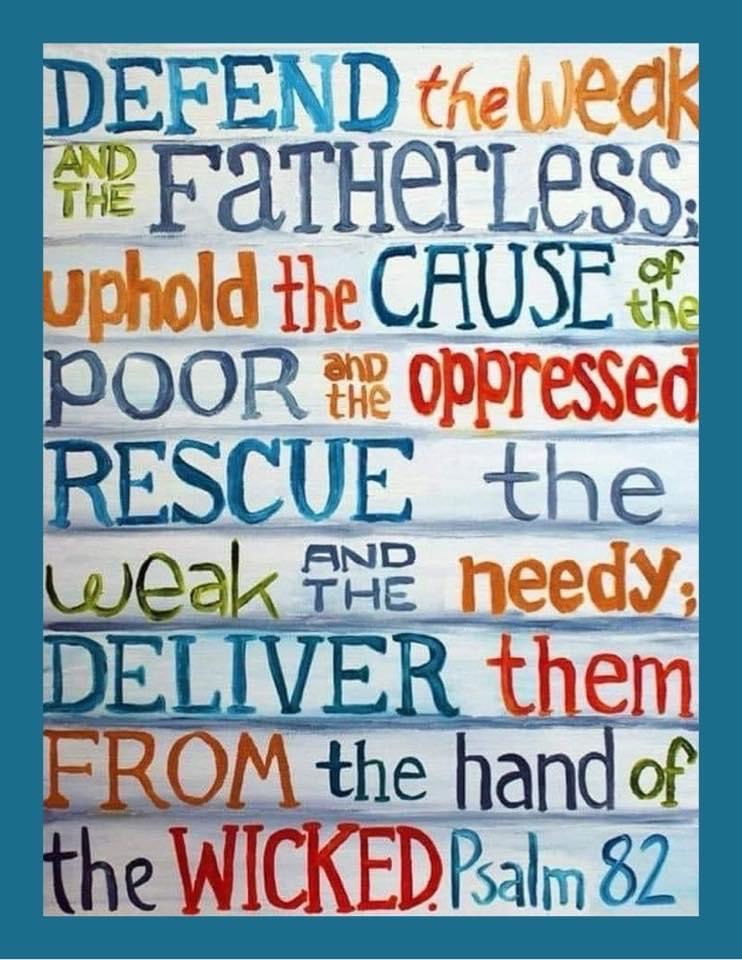
The reign of Jesus is the exact opposite, because the reign of Jesus heralds the truth that God favors the poor, the meek, and the peacemakers. The reign of Jesus heralds the good news that God favors those who hunger and thirst for justice and is on the side those who are grieving.

The reign of Jesus supports the most vulnerable, stands on the side of the marginalized, defends the rights of women, elevates the widow, and defends the Eunuch.

The reign of Jesus fills the hungry with good things and sends the rich away empty. The reign of Jesus casts down the powerful and lifts up the lowly and decrees that the Kingdom of God belongs to little children like Phyllis Rose.

This is why our commitments today through this service of baptism to guide Phyllis in the way of Jesus are so important. In a world where Phyllis will be bombarded with lies, made-up stories, and propaganda pulling her in the opposite direction, we as the church must be intentionally vigilant in our efforts to guide Phyllis in the gospel truth.

In a world where many do not understand Jesus’ kingship, and others, even those in the church, reject it outright, we’ve made promises before God today to demonstrate to Phyllis that Christ is our King. That the voice that we listen to has never sat on any earthly throne or ever once occupied the White House.

And the voice we listen to tells us that those in this world who have power over us, those who control our thoughts and our actions, are not the strong, the powerful, and the hyper-masculine. But they are the weak, the powerless, and the most vulnerable among us.

And that the perfect example of those with the most power in our lives, in our world, is the tiny precious infant we have baptized this day.

Because, when Christ is King, little children reign supreme.

When Christ is King, the least among us are the greatest, and the last are first.

When Christ is King the humble are exalted and the meek inherit the earth.

When Christ is King, there is no longer male or female, but all are one.

When Christ is King (in the beautiful words of feminist artist Judy Chicago), then…

All that has divided us will merge

And then compassion will be wedded to power

And then softness will come to a world that is harsh and unkind

And then both men and women will be gentle

And then both women and men will be strong

And then no person will be subject to another’s will

And then all will be rich and free and varied

And then the greed of some will give way to the needs of many

And then all will share equally in the Earth’s abundance

And then all will care for the sick and the weak and the old

And then all will nourish the young

And then all will cherish life’s creatures

And then all will live in harmony with each other and the earth.

And then everywhere will be called Eden once again

Amen.

Jesus Is the Answer

Ephesians 1:5-23 NRSV

On this Sunday after Thanksgiving, as a Christian pastor, I am most thankful for Jesus, for I truly believe with all my heart, for me personally, Jesus is the answer.

Now, I know how cliché, cheesy and bumper-stickery that sounds, but I can’t help it. When it comes to questions about theology, about all I got for an answer is Jesus.

And you should know that I dislike few things more than bumper-sticker theology! It tears my nerves up when people try to reduce something as miraculously mysterious as faith in the Holy-Source-of-all-that-is into a few pithy words to slap on the back of a vehicle.

“Jesus is my co-pilot.” If Jesus is merely your co-pilot, I suggest you switch seats. Because I believe it’s Jesus who needs to be your pilot, the one who makes the decisions, charts the course, and steers the ship, leading you on the way of love that has the power heal sick religion, restore a distorted morality and make whole a fragmented planet.

“Honk if you love Jesus.” Please don’t do that. If you truly love Jesus, if you are following the way of love that Jesus embodied and taught his disciples, please, never toot your own horn. If you really love Jesus, feed the hungry, clothe the naked, shelter the homeless, love the outcast, forgive the sinner, care for the dying, and be a friend to the lonely.

“Got Jesus?”  No, I don’t. Because I don’t believe Jesus can be “got.”  I believe the way of love Jesus modeled wants to get us. Jesus wants to get us to deny ourselves, pick up a cross and follow him. We don’t get Jesus to meet our needs. Jesus wants to get us to meet the needs of the world. We don’t get Jesus as some sort of ticket to heaven. Jesus wants to get us to bring heaven to earth.

“Jesus is the reason for the season.” If we call ourselves a Christians, shouldn’t Jesus be the reason for every season, be the Lord over, reign over, every season, every month, and every day. Shouldn’t the way of love of give meaning and direction to our lives all year long?

“Keep Christ in Christmas.” Why don’t we first try to keep Christ in “Christian?” For I believe the reason so many people are turned off by Christians today is because many Christians act nothing like the Christ by whom they identify themselves. And in many cases, behave in a way that is best described as anti-Christ.

“If Jesus had a gun, he’d still be alive today.” No, I am afraid that it is because of Christians like you that the way of Jesus seems dead in this world today.

“Are you following Jesus this closely?”

Hmmm. I actually kind of like that one.

However, I am thankful that faith in God cannot be condensed into a few simple words that will fit on a bumper sticker. Yet, this Sunday after Thanksgiving, I still am most thankful, that for me, that Jesus is the answer.

On this Christ the King Sunday, I am thankful for these beautiful words of Ephesians:

God put this power to work in Christ…far above all rule and authority and power and dominion…And [God] has put all things under his feet and has made him the head over all things for the church, which is his body, the fullness of him who fills all in all. Jesus is above all and is the head over all things.

That is why we celebrate this “Christ the King Sunday” on the last Sunday of the Christian calendar. At the end of the year, we proclaim that our church, our faith, our theology, everything we do, is all about Jesus. In other words, Jesus is the answer.

This is particularly good news for me as I am one who readily confesses that, when it comes to faith and theology, when it comes to this amazing grace that we call life, I have far more questions than I have answers. In fact, over the years I have discovered that the more I know the less I know.

For me, life is as mysterious as it is miraculous. The very existence of God, and the specific revelation of God through Jesus Christ, is even more miraculously mysterious. God, the creator of all that is, is so incredibly large that I will never be able to wrap my mind around God. And I will never understand the height, the depth and the breadth of the love of God.

My mind is not only very small, but I believe it is also very flawed. Whether one blames it on “original sin” or “the Fall of Humankind” or just “being born in an imperfect world,” we can agree that all of creation is seems to be fragmented. Consequently, as a creature on this earth, I will always understand God and God’s will for the world and my life as “seeing through a glass darkly” (1 Corinthians 13). My understanding will always be limited, imperfect and incomplete.

As I was waiting to get my car inspected this past Wednesday, when they found out I was a pastor, someone asked me if I thought we were “living in the last days.”

Honestly, I don’t know much about such things. All I know is that life is precious, fragile and fleeting and, as I said last week, none of us are guaranteed that this is not our last day.

In the days before Halloween, someone asked me about the role of Satan and demons in the world. Again, I don’t know about that. I believe demonic evil is real and personal. I have experienced it in the hate that has been directed at me by people, ironically by those who claim to be Christian, but I don’t really know where it comes from or exactly why it exists in this world.

People have asked me the same questions about angels. Some people believe they have guardian angels that have intervened in their lives, sometimes saving their lives. Again, I don’t know much about that.

People ask me if God created it all, then who created God? Who was Cain’s wife? How did that fish swallow Jonah? How can God be both God and Jesus? If Jesus was God, how does God pray to God? Why do some people seem be blessed and others seem to be cursed? Why are some people healed while others suffer and die? Do people who do not accept Christ as their Lord and Savior go to Hell? What about people who have never heard of Jesus? What about two-thirds of the world’s population who were born and raised in another faith? What really happens to us after we die? Does the soul really leave the body immediately and go to heaven?  What does the Bible mean when it talks about the dead being raised on the last day? Do we have a soul? Are we really any different than animals? Again, I know very little about such things.

And I believe there are many people who agree with me on this. And they say that this is one of the reasons that they find faith in God so difficult. They don’t have all the answers. Consequently, they call themselves agnostic or atheist. And I respect that. In fact, I get along better with agnostics and atheists, than Christians who believe they have all the answers.

However, for me, living in this fragmented world, I cannot imagine life without some type of faith. Without faith, it’s difficult for me to understand how my life would not be devoid of meaning. For there would be nothing to define my life, steer my life, fulfill my life, to give my life hope other than my own selfish desires. So, to give my life meaning, I choose to believe that God, or the Creator of all, or a Higher Power, is not completely mysterious.

After all, I do know some things. I know that I did not do anything to earn the gift of life. I know life is in an inexplicable gift of grace. And I am compelled then to express gratitude for this gift. And the only way I know to do that is through a life of faith in the Giver, the source and power behind it all.

Furthermore, I have specifically chosen a life of Christian faith in this Source or Power. I have chosen to make the God, that is revealed in the words and works of Jesus, my God. I often wonder if I would have chosen this faith if I was born to parents in another part of the world. Nonetheless, I am grateful for the way that this choice informs my beliefs and enriches my life today.

Consequently, my limited understanding of who God is, how God acts and what God desires is derived from the words and actions of Jesus as revealed in scripture. In other words, Jesus is the answer.

As you have heard me say before, I don’t know much. I don’t have all the answers. However, on this “Christ the King Sunday,” on this Sunday after Thanksgiving, I am very grateful that for me personally, Jesus is the answer. The revolutionary way of Jesus recorded in the Holy Scriptures—the radical way Jesus elevated the status of women, lowered himself to wash the feet of others, befriended the lowly, welcomed the stranger, learned from the foreigner, sought justice for the poor and the marginalized, brought wholeness to the disabled, fed the hungry, defended and forgave the sinner, embraced the untouchable, welcomed the children, told extravagant stories of grace and love, healed the sick—the scandalous way his selfless love for others led him to suffer and die on a cross, the way he sacrificially gave his body and inclusively poured his life out for all people, is more than enough to build my life around, to give my life purpose, meaning, direction and hope.

Question: Jarrett, what if we are living in the last days? Answer: I am just going to keep following the way of Jesus, keep doing the things that Jesus did, keep loving the people Jesus loved, keep taking the stands that Jesus took.

Question: Dr. Banks, how real and powerful is the demonic? Answer: Not as real and as powerful as the way of love that Jesus taught and embodied.

Question: Rev. Banks, do you believe angels can save you? Answer: I believe the way of love Jesus emulated saves me, and that is enough for me.

Question: Rev. Dr., why do people suffer? Answer: Jesus suffered, thus when we suffer, I believe that the Divine compassionately, empathetically and intimately understands, and that is all I really need.

Question: Preacher, where are we going when we die? Answer: We need to be more concerned about where we are going while we are living, to the places and to the people Jesus went.

Question: Pastor, what is the meaning of life? Answer: Well, Jesus said that the greatest commandment is to love our neighbors as ourselves. And that is enough for me.

Question: Minister, what will it take to make the church relevant in the 21st century? How can the church be revived to make a positive impact in the community, throughout the region and around the world?  Answer: Jesus. The way of love that Jesus modeled. The acts of welcoming, healing, feeding and liberation that Jesus performed. Jesus is the answer.

I know it sounds like a bumper sticker. But you know something? I really don’t care. Because for me, and perhaps for you. For the sake of the church and this world, I believe Jesus is the answer.

         Jesus is my king, my lord, my savior, my friend, my guide, and my hope in life and in death.

Who Is Your King?

christ the king

John 18:33-37 NRSV

Jesus has been arrested for his words and deeds and has already been questioned by Caiaphas, the high priest. Because the sad truth is, that in this world, when you love all people and teach others to love all people, there will always be some people, probably religious, who will want to kill you.

It is now Pilate’s turn to question him.

“Are you the King of the Jews?”

Jesus is the King. But as he told Pilate, Jesus is a different kind of King, for his kingdom “is not from this world.” He adds: “If my kingdom was from this world, my followers would be fighting to keep me from being handed over to the Jews. But as it is, my kingdom is not from here.”

And, if we are honest, this makes those of us living in this world very uncomfortable. But that is Jesus. He comforts the afflicted of this world and afflicts the comfortable of this world. Whether we like to admit it or not, the truth is, we have grown rather fond of the kings and kingdoms of this world.

We prefer the kingdoms in this world that “would be fighting” to keep Jesus “from being handed over to the Jews.”

Nowhere is this more clear than in our response to the threat of terrorism that is in our world today.

We prefer “an eye for an eye and a tooth for a tooth.”

We prefer “It’s not our job to judge the terrorists. It’s our mission to arrange the meeting.”

We prefer “I hear you, and the ones who knocked down these buildings will soon hear from all of us!”

We prefer “the statue of Liberty…shaking her fist.”

The truth is that we prefer answering violence with more violence. We believe combating hate with more hate. We believe fighting for what we believe, even for Jesus.

We believe in coercing our convictions, imposing our opinions, forcing our beliefs, and we don’t care who it offends or even destroys in the process.

We prefer a kingdom where we say it loudly and proudly that “we eat meat; we carry guns; we say Merry Christmas; we speak English, and if you don’t like it, get the heck out.”

We prefer a kingdom where we do unto others as they do unto us.

We prefer a kingdom where we love and help only those who we believe deserve our love and help.

We prefer a kingdom where people know their places and have earned those places.

We prefer a kingdom where people put the needs of their own before the needs of a foreigner.

We prefer a kingdom where we love ourselves, while our neighbors fend for themselves.

Jesus is implying that there are two types of kings. There are the kings of this world, and then there is the king from another world. And Jesus is asking Pilate and Jesus is asking you and me: Who is your king? Who do you say that I am? Am I your King? Is your king from another world or is your king from this world?

One king offers safety;

One king promises persecution, saying if you follow him, people will rise up and utter all kinds of evil against you.

One king offers security;

One king demands risk.

One king endorses greed and prosperity;

One king fosters sacrifice and promotes giving it all away.

One king caters to the powerful, the wealthy and the elite;

One king blesses the weak, the poor and the marginalized.

One king accepts only people of like-mind, like-dress, like-language, and like-faith;

One king accepts all people.

One king is restrictive with forgiveness;

One king is generous with it.

One king controls by fear;

One king reigns with love.

One king leads by threat of punishment;

One king rules with the promise of grace.

One king governs by imposing;

One king leads with service.

One king throws rocks at sinners;

One king defends those caught in the very act of sinning.

One king devours the home of the widow;

One king offers her a new home.

One king turns away the refugee;

One king welcomes the refugee, for he, himself, was a refugee.

One king demeans and mocks women;

One king elevates women as an equals.

One king destroys his enemies with an iron fist;

One king dies for his enemies with outstretched arms.

For one king’s throne is made with silver and gold;

One king’s throne is made with wood and nails.

One king wears a crown of rubies and diamonds;

One king wears a crown of thorns.

So, of course the powers that be, the kings of this world, arrested the king “whose kingdom is not from this world.” Of course they tortured this king, spat on this king, mocked this king and crucified this king, this king from a foreign realm. Of course they tried to bury this king and seal this king’s tomb up with a stone.

But hate could not defeat this king. Bigotry could not stop this king. Religion and nationalism could not overthrow his throne. This king would rise again. But not the way the kings of this world rise. Despite the desires of his followers or the lyrics of their songs, there was no thunder in his footsteps or lightening in his fists. There were no plagues, fire, brimstone, or flood. There was no shock and awe or violence of any kind.

For this king understood what, sadly, few since have understood, and that is:

“The ultimate weakness of violence is that it is a descending spiral, begetting the very thing it seeks to destroy. Instead of diminishing evil, it multiplies it. Through violence you may murder the liar, but you cannot murder the lie, nor establish the truth. Through violence you may murder the hater, but you do not murder hate. In fact, violence merely increases hate. So it goes. Returning violence for violence multiplies violence, adding deeper darkness to a night already devoid of stars. Darkness cannot drive out darkness: only light can do that. Hate cannot drive out hate: only love can do that,” said the Reverend Doctor Martin Luther King Jr.

Consequently, this king arose from the darkness of the grave, powerfully, yet unobtrusively; mightily, yet unassumingly; leaving room to recognize him or not to recognize him, leaving room to believe or to doubt, to reject him or to follow him. This king drove out the darkness, not with more darkness, but with light. This king drove out the hate, not with more hate, but with love.

So, how do we live in these dark days of November 2018?

It all depends on who your king is.

Three years ago this week, Antoine Leiris lost his wife in a terrorist attack in Paris. ISIS claimed responsibility. Days following at the attack, Antoine proclaimed to the world which king he chooses to serve. He shared it in beautiful tribute to his wife on Facebook, promising to not let his 17-month-old son grow up in fear of ISIS.

Friday night you took away the life of an exceptional human being, the love of my life, the mother of my son, but you will not have my hatred…

I do not know who you are, and I do not wish to…

If this God for whom you kill so blindly has made us in His image, every bullet in the body of my wife will have been a wound in His heart…

So I will not give you the privilege of hating you. You certainly sought it, but replying to hatred with anger would be giving in to the same ignorance which made you into what you are. You want me to be frightened, that I should look into the eyes of my fellow citizens with distrust, that I sacrifice my freedom for security. You lost. I will carry on as before.

The good news is that our king is not Donald Trump and our King is not Nancy Pelosi. Our King was never Barak Obama or George W. Bush.

For their kingdoms, like all of the kingdoms of this world, are flawed and dark, and the peace they may offer is temporary. Their reigns are fleeting.

If we choose, our king is and will be the one whom the prophet Daniel speaks:

As I watched,

thrones were set in place,

and an Ancient One took his throne;

his clothing was white as snow,

and the hair of his head like pure wool;

his throne was fiery flames,

and its wheels were burning fire.

A stream of fire issued

and flowed out from his presence.

A thousand thousand served him,

and ten thousand times ten thousand stood attending him.

The court sat in judgement,

and the books were opened. As I watched in the night visions,

I saw one like a human being

coming with the clouds of heaven.

And he came to the Ancient One

and was presented before him.

To him was given dominion

and glory and kingship,

that all peoples, nations, and languages

should serve him.

His dominion is an everlasting dominion

that shall not pass away,

and his kingship is one

that shall never be destroyed.  (Daniel 7:9-10, 13-14)

The King We Need

rolling stones

Luke 19:28-40 NRSV

Our Palm Sunday gospel lesson is a rather strange text. As Jesus instructed them to do so, the disciples borrowed a donkey, brought it to Jesus, threw their cloaks on it and set Jesus on top. “As he rode along, people kept spreading their cloaks on the road. As he was approaching the path down from the Mount of Olives, the whole multitude of the disciples began to praise God joyfully with a loud voice, for all the deeds of power that they had seen, saying, “Blessed is the king who comes in the name of the Lord! Peace in Heaven, and glory in the highest heaven!”

Did you hear something strange there? For when have you ever heard the disciples of Jesus referred to as “the whole multitude of the disciples.” There were only twelve. But Luke describes them as “the whole multitude of the disciples.”

Let’s see, has there been any other time in Luke’s gospel when we have heard such language? Reminds us of another multitude, doesn’t it? The whole “multitude of the heavenly host” at the birth of Jesus, praising God and saying, “Glory to God in the highest heaven, and on earth peace among those whom he favors!” That sounds much like the chant of the disciples this morning, doesn’t it? I believe Luke wants to make the point that this processional of Jesus into Jerussalem is as important as the first processional of Jesus into the world. For Luke, Palm Sunday is as significant as Christmas.


And this is certainly not the only strange thing in this text. But by this point in Luke’s story, should we really be that surprised?  For throughout Luke something is always out of place, out of kilter, out of whack. If we remember the stories Luke has told us thus far, we would remember that the perfect neighbor is a despised Samaritan; the selfish prodigal is welcomed home with an extravagant party; the greedy publican goes home from the Temple justified; a woman who lets down her hair at the dinner table is praised; the first is last and the last is first; to save one’s life, one must lose one’s life; and now the king, and not just any king, the king of kings, the one whose birth was heralded by “a  multitude of heavenly hosts,” a theme now picked up by a multitude of disciples, enters the city riding on a donkey, and not just any donkey, a borrowed donkey.

If Jesus is a King, he is certainly unlike any king the world had ever seen: A king of poor shepherds; A king of simple fishermen; A king of dishonest tax collectors; A king of despised Samaritans; A king of harlots; A king of lepers, demoniacs, cripples, and outcasts. New Testament professor Alan Culpepper writes: “Those who followed this king were a rag tag bunch, pathetically unfit for the grand hopes that danced in their imaginations.”


And the cloaks thrown on the road that day were not expensive garments but tattered shawls and dusty, sweat-stained rags. Jesus was certainly no ordinary king, but a rather strange one.

The King we may want is not the king we get. But the good news is, this is the King we truly need. It is the King this broken world needs. It is the only king that can save this world. It is the only King that can give us life, true life, abundant and eternal.

Reminds me of the words of those great theologians of our time who once sang: “We can’t always get what we want, but we we try sometimes, we might just find, we get what we need.”

Jesus is the King. But as he will tell Pilate later this week, Jesus is a different kind of King, for his kingdom “is not from this world.” He adds: “If my kingdom was from this world, my followers would be fighting to keep me from being handed over to the Jews. But as it is, my kingdom is not from here.”

And, if we are honest, this makes those of us living in this world very uncomfortable. But that is Jesus. He comforts the afflicted of this world and afflicts the comfortable of this world. And whether we like to admit it or not, the truth is, we have grown rather fond of the kings and kingdoms of this world. And we sometimes have difficulty accepting anything different.

We prefer the kingdoms in this world that “would be fighting” to keep Jesus “from being handed over to the Jews.”

We prefer “an eye for an eye and a tooth for a tooth.”

We prefer “It’s not our job to judge the terrorists. It’s our mission to arrange the meeting.”

We prefer “the statue of Liberty…shaking her fist.”

The truth is that we prefer answering violence with more violence. We believe combating hate with more hate. We believe fighting for what we believe, even for Jesus.

We believe in coercing our convictions, imposing our opinions, forcing our beliefs, and we don’t care who it offends or even destroys in the process.

We prefer a kingdom where we say it loudly and proudly that “we eat meat; we carry guns; we say Merry Christmas and Happy Easter; we speak English and if you don’t like it, get the heck out!”

We prefer a kingdom where we do unto others as they do unto us.

We prefer a kingdom where we love only those we believe deserve our love.

We prefer a kingdom where we help only those who are willing to help themselves.

We prefer a kingdom where people put the needs of their own before the needs of a foreigner.

We prefer a kingdom where we care ourselves, while our neighbors fend for themselves.

Jesus implies to Pilate that there are two types of kings. There are the kings of this world, and then there is the king from another world. And then Jesus asks Pilate and Jesus asks you and me: Who is your king? Who do you say that I am? Am I your King? Is your king from another world or is your king from this world?

One king offers protection;

One king promises persecution, saying if you follow him, people will rise up and utter all kinds of evil against you.

One king endorses greed and validates prosperity;

One king fosters sacrifice and promotes giving it all away.

One king caters to the powerful, the wealthy and the elite;

One king blesses the weak, the poor and the marginalized.

One king accepts only people of like-mind, like-dress, like-language, and like-faith;

One king accepts all people.

One king is restrictive with forgiveness;

One king is generous with it.

One king controls by fear;

One king reigns with love.

One king leads by threat of punishment;

One king rules with the promise of grace.

One king governs by imposing;

One king leads with service.

One king throws rocks at sinners;

One king defends those caught in the very act of sinning.

One king devours the home of the widow;

One king offers her a new home.

One king turns away the refugee;

One king welcomes the refugee, for he, himself, was a refugee.

One king destroys his enemies with an iron fist;

One king dies for his enemies with outstretched arms.

For one king’s throne is made with silver and gold;

One king’s throne is made with wood and nails.

One king wears a crown of rubies and diamonds;

One king wears a crown of thorns.


So, of course, the powers that be, the kings of this world, will arrest this king “whose kingdom is not from this world.” Of course, they will torture this king, spit on this king, mock this king, and crucify this king—this king from a foreign realm. Of course, they will try to bury this king and seal this king’s tomb up with a stone.

But hate will not defeat this king. Bigotry will not stop this king. Religion and patriotism will not overthrow this king. This king will rise again. But not in the way the kings of this world rise. Despite the desires of his followers or the lyrics of their songs, there will be no thunder in his footsteps or lightening in his fists. There will be no plagues, fire, brimstone, or flood. There will no shock and awe or violence or riots in the streets of any kind.

For this king understands what, sadly, few since have understood, and that is:

“The ultimate weakness of violence is that it is a descending spiral, begetting the very thing it seeks to destroy. Instead of diminishing evil, it multiplies it. Through violence you may murder the liar, but you cannot murder the lie, nor establish the truth. Through violence you may murder the hater, but you do not murder the hate. In fact, violence merely increases hate. So it goes. Returning violence for violence multiplies violence, adding deeper darkness to a night already devoid of stars. Darkness cannot drive out darkness: only light can do that. Hate cannot drive out hate: only love can do that,” said the Reverend Doctor Martin Luther King Jr.

Consequently, this king will arise from the darkness of the grave, powerfully, yet unobtrusively; mightily, yet unassumingly; leaving room to recognize him or not to recognize him, leaving room to believe or to doubt, to reject him or to follow him. This king will drive out the darkness, not with more darkness, but with light. This king will drive out the hate, not with more hate, but with love.

So, how do we live in these hate-filled days of hostility, violence and riots in the streets?

Well, that all depends on who your king is.

The arrest this week of a terrorist responsible for the attacks in Paris reminded me of Antoine Leiris, who lost his wife in those attacks, who proclaimed to the world which king he chooses to serve. He shared it in beautiful tribute to his wife on Facebook, in the days after the attack, promising to not let his 17-month-old son grow up in fear of ISIS.

“You took away the life of an exceptional human being, the love of my life, the mother of my son, but you will not have my hatred…

I do not know who you are, and I do not wish to…

If this God for whom you kill so blindly has made us in His image, every bullet in the body of my wife will have been a wound in His heart…

So I will not give you the privilege of hating you. You certainly sought it, but replying to hatred with anger would be giving in to the same ignorance which made you into what you are. You want me to be frightened, that I should look into the eyes of my fellow citizens with distrust, that I sacrifice my freedom for security. You lost. I will carry on as before.”

No, it may not be what we want, but if we open our hearts and try, it is truly what we need. It is what our world needs. So let heaven and nature sing! May the whole multitude of God’s people prepare him room shouting with our words and deeds: ‘Blessed is the king who comes in the name of the Lord! Glory in the highest heaven and on earth peace!”

Reigning from the Cross

world_in_handsLuke 23:33-43 NRSV

Today is the last Sunday of the Christian Year.  It is called “Christ the King Sunday” or “The Reign of Christ Sunday.”  It signifies that at the end of it all, Jesus Christ has the last and final word.  And in this world of so much suffering and pain, oh how we need a day like today!  Oh how we need to be reminded that when it all boils down, when it all pans out, Jesus Christ is our ruler and our king. When it is all said and done, Jesus the Christ is ultimately in charge. Today is the day that we reassure ourselves that no matter how bad life gets, no matter how distressed, fragmented and chaotic life becomes, Christ is always in complete control.  “He’s got the whole world in his hands,” as we all like to sing.

Now, in this world of heart ache and heart break, the truth that Christ is the king and ruler of it all is always supposed to bring us great assurance and peace.  However; although none of us good God-fearing, church-going folks like to admit it, this truth of God’s complete reign over this world usually brings us the exact opposite.

Think about those times you were reminded by someone, albeit with good intentions, that “God is in control.”  When Lori and I lost our first child two months before the due date, people came up to us and said, “Don’t let this get you down.  Just remember that God doesn’t make any mistakes.”

After the doctor gave you the news that the tumor was malignant, people came up to you and said, “Don’t worry, God knows what God is doing.”

When people learned that you were going to lose your job, they reminded you, “It is going to be alright, for God is in control.”

At the graveside of a loved one, your friends and family lined up between you and the casket and whispered: “God has a reason for this.”

And very politely, we nodded. We even thanked them for their words with a hug or a handshake.  But then, a short time later, after we dried our tears, after we came to our senses, while we were sitting quietly at home or while we were out on a long drive, or maybe sitting in church, we began to reflect and to ponder those well-intended words. We began to think to ourselves: “If God is really sitting on some providential throne in complete control of this fragmented fiasco called life, this disastrous debacle called the world, then what type of ruler is this God? What type of king sits back and allows so much evil to occur in their kingdom?

Christ the King—what is supposed to bring us great strength, peace and comfort, instead brings us frustration, anger and doubt.  Christ the King—what is supposed to bring us assurance and hope brings us utter misery and despair.  And we are very much tempted to join all those who laughed and ridiculed Jesus: “Umphh!  King of the Jews! Some King!”

I have said it before, and I do not mind saying it again—If  God is the one who willed our first baby’s death, causes tumors to be malignant, gets us fired from our jobs, and takes our loved ones from us, then I really do not believe I want anything to do with a god like that!  I think I would rather join the millions of people who have chosen not to be in church on this Sunday before Thanksgiving.

The good news is that I am here. And I am here to thank God that God is not the type of King who decrees the death of babies, pronounces malignancies, commands layoffs and orders our loved ones to be suddenly taken from us. There is no doubt about it, Christ is King.  But thank God, Christ does not reign the way the kings of this world reign.

The reason I believe we allow ourselves to be tempted to give up on God in the face of evil is because we often forget that our God reigns not from some heavenly throne in some blissful castle in the sky. Our God reigns from an old rugged cross, on a hill outside of Jerusalem, between sinners like you and me. I believe we oftentimes become despairing and cynical about God, because we forget that our God does not rule like the rulers of this world.

The rulers of this world rule with violence and coercion and force.  Earthly rulers rule with an iron fist: militarily and legislatively and with executive orders. The kings of the world rule with raw power: controlling, dominating, taking, and imposing.

But Christ is a King who rules through suffering, self-giving, self-expending, sacrificial love.  Christ the King rules, not from a distance at the capital city, not from the halls of power and prestige, but in little, insignificant, out-of-the-way places like Bethlehem and Nazareth, and Fountain and Farmville.

Christ the King doesn’t rule with an iron fist, but rules instead with outstretched arms. Christ the King doesn’t cause human suffering from a far, but is right here beside us sharing in our suffering.

God possess what the late theologian Arthur McGill called a “peculiar” kind of power.

God’s power is not a power that takes, but is a power that gives.

God’s power is not a power that rules, but is a power that serves.

God’s power is not a power that imposes, but is a power that loves.

God’s power is not a power that dominates, but a power that dies.

And as Arthur McGill has written, this is the reason that it is “no accident that Jesus undertakes his mission to the poor and to the weak and not to the strong, to the dying and not to those full of life.  For with these vessels of need God most decisively vindicates his peculiar kind of power, [a] power of service whereby the poor are fed, the sinful are forgiven, the weak are strengthened, and the dying are made alive.”[i]

Christ the King did not take our first child.  The day our baby died, God cried with us in that hospital room.

God did not cause the tumor. The day the doctor said the word “cancer” was a day of anguish for God as it was for us.

God did not create the layoff.  The day you were told that your job was ending, God stayed up with you and worried with you all night long.

And God did not take your loved one.  When they died, something inside of God died too.

What we all need to learn are very different definitions of “king,” “rule,” “reign” and “power”—very different because they define the ways of the only true and living God rather than defining our false gods and their ways.

So when life gets us down (and if we live any length of time at all in this world, it most certainly will), we need to remember the great truth of this day—Christ is the King. And this King is reigning, suffering, sacrificing and giving all that God has to give from the cross.

crown of thornsGod does not make mistakes.  God knows what God is doing.  God is in control.  But God’s throne is not made of silver and gold. God’s throne is made of wood and nails. God wears not a crown of jewels but a crown of thorns.

This past week I visited a lovely lady in the hospital who is dying with cancer. Doctors have given her about three months to live. With great faith and assurance and peace, she told me that everything was going to be all right. No, she is not delusional. Her mind is not clouded with morphine. She is at peace because her King reigns from a cross. Her King is not far away from her sitting a throne removed from her agony. Her King is at her side suffering with her. Her King is not above her pain.  Her King is experiencing her every pain. Her King is not slowly taking her life away from her. Her King is giving the King’s very life to her, pouring out the King’s very self into her, and promises her every minute of every day to see her through.

Because of this, she told me that she has never known a time in her life when she more close to her Lord. All of her despair has been transformed into hope. And she is absolutely convinced that her death will be transformed into life everlasting.

After she described the intensified intimacy she now shares with her Lord, she then said something miraculous. With a hopeful joy in her smile and eternity in her eyes, she told me that she is really looking forward to celebrating Thanksgiving this year.  Think about that for a moment.

A woman, dying with cancer, told me that she has a lot for which to be thankful.

Don’t we all?


[i] Arthur McGill, Suffering: A Test of Theological Method, 61-63.

Crown of Thorns

crown of thorns

Many people will not worship in a church during Holy Week because someone in the church, without thinking, offered them an easy answer in the face of evil. “God does not make mistakes,” they said. “God is in control. God knows what God is doing,” they said. “God is the ruler of the universe,” they said.

The reason I believe people are tempted to give up on faith in God is because they are unaware that God does not reign from some heavenly throne in some blissful castle, but from an old rugged cross, on a hill outside of Jerusalem, between sinners like you and me. I believe people become despairing and cynical about God, because they fail to understand that our God does not rule like the rulers of this world.

The rulers of this world rule with violence and coercion and force. Earthly rulers rule with an iron fist: militarily and legislatively and with executive orders. The kings of the world rule with raw power: controlling, dominating, taking, and imposing.

But Christ is a King who rules through suffering, self-giving, self-expending, sacrificial love. Christ the King rules, not from a distance at the capital city, not from the halls of power and prestige, but from ordinary places like Bethlehem and Nazareth, and Van Buren and Fort Smith.

Christ the King doesn’t rule with an iron fist. This King rules with outstretched arms.

Christ the King doesn’t cause human suffering from a far, but is right here beside us sharing in our suffering.

God’s power is not a power that takes. It is a power that gives.

God’s power is not a power that rules. It is a power that serves.

God’s power is not a power that imposes. It is a power that loves.

God’s power is not a power that dominates. It is a power that dies.

This, says the late theologian Arthur McGill, is the reason that it is “no accident that Jesus undertakes his mission to the poor and to the weak and not to the strong, to the dying and not to those full of life. For with these vessels of need God most decisively vindicates his peculiar kind of power, [a] power of service whereby the poor are fed, the sinful are forgiven, the weak are strengthened, and the dying are made alive.”

God did not cause the tumor. The day the doctor said the word “cancer” was a day of anguish for God as it was for us.

God did not create the layoff.

The day you were told that your job was ending, God stayed up with you and worried with you all night long.

And God did not take your loved one.  When they died, something inside of God died too.

What we all need to learn are very different definitions of “king,” “rule,” “reign” and “power”—very different because they define the ways of the only true and living God rather than defining our false gods and their ways.

So when life gets us down, we need to remember the great truth of Holy Week—Christ is the King. And this King is reigning, suffering, sacrificing and giving all that God has to give from the cross.

God does not make mistakes. God knows what God is doing. God is in control. But God’s throne is not made of silver and gold. God’s throne is made of wood and nails. God wears not a crown of jewels but a crown of thorns.