Don’t Be An Absent Thomas

John 20:19-31

It can be difficult to relate to the ancient characters of scriptures. They walked this earth so long ago, that we sometimes wonder if we share anything in common.

However, most of us can easily relate to the disciples who were cowering behind locked doors on that first Easter evening. It’s been 2,000 years, but today, we can feel their anxiety, we know their grief.

Jesus had been rejected by the religious and political culture. People had chosen the way of a violent insurrectionist, and condemned the way of nonviolent, universal, unconditional love for all people.

Disappointment, disillusionment, and despair overwhelmed the disciples, as it seemed that love was defeated and hope was lost.

We can imagine their regret and guilt, as we wonder what we might have done differently. And we can sense their fear, as we wonder today if there is any path forward, if the world can be any better.

The disciples did the only thing that they knew to do. They gathered together.

You might say, they went to church, as the Greek word for church, ecclesia, literally means a gathering or an assembly.

That’s all it means— not an institution; not an establishment; not even an organization. Just a gathering, an assembly. It means community.

When all seemed to be falling apart around them, they gathered together in community.

And it was while they were together, in community, that something miraculous happened, that something that we call Easter. Somehow, someway, the Risen Christ showed up and a peace beyond all understanding came over them.

Together, in community, they received the good news that love cannot be defeated, that love never ends. When all seems to be lost, love remains. Love bears all things, believes all things, hopes all things, endures all things. Love always wins.

And the anxiety and fear of the disciples were suddenly transformed into rejoicing, as a path forward began to emerge. They suddenly felt empowered and sent into the world to share hope with all who are despairing, speaking the truth to the powers of darkness, standing up for mercy, defending the defenseless, and to breaking down every wall that divides and every barrier that excludes.

The story of the way the disciples first encounter Easter this speaks volumes about the power of community— Community is where we experience love and grace. Community is how we experience hope and peace. Community is where fear is transformed into rejoicing. Community is when the Risen Christ shows up and Easter happens. Community is how love wins, death is defeated, and light overcomes the darkness.

This is the power of church. This is why church is needed today. This is why it is good to join a church, to be a church together.

However, in the middle the rejoicing, we get our first inkling that something is wrong. It is here we read that sometimes dreaded conjunction: “but.”

But Thomas, who was one of the twelve, was not with them when Jesus came.”  All of the disciples were gathered together in community, and all experienced the hope of Easter—all of them, except Thomas.

We can only guess where he was— Somewhere out on his own; someplace withdrawn; somewhere isolated; in some private sanctuary. We just know he was not where he should have been. He was not in church. Thomas was absent from community.

Later, when the disciples find Thomas and tell him that they had experienced the Risen Lord, Thomas responds with those infamous words that has given him the nickname, “Doubting Thomas.” “Unless I see the mark of the nails in his hands, and put my finger in his side, I will not believe.”

We like to call him “Doubting Thomas,” because, all of us, if we are honest, have our doubts. And we like to be able to relate to these disciples, even if it is 2,000 years later. However, when you think about it, that is really an unfair designation, because Thomas is really no different from the other disciples. Thomas is not asking for anything more than the other disciples received on that first Easter.

The only thing that makes Thomas different from the others is that Thomas had skipped church. Thomas was not present in community. He’s not so much a “doubting Thomas” as he is an “absent Thomas.” All the other disciples had gathered together in community. The Risen Christ showed up. And absent Thomas missed it all!

No, we really don’t know why Thomas was absent on that Sunday. But those of us who have been a part of the church could certainly guess, couldn’t we?

For how many times have we been tempted to stay home on Sunday mornings. How often have we thought to ourselves: “You know, I don’t need those people down at the church! After all, there are people there who have hurt my feelings. There are some people there who get on my nerves. I am better off sitting my back porch, taking a walk in a park, or watching the sun rise all by myself..”

Maybe Thomas was just tired of people. As United Methodist Bishop William Willimon once said, “Being a pastor would be a great profession, if it weren’t for the people.”

Maybe he was tired of all the self-absorbed arguments about who was going to be seated where in the Kingdom of Heaven. Maybe he was simply sick of being around people who were constantly disappointing Jesus—people who could never follow through with their commitments, keep their promises, fulfill their obligations. Maybe he was tired of all of the passive aggressiveness, resentment, and jealousy.

Maybe he had just given up on the hope that the world could be a better place. Maybe he had acquiesced to the belief that love can never and will never win, that the moral arc of the universe actually does not bend towards justice.

So, when Sunday came around, Thomas stayed home. Thomas decided that he’d be better off on his back porch with a cup of coffee. And who could blame him?

But here’s the problem.

In staying home on Sunday, in avoiding community, in missing church, Thomas missed the miraculous transforming presence of the risen Christ.

And here’s the thing. We read in verse 26 that Thomas had to wait “a week later” to experience Easter.

Think about that. A whole week later. Thomas, the only disciple who missed seeing Jesus, the only one who missed the transforming power of Easter, the only one not to experience love winning, did not receive a personal, private visit from Jesus on Monday morning. He didn’t get a phone call on Tuesday, or a card in the mail from Jesus on Wednesday letting him know he was missed. There was no text message on Thursday, no email on Friday and no Facebook message or Instagram on Saturday.

Thomas had to wait an entire week—until when? When the disciples were again gathered together in community.

Listen again to verse 26. “A week later his disciples were again in the house, and Thomas was with them.” I bet he was!

And just like the week before with the other disciples, Jesus gives Thomas what he needs to experience the fullness of his transforming presence. Jesus says to Thomas, “Put your finger here and see my hands. Reach out your hand and put it in my side. Do not doubt, but believe.” And this time, not so much because Thomas had stopped questioning, stopped doubting, but because Thomas was present, because he was in community, the risen Lord gave Thomas what he needed to exclaim: “My Lord and my God.”

I believe one of the biggest problems with the church today is not doubt, but a belief that love can win, justice can come, Easter can happen, faith can be lived, without community, without ecclesia, without gathering.

Faith today has been reduced to a private, personal transaction between the individual and God. The love-wining, community-organizing, campaign-building, forward-marching, culture-challenging, justice-doing movement of Jesus that has the power transform the world and all its troubles…has been reduced to an individual’s personal ticket to leave this world and its troubles behind.

Our faith has become more about meditating to be in a personal relationship with Jesus and less about collaborating to be on a public mission led by Jesus. It has become more about worshiping Jesus in the heart and less about following the way of Jesus in the world.

It was Jesus who defined our faith by saying:

“The Spirit of the Lord is upon me,
because he has anointed me
to bring good news to the poor.
He has sent me to proclaim release to the captives
and recovery of sight to the blind,
to let the oppressed go free…” (Luke 4:18).

As disciples, this is our mission. And there’s is just no we can accomplish this mission alone, by ourselves, watching the sunrise or walking our dog in the park. It is talks community, collaboration and cooperation.

Because the gospel of Jesus is not good news to the individual. It is good news to the poor.

The gospel of Jesus is not about the release of an individual’s soul. It is about speaking out to release all who are held captive—physically, systemically, and spiritually.

The gospel of Jesus is not about an individual closing their eyes in thoughts and prayers to the troubles of this world. It is about possessing eyes that are wide-open to the world’s problems and having the power to come together to do something about it.

The gospel of Jesus is not about individual freedom. It is about coming together, side by side, shoulder to shoulder, hand in hand, leaning on one another and on God, while working for the liberty and justice of all.

Our faith in the risen Christ is personal, but it is never private. It is only by coming together as a community that we become who we were created to be as human beings and called to be as disciples of Christ. It is through our coming together, that we experience the fullness of the presence of the risen Lord and are given the power transform the world.

The church is far from perfect. There can be accusations, denials, and desertion. There’s apathy, jealousy, resentment, and failure. There’s cowardice, compromise, manipulation, and selfishness. This is the way it has always been, even with the first group of disciples.

However, when we come together in the name of Christ, something miraculous happens that we call Easter. Despite all our imperfections, the risen Christ shows up. And we are given what we need to believe, to hope, to move forward, to be justice-doers, and peacemakers. In community, we are transformed in love, so we can transform the world with love. Amen.

Seventy Disciples

Mission Possible

Luke 10:1-11, 16-20 NRSV

For several years now First Christian Church in Fort Smith has adopted a little slogan that we have used to identify us as a congregation: Mission Possible. You’ve seen it on t-shirts, on our Facebook page, and on our Narrative Budget that shares our mission with others.

The slogan has more meaning for me this week in light of today’s gospel lesson.

Mission Possible has been on my mind, because, as preaching professor Karoline Lewis has pointed out, Jesus’ instructions to the seventy before they venture out on their mission sound more like orders received from central command in the series “Mission Impossible.”

“Go on your way. See, I am sending you out like lambs in the midst of wolves. Carry no purse, no bag, no sandals; and greet no one on the road—Carry no provisions. Not even a decent pair of walking shoes. Danger abounds, and by all means, don’t stop and ask for directions!”[i]

And guess what? Although you are going in peace, announcing the Kingdom of God is here, not everyone is going to accept your peace or be happy with what the Kingdom of God being near entails!

Now, how many of us are ready to sign up for that mission trip? It sounds absolutely dreadful.

Yet… here we are.

On this weekend after the Fourth of July, there’s not many of us, but there’s at least, what would you say, 70?

A good 70, I’ll say; which, interestingly enough, just so happens to be the average worship attendance in mainline churches these days.

Here we are. And curiously, the mission to which we have committed ourselves through this particular church is no less daunting, dangerous, and dreadful today than the mission of these 70 Jesus sends out.

Like Jesus’ 70, we have inherited an Abrahamic faith that began when Abraham extended generous hospitality to complete strangers who just so happened to be messengers from God.

Sadly, in our current culture, sharing this hospitable faith, or even standing up for this faith is very unpopular.

Deuteronomy might say:

 You shall also love the stranger, for you were strangers in the land of Egypt (Deuteronomy 10:19).

But our culture says, “Some strangers are animals, not people.”

Leviticus might say:

The alien who resides with you shall be to you as the citizen among you; you shall love the alien as yourself, for you were aliens in the land of Egypt: I am the Lord your God (Leviticus 19:34).

But our culture says: “We should only love and welcome aliens based on their merit which we will determine through a strict vetting process.”

Mosaic Law may warn:

Cursed is anyone who withholds justice from the foreigner, the fatherless or the widow (Leviticus 27:19).

And the Psalmist may warn:

The Lord watches over the strangers; he upholds the orphan and the widow, but the way of the wicked he brings to ruin (Psalm 146:9).

But today’s culture says: “If foreigners and strangers are unhappy with the conditions of our detentions centers, just tell them not to come. All problems solved.”

The prophets may declare:

For if you truly amend your ways and your doings, if you truly act justly one with another, if you do not oppress the alien, the orphan, and the widow, or shed innocent blood in this place, and if you do not go after other gods to your own hurt, then [the true God] will dwell with you in this place, in the land that I gave of old to your ancestors forever and ever (Jeremiah 7:5-7).

But our religious culture says, “The God you talk about is not the true God, but some imaginary God.”

The prophets may command:

Thus says the Lord of hosts: Render true judgments, show kindness and mercy to one another; do not oppress the widow, the orphan, the alien, or the poor; and do not devise evil in your hearts against one another (Zechariah 7:9-10).

But today’s culture argues: “But they might be drug dealers, criminals and rapists.”

So many churches today have said, “Thanks, but no thanks, Moses. Sorry Jeremiah. It’s not happening Zechariah.” What you people of God are talking about, especially in these days, is Mission Impossible.

However, the good news is that this church, the First Christian Church in Fort Smith, says, no, what the holy scriptures command us is actually Mission Possible. But how? How do we do what the Bible tells us to do when we live in a world where we are like lambs living in the midst of wolves?

For the mission we have committed ourselves to seems impossible when we consider that not only are we a church with Abrahamic roots that has been called to stand up for the foreigners coming into our land, we are a group of people who claim to be followers of Jesus, who we believe Jesus is the Christ, the way, the truth and the life. Consequently, we are a church on a mission to embrace the way of Jesus, and to call on all people, all nations, including our own nation, to embrace the same way.

On this first Sunday after the day we celebrate our nation’s birth, we implore our leaders:

  • To lose their way of greed and materialism, to follow Jesus’ way of generosity
  • To lose their way of dishonesty and deceit, to follow Jesus’ way of truth
  • To lose their way of militarism and perpetual war, to follow Jesus’ way of peace
  • To lose their way of violence and domination, to follow Jesus’ way of servanthood
  • To lose their way of putting themselves first, to follow Jesus’ way that started with: “For God so loved the world.”
  • To lose their way of bigotry, to follow Jesus’ way of valuing every human as one made in the image of God
  • To lose their way of harming children, to follow Jesus’ way of treating children as the greatest among us
  • To lose their way of suppressing the rights of women, to follow Jesus’ way of empowering women
  • To lose their way of abandoning the needs of the sick, the hungry, the foreigner and the imprisoned, to follow Jesus’ way of loving them as their very selves

And here is perhaps what makes our church’s mission seem even more impossible these days:

Not only are we a church with Abrahamic roots, and not only are we committed to following the compassionate and just way of Jesus, we are a church born out of the Stone-Campbell movement. That means, that like our foundersBarton Stone and Thomas and Alexander Campbell, we have made a commitment to be on a mission to follow the inclusive way Jesus, even if it causes us to lose some friends!

We have made the decision to welcome all people to Lord’s table as God has welcomed us—graciously, generously, lovingly, unconditionally. And we do this in a culture where such welcome is socially unacceptable.

We have committed ourselves to let the first word that anyone hears from our mouths be “Peace.”  And we do this in a culture where the very first words that many hear from churches are words that denote the exact opposite of peace—Words of judgment and condemnation; words judging others as not only sinners, but as “abominations.” In the name of God, they justify their hate with the same type of Christ-less scriptural interpretation that has been used to support sexism, slavery and racial discrimination since our country’s founding.

So, how do we do it? How do we transform a Mission Impossibleinto a Mission Possible? How is that our slogan?

I believe the answer is in the obvious but oftentimes overlooked detail in our gospel lesson this morning. The answer is the number 70.

The good news is that we are not on a mission to be open and affirming in a culture that is closed and condemning alone. Each one of us has at least, at least, 69 fellow disciples, 69 friends in the faith, on whom to depend. Seventy people may look small in this sanctuary that seats 400, but 70 is a lot of bodies, a lot of somebodies, a lot of disciples on which to count when the going gets rough.

Jesus did not expect any of his disciples to be alone on the difficult mission to which he was sending them. And neither does God expect us to be alone to do our seemingly impossible work.

Right now, I want you to take a moment and look around you. For what you see… no… whoyou see, is all you need to do the work Jesus is calling you to do in a world where danger and injustice abound.

You need no purse, no bag, no sandals; and not even the ones you may meet on the road. All that is necessary to carry out our mission, to transform Mission Impossible into Mission Possibleare scattered about in these pews.

And I have a feeling that is why you are here this morning. You are here, because here, in this place, is your group of seventy. You come to be reminded that you are not in this alone. You come here acknowledging that if we are ever going to be the people God is calling us to be, we need one another.

Even before moving here two years ago to serve with you as your pastor, the Mission Possible slogan caught my eye.

For it is a slogan with optimism and assurance, potential and promise, success and victory.

With God, anything is possible! Right?

With God, it will be possible for me to declare that the Kingdom of God is coming near to the River Valley.

With God, it will be possible for me to announce to Fort Smith, Van Buren, Barling, Greenwood, Roland and Spiro: “Peace!”

With God, it will be possible for me to speak up and speak out, and the demons will submit!

Well, not exactly. With God, and about 70 others!

Today, I am grateful that I found a group of 70, well, at least 70, sometimes 120-140, and more than that on Easter and Christmas Eve, whatever the number, I have found a lot of good somebodies with whom to go out and follow Jesus wherever he leads.

And together, although we seem small, and our provisions are limited, with God, we can do some big things to bring the Kingdom of God near!

Let us pray together.

Gracious God, emboldened by being apart of our 70, may our spirits be filled with joy and enthusiasm by following the way of Abraham, Moses, the prophets and Jesus, sharing your redeeming love with all people. AMEN.

[i]http://www.workingpreacher.org/craft.aspx?post=4683

Born Holding Hands

Twins holding hands at delivery

John 14:15-21 NRSV

Three years ago on Mother’s Day, a rare set twins were born. They were called mono, mono twins, meaning that they shared the same amniotic sac and thus were in constant contact with one another. However, it was not the mono, mono rarity that got them so much attention. Jillian and Jenna Thistlewaite were born holding hands.

One of the most popular songs when I was born back in 1966 was entitled, Born Free. “Born free, as free as the wind blows, as free as the grass grows, born free to follow your heart.”

It’s a nice song. However, Jillian and Jenna reminded us of the truth. We were not born to be independent and free, but we were born to be bound to, dependent on, one another. We were born to need one another. Jillian and Jenna reminded us that Christ has commanded us to love one another, to link up with mutual care and concern for one another, and to feel responsibility for one another. We were born to live in community.

We were not born free, as the song goes. We were born holding hands.

This should not surprise even the most casual observer of the human condition. The human animal is dependent upon his or her parents longer than any other animal on the face of the earth. We humans are born as frail, vulnerable, needy and very dependent creatures. Other animals are born with a more robust set of instincts. Within a few days after birth, a few hours for some, other animals are out and about, exploring the world on their own two or four feet; but not humans. We remain dependent for years, needing parental instruction for just about everything that makes us human in the first place. The truth is that we were created to be dependent.

In today’s gospel lesson, Jesus is preparing to leave his disciples.  But notice how he says goodbye. Does he say to them: “Congratulations, I’ve taught you well! You are now free to be on your own. Good luck with that”?

No, Jesus says, “I will not leave you orphaned.”  “I’ll give you another advocate.”  And this “advocate” will be the Holy Spirit who is to be the same counselor, comforter and guide that I have been with you.”

Jesus is preparing to leave, but he promises that he will not leave his disciples alone. He does not expect them to freely find their own way. He tells them that this companion, this Holy Spirit, “will abide with them, and will be in them.” In other words, they will have the same intimate, personal connection with the Advocate that they have enjoyed with Jesus.

Jesus promises to never leave his disciples alone, and with that promise comes the responsibility to keep his commandments, which Jesus said could be summarized in two: “Love God with all of your heart, soul, strength and mind, and love your neighbor as yourself.” Jesus wants the disciples to ensure that none of their neighbors ever feel alone or unloved. They are commanded to remember how they were born, to be in relationship with others, linking up with one another in mutual care and concern, always feeling responsibility for one another.

Jesus understood that human beings, like perhaps no other animal on earth, share a primal need for community. And Jesus understood that God wills for no one to ever be alone.

The pain of loneliness is so great that many have likened it to Hell itself. C. S. Lewis once wrote about waking up in the middle of the night, and not being able to go back to sleep. He was living alone at the time; and as he lay there in utter darkness, and with no one to whom to relate, it dawned on him that such a condition was the antithesis of what it meant to be a vibrant human being. Then the thought struck him,

“What if I had to live on in this kind of vacuum forever?” Such a prospect appeared more fearful than a thousand burning hells. Then he realized that this kind of aloneness was the logical end of not loving or of refusing to relate.[i]

T. S. Elliot once wrote these words about loneliness:

There was a door, and I could not open it. I could not touch the handle. Why could I not walk out of my prison? What is Hell? Hell is oneself, Hell is alone, the other figures in it merely projections.

There is nothing to escape from and nothing to escape to. One is always alone.[ii]

No wonder the first thing in the creation that God said was “not good,” says Genesis, was loneliness.

During the same week that the Thistlewaite twins were born, I visited someone in the nursing home who was sound asleep when I arrived in her room. Her roommate heard that I was having trouble waking her up, and spoke up with a soft voice through the curtain that divided the beds: “She has been sleeping like that for hours.”

Being polite, I acknowledged her, “Hey! How are you doing today?”

The way she barely responded let me know right away that she was not well. So I went around the curtain to her bedside.

“How long have you been in the nursing home?” I asked.

“Three years,” she said.

“Three years! My goodness. Well, why are you here?” I asked.

She said, “I can no longer walk. I cannot even get out of this bed.”

She then told me that she had been a victim of domestic violence. “My second husband beat me and beat me and beat me. He messed up my back, my hip and my legs.”

“I am so sorry to hear that! Have you had surgery?”

“Oh, yes, I have had many surgeries, but none of them did any good.”

Do you have any children?”

She said, “I have two boys. One though lives in Oklahoma City. He is a pilot. The other lives closer. He is the only one who comes to see me.”

I asked: “Are you a member of a church?”

Tears began to well up in her eyes as she responded: “I tried to join a church one time, but I was always black and blue from the beatings my husband would give me. I reckon that because of that, people did not accept me. At least, I never felt that they accepted me.”

As tears now streamed down her cheeks, she got louder and said, “But I wanted nothing in my life more than to be a part of a church, to have a church family, to be accepted.”

I asked, “So you have never had a pastor?”

She shook her head “no.”

Now, how else could I have responded? What else could I have said? There was only one thing that I could have said. I was not free to say anything else, for I had been commanded by my Lord and Savior to say it. I pulled a business card from my pocket and said, “Well, you have a pastor now.”

I then reached down and took her hand, and holding hands, we prayed together. After the prayer, I told her that I was going to my car where I had some more information about our church for her. When I came back, she was holding the card that I had given her, sobbing. She looked at me with a smile and thanked me as if I had given her a million dollars.

May we never forget that each human born in this world was born to hold hands with another. No one is ever born to be alone. Everyone needs to be accepted. Everyone needs to be loved. Everyone needs to be a part of a family. Everyone needs to believe that their life matters to someone. Every one needs to be understood. Everyone needs to be able to pray the prayer of the seventy-third Psalm: “O God, I am never away from you, always with you, for you hold my right hand.”

Today is Senior Sunday. We do not have this service this morning to say: “Congratulations, you have been taught well. You are now free to be on your own! Good luck, with that!”

No, this morning, like every Sunday morning, we have gathered this morning acknowledging our dependency on one another and on God. We are here to be a part of something that is bigger than ourselves. We are here seeking to move away from selfishness and towards selflessness, away from loneliness and towards community. We are here to hold hands with one another and to hold hands with God.

We are here to help each other die completely to self, to deny the self-centeredness that C.S. Lewis said leads to “a thousand burning hells.” We are here to remind ourselves that we have been born again, not to be free, but to be dependent on God and one another as we seek to keep the commandments of Christ to love our neighbors as ourselves.

Emily Angleton, Meg Bloom, Molly Bloom, Hunter Evans, Sarah Johnson, and Brent Tilley…

Wherever you go, know that you are never alone. Know that you will always have a home here. You will always have a family here. You will always have a community of grace here. And remember you have been called to share the community we experience here, to share the love of Christ that binds us together here, with all people.

Be thankful not only for what you have already learned, but for the opportunities that lay before you to continue learning, to continue to be seekers of truth and knowledge; and may you use truth, never for selfish advantage, but to be advocates of acceptance and justice for all people.

Now, at this time, may we all reaffirm our commitment to love one another, to love these graduating Seniors, to link up with one another in mutual care and concern, and be responsible for one another, to live in community, to truly be a family of faith, by taking the hand of the person sitting next to you. For the sake of these graduates and for our community, let us follow the lead of Jillian and Jenna Thistlewaite, as we pray together.

O God, thank you for the high school graduates of our community.

Bless them as they seek to die to self and follow you daily.

May they remember that they are never alone. For we are and will always be family to them.

And we ask your blessings upon all of us here as we hold hands and commit ourselves be a community, a family of faith for each other.

And may we continue to recognize that there are many in our world,

in our town, who are experiencing the burning Hell of loneliness,

those who have never been accepted, welcomed, loved by others.

May we commit ourselves today to reach out to them with grace,

accept them, love them, and take them by the hand,

until they know the love of Jesus Christ

who does not want to leave any person orphaned. Amen.

[i] Claypool, John. God Is an Amateur (Cincinnati: Forward Movement Publications, 1994), 32

[ii] William P. Tuck, When You Are Lonely


Choosing Our Pain

Mark 8:34-38 NRSV

This past week, I invited someone to visit our church. They responded that they had been wounded so badly by people in the church in the past, that they were much better off staying at home on Sunday mornings. Their words and the snow that had just fallen reminded me of an old song by Simon and Garfunkle:

A winter’s day in deep and dark December

I am alone, gazing from my window to the street below

On a freshly fallen, silent shroud of snow,

I am a rock, I am an island.

I’ve built walls, a fortress deep and mighty that none may penetrate.

I have no need of friendship.

Friendship causes pain.

It’s laughing, it’s loving I disdain.

I am a rock, I am an island

Don’t talk to me about love;

Well, I’ve heard that word before.

It is sleeping in my memory.

I won’t disturb this slumber of feelings that have died.

If I had never loved, I never would have cried.

I am a rock, I am an island.

I have my books and poetry to protect me.

I am shielded in my armor, hiding in my room, safe within my womb.

I touch no one, and no one touches me.

I am a rock, I am an island,

And a rock feels no pain, and an island never cries.

How many of us have been tempted by the brokenness of human relationships, hurt so badly by love, that were tempted to withdraw unto ourselves becoming rocks or islands?

We give our love to another—a spouse, a relative, maybe a friend, perhaps even the church. We empty ourselves. We pour out ourselves.  We make ourselves vulnerable as we give ourselves completely to that person, to that family or to that community.  And what do we get in return? We get disappointed. We get betrayed. We get stabbed in the back. We get manipulated. We get used and abused.

Sometimes the pain is so profound and so intense that we are tempted to withdraw. We say: “If loving others is only going to bring heartache and heartbreak, I will never love again! I will never open myself up, empty myself, pour myself out to another!

“If being her friend is going to hurt this much, I’ll go it alone. “If loving him is going to bring this pain, I’ll be a rock.” “If joining a church and getting involved in the life of the church is going to bring this much misery, then on Sunday mornings, I’ll be an island! And I will never feel pain and grief again!  For ‘a rock feels no pain, and an island never cries.’”

Perhaps we’ve all said it, or at least felt it. For who can deny the reality that when we do open ourselves up and love another as God has created us to love, we indeed open ourselves up to the enormous likelihood of grief and pain.

However, the question I would like to pose this morning is this: “Is the likelihood of grief and pain any less enormous when we choose to stay home, go it alone? Is it really true that “rocks do not hurt and islands do not cry?” The truth is that if we love, we cannot avoid grief. But can we truly avoid grief by avoiding love? As human beings, is it possible for us to avoid pain by going it alone, by living life outside of community?”

A Buddhist Monk would argue that the one element in life that is unavoidable in this world is pain. One of the four noble truths of Buddhism is that suffering is a basis for reality. Pain is in inescapable. I believe there is an element of truth here. If we love we will suffer. But if we go it alone we will also suffer. Whatever path we choose, pain is always inevitable.

Jesus himself said, “In the world, we will have tribulation.”

But here’s the good news: We have been given the grace to choose our pain.

We can choose to love as Christ taught us to love, choose to be in community and experience the pain of grief. Or, we can choose to become rocks or islands and experience the pain of loneliness. But what every human being needs to do at some point or another is to choose their pain. We can choose the pain that comes from emptying and pouring out ourselves, denying ourselves, loving and forgiving others, living in community or we can choose the greater pain that comes from being alone.

Let’s consider for a moment the pain of loneliness, the pain of living a total self-centered life.

In the beginning, God called everything in creation good. But when God looked around and saw that Adam was alone, God said, “It is not good that the man should be alone. I will make him a helper as his partner.”  John Milton once wrote: “Loneliness was the first thing the eyes of God called ‘not good.’”[1]

The truth is that we were created for relationships. We were created to be with one another and to love one another. Without other human beings, we cannot be truly human.

Commenting on this passage from Genesis, John Claypool once said, “A man by himself is not a man; that is, he could never have become one, nor having become one, remain one, without…other humans.”[2] And although the path of love will lead to the enormous likelihood of pain, any other path we choose will lead to even greater pain.

The pain of loneliness and isolation is so much greater that C.S. Lewis likened it to Hell itself. He once said that the thought of “being alone forever was more fearful than a thousand burning hells.” And such existence is the logical end of not loving, of leading a totally self-centered life. [3]

T. S. Elliot once wrote these words about self-centeredness and loneliness:

There was a door And I could not open it. I could not touch the handle. Why could I not walk out of my prison? What is Hell? Hell is oneself, Hell is alone, the other figures in it merely projections. There is nothing to escape from And nothing to escape to. One is always alone.[4]

I believe this is partly what Jesus meant when he said: “For those who want to save their life will lose it, and those who lose their life, for my sake, for the sake of the gospel, will save it.”

Loving others as we are created to love others is painful. Being a part of a church can be painful; however, not loving, becoming a rock or an island is “as painful as a thousand burning Hells.”

When I was a pastor in Winston-Salem, our church advertised in our community that we were going to have “a mission blitz.” We were going to take an entire Saturday, split up in teams and to go out into the community to work in people’s yards and homes. We had several people respond to our advertising by contacting the church days before the blitz to request yard work and light housework.

There was an elderly man we will call Mr. Jones who contacted us stating that his gutters needed to be cleaned and his yard needed to be raked. That Saturday afternoon I arrived at his house with three other adults and four teenagers to do the requested work.

Before we could get started, Mr. Jones met us in the front yard. He immediately welcomed us with left over Halloween candy explaining that since the light on his front porch was burned out, not a single trick-or-treater had visited his house this year.

As we sat on his front porch eating fun-size candy bars, Mr. Jones began to share his sad and rather long story with us. He said that since his wife died twenty years ago he had been living all alone in his house. He then shared with us that although he and his wife had desired a family, they were never able to have any children. Having been injured in World War Two, he never had a job, but he somehow managed to make ends meet with his disability checks. When we finally were able to get away from his stories and hospitality, we got the ladders and the rakes out of the truck and went to work on his gutters and yard.

I had not been on my ladder for more than fifteen minutes when Mr. Jones came out of the back door carrying a tray of cups of hot chocolate for all of us. He said, “Y’all better come and get this before it gets cold.”

We stopped our work and visited again with Mr. Jones for another half hour or so. This time he asked us a lot of questions, especially the teenagers. He wanted to know what grade they were in, what their favorite subjects were, what they wanted to do when they grew up, and whether or not they had a girlfriend or boyfriend.

When we finally got away from him again, we began to see something that we had not seen earlier. There was really not that much work to do. He only had one tree in his yard. The gutters had very few leaves in them. They were not impeding the flow of water. And the leaves that were on the ground were being blown by the wind from his yard into a field behind his house.

It then occurred to me, that Mr. Jones did not need any work. Mr. Jones needed us. Mr. Jones needed someone in the world to acknowledge that he was alive. Mr. Jones needed what he was created to need. Mr. Jones needed others to love him. And Mr. Jones needed to love others.

Yes, loving others will inevitably bring us enormous pain. But the pain will not be any less enormous if we become rocks or islands. In fact, the pain of isolation and loneliness may be as enormous as “a thousand burning hells.”

We can choose to love or not to love.  But we cannot choose pain or no pain. Therefore, in this world we must choose our pain. My prayer is that each of us will recommit to choosing the pain that comes with giving, with emptying ourselves, and pouring out ourselves to others.

And may we go out into our community and find the Mr. Jones’ of the world, male and female, young and old, and love them, and allow them to love us.

[1]This quote of John Milton was borrowed from a sermon entitled “When You Are Lonely” by Dr. William Powell Tuck to Hampton Baptist Church in Hampton, Virginia on July 20, 2003

[2]John Claypool, “Choose Your Pain”

 [3]Ibid

 [4]William P. Tuck, “When You Are Lonely”

The Untouchables

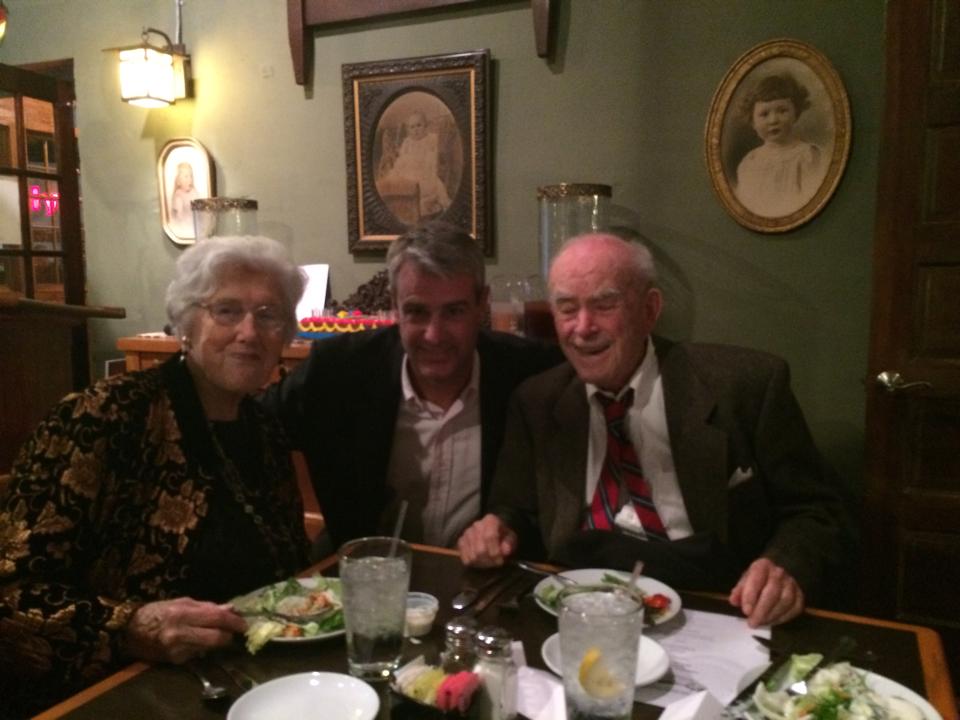
BS and Joan on November 15, 2014
BS, Joan and me on November 15, 2014

Mark 1:40-45 NRSV

As was pointed out a couple of weeks ago, for Mark, Jesus is a teacher. He is a teacher with a new teaching, one with authority. Last week, when Jesus healed Simon’s mother-in-law, we were taught by Jesus that it is not God’s will for anyone to be sick or even have a fever. As Jeremiah prophesied: “For surely I know the plans I have for you, says the Lord, plans for your welfare and not for harm…”

I have said before, albeit somewhat selfishly, that I believe it is God’s will for all men to live to be over 100 years-old and perhaps be married to a much younger woman, which is, of course, perhaps the only way a man can get to a hundred.

However, living in this broken and fallen world, we rarely encounter people who have been so blessed. Because not everything that happens in this world is the will of God, we seldom encounter people with the vitality and longevity of BS and Joan Smith. That is why we are having a party today. This is why we are celebrating today as a community of faith. For their long life together is a special thing. It is a good thing. It is a God-willed thing.

Some of you may say, “Well, I don’t want to live to be 100.” I dare you to say that the last day of our 99th birthday if you look as good as BS Smith! You know who wanted to be a hundred? Well, this past Thursday, it was BS!

This morning, we are still in the first chapter of Mark, and Jesus is still teaching.

“A leper came to him begging him, and kneeling, he said to him…”

Can’t you just picture the desperation? You can almost see it: “begging,” “kneeling.” This picture teaches us that when we are desperate, when we are despairing, when we are anxious, we can always come to Jesus.

“If you choose, you can make me clean.”

Well, of course Jesus chooses. As we have already learned, Jesus never wills for anyone to suffer.

We are then told that Jesus is “moved with pity…” It is important to note that the Greek word here is a visceral, gut-wrenching word. Jesus was moved from deep within his soul. Jesus literally felt this man’s pain. Because he was suffering, Jesus also suffered. Some scholars have said that the word is better translated: “angry.” When Jesus encountered human suffering, it angered him.

Here, Jesus teaches us that God is moved by human misery and suffers with us. As I tried to say yesterday at Alawoise’s memorial service, God never willed for her have Parkinson’s disease. When Alawoise felt the very first symptoms of the disease, God felt it too, from deep within God’s very soul. So, of course, Jesus chooses for him to be made clean, whole and well.

Jesus immediately reaches out his hand and touches him, saying, “I do choose. Be made clean!”

Here is where the story gets interesting. It is interesting, because Jesus reaches out his hand and “touches” this one who was considered by faith and society to be “untouchable.”

Leprosy was the most feared and dreaded disease of Jesus’ day, one that always brought horror and despair. Leprosy is an indefinite and general term used for a whitish rash on the skin. Spots, sores and swelling may also be present. It was an uncomfortable disease; however, what made leprosy so feared was no so much what it did to a person physically, but what it did not a person socially. The disease excluded one from the general population, and thus, from the people of God.

Chapters 13 and 14 of Leviticus discuss the social side effects of this disease at great length. Because a person with leprosy was considered to be “unclean,” a leper had to wear clothes which had been torn so they could be easily recognized and avoided. Lepers also had to cover their mouths and cry “unclean, unclean” in the presence of others so no one would approach them. Eduard Schweizer comments that rabbis considered a leper to be a “living corpse.” They were alive, but not alive. They were here, but not here; in the community, but not a part of the community. They were unalive, unaccepted, and untouchable.

So, when Jesus was deeply moved, or angered at the man’s disease, he was angry not only by the physical pain of it, but by the social pain of it— how this dehumanizing disease took people out of community, how it made them social outcasts, outsiders, untouchables.

However, at least one person did not regard the leper as untouchable. Mark writes that Jesus reaches out his hand and touches him. And “immediately the leprosy left him and he was made clean.”

The passages that we have been studying the past few weeks teach us a lot about healing. We learn that Jesus is against all forms of suffering. Jesus wants to deliver us from afflicting spirits, break our simple fevers and cleanse us of our most dreaded diseases. But, notice in this morning’s lesson that after Jesus touches and heals the leper, he gives the leper some “stern” instructions.

“After sternly warning him he sent him away at once, saying to him, ‘See that you say nothing to anyone; but go, show yourself to the priest, and offer for your cleansing what Moses commanded, as a testimony to them.”

Although Jesus had made the man clean, he wanted him to follow through with the cleansing rituals that would restore him back into community. Yes, God is concerned about our physical well-being, but God is more concerned about our spiritual well-being and our acceptance into community. More than anything else, Jesus wanted this outsider to become an insider. Jesus wanted this untouchable to be touchable.

I think I speak for everyone when I talk about the admiration I have for BS and Joan Smith. Some might say, “Well, of course, you have. You have to admire couple who is 90 and 100 years old. However, it is not so much their physical age or physical vitality that I admire, as much as it is their determination to be in community. Almost every time I visit with them, they ask me about the well-being of others. How is “Jimmy Cowan? Have you heard from Joyce Letchworth? Tell me about Alawoise. How is Harold holding up?”

And on more than one occasion it has been one of them who actually informed me of a concern in the community. I can clearly hear BS asking: “Jarrett, did you hear about so-in-so? And with compassion obviously arching from deep within his soul, he shakes his head, and closes his eyes with almost an agony and anger and says: Shhhhhhhh.”

Both BS and Joan want to meet every new person than joins or even just attends our worship services. And they don’t just want to know their names. They want to know where they live, where they went to school, where they work; who are their parents? Who are their grandparents? They are genuinely interested in truly knowing them, loving them.

And BS constantly asks me about the whereabouts of certain people that he has missed from our gathered community of faith. “Jarrett, have you seen so-in-so? She has not been here in several Sundays. Jarrett, you need to go see her.”

And you should never be fooled by his poor eyesight and selective hearing, for he doesn’t miss a thing, especially when it concerns this, his community of faith.

And have you noticed something else about BS? He not only is concerned about you and others, he not only expresses his compassion and empathy for others, BS likes to reach out his hand and touch you. No matter who you are or where you are from, BS likes to hold your hand. For no one in BS’s book is an outsider. Through his eyes, it is as it is in the eyes of God, no one is untouchable. Everyone’s hand is to be touched, grasped, held. This morning, I am proud to say that BS and Joan are the epitome of who we are as a church.

For all are truly welcome here. This is indeed a safe place. We accept you as Christ accepts you: Just as you are. If you are sick, we pray for your healing. If you are grieving, we pray for your peace. Because we know that when you suffer, God also suffers, and because of that, we suffer.

And know this, here, in this place you will never be alone. Here in this sacred space, there will always be a hand to hold. For here, there are no outsiders. There are no untouchables. There is truly room at the table for all.

Mark continues: “But he went out and began to proclaim it freely, and to spread the word…and people came to [Jesus] from every quarter.”

May we go out this morning from this sacred place and do the same.

Running this Race Called “Life”

running-group

Running is such a great metaphor for life.

It began as an ordinary Saturday morning run with the Greenville Running Group.  We were running our regular Starbucks’ route from Greenville Boulevard to the Town Commons and the Greenway. I effortlessly covered the distance of the first two miles before I even realized it. Into the third mile, I was confidently running down Charles, past Dowdy-Ficklen Stadium, as I had many times in the past. I had this. Life was good. I was all smiles, on cruise control.

Then without warning, early into mile three, I really stepped into it. Without seeing it, I managed to step into a metal hoop that was in the road, about 18 inches in diameter. My right heel caught the back of the hoop and stood it up. My left foot joined my right foot inside the hoop and down I went. Before I knew exactly what happened, I was laying in the gutter of Charles Boulevard. Muddy and bloody, my knees took the brunt of the fall.

Three of my running friends rushed to my aid, empathetically asked me if I was okay, then reached down and helped pick me up out of the gutter. They did not judge me for not looking where I was planting my feet, nor did they express any disappointment that I had interrupted their run. They only expressed compassion for me.

They led me to the Duck-Thru convenience store at the corner on 14th Street where they found a spigot to wash my wounds. One of my friends came out of the store with a first aid kit. Another friend, with her own hands, took some gauze from the kit and made sure my abrasions were clean.

Willing to sacrifice their run, they offered to walk back with me to my car. However, their compassion was more than I needed to encourage me to press on and finish the run. Ten miles later, I completed one of the best runs ever.

The scriptures say: “Therefore, since we are surrounded by so great a cloud of witnesses…let us run with perseverance the race that is set before us…” (Hebrews 12:1). Jesus said, “I give you a new commandment, that you love one another. Just as I have loved you, you also should love one another” (John 13:34).

May God forgive us for arrogantly thinking that we can do this thing called “life” alone. And may God give us the grace to love one another, to link up with one another in mutual care and compassion, to feel responsibility for one another, and to run this race together.

Born Holding Hands

Twins holding hands at deliveryLast Sunday in Ohio, which just so happened to be Mother’s Day, a rare set of mono, mono twins, Jillian and Jenna Thistlewaite, were miraculously born holding hands.

One of the most popular songs when I was born back in 1966 was entitled, Born Free.  “Born free, as free as the wind blows, as free as the grass grows, born free to follow your heart.”

It’s a nice song.  However, when you take a good look at Jillian and Jenna Thistlewaite who were born this week holding hands, we learn something completely different. We were not born to be independent and free, but we were born to be very dependent on one another. We were born to need one another. Jillian and Jenna remind us that Christ has commanded us to love one another, to link up with one another in mutual care and concern, and to feel responsibility for one another. We were born to live in community.

We were not born free, as the song goes. We were born holding hands.

So, perhaps the worst kind of evil in this world is failing to accept one another. Or alienating another. Or living a self-absorbed, self-centered life.

Going Solo

run in the park

From People Grumble but Angels Sing!

This Sunday, we have a choice to make. We could make the choice with the majority of Americans to stay home and experience God on our back porches or patios with a cup of coffee or during a morning run or during walk in the park.  Or we could make the difficult decision to get up, get dressed and drive to a place of worship.  And there, we may sit beside people with whom we could not disagree more. We may sit beside folks who press our buttons, even drive us crazy.

In a recent interview, Rev. Lillian Daniel, pastor of First Congregational Church from Glen Ellyn, Illinois, has said: “Any idiot can find God alone in the sunset. It takes a certain maturity to find God in the person sitting next to you who not only voted for the wrong political party, but has a baby who is crying while you are trying to listen to the sermon. “Community,” she says, “is where the religious rubber meets the road. People challenge us, ask the hard questions, disagree, need things from us, require our forgiveness. It’s where we get to practice all the things we preach.”

She continues: “I think a lot of those who can’t tolerate organized religion are really just frustrated by other people. They think, ‘If they could just kick all of the flawed human beings out of the church, we could really do this Jesus thing. Better do my spiritual life solo, where I don’t have to be disturbed by the amateurs.”

I have a confession to make. During my break from pastoral ministry, I often felt the temptation to go solo with my faith. I would go for a Sunday morning run along the Tar River in Greenville. There, I would pray and enjoy being alive in God’s creation, and think to myself, “This is the way to do church! There is no one to disagree with me. There is no one sharing their problems with me, making me uncomfortable, and taking up my time. And I must confess, it was rather nice!

However, I must also confess it was very selfish. It was arrogant, and it was self-righteous. The truth is: it was the very antithesis of who Jesus calls us to be as his disciples.