A Topsy-Turvy World

Mark 10:35-45 NRSV

What a great moment we experienced together last Sunday, as we received the hopeful good news that for God all things are possible! That after 150 years, we are still here, and we are still saying “yes” to following Jesus!

Last week, the commitment of Peter and the disciples, and our own commitments to leave behind friends and family to follow Jesus, were affirmed with a promise from Jesus. With those first disciples, because we are allowing Jesus to turn our lives upside-down by accepting and working for a world where the first are last and the last are first, and the greatest among us are servants, Jesus promised us:

For everything we have given up, he will give us much more. For everything we have turned our back upon, he will give us a hundred times more!

It was a great day! A joyful day! A hopeful day!

But… (C’mon you knew it was coming!) …but, what a difference just one week can make.

Just when we were beginning to think that the disciples were finally starting to get it right, we open our Bibles, and still in this 10th chapter of Mark, we read where James and John, the sons of Zebedee, come asking Jesus if he will do them a favor.

You remember their poor parents, don’t you, Mr. and Mrs. Zebedee? Matthew told us the story of how their family fishing business was nearly destroyed that day a radical rabbi named Jesus came to town. That was the day James and John proved they were willing to drop everything, literally as they dropped their nets, leaving family, their job, everything behind, to follow Jesus (Matthew 4:21).

I am sure Peter had James and John in mind when he said to Jesus: “Look, we have left everything and followed you.”

But today, in the same chapter, we discover that they really don’t have a clue to what it truly means to follow Jesus when they ask Jesus if one can sit at his right and one at his left in his glory.

Pointing out their disappointing cluelessness, Jesus responds: “You really don’t know what you are asking!” For they had no idea that the ones who would end up on Jesus’ right and his left would be hanging on crosses!”

But that’s what it’s like after you say “yes” to Jesus. One Sunday, we got it! One Sunday, we are affirmed by Jesus! One Sunday, the pastor pats you on the back and calls you a kindness-lover, a peace-maker, a justice-doer, and a grace-giver. And the next week, you’re sitting on the struggle bus without a clue.

One Sunday, we feel like we have all the courage we need to stay on the right, albeit narrow, road that leads to life, abundant, meaningful, purposeful, and eternal. And the next week we are struggling, questioning, and wondering if staying on this difficult road with Jesus is really worth all the grief we receive from our family and friends, from our co-workers and neighbors.

We are always being tempted to acquiesce to popular culture. Because, following this narrow way of Jesus really does turn our entire world upside-down, and if we are honest, we’d admit that we’d be much more comfortable if we could just put some of our world back right-side-up.

We think about how good it would be to put ourselves first for a change, to be great again, to live without dying to self, to confront our enemies without having to love them, and to build wealth without having to give everything to the poor. How much better would life be if we identified with the first instead of the last, with those who have the most instead with those who have the least, with the powerful instead of the enslaved.

We think of how much better we would have it if we never heard of a woman whose two copper coins, worth just a few cents, were actually more valuable in the eyes of Jesus than the large bags of money that others were putting into the temple treasury.

We dream of what life would be if we never heard the story of a poor beggar named Lazarus resting by Abraham’s side, while a rich man begs for mercy.

We think about how much better life might be if we never heard the Sermon on the Mount, or the story of the Good Samaritan. How much better would we sleep at night, how much more money would we have in the bank, if could be like the Priest and the Levite who, without a care in the world, passed by on the other side.

New Testament Scholar Martin Copenhaver writes that our gospel lesson in Mark chapter ten bears repeating, because we are continually being tempted “to straighten up the order of things that Jesus turned topsy-turvy.”

As Disciples of Christ were creating a movement in the 19th century to return to the radical teachings of Jesus, German philosopher and cultural critic Friedrich Nietsche was denigrating those teachings calling the way of Jesus “a slave morality.”

Nietshche noticed that Christianity seemed to be most popular among the people in his day who were at were at the bottom: women, children, people living in poverty, people living with disabilities, people of color, and of course, the slaves. He accused Christianity of giving hope to those at the bottom, while offering very little to those at the top.

His criticism served as a warning to the church as they heard Nietshche saying: “If you’re not careful, if you keep teaching the upside down Gospel of Jesus, then you might fill your churches up with the wrong type of people!”

And it was a red flag for the privileged and for the powerful as they understood Nietshche saying: “If you don’t do something about this radical, upside-down topsy-turvy message of Jesus, then your workers may want to organize. They might begin to collectively bargain to improve their economic and social status. Your women may demand to have the same rights as men, even the right to vote. And although it’s unthinkable, they may even want the right to control their own bodies! And your slaves, well, they may rise up and demand to be treated like whole human beings, not just three-fifths.

So, the false prophets in the world went to work. Rejecting the gospel of Jesus that turns the whole world upside down, they began to twist scripture, take it out of context, and even make up unbiblical sayings to preach and teach the antitheses of Jesus, all in order to straighten out the topsy-turviness of the gospel.

“God only helps those who help themselves!” they declared.

“Women should be submissive to men, at home, in the workplace, in government and in the church,” they asserted.

“Children could be exploited for their labor,” they affirmed.

“Jesus was a white European man,” they pronounced in a plethora of artistic portrayals.

“God’s Word sanctions slavery,” they argued.

“Those people are abominations to God,” they preached.

And we know that those false prophets are still very much at work today, “straightening up the order of things that Jesus turned topsy-turvy.”

In an interview with NPR, evangelical leader Russell Moore said that multiple pastors have told him stories about their congregants being upset when they hear words read from the Sermon on the Mount of Jesus proclaiming an upside-down world where the poor are blessed, those who hunger for justice are filled, and the meek inherit the earth.

Moore said:

Multiple pastors tell me essentially, the same story about quoting Jesus in the Sermon on the Mount – [and] to have someone come up after to say. “Where did you get those liberal talking points?” Moore added: “And what was alarming to me is that in most of these scenarios, when the pastor would say, ‘I’m literally quoting Jesus,’ the response would be, ‘Yes, but that doesn’t work anymore. That’s weak.’

So, what do the pastors do? Well, at an alarming rate, many are leaving the ministry. But some stay, but to keep their congregants happy, they water-down the gospel, transforming the offensive counter-cultural meat of Jesus’ teaching into some, warm, comforting chicken soup for the soul. And to pastor a large church, some pastors have traded in the gospel that sides with the weak and the oppressed in exchange for a nationalism that sides with the strong and powerful.

Although this is the reason many people have given up on the church today, the irony is that it is also the reason people need the church today. Because to fight the great temptation to straighten up, water down, or trade in the gospel, people who have made the decision to say “yes” to Jesus need one another. To stay on the radical, narrow, offensive, difficult, counter-cultural, topsy-turvy way of Jesus, we need each other to help keep us accountable and encouraged, especially during these serious times when many in the church are rejecting it, calling it weak.

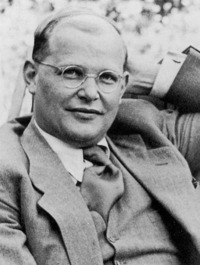
Dietrich Bonhoeffer, who stood up to the fascism and white Christian nationalism of his day in Nazi Germany, once prophetically preached:

Christianity stands or falls with its revolutionary protest against violence, arbitrariness, and pride of power, and with its plea for the weak. Christians are doing too little to make these points clear, rather than too much. Christendom adjusts itself far too easily to the worship of power. Christians should give more offense [and] shock the world far more than they are doing now. Christians should take a stronger stand in favor of the weak, rather than considering first the possible right of the strong (Dietrich Bonhoeffer, from his sermon 0n 2 Corinthians 12:9, 1934).

The good news is that we are a part of a church where we are going to keep holding one another accountable. We are going to keep one another encouraged and hopeful. No matter what happens this week, or in the next three weeks, we are going to do all that we can do to stay topsy-turvy, following the radical, narrow, seemingly foolish, upside-down way of Jesus toward the poor, the suffering, the marginalized, the prisoners, the refugees, the undocumented, the lonely, the hungry, the dying, the tortured, the homeless–toward all who thirst and hunger for justice and compassion.

Following this way will shock many. It will offend some of our friends and even disappoint some in our family. Because what does this way offer us? Not success, not popularity, not riches, not worldly power, but we believe—we may not always understand, and at times we are even clueless—but we believe Jesus when he says it leads to a life that is full, complete, meaningful, purposeful, abundant, and eternal, and it creates a world that is more kind, more just, more free, and more merciful. Amen.
For Easter to Happen, Somebody Needed to Pick Up and Carry a Cross

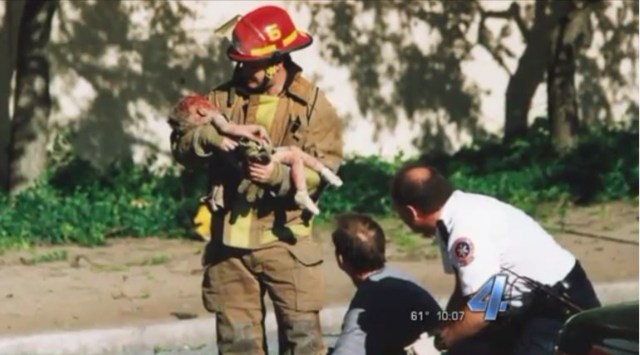
oklahoma city bombing firefighter baby

Luke 24:1-12 NRSV

It is Easter Sunday! Resurrection morning has dawned. New life is being born! Something wonderful has been lost, but something magnificent is being gained.

However, on this Sunday of Sundays, I believe it is important for us to realize that before we can experience new life, before we can celebrate resurrection, before we can sing alleluias, before love can win, somebody needed to pick up and carry a cross.

And the sad thing is that there are very few of Jesus’ disciples who understand this. They do not understand it today, and they did not understand it 2,000 years ago.

Although Jesus continually taught that to gain our lives, we must be willing to lose our lives, that Easter could not happen without some self-denial, that resurrection could not come without some self-expenditure, that new life could not be born without some sacrifice, that love could not be won without some suffering, that the the light of Sunday morning could not  dawn without the darkness of Good Friday, when the time came for the disciples to follow Jesus all the way to the foot of the cross, most all of them very selfishly fled to save their lives.

One would betray Jesus. Another would deny that he even knew Jesus. Nearly all would desert him. In spite of Jesus’ continual call to pick up a cross and follow him, most of the disciples never got it.

However, there were a few disciples who did get it. There were a few who were willing to carry a cross. There were a few who chose to live selflessly and to love sacrificially. There were a few who faithfully followed Jesus all the way to Golgotha.

Although the intrinsic sexism of this world’s history has caused many in the church to overlook these faithful disciples, the good news is that all four Gospel writers did not.

In Luke 8 we read these words: Afterward [Jesus] journeyed from one town and village to another, preaching and proclaiming the good news of the kingdom of God. Accompanying him were the Twelve and some women…Mary, called Magdalene… Joanna…Susanna, and many others…” These women helped support Jesus and the twelve “out of their own means.”

And on Good Friday, when none of the male disciples could be found, Mark 15 reads: “There were also some women looking on…among whom were Mary Magdalene, and Mary the mother of James, Joses, and Salome.

In Matthew 27 we read: “Among them [gathered at the foot of the cross] was Mary Magdalene, and Mary the mother of James and Joseph, and the mother of the sons of Zebedee.

In John 19:25 we read where all the male disciples fled: “But standing by the cross of Jesus were His mother, and His mother’s sister, Mary the wife of Clopas, and Mary Magdalene.

There are many problems with Christianity today. However, I believe one of the biggest problems with our faith today, especially here in North America, is that we have too few Mary Magdalenes.

There are too few people who understand that authentic faith, true discipleship, always involves a cross. It always involves answering a call, taking a risk, denying oneself, going against the status quo, pushing the boundaries, stepping way outside one’s comfort zone.

A problem with the church today is there are too many Christians who believe they can sing “alleluias” on Easter Sunday without going through some suffering on Good Friday, who believe they can experience some new life without death to self, who believe they can somehow rise up from the waters of baptism without getting their hair wet, who believe they can serve Jesus without getting their hands dirty.

What this world desperately needs needs right now, and what the church needs more than anything today, are more disciples like Mary Magdalene. For Mary Magdalene understood that when Jesus called people to be his disciples, Jesus was always clear that there would be a cross involved.

I think this is the reason that Mary Magdalene is remembered today by Matthew, Mark, Luke and John. This is the reason she is mentioned by name by the gospel writers more than any other apostle. And this is the reason that today, on this Easter Sunday morning, Christians all over the world will hear her name mentioned as they gather to worship.

Some will hear her name as Mark 15 is read: “Mary Magdalene and Mary the mother of Joses were looking on to see where Jesus was laid.”

Some will hear her name as Matthew 28 is read: “Now after the Sabbath, as it began to dawn toward the first day of the week, Mary Magdalene and the other Mary came to look at the grave.”

Some will hear it as Mark 16 is read: “When the Sabbath was over, Mary Magdalene, and Mary the mother of James, and Salome, bought spices, so that they might come and anoint Him.”

And others will hear it as John 20 is read: “Now on the first day of the week Mary Magdalene came early to the tomb, while it was still dark, and saw the stone already taken away from the tomb.”

Just as Mary Magdalene had given what she had to support Jesus’ life, Mary was still doing all she could for Jesus in death.

And because she always selflessly pouring herself out, because she kept giving, kept sacrificing, kept risking, serving, bending, expending, anointing, because she was the most faithful of all of the disciples, because she not only sacrificially followed Jesus all the way to the cross, but courageously followed him all the way to the grave, because she followed him to the very end, she was the first person on earth to see the risen Lord.

Mark 16:9 reads: “Now after He had risen early on the first day of the week, He first appeared to Mary Magdalene…”

And in John 20:18 we read where it was Mary Magdalene who first proclaimed the good news of Easter, speaking five simple words that changed the world forever: “Mary Magdalene came, announcing to the disciples, ‘I have seen the Lord.’”  Not only was she the first person to see the Lord, she was the first person to proclaim the world-changing, earth-shaking, life-saving good news of Easter to the world!

Mary Magdalene was the very first to preach the glorious good news of resurrection on Easter Sunday, because she stayed with Jesus until the very last in his suffering and death of Good Friday. Easter happened for Mary because she had answered a call to follow Jesus, and she followed Jesus all the way.

Observing Good Friday this year was a surreal experience for many Americans, as it fell on April 19, the day of the terrorist bombing in Oklahoma City.

The story of one survivor, Terri Talley, exemplifies the suffering experienced by our nation, as well as how new life was raised out of the ashes through those who were willing to pick up and carry a cross.

Employed by the Federal Employee’s Credit Union on the third floor of the Murrah Federal Building, that morning was extremely busy for Terri. She had just returned to work after spending several days away, and a stack of paperwork waited for her.

Catching up on work, Terri took a moment that morning to chat with her good friend and coworker Sonja Sanders. “For her, it was a big day. She had just been promoted into management,” states Terri, who is certain she was the last person to have spoken with her friend.

What seemed like just moments afterward, everything changed. At 9:02 am, thousands of pounds of explosives, assembled in the back of a Ryder moving truck parked in front of her office building, exploded.

Terri recounts: “I fell from the third floor to somewhere around the basement level. It was really really fast. It was so fast that I didn’t really know what had happened. The suction pulled me down so quickly.”

Surrounded by noise Terri says, “When I came to the first time, I thought: ‘This is a really bad dream. I will just go to sleep and when I wake up everything will be okay.’ But when I came to [again], everything wasn’t okay. I thought that I must have been in a really bad wreck, and I must be [pinned in the wreckage], because I couldn’t see anything. I couldn’t move. I couldn’t even scream for help. I would try, but I was really squished. And I thought to myself: ‘I hope someone finds me.’”

Terri was found by a firefighter who almost overlooked her. [Like being sealed in a tomb] she was completely encased in concrete and granite. Terri says: “There was just a little hole and a little piece of me was showing. He touched me and … started screaming: ‘Hey! I have a live one here, and I need some help!'”

After much hard work, Terri was freed and rushed to a nearby hospital, where her injuries were identified: temporary blindness, a concussion, temporary amnesia, a cracked first vertebra in her neck, a broken right ankle, skin damage on her foot, and multiple abrasions. During her seven days in the hospital, and for weeks following, a sense of shock permeated her life.

However, today, she has this powerful message for the world:

I always tell [even] the littlest of kids: ‘Don’t think that there is nothing you can do, because kids would color pictures and send me notes. Those made me feel like people were really thinking about me. You can always do something, no matter what age you are.’[i]

This illustrates that to experience Easter Sunday, we have to have a Good Friday.

Before new life could be experienced, before resurrection could be celebrated, before “alleluias” could be sung, before love could be won, somebody needed to pick up and carry a cross.

-First Responders needed to run toward an explosion.
-Firefighters needed to go into a burning building.
-Doctors and nurses needed to give all that they had to give.
-Friends and family and church members needed to pray.
-And little children needed to pick up some crayons and color a picture.

To make Easter happen for someone–today, right here, right now–we can all do something, be something, risk something, sacrifice something, give something, create something.

We can all pick up and carry a cross.

We can feed someone who is hungry.

Visit someone who is lonely.

Love someone who is hurting.

Include someone who has been left out.

We can mentor someone who lives in a foster home.

Care for someone who is sick.

Forgive someone who has made mistakes.

Believe someone who has been abused.

We can share grace with someone who faces discrimination.

Stand up for someone victimized by injustice.

Speak out for someone devalued by oppression.

We can stay close by and anoint someone who is dying.

Be a friend to someone who is grieving.

With the spirit of Mary Magdalene, let’s keep the faith, and let’s keep the faith going, keep it moving forward, all the way to the foot of the cross, through the betrayals, through the fear, through the denials, through the suffering, through the shame, all the way to the grave, even to a tomb that has been sealed by granite or concrete.

Let us keep doing whatever we can, with whatever we have, wherever we are, to love one another until the entire world is able to sing:

“Alleluia! Alleluia! I have seen the Lord!”


[i]https://www.nps.gov/okci/learn/historyculture/stories.htm

Dangerous Dancing

Dance

2 Samuel 6:1-5; 12b-19 NRSV

Mark 6:14-29 NRSV

The first test that I took in seminary is called the Myers-Briggs test. It is a test that identifies your personality-type. After taking the test, I met with my professor who saidL “I have good news, and I have bad news. The good news is that you are an extrovert. You love people. And if you are ever going to be a pastor, then loving people certainly has some advantages. However, the bad news is that it also has some disadvantages. You love people, which means your probably want people to love you. And this is where extroverted preachers like yourself tend to get into trouble. You need to be careful as a preacher that you are preaching to please God and not just to please your congregation.”

That may be the primary reason that I have chosen to use a tool we call the Revised Common Lectionary. It is designed to help the preacher preach the entire Bible, and not just the parts of the Bible that might endear him or her to a congregation.

But I must admit, first thing, every Monday morning, I read the lectionary texts, hoping and praying that it might lead me to preach what we preachers like to call a “sugar-stick sermon,” something that will bring comfort rather than challenge, consolation rather than confrontation, something that will cause people to come up to me afterwards in the Narthex and say: “Thank you for that delightful sermon, pastor. We just love you!”

So, you can imagine my consternation this past Monday morning when I read the gospel lesson about the fate of our old friend John the Baptist, that eccentric character from the Advent season that gets us ready for Christmas every year, that one who prepared the way of the Lord by faithfully preaching the truth in the wilderness, that one who also preached truth to power by calling out the immorality of the King.

And what does he get for faithfully standing for the truth of the Word of God? He gets his head served up on a silver platter.

So, on Monday morning, I said to myself. “Ah man! Nobody wants to hear that!” I think I’ll preach from the Old Testament this week. Let’s see, it is from 2 Samuel, chapter 6.

After King David led a great army to return the Ark of the Covenant to Jerusalem from the Philistines, David and his army were so overcome with emotion that they engaged in festive dancing.

The scripture tells us that David danced before God “with all his might.” He danced before God with all that he had and with all that he was, as he was utterly and completely overcome by the joy of God.

Now, this is more like it! Here’s something that will preach! My sermon can be entitled: “Let’s Dance!” And the people will love it!

David danced, affirming the rule of God. David danced, consumed by the Word of God. David danced a dance of total self-surrender. David danced, holding nothing back. David danced giving all that he had and all that he was to God.

Oh, who is not going to love this! David’s dance is certainly better than the dance of Herodias in our gospel lesson this morning!

But then, just when I felt a happy sugar-stick sermon coming on, I read this: “And Michal despised David for it.”

Michal, David’s wife, looked out the window at David’s exuberant dancing in the street and despised him for it.

I like the congregational response that is printed in our order of service after the scripture lesson is read on Sunday mornings: “This is the Word of God for the people of God. Thanks be to God.” However, sometimes, I think we should add: “Whether we like it or not, this is the Word of God for the people of God. Thanks be to God.”

The truth is, whether we like it or not, the dance of the gospel is a dangerous dance. The dance of the gospel is a disturbing dance. The dance of the gospel is a dance that is despised by many. The active affirmation of the rule of God does not set well with the Michals and the Herods of the world. In fact, people are likely to lose their heads if they claim too much for the gospel.

The dance of prosperity preachers are much easier steps to follow. The message of false prophets who distort the gospel of Christ as nothing more than a little dose of “chicken soup for the soul” is much easier to swallow. If we just get ourselves right with the Lord, if we would just straighten up and pray right and live right, good health and great wealth will come our way. If we just accept Jesus as our Lord and our Savior, everything is going to be alright.

However, the dance of the gospel is radically different. The dance of the gospel contains steps to the beat of a different drum. If we get right with the Lord, if we pray right and live right, if we lose all inhibitions and all restraint, if we completely surrender ourselves to the rule of God, if we love others as Christ loves others, if we allow the Word of God to challenge us, confront us, consume us, to control us, then suffering is inevitable.

For the dance of the gospel is a dance of self-surrender to a very radical drum beat. It is a beat of sacrifice. It is a beat of selflessness. It is a beat of self-expenditure. It is a beat of love and of grace.  And to world, as the Apostle Paul warned the Corinthians, if we let go and dance to this beat, we are certain to look pretty foolish.

We may look like a fool…

…when we offer friendship to someone who can not offer us anything in return.

…when we spend valuable time volunteering at the hospital, serving lunch in a soup kitchen, visiting someone in prison or working in a homeless shelter.

…when we love our enemies, when we give the shirt off our backs to complete strangers.

…when we give sacrificially and consistently to a church that is always encouraging us to give even more.

…when we speak truth to those in power.

And we might look foolish anytime we love anyone with the self-expending love of Christ—whenever we love someone without inhibitions, without restraints, and without reservations.

I believe this is the dance of the gospel. It is a dance of immense joy, but also a dance of enormous suffering. For the Herods and Michals of the world despise this dance. And they will do everything in their power to stop this dance.

We have all heard their voices, echoes that discourage such dancing:  “Don’t get too close to him. Don’t give your heart to her. As human beings they will only let you down.”

“Don’t bother with church. The giving never ceases. The work never ends. The disappointments never stop.”

“Don’t love that man.  He has done absolutely nothing to deserve it.  And he will probably never be able to reciprocate. Don’t love that woman. She is poor and destitute. She is too needy. She will demand too much.”

The voices Michal and Herod say: “Don’t give yourself away to another. Loving like that is too risky. It leads to too much pain, heartache and grief.”

However, there is another voice.  A voice which was heard by David and by John the Baptist. It is a voice that says: “Dance!  Hold nothing back.  Give yourself away. Surrender yourself to beat of the heart of the gospel.  Love. Love honestly and deeply. Love courageously and graciously.  Lose yourself.  Empty yourself.  Pour yourself out.”

Will this love cause pain? It will cause enormous pain. But the joy of God which will consume you will be so immense the suffering will be well worth it. So, dance.

Garth Brooks once sang a song entitled “the dance.” There’s a line in that song that goes, “I could have missed the pain, but I would have had to have missed the dance.”

Loving others will inevitably bring pain.  However, never loving to avoid that pain is never really living.  There is no joy being a wallflower on the wall of life.

The Revised Common Lectionary has a gospel and a Hebrew lesson. It also has a Psalm.

The Psalm for this week is the 24thPsalm. As we avoid the dance of false prophets with steps that are easier to follow and join the dance of the gospel, even if it brings us pain, may we remember these hopeful words:

The earth is the Lord’s and all that is in it, the world, and those who live in it; for he has founded it on the seas, and established it on the rivers. Who shall ascend the hill of the Lord? And who shall stand in his holy place?

Those who have clean hands and pure hearts, who do not lift up their souls to what is false… They will receive blessing from the Lord, and vindication from the God of their salvation.

So, let’s dance!  Let us go out and dance in the streets of our world consumed and controlled by the Word of God, the radical beat of the gospel of Christ! Be warned, we might look like fools, people will despise us, and we will suffer for it. However, the blessings we receive from the Lord, our vindication from the God of our salvation, is well worth it.

Pastoral Prayer Inspired by Dietrich Bonheoffer

Dietrich BonhoefferDietrich Bonhoeffer did not have to help Jews escape Nazi Germany and flee to Switzerland.  After all, he was safe and sound in New York in the early 1940’s. He was free to stay in America and preach the gospel from the safety of a free church pulpit or teach New Testament in the peace and freedom of a university. But the gospel he preached compelled him to return to Germany and stand against Nazi aggression.

Before he was executed by the Nazis in 1945, he wrote the following words that I believe the American Church that is embedded in a narcissistic society needs to hear again and hear loudly:

Cheap grace is the preaching of….forgiveness without requiring repentance, baptism without church discipline, communion without confession…  Cheap grace is grace without discipleship, grace without the cross, grace without Jesus Christ living and incarnate. Costly grace is…the gospel which must be sought again and again. The gift which must be asked for, the door at which one must knock. Such grace is costly because it calls us to follow Jesus Christ.  It is costly because it costs us our lives. It is grace because it gives us the only true life.

The following pastoral prayer was inspired by Bonhoeffer’s timeless words:

O good and gracious God, we come to this place this morning to recommit ourselves to being faithful disciples of Jesus Christ our Lord and Savior. However, if we are ever going to truly follow Jesus, we will first need to repent of our sins that are derived from our love with what your servant Dietrich Bonhoeffer called “cheap grace.”

We gather in this place Sunday after Sunday to hear preaching that will remind us that we are loved and forgiven; not to hear that we need to change our selfish ways.

We gather to remember the way we came up out of the waters of our baptism to symbolize life abundant and eternal; not to remember our immersion into the waters to symbolize death to self.

We come to gather around a table to receive the gift of Holy Communion; not to confess our sins and our shortcomings.

We come to this place to receive grace and love; not to be encouraged to share grace and love with others.

We come here to worship at the foot of the cross; not to pick it up and carry it ourselves.

We come here to worship Christ in the safety and comfort of this sanctuary; not fully realizing that the Christ is actually alive today, present  here, calling us, prodding us, pulling us to follow him out into a risky and uncomfortable world.

So, O God, forgive us of our love for “cheap grace.” Help us to truly repent, turn from our wicked ways and seek to live for a grace, in a grace, and by a grace that is worthy of your sacrificial love for us, even if it is “costly.”

May we come to this place to seek this grace Sunday after Sunday. May we keep asking, keep knocking at your door, keep giving our lives away to you, keep denying ourselves, and keep looking to you for the strength we need to pick up our crosses and follow our Lord and our Savior wherever he leads. Because we know that this grace, although it costs us our very lives, is the only way to true life, abundant and eternal. We pray this in the name of Jesus Christ our Lord.  Amen.