
It is Easter Sunday! Resurrection morning has dawned. New life is being born! Something wonderful has been lost, but something magnificent is being gained.
However, on this Sunday of Sundays, I believe it is important for us to realize that before we can experience new life, before we can celebrate resurrection, before we can sing alleluias, before love can win, somebody needed to pick up and carry a cross.
And the sad thing is that there are very few of Jesus’ disciples who understand this. They do not understand it today, and they did not understand it 2,000 years ago.
Although Jesus continually taught that to gain our lives, we must be willing to lose our lives, that Easter could not happen without some self-denial, that resurrection could not come without some self-expenditure, that new life could not be born without some sacrifice, that love could not be won without some suffering, that the the light of Sunday morning could not dawn without the darkness of Good Friday, when the time came for the disciples to follow Jesus all the way to the foot of the cross, most all of them very selfishly fled to save their lives.
One would betray Jesus. Another would deny that he even knew Jesus. Nearly all would desert him. In spite of Jesus’ continual call to pick up a cross and follow him, most of the disciples never got it.
However, there were a few disciples who did get it. There were a few who were willing to carry a cross. There were a few who chose to live selflessly and to love sacrificially. There were a few who faithfully followed Jesus all the way to Golgotha.
Although the intrinsic sexism of this world’s history has caused many in the church to overlook these faithful disciples, the good news is that all four Gospel writers did not.
In Luke 8 we read these words: Afterward [Jesus] journeyed from one town and village to another, preaching and proclaiming the good news of the kingdom of God. Accompanying him were the Twelve and some women…Mary, called Magdalene… Joanna…Susanna, and many others…” These women helped support Jesus and the twelve “out of their own means.”
And on Good Friday, when none of the male disciples could be found, Mark 15 reads: “There were also some women looking on…among whom were Mary Magdalene, and Mary the mother of James, Joses, and Salome.
In Matthew 27 we read: “Among them [gathered at the foot of the cross] was Mary Magdalene, and Mary the mother of James and Joseph, and the mother of the sons of Zebedee.
In John 19:25 we read where all the male disciples fled: “But standing by the cross of Jesus were His mother, and His mother’s sister, Mary the wife of Clopas, and Mary Magdalene.
There are many problems with Christianity today. However, I believe one of the biggest problems with our faith today, especially here in North America, is that we have too few Mary Magdalenes.
There are too few people who understand that authentic faith, true discipleship, always involves a cross. It always involves answering a call, taking a risk, denying oneself, going against the status quo, pushing the boundaries, stepping way outside one’s comfort zone.
A problem with the church today is there are too many Christians who believe they can sing “alleluias” on Easter Sunday without going through some suffering on Good Friday, who believe they can experience some new life without death to self, who believe they can somehow rise up from the waters of baptism without getting their hair wet, who believe they can serve Jesus without getting their hands dirty.
What this world desperately needs needs right now, and what the church needs more than anything today, are more disciples like Mary Magdalene. For Mary Magdalene understood that when Jesus called people to be his disciples, Jesus was always clear that there would be a cross involved.
I think this is the reason that Mary Magdalene is remembered today by Matthew, Mark, Luke and John. This is the reason she is mentioned by name by the gospel writers more than any other apostle. And this is the reason that today, on this Easter Sunday morning, Christians all over the world will hear her name mentioned as they gather to worship.
Some will hear her name as Mark 15 is read: “Mary Magdalene and Mary the mother of Joses were looking on to see where Jesus was laid.”
Some will hear her name as Matthew 28 is read: “Now after the Sabbath, as it began to dawn toward the first day of the week, Mary Magdalene and the other Mary came to look at the grave.”
Some will hear it as Mark 16 is read: “When the Sabbath was over, Mary Magdalene, and Mary the mother of James, and Salome, bought spices, so that they might come and anoint Him.”
And others will hear it as John 20 is read: “Now on the first day of the week Mary Magdalene came early to the tomb, while it was still dark, and saw the stone already taken away from the tomb.”
Just as Mary Magdalene had given what she had to support Jesus’ life, Mary was still doing all she could for Jesus in death.
And because she always selflessly pouring herself out, because she kept giving, kept sacrificing, kept risking, serving, bending, expending, anointing, because she was the most faithful of all of the disciples, because she not only sacrificially followed Jesus all the way to the cross, but courageously followed him all the way to the grave, because she followed him to the very end, she was the first person on earth to see the risen Lord.
Mark 16:9 reads: “Now after He had risen early on the first day of the week, He first appeared to Mary Magdalene…”
And in John 20:18 we read where it was Mary Magdalene who first proclaimed the good news of Easter, speaking five simple words that changed the world forever: “Mary Magdalene came, announcing to the disciples, ‘I have seen the Lord.’” Not only was she the first person to see the Lord, she was the first person to proclaim the world-changing, earth-shaking, life-saving good news of Easter to the world!
Mary Magdalene was the very first to preach the glorious good news of resurrection on Easter Sunday, because she stayed with Jesus until the very last in his suffering and death of Good Friday. Easter happened for Mary because she had answered a call to follow Jesus, and she followed Jesus all the way.
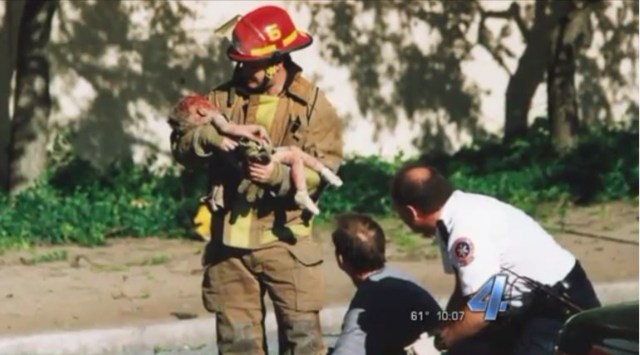
Observing Good Friday this year was a surreal experience for many Americans, as it fell on April 19, the day of the terrorist bombing in Oklahoma City.
The story of one survivor, Terri Talley, exemplifies the suffering experienced by our nation, as well as how new life was raised out of the ashes through those who were willing to pick up and carry a cross.
Employed by the Federal Employee’s Credit Union on the third floor of the Murrah Federal Building, that morning was extremely busy for Terri. She had just returned to work after spending several days away, and a stack of paperwork waited for her.
Catching up on work, Terri took a moment that morning to chat with her good friend and coworker Sonja Sanders. “For her, it was a big day. She had just been promoted into management,” states Terri, who is certain she was the last person to have spoken with her friend.
What seemed like just moments afterward, everything changed. At 9:02 am, thousands of pounds of explosives, assembled in the back of a Ryder moving truck parked in front of her office building, exploded.
Terri recounts: “I fell from the third floor to somewhere around the basement level. It was really really fast. It was so fast that I didn’t really know what had happened. The suction pulled me down so quickly.”
Surrounded by noise Terri says, “When I came to the first time, I thought: ‘This is a really bad dream. I will just go to sleep and when I wake up everything will be okay.’ But when I came to [again], everything wasn’t okay. I thought that I must have been in a really bad wreck, and I must be [pinned in the wreckage], because I couldn’t see anything. I couldn’t move. I couldn’t even scream for help. I would try, but I was really squished. And I thought to myself: ‘I hope someone finds me.’”
Terri was found by a firefighter who almost overlooked her. [Like being sealed in a tomb] she was completely encased in concrete and granite. Terri says: “There was just a little hole and a little piece of me was showing. He touched me and … started screaming: ‘Hey! I have a live one here, and I need some help!'”
After much hard work, Terri was freed and rushed to a nearby hospital, where her injuries were identified: temporary blindness, a concussion, temporary amnesia, a cracked first vertebra in her neck, a broken right ankle, skin damage on her foot, and multiple abrasions. During her seven days in the hospital, and for weeks following, a sense of shock permeated her life.
However, today, she has this powerful message for the world:
I always tell [even] the littlest of kids: ‘Don’t think that there is nothing you can do, because kids would color pictures and send me notes. Those made me feel like people were really thinking about me. You can always do something, no matter what age you are.’[i]
This illustrates that to experience Easter Sunday, we have to have a Good Friday.
Before new life could be experienced, before resurrection could be celebrated, before “alleluias” could be sung, before love could be won, somebody needed to pick up and carry a cross.
-First Responders needed to run toward an explosion.
-Firefighters needed to go into a burning building.
-Doctors and nurses needed to give all that they had to give.
-Friends and family and church members needed to pray.
-And little children needed to pick up some crayons and color a picture.
To make Easter happen for someone–today, right here, right now–we can all do something, be something, risk something, sacrifice something, give something, create something.
We can all pick up and carry a cross.
We can feed someone who is hungry.
Visit someone who is lonely.
Love someone who is hurting.
Include someone who has been left out.
We can mentor someone who lives in a foster home.
Care for someone who is sick.
Forgive someone who has made mistakes.
Believe someone who has been abused.
We can share grace with someone who faces discrimination.
Stand up for someone victimized by injustice.
Speak out for someone devalued by oppression.
We can stay close by and anoint someone who is dying.
Be a friend to someone who is grieving.
With the spirit of Mary Magdalene, let’s keep the faith, and let’s keep the faith going, keep it moving forward, all the way to the foot of the cross, through the betrayals, through the fear, through the denials, through the suffering, through the shame, all the way to the grave, even to a tomb that has been sealed by granite or concrete.
Let us keep doing whatever we can, with whatever we have, wherever we are, to love one another until the entire world is able to sing:
“Alleluia! Alleluia! I have seen the Lord!”
[i]https://www.nps.gov/okci/learn/historyculture/stories.htm

 Just Love