
Ashamed of the Gospel

Mark 8:31-38 NRSV

I believe the church needs to re-discover its mission to be the church, to be the body of Christ, to be the very embodiment of Christ in this world. We are to continue his ministry in this world, doing the very same things that he did while he was on this earth: feeding the hungry, healing to the sick, sheltering the homeless, liberating the oppressed, elevating the rights of women, defending those judged by religious hypocrites, siding with the marginalized and speaking truth to power.

Now, there may be some who are thinking: “I just don’t know if I am ready to make such a commitment. I think I will stick to just going to church for now, and maybe I can be the church another time!”

 “After all, I have some things that I need to work out first in my life. My faith needs some work. I have my doubts. I have some questions. I have so much to learn, so much to figure out. And I have some very personal issues to deal with. I have this problem with anger. Sometimes I act or say before I think. So right now, if you don’t mind, until I can get my act more together, learn a little more, I think I will pass on this following Jesus thing. I have enough trouble these days just believing Jesus.”

Well, here’s my response to that: “Have you ever met Peter?”

You know, Saint Peter. The one Jesus called a “rock” and said, “on this rock, I will build my church.” The one Roman Catholics recognize as the first Pope. Perhaps you’ve heard of St. Peter’s Square, St. Peter’s Cathedral, and St. Peter’s Basilica. Peter: the one whom Jesus loved and trusted to carry on his ministry in this world.

You may think, there’s no way I can be like Saint Peter. Well, let me tell you a little more about this Peter fella.

One day, he is out on boat with the other disciples. It is the middle of the night, and there’s this big storm. The wind is howling. The waves are crashing against and into the boat. And as you could imagine, they were all scared to death. But then, Jesus comes to them, walking on the water, saying to them to have courage and to fear not.

But Peter…Peter has some doubts. Peter has some questions. Peter needs to work some things out: “Lord, if it is really you, then command me to come out on the water.” And Jesus responds, “Peter, you of little faith.”

Later, Jesus is instructing Peter about discipleship. Jesus talks about being humble, lowering one’s self, even pouring one’s self out. Jesus talks about selfless, self-expending, sacrificial love, being with and for the least of these.

But Peter…Peter has some issues. Peter has some things to learn. Peter gets into an argument with the other disciples about which one of them was the greatest.

After Jesus prays in the garden, surrendering himself to the will of God, Jesus does not resist arrest. Jesus practices what he teaches and turns the other cheek.

But Peter…Peter loses it. Peter acts before he thinks. In a fit of anger, Peter fights back. Peter draws his sword and begins swinging it at Jesus’ captors, cutting off the ear of one.

And in our text this morning, Jesus foretells that garden event. He talks about being rejected by organized religion. Jesus is essentially saying:

“When you preach the word of God that cuts like a sword; when you love all people and try to teach others to love all people; when you preach a grace that is extravagant and a love that is unconditional; when you talk about the need to make room at the table for all people; when you stand up for the rights of the poor and the marginalized; when you proclaim liberty to the oppressed and say that their lives matter; when you defend, forgive and friend sinners caught in the very act of sinning; when you tell lovers of money to sell their possessions and give the money to the poor; when you command a culture of war to be peacemakers; when you tell the powerful to turn the other cheek; when you call religious leaders hypocrites and point out their hypocrisy; when you criticize their faith without works, their theology without practice, and their tithing without justice; when you refuse to tolerate intolerance; when you do these things that I do,” says Jesus, “then the self-righteous-powers-that-be will rise up, and they will hate. They will come against you with all that they have, and they will come against you in name of God. They will do anything and everything that is in their power to stop you, even if it means killing you.”

But Peter…Peter has some serious issues with that. Peter says to Jesus: “No way! Stop talking like that. This is not right. You are crazy. We will not let this happen!”

Then, having had about all that he could stand of Peter and his nonsense and excuses: his doubts, his questioning, his anger, his lack of faith, his personal issues, all the mess that he needs to work out, Jesus responds to Peter with some of the harshest words ever recorded by Jesus: “Get behind me, Satan.”

Jesus, calls Peter, “Satan.”

And yet, that did not stop Jesus from loving Peter, from using Peter. Jesus kept teaching Peter, kept calling Peter, and kept leading Peter to do his work in the world. In fact, that did not stop Jesus from calling Peter to start his church in the world.

So, if you do not feel like you can follow Jesus, and if your excuses are: that you have doubts; or you have questions; or you are just not ready; or you have some issues to work out; or even have days you feel unworthy, even have days you know you resemble Satan more than God; then you are going to have to come up with some better excuses, because as Peter teaches us: with Jesus, those excuses simply don’t fly!

So, what is it that is really keeping so many today who call themselves Christian from actually following Jesus?

After Jesus is arrested, Peter goes into the courtyard of the High Priest. It is a cold night, so he gathers with some folks who had started a fire to warm themselves. A servant girl begins staring at Peter and says: “This man was with Jesus. He traveled around with him doing the things that Jesus did, saying the things that Jesus said.” But Peter denied it, saying, “Woman, I do not even know this Jesus.”

A little later, another saw him and said: “You are a disciple, a disciple of Jesus who defended, forgave and friended sinners. You welcomed strangers, visited prisoners, clothed the naked, gave water to the thirsty, and fed the hungry. You restored lepers, elevated the status of women, gave dignity to Eunuchs, and offered community to lepers. But, again, Peter denied it.

About an hour had passed and another man began to insist saying: “Certainly this man was with Him, for he is a Galilean too. You called out hypocrisy on the behalf of widows. You challenged the status quo on the behalf of the sick. You disobeyed the laws of God on the behalf of the suffering.” But Peter said, “Man, I do not know what you are talking about!”

Peter’s denials had nothing to do with his lack of faith. His denials, his refusal to take up his cross, his failure to follow in the selfless, sacrificial way of Jesus had nothing to do with his doubts and his questions, his personal issues and poor anger management because, as Jesus pointed out over and over, those excuses simply don’t cut it. Peter’s failure was shame.

Peter had trouble following Jesus because he was ashamed of the gospel.  He was ashamed of what the gospel stood for and for whom the gospel stood.

Which raises the question: “Could this be the reason why so many churches today are failing miserably in answering the call to follow the way of love that Jesus taught his disciples?”

Peter was ashamed to love, because living among voices clamoring to take their country back, it was more popular to hate.

Peter was ashamed to identify with the least because it was more popular to identify with the greatest.

Peter was ashamed to defend and forgive sinners because it was more popular to throw rocks.

Peter was ashamed to welcome and elevate little children because it was more popular to send them away.

Peter was ashamed to be last because it was more popular to be first.

Peter was ashamed to tell the truth because it was more popular to embrace a lie.

Peter was ashamed to embrace a way of humility because it was more popular to be arrogant, proud, condescending, and self-important.

Peter was ashamed to share his wealth because it was more popular to hold on to it.

Peter was ashamed to side with the poor, because it was more popular to call them “lazy.”

Peter was ashamed to include foreigners, because it was more popular to dehumanize them by calling them “aliens.”

Peter was ashamed to visit prisoners because it was popular to treat them as animals.

Peter was ashamed to stand up for the marginalized because it was more popular to call them “abominations.”

Peter was ashamed to respect the basic rights of women, because it was more popular to subjugate them.

Peter was ashamed to turn the other cheek because it was more popular to draw a sword.

Peter was ashamed to pick up and carry a cross, because it was more popular to pick up and carry a weapon of war.

And Jesus said: “Those who are ashamed of me and of my words in this adulterous and sinful generation, of them the Son of Man will also be ashamed when he comes in the glory of his Father with the holy angels.”

So, are we ready to follow Jesus? Are we ready to give sacrificially and serve graciously? If not, what’s our excuse? We must remember, with Jesus, a lack of faith, having a lot of questions and some serious issues, or not having ourselves together are no excuses at all!

Could it be that much of what is wrong with the church today is shame? Christians are ashamed of the gospel, what the gospel stands for and for whom it stands. Maybe it is due to peer pressure from family or friends, or to fear of losing some political or societal clout. The truth is there are too many who claim to follow Jesus who are ashamed to stand on the side of children like Nex Benedict and ashamed to stand against popular voices of hate like Moms for Liberty and other MAGA Christian Nationalists.

The good news is that Peter dealt with his shame. Peter repented, and this one Jesus called “Satan,” helped start the church and has been named by the Church as its first Pope.

And the good news for the church this morning is that there’s still a little time to deal with its shame.
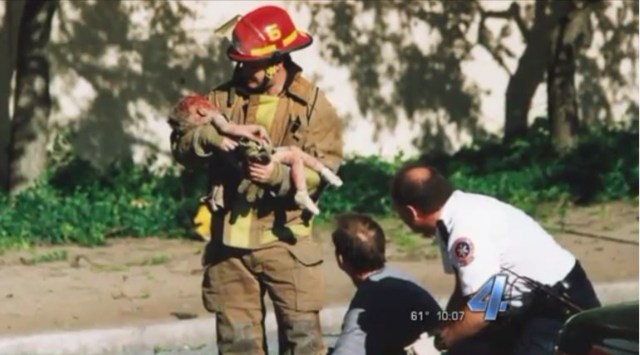
For Easter to Happen, Somebody Needed to Pick Up and Carry a Cross

oklahoma city bombing firefighter baby

Luke 24:1-12 NRSV

It is Easter Sunday! Resurrection morning has dawned. New life is being born! Something wonderful has been lost, but something magnificent is being gained.

However, on this Sunday of Sundays, I believe it is important for us to realize that before we can experience new life, before we can celebrate resurrection, before we can sing alleluias, before love can win, somebody needed to pick up and carry a cross.

And the sad thing is that there are very few of Jesus’ disciples who understand this. They do not understand it today, and they did not understand it 2,000 years ago.

Although Jesus continually taught that to gain our lives, we must be willing to lose our lives, that Easter could not happen without some self-denial, that resurrection could not come without some self-expenditure, that new life could not be born without some sacrifice, that love could not be won without some suffering, that the the light of Sunday morning could not  dawn without the darkness of Good Friday, when the time came for the disciples to follow Jesus all the way to the foot of the cross, most all of them very selfishly fled to save their lives.

One would betray Jesus. Another would deny that he even knew Jesus. Nearly all would desert him. In spite of Jesus’ continual call to pick up a cross and follow him, most of the disciples never got it.

However, there were a few disciples who did get it. There were a few who were willing to carry a cross. There were a few who chose to live selflessly and to love sacrificially. There were a few who faithfully followed Jesus all the way to Golgotha.

Although the intrinsic sexism of this world’s history has caused many in the church to overlook these faithful disciples, the good news is that all four Gospel writers did not.

In Luke 8 we read these words: Afterward [Jesus] journeyed from one town and village to another, preaching and proclaiming the good news of the kingdom of God. Accompanying him were the Twelve and some women…Mary, called Magdalene… Joanna…Susanna, and many others…” These women helped support Jesus and the twelve “out of their own means.”

And on Good Friday, when none of the male disciples could be found, Mark 15 reads: “There were also some women looking on…among whom were Mary Magdalene, and Mary the mother of James, Joses, and Salome.

In Matthew 27 we read: “Among them [gathered at the foot of the cross] was Mary Magdalene, and Mary the mother of James and Joseph, and the mother of the sons of Zebedee.

In John 19:25 we read where all the male disciples fled: “But standing by the cross of Jesus were His mother, and His mother’s sister, Mary the wife of Clopas, and Mary Magdalene.

There are many problems with Christianity today. However, I believe one of the biggest problems with our faith today, especially here in North America, is that we have too few Mary Magdalenes.

There are too few people who understand that authentic faith, true discipleship, always involves a cross. It always involves answering a call, taking a risk, denying oneself, going against the status quo, pushing the boundaries, stepping way outside one’s comfort zone.

A problem with the church today is there are too many Christians who believe they can sing “alleluias” on Easter Sunday without going through some suffering on Good Friday, who believe they can experience some new life without death to self, who believe they can somehow rise up from the waters of baptism without getting their hair wet, who believe they can serve Jesus without getting their hands dirty.

What this world desperately needs needs right now, and what the church needs more than anything today, are more disciples like Mary Magdalene. For Mary Magdalene understood that when Jesus called people to be his disciples, Jesus was always clear that there would be a cross involved.

I think this is the reason that Mary Magdalene is remembered today by Matthew, Mark, Luke and John. This is the reason she is mentioned by name by the gospel writers more than any other apostle. And this is the reason that today, on this Easter Sunday morning, Christians all over the world will hear her name mentioned as they gather to worship.

Some will hear her name as Mark 15 is read: “Mary Magdalene and Mary the mother of Joses were looking on to see where Jesus was laid.”

Some will hear her name as Matthew 28 is read: “Now after the Sabbath, as it began to dawn toward the first day of the week, Mary Magdalene and the other Mary came to look at the grave.”

Some will hear it as Mark 16 is read: “When the Sabbath was over, Mary Magdalene, and Mary the mother of James, and Salome, bought spices, so that they might come and anoint Him.”

And others will hear it as John 20 is read: “Now on the first day of the week Mary Magdalene came early to the tomb, while it was still dark, and saw the stone already taken away from the tomb.”

Just as Mary Magdalene had given what she had to support Jesus’ life, Mary was still doing all she could for Jesus in death.

And because she always selflessly pouring herself out, because she kept giving, kept sacrificing, kept risking, serving, bending, expending, anointing, because she was the most faithful of all of the disciples, because she not only sacrificially followed Jesus all the way to the cross, but courageously followed him all the way to the grave, because she followed him to the very end, she was the first person on earth to see the risen Lord.

Mark 16:9 reads: “Now after He had risen early on the first day of the week, He first appeared to Mary Magdalene…”

And in John 20:18 we read where it was Mary Magdalene who first proclaimed the good news of Easter, speaking five simple words that changed the world forever: “Mary Magdalene came, announcing to the disciples, ‘I have seen the Lord.’”  Not only was she the first person to see the Lord, she was the first person to proclaim the world-changing, earth-shaking, life-saving good news of Easter to the world!

Mary Magdalene was the very first to preach the glorious good news of resurrection on Easter Sunday, because she stayed with Jesus until the very last in his suffering and death of Good Friday. Easter happened for Mary because she had answered a call to follow Jesus, and she followed Jesus all the way.

Observing Good Friday this year was a surreal experience for many Americans, as it fell on April 19, the day of the terrorist bombing in Oklahoma City.

The story of one survivor, Terri Talley, exemplifies the suffering experienced by our nation, as well as how new life was raised out of the ashes through those who were willing to pick up and carry a cross.

Employed by the Federal Employee’s Credit Union on the third floor of the Murrah Federal Building, that morning was extremely busy for Terri. She had just returned to work after spending several days away, and a stack of paperwork waited for her.

Catching up on work, Terri took a moment that morning to chat with her good friend and coworker Sonja Sanders. “For her, it was a big day. She had just been promoted into management,” states Terri, who is certain she was the last person to have spoken with her friend.

What seemed like just moments afterward, everything changed. At 9:02 am, thousands of pounds of explosives, assembled in the back of a Ryder moving truck parked in front of her office building, exploded.

Terri recounts: “I fell from the third floor to somewhere around the basement level. It was really really fast. It was so fast that I didn’t really know what had happened. The suction pulled me down so quickly.”

Surrounded by noise Terri says, “When I came to the first time, I thought: ‘This is a really bad dream. I will just go to sleep and when I wake up everything will be okay.’ But when I came to [again], everything wasn’t okay. I thought that I must have been in a really bad wreck, and I must be [pinned in the wreckage], because I couldn’t see anything. I couldn’t move. I couldn’t even scream for help. I would try, but I was really squished. And I thought to myself: ‘I hope someone finds me.’”

Terri was found by a firefighter who almost overlooked her. [Like being sealed in a tomb] she was completely encased in concrete and granite. Terri says: “There was just a little hole and a little piece of me was showing. He touched me and … started screaming: ‘Hey! I have a live one here, and I need some help!'”

After much hard work, Terri was freed and rushed to a nearby hospital, where her injuries were identified: temporary blindness, a concussion, temporary amnesia, a cracked first vertebra in her neck, a broken right ankle, skin damage on her foot, and multiple abrasions. During her seven days in the hospital, and for weeks following, a sense of shock permeated her life.

However, today, she has this powerful message for the world:

I always tell [even] the littlest of kids: ‘Don’t think that there is nothing you can do, because kids would color pictures and send me notes. Those made me feel like people were really thinking about me. You can always do something, no matter what age you are.’[i]

This illustrates that to experience Easter Sunday, we have to have a Good Friday.

Before new life could be experienced, before resurrection could be celebrated, before “alleluias” could be sung, before love could be won, somebody needed to pick up and carry a cross.

-First Responders needed to run toward an explosion.
-Firefighters needed to go into a burning building.
-Doctors and nurses needed to give all that they had to give.
-Friends and family and church members needed to pray.
-And little children needed to pick up some crayons and color a picture.

To make Easter happen for someone–today, right here, right now–we can all do something, be something, risk something, sacrifice something, give something, create something.

We can all pick up and carry a cross.

We can feed someone who is hungry.

Visit someone who is lonely.

Love someone who is hurting.

Include someone who has been left out.

We can mentor someone who lives in a foster home.

Care for someone who is sick.

Forgive someone who has made mistakes.

Believe someone who has been abused.

We can share grace with someone who faces discrimination.

Stand up for someone victimized by injustice.

Speak out for someone devalued by oppression.

We can stay close by and anoint someone who is dying.

Be a friend to someone who is grieving.

With the spirit of Mary Magdalene, let’s keep the faith, and let’s keep the faith going, keep it moving forward, all the way to the foot of the cross, through the betrayals, through the fear, through the denials, through the suffering, through the shame, all the way to the grave, even to a tomb that has been sealed by granite or concrete.

Let us keep doing whatever we can, with whatever we have, wherever we are, to love one another until the entire world is able to sing:

“Alleluia! Alleluia! I have seen the Lord!”


[i]https://www.nps.gov/okci/learn/historyculture/stories.htm

On a Self-Denying, Self-Giving Mission

Time Magazine

Matthew 16:21-28 NRSV

As our facebook profile picture suggests, the First Christian Church of Fort Smith is on a mission.

We are on a mission to be a church of extravagant welcome. We want to live up to the identity statement of our denomination and truly welcome all people to the Lord’s Table as God has graciously welcomed us. Because when we graciously and generously welcome others, we welcome God. When we compassionately and lovingly include others, we include God.

And when we say we include God here, we are saying that we believe the spirit of the Risen Christ is actually present, moving, working, stirring, prodding, pulling, pushing, and calling us to be on this mission, and I believe he is calling us in the same way he called the first disciples, with the simple, yet profound words:

If any want to become my followers, let them deny themselves and take up their cross and follow me.

Jesus says that the first thing we need to do is to decide if we want to follow him. He said: “If any want to be my followers…”

You have heard me say that I believe the reason there are so many empty pews these days on Sunday mornings, is because of the perception that many have of the church. Instead of seeing a group of people who have made a decision to follow Jesus, they look at the church and see some type of religious club created for members to make them feel holier and more superior than others.

This is perhaps why the first thing Jesus says we must do once we decide we want to follow him is to “deny ourselves.” This thing called “discipleship,” this thing called “church,” is not about us. It’s not about making us feel spiritual, righteous, enriched or blessed. It is not about achieving a good, better, happy or successful life, or even gaining an eternal life. It’s about dying to self.

Church is not about receiving a blessing. It is about being a blessing.

It is not about having our souls fed. It is about feeding the hungry.

It is not about finding a home. It is about providing shelter for the homeless.

It is not about prosperity. It is about giving everything away to the poor.

It is not about getting ahead. It is about sharing with people who can barely get by.

I recently saw a church billboard inviting people to their church by saying: “Help people win.”

The problem with that is that our faith is not about winning. It’s about sacrifice.

I believe the reason some churches fail to look like Jesus today is because, in our attempt to entice new members, excite new members, gain new members, we have made the church about us. We say: “Come, and join our church where we have sermons, music and programs that are certain to enrich your life.” Instead of saying: “Come, join our church, where you will be given opportunities to give your life away.” “Come, join our church, where you will be encouraged to sacrifice and selflessly serve.”

Jesus said, “Let them deny themselves, and take up their crosses.”

I don’t know how it happened, or precisely when it happened, but I can understand why it happened. At some point we have interpreted taking up and carrying our crosses to mean something completely different than what Jesus intended. The crosses we bear have become synonymous with the suffering that we involuntarily have to put up with in life.

We say: “Diabetes: It’s my cross that I have to bear.” “Arthritis: It’s the cross I carry.” “Migraine headaches: It’s my cross.”

However, when Jesus is talking about cross bearing, he is talking about something completely different. He is not talking about some kind of involuntary suffering that we are forced to endure for being human. He is talking about the suffering that we voluntarily choose for the sake of our mission to be a movement for wholeness in a fragmented world.

Jesus is talking about living a life so transformed by the love of God that we cannot remain comfortably complacent while others are suffering from disease, grief, disability, poverty, a catastrophic flood, abuse, addiction, discrimination, or even from bad choices they have made.

Forgiving someone who has wronged us and continues to cause indescribable pain in our life, may be a cross Jesus is calling us to carry.

Visiting residents in a nursing home when a nursing home is the last place we want to be, may be a cross Jesus is calling us to bear.

Spending our time mentoring a young adult raised in foster care when we already have little or no time for ourselves, may be a cross Jesus is calling us to pick up.

Agreeing to volunteer to feed the food insecure when our own cabinets are almost bare, may be a cross Christ is calling us to take up.

Choosing a less lucrative career path because we feel called to serve others might be a cross Jesus is asking us to carry.

Loving all of our neighbors as ourselves knowing that loving some of our neighbors will inevitably cost us something is a cross Jesus wants all of us to bear.

Donating to the Week of Compassion Mission fund to help hurricane victims when our own budgets are tight, or making plans to go rebuild a flooded home when our own homes need some work, is a cross I believe Jesus is calling us to carry.

Standing up for the dignity and rights of minorities, of the poor, of those marginalized by the culture and by bad religion, is a cross that I believe Jesus commands all of us to take up.

I believe the reason some churches are failing to look like Jesus is because they only encourage their members to do what makes them happy, what brings them satisfaction, what makes them comfortable. “Do you love kids? Do children make you happy? Then help us with children’s church!” “Do you love going to the hospital to visit sick people? Have you always wanted to be a nurse? Then serve on our hospital ministry team!”

However, as a leader of this church, I am going to lead you to do things may not only be uncomfortable for you, but I am going to lead you to do some things that actually might cause you to suffer.

Because, you called me to be your pastor. You didn’t call me to be your activities director.

That’s because we are a church. We are not a club. We are far from perfect, but we have intentionally made a decision to follow Jesus by denying ourselves and taking up a cross.

This is what makes being a pastor so difficult, especially being a new pastor. Because, like most pastors that I know, I want you to like me.

Seriously, right or wrong, that is perhaps the most stressful part of my life right now. Does my new congregation like me? After all, I like them. And besides that, they pay my salary, and I have two kids in college!

However, because I am called to be your pastor and not your club president, and because this mission we are on together is not about what either one of us like, it is my calling to lead us to do things we may not want to do, to go to places we may not want to go, to love people we don’t want to love, to include people we would rather exclude. And I realize how difficult it is to always like someone who is leading you in that direction. Jesus’ disciples certainly did not like Jesus leading them in that direction.

I suppose it’s a cross that I have been asked to carry. But may God forgive me, may the Spirit convict me, and may the elders of this church have a special meeting and call me out, if I ever succumb to the temptation to be your pastor without carrying a cross.

Finally, Jesus says, “After you make the decision to follow me, after you deny yourselves, and after you pick up your crosses, then I want you to follow me.”

Notice he doesn’t say to walk down a church aisle and publically confess he is our personal Lord and Savior. Notice he doesn’t say: “Have a personal relationship with me.” And notice he doesn’t say to “worship me” or “study me.”

Jesus says to “follow,” which denotes going, moving, action; not sitting in a pew or in a Sunday School classroom. Jesus wants us to go and do the things that he does, share the same radical grace that he shares, go and do what we can to lavish this world with his revolutionary love even if it costs us everything.

It’s important to make this sanctuary, our narthex, our chapel, Disciples Hall, and every Sunday School room, even every restroom, a place of welcome every Sunday morning. Because, when we welcome others here, we welcome God. And if we don’t welcome God here, then I am not sure what we are doing here. We’re certainly not doing church. It’s important to come together in this beautiful place to worship and to study together each week; however, church should never be limited to any place or time.

We are a church that meets in this place, but we are also a church that is on the move. We’re on a mission 24/7, following the risen Christ, loving our neighbors as ourselves, sacrificially denying ourselves, courageously taking risks, generously giving our gifts, leaving behind family and friends if we have to, as we feed the hungry, fight for the marginalized, stand against the haters, care for the elderly, include the disabled, befriend the stranger, provide shelter for the down-and-out, restore shelter for the flooded-out, give hope to the despairing, bring to life the aspirations of the Dreamer. Whether or not people like us for it, we’re going follow wherever Christ leads us, throughout the River Valley, into eastern Oklahoma, across our entire region, down to Lake Charles, then maybe over to Beaumont, Port Arthur, and in and around Houston. Though none go with us, we still will follow. Our cross we’ll carry forward together, not one step back. Until we see Jesus, no turning back, no walking it back, no dialing it back, no turning back, no turning back.


Invitation to the Table

When we share the bread and the cup from this table, we remember that for our sakes, Christ denied himself and carried a cross, Christ gave himself, poured himself out for us.

We also remember that this is the one we have decided to follow. We remember that we have been called to deny ourselves and to carry a cross. We are called to give ourselves, to pour ourselves out for the sake of others.

As we sing our hymn of communion may we pray for the courage to follow the Christ wherever he leads us. And may we remember that he invites all of us who have gathered here to follow him.