A Hundred Fifty-Three

John 21:1-11

Happy Star Wars Day! May the fourth be with you!

You may laugh, but there are churches that are observing this day, May the 4th, as Star Wars Sunday, focusing on the spiritual struggle between darkness and light, drawing parallels between “the Force” and the Christian concept of God.

Numbers, like the 4th when it occurs in May, have always been significant in the life of the church, as numbers always seem to be significant in the Holy Scriptures.

The number 40 is symbolic of testing, trials, and periods of preparation, as we remember the story of Noah and the rain that fell for 40 days and 40 nights, and of Moses and the Israelites’ 40-year journey out of slavery into the Promised Land, and of Jesus’ 40-day fast in the wilderness.

The 144,000 protected from judgment we read about in the book of Revelation is based on the number 12, a symbol for wholeness based on the 12 tribes of Israel and the 12 disciples. The number 7 in Revelation symbolizes divinity, whereas the number 6, particularly 666, symbolizes evil.

So, when we read the story of the miraculous catch of fish in this post-Easter story, the number 153 leaps off the page!

Verse 11 reads: “So, Simon Peter went aboard and hauled the net ashore, full of large fish, a hundred fifty-three of them, and though there were so many, the net was not torn.”

Such an odd number. Such an exact number. Why not just say 150 fish? Or tell a good fishing story by exaggerating it, rounding it on up to 200?

But John says the net contained exactly a hundred fifty-three fish. There are so many possibilities with and no shortage of interpretations.

Some have interpreted 153 fish to mean: “It’s just a lot of fish.”[i] And that moments of such abundance say something about living in a world where the good news of Easter is a reality, as grief is transformed into action, scarcity is transformed into abundance, and despair becomes hope we discover that what seems like the end is only the beginning!

It means living in a world, that when it comes to the love that Jesus taught, modeled, and embodied, we can never give in, give out, or give up, because we know that such love always wins. Such love never ends. Not even death can stop it. It means never retreating in despair believing that things in the world cannot get better.

But something tells me that the number 153 means even more. If it’s just about “a lot of fish,” why didn’t John simply write, “they caught so many fish the nets started to break, and the boats began to sink,” as we’ve heard in another story (Luke 5)? Why does John specifically record the number 153?

Some scholars believe the number symbolizes the truth  that Jesus did not come to abolish Jewish law or the Torah. They point out that the Torah, the first five books of the Bible, was divided into portions to be read in worship. Like the Lectionary that I use each week to preach, the portions were part of a three year-cycle, and the three-year Torah cycle used in Palestine around the First Century had, you guessed it, 153 portions.

Now, if you think that is interesting, listen to this.

St. Augustine pointed out that the number 153 is the triangular of 17. That means that if you add all the numbers decreasing from 17, you get 153. That is to say: 17 + 16 + 15 + 14 +13 + 12 + 11… all the way down to +1 = 153.

So 153, according to Augustine, is all about the number 17, which Augustine believed was a sign of the union of Judaism and Christianity as we have 10 commandments in the Old Testament and 7 Gifts of the Spirit in the New Testament.

How about that? But wait, there’s more.

In the book of Acts, we read that 17 nations were present for Pentecost. So, Peter’s catch of 153 fish at the end of John’s gospel might mean something like the end of Matthew’s gospel when Jesus calls us to make disciples of all nations.

It was St. Jerome who pointed out that during the time John tells this story that there were only 153 species of fish in all the world. Hence, 153 signifies the universal hope that every person of every class and time would be saved through the Gospel.

St. Gregory the Great believed 10 and 7 are perfect numbers, added together make 17. This, times 3, factoring in the Trinity, makes 51. This, times 3 again, makes 153.

St. Augustine also notes that there were 7 disciples in the boat (Peter, Thomas, Nathanael, James and John, and two other disciples), who had all been filled with the 7 gifts of the Holy Spirit. 7 times 7 equals 49. 49 plus 1 (that’s Jesus) makes the perfection of 50. And 50 x 3 for the Trinity gives you 150 plus another 3 for the Trinity gives you 153.

St. Cyril breaks 153 into 100 (the great number of gentiles to be saved), plus 50 (the smaller number of Jews to be saved), plus 3 (the Trinity who saves all).

Others have pointed out that 100 (representing the number of married faithful in the Church), plus 50 (the faithful who commit themselves later in life to celibacy either living as widows or living with their spouse in a brother-sister relationship), plus 3 (the precious few who commit their whole lives to celibacy as virgins) equals 153.[ii]

I hope you are writing all this down.

Now, do you want to know what I believe is the significance of 153?

Allow me to first preface my opinion by reminding you that I have a Doctorate in Ministry and have been a student of scripture for half a century, if you count my Sunday School classes as a child. Plus, I grew up on the Outer Banks of North Carolina; thus, I know a thing or two about fishing.

Here it is. You will really want to write this down. For it is going to blow your mind and probably change your life.

Here it is. Drum roll please. People who go fishing like to count their fish.

That’s it. People who fish count their fish. Now, it may mean a little more than that, but not much more.

I also believe this Easter story has something to do about people, as the story is very similar to other fishing stories when Jesus tells the disciple anglers that they were going to go from catching fish to catching people (Mark 1 and Matthew 4).

Thus, a hundred fifty-three means that people, like fish, are to be counted. Now, compared to the hyper-symbolic, mathematical theories of the saints, that may sound like a hollow interpretation; however, when we consider the number of people who are discounted and marginalized in our world today, this simple interpretation is nothing less than prophetic.

So, what this Easter story says to me is that this movement we call discipleship where we can be confident love will win and justice will prevail, is a movement that prophetically proclaims that every person counts.

A hundred fifty-three is particularly prophetic for Americans as the United States has always had a problem counting certain people, as some in this nation, including those in power today, have always had a problem with equality. There have always been those who want to put a tear in the net, so all will not be counted.

Ever since the Constitution’s original framework, when enslaved people of color were counted as three-fifths of a person, there have been people in this country who have sought to undermine equality, suppress the vote, and discount entire groups of people.

And today, those people are in power, intentionally tearing the net by rolling back all the progress made for equality and civil rights in the 20th century, calling desegregation “a historic wrong,”[iii] and going after any organization, business or university that seeks to count everyone with programs focused on diversity, equity, and inclusion. And now, democracy hangs in the balance.

Perhaps we should have seen the end to democracy coming —when every ten years there’s an argument in our country about who should be counted and who should not be counted in the census, as counting every person is fundamental to democracy, based on the principle that each person counts and deserves representation.

So, I believe 153 is a profoundly prophetic number for America today. A hundred fifty-three affirms democracy and the principle that all people are created equally. A hundred fifty-three means there is no person who does not count.

A hundred fifty-three affirms our annual Holocaust Remembrance Service, as a hundred fifty-three means that six million Jewish people count. And they still count, despite those today who are seeking to re-write history or “move on from past guilt.”[iv]

And a hundred fifty-three also means that 2.3 million people in Gaza count, 2.3 million Palestinians who are starving to death today because of the Israeli and US-backed ban of food and humanitarian aid.[v]

One of the best things about living in New Orleans was when I had the opportunity to officiate a funeral where we marched in the cemetery behind a jazz band singing: “Oh when the saints go marching in, when the saints go marching in, oh Lord, I want to be in thatnumber when the saints go marching in!”

Oh Lord, how people just want to be counted.

People of color who cry for their lives to matter just want to be counted.

Trans men and women asking not to be called by their dead name just want to be counted.

Pregnant women who desire to have a choice in their healthcare, just want to be counted.

Disabled people requesting fairness and equal opportunity, just want to be counted.

Immigrants, refugees, and Asylum-seekers in the pursuit of happiness, just want to be counted.

People who are being snatched off our streets and disappeared, need to be counted.

Books banned; history erased; votes suppressed; due process denied; free speech stifled; basic rights deprived; Medicaid, SNAP, Head Start, low-income energy assistance, and other programs cut—it’s all about people who must be counted!

Think about who you know today—at work or at school, in your neighborhood or in your family—who may feel like they are of no count. And think about what actions you could take, or this week, or next, to let know that they do count—to you, to this church, and to God—and maybe, one day, to the nation.

“Simon Peter…hauled the net ashore, full of large fish, a hundred fifty-three of them, and though there were so many, the net was not torn.”

The net was not torn. All were counted. Amen.


[i] https://www.workingpreacher.org/dear-working-preacher/resurrection-is-abundance

[ii] https://parish.rcdow.org.uk/harefield/wp-content/uploads/sites/148/2022/10/The-mystery-of-the-153-fish-in-the-Gospel-of-John.pdf

[iii] https://wpde.com/news/nation-world/doj-department-of-justice-officially-ends-desegregation-order-at-louisiana-school-plaquemines-parish-after-nearly-50-years-court-system-integrated-racial-segregation-south#

[iv] https://www.npr.org/2025/01/27/nx-s1-5276084/elon-musk-german-far-right-afd-holocaust

[v] https://www.pbs.org/newshour/world/palestinians-struggle-to-feed-their-families-as-israel-blocks-gaza-aid-for-nearly-60-days

Free to Follow Jesus

Mark 6:6-13 NRSV

What a surreal Fourth of July this has been following the Supreme Court’s decision that Presidents who break our laws are immune to prosecution, that a president with a flawed character can do whatever they want to do and get away with it, if it is deemed an official act.

As outrageous as it is, I am afraid that this is how many in our country have always defined the concept of freedom. It is a type of freedom that serves the privileged and the powerful, as it figuratively, and sometimes literally, places shackles on all others. It is a type of freedom that is for some of the people and never for all the of the people.

Freedom (life, liberty and the pursuit of happiness) is part of our identity as a nation, a sacred concept for which blood has been shed. Yet, as history proves, it is a concept that is far from perfect.

History reveals a national economy built on the genocide of native people, slavery, Jim Crow laws, a denial of voting rights for women, and LGBTQ oppression.

For some with privilege and power today, freedom means the right to deny workers a living wage and the right to refuse service to people they find objectionable. They use the iconic Revolutionary War motto “Don’t Tread on Me” to express their disdain for their taxes being used to feed impoverished children at school or to provide SNAP benefits to the parents of those children.

For some, religious liberty means the right to hurt their neighbors instead of the freedom to love them. It is all about self-interest with no regard for others, especially minorities. Although they claim to be Christian, their beliefs and actions are most accurately described as “anti-Christ.”

The good news is (and oh how we need some good news today) I know many people who have committed themselves to follow the way of love that Christ taught and embodied—a powerful, liberating way of love that lets freedom ring for all.

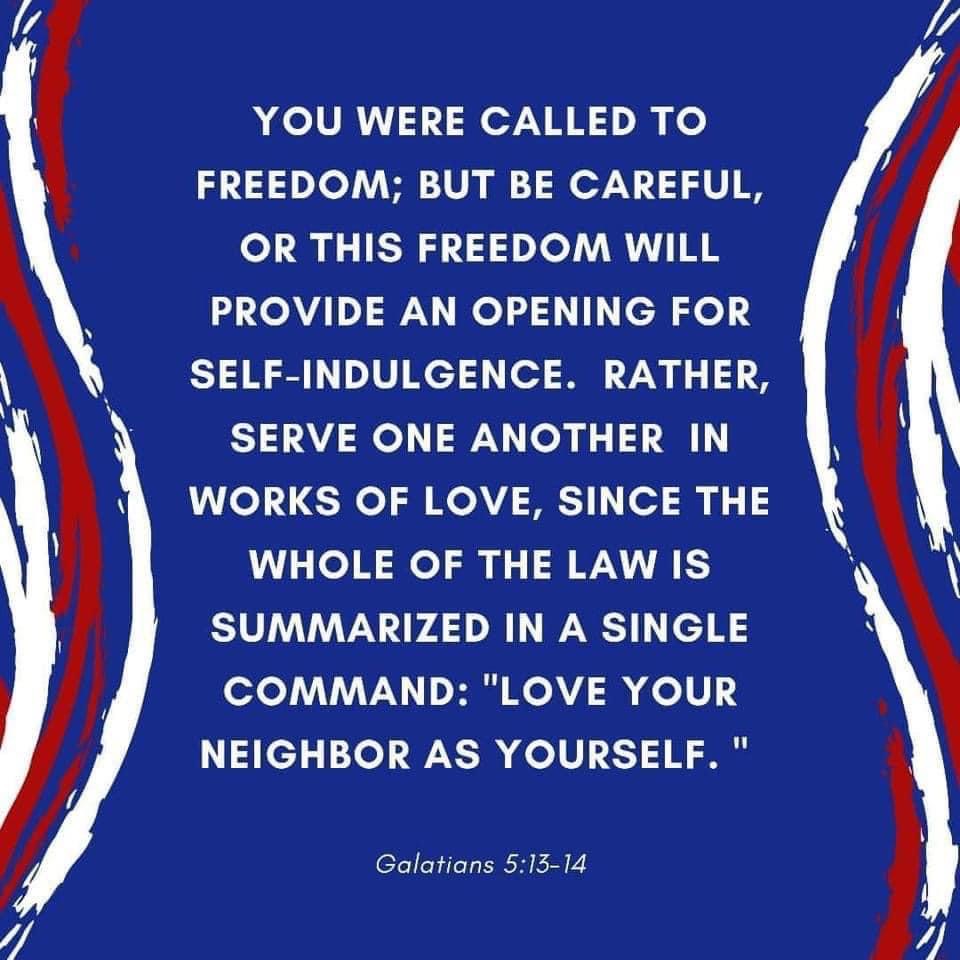
I am looking at a whole room of people who believe with the Apostle Paul that we are called to freedom, not to indulge in our selfish impulses, but to serve one another in love, people who believe they are free, not only to love themselves, but to love their neighbors as themselves.

I am looking at a room full of people who are concerned with freedom for others as much as they are concerned with freedom for themselves, who believe freedom brings both the opportunity and the responsibility to serve and to stand for others, not simply to amass personal rights and privileges at the expense of others.[i]

I see people who have chosen to use their freedom to follow Jesus as disciples, people who are fulfilling what it truly means to be the church in an oppressive world, unlike some in the church today who are doing the exact opposite, actually supporting systems of oppression.

When I think about the purpose of the church, how the church should serve in today’s world, I am constantly drawn to Mark 6 and this account of Jesus sending the disciples into the world for the very first time to be disciples. So much so, it was the source of inspiration for our new expression of church in New Orleans that Lori and I were a part of.

In verse 6 we read:

6aAnd he was amazed at their unbelief. 

I wonder if Jesus would be amazed at the unbelief of some in the church today. Having been a part of the church my entire life, I know I am often amazed when I consider how many in the church do not seem to believe that we are called to live, love and serve in the selfless, sacrificial way of Jesus. Instead, they have accepted an individualistic religion where they “accept Jesus,” “receive Jesus,” “study Jesus,” and “worship Jesus”; not actually “follow Jesus.”

I wonder if Jesus is amazed by the number of people who believe the Kingdom of God is just some place we go to after we die, instead of something we are supposed to work at, to give of ourselves to, to pour ourselves out for, to sacrifice to create right here on earth. I wonder if Jesus is amazed every time people pray: “Thy kingdom come on earth as it is in heaven,” and then don’t do a thing to make it happen!

6bThen he went about among the villages teaching.

Jesus was among the people, all the people, because Jesus was for all the people. Jesus went village to village teaching everyone that the most important thing we can do in this world is to love our neighbors as ourselves, and here in this text, we read that he expects his disciples to do the very same thing.

7He called the twelve and began to send them out two by two, and gave them authority over the unclean spirits. 

To me, one of the most disturbing political signs that I see in some yards today are the ones that say: “Jesus 2024 – Our Only Hope.” Not only do these signs support a dangerous Christian Nationalism making our Jewish, Muslim, and Hindu neighbors feel like second-class citizens, but they support an individualism that is opposed to the mission of Jesus as Jesus never intended to be on a mission to transform and save the world by himself. In what could be described as a call to democracy, Jesus called and gave authority and power to people to join him on that mission. He sent them out doing the very things that he did, some very big things like: challenging the unclean spirits: the spirits of war, selfishness, greed, poverty, all kinds of bigotry, and any type of oppression.

8He ordered them to take nothing for their journey except a staff; no bread, no bag, no money in their belts; 9but to wear sandals and not to put on two tunics. 

Freedom for many means the freedom to acquire and accumulate as much wealth as possible without any sense of responsibility to share any of that wealth. Jesus, however, calls people to live simply so they are able to give generously.

10He said to them, ‘Wherever you enter a house, stay there until you leave the place. 11If any place will not welcome you and they refuse to hear you, as you leave, shake off the dust that is on your feet as a testimony against them.’ 

 Jesus warns that if we teach others the importance of using our freedom to love our neighbors as we love ourselves, we will not be received by everyone. There will always be those who will choose to live solely for themselves instead of for others. But we should never let that discourage or stop us. We should peacefully but persistently keep moving forward, keep working, and keep doing what we have been called to do.

12So they went out and proclaimed that all should repent. 

Disciples go out and proclaim that all should repent of their selfish, self-centered, self-preserving ways and embrace a way of freedom that is far from individualistic, but a way of freedom that is profoundly connected with the well-being of everyone.

13They cast out many demons, and anointed with oil many who were sick and cured them.

We are called to stand up and speak out against the evil forces in our world. We are called to restore and to heal. We are called to be a courageous, peace-making, justice-creating, evil-exorcising, hope-giving movement for wholeness in our fragmented world!

And today, perhaps more than ever, I am grateful that you with so many others are offering this world hope by answering this call, as we journey towards a more perfect union, realizing the truth that all people are created equal and freedom is for all.

In his Fourth of July email, prophetic preacher John Pavlovitz wrote the following:

It is highly probable that it will get much worse before it gets better. And yet, no matter how dire things become, we still have our hands and our voices and our gifts and resources and platforms and privilege and lives to leverage to make it less dire for someone.

I’m not writing to tell you how bad things are…I’m [writing] to remind you how good you are.

This is not about anyone else’s inhumanity. It’s about your humanity.

It’s not about one group of people’s cruelty. It’s about your empathy…

In some ways it doesn’t matter who is in the seats of power.

It doesn’t matter how horrible the legislation that gets passed.

It doesn’t matter how much the evangelical church rejects Jesus and his teachings.

It doesn’t matter how compromised the courts are.

It doesn’t matter how predatory the preachers or the politicians become.

That is almost irrelevant.

Their violence is not the point.

Your capacity for love is the point.

And that love is the only plan.

Pavlovitz continues:

So yes, we will grieve and lament the unthinkable news this week. We will feel the sickness on this holiday [celebrating] a freedom that feels as though it’s evaporating—and then, we will get on to the work of fighting like hell to make sure that it doesn’t. Be greatly encouraged.

Amen.

[i] Adapted from article by Rev. Dr. Brett Opalinski, Emory University Candler School of Theology

A Pentecostal Outpouring

Acts 2 NRSV

I have heard more than one person say: “the Spirit of God is in this place.”

I have also heard people make the counter observation about other churches, saying something like: “I no longer felt the Spirit in that place.” And I am sure that there are some who have made, and who still make, that observation about our church.

So, a good question for us to ask on this Pentecost Sunday is: “How do we know whether or not the Holy Spirit is here?” How do we know if any church ever experiences something like Luke described as a violent wind and tongues of fire? How do we recognize a Pentecostal outpouring of the Holy Spirit?”

As a child, I remember our congregation often opening a worship service by singing:

There’s a sweet, sweet Spirit in this place. And, I know that it’s the Spirit of the Lord; There are sweet expressions on each face, And I know that it’s the presence of the Lord (Doris Akers, 1962).

“Sweet facial expressions?” Is that how we know? I suppose I see a few of those today. But are you happy because the Spirit is here or because you know there’s some good food waiting for you at the end of the service?

I have heard some people talk about an outpouring of the Spirit as they describe a worship service where people are standing singing praise songs to Jesus with their hands raised and tears rolling down their cheeks.

I once served on a town’s recreation committee with the responsibility of organizing the summer church softball league. After leading worship on Sunday, I drove over to a neighboring church to deliver the schedule for the upcoming season. As I pulled into the parking lot, I noticed that cars were pulling out, so I assumed their service had just ended. As I opened and walked through the front door of the sanctuary, I was alarmed to see several people lying motionless in the aisle! The pastor, who was gathering his notes at the pulpit, saw me come in, and without even a hint of concern in his voice, greeted me with a smile saying: “Brother Banks, welcome! Come back with me to my office, and don’t mind those folks lying there in the aisle.”

More than a little distressed, as I walked around the bodies lying in the aisle, I asked: “Are these people ok?”

The pastor said: “Oh, don’t you worry about them. They’ll get up soon enough. We just had a tremendous outpouring of the Holy Spirit today where several people were slain in the Spirit. It happens from time to time.”

I anxiously followed the pastor into his office, where he asked me to sit down across from his desk. As I handed him the softball schedules, I must have had a not-too-sweet expression on my face, because he asked, “Brother Banks, you don’t ever have people fall out during your services, do you?”

I answered: “Oh, it’s happened a time or two, and each time, somebody called 911.”

He smiled and said, “Well, that’s how we know that the Holy Spirit is in this place.”

So, should be concerned that no body passes out in the floor during our worship here? That no one stands and raises their hands as they sing overwhelmed with emotion?

So, what do we mean when we say we feel the spirit in this place?

Some Sundays, I am amazed how the anthem that Jeremy selects or the hymns that Judy plays fit perfectly with the sermon. I sit back here and say to myself: “That’s the Spirit working!”

However, as amazing as that is at times, I am not sure that exactly what is being described by Luke on the Jewish festival called Pentecost.

Luke writes: “When the day of Pentecost had come…all of them were filled with the Holy Spirit and began to speak in other languages, as the Spirit gave them ability.”

I suppose we could ask someone who knows a few languages, like Brian Cox, to come up here and speak to us this morning. But there’s a problem with that. The miracle of Pentecost was not so much in the speaking as it was in the hearing.

Amazed and astonished, they asked, ‘How is it that we hear, each of us, in our own native language?

If Brian comes up here and speaks to us in German, I am pretty sure we are not going to hear him in English.

Perhaps Luke, in describing the outpouring of the Holy Spirit, is trying to paint a portrait to help us see something larger, more wonderful, and more astonishing.

Perhaps Luke is describing what our country needs today, what our world needs today— a divine grace to listen, to hear, to understand, to empathize with others who may be so different from us that they speak a different language. Perhaps Luke is describing an outpouring of the Holy Spirit that produces a divine compassion for more people than the people we see as “our own,” a holy call for people to possess an empathy that transcends countries, ethnicities, sexual orientation, gender, and race. In this great Pentecostal outpouring-of-the-Spirit event, Luke just well may be describing the first Diversity, Equity, and Inclusion Conference!

Luke is describing a Pentecostal outpouring that transforms the hearts and minds of people to have the heart and mind of Jesus who listened to, heard, and learned from a Syrophoenician woman, saw the Samaritan as his neighbor, and accepted Eunuchs, who Matthew records Jesus saying were “born that way” (Matthew 19).

Luke is describing a people who would never say “God bless America” without a sincere desire for God to bless the entire world. He is describing a group of people who would never condemn the genocide of one nation without condemning the genocide of another. He is describing white people who do not hesitate when they see a black man mercilessly executed by police in the street to stand up and say “Black Lives Matter” or to speak out at the school board when the history lessons taught to children in our schools are being whitewashed.

Luke is describing people who do not merely worship Jesus, but they follow Jesus, and teach the way of love that Jesus taught, a generous love that is expressed as goodwill for all people.

Luke is describing hearts that are so generous “they would sell their possessions and goods and distribute the proceeds to all, as any had need.” These are people who never complain about food stamps, free healthcare, and increasing the minimum wage, because they truly believe in supporting the welfare of all people, so no one, regardless of their citizenship is in need.

Luke is describing people who feel a deep sense of connectedness to all people.

The COVID-19 pandemic taught us many things. Like all communicable diseases, that a virus can originate on the other side of the world and quickly spread to every nation on earth taught us how connected we all are to one another.

But it also taught us something about our refusal to acknowledge such connectedness. It taught us something sinister about our selfishness and self-centeredness as some refused to wear a mask in public or get a vaccine to protect their neighbor. Even some churches refused to abide by the stay-at-home orders at the beginning of the pandemic, revealing that we have many churches in America devoid of the Holy Spirit of the One who said the greatest commandment is to love our neighbors as ourselves.

It revealed that what this world needs today is some Pentecost, a serious outpouring of the Holy Spirit!

And by “serious,” I mean the world doesn’t need more people tearfully worshipping Jesus with their hands raised in the air. It needs more people following Jesus by extending their hands to help their neighbors in need.

The world doesn’t need more anthems or postludes that pair well with the sermon. It needs more people who are offering their spiritual gifts to pair with the needs of the world.

The world doesn’t need more people slain in the spirit on Sunday morning. It needs more people to be awakened by the spirit to a live a life of generosity for the goodwill of all people every day of the week.

And the world doesn’t need any more congregations with sweet expressions on each face. It needs more of the fire that was experienced on that day the Holy Spirit showed up enabling people of all nationalities, ethnicities, and races to see, to listen, to hear, and to care for one another.

The world needs more empathy and equity, more justice and generosity, more sharing and more goodwill, and not just for people who speak our language, are born in our country, share our pigmentation, or go to our church, but for all people.

The good news is that I believe this is indeed a spirit-filled church. Now, we are still calling 911 if you fall out in the aisle this morning, but there’s plenty of other evidence that the Spirit of the Lord is in this place.

The building and the blessing of the little food pantries, our donations to the Rivermont food pantry, our volunteers each month who serve at the Park View Mission, our folks who have signed up to deliver Meals on Wheels—these are all evidence of a Pentecostal outpouring of the Holy Spirit, or as my childhood preacher liked to say, “an unction of the Holy Ghost!”

And just this past week, our Outreach Team met with the Interfaith Virginia Center for Public Policy to discuss a partnership that will enable us to not only feed our neighbors in need, but to be advocates for justice, so our neighbors will not be hungry in the first place. This may be the strongest evidence of all that there’s Pentecostal outpouring in this place.

So, as we celebrate 150 years as a church, on this day which has been called “the birthday of the Church” (that’s Church with a big ‘C’), there is indeed a sweet, sweet spirit in this place. There are sweet expressions on some faces, but there are also some holy scowls, some furrowed brows, some eyes filled with divine determination, souls ignited by a fiery Call of Love to make this a more generous, equitable, and just world, not just for some of the people, but for all people. And I know that it’s the Spirit of the Lord. Amen.