
When the Bent-Over Stand Tall

Luke 13:10-17

There she was. Bent over for eighteen long years. Eighteen agonizing years of looking at the ground instead of the sky. Eighteen heartbreaking years of staring at her feet when she longed to see the stars. Eighteen years of neighbors passing by, some whispering, some staring, some mocking, and some pretending not to notice.

This one who was “bent over and not able to straighten up at all,” says Luke, had come to the synagogue to hear the teaching of a young rabbi named Jesus.

Listen again to verse 12, “When Jesus saw her…”

Let’s not miss that.

Before anyone else noticed her, Jesus saw her.

When the world looks away, Jesus sees. When society grows accustomed to suffering, Jesus stops.  When the culture calls suffering “normal,” Jesus calls it “wrong.”  When the world says, “nothing can change,” Jesus says, “oh, yes it can!”

This woman lived eighteen years under the weight of her condition.
But how many of us know people bent over for far longer than that?

Notice that Luke tells us that “a spirit” had crippled this woman. This was not some cartoon ghost floating around. Luke is naming the same thing John calls “the spirit of the antichrist,” the same thing Paul calls, “the spirit of slavery.” It’s the same spirit Mark called “Legion” pointing directly to Roman military occupation. It’s the same thing our ancestors called the spirit of Jim Crow. It’s the spirit of greed, the spirit of sexism, the spirit of pride and self-righteousness.

These spirits don’t float around in the air. They take root in systems and in structures. They show up in unjust laws, in hateful rhetoric, and in economic exploitation. When Jesus lays his hands on the bent-over, he is confronting not just sickness but the very spirit that says some people should stay bent over.

This is the spirit of oppression, the kind of spirit that settles in when the world tells you that bent down is all you will ever be. It’s the spirit that whispers, “Stay in your place.” It’s the spirit that says, “You don’t deserve healing. You don’t deserve dignity. You don’t deserve to stand tall.”

It’s the spirit that tells workers scraping by on minimum wage that they don’t deserve a living wage. It’s the spirit that tells people without health insurance that their lives are expendable. It’s the spirit that tells young Black men they are more likely to fill a jail cell than a college classroom. It’s the spirit that tells women, immigrants, trans and queer folk: “You don’t belong. You are less than. You should stay bent.”

The truth is that we are surrounded by the bent-over. And the tragedy is not just that people are bent. The real tragedy is that, like the synagogue leader in our story, the religious and political establishment today would rather preserve the systems that bend people over, than bring healing and transformation that makes the bent over stand tall.

That’s the ugly spirit that cripples this woman in the synagogue. And that’s the spirit that Jesus confronted in that synagogue. And that’s what really angers the religious leaders. Because when Jesus lays his hands on this woman, it’s not just a personal miracle. It’s a public exorcism. It is the casting out of a spirit that says bondage is normal. It is the overthrow of every lie that says any of God’s children should stay bent and broken.

Indignant that Jesus would not only heal on the Sabbath, but heal a woman, touching her, violating the rules of religious tradition, the religious leader scowls: “How dare you! Come for healing on any other day, but not on the Sabbath!”

But the Sabbath was never about rules. The Sabbath is about restoration. The Sabbath is God’s reminder that human beings are not machines. The Sabbath is the declaration that Pharaoh’s bricks and quotas and endless production do not have the final word.

The Sabbath is freedom. And Jesus, right there in the synagogue, calls out their hypocrisy by saying: “How can you untie your ox or donkey on the Sabbath but refuse to untie this woman from her bondage?”

Two years ago, during the Sunday School hour, to get to know the new pastor, we played this game called “Quiz the Pastor” where you were asked to write questions and place them in a box for me to draw and answer. Most of the questions were easy, like “what is your favorite dessert?” But I will never forget one of the questions: “What is the gospel?” I can’t remember how I answered that important question, but I should have answered by retelling this story in Luke 13.

Because Jesus answers that question in the synagogue that day when he talks about the Sabbath: If the Sabbath is for rest and restoration, then the people most in need of restoration, the ones most bent over, the ones most tied down and bound, are the very first who should taste its freedom.

I believe we must be clear: this story is not just about one woman with a bad back in Galilee. It is about all the places where people are bent over today. And it’s about all the ways our society tolerates suffering, because healing would disrupt business as usual.

We live in a nation where: patriarchy is untied while women are bowed down with fewer rights; corporations and billionaires are untied every tax season while workers stay bound; banks are untied from regulations while the poor stay bent beneath debt; guns are untied while active shooter drills bend school children beneath desks; autocracy is untied while gerrymandering and voter suppression bends down democracy; and much of the church in our country has been untied from any responsibility to make this world more loving, peaceful and just, as pastors preach about Jesus’ role in personal salvation while ignoring his role in social liberation.

The synagogue leader says to Jesus: “No, not today. It’s unacceptable to bring that in here!”

And Jesus responds with the gospel: “Not tomorrow but today is the day of liberation! Here and now is the acceptable place and time for all who are bound to be untied!”

And because of this gospel truth, the good news is we’ve seen bent-over people stand tall throughout history.

In 1968, the Memphis sanitation workers were bent under dangerous conditions and poverty wages, but they stood tall, carrying signs that said, “I Am a Man” until the world had to see their dignity.

A year later, Marsha Johnson and Sylvia Rivera were bent by poverty, police harassment, and transphobia, yet they stood tall at Stonewall and beyond, fighting for the dignity of LGBTQ+ people.

More recently, Greta Thunberg was bent by the loneliness of being a child confronting the climate crisis. She was mocked and dismissed by the powerful, yet she stood tall, sparking a global movement of youth demanding a livable planet.

And there have been countless others who have stood tall after being bent down: the farmworkers led by César Chávez, Desmond Tutu in South Africa, Martin Luther King Jr. in a Birmingham jail, and nameless mothers and grandmothers who kept marching, kept praying, and kept believing.

And every time they stood tall, strong men trembled. Every time they stood tall, chains cracked. Every time they stood tall, the Kingdom of God broke in just a little more.

The question is not whether Jesus can help people stand tall today. The question is whether we will join him. Will we dare to touch the wounds this world says are untouchable? Will we dare to lift up those our society keeps bent over? Will we dare to live like the Sabbath is real, that God’s rest and God’s restorative justice belong to everybody?

This is the vision of the Kingdom. Not just one person healed, but entire communities rising up, standing tall, rejoicing together with all.

Because, as Dr. Barber reminds us with the Poor People’s Campaign, when the bent-over stand tall, when the poor organize, when the oppressed resist, when the weary find their strength in faith, then the powers that profit from their suffering are put to shame.

That’s why the crowd rejoiced, and that’s why the rulers were humiliated. Because nothing frightens empire more than people who refuse to stay bent.

So, the question for us today is: Will we be content with a Sabbath that unties donkeys but leaves people bound? Or will we follow Jesus into the holy work of untying our neighbors, of lifting up the bent-over, of making straight what has been made crooked for too long by an anti-Christ spirit in our world?

The good news is that there’s another spirit in our world. The good news is that the spirit of the same Jesus who made that woman stand up is alive and moving today.

He is moving every time someone stands and demands living wages, every time someone stands and fights for universal health care, every time someone stands and calls for racial justice, and stands to end the scapegoating of and the cruelty to immigrants.

He is moving every time someone stands up and does something to help the bent-over stand tall.

And here’s the reality, because we are the body of Christ in this world, if we leave here today and do nothing, then the woman stays bent.

If we leave here today and stay silent, then Herod, and the religious powers who have forsaken the gospel to follow Herod, still win. If we leave here today and choose comfort over courage, then the powers will keep alive the lie that there is no alternative to the status quo.

But I declare to you today in the name of Jesus that there is an alternative! There is a better way! And it begins when the people of God stand tall, when they refuse to bow to Herod and refuse to look away from the suffering around us.

So, let us rise and stand up straight as that woman did. Let us lift our voices in praise, and let our praise spill into protest, and let our protest grow into policy, and let our policy become a new way of life.

Because when the church rises and stands tall, the world cannot stay bent! When God’s people stand up tall together, Herod trembles. And when the bent-over stand tall, that’s when the Kingdom of God breaks in!

So church, it’s time to rise and stand up!

It’s time to rise and stand up for justice!

To rise and stand tall for mercy!

Stand tall for peace! Stand tall love!

Stand until every child of God can stand tall and sing free!

May we always have the courage to see, the faith to act, and the love to untie any bond that keeps any one of God’s children bent down.

And may we rejoice with the crowd until every last one of us can stand tall and rejoice together. Amen.

The Lane Is a Lie

Luke 10:38-42

I recently received some advice from a concerned friend, and I quote: “Jarrett, as a pastor you’d be better off to just preach the gospel and stay out of politics. Just stay in your lane.”

And as you are probably aware, I am not the only preacher who has been told this.

Following the murder of George Floyd in 2020, when preachers spoke the names of Breonna Taylor, Tyre Nichols, or Sandra Bland from their pulpits, or when they dared to say out loud, “Black Lives Matter,” many congregants responded with discomfort or outright anger, telling pastors they were being “too divisive,” and yes, “too political.”

Translation: Stay in your lane.

Churches that have offered physical sanctuary to undocumented immigrants have been surveilled, threatened with fines, and reported to ICE. The pastor of a Colorado church that sheltered a mother facing deportation was investigated for “harboring a fugitive.”

Translation: Stay in your lane.

When churches in Georgia, Florida, and North Carolina organized voter registration drives, especially in Black and poor communities, they were accused of violating the Johnson Amendment by “engaging in politics.” In 2022, a church in Georgia was investigated for “election interference” after encouraging people to vote for candidates who support Medicaid expansion without endorsing a particular candidate.

Translation: Stay in your lane.

And now, pastors, rabbis, and imams who dare to speak out against the ethnic cleansing in Gaza, who mourn the loss of innocent life and demand a ceasefire and humanitarian aid, are accused of being antisemitic, unpatriotic, or “on the wrong side of history.” All because they had the audacity to declare that every life is sacred.

Translation: Stay in your lane.

In all these cases, the message is clear:

“You can pray for peace in the Middle East, but don’t protest the genocide of Palestinians by Israel and the United States.”

“You can preach salvation, but not liberation.”
“You can feed the hungry, but you can’t ask why they’re hungry in the first place.”

“You can convict souls, but you can’t challenge systems.”

“You can bury the dead, but you shouldn’t question what’s killing them.”

Preacher, your lane is in the sanctuary, not in the public square. And you need to stay in your lane.

Have a bake sale for the underprivileged but keep quiet about the greed of the privileged. Pray for the sick, but don’t talk about a deadly bill that takes away Medicaid from millions. Stock a food pantry, but don’t talk about the government taking away SNAP benefits. Give to charities but don’t ever mention the need to raise the minimum wage. Talk about loving your neighbor, but don’t use the words like “racism” or “white supremacy.” Have programs to support teenagers, but don’t defend trans youth. Just stay in your lane pastor and preach Jesus.

But here’s the thing they don’t seem to understand; the Jesus we preach never stayed in his lane. Yes, he set tables that fed hungry people, but he also flipped tables that fed greedy people. He healed sick bodies, but he also called out sick systems. Jesus worshipped on the sabbath, but he also broke the laws of the sabbath. He continually switched lanes to be on the side of the forgotten, the suffering and the lost.

And today, our gospel lesson invites us to not only leave the lane they want us to stay in, but to reject that lane as a lie. It encourages us not to shrink our witness today, but to expand it. To sit like Mary, in those places they said we are not allowed.

Now, to 21st century ears, this story may sound like a simple story of sibling rivalry, of two sisters in a little family feud about who’s working hard and who’s hardly working.

 But when we put this story in the context of first-century Palestine, we understand that it’s really a story about what happens when one refuses to be confined to the lane they have been assigned by the culture.

Martha was doing exactly what society expected of her. She was in her lane, in the kitchen, preparing to serve her male guest, a young Rabbi named Jesus.

And Mary?

Mary was in the living room audaciously sitting down at the feet of this Rabbi to listen to what he had to say. I say “audaciously” because only disciples were permitted to sit at the feet of a Jewish Rabbi. And disciples were always, without exception, male.

Thus, in sitting down at the feet of Jesus, Mary demonstrated a refusal to stay in the lane society had given her. She made it her business where they said she had no business. She challenged the status quo in a society that wanted her quiet and invisible, or busy and distracted in the kitchen.

And Jesus?

He doesn’t correct her. He doesn’t scold her. And he doesn’t just defend her. Jesus applauds her. Jesus not only allows it, he affirms it, saying: “Mary has chosen the better part, and it will not be taken from her.”

Jesus saw the system. He knew the expectations. He understood that Mary was way out of line. And still, he said: “This is what discipleship looks like.” Mary found God’s holy purpose not by staying in line, but by stepping out of line.

And so does the church. Throughout history, the Church has always been at its best when it refuses to be silent, when it organizes, protests, speaks truth, and shows up, when the Church understands that it is not called to a civic club to just manage injustice with thoughts, prayers, and charity. But called to be a holy movement interrupting injustice by getting into some good trouble.

The Church has always been more aligned with who God has called it to be when we get out of line and, yes, are criticized for being too political.

Such criticism only affirms we’re aligned with a gospel that is inherently political, because it’s good news for the poor, it’s freedom for the oppressed, and it’s justice for the left out and left behind.

There’s nothing partisan about the gospel we proclaim. It’s not owned by any political party. It belongs to the poor. It belongs to the marginalized. It belongs to the sick, to the disabled, to the oppressed, to the most vulnerable among us.

I know things are bad in the world right now. But think of how much worse things would be if the peace-makers and the justice-seekers of our history stayed in their lane— if Frederick Douglas and Sojourner Truth obeyed their slave masters, if Harriet Tubman didn’t go underground, if Fannie Lou Hamer never publicly proclaimed she was “sick and tired of being sick and tired!” Where would this country be today if Martin Luther King Jr. only preached about Jesus inside the four walls of his church, or if Rosa Parks got up and moved to the back of that bus, or if Joseph McNeil, Franklin McCain, Ezell Blair Jr., and David Richmond never sat down at a Woolworth lunch counter in Greensboro, North Carolina, or if Rev. David and Kaye Edwards, pastors of the First Christian Church in the Lynchburg, Virginia stopped talking about the church’s to be Open and Affirming in the 1990’s when some of the members told them they were out of line?

But thank God they each understood that being disciples of Jesus in a world misaligned with will of God, meant they were called step out of line.  And when they were criticized for stepping into the wrong lane, they rose up and they said: “No, I’m in my lane, for my lane is unconditional love, my lane is mercy, my lane is justice, my lane is emancipation and liberation, my lane is equality and solidarity, because my lane is Jesus, the one who never stayed in any of the lanes the empire gave him!”

Thank God they each understood that Mary chose the better part by sitting down in a place the religious culture did not want her to sit, choosing truth over tradition, choosing the lane Jesus called her into over the one the patriarchy assigned her to. And Jesus says, “It will not be taken from her.”

So church, we’ve got a choice today.

Do we stand in the lane that will make the privileged more comfortable? Or do we sit down in holy protest and say: “We’re choosing the better part and nobody’s going to take that away from us!”

We’re boldly choosing to preach God’s Truth when the world tells us to be quiet. We’re audaciously choosing to leave the sanctuary to show up in in city halls, on protest lines, at silent vigils, detention centers, homeless shelters, and school board meetings. We’re courageously choosing the gospel of Jesus over the comfort of religious respectability. We’re fearlessly choosing to get in some “good, necessary trouble.”

We’re choosing to follow Jesus—not the version wrapped in stars and stripes—but the one who broke bread with the outcasts and flipped the tables of those who were part of an unholy alliance of greed, religion, and nationalism.

So, let them say we need to stay in our lane.
Let them say we’re too political.
Let them say we’re too bold, too loud, too much.

Because I’d rather be too much for fascism than too little for Jesus!

Mary chose the better part. And so must we. And Jesus says: It will not be taken from us.

It’s sad to me that the ones who want to take it from us also claim to follow Jesus. So, when they tell us to stay in our lane, we need to remind them that Jesus never stayed in his lane.

Jesus left heaven to walk with the poor.
He healed on the Sabbath.
He touched the untouchable.

He offered belonging to outcasts.
He fed the hungry without a permit.

He provided healthcare without a copay.
He overturned tables in the temple of injustice.

And if Jesus didn’t stay in his lane, as followers of Jesus, neither can we.

So, when they tell you that politics isn’t any of the church’s business—
You remind them that the prophets spoke truth to the kings.
That Moses stood in Pharaoh’s face.
That Esther interrupted the empire.
That Mary sang a song so radical, it brought down the mighty from their thrones.

When they try to tame your gospel, shrink your God, or soften your truth,
You lift your voice like a trumpet!
You say, “We were not baptized in front of all those people just to keep our faith in the closet!”
We were not called by Jesus to conform to the culture.
And we were not filled with the Holy Spirit so we could keep privileged folks comfortable.

So, Church let’s go and cross a line for love!
Run out of bounds into some good trouble for justice!

Refuse the script. Interrupt business as usual!
Feed the hungry, welcome the stranger, and tear up the blueprint of empire!

Walk, stand, and sit with the audacity of Mary!

Because when we’re out of line, when they’re begging us to stay in our lane, we are most aligned with our Holy purpose!

 Amen.

We’re on the Way

Mark 10:46-52 NRSV

The first thing we learn from our scripture lesson this morning is that Jesus and his disciples are on the move. They are on the way. Jericho was not the final destination. There is one last stop to make. Jerusalem: Where furious religious leaders, offended by the good news of the gospel toward those who are poor, ashamed of the grace of the gospel toward those who have been cast aside, and shocked by the topsy-turviness of the gospel toward those considered to be the least, have been plotting to put an end to all. Jerusalem: Where a selfless Jesus is prepared to love and to forgive and to be killed for the sake of the gospel.

It is on this way, this way of self-denial and self-giving, this way of self-expending love for all people, especially those who are otherized, demonized and marginalized, that Jesus is confronted by a man who fits every one of those descriptions. His name is Bartimaeus. He is not only blind, he’s also a beggar. He’s helpless, and he’s poor. He’s disabled and he’s dismissed. Because many believed there must be some reason for his blindness, he is judged and demonized. And, in desperation, this “other” is waiting for Jesus on the side of the road. From the margins, he’s waiting for some love. He’s waiting for some justice, and he is waiting for some grace.

He jumps up and pleads: “Jesus, Son of David, have mercy on me!”

And notice the actions of the crowd. They try to silence him, for they simply don’t want to hear his cries.

Does that sound familiar?

Have you ever been on the way somewhere, met someone, nodded your head and asked: “How ya doin’?” It’s a stereotypical pleasantry, an informal greeting. You expect them to nod back, and say something like, “I’m good, how ya doin’?”

But then, to our surprise, the person doesn’t answer the way we expect them to answer, the way we want them to answer, the way we believe they should answer. No, this person decides to unload on you. They have all of these aches and pains, all of these troubles and frustrations, all kinds of maladies that you label as TMI.

We don’t like TMI, especially when the TMI has to do with suffering.

I believe this is one of the reasons we tend to avoid people who have some sort of disability. Their suffering threatens us, because their circumstances are a reminder of how vulnerable all of us are. We know that if it could happen to them, it could happen to us, or to one of our loved ones. So, we prefer to keep the sick, the troubled, the unfortunate, and the disabled out of sight, thus out of mind.

I admire companies like Target and Kroger who make it their mission to hire disabled persons. Fortunately, there are many advocates today for the disabled and others who have been marginalized by society who are urging them to come out, to come forward, to speak up, and to seek equity and equality.

This blind beggar does just that. Despite the crowd who “sternly orders him to be quiet,” the man keeps yelling at Jesus, “Son of David, have mercy on me!” “Son of David, have mercy on me!”

And the good news is that Jesus hears his voice. Jesus stops. And Jesus calls him to come over.

Jesus asks, “What do you want me to do for you?”

Not surprisingly, blind Bartimaeus says, “My teacher, let me see again.”

And Jesus does just that.  He says, “Go, your faith has made you well.”

Then Mark describes something that he never describes when telling a healing story. Out of all the folks that were healed in Mark’s gospel, Bartimaeus is the only one who chooses to follow Jesus “on the way.”  Out of all the people who were healed by Jesus, Bartimaeus is the only one who becomes a disciple and follows Jesus on the way to Jerusalem; on the way to the cross; down the road of self-denial and self-expenditure; down the road of grace, mercy, justice, abundant and eternal life.

Thus, what we have here in this text is not just another miraculous healing story, but a wonderful story of discipleship. And guess what? It’s not just a story about one blind beggar. It is a story about you and me.

For, I believe we sometimes tend to come to Jesus asking him to heal us, solve our problems, fix what’s wrong with us. We come to Jesus saying: love me, feed me, hold me, and make me happy. Give me some sense of fulfillment. We come to church hoping that we might get something out of Jesus, something from Jesus, that he might give us some semblance of peace and joy. We come to Jesus seeking help, wholeness, security, and spiritual bliss.

But how many of us come to Jesus because we are truly willing to follow Jesus as a disciple, especially to those places that we know Jesus is heading?

After restoring Bartimaeus’ sight, Jesus tells him that he can go on his way. And who would blame Bartimaeus if he turned around right then to go on his way? Think of all the places he might want to go! Think of all the sights that he might want to see with his new eyes!

Bartimaeus could have gone home with his new-found faith in Jesus and love for Jesus. He could have been content knowing that Jesus heard his cries, restored his sight, and gave him salvation.

But Bartimaeus doesn’t go his way.

Bartimaeus goes Jesus’ way.

Bartimaeus chooses to follow Jesus. Where? Toward Jerusalem. Toward rejection. Toward a mission of love, mercy, and justice that will make some in power label him “the enemy within.” Bartimaeus chooses to follow Jesus all the way to the cross.

The irony is that Bartimaeus is introduced to us in this story as “a blind man.” However, Bartimaeus proves he may see Jesus much better than many who call themselves “Christians” today.

Bartimaeus teaches us that this thing we call “Christianity,” this thing we call “church,” is all about following Jesus.

Jesus is not calling people who merely want to be saved, to be healed, to be made stronger, to see more clearly, and to be fed by him. Jesus is not calling people who simply want to agree with him, believe in him, or admire him. Jesus is not calling people who only want to read about him, study him, or sing praise songs to him. Jesus is calling people who desire to follow him.

In C.S. Lewis’ classic novel, The Screwtape Letters, the devil advises an apprentice demon that the main way to keep people from the Christian faith is to prevent the potential convert from doing anything. 

The devil says that the main thing…

…is to prevent his doing anything. As long as he does not convert it into action, it does not matter how much he thinks about this new repentance. Let the little brute wallow in it. Let him, if he has any bent that way, write a book about it…. Let him do anything but act. No amount of piety in his imagination and affections will harm us if we can keep it out of his will. As one of the humans has said, active habits are strengthened by repetition, but passive ones are weakened. The more often he feels without acting, the less he will be able to ever act, and in the long run, the less he will be able to feel.

To the dismay of CS Lewis’ devil, Bartimaeus put his faith into action and followed Jesus, even toward Jerusalem.

At the end of this service, we are going to have what we call an invitation. Some churches call it an altar call. It is a practice that was started in many protestant churches during the turn of the 20th century. Those who wish to dedicate or rededicate their lives to Christ or become a member of the church are invited to come down to the front as a public sign of their commitment.

Sometimes, this practice has been emotionally manipulative. Preachers have used guilt and other forms of pressure to get people to walk the aisles. Because of this, the invitation or the altar call has been dropped in many churches and is very rare in most denominations.

Well, I’m not ready to drop it, and it’s not just because I have a little Baptist left in me from my childhood. It is because I believe, despite its misuse and abuse, the “Invitation,” whether or not anyone ever comes forward, keeps reminding us that it is not enough for us to come together on Sunday morning to get something out of Jesus: a sense of well-being, as sense of peace, a feel-good feeling of spiritual bliss. It reminds us that the point of it all, the point of Christianity is to follow Jesus, to give our lives to Jesus, to stumble after him along the way, even to Jerusalem. To be like Bartimaeus and summon the courage to stand up and not be ashamed, to be willing to give and to sacrifice and follow him on the way:

On the way to hear and answer the cries of the disabled;

On the way to stand up and speak up for those who are otherized, demonized and marginalized;

On the way to defend liberty on the behalf of the oppressed;

On the way to speak words of healing to the sick;

On the way to speak words of grace to those who struggle, words of peace those who are afraid;

On the way to put our arms around the troubled and offer hope to the despairing;

On the way to feed the hungry, clothe the naked, visit the imprisoned;

On the way to the ballot box to vote for people who care, not just about themselves or their friends, but truly care about the least among us;

On the way to Jerusalem, where resistance, and even a cross awaits.

A Topsy-Turvy World

Mark 10:35-45 NRSV

What a great moment we experienced together last Sunday, as we received the hopeful good news that for God all things are possible! That after 150 years, we are still here, and we are still saying “yes” to following Jesus!

Last week, the commitment of Peter and the disciples, and our own commitments to leave behind friends and family to follow Jesus, were affirmed with a promise from Jesus. With those first disciples, because we are allowing Jesus to turn our lives upside-down by accepting and working for a world where the first are last and the last are first, and the greatest among us are servants, Jesus promised us:

For everything we have given up, he will give us much more. For everything we have turned our back upon, he will give us a hundred times more!

It was a great day! A joyful day! A hopeful day!

But… (C’mon you knew it was coming!) …but, what a difference just one week can make.

Just when we were beginning to think that the disciples were finally starting to get it right, we open our Bibles, and still in this 10th chapter of Mark, we read where James and John, the sons of Zebedee, come asking Jesus if he will do them a favor.

You remember their poor parents, don’t you, Mr. and Mrs. Zebedee? Matthew told us the story of how their family fishing business was nearly destroyed that day a radical rabbi named Jesus came to town. That was the day James and John proved they were willing to drop everything, literally as they dropped their nets, leaving family, their job, everything behind, to follow Jesus (Matthew 4:21).

I am sure Peter had James and John in mind when he said to Jesus: “Look, we have left everything and followed you.”

But today, in the same chapter, we discover that they really don’t have a clue to what it truly means to follow Jesus when they ask Jesus if one can sit at his right and one at his left in his glory.

Pointing out their disappointing cluelessness, Jesus responds: “You really don’t know what you are asking!” For they had no idea that the ones who would end up on Jesus’ right and his left would be hanging on crosses!”

But that’s what it’s like after you say “yes” to Jesus. One Sunday, we got it! One Sunday, we are affirmed by Jesus! One Sunday, the pastor pats you on the back and calls you a kindness-lover, a peace-maker, a justice-doer, and a grace-giver. And the next week, you’re sitting on the struggle bus without a clue.

One Sunday, we feel like we have all the courage we need to stay on the right, albeit narrow, road that leads to life, abundant, meaningful, purposeful, and eternal. And the next week we are struggling, questioning, and wondering if staying on this difficult road with Jesus is really worth all the grief we receive from our family and friends, from our co-workers and neighbors.

We are always being tempted to acquiesce to popular culture. Because, following this narrow way of Jesus really does turn our entire world upside-down, and if we are honest, we’d admit that we’d be much more comfortable if we could just put some of our world back right-side-up.

We think about how good it would be to put ourselves first for a change, to be great again, to live without dying to self, to confront our enemies without having to love them, and to build wealth without having to give everything to the poor. How much better would life be if we identified with the first instead of the last, with those who have the most instead with those who have the least, with the powerful instead of the enslaved.

We think of how much better we would have it if we never heard of a woman whose two copper coins, worth just a few cents, were actually more valuable in the eyes of Jesus than the large bags of money that others were putting into the temple treasury.

We dream of what life would be if we never heard the story of a poor beggar named Lazarus resting by Abraham’s side, while a rich man begs for mercy.

We think about how much better life might be if we never heard the Sermon on the Mount, or the story of the Good Samaritan. How much better would we sleep at night, how much more money would we have in the bank, if could be like the Priest and the Levite who, without a care in the world, passed by on the other side.

New Testament Scholar Martin Copenhaver writes that our gospel lesson in Mark chapter ten bears repeating, because we are continually being tempted “to straighten up the order of things that Jesus turned topsy-turvy.”

As Disciples of Christ were creating a movement in the 19th century to return to the radical teachings of Jesus, German philosopher and cultural critic Friedrich Nietsche was denigrating those teachings calling the way of Jesus “a slave morality.”

Nietshche noticed that Christianity seemed to be most popular among the people in his day who were at were at the bottom: women, children, people living in poverty, people living with disabilities, people of color, and of course, the slaves. He accused Christianity of giving hope to those at the bottom, while offering very little to those at the top.

His criticism served as a warning to the church as they heard Nietshche saying: “If you’re not careful, if you keep teaching the upside down Gospel of Jesus, then you might fill your churches up with the wrong type of people!”

And it was a red flag for the privileged and for the powerful as they understood Nietshche saying: “If you don’t do something about this radical, upside-down topsy-turvy message of Jesus, then your workers may want to organize. They might begin to collectively bargain to improve their economic and social status. Your women may demand to have the same rights as men, even the right to vote. And although it’s unthinkable, they may even want the right to control their own bodies! And your slaves, well, they may rise up and demand to be treated like whole human beings, not just three-fifths.

So, the false prophets in the world went to work. Rejecting the gospel of Jesus that turns the whole world upside down, they began to twist scripture, take it out of context, and even make up unbiblical sayings to preach and teach the antitheses of Jesus, all in order to straighten out the topsy-turviness of the gospel.

“God only helps those who help themselves!” they declared.

“Women should be submissive to men, at home, in the workplace, in government and in the church,” they asserted.

“Children could be exploited for their labor,” they affirmed.

“Jesus was a white European man,” they pronounced in a plethora of artistic portrayals.

“God’s Word sanctions slavery,” they argued.

“Those people are abominations to God,” they preached.

And we know that those false prophets are still very much at work today, “straightening up the order of things that Jesus turned topsy-turvy.”

In an interview with NPR, evangelical leader Russell Moore said that multiple pastors have told him stories about their congregants being upset when they hear words read from the Sermon on the Mount of Jesus proclaiming an upside-down world where the poor are blessed, those who hunger for justice are filled, and the meek inherit the earth.

Moore said:

Multiple pastors tell me essentially, the same story about quoting Jesus in the Sermon on the Mount – [and] to have someone come up after to say. “Where did you get those liberal talking points?” Moore added: “And what was alarming to me is that in most of these scenarios, when the pastor would say, ‘I’m literally quoting Jesus,’ the response would be, ‘Yes, but that doesn’t work anymore. That’s weak.’

So, what do the pastors do? Well, at an alarming rate, many are leaving the ministry. But some stay, but to keep their congregants happy, they water-down the gospel, transforming the offensive counter-cultural meat of Jesus’ teaching into some, warm, comforting chicken soup for the soul. And to pastor a large church, some pastors have traded in the gospel that sides with the weak and the oppressed in exchange for a nationalism that sides with the strong and powerful.

Although this is the reason many people have given up on the church today, the irony is that it is also the reason people need the church today. Because to fight the great temptation to straighten up, water down, or trade in the gospel, people who have made the decision to say “yes” to Jesus need one another. To stay on the radical, narrow, offensive, difficult, counter-cultural, topsy-turvy way of Jesus, we need each other to help keep us accountable and encouraged, especially during these serious times when many in the church are rejecting it, calling it weak.

Dietrich Bonhoeffer, who stood up to the fascism and white Christian nationalism of his day in Nazi Germany, once prophetically preached:

Christianity stands or falls with its revolutionary protest against violence, arbitrariness, and pride of power, and with its plea for the weak. Christians are doing too little to make these points clear, rather than too much. Christendom adjusts itself far too easily to the worship of power. Christians should give more offense [and] shock the world far more than they are doing now. Christians should take a stronger stand in favor of the weak, rather than considering first the possible right of the strong (Dietrich Bonhoeffer, from his sermon 0n 2 Corinthians 12:9, 1934).

The good news is that we are a part of a church where we are going to keep holding one another accountable. We are going to keep one another encouraged and hopeful. No matter what happens this week, or in the next three weeks, we are going to do all that we can do to stay topsy-turvy, following the radical, narrow, seemingly foolish, upside-down way of Jesus toward the poor, the suffering, the marginalized, the prisoners, the refugees, the undocumented, the lonely, the hungry, the dying, the tortured, the homeless–toward all who thirst and hunger for justice and compassion.

Following this way will shock many. It will offend some of our friends and even disappoint some in our family. Because what does this way offer us? Not success, not popularity, not riches, not worldly power, but we believe—we may not always understand, and at times we are even clueless—but we believe Jesus when he says it leads to a life that is full, complete, meaningful, purposeful, abundant, and eternal, and it creates a world that is more kind, more just, more free, and more merciful. Amen.

Saying “Yes” to Jesus

Mark 10:17-31 NRSV

I have some good news to share this morning!

But, first, let me give you the bad news—for that is the order that it comes to us through this morning’s gospel lesson. The very first line of our text sets an ominous tone: “As he was setting out on a journey…”  For we all know where that journey takes Jesus—the betrayal, the denials, the abandonment, the condemnation, the mocking, and the crowds cheering it on, the crucifixion, death.

The bad news is that the journey we are on as followers of Jesus leads us to the cross. It leads us to places that we would rather not go. It leads us to sacrifice and self-expenditure. It leads us down a confusing, challenging road. To be first, we are challenged to be last. To be great, we are challenged to be a servant. To save our lives, we are challenged to lose our lives. To live, we challenged to die.

Furthermore, our gospel lesson teaches that saying “yes” to this journey is difficult for many people. The road to the life God has created us to live is truly narrow, and there are few who find it.

We read that a man runs up to Jesus, kneels before him and asks him a very good question: “Good teacher, what must I do to inherit eternal life?”  It is the question of every person: “What must I do to have a life that is full, purposeful and meaningful?”

Jesus replies:

You know the commandments: “You shall not murder; You shall not commit adultery; You shall not steal; You shall not bear false witness; You shall not defraud; Honor your father and mother.

“But teacher, I have kept all of these since my youth.”

In other words, “Jesus, I have been going to Sabbath School since I was a little boy!”

Mark says that Jesus then looked at the man, (I like this next line) and “loved the man,” and said,

But you lack one thing. Go and sell everything you own, and give the money to the poor, and you will have treasure in heaven; then come, follow me.

When the man heard this, he was shocked. And he went way grieving, for he had many possessions.

This is bad news because, here we have a very good person, a law-abiding person, a frequent synagogue goer, a religious person, a sincere seeker, someone raised in the faith, who is unable to say “yes” to the call of Jesus to become one of his disciples.

And here is the really bad news for us. The reason the call of Jesus is rejected is because of something that we, living in our capitalistic society, have a great affinity toward: money. This one is unable to follow Jesus, unable to experience, life, full, meaningful, abundant, and eternal, because he loves his bank account more than he loves poor people.

This is a discouraging teaching for those who live in a culture that believes wealth is the answer to all of life’s problems.

It is no secret that the voters of this country have a history of electing their leaders based on what? The leader’s psychological fitness to lead? Nope. The leader’s moral values and ethical character? Oh, heck no! The leader’s sense of compassion and empathy for others? Ha! The leader’s anti-racist, anti-sexist, pro-LGBTQ sentiments? Lord, have mercy!

It was the campaign strategist of Bill Clinton’s successful 1992 presidential campaign James Carville who answered that question most clearly when he said, “It’s the economy stupid.”

Because what our culture values most is wealth. And we seem to be willing to sacrifice everything that is good and decent and holy to create it and hold on to it. People will vote for someone who uses the same lying, hateful, racist, authoritarian language of Adolph Hitler, if they believe doing so might lower their taxes or assure them that none of their tax dollars will be used to help people of another race, ethnicity, or sexuality.

The spirit of greed and selfishness that possesses our society and drives our economy is bad news when we realize that people with wealth do not fair very well in the Bible. Jesus said it is as harder for a wealthy person to do the right thing than it is to get a camel through an eye of a needle.

That’s the bad news. Now, are you ready for the good news? The good news is that this is not the end of this morning’s gospel lesson.

Jesus responded, ‘For mortals it is impossible [for wealthy people] to receive eternal life, but not for God; for God all things are possible.’

Peter says: ‘Look, we have left everything and followed you.’

And Jesus responds:

Truly I tell you, here is no one who has left house or brothers or sisters or mother or father or children or fields, for my sake and for the sake of the good news, who will not receive a hundredfold now in this age—houses, brothers and sisters, mothers and children, and fields, with persecutions—and in the age to come eternal life.

The good news is that this is one of the few times in the gospel story that ol’ Peter opens his big mouth and blurts out something without getting pulled aside and rebuked by Jesus.

Peter says: “Lord, we have left everything—homes, family, friends, jobs—and we have followed you!”

Peter is saying: “Look, Jesus, we are not like the one who came inquiring about eternal life, only to be shocked and grieved by your strange answer. Although you turned our world upside down, although you said things to us like the first shall be last and the last shall be first, and to be the greatest we must be a servant, to save ourselves we must lose ourselves, to live we must die, when you called us, we dropped everything.”

“We let go of a lot to follow you.  And although we do not understand half, a third, ok Jesus, one fourth of the things you teach us, although you scare us to death when you talk about being arrested, tried, and crucified, we’re still here. We didn’t walk away. We’ve stayed the course, and we’ve kept the faith. We may not understand everything, but we do listen! Well, every now and again we might fall asleep, but sometimes we even take notes.”

The good news is that our lesson this morning does not end with the rejection of one greedy man. It ends with a promise from Jesus:

I promise you, for everything you have given up, I will give you much more. For everything you have turned your back upon, I will give you a hundred times more.

Now, are you ready for some more good news?

None of you in this room is like this one who came inquiring about eternal life, only to be shocked and grieved by Jesus’ strange answers. Although Jesus turned your world upside down, although he said things to you like the first shall be last and the last shall be first and to be the greatest you must be a servant, to live you must die, when Jesus called you, you said “yes” to that call.  Some of you let go of a lot to follow him.  And although you do not understand half, a third, ok, one fourth of the things Jesus teaches you, although you don’t even remember last week’s sermon, although Jesus scares you to death when you read of him talking about being arrested, tried and crucified, you’re still here. You’ve not walked away. You’ve stayed the course. You’ve kept the faith.  You may not understand everything you hear, yet you come to this place week after week after week and you listen. Yes, sometimes you fall asleep.  But sometimes, some of you even take some notes!

Although every muscle in your body aches and your knees and hips are worn out, and it hurts to walk and it hurts to sit, and it hurts to stand, you somehow make it to this place every Sunday you can. When you wanted to pull the covers up over your heads and sleep in on this cool Sunday morning, you got up. You got yourself ready and you came. You are here.

And not only are you here to listen to these strange teachings of Jesus, you’ve decided to follow him on a journey that leads to the cross.  You have decided to follow Jesus on a journey that leads to sacrifice and self-expenditure.

Some of you have given up wealth by turning down more lucrative careers in order make a difference in the world by working for a non-profit or as a public servant, by teaching children or caring for senior adults.

Although you don’t have to, and really don’t want to, many of you frequently volunteer as selfless servants in this community— volunteering at the hospital or the Free Clinic, delivering meals on wheels, helping neighbors with their groceries at Park View Mission, advocating for someone with special needs or serving on the board of a non-profit. You freely share your wealth donating to charity and investing in the community.

Many of you have said yes to be a deacon, an elder, a Sunday School teacher or a board member—to work with our children and youth, to sing in the choir, to give to a hurricane relief fund or to purchase diapers or baby formula to deliver to strangers in need, to do whatever you can, with whatever it takes, whatever the cost, wherever you are, to make this world a better place.

And although the way is sometimes difficult, as few follow and many reject this way, you welcome the opportunity to get into some good trouble, some necessary trouble. You are willing to speak out before the town council or the school board, and you are willing to pay the price for doing so.

Although it has made you the black sheep of your own family, you do not hesitate to defend those who are marginalized by sick religion. Your stand for social justice has caused some of your friends to alienate you or to even unfriend you but you keep standing!

Living in a part of the world where it is most unpopular to do so, where the majority of church people have rejected the way of Jesus, you have fully embraced this narrow way that Jesus taught and modeled as you empathetically stand with immigrants and minorities who are being scapegoated, with women whose rights have been taken away, and with the poor who are being crushed by policies of greed.

And you are standing firm in this election season against Christian Nationalism and White Supremacy, the very Spirit of the anti-Christ that is possessing many in the church today.

You speak up for both Jews and Palestinians. You defend the freedom of people of all religions, and you defend people’s right to be free from religion. You decry all war, violence, hate and bigotry.

You deny yourself, love your enemies, forgive seventy times seven, offer the shirt off your back, and you are willing to go the extra mile to heal the hurting, welcome the excluded, and free the oppressed.

When people say that we should only help those who help themselves, you quote Jesus saying: “We are to love our neighbors as we love ourselves!”

When people scream, “America first!” you quote Jesus saying: “for God so loves the whole world!”

When people chant, “Send them back!” You model Jesus by finding those who are being scapegoated, and you invite them to join you at a table.

And when people say they love the sinner, but hate the sin, you remind them that Jesus never once followed the word “love” in a sentence with the word “but!”

As I said last night at our 150-celebration, you have joined members of this historic congregation, and the saints who have gone before us, to do all that you can do to be a kindness-lover, a peace-maker, a foot-washer, a cheek-turner, a justice-doer, and a grace-giver.[i]

The bad news is the story of this one we read about in Mark’s gospel ends with greed, selfishness, grieving and rejection. The good news is that his story is not your story. For even when you were shocked by Jesus’ strange and challenging teaching, you dropped everything and followed him. And because of that, although you suffer persecution from even the people you love, your story ends with a promise from Jesus. Thanks be to God.

[i] Inspired by the words of John Pavlovitz, If God Is Love, Don’t Be a Jerk (Louisville, KY: John Knox Press, 2021), 69.

Free to Follow Jesus

Mark 6:6-13 NRSV

What a surreal Fourth of July this has been following the Supreme Court’s decision that Presidents who break our laws are immune to prosecution, that a president with a flawed character can do whatever they want to do and get away with it, if it is deemed an official act.

As outrageous as it is, I am afraid that this is how many in our country have always defined the concept of freedom. It is a type of freedom that serves the privileged and the powerful, as it figuratively, and sometimes literally, places shackles on all others. It is a type of freedom that is for some of the people and never for all the of the people.

Freedom (life, liberty and the pursuit of happiness) is part of our identity as a nation, a sacred concept for which blood has been shed. Yet, as history proves, it is a concept that is far from perfect.

History reveals a national economy built on the genocide of native people, slavery, Jim Crow laws, a denial of voting rights for women, and LGBTQ oppression.

For some with privilege and power today, freedom means the right to deny workers a living wage and the right to refuse service to people they find objectionable. They use the iconic Revolutionary War motto “Don’t Tread on Me” to express their disdain for their taxes being used to feed impoverished children at school or to provide SNAP benefits to the parents of those children.

For some, religious liberty means the right to hurt their neighbors instead of the freedom to love them. It is all about self-interest with no regard for others, especially minorities. Although they claim to be Christian, their beliefs and actions are most accurately described as “anti-Christ.”

The good news is (and oh how we need some good news today) I know many people who have committed themselves to follow the way of love that Christ taught and embodied—a powerful, liberating way of love that lets freedom ring for all.

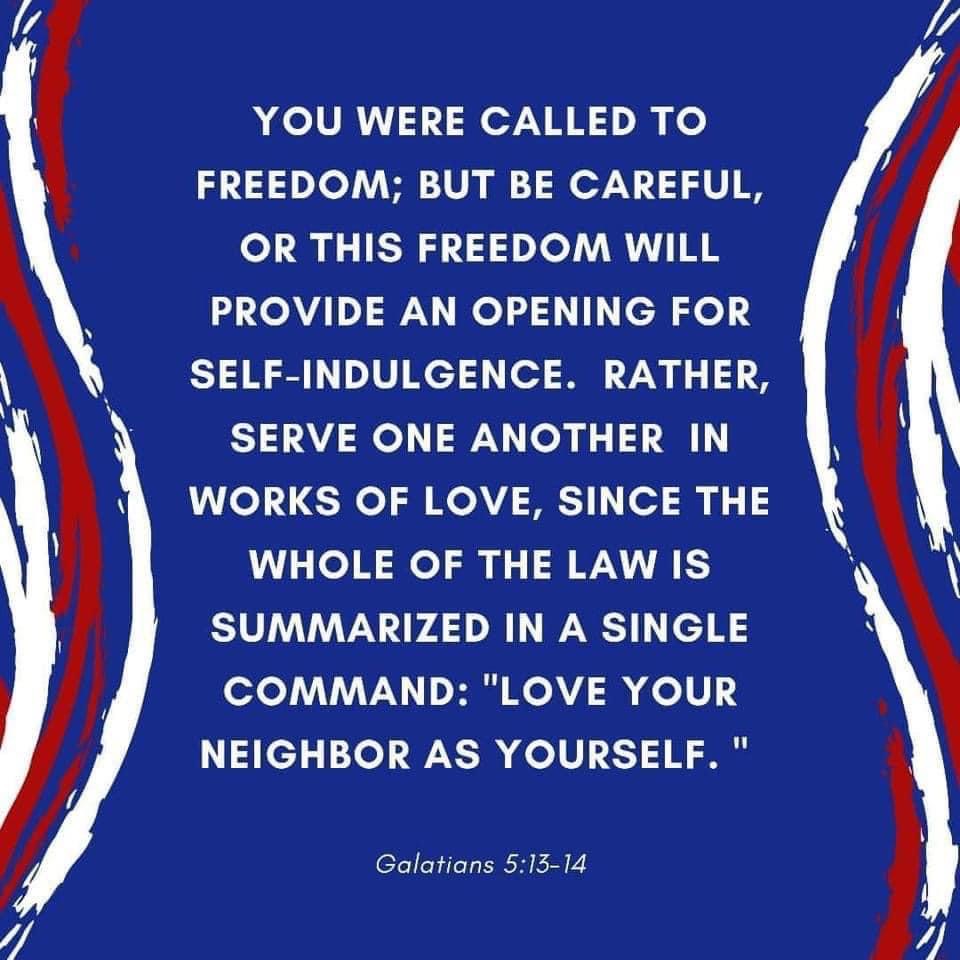
I am looking at a whole room of people who believe with the Apostle Paul that we are called to freedom, not to indulge in our selfish impulses, but to serve one another in love, people who believe they are free, not only to love themselves, but to love their neighbors as themselves.

I am looking at a room full of people who are concerned with freedom for others as much as they are concerned with freedom for themselves, who believe freedom brings both the opportunity and the responsibility to serve and to stand for others, not simply to amass personal rights and privileges at the expense of others.[i]

I see people who have chosen to use their freedom to follow Jesus as disciples, people who are fulfilling what it truly means to be the church in an oppressive world, unlike some in the church today who are doing the exact opposite, actually supporting systems of oppression.

When I think about the purpose of the church, how the church should serve in today’s world, I am constantly drawn to Mark 6 and this account of Jesus sending the disciples into the world for the very first time to be disciples. So much so, it was the source of inspiration for our new expression of church in New Orleans that Lori and I were a part of.

In verse 6 we read:

6aAnd he was amazed at their unbelief. 

I wonder if Jesus would be amazed at the unbelief of some in the church today. Having been a part of the church my entire life, I know I am often amazed when I consider how many in the church do not seem to believe that we are called to live, love and serve in the selfless, sacrificial way of Jesus. Instead, they have accepted an individualistic religion where they “accept Jesus,” “receive Jesus,” “study Jesus,” and “worship Jesus”; not actually “follow Jesus.”

I wonder if Jesus is amazed by the number of people who believe the Kingdom of God is just some place we go to after we die, instead of something we are supposed to work at, to give of ourselves to, to pour ourselves out for, to sacrifice to create right here on earth. I wonder if Jesus is amazed every time people pray: “Thy kingdom come on earth as it is in heaven,” and then don’t do a thing to make it happen!

6bThen he went about among the villages teaching.

Jesus was among the people, all the people, because Jesus was for all the people. Jesus went village to village teaching everyone that the most important thing we can do in this world is to love our neighbors as ourselves, and here in this text, we read that he expects his disciples to do the very same thing.

7He called the twelve and began to send them out two by two, and gave them authority over the unclean spirits. 

To me, one of the most disturbing political signs that I see in some yards today are the ones that say: “Jesus 2024 – Our Only Hope.” Not only do these signs support a dangerous Christian Nationalism making our Jewish, Muslim, and Hindu neighbors feel like second-class citizens, but they support an individualism that is opposed to the mission of Jesus as Jesus never intended to be on a mission to transform and save the world by himself. In what could be described as a call to democracy, Jesus called and gave authority and power to people to join him on that mission. He sent them out doing the very things that he did, some very big things like: challenging the unclean spirits: the spirits of war, selfishness, greed, poverty, all kinds of bigotry, and any type of oppression.

8He ordered them to take nothing for their journey except a staff; no bread, no bag, no money in their belts; 9but to wear sandals and not to put on two tunics. 

Freedom for many means the freedom to acquire and accumulate as much wealth as possible without any sense of responsibility to share any of that wealth. Jesus, however, calls people to live simply so they are able to give generously.

10He said to them, ‘Wherever you enter a house, stay there until you leave the place. 11If any place will not welcome you and they refuse to hear you, as you leave, shake off the dust that is on your feet as a testimony against them.’ 

 Jesus warns that if we teach others the importance of using our freedom to love our neighbors as we love ourselves, we will not be received by everyone. There will always be those who will choose to live solely for themselves instead of for others. But we should never let that discourage or stop us. We should peacefully but persistently keep moving forward, keep working, and keep doing what we have been called to do.

12So they went out and proclaimed that all should repent. 

Disciples go out and proclaim that all should repent of their selfish, self-centered, self-preserving ways and embrace a way of freedom that is far from individualistic, but a way of freedom that is profoundly connected with the well-being of everyone.

13They cast out many demons, and anointed with oil many who were sick and cured them.

We are called to stand up and speak out against the evil forces in our world. We are called to restore and to heal. We are called to be a courageous, peace-making, justice-creating, evil-exorcising, hope-giving movement for wholeness in our fragmented world!

And today, perhaps more than ever, I am grateful that you with so many others are offering this world hope by answering this call, as we journey towards a more perfect union, realizing the truth that all people are created equal and freedom is for all.

In his Fourth of July email, prophetic preacher John Pavlovitz wrote the following:

It is highly probable that it will get much worse before it gets better. And yet, no matter how dire things become, we still have our hands and our voices and our gifts and resources and platforms and privilege and lives to leverage to make it less dire for someone.

I’m not writing to tell you how bad things are…I’m [writing] to remind you how good you are.

This is not about anyone else’s inhumanity. It’s about your humanity.

It’s not about one group of people’s cruelty. It’s about your empathy…

In some ways it doesn’t matter who is in the seats of power.

It doesn’t matter how horrible the legislation that gets passed.

It doesn’t matter how much the evangelical church rejects Jesus and his teachings.

It doesn’t matter how compromised the courts are.

It doesn’t matter how predatory the preachers or the politicians become.

That is almost irrelevant.

Their violence is not the point.

Your capacity for love is the point.

And that love is the only plan.

Pavlovitz continues:

So yes, we will grieve and lament the unthinkable news this week. We will feel the sickness on this holiday [celebrating] a freedom that feels as though it’s evaporating—and then, we will get on to the work of fighting like hell to make sure that it doesn’t. Be greatly encouraged.

Amen.

[i] Adapted from article by Rev. Dr. Brett Opalinski, Emory University Candler School of Theology

Ashamed of the Gospel

Mark 8:31-38 NRSV

I believe the church needs to re-discover its mission to be the church, to be the body of Christ, to be the very embodiment of Christ in this world. We are to continue his ministry in this world, doing the very same things that he did while he was on this earth: feeding the hungry, healing to the sick, sheltering the homeless, liberating the oppressed, elevating the rights of women, defending those judged by religious hypocrites, siding with the marginalized and speaking truth to power.

Now, there may be some who are thinking: “I just don’t know if I am ready to make such a commitment. I think I will stick to just going to church for now, and maybe I can be the church another time!”

 “After all, I have some things that I need to work out first in my life. My faith needs some work. I have my doubts. I have some questions. I have so much to learn, so much to figure out. And I have some very personal issues to deal with. I have this problem with anger. Sometimes I act or say before I think. So right now, if you don’t mind, until I can get my act more together, learn a little more, I think I will pass on this following Jesus thing. I have enough trouble these days just believing Jesus.”

Well, here’s my response to that: “Have you ever met Peter?”

You know, Saint Peter. The one Jesus called a “rock” and said, “on this rock, I will build my church.” The one Roman Catholics recognize as the first Pope. Perhaps you’ve heard of St. Peter’s Square, St. Peter’s Cathedral, and St. Peter’s Basilica. Peter: the one whom Jesus loved and trusted to carry on his ministry in this world.

You may think, there’s no way I can be like Saint Peter. Well, let me tell you a little more about this Peter fella.

One day, he is out on boat with the other disciples. It is the middle of the night, and there’s this big storm. The wind is howling. The waves are crashing against and into the boat. And as you could imagine, they were all scared to death. But then, Jesus comes to them, walking on the water, saying to them to have courage and to fear not.

But Peter…Peter has some doubts. Peter has some questions. Peter needs to work some things out: “Lord, if it is really you, then command me to come out on the water.” And Jesus responds, “Peter, you of little faith.”

Later, Jesus is instructing Peter about discipleship. Jesus talks about being humble, lowering one’s self, even pouring one’s self out. Jesus talks about selfless, self-expending, sacrificial love, being with and for the least of these.

But Peter…Peter has some issues. Peter has some things to learn. Peter gets into an argument with the other disciples about which one of them was the greatest.

After Jesus prays in the garden, surrendering himself to the will of God, Jesus does not resist arrest. Jesus practices what he teaches and turns the other cheek.

But Peter…Peter loses it. Peter acts before he thinks. In a fit of anger, Peter fights back. Peter draws his sword and begins swinging it at Jesus’ captors, cutting off the ear of one.

And in our text this morning, Jesus foretells that garden event. He talks about being rejected by organized religion. Jesus is essentially saying:

“When you preach the word of God that cuts like a sword; when you love all people and try to teach others to love all people; when you preach a grace that is extravagant and a love that is unconditional; when you talk about the need to make room at the table for all people; when you stand up for the rights of the poor and the marginalized; when you proclaim liberty to the oppressed and say that their lives matter; when you defend, forgive and friend sinners caught in the very act of sinning; when you tell lovers of money to sell their possessions and give the money to the poor; when you command a culture of war to be peacemakers; when you tell the powerful to turn the other cheek; when you call religious leaders hypocrites and point out their hypocrisy; when you criticize their faith without works, their theology without practice, and their tithing without justice; when you refuse to tolerate intolerance; when you do these things that I do,” says Jesus, “then the self-righteous-powers-that-be will rise up, and they will hate. They will come against you with all that they have, and they will come against you in name of God. They will do anything and everything that is in their power to stop you, even if it means killing you.”

But Peter…Peter has some serious issues with that. Peter says to Jesus: “No way! Stop talking like that. This is not right. You are crazy. We will not let this happen!”

Then, having had about all that he could stand of Peter and his nonsense and excuses: his doubts, his questioning, his anger, his lack of faith, his personal issues, all the mess that he needs to work out, Jesus responds to Peter with some of the harshest words ever recorded by Jesus: “Get behind me, Satan.”

Jesus, calls Peter, “Satan.”

And yet, that did not stop Jesus from loving Peter, from using Peter. Jesus kept teaching Peter, kept calling Peter, and kept leading Peter to do his work in the world. In fact, that did not stop Jesus from calling Peter to start his church in the world.

So, if you do not feel like you can follow Jesus, and if your excuses are: that you have doubts; or you have questions; or you are just not ready; or you have some issues to work out; or even have days you feel unworthy, even have days you know you resemble Satan more than God; then you are going to have to come up with some better excuses, because as Peter teaches us: with Jesus, those excuses simply don’t fly!

So, what is it that is really keeping so many today who call themselves Christian from actually following Jesus?

After Jesus is arrested, Peter goes into the courtyard of the High Priest. It is a cold night, so he gathers with some folks who had started a fire to warm themselves. A servant girl begins staring at Peter and says: “This man was with Jesus. He traveled around with him doing the things that Jesus did, saying the things that Jesus said.” But Peter denied it, saying, “Woman, I do not even know this Jesus.”

A little later, another saw him and said: “You are a disciple, a disciple of Jesus who defended, forgave and friended sinners. You welcomed strangers, visited prisoners, clothed the naked, gave water to the thirsty, and fed the hungry. You restored lepers, elevated the status of women, gave dignity to Eunuchs, and offered community to lepers. But, again, Peter denied it.

About an hour had passed and another man began to insist saying: “Certainly this man was with Him, for he is a Galilean too. You called out hypocrisy on the behalf of widows. You challenged the status quo on the behalf of the sick. You disobeyed the laws of God on the behalf of the suffering.” But Peter said, “Man, I do not know what you are talking about!”

Peter’s denials had nothing to do with his lack of faith. His denials, his refusal to take up his cross, his failure to follow in the selfless, sacrificial way of Jesus had nothing to do with his doubts and his questions, his personal issues and poor anger management because, as Jesus pointed out over and over, those excuses simply don’t cut it. Peter’s failure was shame.

Peter had trouble following Jesus because he was ashamed of the gospel.  He was ashamed of what the gospel stood for and for whom the gospel stood.

Which raises the question: “Could this be the reason why so many churches today are failing miserably in answering the call to follow the way of love that Jesus taught his disciples?”

Peter was ashamed to love, because living among voices clamoring to take their country back, it was more popular to hate.

Peter was ashamed to identify with the least because it was more popular to identify with the greatest.

Peter was ashamed to defend and forgive sinners because it was more popular to throw rocks.

Peter was ashamed to welcome and elevate little children because it was more popular to send them away.

Peter was ashamed to be last because it was more popular to be first.

Peter was ashamed to tell the truth because it was more popular to embrace a lie.

Peter was ashamed to embrace a way of humility because it was more popular to be arrogant, proud, condescending, and self-important.

Peter was ashamed to share his wealth because it was more popular to hold on to it.

Peter was ashamed to side with the poor, because it was more popular to call them “lazy.”

Peter was ashamed to include foreigners, because it was more popular to dehumanize them by calling them “aliens.”

Peter was ashamed to visit prisoners because it was popular to treat them as animals.

Peter was ashamed to stand up for the marginalized because it was more popular to call them “abominations.”

Peter was ashamed to respect the basic rights of women, because it was more popular to subjugate them.

Peter was ashamed to turn the other cheek because it was more popular to draw a sword.

Peter was ashamed to pick up and carry a cross, because it was more popular to pick up and carry a weapon of war.

And Jesus said: “Those who are ashamed of me and of my words in this adulterous and sinful generation, of them the Son of Man will also be ashamed when he comes in the glory of his Father with the holy angels.”

So, are we ready to follow Jesus? Are we ready to give sacrificially and serve graciously? If not, what’s our excuse? We must remember, with Jesus, a lack of faith, having a lot of questions and some serious issues, or not having ourselves together are no excuses at all!

Could it be that much of what is wrong with the church today is shame? Christians are ashamed of the gospel, what the gospel stands for and for whom it stands. Maybe it is due to peer pressure from family or friends, or to fear of losing some political or societal clout. The truth is there are too many who claim to follow Jesus who are ashamed to stand on the side of children like Nex Benedict and ashamed to stand against popular voices of hate like Moms for Liberty and other MAGA Christian Nationalists.

The good news is that Peter dealt with his shame. Peter repented, and this one Jesus called “Satan,” helped start the church and has been named by the Church as its first Pope.

And the good news for the church this morning is that there’s still a little time to deal with its shame.

Come and See

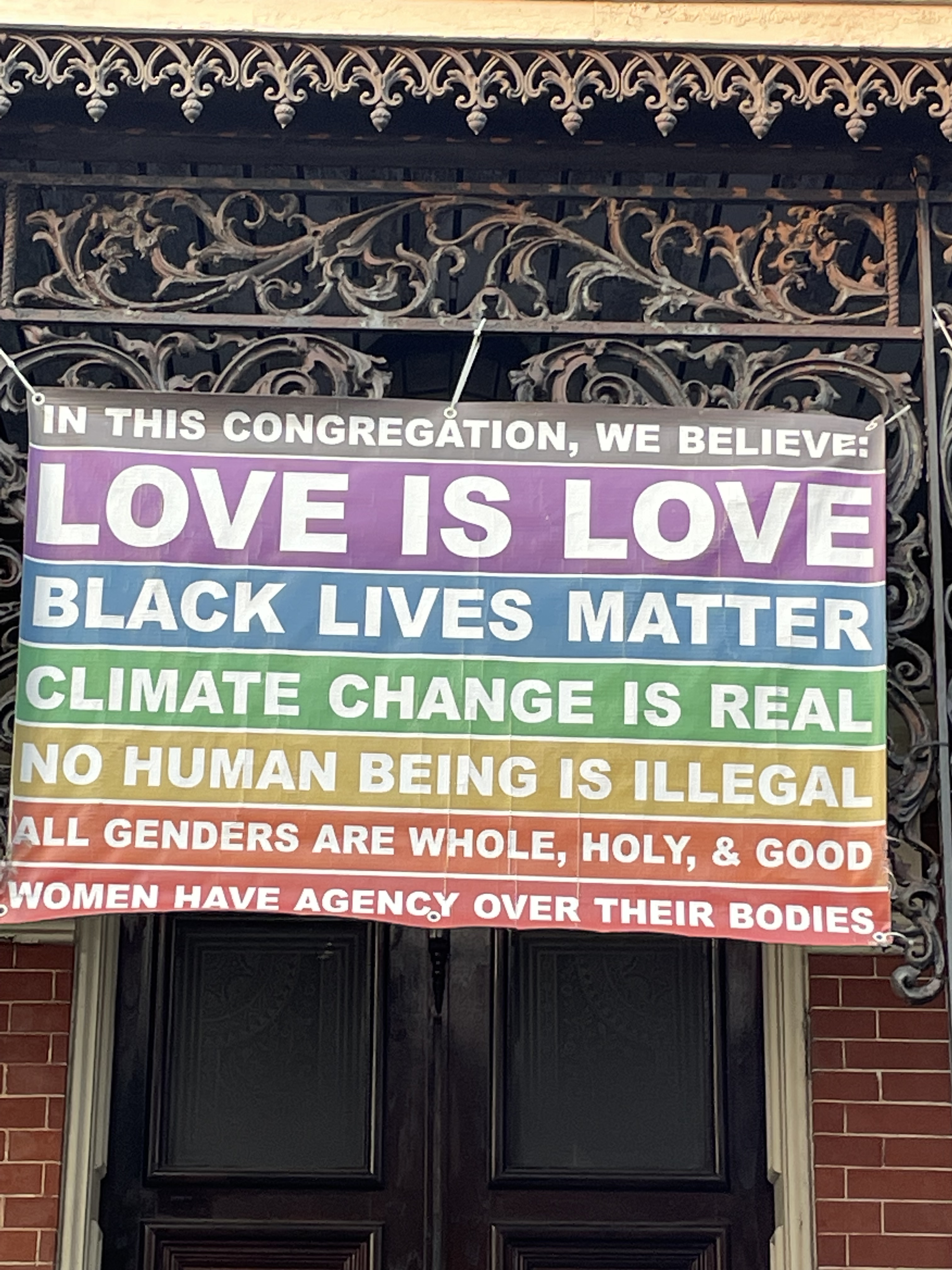
Photo taken at the home of the Unitarian Universalist congregation in Lynchburg, Virginia.

What are we doing here this morning? How did we get to this place? Why are we here this morning sitting in a worship service? How does faith happen?

Well, according to John, it all started one day when John the Baptizer saw Jesus walking by and said to two of his disciples: “Look.” “Look, here is the Lamb of God.”

When the disciples heard him say this, they immediately, almost enthusiastically, began to follow Jesus, spending the entire day with him.

The disciple named Andrew went out and found his brother, Simon Peter and said, “We have found the Messiah.” He then brought Simon to Jesus so Simon could see for himself.

This is how church happens. This is how we got here this morning. We are here this morning because one person told another person who told another person who told another person about Jesus.

This is how our faith got started. It is the way our faith happens today. It is the way that faith has always happened. It is the way it is intended to happen. It is to be shared personally, person to person to person.

Our scripture text continues…

The next day, Jesus went out to Galilee and found a man named Philip and said to him, “Follow me.” Then Philip, much like Andrew who went and told Simon about Jesus, went out and found his friend Nathanael and said to him, “We have found him about whom Moses in the law and also the prophets wrote: Jesus, son of Joseph from Nazareth.”

And here’s where the story really gets interesting. Nathanael doesn’t respond with the eagerness and enthusiasm of Andrew or Simon when they first heard about Jesus. In fact, Nathanael responds much like we might expect people to respond to Jesus today. Nathanael seems cynical, skeptical, dismissive, and even rude. We can picture him arrogantly rolling his eyes asking, “Can anything good come from Nazareth?”

We can picture this, because we have seen it. We’ve heard this before, haven’t we?

Especially if we’ve invited anyone to be a part of a church lately, and I am hoping that all of you are inviting people! Because that is how our faith works. It is how church works. It is shared personally, person to person.

Do you remember hearing the cynicism in their voice, asking us: “Can anything good come from the church these days?” “Does anything good ever come from organized religion?”

Nathanael responds the same way people might respond to us when we bring up Jesus or the church these days.

However, notice how Philip responds to the cynicism of Nathanael. Philip does not respond in any of the ways I would respond. He doesn’t snap back. He doesn’t get defensive or walk away disappointed or angry. I am sometimes tempted to start preaching a little sermon, defending God and the way of Jesus, making the case for following Jesus, arguing that the things that he had heard about Jesus, Nazareth, and organized religion, are not all true.

No, Philip doesn’t do any of those things. He lets Nathanael’s criticism roll off his back and simply answers: “Come and see.”

What is interesting is that this is exactly how Jesus answered Andrew and his friend one day when they asked Jesus where he was staying. Jesus said, “Come and see.”

Andrew went and saw, and he saw that Jesus never really stayed anywhere. He saw that foxes have holes and birds have nests but the Son of Man has nowhere to lay his head (Matthew 8:20). He saw that Jesus was continually on the move, on a journey, teaching, leading, touching, healing, forgiving, feeding, giving, welcoming, accepting, restoring.

Jesus simply said, “Come and see,” and when Andrew went and saw, he saw that he had indeed seen the Messiah.

And when Nathanael dismisses Philip, Philip simply responds: “Come and see.”

Professor of preaching Michael Rogness points out that our task is “not to prove the truth of the Christian faith” to a skeptic or a cynic. It is not even to persuade others to become Christian. Our task is simply to say to others: ‘Come and see.’”[i]

And Nathanael came. And Nathanael saw this one who surprisingly knew him by name, this one who saw the good that was in him, this one who loved him and promised to open up heaven for him.

Seminary president David Lose remarks: “Such simple…and inviting words.” “Come and see.” Words, he says sum up “not only the heart of the Gospel of John, but the whole Christian life.” Because the Christian faith, he says, is “all about invitation.”

“It’s not about cramming your faith down someone else’s throat. After all, nowhere in the Bible does it tell us to ask anyone: ‘Have you given your life to Christ?’” Nowhere does the Bible tell us to go up to our neighbors and ask: “Have you accepted Jesus into your heart?” “Have you been saved?” Or worse: “If you died this very day, do you know where you will spend eternity?” Or even much worse: “God loves you and wants a personal relationship with you, but if you reject God, then God will send you straight to hell.”[ii]

No, we’re just asked to say (not to push, guilt or scare) but to say: “Come and see.” “Come and see for yourself what following this way of love that Jesus taught and embodied means in my life.”  “Come and see how the words and actions of Jesus informs my thinking, guides my life, gives my life meaning.” “Come and see for yourself the good things our church is doing to continue the revolution that Jesus started.” “Come and see.”

It is not our job to persuade, convert or to save; only to invite.

And here’s the thing. When we first bring up the subject of church, if they can see that we are truly being sincere, if they can see in our eyes that we are being honest and genuine, if they can see we are sharing from our hearts, we should expect them to be skeptical and cynical. We can fully expect them to dismiss what we are saying, or even make some smart-aleck response like: “I didn’t know anything good could come from church these days!”

And when they do, when they hesitate or smirk, we need to understand that that’s okay. In fact, in this world, it is to be expected. Because this good news that we are sharing—the good news that God, the creator of all that is, not only knows us by name, but loves us, sees the all of the good in us, the good that others are unable to see in us, the good we sometimes have trouble seeing us, and gives God’s self to us, affirming us as their child, and challenging us every day to bring some heaven to this earth—this good news does seem too good to be true.

Thus, we should completely understand if they pause at our invitation, if they look unsure, or even if they walk away. All we can do, all God wants us to do, is just say, “Come and see.”

Come and see a church that never stays put but is always on the move. Come and see a church that does not invite you to come to church but to go and be the church, to be the embodiment of Christ, a movement for wholeness in this fragmented world.

Come and see a church who strives every day to keep the dream of the Rev. Dr. Martin Luther King Jr alive by being a pro-reconciling, anti-racism church.

Come and see a church that believes in religious freedom for all religions, not just Christians. And come and see a church that does not believe religious freedom gives us a right to discriminate or to do harm to another.

Come and see a church that invites and welcomes both Jewish and Muslim leaders in our community to speak at a Thanksgiving Service, a church that wants to do all that it can do to break down the walls that divide us, to build bridges and create friendships will all our neighbors.

Come and see a church where you brain does not have to be checked at the door and believes in the importance of critical thinking. Come and see a church that believes science is real and caring for this planet is a God-given, moral and holy responsibility.

Come and see a church that believes all people are created in the image of God, and all means all. Come and see a church that values the leadership of women, ordains women, and believes women’s rights are human rights.

Come and see a church that is deeply rooted in the American dream, a church that was conceived by immigrants in the early 19th century, a church where the words of Emma Lazarus that are engraved in the foundation of the Statue of Liberty are engraved in our historical and spiritual DNA:

“Give me your tired, your poor,

Your huddled masses yearning to breathe free,

The wretched refuse of your teeming shore.

Send these, the homeless, tempest-tost to me,

I lift my lamp beside the golden door!”

Come and see a church that is not afraid to be labeled “woke” or “liberal” in a conservative town. And when we are, we smile and respond, “Thank you. We strive every day to be as wide awake and liberal as Jesus, Paul and the Hebrew prophets!”

Come and see a church that is committed to the Word of God, and, with the prophet Isaiah, isn’t afraid to speak truth to power:

Ah, you who make iniquitous decrees,

   who write oppressive statutes,

to turn aside the needy from justice

and to rob the poor of my people of their right,

that widows may be your spoil,

   and that you may make the orphans your prey!

Come and see a church that is preparing to celebrate 150 years of serving community by supporting childhood literacy, feeding the hungry, caring for the planet and supporting our threatened democracy by registering people to vote.

Come and see a church who, without condemning or judging, genuinely welcomes all people to join their mission to be the Body of Christ in this world. Come and see a church that believes we are all called to be ministers; we are all disciples called to build up the Body of Christ by inviting others to join us.

Come and see a church that believes that the grace of God extends to all, especially to those who need more grace, and that there is nothing in heaven or on earth, or in all of creation that can ever separate any of us from the love of God through Christ our Jesus Lord.

Come and see a church that seeks to be a place of grace, believing that none of us are better than others, and all of us, each one of us, including the pastor are imperfect and needs grace.

What’s that? You don’t believe what you are hearing?

Of course, you don’t. And we don’t expect you to. We are aware that it sounds too good to be true.

So, why don’t you just come and see!

There’s a Cross Involved

I have a confession this morning. This preaching thing is hard. It’s hard on me, and I know it’s hard on you. And there are some Sundays I wished I didn’t have to do it. Not because it’s Labor Day weekend and half the congregation is out of town, but because as a lectionary preacher, as someone who does not choose my own scripture to preach, I sometimes have to preach scripture that I don’t want to preach.

This morning’s lectionary gospel lesson is especially problematic for a new preacher, one who really likes their new congregation, and who really wants their congregation to like them.

Sometimes preaching can be fun, like last Sunday when the text speaks of the church possessing the keys to break loose some heaven on earth, of the church being on the offensive, confronting the forces of death, darkness and despair, with the promise that, in the end, love always wins! Now, that will preach!

But then you have a text like the one we have this morning. After Jesus announces that love will indeed win, freedom will ring, death will be defeated, Easter will happen, he says, “but before any of that can take place, somebody needs to pick up and carry a cross.”

Peter immediately takes Jesus aside and rebukes him. Of course, he does! For who wants to hear a sermon like that?

And then we hear what are perhaps the most offensive words Jesus ever spoke: “Get behind me Satan.”

It is then that our scripture lesson becomes even more difficult to hear: “If any want to become my followers, let them deny themselves and take up their cross and follow me.”

Jesus is implying for love to win, for heaven to break loose, for freedom to ring, there’s a cross involved. And it’s not just Jesus who has to carry a cross, it’s anyone who wants to follow him, anyone who wants to bring some heaven to this earth, some wholeness to this fragmented world. Although we possess the keys to break loose some heaven on earth; to use those keys, for love to truly win, we must be willing to sacrifice everything.

Can you see why I don’t want to preach this text this morning? Nobody wants to hear that!

So, what we preachers do with a text like this, especially preachers who want their congregations to like them, is to walk it back, or dial it back.

 To avoid upsetting too many congregants, preachers interpret carrying a cross (a symbol of execution, assassination and murder) as simply doing things for the church that we might not want to do.

For example, we say things like:

“Somebody needs to carry a cross by volunteering one Sunday morning to help in the nursery” (By the way, Gretchen did call me this week and asked me to mention that).

“Somebody needs to carry a cross by stepping up to chair a ministry team” (By the way, I understand that the Christian Education team currently needs someone).

Or “the preacher needs to carry a cross by showing up on Sunday morning to preach a sermon, even a sermon he doesn’t want to preach.

Now, that’s a sermon we can all tolerate. Right?

However, I often wonder how much better this world would be if preachers did not walk or dial back these words of Jesus? What if we preached these words the way Peter heard them, in a way that was so offensive, that made Peter do something as audacious as pulling aside and rebuking the Messiah and Son of the living God?

Jesus said: “…he must go to Jerusalem” (notice the urgency here. “He must”). “He must go to Jerusalem” to serve on a ministry team?  No. To preach a difficult sermon? No. “To undergo great suffering at the hands of the elders and chief priests and scribes and be killed.”

In other words, I believe Jesus is saying: If you follow the way of love that you see me demonstrate. If you love all people and teach others to love all people, especially those who have been pushed to the margins by self-serving religion: sick people, Eunuchs (who, today, would be considered a part of the LBGTQ community); poor people; people of other ethnicities, and people of other religions—if you teach people that God even wants us to love our enemies—if you point out, speak out and call out the demonic forces of evil that are oppressing people, if you stand up to hate and attempt to disarm hate, then there will be some people, probably religious people, who are going to want to kill you.

This past Monday, I attended a beautiful gathering of clergy on the campus of the University of Lynchburg to consider ways we can work together in this city. Meeting in that room vowing to partner with white and black pastors, male and female pastors, along with a Jewish Rabbi, I could not help to think how far we have come in the last 100 years. But in order to get here, the truth is: somebody had to pick up and carry a cross.

I believe Dietrich Bonhoeffer understood this.

Bonhoeffer did not have to return to Germany to stand against the Nazi aggression. After all, he was safe and sound visiting New York City in the early 1940’s. He was free to stay in America and preach the gospel from the safety of a free church pulpit or teach New Testament in the peace and freedom of a university. But when he decided to follow Jesus, he knew there would be a cross involved. Bonhoeffer understood “saying ’yes’ to God requires saying ‘no’ to all injustice, to all lies, and to all oppression” even if it gets you killed. So, he returned to Germany, and for helping Jews escape and flee to Switzerland, he was arrested and executed by the Nazis just days before the war ended in 1945.

Ten years later, the Rev. George Lee, one of the first black people to register to vote in Humphreys County, Mississippi, used his pulpit and his printing press to urge others to vote, despite the many death threats he received. White government officials offered Lee protection on the condition he end his voter registration efforts. However, Rev. Lee understood that if justice was going to prevail, if heaven was going to break loose, somebody needed to pick up and carry a cross. So, Rev. Lee kept preaching, and he kept printing, until he was murdered by White Supremacists.

William Lewis Moore, a postman in Baltimore, could have remained safe and comfortable in his home in Maryland in 1963. But instead, he decided to pick up a cross and travel to Mississippi.  There, Moore staged a one-man march against segregation to deliver a letter to the governor urging an end to the hate. But before making it to Jackson, he was shot and killed.

In 1964, the Rev. Bruce Klunder, a Presbyterian minister, was aware he was carrying a cross every time he demonstrated for fair housing and spoke out against segregation and discrimination. But when he decided to follow Jesus, he decided that there were things more important in this world than his life. And one day, while out protesting the construction of a segregated school in Cleveland, Ohio, he was brutally murdered when he was crushed to death by racist operating a bulldozer.

The following year, after watching state troopers attack civil rights marchers on the Edmund Pettus bridge in Selma, Alabama, the Rev. James Reeb, a Unitarian minister from Boston, drove to Selma, picked up a cross and joined the marchers. After the march, while he was walking down a street in Selma, he was attacked and beaten to death by white men.

After Viola Liuzzo, a housewife and mother from Detroit, saw the televised reports of the attack on the Edmund Pettus bridge by state troopers, she decided to pick up a cross and follow Jesus alone to Alabama to help with the Selma march. Though none went with her, she still followed. And while she was helping to ferry marchers between Selma and Montgomery, she was shot and killed by a Klansmen.

That same year, Jonathan Daniels, an Episcopal Seminary student in Boston, decided to pick up a cross and go to Alabama to help with black voter registration. He was arrested at a demonstration, jailed, and then suddenly released, only to be immediately shot to death by a deputy sheriff.

In 1966, Vernon Dahmer, a wealthy businessman from Hattiesburg, Mississippi, picked up a cross when he offered to pay poll taxes for those who couldn’t afford the fee required to vote. The night after a radio station broadcasted Dahmer’s offer, his house was fire-bombed. Days later, Dahmer died from severe burns.

Two years later, Dr. Martin Luther King Jr., a Baptist minister and leader of the Civil Rights Movement, knew that if freedom was to ever ring, if his dream of a beloved community was ever to be realized, somebody needed to pick up and carry a cross. Thus, despite receiving countless death threats, King kept preaching. He kept marching. He kept protesting. He kept carrying a cross, no turning back, until he was assassinated in Memphis, Tennessee.

As the late Frank Tupper, my seminary professor of theology, once said: “There’s a lot of correlation between what happened in Memphis in 1968 and what happened in Jerusalem 2,000 years ago.”

Whether we like it or not, when Jesus talked about carrying a cross, he wasn’t talking about working in the nursery or serving on a ministry team, as important as those things are. He was talking about a passionate, courageous willingness to put it all on the line. His words are nothing less than radical. For he doesn’t say that we cannot be exemplary disciples, super-hero disciples, unless we carry a cross. He says that we cannot call ourselves disciples at all unless we are willing to sacrifice it all.

I recently saw a sign outside of a church which boasted: “We help people win.”

The problem with that is that our faith is not about winning. Our faith is about losing.

This thing called “discipleship,” this thing called “church,” is not about achieving a good, better, happy or successful life, or even gaining an eternal life. It’s about dying to self.

It’s not about receiving a blessing. It’s about a willingness to risk it all to be a blessing.

It’s not about having our souls fed. It’s about sacrificing it all to feed the hungry.

It’s not about finding a home. It’s about giving it all to provide a home for the homeless.

It’s not about prosperity. It’s about giving everything we have to the poor.

It’s not about getting ahead. It’s about sharing with people who can barely get by.

It’s about courageously taking risks. It’s about challenging the powers-that-be. It’s about raising our voices in front of the city council, getting arrested if we must. It’s about an unwavering, fearless willingness to lose it all while fighting for the marginalized and standing against the haters.

The Rev. Dr. William Barber, a Disciples minister who has been arrested 17 times for protesting injustices, says that one of his arrest records reads: “praying too loud.”

When we call ourselves disciples, we are saying that we have decided to follow Jesus, which always involves praying loudly for God’s peace and justice, standing on the side of love, even if it costs us our very lives. We are saying that we’re going to follow Jesus wherever he leads us, even into dark, dreadful, dangerous places. Though none go with us, though friends and family forsake us, though proud boys threaten us, we still will follow. Our crosses we’ll carry, forward together, not one step back. Until we see Jesus. No turning back, no walking it back, no dialing it back, no turning back, no turning back.

-Sermon inspired the prophetic preaching of Rev. Dr. William Barber


Pastoral Prayer

Before he was executed by the Nazis in 1945, German Lutheran pastor Dietrich Bonhoeffer wrote the following words that I believe the American Church needs to hear again:

Cheap grace is the preaching of…forgiveness without requiring repentance, baptism without church discipline, communion without confession…  Cheap grace is grace without discipleship, grace without the cross, grace without Jesus Christ living and incarnate. Costly grace is…the gospel which must be sought again and again. The gift which must be asked for, the door at which one must knock. Such grace is costly because it calls us to follow Jesus Christ. It is costly because it costs us our lives. It is grace because it gives us the only true life.

The following pastoral prayer was inspired by Bonhoeffer’s timeless words:

O good and gracious God, we come to this place this morning to recommit ourselves to being faithful disciples of Jesus Christ our Lord and Savior. However, if we are ever going to truly follow Jesus, we will first need to repent of our sins that are derived from our love with what your servant Dietrich Bonhoeffer called “cheap grace.”

We gather in this place to hear preaching that will remind us that we are loved and forgiven; not to hear that we need to change our selfish ways.

We gather to remember the way we came up out of the waters of our baptism to symbolize life abundant and eternal; not to remember our immersion into the waters to symbolize death to self.

We come to gather around a table to receive the gift of Holy Communion; not to confess our sins and our shortcomings.

We come to this place to be accepted with grace and love; not to be encouraged to accept others with grace.

We come here to worship at the foot of the cross; not to pick it up and carry it ourselves.

We come here to worship Christ in the safety and comfort of this sanctuary; not fully realizing that the Christ is actually alive today, present here, calling us, prodding us, pulling us to follow him out into a risky and uncomfortable world.

So, O God, forgive us of our love for “cheap grace.” Help us to truly repent, turn from our selfish ways and seek to live for a grace, in a grace, and by a grace that is worthy of your sacrificial love for us, even if it is “costly.”

May we keep asking, keep knocking at your door, keep giving our lives away to you, keep denying ourselves, and keep looking to you for the strength we need to pick up our crosses and follow our Lord and our Savior wherever he leads. Because we know that this grace, although it costs us our very lives, is the only way to experience life now and forever.

Called to Ministry

MISSION TRIP 2018

Mark 6:6B-13 NRSV

I think we sometimes need to be reminded of the peculiar way that the Kingdom of God was started in this world, to be reminded how Jesus began his ministry on this earth ushering in the reign of God. As the Son of the Most High, the Alpha and the Omega, the eternal Word who became flesh, the one through all things came into being and the Messiah of the world, do it all by himself?

He certainly could have. But instead, he goes out, finds, and calls together a group of some of the most ordinary people in the world to do get the Kingdom started. And not only were they ordinary, they were also

imperfect. They stumble, fumble and bumble behind Jesus proving over and over that they have very little idea of who Jesus was and where Jesus was taking them. Yet, this is how God works in our world. It is the way God has always worked.

In Genesis, we read that God creates the world: the mountains and seas; the valleys and streams; every animal, every living thing in the water, in the air and on the land; the sun, moon, stars and all that lies beyond. Then, God creates human beings, gives them a garden, telling them to look after it and tend to it.

It is as if God says, “You know, I have really enjoyed creating all the beauty and order in this world. Of course, I could take care of it all myself, but I want to see you do it.”

Likewise, Jesus comes into the world making all things new, creating, recreating, reordering; ushering in the Kingdom of God. He touches and heals, welcomes and includes, defends and forgives, turns water into a lot of wine and a small basket of food into a great feast, all as a sign of that Kingdom of God was coming. He redeems and restores the lives of the lost, the poor and the marginalized. He chastises judgmental religion and exorcises demonic forces.

And then it is as if he says, “You know, I’ve enjoyed doing the holy work of God, demonstrating the reality of God’s reign, but now I want you to do it for yourselves. Now, it’s your turn. I am commissioning you to do my work in the world.”

Today’s scripture lesson is this commissioning. I believe it’s important to notice here that Jesus sends them out to do exactly what he himself does: to preach, teach, heal, and to overcome evil.

And Jesus chooses people who to these things who, as far as we can tell in Mark’s Gospel, have no apparent qualifications to do these things. Their only qualification is that they are chosen and commissioned by Christ. And that is enough.

If we are to be the church God is calling us to be, it is imperative for us to recognize the fundamental truth that God does not work alone. Our God is in the business of calling disciples, calling ordinary folks like me and you, and commissioning them to be his ministers in this world.

It’s important for us to realize that all of us are ministers—those to whom Jesus has delegated the work of God. My job as senior minister, at best, is a coordinator, and an encourager and an equipper of you, the ministers.

After finding out that Lori was going into the hospital this past week for a procedure, someone came up to me this week and said, “Jarrett, as our minister, you come and pray for us when we have surgery, but who comes and prays for you when you have surgery?” I said, “I’m lucky, for I have an entire congregation of ministers who pray for me.”

One of my favorite preachers, Barbara Brown Taylor, has written a wonderful meditation on ordination and preaching, stressing the importance of the preaching of all Christians.  It’s called The Preaching Life.  In it, she writes:

Somewhere along the way we have misplaced the ancient vision of the church as a priestly people—set apart for ministry in baptism, confirmed and strengthened in worship, made manifest in service to the world. That vision is a foreign one to many church members, who have learned from colloquial usage that ministermeans the ‘ordained person,’ in a congregation, while lay personmeans ‘someone who does not engage in full-time ministry.’ Professionally speaking that is fair enough—but speaking ecclesiastically, it is a disaster. Language like that turns clergy into purveyors of religion, and lay persons into consumers, who shop around for the church that offers them the best product.

Taylor writes of the need to revive Martin Luther’s vision of the priesthood of all believers, who are ordained by God at baptism to share Christ’s ministry in this world.

Nowhere in the scriptures do we find God saying: “Go into the world and make nice Christians out of people. Bring them into the church so they can sing some hymns, pray and listen to a sermon that will make them feel like they are good, religious, moral people who are on their way to heaven. Form a type of club. Hire a full-time club president to be there for the comfort, security and entertainment of the club members.

No, what we do find in scriptures is Jesus instructing us to go forth into the world and make disciples. And what do disciples do? Sit on a pew every Sunday? Sing, pray, and dream about heaven? No, they do what Jesus did. They preach, and they teach. They welcome, and they include. They accept, and they forgive. They clothe, and they feed. They heal, and they fight injustice. They love, and then, they love some more.

But you say, “I can’t do those things. I can’t preach. I am no preacher. That’s why we pay you to be the “preacher!”

Barbara Brown Taylor continues writing: “

While preaching and celebrating the sacraments are two particular functions to which I was ordained, they are also metaphors for the whole church’s understanding of life and faith…Preaching is not something that an ordained minister does for 20 minutes on Sundays, but what the whole congregation does all week long; it is a way of approaching the world, and of gleaning God’s presence there.

We are all preachers, and whether or not you realize it or not, some of you have been preaching all week.

Our mission team has been preaching the gospel of Christ every day this week in New Mexico with hammers and nails and screws and saws, helping to add on a room to a church building in addition to leading a Vacation Bible School.

Some of you preach the grace of Christ every week by working with recovery programs such as Alcoholics Anonymous.

Some of you preach the love of Christ mentoring young people as a Boy Scout leader or camp director.

Some of out preach good news of Christ to the poor by making distributing sandwiches to the food insecure through the sack lunch program.

Some of you are physicians who preach the healing of Christ to people who are suffering. Some preach the hope of Christ to people who are homeless. And some preach the comfort of Christ my volunteering at the hospital.

Although you do not get paid by your employer to preach, some of you preach every day at work and at home. Many of you preach a sermon of unrestricted grace to a co-worker, a sermon of unconditional love to a customer, a sermon of undeniable hope to a friend, to a neighbor, even to a stranger.

And many more of you; although you had other places to go, other things to do (some of you no doubt even felt like staying home), you got up this morning to come to this place of worship. You didn’t know it, but your smile this morning made someone else smile. The handshake that you offered was heartfelt. The hug you gave was sorely needed. Your simple words of greeting brought someone encouragement and another peace.

Mark’s gospel teaches us when you do all these things in the name of Jesus, then you are ministering. Yes, I’m happy to say that some of First Christian Church’s best preaching does not come from this pulpit on Sunday mornings. But it comes from the people in the pews who have answered their calling to be preachers every day of the week.

These are serious times, and Jesus is calling. He is calling ordinary people like me and you everyday to do ministry. Where has Jesus called you to ministry?  What is the work you are equipped and called to do? There is perhaps no more important question. For it is simply the way our God works, the way God has always worked in this world.

Let us pray:

O God, you do not work alone in this world. You reach out and call ordinary folk to be your disciples. We thank you for your graciousness in calling us. Give us what we need to be faithful disciples. You have given us good work to do. Keep giving us the gifts we need to keep doing your work. In the name of Jesus, Amen.

Invitation to Communion

As we sing our hymn of communion, may we open our minds and  hearts so that we may hear the voice of Jesus—calling us and commissioning us to be his disciples, God’s representatives, God’s ministers in this world. All are invited to receive these elements representing the body of Christ because all are called to be the body of Christ.