On a Self-Denying, Self-Giving Mission

Time Magazine

Matthew 16:21-28 NRSV

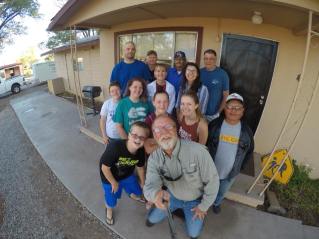
As our facebook profile picture suggests, the First Christian Church of Fort Smith is on a mission.

We are on a mission to be a church of extravagant welcome. We want to live up to the identity statement of our denomination and truly welcome all people to the Lord’s Table as God has graciously welcomed us. Because when we graciously and generously welcome others, we welcome God. When we compassionately and lovingly include others, we include God.

And when we say we include God here, we are saying that we believe the spirit of the Risen Christ is actually present, moving, working, stirring, prodding, pulling, pushing, and calling us to be on this mission, and I believe he is calling us in the same way he called the first disciples, with the simple, yet profound words:

If any want to become my followers, let them deny themselves and take up their cross and follow me.

Jesus says that the first thing we need to do is to decide if we want to follow him. He said: “If any want to be my followers…”

You have heard me say that I believe the reason there are so many empty pews these days on Sunday mornings, is because of the perception that many have of the church. Instead of seeing a group of people who have made a decision to follow Jesus, they look at the church and see some type of religious club created for members to make them feel holier and more superior than others.

This is perhaps why the first thing Jesus says we must do once we decide we want to follow him is to “deny ourselves.” This thing called “discipleship,” this thing called “church,” is not about us. It’s not about making us feel spiritual, righteous, enriched or blessed. It is not about achieving a good, better, happy or successful life, or even gaining an eternal life. It’s about dying to self.

Church is not about receiving a blessing. It is about being a blessing.

It is not about having our souls fed. It is about feeding the hungry.

It is not about finding a home. It is about providing shelter for the homeless.

It is not about prosperity. It is about giving everything away to the poor.

It is not about getting ahead. It is about sharing with people who can barely get by.

I recently saw a church billboard inviting people to their church by saying: “Help people win.”

The problem with that is that our faith is not about winning. It’s about sacrifice.

I believe the reason some churches fail to look like Jesus today is because, in our attempt to entice new members, excite new members, gain new members, we have made the church about us. We say: “Come, and join our church where we have sermons, music and programs that are certain to enrich your life.” Instead of saying: “Come, join our church, where you will be given opportunities to give your life away.” “Come, join our church, where you will be encouraged to sacrifice and selflessly serve.”

Jesus said, “Let them deny themselves, and take up their crosses.”

I don’t know how it happened, or precisely when it happened, but I can understand why it happened. At some point we have interpreted taking up and carrying our crosses to mean something completely different than what Jesus intended. The crosses we bear have become synonymous with the suffering that we involuntarily have to put up with in life.

We say: “Diabetes: It’s my cross that I have to bear.” “Arthritis: It’s the cross I carry.” “Migraine headaches: It’s my cross.”

However, when Jesus is talking about cross bearing, he is talking about something completely different. He is not talking about some kind of involuntary suffering that we are forced to endure for being human. He is talking about the suffering that we voluntarily choose for the sake of our mission to be a movement for wholeness in a fragmented world.

Jesus is talking about living a life so transformed by the love of God that we cannot remain comfortably complacent while others are suffering from disease, grief, disability, poverty, a catastrophic flood, abuse, addiction, discrimination, or even from bad choices they have made.

Forgiving someone who has wronged us and continues to cause indescribable pain in our life, may be a cross Jesus is calling us to carry.

Visiting residents in a nursing home when a nursing home is the last place we want to be, may be a cross Jesus is calling us to bear.

Spending our time mentoring a young adult raised in foster care when we already have little or no time for ourselves, may be a cross Jesus is calling us to pick up.

Agreeing to volunteer to feed the food insecure when our own cabinets are almost bare, may be a cross Christ is calling us to take up.

Choosing a less lucrative career path because we feel called to serve others might be a cross Jesus is asking us to carry.

Loving all of our neighbors as ourselves knowing that loving some of our neighbors will inevitably cost us something is a cross Jesus wants all of us to bear.

Donating to the Week of Compassion Mission fund to help hurricane victims when our own budgets are tight, or making plans to go rebuild a flooded home when our own homes need some work, is a cross I believe Jesus is calling us to carry.

Standing up for the dignity and rights of minorities, of the poor, of those marginalized by the culture and by bad religion, is a cross that I believe Jesus commands all of us to take up.

I believe the reason some churches are failing to look like Jesus is because they only encourage their members to do what makes them happy, what brings them satisfaction, what makes them comfortable. “Do you love kids? Do children make you happy? Then help us with children’s church!” “Do you love going to the hospital to visit sick people? Have you always wanted to be a nurse? Then serve on our hospital ministry team!”

However, as a leader of this church, I am going to lead you to do things may not only be uncomfortable for you, but I am going to lead you to do some things that actually might cause you to suffer.

Because, you called me to be your pastor. You didn’t call me to be your activities director.

That’s because we are a church. We are not a club. We are far from perfect, but we have intentionally made a decision to follow Jesus by denying ourselves and taking up a cross.

This is what makes being a pastor so difficult, especially being a new pastor. Because, like most pastors that I know, I want you to like me.

Seriously, right or wrong, that is perhaps the most stressful part of my life right now. Does my new congregation like me? After all, I like them. And besides that, they pay my salary, and I have two kids in college!

However, because I am called to be your pastor and not your club president, and because this mission we are on together is not about what either one of us like, it is my calling to lead us to do things we may not want to do, to go to places we may not want to go, to love people we don’t want to love, to include people we would rather exclude. And I realize how difficult it is to always like someone who is leading you in that direction. Jesus’ disciples certainly did not like Jesus leading them in that direction.

I suppose it’s a cross that I have been asked to carry. But may God forgive me, may the Spirit convict me, and may the elders of this church have a special meeting and call me out, if I ever succumb to the temptation to be your pastor without carrying a cross.

Finally, Jesus says, “After you make the decision to follow me, after you deny yourselves, and after you pick up your crosses, then I want you to follow me.”

Notice he doesn’t say to walk down a church aisle and publically confess he is our personal Lord and Savior. Notice he doesn’t say: “Have a personal relationship with me.” And notice he doesn’t say to “worship me” or “study me.”

Jesus says to “follow,” which denotes going, moving, action; not sitting in a pew or in a Sunday School classroom. Jesus wants us to go and do the things that he does, share the same radical grace that he shares, go and do what we can to lavish this world with his revolutionary love even if it costs us everything.

It’s important to make this sanctuary, our narthex, our chapel, Disciples Hall, and every Sunday School room, even every restroom, a place of welcome every Sunday morning. Because, when we welcome others here, we welcome God. And if we don’t welcome God here, then I am not sure what we are doing here. We’re certainly not doing church. It’s important to come together in this beautiful place to worship and to study together each week; however, church should never be limited to any place or time.

We are a church that meets in this place, but we are also a church that is on the move. We’re on a mission 24/7, following the risen Christ, loving our neighbors as ourselves, sacrificially denying ourselves, courageously taking risks, generously giving our gifts, leaving behind family and friends if we have to, as we feed the hungry, fight for the marginalized, stand against the haters, care for the elderly, include the disabled, befriend the stranger, provide shelter for the down-and-out, restore shelter for the flooded-out, give hope to the despairing, bring to life the aspirations of the Dreamer. Whether or not people like us for it, we’re going follow wherever Christ leads us, throughout the River Valley, into eastern Oklahoma, across our entire region, down to Lake Charles, then maybe over to Beaumont, Port Arthur, and in and around Houston. Though none go with us, we still will follow. Our cross we’ll carry forward together, not one step back. Until we see Jesus, no turning back, no walking it back, no dialing it back, no turning back, no turning back.


Invitation to the Table

When we share the bread and the cup from this table, we remember that for our sakes, Christ denied himself and carried a cross, Christ gave himself, poured himself out for us.

We also remember that this is the one we have decided to follow. We remember that we have been called to deny ourselves and to carry a cross. We are called to give ourselves, to pour ourselves out for the sake of others.

As we sing our hymn of communion may we pray for the courage to follow the Christ wherever he leads us. And may we remember that he invites all of us who have gathered here to follow him.

A Bunch of Losers

forest-gump1

Luke 14:25-33 NRSV

I have heard people say that one of the reasons that they do not belong to a church is that the church is nothing more than a “bunch of losers.” They say we are weak, and we weaklings find strength in numbers. They say we cannot handle life on our own, so we use religion, faith, and church as a crutch to help us get along in this broken world.

Now, as bad as it might be for us to hear this, these critics of faith and religion may have a point. Sadly, their critique of Christianity, especially here in North America, may be justified.

To understand where they are coming from, all we have to do is turn on our TVs at almost any time of the day. There we will find countless preachers with great hair, bright smiles and big dimples promoting a health- wealth-and-prosperity gospel offering strength to the weak. Or we only have to walk into any Christian bookstore and see the shelves that are literally full of books promoting this message of self-help and good fortune.

I believe this is the reason Jesus may have become a little irritated with the large crowds that often followed him during his earthly ministry. One day, noticing the growing number of people following behind him, like a scene in Forrest Gump, Jesus suddenly stops, turns to the masses and says something like: “Do you people really know what this is all about?” Like someone asked me when I first moved to Enid, “Do you really know what you are getting yourselves into here?”

“Because I am not so sure the crowd would be this large if you really knew!” says Jesus. “Do you really understand what you are signing up for here? Do you really get this journey called, ‘discipleship’? Because, I have a sinking suspicion that most you do not have a clue.”

I suspect that the large crowds were following Jesus that day for much of the same reasons some people attend church today. They were looking to get something out of it. Some sort of blessing, reward, some kind of direction, perhaps a better handle on things, a little attention, keys to a better, more successful and prosperous life. They were looking to strengthen their families, be a more productive businessperson, get a leg up, receive a helping hand, get a little boost, a shot in the arm, a pat on the back and maybe just a little dose of something to help feel a little bit better, at little more righteous, a little more holy than all of those people who were not following Jesus.

As the church critics and cynics say, “They were merely looking for a crutch to help them to cope with everyday living. They were a bunch of losers looking for something, anything, to help them become winners. Because after all, isn’t that what God is all about: winning?

And noticing what was going on, Jesus stops in his tracks, turns and says to them, “You people really do not get this, do you? This journey called discipleship is not about making your family stronger. In fact, this could tear your family apart. This is not about making you feel superior or more holy than the ones who are not following. This journey will humble you! It will bring you down to your knees! This is not about self-help. It is about denying self. And this is certainly not about obtaining any keys to a more successful and productive life. It is not even about helping you cope or get a better grip on your life as it is. This is about losing your life. This is not about winning. This journey called discipleship is about losing.

So if you really want to follow me on this journey, you better think long and hard about it. Because this journey is not about receiving any reward or gain. In fact, the opposite is true. This journey is going to cost you. And it is going to cost you every possession you have. And guess what, there is even a cross involved. And you, my friend, are going to carry it.  So you better do some calculations, you better do a good ol’ gut check, you better look yourself in the mirror and ask yourself if you really have what it takes to follow me on this journey. For this journey is not for the weak, the timid or the reluctant. It is for the courageous and the heroic. Some say that it is for the crazy and the foolish.

So, if you are a loser looking for something to make you a winner, this may not be for you. But if you are an ordinary person who really wants to find true life, life the way God intends for it to be, I am looking for a few good people who are willing to take some risk and lose it all!

This church has two wonderful practices that define who we are as the Disciples of Christ. The first one is what we call Believers Baptism. One of the reasons that we do not baptize infants is because we recognize that there is some cost involved to becoming one of Jesus’ disciples. Although the gift of salvation is a free gift of God’s grace, and there is nothing we can do to earn it or deserve it, walking with Jesus as disciples is a risky and costly venture. So, we wait until a child is of an age where they can weigh and calculate that cost. We call it the “age of accountability.”  They have to be able to do some accounting. And that age is different for different children.

The second practice that defines who we are as Disciples of Christ is Communion. Every Sunday we remind ourselves of the cost that is involved on this journey we call discipleship. We break bread remembering that God through Jesus loved this world and all of us in it so much that he was willing was willing to suffer greatly for us. We share a cup representing the blood of Christ remembering that God’s love for us compelled God to pour God’s self out, empty God’s self through the life and death of Jesus Christ.

And we are reminded that we as disciples are called to take this same journey, carry our own crosses. We come to church not in search of some crutch to help our broken selves, but to be reminded that we are called to be willing to break ourselves for others, suffer with and for others. We come to church not looking for something to help us improve life, but for the courage and the opportunity to pour our lives out to help others.

I firmly believe that fully embracing this identity is the only way we are going to change the way the local church and the Christian faith is often perceived by those people who have all but given up on organized religion. Instead of being a bunch of losers looking for the church to help us become winners, we need to be a bunch of ordinary people who are willing to be a bunch of losers, willing to lose our very selves.

Then, we will not only have life the way God intends for it to be, we will be the witness to the world of the love that God calls us to be. And if we pay attention, there are examples of this witness all around us.

I have a friend in Raleigh who left a good paying job to become the pastor of a group of homeless men and women. He looks to the generosity from friends scattered all over the country to pay for a roof over his head and to put meals on his table. Loving God more than self, he gave up much, risked much and lost much to love a group of people who can offer him little in return.

There are people right here in this room who have given up much to not only do missions in other parts of the world like Peru and the Dominican Republic, but also right here at home. You give of yourselves constantly to minister to the poor and needy here through Loaves and Fishes or Our Daily Bread. Others here could have chosen more lucrative careers, but instead you answered a call to serve others as social workers, school teachers, nurses and other service oriented professions. Others have sacrificed much to provide for children, other family members, and even friends or employees who have exceptional needs.

Just this week, some of you gave up, lost an entire Wednesday evening, as you did yard work for people who needed it through Hearts for Care.

So to all of the church skeptics and critics, I want to say this: I understand that no one wants to be associated with a bunch of whiney losers who are always looking to get something, to find something to make their lives better or to get something just to help them cope. And I know that is why some people in the church are very attracted to the health and wealth evangelists and the always-smiling prosperity preachers.

However, I belong to the Central Christian Church of Enid, Oklahoma, a church that is full of a bunch of losers of another sort: a bunch of courageous and faithful losers who have made a commitment to always strive to love God and others more than self; a bunch of self-denying, selfless losers who are willing to risk it all to put the needs of others over their own needs and wants.

And no, we are not perfect. We all have our selfish moments. But we have decided to try our best with the help of God and each other to follow Jesus on a risky journey called discipleship— a journey of self-denial, self-giving and sacrifice, believing that it is the only journey that leads to real life, life that is truly abundant and eternal.

We believe “losing” is what “winning” really looks like. And yes, as crazy and as foolish as it may seem, we do know what we have gotten ourselves into!

Burning Down the House

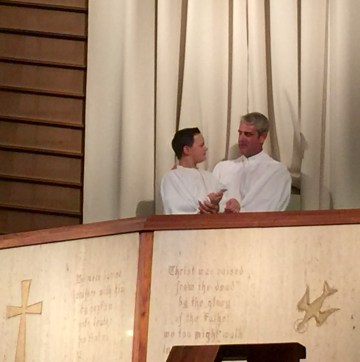
Jackson Weibling Baptism

Luke 12:49-53 NRSV

I’ll never forget what the youth minister said to me right after I bought a brand new car back in 2003. It was a time when I was not a very happy person.

My father-in-law had just died. As a senior minister, I was coming to the harsh realization that it was absolutely impossible to please everyone. The youth minister knew this.

It was during this time I traded in my pick up truck that was just a few years old. The youth minister said, “Jarrett, when most people get a little blue, they might go to the mall a buy a new outfit or get a new pair of shoes, maybe a new piece of furniture, but you go out and buy a brand new car!”

At the time I remembering justifying the purchase by saying that my truck got poor gas mileage, and it just wasn’t very practical driving back and forth to the hospital. I needed something smaller, more economic.

But the reality is that the youth minister had a pretty good point. I, like so many American consumers, thought that I could maybe buy me a little bit of happiness. I could perhaps purchase me a little bit of fulfillment.

We buy new furniture. We hang new clothes in our closet. We park a new car in the garage. And we might even buy a whole new house. But guess what? We are still unhappy. Things at home are still not right. Our spouse is still distant. The relationship with our children is still not what it should be. And our souls are still filled with discontent. On the outside our home looks beautiful and whole, but on the inside our home is broken and is in danger of falling completely a part.

So what do we do? We do what I suppose most good God-fearing Americans do. We go to church. We say: “Maybe that is what is missing in my life. Perhaps the church is the solution to building a happy home, the key to good relationships, the key to my happiness and my fulfillment.”

So we come to this place. We attend Sunday School. We come to worship. We sing and we pray and we listen, and we take communion, and we sing and we pray.

After the first week, nothing really changes in our lives. But we realize that what’s broke didn’t break overnight, so it probably wasn’t going to be fixed over night. So we do it again the next Sunday, and the next and the next. We even start having family devotions, holding hands and saying grace at our meals and praying at bed time. But, still, nothing at home changes.

We’re still struggling. We’re still lost, and the confusion is painful. We are still unhappy. Things are still not right.

Why? Why hasn’t religion worked? Why haven’t things gotten better? We got Jesus. He’s supposed to help our families. He’s supposed to be the glue that keeps us together, right? After all, you know what they say?  The family that prays together stays together, right?  Well, according to our scripture lesson this morning, not necessarily. In fact, according to Luke, Jesus may be more of a home-wrecker, than he is a home-maker.

Jesus said, “I came to bring fire to the earth, and how I wish it were already kindled!  Do you think I have come to bring peace to the earth? No I tell you, but rather division!”  Luke even softens this a bit for us, for in Matthew Jesus sounds downright violent: “I come not to bring peace, but a sword!”

“I will divide father against son and son against father, mother against daughter and daughter against mother, mother-in-law against her daughter-in-law and daughter-in-law against mother-in-law.”

St. Francis of Assisi became a knight in the wars with Perugia and had a promising future ahead of him. His father was proud of his son, but the problem was that Francis kept going to church and praying and asking God what he wanted him to do. Over time, he became convinced that God did not want him to be a French troubadour or a dashing knight, but rather to be a follower of Christ, a genuine disciple. God wanted Francis to serve the poorest of the poor.

Francis heard the scripture say, “Sell all that you have and give it to the poor” and with a startling naïveté he said, “Okay.” And he sold all that he had and gave it to the poor.

But his father took exception, for what the boy gave away really wasn’t his but was given to him by his father, who had no urge to take the Bible literally.  He threw Francis in jail, then took him to court.

It was then Francis said, “No longer is Pietro Bernardone my father, for, from now on, my father is in heaven.”

Sometimes, Jesus sets father against son and son against father.

But that is not the same Jesus that we go to church to get. Is it?

We go to get a different kind of Jesus, a Jesus of our own making.

For many of us, our faith is just one more materialistic thing we own. Many Americans have trivialized Christianity to the point that Jesus has become just another commodity that is supposed to make our lives easier, better, more productive. That’s why we go to church. We go to get this product called “Jesus” to make us feel better. He’s like a new pair of shoes, a new outfit, a new piece of furniture, or a brand new car. He is something that fulfills our desires, our wants, our needs. He is something that helps us to do the things we want to do in life.

But as nine-year old Jackson Weibling told me about his baptism that we are celebrating this day: “Having Jesus in my life means that I can no longer do the things that I want to do, but only the things that God wants me to do.”

Rev. Marianne Williamson once said, “When you ask God into your life, you think God is going to come into your psychic house, look around and see that you just need a new floor or better furniture, and that everything just needs a little cleaning—and so you go along for the first six months thinking how nice life is now that God is there. Then one day you see that there a wrecking ball outside. It turns out that God actually thinks your whole foundation is shot and you’re going to have to start all over from scratch.”

Our problem is that we have so trivialized Jesus, we think of Jesus as someone who comes knocking on our door with a bouquet of fresh flowers to brighten the whole house up when in reality, Jesus comes knocking with a flamethrower to ready to burn the whole house down.

We thought that all we needed was a little bit of family prayer time.  So we prayed for two minutes a day. And it didn’t work. We were still cold.  Why?  Because we can’t pray for two minutes a day, patch that prayer onto an otherwise unchanged life and expect it to be different.

Jesus does not come into our lives so our behavior will just be a little different, but so that everything will be transformed. Jesus is not some sweet commodity we can pick up at church to bring home and meet our needs and fulfill our desires. Jesus comes to change our needs and transform our desires!

And we don’t get Jesus. Jesus is not something that can be got. It is Jesus who gets us.

If Jesus is something or even someone that we get, then the church really does become just another product whose members are merely consumers. Thus, like going to a store, the spa, or the local cineplex, church becomes some place we go to get something. Some go to get fed. Others go to get nurtured and pampered. Some go to get entertained.

However, if it is Jesus who gets us, if Jesus is about us giving ourselves to the God revealed in Christ, then church means a radical, self-denying, sacrificial way of living.

If Jesus is about giving one’s life away, then the church becomes something much more than a self-help center offering self-improvement workshops.

Sunday school and Wednesday Night Fellowships become less of a time to get fed, physically and spiritually, and more of a time to pray for others, celebrate the joys of life with others, and even suffer with others. It becomes a time to build a community of selfless love and forgiveness with others. Bible study becomes less of a time to acquire more biblical knowledge than others and more of a time to consider how the scriptures inform our service to others.

Sunday morning becomes less about what God has to offer us and more about what we have to offer God. When we eat the bread, we do not consume it. When we drink from the cup, we do not merely swallow it. We allow it to consume and swallow us, every part of us. And we commit ourselves to presenting our own bodies as living sacrifices, pouring our very selves out for others in the name of the God who emptied God’s self out for us.

And every day of the week, we become much more than Christians who possess exclusive tickets to heaven in hand. We become the Light, even the fire of the world.

So for all of us who have been settling for an innocuous faith:  look out the window. The torch is lit. The wrecking ball is swinging. So let’s get out of the house!  Let it do its work. Let it bring destruction of all that holds us back form God. Let it all burn down to the ground. Then let our lives be rebuilt on the only foundation that can give us life.

A Word from the Lord

cialis

Luke 4:14-29 NRSV

Tom Long tells the story of an incident that occurred in a church one Sunday morning in Charlotte, North Carolina. The minister had just finished reading the scripture lesson and was taking a deep breath before launching into the sermon when suddenly, a man, a complete stranger, stood up in the balcony and startled everyone by proclaiming in a clear, loud voice: “I have a word from the Lord!”

Shoulders tensed and heads swiveled around and upward to see the source of the interruption.

What “word from the Lord” did this man possibly have to bring to the people on that day?

Well, no one will ever know, for the ushers, says Long, “bounded like gazelles” up to that balcony, and before the man could utter another word, they had escorted him down the stairs and out the front door.

Now, with Long, I don’t blame them. I understand. The apostle Paul said we ought to do things with some semblance of order, and his was way out of order. Who knew what this guy had in mind. But it does cause me to wonder a little bit.

Isn’t it strange? Sunday after Sunday countless preachers in innumerable pulpits spread out their sermon notes, clear their throats, and begin their sermon, saying, or at least implying, that they have a word from the Lord. And nobody tenses. No heads swivel in alarm. No ushers leap into action. Instead, people sit back in their pews, crease their bulletins, silently check their watches, and settle back for the sermon. For that is what you’re expecting isn’t it?  A sermon. Right? Not a word from the Lord.[i]

This is exactly how it was on that Sabbath day in Nazareth. Joseph’s son Jesus was home for the weekend and had been asked to read the scripture lesson from the prophets and to preach the sermon. The congregation knew Jesus well. They knew his parents and remembered him as a little boy. They were no doubt proud of the reports that had filtered down from Capernaum and other towns about his preaching and teaching. So, they settled back in their pews to hear what this articulate young man had say. What were they expecting? A sermon. Right? Not a word from the Lord.

Part of the reason I believe we expect a sermon instead of “a word from the Lord” is that as much as we do not like admitting it, we really would prefer not to hear such a word. We prefer a simple sermon. We prefer some nice religious words, some nice sweet thoughts to help get us through the week. What we expect is a little “chicken soup for the soul.”  Some good advice to help make our lives run a little more smoothly, some encouraging words to help get us through the week.

A word from the Lord is completely different. A word from the Lord is disruptive. A word from the Lord is uncomfortable.

A sermon can be can be easily forgotten and even completely ignored. But, a word form the Lord must be heeded. A word from the Lord is sharper than any two-edged sword. For a word from the Lord is news, real news. It is news that turns our whole world upside down. A word from the Lord changes everything and forces us to adjust our lives to that change.

It has been said that most people who pick up the newspaper every morning or watch the evening news are not so much interested in the news as they are in confirming that the world is pretty much the same as it has always been. “Democrats are still not cooperating with Republicans and vice versa.” “It’s going to be windy today, again.” “There was another small earthquake in Fairview.” “The Cleveland Browns and the Detroit Lions are still not going to the Super Bowl.” “Yep, that’s the way the world is, it’s the way it always has been, and it is the way it always will be.”

I am afraid that is why many of us come to church. We do not go to church to hear any news. Instead, we go to church to have the things that we have always believed about God confirmed. We listen to the sermon to have the way we have been practicing our faith all of these years affirmed. We’d really prefer not to hear anything new. We’d rather not hear anything that challenges our beliefs, calls the way we practice our faith into question or creates any urgency to change. We are really not interested in hearing any real news.

For real news is unexpected. Real news is surprising. Real news is disturbing. Real news means the world is not the same as it was yesterday; therefore, I cannot live my life in the same way. A word from the Lord is real news.

It is news that demands change. It is news that demands a complete reordering of priorities. It is news that causes us to see the whole creation in a brand new way. It is news that moves us and mobilizes us to take some kind of action. It is news that often requires sacrifice. It is news that necessitates us doing things that we do not want to do and going to places that we do not want to go.

So, thanks but no thanks. Preacher, I think I’ll be just fine with a simple sermon instead. Either say some words to reaffirm what I already believe or maybe give me a little antidote that might help me live a happier, healthier life. Give me some good ideas that might fix some of the things that are ailing me.

I am afraid we often want a sermon to be like some new prescription drug that has just been FDA approved. Much like the ones whose benefits are being touted these days on nearly every other television commercial.

Do you have frequent heartburn? Are you tired of being tired? Is depression making you depressed?  Do you have trouble going to sleep? Do you have difficulty waking up? Do you want to avoid diet and exercise? Do you want to lose weight and still enjoy the foods you love? Is it painful for you to walk your dog? Is your hair falling out? Do you have a going or a growing problem? Do you need to put some excitement back into your relationships?

And then, in nearly every commercial, after the person begins taking what they asked their doctor to prescribe, there is all of this exuberant celebration: dancing in the streets; jumping up and down; digging for clams; running around in the yard with your dog and your water hose; even sitting outdoors and watching the sunset while holding hands with your significant other in separate bathtubs!

As a pastor, I oftentimes wonder if this is not how we oftentimes promote church. If you channel surf through the religious channels, you will find that there is no shortage of preachers who sound like they are spokespersons for some new drug. “Are feeling depressed?  Are you drowning in a sea of debt? Are you empty inside? Does your marriage need a boost? Then pick up the phone and make your pledge, send in your check, and sit back and wait for God to pour out God’s blessings!”

I am not exactly sure, but I suspect that is what many people were probably expecting when they showed up to hear Jesus’ first sermon back in hometown Nazareth. They came expecting a sermon, a little pat on the back, a little stroke of the ego, a little feel-good-pick-me-up to get them through the week, not a word from the Lord.

So, when Jesus stood up and began to speak, no shoulders got tense. No ushers tried to muscle him out into the street. People smiled and whispered to one another how proud they were of this their product, and how Mary and Joseph must be tickled pink to have such a fine son.

They came expecting a little sermon. But instead of a sermon, they got a word from the Lord. Jesus began to say things like, “For the gate is narrow and the road is difficult that leads to life, and there are few who find it.”

The crowd gets really quiet!  Someone whispers, “I know he didn’t say ‘difficult,’ did he? I thought God was all about making things easy! I thought sermons were about making us happier.”

Jesus continues:

“Love your neighbor, including your enemies. Be a blessing to the poor and to all who hunger and thirst for justice. Stand up for the liberty of those oppressed and bullied by culture. By the way, people will persecute you for that, utter all kinds of evil against you for that, but pray for those who persecute you. Forgive those who have wronged you. Don’t judge. Accept others as I have accepted you. Deny yourself. Pick up your cross and follow me. Die to yourself. Don’t just hear these words, but do these words.”

And then, his words began to sink in. “Today, this scripture is fulfilled in your hearing.”  Today. Not yesterday, not in times gone by, not someday, but today.  Fulfilled.  Not read nicely, heard sweetly, or barely remembered, but fulfilled. In your hearing. Not in somebody else’s. Not just in Abraham’s, Moses’, Elijah’s, and Deborah’s, but in you.

And the Word of the Lord was also not just for them. Jesus said it was for all people. It was also for outsiders, foreigners, those marginalized by society, widows and lepers and others who were not a part of their synagogue, their faith, or even their culture.

And it then became obvious that this was not just another simple sermon. This was a word from the Lord. This was news. Real news. God had come. God is present. Here. Now. Today. God is here, and God’s love is for all people, even for the lepers of Syria in and the widows in Sidon.

The world was now changed, for the Word of God had come, and the Word had come for all people. The Word of God had been made flesh and was now present in all its demanding fullness. And you could fight it, you could try to hurl its presence off a cliff, or you could accept it, you could follow it, but there was no way on earth you could ignore it.

Each Sunday morning, our worship is about the gospel truth, the amazing good news, that God is alive and present to us this day, as alive and present here as Jesus was to those worshippers in Nazareth. Thus some shoulders here this morning should be a more than a little tense, for there is work for us to do!

God is here! God’s kingdom is now! God speaks words of love and of grace, of mission and of purpose, of vocation and of duty, that are fulfilled in our hearing. Words that, if we listen and respond, will send us out from the pews into the public square to transform our world.

[i] https://www.cathedral.org/worship/sermonTexts/tl080601.shtml


On the Way

Our Missions Trailer that was recently purchased to help our church get moving on the Way.

Mark 10:46-52 NRSV

The first thing we learn from our scripture lesson this morning is that Jesus and his disciples are with a large crowd, and they are on the move. They were on the way. Jericho was not the final destination. There is one last stop to make. Jerusalem: Where furious religious leaders offended by the good news of the gospel, ashamed of the grace of the gospel, have been plotting to put an end to it all. Jerusalem: Where a selfless Jesus is prepared to sacrifice his very life for the sake of others.

It is on this way, this way of self-denial and self-giving, that Jesus is confronted by a man in great need. His name is Bartimaeus. He is not only blind, he is also a beggar. He is helpless, and he is poor. He is disabled, and he is marginalized. Because many believed there must be some purpose driven reason for his blindness, he has been judged and he has been demonized. And, in desperation, he is waiting for Jesus on the side of the road. He is waiting for justice, and he is waiting for grace.

He jumps up and pleads: “Jesus, Son of David, have mercy on me!”

And notice the actions of the crowd. They try to silence him. They simply don’t want to hear his cries.

Does that sound familiar?

Have you ever been on the way somewhere, met someone, nodded your head and asked: “How you doin’?” It’s a stereotypical pleasantry, an informal greeting. You expect them to nod back, and say something like, “Good, how you doin’?”

But then, to our surprise, the person doesn’t answer the way we expect them to answer, the way we want them to answer, the way we believe they should answer. No, this person decides to unload on you. She has all of these aches and pains, all of these troubles and frustrations, all kinds of maladies that you label as TMI, too much information.

We don’t like that TMI, especially when the TMI has to do with suffering.

I believe this is one of the reasons why we do not eagerly visit someone who has some sort of disability. We might go, but we don’t want to go. Perhaps it threatens us to be around people who are suffering. Because their circumstances are a reminder of how vulnerable all of us are. We know that if it could happen to them, it could happen to us, or to one of our loved ones. So, we prefer to keep the sick, the troubled, the unfortunate, and the disabled out of sight, thus out of mind.

I admire companies like Target and Whole Foods who make it their mission to hire disabled persons. Fortunately, there are many advocates today for the disabled and others who have been marginalized by society who are urging them to come out, to come forward, to speak up, and to seek equity and equality.

This blind beggar does just that. Despite the crowd who “sternly orders him to be quiet,” the man keeps yelling at Jesus, “Son of David, have mercy on me!” “Son of David, have mercy on me!”

And the good news is that Jesus hears his voice. Jesus stops. And Jesus calls him to come over.

Jesus asks, “What do you want me to do for you?”

Not surprisingly, blind Bartimaeus says, “My teacher, let me see again.”

And Jesus does just that. He says, “Go, your faith has made you well.”

Then Mark says something that he does not say when recounting any other healing story. Out of all the folks that were healed in Mark’s gospel, Bartimaeus is the only one who chooses to follow Jesus “on the way.”  Out of all the people who were healed by Jesus, Bartimaeus is the only one who becomes a disciple and follows Jesus on the way to Jerusalem; on the way to the cross; down the road of sacrifice and self-denial and suffering; down the road of grace, mercy, justice and eternal life.

Thus, what we have here in this text is not just another miraculous healing story, but a wonderful story of discipleship. And guess what? It’s not just a story about one blind beggar. It is a story about you and me.

For I believe we have a tendency to come to Jesus asking him to heal us, solve our problems, fix what’s wrong with us. We come to Jesus saying: love me, feed me, and make me happy. Give me some sense of fulfillment. We come to church hoping that we might get something out of Jesus, that he might give us a semblance of peace and joy. We come to Jesus seeking help, security and spiritual bliss.

But how many of us come to Jesus because we are truly willing to follow Jesus as a disciple, especially to those places that we know Jesus is heading?

After restoring Bartimaeus’ sight, Jesus tells him that he can go on his way. And who would blame Bartimaeus if he turned around right then to go on his way? Think of all the places he might want to go! Think of all the sights that he might want to see with his new eyes!

Bartimaeus could have gone home with his new found faith in and love for Jesus. He could have been content knowing that Jesus heard his cries, restored his sight, and gave him salvation.

But no, Bartimaeus doesn’t go his way.

Bartimaeus goes Jesus’ way.

Bartimaeus chooses to follow Jesus. Where? Toward Jerusalem. Toward suffering. Toward rejection. Toward a mission of love, mercy and justice. Toward the cross.

The irony here is that Bartimaeus is introduced to us in this story as a blind man. However, if we are honest, I believe we would have to admit that, in many ways, Bartimaeus may see Jesus better than we do.

Bartimaeus teaches us that this thing we call Christianity, this thing we call church, is about following Jesus. Jesus is not looking for people who merely want to be healed, made stronger, see more clearly and fed by him. Jesus is not looking for people who simply want to agree with him, believe in him, or admire him. Jesus is not looking for people who only want to read about him or study him or even worship him. Jesus is looking for people who truly desire to follow him.

In C.S. Lewis’ classic novel, The Screwtape Letters, the devil advises an apprentice demon that the main way to keep people from the Christian faith is to prevent the potential convert from doing anything.

The devil says that the main thing “is to prevent his doing anything. As long as he does not convert it into action, it does not matter how much he thinks about this new repentance. Let the little brute wallow in it. Let him, if he has any bent that way, write a book about it…. Let him do anything but act. No amount of piety in his imagination and affections will harm us if we can keep it out of his will. As one of the humans has said, active habits are strengthened by repetition, but passive ones are weakened. The more often he feels without acting, the less he will be able to ever act, and in the long run, the less he will be able to feel.”

To the dismay of the devil, Bartimaeus put his faith into action and followed Jesus, even toward Jerusalem.

In just a few moments this church is going to have what we call an invitation. Some churches call it an altar call. It is a practice that was started in many protestant churches during the turn of the 20th century. Those who wish to dedicate or rededicate their lives to Christ or become a member of the church are invited to come down to the front as a public sign of their commitment.

Sometimes, this practice has been emotionally manipulative. Preachers have used guilt and other forms of pressure to get people to walk the aisles. Sometimes the act has had little substance or consequence. Because of this, the invitation or the altar call has been dropped in many churches and is very rare in most denominations.

Well, I’m not ready to drop it, because I believe, despite its misuse, the invitation keeps reminding us that it is not enough for us to come together on Sunday morning to get something out of Jesus: a sense of well-being, as sense of peace, a feel-good feeling of spiritual bliss. It reminds us that the point of it all, the point of Christianity is to follow Jesus, to give our lives to Jesus, to stumble after him along the way, even to Jerusalem.

Some of us are doing just that. We are here today because we have been encountered by Jesus and we are trying our very best to follow him along the way. And that’s good. Some of us are going to be going to West Virginia this week to do some of the things that Jesus commanded us, namely to provide shelter for some of our poorest neighbors. Others are making the commitment to go to South Carolina next month to do what we can to help victims of the recent record flooding. Jameson Cowan is following by literally picking up his cross to defend the cause of freedom through service in the United States Marine Corps. And many more of us have committed to serve on various ministry teams through the church.

But some of us have yet to commit. We have yet to follow. The question then is: will those of us who have not quite yet been on the way with Jesus, will we, like blind Bartimaeus, summon the courage, stand up and not be ashamed, be willing to give and to sacrifice and follow him on the way?

On the way down the selfless, self-giving road of discipleship;

On the way to hear and answer the cries of the disabled and the marginalized;

On the way to defend liberty on the behalf of the oppressed;

On the way to speak words of healing to the sick;

On the way to offer grace to sinners;

On the way to put our arms around the troubled and offer hope to the despairing;

On the way to feed the hungry, clothe the naked, visit the imprisoned;

On the way to Jerusalem, where resistance, and even a cross awaits.

Ashamed of the Gospel

ashamed of the gospelMark 8:27-38 NRSV

Next Sunday is Consecration Sunday. It is the Sunday that we are asked to prayerfully commit ourselves to the 2016 budget of this church and to serve on a ministry team, and it is the Sunday that we will ask God to bless those commitments. Members will receive a pledge card in the mail. If you are not yet a member, if you wish, you will be able to pick one up from an usher.

We are doing this, because for almost two years now, I have been preaching that, perhaps more than anything else, the church needs to re-discover its mission to be the church, to be the body of Christ, to be the very embodiment of Christ in this world. As Christ, we are to continue his ministry in this world, doing the very same things that he did while he was on this earth: offering healing to the sick, hope to the despairing, comfort to the troubled, grace to the sinners, love to the hateful, and life to the dying.

Now, if this is like any church that I have ever known, there may be more than a few of you who are thinking: “I just don’t believe I am ready to make such a commitment. I have some things that I need to work out first in my life. My faith needs some work. I have my doubts. I have questions. I have so much to learn, so much to figure out. And I have some very personal issues to deal with. I have this problem with anger. Sometimes I act or say before I think. So right now, if you don’t mind, until I can get my act more together, learn a little more, I think I will pass on this pledge card thing.”

Well, here’s my response to that: “Have you ever met Peter?”

You know, Saint Peter. The one Jesus called a “rock” and said, “on this rock, I will build my church.” The one Roman Catholics recognize as the first Pope. Perhaps you’ve heard of St. Peter’s Square, St. Peter’s Cathedral, and St. Peter’s Basilica. Peter: the one whom Jesus loved and trusted to carry on his ministry in this world.

Well, let me tell you a little more about this Peter fella.

One day, he is out on boat with the other disciples. It is the middle of the night, and there’s this big storm. The wind is howling. The waves are crashing against and into the boat. And as you could imagine, they were all scared to death. But then, Jesus comes to them, walking on the water, saying to them to have courage and fear not.

But Peter…Peter has some doubts. Peter has some questions. Peter needs to work some things out: “Lord, if it is really you, then command me to come out on the water.” And Jesus responds, “Peter, you of little faith.”

Later, Jesus is instructing Peter about discipleship. Jesus talks about being humble, lowering one’s self, even pouring one’s self out. Jesus talks about selfless, self-expending, sacrificial love, being with and for the least of these.

But Peter…Peter has some issues. Peter has some things to learn. Peter gets into an argument with the other disciples about which one of them was the greatest.

After Jesus prays in the garden, surrendering himself to the will of God, offering himself as a sacrifice, Jesus does not resist arrest. Jesus practices what he teaches and turns the other cheek.

But Peter…Peter loses it. Peter acts before he thinks. In a fit of anger, Peter fights back. Peter draws his sword and begins swinging it Jesus’ captors, cutting the ear off of one.

And in our text this morning, Jesus foretells that garden event. He talks about being rejected by organized religion. Jesus is essentially saying:

“When you preach the word of God that cuts like a sword; when you love all people and try to teach others to love all people; when you preach a grace that is extravagant and a love that is unconditional; when you talk about the need to make room at the table for all people, even for folks called “illegal” or “aliens”; when you stand up for the rights of the poor and the marginalized; when you proclaim liberty to the oppressed and say that their lives matter; when you defend, forgive and friend sinners caught in the very act of sinning; when you tell lovers of money to sell their possessions and give the money to the poor; when you command a culture of war to be peacemakers; when you tell the powerful to turn the other cheek; when you call religious leaders hypocrites and point out their hypocrisy; when you criticize their faith without works, their theology without practice, and their tithing without justice; when you refuse to tolerate intolerance; when you do these things that I do,” says Jesus, “then the self-righteous-powers-that-be will rise up, and they will hate. They will hoist their colors, and they will grab their guns. They will come against you with all that they have, and they will come against you in name of God. They will do anything and everything that is in their power to stop you, even if it means killing you.”

But Peter…Peter has some serious issues with that. Peter says to Jesus: “No way! Stop talking like that. This is not right. You are crazy. We will not let this happen!”

Then, having had about all that he could stand of Peter and his nonsense and excuses: his doubts, his questioning, his anger, his lack of faith, his personal issues, all the mess that he needs to work out, Jesus responds to Peter with some of the harshest words ever recorded by Jesus: “Get behind me, Satan.”

Jesus, calls Peter, “Satan.”

And yet, that did not stop Jesus from loving Peter, from using Peter. Jesus kept teaching Peter, kept calling Peter, and kept leading Peter to do his work in the world. In fact, that did not stop Jesus from calling Peter to start his church in the world.

So, if you are not ready to make a commitment to Christ and his church, and if your excuses are: that you have doubts; or you have questions; or you are just not ready; or you have some issues to work out; or even have days you feel unworthy, even have days you know you resemble Satan more than God; then you are going to have to come up with another excuse, because as Peter teaches us: with Jesus, those excuses simply don’t fly!

So, what is it that is really keeping us from committing ourselves to Christ and his church?

After Jesus is arrested, Peter goes into the courtyard of the High Priest. It is a cold night, so he gathers with some folks who had started a fire to warm themselves. A servant girl begins staring at Peter and says: “This man was with Jesus. He traveled around with him doing the things that Jesus did, saying the things that Jesus said.” But Peter denied it, saying, “Woman, I do not even know this Jesus.”

A little later, another saw him and said: “You are a disciple, a disciple of Jesus who defended, forgave and friended sinners. You welcomed strangers, visited prisoners, clothed the naked, gave water to the thirsty, and fed the hungry. You restored lepers, elevated the status of women, gave dignity to Eunuchs, and offered community to lepers. But, again, Peter denied it.

About an hour had passed and another man began to insist saying: “Certainly this man was with Him, for he is a Galilean too. You called out hypocrisy on the behalf of widows. You challenged the status quo on the behalf of the sick. You disobeyed the laws of God on the behalf of the suffering.” But Peter said, “Man, I do not know what you are talking about!”

Perhaps Peter’s denials had nothing to do with his lack of faith. Perhaps his denials, his refusal to take up his cross, had to do with shame.

Peter’s failure to pledge his commitment to Christ and his church had nothing to do with his doubts and his questions, because, as Jesus pointed out over and over, those excuses simply don’t cut it. Peter’s failure was shame.

Peter’s failure to start his own ministry team had nothing to do with his personal issues or poor anger management. Peter’s failure had to do with shame.

Peter failed to make a pledge; Peter failed to commit himself to Christ and his church, because he was ashamed.

Peter was ashamed of the gospel: What the gospel stood for, and for whom the gospel stood.

Peter was ashamed to love, because living among voices clamoring to take their country back from foreign invaders, it was more popular to hate.

Peter was ashamed to turn the other cheek, because it was more popular to draw a sword or get a gun.

Peter was ashamed to identify with the least, because it was more popular to identify with the greatest.

Peter was ashamed to share his wealth, because it was more popular to hold on to it.

Peter was ashamed to side with the poor, because it was more popular to ridicule them for being “lazy” and “entitled.”

Peter was ashamed to welcome immigrants, because it was more popular to dehumanize them by calling them “aliens.”

Peter was ashamed to defend sinners, because it was more popular to throw rocks.

Peter was ashamed to stand up for the marginalized, because it was more popular to call them “abominations.”

Peter was ashamed to visit those in prison, because it was popular to treat them as animals.

And Jesus said: “Those who are ashamed of me and of my words in this adulterous and sinful generation, of them the Son of Man will also be ashamed when he comes in the glory of his Father with the holy angels.”

So, are we ready to commit? Are we ready to give sacrificially and serve graciously? If not, what’s our excuse? We must remember, with Jesus, a lack of faith, having a lot of questions and some serious issues, or not having ourselves together simply doesn’t cut it!

Could it be it is because we are somewhat ashamed? Are we ashamed of the gospel? Are we ashamed of what it stands for, and for whom it stands?

The good news is that Peter dealt with his shame. Peter made his commitment. Peter turned in his pledge card. Peter joined one ministry team and started another. And, this one Jesus called “Satan,” helped start the church and has been named by the Church as its first Pope.

And the good news for us this morning is that we still have a little time to deal with our shame.

Why Follow Jesus?

Why

Mark 1:14-20 NRSV

My wife Lori has always taken after her father: easy going, cool, calm and collected. She is never stressed, uptight, and never in a hurry. She is deliberate, slow, methodical, a mull-it-over kinda girl. When our realtor handed us papers to sign for the sale of the house this week, although it has been on the market for six months, Lori said she needed another day to sleep on it.

I will never forget the first time I put my moves on her. It was the last Thursday night of May 1986. We were on the campus of Wake Forest University for a week of orientation for the Baptist State Convention’s Summer Youth Corps program. We were taking a crash course to learn in one week how to be a youth minister for the summer. Following a worship service that evening, I made eye contact with Lori and sashayed myself over to meet her on the other side of the room. With words that were as smooth 19 year old face, I asked her to go outside with me to take a walk. I then turned and walked toward the door with utmost confidence that she was going to be following right behind me. As soon as I got outside just knew I was going to turn around and see her standing there smiling from ear to ear. However, I turned only to discover that I was standing outside by myself.

I stood there all alone and waited. A couple of minutes passed by, seemed like a couple of hours. I peeked in the window and saw her just sitting there inside, like she had nowhere to go. Five more minutes passed. And just as I was about to turn and give up, go back to my room rejected and dejected, she finally came outside.

The fisherman who were called by Jesus responded in a very non-Lori way. Jesus did not have to wait. There was no hesitation, no reluctance, no qualms whatsoever on the part of the fisherman. When Jesus called, Mark says that they “immediately” followed him. And not only did they follow Jesus with immediacy, Mark also tells us that without any dillydallying or shillyshallying the fisherman left their families and their businesses to follow Jesus.

I believe this is the most perplexing part of our scripture lesson this morning. It begs the question: Why? Why did these fishermen immediately leave everything behind to follow this man named Jesus?

At first glance, we might assume that these fishermen simply did not have much to leave behind. We might assume that they were poor, destitute hobos where were fishing for their next meal. And any change in their life would be a good one. Any move in their life would be one in the positive direction. In their desperate circumstance, there was only one way they could go and that was up.

However, we learn in this story that this was certainly not the case, because hobos do not work with their fathers and hired hands. These were successful fishermen who had security working in a family business. They were like most Jewish men. They had a family. They had a wife. They probably had children. But as soon as Jesus called, they immediately left it all behind to follow.

So they mystifying question is “why?” Why would these fishermen forsake all that they were and all that they have to follow Jesus?

Well, we could suppose that these fishermen believed they would somehow be rewarded for following Jesus. There was something to be gained. However there is nothing in this text that would lead us to believe this is the case. And nowhere in the gospels are we ever told that Jesus promises these fishermen any reward. There is no promise of more money, more friends, more influence, or more respect. The other thing we know they are ever promised by Jesus is persecution and conflict.

Well, we might suppose that the disciples simply thought that fishing for people would somehow be more satisfying than fishing for fish. I have often heard this text preached contrasting the worldly occupation of fishing for fish with the more spiritual occupation of fishing for people. And I suppose I suppose that could sound rather altruistic.

The church I served in Winston-Salem had a men’s choir that sang on special Sundays. They proudly called themselves: “The Singing Fishermen.” Although many of them loved to actually fish, they also understood that Jesus had called them to also fish for people. They understood that God has called them to catch people, to rescue people from the sea, to bring them on board, put them in the boat to experience God’s grace, love and mercy.

However, there is nothing in our scripture lesson this morning that indicates that these fishermen are able to understand this concept. After years of reading and studying the words and works of Jesus, we can grasp it. But how can we possible expect these first disciples to grasp it? How can we expect these to who prove over and over that they fail to understand Jesus to grasp this? After fish are caught, they die. They are gutted, cleaned, and broiled or fried. Then they are eaten. So what happens to people when they are caught? Knowing these disciples, I suspect that they are much more than a little confused.

So we are left with the question: why? Why do these men leave everything they possess, their jobs, their families, all forms of security, to follow this man named Jesus? Why do they give up a family business with a very secure future for some business that is ill-defined at best?

New Testament scholar Beverly Gaventa comments that there is absolutely nothing in these verses that tell us why these fishermen do what they do, why they leave it all behind to follow this man whom they cannot understand, on a journey that will perplex and confuse them, to a destination that is unspecified.

Why do they act in faith without any hesitation? And what kind of faith is this? Gaventa writes: “It is not a faith that understands. It is not a faith that takes only calculated risks. And it is not a faith that seeks a reward.”

She continues: It is a faith that responds with immediacy to a call from outside, a call that must remain unclear for them, even frightening. Responding to Jesus provides the fishermen with no security, but rather with the promise of rejection and danger. But they respond nonetheless. Immediately, they follow Jesus. And we are still left scratching and shaking our heads asking: Why?[i]

Maybe this is the point that God wants us to take from this scripture passage. Could it be that our lives as disciples of Christ make too much sense?

Think about it. Is there any part of our lives that are as perplexing as the lives of the first disciples who forsook it all to follow? Do people ever look at who we are and how we act; do they ever look at our selflessness and sacrifice; do they look at our faithful and immediate response to our Lord, then scratch and shake their heads, asking: why?

Why did she agree so quickly to serve on that ministry team?

Why does he travel every year to Nicaragua?

Why does she want to go back to West Virginia?

Why does he give up a Saturday to build a handicap ramp?

Why are they bringing new underwear to church?

Why does she care so much for the poor?

Why does she visit the nursing home and spend valuable time with strangers?

Why does she tutor a kid that is not in any way related to her?

Why does he help prepare meals for people who have in no way earned it or even deserve it?

Why do they give sacrificially of their hard earned money to the church?

Why is he so kind?

Why is she so loving?

Why are they so forgiving?

Why are they so welcoming?

Why doesn’t he ever complain?

Why does he have so much joy in the midst of so much suffering?

Why did she go into the funeral home with so much hope?


And our only answer to these questions is because we have heard a call from outside. And with a faith that does not and cannot completely understand, we have responded to that call, and we follow.

[i] Sermon inspired from the comments of Beverly Gaventa, Texts for Preaching: A Lectionary Commentary Based on the NRSV—Year B, 1993.

All Are Welcome, but…

Homecoming sign

Matthew 22:1-14 NRSV

Jesus said that the Kingdom of God is like a King who hosted wedding banquet for his son. But today, let’s say that the Kingdom of God is like a church hosting their 160th Homecoming Celebration.

The church sent out invitations, publicized it in the newsletter, on their on their sign out front, on their website and all over social media. The invitation was generous: “A bountiful table has been set.” The invitation was inclusive: “All are invited.” And the hospitality promised to be extravagant: A fat cow grilled, a fat pig barbequed, and thirty fat chickens fried golden brown.

Now, most people who rode by the church and read the sign “made light of it” and never gave the invitation much thought at all. They simply continued down the road, some to their farms, others to their places of business, others to CVS or The Little Rocket. Most who came across it in their facebook newsfeeds continued to scroll down to look at funny pictures and videos that had been posted by their friends.

However, some people who read the invitation were rather offended by the inclusive welcome. “What do they mean, ‘all are invited.’? Do they really have the audacity to invite all? If I go, will I have to sit at the same table with the poor, the undeserving, the marginalized, tax collectors and sinners?”

Some became so offended by the invitation that they even had thoughts which proved that the preacher was right when he one day proclaimed: “When you truly love all people and try to convince others to love all people, there will always be some people, probably religious people, who will want to kill you.”

On the day of the feast, many were found to be unworthy as they refused the invitation because the very thought of attending any party with some people was too much to bear.

But many accepted the generous invitation. For they knew that the invitation to the table came not only from the church, but it came from the Lord Himself. So, they came. They came through doors that were opened wide and they came to a table made large by the Lord. They came, and they filled the sanctuary. They came, the good and the bad, saints and sinners. They came from all walks of life, with diverse backgrounds and different beliefs. But they came united by the same extravagant love, the love of their Lord who lived for all and died for all. They disagreed, but they were not divided. They came together in love, through love and by love.

The love which united their hearts was so amazing, so divine, so selfless and so sacrificial that it literally changed them. It changed them inwardly, and it changed them outwardly. Sorrow was turned into joy, stress was replaced by peace, and despair was changed into hope.

It was a radical transformation. Everyone in the sanctuary that morning was covered with grace. They were clothed by grace. It was as if they were all wearing it like a beautiful garment.

Hate was replaced by love. Pride was transformed into humility. Judgment was replaced by acceptance. And complacency was turned into passion. Simply accepting the invitation of the Lord was replaced by a commitment to follow the Lord. Simply admiring the Lord being a shallow observer of the Lord, being a casual fan of the Lord, was transformed into a deep and deliberate discipleship.

Someone sent me the following quote on facebook this week:

Most of us don’t mind Jesus making some minor change in our lives but Jesus wants to turn our lives upside down. Mere fans of Jesus don’t mind him doing a little touch-up work, but Jesus wants complete renovation. Fans of Jesus come to Jesus thinking tune-up, but Jesus is thinking overhaul.

I have heard United Methodist Bishop William Willimon say something like, “Jesus does not want to meet our needs; he wants to rearrange our needs. He does not want to merely fulfill our desires; he wants to transform those desires.”

One of my favorite quotes by Henri Nouwen is that Jesus wants to take us to places we would rather not go: dark, dangerous, dreadful places.

And on that day, that glorious Homecoming morning, the people came and were changed the the grace of it all. They were overhauled. They filled the sanctuary, united by love, ready and willing to follow their Christ wherever he leads.

Then comes the disturbing part of the parable.

But one of the guests at the Homecoming service that day was sitting there in his pew unchanged. He was just sitting there unmoved, unaffected by the extravagant grace of it all, the generous hospitality of it all.

And he was asked, “Friend, how did you come here and not be changed? How did you accept such a generous invitation, receive such an extravagant hospitality, receive such a divine love and an amazing grace, and not be transformed? How can you receive love and not love others? How can you receive grace and not extend grace to others?”

The man was speechless. And the congregation watched in horror as the deacons sprung into action. They went over to the man, picked him up, tied a rope around his feet and hands, and carried him out the front door.

And when the congregation turned back around to face the pulpit, the preacher matter-of-factly said: “Many are invited, but few are chosen.”

That is harsh! It is why I don’t like this parable. But should it surprise us?

A couple of chapters later we read something remarkably similar.

A King will say, “You that are accursed, depart from me into the eternal fire prepared for the devil and his angels; for I was hungry and you gave me no food, I was thirsty and you gave me nothing to drink, I was a stranger and you did not welcome me, naked and you did not give me clothing, sick and in prison and you did not visit me.” Then they also will answer, “Lord, when was it that we saw you hungry or thirsty or a stranger or naked or sick or in prison, and did not take care of you?” Then he will answer them, “Truly I tell you, just as you did not do it to one of the least of these, you did not do it to me.” And these will go away into eternal punishment, but the righteous into eternal life.

Jesus seems to be saying, “All are welcome, but…”

The invitation is inclusive. The hospitality is extravagant. The grace is generous. The love is divine. The doors are wide and the table is large. All are welcome, and “all” means “all”, the good and the bad, the sinner and the saint, all are welcome, but…

All are welcome to this Homecoming Sunday this morning, but there is something more going on here on than a gathering of friends and family, an observance the Lord’s Supper, the singing of hymns, the preaching of a sermon and sharing an extravagant meal on the grounds.

All are welcome, but there is no real acceptance without the acceptance of others.

All are welcome, but there is no real love without loving those who hunger for it.

All are welcome, but there is no grace without extending grace to those who thirst for it.

All are welcome, but there is no forgiveness without forgiving those who have trespassed against us.

All are welcome, but there is no Holy Communion without the offering of our own bodies, the pouring out of our own lives as living sacrifices.

All are welcome to the table, but there is no true sharing, no true fellowship, no true nourishment, without feeding the hungry.

All are welcome to put on the white robes of baptism, but there is no meaning in those garments without clothing the poor.

All are welcome, but there is no life, abundant or eternal, without the dying of self.

All are welcome, but there is no salvation without the cross.

All are welcome, but if there is no discipleship; if there is no desire to follow Jesus; no commitment to stand against the bullies of this world, to share hope with the victims of bullies everywhere; if there is no commitment to stand for the poor, the marginalized, and the outcasts; no desire to eat with tax collectors and sinners; no dedication to love the least of these our brothers and sisters; well then, the deacons might as well pick you up, bind your legs and arms, and carry you out the front door.

That is harsh. It is why I don’t like this parable. It is why I use the entirety of the Bible to interpret this part of the parable.

Now here’s the good news. As far as I know, there is not a deacon in this room who is prepared to pick anyone up and throw them out the door this morning. Each person in this room is different. We come from different backgrounds, different walks of life, and we have different beliefs. We are at different places in our journeys of faith. But we came through these doors this morning united by the same love: the extravagant love of our Lord who lived for all and died for all.

And listen to the good news in the words of the Apostle Paul concerning this love:

Jesus’ love is patient. Jesus’ love is kind; the love of Christ is not envious or boastful or arrogant or rude. The love of our Lord love does not insist on its own way; it is not irritable or resentful. The love of Christ does not rejoice in wrongdoing, but rejoices in the truth. The love of the Lord bears all things, believes all things, hopes all things, endures all things.[i]

So let us join God and keep loving one another with the patient love of our Lord and our Savior. And may this love always be with us as we continually seek to change to be the people and the church God is calling us to be. Amen.

[i] Gale Burritt Hagerty, a thoughtful Christian friend responded  with these words from 1 Cor 13 to the interpretation of Jesus as “belligerent” and “demanding” in the following quote: “Most of us don’t mind Jesus making some minor change in our lives but Jesus wants to turn our lives upside down. Fans don’t mind him doing a little touch-up work, but Jesus wants complete renovation. Fans come to Jesus thinking tune-up, but Jesus is thinking overhaul.”


Ten Reasons Victoria Osteen Was Wrong

Victoria Osteen was wrong because our faith in God calls us to love all people. The reality is that if we love all people, and persuade others to love all people, there will always be some people, probably religious people, who will want to kill us.

Victoria Osteen was wrong because our faith in God beckons us to act like fools. While the world continually beckons us to look up and get ahead, Christ beckons us to look down and get with those who have been left behind.

Victoria Osteen was wrong because our faith in God drives us to bear the suffering of others. We are to offer others genuine care, not a simple cure; compassionate empathy, not a quick-fix; and an understanding presence, not some happy religious advice to make everything better.

Victoria Osteen was wrong because our faith in God encourages us to help those who cannot help themselves. Furthermore, not only can they not help themselves, neither can they help us.

Victoria Osteen was wrong because our faith in God challenges us to love unconditionally. We are to lift up, embrace, and accept those who in no way deserve our love and that seldom makes us happy.

Victoria Osteen was wrong because our faith in God demands that we forgive those who have wronged us. We are to forgive those who do not deserve our love and have done things to earn our hate. Happiness is revenge. It is not forgiveness.

Victoria Osteen was wrong because our faith in God leads us to places that we would rather not go to do things we would rather not do. It propels us to dark, dangerous and dreadful places to do unpleasant, uncomfortable and unsafe things.

Victoria Osteen was wrong because our faith in God requires that we put the laws of God over human laws. There is a reason that much of the New Testament was written from a prison cell: God’s greatest commandment to love our neighbor as we love ourselves is oftentimes illegal.

Victoria Osteen was wrong because our faith in God costs us our lives. A god that wants us to live long, happy lives is attractive. However, the God of Christ continually urges us to give our lives away.

Victoria Osteen was wrong because the symbol of our faith in God is a cross. We tend to forget that the cross is not a pretty piece of jewelry or a cool tattoo. It is an emblem of suffering and shame. It is an instrument of death to one’s self.

Sermon Excerpts about Discipleship

As we renew our mission to being Disciples of Christ, here are a few discipleship quotes to prayerfully consider from a year’s worth of sermons.


Do you know what you are getting yourselves into here?

forest-gump1One day, noticing the growing number of people following behind him, like a scene in Forrest Gump, Jesus suddenly stops, turns to the masses and says something like: “Do you people really know what this is all about? Do you really know what you are getting yourselves into here? Because I am not so sure the crowd would be this large if you really knew! Do you really understand what you are signing up for here? Do you really get this journey called, ‘discipleship’? Because, I have a sinking suspicion that most of you do not have a clue.”

The truth is, this road we call discipleship is a difficult and sometimes painful road. There’s even a cross involved. And we are going to have to carry it.

From A Bunch of Losers, September 8, 2013.

For those who believe discipleship is only about a ticket to heaven

Jesus is saying: “It is perfectly is to think and dream about going to Heaven one day. It is fine to have the hope that someday, somehow, some way there’s not going to be anything more to fear or dread. It is wonderful to know a time is coming when there is going to be no more crying, no more pain, and no more death. It is great to sing those old hymns of faith, such as “When We All Get to Heaven,”  “Shall We Gather at the River,” and “I Can Only Imagine,” but if Heaven is the only place your hearts are, if going to Heaven and avoiding Hell is the only reason you are Christians, then you have missed the whole point of who I am and who you are called to be as my disciples.”

I believe Jesus is saying to us: “So don’t come to church looking to avoid a suffering world! Come to church and bear the sufferings of this world! Don’t come to church looking for some fire insurance. Come to church and let me lead you into the fire!”

This is exactly why I believe so many Christians are tempted “go after” those who love to preach about the end of days, especially those who say that it is coming in our lifetimes. For it is far easier to believe that God has already given up on this world. It is much easier to look at the destruction in the Philippines and believe that it is all a part of God’s plan, a preview of things to come! It is far easier to believe that earthquakes and hurricanes and tornadoes and poverty and wars are all part of God’s apocalyptic will than it is to believe that God calls us to selflessly and sacrificially suffer alongside those who are suffering.

It would be far easier to believe that Christianity is only about getting a ticket to heaven to escape this world than it is to believe that it is about selfless, sacrificial service.

From Heaven Can Wait, November 17, 2013.

Faith is a journey

It is no mere coincidence that all of the Gospels depict Jesus as we meet him in today’s Gospel—as one who is always on a journey, always going someplace, always on the way to see someone, always on the move.

I’m afraid many of us have erroneously learned along the way that this thing we call faith is something that we possess instead of some road we travel, some place we go. We have reduced our faith into some sort of transaction made or some sort of ticket in hand. Our faith is merely some sort of stamp of approval or some kind of Get-of-Hell-Free card.

When we invited Jesus into our hearts, who knows what we thought he was going to do in there! Just come in and sit still? Come inside, lay down and take a nap? Just stay with us, comfort and assure us until we die and go to heaven? We seldom understand that our faith is a journey with the Christ who is always on the move, always going places. Thus faith in Christ is always an adventure, an expedition to places that were previously, without Christ, unknown to us.

From Guess Where We’re Going, January 25, 2014

Our problem

Our problem is not that we are not willing to turn the other cheek and forgive. Our problem is that we are so private, so unconcerned about anyone other than ourselves, that we never cause any confrontations.

Our problem is not that we are not willing to give someone the shirt off our backs. Our problem is that we are never around anyone who needs even our coats.

Our problem is not that we are not willing to go the second mile. Our problem is that we are never in a position to go the first mile.

Our problem is not that we are not willing to give to needy who personally approach us and beg of us. Our problem is that we do not know anyone in need.

Our problem is not that we are not willing to love our enemies. Our problem is that most of us have never created any. We are so self-centered, self-absorbed, and so afraid of any controversy that might cause us a little pain, we simply never put ourselves out there to make any enemies.

From The First Mile, February 23, 2014.

The downward way of Jesus

The scriptures do say that Jesus grew upward in stature; however, the gospel writers continually paint a portrait Jesus’ life as one of downward mobility. He is continually bending himself to the ground, getting his hands dirty to touch the places in people that most need touching.

While his disciples seemed to always focus on privilege and honor and upward mobility, chastising little children who needed to shape up and grow up before they could come to Jesus, Jesus argued that the Kingdom of God actually belonged to such children.

While his disciples argued about who was going to be promoted to be first in the Kingdom, Jesus frustrated them (and if we are honest, frustrated us) by doing things like moving down to sit at the lowest seat at the table, bending down to wash their feet, stooping down to welcome small children, crouching down to forgive a sinner, reaching down to serve the poor, lowering himself down to accept the outcast, touch the leper, heal the sick, and raise the dead.

While others exercised worldly power to move up, climb up, and advance, Jesus exercised a strange and peculiar power that always propelled him in the opposite direction. It is not a power that rules but is a power that serves. It is not a power that takes but is a power that gives. It is not a power that seizes but is a power that suffers. It is not a power that dominates but is a power that dies.

And today, we remember that, nearing the culmination of his downward life, Jesus comes into Jerusalem to save the world, riding a borrowed donkey with a handful of disciples stumbling, fumbling and bumbling behind him. The whole scene, in the words of Henri Nouwen, looks “downright stupid.”

This is the narrow and seemingly foolish way of downward mobility, the descending way of Jesus toward the poor, the suffering, the marginal, the prisoners, the refugees, the lonely, the hungry, the dying, the tortured, the homeless–toward all who thirst and hunger justice and compassion. What do they have to offer? Not success, not popularity, not riches, not worldly power, but the way to life, full, complete, abundant and eternal.

From This Church Is Going Down, April 13, 2014.

Risky hospitality

And Jesus said to go and do this. Go out, move out, and reach out to strangers. Love your neighbors. Yes, this world is very frightening beyond our walls. And the truth is our neighbors are downright scary. But our neighbors are also thirsty. Welcome, engage, touch. Make yourselves vulnerable to another. For there is no other way to fulfill the purpose for which you were created—to seek and make genuine peace in this world. This is discipleship. This is following the way of Jesus. It is done face-to-face, hand-to-hand, person-to-person. We cringe. Because we know that this kind of hospitality is risky. It involves openness and intimacy with another.

From Ricky Business, June 22, 2013.

Why churches are losing members

I believe one of the reasons many churches are losing members today is because, for many, the church does not look like Jesus. I believe people still love Jesus and want to follow Jesus today; however, the church does not look like a group of people who have decided to follow Jesus. Church members do not look like a group of people who are on a mission for others but look more like some type of religious club created for the members in order to make them feel holier and superior than others.

This is perhaps why the first thing Jesus says we must do once we decide we want to follow him is to “deny ourselves.”  We must learn that this thing called “discipleship,” this thing called “church,” is not about us. It is not about achieving a good, happy and successful life or even an eternal life.

Discipleship is not about receiving a blessing. It is about being a blessing to others. It is not about feeding our souls. It is about feeding the hungry. It is not about finding a home. It is about welcoming the outsider. It is not about acquiring spiritual riches. It is about giving everything away to the poor. It is not about getting ahead. It is about sharing with people who can barely get by. It is not about triumph. It is about sacrifice. It is not about gaining eternal life for ourselves. It is about dying to ourselves.

I believe the reason that many churches struggle today is because, in our attempt to entice, excite and gain new members, we have made the church all about us. We have said, “Come, and join our church where we have programs that are certain to benefit your life!” Instead of saying: “Come and join our church where you will be given opportunities to give your life away. Come and join our church where you will be encouraged to sacrifice and to serve expecting nothing in return.”

From Renewing Our Discipleship Mission, August 24, 2014.

Wise ones still seek him

I believe there is something within all of us, deep within our most selfish, indulgent and decadent selves, even in the heart of sin city, that yearns to associate with those who love others more than self, with those who humbly, courageously and sacrificially serve, expecting absolutely nothing in return.

And I believe there is something within even the most devout church cynic, even within the ones who have all but given up on organized religion, that desires to be more like Jesus. And they still are hoping that somewhere, somehow, some way, a church exists in this broken world that looks and acts like more Jesus than a country club for the pure and self-righteous.

From The Least of These or The Exalted of Us, September 1, 2013.