Sermon Excerpts about Discipleship

As we renew our mission to being Disciples of Christ, here are a few discipleship quotes to prayerfully consider from a year’s worth of sermons.


Do you know what you are getting yourselves into here?

forest-gump1One day, noticing the growing number of people following behind him, like a scene in Forrest Gump, Jesus suddenly stops, turns to the masses and says something like: “Do you people really know what this is all about? Do you really know what you are getting yourselves into here? Because I am not so sure the crowd would be this large if you really knew! Do you really understand what you are signing up for here? Do you really get this journey called, ‘discipleship’? Because, I have a sinking suspicion that most of you do not have a clue.”

The truth is, this road we call discipleship is a difficult and sometimes painful road. There’s even a cross involved. And we are going to have to carry it.

From A Bunch of Losers, September 8, 2013.

For those who believe discipleship is only about a ticket to heaven

Jesus is saying: “It is perfectly is to think and dream about going to Heaven one day. It is fine to have the hope that someday, somehow, some way there’s not going to be anything more to fear or dread. It is wonderful to know a time is coming when there is going to be no more crying, no more pain, and no more death. It is great to sing those old hymns of faith, such as “When We All Get to Heaven,”  “Shall We Gather at the River,” and “I Can Only Imagine,” but if Heaven is the only place your hearts are, if going to Heaven and avoiding Hell is the only reason you are Christians, then you have missed the whole point of who I am and who you are called to be as my disciples.”

I believe Jesus is saying to us: “So don’t come to church looking to avoid a suffering world! Come to church and bear the sufferings of this world! Don’t come to church looking for some fire insurance. Come to church and let me lead you into the fire!”

This is exactly why I believe so many Christians are tempted “go after” those who love to preach about the end of days, especially those who say that it is coming in our lifetimes. For it is far easier to believe that God has already given up on this world. It is much easier to look at the destruction in the Philippines and believe that it is all a part of God’s plan, a preview of things to come! It is far easier to believe that earthquakes and hurricanes and tornadoes and poverty and wars are all part of God’s apocalyptic will than it is to believe that God calls us to selflessly and sacrificially suffer alongside those who are suffering.

It would be far easier to believe that Christianity is only about getting a ticket to heaven to escape this world than it is to believe that it is about selfless, sacrificial service.

From Heaven Can Wait, November 17, 2013.

Faith is a journey

It is no mere coincidence that all of the Gospels depict Jesus as we meet him in today’s Gospel—as one who is always on a journey, always going someplace, always on the way to see someone, always on the move.

I’m afraid many of us have erroneously learned along the way that this thing we call faith is something that we possess instead of some road we travel, some place we go. We have reduced our faith into some sort of transaction made or some sort of ticket in hand. Our faith is merely some sort of stamp of approval or some kind of Get-of-Hell-Free card.

When we invited Jesus into our hearts, who knows what we thought he was going to do in there! Just come in and sit still? Come inside, lay down and take a nap? Just stay with us, comfort and assure us until we die and go to heaven? We seldom understand that our faith is a journey with the Christ who is always on the move, always going places. Thus faith in Christ is always an adventure, an expedition to places that were previously, without Christ, unknown to us.

From Guess Where We’re Going, January 25, 2014

Our problem

Our problem is not that we are not willing to turn the other cheek and forgive. Our problem is that we are so private, so unconcerned about anyone other than ourselves, that we never cause any confrontations.

Our problem is not that we are not willing to give someone the shirt off our backs. Our problem is that we are never around anyone who needs even our coats.

Our problem is not that we are not willing to go the second mile. Our problem is that we are never in a position to go the first mile.

Our problem is not that we are not willing to give to needy who personally approach us and beg of us. Our problem is that we do not know anyone in need.

Our problem is not that we are not willing to love our enemies. Our problem is that most of us have never created any. We are so self-centered, self-absorbed, and so afraid of any controversy that might cause us a little pain, we simply never put ourselves out there to make any enemies.

From The First Mile, February 23, 2014.

The downward way of Jesus

The scriptures do say that Jesus grew upward in stature; however, the gospel writers continually paint a portrait Jesus’ life as one of downward mobility. He is continually bending himself to the ground, getting his hands dirty to touch the places in people that most need touching.

While his disciples seemed to always focus on privilege and honor and upward mobility, chastising little children who needed to shape up and grow up before they could come to Jesus, Jesus argued that the Kingdom of God actually belonged to such children.

While his disciples argued about who was going to be promoted to be first in the Kingdom, Jesus frustrated them (and if we are honest, frustrated us) by doing things like moving down to sit at the lowest seat at the table, bending down to wash their feet, stooping down to welcome small children, crouching down to forgive a sinner, reaching down to serve the poor, lowering himself down to accept the outcast, touch the leper, heal the sick, and raise the dead.

While others exercised worldly power to move up, climb up, and advance, Jesus exercised a strange and peculiar power that always propelled him in the opposite direction. It is not a power that rules but is a power that serves. It is not a power that takes but is a power that gives. It is not a power that seizes but is a power that suffers. It is not a power that dominates but is a power that dies.

And today, we remember that, nearing the culmination of his downward life, Jesus comes into Jerusalem to save the world, riding a borrowed donkey with a handful of disciples stumbling, fumbling and bumbling behind him. The whole scene, in the words of Henri Nouwen, looks “downright stupid.”

This is the narrow and seemingly foolish way of downward mobility, the descending way of Jesus toward the poor, the suffering, the marginal, the prisoners, the refugees, the lonely, the hungry, the dying, the tortured, the homeless–toward all who thirst and hunger justice and compassion. What do they have to offer? Not success, not popularity, not riches, not worldly power, but the way to life, full, complete, abundant and eternal.

From This Church Is Going Down, April 13, 2014.

Risky hospitality

And Jesus said to go and do this. Go out, move out, and reach out to strangers. Love your neighbors. Yes, this world is very frightening beyond our walls. And the truth is our neighbors are downright scary. But our neighbors are also thirsty. Welcome, engage, touch. Make yourselves vulnerable to another. For there is no other way to fulfill the purpose for which you were created—to seek and make genuine peace in this world. This is discipleship. This is following the way of Jesus. It is done face-to-face, hand-to-hand, person-to-person. We cringe. Because we know that this kind of hospitality is risky. It involves openness and intimacy with another.

From Ricky Business, June 22, 2013.

Why churches are losing members

I believe one of the reasons many churches are losing members today is because, for many, the church does not look like Jesus. I believe people still love Jesus and want to follow Jesus today; however, the church does not look like a group of people who have decided to follow Jesus. Church members do not look like a group of people who are on a mission for others but look more like some type of religious club created for the members in order to make them feel holier and superior than others.

This is perhaps why the first thing Jesus says we must do once we decide we want to follow him is to “deny ourselves.”  We must learn that this thing called “discipleship,” this thing called “church,” is not about us. It is not about achieving a good, happy and successful life or even an eternal life.

Discipleship is not about receiving a blessing. It is about being a blessing to others. It is not about feeding our souls. It is about feeding the hungry. It is not about finding a home. It is about welcoming the outsider. It is not about acquiring spiritual riches. It is about giving everything away to the poor. It is not about getting ahead. It is about sharing with people who can barely get by. It is not about triumph. It is about sacrifice. It is not about gaining eternal life for ourselves. It is about dying to ourselves.

I believe the reason that many churches struggle today is because, in our attempt to entice, excite and gain new members, we have made the church all about us. We have said, “Come, and join our church where we have programs that are certain to benefit your life!” Instead of saying: “Come and join our church where you will be given opportunities to give your life away. Come and join our church where you will be encouraged to sacrifice and to serve expecting nothing in return.”

From Renewing Our Discipleship Mission, August 24, 2014.

Wise ones still seek him

I believe there is something within all of us, deep within our most selfish, indulgent and decadent selves, even in the heart of sin city, that yearns to associate with those who love others more than self, with those who humbly, courageously and sacrificially serve, expecting absolutely nothing in return.

And I believe there is something within even the most devout church cynic, even within the ones who have all but given up on organized religion, that desires to be more like Jesus. And they still are hoping that somewhere, somehow, some way, a church exists in this broken world that looks and acts like more Jesus than a country club for the pure and self-righteous.

From The Least of These or The Exalted of Us, September 1, 2013.

Church Is Not About Us

Its not about usThe following is an excerpt from Renewing Our Discipleship Mission to be published in the Farmville Enterprise.

I believe one of the reasons many churches are losing members today is because, for many, the church does not look like Jesus. I believe people still love Jesus and want to follow Jesus today; however, the church does not look like a group of people who have decided to follow Jesus. Church members do not look like a group of people who are on a mission for others but look more like some type of religious club created for the members in order to make them feel holier and superior than others.

Mike Huckabee, former pastor, Arkansas governor, and presidential candidate, wrote about why he resigned from serving as pastor of a church to enter politics. He states: “I had been growing restless and frustrated in the ministry,” As a young minister, he said he envisioned himself as “the captain of a warship leading God’s troops into battle.” But he said, what the people really wanted was for him “to captain the Love Boat, making sure everyone was having a good time.”

This is perhaps why the first thing Jesus says we must do once we decide we want to follow him is to “deny ourselves.”  We must learn that this thing called “discipleship,” this thing called “church,” is not about us. It is not about achieving a good, happy and successful life or even an eternal life.

Discipleship is not about receiving a blessing. It is about being a blessing to others. It is not about feeding our souls. It is about feeding the hungry. It is not about finding a home. It is about welcoming the outsider. It is not about acquiring spiritual riches. It is about giving everything away to the poor. It is not about getting ahead. It is about sharing with people who can barely get by. It is not about triumph. It is about sacrifice. It is not about gaining eternal life for ourselves. It is about dying to ourselves.

I believe the reason that many churches struggle today is because, in our attempt to entice, excite and gain new members, we have made the church all about us. We have said, “Come, and join our church where we have programs that are certain to benefit your life!” Instead of saying: “Come and join our church where you will be given opportunities to give your life away. Come and join our church where you will be encouraged to sacrifice and to serve expecting nothing in return.”

We’re Small, but We Can Do Some Big Things!

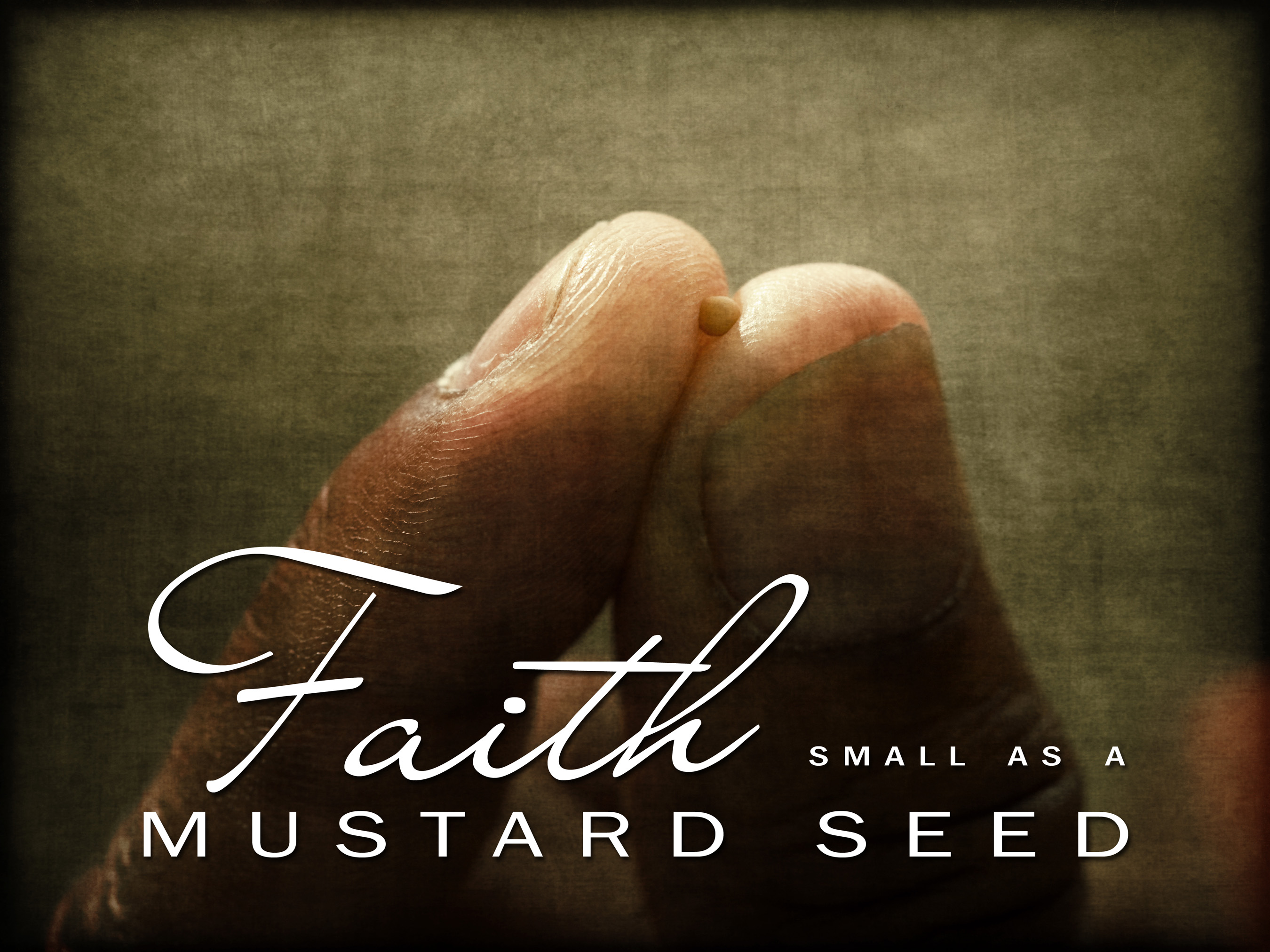
Mustard-Seed-Faith-by-CRILuke 17:3-6 NRSV

As Luke begins his gospel by addressing Theophilus, I want to begin the sermon this morning addressing Luke.

Dear Luke:

Thank you for your careful investigation and for the very orderly account you gave us so that we may know the truth concerning the life, death and resurrection of our Lord and Savior, Jesus Christ. However, on this World Communion Sunday, on the behalf of millions of Christians spread across this globe, and especially on the behalf of a handful of Christians here in Farmville, North Carolina, I would like to voice a concern that many of us have. (Sounds pretty tactful so far, don’t you think? Because here comes the boom!)

Luke, my dear brother in Christ, you are killing us. I mean, brother come on! For five weeks now you have been asking us to do some very big things! You have told us that if we want to be disciples of Jesus it is going to mean losing ourselves, denying ourselves, being a community that is always more concerned about others, about the outsider, than we are about ourselves.  It means having a strong passion for the poor, those we regard as “the least of these.” You have even told us that following Jesus involves a cross and we are going to have to carry it! Brother, come on!

Luke, during these five weeks, we have listened as you have shared some pretty outlandish parables of Jesus. And yes, although some revealed that there is nothing in this world that can separate us from the grace of God, which was rather comforting, they also re-emphasized that Jesus wants us to extend this same grace and to all people, which, quite frankly makes us rather uncomfortable. And last Sunday, you even had the audacity to bring Hell into it. You warned us that if we continued to believe that we were more blessed and favored than others, one day, we might find ourselves in flames begging one of those “others” for a sip of water!

So, come on Luke, enough already. We simply cannot take it anymore. We just can’t handle it. You are asking far too much from us! Being a community of love and forgiveness for all people is just too messy, too hard, too risky, and takes too much of our time. There’s just so much pride we can swallow at one time. And besides, we have enough of our own problems to worry about.

We have our own kids to take care of. Luke, I am not sure if you know about these things, but we have these things called soccer, football, volleyball, cross country, cheerleading and dance. And some of our kids have special needs, and then on top of that, there are our parents who are getting on up there in age with their own special needs. And did we mention that we have full-time jobs?

Oh, yes, there are some of us who are retired, but we too have our own needs. The truth is some of us are just too tired and too old to keep doing all these things that Jesus demands. You ask us to deny ourselves and carry a cross, when just trying to survive each day is like carrying a cross.

And Luke, have you seen our church lately? Have you seen how small we have become these days? We just don’t have the resources that we once had. So many good people have passed away. We have lost too many hard workers, too many teachers, too many people with some deep pockets, if you know what I mean. And have you seen our building? It is over 100 years old! So many repairs, renovations are needed. It is about all we can just do to keep it up.

So Luke, with all due respect, if you really need us to do more than we are doing now, if you want us to be more that we already are, if you really want us to reach out to others, sacrifice, be a community of love and forgiveness for all, and on top of all of that carry a cross, then something is gonna have to give. You are going to have to find a way to give us some more faith, because there is just too little left here. Sincerely, your friend and brother in Christ, Jarrett Banks

After Jesus finished speaking about the need to forgive people who have wronged them not once, but seven times, the disciples, like a crowd of exasperated members of a small, struggling old church in a small town in Eastern North Carolina, said: “Come on Jesus. You are killing us. Enough already. We simply cannot take it anymore. We just can’t handle it. You are asking far too much from us! If you really want us to do more, you need to “increase our faith” (Luke 17:5).

It is then that Jesus responded with some very good news: “If you had the faith the size of a mustard seed, you could say to this mulberry tree, ‘Be uprooted and planted in the sea,’ and it would obey you.”

And to really understand just how good this news is we need to understand something about the Greek language and the use of the word “if”. In the Greek, it is used two different ways. One is to express a condition contrary to a fact, “If I were you.” The second way is to express a condition according to the fact, “If God is for us, who can be against us.” Here, Jesus is using the latter. In the original Greek, Jesus was saying: “If you have faith as small as a mustard seed,” (And you do have it) then you can do some very big and miraculous things!

When the exasperated disciples got to a point when something just had to give, when they just did not believe they had enough of what it takes to be the people Jesus was calling them to be, they said: “Then, Jesus, increase our faith!”

Jesus responded: “Here’s the good news! I don’t have to increase it, because it only takes a little to do some very big things. And since, by the grace of God, you have a little, (you would not be following me if you didn’t) although your numbers are small, although you have very little left in the tank, in fact, I know that some of you are currently running on fumes, I have already given you what you need to do some very big things. If fact, as small as you are, as frail as some of you are, as uneducated and misinformed some are, although you constantly misunderstand what I have been teaching you, although some of you will even betray me, others will deny me, and when the going gets tough all may desert me, I have given you all that you need to change the world!

Night is falling. Jesus has been teaching out on a hillside. And the crowd that showed up that day, well, they were getting hungry.

The disciples with a little panic in their voices insist: “Jesus, there’s a thousand hungry people out there. We need to send them back to town so they can buy something to eat.”

Jesus asks, “But tell me what do you have?”

“Jesus, something’s got to give because we have very little. Just a few loaves and two miserable little fish.”

Jesus takes what they have, blesses it, breaks it, and gives it.  And, the good news is: it is enough.

However, that is not the end of the story.  Although that would be enough, there is more.  We read where “all ate and all were filled.”  They were all fulfilled, all satisfied.  They just didn’t receive something to “tie them over” until they got back into town.  They ate until they were full and satisfied.

But the story doesn’t even in end there.  They took up what was left over and 12 baskets were filled. The truth is: there was not enough.  There was more than enough. There was not only fulfillment and satisfaction, but there was a surplus. The good news is: This is simply the way it is with Jesus.

All of ye of little faith, those of us who complain that we are just too small, too old, too tired, to transform this church, to transform this community, and to change our world, this good news that Jesus always gives us more than enough is not new news to us.

Let’s take just a few minutes now and think about it.  Let’s go back in time several years. Remember that time before the divorce or separation, before the diagnosis, before you lost your job, before the flood, before the tornado, before the miscarriage, before the accident, before your child was lost, before your spouse died.  During that time before the pain, before the grief, imagine that God came to you in a dream and revealed every hardship you would have to endure in your life.  How would you have responded?

I know how I would have responded. God, you are killing me. There is just no way. Come on God, enough already. Something will have to give. There’s just no way I can do it. I simply do not have what it takes. If you really want me to make it, Lord, you are going to have to increase my faith!

And Jesus would say, “I don’t have to. I have already given you what you need.” And guess what, the good news is, and we knew it all the while, Jesus is absolutely right.

On this World Communion Sunday, we have gathered with Christians all over the world around a very small but very holy table. From this table, we take into our hands what may be one of the smallest, tiniest pieces of bread that we have ever held, and we put what resembles a mere crumb into our mouths, and we eat it.. And then we take the smallest of cups, and sip the smallest amount of juice.  It is just a small taste really, but the good news is: it is enough. No, the good news is: it is more than enough. Amen.

People Grumble but Angels Sing!

Stain_GoodShepherd

Luke 15:1-10 NRSV

It is Consecration Sunday. To consecrate: it means to “set apart,” “devote,” “dedicate,” “commit.” Today, with our presence, prayers, and pledges, we consecrate First Christian Church to the selfless, self-denying, sacrificial service of God in this community and in our world. We set-apart, devote, dedicate and commit ourselves to the difficult journey we call discipleship, a journey that calls us to lose ourselves, empty ourselves, and pour ourselves out for others; a journey that calls us to lose our pride, our possessions, even our lives.

And as painful, as difficult, as taxing, and as costly as this journey is, Consecration Sunday is the day we claim it, and commit ourselves to it, believing it is the only journey that leads to true life, abundant and eternal.

And after being around you folks now for a couple of weeks, I believe with all my heart that the First Christian Church of Farmville is more than ready for this day of Consecration. And believe it or not, I can just look at you this morning and tell that you are ready.

I believe you are ready simply because you are here. Like all churches on the discipleship road, this church has experienced a few bumps, several pot holes, a little bit of mud, some rocky terrain, a couple detours, and although you have even gotten close to going over the cliff, you have somehow managed to stay on road. And in many ways because of that, you are more committed and more devoted than ever to seeing this journey through. I know you are ready to commit to this journey because you are here.

And let’s face it, you could have made the choice with the majority of Americans to stay home today and experience God on your back porch or patio with a cup of coffee or during a morning run or walk in the park. But you made the difficult decision to get up, get dressed and drive to this place this morning. Some of you came here to sit beside of people with whom you could not disagree more, with people who have at times made you angry or even made your cry, but you still came because you are committed to something that is much bigger than your feelings, your emotions, even your life.

Rev. Lillian Daniel, pastor of First Congregational Church from Glen Ellyn, Illinois, has said: “Any idiot can find God alone in the sunset. It takes a certain maturity to find God in the person sitting next to you who not only voted for the wrong political party, but has a baby who is crying while you are trying to listen to the sermon. “Community,” she says, “is where the religious rubber meets the road. People challenge us, ask the hard questions, disagree, need things from us, require our forgiveness. It’s where we get to practice all the things we preach.”

She continues: “I think a lot of those who can’t tolerate organized religion are really just frustrated by other people. They think, ‘If they could just kick all of the flawed human beings out of the church, we could really do this Jesus thing. Better do my spiritual life solo, where I don’t have to be disturbed by the amateurs.”[1]

I have a confession to make. During my break from pastoral ministry, I often felt the temptation to go solo with my faith. I would go for a Sunday morning run along the Tar River in Greenville. There, I would pray and enjoy being alive in God’s creation, and think to myself, “this is the way to do church! There is no one to disagree with me. There is no one sharing their problems with me, making me uncomfortable, and taking up my time. And I must confess, it was rather nice!

However, I must confess it was also very selfish. It was arrogant, and it was self-righteous. The truth is: it was the very antithesis of who Jesus calls us to be as his disciples.

One day, perhaps one Sunday at 11 am, Jesus decides to have some church. He gets the word out that he would be leading worship, preaching a sermon, and then afterwards having a covered dish or a nice catered lunch. And people from all over town came to the service. Of course, other religious leaders and people of faith came carrying their Bibles: Pharisees and scribes, deacons and elders, Sunday School teachers, and other respectable, well-dressed and well-groomed church people, even some from other congregations in town.

But then through the front door entered the other people. You know who I am talking about: the others—those who tempt us to find Jesus alone with a cup of coffee and a sunrise—those others, who are just so, well, “other.”

It was then that it came. It came in whispers and it came in murmurs and it even came in a few gasps the sound of grumbling. “This fellow welcomes sinners and eats with them.”

The truth is that being the church that God calls us to be in this world is in itself a selfless, sacrificial, self-denying journey because it calls us not only to welcome, accept and love others; Jesus suggests that “others” is who the church is actually for.

Jesus asks, “Which one of you, having a hundred sheep and losing one of them, does not leave the ninety-nine in the wilderness and go after the lost one until he finds it?”

Well, Jesus, do you really want us to answer that question? Do you really want to know if we are willing to risk 99, forget about their wants and needs, just so we can go after one that has lost his way? And just how did he get lost in the first place? I hate to say it, but he probably deserved it. It makes more sense to make sure the more deserving sheep that have not strayed stay safe and comfortable. Do you really want us to risk losing the entire flock for one lost soul?

Then Jesus says, not only do I want you to risk the entire flock, put their needs and their wants last, but when you find the lost, I want you to put him up on your shoulders and throw one big party! Because, when one lost soul is found, that is exactly what the Father and the Holy Spirit and the Angels are doing in heaven!

Then Jesus asks, “which one of you women, having 10 coins, and loses just one of them, does not light a lamp, sweep the house and search until she finds it?”

Well, Jesus, it all depends. I might look in a few places, but I am not willing to move any furniture or tear the house apart. And I might look for an hour or so, but I am not going to waste an entire day. I think I’m better off to use my time and efforts to hold on good and tight to the on other nine. Make sure they stay safe and protected. Doesn’t that make more sense?

Jesus says, “It may make sense to you, but not to my Father and the heavenly host. I tell you again, when you exist and act on the behalf of the lost, on the behalf of the other, although it might cause some in the church to grumble, the angels are singing!

And if we are all honest this morning, we would admit that we understand the grumbling. There is something within all of us that would prefer to be a country club for the ninety nine. Deep down, we prefer to hold on to each other, comfort each other. After all, membership should have some benefits for its members. It is not easy consecrating the First Christian Church not for us here on the inside, but for all those others who are on the outside.

It is not easy consecrating ourselves to leave our areas of comfort and safety and venture forth into the world share the good news that Jesus came and died for all people. However, although we may want to grumble, there is absolutely nothing than can stop us from this consecration. We have been through too much, the road has been too long, too bumpy and too muddy, too rough, and we’ve been too close to edge of the cliff to turn back now!

I once belonged to a church that had beautiful stained glass windows that told the gospel story. The first window portrayed Jesus’ baptism; the second, the call of the disciples; the third, the feeding of the five thousand; and so on. And then they portrayed Jesus’ crucifixion the resurrection and the ascension. Each window was imprinted with an appropriate scripture verse for each scene.

We had a guest preacher one day who pointed out how the stained glass windows should be taken out, flipped around, and put back in so that the gospel story could be seen, the scripture verses read by the people outside of the church, instead of to the people who were already on the inside.

It was a great sermon illustration. For it not only illustrates why we need to fix our own windows here where they can be seen by those outside our church, and we need to do it sooner than later, it illustrates that Jesus wants the church to always, selflessly and sacrificially, exist for the other, the outsider, even if it causes some to grumble.

Fred Craddock, one of my all-time favorite preachers, who I have quoted for 25 years, who by the way just happens to be ordained as a Disciple of Christ, tells the story of a local church that had a lot of grumblers. Although their sign out front read, “A church that serves all people,” when all people would show up to be served, the grumbling became so intense that it continually drove the newcomers away.

“Would you look at how long his hair is? Do you see all of those piercings! Oh my word, how those children are dressed! He sure is odd. She’s certainly strange. Don’t tell me we are now going to be a church for those people?

About ten years went by. When, one day, Craddock was driving down the road where that church was located when he saw that the building that once housed that church had been converted into a restaurant. Curious, he stopped and went inside. In the place where they used to be pews, there were now tables and chairs. The choir loft and baptistery was now the kitchen. And the chancel area which once contained the pulpit and communion table now had an all-you-can-eat salad bar. And the restaurant was full of patrons—every age, color and creed.

Upon seeing the sad, but very intriguing transformation, Craddock thought to himself, “At last, God finally got that church to serve all people.”

It is Consecration Sunday and we have come too far to turn back now. So, today we set aside, devote, dedicate and commit our presence, our prayers, our pledges, our budget, our building our windows and our very selves to the service of God in this community and in our world NOT for the benefit of the 99, but for others.

The road has been long and the going has been rough, but because of that we are stronger and more committed than ever to see this journey through. Although this way is narrow and at times uncomfortable, we are still here. And while some may grumble, we have decided this day to exist for others and sing aloud with the Father, Son, Holy Ghost and Heavenly Host. Then, at the altar we are going to lay our pledges to continue this journey as we make our way to the fellowship hall sit down together at the table and enjoy one big party!

Going Solo

run in the park

From People Grumble but Angels Sing!

This Sunday, we have a choice to make. We could make the choice with the majority of Americans to stay home and experience God on our back porches or patios with a cup of coffee or during a morning run or during walk in the park.  Or we could make the difficult decision to get up, get dressed and drive to a place of worship.  And there, we may sit beside people with whom we could not disagree more. We may sit beside folks who press our buttons, even drive us crazy.

In a recent interview, Rev. Lillian Daniel, pastor of First Congregational Church from Glen Ellyn, Illinois, has said: “Any idiot can find God alone in the sunset. It takes a certain maturity to find God in the person sitting next to you who not only voted for the wrong political party, but has a baby who is crying while you are trying to listen to the sermon. “Community,” she says, “is where the religious rubber meets the road. People challenge us, ask the hard questions, disagree, need things from us, require our forgiveness. It’s where we get to practice all the things we preach.”

She continues: “I think a lot of those who can’t tolerate organized religion are really just frustrated by other people. They think, ‘If they could just kick all of the flawed human beings out of the church, we could really do this Jesus thing. Better do my spiritual life solo, where I don’t have to be disturbed by the amateurs.”

I have a confession to make. During my break from pastoral ministry, I often felt the temptation to go solo with my faith. I would go for a Sunday morning run along the Tar River in Greenville. There, I would pray and enjoy being alive in God’s creation, and think to myself, “This is the way to do church! There is no one to disagree with me. There is no one sharing their problems with me, making me uncomfortable, and taking up my time. And I must confess, it was rather nice!

However, I must also confess it was very selfish. It was arrogant, and it was self-righteous. The truth is: it was the very antithesis of who Jesus calls us to be as his disciples.

Free to Be Free

4th of July

(Sermon delivered to First Christian Church, Farmville, NC, on June 30, 2013)

Galatians 5:1, 12-25  and Luke 9:51-62 NRSV

For freedom Christ has set us free—and all God’s people here in America on this Sunday before the July 4th proudly and fervently say: “Amen!”

But what exactly does that mean?

I know the type of freedom that most Americans cherish, as I am one of them. We call it the freedom of opportunity.  Which is usually translated in our consumerist society:  the freedom to attain, to acquire, to amass and to accumulate as much as we possibly can.

We are free to go after the American dream. Buy a big house in the suburbs or in a small town, purchase two cars and a dog and raise our children by providing them with the latest smart phones and the trendiest clothes.

And we are free to pursue happiness. To be the people we want to be and to go to the places we want to go. We are free to fulfill our every desire and to meet our every need. We are free to get as much as we can out of this life and this world.

And we American Christians love to evoke Jesus to help us. We look to Jesus as our ticket to attaining the American dream.

In other words, Jesus, for many Americans, becomes just another commodity that we can get, so we can get some more.

I have seen Christian billboards, bumper stickers and t-shirts take the once popular slogan of the American Dairy Association “Got Milk?” and change it to “Got Jesus?”

Do you seek happiness? Want to fulfill your desires, meet your needs? Need help paying the mortgage? Need to build a stronger family? Then, just get you some Jesus!

Yes, God bless America that we are free to worship and get Jesus so Jesus can help us get some more!

The Samaritans had received word from the disciples that Jesus was on the way to visit their village. Can you imagine hearing such an announcement? Jesus is coming to town! Jesus is coming to Farmville! Jesus is coming to help us achieve the American dream, help us with the mortgage, help us strengthen our families, help us go to the places that we want to go and to be the people that we want to be!  Can you imagine the grand reception, the huge welcome that would await Jesus?  No doubt there would be parades, cook-outs and a lot of fireworks to celebrate his arrival.

Let’s read how they celebrated such a grand event early in the first century. In verse 53 we read, “but they did not receive him”…what? Why on earth not?  Because his face was set toward Jerusalem.

His face was set toward Jerusalem. Toward the cross. Toward sacrifice. Toward self-denial. Toward self-giving. Toward pain and toward suffering.  And the Samaritans, of course, were not interested.

So, Jesus goes into another village. Surprisingly someone cries out, “Jesus, I will follow you wherever you go!”

Jesus, assuming the zealot really did not know what he was saying, asks, “Are you sure you really want to do that? Do your really mean that? Do you really want to go with me? Don’t you understand that foxes have holes and birds have nests but the son of man has no where to lay his head.”

So much for Jesus helping us with the American dream of that big home in the suburbs!

To another he said, “Follow me.” But he said, “Let me first bury and mourn my father.” Jesus respond, “Let the dead bury the dead, as for you go and proclaim the Kingdom of God.”

So much for Jesus helping us to meet our needs.

Another said, “I will follow you, but let me first go back and tell my family good-bye.” To which Jesus responds: “Those who look back are not fit for the Kingdom of God.”

So much for Jesus coming to help us build a stronger family!

In other words, Jesus says:

If you want to follow me as my disciples in this world, then you must let go of the things to which the world assigns so much value. You must abandon those things with which the world seduces you into believing they can be the fulfillment of your most profound desires.

Jesus also puts it this way… to truly live, we must first die to self.  Dietrich Bonhoeffer, who was executed in a Nazi concentration camp for helping Jews escape to Switzerland insightfully wrote, “When Christ calls a man, He bids him come and die.”

And the Samaritans wanted none of that. No wonder that night in their village there were no fireworks.

That was not the message they wanted to hear. If Jesus’ face is set toward Jerusalem, then Jesus better get himself to Jerusalem, and we will stay right here.

I attended a church growth conference a few years ago where the speaker talked about the importance of making sure that church members “feel satisfied.”  In other words, if you want the church to grow, the job of your pastor is to make certain that you are happy.

You know, the speaker is absolutely right. Just ask the Samaritans. If Jesus came to the Samaritans with his face set toward the pursuit of happiness, I am sure the pews would have been packed. The problem is that this is not the purpose of the church.

Jesus does not call us to go to church to get happy. Jesus calls to be the church, to be the body of Christ in a broken and fragmented world, with its face set towards Jerusalem.

And Jesus is not just some commodity that we can get so we can get some more…more happiness, more contentment, more fulfillment.  Jesus does not want us to get him, Jesus wants to get us. As William Willimon puts it, Jesus does not want us to get him to meet our needs. Jesus wants to get us and rearrange our needs. He does not want us to get him to fulfill our every desire. He wants to get us and transform our every desire.

Jesus is not interested in helping us to be the people we want to be and to go to the places we want to go. Jesus wants us to be His people and go to the places that he wants to go. And his face is set toward Jerusalem.

As one of my favorite writers, Henri Nouwen has said, sometimes Jesus calls us to places we would rather not go.  Sometimes Christ calls us into “unknown, undesirable and painful places.”

The truth is, that when we come here on Sunday morning, instead of finding ourselves surrounded by a bunch of happy people satisfied and content, we probably should find ourselves in the midst of a people who are more than a little anxious, apprehensive, and nervous for we never know where this Christ is going to lead us next.

This weekend as we Americans celebrate our nation’s birthday, may each of us thank God for our country and the freedom our country affords us.  However, as a church that is not seeking to get Jesus, but continually be in the process of allowing Jesus to get us, to rearrange our needs, transform our desires, lead us toward Jerusalem, toward the cross, toward suffering, self-denial, self-giving, may we be mindful that with our freedom comes a radical call to truly free ourselves of some things that many Americans hold very dear.  May we mindful that we are free to be truly free.

While it is true that we are free acquire and accumulate, to accrue and to amass, to meet our every need and to fulfill our every desire, it is also true that we are free, to abandon and relinquish, to let go and to leave behind.  We are free to be free from all of the material trappings and selfish desires that prevent us from following Christ wherever he leads.  We are free, not to get Jesus to meet our needs and fulfill our desires, but we are free to allow Christ to get us to rearrange our needs and transform our desires.  We are free to not only get to give.

Bonhoeffer did not have to help Jews escape Nazi Germany and flee to Switzerland.  After all he was safe and sound in New York in the early 1940’s. He was free to stay in America and preach the gospel from the safety of a free church pulpit or to teach New Testament in the peace and freedom of a university.  Bonhoeffer could have lived the American dream. But the gospel he preached and the freedom that he was granted compelled Bonhoeffer to return to Germany and stand against Nazi aggression.

Before he was executed by the Germans, he wrote the following words.  They are words that the American Church needs to hear again and hear loudly… “Cheap grace is the preaching of….forgiveness without requiring repentance, baptism without church discipline, communion without confession…  Cheap grace is grace without discipleship, grace without the cross, grace without Jesus Christ living and incarnate.

“Costly grace is…the gospel which must be sought again and again. The gift which must be asked for, the door at which one must knock. Such grace is costly because it calls us to follow Jesus Christ.  It is costly because it costs us our lives. It is grace because it gives us the only true life.”

For freedom Christ has set us free—and all God’s people here in America on this Sunday before the July 4th proudly and fervently say: “Amen!”

Let us pray.

O God as we recommit ourselves this day to follow the Christ, give us your grace to let go, give up, and relinquish every desire, trait, and tendency that weighs us down or hinders our faithful work for you in the name of Christ Jesus our Lord. Amen.

Commissioning and Benediction

We came here this morning to get a little bit of Jesus. To get him to help us meet our needs and fulfill our desires. Instead, Jesus came here and got us. Through Jesus, God the creator of all that is has spoken, saying, “I have some very important work to do in this world, and I am here to get you to help me.

Go now and do the work in this world to which you have been called.  You may have to leave friends and family behind.  You may have to give up some things that you hold very dear.  Even life itself.  But in so doing, you will gain the only true life. And may the love of God, the grace of Jesus Christ and the communion of the Holy Spirit be with us all. Amen.