Can’t Celebrate Easter Without a Carrying a Cross: Remembering Mary Magdalene Feightner

Mary-Feightner-1492072139Here in the mournful darkness of this Saturday vigil, still in the shadows of Good Friday, we gather together with bated breath.

For Easter is coming! New life is being born! Resurrection morning is dawning! Something wonderful has been lost, but something magnificent is being gained.

However, I believe it is very important for us to realize on this Holy Saturday, that before we can experience new life, before we can celebrate resurrection, before we can sing alleluias, someone needed to pick up and carry a cross.

And the sad thing is that very few of Jesus’ disciples understand this. They don’t understand it today, and they didn’t understand it 2000 years ago.

Although Jesus continually taught that to gain life, we must be willing to lose our lives, that Easter would not happen without some self-denial, resurrection would not come without some self-expenditure, new life would not be born without some sacrifice, and the light of Sunday morning cannot dawn without the darkness of Good Friday, when the time came for the disciples to follow Jesus all the way to the foot of the cross, most all of them very selfishly fled to save their lives. One would even betray Jesus. Another would deny that he even knew Jesus. Nearly all would desert him. In spite of Jesus’ continual call to pick up a cross and follow him, most of the disciples turned their backs on him in his darkest hours.

However, there were a few disciples who got it. There were a few who were willing to carry a cross, to live and to love selflessly and sacrificially. There were a few who faithfully followed Jesus all the way to Golgotha.

Although the intrinsic sexism of this world’s history has caused the majority of people to overlook these faithful disciples, all four gospel writers did not.

In Luke 8 we read these words: Afterward [Jesus] journeyed from one town and village to another, preaching and proclaiming the good news of the kingdom of God. Accompanying him were the Twelve and some women…Mary, called Magdalene… Joanna…Susanna, and many others…”

And on Good Friday, when none of the male disciples could be found, in Mark 15 we read: “There were also some women looking on…among whom were Mary Magdalene, and Mary the mother of James, Joses, and Salome.

In Matthew 27 we read: Gathered at the foot of the cross: “among them was Mary Magdalene, and Mary the mother of James and Joseph, and the mother of the sons of Zebedee.

In John 19:25 we read where all the male disciples fled, “But standing by the cross of Jesus were His mother, and His mother’s sister, Mary the wife of Clopas, and Mary Magdalene.

The problem with Christianity today is that there are too few Mary Magdalenes in the church who understand that authentic faith, true discipleship, involves a cross. There are too many Christians in our world who believe they can have Easter Sunday without Good Friday, who believe they can experience new life without death to self, who believe they can sing alleluias without sacrifice.

What this world needs, what this community needs, what the church needs more than anything are more disciples like Mary Magdalene and Mary Magdalene Feightner.

Like the Mary Magalene before her, Mary Magdalene Feightner understood that when Jesus called people to be his disciples, Jesus was always quite clear that there would be a cross involved, a cross that they would voluntarily need to pick up and carry.

I will never forget the last time I spoke with Mary. It was here, in this place, just this past Sunday. After the service was over and the congregation was dismissed, I was finishing a conversation with some people down front here who were asking about joining our church. I looked up and saw Mary walking down this aisle. I met her right here to greet her. I said, “It is so great to see you Mary.” And it was so good to see her. For each time I saw her she was always beautiful, stunning really, dressed to the nines, and always wearing a tremendous, welcoming smile.

Mary responded not in a manner people usually respond to such a greeting with “It is good to see you too!“ but rather “How is it going with that Air Force Class Central Christian Church adopted?”

I said, “It is going great! We had a good time trap shooting with them!”

And instead of replying, “Great, glad to hear it!” not allowing me to rest on any laurels, she replied: “Well, what’s the next event you have planned for them?”

Like Mary Magdalene, Mary Magdalene Feightner understood that to find true life is to lose one’s life, to truly live to truly deny one’s self, to always put the needs of others ahead of one’s own needs, to love and to welcome and to accept as Christ loves, welcomes and accepts.

It is no secret that Mary made it her mission for nearly the last thirty years of her life to give all that she had to welcome Air Force pilots and their families into our community.

It was obvious that Mary learned from her own personal experience, as she compassionately and empathetically understood from how difficult life could be for enlisted service men and women having to move and make a new home in a new community every few years. She knew the hardship on families: the time the kids get settled in school, make new friends, it’s time to move and start all over.

This is why Mary made Vance Air Force Base her base. They were here pilots, her families. She didn’t invite businesses or organizations or churches like ours to adopt these pilots or to do anything that she was not willing to do herself.

And she never did it for the recognition, for any reward, and certainly not to have the foyer of the auditorium named in her honor—the foyer, the first place pilots enter when they come to Vance, and the last place they leave after they earn their wings.

The night of the naming ceremony, her sons Ray and Mark will never forget having to tell Mary that they were going to the base, because Governor Mary Fallin was speaking, just so their mother would get dressed up and go.

Although Mary earned much recognition, Mary Magdalene Feightner did not volunteer her time for any award, any accolade, I believe she did it because she understood to find one’s life, one must first lose one’s life, as her work for the base was purely selfless, always tireless, and truly sacrificial.

It has been said by many who are associated with Vance: “Mary didn’t know she was 81 years old.” Because even during the most fragile part of her life, she selflessly gave all that she had. For example: staying out on the 103-degree tarmac for the Thunderbirds last summer until she passed out, sacrificing her personal well-being.

This was just Mary. No matter what Mary did, she gave her all and always put others first, whether as a banker in a man’s world working her way up from a teller to a loan officer to a Vice President, as a substitute teacher in the Enid public school system, as a Grace-Care Volunteer helping the elderly with basic needs, as the Secretary-Treasurer of the Northwest Oklahoma Banker Association, as a successful fund-raiser for the YMCA, the American Cancer Society, the March of Dimes, the United Way, or as Secret Shopper for Subway and Pizza Hut.

She did it because as a genuine disciple of Jesus, when it came to loving others, she didn’t mind that a cross might be involved. For Mary, people were worth the sacrifice. Thus, you could often find Mary in Enid wherever you find people. Whether she was picking up side gigs peddling Straight Talk phones at Wal-Mart or Kobalt tools at Lowes, she just wanted to where the people were, because she genuinely loved people!

She loved others, perhaps especially the Vance Air Force family with the same love that she had for her own family. By a living example she taught her sons a staunch work ethic, the importance of networking and social skills, and yet how to be a good listener. But, perhaps most importantly, she taught them how to accept, welcome, and love people.

Mark’s wife Diane will always cherish the way she used to welcome her and Mark into her home while they were in college. She said no matter what time of night it was when they arrived, she could always count on Mary being there to greet them at the front door.

Ray’s wife Kim and Diane testify, although somewhat reluctantly, of Mary’s unwavering devotion to her family, as according to Mary, Ray and Mark simply can do no wrong.

And each of her grandkids, Zachary and Kylie, Mason, Morgan and Madison can attest, at Gurnie’s house there were never any rules. Three scoops of ice cream? Who says you can’t have four?

I think it is interesting that Mary Magdalene is remembered and mentioned by name by the gospel writers more than any other apostle. And perhaps more than any other Partner in the Sky in Enid, Mary Magdalene Feightner will perhaps be most remembered by our community.

However, her great legacy is not why we are gathered here this afternoon in a Christian church. And her many contributions to this community is not why it is so appropriate that we have gathered here on this Holy Saturday, between the darkness of Good Friday and the light of Easter Sunday.

For tomorrow morning, Christians all over the world will gather and read or hear the following scriptures.

Some will hear the words Mark 15:47: “Mary Magdalene and Mary the mother of Joses were looking on to see where Jesus was laid.”

Matthew 28:1 reads: “Now after the Sabbath, as it began to dawn toward the first day of the week, Mary Magdalene and the other Mary came to look at the grave.”

Mark 16:1 reads: “When the Sabbath was over, Mary Magdalene, and Mary the mother of James, and Salome, bought spices, so that they might come and anoint Him.”

John 20:1 reads: “Now on the first day of the week Mary Magdalene came early to the tomb, while it was still dark, and saw the stone already taken away from the tomb.”

Out of all of Jesus’ disciples it was Mary Magdalene who not only sacrificially followed Jesus all the way to the foot cross, but she followed him all the way to the grave.

I don’t believe it was a coincidence that Mary Magdalene Feightner was here in this place to worship Jesus last Sunday morning. I don’t believe it was happenstance that she walked down this aisle on her last Sunday on earth, with her mind and heart not on herself, but on others. Like the Mary Magdalene before her, Mary Magdalene Feightner followed Jesus to the very end.

Because tomorrow Christians all over the world will read and hear those wonderful words that we are all anticipating on this Holy Saturday. From Mark 16:9 we read: “Now after He had risen early on the first day of the week, He first appeared to Mary Magdalene…”

We are gathered here in this place, appropriately on this Saturday between Good Friday and Easter to celebrate someone who, because of her faithful discipleship, because she voluntarily carried a cross, because she sacrificed and poured herself out to this community, because she selflessly followed her Lord all the way to the end, Mary Magdalene Feightner has now experienced the good news of Easter in a way that we can only imagine.

And this Easter, out of all the disciples that have gathered here this day, “He, the risen Lord and Savior of the world, first appeared to Mary Magdalene Feightner.”

In John 20:18 with we these most hopeful words: Mary Magdalene came, announcing to the disciples, “I have seen the Lord.”

Yes, she most certainly has. Thanks be to God.
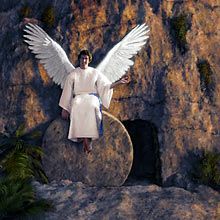
The Seal Broken

stone rolled away

Matthew 27:62-28:10

During our very meaningful Tenebrae service on Friday night, we listened to the voices of Good Friday. “Father, if it is possible, let this cup pass from me; yet not what I want, but what you want.”

“Are you still sleeping and taking your rest? See, the hour is at hand, and the Son of Man is betrayed into the hands of sinners. Get up, let us be going.  See my betrayer is at hand.”

“The one I will kiss is the man; arrest him.”

“Have you come out with swords and clubs to arrest me as though I were a bandit?”

“Then all of the disciples deserted him and fled.”

“He has blasphemed!  Why do we still need witnesses? He deserves death. Then they slapped him and spat in his face.”

“You were also with Jesus, the Galilean.” “I do not know what you are talking about.”

“This man was with Jesus of Nazareth.” “I do not know the man.”

“Certainly you are also one of them, for your accent betrays you.”

“’I do not know the man!’ And the cock crowed.”

“I have sinned by betraying innocent blood.” “Judas then went out and hanged himself.”

“Are you the King of the Jews?”

“Release to us Barabbas.” “Crucify Jesus.” “Let him be crucified.”

“I am innocent of this man’s blood, see to it yourselves.”

“Hail, King of the Jews!”

“You, who would destroy the Temple and build it in three days, save yourself!”  “If you are the Son of God, come down from the cross.” “He saved others, yet cannot save himself.”

“Eli, Eli, lema sa-bach-tha-ni? My God, my God, why have your forsaken me?”

“Command the tomb to be made secure. You have a guard of soldiers; go, make it as secure as you can.” “So they went with the guard and made the tomb secure by sealing the stone.”

These are the voices of Good Friday: voices of betrayal; voices of denial; voices of disappointment; voices of hate; voices of cruelty; voices of finality; voices of no turning back; voices of no moving forward; voices of death. “Make the tomb as secure as you can. Seal the stone.”

And the reality is that you did not have to attend either the service on Thursday or Friday to hear these voices. For we live in a Good Friday World, don’t we?

We’ve heard these voices just this week.

Yesterday from Utah: “A woman heading to her mother’s funeral has died in a car crash.”

From Iraq on Friday: “A suicide attacker detonated an explosive belt in a park outside Baghdad on Friday, killing 41 people and wounding over 50 more.”

From Oklahoma City on Thursday: “The state medical examiner’s office said bones recovered from near Lake Stanley Draper are human.

Oklahoma City police Master Sgt. Gary Knight said police received a call Monday that bones, clothing and personal effects had been discovered near the lake.”

From North Carolina on Wednesday: “In a bill that zoomed through with head-spinning speed, lawmakers blocked cities and counties from protecting people from discrimination.”

From Brussels on Tuesday: “Two suicide bombers blew themselves up in Brussels airport, killing 11 people, and a third man detonated a suicide bomb one hour later in an underground train in central Brussels, killing 20 more.”

From Indiana on Monday: “Indiana Sheriff’s deputy shot dead. Partner seriously injured after serving search warrant.”

And from Enid this week: “I can’t believe she talks about me behind my back.”

“Why does he have to be so hateful?”

“I don’t even know who you are anymore.”

“Why won’t my children come and visit me?”

“My wife is having part of her foot removed next week. We are just waiting for the doctor to call with the exact day and time.”

“Since my back surgery, I am still dealing with a lot of pain.”

“She needs a root canal. He needs braces.”

“I owe thousands in taxes this year. And I don’t know where the money is going to come from. I am already working more hours now than by body and mind can stand.”

“I’m never going to be able to forgive myself. “I have never been so embarrassed in my whole life.” “I simply can’t continue going on like this.”

“My mother really doesn’t like the nursing home. She believes we are all plotting against her. I think my father may have Alzheimer’s.”

“Her baby was born three months premature. My sister has been having chest pains. My brother’s arthritis is about to get the best of him. The doctor said my tumor is malignant and inoperable. I still can’t believe that my wife is gone. I have never felt so alone and so depressed. At times, I just want to go to sleep and never wake up.”

These are the voices of Good Friday, and they echo throughout our world without ceasing, sometimes overwhelming us. Every time we turn around there is something else in our Good Friday world to worry about. There is no escape. It is like being entombed in sepulcher for all of eternity by a large stone that has been sealed shut by soldiers.

So, now let us hear another voice. It is a voice called Easter. It is a voice called resurrection, a voice called hope.

“As the first day of the week was dawning. . .”  (Sounds hopeful already, doesn’t it?) As a new day, a new week was dawning, was beginning anew, fresh, bright, giving a chance to the promise of hope, “Mary Magdalene and the other Mary went to see the tomb. And suddenly there was a great earthquake; for an angel of the Lord, descending from heaven, came and rolled back the stone and sat one it.”

In our Good Friday world, oh how we need to hear this voice of Easter— this voice that says that our God who gave God’s all for us on the cross is so awesome, so good, so great, so much bigger than all of the cruelty and evil of the world, that God does not have to lift one finger, but sends an angel to break the seal that entombs all of us who are shrouded by the evil of our Good Friday world.

The Good Friday world says: “Seal it up.” Then our Easter God, without flinching a muscle, sends one meek angel to break the seal—an angel who then sits upon the stone and says the most hopeful words found in the entire Bible: “Do not be afraid; I know you are looking for Jesus, who was crucified. He is not here; for he has been raised, as he said.”

The world says seal it up. The world says things are not going to get any better. The world says the good old days are long gone. The world says that evil will get the best of us. The world says that God is either a fairy tale, is powerless, or has taken some cosmic vacation. The world says death is final.

Then God without lifting a finger breaks the seal and says: “I am always working all things together for the good. Through the breaking of the seal, God says to us that the best days of our lives are always yet to come. Gods says, although we cannot go back to the good old days, good new days are dawning. God says that nothing in this world is final, not even death. God says I can, and I will transform all of your despair into hope, all of your defeats into victory, all of your pain into joy, and even all of your deaths into life.”

The world says: “seal it up; you will never amount to anything. You’re a loser. You are insignificant. You are worthless. You are not a good person. Nobody really cares about you. You are pitiful. No matter how hard you try, sin always has a way of getting the best of you.  Perhaps you’d be better off dead. Seal it up.”

God breaks the seal and says: “I love you and suffered for you and died for you and raised Jesus to life for you, just as you are. There is nothing you could possible do to earn my love. I will always be with you and never away from you. I will always be for you and never against you. I will always stay by your side fighting for you, doing all that I can to wring whatever good can be wrung out of all of your misery.” God says “I will give you an Easter Faith to live victoriously in your Good Friday world.”

“Through eyes and ears of Easter faith you will see my resurrecting presence all around and hear my voice everywhere. You will be able to see it in flowers and in the trees. You will read it in a card sent to you by a friend. You will experience through the smile of a child.”

You can know it through the devotion of a Sunday School teacher. You can experience it through the woman who serves meals in the soup kitchen the needy. You can experience it with the church group who visits the nursing home; see it in the one who volunteers at the hospital; through the family who gives sacrificially and faithfully to the church, through missionaries who have given their lives to serve in third world countries, through encouraging words, handshakes, hugs, through a meal prepared; a lawn mowed, a house painted, a petition signed.

You can hear it through the confessions of faith from two young men being baptized.

God says you can hear it and see it and sense it and know it through people who by my grace are living an Easter Faith in a Good Friday world. You can see it when and wherever justice finally prevails and love ultimately wins.

During this coming week, you will not have to pay close attention to continue to hear the voices of Good Friday. You will quite possibly hear them even before this Easter Sunday ends. My hope and prayer is that as people living an Easter faith, we will continue to raise our Easter voices: voices of hope; voices of justice; voices of equality; voices of peace and love; voices of life; voices of a new day dawning; voices of a tomb whose seal has been broken on this day and forevermore.

Spring Is in the Air

lilies

“As he was now approaching the path down from the Mount of Olives, the whole multitude of the disciples began to praise God joyfully with a loud voice for all the deeds of power that they had seen, saying,
‘Blessed is the king who comes in the name of the Lord!
Peace in heaven, and glory in the highest heaven!’

Some of the Pharisees in the crowd said to him, ‘Teacher, order your disciples to stop.’ He answered, ‘I tell you, if these were silent, the stones would shout out’”(Luke 19:37-40).

This year, I believe what makes Holy Week special in Oklahoma is the way it corresponds with the unmistakable arrival of spring. The freezing temperatures of this Palm Sunday weekend appear to be the last gasp of winter. It is as if the entire creation is joyfully crying out with a loud voice: “Blessed is the king who comes in the name of the Lord!”

Trees budding; thunder booming; flowers blooming; grass greening; lilies rising; birds singing; sun shining—our world seems to be proclaiming that death has finally been transformed into life! It is Holy Week, and spring and hope and good news is literally in the air.

As disciples of the Lord, our mission is to share this good news with all people. And if we do not do it, Jesus says that the earth itself will shout out! May the arrival of spring remind us each day of this mission.

When we see new leaves in the trees dancing in warm breezes with new life, may we be reminded to hug those experiencing grief and loss.

When we hear the thunder, may we be reminded to comfort those who are afraid.

When we see flowers opening their blossoms toward the sun, may we be reminded to offer a smile and a kind word to those who are discouraged.

When we walk on green grass, may we be reminded to welcome those who feel lost and marginalized.

When we see lilies rise from the earth, may we be reminded to stand tall for justice on the behalf of the victims of narrow-minded bigotry.

When we hear the birds singing harmoniously together, may we be reminded to worship together in community.

And when we feel the warmth of the sun on our faces, may we be reminded to always let the light of love shine brightly for all people.

Why the Risen Christ Ate a Piece of Fish

fish1

Luke 24:36-53 NRSV

I often wonder what people mean when they say they are “spiritual.”  I hear people say: “I am not religious, but I am a very ‘spiritual’ person.”  “I don’t attend church, but I am quite ‘spiritual.’”

As a Christian, I sometimes find this odd as not even the risen Christ seemed to be all that spiritual. In fact, as our scripture lesson points out, the gospel writes, especially Luke, seem to go almost out of their way to point out the very physical, not spiritual, nature of the risen Lord.

Luke points out that Jesus asked the disciples to touch him and see that he had flesh and bones; not some spirit or ghost.  Jesus showed his disciples his hands and his feet which were scarred from his crucifixion. And then to still prove that he was there in the flesh and not in some spiritual form, he asked the disciples for something to eat. Then they give him a a piece of broiled fish that he eats in their presence.

The question that I want us to ask together this morning is: What is Luke trying to tell us by giving us this unusual and somewhat strange presentation of Jesus to the disciples? Why does the risen Christ eat broiled fish?

I have heard some preachers say that Luke was giving us a clue of what heaven is going to be like and what we will be like when we, like Jesus, are resurrected.

When I was growing up, my home church had a week of revival every August.  We had services Sunday Night through Friday night and we would always conclude the revival with a fish fry on Saturday.  Six long nights: 30 minutes of singing, one hour of preaching, and then thirty more minutes of altar call. I remember that these annual revival services used to scare me to death. The guest preachers would come into town and preach that heaven or hell was right around the corner and we better get ready. Although I’d never feared going to hell, as a nine, ten, eleven year old, going to heaven was not a place I wanted to visit anytime soon.

I used to hate going to revivals. On top of being frightening, it was hot, had to dress up, wear a tie, for six long nights, two hours a night. The only thing that got me through the week, and I suspect a few others, was the big, delicious fish fry that awaited us on Saturday.

Every year, without exception, preachers would come and scare me with their heaven-or-hell-is-right-around-the-corner sermons.  However, I remember that one preacher preached a particular sermon that made me feel a lot better about going to heaven. It was Friday night, and bless his heart, he was trying to connect the revival service with the fish fry that everyone was looking forward to the next day. He said that one of the most appropriate things we can do at the end of these services is to have a fish fry. He said, “After all, most all of Jesus disciples were fishermen. It also seems like Jesus himself liked to fish. And when we all get to heaven at the resurrection, we are all going to sit down with Jesus and eat fish, because after he was resurrected, Jesus ate some fish with his disciples.”

I wanted to shout, “Amen!”  Because that preacher answered one of those tough theological questions that no one could answer for me, a question that was more important than where did God come from and who was Cain’s wife: “Are we going to be able to eat in heaven?”  For all of us who live to eat instead of eat to live, this was good news. The answer is yes. We are going to be able to eat fish. For someone who loves seafood, it took the fear of dying right away.

I love this idea; however, I believe Luke is trying to tell us something more. I believe the fact that Luke tells us that Jesus offered his physical body for examination and eats fish in the disciples’ presence, tell us something very important about who the risen Christ is and who we are called to be as Christians.

First of all, Luke wants us to know that the risen Christ is in fact the same Jesus who died. The Christ the disciples saw was the same Jesus who suffered and died a horrible, degrading death on a cross. We need to get this for the risen Christ’s identification with the suffering Jesus is critical, not just for sound theology, but for defining the nature of the Christian life and who we are to be as Christians.

If the risen Christ the disciples now follow is not the same as the Jesus who suffered and died, then the Christian life takes on forms of spirituality that are without suffering for others, without a cross, without any concern for the suffering of this world. If the risen Christ is not the Jesus who died, then our eyes would be focused only on heavenly matters and not on the problems of this world.

Even Paul, who makes few references to the historical Jesus, insisted in his letters on joining crucifixion with resurrection. Paul always proclaimed “Christ crucified.”  The risen Lord that we worship has nail scars in his hands and on his feet. Thus, Luke points out that Jesus said, “See my hands and my feet.” The empty tomb is directly tied to the cross. The wonderful message of Easter is forever joined to the suffering of Good Friday.  To follow the risen Christ is to follow the one who bore the cross.

Ok, preacher, I get that, but what does that really mean to us and how should that affect the way we should live as Christians?  Here it goes:

I think it is perfectly fine and healthy to think and dream about going to Heaven one day.  It is fine to have the hope that someday, somehow, some way there’s not going to be anything more to fear or dread. It is wonderful to know a time is coming when there is going to be no more crying, no more pain, and no more death. It is great to sing those great hymns of faith, the ones we sang during our six night revival services, such as “When We All Get To Heaven,”  “In the Sweet Bye and Bye we Shall Meet On that Beautiful Shore,” “When the Roll is Called up Yonder,” and “Shall We Gather at the River,” but if Heaven is the only place our hearts are, if going to Heaven is the only reason we are Christians, then we have missed the whole point of who Jesus Christ is and who we are called to be as Christians.

As Christians, our eyes are to always be focused on the suffering of this world. Our Lord is not only the one who is exalted and glorified, but our Lord is the one who was rejected, suffered and died.

When we look at the frail bodies of the hungry, we are looking at the frail body of Jesus.

When we see the parched lips of the thirsty, we see the parched lips of Jesus.

When we walk by the homeless beggar on the street, we walk by Jesus.

When we meet people who are disabled, physically, mentally, and socially, we meet Jesus.

When we encounter minorities who have been oppressed for their religion, for what country they’re from, for their sexuality, or for the color of their skin, we encounter Jesus.

When we visit the sick in hospitals, the forgotten in prisons, the elderly in nursing homes, the widows and widowers who sit all alone day after day, we visit Jesus.

When we reach out with grace and forgive and love even those who have committed unspeakable sins against us, we reach out to Jesus.

When we make the church a place of grace for all people, especially for those who have been marginalized or demonized by society, culture and bad religion, then we make a place of grace for Jesus. When we do it for the least of these our brothers and our sisters, we do it for Jesus.

And there’s more, much more…

Since we know that the risen Christ we serve is a Christ who knows suffering, who knows what it is like to be a human being, and experience the evils of this world, when we find ourselves overwhelmed by the suffering and pain of this world, we can have faith that Christ is there suffering with us and feeling our pain. And giving us hope and understanding and grace as only a loving God who knows suffering can give.

When we are overwhelmed by grief and loneliness, Christ is there.

When we reach the ends of our ropes and feel that we can not take it anymore, Christ is there.

When we hear words from our doctor’s like:  heart disease, cancer, diabetes, pneumonia, Alzheimer’s, inoperable, and terminal, Christ is there.

When human mistakes seek destroy relationships with the ones we love, Christ is there.

When it seems there is nothing holding together our marriages, Christ is there.

And when we are faced with the knowledge of our own imminent deaths, and feel abandoned, even by God, when we want to cry out with a loud voice, “My God, My God why have you forsaken me?” Christ is there.

This is why Luke places so much emphasis on Jesus’ physical nature. This is the reason the risen Christ ate a piece of broiled fish with his disciples. Although it is a good thought, Luke does not write this to tell us that when we all get to heaven we will all get to stuff our faces with seafood. He is telling us a more important message: a message that the disciples got and gave their physical lives proclaiming.

This is why every disciple, except for John, who experienced the risen Christ were killed for preaching “Christ Crucified.”  John died for his preaching all alone on the island of Patmos in prison after writing the book of Revelation.

May each of us, like the disciples, hear Luke’s message this morning. And may each of us, like the disciples, give our physical lives, our bodies, broken, our life, outpoured, proclaiming with our words and by our deeds, “Christ Crucified.”

Easter Eggs

Easter eggsEaster eggs have been used by Christians since the first century to symbolize the significance of Easter for several important reasons. Eggs have always been a symbol for new life, and the hope which that new life brings. Eggs symbolize that, with our creating, resurrecting God, new, inexplicable, indescribable, life is always cracking open. Eggs symbolize the truth that with our creating, resurrecting God, our best days of life are always ahead of us.

There is much evidence that the early Christians saw the egg as a symbol of immortality.  Archaeologists believe that Christians in the first century met on Easter at the tombs of deceased Christians, and they ate a meal called a re-frig-ria. In fact, at the supposed tomb of St. Peter in Rome, when excavations were undertaken during the last century, piles of egg shells were discovered. Throughout the centuries, Christians have gathered in cemeteries on Easter Sunday morning to eat breakfast, to eat eggs, a sign of eternal life.

This leads to a more profound way I believe eggs symbolize Easter. Read John 21:12-25 NRSV.

When does the risen Christ appear to the disciples? He appears at breakfast. Why is this significant?  I will tell you.

Few of our meals are more ritualized, more predictable, and more routine than breakfast.  Some of us eat the same thing for breakfast every morning. It is the most ordinary meal of the day.  Yet, this is the time and the place the risen Christ meets his disciples. During the most ordinary time and place, the disciples experience the risen Christ and hear his call.

The good news is the risen Christ may appear to us on a very special Easter Sunday morning in a very extraordinary worship service; however, if we pay attention, he might also appear to us on a very ordinary Monday morning at home around a mundane breakfast table.

Grace in Galilee

easter angel

Mark 16:1-8 NRSV

The messenger tells the women at the tomb, “Go, tell his disciples—and Peter—that he is going ahead of you to Galilee’ there you will see him, just as he told you.”

What a peculiar thing to say. What does he mean “the disciples and Peter?”  Is Peter no longer a disciple? That’s like someone saying, “Go tell the choir—and Harold.”  When was Harold ever not a part of the choir?

Go tell the disciples—and Peter.  It would be, of course, fair to assume, that on this first Easter Sunday morning, Peter just might be outside Jesus’ circle of trust.

When Jesus is arrested in the garden of Gethsemene, John tells us that it was Peter who protested by drawing his sword and cutting the ear off the slave of the High Priest. Jesus chastises Peter and heals the man’s ear.  In this action, Peter proves that he has missed the whole point of Jesus’ ministry and purpose.  All throughout his ministry, Jesus spoke of turning the other cheek, laying down one’s life, losing one’s self, dying to self, and loving one’s enemies, and here is Peter, at the end of Jesus’ ministry, demonstrating that he doesn’t have a clue who Jesus is or what his Kingdom is all about.

Then after Jesus is arrested and taken to the high priest, Marks says that Peter followed behind at safe distance, right into the courtyard of the high priest where Jesus would be tried. He sat outside with the guards, warming himself at a fire when this servant girl of the high priest stares at him.  She then approaches Peter: “I know you. You were with Jesus, the man from Nazareth.”  Peter denies it saying, “Girl, I don’t know and I don’t even understand what you’re talking about.”

Then Peter, trying to save his own skin, tries to make an exit.  This one who has been taught that those who try to save their life will lose it, slips out into the forecourt. A cock crows.

The same servant girl followed him and started talking about him to all the bystanders saying, “This man is definitely, one of them.”  But again, Peter denied it.  Then, it is one of the bystanders who goes up to Peter and says, “I know you’re with that Jesus, because you’re not from the city, you are from the country, you’re a Galilean.”

Then Peter, this disciple of Jesus, this one who has been taught by Jesus to do unto others as he would have them do unto him, this one who has been taught that the greatest commandment is to love one another, curses at the innocent bystander.  And then, this one who was taught by Jesus to never swear with an oath, let your yes be yes an your no be no, always be honest and truthful, lies again, this time emphatically, by swearing an oath, “I told you that I don’t know this man that you are talking about.”

And that moment, Mark says, the cock crowed for the second time.  Then Peter remembered Jesus’ words to him, “Before the cock crows twice, you will deny me three times.”  And he broke down and wept.

So of course it is very fair to assume that Peter is now way outside the circle. Simon Peter simply never got it. He never got the point of understanding who Jesus was or what his Kingdom was all about.  Peter was as dumb at Easter as he was at Christmas.  One could say that he was a complete failure at being a disciple.

And what maybe worse, he was a failure and he knew that he was a failure.  That’s why we find him at the end of Mark’s story crying like a baby.

“Go tell the disciples and Peter—this has-been, washed-up and flunked-out disciple who is far, far outside my circle.”

Now, it would be easy to believe this interpretation if it wasn’t for one important fact.  All of the disciples were flunkies.  In the Gospel of Mark, none of them get it.  After Jesus was arrested, while Peter was following the soldiers and Jesus into the courtyard of the High Priest, where are all of the others?  Read verse 50 of chapter 14.  “All of them deserted him and fled.”

They’re all losers. They all cared more about their own lives then they did Jesus.  And not only that, even the women in Mark’s gospel, the women who always appear in the gospels to be just a little more astute than the men, even the women do not seem to get it.  “Go tell the disciples and Peter that he is going ahead of you to Galilee; there you will see him just as he told you.”  And what did they do? “Go, tell,” said the angel.  Read verse 8:  “and they said nothing to anyone.”

No, in saying, go tell the disciples and Peter, the messenger of God was not inferring that Peter was outside the circle. God was saying that Peter, despite everything that he had done, despite everything that he hadn’t done, despite his stupidity, his failings, his denials, Peter was still very much in the circle.

The angel was saying: “Go tell all the disciples that Jesus has be raised for them, and please, especially tell Peter. Tell him to dry up his tears in spite of all of his sin, his failure to follow Jesus, and his denials.”

Jesus is alive for all, maybe more so for Peter.

“Please let this one who feels like an outcast, who feels so much outside the circle of God’s love, that if Death could not separate him from Jesus love, his sin and his denials were certainly not going to do it. Jesus is alive for all of the disciples, and even, especially Peter, especially this one who realizes his failure. Jesus is alive for even Peter, and the good news is, even for you and for even me.

Go tell the disciples and Peter. It is not a peculiar thing to say. It is good news. It is not odd. It is amazing. It is good, amazing grace.  It is the good, amazing news of Easter. God offered us the very best that God had to offer, the gift of God’s self through Jesus Christ. We reciprocated that gift with the worse that we had to offer—the cross.  And yet, God still raises Jesus from the dead and sends him back to the very ones who nailed him to a tree.

Now, let me tell you what’ really odd about this text. “Go tell the disciples and Peter that he is going ahead of you to Galilee.”  To Galilee?  Now that’s peculiar. On the first day of his eternal life, Jesus decides not to go to the capital city, not to the places of power and prestige, not to where he could really get some attention, be some breaking news before millions, but he chooses to go to Galilee.[i]

Compared to Jerusalem, Galilee is backwoods, insignificant. Galilee is way out in the country, way out of the way.

One might have thought, that upon being raised from the dead, Jesus would stride triumphantly back into Jerusalem. Imagine what a stirring sight that would have been. Jesus could have strolled right into the palace and said, “Pontius Pilate, I am afraid you’ve made a big mistake.”  Or he might have stood on the steps of the temple, chiding the crowds for their fickleness and betrayal, showing himself to the multitudes that were present when he was crucified.

Jesus, however did none of that.  Rather, he went on ahead of his own disciples to meet them back in Galilee.

That is, Jesus will meet his disciples in a rather ordinary place, a place where their discipleship began. Jesus had come out to where they lived, out to Galilee. They had attempted to be his disciples mostly in Galilee. It was in Galilee where they left good paying jobs, their families all forms of security to follow Jesus.

In Jerusalem, they had betrayed and deserted him.  Back home, in Galilee they accepted and followed him.

And Jesus goes back home—to Galilee. The failure of the disciples, the denial of Peter, the disobedience of the women, none of this is the end of the story. A fresh start can be made, and where will this new beginning be? Where is the risen Christ? Back where it all began, back home in Galilee.

The good news of Easter is that in spite of our sins, our failures to follow him, our denials and betrayals, Jesus is alive—Jesus is on the loose—Jesus is moving.  Where?  Out in Galilee.  He’s out where the disciples live. He’s out where you live and I live. At home, out in Galilee.

The risen Christ always appears to the disciples in the most ordinary of places: at breakfast, on the beach, while they are at work.  Something about the risen Christ loves to meet people in the most ordinary places.  That’s good if you want to meet Jesus, because most of us live and most of us work in ordinary places, like Galilee.

Go tell the disciples and especially Peter that Jesus is going ahead of them to Galilee. And, there in Galilee, there in a most ordinary place, you will find grace.

Go tell these sinful, selfish, human beings, these very ordinary fishermen, even this one named Peter who thinks I have forsaken him, that I am going ahead of them, back to the place where it all started.  Forgiveness of sins, a fresh new beginning, a brand new start is available where?  In the most ordinary of places—at home, where you live, where you work.

The good news is that no matter what we have done, no matter who we are, even if we are just as dumb at Easter as we were at Christmas, Jesus lives for us. And we don’t have to go anywhere special or do anything special to meet him. He’s gone on, ahead of you, ahead of me.  He’s gone to where we live.

The good news of this day of days is that we, even sinners like us, can go home today. We can go back to our homes here in Farmville, in Fountain, in Wilson, Tarboro, Greenville, Winterville, New Bern, we can even go down back into Greene County, and there, wherever we go, in our most ordinary place, we will find that Jesus is already there, enveloping us with grace, filling our hearts with love with love, giving us a fresh new beginning, a brand new start.

So, go!  Go home. And begin living the first day of your eternal life.


[i] Inspired from William Willimon, He Came Back to Us .(http://www.northalabamaumc.org/blogs/detail/177), 2008


Holy Week

holyweekSometimes it seems odd to call this week “Holy.”

The week that begins on Sunday with our Savior’s triumphant entry into Jerusalem ends with his death on a cross at a place called “The Skull. Shouts of “Hosanna!” on Sunday quickly turn into shouts of “Crucify Him!” by Friday.

Every imaginable evil is hurled his way. The powers that be, both religious and political, are ready to entrap and ensnarl him. He is betrayed by one of his very own followers with a kiss for thirty pieces of silver. After his arrest and a hasty trial, his disciples all abandon him. One of his closest friends on earth denies that he even knows him.

Then, deserted by his friends, Jesus is ridiculed, spat upon, utterly humiliated and beaten beyond recognition. A crown of thorns is put on his head, and he is forced to carry his own cross. His hands and feet are nailed to the cross before it is lifted into the air where he hung for six hours between two criminals before dying. The week ends with his burial.

What on earth is “holy” about any of these events?

The answer is a simple one. If Jesus is an ordinary man, then the answer is, “nothing.” If Jesus was but a man, then this week is utter tragedy. However, if Jesus is the Incarnate God, the creator of all that is who became one of us, then the answer is “everything!”

For it means that God understands every aspect of what it means to be human. Our God is a God knows something about every imaginable evil that can be hurled our way. Our God knows betrayal, abandonment, humiliation, loneliness, and immense suffering. Our God has experienced death.

This week means that our God understands.

And three days later, an empty tomb reveals that God redeemed it all! God took the evil hurled God’s way and transformed it, recreated it into something wonderful.

Thus, the good news of this week is that not only has God experienced all of the evil of this world and understands (which would be good news enough), but that God takes that evil and transforms it into something wonderful, something profoundly “Holy.”

Greatest Love Story Ever Told

greatest love storyJesus did his best preaching when he told a story, a parable. Jesus simply told a story, usually taken from the ordinary, everyday experience of life to reveal something extraordinary about who our God is and how much our God loves us. So, at this time, I would like to attempt to do the same.

Once upon a time, a man and a woman who loved each other very much were married (by the way, this is a true story, based on a real couple I know). They shared a wonderful life together.  They lived out their marriage covenant in a way that many couples do not duplicate.  They were completely faithful to one another in every way.  They were never abusive to one another, and neither one ever held any grudges or let selfish ambition come between them.

The couple had been married for nearly thirty-years, when the husband was diagnosed with Parkinson’s disease. After several unsuccessful brain surgeries to control the progression of his disease, he was left in a catatonic state and had to be admitted to a nursing home. Unable to lift his head, he was spoon-fed and cared for as if he were an infant.  On most days, there was no way to tell if he even knew he was in the world.

Yet, this loving, compassionate wife, who promised to be faithful in good times and in bad, in sickness and in health, for better or for worse, till death shall part them, remained very faithful.  A day never went by when she did not visit the nursing home to make sure his needs were being met, letting him know in the best way she can that she will always remain by his side.  And oftentimes, she made his favorite dishes at home: strawberry shortcake, always using pound cake as he liked it, and sometimes a pecan pie.  She would then wrap the dessert up and bring it to the nursing home, where she would place one hand under his chin, lift his head and feed him the cake or pie with the other hand.

I have often thought how wonderful it would be to know that if one day my health fails me, and I wind up in a similar situation, someone will be there for me, to not only check on me daily, to make sure I am treated well, my needs are being met, to stay by my side, but also to prepare my favorite dishes, which just so happens to be strawberry shortcake and pecan pie, hold my chin, lift my head, and feed me.

This is who I believe our God is.  God is a loving spouse who is living out a covenant with us, not only promising to be faithful, to stay by our side, but there at our side, in our weakest moments, takes a hold of our chin, lifts our heads and feeds us pie, a peace beyond understanding.

But you know something. There is something amiss in this parable.  There is something wrong, something missing.  For when we really think about it, as wonderful as this parable is, we realize that it simply fails to do the greatest story ever told appropriate justice.  Especially when we consider that unlike the husband in this parable, we have not always been faithful to our God; when we consider our constant betrayals and our continuous denials. When we consider that when God offered us the very best gift God had to offer, the gift of God’s self, we reciprocated that gift with the very worst we had to offer, the cross.  But remaining faithful, empowered by pure, unconditional love, God summoned the will to resurrect this gift and give him right back to the undeserving ones who killed him, making eternal life possible for all.

Perhaps a more appropriate parable would go something like this:

Once upon a time, a man and a woman who loved each other very much were married. However, they did not share such a wonderful life together. From the very beginning, the husband had a problem with alcohol, which grew as time went on. Although the woman remained true to her marriage covenant, he did not. He had numerous affairs.  He usually blamed the alcohol, but on occasions he would tell his wife that his running around was her fault. He simply did not find her as attractive as he once did.

Family and friends, even her pastor, rightfully tried to persuade the woman to leave the loser. But they did so in vain. She said repeatedly that she promised to remain faithful in good times and in bad, in sickness and in health, for better or for worse, till death shall part them, and she intended to do just that. And this husband was not always bad. She said, “At times, when he is sober, he could be a perfect gentleman, always apologizing for his actions. He can even be attentive to my needs.”

But as time went on, those good times became fewer and further apart. The abuse, which had in the past always been verbal and mental, turned into physical abuse.  It got to a point when the woman could hardly remember a day when he was sober and when he did not strike her.

One day, in a drunken rage, he was yelling and screaming for his supper. As the wife, who had been nursing a broken jaw from a previous fight, was preparing it as fast as she could, he hurled abusive insults at her and struck her again on the side of her face that was still swollen.

She said, “Stop it. Please stop it.  Look at yourself. You are not the man that I married. Look what you have let alcohol do to you. You don’t know what you are doing.  Please, please get some help.  Please. Don’t you know that I still love you?”

Interpreting her desperate pleas as being combative and disrespectful, he threatened to kill her if she did not shut up.

She continued, “Please, please, I love you, I really do love you.”

He stormed out of the kitchen, slamming the door. She went into the den, dropped face first into a pillow on the sofa and began to cry.  Weeping would be more accurate.  He came into a den with a pistol, jumped on top of her and placed it against her head. She cried:  “Please no. I love you, I love you.”

“I swear to God if you don’t shut up and fix my supper I will blow your head off.” Somehow she managed to turn around and place both of her hands on the pistol. As they struggled, the gun went off.  The husband fell to the floor, bleeding from the head.

But the sorry sod was too mean to die. However, he had to be placed in a nursing home, for he was left in a catatonic state, unable to lift even his head. He had to been spoon-fed and taken care of like an infant. On most days, there was no way to tell if he even knew he was in the world.

And yet, this wife, who promised to be faithful in good times and in bad, in sickness and in health, till death should part them, remains faithful to this very day. A day does not go by when she does not visit the nursing home to make sure his needs are being met. Letting him know the best way she can that she will always remain by his side. And oftentimes she makes his favorite dishes at home: chocolate cake and coconut pie. She wraps it up and bring it to the nursing home, where she will hold his chin with one hand, lift his head and feed him with the other.

Of course, unlike the first parable this one is not based on any man or woman I know. For no one could possibly have so much compassion, be so forgiving, so loving, so patient, so merciful, yet so offensive. No one loves with such socially unacceptable grace, no one except God, as revealed to us in the greatest love story ever told.

For when God offered us God’s very best, we nailed it to a tree.  And then somehow, some miraculous way, through the power of the resurrection, born out of pure love, God fed us and continues to feed us pie.