The Bread of Eternal Life

John 6:24-35 NRSV

Today marks my one-year anniversary as the Senior Minister of this church, and I thank God for the honor and the privilege of serving alongside you.

There are many reasons for which I am grateful, but as someone who led a feeding ministry for three and half years in New Orleans before moving to Virginia, this morning I want to talk about the Christ-like way we have made addressing food insecurity. It was one year ago yesterday that I met some of you at the Park View Community Mission to feed our hungry neighbors with a beautiful spirit of grace and generosity.

I love that you understand that feeding people who are hungry is continuing the mission of Jesus in this world. And feeding hungry people, generously and graciously, with no conditions or strings attached, is following the particular way of Jesus.

It would take all afternoon to tell you stories from my ministry about how Christians have failed to grasp this great gospel truth—stories of people and organizations who have demonstrated a misinterpretation our gospel lesson this morning.

As I have shared with you before, as we fed people in the greater New Orleans area each week, we were continually criticized by other Christians. They would say something like: “Pastor, I love the way you feed people, but people need more than the bread that perishes. They need the bread that will give them eternal life. They need the living bread. They need Jesus.”

This is the theology behind many Christian service organizations today that I believe is doing great harm to others, that is causing religious trauma, all in the name of Christ.

“You need food? You need shelter? Well, we’ll give you a hot meal and a warm bed. But first, you need to attend a Bible study or listen to a sermon, or allow me to me pray with you.”

I know of one ministry to the homeless in another state that provides a program to help people back on their feet. They will work with you, feed you, clothe you, help you find a job, as long as you turn in a Sunday worship bulletin from a list of approved churches in town.

Because they say that feeding people only something to tie them over until their next meal is not enough. They say they must offer them something which has eternal consequences. They must offer them Jesus. They must do more than feed their stomachs. They must feed their souls.

However, when we look at the context of our gospel lesson, we see that Jesus had just fed the multitude with absolutely no strings attached.  And we have enough biblical acumen to know that Jesus never once said, “Feed the hungry, if…” or “Feed the hungry, but…” His command and his example was always: “Feed the hungry, period!”

And in addition to being antithetical to the way of love that Jesus taught and embodied and to being a gross misinterpretation of scripture, we have enough common sense, decency, and humanity to know that using food or any of the basic necessities of life to manipulate people to accept the Christian faith, or any faith, is just pain gross.

And we know that whenever Jesus encountered hunger, whether the hunger be for food, water, peace, safety, health care, wholeness, grace or love, Jesus was always moved by the hunger. His own stomach ached from the hunger. Bs heart burned, and he always did all he could do to alleviate the hunger. He always preached against the systems of injustice which created the hunger in the first place.

This is why I am so grateful for this church. Because as wonderful as it is showing up at Park View once a month or volunteering with Meals on Wheels, or purchasing food to stock a little food pantry, for this congregation, you also believe it is not enough. And by believing it is “not enough,” you are not talking about saving their souls so they can die and go to heaven. You are talking about doing something that prevents people from being hungry in the first place.

You have heard the words of Jesus: “Do not work for the food that perishes, but for the food that endures for eternal life.”

And you come together each week as church, and ask God and one another: “What works of God must we that have eternal consequences, that have implications on this earth long after we are gone?”

And we hear Jesus’ response: “This is the work of God: that you believe in him whom he has sent.”

Jesus says we should believe in the One who taught and embodied a way of loving and living, a way of giving and advocating, a way of serving and organizing, that can nourish and sustain the world for decades after our lives on this earth end.

Jesus reminds his disciples that the way we live and sustain life means more than we know. Baking, serving. and sharing bread, when it is done in the inclusive, gracious, peace-making, justice-seeking way of Jesus, doesn’t just sustain us until our next meal, but has eternal significance. It is about life after our deaths, which means that it has ramifications for this world after we are no longer in it.

I cannot wait for Connor and Maria’s new baby girl Phyllis to join us here on Sunday mornings. And I long for the day—when Josh Brandi’s baby girl who is due to come into this world in December, and my granddaughter, who is due to arrive at the same time, will join Phyllis and all of the other girls who are a part of our congregation, girls like Addie Baugher, Frankie Brickhouse-Bryson, Leighton Lindmark, and Feyre Barricklow-Young. I long for the day that these girls will all join us here to remind all of us of the bread for which we must work for their sakes.

The words of Jesus to work for the food that endures for eternal life is a call to work for the freedom and the opportunity for these girls to thrive in this world long after most of us are dead and gone.

The words of Jesus to work for the food that endures for eternal life is a call to work for a world where these girls are free to be their authentic selves, precious beings who are created in the image of God, not confined the selves that others may want them to be.

The words of Jesus to work for the food that endures for eternal life is a call to work for a world where these girls have access to the best education possible, have the best teachers, and are always taught the truth about our history, no matter how difficult that truth is, and never have to fear that their classroom might be a target of gun violence.

The words of Jesus to work for the food that endures for eternal life is a call to work for a world where these girls are free to fall in love and marry the person they choose, or they are free to make the decision to never marry or have children, and know that they will still be equally valued with certain indelible rights.

The words of Jesus to work for the food that endures for eternal life is a call to work for a world where these girls will always have a voice and vote, a world where they are free to make her own healthcare decisions without interference from any government, a world where they will enjoy the same freedom their grandmothers once enjoyed.

The words of Jesus to work for the food that endures for eternal life is a call to work for world where these girls can choose a career which brings them joy and doesn’t pay or treat them differently because of their gender.

The words of Jesus to work for the food that endures for eternal life is a call to work for a world where these girls never have to put up with any misogyny or discrimination in the workplace or the marketplace and certainly at church.

The words of Jesus to work for the food that endures for eternal life is a call to work for a world where these girls are free to choose their own faith, and live out their faith, whether it is the Christian faith of their parents or it is another faith or spirituality which gives their lives meaning and purpose helping them to love their neighbors as they love themselves.

The words of Jesus to work for the food that endures for eternal life is a call to work for a world for these girls where science is believed and the earth is respected, where people do all they can do, even if it means some sacrifice, to reverse climate change to prevent ecological devastation.

The words of Jesus to work for the food that endures for eternal life is a call to work for a world where these girls will never doubt that they have the opportunities to live up to their fullest potential, which includes one day being president of these United States.

For this is bread of God that comes down from heaven and gives life to the world.

And, this morning, we have gathered here in this place, to say together: “Give us this bread always.”

Amen.

Eternal Educator: Remembering Kaye Birkhead

BruceKaye_2777

It is with gratitude and honor that I stand before you today to share a word of hope and good news for all of us who loved Kaye Birkhead.

For how wonderful is it to be able to speak words marking the end of one’s life that are evidence that one truly fulfilled their human vocation, their very purpose for which they created.

In the first story of creation, we read about this purpose. It is the purpose of every human being. It’s the first commandment of God to humankind:

God blessed them, and God said to them, ‘Be fruitful and multiply, and fill the earth and subdue it (Gen 1:28)

And how do we do that? How do we become the people God has created us to be?

It is in the second creation story, that we read where God places the human in the garden, because to fulfill our purpose, we humans have to eat.

We are all going to have an opportunity to do this essential, primal thing together in just a few minutes, as we are all invited to gather in Disciples Hall, or what might be called, our church’s garden, to share a simple meal of Pintos and Cornbread, one of Kaye’s favorite dishes that her grandmother used to serve.

A side note here. I have sometimes been criticized for the funerals that I preach for making the person being remembered out to be a saint. Well, let me go ahead and state right here that Kaye was not perfect. Nope, as good as we think she was, she was a human being. For when Kaye’s mother would serve a meal that Kaye didn’t like when she was a little girl, I am told that Kaye would get under the table and cry until one of her uncles would go over to her grandmother’s house and come back with a bowl of beans and some left-over biscuits from breakfast.

Her grandmother’s food would comfort Kaye. It would dry her tears, and feed her heart.

Perhaps that is why Kaye loved coordinating countless meals, making certain everything was prepared just right, to comfort grieving families after the funeral or memorial services. Maybe she wanted to do what she could do to dry their tears and feed their hearts.

Back to the creation story:

Then the Lord God said, ‘It is not good that the human should be alone (Gen 2:18)

The very first thing that God said was not good in the creation was loneliness, so God created a partner for the human which made him exclaim: “This at last is bone of my bones and flesh of my flesh.” “At last, someone who gets me, understands me, and loves me.

To fulfill our purpose as human beings, the story of creation is explicit: we need one another. We need to understand the sanctity and the holiness and the grace that is in all human relationships.

It was very difficult visiting Kaye during these last couple of weeks of her life in palliative care, but what made it a little easier was knowing that Kaye was never alone. Kaye spent her last days on earth as she did all of her days, surrounded by her family and her friends, those with whom she shared a sacred relationship, those who got her, understood her, loved her, those who could relate to her so genuinely they affectionately called her “Muffin.” I never saw her in the hospital when Bruce, Todd, Zena, grandchildren, or others were not there with her. There is no doubt thate love that you share as a family is from God and of God.

Right before God creates a companion for the human, something else happens in this creation story that we can sometimes miss.

So out of the ground the Lord God formed every animal of the field and every bird of the air, and brought them to the human to see what the human would call them; and whatever the human called each living creature, that was its name. The human gave names to all cattle, and to the birds of the air, and to every animal of the field (Gen 2:19-20).

After eating, the very first thing the human did in order fulfill their purpose on the earth was to name the mystery and majesty of God’s creation. To be the person God was calling them to be, the first thing the human needed to do was to name God’s world.

Do you know what we call that?  In a recent sermon, I heard the Rev. Charles Johnson from Texas say, “We call that ‘education.’”[i]

The naming of God’s world, naming its beauty and its mystery, naming its diversity and its majesty: this is education.

In order to fulfill the first commandment of God to humankind, in order to be fruitful and replenish the earth, before we can be the person God has created us to be, we first need education. We need to name the creation.

Valuing every child and every child’s passion, and believing that every child, not just those who can afford it, has a God-given, inalienable right fulfill their purpose, to live out the full potential of who God created them to be, Kaye began a career in public education in 1957, a career she would love until her retirement in 2000.

But because Kaye truly yearned for all children to fulfill their God-given purpose, no matter their circumstance in life, she came right out of retirement to work for the Fort Smith Adult Education Center. She loved this work.

I believe Kaye appreciated the words of our second President John Adams who said in 1785: “Let there be not one square mile in this land without a school in it.” With our forbearers, Kaye believed in equitable public education for all, and all means all. And that this was the way to build a great nation.

And I believe Kaye would want her new pastor to emphasize today that equal access to quality public education is not only one of the highest ideals of our country, it is the high, God-ordained, holy work, spelled out on the first pages of our Bible—Learning, studying, discovering, and naming the creation, is the first thing human beings were called to do.

But God’s creation is so wonderfully diverse, so mysteriously majestic, sometimes naming it with mere words simply will not do.

To name the mystery of this miracle we call life, sometimes we need to appeal to the arts. I believe this is why art, sewing, cooking, floristry, the theater, dramatic and musical expressions of life, were so important in Kaye’s life and will always be important in the life of her family.

Likewise, the gospel of Christ, the good news of God’s love and grace, is so extravagantly expansive, so radically revolutionary, naming it with mere words simply will not do.

This is why I believe Kaye will always be known in this city, as not only an educator, but also as a selfless servant. Kaye served her community through public education, her church, her PEO, the Fort Smith Little Theater, teaching through her service the good news of the Christ who came as a sacrificial servant for all.

I believe Kaye’s servitude indicates that the greatest thing that this educator ever learned in life was knowing who she was in the creation. For this, I believe, is the greatest education any of us can receive: Knowing who we are before God in God’s world.

This sacred, intimate and personal knowledge that God’s love enveloped her, God’s grace covered her, God’s presence surrounded her, is the only way I can explain Kaye’s miraculous disposition during these last difficult days. Kaye knew that the one who had always been so gracious to her in life was not going to let her down in death. As a parent herself, she knew that her heavenly parent was going to take care of her the same way she took care of her children, and so many of God’s children.

Therefore, in her final days, there was really nothing final about them. Kaye was miraculously more whole, more alive, more aware, and more hopeful, than the healthiest person any of us know. Even when she no longer possessed the strength to open her eyes, she still mustered the strength to smile and sometimes laugh, for as Kaye always taught us, “laughing makes everything better.”

I marveled how she continued to stay so engaged with the world, so interested in what was going on around her, always asking questions, asking me how I was doing and how things at the church were going. It amazed me how she continued to watch Jeopardy every weekday afternoon.

Maybe it was because Kaye wanted to keep learning. Even at the end of her life, she wanted to keep growing, keep discovering, keep expanding her mind, keep naming God’s beautiful world. Because she believed that God through life itself, always had something to teach her.

The problem with many people we know is that they have life all figured out. They have all of the answers. There is no room for growth and change. Their minds are made up and closed. There is no mystery. And when we think about it, these are the people we usually don’t like being around. They are nothing like Kaye.

Kaye taught us to never stop learning, to never close our minds. As long as we are awake in this world, we should never cease listening to what God has to teach us.

And the good news for all of us who loved Kaye Birkhead is that by the power of the resurrection, God is still using Kaye to teach us. From eternity, this great educator will instruct us for the rest of our lives to keep learning, to keep our minds and our hearts wide-open, to keep growing, to keep discovering, to keep changing.

Continue to learn to know who we are in God’s creation before our Creator. Learn to know how loved we are. Touch, taste and inhale the grace that is in it all. And then, learn to know how we are uniquely called to share this love and grace with others.

Therefore, perhaps the best way you can remember Kaye, thank God for Kaye, celebrate Kaye, is to read a book, visit the library, take a class, go to a play, attend a musical, stop and absorb the beauty of a flower, hold a baby, cook a meal for a loved one, love, laugh, share.

Soak in as much of life as you can. Never stop naming God’s creation. Continue to allow God to teach you how much God loves us—how deeply, how graciously, how eternally.

And then, with the knowledge of God’s expansive and everlasting love, reach out and read to a child. Tutor a student. Get your business to offer an internship. Ask your church to adopt a school. Pray for a teacher. Join a PTA. Donate school supplies. Fill a backpack.

And I believe that Kaye would always want us to remember that this is not only what she would want from us, but according to the first two stories of our Bible, this is what our Creator wants from all of us if we are to be the people God has created us to be.

___________________________

[i] Rev. Charles Foster Johnson, the keynote speech at the first Pastors for Oklahoma Kids meeting, January 24, 2017, First Baptist Church, Oklahoma City, Oklahoma.


Kaye BirkheadIn Memory of Saundra Kaye Birkhead

January 3, 1939 – October 11, 2017

Obituary

Saundra “Kaye” Birkhead passed into the age of the eternal on October 11, 2017. She was born to Oza Butler Albert and Jack Albert on January 3, 1939 in White County, Arkansas. She and her brother, Jack Albert, grew up a part of a robust extended farming and mercantile family of which she was very proud. She earned a degree from then Arkansas State Teachers College, now UCA, and began teaching on an emergency teaching license in 1957. She married Bruce Birkhead in 1962 and together they raised two children, Zena Marshall and Todd Birkhead, in Fort Smith, Arkansas.

Kaye was a charter member of the Carnall Elementary School teaching staff and after a brief time away from education, taught at Orr Elementary School until her retirement in 2000. Rather than “retire” however she went to work for the Fort Smith Adult Education Center where she became the Chief GED Examiner. She was dedicated to each of her many students through the years and instilled in them, and her own children and grandchildren, a love for learning. In addition to her teaching career, she volunteered at the Fort Smith Little Theater for many years and helped many directors costume shows including “The Best Little Whorehouse in Texas” and the “Sanders Family” shows.

She is preceded in death by her mother and father; and son, Brett; her dear friend and sister-in-law, Barbara Arndt. She is survived by Bruce; her brother, Jack and his wife, Diane Albert; son, Todd and wife April Birkhead; daughter, Zena and husband Dan Marshall; her grandchildren, Katy and Grace Featherston, Claire Birkhead, Alex and Mitt Marshall and their families, Eleanor and Larry Underwood, Richard Arndt, nieces, nephews, and her cousins, along with many friends at First Christian Church (DOC) and PEO, Chapter AD, Fort Smith Adult Education Center, and The Fort Smith Little Theater.

Graveside services will be held at Mt. Salem Cemetery in Logan County at 11 a.m. on Saturday, October 14, 2017 under the direction of Edwards Funeral Home.

A memorial service will be held Saturday at 5 p.m. at First Christian Church (DOC), 3501 Rogers Avenue in Fort Smith.

Memorial contributions can be made for books for children who attend the Fort Smith Adult Education Childcare Center or First Christian Church, Fort Smith.

The Hands of God

Cash
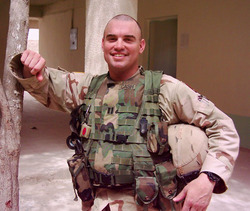
Army Captain Christopher S. Cash, 36, died on June 24, 2004 in Baquabah, Iraq when his Bradley Fighting Vehicle came under attack by enemy forces using small arms fire and rocket-propelled grenades. He was assigned to the Army National Guard’s 1st Battalion, 120th Infantry, Jacksonville, North Carolina. 

Isaiah 49:8-16

If I am to be truly honest with you, I must confess, that I suppose I am just like most of us here, in that, from time to time, I have my doubts.  I cannot help it, and I’d be a hypocrite to deny it.  It’s just part of my fragmented human nature.

What I believe makes the Bible so great is the sheer honesty of it.  When I slip into the doldrums of doubt and despair, I can always pick up the Bible to discover that I am not alone.

Listen again to these words of Isaiah to the people of Israel in exile:

“Thus says the Lord”—what a powerful statement. This is not a mere prophet’s voice, but the voice of Almighty God, the Holy One, the Redeemer of Israel.

“Thus says the Lord… who is faithful…who has chosen you.” Israel did not reach up and choose God. God reached down and chose Israel. Here, God is the actor, the mover, the shaker. And listen to how God has acted…

“Thus says the Lord…I have answered you…I have helped you…I have kept you…I have given you….”  In other words, “I answered your cries in Egypt, I sent Moses to deliver you, I protected you in the wilderness, and I gave you a promised land.”

“And not only have I acted in the past, I promise to continue acting, reaching out and reaching in… giving you light in your darkness…feeding your hunger, quenching your thirst.  I promise to protect, lead and guide you.  I will transform mountains into roads, lift up highways and show you the way out of captivity…”

“So shout for joy, O heavens, and exult, O earth; break forth O mountains into singing!  For the Lord has comforted God’s people, and will have compassion on God’s suffering ones!”

And what did the people say?  “Halleluiah!  Thine the glory?”  No, not even close.

The people in exile responded to the voice of God, the divine acts of the past and the divine promises for the future the same way I suppose you and I sometimes respond—with a lot of doubt.

In verse 14 we read…But Zion said, “The Lord has forsaken me, the Lord has forgotten me.”

Deep within, we know that God has always been with us, never away from us. We know God is for us, not against us.  And we believe in our hearts that whatever our future brings, God will always work all things out for the good. However, due to, I suppose, our sinful, finite nature, the reality is that, sometimes, we have our doubts.

I can go to church on Sunday and experience the love and grace of Christ through my family of faith. I’m greeted each Sunday at the door with handshakes and smiles. I listen to the choir sing. I hear the word of God being read. I sing the great hymns of faith, and through it all, I sense the nearness and the intimacy of God. But then, during the week, a thousand different things can happen and change everything.

Fifteen years ago, I became good friends with Christopher Cash, a member of the National Guard.

On October 1, 2003, his unit was deployed to Iraq. As the only person I personally knew in Iraq, I specifically remember praying for my friend Christ the following year, on the Sunday morning before Memorial Day the following year.

About a month later, I picked up the Saturday newspaper and read the headlines on the front page: “Captain Christopher Cash Killed in Iraq.” I tried my best to read the article, but couldn’t. I never made it pass the sub-title: “Cash leaves behind his wife, Dawn, and two children.”

The room started spinning. I felt sick to my stomach. I was lost.  And I had never felt more alone. With Zion I wanted to cry out, “The Lord has forsaken me. The Lord has forgotten me.”

One moment we’re filled with faith and hope; we sense the intimate presence of God. And in the next moment, we sense only God forsakenness.

A thousand different things can happen…the telephone rings in the middle in the night…there’s been a terrible accident…your child is sick…your spouse is laid off from work…someone who you are supposed to be able to count on for encouragement, lets you down…a terrorist or a crazed gunman attacks…a tornado or earthquake strikes…war rages…the doctor gives a grim diagnosis…a loved one dies.

One day we are basking in the presence of God. We know we’ve been chosen. Our prayers have been answered. We’ve been helped. We have received and kept by an eternally faithful God. We have confidence that as God has not let us down in the past, God will certainly not desert us in the future. God will continue to reach out and reach in, transform, protect, shed light in our darkness, feed and quench, protect, lead and guide.

But then something happens; and just a short time later, with Zion we cry out, “The Lord has forsaken me. The Lord has forgotten me.”

This is why I love the Bible. I love the sheer honesty of it!  In spite of everything we know about God, what God has done, and what God promises to do, like Zion, we fragmented and finite human beings still have our doubts.

Now listen to the good news. The good news is that our God never gives up on us. God never leaves us to our own devices. God never deserts us with our doubts, but always responds to our doubts. God keeps moving, keeps reaching out and reaching in.

In verse 15, we read God’s response to our doubt.  “Can a woman forget her nursing child, or show no compassion for the child of her womb?  Even these may forget, yet I will not forget you. See, I have inscribed you on the palms of my hands…”

Tomorrow, our nation remembers those members of our armed forces who have made the ultimate sacrifice. Today, our church remembers members of our family of faith who have died during the past year. But this is not why we have gathered here for worship. We gather to worship this day, not because we remember them, but because our God remembers them.

For our remembering is shallow and weak; our remembering is fraught with doubt; laden with despair. God’s remembering is deep, unfailing. God’s memory endures forever. God responds to our doubt with the assurance that we and our loved ones will never be forgotten by God because they, with us, are in the very hands of God.

And, as Christians, we know something about the hands of God, don’t we? The life, death and resurrection of Jesus Christ teaches us that the hands of our God are always responding to our brokenness, always working, always doing all they can do to work all things together for the good, always creating and recreating, healing and transforming and resurrecting.

As my heart broke upon learning about by friend’s violent death in Iraq. I must confess I had my doubts. I am sure that his wife Dawn had her doubts. But thank God that God did not give up on us. God responded to our doubts the hands of God kept working, kept moving, kept creating, kept resurrecting. And today, nearly 14 years after Chris’ sacrifice for this country, Dawn has helped to raise nearly a half million dollars in scholarship money in Chris’ memory to assist needy students with college educations.

And for me, well, I still have my doubts from time to time; however this Memorial Day, because of Chris and so many others who gave their lives serving and protecting this country, I possess a deeper appreciation for our country and for this miraculous gift we call life. Because of their sacrifice, I possess a profound desire to serve others more faithfully, to love others more deeply, and to preach the message of peace more fervently.

But here’s the true miracle: Because God never gives up on any of us, because we are indeed in the very hands of God, each time in our humanness we have our doubts, each time we wonder if our faith is even real, that God is even real, our faith miraculously grows stronger.

Thanks be to God that as the very hands of God picked my friend Chris up from the battlefield to hold forever, those very hands also hold us.

Her Jug Will Never Fail: Remembering Delcea Batterman

Delcea-Batterman-1463996239

1 Kings 17:8-16 NRSV

In 1 Kings we read, “Then the word of the Lord came to him.”

Those of us who grieve the loss of Delcea are also able to celebrate this day, because we know that the word of the Lord came to her.

Because we know that the word of the Lord came to her many years ago when she decided to follow Christ as his disciple, and because of the many ways that she let us know through her faithful love and amazing smile that the word of the Lord came to her daily, today we who grieve also celebrate. We celebrate because we also know that the word of the Lord came to her this past Saturday morning, finally, fully and eternally.

I loved the way her daughter Eilene notified me Saturday morning of her passing. Revealing Delcea’s deep faith in the word of the Lord, and the faith that she passed down to her children, Eilene sent me a text that simply read: “Mom just left this world to be with God.”

Eilene will never forget the first time she truly grasped the depth of her mother’s faith. As a small child she remembers living very meagerly in a mobile home. One day, Eilene asked her mother to make her a peanut butter sandwich, but Delcea had to explain that, at the time, there was no bread in the house.

“But mama, I really want a peanut butter sandwich.”

“I am so sorry,” said Delcea. “And we don’t have any money right now to go out and buy any bread.”

Looking at the disappointment in her child’s face, Delcea said, “But you know something, we can pray for bread.”

The two of them then knelt down by the couch in the living room and prayed for bread.

As soon as they got from prayer, there was a knock on the door. Delcea opened the door, with Eilene by her side, to greet a gentleman who was giving away loaves of Colonial Bread.

Whenever I read stories of the Bible like the ones I read from 1 Kings and the gospel of Mark, someone will inevitably comment: “I sure wished the Lord spoke to people and worked miracles today like God did back in Bible days.”

But I don’t think you will ever hear any member of the Batterman family make that comment. And I know for certain you have never heard Delcea make that comment.

“The word of the Lord came to Elijah saying: Go now to Zarephath and live there; for I have commanded a widow there to feed you when you arrive.”

Notice that, like Delcea illustrated throughout her life, Elijah was faithful to the command of the Lord. He sets out and goes immediately to Zarephath. And when he comes to the gate of the town, just as the Lord had said, he meets a widow who is gathering a couple of sticks to build a fire for dinner. He called to her and said, “Pour me a glass of water. And while you are at it, bring me a morsel of bread.”

But she said, “As the Lord your God lives, [I don’t have a loaf of bread in the house] I have nothing baked, only a handful of meal in a jar, and a little oil in a jug.” She only had enough flour and oil to make one final meal for her and her son. Then, in the midst of the drought and famine in the land, they would surely die.

Elijah says: “Do not be afraid.”

Hebrew biblical scholar Katherine Schifferdecker imagines her saying:

“Easy for you to say! You’re not the one preparing to cook one last meal for yourself and your son before you die. You’re not the one who has watched your carefully-hoarded supply of flour and oil relentlessly dwindle day-by-day, week-by-week, as the sun bakes the seed in the hard, parched earth and the wadis run dry. You’re not the one who has watched your beloved son slowly grow thinner and more listless.”

But Elijah still says to her, go and make me a little cake of it and bring it to me, and afterwards make something for yourself and your son” (1 Kings 17:13).

“How dare this man of God ask me for bread, knowing that I have so little? Who does he think he is, asking me for bread before I feed my own child? There is simply not enough to go around. I told him that I have only “a handful of meal, a little oil, and a couple of sticks. There is not enough. And Death waits at the door.”

Then the good news:

“For thus says the Lord, the God of Israel: The jar of meal will not be emptied and the jug of oil will not fail until the day that the Lord sends rain on the earth.’ She went and did as Elijah said, so that she as well as he and her household ate for many days. The jar of meal was not emptied, neither did the jug of oil fail, according to the word of the Lord that he spoke by Elijah” (1 Kings 17:14-16).

Have you heard the word of the Lord?

We who grieve this day are also able to celebrate, because we know Delcea not only heard the word of the Lord, she believed it. And today we give thanks that she was a living testimony to the miracle of that word.

Born right before the Great Depression, I am certain that there were many times that her family questioned whether or not they would make it. But Delcea did make it, graduating from Elkhart High School in Kansas and marrying the love of her life, Marion Batterman. Growing up during some of the most difficult years in our country was not easy. I am certain there were many times her family just about ran out of sticks. But the good news is that their jars never emptied, and their jugs never failed.

The two newlyweds farmed together and dreamed of starting a family and making a good life together. But this was 1943, and the United States was in the middle of war with Germany and Japan. So Marian left Delcea to defend his country and freedom around the world. I am sure she worried and prayed every day and night for Marion, and although I am sure she sometimes doubted that her dreams of raising and family and growing old with her husband would be realized, the miracle was that her jar did not empty, and her jug did not fail.

Upon Marian’s return, they both put their faith into action as they both answered a call to Christian ministry. Marian preached in the gospel, while Delcea played the piano. And although they often struggled, sometimes not even having a loaf of bread in the house to make a peanut butter sandwich, the good news is: although their jars got low, they never emptied; although their jugs almost ran dry, they never failed.

I met with Delcea’s children, Marvin, Eilen and Glenda Saturday afternoon and asked them to name some things about their mother that would inspire them for the rest of their lives.

They talked mostly about her faithfulness to them as a mother. They talked about her always being there for them, supporting, them encouraging them no matter what. They talked about her always being there when they go home from school.

They also talked about how much she loved life, always curious. How she took flying lessons, enjoyed traveling and making costumes and participating in the Gaslight Theater.

They talked about a faithful woman whose jar never emptied, a woman whose jug never failed.

For the last several years, unable to walk, Delcea has suffered greatly. Her poor health forced her to move out of an assisted living facility with Marion into a nursing home.

A few weeks ago, she was hospitalized. Her doctors determined that she had suffered multiple heart attacks. They tried to correct the blockages in the arteries of her heart, but they were unsuccessful. They essentially told her that she only had only a couple of sticks left.

Hospice was called in to keep her comfortable. However, each time I would visit her, in the hospital or in the nursing home, Delcea had this amazing, remarkable smile that, considering her condition, was miraculous.

She smiled and laughed with the hope of a young girl who had just gotten married to what would be the love-of-her-life for over seventy-three years; certainly not like someone who had only a couple of weeks to live.

And during her final hours with us, when she was heavily medicated and unable to laugh and smile, if you looked down towards her legs that had been immobile for years, you would see them moving, running, almost dancing, as if if to say: “My sticks may almost gone. Death may be at the door. But my jug will never be emptied and my jar will never, ever fail.”

Night is falling. Jesus has been teaching out on a hillside. And the crowd that showed up that day, well, they were getting hungry.

The disciples with a little panic in their voices insist: “Jesus, there’s a thousand hungry people out there. We need to send them back to town so they can buy something to eat.”

Jesus asks, “But tell me what do you have?”

“Just a few loaves and two miserable little fish.”

Jesus takes what they have, blesses it, breaks it, and gives it.  And, the good news is: it is enough.

However, that is not the end of the story.  Although that would be enough, there is more. We read where “all ate and all were filled.”  They were all fulfilled, all satisfied. They just didn’t receive something to “tie them over” until they got back into town. They ate until they were full and satisfied.

But the story doesn’t even in end there. They took up what was left over and 12 baskets were filled. The truth is: there was not enough. There was more than enough. There was not only fulfillment and satisfaction, but there was a surplus. The good news is: This is simply the way it is with Jesus.

I visited a little while with Marion yesterday. He talked about how difficult life was going to be without his wife at his side. Naturally, he talked about being a little numb, how reality had yet to set in. He knows that will soon find himself in a deserted place.

The good news is, and all of us who knew and loved Delcea know it, the word of the Lord will surely come to Marian, to Marvin, Eilene and Glenda and their families, and to each one of us who grieve this day saying: “Do not be afraid. Because your jar will never be emptied and your jug will never fail, and as long as you are following Jesus, you will always have a great big pile of sticks and more than enough bread!”

God Fights for Us – Remembering Jane Puckett

3597981

I believe this ground, this sacred place where tears have cried a river, is reminiscent of that place the Israelites found themselves in after they were liberated from Egyptian bondage.

With Pharaoh’s army advancing behind them, it was as if their whole world was suddenly crashing down upon them. Because standing before them stood what they perhaps feared the most, the Red Sea. It stood before them like the casket of a loved one for it most certainly represented the end of the line, the end of dreams, the end of hopes. For the Israelites, encamped by the sea with an army closing in behind them, the sea represented certain death.

Overcome by fear, the Israelites did not know what to do. They could not go back to the good old days, and going forward into the promise of good new days seemed impossible. Paralyzed by grief, unable to take one step forward, they did the only thing they could do. They cried out. They cried out to the Lord. They cried out to Moses. They cried out to anyone who would hear. They cried out in disbelief. They cried out in anger. They cried out in fear. They cried out in grief.

But then, the good news. Moses said to the people: “Do not be afraid, stand firm, and see the deliverance that the Lord will accomplish for you today; for the Egyptians whom you see today, you shall never see again. The Lord will fight for you, and you have only to keep still.” (Exodus 14: 13-14).

And we know the rest of the story: The Red Sea was not the end of the line. It was not the end of their dreams. It was not the end of their hopes.

“Then Moses stretched out his hand over the sea. The Lord drove the sea back by a strong east wind all night, and turned the sea into dry land; and the waters were divided.”

Then the same Israelites who were unable to move forward, unable to see beyond the sea, or the casket in front of them, rose up and walked into the sea of their fear as if it were dry ground. They rose up and moved forward into the future with a renewed confidence and a resurrected strength. And this is how they were able to make it to yet unimaginable promised land.

Gary, Josh, Heidi, Amy and Mike, although you cannot go back to the good old days, this is how you and your family will be able to move forward this day into unimaginable good new days. The good news is that the Lord will fight for you. And the really good news is that you only have to stand firm and keep still.

There is no other way that I can possibly explain the industrious strength and the unfailing patience of Jane Puckett. There is no other explanation for her tenacious work ethic, serving her country working for Vance Air Force Base with aircraft maintenance for 42 years. She only recently retired because her unbeknownst cancer made her work physically impossible.

And how else do you account for her courageous battle she fought once she discovered her stage-four cancer that started in her lungs but had metastasized into her brain? How do you explain someone who was as sick Jane, but never complained?

And if anyone had any reason to complain it was her. To work as hard as she did for 42 long years without the opportunity to enjoy a well-earned retirement would make even the sweetest personality bitter. The truth is: a diagnosis like Jane changes most people.

But not Jane. Jane remained firm. She was still the sweet, fun-loving person that she had always been.

The one who loved to go snow skiing in Colorado and water skiing in Canton Lake.

The one who loved to patiently cross stitch gifts for her family and friends.

The one who loved to make baby blankets that were so beautiful that the mothers who received them would hang them on the wall for all to see instead of wrapping them around their babies.

The one who never said anything negative about anyone else.

The one with terminal cancer who had every right to be jealous of those who arbitrarily live into their seventies, eighties and nineties, but still refused to join in any conversation that demeaned another.

The one refused to be bitter and impatient with anyone, including herself and God.

She was still the same firm and patient one who not only tried to make caramel once, only to have it explode sending its sticky shrapnel flying all over her kitchen, but she was the one who had the audacious forbearance to try it again, albeit with the same result.

Even with a terminal disease, she was still the same person who loved to sit on the back porch with Gary and her beloved pet Weazer enjoying a cold drink on a summer evening, thanking God for the gift of her life.

Now, some may say that her kids should probably take some credit for some of her patience and strength, for they were both known to test it a time or two or thirty. Like the time one winter Josh decided to go skiing in the back yard. However, the flat plains of Oklahoma have never been very conducive to backyard snow skiing. But Josh, being a crafty and smart kid, some would argue “perhaps a little too smart for his own good,” decided he would ski off the roof of the house.

Sitting inside, Amy was watching the snow fall out the window, when here comes Josh flying off the roof like some Nordic Olympic ski jumper. “Mama, Josh just skied off the roof!”

Amy also remembers trying her mama’s patience by doing foolish things like walking through a glass door, without first opening that door, requiring a multitude of stitches.

However, as much as these kids tried her patience and tested her strength, I still believe that her strength, her courage, and her patience, especially in the face of her illness, came from a much higher place. I believe it came from the God who continually whispered words to her throughout her living and perhaps especially in her dying. It was the same words whispered to Moses and to the Israelites when they were tested in the wilderness: “The Lord will fight for you, and all you have to do is be still.”

The good news is that her fight is now over. Jane has crossed the sea. Her enemy, her cancer, has been defeated like Pharaoh’s army. She has been led by a pillar of fire and cloud, led by the very hand of God, into a promised land.

And the good news is that as the Lord fought for her, the Lord will fight for you too, and all you have to do is be still. Be still, and then move forward, holding onto one another, holding onto the memory of Jane’s courage and strength, while holding onto the hand of God.

I want to close by reading some words that I read at my grandmother’s graveside service. She also died in her sixties with lung cancer that also had metastasized. However, because of her courage and strength, because she, like Jane, never complained, never had a bitter bone in her body, never uttered a word of malice against anyone, there was no doubt in my mind that before she died, God was there fighting with her and for her. And I knew that everything was going to be alright.  The following are those words (author unknown):

Although Cancer seems to destroy so much, when God is fighting for us, it is obvious that there are many things that cancer cannot do. Cancer, in fact, is very limited in the presence of God. [Like my grandmother, Jane Puckett was a testimony of this].

Cancer is limited.

Cancer cannot cripple love.

It cannot shatter hope.

It cannot corrode faith.

It cannot eat away peace.

It cannot destroy confidence.

It cannot kill friendship.

It cannot shut out memories.

It cannot silence courage.

It cannot invade the soul.

It cannot reduce eternal life.

It cannot quench the Spirit.

It cannot lessen the power of the resurrection.

Thanks be to God.

What Heaven Looks Like

barefootThe following sermon is for an All Saints’ Day Service remembering the seven members of the First Christian Church of Farmville NC who died during the past year.

Revelation 22:1-7 NRSV

To be honest, the promise of going to heaven one day to live forever has not always appealed to me. Floating on a cloud playing a harp for all of eternity does not sound like good times. Furthermore, I have always been leery of Christians who seem to make going to heaven one day the whole point of what it means to be a Christian. It sounds rather selfish to me. And when I consider the selflessness of Jesus, the mission of Jesus, I believe that type of theology actually misses the whole point of what Christianity is all about.

I have also never desired to live in a mansion or walk on streets of gold. Again, because of what I know about Jesus’ identification with the poor, such opulence turns my stomach as a follower of Jesus.

However, there is one description of heaven in the Bible that I do find rather interesting, even attractive.

The most vivid, and perhaps the best description of heaven may be found in the last chapter of our Bible.

What does heaven look like?

Although the description is certainly symbolic, it is nonetheless beautiful. There is a holy city, and in the middle of the city’s main street, there is a river of the water of life, bright as crystal, flowing from the throne of God and of the Lamb.

What does heaven look like?

On both sides of the river, there is the tree of life, bearing twelve kinds of fruit, and the leaves on the trees have the power to heal the nations.

What does heaven look like?

Nothing accursed will be there. There will be no more hate; no more bigotry; no more ugliness; no more backbiting and powerplays; nothing that is vile, foul or evil.

There is nothing accursed in heaven, because the throne of God, the compete rule of God, and the Lamb, who is Jesus the Christ, will be there.

And here’s my favorite part. There is nothing accursed in heaven, because all of the servants of Christ will be there; together, gathered around the throne worshipping the Lamb face to face,

What does heaven look like?

Heaven looks like John Barefoot.

According to the gospel of Luke, when the angels announced that heaven was coming down to earth, they said: “I am bringing you good news of great joy.”

Almost a year ago, I believe those of us who went Christmas caroling to John Barefoot’s house were privy to a glimpse of what the joy of heaven looks like. For, as we sang around John’s bed where he was confined after suffering yet another debilitating stroke, something miraculous happened. God showed up. Heaven came down. As we watched John donning a Santa hat and wearing this smile that was so amazing that it had to be divine, as we watched him sing along with the children the best that he could, with a joy, this amazing joy, a joy that had to come from heaven, Christmas became real to us. Faith became real. God became real.

What does heaven look like?

Heaven looks alike Alawoise Flanagan.

According to Isaiah, heaven looks like children who are being comforted by their mother: “You shall nurse and be carried on her arm and dandled on her knees. As a mother comforts her child, so I will comfort you,” says the Lord.

Alawoise lived her life providing motherly comfort, not only to her own family, but also to the residents at the nursing home in Farmville where she devoted much of her life. And in the end, it was obvious that this one who comforted so many was herself comforted.”

I don’t believe there is any other way to explain the very last words Alawoise said to me. Just days before she died, after suffering more than anyone one deserves, she opened her eyes, and spoke, not words of complaint or bitterness, but words of a loving mother, or of a child who has been comforted by her heavenly mother. After I asked her how she was doing, she immediately asked me: “And, Jarrett, how is your family.”

What does heaven look like?

Heaven looks like Albert Mosley.

Nearly every time before I left Albert, even in ICU after a stroke that would take his life, he would miraculously say to me those words that Jesus often spoke to his disciples: “Peace be with you.”

And the miracle was not only that Albert could speak those words of peace, but was how it was obvious to all that in spite of every tribulation he encountered, Albert actually possessed this miraculous peace. And he truly wanted to share it with others.

The only way that I can possibly explain how Albert endured his suffering is that the God of Jesus, heaven itself, somehow, some miraculous way, came to Albert and filled him with this peace that surpasses all human understanding.

What does heaven look like?

Heaven looks like Donna Mosley.

As Jesus reminded us in the Sermon on the Mount, God looked upon Donna truly blessed her in ways that few of us here have been blessed. And I believe this is the real reason that no matter her disability, no matter how bad she felt, or how hard it was for her to walk, see, eat or breathe, when you asked her how she was doing, she would always respond: “I’m doing good!”

I believe Donna was a living testimony of Jesus words about heaven when he said: “Blessed are the poor in spirit, for theirs is the kingdom of heaven.”

Whereas we may look at those with whose spirits that are allowed to soar to achieve success as the world defines success as blessed and favored by God, the reality is that God looks with favor and blesses not those who are born with perfect bodies, 20/20 vision, and silver spoons in their mouths, but those whose spirits have many challenges and obstacles. And notice that Jesus uses the present tense. Not they will be blessed. Not might be blessed. They are, right now, right here, on this earth blessed. And their future is the kingdom of heaven.

What does heaven look like?

Heaven looks like Harry Albritton.

Having returned yesterday from Wyoming County, West Virginia, one of the most impoverished counties in our country, the words of Harry Albritton are fresh on my mind. Some of you here remember.

How many people do you know who after listening to a presentation at church about a mission trip opportunity to repair homes in the rural Mountains of West Virginia became so moved, so agitated and concerned that he stood up and spoke out, saying that he didn’t want to just put a Band-Aid on the poverty, but he wanted to actually do something to cure the poverty? He wanted to strategize, energize and mobilize to end the poverty, to repair the breach, to restore the streets, and make it a place where future generations could thrive.

He wanted to set up meetings with the CEO’s of corporations, with state and local government and investors and encourage them to build new factories in the area and offer employment. And if that did not work, he wanted to lobby Congress to provide tax incentives to create ways to re-locate the residents to the jobs.

Someone spoke up responded, “We can’t do that!”

He said, “What do you mean ‘we can’t?’ There’s no such thing as ‘can’t.’ You mean, we ‘won’t.’”

Only Harry.

It was the prophet Isaiah who painted this can-do portrait of God’s heavenly justice by admonishing God’s people: “to rebuild the ancient ruins, to raise up the foundations for future generations, to be called the repairers of the breach, restorers of the streets to live in” Isaiah 58).

What does heaven look like?

Heaven looks like Earl Umphlett.

Jesus tells us that God loves a quiet, generous giver.

‘So whenever you give alms, do not sound a trumpet before you, as the hypocrites do in the synagogues and in the streets, so that they may be praised by others. Truly I tell you, they have received their reward. But when you give alms, do it in secret; and your Father who sees in secret will reward you (Matthew 6:1-3).

Earl would quietly attend our Wednesday night suppers at church with Donna. As soon as they walked through the door, they would be greeted by Kim, our church administrative assistant who takes up money for each plate which costs $6.00.

Kim says that every time before Earl would for pay him and Donna, he would say the same thing. He said: “Look, I will make a deal with you. I don’t have any money on me today. But Donna will wash all of the dishes.” Then, when he’d catch Kim off guard, he would whip out a hundred dollar bill, put it in the basket, and say, “Keep the change.”

The only reason that I know this is that Kim told me this every Thursday morning after this happened. She says: “And he never says what all of the extra money is for! When he first did it, I thought he was pre-paying for him and Donna for an entire year of suppers. But, every week, he keeps doing it.”

This was just the type of Christian Earl was. Unlike some who brag openly about how much they give to the church, Earl gave quietly, unassumingly, inconspicuously. Earl did not have a pretentious, hypocritical bone in his body. Earl modestly served his Lord reticently, yet compassionately and generously.

What does heaven look like?

Heaven looks like Joseph Scott Thorne.

When Jesus found himself in the wilderness, Mark says that angels came down from heaven and waited on him.

Heaven is a place where no one is ever in need, because there are a multitude of angels waiting on us.

Although Scott was disabled, I could stand up here for the rest of the day and talk about the countless mission projects that Scott served on here in Farmville waiting on folks in need. He volunteered through the First Baptist Church, Monk Memorial Methodist Church, Emmanuel Episcopal Church and the Farmville Community Soup Kitchen. Scott spent incalculable hours volunteering his time to serve this community, many times working all through the night, painting, refurbishing, repairing, restoring, and landscaping.

Scott also shared his talents by working on many homes that needed repair throughout eastern North Carolina. Additionally, Scott volunteered at a homeless shelter in Tarboro doing whatever they needed him to do.

Along with local mission projects here in eastern North Carolina, Scott traveled to Gulfport, Mississippi to repair homes with this church after Hurricane Katrina. Scott also traveled to Moldova on a mission trip with the Oakmont Baptist Church of Greenville. Scott’s mission in life, despite his disabilities, was literally doing anything he could to serve someone else.

What does heaven look like?

Heaven looks like a river of life, bright as crystal. Heaven looks like a tree of life with branches of healing. Heaven looks like the rule of Christ, the Kingdom of God. And the good news is that heaven looks like the servants of God, worshiping the Christ.

John Barefoot taught us that heaven looks like amazing joy. Alawoise Flanagan taught us that heaven looks like a mother’s comfort. Albert Mosley taught us that heaven looks like a peace that is beyond our understanding. Donna Mosley taught us that heaven looks like eternal blessedness. Harry Albritton taught us that heaven looks like the prophet’s justice. Earl Umphlett taught us that heaven looks like selfless generosity. And Joseph Scott Thorne taught us that heaven looks like angels waiting on us.

They all taught us that heaven looks like Jesus. Heaven looks like who God is calling us to be as the church. Heaven looks like extravagant grace and unconditional love. Heaven looks like the selflessness of Christ, the mission of Christ.

So, maybe living forever is not so bad after all.

Why the Risen Christ Ate a Piece of Fish

fish1

Luke 24:36-53 NRSV

I often wonder what people mean when they say they are “spiritual.”  I hear people say: “I am not religious, but I am a very ‘spiritual’ person.”  “I don’t attend church, but I am quite ‘spiritual.’”

As a Christian, I sometimes find this odd as not even the risen Christ seemed to be all that spiritual. In fact, as our scripture lesson points out, the gospel writes, especially Luke, seem to go almost out of their way to point out the very physical, not spiritual, nature of the risen Lord.

Luke points out that Jesus asked the disciples to touch him and see that he had flesh and bones; not some spirit or ghost.  Jesus showed his disciples his hands and his feet which were scarred from his crucifixion. And then to still prove that he was there in the flesh and not in some spiritual form, he asked the disciples for something to eat. Then they give him a a piece of broiled fish that he eats in their presence.

The question that I want us to ask together this morning is: What is Luke trying to tell us by giving us this unusual and somewhat strange presentation of Jesus to the disciples? Why does the risen Christ eat broiled fish?

I have heard some preachers say that Luke was giving us a clue of what heaven is going to be like and what we will be like when we, like Jesus, are resurrected.

When I was growing up, my home church had a week of revival every August.  We had services Sunday Night through Friday night and we would always conclude the revival with a fish fry on Saturday.  Six long nights: 30 minutes of singing, one hour of preaching, and then thirty more minutes of altar call. I remember that these annual revival services used to scare me to death. The guest preachers would come into town and preach that heaven or hell was right around the corner and we better get ready. Although I’d never feared going to hell, as a nine, ten, eleven year old, going to heaven was not a place I wanted to visit anytime soon.

I used to hate going to revivals. On top of being frightening, it was hot, had to dress up, wear a tie, for six long nights, two hours a night. The only thing that got me through the week, and I suspect a few others, was the big, delicious fish fry that awaited us on Saturday.

Every year, without exception, preachers would come and scare me with their heaven-or-hell-is-right-around-the-corner sermons.  However, I remember that one preacher preached a particular sermon that made me feel a lot better about going to heaven. It was Friday night, and bless his heart, he was trying to connect the revival service with the fish fry that everyone was looking forward to the next day. He said that one of the most appropriate things we can do at the end of these services is to have a fish fry. He said, “After all, most all of Jesus disciples were fishermen. It also seems like Jesus himself liked to fish. And when we all get to heaven at the resurrection, we are all going to sit down with Jesus and eat fish, because after he was resurrected, Jesus ate some fish with his disciples.”

I wanted to shout, “Amen!”  Because that preacher answered one of those tough theological questions that no one could answer for me, a question that was more important than where did God come from and who was Cain’s wife: “Are we going to be able to eat in heaven?”  For all of us who live to eat instead of eat to live, this was good news. The answer is yes. We are going to be able to eat fish. For someone who loves seafood, it took the fear of dying right away.

I love this idea; however, I believe Luke is trying to tell us something more. I believe the fact that Luke tells us that Jesus offered his physical body for examination and eats fish in the disciples’ presence, tell us something very important about who the risen Christ is and who we are called to be as Christians.

First of all, Luke wants us to know that the risen Christ is in fact the same Jesus who died. The Christ the disciples saw was the same Jesus who suffered and died a horrible, degrading death on a cross. We need to get this for the risen Christ’s identification with the suffering Jesus is critical, not just for sound theology, but for defining the nature of the Christian life and who we are to be as Christians.

If the risen Christ the disciples now follow is not the same as the Jesus who suffered and died, then the Christian life takes on forms of spirituality that are without suffering for others, without a cross, without any concern for the suffering of this world. If the risen Christ is not the Jesus who died, then our eyes would be focused only on heavenly matters and not on the problems of this world.

Even Paul, who makes few references to the historical Jesus, insisted in his letters on joining crucifixion with resurrection. Paul always proclaimed “Christ crucified.”  The risen Lord that we worship has nail scars in his hands and on his feet. Thus, Luke points out that Jesus said, “See my hands and my feet.” The empty tomb is directly tied to the cross. The wonderful message of Easter is forever joined to the suffering of Good Friday.  To follow the risen Christ is to follow the one who bore the cross.

Ok, preacher, I get that, but what does that really mean to us and how should that affect the way we should live as Christians?  Here it goes:

I think it is perfectly fine and healthy to think and dream about going to Heaven one day.  It is fine to have the hope that someday, somehow, some way there’s not going to be anything more to fear or dread. It is wonderful to know a time is coming when there is going to be no more crying, no more pain, and no more death. It is great to sing those great hymns of faith, the ones we sang during our six night revival services, such as “When We All Get To Heaven,”  “In the Sweet Bye and Bye we Shall Meet On that Beautiful Shore,” “When the Roll is Called up Yonder,” and “Shall We Gather at the River,” but if Heaven is the only place our hearts are, if going to Heaven is the only reason we are Christians, then we have missed the whole point of who Jesus Christ is and who we are called to be as Christians.

As Christians, our eyes are to always be focused on the suffering of this world. Our Lord is not only the one who is exalted and glorified, but our Lord is the one who was rejected, suffered and died.

When we look at the frail bodies of the hungry, we are looking at the frail body of Jesus.

When we see the parched lips of the thirsty, we see the parched lips of Jesus.

When we walk by the homeless beggar on the street, we walk by Jesus.

When we meet people who are disabled, physically, mentally, and socially, we meet Jesus.

When we encounter minorities who have been oppressed for their religion, for what country they’re from, for their sexuality, or for the color of their skin, we encounter Jesus.

When we visit the sick in hospitals, the forgotten in prisons, the elderly in nursing homes, the widows and widowers who sit all alone day after day, we visit Jesus.

When we reach out with grace and forgive and love even those who have committed unspeakable sins against us, we reach out to Jesus.

When we make the church a place of grace for all people, especially for those who have been marginalized or demonized by society, culture and bad religion, then we make a place of grace for Jesus. When we do it for the least of these our brothers and our sisters, we do it for Jesus.

And there’s more, much more…

Since we know that the risen Christ we serve is a Christ who knows suffering, who knows what it is like to be a human being, and experience the evils of this world, when we find ourselves overwhelmed by the suffering and pain of this world, we can have faith that Christ is there suffering with us and feeling our pain. And giving us hope and understanding and grace as only a loving God who knows suffering can give.

When we are overwhelmed by grief and loneliness, Christ is there.

When we reach the ends of our ropes and feel that we can not take it anymore, Christ is there.

When we hear words from our doctor’s like:  heart disease, cancer, diabetes, pneumonia, Alzheimer’s, inoperable, and terminal, Christ is there.

When human mistakes seek destroy relationships with the ones we love, Christ is there.

When it seems there is nothing holding together our marriages, Christ is there.

And when we are faced with the knowledge of our own imminent deaths, and feel abandoned, even by God, when we want to cry out with a loud voice, “My God, My God why have you forsaken me?” Christ is there.

This is why Luke places so much emphasis on Jesus’ physical nature. This is the reason the risen Christ ate a piece of broiled fish with his disciples. Although it is a good thought, Luke does not write this to tell us that when we all get to heaven we will all get to stuff our faces with seafood. He is telling us a more important message: a message that the disciples got and gave their physical lives proclaiming.

This is why every disciple, except for John, who experienced the risen Christ were killed for preaching “Christ Crucified.”  John died for his preaching all alone on the island of Patmos in prison after writing the book of Revelation.

May each of us, like the disciples, hear Luke’s message this morning. And may each of us, like the disciples, give our physical lives, our bodies, broken, our life, outpoured, proclaiming with our words and by our deeds, “Christ Crucified.”

Divine Strength of John Barefoot

Exodus 17:9-13 NRSV

In the 17th chapter of the Book of Exodus we read the amazing story of how the Israelites defeated of their enemy, the Amaleks. The Amaleks were a group of nomads who attacked the Hebrews in the desert of Mount Sinai during the Exodus from Egyptian slavery. The Amaleks swooped in on the Israelites and cowardly killed those who were lagging behind: the weary, the old, the weak and frail.

For that is what the enemies of life do. They can attack us at any time, during our strongest times when we are young, but perhaps more so, during our weakest times, often when we are older. Cancer, heart disease, and debilitating strokes swoop in on many during that precious period of life that we call retirement, during that period of life where we look forward to well-earned rest, respite, and recreation.

John Barefoot was not the first person to receive a new set of golf clubs as a retirement gift that he would never use due to sickness or a disability.

And when the enemies of this life attack us, we are faced with a choice. We can surrender to our enemies; we can succumb to their attacks; or, like an old Army veteran, we can stand our ground and fight.

“Moses said to Joshua, ‘Choose some men for us and go out; and fight with Amalek.”

After faithfully serving this country in the US Army, after devoting his life to what is now Southern States, after raising two beautiful children, Roger and Linda, after thirty years of service through this community through the First Christian Church, John began to suffer debilitating strokes. Many men, in John’s shoes, surrender and succumb to such illnesses, especially after retirement. After all, they are weary and old; they no longer lack the strength within to fight. They can reach down and dig deep; however, there is just nothing left. No amount of digging will see them through.

However, men with faith in the God of Abraham and Isaac, Moses and Joshua, men with faith in the God revealed in the Risen Christ, understand that true strength does not come from within, but comes from and by the grace of God.

Moses said to Joshua: “Choose an army and fight. I, myself, retired a long time ago from fighting. I left the army years ago. I am too old, too tired, but I will stand on the top of a hill and raise the staff of God with my hands and summon the grace and strength of God to defeat our enemy.”

So Joshua did as Moses told him, and fought with Amalek, while Moses, Aaron, and Hur went up to the top of a hill.

Whenever Moses held up his hand, Moses noticed that Israel prevailed; and whenever he lowered his hand, he noticed that Amalek prevailed. [This was a certain sign that it was God, and God alone, who was giving the Israelites the grace, perseverance and strength to defeat their enemy].

There can be no other explanation for the strength and the perseverance of John Barefoot, especially during these last years of his life. As I have said, many in John’s shoes would have surrendered and succumbed twenty-five years ago. Possessing no reason to live, no sense of purpose, and no strength to fight, many men die shortly after their retirement.

Many more men die shortly after their wives pass away. Several years ago when Audrey died, it would not have surprised anyone if John followed her soon after.

But John kept going, kept persevering, kept fighting. Many studies have been made to identify symptoms of depression or the giving up on life. People who give up and surrender to the enemies of life become detached and disengaged from the world around them. They no longer care what their neighbors are up to. They become disinterested in their church, the local and national headlines, and interestingly, they no longer care about sports.

John possessed none of these symptoms. John always looked forward to visits from his church family. He absolutely loved taking a stroll in his wheelchair around the neighborhood and even downtown so he could see the people he loved. He cared about what was going on in the world, and he was in no way, shape or form disengaged from sports. He was an avid fan and loved rooting for the Wolfpack of NC State and the Atlanta Braves.

It was obvious to everyone that John, though weak and weary, never gave up. For as Isaiah 40:29 reads, John was a living testimony that “God gives strength to the weary, and to him who lacks might God increases power.” And in the 73rd Psalm we read: “My flesh and my heart may fail, but God is the strength of my heart and my portion forever.” John Barefoot was a living example to all of this great truth.

Our story continues in Exodus: “But Moses’ hands grew weary; so Aaron and Hur took a stone and put it under him, and he sat on it. And Aaron and Hur held up the hands of Moses, Aaron on one side and Hur on the other, and the hands of Moses were steady until the sun set.”

God has always used others to do God’s work in this world. God calls each of us to minister to one another. God uses us to supply God’s strength to those who are weak, to keep them steady, to help them fight the good fight, to finish the race. Such was the case in this victory of Amalek. Moses did not possess the strength to keep his hands raised through the duration of the battle, so God sent him Aaron and Hur who brought him a rock to sit upon and then held up each of his hands.

God also sent John others to give him support when he was the most weary. Church members visited. He children cared for him daily. And caregivers from Silvercare came to John’s aid. You could say that they brought him a rock and steadied his hands until the sun set. Pam Johnson, Catherine Walker and Savilla Jones were to John like Aaron and Hur were to Moses.

“And the hands of Moses were steady until the sun set. And Joshua defeated Amalek and his army.”

God always supplies us with strength for a purpose. God supplied Moses with strength through Aaron and Hur for the purpose of defeating the enemy. Thus, God did not supply John with strength, send him a rock through Pam, Catherine, Savilla and others who visited him and prayed for him just so John could watch a few more ballgames on TV. As Ephesians chapter 2 reads: “God will enable us to continue on in righteousness and to do the good works which the Lord has appointed for us.”

As God supplied Moses with the strength to keep his staff raised through the battle to defeat the enemy and to reveal the source that strength, I believe God supplied John with strength. As it was evident to all who encountered John—who saw his smile, heard his laughter, experienced his joy—that God was the source or his strength.

barefoot

A month ago, a group of parents and children from our church came to John’s house to sing Christmas carols. One of the mothers that came with her children was someone who, just a couple of years ago, was not a part of any church. She said that she even avoided church and had many doubts about faith and the power of God.

But there, standing around John’s bed with others from the church singing Christmas carols, through John, something miraculous happened. God spoke. She said as she watched John donning a Santa hat and wearing a smile that was so amazing that it had to be divine, as she watched him sing along with the children the best that he could, with a joy, this amazing joy, a joy that had to come from heaven, she said that Christmas became real to her. Faith became real. God became real.

There is no telling how many people have been changed by God, how many battles have been won by God, how many of life’s enemies were defeated by God, through John Barefoot’s amazing strength in the midst of adversity, through John’s amazing joy in the midst of suffering, through God’s amazing grace in the midst of John’s life.

And the good news for us today is, that this same God, the God of Abraham and Isaac, the God of Moses and Joshua, the God revealed in the Risen Christ and in the life of John Barefoot, will give us strength in our grief, joy in our suffering and grace in our lives. God will send others: friends and family and church members to hold our hands, to keep them steady, until the sun sets, until the battle is won.

But the really good news is that the final battle, the battle with life’s final enemy has already been won. As Paul wrote to the Corinthians: “Death has been swallowed up in victory. O death, where is your victory? Where is your sting?”

The good news for all of us today is that as God has stood by John and has given him strength to battle the enemies of life, through our resurrected Lord, God has defeated death, and John is now and forever with his Lord.

May this good news help us now to live our lives as John lived his: Persevering with the strength of God, receiving help from friends and family who provide us a rock, living with the purpose of sharing the joy and the hope of the Lord with all people, until the sun sets here and rises forever in eternity. Amen.

Voices from the Grave

AllSaintsSundayCandleHebrews 12

Years after her husband died, Betty told me that she still goes to the cemetery, almost daily, to visit his grave. “And Jarrett, I need to ask you something,” she said. “Oftentimes when I go, I stand there and talk to him. Sometimes I even bring a chair to sit in so I can talk to him for hours. I talk about my day, the good parts and the bad parts, and, of course, I talk to him about how much I miss him. Jarrett, here’s my question: “Do you think I am crazy?”

I said, “I guess that all depends. Let me ask you this: Does he ever talk back?”

However, when one considers the response of Jesus in the gospels, perhaps hearing voices from the dead is not so crazy. The Sadducees, who did not believe in eternal life, were trying once again to entrap Jesus by questioning his teaching on resurrection. Jesus responds:

“The fact that the dead are raised Moses himself showed, in the story about the bush, where he speaks of the Lord as the God of Abraham, the God of Isaac, and the God of Jacob. 38Now he is God not of the dead, but of the living; for to him all of them are alive” (Luke 20).

So perhaps Betty would not have been that crazy after all, if she heard her husband’s voice from the grave.

Now, of course, I am not talking about hearing audible voices from the grave. I am talking about the hearing voices from the dead the way the writer of Hebrews describes it when he writes:

“Therefore, since we are surrounded by so great a cloud of witnesses, let us also lay aside every weight and the sin that clings so closely,* and let us run with perseverance the race that is set before us, looking to Jesus the pioneer and perfecter of our faith…”

He is talking about being inspired by, encouraged by those who have lived before us. In the previous chapter, we read a list of those he is talking about: Abraham, Isaac, Jacob and Esau; Moses and each Israelite who escaped slavery in Egypt; Barak, Samson, Jephthah, David, Samuel, all of the prophets and every person had has ever been persecuted or martyred for their faith.

The writer to the Hebrews is saying, when life is hard, when the way is difficult, remember these, remember their voices, remember their actions, and especially remember how they point you to the way of Jesus, and be encouraged, be strengthened, and gain perseverance to continue not only life, but a life of courageous faith and selfless service.

I absolutely love worshipping in this place. Because every person that first worshipped in this sacred place that was built in 1909 ran their race and kept the faith long before us. Every time I gather here, I can hear their voices: voices of those who sang the great hymns of faith in these pews through World War One and the Great Depression. I stand behind and preach from a pulpit and hear the voices of preachers who preached the gospel amid World War Two, the Korean Conflict, Vietnam and the Cold War. I hear voices of those who preached for the rights of African Americans during the Civil Rights movement.

I hear the voices of those who have served the poor in this community and around the world for decades, those who have donated generously, and served sacrificially.

Every time I gather here, I hear the particular voices of those who served faithfully with me through Farmville Benevolent Ministries while I was the pastor of First Baptist Church. I hear the compassion in the voices of AC and Vivian Turnage for the poor of this community. I hear the love in the voice of Gay Johnson who would always have jars of Molasses in the trunk of her car to distribute to those in need.

Listen, can you hear them? Can you hear the voices of the saints echoing through this place this morning? When I listen carefully, I can hear the voice of Marie Allen. I hear great perseverance in the voice of an extraordinary mother who selflessly gave her all in loving her family. I hear the voice of an extraordinary mother who got up each morning, made everyone breakfast, packed lunches, and then went to work herself every day at her full-time job at the drug store or the dry cleaners in town. Then, somehow, some miraculous way, in a world without fast food and microwaves, still managed to prepare a hot supper and have on the family dinner table each night. And whenever little Pete or Donna needed new clothes to wear, with needle and thread and some material, Marie could always create whatever they wanted with her own hands. I hear the voice of a faithful mother who made a point to raise Pete and Donna in this church giving them a foundation for a faithful life that is being lived out today.

Listen, do you hear them? I hear sincere gratitude in the voice of William Meeks. I hear a voice that thanked God, even amid struggle and difficulty, for his opportunity to selflessly and sacrificially serve his country through military service during the Korean War. Although he freely admitted that those years changed him, affected him, not always for the good; in some ways it broke him; he was still very grateful for the opportunity to serve these United States.

William was also very grateful for his opportunity to serve through the First Christian Church of Farmville, especially as an electrician. And the First Christian Church is very grateful that we were able to give him that opportunity! When you worship in a church building that was built in 1909, you appreciate someone with the skills and the generosity of William Meeks. There is no telling how many hours William freely gave to the church doing all kinds of needed repairs. William loved his church. Like his love for his country, there was perhaps something deep within William that yearned to be a part of something that was larger than himself.

William always talked about how good his church was to him, especially when he needed the church the most. I don’t think I ever visited him when he did not express his gratitude to God for Jimmy Lethworth and for the many times that Jimmy picked him up and carried him to the VA Hospital in Durham for his cancer treatments.

Listen, do you hear them? I hear gracious hospitality in the voice of Kenneth Ross. One could say that Kenneth Malcolm Ross lived his entire life preparing a place at the table, preparing a home for others, for Marilyn, Amelia and Ken, and even for all Americans, each one of us, through his service to this country.

I think this explains why life was so difficult for him these last eight years. When Marilyn died in 2006, something inside of Kenneth also died. For Marilyn was such a large part of his purpose for living. And having been diagnosed with lung cancer himself, at the same time Marilyn was diagnosed, undergoing chemotherapy alongside of Marilyn, Kenneth did not only survive with a great loss of sense of purpose, Kenneth survived with the guilt associated with surviving. He also survived with severe physical limitations, COPD and other side effects from his battle with cancer that prevented him from living and breathing, preparing and providing for others as he had his entire life.

However, although he struggled much these last few years, although he was limited physically, it was evident through each of my visits with him that he never lost faith. Kenneth continued to love and care for the First Christian Church where he raised his family, served as a deacon and practiced the greatest commandment of loving God and neighbor as self.  Each visit I had with him, he would always inquire about the state of the church and of the needs of the church.

Listen, do you hear them? I hear great hope in the voice of Marie White. I will never forget the confident faith in her voice that I heard from her the week she passed away. Each time I visited her in the hospital, although she was very sick and felt terrible, it was evident that she was never separated by the love of God. She was sick, but she was not despairing. She was neither eating nor drinking; neither was she giving up hope. Although she was in the valley of the shadow of death, she feared no evil. Although her body was tired and broken and in pain, she was at peace. Although she was near the end of her life, her cup runneth over. It was so evident, that although she was separated from her friends, most of her family, her youth, her health, she was not separated by the love of God through Christ Jesus her Lord. She was a living testimony to the truth that spiritual wholeness is more important that physical well-being, even more important than life on this earth.

Listen, do you hear them? I can. Thanks be to God that we are surrounded by a great cloud of witnesses. So let us set aside every weight and the sin that clings so closely and let us run with perseverance the race that is set before us, [always] looking to Jesus the pioneer and perfector of our faith. Thanks be to God that we clearly hear the voices of the saints that have lived before us.

And no, we are not crazy. We just worship the God of the living; not of the dead, for to God, all of them are alive.