


Every service of worship should begin with a warning. Instead of a welcome and a few announcements, I believe the congregation needs to be forewarned, put on alert, and advised to proceed with caution.
Because every time we gather around a table that we say doesn’t belong to us but belongs to Jesus and partake in something we call “the Lord’s Supper” things are likely to get a little crazy! Things are bound to happen that surprise, even shock us. Things can mysteriously break out, break open, shift, and spill out. Because, here, at this table with Jesus, things are not always as we expect them to be, nor even as they appear to be.
To illustrate what I am trying to say, allow me to share a story.
Jesus is nearing the end of his ministry. There’s always been opposition to his radical way of love and the way it turned everything upside down. The first are last, and the last are first. The poor are blessed, and the rich are sent away empty. But now there is a sense that things are coming to a head. The enemies of Jesus, the religious leaders who profited from the status quo, those for whom life holds no mystery, those who have been lurking in the shadows plotting against him, are now ready to finally entrap him.
But before Jesus takes his disciples on that fateful journey into Jerusalem, he gathers for supper with his most faithful disciples, Mary and Martha, and oh-my-word, what a supper that was!
John opens the story by saying, “Jesus came to Bethany, the home of Lazarus, whom he had raised from the dead.”
Now, can you imagine standing behind your chair at the table getting ready to pull it out and sit down when someone introduces you to the one standing at the head of the table by saying, “You know our host, Mr. Lazarus, don’t you? Yeah, we didn’t know he was going to be able to host our gathering today, because a couple of weeks ago he became very ill. And about a week ago, he was dead and buried.”
As you pull out your chair to sit down at the table, you’re thinking: “This is going to be one crazy supper!”
Well, not long after the wine is poured, Mary starts acting as if she has already had too much wine as she lets down her hair right there at the dinner table! Then she shocks everyone, when takes a bottle of very expensive perfume, gets down on her knees under the table, and begins anointing the feet of Jesus! Pouring the perfume all over his feet and wiping his feet with her hair! The fragrance, almost overbearing, fills the entire house. Perfume and hair everywhere! At the supper table!
John mentions only one other guest at the table that evening. He is the disciple whose reputation precedes him: Judas Iscariot—The very disciple who will betray Jesus. Now, let me ask you this, can this supper get any more crazy?
Shaking his head at Mary making a spectacle of herself under the table, Judas, being the good, committed liberal that he is, asks a great ethical question: “Why wasn’t this expensive perfume sold and the money given to the poor rather than wasting it by pouring it all over Jesus’ feet?”
It is rather shocking that it comes from Judas, for it’s the type of question that one can easily imagine the Jesus asking.
Well, surprise, surprise, Judas! You have been paying attention! You didn’t sleep through all of Jesus’ sermons! Way to go, Judas!”
But then, just when you thought things could not become more crazy, comes an even bigger surprise in the way Jesus responds: “The poor you will have with you always, but you will not always have me.” Whaat? Why would Jesus say something like that?
But then we begin to get it. When Jesus first mentioned burial, we thought he was talking about Lazarus. But this is not about Lazarus. And this is not about the poor. This is about what is going to take place in Jerusalem during the next couple of weeks.
What should be a happy gathering of good friends enjoying a lovely supper is a prelude to the crucifixion. Jesus is at the table with both friends and betrayer. Sweet smelling perfume is not the only thing in the air. Disloyalty, disappointment, and death are also in the air. But so is unconditional love, extravagant grace and love poured out.
What a supper this has turned out to be! So much more going on beyond the senses.
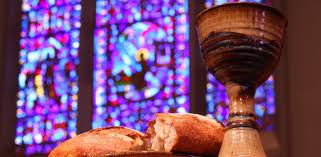
This is how it always is with Jesus. When we choose to follow Jesus, to eat and drink with Jesus and choose to include those with whom he ate and drank, we can expect that there is always more meaning beyond the moment, more reality beyond the senses. The truth is that this very morning, here in this place, there is more going on than we can possibly imagine. There is more happening here than the saying of a few prayers, the singing of few hymns, the tasting of a little bread and the sipping of a little juice.
Because, in this place the Holy One is mysteriously, yet certainly present, communing with us, giving the Divine Self to us, revealing the Divine Self for us. And as flawed, fragmented human beings, we can count on being surprised and even shocked by the revelation.
So, this morning, I am asking you to hold on to the pews, for anytime Christ comes among us things are liable to break out, break open, change, shift and spill out.
You might have thought you were going to come to this place to see a few friends, but before you leave this place, you may be shocked to discover that you have seen Jesus here.
Soon after Jesus arrives in Jerusalem, John says that some Greeks come to Philip and said, “Sir, we wish to see Jesus.”
Philip went and told Andrew; then they both went and told Jesus. And listen to how Jesus answers them: “Unless a grain of wheat falls into the earth and dies, it remains just a single grain; but if it dies, it bears much fruit. Those who love their life lose it, and those who hate their life in this world will keep it for eternal life. Whoever serves me must follow me, and where I am, there will my servant be also.”
Jesus seems to be saying: “They want to see me? Then tell them they must be willing to die to themselves, break their bodies, pour themselves out. Turn the world upside down. Follow me by humbly being a servant to the least of these among us. And it is there, perhaps in the least likely place, and among the least likely people, in the least likely of ways, there they will see me.”
Henri Nouwen was a gifted Catholic priest and brilliant teacher who taught at prestigious universities like Harvard and Yale. He was a renowned author and sought-after speaker. However, answering a call to follow Jesus, he left the Ivy League to spend the last decade of his life serving as a chaplain within a community of people with severe emotional, mental, and physical disabilities.
In one of his many books, Nouwen tells a story about Trevor, a man in that community who was dealing with such severe mental and emotional challenges that he had to be sent to a psychiatric unit at a large hospital for an evaluation. One day Henri wanted to visit him, so he called the hospital and arranged for a visit.
When the administrators at the hospital received word that Henri Nouwen, the renowned author and teacher from Yale and Harvard would be coming, they reached out to him and asked if they might have lunch with him in the Golden Room—the most elegant meeting room in the hospital. They would also invite doctors and other clergy to the special luncheon. Nouwen agreed.
As soon as he arrived at the hospital, someone was there to meet him to take him to the Golden Room. When he got to the room, Trevor was nowhere to be seen. Troubled, he asked about Trevor’s whereabouts.
“Oh,” said an administrator, “Trevor cannot join us for lunch. Patients and staff are not allowed to have lunch together. Besides, no patient has ever had lunch in the Golden Room.”
By nature, Henri was not a confrontational person. But perhaps guided by the Spirit, this crazy thought that came to his mind: “Include Trevor.” “Trevor ought to be here.” So, Henri swallowed hard, turned to the administrator, and said, “But the whole purpose of my coming here was to visit with Trevor. So, if Trevor is not allowed to attend the lunch, I will not be able to attend.”
Well, the administrators couldn’t imagine missing an opportunity for lunch with the great Henri Nouwen, so they quickly found a way for Trevor to attend.
And this is when, like hair and perfume everywhere, things around the table. At one point during the lunch, Henri was talking to the person to his right and didn’t notice that Trevor, seated at his left, had stood up and lifted his glass of Dr. Pepper.
“A toast. I will now offer a toast,” Trevor said to the group.
Everybody in the room tensed up. What in the world was Trevor going to say?
Then Trevor, this deeply challenged man in a room full of PhDs and esteemed clergy, started to sing, “If you’re happy and you know it, raise your glass. If you’re happy and you know it, raise your glass…”
No one knew what to do. It was awkward. Here was a man with a level of challenge and brokenness they could not begin to understand, yet he was beaming. Although most everyone one in the room was apprehensive about him being there, he was absolutely thrilled to be there. So, they started to sing. Softly at first, but then louder and louder until all the doctors and clergy and Henri Nouwen were practically shouting, “If you’re happy and you know it, raise your glass.”
Henri went on to give a brief lecture at the luncheon, but the moment everyone remembered, the moment everyone saw Jesus the most clearly and heard the word of God the most profoundly, happened through the person they all would have said was the least likely at the table to emulate Jesus.[i]
When we gather at the table with Jesus, things are not always what we expect them to be, nor are they what they appear to be. Like perfume and hair everywhere, the Holy Spirit of God is breaking out, breaking open, and spilling out.
You thought that you had things all figured out, that you knew what was going on and what was not going on in this world, only to discover that you do not have a clue.
This morning, you thought you were going to go to church, go through the motions and go back home unchanged, but to your startling surprise it has been revealed that you have been summoned, you have been called to do something that is bigger than you and to go on a journey that is far from home.
And here is the real shock, saying yes to this summons to die to yourself, to leave a place of comfort and security, you have never felt more alive, more you, and more at home.
[i] John Ortberg, in the sermon, “Guide.” Preachingtoday.com.

 Just Love