
The pastor stands up behind the pulpit, clears his throat, and announces: “This morning we are going to talk about race and racism.”
All over the sanctuary the congregation winces, and beg under their breaths: “Preacher, please don’t do it, for you’re about to open up a giant can of worms!”
But the old preacher, who has opened up more cans of worms than anyone could possibly count, ignores the grimaces and metaphorically gets out the can opener.
I hear many people in the church say that we should not talk about race or make race an issue. However, I believe we make it an issue when we pretend that it is a non-issue. I believe we do great harm to the cause of Christ when we ignore racism or deny that it exists. Furthermore, if we are to accept and do the will of God that I believe is revealed in the story of the Tower of Babel, the church must be willing to openly talk about race and the inherent racism that is prevalent in our families, our town, our region, our world, even in our own hearts.
In the eleventh chapter of Genesis we read:
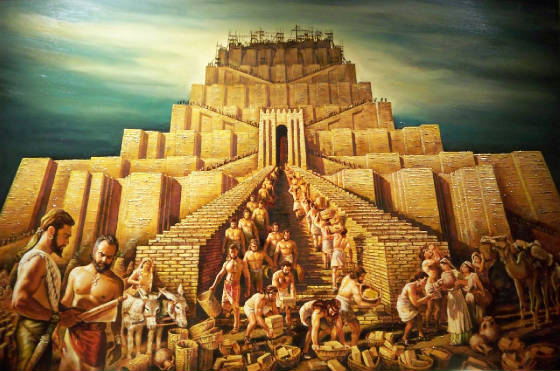
Now the whole earth had one language and the same words. And as they migrated from the east, they came upon a plain in the land of Shinar and settled there. Then they said, ‘Come, let us build ourselves a city, and a tower with its top in the heavens, and let us make a name for ourselves; otherwise we shall be scattered abroad upon the face of the whole earth.
The whole earth was one. One language. One people. One tribe. One race. And they all came together to live in one place. They all came together to build something special, something big, something wonderful that would be a symbol of their unity, pride and patriotism.
Now, what is not to like about that?
Unity, oneness, togetherness, harmony, people of the same minds living in one accord. Isn’t that the aspiration of all? Isn’t true that great minds think alike? Isn’t this the will of our God, God’s great purpose for humanity?
So what’s not to like in this seemingly perfect picture of unity in Genesis chapter 11? As it turns out, according to God, the creator of all that is, not very much.
Let’s look at God’s reaction to this oneness in verse 7 of our story: “Come, let us go down, and confuse their language there, so that they will not understand one another’s speech.” So the Lord scattered them abroad from there over the face of all the earth…”
What? Are you serious? What is wrong with this great portrait of human unity, of one race of people, one nation, under God indivisible, all of one mind, coming together to make a name for themselves, to build great things, to be on top of the world, to celebrate their purity and pride as one master race?
The truth is that the builders of the great tower in Shinar had accomplished not what God wants for humanity, but what many throughout history, including the likes of Adolf Hitler and the Ku Klux Klan, have wanted for humanity: One master race of people coming together to form one supreme social order, one culture, sharing the same ideals, values and moral principles. Diversity is a threat. Diversity is something to fear. Diversity is something to segregate and discriminate. Diversity is something to send to the gas chambers or lynch in a tree.
I am not sure if anyone in my lifetime has articulated the thinking of the people of Shinar better than Atlanta Braves pitcher John Rocker back in 1999. Some of you may remember his response when he was asked by Sports Illustrated if he would ever play for the New York Mets or New York Yankees.
Rocker said:
I’d retire first. It’s the most hectic, nerve-racking city. Imagine having to take the number 7 Train to the ballpark looking like you’re riding through Beirut next to some kid with purple hair, next to some queer with AIDS, right next to some dude who just got out of jail for the fourth time, right next to some 20-year-old mom with four kids. It’s depressing… The biggest thing I don’t like about New York are the foreigners. You can walk an entire block in Times Square and not hear anybody speaking English. Asians and Koreans and Vietnamese and Indians and Russians and Spanish people and everything up there.[i]
The story of the Tower of Babel teaches us that what John Rocker said racked his nerves in the world is what God wills for the world. In verse 4 we read that the purpose of building the tower was to avoid what depressed John Rocker on the No. 7 train leaving Manhattan for Queens, and to avoid what John Rocker heard in Times Square. The purpose of settling in Shinar and building that tower was to live in a world with no foreigners, no confusing babbling in the streets, no queers or kids with purple hair to encounter on the way to work, no eating in the marketplace with people on strange diets, no rubbing elbows with people wearing weird clothes, head coverings or dots on their foreheads. So they came together and said, let’s build a tower of unity “to not be scattered over the face of the whole earth.” And God’s reaction to this racial purity and pride was to “scatter them over the face of the whole earth,” to create a world of diverse languages and cultures, to create a world of foreigners.
God was only accomplishing what God had always willed for the creation: diversity. In chapter one of Genesis, we read that the original plan for creation was for humankind to “multiply and fill the earth.” And after the flood in chapter ten we read where God sanctions and wills all nations to be “spread out over the earth.” (Gen 10:32). Simply put, from the very beginning of time, in spite of our will, in spite of our fear and our racial pride, God wills diversity.
Therefore, if we ever act or speak in any manner that denigrates or dehumanizes another because of their race, language, nationality or ethnicity, we are actually disparaging the God who willed such diversity. According to Genesis, diversity is not to be feared, avoided, prevented or lynched. If we want to do the will of God our creator and redeemer, diversity is to be embraced. In other words, if we love God, we will also love our neighbor. And this is what God wants us to be united by. It is why Jesus called it the greatest commandment—love God and our neighbors as ourselves. Love is what should unite us; not racial pride or patriotism.
The story of the Tower of Babel belongs to the same genre of the stories of Adam and Eve, Cain and Abel and Noah and the Flood. They are considered to be “pre-history stories.”[ii] That is, they are describing God’s relationship to the world before the call of Abraham and the history of the Jewish people. It amazes me how God in each of these stories is so often misinterpreted by Christians who believe that the God of the Old Testament is a God of wrath; not a God of grace. They say that they believe Jesus Christ is God; however, they fail to see Christ in these stories.
Consequently, God is often seen as one who curses Adam and Eve by kicking them out of the garden instead of as one who bends to the ground and clothes them with grace. God is seen as someone who curses Cain by sending him to the land of Nod, instead of as one who protects his life with a mark of grace. God is seen as one who curses all of humanity with a great flood with the exception of one family, instead of one who makes a decision to graciously suffer alongside all of humanity. And here in this story, God is seen as one who curses the builders of the tower by scattering them over the face of the earth, instead of being seen as one who reacts to racial pride and unity by fulfilling the purpose of creation from the very beginning, filling the earth, by graciously creating diverse languages, races and cultures.
The tragic irony is that throughout history many have used the story of the Tower of Babel to support slavery, apartheid, segregation and other forms of racism. Bob Jones University once used this story to ban interracial dating on campus. However, this story teaches something very different. The story of the Tower of Babel is God’s gracious stamp of approval, of blessing, on every race, every tribe, and every language in every land. It is the fulfillment of God’s original purpose for creation. The song we learned as little children cannot be more true: “Red, yellow, black and white, they are all precious in God’s sight.” God is not color-blind, as I hear some say, for God creates, wills, blesses and loves color. And it is this love that unites us all, as we have all been created to harmoniously see humanity as God sees it: as a beautiful, diverse, colorful rainbow created by, sanctioned by, and graced by God.
As a Bible-believing Christian, it confounds me when I hear that another, supposedly, Bible-believing Christian, has decided to put their house on the market and move because a person or a family of another race has moved into their neighborhood. I often think about this story in the first book of our Bible that describes a beautiful and diverse creation willed by God. But I also think about a passage in the last book of our Bible that describes an eternity willed by God. And I wonder what in the world these people, who claim to be Christian, are going to do if they do get to that place they think they are going after they die to live forever and ever.
Because guess what? According to Revelation, heaven looks more like Times Square and that No. 7 train on the way from Manhattan to Queens than some affluent suburb outside of Atlanta, Georgia.
In Revelation 7, we read these words:
After this I looked, and there was a great multitude that no one could count, from every nation, from all tribes and peoples and languages, standing before the throne and before the Lamb, robed in white, with palm branches in their hands. They cried out in a loud voice, saying, ‘Salvation belongs to our God who is seated on the throne, and to the Lamb!’ And all the angels stood around the throne and around the elders and the four living creatures [each representing the diversity of all creation], and they fell on their faces before the throne and worshipped God, singing, ‘Amen! Blessing and glory and wisdom and thanksgiving and honor and power and might be to our God for ever and ever! Amen.’
[i] Read more: John Rocker – At Full Blast – York, Braves, City, and League – JRank Articles http://sports.jrank.org/pages/4014/Rocker-John-At-Full-Blast.html#ixzz39oVUCEtA
[ii] See Walter Brueggemann Genesis
Other Sermons in this Series:
Grace in Genesis: Adam and Eve
Grace in Genesis: Cain and Abel

 Just Love