Preparing the Way for Peace

Isaiah 11:1-10; Matthew 3:1-12

As if we needed it, Advent is the annual reminder that the world is not as it should be. But it is also our reminder that God is not finished with this world yet. It’s a reminder that God has plans for this world, and you and I are a part of those plans.

Advent is a holy tension. We wait and watch, but we wait and watch with hope. We light candles, because we believe the light still rises, and peace on earth is still possible, even during a time of deep violence.

Today, our nation remembers another Sunday morning when the world was plunged into deeper violence, when fear and grief reshaped lives overnight.

We remember Pearl Harbor today, not to glorify war, but to deepen our longing to be a people shaped by the peace that God promises. On a day we remember a time when peace collapsed, when meetings for diplomacy didn’t happen, when steps to find equitable solutions were not taken, we gather to proclaim a new day, a new time when swords are beaten into plowshares, and peace is not a distant dream, but a way of life.

And through our scripture lessons this morning, two prophets speak about this time: Isaiah and John the Baptist. Two voices, centuries apart, but carrying one message: God is breaking into this world with a peace that transforms everything!

Isaiah speaks with poetry. John speaks with fire.

Isaiah shows us the world God intends.

John tells us how we must prepare for it.

Isaiah invites us to imagine and dream.

John insists we repent and change.

Together, they give us the full message of Advent: the hope and the urgency; God’s promise and our responsibility.

I love that Isaiah begins Advent with a stump, and Matthew begins with a wilderness. Isaiah says: “A shoot shall come out from the stump of Jesse.” Matthew tells us: “In those days John the Baptist appeared in the wilderness.”

A stump is what remains after something has been cut down. Here, it belongs to Jesse, the father of King David, symbolizing the seemingly dead royal lineage of David.

A wilderness is a place where familiar paths have disappeared. It’s a place of withdrawal, isolation, and loneliness.

 And yet, both are places where God begins again. Both are places where grace breaks in. Both are places where hope refuses to die, and love finds a way!

Some of us have walked into Advent this year with stumps in our lives. There have been losses, endings, dreams cut down, seasons cut short.

Some are walking toward Christmas this year surrounded by wilderness. There is much uncertainty, weariness, loneliness, and feelings of lostness.

But both Isaiah and John remind us of the good news: that God does some of God’s best work in the places that seem barren. God is in the business of making a way when it seems like there’s no way.

Isaiah gives us a breathtaking vision of God’s business in this world. It’s of a world ruled not by fear, corruption, hate, and violence, but by justice, tenderness, compassion, and reconciliation.

Wolves lie down with lambs. Children play safely at the entrance of a cobra’s den. Predators and prey live at peace.

This isn’t some fantasy. It’s the reordering of the entire world. Isaiah saw what scripture calls “shalom:” a peace that heals, restores, and reshapes not only society, but the entire creation.

Isaiah says this peace will be led by a Spirit-filled one who will: “judge the poor with righteousness…and decide for the meek with equity.”

In other words, peace and justice are inseparable. We cannot have one without the other. Peace without justice is fragile. Peace without equity is deceptive. Peace that ignores any harm to others, or to the creation, is not peace at all.

On this December 7th, as we remember our parents and grandparents waking up to the violence of Pearl Harbor, we must not pretend that violence belongs only to the past. For every day we wake up to stories of good people being yanked from their cars, or off the streets, on their way to work, on their way to school or to a thanksgiving dinner with their family, detained by masked men and deported because of the color of their skin. We wake up to stories of fishermen blown up in boats without due process or any chance to speak their truth.

 We see a world where fear is weaponized, food for the hungry is politicized, meanness is rationalized, human dignity is discounted, and inequity is engineered rather than accidental.

On this Pearl Harbor Sunday, we confess the many ways violence still shapes our world, and we cry out for the peace Isaiah dares to imagine and for which Christ commands us to prepare.

And then a wild, fiery preacher named John bursts into our story. He’s wearing some strange clothes. He’s got this crazy diet, and a voice that sounds like a siren screaming in the desert.

And his first word is not, “Peace.” No, it is, “Repent.”

Now, at first his preaching sounds like one of those hell, fire, and brimstone preachers we’ve heard before. We think, “no wonder they call him a Baptist!” At first, his message sounds like the opposite of Isaiah’s message, but the more we listen to it, we discover that John is not contradicting Isaiah. No, he’s showing us the way to Isaiah’s vision of peace.

You see, John knows that peace never arrives in this world easily. Peace is not passive. It’s not something we just sit back and wait for. Peace requires transformation. If peace is gonna come, then people gotta change!

If Isaiah shows us what peace looks like, John shows us what peace requires.

John calls us to turn from every way that does harm: our habits; our politics; our systems; our silence; our consumption; even our religion, especially our religion; to embrace a life of nonviolence. And he makes it clear that peace on earth is not some naïve dream from some woke, left-wing lunatic; it is a moral imperative from God. John is the prophet who prepares us for the world Isaiah describes.

John’s challenges his hearers to “bear fruit worthy of repentance.” In other words: Don’t just want peace and sing about peace. Live peace. Practice peace. Embody peace in your decisions, your priorities, your words, your vote, your compassion, your courage, your lifestyle.

Repentance is not self-hatred. It’s not guilt. And it’s not shame. True repentance is liberation. It’s simply returning to God’s way of peace that was intended for the creation.

On a day when the nation recalls the devastation of war, repentance becomes not just a personal religious ritual, but a moral commitment. It’s a commitment to dismantle hatred. It’s a commitment to stand with the vulnerable. It’s a commitment to uproot the seeds of harm before they ever take root in our lives or in our world.

That is the fruit worthy of repentance, as John says. That is the path toward the world Isaiah imagined.

And let’s not miss this. John’s harshest words are not aimed at the people the religious leaders dismissed as outsiders, unbelievers, or unclean. John’s sharpest critique is directed at the religious establishment itself, the ones who believed they were closest to God because of their heritage, their appearance, their privilege, their assumed moral superiority. He turns to them and says, “Do not presume… the axe is already lying at the root.”

John doesn’t say this because God delights in their tjdestruction. He’s not warning them because God wants to punish or shame them. John speaks this harsh word because God seeks to prune. God seeks to cut away anything, no matter how pious, polished, or patriotic, that destroys real peace in the world. And that includes any movement that weds faith to nationalism and proclaims that God’s blessing is the property of one nation, one party, one people. It includes any faith that blesses fear, excuses cruelty, or elevates domination as destiny.

We cannot cling to anything that kills equity.
We cannot preserve the things that preserve injustice.

We cannot call violence “protection,” or prejudice “tradition” or “heritage.”

We cannot keep watering the roots of fear, greed, Christian nationalism, or complacency, and then pretend we are bearing the fruit of peace.

Advent is the holy season of pruning, not for punishment, but for preparation. Advent will not allow us to believe that for peace, repentance is optional.

Isaiah teaches us what God’s peace looks like.

John teaches us how to make room for it.

Isaiah lifts our eyes.

John steadies our feet.

Isaiah speaks hope.

John calls for courage.

And together they prepare us for the Christ who comes not with military might, not with political coercion; but with justice, mercy, grace, humility, and fierce love: the Christ who judges with righteousness; the Christ who defends the meek, heals the sick, forgives the sinner, feeds the hungry, and includes the outcast.

This Advent, perhaps peace begins with us by letting something go:
a resentment we’ve carried too long; a fear that narrows our compassion; a selfishness that feeds our apathy and fuels our greed; a prejudice we inherited; a silence we use to avoid conflict.

Perhaps peace begins with healing something inside us.
Or perhaps peace begins with speaking a truth we’ve been afraid to name.
Or standing with someone who has been pushed to the margins.
Or choosing generosity in a season obsessed with consumption.
Or refusing despair in a world that seems addicted to it.

Or perhaps, on this December 7th, peace begins with remembering that violence is not inevitable, war is not destiny, and equitable solutions are real, and love, not hate, is what truly makes a nation great.

Advent is the season when we stare at the world’s stumps and declare, “A shoot’s gonna spout, and I can see it!”

We look at the wilderness and say, “A voice is calling, and I can hear it!”

We remember the wounds of history and pray with renewed commitment: “Never again!”

And we see the darkness all around us and still light our candles, because we trust the promise that the light still rises.

It rose from the stump of Jesse.
It rose in the waters of John’s baptism.
It rose in Bethlehem.
It rises in every act of justice.
It rises in every step toward peace.
It rises, even now, in us.

Thanks be to God. Amen.
What’s Written on Your Heart

Some appeal to guilt: “If you don’t give, how will we keep the lights on and the camera rolling?”

Some appeal to fear: “If you don’t tithe, God will not bless you.”

Some appeal to self-interest: “Give, and you’ll get an unexpected check in the mail.”

And some appeal to nostalgia: “This is the church your grandparents built. You owe it to them to give.”

So, this stewardship season, I want to make something clear: you will never ever hear anyone in this church suggest that pledging your tithes and offerings, your service and your presence, is a way to bribe God, to buy blessings, to feed our souls, or keep our consciences clear.

Furthermore, we are not being asked to make a pledge to the 2026 budget because we recently had to replace the hot water heater, the roof may leak in a heavy rain, and we’ve hired an expensive professional to relocate a large family of bats which have taking up residence in the attic.

That’s because, we believe your pledges, your service, must come from a deeper place.

It was the prophet Jeremiah who proclaimed: “The days are coming,” declares the Lord, “when I will make a new covenant…I will put my law in their minds and write it on their hearts.”

We give because God’s law has been put in our minds and written on our hearts.

Now, when we hear the word “law,” we might think about rules, regulations, and restrictions, what we can and can’t do. But Jeremiah isn’t talking about that kind of law. He’s talking about something much deeper than any rule or ritual.

Jeremiah is talking about the moral rhythm of God. He’s talking about justice, kindness, mercy, and humility. He’s talking about empathy and compassion, engraved not on tablets of stone, but on the living tablets of human hearts.

This is the reason we pledge our gifts. We give, not from guilt, not from obligation, not from a belief that we will get something in return, not even from a command. We give because the rhythm of God’s morality has been written on our hearts.

And when this is written on our hearts, we don’t have to be told to pledge, to give, or to care, to love, to be kind, to show mercy, and to do justice. We just do. We don’t even need a stewardship campaign to tell us we need to embody radical welcome and revolutionary love. It is just who we are.

So, as we think about stewardship this month, as we consider pledging our tithes and our offerings, our service, and our presence, to make this world more just, loving, and peaceful, an important question we should ask ourselves is this:

What is it that is written on our hearts? Because the reality is, everyone has something written inside of them.

Sadly, for many, it is fear—put there by wicked men who seek power by dividing us.

For some, it’s scarcity. It’s the fear that there’s not enough.

For some, it’s fear of the other, immigrants taking what we believe is ours.

For some, it is cynicism. It’s the fear that nothing in this world ever changes, anything I give simply will not matter.

The good news is that not only does God have a powerful eraser, in the words of the prophet, “forgiving wickedness and remembering sin no more,” the good news is that God is still writing. And when God writes, God never uses the ink of fear, but always writes in the ink of justice.

Onto our each of our hearts, God is writing justice, not selfishness; compassion, not comfort; and selfless love, not self-preservation.

Here’s some more good news. Your choosing to be here this morning is a good sign that that the ink of God is flowing through your veins. That’s why I believe you are sitting in a pew this morning. That’s why you give. That’s why you serve. That’s why you show up when your neighbors need you, and that’s why you rally when your country needs you.

Jesus illustrated this truth with a story of a woman, a widow with no power, no protection, and no position. She doesn’t have wealth. She doesn’t have influence. All she has is the ink of God on her heart.

She shows up before a judge who, the text says, neither feared God nor had respect for people. We know the kind. He doesn’t care about justice. He doesn’t care about her. He doesn’t care about God. He cares only for himself.

But because of that something written on her heart, nevertheless she persists. She keeps showing up. She keeps knocking. She keeps demanding justice.

Now, we don’t know what her case was.

Maybe her landlord was exploiting her.

Maybe her neighbor had taken her land.

Maybe she had been cheated out of her inheritance.

Maybe she was being denied healthcare, due process, or civil rights.

Most certainly, she was a victim, or should I say “a survivor” of misogyny.

Whatever it was, she kept showing up.

And although the judge doesn’t have a moral, empathetic bone in his body (again, we know the type, don’t we?), even he gives in. Not because he suddenly finds compassion, but because she refuses to go away.

Now, this is not a story about nagging God until God gives us what we want. This is a story of faithful persistence in the face of injustice. It’s a story about a woman who knew something about the power of showing up. The odds were against her, but she kept showing up. The judge was morally depraved, but she kept showing up. Her friends told her she needed to accept things the way they are because nothing in this world ever changes, but she kept showing up because God’s justice, the rhythm of God’s morality was written on her heart.

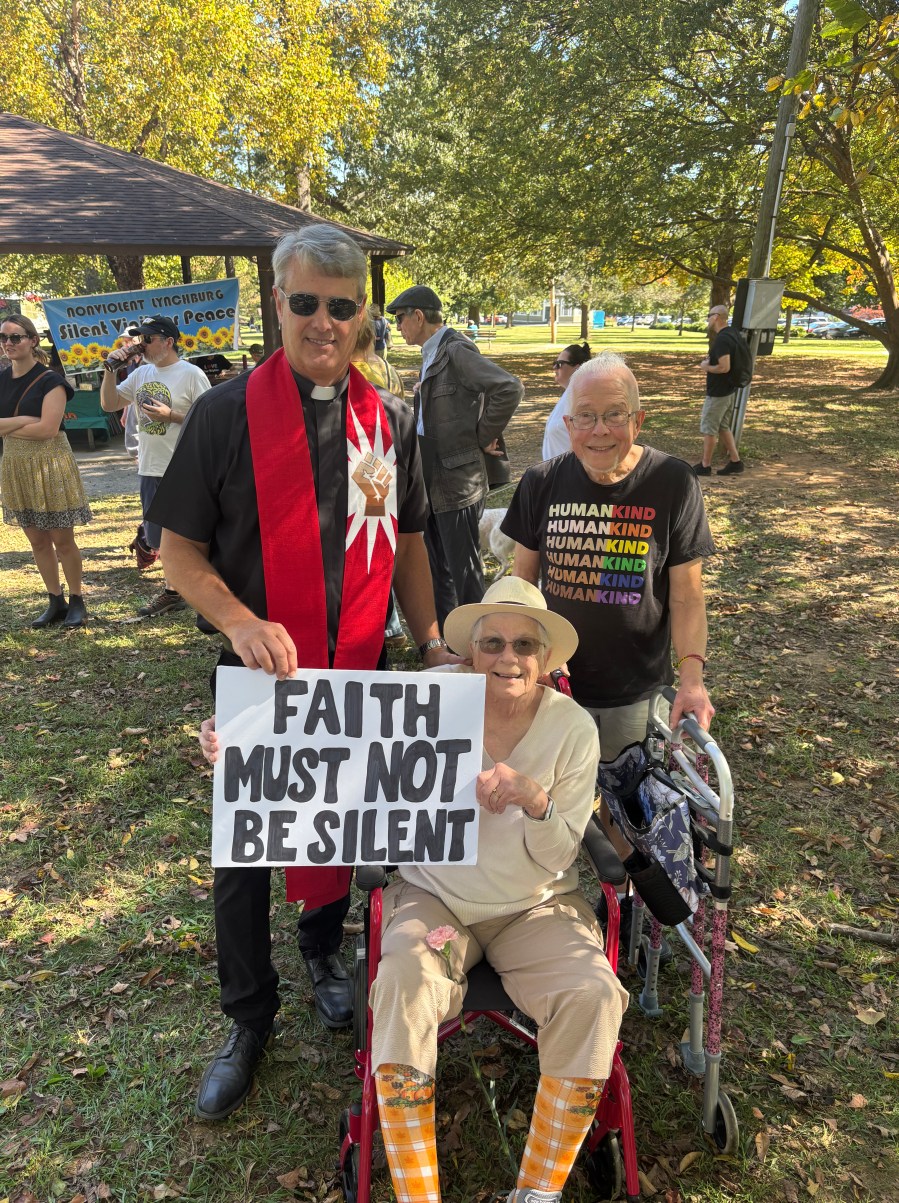
It was the same rhythm that propelled Marion Stump to show up in Miller Park yesterday at the No Kings Rally— demonstrating that when justice is written on your heart, when the ink of God is coursing through your veins, not even pancreatic cancer can keep you from showing up!

This is why this is a perfect text for our stewardship season in this time and place. Because giving is a form of showing up. Serving is a form of showing up. Speaking out, organizing, marching, standing with the vulnerable, fighting for democracy — all of it is showing up before the immoral powers and principalities and saying: “There will be justice here.”

As the widow kept knocking at the courthouse door, we must keep knocking at the world’s door. And every gift of generosity, every dollar given, every act of kindness, every time we show up, is one more knock, one more insistence that justice matters, and love will win.

Now, here’s a statistic that gives me hope today: Researchers say that if just 3.5% of a nation’s population mobilizes in sustained, nonviolent action, they can turn the tide against authoritarianism. Think about that. Not half the country. Not even a tenth. Just 3.5%. That’s about one in every thirty people. If one in thirty people with justice written on their heart keeps showing up, keeps marching, keeps knocking, keeps giving, keeps serving, keeps praying, you can change the direction of a nation. This nation can be turned toward justice again.

So, we must never believe our offering doesn’t matter, our presence doesn’t count, our gifts are too small, or that our persistence is not power. Because every time we show up, every time we give out of what’s written on our hearts, we’re part of that 3.5%. We’re part of the turning. We’re part of God’s kingdom breaking in.

Good stewardship is and has always been heart-based. It’s justice-based. It’s love-based. It’s what Jeremiah saw when he said:

No longer shall they teach one another, saying, ‘Know the Lord,’ for they shall all know me, from the least of them to the greatest.

When the covenant is written on our hearts, we don’t need coercion. We don’t need compulsion. We don’t need manipulation. Because the Spirit itself bears witness in our hearts, and when God’s handwriting burns in your chest, you wake up every morning asking: “How can I give myself today for justice, for peace, for love?”

And the good news is that the world doesn’t need an extraordinary event to change. It changes through ordinary persistence. Through the widow who won’t give up. Through the disciple who keeps showing up. Through the church that keeps preaching hope, even when hope seems hard to find, because every time we show up, we bear witness to the covenant of God written inside of us. We demonstrate to the world: “Greed will not have the last word. Hate will not have the last word. Fear will not have the last word. And love will one day ultimately and finally win.

Disciples, we are the people who keep showing up. We show up for one another. We show up for our neighbors. We show up for the nation. We show up wherever anyone thirsts for justice and hungers for love.

Because when the covenant of God is written on your heart, you can’t sit still in the face of suffering. You can’t stay silent in the face of injustice. You can’t keep your hands closed when the Spirit is calling you to open them.

The widow kept showing up before the unjust judge, and we keep showing up before an unjust world—not out of guilt, not out of duty, not to get something in return, but because there’s something divine inside of us that will not let us rest.

It’s what Jeremiah called a new covenant. It’s what Jesus called the kingdom of God. It’s what we call faith in action.

So, this stewardship season, we’re not asking you to give out of fear or guilt or obligation. We’re asking you to give because you’ve got something written on your heart.

Give because you believe that love is stronger than hate, and there’s a love inside of you that will not let you go. Give because you trust that justice will prevail. Give because you know that hope still has work to do in this world!

Give, because you’re part of that 3.5% who refuse to bow before kings, who refuse to be silent in the faces of those in power with no regard for people or God, who refuse to quit knocking, who refuse to stop showing up.

Because that’s what the church is.

It’s not a building that needs maintaining, but a movement that needs to keep marching.

And we will keep showing up—not until we get what we want, but until the world becomes what God dreams it to be.

Until every heart bears the handwriting of God, and every gift, every prayer, every act of courage echoes that same eternal truth:

We give, we serve, we love, we persist, because it’s written on our hearts!

Amen.


Pastoral Prayer

God of persistence and promise,
You are the One who writes truth on human hearts,
who carves compassion into our very being,
and who teaches us to keep showing up
in hope, in prayer, and in love.

You have written Your covenant not on stone tablets
but in the living flesh of our hearts.
So even when the world forgets justice,
even when the powerful ignore the cries of the poor,
Your truth keeps pulsing within us,
calling us to rise again, to knock again,
to believe again that love will have the final word.

We thank You for the saints and prophets
who never stopped knocking on the doors of indifference.
For the mothers who marched,
for the workers who organized,
for the dreamers who still believe in a more just tomorrow.
May their persistence live in us.

And forgive us, O God, when we grow weary in doing justice.
Forgive us when our compassion has an expiration date,
when our generosity depends on convenience,
when our prayers fade because the answers take too long.
Remind us again that the work of justice
is not measured in days or dollars or ease,
but in faithfulness, in showing up again and again.

In this season of stewardship, teach us to give not from fear or guilt,
but from gratitude and conviction.
Let our generosity be an act of defiance
against greed, apathy, and despair.
Write Your covenant deep within us,
until our giving, our praying, and our living
all bear witness to Your love at work in the world.

We pray for those whose hope feels faint today:
for the tired caregiver; the underpaid worker;
the neighbor who feels unseen; the soul that feels unheard.
May they find strength in the knowledge
that You are the God who listens, the God who remembers,
the God who still answers cries for justice.

And so, we will keep showing up.
We will keep praying, keep working, keep giving,
until the widow’s cry is answered,
until Your justice rolls down like waters,
and Your mercy like an ever-flowing stream.

We ask this in the name of Jesus,
the One who kept showing up,
the One who never gave up,
the One who lives and reigns through love.
Amen.

If We Loved Like Jesus

John 13:31-35

In the words of Stevie Wonder, I have “some serious news to pass on to everybody (which is really news to no one): “Love is in need of love today.”

Although some of Jesus’ last words, which are usually understood as one’s most important words, came in a commandment to love one another as he loved, many Christians have rejected those words, and today, love seems to have fallen out of favor.

One excuse I hear is: “Well, love might have worked back in Jesus’ time, but the world’s a much different place today. Love, especially loving like Jesus loved, well, that just doesn’t cut it anymore.”

Preaching love these days gets one called “a left-wing lunatic,” while stirring up hate gets one elected President. Being empathetic toward another gets one called “a sinner,” while being a bully gets one called “faithful,” or “councilman.” Deporting and separating families gets cheers, while asking for some common decency and humanity, gets one called “soft.”

If we truly love like Jesus loved—if we feed the hungry, if we care for the sick, if we give to the poor, if we stand up for the marginalized, if we speak out on behalf of the oppressed, if we welcome the stranger, and accept those who are cast away, we’re considered: “enemies of the state.”

These days, the peace and love crowd who lead with mercy, are out of date. And the mean and tough crowd, those who can make the hard decisions are trending. They can take away SNAP benefits without any apprehension, have people arrested without any due process and disappeared without any second thought. They say the country can afford to show our strength with a military parade, but not to show our compassion with healthcare for the elderly.

But love? Love is weak, they say. And these days, in these times, they say love is for losers. It may have worked back in the first century, when Jesus commanded it, but not here in the twenty-first, not anymore.

But the truth is, first century Palestine was not much different from today. Beneath the rule of the Roman Empire, ordinary people bore the weight of crushing taxes, land seizures, violent crackdowns, and the threat of crucifixion designed to silence dissent and maintain control. The elites—

local, imperial and religious— colluded to rob people of their wealth and dignity, leaving entire communities displaced and impoverished. It was a time when the underprivileged dare not imagine a world where justice was right for the oppressed and not a privilege of the powerful.

And it was into the thickness of that unrelenting, darkness, Jesus commanded his followers: “Love one another.”

Because Jesus knew that love is the light the darkness cannot overcome, and love is only power in the world strong enough to tear down empires and build God’s kin-dom.

So, when Jesus said, “Love one another as I have loved you,” he wasn’t being soft, and he sure as heaven wasn’t being weak.

He was talking about using the most powerful force in the world to change the world! He was talking about a love that was so threatening to the powers-that-be it would get you arrested and could easily get you nailed to a cross.

Jesus was talking about a love that confronts the empire, a love that calls out injustice, a love that always, insistently, and unapologetically, favors the oppressed and welcomes the people society tries to cast out. It’s a love that moves mountains, flips tables, and shakes up the status quo. It’s a love that demands justice for the poor, healthcare for the sick, and freedom for the oppressed.

Jesus said, “Love one another, as I have loved you,” because Jesus knew that love, the love he taught, the love he modeled and embodied, is the only power in the universe that can turn this world around.

Earlier this spring, Father John Dear reminded us that although the term “nonviolence” may sound passive and weak, there’s really nothing passive or weak about it. Nonviolence is “active love. It’s active resistance to evil.”

It’s important to remember that Jesus was anything but passive. He didn’t just sit back in his thoughts and prayers and wait for the world to change. He marched right into the temple and flipped over the tables of those who were hurting the poor saying: “This is not the kingdom of God! This is not how God’s people do things!”

He challenged the hypocrisy of the religious culture, those who claimed to love God but failed miserably in the things God requires, kindness, justice, and mercy, especially to those who were the most thirsty and hungry for it.

That’s how Jesus loved. And that’s how the world today needs us to love.

Dorothy Day, who devoted her entire life to loving like Jesus, once said: “Love, and ever more love, is the only solution to every problem that comes up in the world.” Love keeps coming. It keeps showing up. It keeps resisting and pushing back the darkness.

Dr. King described love’s power this way: “Power at its best is love implementing the demands of justice, and justice at its best is power correcting everything that stands against love.” Love stands up to racism, to sexism, to greed, to exploitation, to marginalization, and says: “Not on my watch!”

Gandhi once said: “Nonviolence is not a weapon of the weak. It is the weapon of the strong.” The strength of love is not how hard we hit or how loud we shout. It’s in how firmly we stand for love when hatred thunders and violence strikes. That’s true strength. And the good news is that the church that commits to loving like Jesus has that strength in abundance!

The problem is that an alternative Jesus devoid of love is now being used to fuel injustice. When I heard in seminary that when fascism comes to America, it’ll be wrapped in the flag and carrying a cross, I really didn’t think I’d ever see it.

Ten commandments hang on the walls, but there’s no compassion in the halls. They call it freedom, but it only works for some. Prayers and crosses are everywhere, but mercy? It’s nowhere to be found. They may say it is about God, but it’s all about control.

As Rev. Dr. William Barber likes to say, you can’t say God Bless America and think you’re being holy when you’re terrorizing immigrants, taking away food from the poor, and denying healthcare. That’s not holiness, says Barber, — “that’s pure hypocrisy dressed up in Sunday clothes!” It is sin. And if we stay silent while God’s name gets stamped on policies that crush the poor, deport the stranger, and hoard wealth for the few, then we are complicit in that sin. Jesus didn’t die for a faith that props up empires — he died for a love that tears them down.

And Barber reminds us that none of what we are seeing today is new. In the 1930s, fascists in Europe had a way of wrapping cruelty in religious national pride. They spread lies about minorities and built concentration camps and called it security. They locked up dissenters and called it patriotism. They cut off aid to the vulnerable and called it government efficiency. They blamed the Jews for the crucifixion of Jesus and called it eradiating anti-Christian bias.

And today’s mass deportations, voter suppression, and attacks on the press, free speech and universities — they are all echoes of those same dark chapters.

The good news is that love didn’t fail back then — because love does as love always does— Love showed up.

Love resists. It never quits. Love stays. It never retreats. Love fights. And love always wins.

Harriet Tubman went back, again and again. Because love doesn’t leave people behind. Chains broke. A system cracked. The lie of slavery collapsed. And love won.

In Selma, they beat ‘em with batons on that bridge. But they marched anyway. Love crossed into history. The Voting Rights Act was signed. And love won.

At Stonewall, they said love was illegal. They raided bars and broke lives. But the people rose. Years later, the Supreme Court saw the truth that love is love is love, and love got a seat at the altar. Love won.

In 2020 when everything shut down, love opened up. Mutual aid was demonstrated. Grocery runs happened. Meals on porches were shared. Text chains were created. Check-ins occurred. Love filled the gaps.

Not soft love. Not timid love. Resilient, rooted, revolutionary love—this is the love Jesus commanded when he said: “as I have loved you, love one another.”

It’s a love that doesn’t flinch. A love that never folds. A love that bears all things, believes all things, hopes all things, endures all things. A love that doesn’t give up. Not then. And not now.

If only the church had followed the simple commandment to love Jesus as he loved, it would’ve never been seduced by any politician shouting, “Make America Great Again!” Because the only greatness Jesus is interested in is the greatness of love—Love that welcomes the stranger, feeds the hungry, and protects the vulnerable—A love that would never chant “Send them back.”  But always says: “Come to me, all you who are weary and burdened, and I will give you rest.”

So, no — love is not weak, and it is not soft— love is power. Love is resisting. Love is marching. Love is standing up and speaking out.

Love is nonviolence in action, and as Father Dear says, love is a “force more powerful than all the weapons of war.”

The good news is—we can see love is rising today!

We can see love standing unshakably during a silent peace vigil on Monument Square in the pouring rain. It can be seen getting pastors arrested for praying in public in the Rotunda to protect Medicaid. And when the Boss sits down at concert and speaks like the prophet Isaiah.

And we can see love persisting as a new Pope chooses to be named Leo, after the Pope who laid the foundations in 1891 for Catholic social teaching advocating for: the rights of workers, especially the poor; the divine dignity of all persons, the government’s role in social justice; and role of the church in protecting the most vulnerable.

A small act of kindness extended to a stranger, a church sheltering an asylum-seeker, federal judges pushing back to defend the Constitution—This is not weakness. This is the power that can change the world!

If we loved like Jesus, our immigration policies would be built on hospitality, not hostility.

If we loved like Jesus, we would welcome the stranger, not criminalize them.

If we loved like Jesus, unchristian Nationalism would bow to the kingdom of God, and white supremacy wrapped up in Christian language would never be tolerated.

And the church wouldn’t be known for judgment, but for joy. We’d be too busy setting extra places at the table to worry about who belongs and who doesn’t.

If we loved like Jesus, our love would be bigger than our borders. Our love would be stronger than our fears. And our love would be louder than all voices put together conning us to divide, exclude, and hoard.

So, let’s love like Jesus! Let’s make the kingdom of God visible, one act of radical love at a time!

As Rev. Barber says — “it’s not about left or right, it’s about right and wrong.” And love is always right!

So, let’s be known for love. Let love do the talking. Let love do the walking. Let love be the proof. Let love be the revolution! Amen.

God Is Love: Yesterday, Today and Forever

same yesterday today and forever

I hear many people say that the Bible paints two very different portraits of God. They say that the God of the Old Testament was a God of wrath, judgment and vengeance, a God of Hell, fire and brimstone; whereas, the God of the New Testament was a God of love, grace and mercy. I suspect this may be part of the reason that while some say they believe in love and grace, they make it very clear with their words and deeds, that they also believe in judgment and condemnation.

However, I believe God is the same yesterday, today, and tomorrow, and I believe God is love. Therefore, God will always be love, and God has always been love. Many point to the story of Adam and Eve in Genesis 3 and talk about God punishing the first two humans by kicking them out of the garden; however, as I pointed out a couple of weeks ago in a sermon, the story is about the human consequences of knowing good and evil, and consequently, our shame. And it is a story about a God who deals with our shame by clothing us with grace, as God made garments of skin to cover Adam and Eve’s shame.

Furthermore, in the next chapter, when Cain, who deserves to die for killing his brother Abel, fears that his life is over, God emphatically says, “Not so!” God then reaches down and puts a mark of grace on Cain. Moreover, God’s grace followed Cain, even in that place east of Eden called Nod, even in that place that Cain believed was outside of God’s presence.

Thus, proving in the very beginning of all that is, that there is not, has never been, and will never be, anything in all of creation that can separate us from the love of God.

A Runner’s Prayer

MARTATHON-1

Someone recently asked me how she should pray for me this weekend during the marathon.

She even had the audacity to ask: “Do you want me to pray that you win the race?” 

First of all, let’s get something straight. The winner of the marathon will have time to take a shower, eat some brunch, update their facebook status, and take a nap before I cross the finish line!

Then she asked, “Or do you want me to pray that you don’t get injured and are just able to finish the race?”

Now, that is a better prayer.

However, I do not believe it is the best prayer.

The truth is that I ought to be grateful that I have the health and the ability to risk injury.

The real miracle on Saturday will not be that I finish the race, but that I have the opportunity to start the race.

So if you want to pray for me this weekend, don’t pray for my legs.

Instead, pray for my eyes.

Pray that my eyes may see the sheer grace of this mystery we call life, this miracle we call the world.

Pray that my eyes may see that all that I have and all that I am is an unearned and undeserved gift of God’s amazing grace.

And then, maybe, having seen the sheer grace and absolute glory of it all—the gift of my great friends, the gift of my wonderful family, the gift of my inexplicable life—I will not only run the full marathon this Saturday, but I will dance the 26.2!

Even if it takes all day.

Got Jesus? O God, I Hope Not

got jesus

If Jesus is something or even someone that we get, then church becomes just another product whose members are mere consumers. Thus, like going to a store, the spa, or the local cineplex, church becomes some place we go to get something. Some go to get fed. Others go to get nurtured and pampered. Some go to get entertained.

However, if it is Jesus who gets us, if Jesus is about us giving ourselves to the God revealed in Christ, then church means a radical, self-denying, sacrificial way of living.

If Jesus is about giving one’s life away, then the church becomes something much more than a self-help center offering self-improvement workshops.

Wednesday night becomes less of a time to get fed, physically and spiritually, and more of a time to pray for others, celebrate the joys of life with others, and even suffer with others. It becomes a time to build a community of selfless love and forgiveness with others. Bible study becomes less of a time to acquire more biblical knowledge than others and more of a time to consider how the scriptures inform our service to others.

Sunday morning becomes less about what God has to offer us and more about what we have to offer God.  When we eat the bread, we do not consume it. When we drink from the cup, we do not merely swallow it. We allow it to consume and swallow us, every part of us. And we commit ourselves to presenting our own bodies as living sacrifices for others, pouring our very selves out for others in the name of the God who emptied God’s self out for us.

And every day of the week, we become more than Christians who possess exclusive tickets to heaven in hand. We become the Light of the World.

Got Jesus? O God, for the sake of this community and for sake of this world, I pray not. Amen.

Grace and Gratitude: Remembering Ronnie Avery

The Second Miraculous Catch of Fish

From Ronnie Avery’s Memorial Service February 8, 2004.

Luke 5:1-11 NRSV

“Grace” and “gratitude.”  The two words come from the same Latin root and belong together.  Grace is when God does something for us that God did not have to do.  And the only way to respond to God’s amazing grace is with humble gratitude.

The soon-to-be disciples were in a boat with Jesus just offshore.  Jesus asked Simon, who had been fishing all night without catching a thing, to drop his nets out in some deeper water.  When he did they filled up the boat with so many fish that the boat began to sink!  They signaled another boat to come over to help.  Then they filled that one up!  They barely got back to shore before the boats sank under the weight of the fish.

These fishermen had never seen anything like it before. It was a miracle. It was also grace. Jesus did something for these ordinary fishermen that Jesus did not have to do. That is the definition of grace. And the fisherman responded with humble gratitude as they “dropped everything” to follow Jesus. They left their old lives behind on that beach, to worship and to serve Jesus for the rest of their lives.

The disciples responded to grace the same way Ronnie Avery responded to the grace that he received.  Ronnie would be the first person to tell you that he was on a road in the summer of 2003 that was leading him to a place that he did not want to go.  When he was hospitalized in July of that year, gravely ill with congestive heart failure, he realized this, and was filled with fear.

That day in ICU Ronnie said that he prayed a prayer that went something like this: “Oh God, not now.! Please don’t let me die now!  Please save me God, and I promise I’ll get myself right and start living for you.”

He said when he opened his eyes from that prayer, he saw me standing there in front of him for the very first time.

I had a short prayer with him and said, “Ronnie, I sure am glad to meet you, but I am sorry that it had to be under these circumstances here in the hospital.”

I will never forget how he responded. He said, “You’re getting ready to see a lot more of me, because I am going to be sitting on a pew in your church the first chance I get, and I am going to be sitting on one every Sunday that I possibly can!”

Ronnie told many people that on that day, in that moment, his life miraculously changed forever.  Not only was he suddenly and miraculously healed of a disease which had plagued his entire adulthood, it was in that moment that he began to live his life like those fishermen—fishermen who one day dropped everything, left their old lives behind them, to live a brand new life following Jesus. And this was the real miracle.

The very first Sunday that he was able, Ronnie was sitting on a pew in church, just like he said. A little over a month later, Ronnie joined the church.  He came every Sunday and every Wednesday night he could.  He gave faithfully our church’s budget.  He contributed generously to the fund set up by the church to help pay the tuition for my doctorate.  He loved his wife more sincerely.  He loved his siblings more deeply.  He loved his children and stepchildren and family and everyone he knew more earnestly.  Although he was weak and tired, he spent the entire first day of 2004 loving his sister-in-law, Donna, in the emergency room of Wake Forest University Hospital in Winston-Salem.

He repeatedly told me that he wished he was well enough and strong enough to do more.  However, the truth was, Ronnie did more for the Lord in six months than most people do their entire lives.

Ronnie would tell people that I changed his life.  He even said that I saved his life. However, we all know this was not true.  And deep inside, Ronnie knew that was not true.  God saved Ronnie’s life. God changed Ronnie’s life. I just happened to be the one who happened to be standing at his beside after his fearful prayer to God.  God used me to give Ronnie something that God did not have to give Ronnie: grace. Amazing grace: free, unearned, undeserved and unmerited.  And Ronnie responded like fishermen with humble gratitude and sincere thankfulness.

God also used Ronnie’s family members the same way God used me. God used so many people through the steadfast love they had for Ronnie.  They loved Ronnie with a love that was unwavering.  Each of his siblings, Steve, Dianne and Shirley, loved Ronnie with the steadfast love of their mother, Mary.  With his faithful wife, Becky, they never gave up on him. They showered Ronnie with the grace of God—unearned, undeserved and unmerited.

At Ronnie’s funeral service on February 8, 2004, I shared something that I had never shared with anyone before.  I tried to share a little of it with Ronnie on the way back from Winston-Salem on January 1, 2004.

Ronnie told many that I changed and saved his life.

What many did not know was the extent of which Ronnie changed and quite possibly saved me.

There is a disturbing and alarming statistic concerning pastors.  After just ten years of ministry, 30% of pastors drop out of the ministry.  After ten years, many pastors wake up and just decide that being a pastor is simply not worth all of the heartache and heartbreak. Trying to please people is a very demanding and stressful job. Not to mention, impossible. Many pastors decide that the burden that is placed their families is simply not fair. And many come to a place where they feel they are ceasing to make a difference. So they drop out and leave the ministry all together. You will find many of them selling insurance or real estate.

Personally, since I have been a pastor, I have always experienced a strong call to pastoral ministry. There was never any doubt in my heart or mind that serving as a pastor is what God was calling me to do, until 2003.  That marked my eleventh year of ministry.  I was at the point where 30% give up and drop out.  The first six months of that year were the most difficult six months of my entire ministry. The heartache of trying to please everyone and the heartbreak of failing to please everyone was wearing me down. The church was taking in fewer new members, and we were failing to meet our budget.  Church attendance was down, and I was at the darkest point in ministry wondering if I was really making a difference in anyone’s life.  I was contemplating joining the 30% of my colleagues by seeking another profession.

Then came a hot day in July. I went to the hospital to visit with the family of Howard Evans and Venetia Kue. I got off the elevator on my way to see Venetia and ran into Donna Mosley. She told me about Ronnie and sent me directly to see him in ICU.  And I have never, and I will never be the same.

For you see, on that day God showered two people with grace. Amazing grace—unearned, undeserved, unmerited. God was not finished with Ronnie, and God was not finished with me.  After ten years, God was still using me and calling me to be a pastor.  God may have used me to save and change Ronnie, but I will thank God the rest of my life that God used Ronnie to save and change me–as God used Ronnie to change so many others.

Ronnie continually told me that he wished he could do more for the Lord through the church.  I tried to tell him in the car on the way back from Winston-Salem  just a month before he died, and I hope to God that God has told me now, that he did more for the Lord than he ever knew. Ronnie saved my ministry and quite possibly my life.  And I will thank God for Ronnie Avery the rest of my life, as will many others.

In that ICU room, Ronnie said, “You’re getting ready to see a lot more of me, for I am going to be sitting on a pew in your church the first chance I get and I am going to be sitting on one every Sunday that I possibly can.”

Now I hate to admit it, but deep within my sometimes cynical self, I thought, “Sure you will.”  I didn’t graduate from seminary yesterday.  I had been a pastor for eleven years.  I know how most people work.

When most of us are given a gift which is completely undeserved, unearned, and unmerited, a gift that changes our lives, at first we are grateful.  But then our gratitude begins to wane. I expected to see him on a pew one Sunday, maybe two Sundays, but I certainly did not expect to see as much of him as I did, and I never expected that he would have the impact on my life that he did.  That’s the way grace and gratitude works with most people.

But thank God, Ronnie Avery was not most people.

Like fishermen dropping their old lives in the sand to leave them behind for a brand new life, Ronnie Avery certainly dropped his old life in exchange for another.

How did he do it?  Why didn’t his gratitude wane like most people?

Because Ronnie lived everyday of the rest of his life acknowledging that God had done something for him that God did not have to do. God had showered Ronnie with grace. Amazing grace—free, unmerited, undeserved, unearned. And Ronnie was grateful.

Think of what the church of Jesus Christ could be and what the church could do, if all of us made this simple acknowledgement: That God has given us something that God did not have to give us.  The gift of life.  The gift of friends and family.  The gift of himself.  The gift of resurrection.  The gift of life everlasting.

Think of the difference we could all make if we woke up each morning with the prayer that I believe was Ronnie Avery’s prayer everyday:  “Today God has given me something that he did not have to give me, something that I did not have coming to me—something completely unearned, undeserved, unmerited.”

I believe our lives will truly bear witness to the love and grace of our Lord Jesus Christ. We will be the people God is calling us to be.  We will be the church God is calling us to be. And there is no telling how many people, and even pastors, may be changed along the way.

It’s Time to Get Personal

adam

Isaiah 49:1-7 NRSV

1 Corinthians 1:1-9 NRSV

John 1:29-42 NRSV

The season of Epiphany is the time the church traditionally talks about the revelation of God to all of humanity.

It is the time to ask some of the most difficult questions of our faith. Who or what is God? What is God like? What does God feel? What does God want? How does God relate to and interact with us and the world? How does God reveal God’s self to us?

These are very difficult questions, because with our mortal minds, I do not believe we can ever answer them completely. And as I said last week, I am okay with that. In the words of Fosdick: “I would rather live in a world where my life is surrounded by mystery than live in a world so small that my mind could comprehend it.” I am very comfortable living, as the Apostle Paul wrote, in a world where I “see through a glass dimly” (1 Cor 13).

I love the way we begin each service with the Lord’s Prayer praying, “Hallowed be Thy name.” For the name of God is so above our mortal comprehension it always evokes reverence, awe, and respect.

And I believe that one of the problems with religion these days is that, for many in the church, there is no mystery. Too many people have the world and have God all figured out. They are know-it-alls and listen to a sermon or attend a Bible Study not to learn anything new, not to be challenged, but to have what they already know reaffirmed. They have all of the answers and never have any doubts.

A parishioner came to see me one day almost in tears. She was so upset that she was shaking. A friend of hers was dying. She said that she was not sure about her friend’s faith so she asked her: “Without any doubt, do you know that if you died today that you would spend eternity in heaven?”

Has anyone ever asked you that before?

The dying woman responded, “I hope so.”

Well, that response tore her friend completely out of her frame!  For she wanted her to respond: “Yes! No doubt about it, I know! I know unequivocally, for absolute certainty!”

But her friend’s response did not sound that troubling to me. She may not have responded with absolute certainty, but it sounded to me as if she had faith.  She hoped. She believed. She trusted.

To be honest, I tend to get along better with people who are honest enough to admit that they sometimes have their doubts; that they do not always know absolutely. And I am often wary of those who have no doubts whatsoever, because it has been my experience that those are the ones who are the quickest to judge and are the first to belittle, even condemn, others who hold different beliefs.

A member of a pastor search committee once asked me if I believed the Biblical account of Jonah and the whale should be taken literally. She asked, “Did it actually historically happen the way the Bible says it did?”

I responded, “I believe that God can do what God wants to do. I have no trouble believing that God can use a whale to actually swallow man and spit him out on the beach of God’s choosing. However, if I die and get to heaven and find out that it was just a fictional story to reveal a great truth about the will of God, then I am not going to get angry and ask for a transfer!”

I believe the problem with the church today is that too many church people are so closed-minded they would opt for the transfer. They are so convinced, so right, so certain about the things of God that they leave no room for mystery and thus no need for faith, hope or trust.

One of the great things about our heritage as Disciples of Christ is our individual freedom to interpret the scriptures and to understand God and God’s relation to the world. We are encouraged to have open-minds when reading the Bible. No one was more of a free-thinker or had more of an open mind than our forefather, Barton Stone. That is why I believe he was so inclusive, welcoming all people to the Lord’s table. And that is why I believe we are such a non-judgmental, non-self-righteous, accepting people today. We do not presume to have all the answers. And we are not even close to having God all figured out.

Now, I wished we could just end the sermon right here. I wished we could just stand now and sing our hymn of commitment, pat ourselves on the back, and then go get some lunch. But, we can’t do it. We can’t do it, because now, now the sermon is just beginning.

We open-minded, free thinkers have to be very careful, that while embracing the mystery of God, we do not completely depersonalize God. While we accept broad views and opinions, while we practice widespread inclusivity and acceptance, we do not make the mistake and generalize God.

In emphasizing God as mysterious Spirit, a Spirit that Jesus says is comparable to the wind, blowing when and where it wills, in stressing God as Light in our world working in mysterious ways, we must be careful not make God into some sort of generic, vague enigmatic force.

In church, we say very specifically, “May the Spirit of Christ be with you.” We do not say very vaguely say, “May the force be with you.” That’s from Obie One Canobie and Yoda; not from the Old and New Testaments.

I have noticed, especially over the last decade, how Christians, in their attempts to find common ground with other faith groups, talk more about following a general God and less about following a specific Christ. When relating to Hindus, Muslims and Jews, I have heard Christians say things like: “We have our differences,” “but we all believe in God.”  But in our attempt to find common ground and unity, I believe we sacrifice God as a distinct, particular, and very personal being.

You hear a lot of talk today about spirituality.  More and more people are calling themselves “spiritual” instead of “Christian.”  There are far more books at Barnes and Nobles on Spirituality than are on Jesus. William Willimon says he can understand why this sort of reasoning is so attractive. “The more vague, indistinct, mushy, and impersonal we can make God, the better for us!” Willimon says that if God is so mysterious, “Then we can make God just about anything we want. We can render God into a projection of our sweet sentimentality and we will never have to grow, change, or be born again.”[i]

And when we depersonalize God we ignore about almost everything said about God in scripture. Take, for instance, today’s lectionary lessons—every one of them. Each of them, in their own way, speaks of a very personal God who sees, speaks, acts, moves, feels and intrudes. In the Old Testament Lesson for the day, the prophet Isaiah recounts how, even before he was born, God knew him personally and intimately and had special plans for him.

In the Epistle Lesson, Paul, when challenged by some dissidents at one of his early congregations, defends his authority as leader on the basis that God Almighty, the creator of all that is, had reached down and touched him, personally authorizing him as an apostle. The Greek word apostle, literally means “someone personally sent from God.”

And in our Gospel Lesson that I read this morning, John the Baptist looks at Jesus and sees in him the very presence of God in the flesh, the personification of God among us.  And Jesus himself said, that if we know him, we know his Father as well (John 14:7).

I believe we should think of this hour on Sunday morning as our attempt to get personal with God, to give that word “God,” which can be terribly abstract and general, some specific concreteness. Sunday morning is the time when we tell God who we are, but more importantly, it is the time when we listen to God tell us who God is.[ii]

Our God is not distant, aloof, some indistinct concept or some abstract idea. Our God is a personal being who yearns for the most intimate of relationships with each one of us. Our God is one who continually rips the heavens wide and swoops like a bird when we least expect it, calling us by name, affirming us as God’s beloved children. God reaches out and reaches in and touches the places in us that most need touching. And our hearts, our very souls burn with love.

Let me just stop my sermon for a moment and just look at you. As your pastor, part of what I love about you is not your vague generalities, but your very personal ways: the particular ways you love, the intimate ways you care, the unique ways you act, the peculiar way you share, the specific you give, the distinctive ways you serve, the certain ways you accept, the special ways your forgive.

I love you not for your generalities, but for your personal uniqueness.

“Humanity in general” does not move me.  A congregation “in general” does not energize me, evoke me, persuade me or love me—but you specifically can. You particularly can. You explicitly and certainly can.

The same is true with God. Here in this season of Epiphany, it is time to get personal, to get down to the specifics. We believe, that in the personal specifics of the life, death and resurrection of Jesus, we have seen God. We have seen not some general, vague idea, not some mysterious force, but we have seen a person, a person walking among us, calling us, urging us, challenging us, loving us, forgiving us, changing us, and one day resurrecting us revealing the true life of God—revealing who God is, what God is like, how God feels, and how God relates to us and our world.

No, we do not have all of the answers. And as I said, I am comfortable not knowing all of the answers. I fully embrace the mystery of all that is.  I believe that there is a very good reason that each Sunday, we unite our hearts and pray, “Hallowed be Thy Name.” For His name is so beyond our fragile minds, so above our finite understanding, so outside our mortal comprehension, so utterly mysterious, that it is a name that is to always be revered and respected and sanctified.

However, that name just so happens to be “Father”—a word that cannot be any more personal. And the good news is, we pray, not merely “Father” but we pray very intimately and very specifically and personally “Our Father.”

No, when it comes to God, we cannot know it all, but what we can know is certainly, absolutely, unequivocally, undoubtedly enough.


[i] William Willimon, Pulpit Resource, 2006.

We Cannot Afford to Stop the Celebration!

peanuts christmas

Ephesians 1:3-14 NRSV

I know what some of you are thinking. You are thinking it because you were raised with the same good old-fashioned conservative values that I was raised with!

“Preacher, now tell me, just how long are we going to be celebrating Christmas? It is January 5th!  Christmas is long over. The time has now come to tighten up and cut back!”

“Yes, in December we are allowed to splurge a little, even overdo it. Be a little excessive, extravagant, indulgent, even a little wasteful. Because, after all, it was Christmas. It was the season for spending and bingeing. The time for gold, frankincense and myrrh!”

“We kept the heat running in the sanctuary 24-7 for an entire month to keep the tropical poinsettias alive. The lanterns burning outside beside each door have not been turned off since Thanksgiving.  

“But preacher, we just cannot afford to keep this extravagance going! Do you know how much light bulbs now cost?”

“And our utilities is not the only place where we have been indulgent. Do you know how much weight we have gained since Thanksgiving? Do you know how many extra calories we have consumed? We have gorged ourselves with cookies and pies and cakes and all sorts of candy! And we don’t even want to think about how much ham we have eaten!”

“And then we spent all of that money on gifts. We bought way too many presents for way too many people. Every year we always overdo it. Even for total strangers! Because, after all, it was December. And no one wants to be a scroogy, stingy Grinch at Christmas!”

“But now it is January. It is time to tighten those purse strings. Turn off those Christmas lights. Throw away those left-over cookies. And start pinching those pennies!”

“January is the time to restrict, conserve and limit. It is the time to scrimp and to save. It is time to tighten the belts and pull in the horns and get back to our miserly ways!”

“As much as we would like to, we simply cannot afford to keep this Christmas celebration going. We will run out of money before Easter or all be dead from diabetes or heart disease!”

So, ok, I got it. I totally get it. As soon as this service is over, I promise, we are turning off the Christmas tree lights, and we will not light them again until November 30th! The poinsettias are gone so we will make sure the thermostat is set to turn the heat off in this place until choir practice on Wednesday night. And I have resolved with many of you to go on a stricter diet and adopt a stricter budget.

However, while we are all in this conservative mood to cut down, cut back, and cut out, we need to be careful that we do not forget, put aside or ignore the good news that was Christmas.

This week the Apostle Paul reminds us that we must keep part of the celebration going with these eloquent words:

 He destined us for adoption as his children through Jesus Christ, according to the good pleasure of his will, to the praise of his glorious grace that he freely bestowed on us in the Beloved. In him we have redemption through his blood, the forgiveness of our trespasses, according to the riches of his grace that he lavished on us.

Now there’s a word in that does not fit in our tight-fisted January vocabulary.  Lavish:  That’s a December word if there ever was one!

Riches that are lavished: It denotes unrestrained, excessive, even wasteful extravagance. The Apostle Paul seems to be saying, that when it comes to grace, when it comes to forgiveness, when it comes love, when it comes to giving people fresh starts and clean slates, no matter what month of the year it is, there is nothing miserly or conservative about our God.

The entire Biblical witness testifies to this truth. Cain killed his brother Able in the very first chapters of our Bible. And what does God do? Cain is exiled from the community because of his actions, but God promises to go with him to protect him.

Moses killed an Egyptian, breaking one of the big Ten Commandments. But here’s the thing: God chose that murderer to reveal those commandments to the world and to lead the Israelites out of bondage into the Promised Land.

David not only committed adultery, but killed the husband of his mistress. Yet, God chose him to be the King of Israel.

When it comes to forgiveness, when it comes to grace, when it comes to love, when it comes to giving people fresh starts and clean slates, God lavishes. God overdoes it. The riches of God’s grace are excessive, extravagant and abundant.

And those of us who have listened to Jesus should not at all be surprised.

The story of his very first miracle says it all. When the wine gave out at a wedding party, what does Jesus do?  He turns water into more wine!  Not just some water into a little bit of wine. He makes, according to John’s estimate, about 180 gallons of the best-tasting wine they ever had.  As a preacher, I know I am probably not supposed to know about such things, but that seems like an extravagant amount of wine to me! Sounds like he just might have overdone it a bit!

Then, we’re reminded of all those stories that Jesus told. A farmer sows way too much seed. Most of it was “wasted,” falling on the wrong type of soil. But I suppose when sowing good seed in bad soil, you have to overdo it. You have to lavish the dirt with seed. And the seed that did manage to take root produced a harvest that is described as abundant!

The father of the prodigal son didn’t just welcome his returning son.  That in itself is extravagant.  But the father lavished the son. The father said to his servants, “Quickly bring out a robe—the best one—and put it on my son; put a ring on his finger and sandals on his feet.  And get the fatted calf and kill it, and let us eat and celebrate!

It wasn’t that the Good Samaritan stopped and helped the wounded man in the ditch. It was the way he stopped and helped. It was the way he lavished the man pouring expensive oil on his wounds. Then he put the wounded man in his car. He took the man to the hospital and told the doctors, “Forget about filing insurance! Here’s all my credit cards, my checkbook, everything. I’ll be back in a week, and if that’s not enough money to treat the man’s wounds, I’ll give you even more!”

Come on now! Isn’t that overdoing it?

There’s something built right into the nature of God, it would seem, that tends toward extravagance and abundance and excessiveness.

As people who have been called to inherit this nature, as the Body of Christ in this world, how do we live?  I know how we live in December. But how do we live January through November? Are we protective with our love?  Are we miserly with our forgiveness?  Do we scrimp on grace? Are we tight-fisted with the good news? Do our good, old-fashioned conservative values sometimes cause us to put Christmas back in the attic and turn off the lights too quickly?

I have to ask that questions because, unfortunately, this is a real problem with many churches these days. If somebody wants to be judged or belittled; feel unforgiven, unaccepted, unloved and unworthy; if someone wants someone to look down on their noses at them, one of the best places they can go is to church.  And that, I believe, is one of the main reasons, some churches will be forced to close their doors for good in the next few years.

People come to church seeking the Jesus that they have heard about, the God that they have experienced while gazing at the vastness of the stars in the night sky, but they enter the doors to find something that is quite the opposite.

Each Sunday morning of the year, maybe especially this Sunday morning, this first Sunday of a new year, we open the doors to our sanctuary and welcome people who are in desperate need. They are wanting, hungry. They are people who are yearning to start over, begin anew, get a fresh start, a clean slate.

How do I know? Because I am one of them.

Death, divorce, disease, and grief—in a thousand different ways, this world has beaten them up. They have grown weary and some even hopeless from battling cancer and other illnesses, having nightmares about terrorism, bank robberies and home invasions. They have made countless mistakes in life. Some have betrayed the people they love the most. They have disappointed co-workers, friends and family. They are riddled with guilt. They are sometimes tempted to believe God, like others, has it in for them. At times they feel judged and feel condemned by the universe.

And as the body of Christ in this world, we are called to give them the one thing that they need, the one thing that every human being living in this broken world needs: a need to be lavished. We are called to lavish them with the love and grace and forgiveness that we inherited at Christmas.

Jesus was teaching on a hillside and looks out at the large crowd that showed up looking for some hope. Thousands of them came from all over. They were hungry and weary, broken and sinful. Darkness and desperation was setting in.

The miserly disciples said: “Send them back to town, for there’s really nothing we can do for them here. We barely have enough to take care of our own needs.

But Jesus takes all they have, blesses it, breaks it, and feeds 5,000 people, the population of Farmville!

But the story doesn’t end there. They took up what was left over, and 12 baskets were filled. Once again, in typical fashion, Jesus overdid it. Jesus splurged. He went on a bender. He binged. Jesus indulged and overindulged. Jesus lavished.

When Jesus is present, people in need are always lavished. There is always abundant love, extravagant forgiveness, and overflowing grace.

As a church we might say cannot afford to keep the December celebration going. But the reality is: we cannot afford to stop the celebration. Because if we ever stop lavishing one another with the riches of God’s love and grace and forgiveness, if we ever get scroogy and stingy with the good news of Christmas, then we stop being the church.

Let us pray.

O God, may we continue to be the church you are calling us to be, one that lavishes all people with your grace, just as we ourselves have been lavished. In the name of Christ Jesus our Lord. Amen.

COMMISSIONING AND BENEDICTION

Go now and keep the celebration going. Because the truth, we cannot afford to stop it. Continue your December bender. Go on, continue to overdo it. Splurge. Indulge and overindulge. Lavish all people with overflowing grace of Jesus Christ, the abundant love of God and extravagant communion of the Holy Spirit, as it has been and continues to be lavished upon each of us!

We Do Not Light Our Candles on Christmas Eve with Optimism

candlelight-services

I was listening to MPR a while back and heard an interview with a psychologist who said that, according to her research, the single, biggest key to living a healthy life is staying optimistic.   In one of those voices that was so pleasant and friendly and sugary sweet that it got on your nerves, she said:

“Optimists have less stress, better marriages, and healthier diets. They tend to have a sunnier outlook on the world, which translates to positive self-esteem and self-confidence. Optimists generally believe that things are getting better, that humanity is improving, the world’s problems are being solved.”

And then, to clinch her point, she said: “We also discovered that optimists live longer than other people.”

As a Christian minister I thought: “If that statement about optimists is really true, then there is no way that Jesus could have been an optimist.  For he was dead at 33.”

While some Christians are always  a delight to be around, always cheerful and positive, Christmas hope is fundamentally different from optimism.

Christian hope has very wide and focused eyes on the devastation of the world, and Christmas hope readily acknowledges that things may not get better.  Christmas hope does not bury its head in yuletide cheer and artificial lights, but like an Advent wreath glowing stronger and brighter each week, Christmas hope pushes its way into the brokenness of this world, clearing a path in the darkness so that the true light might shine.

Christian hope has the courage to work for the Biblical vision of justice, healing and liberation, trusting that such working is a testimony, a witness to the Light: The light that came through Jesus to teach us that God loves us and God is with us and God will never leave us and never forsake us;  The Light that reveals God will stay by our side and resurrect all of our sorrow into joy, our despair into hope and our deaths into life.

Tom Long tells a story about rabbi Hugo Grynn who was sent to Aushwitz as a little boy.  In the concentration camp, in the midst of death and immense suffering, many Jews held on to whatever shreds of religious observance they could without drawing the attention of the guards.  One cold winter’s evening, Hugo’s father gathered the family in the barracks.  It was the first night of Chanukah, the Feast of Lights.  The young child watched in horror as his father took the family’s last stick of butter and made a makeshift candle using a string from his ragged clothes.  He then took a match and lit the candle.

“Father, no!” Hugo cried.  “That butter is our last bit of food!  How will we survive?”

“We can live for many days without food,” his father said. “But we cannot live a single minute without hope.  This is the fire of hope.  Never let it go out.   Not here.  Not anywhere.”

It is Christmas Eve.  These days are darker, both literally and figuratively.  We are surrounded by never-ending questions of pain and sadness—a world groaning for salvation. Tonight we light our candles, hear the Christmas story and say our prayers, and wait for the coming Christ.  We wait for the Light that will never go out.

We are not being merely optimistic.  But in Christ, we possess an abundance of faith, trust and confidence that God is Emmanuel, God with us and God for us, and the day is coming when God’s Light will come and rid this world of darkness forever bringing forth a new and glorious creation!