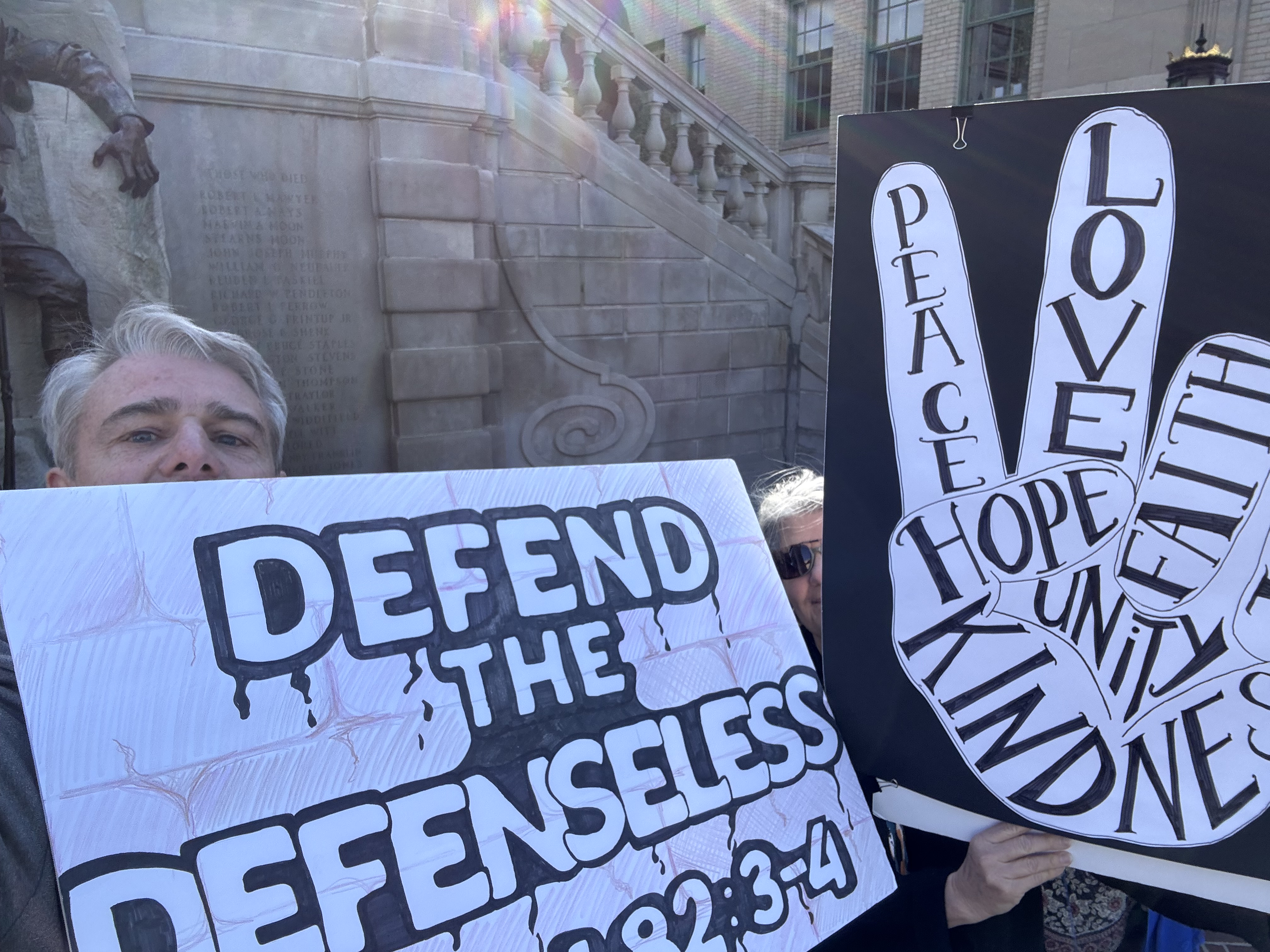
Palm Sunday Prayer

God of Love and Justice,

As we begin this Holy Week, some of us can remember a more innocent time when we possessed a more naïve understanding of the world.

Our thoughts were as innocent as the children who waved palm branches on this day.

We once listened to scripture retell the events of this week and wondered how on earth can the actions and attitudes of people change so dramatically in a just few days.

How can people enthusiastically choose to follow a nonviolent savior riding a donkey on Sunday, and in the same week, choose a violent insurrectionist to be their savior instead. How can people shout “Hosanna! Blessed is he who comes in the name of the Lord!” on Sunday, and days later, shout “Crucify him.”

But living in this current culture, we no longer wonder.

For we live in a nation where people claim to follow the way of Jesus on Sunday, but during the week, willfully choose to live a way that is the exact opposite.

Instead of blessing the poor, they curse the poor.

Instead of providing comfort to those who are mourning for their lives to matter, they tell them that their lives matter too.

The meek are oppressed; not blessed.

Those who hunger and thirst for justice are scapegoated; not filled.

The merciful are ridiculed.

The pure in heart are bullied.

The peacemakers are labeled “weak” and “stupid.”

And those who seek to follow the inclusive, unconditional, universal way of love that Jesus taught are persecuted for doing so by those who claim Jesus to be their Savior.

The singers of “Hosanna” deny food to the hungry. The wavers of palm branches deny healthcare to the sick. The triumphant deny children an equitable education. Workers are denied a living wage. The imprisoned are denied due process. Immigrants are tormented. Women are subjugated. Strangers are feared and sent away.

Truth and honesty are rejected in favor of misinformation and lies.

Nationalism is preferred over discipleship.

Greed is favored over generosity.

Retribution is supported over forgiveness.

Profit is chosen over the planet.

Guns are valued over children.

Kindness is mocked.

Equality is despised.

Diversity, equity, and inclusion are banned.

Empathy is called a sin.

So, Lord, on this Palm Sunday we pray for the strength to resist, for the courage to dissent, and for the resilience to defy the anti-Christ spirit that seems to have a hold on our world.

Be with us, O God, through the betrayal, the trial, the denials, the mockery, the flogging, the suffering, and the execution; that we like the women disciples, will remain faithful, purposeful, and peaceful all the way to the tomb.

In the shadow of death and grief, renew our spirits to courageously stand against the evil rulers, the authorities, and the powers of this dark world.

May we be resilient until the stone is rolled away, the bonds of death are broken, and the power of evil is defeated. May we remain faithful until love is finally won, peace is fully realized, and liberty and justice are enjoyed by all.

We’re Climbing a Mountain

Sermon inspired from the Anti-Racism/Pro-Reconciliation Facilitator Training workshop presented by the Virginia Christian Church (Disciples of Christ) ARPR Ministry, Martinsville, VA, February 28-March 1, 2025

Luke 9:28-43a NRSV

I have an embarrassing confession to make this morning. I am afraid that some very shameful pictures of me have been posted on the internet. And to make matters worse, I know this will be hard for some of you to believe, but Lori, is with me in those pictures. We thought we were alone.

The pictures were taken on the very top of Sharp Top Mountain. Has anyone here seen them? It has been brought to my attention that some of you may have.

What makes these photographs so disgraceful and humiliating, is that when people see them and say to us, “Oh, I see that you and Lori climbed all the way to top of Sharp Top Mountain!” to be truthful, I must confess that we took the bus.

I know, you are disappointed.

And I am the one who posted the pictures, because the scene from the mountaintop is nothing less than glorious!

Do you want to hear something more disappointing?  For more than thirty years, I have been preaching on Transfiguration Sunday recounting the story of Jesus taking Peter, James, and John to the mountaintop to experience something glorious, and I do not remember ever considering how difficult it is to climb a mountain. Because as far as I know, I don’t believe there were any buses in service for them to take.

And to add to my shame, the mountain that I climbed riding safely in a comfortable, climate-controlled bus, is visible almost everywhere I go in and around Lynchburg, standing as symbol of my shame!

But seeing this mountain as I am driving around, I also think about giving myself a second chance to actually climb it one day. But it’s been a year and a half, and I am still waiting for that perfect day, that day when I don’t have so many other things on my calendar, that day when the weather conditions are just right, when the wind is calm, when I know there’s going little temperature change from the bottom to the top, when the snakes, ticks, bears, coyotes and poison ivy are more scarce, and, of course, when I am in a little better physical shape.

There are so many obstacles to climb a mountain! So many excuses that can be made. Because glory doesn’t happen without some thoughtful planning, some arduous work, some risk of danger, some level of endurance, and even some pain.

On the way to glory, there can be twists and turns. And I am not just talking about ankles and knees. On the way up, sometimes you may have to take a downward turn, even curving around backwards, before heading back up. And because of that, the road is always long. A short mile and a half can take hours.

Unseen forces like gravity are constantly working against you, wearing you down, pulling you in the opposite direction, doing all it can to slow you down, or stop you in your tracks. Yes, there’s some hope on the journey. In some places there are glimpses of the summit, but there’s also self-doubt on the journey and moments of despair.

Perhaps that is why Jesus took Peter, James and John and went mountain climbing—to teach them that glory doesn’t happen without some work. That any vision of the culmination of the law and the prophets and the messiah cannot be seen, transformation and transfiguration cannot occur, liberation and reconciliation cannot be experienced without some serious climbing, without some risk along the way, without unseen forces and entities wearing you down along the way, without a few setbacks along the way.

Perhaps Jesus was trying to teach them that when it comes to real change, glorious change, there’s no such thing as a convenient and comfortable bus that is going to pick you up to take you safely and quickly to the summit. Reaching the summit takes hard work. It takes much energy, and a lot of time. It takes courage, and it takes faith.

So, maybe that is why Luke follows the story of Jesus and the disciples’ mountain climbing adventure with the story of a boy possessed by some dark and evil force.

Now we can only speculate what kind of evil tormented that boy, that put him in physical, psychosocial, or spiritual chains. Maybe he had epilepsy, a traumatic brain injury, or some other disability. But maybe the systems of his day had put him in some place of disadvantage. Perhaps he suffered discrimination and prejudice because of the color of his skin. Maybe he was suffering from the sting of rejection for being non-binary or gay.

We just know that the disciples were unable to do anything to begin to liberate to the boy, to break the chains, to challenge the systems of injustice, to confront the wicked authorities and evil forces that were oppressing the boy, that were refusing to see the image of God in the boy. And like my inability to climb Sharp Top Mountain, I am sure they had plenty of excuses. Maybe they were waiting for some quick and easy solution.

Thus, comes the scathing indictment from Jesus: “You faithless and perverse generation!”

Jesus says to those who claim to be his followers but fail to do the holy work of liberation: “You faithless and perverse generation!” Can you imagine Jesus saying such a thing today? I think you can—

As we are certainly witnessing a perversion of the gospel as a large swath of Christianity has been corrupted to favor a faithless authoritarian over a faithful patriot, favor billionaires over the poor, and favor the privileged (whether that privilege comes from race, gender, sexuality, or money), over anyone who is different.

The world dashes the poor against the rocks of hunger, war, and greed every day. In the words of theologian Cláudio Carvalhaes: “The economic beast controlled by a few demons is making people [today] convulse day and night.”

The immigrant, the refugee, the homeless, the incarcerated, the sick who cannot afford their medications, the mothers who work three jobs to make a minimum wage to feed her children, the trans boy or girl unseen by their country, the victims of mass deportation, the broken families, the traumatized children—they are all like that boy, “thrown into the shadows of our society, convulsing day and night right in front of us!”

And the Christians who have resisted worshipping the beast, those whose faith has not been perverted— those who listen the cries of the left-out and left-behind, who listen to the laments from their friends who are from Ukraine or know people in Ukraine, or are farmers, researchers, or federal workers—we can certainly feel powerless. We can become frozen in our tracks, not knowing what to do, what steps to take to break the chains. And if we can’t find an easy solution or some quick fix, find a meme on social media that will quickly change some minds, come up with some program or event to make it all right, make some real progress to give us some instant gratification, we can become stuck, paralyzed, and, then do absolutely nothing. And we become like the disciples who are rebuked by Jesus.

Yes, perhaps Luke tells us the story of the disciples’ failure to liberate the boy on the heels of the story of the Mount of Transfiguration to teach us that the path to transformation, liberation, restoration, and reconciliation, the road to justice, equity, and freedom, is like climbing a mountain.

It is a long, tedious journey. It is a risky, difficult, hopeful, and sometimes disappointing process. Along the way, there are always forces working against us. One moment we can see the summit and the next moment, a cloud of doubt rolls in, and we wonder if reaching the summit is ever a possibility. Sometimes we take three steps forward only to take four steps backward.

As I reflect back on Black History Month, I become irritated, as I have heard people talk about the Civil Rights movement like it is ancient history, that the fight for equality and justice has been won, that racism is an evil from the past which has been defeated, a sin of the country that should be forgiven, and even forgotten. That we have somehow reached the mountaintop that Martin Luther King Jr referenced in his sermon on April 3, 1968, the day before his assassination.

When the truth is that the Civil Rights movement is far from over. In 2025, the work of justice and liberation continues. The road to glory and reconciliation is a long road that faithful people are traveling today. We are still climbing to reach Dr. King’s mountaintop. While we’re making some headway, there are powerful forces pulling us back.

That is why I believe the season of Lent is so important for the follower of Jesus. For Lent has been called a journey to resurrection, a journey to glory. And there are too many Christians today who ignore or skip this journey by hopping on a bus to get straight to Easter!

That’s why the most attended Christian worship service is on Easter Sunday, while the least attended service is on Ash Wednesday or on Maundy Thursday or Good Friday.

However, Ash Wednesday and Lent remind us that the journey to glory takes some contrition, it requires some sacrifice, it involves some work. It is hard work, but it is also holy work. It is the work we were created by God to do, the road we are called by to travel, the mountain we are destined by God to climb. Thus, when we are climbing, every step we take is on holy ground.

And yes, there will be setbacks. There will be times of disappointment, even moments of despair. But Lent teaches us that those of us with a faith that has not been perverted must keep climbing.

When a citizen calls our LGBTQ neighbors abominations at a public meeting of the city council, we must keep climbing.

And when that citizen claims he has suffered religious persecution after he is surprisingly reprimanded by a council member, we must keep climbing.

When we realize our nation is no longer the leader of the free world for the very first time in our lifetime, we must keep climbing.

While perverse politics seek to turn back to clock on civil rights, school segregation, voting rights, and women’s rights, we must keep climbing.

As a faithless and perverse congress tries to take away Medicaid from our most vulnerable citizens among us, we must keep climbing.

When our friends, family or coworkers try to talk us down from the mountain, when unseen forces are pulling us down, when the wicked winds howl and knock us down, we must get up, and keep climbing.

When we are gaslighted by the perverted and faithless privileged, telling us that we no longer have to climb, that we have already reached the summit, we must keep climbing.

And knowing that we may not reach the mountaintop and witness the glory in our lifetimes, we are going to train our children, and if we live long enough, our children’s children, to keep climbing.

Knowing that when we climb, wherever we are on the journey, whatever position or situation we may find ourselves in, when we climb, even if we are pushed back and knocked off our feet, when we climb, even if we are crawling down on our hands and knees, when we climb, we are always on holy ground.

Claiming the Body of Jesus

cross

Sermon preached at St. Francis Xavier Catholic Church for the Ecumenical Good Friday Service, 2017 in Enid, Oklahoma.

John 19:38-42 NRSV

After Jesus is crucified, John speaks of two individuals who emerge from the shadows, exposing themselves, risking their anonymity, putting their reputations on the line, by claiming the body of Jesus.  The first is Joseph of Arimathea, a disciple of Jesus who had previously hid his faith in secrecy for what John calls “fear of the Jews.”  He was one of the Jewish authorities who never openly confessed their faith in Jesus because of fear of losing their political power and position in the synagogue.

And the second was Nicodemus. You may remember Nicodemus from John chapter 3. He had previously come to Jesus secretly by night, showing some interest in Jesus, but never making a public profession of faith.  However, now on Friday afternoon, in claiming the body of Jesus, the faith of both of these men is clearly exposed and made very public.

And as we read John’s account we notice that by coming out of the shadows, openly claiming the body of Jesus, these two men do much more than risk their anonymity and their reputation in their community.  They also put at risk their religion.  For touching the dead body of Jesus made them ceremonially unclean which meant that they would be unable to celebrate the Passover and the Sabbath with their families.

The extravagant amount of burial spices which weighed about a hundred pounds that the men bring to anoint Jesus’ body, tell us that these men also put at risk their riches. Along with the expensive spices, the linen burial clothes they used to prepare Jesus for burial were usually something worn only by people of wealth and prominence. The pristine condition of the garden tomb also underscores the extravagance of Jesus’ interment.

So in this story we see two persons who come out of the shadows risking reputation, religion and riches to claim the body of Jesus.

The question which should come to our minds is why?  Why risk anything for someone who is dead?  Why would Joseph and Nicodemus risk their reputation, their status in the community; their religion, their standing in their family; their riches, and their wealth for a lifeless corpse?

What was it that led these men to risk so much?  Well, one might ask: What would have happened to the body of Jesus if these men had not claimed the body of Jesus?  Well history tells us that after a Roman crucifixion, the unclaimed bodies were often left hanging on the cross to be picked apart by birds. And other times, the unclaimed bodies were simply thrown into the trash dump outside of town.

So these men, living in secret shadows, loving Jesus from afar, simply said, “enough is enough.”

We can no longer conceal our faith.  We can no longer mask our love.  We can no longer sit back and do nothing. We can not bear to let our Lord and our Savior’s body be defiled by being picked at by birds or thrown into a pile of trash.

We must do something.  Even if it means putting at risk every thing that we cherish, everything that we hold dear.  Even if it means risking our reputation, our religion (the way we have always done it anyway), all of our riches, we must act.  We can no longer stay in the shadows. Our love for our Lord demands that we claim his body:  that we remove him from the cross; that we prepare his body for burial, that we seal him in a rich man’s tomb.

It was love, pure and simple and powerful which caused these men to act on the behalf of Jesus by claiming his body risking reputation, religion and riches.

The irony here is that it was the same love which caused our God to act on our behalf.  The story of Joseph and Nicodemus is the story of our God.  Out of a high and holy place, our God said: enough is enough.  I can no longer love my creation from afar.  I can no longer watch my creation suffer and perish.  I can no longer keep myself from risking my all, from empting myself, from becoming a human being.  I can no longer keep myself from offering my creation all that I am and all that I have. I can no longer keep myself from pouring myself out.  I can no longer keep myself from loving my creation even to the point of death, even death on a cross.

Joseph and Nicodemus claimed the body of Jesus because they were filled with the divine love of God.

The question for us is this:  How long are we going to continue to live in the shadows?  How long until we open our hearts to the story of God’s love; to the divine love of God which wants to fill our souls, to be so overflowing with the love of God that we have to cry out: “enough is enough!   I can no longer sit back and do nothing, I must act. I can no longer love my Lord and my Savior from afar.  I must claim the body of Jesus, the body of Christ, for myself even if it means putting at risk the things I most hold dear.  Even if it means risking reputation, religion, and riches, I must share this pure and simple and powerful love with everyone I know. I can no longer let others suffer alone. I can no longer sit back and allow injustice to continue. I can no longer ignore inequality. I can no longer turn my back on those who are marginalized and ostracized. I can no longer keep my faith private.  I can no longer remain silent. I can no longer keep myself from giving all that I have and all that I am to the ones who are lonely, thirsty, cold and hungry.  Enough is enough!  I must claim the body of Christ!”

Well, what are we waiting for?  Are we afraid of what we might lose from risking so much?  Let’s look at what Joseph and Nicodemus lost by claiming Jesus’ body.  They really did not lose a thing.  Instead of losing their reputations, their good names, their names are remembered by the gospel writers and by you and me two thousand years later as the ones who risked everything to claim the body of Jesus.

How do we want to be remembered?  As someone who lived only for one’s self; accumulating a lifetime of reputation, religion and riches?  Or would we rather be remembered as one who because of so much divine love welling up inside of our heart, we risked it all to claim the body of Jesus?   By doing whatever we can to serve our Lord in our community and in our world.  By giving all that we have and all that we are to our Lord by loving others with the complete, divine love of God.

Holy Week

holyweekSometimes it seems odd to call this week “Holy.”

The week that begins on Sunday with our Savior’s triumphant entry into Jerusalem ends with his death on a cross at a place called “The Skull. Shouts of “Hosanna!” on Sunday quickly turn into shouts of “Crucify Him!” by Friday.

Every imaginable evil is hurled his way. The powers that be, both religious and political, are ready to entrap and ensnarl him. He is betrayed by one of his very own followers with a kiss for thirty pieces of silver. After his arrest and a hasty trial, his disciples all abandon him. One of his closest friends on earth denies that he even knows him.

Then, deserted by his friends, Jesus is ridiculed, spat upon, utterly humiliated and beaten beyond recognition. A crown of thorns is put on his head, and he is forced to carry his own cross. His hands and feet are nailed to the cross before it is lifted into the air where he hung for six hours between two criminals before dying. The week ends with his burial.

What on earth is “holy” about any of these events?

The answer is a simple one. If Jesus is an ordinary man, then the answer is, “nothing.” If Jesus was but a man, then this week is utter tragedy. However, if Jesus is the Incarnate God, the creator of all that is who became one of us, then the answer is “everything!”

For it means that God understands every aspect of what it means to be human. Our God is a God knows something about every imaginable evil that can be hurled our way. Our God knows betrayal, abandonment, humiliation, loneliness, and immense suffering. Our God has experienced death.

This week means that our God understands.

And three days later, an empty tomb reveals that God redeemed it all! God took the evil hurled God’s way and transformed it, recreated it into something wonderful.

Thus, the good news of this week is that not only has God experienced all of the evil of this world and understands (which would be good news enough), but that God takes that evil and transforms it into something wonderful, something profoundly “Holy.”

Greatest Love Story Ever Told

greatest love storyJesus did his best preaching when he told a story, a parable. Jesus simply told a story, usually taken from the ordinary, everyday experience of life to reveal something extraordinary about who our God is and how much our God loves us. So, at this time, I would like to attempt to do the same.

Once upon a time, a man and a woman who loved each other very much were married (by the way, this is a true story, based on a real couple I know). They shared a wonderful life together.  They lived out their marriage covenant in a way that many couples do not duplicate.  They were completely faithful to one another in every way.  They were never abusive to one another, and neither one ever held any grudges or let selfish ambition come between them.

The couple had been married for nearly thirty-years, when the husband was diagnosed with Parkinson’s disease. After several unsuccessful brain surgeries to control the progression of his disease, he was left in a catatonic state and had to be admitted to a nursing home. Unable to lift his head, he was spoon-fed and cared for as if he were an infant.  On most days, there was no way to tell if he even knew he was in the world.

Yet, this loving, compassionate wife, who promised to be faithful in good times and in bad, in sickness and in health, for better or for worse, till death shall part them, remained very faithful.  A day never went by when she did not visit the nursing home to make sure his needs were being met, letting him know in the best way she can that she will always remain by his side.  And oftentimes, she made his favorite dishes at home: strawberry shortcake, always using pound cake as he liked it, and sometimes a pecan pie.  She would then wrap the dessert up and bring it to the nursing home, where she would place one hand under his chin, lift his head and feed him the cake or pie with the other hand.

I have often thought how wonderful it would be to know that if one day my health fails me, and I wind up in a similar situation, someone will be there for me, to not only check on me daily, to make sure I am treated well, my needs are being met, to stay by my side, but also to prepare my favorite dishes, which just so happens to be strawberry shortcake and pecan pie, hold my chin, lift my head, and feed me.

This is who I believe our God is.  God is a loving spouse who is living out a covenant with us, not only promising to be faithful, to stay by our side, but there at our side, in our weakest moments, takes a hold of our chin, lifts our heads and feeds us pie, a peace beyond understanding.

But you know something. There is something amiss in this parable.  There is something wrong, something missing.  For when we really think about it, as wonderful as this parable is, we realize that it simply fails to do the greatest story ever told appropriate justice.  Especially when we consider that unlike the husband in this parable, we have not always been faithful to our God; when we consider our constant betrayals and our continuous denials. When we consider that when God offered us the very best gift God had to offer, the gift of God’s self, we reciprocated that gift with the very worst we had to offer, the cross.  But remaining faithful, empowered by pure, unconditional love, God summoned the will to resurrect this gift and give him right back to the undeserving ones who killed him, making eternal life possible for all.

Perhaps a more appropriate parable would go something like this:

Once upon a time, a man and a woman who loved each other very much were married. However, they did not share such a wonderful life together. From the very beginning, the husband had a problem with alcohol, which grew as time went on. Although the woman remained true to her marriage covenant, he did not. He had numerous affairs.  He usually blamed the alcohol, but on occasions he would tell his wife that his running around was her fault. He simply did not find her as attractive as he once did.

Family and friends, even her pastor, rightfully tried to persuade the woman to leave the loser. But they did so in vain. She said repeatedly that she promised to remain faithful in good times and in bad, in sickness and in health, for better or for worse, till death shall part them, and she intended to do just that. And this husband was not always bad. She said, “At times, when he is sober, he could be a perfect gentleman, always apologizing for his actions. He can even be attentive to my needs.”

But as time went on, those good times became fewer and further apart. The abuse, which had in the past always been verbal and mental, turned into physical abuse.  It got to a point when the woman could hardly remember a day when he was sober and when he did not strike her.

One day, in a drunken rage, he was yelling and screaming for his supper. As the wife, who had been nursing a broken jaw from a previous fight, was preparing it as fast as she could, he hurled abusive insults at her and struck her again on the side of her face that was still swollen.

She said, “Stop it. Please stop it.  Look at yourself. You are not the man that I married. Look what you have let alcohol do to you. You don’t know what you are doing.  Please, please get some help.  Please. Don’t you know that I still love you?”

Interpreting her desperate pleas as being combative and disrespectful, he threatened to kill her if she did not shut up.

She continued, “Please, please, I love you, I really do love you.”

He stormed out of the kitchen, slamming the door. She went into the den, dropped face first into a pillow on the sofa and began to cry.  Weeping would be more accurate.  He came into a den with a pistol, jumped on top of her and placed it against her head. She cried:  “Please no. I love you, I love you.”

“I swear to God if you don’t shut up and fix my supper I will blow your head off.” Somehow she managed to turn around and place both of her hands on the pistol. As they struggled, the gun went off.  The husband fell to the floor, bleeding from the head.

But the sorry sod was too mean to die. However, he had to be placed in a nursing home, for he was left in a catatonic state, unable to lift even his head. He had to been spoon-fed and taken care of like an infant. On most days, there was no way to tell if he even knew he was in the world.

And yet, this wife, who promised to be faithful in good times and in bad, in sickness and in health, till death should part them, remains faithful to this very day. A day does not go by when she does not visit the nursing home to make sure his needs are being met. Letting him know the best way she can that she will always remain by his side. And oftentimes she makes his favorite dishes at home: chocolate cake and coconut pie. She wraps it up and bring it to the nursing home, where she will hold his chin with one hand, lift his head and feed him with the other.

Of course, unlike the first parable this one is not based on any man or woman I know. For no one could possibly have so much compassion, be so forgiving, so loving, so patient, so merciful, yet so offensive. No one loves with such socially unacceptable grace, no one except God, as revealed to us in the greatest love story ever told.

For when God offered us God’s very best, we nailed it to a tree.  And then somehow, some miraculous way, through the power of the resurrection, born out of pure love, God fed us and continues to feed us pie.