Gone out of the Religion Business

GoingOutOfBusinessHebrews 10:11-25

This morning, I wonder how many of you could answer the following question if you were on television playing for one million dollars. You’ve already used all of your lifelines. You can no longer poll the rest of the congregation or use your friends at AT&T to telephone a friend.

Which of the following is not a religion?

a. Running Marathons

b. Investing in the Stock Market

c. The Atkins Diet

d. The Christian Faith

Again, you can only choose one. All life lines have been exhausted. Which is not a religion?  If you said, “d. the Christian faith,” and that was your final answer, you just won one million dollars!

The wonderful truth about our faith is that it is not a religion. No matter what some may tell you, the church is not in the religion business.

While I was pastoring a church back in 1993, a deacon asked me where I saw myself in twenty years. I told him that I believed that I would still be pastoring a church somewhere.

He laughed out loud.

“What’s so funny?”

“I see you more as the type who might be teaching in some college somewhere, or playing a college professor in a TV commercial. I don’t think you are going to be a pastor.”

“Why do you say that?”

He said, “For one thing, pastors are generally religious people. And you, my friend, are not very religious!”

What this deacon failed to realize was that the church is not in the religion business. The truth is, the last thing a Christian pastor should be, is religious.

Let me share with you what I think is a good definition of religion.  This comes from Robert Capon. 

Religion is the attempt by human beings to establish a right relationship between themselves and something beyond themselves which they think to be of life-giving significance.

William Willimon has said: 

Religion is the human attempt to get a handle on the key to life, to plug in to power, to find the program that leads to happiness, meaning, self-esteem, or whatever it is that gives a person life.

And the strange thing is: that key, power or program may have absolutely nothing to do with God. Before my knee surgery, Lori used to say that I ran religiously. She has said that I read Runner’s World magazine like I read the Bible. I read it religiously every month, trying my best to run faster, achieve good health and look better so I can enjoy the good life!

We have all observed the religious habits of others. “He studies the Wall-Street Journal religiously.” “She sanctimoniously follows the Atkin’s diet.” “He works 60 hours a week, religiously.” “He plays golf, religiously.”

The truth is many of us are doing all we can do, working out, eating right, studying, going to work, following a regimen, all with the same goal: to achieve life! We do it for ourselves, but we also for that something which is beyond ourselves: low blood pressure and cholesterol, smaller hips, a house on the river, for that something which will grant us fulfillment and satisfaction. So, it’s possible to be a religious fanatic and have absolutely nothing to do with God.

However, for some of us, religion is all about God. There are those of us who feel that we must be religious to get right with God. Religion is viewed as something that people work at in order to have a correct relationship with God. If we can say the right prayers, believe in the right creed, behave the right way, avoid the right sins, then we can be right with God. If we can conduct our lives based on high moral and ethical standards, we can place ourselves in a right relationship with God and achieve abundant and eternal life.

Willimon says that the bad news is that we human beings are always flunking religion. No matter how hard we work at religion we can never get it right. For years I had been following the advice of Runner’s World magazine by eating salmon every chance I can got for those omega three fatty acids for my heart. I used to eat the stuff all the time. Lori once said she thought I was going to turn into a salmon. Well, in an issue not that long ago, I learned that if the salmon is not caught wild, straight from the ocean, it will probably give you cancer. Turns out, the farmers who raise the fish feed it these food pellets which are laced with cancer-causing chemicals. No matter how hard we try, we can never get it right.

They used to say that eating bacon and eggs every morning will make you fat and kill you. Now, they say it is that bagel which is going to make you fat. They used to tell us we could get thin by snacking on rice cakes, now they tell us its best to snack on pork rinds. We can’t win! Religion is always a one-way ticket to failure.

Take the religion of golf. You master your irons and start slicing with your woods. You drive long and straight with your driver, hit your iron and land on the green in two, and then you three-putt. That is part of the reason golf is so addicting. It is a one-way ticket to failure. You make a bad shot and it makes you mad. You make a good shot and it makes you mad, because you wonder why you can’t hit it like that every time!

The truth is: at religion, the harder we try, the greater we fail. We can eat all of the right foods and exercise every day of the week and still need knee surgery.

We can place all of our time and energy into our careers, going to work early and leaving work late, and still be unappreciated and miserable.

And when you finally arrive at the place where you think you have it right with God. You finally believe you have got it right in the ethics and morality department, guess what? It usually leads to pride and arrogance. I had a church member tell me one day, “I am the most humble person in this church!”

Sure you are.

The good news of our scripture lesson this morning is that God came into the world through the person of Jesus Christ to put an end to religion.  Hebrews notes that the priests stood before God in the temple. Of course they stood. There was no time to sit. There is no chair in the holy of holies. Think about it: I know if a priest is going to be setting things right between God and my sin, he’ll never have a chance to sit down! The poor priest will constantly have to be running back and forth between my sin and God’s salvation.

No matter how great and sincere my sacrifice is when I go to the temple, my sin is still going to get the best of me before I can get back to my car. The poor priest is never going to get a day off. He’s never going to be able to sit down. That’s why we read: “And every priest stands day after day at his service and again the same sacrifices that can never take away sins.”

In contrast to the posture of the priest who is always standing, notice what Jesus is doing? Jesus is sitting. “When Christ offered for all time a single sacrifice for sins, he sat down at the right hand of God.”

The veil in the temple, separating us from God was torn in two at his death. In this great gift of God’s self, God put religion out of business. And now, Jesus is sitting down.

Consequently, there is no point of us getting on some treadmill of right thoughts, right speech, right actions, because that right relationship we so desperately seek has already been made right by God. We have to only trust that God has indeed done what was needed to be done through Christ. This is why our church teaches “no creed but Christ.” Being a member of this church is not about believing this set of principles or that set of ideals, that biblical interpretation or this style of worship. It is about believing and following the Christ.

That is why we call it the gospel. It is good news. If we called it religion, it would be bad news. Religion would mean that there was still some secret to be unlocked, some ritual to be gotten right, some law to obey, some theology to grasp, or some little sin to be purged. Praise God, in Jesus Christ, this thing called sin between us and God has been made right. Thank God the church has gone out of the religion business!  If it hadn’t, there is no doubt in my mind that I would be in some other line of work by now!

This is why extremist or fundamentalist religion is wrong and dangerous, whether it is fundamentalist Muslim religion or fundamentalist Christian religion. Religious extremists believe that their salvation and the salvation of the world is dependent on the laws they believe, the laws they teach and the laws they obey. That Is how they can justify shooting people in a marketplace, in a school, or in a church, or blowing up a plane, a restaurant, a theater, an abortion clinic or a building with a daycare center. And this is how they can justify creating a fuss if others do not believe as they believe. They believe it is their God-ordained, religious duty to force their beliefs on others to keep themselves right with God.

The good news is, unlike the priests who are standing, running around, creating a fuss, trying to get it right, Jesus is sitting down. His work is done. The work of religion is out of business. We accept salvation trusting that Jesus has already done the work for us.

Think about that. Because I know that are some of you who still believe that what we do here in the church is religious. You have never professed faith in Christ through baptism because you are waiting until you somehow get it right yourselves. You’re busy running back and forth to altars of good heath, right conduct and correct thinking. I invite you to come and realize that God has already made it right through Jesus Christ. I invited you to take a good look at Jesus this morning.

There he is. He’s sitting down.[i]

[i] Inspired from a sermon written by William Willimon.

Grateful for Grace

life itself is graceDuring the holiday season, I often hear promos on the radio or television soliciting donations of toys, clothing or money to benefit “deserving” families. People will call me every year to ask our church to help an individual or a family at Christmas, and when they do, they will almost always add: “I believe these are the type of people who ‘deserve’ our gifts.”

When the love of God compelled God to give the gift of God’s self to the world, I am thankful God did not limit the gift of Christ to only those who “deserve” such a gift. It was while we were yet sinners, yet undeserving, that God revealed God’s unconditional love to us.

I recently visited a young man in the hospital. He suffered a stroke a few months ago and was being treated for an infection around his heart. It was obvious that he was experiencing both pain and fear. Yet, when I asked him how he was doing, he replied: “Well pastor, I am alive. So, I am doing better than I deserve.”

Aren’t we all? For who on earth did anything to “deserve” the gift of life?

This holiday season let us share our gifts freely, without restrictions, without conditions. Let us love our neighbors as we have been loved by God.

And this Thanksgiving, let us be grateful for grace, because if we are alive, we are doing better than we deserve.

Come Home

prodigal_son

Hebrews 4:12-16 NRSV

A huge issue facing the church today is authenticity, or more specifically, a lack of authenticity.

People say that churches are full of people who pretend like they have it all together. Churches are full of fake smiles and phony piety. Churches are full of folks who act like they have all of the answers, have everything on earth and even in heaven all figured out.

Almost every week, I will hear at least one person ask: “Why can’t Christians just be real?” Someone once asked: “Why can’t people act the same way in church that they act at home?”

I believe the reason many Christians are so fake is that we still have a problem with the good news of the gospel we call grace. We have a difficult time believing that God truly loves us, accepts us, and welcomes us just as we are.

Because, it seems too good to be true.

I believe we Christians have a difficult time being authentic, making ourselves at home, because we have a difficult time accepting that the extravagant, amazing grace of Christ that welcomes us to be real; and because of that, we also have difficult time sharing grace. So, not only do we hide or deny our sins, we are quick to point out the sins of others. Consequently, we have gotten this reputation in the world for not only being fake, but also judgmental.

Indeed, the word of God is living and active, sharper than any two-edged sword, piercing until it divides soul from spirit, joints from marrow; it is able to judge the thoughts and intentions of the heart. And before him no creature is hidden, but all are naked and laid bare to the eyes of the one to whom we must render an account (Hebrews 4:13-13).

Indeed, but sadly, I believe this is where most folks in the church stop reading the Bible. We cannot even think about laying all of our sins bare before the Lord. So we cover it up, hide it, deny it and try to justify it.

And it is obvious to our friends and to everyone we encounter that we phony.

So listen again to the good news:

Since, then, we have a great high priest who has passed through the heavens, Jesus, the Son of God, let us hold fast to our confession. For we do not have a high priest who is unable to sympathize with our weaknesses, but we have one who in every respect has been tested as we are, yet without sin. Let us therefore approach the throne of grace with boldness, so that we may receive mercy and find grace to help in time of need (Hebrews 4:14-16).

But it sounds too good to be true. Doesn’t it? It is almost difficult to hear.

Let us hold fast to our confession. In other words, let us get real and be real. Let us lay bare our sins and authentically approach the throne of judgement.

Wait minute, it doesn’t say that. Does it?

Let us lay bare our sins and authentically approach the throne of grace.

That’s what it says.

And let us do it fearfully.

No, that’s not what it says.

Let us do it with boldness.

That’s what it says.

So, that we may receive our punishment and find correction.

Nope.

So that we might receive mercy and find grace in the time of need. It’s like coming home. Coming home where we can be real, authentic, yet still be accepted and loved.

But it is sounds too good to be true. Doesn’t it? It is all so extravagant, so amazing. It is difficult for us to read, hear and comprehend.

I believe Jesus knew that we would have a hard time with this. That is why I believe he prepared us for it by telling so many stories.

There was a father who had two sons. The youngest had the amazing gall to demand his inheritance so he could leave home. As the youngest, this disrespectful son had no claim to anything of his father’s. Who did he think he was?

Then the truly amazing part: The father takes his “whole living;” (notice how extravagant this is) the scriptures say that he takes all that he has, and gives it to the boy who slips into the “far country” where he wastes every red cent on selfish living. It is only when he finds himself in the time of his need that the boy decides to go back home.

This is where the story gets even more amazing.

“And while he was a long way off,” the father saw him and ran and embraced him.”

Think about this for a moment.

How did the father see him “a long way off?”

Because the father had been looking for him.

Every day this father sat on his front porch gazing down the road, grieving but hoping and praying that his child would one day come home.

And when he finally came home, he ran to him and cried out: “Come and celebrate with me. My child who was dead is now alive!”

I wonder how long the father waited for his dead son’s homecoming. I wonder why the father waited. For all he knew, his son was dead. Can’t you almost hear his concerned friends and neighbors, or maybe even his preacher, telling him: “Old man, it’s time for you to move on. Old Man, you’ve got to get past this. You’ve got to face the facts. He’s not coming back. You got to get over it. Concentrate on your older boy who is still here with you.”

But the father, amazingly, still waited. Most of his friends probably thought he was crazy. Such excessive, extravagant waiting was hard for them to believe.

After all, he really did not know that his son was ever coming home. A young kid with a pocket full of cash first time away from home was an easy target to any would-be thieves and murderers. Remember the story of the Good Samaritan?

Still the father patiently, amazingly waited. Every day he kept looking down the road in front of his house. Straining to see, hoping to see his son coming home.

We call this the story of the prodigal son. But William Willimon says that if the word “prodigal” means “extravagant” or “excessive” or “amazing,” it should be called the story of the prodigal father. For when the boy left home, the father extravagantly gave him his entire savings. While he was gone, his friends and neighbors would say that the father excessively waited. And when the boy at last came home, the father extravagantly threw a huge party, holding nothing back. The father loved his son prodigally when he left home, he loved him amazingly while he was away from home and he loved him extravagantly when he returned home with a fatted calf, a new robe and sandals, a ring, and festive music and dancing.

It all seems too good to be true

It is a story of extravagant, excessive, prodigal love. It is a story of amazing grace.

And the good news is that Jesus’ story of the prodigal father is the story about his prodigal Father. And it is the story about our prodigal Father. Our God is a God who, when it comes to grace and love, holds absolutely nothing back.

I know, the truth sounds too good to believe, but it is the truth.

Our God waits, with confidence that the far country of sin and death shall not be the last word. Our God waits, ready to welcome us home with a celebration that is more than we deserve, not because of who we are, but because of who God is, namely a prodigal father.

One of the greatest things about this story told by Jesus is that it does not have an ending. Have you ever noticed that? We wonder if the younger boy ever learned from his mistakes and grew up to be more responsible. We wonder if the older brother ever let go of his resentment. We don’t know. All we know is that both boys are finally safe, at home with the father.

Willimon suggests that perhaps the reason the story does not have an ending is because this story is eternal. We know when the party began. But for all we know, the party never ended. Maybe this is a scene of what we all have to look forward to. An eternal homecoming celebration for those daughters and sons who once were dead but are now alive, who once were lost but now are found.

After our service this morning, you are invited to a homecoming celebration that has been waiting for you that Joan Smith, once called “a true vision of the Kingdom of Heaven.”

When you see the large amount of food that has been prepared for you this day, it may cause you to pause. It is so excessive, so extravagant, you may have trouble believing it. It will seem too good to be true.

But before this service is over, you are invited to another homecoming celebration that has also been waiting for you. In fact, this homecoming celebration is waiting for you each week. The meal is small. It’s just a tiny cracker and a sip of juice; however, when you understand the meaning of it, the truth of it, the love and grace of it, the extravagance and the excessiveness of it, it may also give you pause. For you may have trouble believing it. It will seem too good to be true.

But the good news is that it is true. For it is the truth. It is the good news of the gospel. It is amazing grace, and it is for you.

So, come home and hold fast to your confession.

Come home and be as real and as authentic as you can be.

Come home with all of your sins laid bare.

Come home and approach the throne of grace with boldness.

Come home because you will not be turned away from it.

Come home because nothing in heaven or on earth can separate you from it.

Come home, because this celebration has been prepared for you, even while you were still a long way off.

Come home, because this table has been set for you even while others have judged you, have condemned you, have given up on you, and even have written you off for dead.

Come home, because your God has not given up on you.

Come home, because your God has been waiting for you.

Come home, because his body has been broken for you.

Come home, because his blood has been shed for you.

Come home, because Christ has died for you.

Come home, because Christ has been raised for you.

Come home, because the baptistery has been filled for you.

Come home, because the Word of God is alive and active for you.

Come home and receive extravagant and excessive mercy.

Come home and find amazing and prodigal grace…

this day and forevermore.

Rain, Faith, Hope and Love

too much rainRain is good. We need rain, but we don’t need so much rain. There is such a thing as too much rain.

I suppose that rain is like most things in life. Moderation, they say, is the key. Eat and drink, but don’t eat and drink too much. Have a little dessert, but have a little dessert. Don’t overdo it.

The same thing could even be said about faith. Muslims and Christians calling for the deaths of one another is an example of extreme faith or too much faith. Too much faith, one could argue, leads to closed-mindedness, bigotry, self-righteousness and even violence.

So have faith, but don’t overdo it. Always respect the freedom of those who have different faiths and even those who have no faith.

What about hope? Have you ever known anyone who hoped too much? They hoped so much that they literally lost touch with reality or got stuck in the past. It is one thing to hope for the possibility of good new days, but it is quite another to hope for the return of good old days.

So hope, but don’t overdo it. Be real with hope. Hope for the future; not for the past. Elvis is not coming back.

What about love? Can we love too much? Can we overdo it with love?

One who has experienced the heartbreak of grief may quickly answer: “Yes.”

However, after thinking about it, I believe most would answer: “No!” Because although loving another will inevitably bring some pain, never loving another, and never being loved by another, is unthinkable. Overdoing love may lead to heartache, but restricting love leads to something much worse.

Garth Brooks once sang, “I could have missed the pain, but I’d have had to miss the dance.” In other words, the only way to miss pain in life is to miss love in life. But to miss love in life is to never really live.

So love. Love freely, unconditionally and unreservedly. Overdo it. Never limit love and never moderate love. Never love “a little.” Love until you think you can’t love anymore. Love until you realize that you can never love too much. Love until it becomes clear that love never fades, and love never fails.

And now rain, faith, hope and love abide, these four; and the greatest of these is love.

Welcome to the Table

Maundy ThursdayEach Sunday, I worship around a table. The table may seem small, but at the same time, it is very large. For the bread that is served from this table, and the cup that is poured from this table symbolize a boundless love, an extravagant grace and an eternal promise.

Therefore, each Sunday, I can stand boldly in front of this table and confidently say:

If you are riddled with all sorts of doubt, you are welcome.

If you have never doubted anything in your life, you are welcome.

If you have no self-control, you are welcome.

If you are all about self, you are welcome.

If you humbly believe you are the worst sinner in town, you are welcome.

If you arrogantly believe you are the best saint in town, you are welcome.

If you are empty and lost, you are welcome.

If you are teeming with pride and confidence, you are welcome.

If you are broken, poor and weak believing you have nothing to give, you are welcome.

If you are whole, rich and powerful with much to give, you are welcome.

If you have little or no faith, you are welcome.

If you think there is no one more faithful than you, you are welcome.

How can this be?

Because this table, this bread and this cup, is not about you.

It is not about what you can or cannot do for God.

But it is all about what God has done, is doing, and will do for you.

Therefore, all are welcome, and all means all.

Flip-Flopping the Message

flip flop

The following is an excerpt from:  Let the Children Come

Although our intentions were to share the love and grace of Christ with others, I believe the church has actually been guilty of doing the exact opposite. Simply put, with our words and our actions, we have oftentimes preached the gospel backwards, and in doing so, we have shared hate and judgment.

To share Christ with others, we often start with what is sometimes called the doctrine of original sin. Now, don’t get me wrong. I believe that all people are born into this world as sinners. I just don’t believe that is where we should begin the conversation or the sermon.

Our sermon usually has three points: 1) All people are sinners; 2) God sent Jesus to die for us; 3) If we believe this, then God will forgive us and love us as God’s children forever.

I think we should preach the same sermon, only flip-flop it and proclaim it the other way around.

I believe we should always begin with God’s love for all people. We should make our number one point that God loves us as God’s children and wants nothing more than to love us forever. The second point should be that God came through Jesus and loved us so radically, showered us with grace so extravagantly, so offensively, that people, most of them religious, nailed him to a tree. And we should make our third and final point that God did this while we were yet sinners.

Do you see the difference? Instead of preaching that all people are born on the outside of the love of God until they do something, say something, or pray something to earn forgiveness, we should preach that all people are actually born inside the love of God without doing, saying or praying a thing to earn it. Our words and actions only help them to believe this and to accept it.

Jesus put it this way: 1) For God so loved the world; 2) God gave God’s only son; 3) So that all whosoever believes may not perish by their sins but have everlasting life (John 3:16).

If we keep teaching this, continue preaching this with our words and deeds, if we keep making the church a place of extravagant grace and radical love, then, before you know it, we will start seeing the entire world differently. We will start seeing people differently. Instead of seeing people first as sinners who deserve hell, fire, and eternal damnation, we will begin to see all people first as God sees them: God’s beloved children.

Repeat the Sounding Joy

communionThe following was written by Alison Lord Stuart on January 12, 2015 for The Daily Reflector.

A good question to ask ourselves in the cold of January is just what will we take from Christmas into the New Year.  Maybe argyle socks, penny loafers, a cherished memory or an unspeakable loss.  Whatever it is that we fold in for the long journey, we will be different because of it.

Throughout December, I was mesmerized by certain words found in Joy To The World; “repeat the sounding joy.”  I have thought of the beauty wrapped into “sounding joy” and often wondered what it could be.  Then I heard it one morning at First Christian Church in Farmville and almost like an epiphany, I knew.  After the serving of Holy Communion, it was the sound of Communion cups being placed in pew holders. Similar, indeed, to the sound of pew benches being turned back after the serving of the same Sacrament. Both sounds indicating that our singular and corporate seeking of God’s forgiveness is fully present and fully heard.

For Believers, it is a majestic, full bodied, orchestration of sound.  The perfect balance; the fulcrum of falling short and being the beneficiary of unconditional love.  In a long week, month or year, it is a sound to be coveted. It is the sound of hope.

God’s will is that the discordance of our sin doesn’t have to be the end of our song or life story.  Forgiveness, strength and renewal are at God’s Table, there for the asking, freely given and freely received.

The sounding joy given to us by a Risen Savior is grace. It is in the wiping clean of our tarnished slates, in forgiving ourselves and others, and experiencing the dignity of a new beginning.  It is best heard when we rest our weary souls in the hollow of God’s hand, listen and repeat, repeat the sounding joy.

Baptism by Fire

baptism debate

Mark 1:9-11 NRSV

If you were to ask me what my favorite part church is, I would say that it the service of Christian baptism. I have always said that it is a good day when the preacher comes to church on Sunday with a Bible in one hand and a bathing suit and pair of dry underwear in the other.

Thus, I love this day on the Christian calendar that we call The Baptism of the Lord. Although I would much rather be getting wet this morning, and getting some of you even wetter, this day at least gives me the opportunity to reflect on the wonderful service of baptism.

Baptism is essentially about grace. Baptism is about new beginnings, fresh starts, and clean slates. Baptism is about dying to the old, broken self and rising to a new, better self. Baptism is about the confession, forgiveness and washing away of sins. It is about coming to know that there’s nothing in heaven or on earth that can ever separate us from the love of God. Baptism is about knowing God is with us, not away from us, for us, not against us. Thus, baptism is about living with a hope that is certain and eternal.

Baptism is about initiation into the Kingdom of God. Baptism is a commissioning to be the body of Christ in this world, the hands, legs, feet and mind of Jesus on this earth. There is a reason that baptism is often called a sacrament. Baptism is sacred. It is holy. It is grace, pure and unfettered.

There is perhaps nothing in the church that is more beautiful than baptism. How ironic is it then that some in the church have taken baptism and have created something very ugly. Throughout church history, baptism has created more controversy, schisms and arguments than perhaps any other ritual, service or rite.

Throughout my own ministry, I have seen people angrily walk out of church meetings over it. I have even seen people who have transferred their membership to another church over it. I know people who have written nasty emails, made harassing phone calls, and started vicious rumors—all over arguments about baptism. I know of churches that have even split over baptism.

I have had staff members threaten to resign if we changed our church’s bylaws to accept members who were baptized as infants or by sprinkling. In their eyes, they simply did not get wet enough to join God’s Kingdom. I have heard people argue that some were not old enough, mature enough, good enough, sincere enough, or even married enough to be baptized. A pastor friend of mine from Concord, North Carolina, was kicked out of the Baptist State Convention because a couple of folks he baptized were not straight enough. I even know people who have gotten upset, because the people being baptized in their church were not white enough.

The irony is that we have taken something beautiful that is essentially about God’s free and unfettered grace for all people, and created something incredibly ugly by placing restrictions, limitations and conditions on it. There have been more rules and regulations written in the bylaws of churches about baptism than any other service of the church.

Some churches believe that you can only baptize in a flowing creek or a river (the water has to be moving) because that was how Jesus was baptized. A stagnant pond, lake, and of course, a baptismal pool will simply not do. Some people believe you can only baptize when the church is gathered for a worship service. And most people believe that a baptism can only be performed by an ordained minister, who is, of course a male.

And once a person’s baptism has been accepted and approved, sanctioned by church officials as worthy of the grace of God, then one can use his or her baptism as an admission ticket to become a full-fledged member of the church. They can take communion, serve on a committee, become a voting member of the church board, and of course, one day, go to heaven.

Pastor Karoline Lewis once preached a sermon to her congregation emphasizing that baptism is not something that we do, but something that God does. She said that when we baptize someone in the name of God, we believe that it is God who is actually doing the baptizing. And she insinuated that when we make baptism something that we do, that we control, that we place limits and restrictions on, we pervert the very intentions God has for baptism, for God’s grace can never constrained.

After the sermon, a woman who was in her nineties approached her. “Karoline,” she said, “Is that really true?”

“What?” the pastor answered.

Hazel responded, “That God baptizes you.”

“Yes, it’s true. This is what we believe. Why?”

Hazel then told her pastor about her sister who was born several years before she was born. Her sister was born very ill in the home and never left the house because she was so sick. The family knew she would not live long. She lived about two months. Right before she died, Hazel says that her mother took her sister in her arms and lovingly baptized her.

When Hazel’s parents went to the pastor of their church where they had been lifelong members to plan the funeral, the pastor refused to hold the funeral in the sanctuary because he had not baptized the baby. The funeral was held in the basement of the church.

Hazel, almost a hundred years later, then asked her pastor, “Karoline, does this mean my sister is OK? Is she really OK?”

“Yes,” she said. “Your sister is OK.”

There was Hazel standing in front of her pastor, weeping for the sister she never knew, crying tears of relief and grace.

This is what happens, says Karoline, this is the ugly consequences restricting, placing limitations on the grace of God.

Of course, such restrictions and limitations on God’s grace is nothing new. The Jewish law was full of rules and regulations controlling who can and who cannot have access to God. Throughout history people of all cultures have sought to control and tame the grace of God.

This is why we need to be reminded of Jesus’ baptism. First of all, it was not in a controlled environment such as a baptismal pool or font in the confines of a religious hall, but out in the untamed, wide-open wilderness.

And we are told that when Jesus came up out of the water, that the heavens, according to some translations, were suddenly opened. Now there is a Greek word for open, but that word is not used in Mark 1:9. The word that is used means “ripped” or “torn” apart. The word describes a God who cannot take the separation any longer. God has had about all that God could stand and rips the heavens apart.

The question for us this morning is: who closed the heavens? Who placed the restrictions and limitations on God’s grace? Who placed the barriers between God and humanity? Who creates systems and structures to mediate God’s presence? Insist on rituals and formalities to regulate God’s grace, control the means of God’s love, not for the sake of good order (like we would like to think), but for the sake of our own power?

As a minister I cannot begin to tell you the amount of trouble I have gotten myself into over the years for baptizing people outside the controlled confines of the church’s bylaws. I have baptized people on days other than Sundays in places other than the church building. I have baptized people in rivers, in swimming pools, in small ponds, even in the Atlantic Ocean. I baptized one man with his head laid back in the basin of a sink at a nursing home, trusting that it is God, and not me, who is actually doing the baptizing. It is God, and not me, who rips the heavens apart to shower God’s people with grace.

For the same reason, I honor, respect and accept all baptisms—sprinkling, dunking, pouring, infant, adolescent and adult. And I believe baptisms can be performed by any Christian, clergy or laity, male or female. I do not believe people ever need to be re-baptized because some self-appointed or otherwise-appointed baptismal authority believes their baptism somehow did not “take,” failed to meet certain clerical requirements, or was not sincere enough or wet enough. There is but one Church, one Lord, one faith, and one baptism.

With Karoline Lewis and other ministers who understand that expansive abundance of God’s grace, I welcome all people to the Lord’s Table, because, well, the last time I checked, it’s the Lord’s Table. While some ministers only extend the invitation to those who have been baptized a certain way, I cannot, nor can I imagine Jesus turning anyone away.

What are we going to do? Require baptismal ID cards to be presented to the deacons before receiving communion? Are we to say to those who have not been baptized or not sure they have been baptized: “Sorry, you sitting there in the pew wondering if you have been baptized or not. When the plate of bread and tray of juice come to you, don’t take anything. Just politely pass it to the more worthy person sitting next to you who has the official seal of approval? Because, here at First Self-Righteous Church, we believe it is better to hedge our bets on the side of human reason and control rather than God’s abundant and unfettered grace.”[i]

When we take something as beautiful as the service of baptism as it was performed in the wide-open wilderness, with God ripping apart the heavens to get to God’s Son, to get to God’s people, to reveal God’s love and grace to the world, and we turn it into something that is restrictive, legalistic, divisive and exclusive, some sort of qualifying test for membership, communion, and salvation, then we have missed the whole point of who God is and who we are called to be as God’s Church.

However, when we begin to understand that at our baptisms, whether we were a tiny infant or a grown adult, whether we were sprinkled, dunked or poured upon, whether by clergy or by laity, male or female—When we understand that God, the creator of all that is, ripped open the heavens to come close enough to us so we could feel God’s breath and hear God say: “I love you. I have always loved you. And there is nothing that can ever limit, restrict or constrain this love. There is nothing in heaven or on earth that will ever separate you from this love. I know all of your shortcomings and all of your sins, and I forgive you. I am with you, and I will always be with you. You are my beloved son. You are my beloved daughter. You are my Church in this world”—When we understand this truth, this good news, then our baptisms become what they were always intended to be: pure, unfettered, abundant grace, and we can live with a hope that is as eternal as it is certain.

[i] Sermon inspired by: Karoline Lewis, Baptism of Our Lord, https://www.workingpreacher.org

Grace of Froot Loops

Froot Loops

Excerpt from Check Your Oil for The Farmville Enterprise.

How many times have you heard “You don’t know what you’ve got until it’s gone”? You don’t know what you’ve got until a relationship ends, a moment is lost, or a freedom is taken away.

A woman suffering with cancer, who lost her ability to perform even the most mundane tasks, once told me: “It is amazing how much we take for granted every day. Oh, how I would give anything in the world to be able to get up out of this bed, walk into my kitchen and just pour me a bowl of Froot Loops.” She went on, “When I was healthy, when I could get out of bed and walk to the kitchen, when I could feed myself, when I could chew and swallow my food, I don’t believe I ever thanked God for something as boring as a bowl of Froot Loops.”

Who in the world even thinks about the awesome gift of being able to do something as mundane and as boring as pouring a bowl of Froot Loops? Someone who can longer pour a bowl of Froot Loops thinks about it.

Who in the world thinks about the miraculous gift of being able to walk? Someone who has lost the ability to walk.

Who in the world thinks about the gift of healthy lungs? Someone living with COPD.

Who in the world thinks about their kidneys or their liver? Someone on the way to a dialysis thinks about their kidneys. Someone living or dying with cirrhosis thinks about their liver.

And who in the world the world truly thinks about the miracle that is their life, the miracle that is this creation? People diagnosed with a terminal illness do. Those who have recently lost a loved one to death do.

In one of his parables, Jesus said that some foolish bridesmaids missed the whole dance, because they forgot to fill their lamps with oil and did not see the bridegroom when he showed up. Jesus ended the parable with the admonishment: “keep awake” (Matthew 25).

Keep awake. Check your oil. Keep your lamp burning. Don’t miss the dance. Keep watching and keep looking, recognizing that we are never promised tomorrow. Take nothing for granted. Don’t wait until it’s gone to know what you’ve got. Treasure your lungs, your kidneys, and your liver. Cherish the ability to walk into the kitchen and pour something as mundane and boring as a bowl of Froot Loops. Relish every taste in creation. Revere every sight and every touch in this world. For in life, nothing is ever mundane. It is never boring. It is all miracle. It is all gift. It is all grace.

Consecrating Our Lives

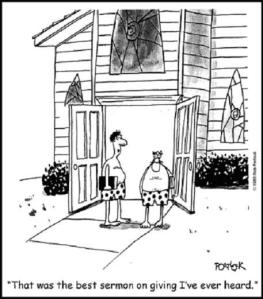
cartoon on giving

Matthew 20:1-16 NRSV

Today is Consecration Sunday. Consecration—It means to bless, to sanctify, or to make holy. This is the Sunday that we consecrate the pledges that we have made to the mission and the ministries of this church for the coming year.

Now, how do you suggest, pray tell, we do that? Exactly, how are we going to make these pledges that are in this box holy? I know how some churches do it. They get themselves a holy man with some holy hands to make the pledges holy. The holy man simply comes, reaches out and everything the holy man touches is consecrated, sanctified, blessed and made holy. The holy man might even have some holy water to help really make some things holy.

Problem is: where are we are going to get a holy man? Does anybody know one? Look around. Does anybody see a holy man in this room? Oh, no. Don’t look at me! Wearing a robe with the pretty stole does not make one a holy man!

And you know better than that as many of you have known me a long time. I have been called a lot of things, but I don’t think anyone has ever called me a holy man. And the only holy water I ever had (if coming from the Jordan River makes it holy), was poured out earlier this month in our baptismal pool.

So, how in the world are we going to consecrate this box, sanctify this box, make this box of pledges holy, without a holy man or a holy woman?

Well, let’s turn to that place that all Christians should turn when they have questions about faith and the church. Let’s turn to the Bible, and more specifically, let’s turn to Jesus.

In this morning’s lectionary lesson, we find Jesus doing something he absolutely loved: telling a story. And not just any story, but a story about who God is, how God acts, and what God desires. And if we want to truly live in the image of God, the story is also about us.

Jesus said, the way God is, acts, and thinks is like a landowner who went out around 6 am to hire some workers for his vineyard. He said, “I will pay you the going rate for 12 hours’ worth of work: 120 bucks.” They agreed and went to work.

At 9 am, he goes out and hires some more workers, and tells them that he will pay them whatever is right. He hired a few more people at noon and told them the same. Then went out and hired some at 3 pm and then even a few more at 5 pm and telling them, “Come and work and I will pay you what is right.”

At 6 pm, when the work day was over and the time had come to settle up with all of the workers, he called up the ones he hired last, who had only worked for only one hour, and shocked everyone by paying them each $120.00.

Well, the ones who had been working for 12 hours started to get a little excited. “Boss man paid them $120 an hour! Let’s see, $120 times 12 hours, uh, that means we are going to get paid $1,440 for our work!”

It is then the boss does something that is even more shocking. He gives those who had worked all day the exact amount he gave those who had worked for just one hour. And you better believe that when they got their check, they got pretty upset: “We have worked out here all day in the scorching heat. And you paid us the same as the ones who worked only an hour in the cool of the day!”

The boss replied: “Did you not agree to work all day for $120? Or are you just envious because I am so generous?”

Of course they were upset because he was generous, too generous. He overdid it with generosity when he paid those last workers, and there was nothing fair about it.  It was shockingly offensive.

This, Jesus says, is who God is, how God works, how God thinks, and what God desires. In other words, this, says Jesus, is holy.

So what is it that makes something holy? According to Jesus, it is an amazing grace, an overdone generosity that is so unfair that it is shockingly offensive.

Now, back to the box. Once again, are we going to make the contents of this box holy? Well, according to Jesus, we do not need a holy man or a holy woman with holy hands or any holy water, which, by the way, is good news, because we certainly don’t have any here.

I believe Jesus would say that these pledges in this box are made holy by the way we give our offerings to fulfill our pledges, and by the way we use these offerings after they are received.

First of all, the ones who made the smallest pledges in this box have as much worth as those who have made the largest pledges in this box. And those who joined this church just a few weeks ago and their pledges, are as important to this church as the ones who joined this church 50 years ago and their pledges. No, it is not fair. It is shockingly offensive. But it is holy.

Secondly, all of these pledges will be made holy if the offerings that are given to fulfill the pledges are given generously and graciously. Jesus says that when the landowner paid an entire day’s wage to those he hired at 5:00, he was essentially paying for nothing. He paid for labor that he did not receive. Therefore, he gave freely, selflessly and sacrificially. He gave generously, expecting nothing in return.

It is interesting to hear some people say that they give to the church expecting to somehow be blessed by God. I cannot tell you how many testimonies I have heard from people on Consecration Sundays about giving a large offering to the church on Sunday, and then on Monday morning, opening their mailbox to find an envelope with an unexpected check inside of it. Or how after they gave to the church their business grew, their sales increased, or a rich uncle died and left them a bunch of money.

The landowner paid some of the workers for 12 hours of labor and only got 1 hour. Therefore for 11 hours, he paid for nothing. He got nothing in return. It is not fair. It is shockingly offensive. But it is holy.

Thirdly, all of these pledges will be made holy, if the offerings which will be given to fulfill the pledges are used to give to others, graciously, selflessly, sacrificially and generously.

We are to give to those who cannot give us anything in return. We are to love those who will never put a dime in our offering plate. We are to use our offerings to reach out to those and care for those who will never do anything whatsoever to benefit our church or our lives. They might live as far away as Nicaragua, West Virginia, and many live right here in Farmville.

I believe this gracious type of generosity that Jesus expects us to have is evident in the way we minister to children and youth: those little ones who have no job, no income, nothing to offer us in return.

Now, I know some churches will say: “if you minister to children and youth by having good and strong programs, then you will get their parents to come and give, maybe even their rich grandparents.” But during the next year, I believe God wants us to minister to our children, finish our basement, purchase children’s choir robes, overdo it with Vacation Bible School, buy some playground equipment, send some kids on a mission trip and send them back to camp, expecting absolutely nothing in return. It is not fair. It is shockingly offensive. But it is holy.

Fourthly, we are also to give generously to those who simply do not deserve our generosity. The landowner gave to workers who did absolutely nothing to earn their pay.

In the weeks leading up to Thanksgiving and Christmas, there is a lot of talk in the media about giving. During this time of the year, many organizations try to raise money to help the less fortunate. In nearly every plea I hear, someone will say something like “Donate this year to a deserving a child.” “Give to the well-deserved needy in our community.” Through this parable, Jesus implies that when we give, we should give maybe especially to those who do not deserve, have done absolutely nothing to earn our generosity. It is not fair. It is shockingly offensive. But it is holy.

This is how we make this box of pledges holy. And we can do it without a holy man or a holy woman with holy hands!

Which brings up an interesting question: If we can make this box holy, if we can consecrate and sanctify our pledges and our offerings, can we then consecrate our lives? Can we make our lives holy? Can we perhaps be holy men and holy women with holy hands?

Through the parable of the workers in the vineyard, I believe Jesus is suggesting that we can.

To make this happen, I believe Jesus wants us to simply get over the envy that we possess by the overdone generosity of God’s grace. And I believe the only way to truly get over it is to understand that we are the recipients of it. We need to understand that there is nothing any of us have done to deserve or earn the gifts of God’s grace. No human being ever did anything to earn the gift of life: the gift of birth; the gift of breath and a beating heart; the gift of feeling the warmth of the sun or a cool autumn breeze or a purple and gold sunset. And no person has or will ever be able to earn, do anything to deserve rebirth, unconditional love, forgiveness, salvation, and life eternal. They are given as free gifts of an amazing grace and an overdone generosity by a loving God. I believe when we understand this truth that all is gift, all is grace, and when we embrace this truth, we will begin to live this truth. We will live it by giving our lives freely, selflessly, sacrificially and generously and thus live in the very image of God. And guess what? Our lives are consecrated and sanctified. They are blessed and made very holy.

Well, how about that! Look around this room. I see a room full of holy men and holy women and holy boys and holy girls with holy hands to go with, what we are going to make together in this next year, a very holy box.