When Jesus Falls Out of Favor (and nearly off a cliff!)

Luke 4:14-30 NRSV

Once upon a time, in a land far away, but not so different from our own, excitement was in the air as folks began gathering in the narthex, sipping their coffee. Everyone was looking forward to the sermon. Because today, they had a special guest preacher!

Many were just glad to have a break from listening to their pastor who they’ve had to now put up with for a year and a half. But some were really looking forward to hearing one of their own, someone who had moved away, made a name for himself, and made them proud. He had come back home for a visit and had been asked by the Elders to fill the pulpit.

No one paid attention as the announcements were being made. In the pews, heads moved and necks stretched, as everyone was trying to catch a glimpse of their hometown pride and joy.

After the Children’s Moment and the Pastoral Prayer, the young man stood up in the pulpit.

“Look! There he is!”

“My, hasn’t he grown!”

“He looks just like one of us, with his dark eyes and complexion.”

The worship leader handed him a scroll. He unrolled it and began reading words from the prophet Isaiah:

‘The Spirit of the Lord is upon me,

   because he has anointed me

     to bring good news to the poor.

He has sent me to proclaim release to the captives

   and recovery of sight to the blind,

     to let the oppressed go free,

to proclaim the year of the Lord’s favor.’

He rolled up the scroll, gave it back to the worship leader, and sat down. All were smiling as he had just read one of their favorite scripture passages.

It is then, that he stood back up and dropped the mic by declaring: ‘Today, this scripture has been fulfilled in your hearing!’

Countless amens could be heard throughout the sanctuary. One congregant shouted: “Hallelujah!” Another exclaimed, “Praise Jesus!” Another said, “I wished he was our full-time pastor!”

Everyone was pleased as they could be! Because the scripture he read was being fulfilled for them. Good news for the poor meant good news for them, because they didn’t consider themselves to be among the rich oligarchs that were in power.

And because they were living in an occupied territory, release to the captives, meant liberation for them!

Because they had lost hope and had a difficult time seeing anyway forward, recovery of sight to the blind meant recovery of hope for them!

And because they felt oppressed by the Romans, freedom for the oppressed meant freedom for them!

So, amen, brother! Preach it!

They could not have been more enthusiastic with their hometown hero! All throughout the sanctuary, you could hear proud comments like: “Why isn’t that Joseph’s oldest boy?”

After the choir sang the anthem, the young preacher stands back up, takes a sip of water, and begins the sermon: “There’s no doubt many of you will say: ‘Doctor, cure yourself.’ ‘Do here also here in your hometown the things that we heard you do Capernaum.’”

“That’s right!” someone shouted!

Another yells: “Charity begins at home!”

Someone else screams, “America First!” (I mean, “Israel First!”)

On the edge of their seats, their ears are itching to hear what their hometown boy had to say next!

It is then he says something like: “You know that no prophet is accepted in his hometown

Someone cupped their hands to their mouth and shouted: “We’ll always accept you Jesus!”

Another yelled: “That’s right! You are one of us!”

Still another shouted: “We’re with you all the way!”

He takes another sip of water and then begins to proclaim that Isaiah’s prophetic vision of good news, liberation, recovery of sight, and freedom is not for them only, or even for them first. It is for everyone, maybe even especially for those who need it the most, folks that may not be from around here

In the congregation, shoulders tense, and heads turn. More comments could be heard, but the enthusiastic tone becomes disconcerting: “Wait a minute! I know he’s not talking about diversity, equity, and inclusion, is he?”

Jesus, though, is undaunted by the sudden aggravation in the air, because he wasn’t there to win a popularity contest or to scratch itching ears. He’s  there to tell the truth, even if that truth is unsettling, because Jesus knows that the truth of God’s inclusive and equitable love, as offensive as it may be, is the only way to create a more peaceful and just world.

Jesus then reminded the congregation why the prophets are never popular in their hometown by referring to two stories, one about the prophet Elijah and one about the prophet Elisha.

“You remember Elijah, don’t you? And the story of those three and half years it hardly rained a drop, causing a severe famine throughout the region? Now there were countless widows living in Israel during that time who were starving to death. But God didn’t send the prophet Elijah to help any widows in Israel. No, instead, God sent the prophet to save a widow in Lebanon.”

Apart from a few gasps, the congregation fell so silent you could hear a pin drop.

“And you remember the prophet, Elisha? There were many lepers suffering in Israel, but instead sending the prophet to heal those in Israel of their disease, God sent Elisha to heal a leper in Syria.”

The sanctuary exploded! People rose to their feet. Some began shaking their fists in the air.

How dare he say that the blessings of God extend beyond our borders, to other cultures and ethnicities!

The audacity he has to say that God’s mercy, justice, and freedom are not just those of us who have the proper papers or the right genes!

And how dare he infer that God may even favor someone from Lebanon or from Syria, over us!

The unmitigated gall he has to say that this scripture is fulfilled in our hearing, but not fulfilled for us!

Overcome with rage, the congregation turns on Jesus.

Some demand an apology.

Others call his words “ungracious,” his tone “nasty.” And his service “boring.”

One accused him of being a left-wing lunatic who was bringing woke politics into the synagogue!

Someone else cried: “Deport him!” Another shouted: “Send him to Guantanamo Bay!”

They become so angry that before Jesus is able to finish the sermon, they chase him out of the sanctuary and run him clear out of town right to the edge of a cliff. But he doesn’t fall off the cliff. He somehow sneaks through the crown and escapes.

How quickly had Jesus fallen out of favor and nearly off a cliff!

But that’s the world in which we live—a world where empathy is considered a sin. Because empathy involves loving our neighbor—not the just ones who live next door, but the ones who live in Lebanon and Syria, in Mexico, Gaza, Columbia, Cuba, and Venezuela—as much as we love ourselves.

The word “freedom” has always been a threatening word when it is applied to a group people that another group of people deem “other” or “less.”

 “Diversity,” “equity,” and “inclusion” have always been offensive words to those who want good things for themselves only, or at least, for themselves first. Equality can feel like oppression to those accustomed to privilege. And in our nation, that means that the angry mobs have historically been white people.

It was only a little over 60 years ago, a time that those currenlty in power are trying to take us back to, empathetic people from all over the United States traveled to the South to take a stand for the civil rights of all people. Some were called Freedom Riders, as they rode buses throughout the South to nonviolently resist unjust Jim Crow laws.

Like the time Jesus preached freedom for the other in the synagogue, an angry mob formed. And on Mother’s Day in 1961, in Anniston, Alabama, 50 white men, many of them religious, attacked a Greyhound bus carrying black and white Freedom Riders with pipes, chains, and bats. They smashed windows, slashed tires, and beat the sides of the bus to terrorize the Freedom Riders who were inside.

Once the attack subsided, with the Freedom Riders still on board, the police pretended to escort the damaged bus to safety, but instead they abandoned it just outside the Anniston city limits.

Another armed mob surrounded the bus and began breaking more windows. The Freedom Riders refused to exit the bus and received no aid from two highway patrolmen who were watching nearby. When a member of the mob tossed a firebomb through a broken bus window, others in the mob attempted to trap the passengers inside by barricading the doors of the bus.

The mob fled when they feared the fuel tank was about to explode. Somehow, the Riders were able to escape the ensuing flames, only to be attacked and beaten as they exited the burning bus.[i]

Kindness, grace, and compassion have always made people wickedly angry when it is applied to outsiders. Some people have always called empathy a “sin,” because empathy involves caring for someone other than yourself, or other than “your” people. Thus, the powers of wickedness have always tried to trump the power of love. Darkness has always sought to overcome light.

The good news is that darkness is no match for even a little bit of light, and love always wins. The good news is that Jesus did not fall off that cliff, and through the resurrected body of Christ, he is still alive and preaching in our world today.

I know that it may feel like we are standing at the edge of a great cliff. Our feet may be slipping as the rocks move under our feet. Some of us have slipped, and our feet are dangling over the edge. We’re barely hanging on. But we are not falling.

Somehow, someway, as Jesus escaped those angry worshippers who chased him to an edge of a cliff outside the city limits of Nazareth, and as the Freedom Riders escaped that bus set on fire outside the city limits of Anniston, Alabama, we too have escaped.

 We are still here. Jesus and his followers may have fallen out of favor with the powers-that-be, but we have not fallen off the cliff!

And despite the opposition in our nation today, the intimidation in our state today, and the hostility in our city today, we are still proclaiming good news today, not just for ourselves, but for all people.

We are still committed as ever to fulfilling the promises of God for black and brown people—

Proclaiming God’s liberation for non-binary and transgendered people—

Proclaiming God’s freedom for undocumented people, asylum seekers, refugees, migrants, and victims of war.

And proclaiming a hopeful vision of God’s peace and justice—

God’s empathetic vision of mercy and compassion—God’s prophetic vision of diversity, equity, and inclusion—shining our lights so all can see it!

The dark winds of wickedness are howling, but our candles are still burning!

On the edge of a cliff, we may feel we are barely hanging on today. We may have fallen out of favor. But we are not falling off! Say it with me: We are not falling off! Amen.


[i] https://calendar.eji.org/racial-injustice/may/14

The Good Snake

Art by Carrie Knutsen

John 3:14-21 NRSV

It’s funny how I still have the same recurring nightmares that I had as a child.

Going to school and suddenly realizing that I forgot to dress myself that morning.

Being chased in the darkness by a gang of clowns that included Bozo, the Town Clown from Captain Kangaroo and Ronald McDonald.

But perhaps my most frightening recurring nightmare is the one where, I suddenly find myself standing in my front yard that is crawling with snakes. I can’t take on step without stepping on a slithering serpent.

Our deep fear of snakes makes even more strange the reference that Jesus makes to an obscure story in the book of Numbers.

 “And just as Moses lifted up the serpent in the wilderness, so must the Son of Man be lifted up that whosever believes in him might have eternal life.”

 This reminds me of the Sumerian God of Healing who walked around with two intertwined snakes upon his staff, which was later adopted as the symbol for the American Medical Association.

It’s a strange image of healing, isn’t it? Two snakes on a staff. Something frightening and threatening as a symbol for healing and wholeness.

But anyone who has ever experienced surgery and has listened to the doctor discuss the risks involved, knows that if we want to be healed, sometimes we must take a risk. If we want to be made whole, sometimes our lives must be threatened.

Yet, we are often startled or frightened by any sight of a snake. And if we dream of snakes most of us would call that dream a nightmare.

 The story in the book of Numbers begins as the starving Israelites desperately cry out to God for help. God hears their prayers and sends manna from heaven. At first, they were grateful, but after eating the manna day after day after day after day, they are fed up with it, literally and figuratively. So, in a spirit of selfish ungratefulness, they begin to complain God.

 It is then that these “fiery” serpents show up.

 One of my favorite preachers, Barbara Brown Taylor, points out that the Hebrew word for “fiery” is Seraph. She says that it is a word that is used to describe how your ankle feels when it is bitten by a poisonous snake: “fiery.” The serpents who bit the Hebrews for their ungratefulness were called Seraphs. Does that sound familiar? It is also the Hebrew name for angels.

In Isaiah 6, we are told that Seraphs or Seraphim surrounded the throne of God, protecting God. And here in Numbers, these, fiery, frightening Seraphs, these slithering serpents show up to frighten, hurt, but to ultimately save the people.

One could say that these fiery angelic serpents come to strike the people back into their senses. Being brought close to death, they remember how precious life is. They apologize to Moses, admitting how selfish and ungrateful they had become.

“Please, Moses, ask God to call back the snakes!” they pleaded.

However, God doesn’t remove the evil from their midst. Instead, God says to Moses: “take a brass serpent, put it on a pole, and make the people look at it.” So that in the future, when self-centeredness and ungratefulness overtake them, they will look at the snake, the symbol of their sinfulness upon the pole, and be saved.

Moses makes a replica of the outcome of the sin of the people and lifts it up onto a pole, makes them look at it, and there, they are able to see that the Seraph of death has become the Seraph of life.

In looking at the truth of who they were, no matter how painful and fiery that truth was—they receive salvation.

And now John says that Jesus uses this serpent on a pole to describe himself.

In a conversation with Nicodemus, Jesus uses the image of a snake on a pole as a parable of what he was doing to save the world.  Thus, one could say that the Gospel of John refers to Jesus, not only as “the Good Shepherd,” but also as “the Good Snake.”

 Jesus surprised us when he came to dwell among us, slithering into our darkness, our sinfulness. He opened his mouth and spoke prophetic words that cut us like a sword.

His teachings to love all people unconditionally, including our enemies, to sell our possessions and give them to the poor, to humble ourselves by taking the lowest seat at the table, to turn the other cheek, to forgive seventy times seven, to walk the extra mile, to regard women and children with equality, to welcome the foreigner, to do justice on the behalf of the marginalized, to defend the sinner, to see God in the least of those among us, to deny ourselves, lose ourselves and take up a cross, felt like a fiery poison coursing through our veins as it made us realize that we have a propensity to love the darkness more than the light.

 So, we had him arrested, and when Pilate asked us to choose between an insurrectionist and Jesus, we chose the criminal. We tortured him and lifted him high on a pole. And while he was lifted up, his prophetic venomous words calling us to deny ourselves and take up our own crosses, somehow, some way became words of life.

And standing at the foot of this pole, all who, even today, hear him cry out, “Father, forgive them, for they know not what they do,” are able to look up and say, “Truly, this was the Son of God.”

 When we dare to look intently at our Good Snake hanging on the cross, we begin to realize that on that cross hangs our refusal to follow his way of love, grace and justice, our choice to feed ourselves rather than feed hungry, look after ourselves rather than heal the sick, love ourselves, rather than love our enemies, and stand up for the rich, privileged and powerful rather than for those considered to be the least. We realize that on that cross hangs our pride, tribalism, hate, and bigotry. We realize that it was none other than our sin that put Jesus on the cross.

         And it is in looking intently at the snake on the pole, we find our salvation. It is in looking at our propensity for evil in this world that saves us and enables us to build God’s kingdom of love, grace, and justice in this world.

This why we need to take notice when others try to prevent us from looking at our sins, acknowledging our evil past, and studying our blighted history. We need to wake up and pay attention when someone repeats a lie to re-write history constantly spouting misinformation such as: “The United States was founded as a Christian nation,” “the Civil War wasn’t over slavery,” “some slaves had it pretty good,” “the holocaust never happened,” or the January 6 insurrectionists were “ordinary tourists.” And we also need to take note how the cross on which Jesus was crucified by an always unholy marriage of religion and state has been made into an adored ornament, and how the cause of Jesus’ death is most often attributed to God’s love instead of the rejection of God’s love by sinful humanity.

There are forces in our world today that want us to forget our sinful history, because they know in the words of George Orwell, that “the most effective way to destroy people is to deny and obliterate their own understanding of their history.” But it is in remembering and studying the truth of our history, no matter how bad that truth hurts, even if it stings like fiery venom in our veins, that we become better, more loving, more gracious, more just, more like the D\disciples we are called to be.

There’s a reason that the Civil Rights movement was emboldened after Mamie Till, the mother of Emmett Till, forced us to look at the snake by declining an offer from the mortician to “touch up” her son’s body and opting for an open casket funeral, saying: “I think everybody needed to know what had happened to Emmett Till.”

Perhaps she knew that when we look intently at the snake, an outbreak of the Kingdom God can happen.

And as people who understand that it was our sins that put Jesus on the cross, we should always do everything we can to help others look at the snakes in our midst today: the bodies of school children riddled with bullets from a mass shooter; the bloodied face of a gay child beat by bullies in a middle school restroom; the malnourished, starved corpses of Palestinian children victimized by a war that needs to end. Because when we look intently at the snake, we find the courage to say: “enough is enough is enough already!”

In planning the annual Yom Ha Shoah Holocaust Remembrance service this week with Rabbi Harley and other clergy, we read together the following words written by Rev. Terry Dickinson which underscore our necessity to remember, to never forget, to always look intently at the snake, because if we are honest, we would rather look the other way and pretend it never happened:

I’d rather pretend it never happened.
I’d rather believe that the sky was never blackened by the smoke of human death, that children and mothers and innocent men
were never victims of such a magnitude of hate.

I’d rather pretend it never happened, but if I have to remember,
if I must look into this gaping scar of human ignorance,
I want to believe that it could only happen once in the history of this universe. Yet, history has a terrible way of echoing in the stone-hard canyons of bigotry, repeating itself again and again.

I’d rather pretend it never happened, for in remembering,
the world seems a frightening place,
where we cannot celebrate, but would rather exterminate our differences and merge into one large mass of sameness.

I’d rather pretend it never happened and believe that it could never happen again. Yet, I know that as long as I look upon even one other person
with seeds of hate, and fail to see him as my brother,
or her as my sister, or them as my family,

then my own precious soul is fertile ground
for these seeds to sprout yet another Holocaust.[i]

Let us look intently at the snake. Look at him, lifted up, crucified. Listen to his words of mercy, love and grace. For if we can keep our eyes on the snake upon the pole, one day, love will finally win, the kingdom will finally come, and the only place on earth we will be frightened is in the deep recesses of our darkest nightmares.

[i] By Rev. Terry Dickinson (1997, Christway Unity Church, Hot Springs, AR)

All Heaven Will Break Loose

hatewall

Matthew 16:13-20 NRSV

Jesus understands the importance of perception and identity.

He asks the question about himself. Who do people say that I am, and who do you say I am? It is Peter who answers correctly: “You are the Messiah, the Son of the Living God.”

Then Jesus shifts the conversation from his identity to the identity of the church, which is very important for us to consider today. This, by the way, is the first of the two times the word “church” is mentioned in Matthew. The word does not appear in Mark, Luke or John. So, it’s probably a good idea that we pay careful attention here.

What is the church? Who are we? How do people perceive the church? What is our purpose? What makes the church special?

Of course, we love part of Jesus’ answer, especially as it is read in the King James Version: “The Gates of Hell will not prevail against it” (KJV).

In a world where hate crimes are on the rise, wildfires are claiming lives, storms are more violent, COVID still threatens, war is still raging, and all hell seems to be breaking loose, this is indeed some very good news.

The forces of death, despair, and darkness, no matter how great those forces seem to be in our world, will not prevail.

Sickness, disease, war, hate, any power of Hades, a word that is accurately translated “the power of death,” will not have its way with us.

That might be one of the reasons we call the place the church meets each Sunday morning a “Sanctuary.”

Death is moving and hell is coming, as the old hymn says. It threatens us. It frightens us. But together, gathered in this sanctuary as the church, we are reminded that we are safe and secure from all alarm leaning on the everlasting arms.

There’s no way I can count members of my congregations who have told me that they don’t know how people make it in this world without the church.

Because, as we are gathered in community, assembled in our sanctuary with people who are praying with us and for us, worshiping together, singing hymns together, as we make commitments to support and to care for one another, when we hear evil knocking at the door demanding to come in, threatening to do us harm, with nothing to fear and nothing to dread, we respond with utmost confidence:

“What’s that you say? You say it’s darkness and despair out there knocking on our door? You say it’s ‘hell’ out there trying to get in here?”

“Oh, not no. But heaven no!”

“In the name of Jesus, heaven no, you’re not coming in here. Heaven no, you’re not taking away our blessed peace. Heaven no, you’re not getting any of our joy divine.”

The good news is, and those of us who are the church know it, despite the constant onslaughts of Hades, despite the powers that seek to destroy us, the church hangs on, because we know that, ultimately, we will emerge victorious. We hang on knowing that, in the end, love always wins.

We hang on.

We hang on.

We. Hang. On.

How many times have you used that expression to describe the church? “How are things going there at First Christian Church in Lynchburg?”

“Oh, we’re hanging on.”

“It’s tough being church in today’s world, but we are making it.”

“We are surviving.”

Sadly, that describes both the perception and identity of many churches today. They’re in survival mode.

And that’s not necessarily a bad thing. For who doesn’t want to be a survivor, especially when all hell is breaking loose?

It’s a struggle, but we’re hanging on. It’s tough, but we’re paying the bills. It’s a fight, but we’re keeping the lights on. COVID knocked us down, but we are getting back on our feet.

Not exactly sure what we think of him yet, but we got a new preacher. He’s not perfect. He’s pretty bad with names. But we seem to be getting by.

But wouldn’t you like to be more than a church that is just getting by? More than just hanging on?

Wouldn’t you like to be a church that is more about making a difference out there, and less about maintaining the status quo in here?

Wouldn’t you like to be a church that is more about bringing some heaven to earth and less about hanging on until we die and go to heaven?

Although we love this place, shouldn’t the church more than “a sanctuary?”

Let’s look again at this passage. About the church, Jesus says: “The gates of hell will not prevail against it.”

Do you hear it? Do you see it?  Jesus says that it’s the gates of Hades, it’s the gates of death, it’s the gates of despair, it’s the gates of darkness, that will not prevail.

Notice that he’s not talking about the gates of the church, the doors of the sanctuary, prevailing against an onslaught from Hades. He’s talking about the gates of Hades that will not prevail against an onslaught from the church!

When Jesus describes the identity of the church, when Jesus talks about who we are, and who we are called to be in this world, he doesn’t talk about a host of evil rounding us. He doesn’t say death is coming and hell is moving. He says that it is the church that is coming, and it is heaven that is moving. It is the host of good that is rounding the host of evil.

By talking about the gates of Hades, Jesus is expecting the church to be on the offensive. Jesus is expecting the forces of truth, light, grace, justice, mercy, empathy, kindness, love and life to be on the move tearing down the gates of death, darkness and despair.

Jesus isn’t talking about all hell breaking loose in our world. Jesus is saying that when we embrace our identity, when we answer the call to be disciples, when we claim our authority, when we fulfill our mission to be the church in our world, all heaven is going to break loose!

Sadly, the perception of the church is often the other way around. We are the ones cowering behind the gates, hiding behind the walls, shrinking behind the stained glass. We are always on the defensive. We are gatekeepers and wall builders. For our own protection and preservation, we decide who can come in and who must stay out.

But Jesus warns us: “what is bound on earth is bound in heaven. And what is loosed on earth is loosed in heaven.”

In other words, too often the church— by taking a defensive posture, with our gates and with our gate keepers, with our walls and our barriers, with our obstacles and our hurdles—the church has been guilty of preventing all heaven from breaking loose in our world.

However, Jesus says we possess the keys, we are given the authority, to open doors, remove barriers, and get rid of obstacles. As the church, we are not gate keepers, deciding who’s in and who’s out; we are gate destroyers. We are not wall builders; we are wall demolishers!

And when we do that, when the church swings wide its doors, when God’s people leave the safety and security of the sanctuary, when we boldly go out into our world to confront the gates of death, darkness and despair, Jesus says, the gates of hell will not prevail, and all heaven will break loose.

But, when we live in a time and place where all hell seems to be breaking loose, with Rev. Dr. King, we must remember that Jesus does not want God’s people to use darkness to defeat darkness or use hate to defeat hate.

I believe Jesus wants God’s people to use the authority entrusted to them to overwhelm deep darkness with illuminating light; overthrow bigoted fear with revolutionary love; overcome deliberate deception with gospel truth; overtake passive attitudes with empathetic mercy, override uncalled-meanness with called-for kindness, and overrun white nationalism with a non-violent determination to work for the liberty and justice of all. Because I believe what our world needs more than anything else is for all heaven to break loose!

There are many ways I am looking forward to breaking loose some heaven with the First Christian Church in Lynchburg.

Next year, as we mark 150 years of serving God and community, in addition to our three celebration dinners, the planning team has already started having a conversation about providing opportunities for service out in the community to compliment each dinner. Together, we will address big problems such as: food-insecurity, affordable housing and illiteracy. And when we tackle these problems head-on, all the while lavishing others with love and grace, then I believe all heaven will break loose!

When we partner with Rabbi Harley of the Agudath Sholom congregation and other faith leaders to offer special opportunities for faith dialogue in the community, such as something called: Theology on Tap; when we demonstrate to the community the holy value of sitting at a table in a public place with people of all faiths and people of no faith, discussing important, albeit difficult matters of faith such as: racism, gun violence, climate change, reproductive justice, and substance abuse. And when we act on these matters with love, then I believe all heaven will break loose!

When we invite and inspire students from our neighboring colleges and universities to join a movement for wholeness in our world, when we harness their passion, their youth, their energy, their love, and their unwavering faith that love always wins, then all heaven is going to break loose!

As advocates for prophetic justice, as part of an anti-racism, pro-reconciling church, we are going to join with the prophets and Jesus to proclaim love for the marginalized and liberation to the oppressed. We will seek to transform racist systems and to change hearts and minds by communicating our faith convictions to policy makers and people in power. We will continue working to fulfill the dream of Dr. King and speak out against the whitewashing of history and the hateful, anti-woke, anti-Christ agenda of racist politicians who embolden others to commit deadly crimes of hate and acts of terror. And when we work for change with love and determination, hell may tremble. Hell may shake, and hell may push back against us; but then, if we don’t moderate our voices or compromise our convictions, all heaven is going to break loose!

We are going to continue to break down the barriers of bigotry that are dividing our nation by partnering with people who truly believe that the greatest thing we can do as human beings is to love our neighbors as ourselves. And when, together, when we pledge to stand up and speak out for the equality, the dignity, and the worth of all people, while celebrating and affirming that the diversity of humankind is the very holy image of God, I believe all heaven is going to break loose.

And as a church committed to unconditional love of God, to the extravagant grace the Christ, and to the unwavering persistence of the Holy Spirit, we will destroy any gate, remove any hurdle, and break down any barrier that any person or institution tries to erect to prevent anyone from coming to the table of the Lord. And when we do this, when we welcome all to the Lord’s table as God has welcomed us, when we encourage all people to answer the call to be a movement for wholeness in our fragmented world, we believe all heaven is going to break loose!

So, let us embrace our identity. Let us claim our authority. And let us answer the call to fulfill the mission to be the church, to move heaven and earth, so the world may know who we are and whose we are: disciples of the Christ, the Messiah, the Son of the Living God. Amen.

Charlottesville Wake-Up Call

torches2

I first expressed the following bullet-points following the actions of domestic terrorist and white supremacist Dylan Roof in Charleston, South Carolina. Many were calling the murders of the African Americans who had gathered for a Bible Study at the Mother Emanuel Church “a wake-up call.” I have heard the same expression used this weekend following the white supremacists who gathered to spew their hate in Charlottesville. What happened? Did we fall back asleep? It is way past time for America, especially the church in America, to stop hitting the snooze button, stop closing our eyes to ignore the racism and bigotry has been emboldened in our country today.  It is way past time to wake up, rise up, stand up, and speak out, as intolerance cannot be tolerated.

  • We must wake up to the reality that racism is not only a wound from our country’s past, but it is a deadly virus that still plagues us today. White preachers, including myself, have been too often afraid to even use the word “racism” from our pulpits for fear of “stirring things up,” as if we might reignite some fire that was put out in the 1960’s, or at least by 2008 when we elected our first black president. We must wake up and boldly call this evil by name and condemn the racism that is ablaze today, in all of its current manifestations: personal racism; systemic racism; political; and the subtle racism that is prevalent in our homes, in the workplace, in the marketplace, in government, and even in the church, for Jesus could not have been more clear when he said: “Love your neighbor as yourself.”


  • We must wake up to the reality that hatred in this country is being defended by people who are calling it “religious freedom.” In America, we believe all people are created equally; therefore, “religious freedom” never means the freedom to discriminate. Slave-owners used the same religious-freedom arguments in the nineteenth century to support slavery. Today, we do not tolerate people who want to own slaves, nor should we tolerate anyone who wants to discriminate on the basis of race, gender, religion, or sexual orientation.


  • We must wake up to the reality that many who cry out that they want to “Make America Great Again” loath what makes our country great today, that is, our cultural, ethnic, religious and racial diversity. We need to boldly speak out that it is this diversity that makes us look most like the image of God in which we were created. This diversity also looks like the portrait of heaven we find in the book of Revelation: “After this I looked, and there was a great multitude that no one could count, from every nation, from all tribes and peoples and languages, standing before the throne and before the Lamb” (7:9). We must wake up to voice our opposition to the purveyors of fear, some who are even calling people bear more arms “to take our country back.” Furthermore, we must wake up to stop folks mid-sentence when they start reminiscing about going back to the good old days of the 1950’s when “we had prayer in school,” as they are completely disregarding the fact that during this time African-Americans in our country were not only treated as second-class citizens, but were being lynched in trees.


  • We must wake up to the reality that the most segregated hours in our country occur on Sunday mornings. We must find ways to build bridges and tear down the walls that we have created that prevent us from worshipping and doing ministry together. To stand against racism, hatred and violence and to stand for social justice and equality for all, we must do it side by side, hand in hand, as one body, one Church, serving one Lord.

Hating on the Pope

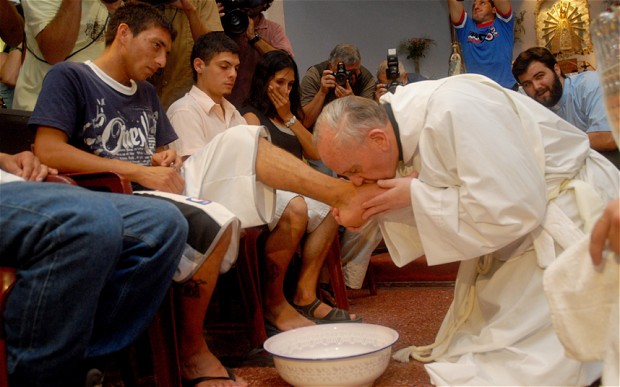
pope francisMany people were shocked when they learned that there are people in the United States calling for the assassination of Pope Francis as a response to the pontiff’s call for European Catholics to shelter asylum seekers from Syria. Someone wrote, “White people need to be protected from the genocidal anti-white Pope and the genocidal anti-white religion he pushes.” Another wrote: “The pope deserves to be executed for crimes against the White race.”

But should Christians be shocked?

Over and over Jesus taught his disciples “that the Son of Man must undergo great suffering, and be rejected by the elders, the chief priests, and the scribes, and be killed” (Mark 8:31). I believe Jesus was essentially saying:

When you preach the word of God that cuts like a sword; when you love all people and try to teach others to love all people; when you preach a grace that is extravagant and a love that is unconditional; when you talk about the need to make room at the table for all people, even for folks called “illegal” or “aliens”; when you stand up for the rights of the poor and the marginalized; when you proclaim liberty to the oppressed and say that their lives matter; when you defend, forgive and friend sinners caught in the very act of sinning; when you tell lovers of money to sell their possessions and give the money to the poor; when you command a culture of war to be peacemakers; when you command the powerful to turn the other cheek; when you call religious leaders hypocrites and point out their hypocrisy; when you criticize their faith without works, their theology without practice, and their tithing without justice; when you refuse to tolerate intolerance; when you humble yourself and do these things that I do,” says Jesus, “then the self-righteous powers-that-be will rise up, and they will hate. They will hoist their colors, and they will grab their guns. They will come against you with all that they have, and they will come against you in name of God. They will do anything and everything that is in their power to stop you, even if it means killing you.

Therefore, the hate that is in our world for Pope Francis should not surprise us. But it should raise a few questions. Among them are: “Why am I not hated for my faith?” “Why have I never been threatened for my faith?” “Why do I feel so safe and secure in my faith?”