The Untouchables

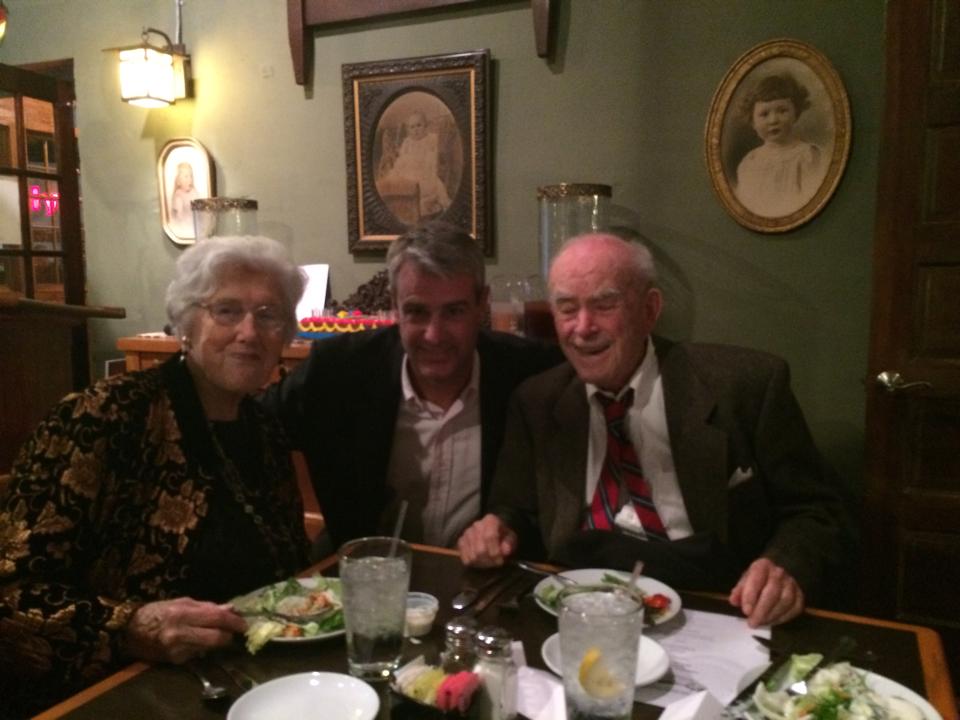
BS and Joan on November 15, 2014
BS, Joan and me on November 15, 2014

Mark 1:40-45 NRSV

As was pointed out a couple of weeks ago, for Mark, Jesus is a teacher. He is a teacher with a new teaching, one with authority. Last week, when Jesus healed Simon’s mother-in-law, we were taught by Jesus that it is not God’s will for anyone to be sick or even have a fever. As Jeremiah prophesied: “For surely I know the plans I have for you, says the Lord, plans for your welfare and not for harm…”

I have said before, albeit somewhat selfishly, that I believe it is God’s will for all men to live to be over 100 years-old and perhaps be married to a much younger woman, which is, of course, perhaps the only way a man can get to a hundred.

However, living in this broken and fallen world, we rarely encounter people who have been so blessed. Because not everything that happens in this world is the will of God, we seldom encounter people with the vitality and longevity of BS and Joan Smith. That is why we are having a party today. This is why we are celebrating today as a community of faith. For their long life together is a special thing. It is a good thing. It is a God-willed thing.

Some of you may say, “Well, I don’t want to live to be 100.” I dare you to say that the last day of our 99th birthday if you look as good as BS Smith! You know who wanted to be a hundred? Well, this past Thursday, it was BS!

This morning, we are still in the first chapter of Mark, and Jesus is still teaching.

“A leper came to him begging him, and kneeling, he said to him…”

Can’t you just picture the desperation? You can almost see it: “begging,” “kneeling.” This picture teaches us that when we are desperate, when we are despairing, when we are anxious, we can always come to Jesus.

“If you choose, you can make me clean.”

Well, of course Jesus chooses. As we have already learned, Jesus never wills for anyone to suffer.

We are then told that Jesus is “moved with pity…” It is important to note that the Greek word here is a visceral, gut-wrenching word. Jesus was moved from deep within his soul. Jesus literally felt this man’s pain. Because he was suffering, Jesus also suffered. Some scholars have said that the word is better translated: “angry.” When Jesus encountered human suffering, it angered him.

Here, Jesus teaches us that God is moved by human misery and suffers with us. As I tried to say yesterday at Alawoise’s memorial service, God never willed for her have Parkinson’s disease. When Alawoise felt the very first symptoms of the disease, God felt it too, from deep within God’s very soul. So, of course, Jesus chooses for him to be made clean, whole and well.

Jesus immediately reaches out his hand and touches him, saying, “I do choose. Be made clean!”

Here is where the story gets interesting. It is interesting, because Jesus reaches out his hand and “touches” this one who was considered by faith and society to be “untouchable.”

Leprosy was the most feared and dreaded disease of Jesus’ day, one that always brought horror and despair. Leprosy is an indefinite and general term used for a whitish rash on the skin. Spots, sores and swelling may also be present. It was an uncomfortable disease; however, what made leprosy so feared was no so much what it did to a person physically, but what it did not a person socially. The disease excluded one from the general population, and thus, from the people of God.

Chapters 13 and 14 of Leviticus discuss the social side effects of this disease at great length. Because a person with leprosy was considered to be “unclean,” a leper had to wear clothes which had been torn so they could be easily recognized and avoided. Lepers also had to cover their mouths and cry “unclean, unclean” in the presence of others so no one would approach them. Eduard Schweizer comments that rabbis considered a leper to be a “living corpse.” They were alive, but not alive. They were here, but not here; in the community, but not a part of the community. They were unalive, unaccepted, and untouchable.

So, when Jesus was deeply moved, or angered at the man’s disease, he was angry not only by the physical pain of it, but by the social pain of it— how this dehumanizing disease took people out of community, how it made them social outcasts, outsiders, untouchables.

However, at least one person did not regard the leper as untouchable. Mark writes that Jesus reaches out his hand and touches him. And “immediately the leprosy left him and he was made clean.”

The passages that we have been studying the past few weeks teach us a lot about healing. We learn that Jesus is against all forms of suffering. Jesus wants to deliver us from afflicting spirits, break our simple fevers and cleanse us of our most dreaded diseases. But, notice in this morning’s lesson that after Jesus touches and heals the leper, he gives the leper some “stern” instructions.

“After sternly warning him he sent him away at once, saying to him, ‘See that you say nothing to anyone; but go, show yourself to the priest, and offer for your cleansing what Moses commanded, as a testimony to them.”

Although Jesus had made the man clean, he wanted him to follow through with the cleansing rituals that would restore him back into community. Yes, God is concerned about our physical well-being, but God is more concerned about our spiritual well-being and our acceptance into community. More than anything else, Jesus wanted this outsider to become an insider. Jesus wanted this untouchable to be touchable.

I think I speak for everyone when I talk about the admiration I have for BS and Joan Smith. Some might say, “Well, of course, you have. You have to admire couple who is 90 and 100 years old. However, it is not so much their physical age or physical vitality that I admire, as much as it is their determination to be in community. Almost every time I visit with them, they ask me about the well-being of others. How is “Jimmy Cowan? Have you heard from Joyce Letchworth? Tell me about Alawoise. How is Harold holding up?”

And on more than one occasion it has been one of them who actually informed me of a concern in the community. I can clearly hear BS asking: “Jarrett, did you hear about so-in-so? And with compassion obviously arching from deep within his soul, he shakes his head, and closes his eyes with almost an agony and anger and says: Shhhhhhhh.”

Both BS and Joan want to meet every new person than joins or even just attends our worship services. And they don’t just want to know their names. They want to know where they live, where they went to school, where they work; who are their parents? Who are their grandparents? They are genuinely interested in truly knowing them, loving them.

And BS constantly asks me about the whereabouts of certain people that he has missed from our gathered community of faith. “Jarrett, have you seen so-in-so? She has not been here in several Sundays. Jarrett, you need to go see her.”

And you should never be fooled by his poor eyesight and selective hearing, for he doesn’t miss a thing, especially when it concerns this, his community of faith.

And have you noticed something else about BS? He not only is concerned about you and others, he not only expresses his compassion and empathy for others, BS likes to reach out his hand and touch you. No matter who you are or where you are from, BS likes to hold your hand. For no one in BS’s book is an outsider. Through his eyes, it is as it is in the eyes of God, no one is untouchable. Everyone’s hand is to be touched, grasped, held. This morning, I am proud to say that BS and Joan are the epitome of who we are as a church.

For all are truly welcome here. This is indeed a safe place. We accept you as Christ accepts you: Just as you are. If you are sick, we pray for your healing. If you are grieving, we pray for your peace. Because we know that when you suffer, God also suffers, and because of that, we suffer.

And know this, here, in this place you will never be alone. Here in this sacred space, there will always be a hand to hold. For here, there are no outsiders. There are no untouchables. There is truly room at the table for all.

Mark continues: “But he went out and began to proclaim it freely, and to spread the word…and people came to [Jesus] from every quarter.”

May we go out this morning from this sacred place and do the same.

Lifted up for Service

Scout_Sunday_2015_Logo

This sermon was preached for Scout Sunday at First Christian Church on February 8, 2015.

Mark 1:29-39 NRSV

These few verses found in the end of the first chapter of Mark, paint perhaps the most beautiful portrait of who our Lord is, how our Lord acts, and what our Lord desires. Listen to them again, carefully, prayerfully…

As soon as they left the synagogue, they entered the house of Simon and Andrew, with James and John. Now Simon’s mother-in-law was in bed with a fever, and they told him about her at once.

Do you hear the immediacy, the urgency in this passage? “As soon as they left…” “…at once.” I hear a lot of people talk about God’s timing. They say that God will bring healing or restoration in God’s own time. They say that God’s time is usually not our time. And they say that God has reasons for God’s delay. I believe this passage teaches us that the Lord wants to heal us and restore us now: not tomorrow, not some day or one day, but today, right now, at once. It is not the Lord’s will for any of us to ever be sick, broken, or even have a fever.

Therefore, when we are sick or broken, when we are suffering in any way, we must understand that it is not because God has some twisted reason or some purpose-driven plan for it. And since suffering is not the will of God, and since we are loved by God, then when we suffer, God also suffers and is doing all that God can do to bring healing, wholeness and restoration.

He came and took her by the hand…

Perhaps more than anything else, I believe it is the will of our Lord to come to us and take us by the hand. When I was a child I learned a wonderful song:

Put your hand in the hand of the man who stilled the water

Put your hand in the hand of the man who calmed the sea

Take a look at yourself and you will look at others differently

Put your hand in the hand of the man from Galilee

Of course, we put our hands in so many other places to receive wholeness, peace and security.

Instead of putting our hand in the hand of the Lord, we often put our hand, our trust, in our own hands. We believe that if we can somehow work hard enough, serve diligently, industriously, thoroughly, and persistently enough, then we can achieve or earn wholeness or peace. We put our hands, our trust in our own hands instead of in the hands of the only one who can save us. Ephesians chapter 2 teaches us: “For by grace we have been saved through faith, and this is not our own doing; it is the gift of God— not the result of works, so that no one may boast.”

Instead of putting our hand in the hand of the Lord, we also put our hands, all of our trust, in the hands of others. My granddaddy was not a pastor, preacher, or scholar, but he was sometimes quite the theologian. One thing that he said, and said often, was: “There’s only one man that you can trust in this world, and that is the Good Lord.”

However many of us put our trust in the hands of so many others. We put our hands in the hands of the government, in the hands of our friends and neighbors, even in the hands of the church. Then we become disillusioned when they sooner or later disappoint us. The 118th Psalm reminds us:

 O give thanks to the Lord, for he is good; his steadfast love endures forever. Out of my distress I called on the Lord; the Lord answered me and set me in a broad place. With the Lord on my side I do not fear. It is better to take refuge in the Lord than to put confidence in mortals. It is better to take refuge in the Lord than to put confidence in princes.

And instead of putting our hand in the hand of the Lord, we also put our hands in our own pockets. We put our trust in our wealth and our material possessions. Our sense of well-being, wholeness and security comes from our bank accounts, 401-k’s, our homes, automobiles and clothing. In chapter six of the Gospel of Matthew we read the warning:

Do not store up for yourselves treasures on earth, where moth and rust consume and where thieves break in and steal; but store up for yourselves treasures in heaven, where neither moth nor rust consumes and where thieves do not break in and steal. For where your treasure is, there your heart will be also.

The good news for all of us this day is that Jesus, the Son of the God of Heaven is coming to us, and he wants to take us by the hand and give us a peace that the world simply cannot give (John 14:27).

Jesus came to her and lifted her up.

When we put our hand in the hand of the Lord, the Lord lifts us up. Preacher and Princeton Theological Seminary professor Nancy Gross observes: “There is no shortage of “down” from which people need to be lifted up. Down today are jobs, wages, the economy, church membership, our hopes, and our children’s futures. Take your pick, add your own.” The good news is when we are down in the dumps, down with despair, down with disease, down with a fever, when we put our hand in the hand of Jesus, Jesus always lifts us up.

It is important to realize that being lifted up, being healed and being made whole, does not necessarily mean in the physical sense. I do not know of anyone who has suffered as much as Alawoise Flannagan. Right now, I do not know of anyone who is more down, more low physically than she. However, when I saw her this week, when she opened her eyes and miraculously asked me how my family was doing, I saw a woman who was more whole, more lifted up spiritually than anyone I know. It was evident that, even in the midst of great suffering, that Alawoise had placed her hand in the hand of the man from Galilee, and that man had lifted her up.

Then the fever left her, and she began to serve them.

It is very important to notice that when her fever left her, she got up and began to serve them. We are lifted up. We are healed. Then we serve. We are lifted up for service. Jesus makes us whole, not only for ourselves alone, not to simply feel better, more hopeful and more alive, but for service to others. As Ephesians chapter 2 reads: “God will enable us [lift us up] to continue on in righteousness and to do the good works which the Lord has appointed for us.”

Like Alawoise, John Barefoot also possessed spiritual healing and wholeness, a remarkable strength and joy in the midst of great suffering. At his memorial service, I pointed out that God did not lift him up, give him that strength and fill him with that joy just so he could watch a few more NC State ballgames on TV.

As it was evident to Gayle and Mark when Alawoise miraculously asked me how my family was doing, it was evident to all who encountered John—to all who saw his smile, heard his laughter, experienced his joy—that God was the source or his strength.

Right before Christmas, a group of parents and children from our church came to John’s house to sing Christmas carols. Some who were there, including me, were not a part of any church a couple of Christmases ago. We had been struggling with what we believed about the Church, what we truly believed about Christmas.

But there, standing around John’s bed with others from the church singing Christmas carols, through John, something miraculous happened. God spoke. As we watched John donning a Santa hat and wearing a smile that was so amazing that it had to be from Heaven, as we watched him sing along with the children the best that he could, with this amazing joy, a joy that had to come from God, Christmas became real. Faith became real. God became real. Church became holy.

There is no telling how many people have been served through Alawoise and John’s amazing strength and joy in the midst of suffering, through God’s amazing grace in the midst of their lives.

This morning, I want to thank the Boy Scouts who are present today for the unique manner you make our scripture lesson come alive each day in our world.

First of all, you are young. You are strong. When the Lord lifts you up, he can lift you high. But more importantly, you live your lives by a sacred oath or promise which begins: “On my honor, I will do my best.” And how do you do you your best?

By first doing your duty to God, by first putting your hand in the hand of Jesus, for that is the only way you can truly serve your country and to obey the Scout Law. For it is Jesus who takes you by the hand, lifts you up, gives you strength, keeps you mentally awake and morally straight so you can help other people, serve other people at all times.